



Abstract

Children acquire and inherit cultural values and rules by interacting with the surroundings they live in (Fleer, 2017). The surroundings include both physical and psychological contexts, such as children’s play and literature, which mirror the cultural image of childhood (Frønes, 2009; Tesar et al., 2019). It is also important to pay equal attention to both “education” and “care” in early childhood, something that traditionally varies across diverse curricula and cultures (Ailwood, 2022). In addition, many other factors may play a role in mediating or moderating the influences from culture to childhood, such as new media, religion, leisure activities, fairy tales, digital games, and curricula. All these factors are, directly or indirectly, influenced by culture. Thus, the path from culture to childhood development varies across contexts. Likewise, the mediating role of childhood curricula also varies across cultures. This implies that culture plays an important role in shaping the childhood curriculum.
Following this argument, it is critical to understand how culture and curriculum interact in early childhood settings, the first and foremost important culture-transmission arena. Given that many educational policymakers and scholars are promoting a culture-free reform of early childhood education and care (ECEC) to achieve “quality” education, this exploration seems to be timely and necessary. Accordingly, we proposed and assembled this Special Issue on “Childhood, Curriculum, and Culture in Diverse Contexts.” Debates in this Special Issue are closely linked to the recent collective scholarly work, which focused on the future of philosophy of education across different cultures and has a clear implication for early childhood scholarship (Tesar, Hytten, et al., 2021). Furthermore, collective scholarly work on what is childhood and who is a child in diverse contexts reflect the diversity and importance of grounding understandings of childhood in diverse curriculum and pedagogical frameworks (Tesar, Duhn, et al., 2021). Similarly, associated scholarly collective work on how to utilize critical and important methodologies and appropriate methods will help and support us to address some of the challenges that are inherently part of working across diverse cultures (Tesar, Guerrero, et al., 2021).
This Special Issue includes a collection of studies examining the role of culture and context in shaping childhood experience and curriculum. This Special Issue aims to explicitly acknowledge that, first, culture and the value system it provides has never stayed away from us. Second, social change and cultural collisions in the globalized world reshape children’s experiences and curriculum. How changing cultures in diverse contexts affect the way our children live and learn is worth rethinking and rediscovering.
Rethinking the influence of culture on curriculum
Educational objectives are derived from values (Goodlad, 1979). As “an activity system of teaching and learning that evolves over time” (Yang & Li, 2022b, p. 2), curriculum as an essential part of children’s experience is inevitably the “bearer of dominant cultural ideologies” (Moore, 2000, p. 91). The interaction between culture and curriculum can be both top-down and bottom-up, allowing cultural inheritance and development as a process of meaning-making rather than knowledge construction (Yang & Li, 2019a, 2019b, 2022b). How curriculum may reflect diverse cultural values and ideologies has been widely examined by anthropologists, sociologists, and educational scholars (e.g., Alexander, 2001; Claydon, 2011; Li & Chen, 2017; Yang, 2018). However, there is a dearth of knowledge about the cultural influences produced by scholars who sit outside of the traditionally hegemonic Euro-American curriculum studies context, especially those from Asia, Africa, and other continents (OECD, 2018). In this Special Issue, we have included those studies focusing on countries (China, Singapore, the United Arab Emirates [UAE]) underrepresented in the international academic literature on this essential issue. Recent literature on childhood has demonstrated the importance of developing global and diverse perspectives on childhood (see Yelland et al., 2021). Inspired by this literature, the included studies provide theoretical, cross-cultural, and cross-disciplinary lenses and evidence on the cultural practices of childhood and curriculum in diverse contexts against the background of globalization and internationalization.
Rediscovering the complexity of childhood and curriculum from an ecocultural perspective
The foci of this Special Issue surround various areas such as childhood studies, curriculum policy and practice, and sociocultural meaning-making of children and their education. Spodek and Saracho (1999) argued that theories should be integrated when translating them into the early childhood curriculum. A revisit of theoretical arguments about educating young children has supported a need to propose a more integrated, inclusive, and balanced framework for understanding childhood and curriculum against the political and sociocultural backgrounds. This framework is supposed to integrate diverse orientations toward promoting children’s learning and development, not only by themselves as human beings but also within the complex and changing sociocultural context (Yang et al., 2022). A fusion of developmental and cultural perspectives will require a hybrid model for teaching and learning, which can be named “curriculum hybridization” (Yang, 2021). Figure 1 shows the ecological model of curriculum hybridization (Yang, 2021), which can be used to rediscover and reexamine the complexity of childhood and curriculum in authentic settings, especially against the backdrop of globalization and internationalization.
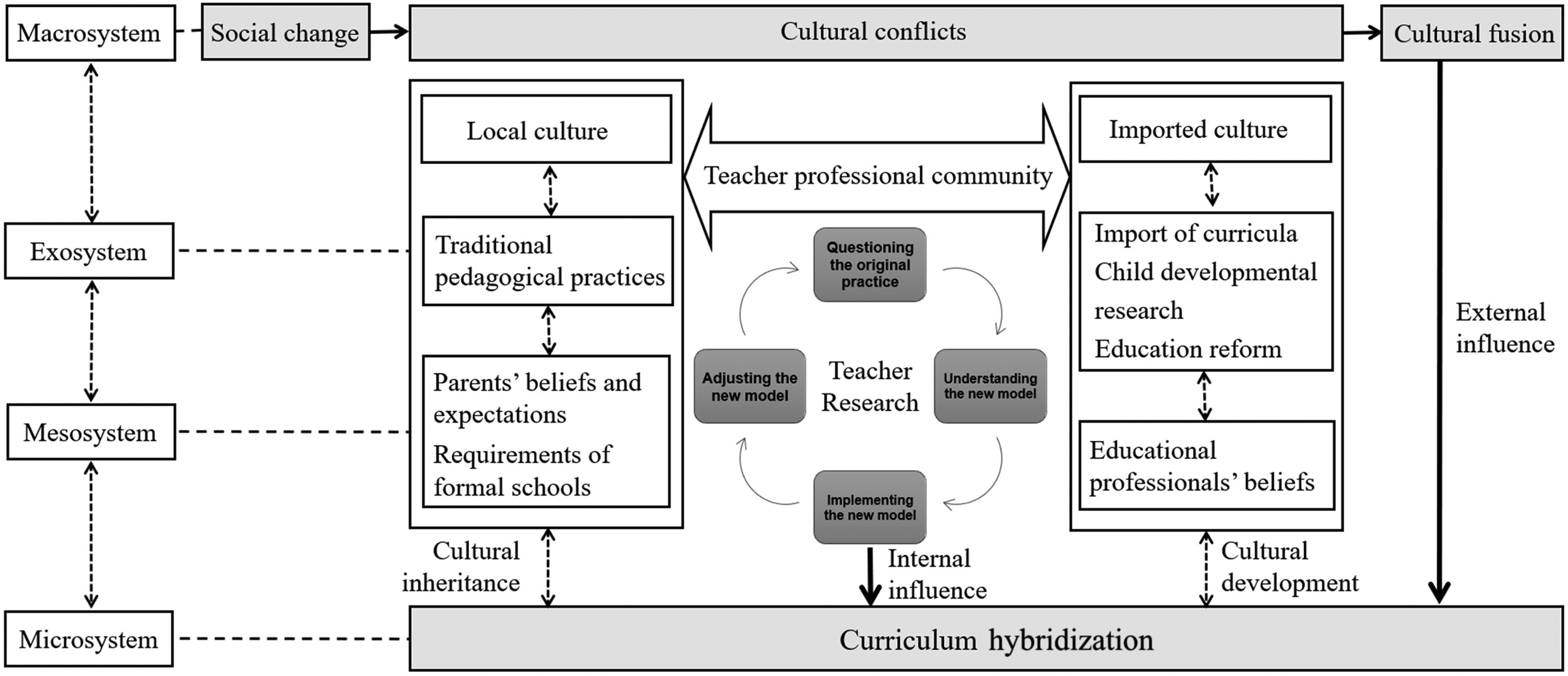
The model of curriculum hybridization. Note. This model was firstly proposed by Yang and Li (2019b) and further developed into the current structure in Yang (2021, p. 24).
The hybrid approach can be used to develop the global understanding of childhood and curriculum. As framed by the ecological systems theory (Bronfenbrenner, 1979; Bronfenbrenner & Ceci, 1994; Bronfenbrenner & Morris, 1998), the conceptual model of curriculum hybridization illustrates the continual interactions among various layers of ecocultural environments (Yang & Li, 2019a). The cultural influences in the macrosystem generally include globalization (imported culture) and local culture, together forming the contemporary culture for a particular social context in which curriculum exists. As for the exosystem, three significant items will influence the curriculum: traditional practices, child developmental theories, and educational policies. Each of these items will also be influenced by the interaction between imported and local cultures. Furthermore, the mesosystem is composed of diverse stakeholders’ beliefs toward curriculum, including parents’ beliefs and expectations, experts’ professional guidance, and requirements of the formal schools. Lastly, curriculum practices are positioned in the microsystem as a hybrid of curricular models and influences from the outer layers. It is worth noting that the hybrid model is dynamic and changing over time with the interacting and interrelated nature of the multiple layers. We use this framework to interpret the main findings of the collected studies (Alhosani, 2022; Feng, 2022; Knight & Crick, 2022; Luo, 2022; Yang & Li, 2022a) and further explain the complex nature of children’s learning and childhood in the following section.
Reexamining childhood and curriculum in multiple ecosystems
This Special Issue seeks to explore and understand the experience of childhood, both formally and informally, in the contemporary world. Feng (2022) explores Chinese children’s moral education via their engagement in process drama, reflecting children’s agency as social actors in the microsystem of ecological influences. Luo (2022), instead, explores the dynamic intersection of children’s informal learning experiences, parental involvement, and the community environment in a public playground in a Western Chinese city. Luo’s interpretation of his vivid data reflects the nature of childhood and children’s learning as a complex social phenomenon, especially when examined in the mesosystem of ecological influences. Furthermore, the exosystem of ecological influences plays a vital role in shaping children’s learning experience. Knight and Crick (2022) present a detailed and critical analysis of inclusive education policy reforms in the context of Wales, UK. The inclusive education policies do not directly involve children but nonetheless affect the experience of childhood, especially in schools. Additionally, Alhosani (2022) takes a cultural perspective to examine how the Emirati heritage and culture affect children’s learning experiences in early childhood education settings. Thus, this study presents a unique case for understanding the influences of the macrosystem on childhood and curriculum. Last, Yang and Li (2022a) provide an up-to-date synthesis of international studies on China’s and Singapore’s early childhood curriculum reforms and practices. In this scoping review, they use a multi-layer framework to detect the sociocultural influences on the changes happening in the landscape of ECEC in China and Singapore. As further commented by Chen (2022), the contradictions between policy and practice, as well as across the multiple ecosystems, could be related to not just the context and factors but also the chronosystem—the favorable timing. Below, we briefly introduce each study and explain how an ecocultural perspective can inform our new understanding of childhood and curriculum in different contexts.
Microsystem: The role of school education
Within the microsystem of school, challenges remain in school-based moral curricula, and efforts are needed to help future generations develop their moral characters more effectively. Feng (2022) examined the potential of process drama as an innovative pedagogy for promoting the moral growth of primary school children in the Chinese educational context. She argues that process drama can introduce social constructivist learning perspectives to classrooms, thus providing an imaginative, dialogic, and narrative pedagogy for moral teaching to complement realistic, monological, and didactic Chinese traditions. Notably, this in-depth case study uses different methods to assess the efficacy and effectiveness of the innovative pedagogy applied in classroom teaching in a public primary school in Beijing, where 16 children volunteered to participate in the “Little Boat” drama workshop. Evidence shows that process drama can help enhance children’s empathic attitude, dialogical thinking ability, and autonomous thinking ability. This study broadens our understanding of the approaches we can use to cultivate moral children.
Mesosystem: The interrelation between parents and the community
Over the past few decades, China’s rapid urbanization is not only (re)shaping the urban landscape but also (re)creating public spaces where children live, play, and learn. Against this unique background, Luo (2022) studied how urban public spaces affect young children’s learning and development via their parents’ involvement. Specifically, Luo’s (2022) ethnographic case study investigates the interrelation and dynamic of parental involvement in children’s play and learning in public outdoor spaces in urban western China, which mirrors the complex multi-stakeholder interactions between various stakeholders including parents, the community, and the physical environment. Luo focuses on the interactions between children and their parents in public playgrounds. Evidence revealed that Chinese parents cultivated their children’s physical and mental development through play. By engaging in this play, fathers often contribute more than in other settings such as home environments. This study provides nuanced research evidence and theoretical interpretation within the mesosystem to understand how Chinese parents fulfill their responsibilities in childhood education in informal learning settings.
Exosystem: The influence of policy reforms
Framed in the exosystem of ecocultural influences, Knight and Crick (2022) look at inclusive education policies in the context of major education reforms in Wales, UK. The Wales government has initiated system-level reforms to build an inclusive education system in Wales. Against this background, this exemplary study explores how inclusion can be articulated and communicated in key policy and guidance documents using two continuums—“practices” and “values”—to interpret the influences brought by the policy initiatives. The study uses critical political analysis to understand the different rounds of inclusive education policy reforms in Wales. Policy analysis shows that there are tensions within and between the policy documents despite previous commitments to inclusion. Due to the lack of consistency in the key messages expressed in Welsh inclusive education policy documents, it is essential to develop a method for assessing inclusive education systems in Wales and other jurisdictions. Similar methods can be used for critical policy analysis to reexamine the exosystem of children’s learning and development in diverse contexts.
Macrosystem: The influence of culture
Alhosani (2022) examines how the UAE’s early childhood curriculum serves the inheritance of cultural values. Alhosani finds that the Kindergarten Curriculum Framework embraces the uniqueness of children in the UAE and lays the foundation for their cultural identity. This article presents a unique case of the UAE’s early childhood curriculum and the role of culture in shaping the curriculum. It is found that core elements of Emirati culture are still taught in ECEC settings, although there is a major influence from global practices. Islamic studies is a key component of the UAE kindergarten curriculum, designed to help children practice religious principles. The core Islamic values of gratitude and charity are deeply ingrained aspects. Also, through social studies, children can learn about the heritage and culture of the UAE. The learning experience engages children with real-life stories related to their personal lives, families, and communities to build cultural awareness. This study is the first to examine the impact of Emirati culture on the early childhood curriculum in the international literature.
Toward a systemic understanding of early childhood curriculum reforms and practices
Yang and Li (2022a) review internationally published research on early childhood curriculum reforms, policies, measures, and effectiveness in China and Singapore to explore the combined and interactive effects of globalization and localization in two different contexts. They analyze the eligible studies with a multilevel curriculum framework: formal curriculum, perceptual curriculum, operational curriculum, and curricular ideology (See Yang & Li, 2018). The combined evidence suggests that constructivist orientations are embedded in the development of curriculum policies in China and Singapore. However, teachers’ perceived curriculum is strongly influenced by indigenous values and contextual realities, while a Western discourse embedded in the curriculum policies has yet to be realized in the classroom practices. As confirmed by research findings and theoretical explanations, the 3CAP (Cultural, Contextual, and Child Appropriate Practices) framework can be used to guide the development of early childhood curriculum in policy and practice. The policy–practice and belief–practice discrepancies reflected from the scoping review seem to be caused by a mix of the macro-, exo-, meso-, and micro-systems. Therefore, the curriculum hybridization model (see Figure 1) was used to explain the ecocultural influences on the implementation of early childhood curriculum across the contexts of China and Singapore.
Interestingly, Chen’s (2022) commentary on Yang and Li’s (2022a) scoping review extends their interpretation of the ecocultural influences on early childhood curriculum. Chen (2022) acknowledges that current early childhood curricula in China and Singapore have inconsistent perspectives and contexts, as shown in Yang and Li’s (2022a) work. She further proposes a solution for educators and policymakers to delineate different curricular landscapes by seeing the middle ground as a driver of internal harmony between the foreground (i.e., the globalization of educational ideas and curriculum policies) and background (i.e., the local cultural values and practices). This solution embraces the beauty of multidimensional perspectives through the delicate coordination of the contexts, actors, and timing in curriculum decision-making. This framework can effectively explain the resistance to curriculum policies at the level of curriculum practices and the time lag in the effectiveness of curriculum reforms. The framework with three elements (foreground, background, and middle ground) brings depth and insight to our understanding of the curriculum within the complex global–local dynamics.
Re-envisioning future childhood and curriculum: Teachers as agents of change
“No child develops in a vacuum” (McClure et al., 2017, p. 5). Therefore, we must not consider children’s home and school experiences independently of the complex and dynamic ecocultural environments. A sound understanding of childhood and curriculum cannot be solely based on evidence of child developmental research (Peters & Tesar, 2018). As depicted in the ecocultural framework of curriculum hybridization, teachers play a vital role in negotiating the contractions between personal knowledge rooted in the local community and professional knowledge related to the imported notions and child developmental research. This is consistent with the framework of “funds of knowledge” in recognizing the role of teachers’ local life experience in their curriculum decision-making (Hedges, 2012). Funds of knowledge can highlight the culturally sensitive and context-dependent bodies of knowledge that can connect home and the classroom (Moll et al., 1992). Developing teachers’ context-specific, practical, and intuitive knowledge for implementing early childhood curriculum requires deep involvement in the local and professional community, giving teachers access to the cultural and professional resources and wisdom to understand and renovate the original curriculum practice. Teachers thus play a vital role in minimizing time lags when a government tries to modernize the curriculum, bridging the gaps between curriculum policy and practice.
As an intentional approach to innovating curriculum within the classroom and local context, teacher research can be used to bridge theory and practice (Baumann & Duffy, 2001; Yang et al., 2021). As shown in the model of curriculum hybridization (Figure 1), the cycle of teacher research can help achieve curriculum innovation by understanding, implementing, and adjusting new curricular approaches. In addition, teacher research is highly connected with the professional community, where teachers’ autonomy, empowerment, and contextualized knowledge can be boosted, allowing them to innovate and reform curriculum via a bottom-up approach (Somekh & Zeichner, 2009). Policymakers should encourage and support practitioners to identify and solve problems in their everyday curricular and instructional practices through teacher research and the building of funds of knowledge, which would further lead to school-based improvements and culturally responsive practices.
Footnotes
Declaration of conflicting interests
The authors declared no potential conflicts of interest with respect to the research, authorship, and/or publication of this article.
Funding
The authors received no financial support for the research, authorship, and/or publication of this article.
