




Abstract
Highlights
The ideas of Zhong (中) have profound cultural implications beyond the Chinese character of Zhong (中) in traditional Chinese culture. This study explores the philosophical significance of Zhong for education. This study is based on the textual research of the original meanings of Zhong, its wisdom, and explanations of Zhong philosophies in Chinese rites and music culture as well as various schools of thought, including Yi-ology, Confucianism, and Daoism. Zhong has significant influence on the ancient Chinese concept of education, and its views on the field of education coincide with many contemporary educational views. Studying the educational and philosophical significance of Zhong provides important guidance and reference for current basic education reforms.
In traditional Chinese culture, Zhong (中) has profound cultural connotations beyond being a Chinese character. Through the wisdom of oracle bone inscriptions, the character of Zhong indicates a time and space view; thus, it means changing as well as being relatively stable. Beyond the meaning of the character, Zhong, as an idea or thought, reflects a developed methodology for practice, a starting point of logic, and a way of theoretical speculation by adopting the middle. In the material and spiritual dimensions of Chinese history and culture, Zhong has been explored in Chinese rites and music culture as well as various schools of thought, including Yi-ology, Confucianism, and Daoism, endowing Zhong with different meanings. Exploring the original meanings of Zhong and the later development of this philosophy offers significant insights for deeper understanding of current Chinese education theory and practice.
Original meanings of Zhong (中)
As a Chinese character, Zhong (中) reflects a unique historical development while retaining the memories of the nation of the Chinese. Zhong is a single-component character possessing a radical with “丨.” However, the real meaning of the character is unclear, necessitating an exploration of its origin.
Initially, Zhong meant “flag.” Oracle bone inscriptions provide two basic pictograms of Zhong: namely, “ ” and “
 ,” which mean “flagpole,” with a flagpole in the middle, and a flag and ribbon above and below (Tang, 1981, pp. 53–54). The top half of the two pictograms are the same regardless of the direction in which it is written (i.e., left to right or right to left), which means that the direction of the flag will change with the direction of the wind.
According to Lan Tang, a famous Chinese philologist, ancient inscriptions of Zhong in metal and stone are typically interpreted as “adding a stroke in the middle to every vertical line” (Tang, 1981, pp. 53–54) in order to symbolize the flag. In peacetime, flagpoles are left bare; however, when something happens, flags of different colors or shapes are raised so that they can convey information, such as the case of naval flag signals. Accordingly, the word Zhong sometimes can have no ribbon or as many as two or four ribbons waving (Xu, 2016).
Over the historic process of character evolution, people have extended different understandings and interpretations of the character of Zhong. For instance, in Explaining Graphs and Analyzing Characters—a Chinese dictionary compiled during the Eastern Han Dynasty—etymologist Shen Xu asserted, “Zhong refers to harmony.” However, the block print edition of this text edited by Changzhi Chen during the Qing Dynasty defined Zhong as “inside.” According to Lan Tang, “when there was a big event in ancient times, we gathered in an open space and planted the flag first” (Tang, 1981, pp. 53–54). As such, the planting of a flag was extended to mean being in the center.
Certainly, flags were of great significance in ancient society. Flags were planted on the site where the tribe or people resided. Flags were flown at the front of a movement, indicating the direction and objective of a people. Providing an easily identifiable mark, flags were flown by commanders during the wartime, often used to issue commands (Xu, 2016). Nonetheless, over time, the character of Zhong has gradually come to embody multiple meanings of space, time, people, and things.
First, although initially meaning “planting the flag,” Zhong developed the spatial meaning of being in the center. Determining the center of the sky according to the Big Dipper constellation, ancient Chinese planted a flag on the corresponding center of the earth. Based on these locations of earth and sky, they defined the center of space. Thus, in terms of orientation, Zhong served as the premise for determining direction. Only when the center was defined, could other directions be determined (Niu, 2013).
Second, Zhong reflects the temporal definition of “a perfect time.” The oracle bone inscription of “时” (time) is “ ,” which has the component of “日,” meaning “sun” on its left, and another component meaning “hands and feet” on its right. It literally means that when the sun is up, we should follow it. Humans follow the sun, that is, “time” (时). As the popular idiom says, “people work from dawn to dusk.” Indeed, people's activities must follow the law of nature—this is what the word “time” means. Later, Confucianism emphasized that conducting oneself in society should be at the right time, never before or after it. Such a philosophy was subsequently referred to as Shi Zhong (时中).
Third, people of the same blood or race tended to live in the same area. Together, they toiled in daily life, fended off enemies during wartime, and shared the honor with one another. In peacetime, the flag was at the center of tribal or societal life. Indeed, in order to optimize security from invasion and emphasize group unity, villages were built in a circle (Xu, 2016). As the center is the best place from which to govern, flags—used to convey information—were logically placed at the center. Accordingly, the planting of the flag came to denote the center (Xu, 2016). From the perspective of “respecting the one in the middle,” Confucianism developed Zhong as an important concept of governance, further promoting it as a philosophical ideology. For example, according to the maxim of Confucianism: “The human heart is unpredictable, and people's belief in Dao is weak. Only by adhering to the moderate way wholeheartedly and sincerely can we govern our country well.” This has had far-reaching influence on later generations, as well as “Zhong Yong Zhi Dao” (doctrine of the mean) and “Zhi Zhong Zhi He” (achieving the ideal with the appropriate method). All of these philosophies endow the character Zhong with deeper connotations. Indeed, in architecture, it emphasizes axial symmetry; in traditional Chinese medicine, it underscores the balance between Yin and Yang; and in music, it illuminates rhythmic harmony. As such, all reflection, on life and the world, extend from the knowledge of Zhong (Niu, 2013).
Ideas of Zhong
Zhong has developed rich connotations over the course of China's history, gradually evolving into philosophical thoughts and practices, including Zhi Zhong (致中) (realizing Zhong), Shang Zhong (尚中) (respecting Zhong), Chi Zhong (持中) (keeping Zhong), and Shou Zhong (守中) (retaining Zhong). Analysis of the development of the meanings of Zhong reveals four developments: 1) from Zhong and He (中和) to Zhi Zhong Zhi He (致中致和) (achieving the ideal with the appropriate method), 2) Zhong Yong Zhi Dao (中庸之道) (doctrine of the mean) to Yun Zhi Jue Zhong (允执厥中) (only by intently and sincerely upholding righteousness can one govern the country well), 3) Shou Zhong (守中) (retaining Zhong) in Daoism, and 4) Shang Zhong (尚中) (respecting Zhong) in Yi-ology. This section explores each of these developments in details.
From Zhong and He (中和) to Zhi Zhong Zhi He (执中致和)
Zhong often appears alongside He (i.e., harmony) in Confucian discourse. Ancient understanding of Zhong and He, which is integral to the Chinese understanding of human life, gradually developed into the governing policy of Zhi Zhong Zhi He. Representing ancient Chinese people's primary understanding of methodology and ontology, Zhi Zhong Zhi He has had a profound impact on Chinese society (Feng, 2011).
Zhong He (balanced harmony) originated from Chinese ritual and music culture. In this respect, Confucius meant that the Zhong Jie (moderate perspective of Zhong) itself is enough; just as there are solar terms in the four seasons, so everything comes into being and realizes Zhong He. The concept of Zhong He is considered one of great wisdom in the history of ancient Chinese ideological development. As a noble virtue, this concept involves sober cognition and the rational treatment of people. In particular, the idea of Zhi Zhong Zhi He, which was later used as the “golden rule across generations,” served to guide the stable development of ancient Chinese society and continues to facilitate the construction of a harmonious society today (Jiang, 2006).
From Zhong Yong Zhi Dao (中庸之道) to Yun Zhi Jue Zhong (允执厥中)
The concept of Zhong Yong Zhi Dao first appeared in The Analects, and later in works like The Doctrine of the Mean and Mencius by the SiMeng School, with the meaning gradually evolving into “the right state of behavior, the highest realm of moral practice” (Shi, 2010). Starting with Confucius, ancient Chinese thinkers and even ordinary people regarded Zhong Yong as a basic concept and means of dealing with various problems, and as the way and purpose of moral cultivation. Widely used in all aspects of governance, conduct, and life, Zhong Yong became the core of the Confucian ideological system. Although modern China has begun reconsidering Zhong Yong, the principles and methods of the Zhong Yong (moderate) way of life still occupy an important position in the history of Chinese ideological development.
Zhi Zhong (upholding righteousness) features in The Book of History: Dayu Mo, which describes the ancient history of Dayu's planning of political affairs. Here, “人心惟危,道心惟微,惟精惟一,允执厥中” 1 is known as the “sixteen-character maxim for cultivation” of Confucianism and even Chinese cultural tradition. According to the legend, the sixteen characters originated from the demise of Emperors Yao, Shun, and Yu. Emperor Yao passed the throne to Emperor Shun and the latter passed the throne to Emperor Yu. Emperor Shun told Dayu that the human heart is dangerous and unpredictable and that the Daoist heart is faint and difficult to understand. Only by intently and sincerely upholding righteousness can one govern the country well. Emperor Shun entrusted Dayu with the important task of guarding the world and the people, that is, the seeds of Chinese civilization. He entrusted future generations with the sixteen Chinese characters centered on Zhong and thematically bound by “heart.”
The true and intelligent Zhong is always changing; while consistently aligned with the specific situations encountered, the Zhong never stops and is never rigid or fixed. As such, the consistent Zhong is always new rather than an immutable truth. The one who holds Zhong keeps balance by maintaining Zhong Jie (中节) (Julien, 2019).
Shou Zhong (守中) in Daoism
Shou Zhong originates from Laozi, “天地之间,其犹橐籥乎! 虚而不屈,勤而愈出。多言数穷,不如守中.”
2
Shou Zhong means keeping inner emptiness and purity. At its core, it means: There seems to be a bellows between the sky and the earth. It is empty but not deflated. The more the wind blows, the more it grows. Therefore, especially when it comes to issues related to the national economy and people’s livelihood, the consequences would be terrible if people speak without consideration. He that talks much errs much, so it’s better to keep silent (Chen, 2009, pp. 82–83).
Essentially, Shou Zhong edifies us to cultivate honesty, respect, modesty, and benevolence.
Clearly, Chinese thought discerns between Zhi Zhong (tenir le milieu) and Ju Zhong (tenir au milieu) (Julien, 2018). Shou Zhong can thus be understood as emphasizing inner cultivation. Moral integrity is premised on being discreet about one's words and deeds. Shou Zhong is the prerequisite for ethical self-cultivation and the foundation of a moral individual's actions.
Shang Zhong (尚中) in Yi-ology
The unique principle of ancient Chinese Yi-ology has had a profound impact on people's behavior and ideological development. The broad and rich ideology of Shang Zhong is drawn from Yi-ology's philosophy of cultivation and temperament. The ideas of Zhong adopting the middle position (尚中爻), pursuing Zhong He (求中和) and valuing Zhong Jie (贵中节) admired in Yi-ology are the result of Yi scholars’ efforts to pursue the overall harmony of nature and the dialectical unity of the world. In doing so, they revealed the ideal form of objective things and the law of their movement and development, providing a methodology and basis for understanding things. Ancient Yi-ology has significantly impacted people's understanding of the development and change of things and ability to maintain the optimal state of things. It is an invaluable spiritual heritage worthy of inheritance and development (Li, 1994).
In the history of Greek moral philosophy, the unique “center” is based on the perspective of action. Where the Greek moral “center” is conceived in a technical way and based on the notion of purpose, the Chinese concept is based on the logic of the development process. Although Aristotle advanced the notion that the center can be changed, his center only involves ethical goodness. In contrast, the Chinese notion of Zhong corresponds to the logic of all processes, with Zhong considering the Dao through which reality can be recognized (Julien, 2019). In short, Zhong contains the potential that Western philosophy cannot fathom.
Educational value of the ideas of Zhong
Given its origin and evolution in Chinese philosophy, Zhong is not only a Chinese character but also a set of values and methodology for understanding the world. Zhong is also a method to shape education, interpret educational phenomena, and solve educational problems. As a philosophical concept, the ideas of Zhong emphasize the state of balance and harmony, strive to find the natural law of development, and pursue the most appropriate process. For example, the ideas of Zhong—including its principles, methods, and views of time and space—can be used to understand the development and change of educational elements such as schools, the environment, teachers, and students, as well as the laws and states that education should follow. Principles such as “moderation,” “acting properly,” “changing according to the times,” and “changing and being flexible after deliberation” contained in Chi Zhong (持中) can facilitate school and student management to achieve the states of “balance” and “moderation.”
As such, the philosophical meaning of Zhong can be considered to comprise four aspects:
Shi (时), being in or acting at the right time; Kong (空), being in the right space; Dao (道), changing flexibly in accordance with time and space; and Jie (节), appropriateness.
These four aspects can be adopted as the method, attitude, perspective, and way of thinking to examine and observe educational phenomena and experiences, forming an Zhong educational philosophy school culture, and curriculum, which are inspired by the ideas of Zhong. Figure 1 illustrates the relationship between Zhong's philosophical meaning and school education.
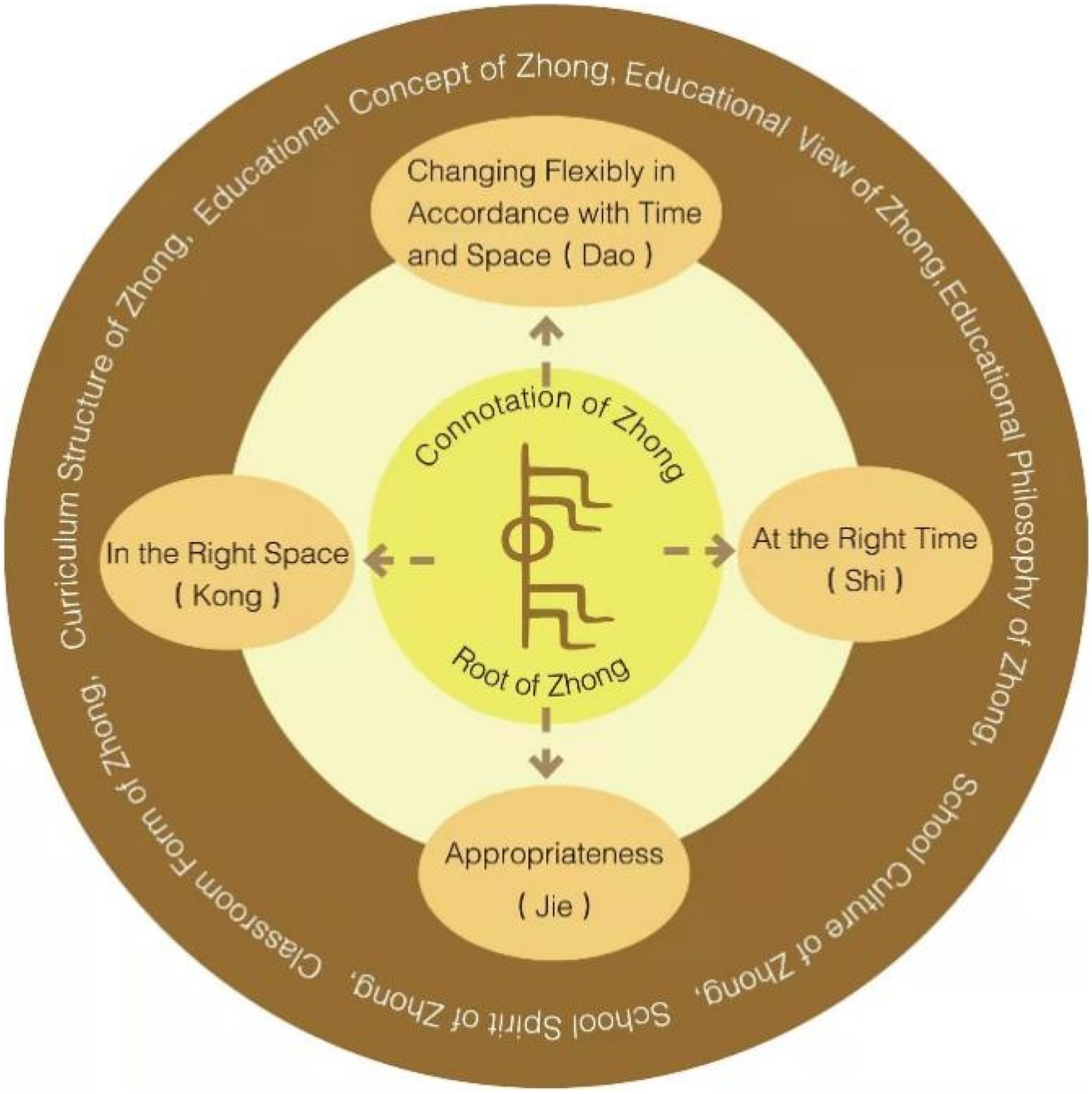
Education inspired by the ideas of Zhong.
First, from the perspective of Shi (时), “acting at the right time” in the process of education means that we should seize the opportunity of education, judge the situation, and provide appropriate education according to students’ physical and mental development. We should not push students too hard or require them to grasp the knowledge, ability, skills, and values beyond their current skill or development level. Confucius rejected all fixed and unchanging positions to prevent stagnation.
Second, from the perspective of Kong (空), “being in the right space” requires educators to put themselves in the middle and to be impartial and without prejudice. Impartial teachers treat every student fairly and without bias, thereby fulfilling the current concept of educational equity.
Third, Zhong possesses the attributes of time and space—that is, Dao (道), which emphasizes the position and change of things in time and space. Dao was regarded as a law in ancient China: the way followed by and in all things. In the field of education, we are exhorted to follow the laws of education and adopt appropriate educational methods, when dealing with and to manage educational phenomena and problems, respectively.
Finally, Jie (节)—that is, appropriateness—refers to the most suitable and balanced state. It emphasizes the right balance, which is integral for qualitative change. In education, Jie inspires us to perform to the best of our abilities in the classroom, including finding the most suitable teaching method and most appropriate learning method for each student. Essentially, the law of wisdom is that there is no law. In other words, there is no law, only regulation, which maintains flexibility. In this respect, appropriateness is the optimal result of adjustment.
The ideas of Zhong and the educational propositions
From philosophical ideas to education practice, Zhong has moved from being a philosophical concept to inspiring practices and finally back to a theory. The wisdom of Zhong comprises Shi, Kong, Dao, and Jie. Zhong offers a framework to solve educational problems and review educational phenomena.
In order to understand and practice Zhong, my colleagues and I practiced and documented various methods, including a teacher community, “Wen Zhong” (问中) Forum, curriculum development, and series of activities employing the Zhong framework in Zhengzhou No. 9 High School and Shenzhen Longhua Zhong Academy. Under the guidance of Zhong philosophy, our observations and perceptions of the process of implementing the theoretical framework of Zhong into practice can be summarized in four propositions as follows.
At the right time: Seize the opportunity of education and change with the times
According to ancient Chinese thought, “at the right time” refers to the time that something should happen. Here, “time” can be understood as the timing of education. However, in the ideas of Zhong, time refers to both “time and opportunity” and “time and moderation.” In other words, we should do the right thing at the right time and change with the times.
Education is inseparable from praise and criticism. We know that we will be praised if we make progress and criticized if we falter; praised if we do good deeds and criticized if we do the wrong things. This is a widely accepted fact. However, when considered in the framework of Shi (时), praise and criticism will produce different educational effects at different times. Shenzhen Longhua Zhong Academy has a “source of Zhong” teacher growth community, the objectives of which include the promotion of educational observation, deep learning, and interpreting meaning through educational narration. This teacher community seeks to encourage teachers to question and seek Zhong, thereby enhancing teachers’ perception and observation of people and things in education.
Among teacher participants, Weinü Pan, an excellent teacher at Zhong Academy, recorded her experience of implementing the principle of “being at the right time.” She referred to this experience as “Spoiled Children Also Have Their Day.” Mrs. Pan recorded her experience with Xiao Hao, who was regarded as a poor student by others, whose teacher always praised and encouraged him at the right time and took advantage of the characteristics of children's desire for praise and love. Consequently, Xiao Hao became a more sensible and polite child. Zhong Academy teachers supplied many such stories, including Shujuan Yuan's “Butterfly Guest,” Xiao Fang's “Every Student Deserves to be ‘Seen’,” and Qin Xu's “A Drop of Water Can Reflect the Light of the Sun.” All these cases occurred under the guidance of the Zhong philosophy.
Essentially, using Zhong wisdom, teachers took advantage of the right moment to unlock children's hearts, tailoring their approach to the child's personality. Shi Zhong (at par with the current times) emphasizes the need to pay attention to differences on the vertical axis of time—that is, that everyone has a unique personality as well as physical and psychological makeup. We must respect the differences between individuals, identify the characteristics of each person, and focus on each person's uniqueness. Essentially, finding the Zhong according to its Shi (时) involves teaching students in accordance with their aptitude.
In the right space: Direct educational experiences
The campus itself is a site with specific spatial attributes. Human being is a narrative existence. Educational stories occur in this spatial field. As such, it is paramount that we identify ways to fully utilize the educational functions of these sites through people and events. With this in mind, Shenzhen Longhua Zhong Academy established the “Wen Zhong” Forum in 2019. This forum is intended to redefine educational problems through teachers’ analysis of the educational field and reflection on their experience and guide teachers to engage in dialogue between educational wisdom and educational practice. Over the past two years, the “Wen Zhong” Forum has encouraged teachers to seek and question Zhong, share their educational experiences, and exchange their feelings as teachers. For example, in an article entitled “Children, Please Give Me Your Hand: The Vulnerability and Protection of Teenagers’ Hearts,” He posits ways of establishing a positive emotional connection when children encounter a development crisis. Similarly, Mei's “Caring for Children in the Corner” explains how to use the cooperative group management mechanism to open the channel for children not considered “outstanding” to find and affirm themselves.
In 2020, the COVID-19 pandemic forced the education field to shift from the classroom to online. This raised new questions. What is the best Zhong education method? An inch of heart holds concerns for the whole world, so who can say one lives idle every day? To this end, we organized the “Wen Zhong” Forum with the theme of “Wisdom of Home Education and Learning.” Teachers exchanged and discussed pandemic education and teaching from three dimensions: education resource mining amid the pandemic, online class video production skills, and school-based curriculum development.
From the perspective of orientation, Zhong is a prerequisite for determining direction. First there is the middle; then, up and down, left and right, east and west, north and south (Tang, 1981). Therefore, from the perspective of spatial attributes, it represents a process of constantly searching for Zhong. As such, when studying educational stories and educational cases on campus, we should visit the scene of the story, emphasize the use of connection, interaction, and development to find the Zhong of educational time, and help teachers and students in this space find the root of their spiritual growth. In school life, students should not only grow physically and attain knowledge, but engage themselves in school life, feel the soul with the soul, and recognize the growth of their spirit.
Changing flexibly in accordance with time and space: Communication modes from grades to strengths
When we examine the teacher–student relationship from the perspective of time and space in the Zhong philosophy, we find that, currently, campuses possess a kind of “unequal” logic in interpersonal communication, with student–teacher communication often limited to talking about grades. Therefore, grades not only determine a student's position in the minds of their teachers and classmates but determine their position in a group. While this simply applies to all relationships, it often results in the masking of educational issues. According to the time–space perspective of Zhong philosophy, people's responses to the environment follow a certain law, that is, the atmosphere you provide students will shape their responses. The current overemphasis on academic achievement has resulted in teachers and students’ responses being shaped by the communication model focused on the exam score.
In light of this, I found myself asking: What do we use to communicate with children? Children's nature is game, curiosity, imitation, and exploration dominated by happiness. According to Zhong, following the law of children's growth is Dao and “changing flexibly in accordance with time and space.” Based on this, I suggested shifting the mode of communication between teachers and students from scores to actual skills, encouraging every student to interact with others in their field of expertise. Accordingly, at Zhengzhou No. 9 Middle School, we attempted using clubs to change the interpersonal relationships between students. In this respect, we encouraged students to organize their own Student Representative Conference. This initiative was also implemented at Shenzhen Longhua Zhong Academy, including the holding of the annual Math Festival, Chinese Spiritual Theme Cultural Festival, Seeing the World in Zhong Academy, Principal Cup Football League, and Art Education Achievement Exhibition.
The systematic and purposeful organization of such meaningful activities will encourage children to cultivate their strengths. To this end, we reorganized the school clubs and reopened elective courses. We were pleased to find that when the focus of communication between teachers and students shifted from exam scores to student specialties and strengths, everyone participated in the community in pursuit of their own interests and strengths, effectively changing the original logic of interpersonal communication and realizing the idea of “giving everyone on the campus dignity.” This is the Dao whereby Zhong philosophy teaches us to “change flexibly in accordance with time and space.” According to this principle, to optimize communication between students and educators, educators should pay attention to reconstructing and encouraging dialogue in different school environments (time and space). In this regard, we should constantly examine the relationship between the authenticity of the process, ensuring that teaching and learning return to the real-life worlds of students.
Appropriateness: Finding the best fit for education
When discussing the concept of appropriateness, we must examine Zhong Jie, a very important concept in Zhong philosophy. According to Book of Rites: The Doctrine of the Mean, The emotions of happiness, anger, sadness and joy did not occur, which can be called “Zhong.” Emotions of happiness, anger, sadness and joy have taken place, but they can be moderate and restrained, which can be called He. Jie, here in accordance with the law, is the key point and the point of fit. That is, Zhong is not static, but when we find “not Zhong,” we must change; when we change we must pay attention to the development law of things and conform to the law. This is “appropriateness.”
At Shenzhen Longhua Zhong Academy, we always look for the best fit between the educational wisdom and practice, teacher–student communication, and home and school cooperation. We also actively seek to identify the “point” of work direction, work content, and work strategy in schoolwork.
In its early days, Shenzhen Longhua Zhong Academy had a complex external environment. When students entered and left the school every morning and evening, people came and went through the school gate, and the traffic was highly congested. An organized school environment is paramount. This requires the posting of administrative cadres at the school gate so as to ensure safety and order, as well as identify and solve unexpected problems in a timely manner. However, over time, different administrations should reevaluate standards and perform their own responsibilities according to changing requirements. As the main posts of the teaching office and student management cadres are in the classroom, they should remain stationed in the teaching building. Placing such staff on duty at the school gate may weaken the inspection of the teaching building, resulting in problems potentially remaining undetected and unresolved. Therefore, we adjusted the duty roster at the school gate. The administration in charge of safety and general affairs remained on duty, while those in charge of teaching and student management returned to the classroom. Colleagues referred to this adjustment as “from the big door to the small door” and “from the school gate to the classroom gate.” Although this is a relatively minute aspect of school management, it underscores how “school management must find the right point.” If you cannot find the “point,” the direction of school management will be biased, rendering it ineffective.
A rule at our school prohibits wearing shorts and slippers. Students tend to comply with this stipulation. However, after the college entrance examination, some students chose to wear slippers and shorts when taking their graduation photos. In observance of school rules, the school's security did not allow them to enter the school. While some students returned home to change their clothes, others did not due to their living too far away, resulting in their being unable to enter the school to take graduation photos. This caused heated debate at the school. One view is that the school has rules that should be strictly and uniformly enforced, particularly insofar as failure to do so will make it difficult to enforce the rules in other situations. Many feared that not enforcing the dress code would cause more students to violate the rules the following year. However, others felt that although students should adhere to school rules, the direct consequences of this incident would be lifelong regret for students. This raises the question of whether the feelings of students should be taken into account when enforcing the rules (Tian, 2017).
In such a case of conflict between instrumentality and humanism in enforcing school rules, Zhong provides us with a solution, that is, to find the best fit between rigidity and elasticity. First, we should make it clear that although the purpose of school rules is to strengthen the ability to manage student behavior, they are not intended to manage student behavior so much as cultivate their moral character and behavior. In this respect, the formulation and implementation of school rules should take student development as the ultimate objective. The best combination of the rigid tool value and elastic humanistic value of school rules lies in “educating people.” In doing so, we can find a means to solve the problem: School rules should be formulated under the premise of educating people, reasonable strategies should be adopted in the process of implementation, and under the premise of ensuring school order, the ultimate goal is to cultivate students’ sense of standardization and moral cultivation. Education can thus be considered a process of constantly exploring and finding the best point of fit, underscoring the need to achieve a state of balance and harmony among the various elements of education. This is precisely what the Zhong philosophy advocates. Indeed, in constantly seeking Zhong, finding the best fit between educational wisdom and practice involves finding the right “points” to make the best use of people's expertise and duties. We must do everything we can to achieve the best results.
Conclusion
We explored and summarized the Zhong philosophy to develop a Zhong framework for educational settings and used it to address and solve problems in education. In this context, Zhong wisdom is a methodology and guide for educational practice. Through the summary and in-depth consideration of educational practice, we developed an educational proposition from the philosophical perspective of Zhong. Figure 2 illustrates this proposition and its relationship with educational practice.
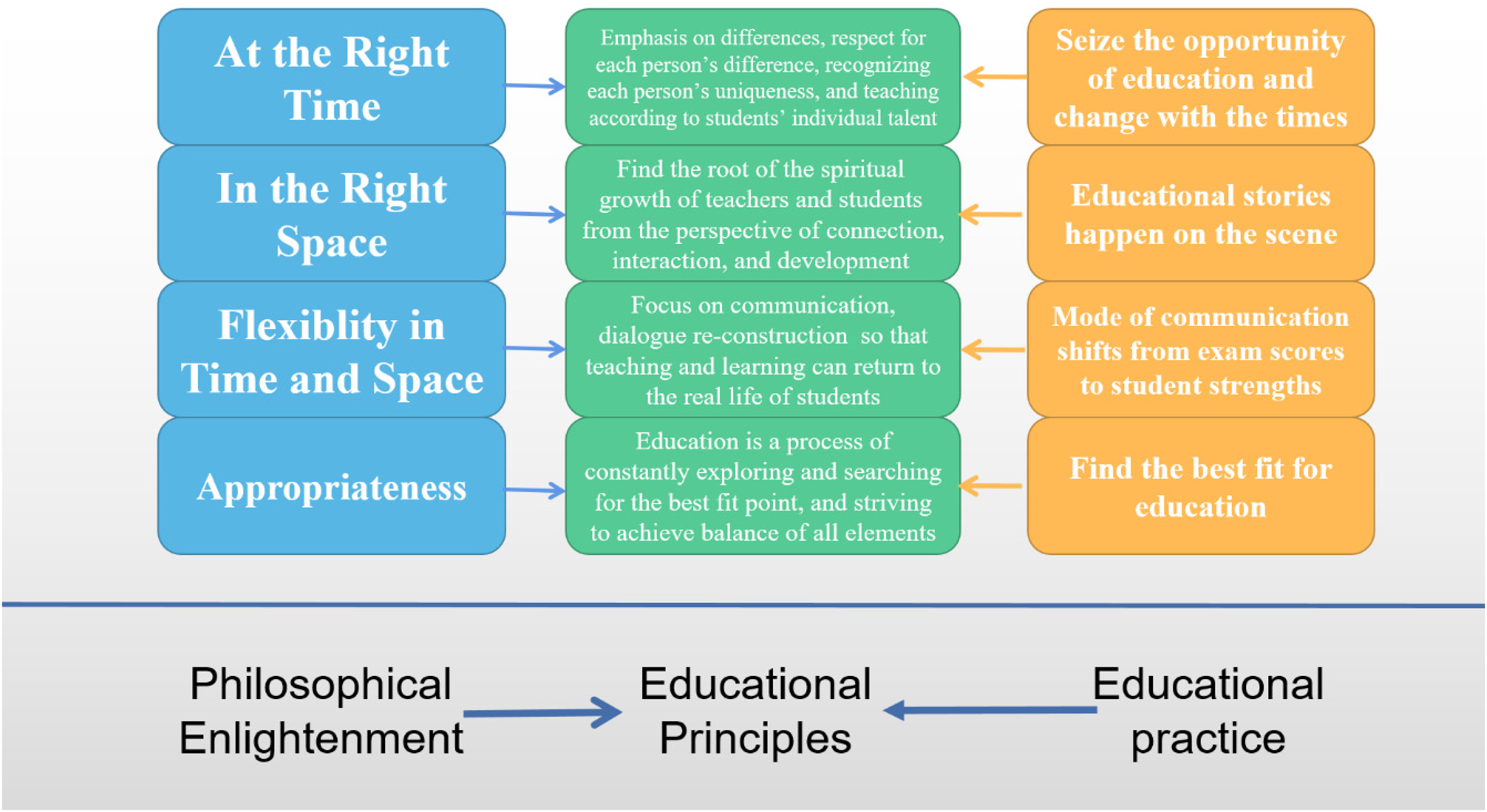
Zhong principles for educational practice.
Exploring the wisdom and philosophical meaning of Zhong, we found that there is no immutable law at the core of applying Zhong. Instead, the value lies in “proper mortality,” or we can learn with someone together, but it is not suitable to the Dao. When it can be compatible with the Dao, we cannot stand with him together. When we can stand with him together, we cannot give him the power. (Julien, 2017, pp. 236–237)
In short, Zhong philosophy argues that education is a process of continuous exploration and searching for the best point of fit. It strives to achieve a balanced and harmonious state among all elements of education. Zhong philosophy emphasizes the need to reexamine the relationship between teachers and students from the perspective of connection, interaction, and development and pays attention to the coordination of teacher quality, student characteristics, teaching content, and teaching environment (Julien, 2019, p. 33). We should emphasize the differences between individuals as everyone has a unique personality and physical and psychological makeup. Therefore, we should identify and adapt to the unique characteristics of each person, teach according to a student's skill and development level, and adopt appropriate measures in accordance with the specific person, place, and time.
In conclusion, the character Zhong and its philosophical connotations played an important role in the development of ancient Chinese thought, profoundly impacting ancient Chinese classics, doctrines, rites, and music, among other aspects. The wisdom and philosophical meaning of Zhong are also valuable for education, where it can inspire those involved in school life and help educators find a suitable position and status.
However, Zhong in education emphasizes the need to change flexibly depending on the context. True and wise Zhong is ever-changing. We should implement Zhi Zhong (holding Zhong), rather than sticking to and stagnating in Zhong. The wisdom and philosophy of the character of Zhong lies in the Zhong Jie, after the adjustment and change of “perfection.” If you stick to the “Zhong,” it will inevitably be damaged: “stick to Zhong without changing, you will fall into a certain state without knowing the change” (Julien, 2019, p. 33). Therefore, to explore the wisdom and philosophical meaning of Zhong, we need to better understand the core of making changes on the basis of the situations. Only by looking back at the past and adopting a current and forward-looking research perspective can we provide important guidance and reference for current basic education reforms.
Footnotes
Declaration of conflicting interests
The author declared no potential conflicts of interest with respect to the research, authorship, and/or publication of this article.
Funding
The author received no financial support for the research, authorship, and/or publication of this article.