




Abstract
Purpose:
Conducting meaningful interactions in the target language is essential for language learning. However, in many English language classrooms in China, it is rare that students are provided with such opportunities. In the current study, we presented and critically evaluated the implementation of a small-group discussion approach called Quality Talk (QT) in an eighth-grade English language classroom in China.
Design/Approach/Methods:
One eighth-grade English teacher and 82 eighth-grade students in a public middle school in Beijing participated in the study using a pretest-posttest, quasi-experimental design. Recordings of teacher coaching sessions and student discussions, researchers’ field notes, and participating teacher’s written reflections were used to identify successful practices and lessons learned with respect to the implementation of QT. Implications for future directions were also discussed.
Findings:
The results revealed that to successfully implement a discourse-intensive pedagogical approach in a large English language class, it is essential that (a) the materials used for discussion closely align with the school curriculum, (b) students are grouped heterogeneously and scaffolded to engage in discussions both in their native and target languages, and (c) student leadership be leveraged to facilitate discussion in each small group.
Originality/Value:
The present study delineated the details with respect to implementing a discourse-intensive pedagogical approach in an eighth-grade English classroom in China. We derived several key insights from recontextualizing QT in an English learning, large class context in China. These insights might hold the potential to improve the effectiveness of English teaching and learning in China.
Keywords
位移
得
是
With the development of globalization, English has become the most widely used language in international communication, such as business, academic, and cultural exchange. To share scientific and technological achievement and to promote understanding among different cultures, it is increasingly important to be proficient in English (Crystal, 2003; Ross, 1992; Warschauer, 2000). Some might argue that to be competitive in the 21st century, it is essential that students foster their English proficiency so that they can use the language to acquire new knowledge and express their own thinking and ultimately develop core 21st-century skills such as critical-analytic thinking (e.g., National Education Association, 2010; Scott, 2015). In response to this goal, the English Curriculum Standards for Compulsory Education (Ministry of Education of People’s Republic of China [MOE], 2011) posits that English needs to be taught as a linguistic tool for communication as well as a tool for thinking. It is emphasized in the Standards that English proficiency needs to be cultivated in authentic contexts. Therefore, activities that prompt students to use English in meaningful contexts such as retrieving, processing, and delivering information and expressing personal opinions are highly encouraged. According to the Standards, by the end of middle school (i.e., Grade 9), students are expected to be able to engage in discussions, exchange information, and express their own opinions in English, as well as to work with others and draft English composition independently.
However, the style and focus of English teaching and learning in China appears to pose several challenges with respect to teaching Mandarin-speaking students to think critically and analytically in English. First, as reported by Floyd (2011), for Chinese students, using a second language such as English to think critically appears to be more challenging than using students’ first language due to students’ lack of L2 language proficiency and cognitive load posed by L2 comprehension. Second, Chinese traditional beliefs, attitudes, and assumptions held toward teaching and learning tend to value the accumulation of knowledge from texts or authoritative figures more than the construction of knowledge for meaningful purposes in authentic contexts (Hu, 2002). Thus, the types of activities that allow students to critically evaluate content provided by the authorities are perceived as less efficient or not in line with the kind of teacher–student relationship valued in the Chinese context (Hu, 2002). Finally, the large class size in China limits the implementation of activities that allow each student to fully engage in using English to talk or think. According to the statistics provided by China’s Ministry of Education, by 2017, the average class size was 38 students in elementary schools and 47 in middle schools. Within the context of English teaching and learning in China, this challenge is compounded with other constraints such as limited instructional time, pressures from high-stakes testing, and lack of necessary resources to manage in-class activities that purport to promote students’ communicative competence in English (Hu, 2002).
One format of instruction often associated with teaching large classes is that teachers follow the structure of Initiate-Respond-Evaluate (Mehan, 1979). That is, the teacher often initiates a question to the whole class, students respond to the question, and finally, teacher evaluates student response. Even in English classes where communicative competence is thought to be valued, most instruction has been devoted to teaching and practicing basic English language skills such as vocabulary and grammar rather than conducting activities to enhance students’ critical thinking or communicative competence in English (Ruan & Leung, 2012). What makes it even more challenging for English language learners (ELLs) in China is that English is not a language used in daily interactions (Butler, 2015) despite the fact that English is taught as early as Grade 3 (MOE, 2011). Consequently, ELLs in China often do not have sufficient opportunities to engage in extended and meaningful verbal interactions in English in their daily interactions.
As such, it is stressed in the new English curriculum that schools need to “shift from the traditional teacher-centered, skills-based English instruction to the current student-centered, communicative competence-based instruction” (Ruan & Leung, 2012, p. xi). To achieve this laudable goal, teachers need exposure to well-designed, effective student-centered instructional approaches and opportunities to learn about and be supported in effective classroom implementation of these approaches (Rao, 2006; Wei & Murphy, 2018). In the present study, we aim to provide professional development for the participating teacher, facilitate the implementation of such student-centered instructional approach called Quality Talk (QT), and promote meaningful English interactions and critical-analytic thinking among Mandarin-speaking students. The goal of this particular article was to present and analyze the possibilities and challenges associated with implementing such instructional approach in a middle school English learning classroom in China.
Small-group discussion as a promising approach
To address the need to cultivate students’ critical-analytic thinking skills and their communicative competence, education researchers have been exploring promising, student-centered instructional approaches that promote learning. Among them, small-group discussion has been identified as an effective approach to enhance students’ basic- and high-level comprehension (Murphy et al., 2009). That is, students who participate in small-group discussions not only show improvement in their ability to recall factual information from text but also garner the skills to make complex inferences and evaluate various information. Specifically, researchers have examined various approaches to discussion such as Book Club, Instructional Conversations, Literature Circles, and Collaborative Reasoning (CR; Farris et al., 2007; Kim, 2004; Shen, 2013; Zhang et al., 2013) in an attempt to enhance students’ basic and high-level comprehension.
In terms of promoting language proficiency of ELLs, researchers have explored the effect of small-group discussion as well. For instance, Zhang and colleagues (2013) examined the effect of CR discussions on students’ English proficiency such as listening and comprehension. The study revealed that ELLs who participated in CR discussions appeared to outperform the control group in English listening and comprehension. Indeed, as stressed in Cheung and Slavin (2012), group work provides increased opportunities for ELLs to use English in meaningful contexts, leading to greater amount and more variety of student talk. Additionally, group work also creates a safer and more affective environment, so that ELLs tend to feel more comfortable practicing English (Zhang et al., 2013). As such, during a small-group, text-based discussion, language learners are encouraged to negotiate and co-construct meaning of the English text with other group members. Within a group of four to six students, it is more likely that ELLs are exposed to comprehensible input (Krashen, 1988) and have more opportunities to generate comprehensible output (Swain, 1985) through meaningful interactions (Long, 1985), which are conducive to foreign language learning.
Among the various approaches to discussion as mentioned above, QT was derived from a systematic and exhaustive meta-analysis on the effects of various discussion approaches on students’ comprehension of text (Murphy et al., 2009). It is a multifaceted, small-group, text-based discussion approach to promote students’ high-level comprehension and critical-analytic thinking about, around, and with text or content (Murphy, Greene, Firetto et al., 2018; Soter et al., 2008). QT has been conducted in the U.S. among English-speaking elementary and high school students in their language arts and science classrooms. The results of these studies revealed that QT can promote students’ high-level comprehension of the text or content in different domains and among students of different ages (Murphy et al., 2017; Murphy, Greene, Allen et al., 2018; Murphy, Greene, Firetto et al., 2018). Further, scholars from Chinese Taiwan also implemented QT and examined the effect of power distance on students’ QT discussions (Liang & Chen, 2018). The study revealed that students with lower power distance index scores (i.e., used to quantitatively measure power distance; Mulder et al., 1971) were more willing to co-construct knowledge with their peers during discussions.
Theoretical foundations
QT is deeply rooted in a Vygotskian (1978) social constructivist lens. According to Vygotsky, higher mental functions such as high-level comprehension or critical-analytic thinking are developed first as learners co-construct knowledge at a social level and then become internalized at an individual level. Development is “more likely when one is required to explain, elaborate, or defend one’s position to others, as well as to oneself; striving for an explanation often makes a learner integrate and elaborate in new ways” (Vygotsky, 1978, p. 158). Through QT discussions, learners ask various types of questions and elaborate as well as defend their arguments using evidence and reasons. The more capable “others” in the group scaffold the learning of their peers who are, subsequently, more likely to develop their potentials within their zone of proximal development, contributing to productive discussions. However, not all types of talk are equally productive in nature. By productive, we refer to text or content-focused talk that promotes episodes of open-ended authentic questions (i.e., questions to which there is more than one justifiable response and in which the question initiator is genuinely interested), where students respond through elaborated explanations or arguments that are either individually generated or co-constructed.
QT model
Rooted in social constructivism, the QT model comprises of four essential components that showcase the rationale underlying the implementation of QT small-group discussions and are central to generating productive talk in the classroom. These four components include instructional frame, discourse elements, teacher modeling and scaffolding, and pedagogical principles (see Murphy & Firetto, 2018, for more details on each component of QT discussion model and Murphy, 2018, for justification of each component).
The first component is the instructional frame that involves parameters requisite to conducting productive discussions (Anderson et al., 2001; Chinn et al., 2001; Murphy & Firetto, 2018). These parameters determine the role and responsibility of teacher and student before, during, and after a QT discussion. Such parameters include teacher chooses the text for discussion, teacher designs pre- and post-discussion activities for students, students are grouped heterogeneously, and students control turn-taking and take on increasing interpretative authority while the teacher gradually releases responsibility during discussion.
The second component pertains to the discourse elements that proximally indicate high-level comprehension (Soter et al., 2008). To conduct high-quality, productive discussions, it is crucial that students learn how to engage in discussion effectively and productively. Indeed, students do not naturally know how to ask authentic questions or give responses that are supported by reasons or evidence (Li et al., 2016). Despite the fact that “discussion” is a frequently used activity in the classroom, students are often not explicitly taught how to become a quality talker. Therefore, an important part of the QT intervention is that the teacher explicitly instructs students how to conduct productive discussions through a series of QT mini-lessons on different types of authentic questions (e.g., generalization question, analysis question, or connection question) that elicit high-level thinking (e.g., Nystrand et al., 2003). Authentic questions are open-ended questions that invite multiple responses which are not explicitly found in the text and are different from test questions that only permit one correct answer with factual information. QT mini-lessons also emphasize well-reasoned argumentation (Murphy, 2018) with an emphasis on the components of an argument (i.e., claim, reason, or evidence), counterargument, and rebuttal that propel students to construct elaborated explanation or exploratory talk (Soter et al., 2008). Having learned different types of authentic questions and argumentation skills, students are encouraged to apply these skills during QT discussions. As such, students not only learn the different ways to productively talk about texts as an individual but may also serve as a model so other group members may learn from a student model during a discussion for such desirable discourse to snowball within the group (Anderson et al., 2001; Jadallah et al., 2011).
The third component, teacher modeling and scaffolding, refers to a set of teacher discourse moves (e.g., prompting, marking, or summarizing) that can be used to guide students toward productive talk (Van de Pol et al., 2010; Wei & Murphy, 2018; Wei et al., 2018). Indeed, the use of specific teacher discourse moves may contribute to the generation of desirable student discourse (Lin et al., 2015). For instance, the teacher may use modeling to raise an authentic question or use promoting to provoke thinking and linking with the text. It is worth noting, however, in large classes where multiple discussions take place simultaneously, it is almost impossible for one teacher to sit with each discussion group. Under this circumstance, a student discussion leader may serve the role of a facilitator and employ the set of teacher discourse moves to facilitate small-group discussions.
The fourth and final component, pedagogical principles, pertain to a teacher’s understanding of teaching and learning which is requisite for fostering a culture of dialogic inquiry and open participation space in the classroom. Such principles emphasize understanding the importance of using language as a tool for thinking and interthinking (Mercer, 2000). To facilitate students in using language for high-level thinking, a teacher needs to endorse another aspect of pedagogical principles, which are normative expectations and dialogic responsiveness. The normative expectations are demonstrated as a set of discussion rules. These rules are established to guide student behaviors, construction of discourse, and interaction with other group members. Importantly, a prominent feature of productive discussions is that students engage with each other by being responsive dialogically. When students are still new to small-group discussions, they may need more scaffolding from the more capable other in the discussion group to endorse the rules below: We don’t need to raise hands. We talk one at a time. We give others time to speak. We listen to each other. We respect others’ opinions. We think about others’ ideas. We give reasons to explain our ideas. We question/argue about ideas not people. If we disagree, we ask “Why?”
The present study
While the majority of researchers who examine ELLs of Chinese tend to focus on student population at postsecondary or postgraduate levels (e.g., Floyd, 2011; Grimshaw, 2007; Ha & Li, 2012), there exists a paucity of research that emphasizes English learning among younger learners. The goal of this article is to delineate the implementation of a 3-month intervention that employs the QT approach as mentioned earlier in an eighth-grade English classroom in China. To our knowledge, the present study constitutes the first study to examine the effect of QT on Mandarin-speaking students in terms of promoting their English language proficiency (for details, see Wei, 2019; Wei & Murphy, 2019). In this article, we focus on factors central to conducting productive talk in the classroom, including lessons learned in the implementation of a QT intervention and implications for encouraging small-group talk in the context of Chinese K–12 education. The present study serves as an extension to prior QT interventions, which were mostly contextualized in elementary and high school classrooms in the U.S. (e.g., Li et al., 2016; Murphy et al., 2017; Murphy, Greene, Allen et al., 2018), with the goal of examining QT from a cross-cultural perspective. In particular, we describe three key aspects pertaining to the recontextualization of QT intervention in an eighth-grade English classroom in China. For each key aspect of the recontextualization, we explain the rationale behind the course of action and delineate successful practices and future directions.
Method
As described in the four components of the QT model, a productive small-group discussion is like a dance where teachers and students serve their respective roles. In an effort to effectively and sustainably conduct high-quality discussions, teachers and students need to balance well their roles after taking into account the specific context of the intervention. In this section, we provide key information of the context (e.g., participant profile, classroom characteristics, or school curriculum) and procedures of the intervention.
Participants and context
In the present study, participants included 82 eighth-grade students from two classes in a public middle school in Beijing. There were 42 students (female: n = 19, male: n = 23) in the treatment class and 40 students (female: n = 17, male: n = 23) in the comparison class. The school adopted the policy of recruiting students in the neighboring communities and students were randomly assigned to different classes upon entering middle school. However, for major subjects such as English, the school placed students into Level A and Level B according to their performance on a school-wide assessment for differentiated instruction to ensure the quality and efficiency of instruction. Participants in the current study were placed at Level B and had low to intermediate English proficiency among their eighth-grade peers in the school.
In the participating school, English was only taught and used as the means of instruction in the English class. The materials used for English classes included a textbook (Chen & Greenall, 2017), an accompanying work book, and handouts with passages and practice questions selected and compiled by a group of English teachers who taught Grade 8 in the school. Teachers in the school were also allowed to use materials in addition to the ones provided in the school curriculum. For instance, a teacher who taught Level A students incorporated a short English novel in her English class.
The participating teacher in the study was a highly experienced K–12 English teacher with over 20 years of teaching experience. Prior to the present study, she had taught English to both classes for one school year. Based on the teacher’s understanding of the students, she assigned treatment students into seven heterogenous discussion groups, with six students per group, after taking into account and matching their gender, talkativeness, and English proficiency. One student with relatively higher level of English proficiency, talkativeness, and leadership skills was selected by the teacher as the discussion leader for each group to help facilitate the discussion.
Procedures
Professional development
To ensure the effective implementation of QT in the treatment class, an extensive professional development was provided prior to the intervention. As stressed previously, even with 20 years of teaching experience, the teacher may not be familiar or comfortable with adopting pedagogical practices that endorse open participation or productive discussions which promote high-level thinking in a large class. Therefore, during the professional development, the four components of the QT model were introduced to the participating teacher. In addition, QT lesson plans with accompanying PowerPoint slides, as well as instructional aids (e.g., tree poster with different question types) on various question types and argumentation were shared with the participating teacher. Feedback and suggestions were collected from the teacher to further refine the lesson materials to ensure their appropriateness with respect to content difficulty and student background knowledge. As the intervention progressed, the research team provided ongoing coaching in the form of discussing with the participating teacher about student performance after listening to the audio-recorded discussions. In accordance with the reflections on student discussions and goals set for future discussions, feedback was provided to the teacher and individual student discussion leader to help them facilitate productive talk in the future.
QT intervention
During the 3-month QT intervention, the teacher delivered a series of QT lessons to the treatment class on various types of authentic questions and argumentation, approximately one lesson every 1 or 2 weeks. Following each QT lesson, students were encouraged to apply what they learned from the lesson in the upcoming QT discussion. For the duration of the current study, the treatment class conducted 10 QT discussions regularly based on the texts selected from the school curriculum. Each QT discussion lasted for approximately 15 min. Given that the QT discussion model required a substantial shift for teacher and student roles, discussions alternated between English and Mandarin (i.e., five English discussions and five Mandarin discussions). This allowed students to practice their newly learned discourse elements in their native language (i.e., Mandarin), thereby reducing cognitive load while allowing students to adjust themselves to the format of small-group discussion. Alternately, students conducted QT discussions in English to practice using English in meaningful contexts to discuss about, around, and with texts. Before each QT discussion, the teacher reviewed a set of discussion rules to guide student discussions and selected one text from the assigned readings for discussion. As part of the pre-discussion activity, the teacher constructed a few questions to check students’ basic comprehension and designed a few warm-up activities (e.g., showing a video or picture in relation to the text or content) to activate students’ prior knowledge about the text or content to be discussed. During a QT discussion, seven small-group discussions took place simultaneously in one classroom. Specifically, the teacher sat with one discussion group at a time to facilitate the discussion as well as to provide modeling for the student discussion leader regarding how to lead a productive small-group discussion. Groups in greater need of engaging group members in discussions received more teacher facilitation.
Data sources and analysis
In this article, we used four sources of data for analysis, including field notes recorded in a research journal, two audio recordings of ongoing coaching sessions with the participating teacher, the teacher’s written response regarding her reflections on the implementation of QT, and the audio recordings of students’ QT discussions. In terms of the field notes, researchers logged everything possible including a detailed schedule of the intervention, materials used for each QT discussion, rationale behind each decision made to recontextualize the intervention considering the specific context of the study, and each student’s performance during QT discussions. These data sources were then synthesized to arrive at several major trends regarding the successful practices during the implementation of QT. The researchers then discussed the synthesized trends and corresponding reflections with the participating teacher to ensure they accurately revealed and represented the teacher’s reflections and experience as well.
Results and Discussion
In this section,1 three key aspects of recontextualization are elucidated with respect to the promises and pitfalls of QT implementation. These three aspects include (a) optimizing the use of existing materials in the curriculum to ensure sustainable implementation of small-group discussions, (b) grouping students heterogeneously and conducting small-group discussions in the native language and the target language to ensure students can adjust themselves to the format of discussion and practice the target language more smoothly in a small-group discussion, and (c) leveraging student leadership by training student discussion leaders to facilitate multiple small-group discussions in a large class. In what follows, for each of the three aspects, we first present results for successful practices and lessons learned, following which we discuss interpretations and implications these results hold for future directions.
Curricular alignment and integration
Successful practices and lessons learned
For a classroom intervention to be implemented in a sustainable manner, it is critical that the intervention align with the educational objectives and can help teachers achieve them as stated in the school curriculum and as mandated in the national standards (e.g., Firetto et al., 2019). In the current endeavor, the researchers and the participating teacher worked closely to recontextualize the intervention such that small-group discussions could be aligned with the school’s existing English curriculum. Specifically, as has been done in prior implementations of QT (e.g., Murphy, Greene, Firetto et al., 2018), we selected the texts and content for discussion from the textbooks or supplementary materials already used in the school.
For eighth-grade English, the major reading for every unit in the textbook was approximately 200–250 words in length, which was limited in the content for discussion. Therefore, to enrich the content for discussion, we selected reading materials from the accompanying workbook as well as the handouts developed by teachers in the school. These workbooks often included several passages and multiple-choice questions following each passage. These questions were meant to be assigned as homework to students as they completed each unit. The reading materials in the handouts were supplementary materials for the specific unit and were also part of the homework assignment. Since students were required to read these materials regardless, these related materials were utilized to enrich the content for discussion. For instance, when students were working on a unit titled transportation in the textbook, a passage about teleportation in their workbook was assigned for intensive reading and selected for discussion, provoking richer talk around the possibilities of transportation and their potential impact.
Interpretation and implications for future directions
Optimized usage of multiple reading resources in the existing curriculum prompted the participating teacher to maximally integrate and utilize the materials already provided to the teacher and students, reducing the teacher’s burden to source other materials for discussion, and thus contributing to the sustainability of such instructional approach in the classroom. In addition, this practice helped enhance the effectiveness of both teaching and learning, as the participating teacher was encouraged to think deeply about the connections between the multiple sources of materials in the existing curriculum and select richer texts for student discussions. By using multiple texts, students were better able to engage with the topic; specifically, students were able to (a) complete the reading assignments as required by the school curriculum; (b) comprehend the reading materials more deeply by discussing about, round, and with rich texts in small-groups; and (c) make intertextual connections between multiple texts in one unit.
We consider two implications herein for future attempts in refining the present intervention. First, it would be helpful to gauge students’ prior knowledge and interest in relation to each unit to optimally select materials for discussion as both factors are regarded as crucial in influencing learning outcomes (Alexander et al., 1994; Silvia, 2008). This could be completed in the form of a brief survey among students. The results of the survey would help teachers select materials that are most relevant to the students and help teachers activate students’ prior knowledge before the discussion. In fact, this type of brief survey has been used in prior implementations of QT in the U.S. (e.g., Li et al., 2016).
The second implication for future practice is to provide teachers with access to tools or guiding principles to efficiently select materials that are appropriate in terms of text difficulty. Indeed, when the participating teacher wanted to supplement school-supplied reading materials, it was rather challenging to find ones that were relevant in terms of content and suitable in terms of text difficulty. While teachers often possess substantial instructional experience and value the flexibility of choosing texts for discussion, they often lack knowledge of scientific tools that would facilitate the search and selection of appropriate materials. In the future, easy-to-use platforms or external tools could be developed to aid text selection for discussion, with the goal of enabling greater flexibility and confidence as the teacher implements the intervention independently.
Conducting small-group discussions in Mandarin and English
Successful practices and lessons learned
A prominent aspect of recontextualization in the current study is that QT discussions were conducted in two languages, with five sessions conducted in English and five in Mandarin. The English and Mandarin sessions alternated with an interval of 3–5 days. There are several reasons for having students discuss in their native language during QT discussions. First, discussing in students’ native language may help them adapt to open participation in a small-group context, which was rather rare in Chinese classrooms. Second, discussing in students’ native language helps reduce the cognitive load associated with talking in a second language and scaffolds them into participating in discussions in English. Given students’ limited English language proficiency and limited opportunities to practice oral English in the past, it may be rather challenging for them to engage in high-quality discussions in English immediately and effectively. Therefore, having Mandarin QT discussions allowed students of various language proficiency to engage in group talk about, around, and with English texts, which helped them transition into English QT discussions more smoothly.
To aid students with low English proficiency in comprehending vocabulary and text, the teacher engaged all students in a few pre-discussion activities prior to each discussion. These activities included presenting pictures or videos that made connections to the text, which helped activate students’ prior knowledge and aroused their interest. Additionally, the teacher reviewed a few comprehension questions and key vocabulary in a whole-class setting to ensure basic comprehension of all students prior to the discussion.
During the discussion, a list of language-based question prompts were provided on the computer screen in the front of the classroom to scaffold students with relatively lower level of language proficiency. For instance, students may refer to question starters such as “How to put…[Chinese word] in English?” or “What is…[Chinese word] in English?” when they need to ask for help from other group members during an English QT discussion. The more proficient students in the group could help answer these questions or ask the teacher for help if needed. Notably, after a vocabulary question was addressed within a discussion group, other members who did not know the word previously were able to gradually pick up the new word and internalize it for their own use during later discussion. Figure 1 shows an excerpt from an English QT discussion in the current study (student names are pseudo names) that demonstrated such snowballing effect (Anderson et al., 2001).
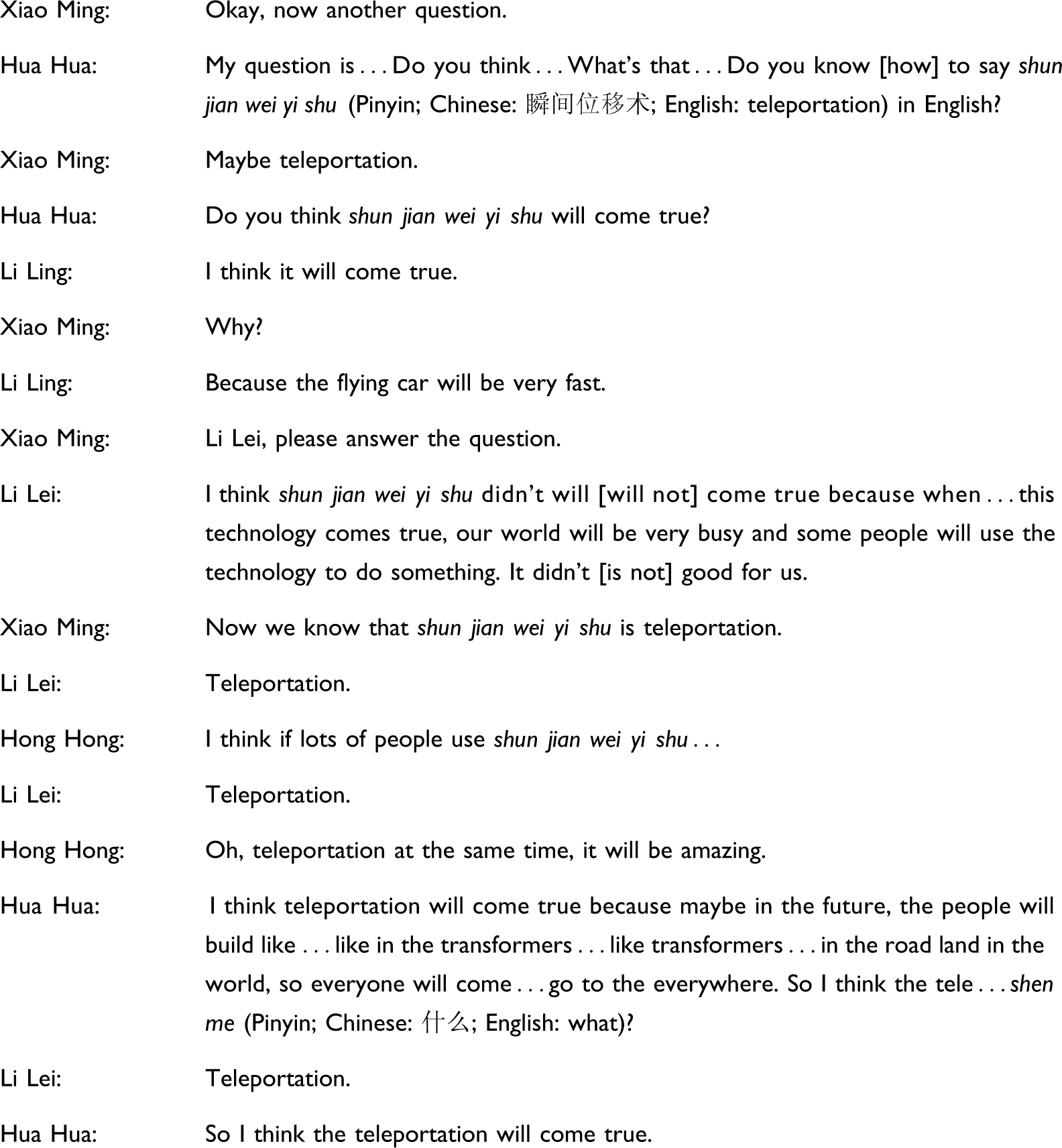
Students internalizing the use of a new word in an English QT discussion. QT = Quality Talk. Adapted from Figure 6.4 in Wei and Murphy (2019, p. 76).
Interpretation and implications for future directions
The inclusion of both Mandarin QT discussions and English QT discussions proved to be quite effective in promoting students’ confidence and interest in discussing English texts, and this was particularly the case for low proficient students who rarely spoke in a whole-class setting. Indeed, at the beginning, these students were reluctant to engage in English discussions and were afraid of making mistakes. After engaging in a few Mandarin QT discussions about English texts, however, they became much more willing to share their opinions in their small groups. While the participating teacher was initially worried that implementing Mandarin discussions in an English classroom might take away the opportunities for students to practice their English listening and speaking skills, she later found that having Mandarin discussion actually promoted student engagement as they discussed about, around, and with English texts. In addition, as students with low English proficiency increased their engagement in the discussion, their contribution was recognized and encouraged by other group members. Subsequently, they became more confident and interested in discussing English-written texts in both Mandarin and English.
Researchers and teachers may continue exploring the best practices to address the needs of low proficient students during small-group discussions in the context of English language learning. Undoubtedly, students, regardless of their English language proficiency, are able to bring to the discussion their unique knowledge and experience and initiate authentic questions that provoke deep thinking. However, in the present whole-class context of English teaching and learning, language proficiency may significantly impede their text comprehension or engagement in the discussion in the target language. Thus, it is important that low proficient students are provided with language-based scaffolds, ideally from the teacher prior to the discussion and from their more proficient peers during small-group discussions.
Leveraging student leadership
Successful practices and lessons learned
Another successful practice we adopted in recontextualizing QT in the present study was assigning student discussion leaders for each small group. Existing studies on the effects of QT language arts discussions in the U.S. (Murphy et al., 2017; Murphy, Greene, Firetto et al., 2018) were usually conducted in classes with small sizes. Thus, the teacher could facilitate each QT discussion by having discussion groups take turns to sit with the teacher. However, Chinese public schools often have large classes with as many as 40 students. In accordance with the curriculum requirements, within a 40-min class period, it is impossible for one teacher to facilitate each discussion group while having the remaining groups work on other tasks. All discussions had to take place simultaneously so that it may become an integrated activity within the curriculum to ensure its feasibility and sustainability. Therefore, in the current study, a student discussion leader was selected by the teacher based on their leadership skills and English proficiency. Figure 2 reveals how a student (Xiao Hua) took on the leadership role to open up a QT discussion (conducted in English) and to facilitate the discussion by inviting other students to ask authentic questions and to respond to each other.
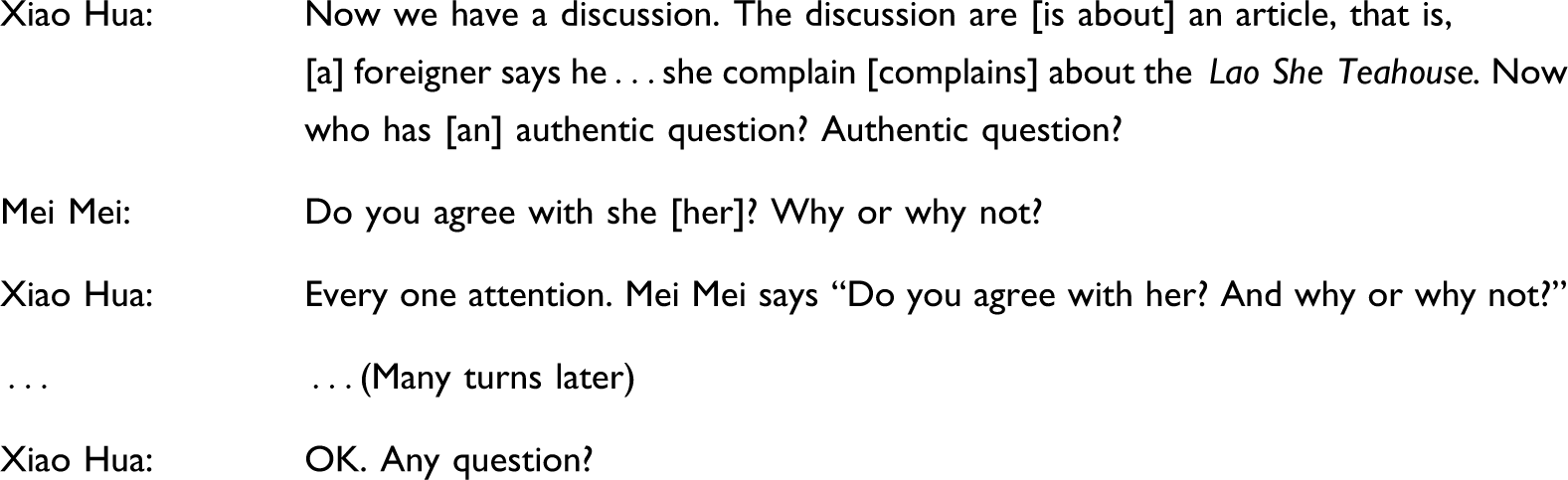
Xiao Hua taking on the leadership role as a discussion leader.
During each QT discussion, the teacher only sat with one discussion group, where she occasionally modeled for the discussion leader in terms of how to manage a discussion or marked desirable moves of the discussion leader to provide immediate feedback. The goal was to help the discussion leader successfully facilitate QT discussions using teacher discourse moves. For instance, the teacher would mark a discussion leader’s move by complimenting specifically why it was a desirable move. In the transcript of a QT discussion (conducted in Mandarin) as shown in Figure 3 about a text on a football player, the teacher marked two moves made by the discussion leader, whose pseudo name was Mei Ling. The teacher explicitly pointed out that the discussion leader did a good job commenting on group members’ questions and prompting students to refer back to the text for evidence (see Figure 3).
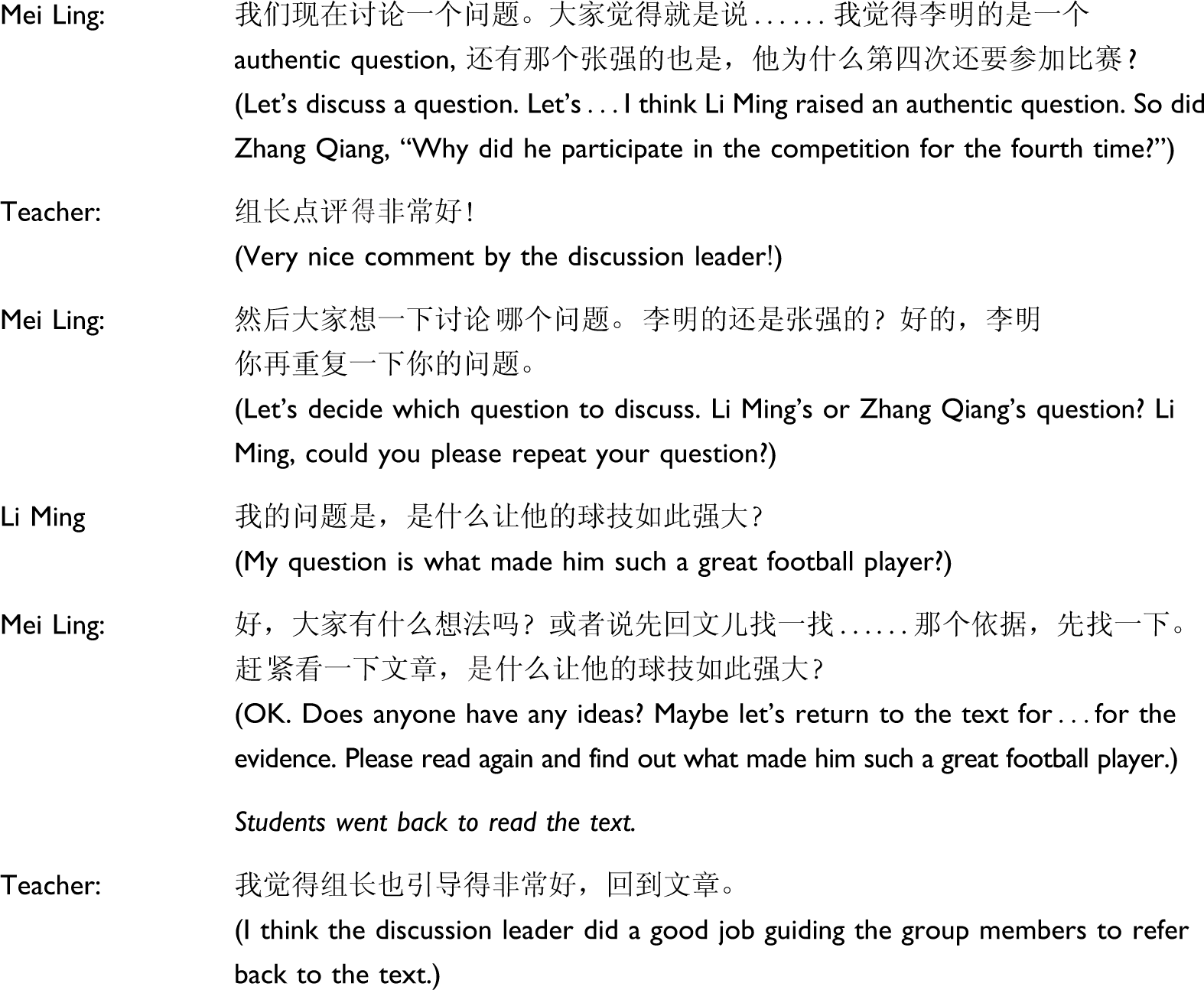
Teacher marking a student discussion leader’s (Mei Ling) moves.
To ensure that all small groups were effectively engaged in discussions as expected, each discussion was audio recorded and was later reviewed by a researcher. Following each class, feedback was provided to each discussion leader depending on their performance. For instance, when the discussion leader misunderstood the goal of the discussion and only focused on asking questions, they would be encouraged to redirect the focus of the discussion by prompting student responses.
Another example of providing feedback to discussion leaders was when one discussion leader determined that only highly proficient students were capable of asking authentic questions and low proficient students were only able to ask test questions. However, the quality of student questions is not necessarily dependent on their English language proficiency. What low-proficient students needed was the scaffolding from the group to help them comprehend the English texts and opportunities to ask and discuss authentic questions. Indeed, one benefit of QT discussions is that they provide opportunities for co-construction or scaffolded construction of understandings. Therefore, we encouraged this leader to invite every group member to ask authentic questions and for those who found the task of comprehending the text challenging, other group members could help with translations. Immediate feedback provided to discussion leaders was important in helping them reflect on and refine the way they facilitated small-group discussions in the future (Mercier et al., 2014). In this process, student discussion leaders enhanced their leadership skills and improved their ability to manage, conceptualize, and propel productive talk with their peers. In this way, conducting multiple discussions in a large class in the Chinese public school context became possible.
Interpretation and implications for future directions
As stressed above, another useful lesson gleaned from the present study is to cultivate student discussion leaders and provide effective feedback to them during the intervention. At the same time, students could also provide feedback to the teacher, which might help the teacher in monitoring the progress of each discussion group, identifying challenges in student discussion groups, and providing help as needed. Indeed, after working with student discussion leaders for feedback in each discussion group, the teacher noted that students became more engaged in QT discussions and gradually recognized it as a part of their English class.
Implications for future practice include developing a more systematic “train-the-trainer” model where the teacher is provided with professional development and materials to assist in training student discussion leaders. A formal written training manual will likely help the teacher review key guidelines as they train the student discussion leaders. Further, as students become well-versed in QT discussions, group members may take turns to serve as the discussion leader, with the goal of helping more students acquire and practice leadership skills in facilitating productive talk in small groups. Researchers may further explore the relationship between leadership skills and student management of small-group discussions, as well as the relationship between leadership skills, learning outcomes, and performance in other group-related tasks (e.g., problem-solving; Sun et al., 2017).
Future interventions may also consider establishing a peer-evaluation system within each discussion group for group members to evaluate each other’s performance during a QT discussion. Dimensions for such evaluation could include frequency and quality of student questions or responses, student normative expectations (e.g., to what extent students follow the discussion rules), or language proficiency. Such peer evaluation could be administered in the form of a brief survey following a QT discussion and may motivate the discussion leader and other group members to contribute more in future discussions and reflect on their own performance during QT discussions; it might also help the teacher in monitoring the progress of each student during the course of the intervention.
Conclusion
In the context of English education in China, students often do not have sufficient opportunities to productively practice their English language skills, particularly, English speaking or listening skills, during or after class. In the school- or district-wide and national-level assessments, majority of the test items focus on reading and listening comprehension and grammar knowledge. Only one simple writing task (e.g., answering a list of questions) is included in these assessments, accounting for a rather small percentage (e.g., less than 20%) of the total score. Provided that Chinese classrooms often accommodate a large number of students and that the school curriculum emphasizes high-stakes testing, it is often rare to see text-based, small-group discussions take place in middle school classrooms in China.
In recent years, however, increased attention has been directed to developing students’ English competencies as stressed in the Standards. Moreover, English speaking has been included in the entrance exam to high schools in several major cities in China (MOE, 2016). Students are now expected to not only have a grasp of English grammar and respond to multiple-choice questions after reading English texts but are also expected to use English for discussion and communication.
In the current study, the text-based, small-group discussion approach called QT provided unique opportunities for Chinese students to learn productive discourse moves from QT lessons and to engage in extended, meaningful interactions in both Mandarin and English through QT discussions. Such interactions allowed students to negotiate meaning with their peers, share their prior knowledge and experience, and co-construct understanding of English texts at a higher level. The pre- and post-discussion activities being an integral part of the intervention helped to set the stage for the following QT discussion. In the current endeavor, we identified several successful practices to effectively and sustainably implement student-centered, small-group discussions in large English classes in China. These practices include aligning texts for discussion with the existing curriculum, conducting discussions using students’ native and target languages, and cultivating peer discussion leaders to help facilitate small-group discussions.
In the present endeavor, the participating teacher also developed some new perspectives to evaluate students’ English competencies rather than merely focusing on test scores. Prior to the intervention, the teacher learned about the four essential components of the QT model through an extensive professional development. During the intervention, she sat with each discussion group to hear students’ expressed thoughts in both Mandarin and English about the English texts. To close our reflection on the implementation of small-group discussions in this eighth-grade English classroom in China, a quote from the teacher summarizing her experience is shared below to demonstrate her perception of QT employed in her English classes: As an English teacher, I have witnessed my students transformed from being unwilling to express their thoughts to deeply engaging in classroom discussions. I have seen enhancement in their reading ability and they began to enjoy English reading because of Quality Talk. Among them, a number of students also learned to invite others to join the discussion instead of occupying most of the discussion time. After teaching English for 20 years in China, QT intervention has brought me a fresh perspective of English teaching and a sense of achievement as an English teacher. I have also grown with my students as I implemented QT discussions in my classroom.
Footnotes
Contributorship
Liwei Wei was responsible for the conceptualization and design of the study, development of instruments, implementation of the intervention, data analysis, manuscript preparation, and responding to reviewers' feedback. P. Karen Murphy provided critical guidance on the design and implementation of the intervention and contributed to the review and revision of the manuscript for submission. Shenghui Wu played an essential role in the implementation of the intervention and offered valuable insights from a practitioner's perspective.
Declaration of conflicting interests
The authors declared no potential conflicts of interest with respect to the research, authorship, and/or publication of this article.
Funding
The authors disclosed receipt of the following financial support for the research, authorship, and/or publication of this article: The research was in part supported by the Student Dissertation Research Initiation Grant awarded by the College of Education, The Pennsylvania State University.