




Abstract
Purpose:
This article explores the question of what is meant by justice in pedagogical contexts and whether there is a proven pedagogical concept of justice at all, from which the public and scientific controversies about justice in pedagogical contexts can be judged.
Design/Approach/Methods:
Instead of developing a positive pedagogical concept of justice, this article analyzes pedagogical injustices and assigns them to different levels of the educational system.
Findings:
The result is a differentiated pedagogical phenomenology of injustices in pedagogical contexts, which at the same time shows starting points for possible changes.
Originality/Value:
The originality of this article is that an instrumentalization of education in the service of extra-pedagogical norms of justice is avoided and a pragmatic approach is developed, which shows how pedagogical injustices can be reduced. Although the arguments for this are developed on the basis of discourses held in Germany, they are of general and international importance.
Keywords
In Germany, there is currently a renewed dispute as to whether the existing education system can be regarded as fair and whether it meets the requirements of an all-encompassing justice. Some criticize that the German schools did not ensure equal opportunities and educational justice for their pupils and call for the establishment of a new Education Council. This council should introduce comprehensive schools as mainstream schools, covering elementary school, secondary level I (junior high and high school), and the Abitur level (general qualification for university entrance), as a way to ensure equal opportunities and educational justice (see http://bildungsrat-fuer-bildungsgerechtigkeit.de/der-weg-zur-petiton/). Others defend the selective structure of the German education system, which also includes secondary schools and traditional high schools in addition to comprehensive schools, and want to stick to this structure. Both groups invoke principles of justice, one by emphasizing the rights of children to a common education and seeking to implement inclusion throughout the educational system, the other by rejecting inclusion at the Abitur level and interpreting selection as essential to the fairness of talents.
This article seeks to clarify the role of basic pedagogical discussion, educational science research, and educational policy reforms in this dispute. In the four sections, the article discusses the question of what is meant by justice in pedagogical contexts and whether there is even a proven pedagogical concept of justice, which would serve as a basis to judge the dispute at issue. The first section examines relationships between ethics and theories of justice in the practical philosophy of ancient times and in modern ethics and questions the importance of the inherent logic of modern pedagogical action for discussing matters of justice in pedagogical contexts. The second section addresses a critique in which the Regensburg educationalist Helmut Heid blames current discourses on justice for serving not to establish justice but rather to legitimize injustice. The third section discusses justice problems in pedagogical contexts along the classical distinction of pedagogical acts into disciplinary, instruction, and counseling as forms of education [Erziehung]. The fourth section concludes by proposing that, in developing a pedagogical concept of justice, positive postulates of justice should be dispensed with and, instead, existing injustices in the educational system should be analyzed and ways and means sought for successfully reducing them, both in pedagogical and social terms.
On the relationship among morality, justice, and education [Bildung] in selected traditions of practical philosophy
Ancient myths do not speak of an innate sense of morality and justice, but rather of a sense of shame and injustice that encourages people to distinguish between “good” and “evil” and to search for the good and the just (see the philosophical interpretation of Hesiod’s theogony in Plato’s dialogue Protagoras). The ability to develop shame and a certain sensitivity to injustices of all kinds is, according to the old narratives, more primal than the positive moral codes and systems of law that have been produced in human history (cf. Die Schrift 1929/1976, Volume 1, pp. 13–17). This can be seen in the codes of ancient civilizations, among other things, in the fact that, although positively codified, they do not suggest what is good and just, but point out evil and unjust things from which people should abstain. Hence, we read in the Ten Commandments that man should not lie, steal, commit adultery, and much more. But the commandments do not say what it means to bear witness to the truth, to distribute goods fairly, and to lead an upright life (cf. Benner et al., 2015).
A philosophically reflective remembrance of negative morality and the associated sensitization to injustice can still be found in Platon (1973), who in his dialogues problematized the contemporary customs and legal systems of the Greek states and asked how these could be improved through education [Erziehung und Bildung] and politics. Unlike Plato, who assigned the education of children and young people to the state but did not derive his concept of education from politics, Aristotle raised the concept of justice to the epitome of good and virtue to be striven for by people and to be initiated by education. In his doctrine of the state, he gave practical philosophy a higher status than pedagogy and assigned pedagogical action a function subordinate to ethics and politics in the service of the positive moral, legal, and social order, which he put into general terms. In the Aristotelian doctrine of politics, there is hardly any mention of a sensitization for shame and the feeling of injustice (cf. Aristotle, 1968, p. 1332b, p. 1342b).
The positive concept of justice, which has been prioritized since Aristotle, pointed to the fact that people in the polis “do not do many things,” but everyone does “his own thing” (cf. the article “Gerechtigkeit im historischen Wörterbuch der Philosophie [Justice in the Historical Philosophical Vocabulary],” p. 330), a formulation which was already mentioned by Plato but was not yet used by him affirmatively, but for the problematization of what is to be regarded by everyone as its own. In modern democratic and republican states, the designation dating back to Plato and Aristotle is sometimes used to classify people who are endowed by nature with an indeterminate, cosmopolitan view, which, in basic theoretical terms, have a morally and politically constituting quality, according to their manifested nature, their talents and gifts, as well as abilities and achievements with regard to the demands of the community, and to provide them with different social resources and rights.
Not only did the ancient civilizations know the distinction between the uncertain nature of man, marked by shame, and a sense of injustice, and a distinction made according to positive norms and laws among slaves, craftsmen, free citizens, and philosophers, but their philosophers also made distinctions among ethical–moral, legal–political, and educational needs and requirements. Thus, Plato distinguished between a search for the good and the just that is left to individual persons and the human race as a whole, which cannot be directly guided by positive concepts of justice. And Aristotle at least added to the legal idea, which he positively oriented toward given purposes, the idea of equity, which requires that concrete cases in practice and jurisprudence are never treated and decided abstractly according to general positive norms, but always also concretely with regard to the individual cases (cf. Aristotle, 1995: Nicomachean Ethics, Chapter 14). Kant’s distinction between decisive and reflective power of judgment ties in with this. It ties decision-making in moral judgments and actions as well as in court back to the fact that moral and legal precepts are never merely applied to decide individual cases, but are always interpreted reflectively in the light of a concrete case. It must then be clarified not only how the case is to be judged according to a given positive rule but always also whether the positive rule interprets the case appropriately or whether it must be amended (cf. Kant, 1793/1966, 1966: “Erste Fassung der Einleitung in die Kritik der Urteilskraft [First Version of the Introduction to Critique of Judgment],” p. 188 et. seq; see also Kritik der Urteilskraft [Critique of Judgment] B Sec. 40).
In the Christian world, ideas of an all-encompassing religious justice that overarches all human action were developed by Augustine all the way to Thomas Aquinas (cf. Flasch, 2015). Christianity produced both an understanding of the uniqueness of each human being and his position before God and a universal concept of justice, which tried to orientate the entirety of human thought and action toward religiously patronized conceptions of justice, all the way to a divine world judgment at the end of history.
Both the Aristotelian and the Christian concept of justice have been problematized in many ways in modern times: – theoretically with regard to parenting, education, and democracy by Rousseau (1762a/1966; 1762b/1979), who made justice in all areas dependent on the legitimacy of their rules being based on treaty theory and on people only submitting to laws in whose creation and interpretation they participate; – ethically, pedagogically, and politically by Herbart (1808) and Li et al. (2011), who distinguished between ethical ideas of moral action, political ideas of social justice, and an education that is intrinsically logical and important for both; – critically of ideology and society by Marx (1844/1953, p. 288), who sought to expose religious legitimizations of existing social conditions as illegitimate strategies to maintain class societies and criticized religion that does this as “opium of the people”; – theoretically with regard to systems by Luhmann (1984), who rejected a universalism of moral, political, or theological concepts of justice in his theory of social systems and anchored the issue of justice in the legal system as a special subsystem of society; – ethically and politically by Rawls (2003), who questioned such a narrow focus on the legal system and advocated a distributive justice that provides comprehensive fairness to the socially unprivileged; – and most recently by Walzer (1983, 2006), who, like Herbart, distinguished between different spheres of justice and placed them in differentiated private and public spaces.
Nowadays, we distinguish not only between shame and feelings of injustice on the one hand and positive notions of justice on the other hand but also among pedagogical, moral, legal, and political interpretations of good. In the development of tradition, morality, and social justice, we always recognize a question to be dealt with pedagogically. And we interpret the education of future generations as a practice that does not simply subject adolescents to an existing order but seeks to introduce them to its interpretations and make them capable of judgment and participation. Pedagogical practice is thus more than just a field of application for noneducational concepts of norms and justice. It must always be considered a touchstone for their transferability, changeability, and improvability (cf. Ruhloff, 1979).
There are not only ethical–moral prerequisites like “inner freedom,” “versatile interest,” and “goodwill” toward fellow men and strangers, without which political justice is unthinkable, but also a dependence of ethical–moral action on a politically protected and socially achieved justice. A legalization and politicization of the private sphere would therefore be just as disastrous as a moralization of justice and politics. No less detrimental, however, would be a functionalization of education [Erziehung and Bildung] in the service of a predefined morality and politics or a pedagogization of the ethical and political. Arendt (1958) rightly pointed out that teachers and educators are not the tax collectors in state and society, and I would add that politicians are not tax collectors of education [Erziehung and Bildung] either. A properly understood pedagogical practice in the private-family sphere as well as in the social-public sphere is based on the pedagogical guiding principle of goodwill, which must be granted to future generations without motive, so that the newcomers can develop as individuals, enter into social fields of action, and participate in common life.
It makes no sense in pedagogical terms to ask whether an individual child, student, or youth deserves the goodwill he or she needs. Benevolence toward a child, but also toward a stranger, must, according to the better insights of practical philosophy, be granted without motive and without a side glance at standards of justice; otherwise, there is no benevolence at all. Benevolence without motive is a precondition of justice and cannot be classified into just and unjust benevolence.
Helmut Heid’s criticism of concepts of justice based on opportunities, talents, or performance
Without comprehensively addressing Herbart, Rawls, and Waltz, Helmut Heid has decisively contradicted attempts to subordinate education and the educational system to non-pedagogical ideas of justice.
In his reflections “Zur Paradoxie der bildungspolitischen Forderung nach Chancengleichheit [On the Paradox of the Educational Policy Demand for Equal Opportunities]” (Heid, 1988), he addressed, in the late 1980s, a school reform program that had previously been developed for Germany, which aimed to create equal opportunities and equal justice in the German educational system and in German society by introducing comprehensive schools. Regarding this program, Heid stated: Justice is a principle of (interpersonal) comparison and the unequal distribution of goods and positions. The concept or the idea of ‘equal opportunities’ barely contributes to a solution (of the problems addressed by this concept)…. At best, equal opportunities suggest the…claim, perhaps only the greater impertinence, of legitimizing the (re)production of inequality. (Heid, 1988, p. 14)
In his study “Gerechtigkeit als Regulativ unterrichtspraktischen Handelns [Justice as a Regulator of Practical Teaching]” (Heid, 2005), Heid then examined the problem of justice through a pedagogical spectrum and asked whether justice is suitable “as a regulator of practical teaching.” He stated that justice never appears anywhere as a pure criterion that speaks for itself but is always used as a criterion for solving concrete questions and thematic problems. This also applies to pedagogical connotations, for example, when talking about the fairness of giftedness, equal opportunities to be established, or distributive justice according to the principle of merit. In all three respects, concepts of justice were not suitable for a pedagogical qualification of practical teaching activities. Demands such as that teachers should teach in a talent-oriented way treated giftedness as a natural fact to which education could easily be linked. They failed to recognize that the appearance and emphasis of certain talents has always been conveyed through unequal learning and development opportunities as well as divergent values and social standards. The plea for a supposed fairness of talent suggests that in certain respects the more talented should be given more support than the less talented in these respects. There is thus no pedagogical requirement of equity, which, conversely, might suggest that many and not only certain talents should be promoted and that special forms of support for slow and difficult learners should be established. Instead, the talk of fairness of systems, talents, and performance reinforces differences in talents and performance, which pedagogical practice has always been involved in creating.
In a third study on the “Beitrag des Leistungsprinzips zur Rechtfertigung sozialer Ungerechtigkeit [Contribution of the Principle of Merit to the Justification of Social Injustice]” from 2012, Heid also interpreted the principle of merit as a principle for the reproduction and reinforcement of individual and social inequality. It is not aimed at reducing or even overcoming inequality, but rather at legitimizing it in whatever way, and therefore acts as a principle of “justification of social injustice.” Heid attributes the close connection between socially caused inequality and social injustice to the fact that the power to define what is acknowledged as merit lies with those who are interested in seeing their own children rewarded by a meritocratic approach. The meritocracy thus promotes positive careers, especially among those who are its “beneficiaries,” and does not correct but rather reinforces unequal educational opportunities.
I share Helmut Heid’s criticism of the principles of a supposed fairness of opportunity, talent, and merit, but I do not want to render the principle of merit illegitimate. Although its application may lead to ideologization in the service of the beneficiaries of this principle, a renunciation of an adequate appreciation of individual achievements performed by people under competitive conditions but also in free exchange with each other would, in my opinion, be no less ideological. Many associate the rejection of the principle of merit with the ideology of an egalitarian distribution of all goods to be striven for. This seems to me to be problematic insofar as it abstracts not only from the services but also from the needs and abilities of people. The ideas of justice developed by Herbart and Walzer in the area of differentiated social systems certainly allow for an unequal distribution of goods to the needy and the non-needy as well as people with special abilities. This need not be seen as unfair. Rather, it may be legitimate to take account of special features and, in the case of need, to refrain from an equal distribution of goods, from subsistence to child benefit and support in the event of illness, and to give preference to needy and non-needy people in terms of financial support, but also to reward outstanding abilities and achievements—for example, by financing a research institution for an award winner.
Do such legitimate differences of treatment also exist in the field of education [Erziehung and Bildung]? Are concepts of justice conceivable here, too, which legitimize special pedagogical considerations as just beyond the ideologies of a supposed justice of opportunity, talent or merit, or equal treatment of all? And what would be understood by a pedagogical concept of justice that allowed unequal treatment of equals under certain conditions and equal treatment of non-equals under certain conditions, and in other contexts possibly dispensed entirely with the consideration of questions of justice?
On problems of justice in pedagogical contexts
Nobody who knows anything about education will deny that the development of gifts and talents can be supported or not supported by pedagogical measures, depending on their orientation and intensity, and possibly even inhibited by counteracting measures. When adolescents threaten to become unilateral, interest in different topics should be encouraged; when the development of a certain capacity threatens to become addictive, counteractive measures must be taken; and when certain performances increase in an area that, like the capacity to steal without being caught, can clearly be judged immoral, disapproving measures, public reparation, and regulations that must be negotiated among thief, robbed person, and educationally responsible players are recommended, as Fritz Oser (1998) defended.
Questions of justice play neither a dominant nor a negligible role in all cases mentioned. The quality of the pedagogical measures to be taken, however, is never based on requirements of justice, but only on whether, for example, the development of a multifaceted interest can be supported by a measure or, for example, the development of an addiction can be inhibited by certain counter-effects or the consequences of an act, as in the case of theft, can be fairly regulated by reparation. In all these cases, the measures to be taken never depend only on extra-pedagogical norms, but always, at the same time, on their pedagogical legitimacy and effectiveness.
That the learning and actions of adolescents must not be influenced by corporal punishment is a topic that has been publicly discussed at least since Rousseau, Herbart, and Schleiermacher. Rousseau’s criticism of the educational means of praise and punishment, Herbart’s limitation of governmental measures to those of a child policy that did not pursue any positive goals, and Schleiermacher’s remarks on a limited need for counteracting measures were theoretically well-founded and yet, as Ariès (1975) and deMause (1980) have shown in their studies on the social history of childhood, they did not become general practice until the late 20th century and were, in part, legally established even later. First, the right of men to chastise their wives had to be recognized as wrong. In Germany, after a long historical background, this law was part of the General Law Code for the Prussian States of 1794 and was not officially repealed until 1928, after courts had stopped applying it as of 1896. Then the right of educators and teachers to physically chastise their pupils had to be abolished, which only happened in Germany in 1973. And finally, parental rights had to be reformed. Since 2000, the “Law for the Outlawing of Violence in Education” also forbids parents to physically chastise their children.
If violence in education had not been judged pedagogically and theoretically, but merely according to the standards of positive law set by the state, corresponding punishments would have been pedagogically legitimate or at least allowed until 1973 or 2000. However, it is not only absurd to clarify questions of violence in education unilaterally according to the guidelines of the positive law applicable in each case, but it would also be wrong to justify the content and methodological approach of the lessons to be taught in schools solely on the basis of laws on education and, if possible, even to derive teaching concepts therefrom. In democracies and republics, the relative autonomy of the spheres of justice distinguished by Herbart and Waltz even has constitutional status. The Constitutional Court of the Federal Republic of Germany has emphasized this for parliamentary legislation and rulings of governments that referred to restrictions of educational freedom, freedom of science, or interpretations of religious freedom.
It is, therefore, not the case that the three pedagogical forms of action, namely, (i) negative discipline, (ii) instruction that serves the expansion of experience and interaction, and (iii) a form of consultative education [Erziehung] that leads learners to self-responsible action are to be geared toward precepts of pedagogical or extra-pedagogical justice, but instead the opposite is true: Questions of justice of all kinds depend on a pedagogical problematization, thematization, and mediation. Not only the theoretical pedagogies since Rousseau, Herbart, and Schleiermacher demand this, but also the further developed concepts of parenting, education [Erziehung and Bildung], teaching, school and modern intergenerationality, and, last but not least, pedagogical ethics. According to the version by Prange (2010), what is pedagogically correct is no longer determined from a political theory of society, as per Gamm (1988), and also no longer, as Brezinka (1988) stated, from religious preconditions, but from a normativity that is pedagogically oriented and can be identified in terms of parenting, educational, and institutional theory (see also Oelkers, 1989).
When applied to the discussion of matters of justice in pedagogical contexts, this means that non-pedagogical conceptions of justice must be subjected to a subsystem-specific “framing” (Biedermann & Oser, 2018, p. 116), a “recontextualization” (Fend, 2006, p. 174) as well as a “transformation of social into pedagogically legitimate influences” (Benner, 2015, p. 108 et. seq), which takes place in the educational system, but which must also be reflected in all other subsystems of society. Like Herbart’s Allgemeine Pädagogik [General Pedagogy], Prange’s treatise Die Ethik der Pädagogik [The Ethics of Pedagogy] does not derive pedagogical ethics from one of the competing philosophical ethics, but, as the title “The Ethics of Pedagogy” emphasizes, reflects the purpose of education itself. It does not examine normativities that extra-pedagogical instances and customers bring to pedagogical practice, but rather the “normativity of educational action” and classifies these into the “care” of parents, the “guidance” of teaching in public education, the “ethics of pedagogical professions,” the “ethics of educational science” as well as an “ethics of personal responsibility” to be assumed by adolescents. In an Appendix, there are considerations on “Law in Parenting” and “Education in Law,” which firmly justify the reservations I share about a legal standardization of pedagogy.
The fact that the content of lessons cannot be derived from political guidelines can also be illustrated by political education [Bildung], which is still one of the areas most likely to be influenced by the state. From Aristotle to Montesquieu, an approach that derived political education [Bildung] from the constitutions of the states was considered legitimate. Under modern, especially democratic conditions, however, the state and politics have lost the competence and authority to establish pedagogical practice, if such a practice ever existed at all. To clarify my remarks, I cite a class in social studies and politics that I myself attended, taught by my esteemed high school teacher Dr Günter Braun and which I have so far only discussed in China. In his classes, he used a version of the West German Basic Law, which was made available to schools free of charge at the end of the 1950s together with the country’s constitution. It not only reproduced the text of the Basic Law of the Federal Republic of Germany but also commented on it through a scientific apparatus that, as I recall, consisted of two kinds of footnotes. The first concentrated on determining which passages of the Basic Law had been enshrined in the first version of 1949 by which groupings of the Parliamentary Council; the second recorded the original and the amended or supplemented versions for all amendments and also stated when and at the instigation of which parties amendments or supplements had been adopted. At that time, the changes were still manageable; they mainly concerned the rearmament of Germany and the establishment of the Bundeswehr (German Army).
The cunning of reason in our teacher’s political lessons was that he taught us to read the Basic Law from its footnotes as a text that had undergone struggles and was decided by votes first in the Parliamentary Council and later in Parliament. In this way, he gave us access as citizens to the constitution of our state, which, among other things, distinguished between two ways of uniting the two post-war German states, namely the accession of the Soviet-occupied zone of Germany or the German Democratic Republic to the scope application of the West German Basic Law and the drafting of a common constitution. The Basic Law at that time stated that it was not to be decided by politicians but by the entire German people. Teaching politics in a way that was both critical and citizen-oriented promoted an understanding of the constitution with regard to all paragraphs of the Basic Law, in which the students as addressees of the constitution were not its subjects but its interpreters and, in a certain sense, even potential coauthors. When I occasionally share this in lectures at the East China Normal University and emphasize the reflective character of such teaching, I repeatedly make the experience that Chinese listeners begin to think about whether the current constitution could also be read with footnotes in the teaching of public schools in China, referring to the changes compared to the constitutions in different eras.
The following is true: For pedagogical reasons, questions of justice should be treated in the classroom in a legal, historical, comparative, and problematizing manner, but not dogmatically. In general, it is not the task of didactics to teach the domains it addresses in a dogmatic way but to promote the development of a professional judgment competence in the learning process. What just is can no longer be dictated for such teaching, just as the teacher cannot decide on his own what should be regarded as just by the learners. What Herbart said about the instructive power of his “General Practical Philosophy” applies to school lessons as a whole: It does not judge but makes one judge (Herbart, 1808, p. 4). This takes place in demanding lessons by taking into account different positions and forms of knowledge, which must be interpreted in a professional manner. Mediating among scientific, historical, critical in terms of ideology and pragmatic claims to truth cannot be a matter of general norms of justice. Just forms of knowledge do not exist in ethical, political, or religious matters, just as in physics. The knowledge of students in all subjects is not judged by whether it is just or unjust, but whether it is right or wrong. Even the knowledge about justice cannot be judged as just, but only as right or wrong, and this, according to different forms of knowledge, namely historical, comparative, critical in terms of ideology, critical in terms of prerequisites, and pragmatic. As a teaching subject, there is neither a prescribed just constitution to be taught nor any other just constitution nor just feelings.
The same applies to issues and questions of justice when they are addressed in pedagogical consultations aimed at making the transition to actions for which the adolescents themselves are responsible. Here again, the constitution and positive law of the states do not prescribe the rules for the art of education of the educators. Instead, pedagogical counseling encourages adolescents to make ascertain their own motivation horizon, to analyze it with a view to real-life situations, and to examine plans for action according to ethical and moral rules, besides supporting adolescents in their transition to acting according to their own insight. In a free interpretation of a precept that Schleiermacher established for religious education [Bildung] and practice, we can say, with regard to the treatment of questions of justice in a consultative educational practice, that this practice should enable adolescents to consider justice in all actions, but not to do anything only for the sake of justice or to decide only according to aspects of justice.
Is there even a positive concept of justice that can be pedagogically proven? A plea to fight existing injustices in the educational system
Having addressed the importance but also about the limits of non-pedagogical discourses on justice with regard to questions and problems of discipline, instruction, and counseling as forms of pedagogical action, the last section will examine whether there might possibly exist, after all, a pedagogically significant concept of justice that cannot be derived from the legal system but from the tasks and possibilities of education itself. In the preliminary clarification of this question, reference will be made to classical pedagogical theories of institutions and schools, which seek to reconcile the orientation of pedagogical practice in educational theory with the concrete possibilities and scope of a publicly institutionalized education.
If one considers, for example, the pedagogical school theories of Herbart and Hegel, it is first of all noticeable that Herbart did not situate the school as an institution in any of the social subsystems differentiated in his General Practical Philosophy and thus also in any of the spheres of justice applicable to them, but defined the public school as a municipal institution for the exercise of the teaching profession (cf. Herbart, 1810/1964). As such, the general school must meet pedagogical requirements and promote growth in basic areas and those optimizing experience and interaction by means of teaching and must refrain, due to its importance compared with vocational training, from prioritizing the qualification of learners for a particular area of the employment system.
According to Herbart, the general public school cannot be a Just Community in the sense of Kohlberg, nor can it be located within the legal, administrative, or cultural system. According to Hegel, it is an institution of transition from the family environment to civil society, which enables individuals to develop a “dual existence,” namely to lead an individual life and to participate in “public life” (cf. Hegel, 1811/1971). According to Humboldt’s school plans, this is made possible by dual-qualification courses, which prepare students at each school level simultaneously for entry to the next higher school level and the transition to life (cf. Humboldt, 1809/1960, pp. 169–170).
The pedagogical code of schools suffers damage if it is defined along the lines of one of the other social subsystems and imitates, for example, the legal or political system through an intra-school jurisdiction, or the employment system through unitary concepts of life and learning. The artificiality of school teaching and learning is not compatible with ideas of learning through practical work, because, as Hannah Arendt emphasized, students do not go to school to be taught, but rather experience school as a theoretical place where that cannot be acquired in modern societies in life is taught. Against this background, what could be understood by a pedagogically legitimate principle of justice? As preliminary answers, I will refer to some insights known from tradition.
Students are not adequately promoted through school education and instruction if they fall short of their possibilities; a precept which is relativized in terms of validity by the fact that no one can know how far an individual’s possibilities extend and how this individual could have developed better through a different education. Herbart, the author of the quoted precept, calls for students to be their own standard of comparison and thus to control their learning progress (cf. Herbart, 1832/1965, p. 168). In the posthumous treatise “Das Erziehungsystem der Gesellschaft [The Educational System of Society],” Luhmann takes a similar view when he problematizes comparisons between school performance of pupils with different teachers and classes with reference to the individuality of learners and teachers (Luhmann, 2002, p. 73).
According to the school theories used, questions of justice can be systematically arranged according to four levels in pedagogical discourses: with regard to individual pedagogical interactions; with regard to pedagogical interactions in groups, classes, and individual schools; with regard to assessing and comparing the performance of individual educational systems; and with regard to dependencies between developments in the educational system and in other social systems.
My final suggestion is to prioritize the identification of injustices in educational and parenting processes over descriptions, assessments, and measurements based on positive norms of justice (see Table 1). The latter usually follow either naive reformist-educational ideas, which seek to base education solely on the right of the child, or political utopias of justice or interests of the users of school graduates, who ultimately only call on pedagogy for instrumental assistance, but are not geared toward educational ideas of justice.
Examples of injustices in educational systems, arranged according to levels A–D and individual and systemic problems.
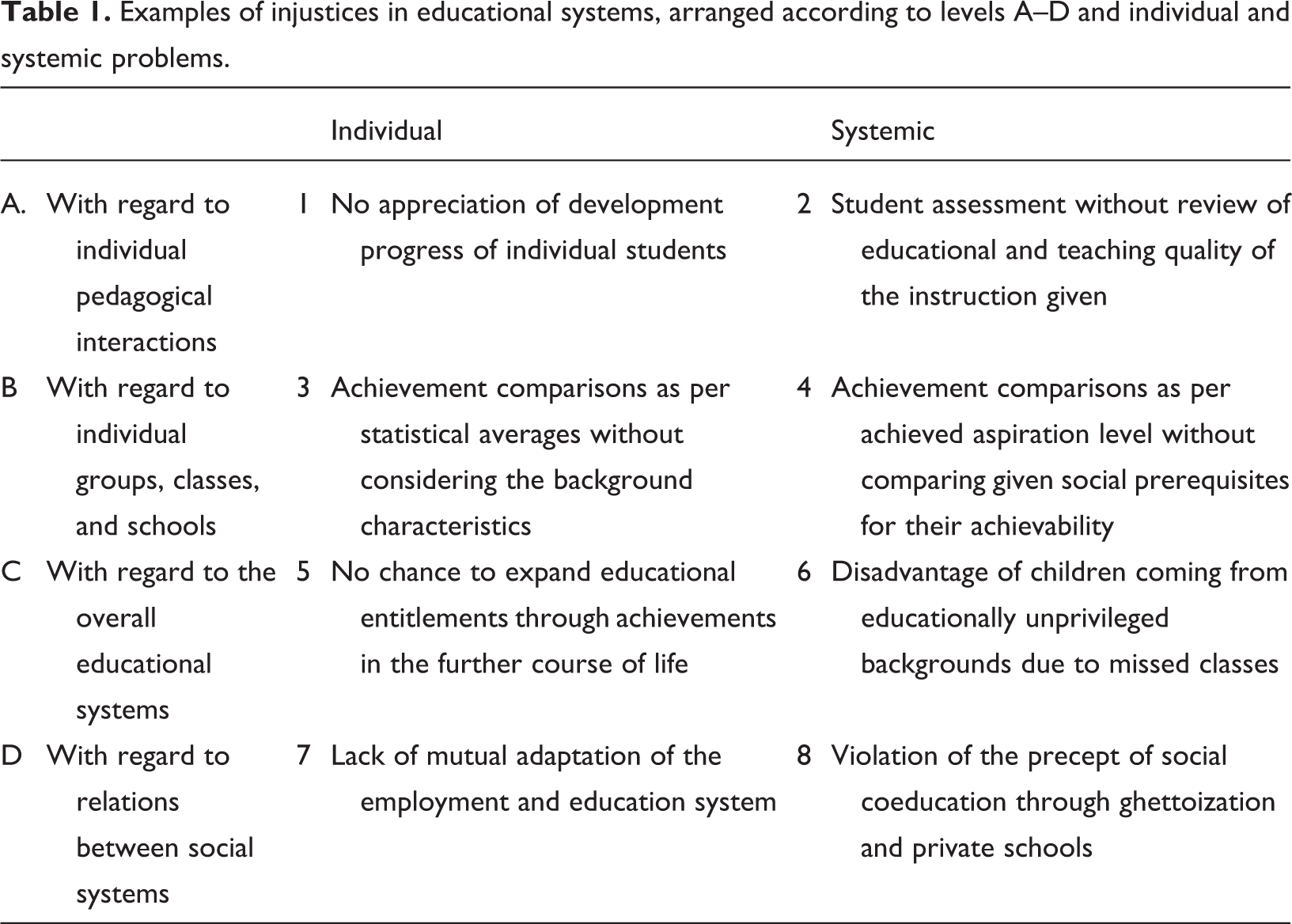
In conclusion, therefore, let us not ask what the ideal just education and school would look like and what education and teaching can contribute to the development of a just society, but let us ask more modestly what must be regarded as characteristics of injustice at the previously differentiated levels, which must be dealt with at pedagogical level, but also in terms of school reform and educational policy.
It is injustice at the level of individual pedagogical interaction, for example, if (1) individual learning progress is not encouraged and appreciated or (2) teachers and professional educators, when assessing adolescents, only make external assessment and do not even question the quality of their teaching and their pedagogical influences.
It is injustice at the level of the group/class/individual school and so on if (3) statistical average values of grades/distribution of entitlements and so on are presented as fair regardless of the composition of the student body and the educational qualifications of the parents and are used as a benchmark for comparative assessments or (4) performance comparisons are made according to the aspiration level achieved without checking the family-related and social prerequisites for their accessibility.
It is injustice at the level of individual educational systems if (5) school judgments are given as final judgments about the educational path of individuals, and changes that occur after schooling are not taken into account or (6) children from educationally unprivileged backgrounds suffer double disadvantage by the lack of personnel and equipment in schools or institutional deficiencies such as the missing classes because they lack the family support that children from educationally privileged backgrounds increasingly experience in such situations.
Injustice with regard to the relations between the educational system and other social subsystems can exist if (7) coordination problems between the educational system and the employment system are also seen and dealt with in an overall political manner and, for example, the consequences of youth unemployment are not unilaterally attributed to the educational system. (8) the requirement of social coeducation, according to which what can only be practiced jointly must also be taught and learned jointly (Aristotle, 1968: Politics 1337a 21–34), is circumvented by ghettoization in schools for children from educationally unprivileged classes or by private schools for members of a particular religion or from rich families or for the descendants of functionaries (cf. Tenorth, 2016).
Private schools can be legitimate if they open up and make use of room for experimentation, which will only play a role in the state school system after having been proven effective in experimental schools. However, private schools must never violate the precept that communal activities should also be taught together. That is why I advocate for conditions that prevent private schools from creating or passing on parallel worlds by accepting only children of rich families or only children belonging to a certain religion, or by concentrating the education of officials in institutions that are not open to others. Such requirements could be that private schools must provide free places for those in need or accept a certain percentage of children with other cultural backgrounds or religious ties, as is the case with Jewish schools in Berlin, which attach importance to Jewish adolescents communicating with non-Jews in school and school life.
The question of whether the cultivation of a critical understanding of pedagogical injustice can further contribute to the development of a positive pedagogical concept of justice will be left open and unanswered here. It may be that a pedagogical concept of injustice in education can contribute to the development of an understanding of justice that is both comprehensive and differentiating. The intrinsic logic of pedagogical thought and action must never be standardized according to notions of justice, but must always be coordinated with the requirements of a governing, teaching, and counseling education. Concepts of justice tend to ascribe an omnipotence to aptitudes and talents or education that they do not have.
This also explains the ongoing dispute we have in Germany about a fair education system. Those who invoke justice as the supreme principle of public education and demand an inclusive school system for all are attached to pedagogical concepts of omnipotence, but those who defend the selection function of the school as just and fair ignore the effects of the intelligence, social status, educational qualifications, and lifestyles of the parents. However, it is not the task of the public school, while attempting to promote extra-pedagogical norms of justice, to support illusions that it cannot meet, nor to permanently set privileges and social demarcations and illustrate them as just, which are, nevertheless, challenged in democratic, republican, and socialist societies under problematizations of a good life for all members of society. Schools and school reforms can only contribute to the humanization of modern societies and raise awareness of issues of justice if schools, education, and teaching resist both instrumentalizations.
Footnotes
Author’s note
In the original German, Benner distinguishes between “Erziehung” and “Bildung.” He uses the term “Erziehung” to refer to the educational impact of pedagogical actors on the learning processes of children and youth; by “Bildung,” he means a human educative formation that happens through his or her interactions with the world. In order to make this distinction visible in English, the word “education” is sometimes followed by [Erziehung] or even [Erziehung and Bildung]. Where “education” is written without an addition, in German “Erziehung” is meant. The German version of the article is published in Johannes Bellmann and Hans Merkens (Eds.) (2019): Education Justice from Promises [Bildungsgerechtigkeit als Versprechen] [in German]. Münster: Waxmann, pp. 23–40. The content of this article is identical with that of the original German version, only little details were made. This English version of Benner's article (2019) has been authorized by J. Bellmann and H. Merkens and acknowledged by ECNU Review of Education.
Declaration of conflicting interests
The author declared no potential conflicts of interest with respect to the research, authorship, and/or publication of this article.
Funding
The author received no financial support for the research, authorship, and/or publication of this article.