




Abstract

This report draws on data from two articles published by the Center for Teacher Education Research of Beijing Normal University, namely, “Survey Report on the Status Quo of Online Teaching and Related Needs Among Elementary and Secondary Schools During COVID-19 Prevention and Control: Based on a Sample Survey on School Principals in China” and “Survey Report on the Status Quo of Online Teaching and Related Needs Among Elementary and Secondary School Teachers During COVID-19 Prevention and Control: Based on a Sample Survey on Teachers in China.” Undertaken by the Center for Teacher Education Research of Beijing Normal University, the aforementioned articles examine the status quo of online teaching and teachers’ needs amidst the COVID-19 response efforts. The project involved an online questionnaire survey of 92 principals and 8,632 teachers from 100 basic-education schools across 23 provinces, municipalities, and regions in China.
Examining these data, this report elucidates and partially compares the status quo, attitudes, difficulties, and needs among school principals and frontline teachers in elementary and secondary schools during the COVID-19 response effort of “suspending classes without suspending teaching and learning.” Data were collected to provide targeted insights to elementary and secondary schools as well as frontline teachers, thereby facilitating communication and mutual understanding between school principals and teachers with regard to online teaching.
Status quo of the adoption of online teaching in elementary and secondary schools
Understanding the status quo of the adoption of online teaching and teachers’ relevant work experiences is integral to the effectiveness of “suspending classes without suspending teaching and learning.” This section examines collected data regarding the current status quo of the adoption of online teaching for K–12 education in China.
Adoption of online teaching
As illustrated in Figure 1, the survey on the status quo of online teaching among educational institutions revealed that 65.2% of surveyed elementary and secondary schools had adopted online teaching. More specifically, the percentage of schools with online teaching was the highest in Tianjin, Chongqing, and provincial capitals (77.8%). Meanwhile, 27.2% of the surveyed schools were poised to adopt online teaching.
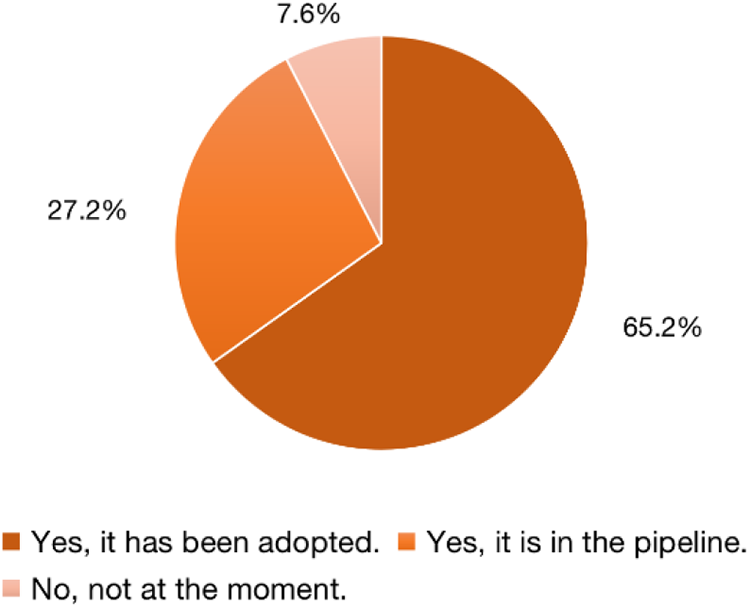
Status quo of the adoption of online teaching in educational institutions.
Preferred online teaching approaches
As illustrated in Figure 2, the survey on the approaches to online teaching among educational institutions revealed that 76.5% and 75.3% of the sample schools have adopted interactive Q&A and livestreaming, respectively. One-to-one online tutoring was the least popular approach, adopted by merely 25.9% of the surveyed schools. A statistical analysis was conducted to identify teachers’ preferred online teaching activities. According to the results (Figure 2), 28.2% of the surveyed teachers selected online interactive Q&A as their preferred online teaching activity, followed by webcasting/video on demand (27.5%) and live streaming (26.7%).
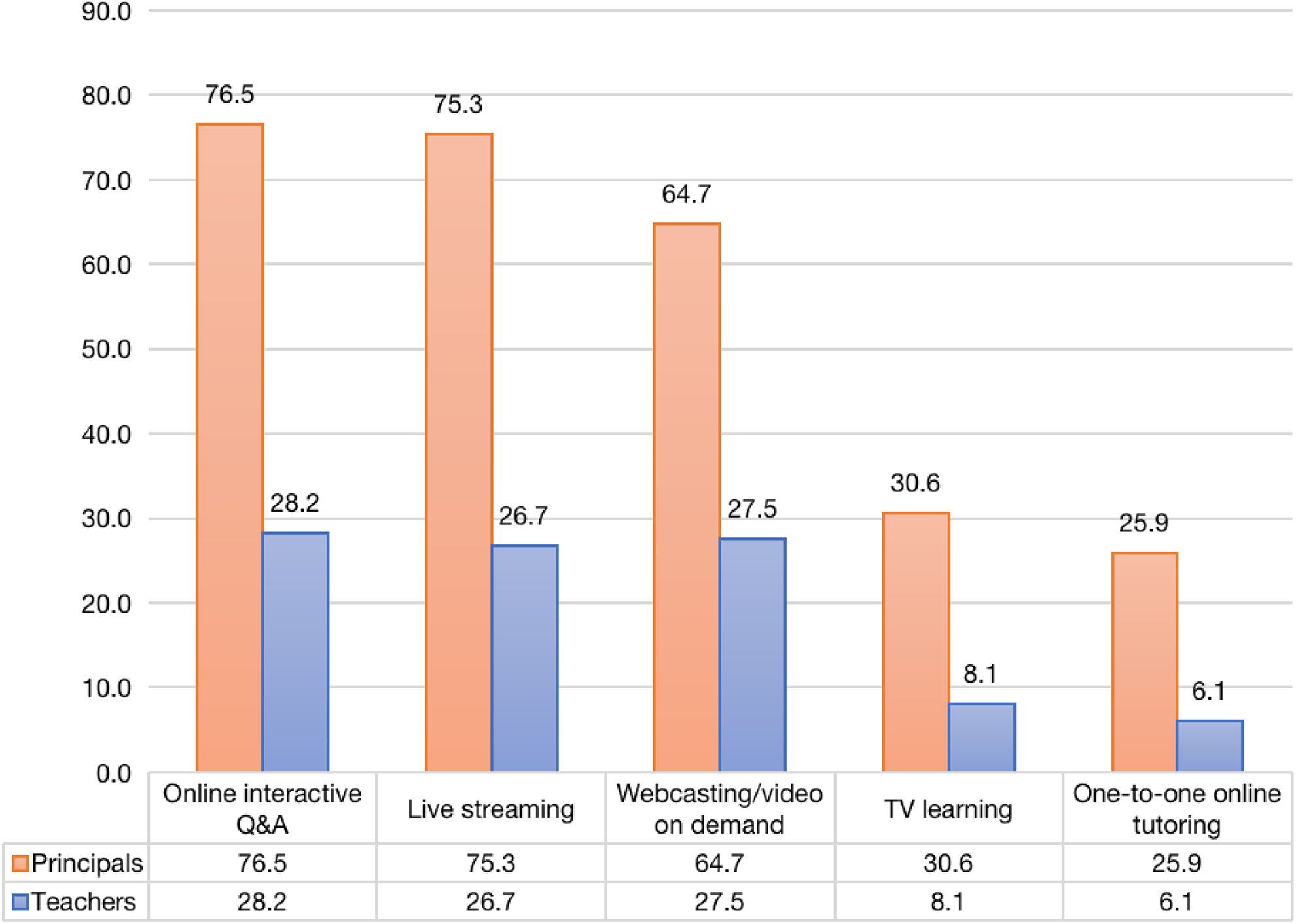
Comparison of approaches to online teaching at schools and teachers’ preferred approaches.
Previous training in online teaching
An examination of the online teaching training received by teachers revealed that more than 76.1% of schools had offered training in online teaching in the past. Accordingly, a survey was conducted on the provision of training by schools and teachers’ participation in training offered by the superior education department over the last 3 years. As Figure 3 shows, 35.7% of the schools had held three to five training sessions in online teaching over the past 3 years, while 37.1% of the schools had arranged for teachers to attend one to two training sessions in online teaching offered by the higher levels of China’s education departments.
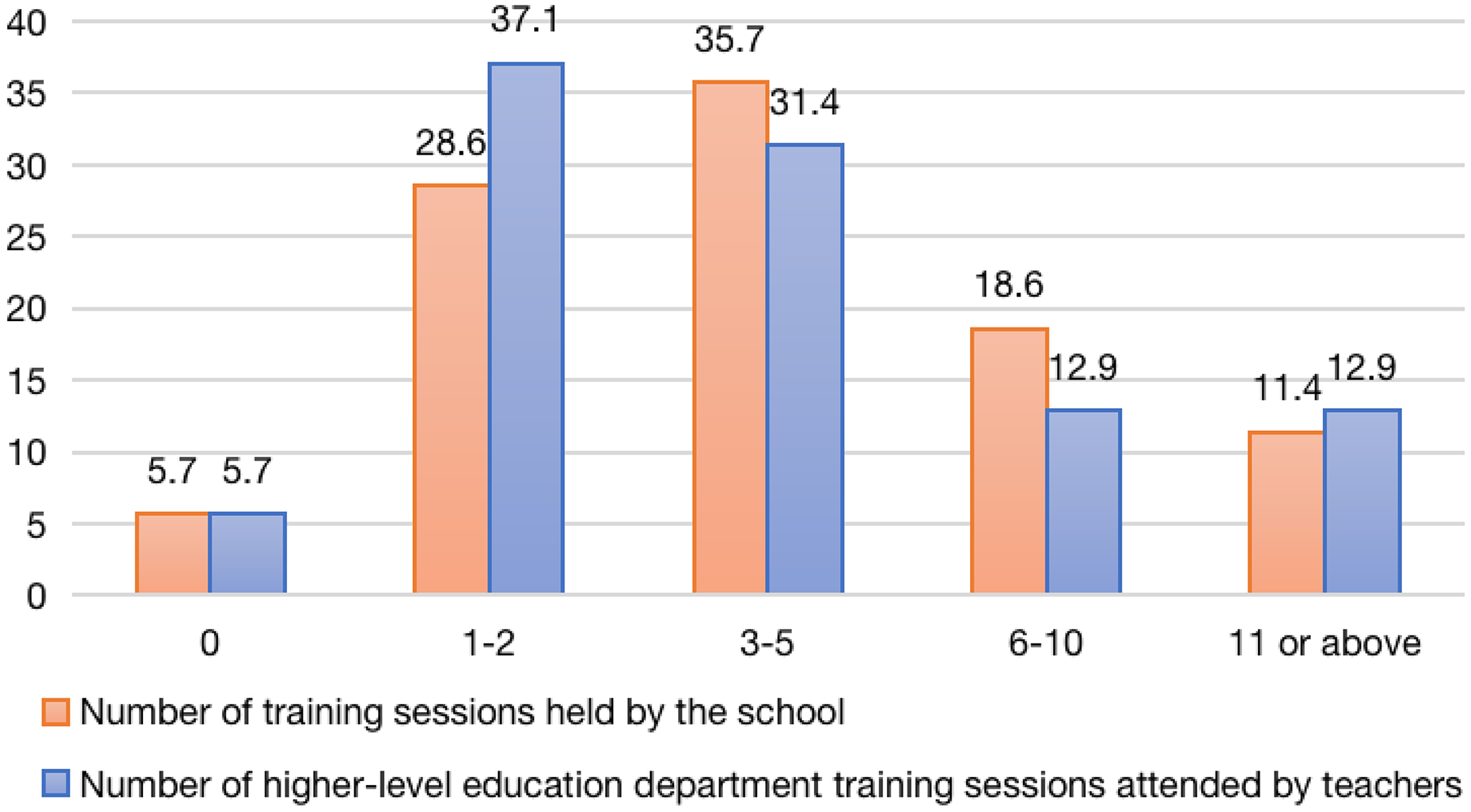
Online teaching training received by teachers in educational institutions.
Frequency of online platform use for teaching and learning
The frequency with which teachers and principals used online platforms for teaching and learning was also investigated. As Figure 4 shows, teachers who “frequently” and “occasionally” used online platforms for learning accounted for 8.8% and 34.5%, respectively, while those who “frequently” and “occasionally” used online platforms for teaching accounted for 1.9% and 18.2%, respectively. Survey results also show that 25% and 51.1% of school principals had “frequently” and “occasionally” used online platforms for learning purposes, while 7.6% and 42.4% of them “frequently” and “occasionally” used online platforms to teach, respectively. More specifically, prefectural- or county-level municipalities recorded the highest percentages of teachers who “frequently” used online platforms for learning (9.3%) and teaching (2.2%). Compared to those from other regions, school principals from Beijing, Shanghai, Guangzhou, and Shenzhen exhibited the highest frequency of using online platforms to learn (41.2%) and teach (17.6%).
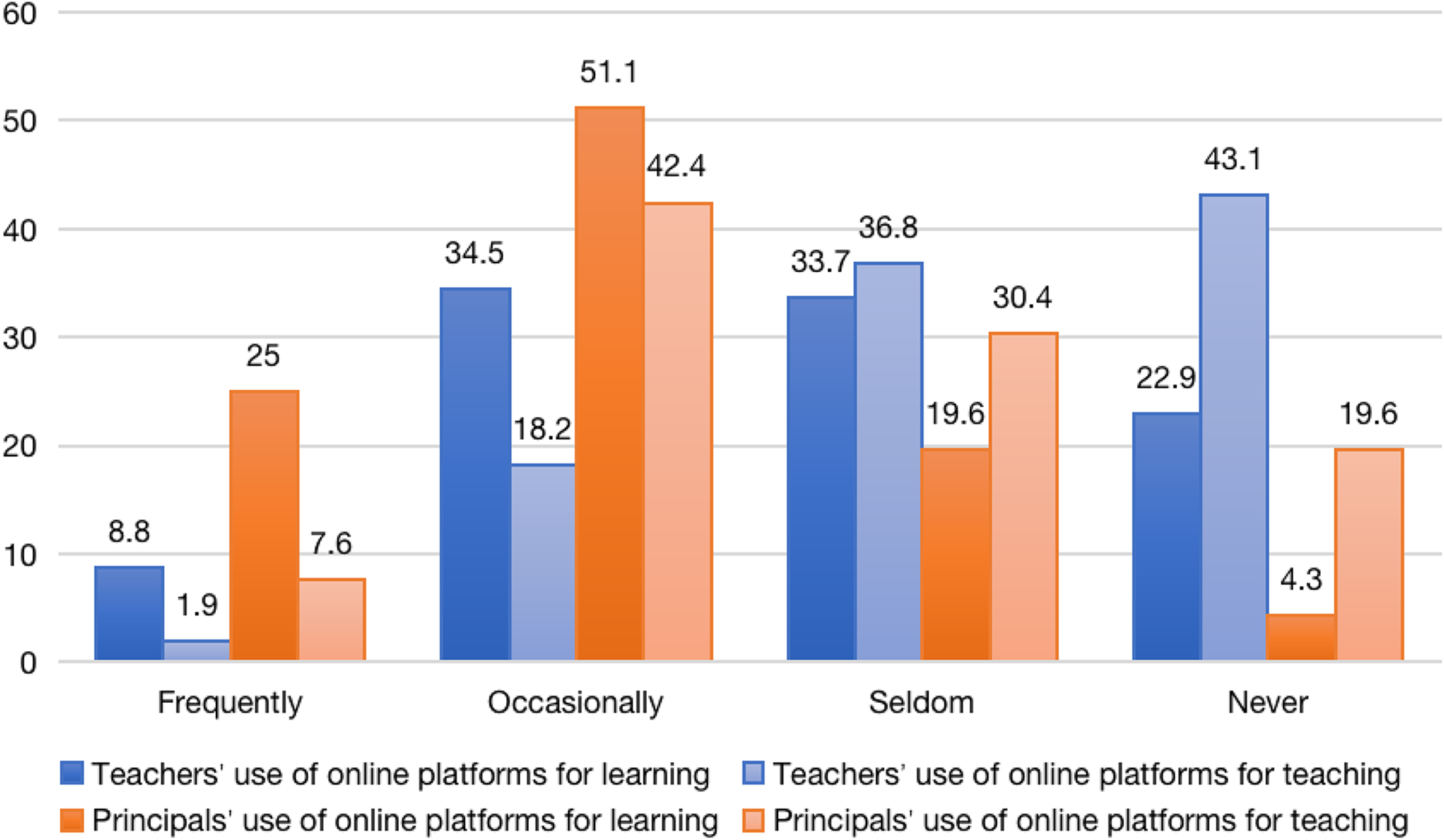
Frequency of online platform use for learning and teaching purposes among teachers and principals.
Perceived efficacy of online teaching training
The results of a survey on the provision of online teaching training provided by schools reveal that the majority (76.1%) of surveyed schools had offered online teaching training in the past. Further investigation was conducted to discern whether past training activities satisfies teachers’ current needs. As Figure 5 shows, 60% of the surveyed teachers suggested that the offered training in online teaching was “somewhat effective” in satisfying their current online teaching needs, while 6.2% described it as “completely effective.” Meanwhile, 48.6% and 4.3% of the surveyed principals believed that the training was “somewhat effective” and “completely effective” in satisfying teaching needs, respectively. However, 44.3% of principals deemed past training as “somewhat ineffective” in satisfying current needs.
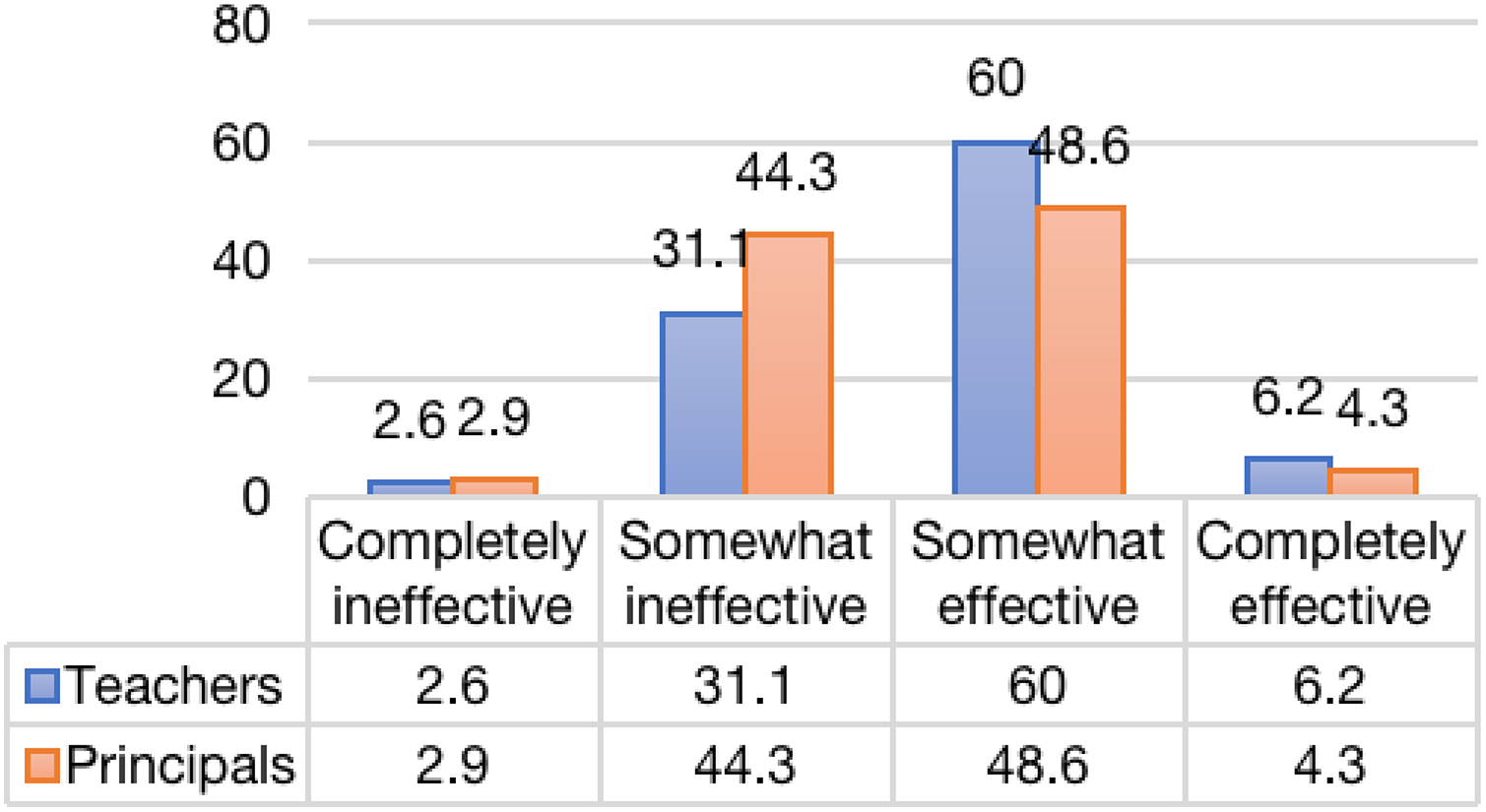
Effectiveness of online teaching training in satisfying teachers’ current needs.
Content deemed most necessary for current teacher training
The survey investigated what school principals and teachers perceived to be the most salient content of current teacher training. As Figure 6 shows, 78.3% of principals and 75% of teachers advanced the need for training in “frequently used online teaching platforms and their application and administration,” followed by the “acquisition and selection of online teaching resources,” “design and development of micro-lectures,” and “design and planning of online activities.”
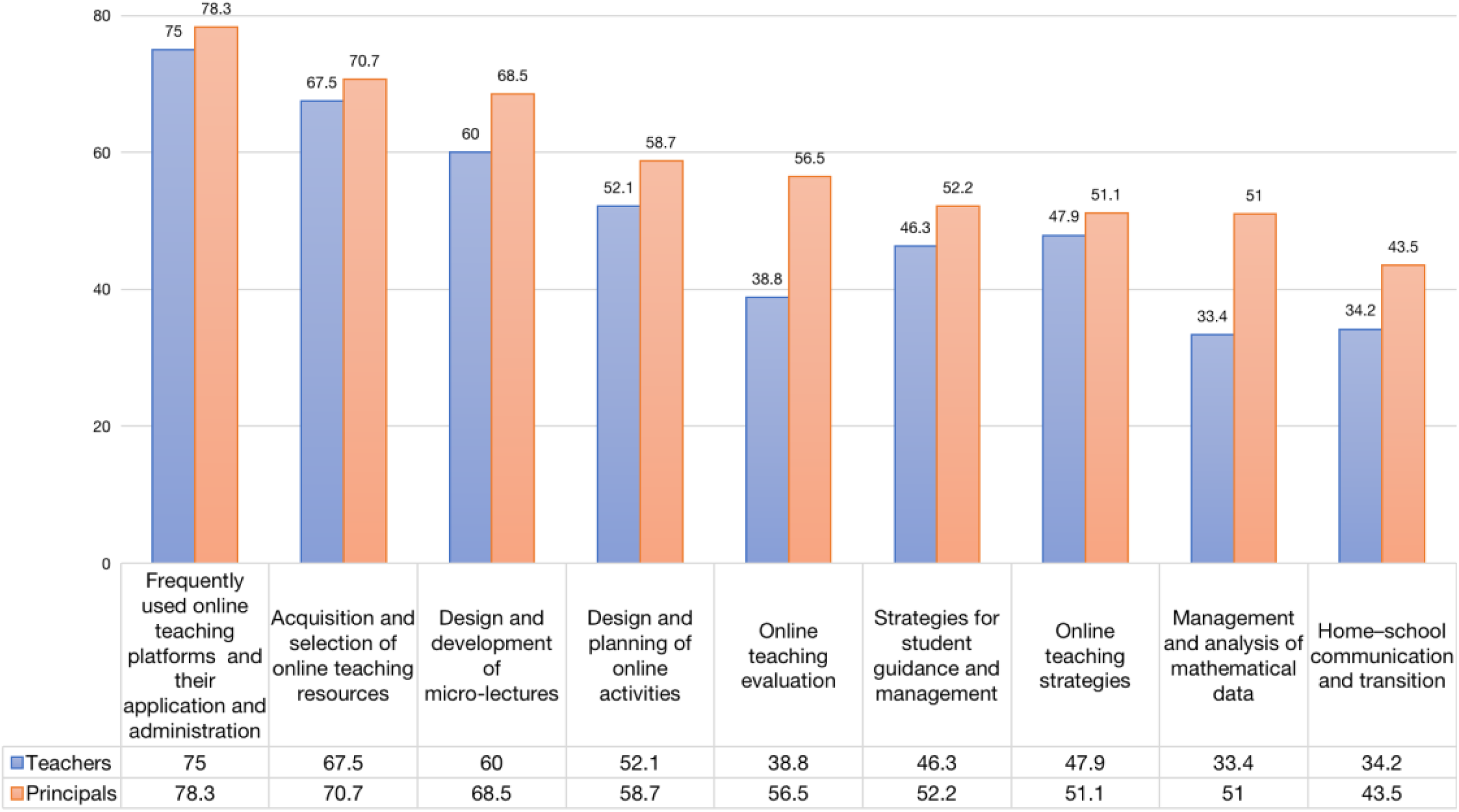
Salient content for current teacher training according to teachers and principals.
The knowledge and attitudes of teachers and principals regarding online teaching
The knowledge and attitudes of teachers and principals regarding online teaching are vital to effective school planning and a smooth teaching process. This section examines collected data regarding the knowledge of and attitudes toward online teaching among teachers and principals in China.
Perceived level of difficulty of online teaching
Teachers’ perceived level of difficulty of online teaching was also surveyed. As Figure 7 illustrates, online teaching was regarded as “somewhat difficult” by 53.8% of teachers and “extremely difficult” by 6.7% of teachers.
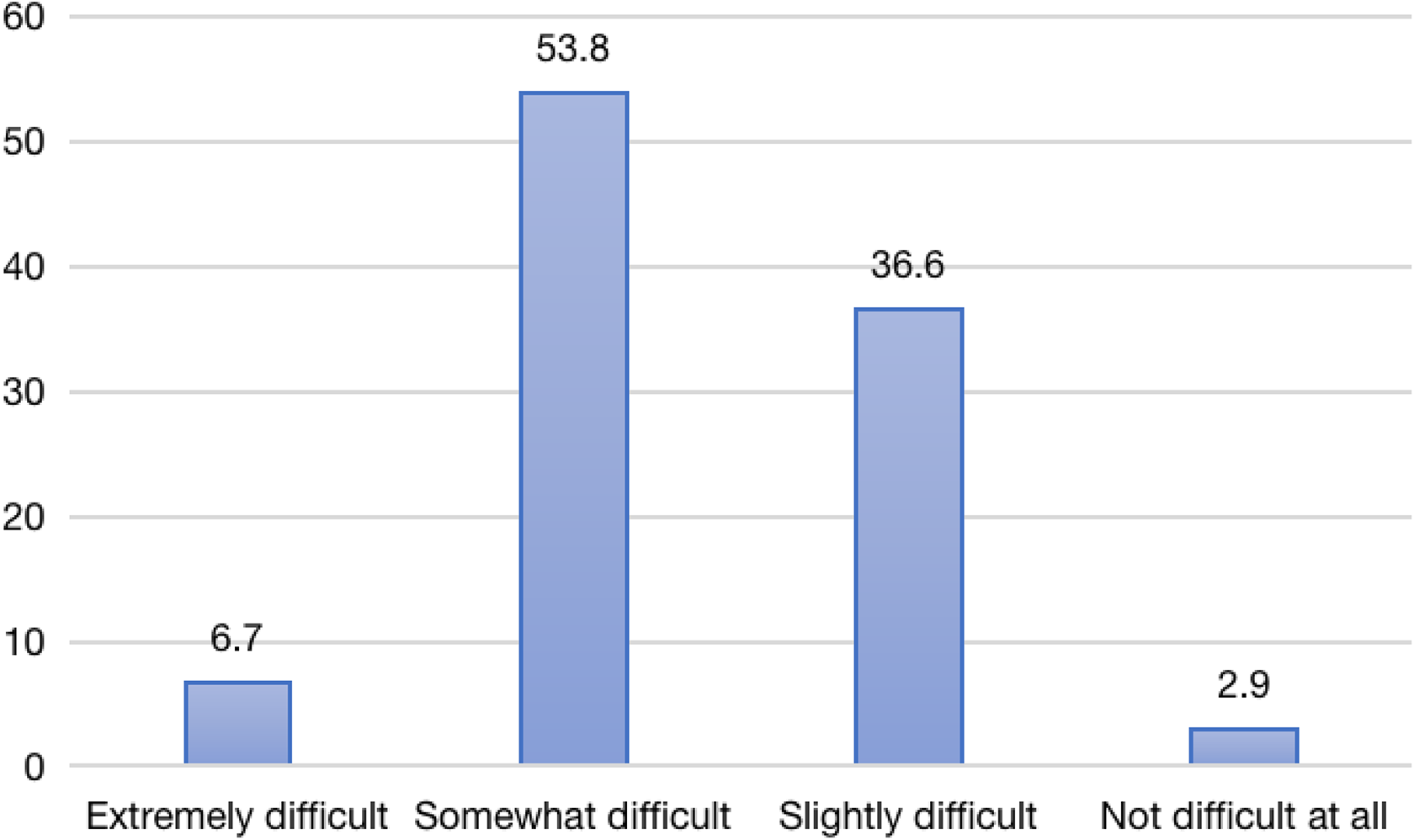
Perceived level of difficulty of online teaching according to teachers.
Teachers’ psychological adaptation to learning and adopting online teaching
Teachers’ psychological adaptation to learning to adopt and adopting online teaching was investigated in four domains, namely, interest, motivation, self-efficacy, and emotional adaptation. In doing so, the survey sought to understand teachers’ interest and motivation in learning to adopt and adopting online teaching, as well as their self-efficacy and emotional experiences—such as tension and stress—when teaching online. As Figure 8 shows, the teachers generally held a proactive attitude toward learning to adopt and adopting online teaching. However, they also exhibited some degree of emotional tension and stress, which warranted emotional adjustment.
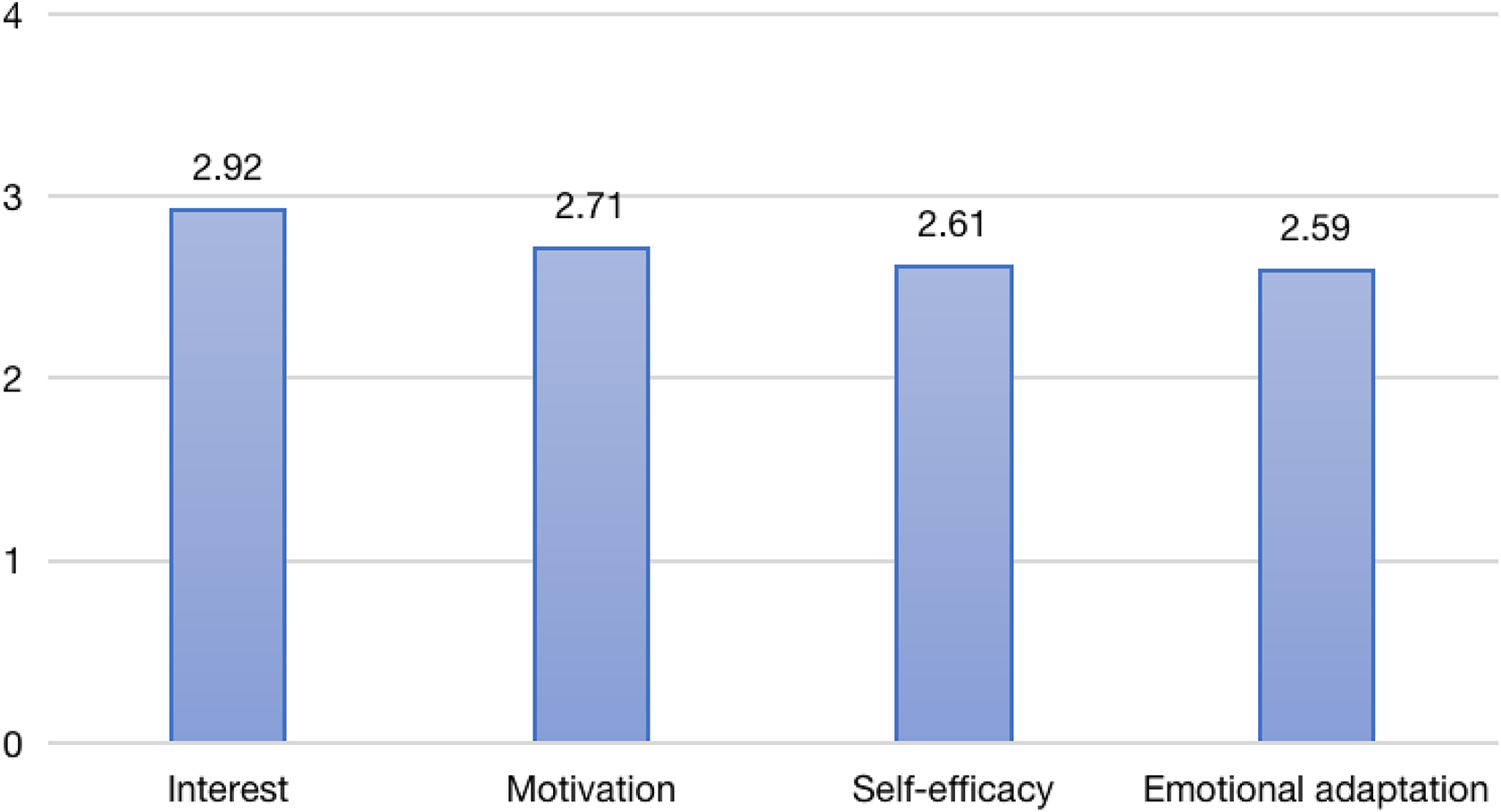
Teachers’ scores in psychological adaptation to learning to adopt and adopting online teaching.
Attitudes toward the adoption of online teaching
The attitudes of school principals and teachers toward online teaching were surveyed. As Figure 9 shows, 80.5% of principals and 70.5% of teachers supported the adoption of online teaching, while 17.4% of principals and 25.7% of teachers were moderately opposed to online teaching.
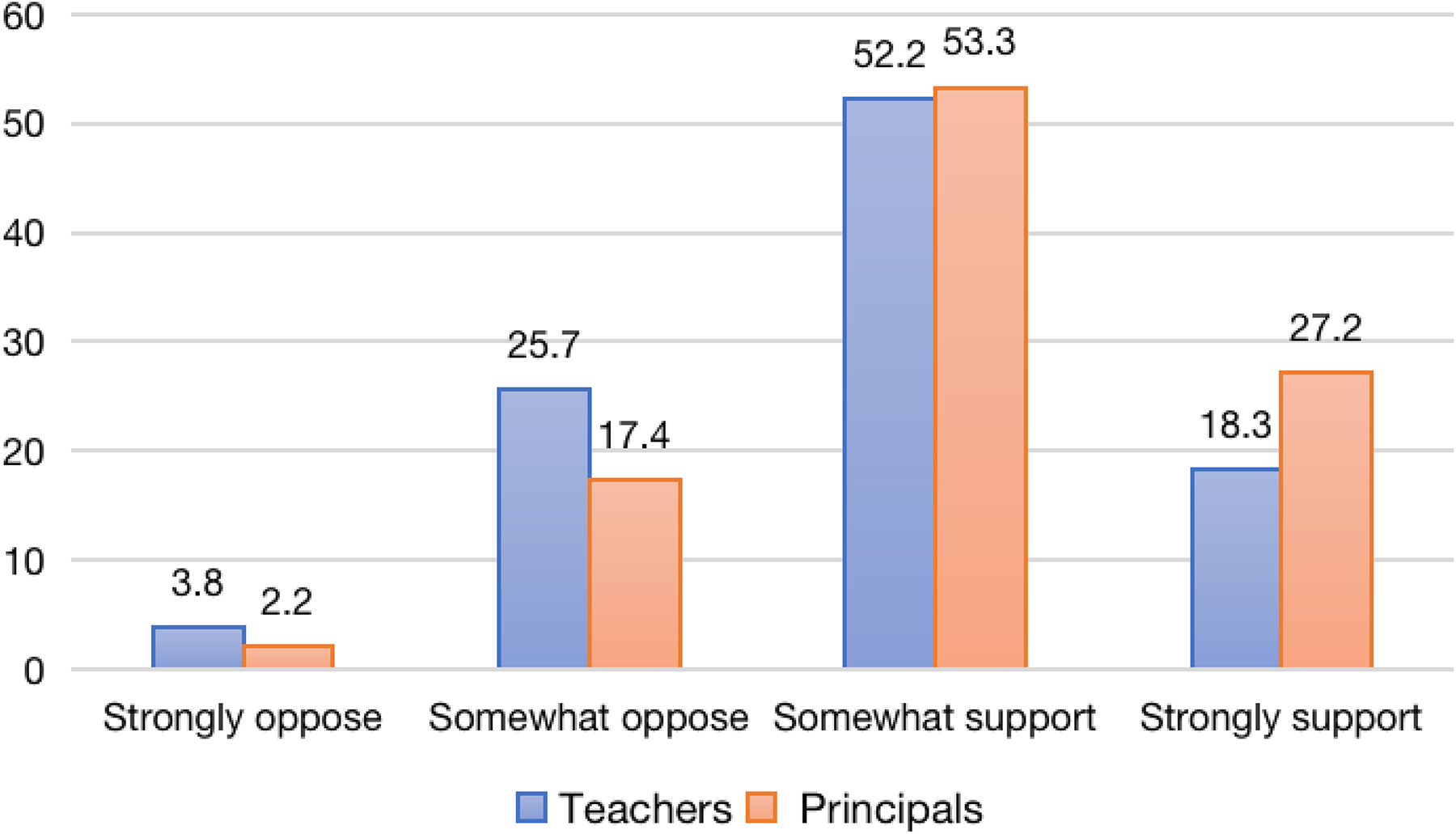
Comparison of principals’ and teachers’ attitudes toward online teaching.
Difficulties and needs arising from the adoption of online teaching
Understanding the difficulties faced and support required by schools and teachers when adopting online teaching is integral to the effectiveness of “suspending classes without suspending teaching and learning” amidst disease prevention and control measures. This section details survey results regarding perceived difficulties and needs of teachers and principals in regard to online teaching.
Difficulties faced by schools in regard to online teaching
Figure 10 presents findings of the survey concerning the difficulties faced by schools in terms of online teaching activities. Approximately 66.3% of the surveyed principals claimed to experience “difficulty in guaranteeing the quality of web-based learning”—the most commonly selected option from the list of difficulties associated with the adoption of online teaching. Other difficulties include “underdeveloped information infrastructure” (48.9%), “tight schedule and heavy workload” (43.5%), and “lack of guidance and training” (38%).
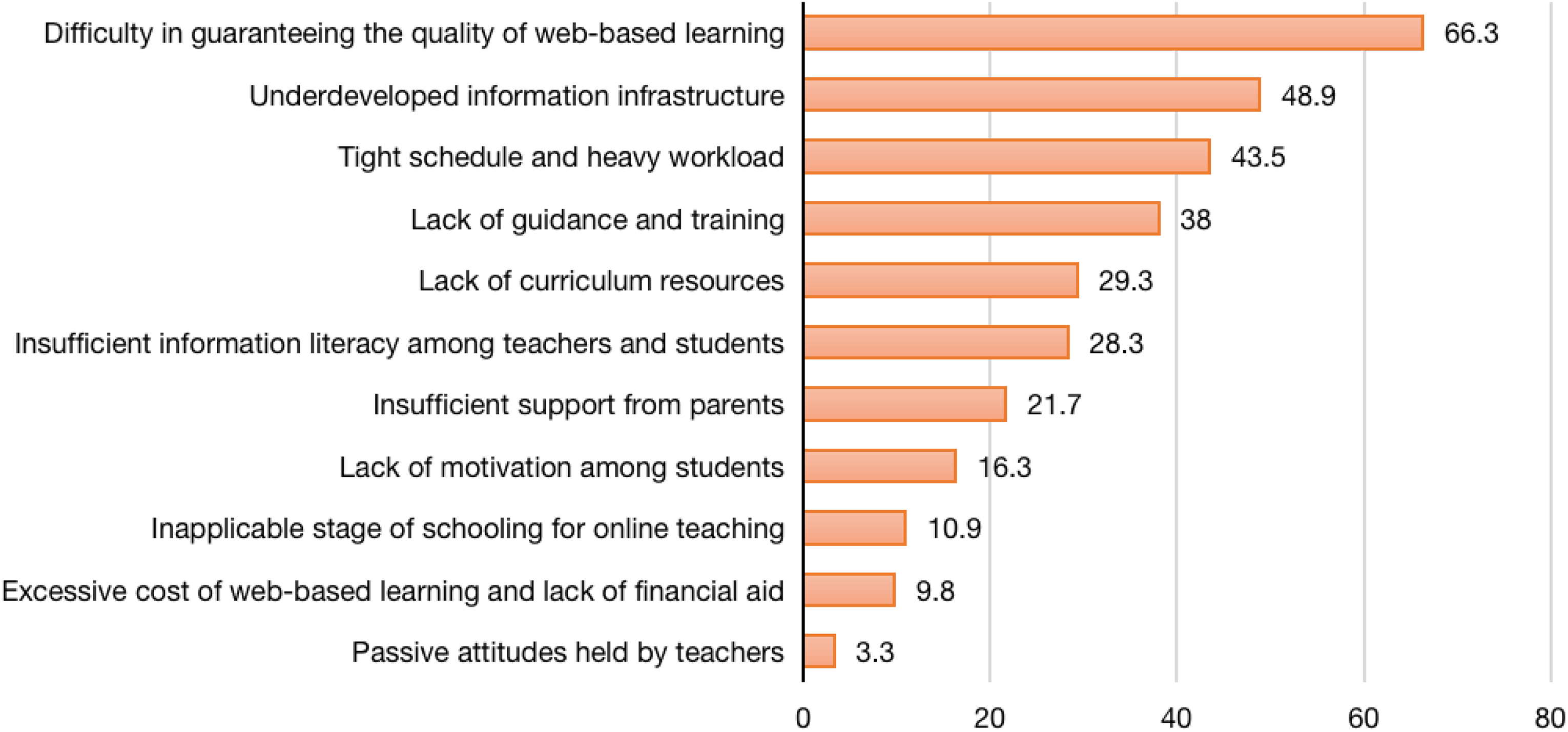
Ranking of difficulties faced by schools in implementing online teaching activities.
Types of support required by schools
The survey explored the types of support required by schools in adopting online teaching. As Figure 11 shows, 94.6% of school principals noted the need for the “assurance of learning outcomes” in the adoption of online teaching—an element that 58.7% of respondents identified as “extremely necessary.” Support in “curriculum and teaching resources” was also selected by 94.6% of the principals, followed by “guidance and training for teachers” (93.5%), “platform-related technical support” (93.5%), and “online home–school collaboration” (92.4%).
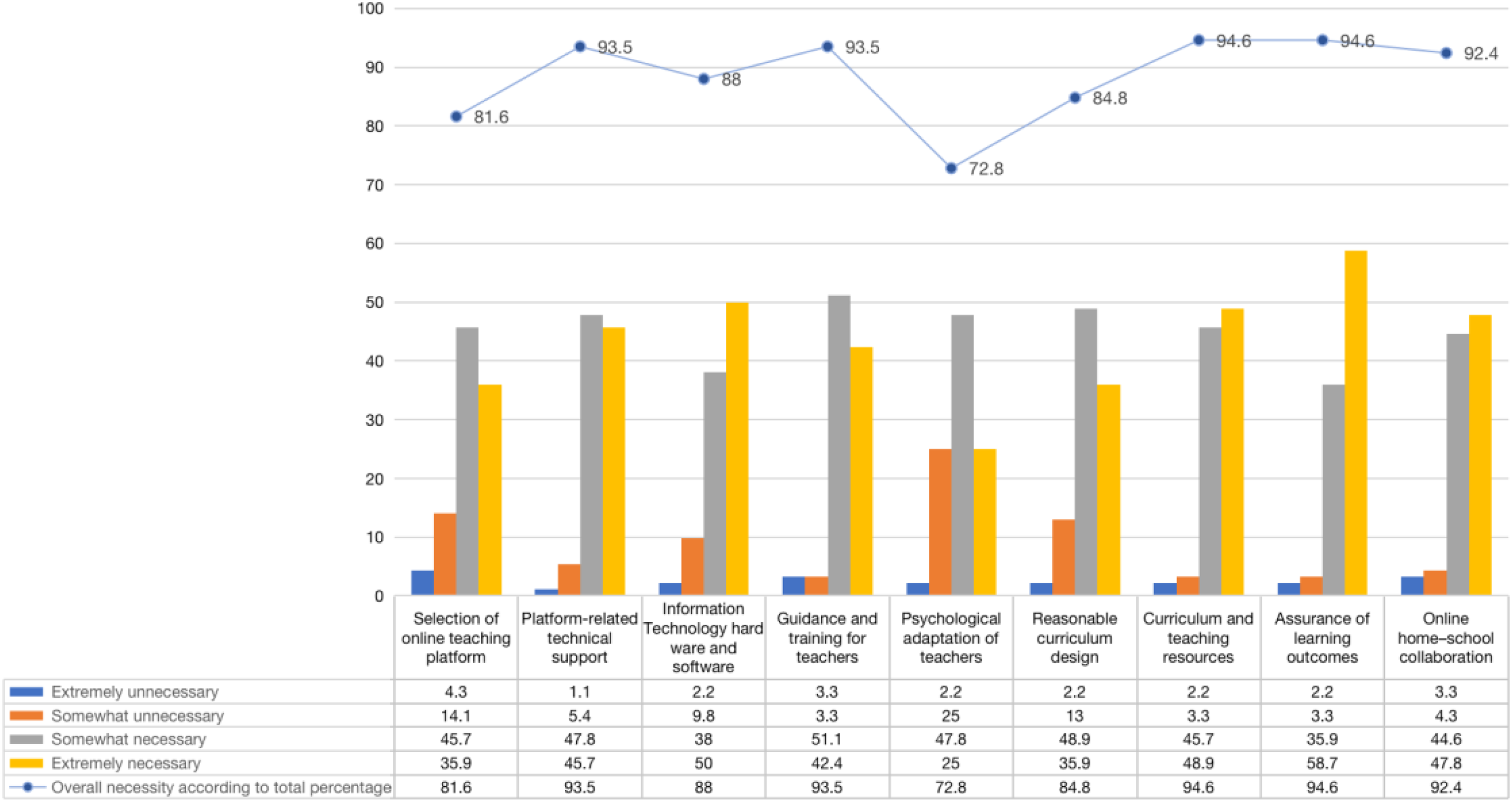
Types of support required by schools in adopting online teaching.
Types of support required by teachers
Figure 12 presents the results of a survey on the types of support required by teachers in adopting online teaching. According to the results, teachers exhibited the greatest need for support in general Information Technology literacy, online teaching skills, online teaching resources, and home–school cooperation. All items in these four categories were deemed necessary by more than 89% of the surveyed teachers. More specifically, “access to successful cases of online teaching” (96.5%) and “access to online curriculum resources” (96.1%)—both categorized as online teaching resources—were selected by the highest percentages of respondents. Support in terms of “teachers’ psychological counseling and adaptation” was deemed necessary by approximately 69.9% of teachers, indicating that teachers’ need for psychological support was significantly lower than the aforementioned categories.
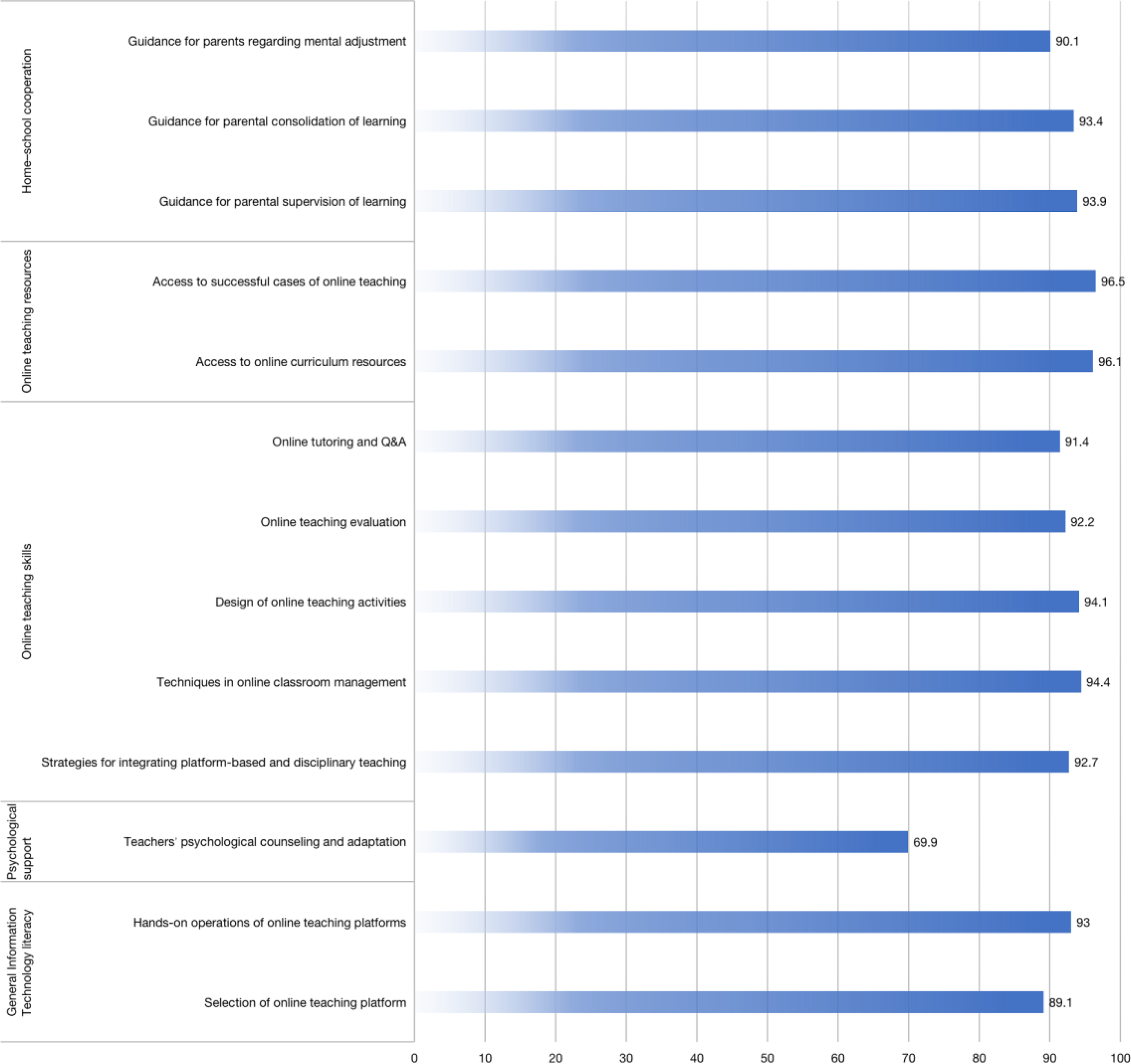
Types of support required by teachers in adopting online teaching.
Conclusion
This report draws on surveys investigating the status quo of online teaching and related needs among elementary and secondary school principals and teachers under China’s COVID-19 prevention and control measures. The findings reveal that the majority of elementary and secondary schools in China actively responded to the Ministry of Education’s rallying call for “suspending classes without suspending teaching and learning” by adopting online teaching in a well-planned and organized manner. Hindered by the urgency of the pandemic, China’s elementary and secondary schools have been confronted by a series of setbacks in preparing and organizing online teaching programs. Fighting an uphill battle, frontline teachers required multifaceted support ranging from information technology and educational resources to home–school cooperation. The majority of school principals and teachers have displayed a high degree of psychological adaptation in transitioning to a new pedagogical model, swiftly adjusting their mindsets and proactively facing the challenges. By comparing and contrasting survey data, this report demonstrates the contrast in pedagogical focuses between school principals and teachers. Where principals adopted the macroscopic perspective of overall planning, teachers took the microscopic viewpoint of actual pedagogical practices. The two groups also exhibited discrepancies in terms of their knowledge and understanding of specific issues.
This report sought to understand and illustrate the difficulties facing and most realistic needs of China’s elementary and secondary school principals and teachers undertaking pedagogical practices under disease prevention and control measures. In doing so, it seeks to facilitate adaptation to the shift in learning and teaching model, thereby promoting the smooth and effective adoption of online teaching in elementary and secondary schools.
Footnotes
Declaration of conflicting interests
The author(s) declared no potential conflicts of interest with respect to the research, authorship, and/or publication of this article.
Funding
The author(s) disclosed receipt of the following financial support for the research, authorship, and/or publication of this article: Project “How to improve teacher preparation quality” supported by National Natural Science Foundation of China (71974016); Project “How to prepare a good teacher” funded the International Joint Research Project of Faculty of Education, Beijing Normal University (CER201905).
