




Abstract
Purpose:
This article identifies an issue in mathematics education, that is, the perceived lack of emphasis in recent times of the roles that the “person” plays in the development of mathematics. The purpose is to examine how values/valuing might contribute to addressing the issue.
Design/Approach/Methods:
“Data” were collected from several purposeful conversations among the three authors. The conversations were audio-recorded and machine-transcribed. The transcript was then subjected to content analysis to identify themes.
Findings:
The data analysis yielded two novel approaches to raising learners’ awareness of the humanness of mathematics. One would be to reframe the values that are operationalized when mathematics is taught and learnt, as processes of valuing which teachers and students engage in, respectively. The second approach would be to acknowledge that writers of mathematics/mathematicians are not simply presenting knowledge but are also acting as mentors conveying and transmitting messages about the discipline.
Originality/Value:
The involvement of the “person” in the development of mathematics is not new knowledge, though it can be made more visible in mathematics education. This article identifies two approaches—valuing and mentoring—which are novel in that they are already part of the pedagogical process and thus, accessible.
As a school subject, mathematics is often perceived as the study of “something out there” (e.g., quadratic curves, congruent triangles) and of concepts and skills such as factorization and probability. This message is further reinforced when applications of mathematics are presented at a surface level, although there have been increased efforts more recently to feature the human doer in applications scenarios in mathematics textbooks and lessons. Nevertheless, school mathematics continues to be seen by many in ways which set it apart from other subjects such as geography, history, and literature, where there are opportunities from students to learn about what, why, and how humans do what they do.
Yet, we know that mathematical themes such as counting and measuring are as much a form of social activity/construction as migration and wars which we encounter in other school subjects. Just like there are different reasons for and phases of human migration, and various stimuli for and ways of waging wars, there are different cultural needs for and methods of counting and measuring. That we take for granted the decimal numeration system in day-to-day counting exercises masks the fact that it was a preferred practical choice from among other counting systems utilizing different bases. For example, the Inuits in Canada and the Celtics in northwestern Europe function with number systems which are base-20 in nature. Indeed, as Bishop (1990) asserted, one of the greatest ironies in this whole field is that several different cultures and societies have contributed to the development of what is called western mathematics: the Egyptians, the Chinese, the Indians, the Arabs, the Greeks, as well as the western Europeans. (p. 61)
Values in (mathematics) education
Values have traditionally played a central role in school education, even before we consider the formal school subject of moral/ethics/values education. As Tal and Yinon (2009) put it, the mere use of the expression “value education” makes other persons quiver as it is interpreted as indoctrination, coercion and an unjust limitation of the children’s choices. Nevertheless, in reality there is no value-neutral education. Every decision made by schools as organizations and by individual teachers in their classrooms, reflects value preferences and it is likely to have an impact on the students’ lives. (p. 259)
When the construct of values was first introduced into mathematics education (research) by Bishop (1988), it was presented as being the ideals and the principles lying behind the actual language or symbols developed by a culture. They are the values which implicitly, or explicitly, the cultural group believes in and sustains. (p. 61)
On the other hand, there is also the achievement motivation perspective which posits that values exert dominant influences on decisions and actions (i.e., behavior) (Eccles, 1983). Lomas’ (2017) study provides more recent evidence in mathematics education that values are conative in nature. This was the theme in Seah (2019), in which valuing is defined as an individual’s embracing of convictions in mathematics pedagogy which are of importance and worth personally. It shapes the individual’s willpower to embody the convictions in the choice of actions, contributing to the individual’s thriveability in ethical mathematics pedagogy. (p. 107)
Values and valuing
Yet, with people (policymakers, researchers, teachers, learners, etc.) it soon became apparent that there can be a difference between what one claims and what one espouses. For one reason or another, any particular quality we subscribe to may not always be expressed through our decisions or actions. Perhaps, too, the values we embrace are organized in some priority order within us, and some values override the others when they are activated at the same time. There might also have been too much made of the possibility of lists of values and of putting together such lists. Take Bishop’s (1988) mathematical values as an example, if one is to treat the three pairs of mathematical values as a list, and perhaps even taking the effort to explore if there might be a fourth pair, then having such a “list of mentality” misses the point of focusing on this aspect of conation and of (mathematics) education, that is, understanding how values are being espoused and activated in the mathematics teaching and learning processes.
Instead of itemizing mathematics pedagogical knowledge through the identification only of values, we want to provide scope for individuals to develop what they value, and for recognizing this developing process. Instead of naming what we find important (where “value” is a noun), we want to emphasize the act of embracing what we find important (where “value” becomes a verb). In so doing, we foreground the human being, the person who is doing the valuing. In fact, if we want students to learn about valuing, then they should have the opportunities to value. In other words, this shift of the discourse from “What are your values?” to “What do/can/should you value?” more explicitly positions “you” as the agent of learning and change.
By referring to the verb (i.e., “valuing”) rather than the noun (i.e., “value”), we are also emphasizing the process in which a value is impacting on decisions and/or actions, whereas referring to a value alone can be considered as merely naming or referencing. Yet, in mathematics education research, we are often not only concerned with what values an individual subscribes to but also interested in how these values affect the ways in which the individual perceives the pedagogical context, makes a choice/decision, and acts on it whether it involves the act of teaching or of learning. From the intervention perspective, we may also be interested to know how desirable or enabling values might be fostered among students.
Valuing involves people interacting with one another. One form of these interactions is the writings that are published, and which we read. These may take the form of teachers’ blogs, teacher professional magazine articles, research journal articles, conference proceedings, as well as books, in either hardcopy or online format. The writers of these publications help to shape and reshape our professional and academic ideas and reflections. In the sense that the valuing of these writers or the characters portrayed by these writers is represented and transmitted through the writings, we can refer to these writers as our mentors. It is on this notion of mentors we focus our attention next.
Mentoring in mathematics education
To facilitate our discussion here of how writers mentor us in mathematics education, let us consider a few books nominated by the third author that had been written about mathematics or mathematicians. The first book is The Man Who Knew Too Much: Alan Turing and the Invention of the Computer, written by David Leavitt. It is about Alan Turing and his life particularly. He had psychological and mental problems which made him a target from some unpleasant people. But he was a very important mathematician during the Second World War. His research on artificial intelligence had helped him to break the codes behind German military messages and had seen him involved in designing and building a machine which was capable of thinking itself. As for this professional mathematician, he was fairly persecuted for his beliefs, many of which were mathematical. Turing would have a strong view, we believe. What he valued or how valuing came into his life would be evident from reading this book.
The next book is The Indian Clerk, also written by David Leavitt. This book is about the mathematician Srinivasa Ramanujan who was born in India. He was initially having a fairly ordinary existence although there was a school teacher who helped him. Ramanujan would later have his mathematical prowess developed further during his time at the Cambridge University, and he finished up being a brilliant mathematician and completely changed the ideas that pure mathematicians had at that point. However, it was no easy feat achieving this: The Cambridge mathematicians did not like what he was doing, because he was challenging and changing prevailing values. Like Alan Turing in the previous book, Srinivasa Ramanujan was an individual in his society, and there were problems associated with his background. And from these contexts came the ideas about what were valued by the characters and/or by the writers.
Next, we consider the book, From One to Zero: A Universal History of Numbers written by Georges Ifrah. Ifrah was a mathematics teacher who later turned into a historian of mathematics. He had written this history book in a very interesting style. It is a very detailed source of how different number systems were set up and how they subsequently developed over time. In the several hundred pages, Ifrah proved himself to be a prolific writer. Coupled with his very strong views—and he did have some nice points about mathematicians and their ideas—he had presented himself as a provocative writer too. The writer’s valuing was evident throughout the book.
We next consider Descartes’ Dream: The World According to Mathematics, a book that was written by Philip J. Davis and Reuben Hersh. This book makes reference to René Descartes, a 17th-century mathematician, who had dreamt of a mathematicized universe. The writings present thought-provoking ideas regarding the applications of mathematics in computerization across different aspects of our lives, including ethical implications. The writers leave us with no doubt about their valuing of the serious side of technology. This book also represents one of the earliest uses of the word “mathematicize,” and this too portrays strong messages of what was being valued about the nature of mathematics. Also, as we can see from the reference to dreams in the book’s title, there was also a valuing of the imagination.
The fifth book discussed here is one written by Morris Kline, entitled Mathematics in Western Culture, which provides an account of how mathematics had shaped and continues to do so on a range of facets of Western living. These would include the arts, the sciences, and the religion. There is a substantial “so what” ideas being discussed in this book, and the valuing which are privileged within the Western culture is in the spotlight here.
Lastly, we would like to refer to Godel, Escher, Bach: An Eternal Golden Braid which was written by Douglas R. Hofstadter. The book brings together what we know about the lives and works of three prominent figures, namely Kurt Gödel (logician), M. C. Escher (artist), and Johann Sebastian Bach (composer), to interrogate the nature of mathematics. By positioning the three areas of knowledge within a cultural frame, Hofstadter considered the formal systems underlying cognitive activities, espousing his valuing of such notions as meaning and reduction. Indeed, revisiting this Pulitzer Prize-winning book now, the idea that computer systems might develop true intelligence seems plausible!
The third author held these writers mentioned above in high esteem, regarding them as his academic mentors. To him, they represent people who have quite broad minds and creative ideas which help to shape what readers value in what is going on in mathematics pedagogy and elsewhere in education. Thus, it is useful to ask ourselves what their writing reveals about valuing in mathematics. Of course, you may ask, “But where’s the mathematics?” and our reply would be, “Everywhere! These writings are all about mathematics. The mathematics is everywhere.” In fact, the third author would even say, “That’s your syllabus; that’s your curriculum!” That is, what the mentors wrote collectively—the content (including the characters), the experience, and the valuing they represent—develop and shape the competencies and skills which are otherwise taught indirectly through the mathematical content and knowledge which we commonly associate in school mathematics programs.
It is also worthy to mention that not all the writers and mathematicians featured in the six books present the stereotypical view of the mathematics genius: social misfits, weird, and exclusive, which would further cement the misconception that mathematics is “something out there.” For example, Ramanujan lived a normal life and not privileged in any way. He had to maintain a postal communication with mathematicians in Cambridge University to try to get their attention. We believe there are many more examples among relevant publications to convey this inclusive image of mathematicians to learners and the wider community.
An example of valuing and mentoring
Above we explained how “persons” in mathematics could mentor or influence others’ views or values in mathematics education. Let us illustrate the roles of mentoring and of the valuing associated with it at the policy level of mathematics education. At the turn of this millennium, the U.S. National Research Council commissioned a report of an 18-month study funded by the U.S. Department of Education and the National Science Foundation (National Research Council of the United States, 2001). The study was conducted by a diverse 18-member research team, led by Jeremy Kilpatrick, to provide “a more rounded portrayal of the mathematics children need to learn, how they learn it, and how it might be taught to them effectively” (National Research Council of the United States, 2001, p. xiv). Central to the report is the team’s adoption of “a composite, comprehensive view of successful mathematics learning…[for students] to cope with the mathematical challenges of daily life and enable them to continue their study of mathematics in high school and beyond” (p. 116). This view of mathematical proficiency is to be made up of five interwoven and interdependent components/strands, namely, conceptual understanding, procedural fluency, strategic competence, adaptive reasoning, and productive disposition, which are to be developed through the various mathematics topics as we know them.
Given that mathematics curricula have traditionally focused on topic-based knowledge and skills (e.g., quadratic equations and similar triangles), this shift of valuing priority to proficiency-based knowledge and skills cutting across mathematics topics reflects the research team’s acknowledgement of the nature of the emerging needs of mathematics and numeracy in the workplace and at home in the then-new 21st century (see World Economic Forum, 2015). The wisdom and vision of Kilpatrick and his team have since shaped the foci of many mathematics curriculum reforms around the world, just like the mentors we mentioned earlier have shaped others’ worldviews. Over the last two decades or so, we have seen the conceptions of similar mathematics proficiencies in the Australian Curriculum (ACARA, 2013), British Columbia’s New Curriculum (Government of British Columbia, 2018), Hong Kong SAR’s New Mathematics Curriculum (Curriculum Development Council of Hong Kong SAR Government, 2017), and Chinese mainland’s Compulsory Education Curriculum (Ministry of Education of the People’s Republic of China, 2012), to name a few. In so doing, we see how the academic and personal experiences of a group of people in the U.S. had been instrumental in defining how mathematics education is developed in the 21st century in the U.S. and beyond. At the very core of these activities are the qualities and attributes of mathematics education as they were collectively valued by the people involved. Indeed, once again, we see how (human) valuing plays a crucial role in shaping what students are expected to know, understand, do, and feel with regards to school mathematics.
The person in mathematics education
To many learners, mathematics is often regarded as that mysterious and out-of-reach body of absolute truths and cold facts. Yet, the human civilization has known that not only do human cultures (civilizations, religions, etc.) develop their own mathematical practices differently, but they have also been contributing to what is known as school mathematics as we know it in many parts of the world (Bishop, 1990). Perhaps we have not emphasized enough the involvement and participation of the person in relation to mathematics. Perhaps relevant contexts and examples to do so are not easy to come by. Regardless, these learner views have contributed to negative attitudes and disenabling mathematics anxiety, affecting the supply of the STEM workforce and more generally, the numeracy levels of the general public across many societies.
In this article, we emphasize how this shaping and reshaping of mathematics can be achieved alternatively through the means by which we are active agents in valuing particular aspects of mathematics, which includes scenarios in which we mentor others into valuing what we ourselves value in mathematics, mathematics education, and education more generally. We believe that this approach can be especially powerful since valuing is inevitable whenever we consider mathematics and/or its pedagogy. Maintaining learner—and thus, public—awareness of the humanness of mathematics and of mathematics pedagogy is not likely to change in this era of Industry 4.0, where artificial intelligence and robotics will likely remain to be the impersonal representations of the human valuing, albeit embedded in codes and algorithms. If anything else, it is even more important for us to make explicit again the humanness of the mathematics discipline. What we would like to see emphasized is the bringing back of the person: (Mathematics) education is about people and about the exchange of ideas between people. And such interactions are guided by what different people value and prioritize. As such, a consideration of the valuing factor is both relevant and necessary in any 360-degree approach to researching and enacting an even more effective and meaningful mathematics education for the 21st century and beyond.
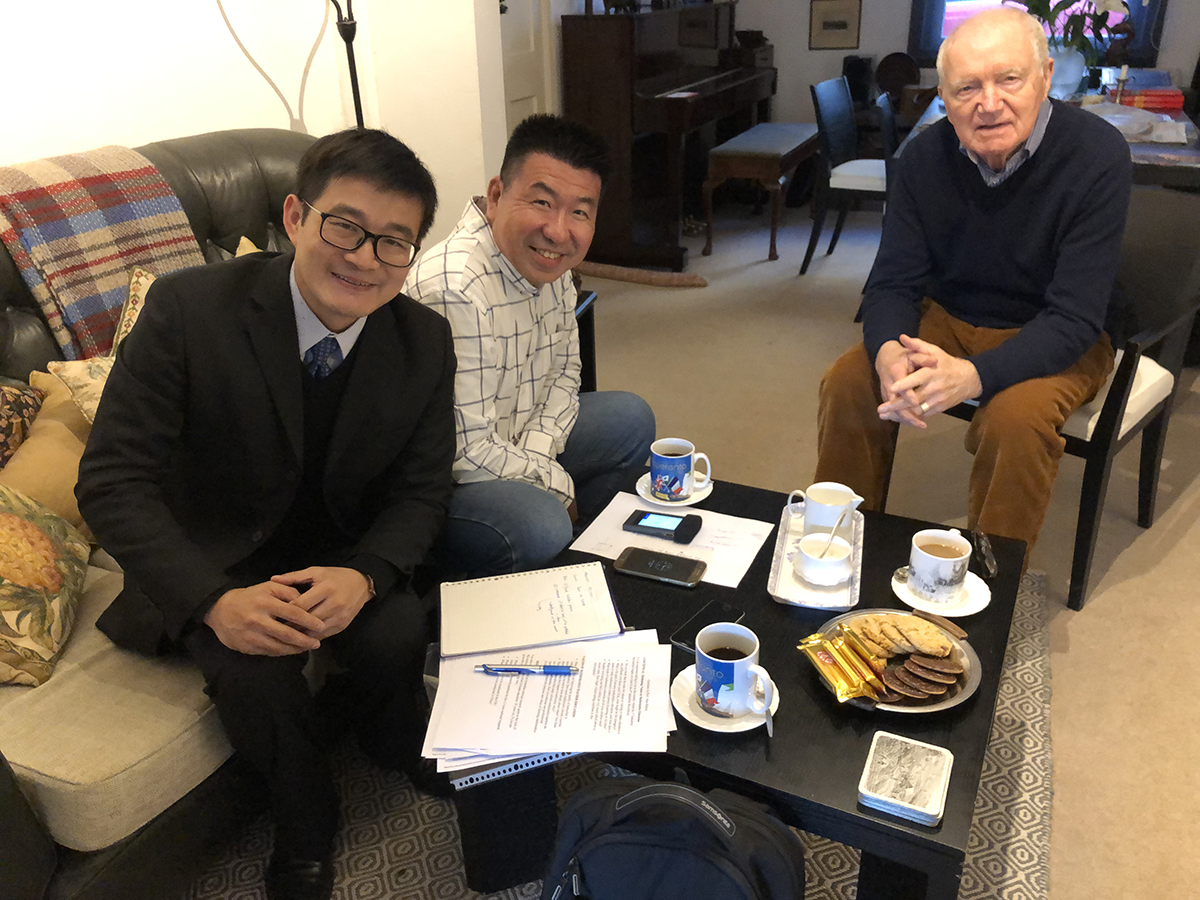
The three authors in conversation in January 2020.
Postscript
The content of this article arose from several conversations that took place over a few days in January 2020 at Cambridge University, U.K. The third author (Alan Bishop) was asked to comment on his latest insights into values in mathematics education. He emphasized how we have failed to emphasize the role of the human in the development of mathematics and of mathematics education, even though this is not new knowledge. He believed that through focusing on the roles of valuing and mentoring in mathematics and mathematics education, we are better able to establish the link between the “person” and mathematics/mathematics education.
Footnotes
Contributorship
Wee Tiong Seah and Qiaoping Zhang conceived and planned the interview with Alan J. Bishop. Wee Tiong Seah took the lead in writing the manuscript and was responsible for writing its main body. Qiaoping Zhang contributed to writing the abstract, teasing out related literature and reviewing the draft. Alan Bishop provided comments and ideas in writing the manuscripts and contributed to the interpretation of the results. All authors provided critical feedback to one another, and worked collaboratively to shape the research, analysis, and manuscript.
Declaration of conflicting interests
The author(s) declared no potential conflicts of interest with respect to the research, authorship, and/or publication of this article.
Funding
The author(s) disclosed receipt of the following financial support for the research, authorship, and/or publication of this article: This work was supported by EdUHK Dean s Research Fund (Ref.: DRF/IRS-7/18-19) and FLASS Internationalization and Exchange Scheme (Ref.: FLASS/IE_D03/18-19).