




Abstract

Introduction
It seems obvious that education (including both basic and higher education) is a commonplace for sunk cost. Parents pay tuitions in advance, purchase textbooks and school uniform, and send their children to tutors preparing for high-stake testing. Such prior investment accounts for a considerable proportion of family expenditures, especially for those who plan to send their children to study abroad. Their sunk costs include not only monetary expenditures but also behavioral choices such as early commitment to an international K–12 education that shuts down the pathway to domestic universities. Based on the classical sunk cost theory, those families are predictable to continue with the endeavor of studying overseas. Emotions such as the fear induced by the global outbreak of COVID-19 no doubt play a moderating role in the prediction of sunk cost effect. In addition to the current anxiety on contagious risk, campus closure, and major international standardized tests (e.g., TOEFL) rescheduled, parents are deeply concerned about the growing anti-Chinese sentiment abroad that is unlikely to disappear overnight. Unpleasant experience, pessimistic outlook, vulnerability of losing control, and other fear-related psychological traits may curb Chinese families’ inclinations to stick with the original plan of studying overseas. Ceteris paribus, the fear associated with COVID-19 has a larger curbing effect on some families with less sunk cost and more options.
The sunk cost theory and family decisions in crises
The term, sunk cost, was coined by Thaler (1980) to summarize the phenomena that people often feel that they have invested too much to quit. Thaler illustrated the sunk cost effect by an example: A family decides to drive 60 miles in a blizzard to watch a baseball game because the tickets cost them US$40; they would instead stay at home if the tickets had been given to them for free. Arkes and Blumer (1985) explicitly defined sunk cost as “an investment in money, effort, or time has been made.” They conducted 10 experiments to demonstrate the effect of prior investment. For explanation, they adopted prospect theory by Kahneman and Tversky (1979) to justify the irrational risk-seeking behaviors driven by sunk cost. Specifically, they highlighted two features of prospect theory particularly pertinent to sunk cost effect. One feature is an S-shaped value function depicted in Figure 1. The family at point A is a winner of “free ticket,” so their behaviors are risk aversion to escape the blizzard; the family at point B, however, is more willing to make a risky move because of US$40 they paid in advance. The other feature is the certainty factor of prospect theory. A certain loss (e.g., immediately stop the plan of studying overseas) is unfavorable than a long shot (e.g., perhaps anti-Chinese discrimination will disappear by year 2025). For alternative theories, they argued that cognitive dissonance, entrapment, foot in the door, and low-ball theories contribute little to the understanding about sunk cost effect. Let us note in passing that they suggested that entrapment is relevant to some sunk cost situations in which continuing investments are endured in the hope of an eventual reward. Some Chinese families continue investing for years on a K–12 international education is a case in point of such entrapped situations. Subsequent studies extend the framework of sunk cost theory. One extension aims at comprehensive understanding about the inflection point (i.e., point A in Figure 1) of the value function (Zeelenberg & Van Dijk, 1997).
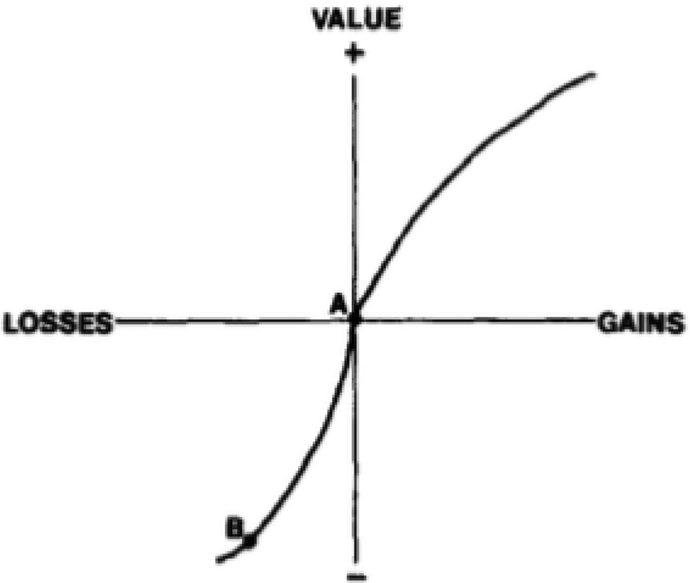
The value function of prospect theory used in the psychology of sunk cost (Arkes & Blumer, 1985, p. 131). Note. Copyright 1985 by Elsevier. Reprinted with permission.
As prospect theory predicts, people are generally risk-seeking in loss situations when sunk cost occurs (i.e., below point A; see Figure 1). Loss situations refer to not only monetary expenditures but also time and effort wasted. The perceived loss is more complicated when the mental accounting process involves a higher aspiration level (e.g., parents send their children abroad for elite higher education, career success, and permanent residence in the destination country) mixed with an increased possibility of regretting the decision (e.g., the regret induced by the outbreak of pandemic and the low morale of global economy). Another extension of the theoretical framework is allowing changes in slope of the value curve when emotions are taken into account (Coleman, 2010). Emotions are individual perceptions about their relationship to the environment from six dimensions: certainty, pleasantness, anticipated effort, attention, control, and responsibility (Smith & Ellsworth, 1985). The fear associated with COVID-19 is an emotional state featured with uncertainty, unpleasant experience, and circumstantial control. Fearful individuals are hypothetically less optimistic and less risk-seeking in a sunk cost dilemma. Unfortunately, Coleman’s (2010) experiment reveals no empirical evidence to support such moderating role of fear in sunk cost effect. One threat to validity of his experimental design is that the fear induced by his simulation (“briefly describe three things that make you afraid”) is not real and completely irrelevant to the specific sunk cost situations he intended to test. The fear induced by the global outbreak of COVID-19 is, however, real, overwhelming, and closely related to family decision on studying overseas.
Discussion: Potential factors among family decisions
Sunk cost matters for parents contemplating the education options of their children. If the earlier commitment to studying overseas is made, the larger sunk cost effect is observed in the decision-making process. From a monetary perspective, if a child continues attending private international schools since kindergarten, for tuition only, nearly half million U.S. dollars has already been invested before the college application begins. The direct expenditure of college application, even when some families hire a college counselor, is trivial compared to the accumulated sunk cost. The effect of nonmonetary sunk cost is more compelling. International school curriculum differs substantially from that instructed in Chinese public schools. Instruction languages, textbooks, teaching style, learning environment, and evaluation methods are all essentially distinct between the two school systems. The gap in teaching and learning is even more obvious for high schools. Parents choosing private international schools often find themselves stuck in the pipeline to studying overseas. Their entrapped situations are highly likely to continue because the wall between the two distinctive school systems has been reinforced by recent policies issued by the Chinese government. One example is more strict regulation on international programs hosted by public high schools, whose students are now forbidden to transfer between international programs and regular programs within the same school.
The fear induced by the global outbreak of COVID-19 plants doubts in the minds of parents despite their prior investment. A downward moderating effect of the fear factor is hypothesized on the family trade-off between sunk cost and future gains. The effect size is larger for those families with less sunk cost and more options. For whose children are young enough (e.g., currently enrolled at K–3 grades) to transfer back to Chinese public schools, their parents can become risk aversion and choose the school transfer. Even for whom stuck in AP- or IB-curriculums of international high schools, with generous family funds, those students can pursue alternative career paths in art performance, entrepreneurship, philanthropy, or take gap years. Their plans on going abroad are delayed, detoured, but not totally denied. Maybe the only change those families need to make is to switch their destination countries from U.S. to Singapore which reports fewer diagnosed COVID-19 cases and less anti-Chinese sentiment. For working-class families who barely afford private international school tuitions and therefore bear little sunk cost, it is a different story. They may walk away more firmly and with less regret. A recent survey completed by 4,461 Chinese undergraduates reveals that 23.20% second-generation college students plan to pursue a graduate degree overseas, while only 10.87% first-generation college students think so (Guo, 2019). This gap by family background can be amplified by the outbreak of COVID-19 when more disadvantaged families withdraw from their original plans of studying overseas because parents are sick or unemployed, governments and universities overseas cut scholarship for international students, or the world economy suffers a low morale due to the pandemic.
Conclusion
Based on a framework of sunk cost theory moderated by emotions, the fear inducted by COVID-19 has heterogeneous impacts on family decision about studying overseas. For some families entrapped in early commitment to a K–12 international education (particularly for whose children are currently in high schools), their inclinations to go abroad remain essentially the same, except a delay of a couple of years or a change in destination country. Nearly 900 private international schools in China, therefore, are the backbones of feeder schools for universities overseas. For other families who have already chosen public schools and then domestic universities, especially working-class families with budget constraints, they are predictable to become risk aversion and avoid the perceived anti-Chinese discrimination and other additional academic, psychological, or social challenges (Yu et al., 2019). The applications for graduate programs overseas from Chinese students are likely to drop. This downward trend will be more obvious for “opportunists” who are pragmatic in seeking better employment worldwide and for “loyalists” who intend to return home eventually (Dimmock & Leong, 2010).
Footnotes
Author’s note
The present forum deals with the coronavirus crisis, cross-border student mobility, and choices for Chinese students.
Declaration of conflicting interests
The author(s) declared no potential conflicts of interest with respect to the research, authorship, and/or publication of this article.
Funding
The author(s) disclosed receipt of the following financial support for the research, authorship, and/or publication of this article: This forum was sponsored by China Postdoctoral Science Foundation [Grant No. 2018M640358].