




Abstract
Purpose:
Learning to do research has been understudied in the context of professional development in postgraduate programs. This exploratory study investigated the agency and experiences of five Chinese students who learned to design their research project in a Master of Education program at an English-medium university in Hong Kong SAR.
Design/Approach/Methods:
We obtained the data from semi-structured interviews and documents to establish data triangulation.
Findings:
The findings revealed that (1) the students’ agency in research design and proposal writing was associated with their personal/professional backgrounds, (2) their English proficiency affected their agency in the proposal writing, (3) the supervisors’ feedback would stimulate students’ agency in changing/refining their research design, and (4) ineffective supervision and learning resources would impede students’ achievement of agency on their way to creating a robust research design.
Originality/Value:
This study adds empirical evidence to the field of research training through the lens of learner agency. It demonstrates the applicability of using the ecological framework of agency in theoretically interpreting the contextual facilitators and constraints in making postgraduate students active agents.
Keywords
Introduction
University teachers worldwide teach research skills and supervise student projects in master’s programs. English is often used as “lingua franca” when they support students’ skill development in designing research, writing research proposals, and conducting empirical studies. Learning to design research can thus be particularly challenging for English-as-a-foreign-language (EFL) students (Singh, 2019). Very little research has been conducted to explore the difficulties of EFL master’s students in the process of research design and the possible causes. In this article, we report a study that addressed this gap in the literature, by focusing on understanding the experiences of five Chinese students pursuing a coursework-based Master of Education (MEd) degree in an English-medium university in Hong Kong SAR, as they constructed their research design for their graduation project, in a process marked with challenges and shaped by various influences. Given the rapid growth of coursework master’s programs around the world in recent decades (Clarke & Lunt, 2014), and the large enrollments of Chinese international students in English-medium universities across the globe (He & Hutson, 2018; Tang et al., 2018; Xing & Bolden, 2019), our research is likely to have broad implications.
Postgraduate students’ need for support as novice researchers
Existing literature on tertiary students’ academic research tends to focus on the experience of doctoral research students. Much less attention has been paid to coursework-based master’s students, who often struggle when they move from coursework and professional tasks to academic research. Most of them are new to academic research when they are required to carry out project or dissertation research and write a substantial piece of research report for their master’s degree. In an early survey conducted among postgraduate students in an Australian university, Russell (1996) found that there was insufficient research support from supervisors and peers, apart from a lack of learning materials, the problem of work commitments, and the challenges of transitioning from workplace to university. A recent study of international master’s students’ views on thesis supervision in Finnish universities revealed that students considered frequent communication, an interesting topic, and emotional support from the supervisor important. Yet, they felt their cultural background and related needs tend to be ignored by supervisors (Filippou et al., 2017).
Studies concerning coursework-based master’s students have pointed to the need to provide support to these students to help them improve their research skills and tackle the challenges they encounter during research. “Supervision pedagogy” (p. 66) has been emphasized for providing the process and structural support to students’ research (McCallin & Nayar, 2012). It is also recognized that novice researchers may need individualized supervision, specific feedback, and articulated guidance to develop their research skills, including their ability to engage with the literature (Li et al., 2017; Owenz & Hall, 2011; Urquhart et al., 2016). Despite these revelations in the literature, there seems to be a lack of reported research that zooms in on EFL master’s students’ experiences in the process of designing a research project for coursework fulfillment.
Learning to design research
Academic research is conducted to systematically and critically investigate real-life phenomena to answer particular questions, solve practical problems, establish principles, and/or produce generally applicable knowledge (Burns, 2000). It usually goes through three major stages: design, implementation, and report of research. The research design stage features two significant challenges: topic construction and proposal writing. A research proposal is a researcher’s plan for their study, which clarifies what and how to investigate and why it is important to investigate. Prior to writing a research proposal, topic selection is crucial. One’s interest in a topic and the topic’s suitability in light of the institutional requirement for a project task are the significant factors to consider as a student selects a research topic (Casanave, 2014). Casanave (2014) emphasizes “topic construction” (as opposed to mere “topic choice”) for topic selection is, in fact, a dynamic process which is influenced by a series of internal and external factors over time. Other than one’s interest, other factors may include readings, personal life, work experience, one’s political and ideological beliefs, one’s challenging situations, and sometimes no less importantly, the supervisor’s research agenda.
Developing a research topic into a workable research proposal is not an easy job, as a full set of challenges accompanies the process. First, novices may not know what is required of a research proposal or do not feel capable enough to achieve the requirements (Emmanuel & Gray, 2003). Practical guidelines on how to prepare for a research proposal and what components a proposal should include (e.g., Denicolo & Becker, 2012; Maree & Van der Westhuizen, 2009) are helpful in this connection. Second, challenges could also stem from writing a research proposal in academic English, as both the genre and the academic register may be unfamiliar to the novices; EFL students may face particular difficulty (Arifani, 2016; Chatterjee-Padmanabhan & Nielsen, 2018; Singh, 2014). Third, the challenge in proposal writing may also come from a mismatch between the supervisor’s and the student’s expectation (Khozaei Ravari & Tan, 2019). While supervisors’ comments during proposal writing can function to scaffold the writing process, students’ misunderstanding of the role of supervisors (e.g., expecting supervisors to make decisions for them) would be a negative factor in the process of proposal preparation (Yu & Lee, 2013).
Some studies have been conducted to examine postgraduate students’ agency in academic learning and research. Ingleton and Cadman (2002) explored international postgraduate research students’ sense of agency in an Australian university to understand what enabled them to act as confident learners and achieve academic success. It was found that the students’ agency in academic learning was affected by their interpersonal relationships, academic outcomes, and the feedback they received (Ingleton & Cadman, 2002). Similarly, Lee (2011) investigated learner agency in an English-medium class of a college in Taiwan China in an ethnographic case study. The EFL students’ agency in English learning was found highly related to their personal experiences and future plans and was situated within particular sociocultural contexts. However, little is known about the dynamics of student agency in the process of academic research or proposal writing, and what may be the shaping forces for the agency of novice researchers.
A sociocultural perspective: Learner agency as situated participation
In this study, we adopt a sociocultural perspective to understand individuals’ meaning-making in a particular social activity which is rooted in their personal histories and embedded in ecological influences (Biesta & Tedder, 2007; Vygotsky, 1978). We subscribe to an understanding that agency is “the socioculturally mediated capacity to act” (Ahearn, 2001, p. 112) and is manifested in such forms as active participation, silence, and resistance. In this study, therefore, student agency refers to the will and abilities of learners to act upon and transform educational activities and circumstances (Rajala et al., 2016). Student agency can lead to varied consequences, including the acquisition, resistance to, and appropriation of knowledge and skills (Moje & Lewis, 2007), a sense of competent self (Hull & Katz, 2006), and the (re)making of identities (Moje & Lewis, 2007) in the situated processes of learning and interaction. Promoting student agency is a central issue in educational reform (Mäkitalo, 2016). From the perspective of a sociocultural or Vygotskyan approach, student agency arises out of learners’ engagement in social interactions as a way of co-construction and (re)negotiation (Lantolf & Pavlenko, 2001). In line with the sociocultural approach, learning is seen as situated participation and as the (re)construction of selves (Lantolf, 2000). Accordingly, our study focuses on the students’ perspective to tap into their voices, to understand how they construct knowledge and notions of academic research and writing, and to unpack the complex factors leading to their agency.
Especially, the personal (or iterational) dimension of agency is applied here to refer to “the selective reactivation by actors of past patterns of thought and action, routinely incorporated in practical activity, thereby giving stability and order to social universes and helping to sustain identities, interactions, and institutions over time” (Emirbayer & Mische, 1998, p. 971). The other three dimensions, namely, cultural, structural, and material, could be recapped as the “practical-evaluative” dimension of agency which refers to “the capacity of actors to make practical and normative judgments among alternative possible trajectories of action, in response to the emerging demands, dilemmas, and ambiguities of presently evolving situations” (Emirbayer & Mische, 1998, p. 971). According to Biesta et al. (2015), the achievement of agency is informed by past experience (the personal/iterational dimension) and enacted within the influences of cultural, structural, and material resources (the practical-evaluative dimension) (see Figure 1 for a model of agency which is based on Priestley et al., 2013, 2015). The set of four notions provide a useful analytical perspective for us when we analyze our data and interpret students’ agency, as to be shown later.
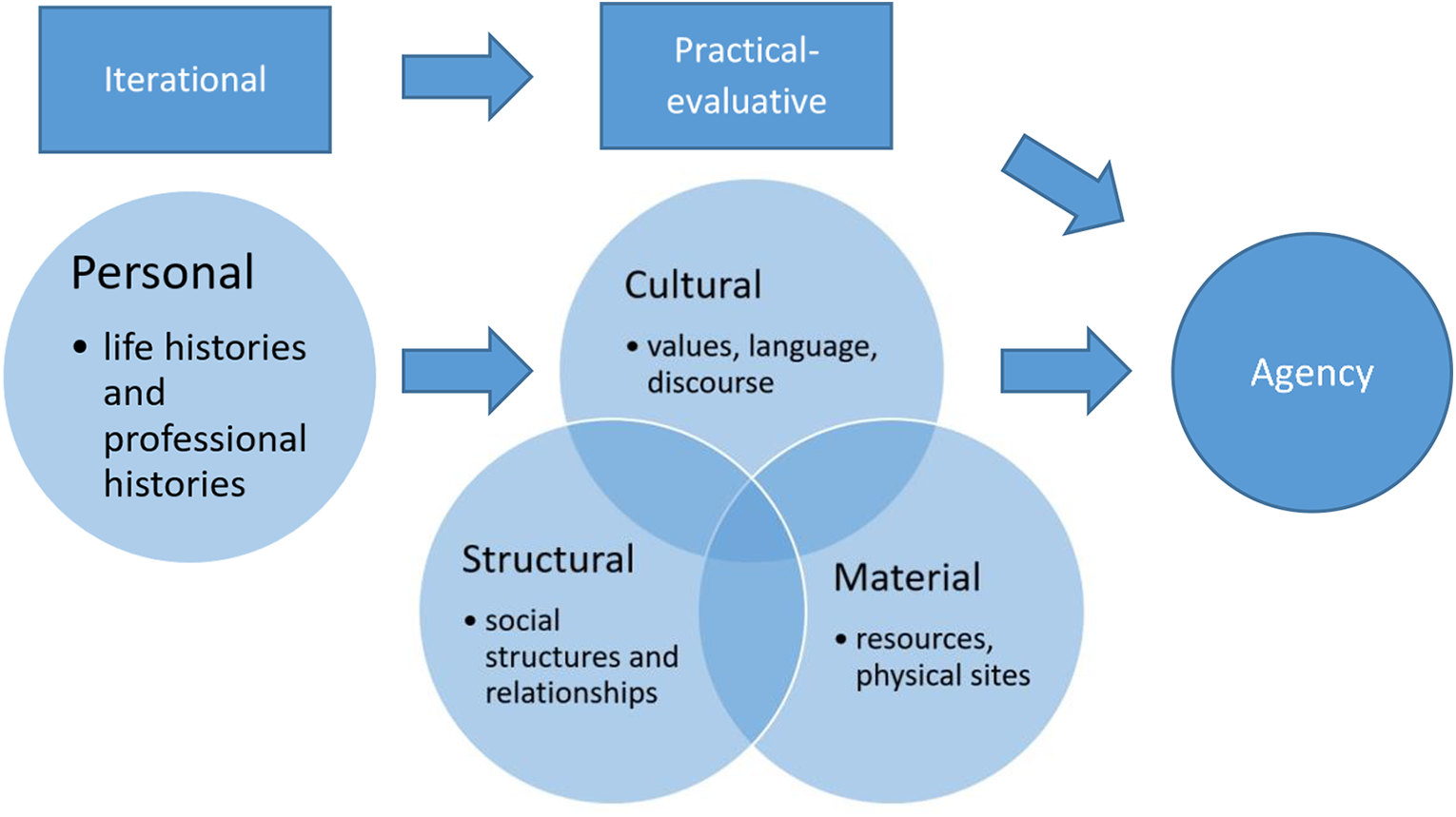
A model of agency. Source. Based on Priestley et al. (2013, 2015).
In short, our study adopts a sociocultural lens upon student agency to explore the complexities of the processes of research topic construction and proposal writing of a group of EFL students in an MEd program. Specifically, the study was guided by this research question which encompasses two interrelated elements: How do students in an MEd program exercise their agency in the process of research design (i.e., topic construction and proposal writing) for project/dissertation, and how might their agency be facilitated or constrained as it is played out?
Methods
Research setting
This study was conducted in the context of an MEd program in an English-medium research university in Hong Kong SAR in the academic year of 2016–2017, with all the participating students coming from the same cohort in the specialism of Early Childhood Education (ECE) and studying in a 1-year full-time mode. Similar to the previous cohorts, about one third of the students in the 2016 intake had no background in studying or working in the area of ECE, and two thirds of them were from Chinese mainland. The internship opportunity provided by the MEd (ECE) specialism for the students in local kindergartens provided professional experiences in ways relevant to their MEd study. The ECE students could choose to do either a “project” (equivalent to one course) or a “dissertation” (equivalent to three courses) as the final research project in the program. Both follow the same requirements for a research project but differ in the length of the report: Project report should be around 5,000 words, whereas dissertation should be about 20,000 words. At the beginning of the first semester, a series of workshops on academic writing (covering such topics as “What is plagiarism and how to avoid it” and “Academic argumentation and literature review”) were offered to these MEd students by the university’s language center. In connection with the final research project, a course entitled Research Methods 1 (RM1) was offered to the students in the first semester, which required all the students to submit their research proposal as the final assignment. When most students had worked out a topic and finished their first draft of the proposal by the end of the first semester, a supervisor was allocated to each student. Then during the transition to the second semester (December–January), the students finished Research Methods 2 (RM2). To fulfill the RM2 requirement, they attended a series of research methods workshops. In addition, they were expected to incorporate the RM1 lecturer’s and their supervisor’s feedback and present their research proposal on Moodle (i.e., the e-learning system used at the university), and engage in the online discussion with their peers and the RM1 lecturer. The combination of RM1 and RM2 is called “an RM course set.” Following RM2 and further communication with their supervisor, they submitted a final version of their research proposal, and applied for and obtained ethical approval (by the end of March). They then typically had about 4–5 months to conduct their study and write up their research report.
Participants and data collection
Of the 30 MEd (ECE) students in the 2016–2017 cohort, 27 were willing to participate in this research. Data collection for this study began after ethical approval was obtained from the Human Research Ethics Committee of the university. From the 27 students, 5 case participants were further selected with informed consent to be interviewed. Case selection was conducted by considering the following factors: (1) experience in academic research, (2) competence in English, (3) professional background, (4) assigned supervisor, and (5) selection of project or dissertation. Most students in the cohort chose to do a project, which was reflected in the selected case participants, with two participants doing the dissertation and three doing the project. All five case participants received their bachelor’s degree in Chinese mainland. As EFL learners, there was also a potential gap between the academic writing experience they had in the past (i.e., in Chinese) and the expectations in the program (i.e., in English). Table 1 lists the five case participants (P1–P5) and the four supervisors (S1–S4) involved.
Profiles of five case participants.
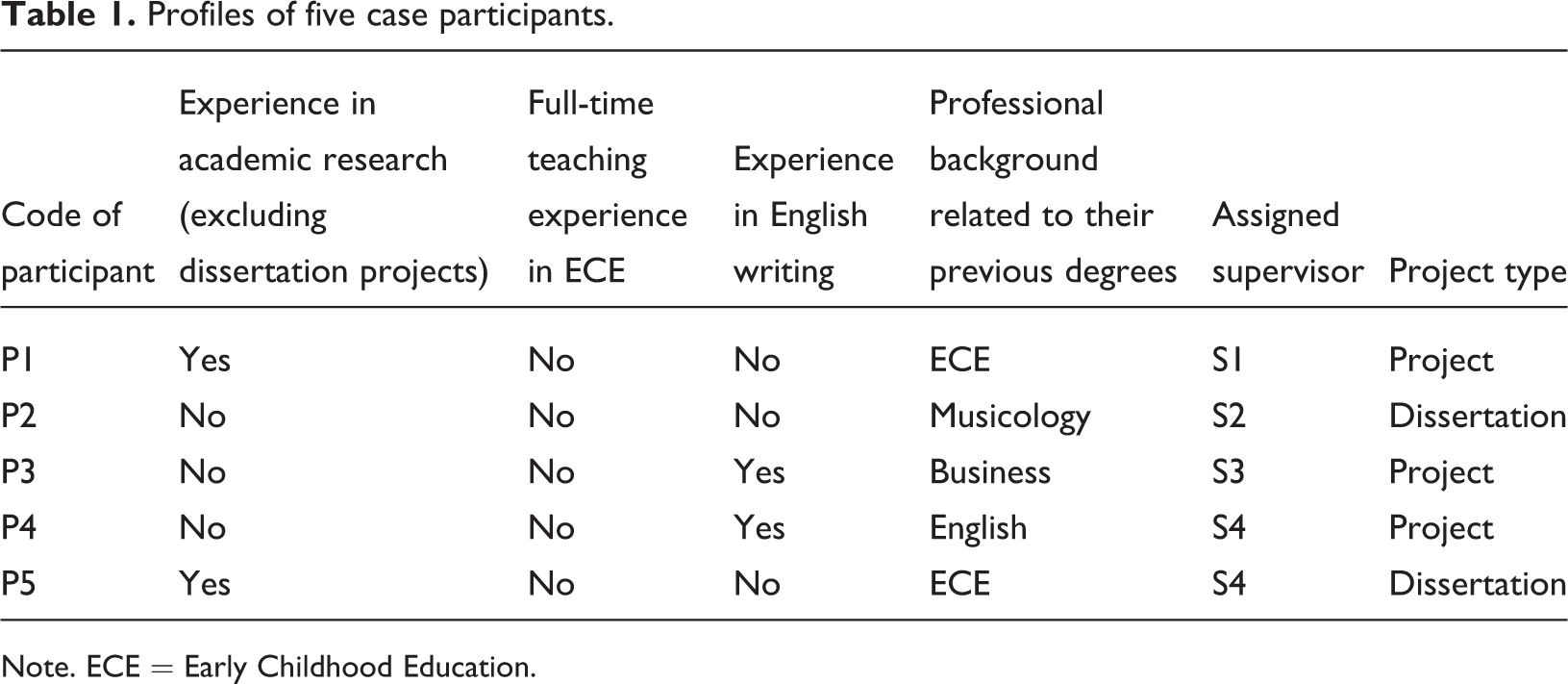
Note. ECE = Early Childhood Education.
A semi-structured interview was conducted with each of the five case participants early in the second semester, when most of the cohort students had gone through topic selection, construction, and modification, and had submitted their final research proposal. The interviews were conducted by one of the authors in Chinese, the shared mother tongue between the interviewer and the students. As our research was concerned with the students’ perspectives, interviewing the participants in their mother tongue was advantageous. Each interview lasted for 20–30 min and was audio-recorded with the agreement of the student participants. The interviews were based on an interview protocol that consisted of four parts. Part 1 aimed to find out about the participants’ professional background, academic experience, and language competence. Part 2 focused on topic construction and modification, from the initial idea to the final decision. Questions were asked to explore the sources of their initial topic, changes to the topic and the reasons, difficulties they encountered at various stages, and their timeline for working on the proposal assignment. Part 3 focused on the feedback from the RM1 lecturer, peers, the supervisor, and anyone else who might have played a role in shaping their research plan, as well as the students’ perceptions of the feedback. Finally, Part 4 invited the students to share their feelings and reflections regarding their research design and proposal, together with the challenges they were facing.
The course lecturer of RM1, also the MEd (ECE) specialism coordinator at the time of the study, or S2 in Table 1, was interviewed twice. In the first interview, questions were asked to obtain his perspectives on running the MEd (ECE) specialism and to understand how he used Moodle to facilitate research supervision. Questions in the second interview focused on the students’ research topic development and their research proposal writing. In addition, S2 also held consultation meetings with the cohort of students by five groups during the first semester. Two of the meetings were observed, with field notes taken to record the students’ initial research ideas and any concerns they expressed.
Data analysis
In this study, the researchers were “involved in a sustained and intensive experience with participants” (Creswell, 2009, p. 177) to understand students’ agency in research design. One of the researchers was an MEd (ECE) student from the target cohort, investigating and reflecting upon her own and peers’ agency from an insider’s perspective. S2 was also on our research team. His role was crucial in this research as he provided a holistic and reflective view. The primary investigators in this study were two colleagues specializing in ECE and academic writing, respectively. The two immersed themselves in the cohort of students’ research design process as outsiders. The four researchers played complementary roles in gathering and analyzing the data and producing this report.
Case participants’ interview audio recordings were transcribed and then coded. Inductive, thematic analysis was conducted to interpret the transcripts (Corbin & Strauss, 2014; Glaser & Strauss, 2009). The theoretical model of student agency from a sociocultural lens was then used to organize the thematic codes into four dimensions, that is, personal, cultural, structural, and material dimensions (Biesta et al., 2015; Biesta & Tedder, 2007; Priestley et al., 2013, 2015). We found it appropriate to examine four interactive dimensions in striving to understand how learner agency is played out with master’s students, namely, in terms of the impact of the personal (e.g., life histories and professional histories), cultural (e.g., values, language, and discourse), structural (e.g., social structures and relationships), and material (e.g., resources and physical sites) factors, which would jointly form a “configuration of influences” (Biesta et al., 2015, pp. 626–627) as the students engage in the topic construction and proposal writing for their research project.
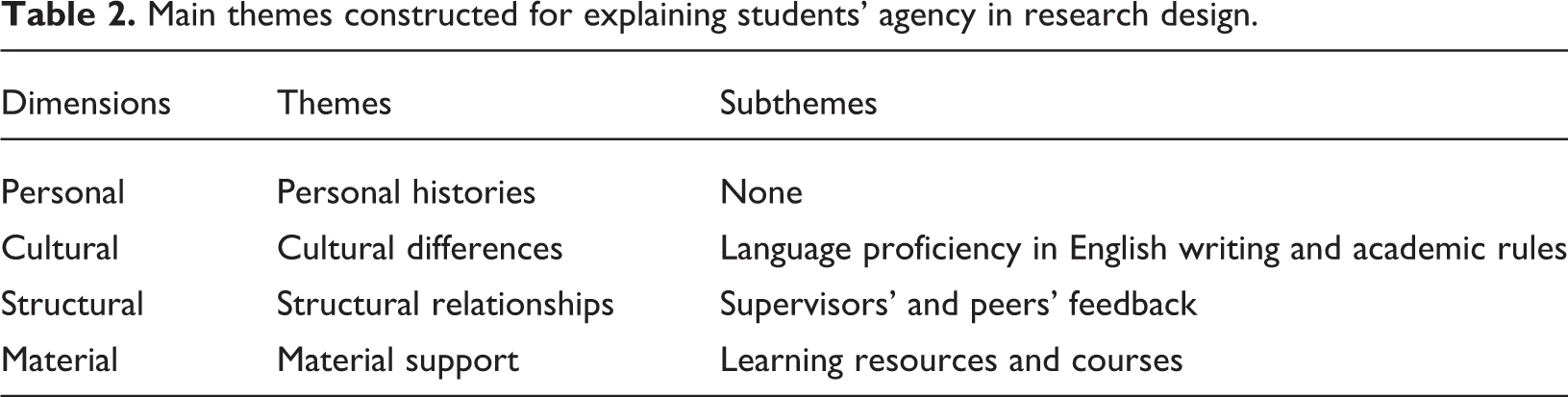
As a result of repeated adjustment in the process of data analysis, major themes of student agency include (1) the personal histories; (2) cultural differences such as language proficiency in English writing and academic rules; (3) structural relationships, especially supervisors’ feedback; and (4) material support such as learning resources and courses (the RM course set) (see Table 2). The field notes of two consultation meetings were examined to confirm, supplement, and enrich the findings yielded by the analyses of the interviews. To enhance the trustworthiness of data analysis (Creswell, 2009), the researchers conducted peer debriefing with a student from the MEd cohort to review and confirm the data interpretation to enhance the accuracy of the account.
Main themes constructed for explaining students’ agency in research design.
Findings
In this section, we report the findings on how the target MEd (ECE) students, or the five case participants, exercised their agency in the process of research design for project/dissertation, and how their agency might be facilitated or constrained as it was played out.
Personal histories
Interviews with the case participants revealed that their research interests were also bound to their own experiences and professional backgrounds. P1, for instance, got her research idea from the preschool in which she had the internship. The Montessori preschool aroused her interest in the approach of Montessori education. Similarly, P4 also obtained her research idea from her internship preschool. Still, she developed her initial design based on her own parenting experience—having a young daughter to educate and addressing a real issue for herself. P2’s and P5’s initial ideas also arose from their personal study experience. P2 studied music education in her previous degrees (bachelor’s and master’s degrees), and she, therefore, aimed to connect music with ECE, with all the topics she considered relating to preschool music education. As she put it in an interview: “People’s previous experiences and learning backgrounds matter a lot.…You will be more familiar with something if it is a field that you are interested in, or if you have done something related to that before.” Likewise, P2’s previous undergraduate experience in a teacher education university motivated her to study a teacher training program in ECE back in her university. Also, P3’s last job inspired her initial research idea. She used to work in an International Baccalaureate (IB) preschool and, naturally, she wanted to examine the existing problems in this IB curriculum. The five case participants chose their research topic from internship and work, professional backgrounds, and interest.
After initiating their topic for investigation, there came the task of producing a sound research design for project/dissertation. It was found again that the students’ decisions in engaging in the research design and proposal writing were closely related to the previous experience or professional histories of the participants. For example, P1 had worked in a preschool context and conducted educational research, whereas P4 had no preschool teaching experience, neither educational research. P4 thus decided to use close observation for addressing her personal concerns, while P1 chose to study the implementation of a preschool curriculum using more complex research methods.
Lacking relevant experience and professional background may also have a negative impact on the students’ topic construction and proposal writing. As P3 put it: I haven’t written any academic papers in English before, so I don’t know how to write [the proposal]. It’s tough for me to write the literature review. I’ve no idea how to be critical and cite references, because in my previous major—business administration, we didn’t cite others’ works in our writing [in Chinese].
P3’s anxiety over her research proposal writing resided in her lack of ECE background as well as English academic writing experience. As pointed out by S2 in an interview, those students lacking an ECE background or weak in English writing were likely to feel difficult and incapable of completing the proposal assignment.
Language proficiency in English writing and academic rules
Prior to their master’s study, the participating students had little experience in English writing, let alone practical skills. Inadequacies in English writing seem to negatively impact upon the students’ agency in presenting their thoughts and writing up a satisfactory proposal. Among the case participants, P5 expressed her lack of confidence in English writing as follows. S2 has said, “If you want to pursue a higher degree, you should learn English well.”…I know that there are grammar errors in my English writing.…Although academically I’m not bad, my English writing is still problematic. I can express my thoughts in Chinese well but can’t write in English with the same accuracy.
Similarly, P2 also described her difficulties in English writing. In my literature review, it seems I have not brought out research gaps explicitly enough.…Also, in terms of using references, I did use some old citations, including some information from Wikipedia, which doesn’t meet the requirements for academic papers.…Regarding the citations, I found almost all students from Chinese mainland shared the same feeling that it’s very different from our previous writing because we now have to paraphrase every sentence cited from sources with accurate citations; otherwise, there is a suspicion of plagiarism.
P2’s comment indicates that the students realized that they were expected to observe academic writing conventions that they were not held accountable for in their prior undergraduate learning which did not have a strong research element. Lacking familiarity with the norms of English academic writing, the students found the proposal writing assignment a challenging task. They were particularly anxious over being accused of plagiarism which they understood would carry serious consequences. S2’s general (formative) feedback on the whole RM1 class of students’ research proposals further pointed to such writing problems as wrong format in using citations and references, not systematically presenting the research methods, absence of a data analysis plan, inconsistency between research questions and methods, weak introduction, and lack of insight and critical stance in the literature review.
Supervisors’ and peers’ feedback
The students’ development of research ideas and research proposal was supported by S2’s feedback provided through the group consultant meetings, the research idea presentations in the RM1 class sessions, and sharing on the Moodle system. In addition, the students were free to seek their project/dissertation supervisors’ face-to-face guidance afterward to revise their proposal further.
The feedback from S2 (the RM1 lecturer) and/or supervisors motivated the changes in the five case students’ process of designing research. Among the five case students, P1 was the one who changed her research focus the most times, going through five iterations of a proposal on the topic of Montessori education from the beginning to the end. Her first idea was about children with special needs in Montessori education. After getting S2’s feedback and discussion with the principal of her internship preschool, P1 changed to study teacher personality, which she presented on Moodle as part of the requirement of RM2. The feedback she received from S2 and classmates made her feel the idea was infeasible. At that point, she met with her supervisor, S1, for the first time and discussed the topic with her. Following the meeting, she wrote a third version, proposing to study the implementation of language activities. Then she came across an assessment checklist of Montessori education and found that enlightening. With her supervisor’s endorsement, she refocused her topic so that she could make use of this checklist, and at the same time, a case study of one preschool was changed to a comparison of two preschools. Then at that point, the supervisor realized that P1 was doing a project instead of dissertation study, and a comparative approach might mean too much work and would exceed the expectation for a project study. Hence P1 revised again and produced the final version of her research proposal.
In other cases, students experienced less of a detour than P1 with their topic construction through a research proposal, but they all made revisions in view of the feedback received. P2 changed her focus three times in the topic area of music education. Her first idea was to examine the gap between the beliefs and the practices in early childhood music education. However, S2, who was also her supervisor, pointed out that the data collection would be hard and suggested she adjust. Thus P2 narrowed down and focused on a specific approach—the Orff approach to music education. She then did her RM2 presentation on Moodle, and S2 suggested she focus on the implementation of the Orff approach, without trying to study potential belief–practice gaps. P2 took on board the advice.
P3 and P4 changed their topics once. P3’s initial idea was to examine whether the IB curriculum is appropriate to be implemented in preschool, a topic that was too general to S2, the RM1 lecturer. So P3 switched to the practical problems that teachers may encounter during the teaching process in the IB curriculum, which was approved by S2. Her supervisor, S3, whose expertise was not in ECE, did not give her suggestions on topic construction but did advise her on aspects of her proposal writing. After her RM2 online presentation, P3 revised her data analysis section, incorporating suggestions from S2.
Although the supervisors’ feedback had propelled the evolution of the students’ topic construction and research design, case participants’ interviews indicated that such support from the supervisors could be improved in both quantity and quality. P2 expected more guidance from her supervisor, S2: I want to know if there are any problems and places that I could improve in my final proposal.…I hope he can set a few regular dates for meetings to provide more guidance so that I could be clearer about what I should do in different stages.
P3 complained about a lack of concrete guidance for her research from her supervisor, S3, whose expertise area was not in ECE, as mentioned above. The lack of adequate supervision seemed to have led to P3’s passive agency in her research project. She reported, “I suspect that this project will not work. I feel it’s not good enough, and this uncertainty has been with me all the time.” Similarly, P4 also reported a lack of guidance on research design and proposal writing from her supervisor, S4. When P4 sent her research proposal to the supervisor, the latter commented “Seems fine,” without giving any specific feedback. P4 likewise experienced a setback in her agency for conducting her proposed research as a result.
Both the in-class presentations of the students’ research ideas in the RM1 course and the Moodle-based online RM2 presentations of individual’s research proposal created learning opportunities, with the presentations inviting feedback from the lecturer (S2) and the peers at the same time. However, in the eyes of the students, peers’ comments may not be constructive in terms of promoting their research work. Four case participants shared a similar sentiment (P1, P2, P4, and P5). P2 observed: Classmates’ comments didn’t seem to help me to improve, because I am aware of these problems in my plan. Although I did work on addressing the concerns raised by my classmates, the improvement of my proposal didn’t seem to be significant.
Although more evidence is needed to verify this finding, the perceived low efficacy of peer feedback seemed to be an issue that needs to be addressed to promote students’ achievement of agency in research design.
Learning resources and courses
The material support of learning resources and courses can be seen as a provision that purposefully and directly trains students’ knowledge and skills in academic research and writing. As noted earlier, to raise the master’s students’ academic abilities, the MEd program under investigation offered two methodological courses. The students took RM1 upon entry into the program, then RM2 in the following semester, which is a series of research methods workshops providing hands-on training on “qualitative research,” “quantitative research,” and data analysis skills. Additionally, the RM course set and writing workshops targeting MEd students across the specialisms were offered to the cohort students to enhance their research and writing skills. However, it was revealed that the students preferred a different timing of the writing workshops (in their assignment writing stage) and wanted to be given specific examples in the workshops. P1 said: When you attended the workshop, you haven’t started to write anything yet. So you can’t engage well with what is taught. I think the workshop is a little bit too early. I feel if it could be a bit later, for example, when we finish the proposal, it may be better. For the session on literature review, [the lecturer] showed us literature search engines or something like that; but we need some specific examples.
P5 further reported that the class size of those academic writing workshops was too big and individual tutoring experience was unavailable. It was suggested that these workshops, as a kind of material support, could be better timed, with specific tutoring provided, to better support students’ growth in research knowledge and competence and to further promote their agency.
Discussion
The study reported in the article focused on exploring EFL master’s students’ agency to understand what enables them to act with confidence as novice early childhood researchers. The empirical evidence demonstrated that student agency tended to be embedded in social structures and shaped by many complex personal and contextual factors.
Students’ agency as a dynamic process
This study highlighted master’s students’ agency as manifested in the process of designing their research project. The findings indicated that the competencies and directions of the participating students in designing a solid project were changeable and dynamic. Instead of a one-time decision, changes were common in the process of these students’ research design. The continual refinement required the students to overcome their inadequacies in academic research and writing, meet supervisors’ expectations by responding to their feedback, and gain knowledge in the target topic area. This process resembles what Ingleton and Cadman (2002) reported on international postgraduate students’ learning experience in an Australian research university. They found that the international students’ self-identities in academic success were challenged in a new environment lacking effective feedback so that self-doubt and diffidence were recognized by the students as a common experience. The struggling process has also been reported by coursework master’s students trying to reconcile their agency with the academic practices in preparing a research dissertation (Shaw & le Roux, 2017). In the process of designing research, the novice researchers in our study went through ups and downs, and their agency was influenced by personal commitments, self-identities, academic socialization, and the ecological system. Consistent with the existing literature, this finding implies that students’ agency is a complex, dynamic system (Mercer, 2011) which emerges in the participatory processes (Mäkitalo, 2016; Siry et al., 2016). Teaching approaches that aim to enhance the agency of the learner will be of importance in improving engagement and learning. If the subjectivity of the learner is not factored into instructional design, then learning is unlikely to take place.
Personal and contextual contributors to novice researchers’ agency
This study found that students’ professional experiences shaped the case participants’ beliefs and motivation. Those lacking professional background and knowledge seemed to have great difficulty in proposing meaningful topics and selecting appropriate methods for their research, echoing Filippou et al.’s (2017) finding that early discussion on students’ previous experiences and even cultural background in research supervision can help to meet the students’ needs and expectations better. As the wider literature would also suggest, students’ agency is shaped by personal and sociocultural factors and plays a crucial role in facilitating their learning (Bown, 2009; Gao, 2010; Huang, 2011; Lan, 2018; Mäkitalo, 2016; Mercer, 2011). Therefore, supervisors should take into consideration students’ professional background and experience when advising them on the design of a research project.
It was also found that the students’ English writing experience and capabilities also limited their exercising of student agency in research design. The lack of academic writing experiences and the insufficient capability in scholarly English writing seemed to undercut students’ agency in presenting their thoughts about their research in trying to produce a research proposal. As demonstrated by Shaw and le Roux (2017), coursework master’s students’ reading and writing practices are crucial in their transition from professional work practice and coursework to dissertation research.
Additionally, this study revealed that the students’ agency tended to be affected by the feedback and suggestions from lecturers and supervisors. Nel (2017) highlighted the importance of supervisors’ feedback in helping master’s students to make progress in their research project, illustrating how the effectiveness of the feedback would affect the enactment of student agency in their dissertation research. Our research has also shown that effective feedback is needed to improve postgraduate students’ academic writing skills and help them to connect their postgraduate study with the professional world (Li et al., 2017). It is interesting to note that some students were not satisfied with the supervision provided in the focal program, indicating a gap between what was provided and the expectations that students had on their supervisors. In addition, inconsistent with the previous finding that peer support is effective in promoting students’ research and writing (e.g., Baker et al., 2014; Noroozi et al., 2016; Yu & Lee, 2016), this study found that the case participants did not feel they benefited from comments given by their classmates. The dissatisfaction with supervision and peer feedback indicated that the students concerned probably had a higher expectation than what their supervisors and peers could provide.
Last but not least, our study found that the training in research methodology and academic writing through courses and workshops supported the students’ agency in research design. However, the writing support can be better timed so that the students could receive instruction when they need it the most (typically while they are in the process of writing). The instruction can be more concrete by using examples of writing (e.g., for writing a literature review). This is in line with similar suggestions in the literature that graduate writing support should be appropriately timed (e.g., Link, 2018) and also echoes the extensive literature on the value of using exemplars in teaching writing (e.g., Hendry et al., 2011).
Conclusion
The research is concerned with the agency and experiences of Chinese students in designing their graduation projects in an English-medium MEd program. This study adds empirical evidence to the field of research training from the lens of learner agency. It is likely to inspire the development of research training mechanisms in comparable master’s programs, perhaps especially in an EFL context. The study also successfully applied the ecological framework of agency (Priestley et al., 2013, 2015) to theoretically interpret the contextual facilitators and constraints in making postgraduate students active agents in learning to do research design. Our endeavors have demonstrated that the sociocultural approach to researching learner agency via an empirical, detailed examination of ecological factors seems promising for identifying students’ needs, which would inform the design of pedagogical support accordingly.
Nevertheless, our study has several limitations. First, we only explored students’ agency in designing research; in the future, a more nuanced and comprehensive understanding of how students exercise agency in implementing research, writing a research report, and publishing research is needed to reveal their learning trajectories and the underlying mechanisms. Second, only limited evidence about peer feedback was gathered in our study, making it impossible for us to analyze this critical issue deeply. Future research could explore how peer relationship and interaction may influence the achievement of student agency in academic research and writing. Finally, the results from this exploratory and qualitative study cannot be generalized to other contexts. Future large-scale quantitative studies may anchor on the themes revealed to examine the complex system of contributing factors that facilitate students’ engagement in research.
Footnotes
Acknowledgements
The authors wish to thank the students who took part in the study.
Declaration of conflicting interests
The author(s) declared no potential conflicts of interest with respect to the research, authorship, and/or publication of this article.
Funding
The author(s) disclosed receipt of the following financial support for the research, authorship, and/or publication of this article: This study was supported by the General Research Fund (Research Grants Council, Grant No. 17607517).
