




Abstract

Despite awareness that simple dichotomies are cul-de-sacs for our research imagination, these academic standoffs continue to shape cultural space and research alike. Two of the most salient, if conflicting, currents in educational research gaining momentum over the past decade have been what Mignolo (2011) has usefully termed “Rewesternization” and “Dewesternization.” The former indicates an array of projects, both theoretical and empirical, that seek to expand the scope and depth of the modern Western paradigm, in particular liberal truths and neoliberal orthodoxies. Salient examples include the Western-led expansion of international large-scale learning assessments, the apparent triumph of Knowledge Capital Theory, and the shaping of the Sustainable Development Goals toward liberal (and often neoliberal) policies long preferred in Anglo-American policy circles. The latter indicates a recognition and forceful reaction against these trends, refusing consumption by the resurgent Western (neo)liberal model through calls to return to “non-Western” ideas and pasts purportedly untainted by Westernization. Among the myriad forces supporting Dewesternization are the recognition of the fraying of political and cultural fabrics across the Anglo-American world (e.g., Trump populism, nationalism, and U.S. policy paralysis; the Brexit debacle), the rise of increasingly confident non-Western powers such as China and India, and—perhaps most of all—an acute, if largely unspoken, awareness of the impending global environmental catastrophe. Amidst this, Dewesternization apparently demands that we contemplate new, non-Western ways of living and learning. Nevertheless, and disappointingly, Dewesternization is not as much of a break from Western frameworks as it might appear. As Mignolo (2011) points out, “Dewesternization shares with Rewesternization the ‘survival of capitalism’” and thus the “confrontation takes place at other levels … the sphere of authority, of knowledge, and of subjectivity” (p. 47). By simply inverting the political and economic status quo, Dewesternization becomes then more of a divisive move. It is far less transformative than its rhetoric may suggest.
Yet Mignolo (2011) also identifies alternative trajectories for the future,
1
those which aim to decenter Western hegemony in knowledge and subjectivity without claiming universality. Unfolding toward “an open horizon of pluriversality,” these alternatives include Decolonial and Spiritual (ontological) trajectories for the future (Mignolo, 2011, p. 275). The Decolonial option attempts to divest or “delink” from Western starting points, particularly epistemic and subjective ones, with the aim of “contributing to building a world in which many worlds exist” (p. 54). In the subfields of education most sensitive to non-Western contexts such as comparative and international education, the rise of decolonial sensitivities is clearly evident (see, e.g., a recent Special Issue of the Comparative Education Review entitled Towards a Postcolonial Comparative and International Education, edited by Takayama et al., 2017; see also Takayama, 2016). And there are strong indications that this gathering “Decolonial Turn” seeks to depart, even from postmodernism and postcolonialism with which it shares strong affinities and some common roots: A generation ago these “post” movements would have framed, at least in part, their demands in terms of difference, justice, and recognition, whereas much decolonial work is energized by the issue of planetary survival and a break from an enduring commitment to Western humanism. Prominent feminist and post-humanist thinker Veronese Braidotti (2016) captures these complex dynamics well, writing: It is a historical fact that the great emancipatory movements of postmodernity are driven and fueled by the resurgent “others”: the women’s rights movement; the antiracism and decolonization movements; the antinuclear and pro-environment movements are the voices of the structural “others” of modernity. They inevitably mark the crisis of the former humanist “centre” or dominant subject-position and are not merely anti-humanist, but move beyond it to an altogether novel, posthuman project. (interviewed by Veronese, 2016, p. 98)
While some scholars remain understandably skeptical about a “posthuman project,” this general sketch also helps us locate Mignolo’s Spiritual trajectory: the turn away from modes of thought and being, which are expected, demanded, and often still enforced by Western civilization. Elsewhere we have suggested that Mignolo’s Spiritual option might be usefully reframed as the “ontological” (Silova et al., in press), arguing that if understood in that way, the Spiritual option can open up new ontological possibilities and alternate metaphysical realms. In refusing a secular, materialist worldview as starting and end point of research, this option also links to the “ontological turn” gaining increased prominence in the social sciences (Charbonnier et al., 2017; Holbraad & Pederson, 2017; Jensen, 2017). While precise definitions and demarcations between these different trajectories remain productively unclear, the point for us is that the Decolonial and Spiritual (ontological) trajectories gesture toward ways of moving beyond the universalist logics that undergird the Rewesternization/Dewesternization standoff. It is precisely these trajectories then that this Special Issue sets out to explore and elaborate and put into dialogue with educational research.
But how to go about doing this? At the heart of the Decolonial and Spiritual (ontological) options is recognition and proposed reconstruction of the cultural, epistemic, and ontological foundations of modern Western thought
2
and, by extension, modern education. This is not seen as a substitute but rather a starting point, for any subsequent political, economic, and/or environmental action. The general aims and resulting questions were captured by a North American education scholar advocating for an “ecologically sustainable culture” more than a generation ago: In effect, the locus of deep and long lasting change is at the preconscious level of a culture’s symbolic foundations that provide answers to how human purposes and relationships are to be understood. Yet … the deepest assumptions of the culture, in effect, often go unrecognized even in the face of the most radical political action … How fast can a culture change itself? What are the leverage points for affecting fundamental changes that are needed if we are to achieve the goal of an ecologically sustainable culture? What is the nature of an ecologically sustainable culture? (Bowers, 1995, p. 2)
While Bowers’ focus is on the environment, the same questions arguably face a broad range of other social movements—from feminist to decolonization movements among others—as all seek “deep and long lasting change” but have often floundered by failing to reach deep enough. To these overarching questions, we would add a methodological one: How must dominant modes of research and thought be reconfigured to bring about both recognition and change at the “preconscious level of a culture’s symbolic foundations”? This Special Issue then also gestures toward a new methodological approach to educational research, one which—as we sketch out further below—answers the Decolonial and Spiritual (ontological) call to build a “world in which many worlds co-exist” through the very forms of engagement that constitute it: initiating a conversation across diverse projects that all seem to be in general agreement about what must be opposed, but need each other to further elaborate new, generative directions for the future.
In this vein, this is an attempt—an experiment even—to reach to the symbolic foundations by, on the one hand, pairing philosophers and social scientists while, on the other, bringing together scholars extending existing Western critiques from within the Western horizon and those advancing critiques rooted in non-Western thought from beyond it. Concretely, we sought to bring together and into dialogue educational scholars, primarily comparative philosophers of education and comparative education scholars, working from (i) post-/decolonialism (Takayama), (ii) ecofeminism (Silova, Taylor), (iii) particular strands of Chinese thought (You, Li), and (iv) modern Japanese philosophy (Komatsu, Rappleye). Our aim was not opposition of theories (an “either–or” approach predicated on the Western philosophical “law” of noncontradiction), but collaborative dialogue that helps all who participate recover the original unity (an “and–plus” approach predicated on the search for media res 3 ).
We suggest that this new methodological approach to research is the way forward and deeper: a collaboration by those working from within and without to reconstruct the symbolic foundations that keep us trapped within and marginalized without. Put in simpler terms, we attempt to move us beyond the antagonisms of Rewesternization/Dewesternization and into collaboration and mutual reconstruction of these symbolic foundations through the primary methodological advance of mutual dialogue. Ecofeminists usefully—and aesthetically—frame this as “sympoiesis”: Sympoiesis is a simple word; it means “making-with.” Nothing makes itself; nothing is really autopoietic or self-organizing … earthlings are never alone. That is the radical implication of sympoiesis. Sympoiesis is a word proper to complex, dynamic, responsive, situated, historical systems. It is a word for worlding-with, in company. Sympoiesis enfolds autopoiesis and generatively unfurls and extends it. (Haraway, 2016, p. 58)
The aim then is not to stake out positions to be defended but to be affected, moved, and changed by the encounter with the Other. While the initial gesture may appear similar to Dewesternization, our demand is much more radical (in the original sense of getting to the roots) and yet also more collaborative. It requires us to engage in educational research not only about relationships but also from relationships, enabling us to reimagine and reconnect with each other in myriad unfinished configurations of places, times, and meanings. From a broader perspective, such an approach to comparative education research recognizes that “mediations” on future trajectories arise only in relation to a multitude of other mediations.
Specific foci and key questions
Against this larger backdrop and new questions it potentially opens up, we sought to loosely focus the Special Issue discussion on three specific dimensions: the onto-epistemic, subjectivity, and modes of learning. At the outset, all four projects appeared to be convergent upon:
an alternative view of the metanarrative of the kosmos (Cowen, 1996), or what we might call the onto-epistemic building blocks of our worldview,
an alternative view of the human “subject,” and, as a consequence,
a divergent view of learning/pedagogy from Western liberalism.
In regard to metanarrative or what Plumwood (1993) describes as the “master story,” we noted that there are critical divergences between, say, the Ecofeminist notion of Gaia (Latour, 2017; Stengers, 2015), the Chinese Dao (Fingarret, 1972; Hall & Ames, 1995; Zhang, 2009), and Japanese Nothingness (Abe, 2014; Nishida, 1911/1947). Yet, all seem to be gesturing toward a different view of the kosmos, one distinct from the metaphysical dualism, and its epistemic consequences, that continues to supply the symbolic foundations of Western liberalism.
Similarly, the “human subject” which in liberalism is portrayed as buffered and transcendent becomes rhizomatic in ecofeminism (Stengers, 2012) and even nearly disappears in Japanese thought. Meanwhile, with Zhao (2015) openly lamenting that the “modern Western autonomous and egoistic self” that “has caused much damage in modern history” urgently needs to be reenvisioned, Chinese thinkers have offered reconstructive resources from Confucian and Daoist notions of personhood.
Finally, in terms of learning, for ecofeminists, bridge-making and “weaving relations that turn a divide into a living contrast” appeared at the fore (Stengers, 2012, p. 1), while within Chinese thought perhaps “road making” through self-cultivation in the dynamic interaction between historical human experience and unique circumstances becomes visible (e.g., Hall & Ames, 1995). Meanwhile, Japanese approaches tend to veer more toward “negation” (Sevilla, 2015) and continual self-overcoming, something that Takayama (2020a) has effectively suggested might be a mode of encounter for Decolonial thought as a whole.
In calling attention to these three dimensions, we sought to make it easier to build bridges across these various projects, aiming to understand to what degree they represent merely differences in vocabulary and narrative emphases and to what extent they represent fundamentally different worldviews that stake out alternative paths to Rewesternization.
Toward that end, we brought together contributors to the Special Issue for an in-depth dialogue in Shanghai, China. When organizing our Symposium 4 in late May 2019, we requested our invited authors to explore the following four sets of questions in their initial drafts and ensuing discussions:
(1a) In relation to what set of dominant assumptions or narratives—that is, implicit symbolic foundations—does this alternative project, in its current form, speak to? and (1b) What alternative questions is it aiming to answer? Or what alternative “state” is it aiming to reach?
(2a) On the road to this alternative question/state, in what ways must we reconstruct both onto-epistemological arrangements (knowledge) and subjectivity? and (2b) To accomplish this, what new forms of learning, or change in methods of how we learn, are necessary to bring it about?
(3a) What are the connections, similarities, or resonances with the other alternative projects represented in this Special Issue? and (3b) What are some of the key divergences, differences, and disagreements?
(4a) Against this larger backdrop, what are the specific implications for education and/or schooling in its current form? and based on this (4b) What sorts of philosophical and empirical research projects can be unfolded to bring these alternative insights into mainstream educational research?
Each of the papers in this Special Issue explores these questions to a greater and lesser extent. One of the key goals was to help move a comparative philosophical inquiry deeper into symbolic foundations and out of its recent confinement to the margins of the modern era; to show how philosophy and social science (sociology) theory can be bridged, learn to collaborate once again, and then link powerfully to empirical elaboration. While the fourth question was challenging, particularly for the more philosophically inclined among the contributing authors, this dimension nevertheless remains fundamental to ensure that Decolonial and Spiritual (ontological) trajectories can gain wider traction in mainstream educational research. Conceptualized together with the issues outlined above, the intended conversation we envisaged for Shanghai was schematically represented in Figure 1. It is important to acknowledge, of course, that neither thought itself nor our contributors could be wholly contained within these rough categories. Particularly, Li, Taylor, and Silova scramble any simplistic attempt to classify and divide, which is—of course—the point of their work. Takayama is both a globally recognized post-/decolonial thinker and yet embedded in Japanese scholarship and thought. Nonetheless, these initial demarcation of different “schools of thought” did provide a way of initiating and organizing the dialogue. As shown in Figure 1, the further out authors moved the more those initial distinctions collapse.
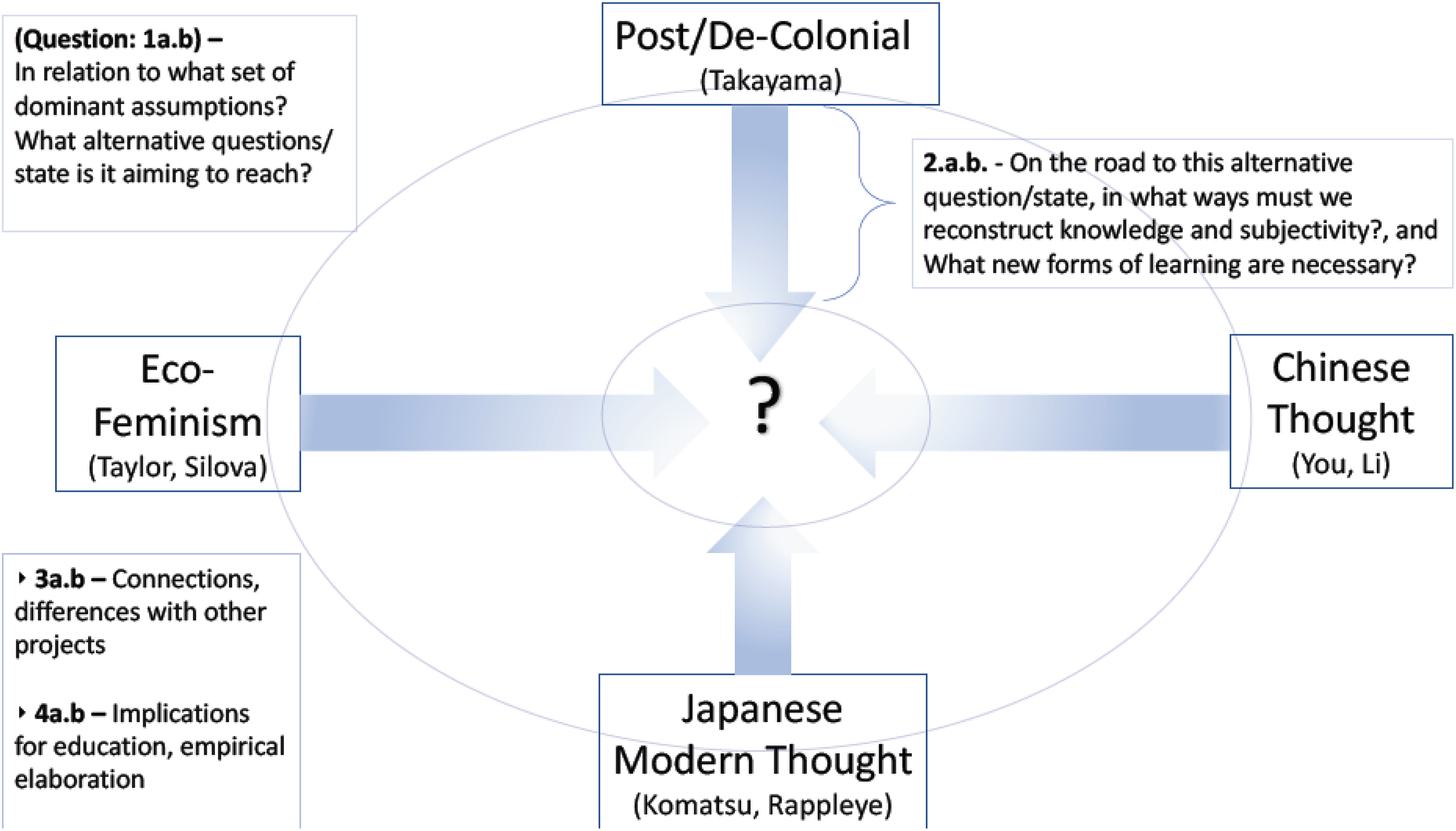
Preliminary schematic of the deeper conversation.
As sketched here, this Special Issue was both an extension and recognition of the limits of the previous work of the Guest Editors Iveta Silova and Jeremy Rappleye (working more recently with Euan Auld). In a series of collaborations that began with a critique of celebration of Rewesternization inherent in World Culture Theory (Carney et al., 2012) and extended in a subsequent appeal to move beyond the World Culture debate (Silova & Rappleye, 2015), this previous work has endeavored to expand the theoretical imagination of the field of comparative education beyond well-worn, but now stifling, theories and approaches. In a more recent paper entitled Beyond the Western Horizon: Rethinking Education, Values, and Policy Transfer (Silova et al., in press), we attempted to remap the terrain of comparative education research onto Mignolo’s trajectories as a way to bring more awareness of and clarity to the growing work on Decolonial and Spiritual (ontological) options.
Yet, through such work, we had become acutely, often embarrassingly, aware of our own lack of ability to go beyond our own “preconscious” allegiances. That is, how to approach the environmental crisis without simply reinscribing our existing worldview? How to reengage in new ways that we once ourselves analyzed with the parochial theoretical lenses of the past (Rappleye, 2017; Silova et al., 2017)? How to engage with new trends, for example, PISA, in meaningful ways that go beyond the usual Western “embrace or reject” standoff and opens up new ways of seeing the World? In coming to this awareness, we have actively sought out the “teachings” of those already doing excellent work beyond the Western horizon. That is, in calling for the expansion of the horizon of the field, we inevitably recognized our limits: We simply could not go any further without help from Others, those who would reach across from the “other side” to help us in our unfolding journey.
Preparing for deeper dialogue about interdependent futures: Groundwork and process
As our intended contribution in this Special Issue extends beyond knowledge itself onto how to create such knowledge—a sympoietic encounter—it is important to sketch out how we prepared this Special Issue. First, we began more than 1 year ago, extending a handful of invitations to scholars whose work was clearly mutually resonant but had not been afforded an opportunity to meet. These invitations were to attend a 3-day intensive Symposium at East China Normal University in late May 2019. In advance of the Symposium, we asked each contributor to submit one scholarly publication that would help other contributors to understand the major themes of interest or sources of inspiration (see Appendix for a list of readings, which all participants were required to read in preparation for the meeting). Our intent was to start the dialogue off at a much deeper level, then extend the exchange through 3 days of intensive work at East China Normal University.
In addition to these readings, each participant prepared a short discussion paper, which was circulated in advance of the Symposium. All participants read each other’s discussion papers in advance and each participant prepared a substantive written commentary on two papers. For example, ecofeminist scholars would have their work read by scholars of Chinese thought and Japanese thought, ensuring rich dialogue and uncommon interactions. Each participant had roughly 45 min to present their discussion paper, followed by two commentaries of 5–10 min, and a general discussion of 30–40 min. The Symposium concluded with an extended, overall discussion, connecting ideas and deepening conversations across different disciplines, approaches, and contexts.
We view this well-prepared and deliberate face-to-face interaction as crucial for the process of “making with,” something so often absent from contemporary academic conferences, often given a lack of time. In a way, the organization of the Symposium itself was an attempt to illustrate—in practice—that it is not only possible but urgently necessary to create the space and time for creating relationships across the epistemological and ontological divides. In Stengers (2012) words, this process offered an opportunity to “become capable of learning again, becoming acquainted with things again, reweaving the bounds of interdependency” (pp. 81–82). In short, it was an attempt to answer Stenger’s challenge about whether “another science is possible.” We are extremely grateful to the Editorial Board of ECNU Review of Education for providing the finances and facilities to make this possible.
After Shanghai, participants were asked to develop their discussion drafts into full papers and put them into deeper dialogue with what had been presented and discussed at the Symposium. Then, initial article drafts were reviewed by different contributors (i.e., not those assigned to provide commentary in Shanghai). A subsequent round of revisions ensued, and penultimate drafts were collected in early November. During this process, we unfortunately lost two Symposium participants—Euan Auld (The Education University of Hong Kong) and Guoping Zhao (Oklahoma State University)—who were unable to continue due to other unexpected commitments, but we are grateful for their contributions to the Symposium discussions and the review of article drafts. At that point, we invited two Commentators with broad knowledge of these different paradigms—Sachi Edwards (University of Tokyo) and Yen-Yi Lee (Taichung University of Education)—to provide short reactions to the assembled papers (see Edwards, 2020; Lee, 2020). As Editors, we envisaged these commentaries as the first step of moving this dialogue beyond those who were personally present in Shanghai. The publication of the Special Issue represents the next step.
Weaving interdependency: Outline of the Special Issue
Komatsu and Rappleye (2020) initiate the Special Issue with their piece entitled “Reimagining Modern Education: Contributions from Modern Japanese Philosophy and Practice?” They suggest that within the wider Decolonial and Spiritual (ontological) trajectories, there has been a tendency to overlook thought and practice found in Japan, perhaps because on the surface it looks highly modern and was not formally colonized (and indeed became a colonial power for a time). But they challenge us to recognize that modern Japanese philosophy has explicitly challenged—in a decolonial sense—the core ontological and epistemic premises of modern Western thought, while Japanese educational practices are clearly distinct in many ways. Their primary focus is on the Kyoto School’s notion of self-negation, which they view as a “mode of encounter” that may affect learning as ontological transformation. In contrast to much of their recent work, they turn to elaborate these ideas by sounding out the resonances (and dissonances) with other projects, carefully comparing and contrasting Japanese thought with ideas suggested by other contributors. In their next move, they initially promise to take us into the empirical, showing us new ways to “read” education in Japan and East Asia. Yet, they quickly retreat from their attempt to reimagine—apparently somewhat to their own disappointment—to address various doubts about the soundness of Japanese educational practice. This move itself becomes a sort of self-negation, wherein they allow themselves to be interrupted and shift course by doubts raised during the Shanghai dialogue. Komatsu and Rappleye conclude using this experience to underscore how difficult it may actually be to affect new readings of existing educational practices, as common sense empirical images of the Other are—they claim—already saturated with “readings” derived from Western liberal starting points. They implicitly raise the question of the extent to which philosophy and practice can be reclaimed from views laid down by centuries of Western imaginings of the Other.
Keita Takayama further illuminates the challenges, uncertainties, and ambivalence associated with moving beyond the Western horizon. In his explorative article “Engaging with the More-Than-Human and Decolonial Turns in the Land of Shinto Cosmologies: `Negative' Comparative Education in Practice,” Takayama (2020b) extends his theoretical work of a “negative” approach to comparative education. He uses “negative” not in the usual pejorative sense but in a philosophical sense, proposing that “negative” approach to comparative education may enable us to confront the limits of previous knowing, while opening ourselves up for new ways of knowing and being. In particular, Takayama reflects on how his own attempt to situate the ecofeminist and decolonial literature within the context of Japanese education has led him to reconsider the role of Shinto in Japanese education, which simultaneously entailed questioning his own identification with the liberal-left politics in Japan. Noting his initial sense of discomfort and the remaining sense of ambivalence, Takayama acknowledges that the Shinto cosmologies may serve as a generative resource for the decolonial project toward the pluriversal world. Along with other marginalized epistemologies and ontologies, Shinto can contribute to reimagining what constitutes education in a “more-than-human” world. Yet, he also points out how Shinto’s potential contributions to the decolonial project are simultaneously tainted by the nationalist and discriminatory nativist politics in Japan. Using this as a “moment of disruption,” Takayama raises difficult but important questions about whether it is possible to free Shinto from modern nationalist connotations (“essentialist” Shinto) and reclaim its historical and spiritual potential for the decolonial efforts (“existentialist” Shinto)? If so, how? And, what would that mean in terms of his own (previously) unquestioned commitments to the liberal-left side of Japan’s postwar political divide?
You (2020) engages in a similar effort of reclaiming categories and language by focusing on “experience” as a key but under-examined concept of constructivist pedagogy, which has become dominant in China—and globally—and accelerated by Western-centric globalization reforms driven by OECD’s PISA and other large-scale student achievement tests. You explores the constructivist understanding of experience, especially as used to define “learner-centered” learning experience, tracing its roots to Western philosophy. She then provides an alternative interpretation and understanding of “experience” by “thinking through Confucius” and then discusses how this alternative understanding may inspire a different, more holistic approach to learning experience in China and beyond. In particular, You suggests that there is more to immediately and consistently experiencing dwelling in this world through learning the concrete content of curriculum than rationally translating experience into knowledge or gaining knowledge on the basis of experience (as conceptualized by Dewey). Drawing on Confucius thought, she elaborates learning experience as a process that leads students to approach dao (or “world-making”) in which tian and ren harmoniously unite, thus evoking students’ experience of aesthetic and religious existence in the continuous and harmonious encounters with all life forms. By illustrating this ontological alternative of learning experience, You’s paper is an important attempt to decolonize our thinking about pedagogy beyond the Western horizon.
Li (2020) continues to the praxis of reclaiming by focusing on the notion of “self” in her article “Toward Weaving a ‘Common Faith’ in the Age of Climate Change.” Noting the limitations of autonomous “self,” which has been consistently cultivated through modernist schooling, she proposes to reclaim a more relational notion of self to foster inclusive and extensive ethical commitment to the flourishing of all living beings in the universe. To pursue this philosophical inquiry, she explores the conceptual linkages among the Buddhist doctrine of no-self, the Confucian conception of the human–nature unity, and Deweyan notion of “common faith” in the context of climate change. Highlighting the interconnections, especially the recognition of a coterminous coexistence of humans and the universe across the different traditions, she proposes a transformative pedagogical praxis that welcomes and embraces a dialogical pluriversality, recognizes human fallibility, and cultivates a shared agency and ecological identity.
Taylor (2020) moves beyond philosophizing by putting her words into practice. In “Downstream River Dialogues: An Educational Journey Toward a Planetary-Scaled Ecological Imagination,” she shares her experience of crossing the subject/object divide between humans and more-than-humans by stepping beyond an exclusively human conversation and entering into a dialogue with the world around her. Informed by animist ecofeminist philosophies, and inspired by Val Plumwood’s writing, she describes the river dialogues which emerged from a recent climate action research field trip to the Athabasca oil sand mines in Alberta, Canada. Vividly retold in the article, these river dialogues are an embodied, emplaced, and interactive mode of thinking and learning with the river, not just about it. They reflect the changing moods and movements of the river—from picturesque Athabasca Falls to tar sands mining shadowlands—while highlighting affective encounters that trigger our ecological imaginations about the possibilities for relational more-than-human methods and pedagogies. Taylor’s article illustrates innovative more-than-human narrative methods and offers a collaborative alternative to the human-centric methods of educational research and pedagogy. Despite the epistemological separations of Western-style modernist education, she argues that it is possible to find ways to dialogue and learn with the non-human world, and thereby to stimulate our ecological imaginations in the face of intensifying anthropogenic climate change.
Silova (2020) continues to incite our ecological imaginations by bringing into dialogue seemingly unrelated knowledge systems across space and time—European “paganism” and 13th-century Japanese Buddhism as well as excerpts from indigenous, ecofeminist, and decolonial scholarship. She pursues a series of speculative thought experiments—epistemological and ontological “regressions”—around “and if” questions in order to reimagine education and our selves within the context of multiple, more-than-human worlds where everything and everyone (both human and non-human) are deeply interrelated. Connecting these thought experiments are shadows of butterflies, fluttering on the edge of extinction and stories (and dreams) about stones shared across time and space. The article proposes to radically reimagine education in two ways. First, it invites us to reconfigure education as a “connective tissue” between different worlds, bringing together rather than differentiating, ranking, and hierarchizing them. Second, it proposes to reframe education as an opportunity to (re)learn how to anticipate and animate our ongoing entanglement with more-than-human worlds through a different type of comparison. Ultimately, such reimaging and reframing entails a metamorphosis as an antidote to Western metaphysics, enabling us to radically reimagine and transform the modern ways of knowing and being as well as the taken-for-granted notions of space and time.
Future directions
These papers are records of our experiments in venturing “beyond the Western horizon” through dialogue and “making-with” (sympoiesis). Degrees of concern over, say, the need to move beyond Western frameworks or urgency of addressing the ecological crisis varies across theses papers, as do levels of engagement with the framing questions, “movement,” and commitment to “making with.” The edges of the papers do not neatly align, as compared with other Special Issues that enfold all contributions within a given theoretical paradigm or set of cultural assumptions. There is much still to be discussed, and many more marginal thought collectives and projects to invite into dialogue. Yet, if we attempt to summarize what has come about as a result of this experiment, we might highlight several unforeseen challenges (and simultaneously opportunities) and one binding theme.
In terms of challenges, three came to the fore. First, as Komatsu and Rappleye highlight strongly at the conclusion of their piece and Lee flags in his commentary, it is challenging to transform these discussions into alternative ways of seeing the empirical world, that is, reimagining empirical research. Seeing the empirical world through a different set of ontological lens than those afforded by Western liberalism is a prerequisite for changing practice, mainly the practice of modern schooling. But most expansive thinkers still leave an alternative empirical-practice dimension undiscussed. Komatsu and Rappleye underscore that our experiments in venturing “beyond the Western horizon” are unlikely to be recognized by a mainstream still so entrenched in that horizon.
Second, as Takayama highlights, our attempts to come together require the use of English, and in such a setting, we are predisposed to think only of “international differences.” This leaves our discussions, at best, untranslated to other languages and, at worst, ignorant of how these ideas may be read in those contexts. No matter how carefully “global dialogue” takes place, it can continue to remain aloof from “intranational” frames and concerns. The study of non-Western languages, histories, and the conundrums of contextualization is—as Takayama so skillfully spotlights—a necessary prerequisite for this project to travel further afield.
Third, through all the papers, there emerges a tension between letting ourselves boldly reimagine, on the one hand, while ensuring rigor and accuracy, on the other. Making connections across projects appears easy when generalized terms such as, say, “relational self” appear. But when an ecofeminist argues for relationality does it carry the same meaning for those thinking from a Confucian tradition? We cannot neglect the unspoken metaphysical backdrops and diverse worldviews against which seemingly similar notions are foregrounded. Intensifying this is the intractable problem of working across vastly different languages. To what extent do those who do not speak Chinese understand the multiple readings and depth afforded by the single characters of Tian or Dao? To what extent can we understand how native Japanese speakers might understand the word kami, which is often so casually translated to English as simply “spirit” or “god”? Does self-negation or “nothingness” invoke a different view when the default position is not Western metaphysics? Similarly, if the term for “nature” already carries less separation in, say, Japanese and Chinese, then what do attempts to imagine the more-than-human look like in that worldview? If languages carry forward a “culture’s symbolic foundations” (Bowers, 1995, p. 2), is there any common ground on which to stand when “making with”?
Unexpectedly that question helps to the one binding theme of this Special Issue: the attempt to collaborate and mutually reconstruct the common ground through meaningful and relevant ways of thinking, dialoguing, and being together. As Stengers (2012) explains, the idea is not to transcend the particularity but “to think with this particularity, to induce the capacity to imagine the possibility that it can be regenerated” without being universalized: It means thinking with its own specific, dangerous and never innocent ways of weaving relations. It means thinking with the resources—imaginative, scientific and political—that it may be able to activate in order to enable us, perhaps, to think with other peoples and natures. (p. 156)
Footnotes
Author’s contribution
All authors contributed equally to this work.
Declaration of conflicting interests
The author(s) declared no potential conflicts of interest with respect to the research, authorship, and/or publication of this article.
Funding
The author(s) received no financial support for the research, authorship, and/or publication of this article.