




Abstract
Purpose:
Taking a particular example of an international partnership programme, this article aims to discuss kindergartens’ participation in international partnership programmes as compelling vehicles for promoting early childhood education for sustainability (ECEfS). The partnership programme included Western Norway University of Applied Sciences, Beijing Normal University, East China Normal University, and kindergartens in Norway and China. Researchers, postgraduate students, kindergarten principals, and teachers participated in the programme, their key concern being to promote competencies for sustainability and agents for change.
Design/Approach/Methods:
The article is based upon research with a phenomenological approach to Chinese and Norwegian kindergarten teachers’ and principals’ experiences of participating in an international partnership programme. The data for this article consisted of reflective notes from the teachers and principals and recordings of teachers’ and principals’ reflections in a joint seminar in the kindergarten network.
Findings:
This article argues that ethical normative, dialogical, and anticipatory approaches are pivotal within international ECEfS partnership programmes.
Originality/Value:
The article has the potential to address international partnership programmes, involving different stakeholders, as vital in promoting ECEfS. It also urges international partnership programmes to promote glocality in ECEfS (i.e., local situatedness with global awareness).
Introduction
Cultural understanding through dialogues leads to a multiplicity of voices and can be mutually enriching, because “it educates each side about itself and about the other, and it not only discovers, but activates potentials.”
In this article, we argue that establishing international partnership programmes is pivotal for early childhood education for sustainability (ECEfS). The United Nations General Assembly announced 17 sustainable development goals (SDGs) in 2015 as part of Resolution 70/1 of the 2030 Agenda. SDG 17 (United Nations [UN], 2015), Developing International Partnerships, is particularly important for strengthening the means of implementing and revitalizing global partnerships for sustainable development. Enhancing international cooperation, rather than competition, and developing multi-stakeholder partnerships for sharing knowledge and expertise, is vital to the overall success of the SDG according to the 2030 Agenda (UN, 2015).
Education for sustainable development (ESD) is explicitly recognized as part of SDG 4, Quality Education (target 4.7) (UN, 2015). ESD promotes crosscutting sustainability competencies in learners, enabling individuals to contribute to sustainable development through societal, economic, and political change, as well as by transforming behavior. The combination of ESD with the development of international partnerships emphasizes the importance of expanding individual learning into transformative learning in communities of practice (CoPs). Building an international network for ECEfS involves identifying global common ground and common challenges but acting locally.
United Nations Educational, Scientific and Cultural Organization (UNESCO, 2016) recognized that early childhood education (ECE) plays a major role in preparing present and future citizens and in aiding societies to make the necessary transitions toward sustainability. The UNESCO report (2016) identified four foci for moving forward: deepening the research base, approaching learning in community-based and holistic ways, educating families and children, and implementing training for early childhood educators. This article promotes the necessity of community learning as well as learning in CoPs.
Sterling (2011) addressed the question of what competencies are necessary, at different levels within educational contexts, to promote multidimensional understandings of sustainability. In the education field, ongoing professional learning is pivotal in influencing how childhood educators think about and enact EfS. However, the role of international partnerships in ECEfS has been somewhat neglected and little attention has been paid in research to how teachers’ key ECEfS competencies can be developed by building international partnership programmes.
This article aims to discuss kindergarten principals’ and teachers’ participation in international partnership programmes as compelling vehicles for promoting ECEfS. The main research question asked is how the design of an international partnership programme can promote kindergarten teachers’ ECEfS competencies.
In most countries around the world, sustainability commonly relates to environmental concerns (Pramling Samuelsson & Park, 2017). There is a need to move from a focus on nature and the environment to a more holistic perspective, in which the dimensions of social cultural sustainability and economic sustainability are given space. The importance of considering local factors as a point of departure for developing strategies for sustainable development is embedded in the first official documents and definitions regarding the concept. Ideas of local action and global impact are founding principles of the UN global action plan’s Agenda 21.
Children’s immediate, local contexts have undergone rapid change in both China and Norway. This has had an impact on education for cultural sustainability within ECE. The increasing migration from rural areas to large cities in China has resulted in multiculturalism, but also in children’s and families’ lack of connectedness to their local roots (Halskov Hansen et al., 2018). The rapid growth of cities and the consequent demographic changes have resulted in children and their families having limited familiarity with their new locality. In Norway, this migration from the rural areas to the cities has also been pronounced. Oslo is now the fastest growing major city in Europe (worldpopulation.com), and its growth is attributed to high birth rates, intranational migration, and international immigration of workers and refugees. Consequently, the society has become more heterogeneous. These changes call for ECE workers to have competencies in cultural sustainability focused on glocality (i.e., local situatedness and global awareness) (Birkeland, 2016; Ødegaard, 2016). This article reassesses the journey of such an international partnership programme so far and proposes avenues for further exploration.
Internationalization in ECE
A long tradition in the ECE field has paid attention to internationalization (Wollons, 2000). Practitioners, teacher educators, and students have been influenced by research concerning ECE across national borders in the initial phases of kindergarten (Wollons, 2000), and China and Norway are no exceptions (Korsvold, 2013; Pan, 2018).
Purposes of internationalization in ECE
Historically, the field of internationalization has been complex and multifaceted, involving different purposes, methods, and theories (Crossley & Watson, 2003; Kazamias, 2009). The research interests have differed between investigating cultural loans; describing best practices; understanding the interrelatedness between education, society, and culture; studying intercultural cooperation; and developing global solidarity as world citizens (Kazamias, 2009; Kemp, 2015; Nussbaum, 1997).
As early as 1900, Sadler warned against the blindfolded transfer of educational policies or practices from one context to another: We cannot wander in pleasure among the educational systems of the world, like a child strolling through a garden, and pick off a flower from one bush and some leaves from another, and then expect that if we stick what we have gathered into the soil at home, we shall have a living plant. (Higginson, 1979, p. 49)
Kelly (2014) stated that internationalization in education allows one to learn from the experience of others; by making the strange familiar, we make the familiar strange (Tobin et al., 1989, 2009 ). Following Kelly’s example, comparison is a method for illuminating the dialectics between the global and the local; so, rather than having cultural loans as its objective, internationalization in ECE needs to acknowledge that “the kindergarten is a diasporic institution, global in its identification, and…local in its execution” (Wollons, 2000, p. 2). Local practices, as the point of departure for international collaboration, provide opportunities for identifying common ground and common challenges within ECEfS.
It is also helpful to establish ethical partnerships that are sustainable: “it is not the goal or logic of ‘helping’ that enables ethical partnerships to be developed. Rather, a reciprocal recognition of the partner, that is also the basis for justice, must be the foundation for an ethical relationship” (Schultz, 2013, p. 84). This ethical space is created when people with different worldviews, positions, or even organizational or personal goals, are in conflict, but those people seek to engage dialogically despite their differences. If partnerships are to be ethically based, they need to be nurtured in this kind of dialogic space (Schultz, 2013, p.84). Such partnership programmes are important countermeasures to the simplistic global transfer of educational politics and pedagogy.
Strategic international partnerships are a “hot topic” within higher education institutions globally. Collectively, there has been a movement away from signing as many memorandums of understanding as possible toward emphasizing strategic partnerships involving careful planning, deliberate action, attention to depth, and sustainability (Sommerville & Williams, 2015).
A particular international ECE partnership programme
In 2013, the Norwegian Government, via the Centre for International Cooperation in Education (SIU), launched a strategy for strengthening cooperation in higher education and research with Brazil, Russia, India, China, South Africa, and Japan (the BRICSJ countries) under the UTFORSK Partnership Programme 1 called Panorama. The overall aim of the UTFORSK Programme is to improve the quality of higher education by enhancing long-term cooperation in higher education in all academic fields within the prioritized countries. The programme should lead to the establishment and strengthening of partnerships between higher education institutions in Norway and the partner countries through (1) the development and implementation of joint educational activities; (2) increased mobility of students between Norway and the partner countries, including mobility in connection with internships/work placements; (3) increased integration of higher education and research in the collaboration between Norway and the partner countries; and (4) increased involvement of nonacademic partners (industry, companies, organizations, etc.) in relevant project activities (Norwegian Agency for International Cooperation and Quality Enhancement in Higher Education [DIKU]). The UTFORSK Programme is funded by the Ministry of Education and Research and is administered by SIU.
The particular UTFORSK Partnership Programme for ECE and research, used as an example in this article, includes Western Norway University of Applied Sciences (HVL), Beijing Normal University, East China Normal University, and six kindergartens in Norway and China. 2 The participants in the programme are teacher educators/researchers, kindergarten principals, teachers, and postgraduate students. The application stated that: “The proposed project will meet the need to broaden researchers’, students’, and practitioners’ views and understanding of culture and education, to further the internationalization in their career development and improve the quality of their research and practice.” The partnership programme was initiated in 2015 and has been continuously developed since that time. The programme’s main activities are illustrated in Figure 1.
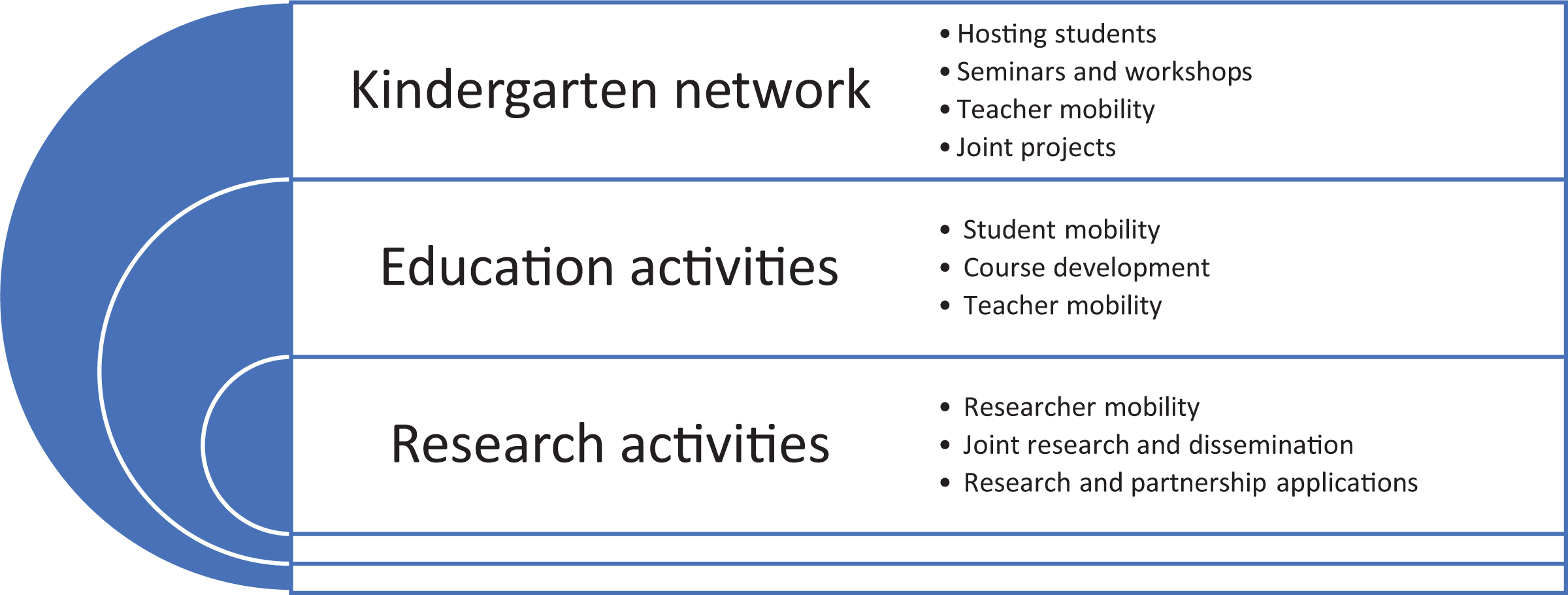
Content of the ECE international partnership programme (UTFORSK). ECE: early childhood education.
The partnership programme aims to combine collaboration within kindergarten teacher education, ECE research, and kindergarten networking. Initially, the partnership had the clear intention of cross-cultural collaboration and mutual learning and was intended to inspire curriculum development, best practices, and teachers’ professional development (Birkeland, 2016; Birkeland & Ødemotland, 2018). Gradually, the focus of the partnership programme has moved toward strengthening the capacity for ECEfS through participation and dialogue in research and educational activities (Li et al., in press). Acknowledging the fact that all the dimensions of ECEfS are vital and that some of the dimensions have received less attention than other dimensions, the partnership programme has so far focused on cultural sustainability.
ECEfS as transformative learning
The UN stated cognitive, socio-emotional, and behavioral learning as the objectives for SDG 17, Partnership for Sustainability. Crucial learning objectives are connected to understanding, raising awareness of, and working with others to promote global multi-stakeholder partnerships for sustainable development. Other learning objectives are connected to becoming agents of change by assuming roles as active, critical, and global citizens and contributing to facilitating and implementing local, national, and global partnerships for sustainable development. In line with the learning objectives, scholars have identified certain necessary competencies within education for sustainability, such as systems thinking, anticipatory, normative, strategic, collaborative, critical thinking, and self-awareness competencies (Rieckmann, 2018).
Developing sustainability competencies through a partnership programme, as stated above, requires a variety of approaches to learning. Mezirow’s theory of transformative learning (1991, 1996, 2000) corresponds well with the competencies required for ECEfS. However, the process of learning within ECEfS needs to expand individual transformative learning processes into CoP learning. Thoughtful learning processes occurring in such an environment do not remain private; instead, the participants’ own mental efforts, and their continuous struggles to learn, understand, and reach beyond given information, become visible throughout the network.
Mezirow (1991, 1996) defined transformative learning as the learning process that transforms a learner’s frame of reference by enabling the learner to critically reflect on taken-for-granted assumptions that shape their perceptions, interpretations, beliefs, and perspectives. According to Mezirow, the transformative learning approach transforms a learner’s prevailing frame of reference by harnessing the learner’s capacity to think hypothetically through a disorienting dilemma. This is often painful and perplexing for a person, because the imbalance challenges core beliefs and assumptions about the person and the world (Mezirow, 1991). Such dilemmas are the result of an external event that causes a sense of internal imbalance. As Mezirow (1991) asserted, feelings of disorientation are excellent opportunities for reflecting on a person’s lived experiences and unquestioned assimilated values and beliefs and, thus, become opportunities for transformative learning to take place. Such challenging scenarios often happen through critical reflection in the context of dialogue with other people (Howie & Bagnall, 2013).
A frame of reference has two dimensions: a habit of mind and a point of view. Habits of mind are more enduring than points of view, since the latter continually change as individuals modify their assumptions in response to feedback from others or to external sources of information. A frame of reference is a complex structure of assumptions, expectations, values, and beliefs that filter one’s sensory experiences and shape emergent meanings (Mezirow, 1996). Habits of mind are “broad, abstract, orienting, habitual ways of thinking, feeling, and acting that are influenced by assumptions that constitute a set of codes” (Mezirow, 2000, pp. 5–6) regarding cultural, social, educational, economic, political, or psychological events. They are expressed as points of view, which are meaning-schemes made up of the beliefs, value judgment, attitudes, and feelings that are used to interpret sensory experiences (Mezirow, 2000, p. 6).
Reflexivity appears in intercultural education as a strategy for developing intercultural competence and as a goal of intercultural training (Blasco, 2012, p. 476). However, this notion of self-contemplation and self-reflection that give participants freedom as thinking beings needs to be challenged in two ways. Blasco (2012) asked whether reflection is necessarily beneficial or sufficient in intercultural education. Jokikokko (2016) drew on a similar question, arguing for the reframing of teachers’ intercultural learning as an emotional process. She argued that emotions are a vital part of any change and, thus, play a significant role in teachers’ intercultural learning processes. The importance of emotions in intercultural learning has been recognized, but the topic has not been theorized or studied extensively. Emotionality is regarded as an effect, rather than as a phenomenon that may have a constitutive role in what intercultural learning may imply for adult learners (Jokikokko, 2016; Zembylas, 2003). Secondly, transformative learning in an international partnerships programme needs to be approached as a dialogical CoP learning and less as an individual learning process.
Methodological approach
This article is based upon empirical evidence from a study of one particular international ECEfS partnership programme (UTFORSK), which involves researchers, students, and kindergarten teachers, and the focus of this article is on the China–Norway kindergarten network. The network includes four Chinese kindergartens and two Norwegian kindergartens, situated in the cities of Beijing, Shanghai, and Bergen. They were invited into the partnership programme due to their interest in international collaboration between Chinese and Norwegian kindergartens. Apart from this project, the participant kindergartens had some international experience but limited experience of being in a partnership.
Data
The empirical material for the study comprised 15 open reflection notes written after host students’ fieldwork and teacher mobility and a recorded discussion among Norwegian and Chinese teachers after a joint seminar about cultural sustainability.
Analyses
The analyses took as their point of departure the qualitatively different levels of interpretation suggested by Kvale and Brinkmann (2015), such as the levels of self-understanding, critical common sense, and theoretical knowledge. The first level of analysis involves condensing the meaning of the applications and reflection notes (Kvale & Brinkmann, 2015, p. 241). At the second (critical common sense) level, the researcher goes beyond the condensation of meaning and interprets the texts in a general commonsense way by examining the content (Kvale & Brinkmann, 2015, p. 241). At the theoretical interpretation level, the researcher applies transformative learning and ECEfS competencies as a theoretical framework for interpreting the meaning and identifying patterns in the material (Kvale & Brinkmann, 2015, p. 2015).
Positions as researchers
As researchers, the authors had dual roles and positions. We were positioned both as project leaders/coordinators and as researchers; hence, we were both insiders as project members and outsiders as researchers bringing potential insights to nuanced cultural signifiers. Our familiarity may have led to the recycling of dominant assumptions; however, outsiders may contribute fresh perspectives or may impose their own worldviews uncritically (Crossley & Vulliamy, 2006). Conducting collaborative research and having international partnerships with both insiders and outsiders can enable research to be more sensitive to the local social constructions of reality (Crossley, 2002) by co-participants, such as students, teachers, and principals (Kelly, 2014).
Simultaneously, we were insiders in different countries living, respectively, in China and Norway. As researchers, we had developed from being insiders regarding ECE in our home country to becoming experienced and knowledgeable about the host countries. In this respect, our position became more that of an “in-betweener,” occupying a “third base,” (Milligan, 2016) as we distanced ourselves from our home education and drew closer to that of the host country (Birkeland, 2013).
Ethics
This research interest had an impact on the establishment of an ethical space in the project in general and the research approach in particular (Schultz, 2013). This ethical space is created when people with different worldviews, positions, or even organizational or personal goals, are in conflict, but those people seek to engage dialogically despite their differences. If partnerships are to be ethically based, they need to be nurtured in this kind of dialogic space (Schultz, 2013).
The information regarding the kindergartens involved in the UTFORSK project is public information, so the ideal of anonymity for the kindergartens was difficult to fulfil; however, detailed information about the participant teachers was not publicized.
Kindergarten principals’ and teachers’ reflections on participating in the programme
The data comprise 15 reflective notes written after host students’ fieldwork and teacher mobility, and a recorded discussion among Norwegian and Chinese teachers after a joint seminar about cultural sustainability. The study focused on the aims and content of the kindergarten network and did not include the aims and content of research and educational activities at the universities, such as student mobility, although all these activities were intertwined and created synergistic effects in the programme.
Activities involving kindergarten teachers and principals
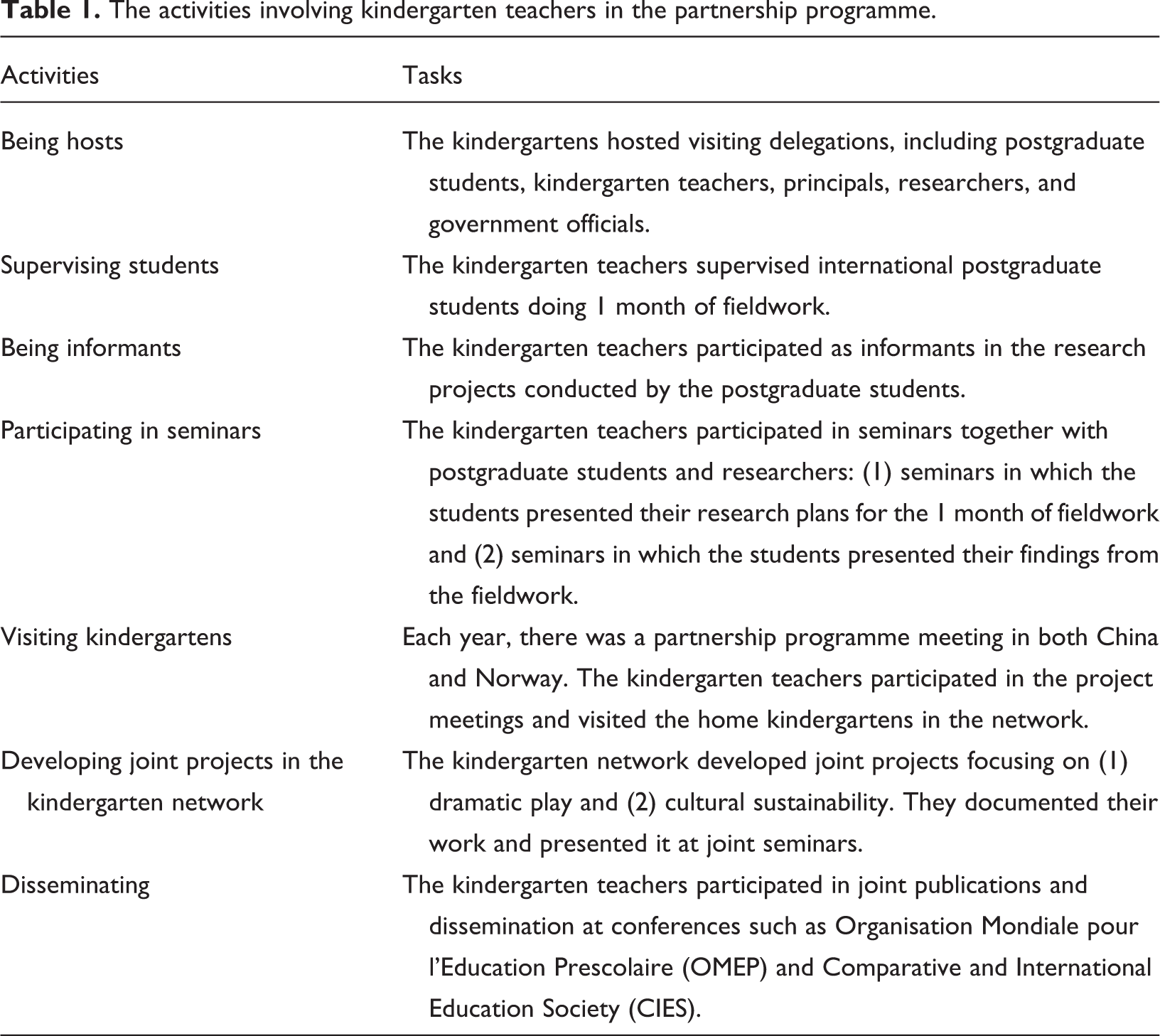
The activities as listed in Table 1 involved kindergarten teachers and principals and were background for their reflections.
The activities involving kindergarten teachers in the partnership programme.
Teacher reflections
The following pieces of text are excerpts from the teachers’ reflective notes and joint reflections in a seminar.
Taking the perspective of “the other”
In particular, the Norwegian teachers reflected upon the role of being a host for visiting delegations and students doing fieldwork in the kindergarten. One of the teachers wrote: Earlier, before we participated in this programme, when we were receiving foreign guests, I thought the best thing for them would be to just observe natural everyday life in the kindergarten. I did not prepare much and I did not reflect upon what they needed to know as foreign guests. Now I pay attention to these kinds of questions. I ask myself “What do the guests need to know in order to understand our practices?” Visiting Chinese kindergartens really impressed me. We could find signs everywhere showing that we were expected. They had published information in the hallway about the visit and about Norway. They gave a PowerPoint presentation about their kindergarten and the children were engaged in welcoming us with small token gifts. The children served us snacks and something to drink in the meeting room. I really felt welcomed to the kindergarten.
To challenge taken-for-granted assumptions of educational practices
The kindergarten teachers helped the postgraduate students to conduct their fieldwork in the kindergarten. The teachers also contributed to the students’ projects by being interviewed and observed and, finally, by contributing to the seminars in which the students presented their work. In their reflective notes, all the teachers highlighted how involvement in student projects challenged their ways of thinking: I was so surprised by all the questions the Chinese students asked. I really understood that we take a lot of our work for granted and that we do things without thinking about why we do them. I am not aware of what I am doing all the time; however, the students’ questions woke me up.
A Chinese teacher wrote: “The Norwegian students needed so many explanations and I didn’t have answers for all their questions.” Another Chinese teacher said: I have become more confident about what I am doing since I have read the students’ observations. I have a lot of skills and knowledge that I can share. I do not feel ashamed of the Chinese way of doing things.
Disturbing preconceptions
All the teachers expressed surprise and confusion when they visited the foreign kindergartens. Most of the teachers reflected upon their preconceptions about each other; as one of the Chinese teachers stated: I thought I would see very rich kindergartens with lots of resources when I came to Norway. I have seen with my own eyes that the kindergartens are in a way simple and use natural resources. Why? I have been thinking a lot about what rich resources in kindergartens really mean. I did not know that the Chinese kindergarten teachers let the children have such a strong voice and that they were listened to in this way. I was impressed by how the children were invited to influence their local community project.
Self-awareness
The kindergarten teachers initiated seminars to present their joint project work to the kindergarten network. They wanted to have their own agenda, with space for their own work on specific topics. The comments after the presentations reflected disturbances of their preconceptions in some ways; for example, some of the teachers changed their preconceptions about the intentions of the project: I thought I was going to Norway to learn from them and bring back new ways of teaching. Now I think differently about this. Of course, there are some ideas I want to take with me home, but the most important is that I feel so much more confident about our local approach; not the general Chinese approach, but the local Chinese approach we have.
One of the Chinese teachers said: “Through these presentations, I really understand how important it is to know the neighbourhood of my kindergarten and to know the history of this neighbourhood.” Another Chinese teacher said: We used to be competitive, giving our best performance and showing our best practices. After these presentations, I have become more relaxed and I am concerned with having less of the “show and tell” attitude and more of the “share and do together.” One of the Norwegian teachers was puzzled by the concept of sustainability. She said: I did not think that sustainability had anything to do with culture and community practices. When I talk about sustainability, I immediately think about the environment. I think about how important it is for children to love nature in order to protect it. Now I see the importance of loving the neighbourhood.
Agents of change
The material does not include many reflections about changes in actions. However, one of the Chinese teachers addressed this topic explicitly in her reflections by saying: After my visit to Norway, I can see that we do many unnecessary tasks in our kindergarten—tasks that provide teachers with hard workloads. I am also designated to unnecessary control. When I return, I want to make the teachers more confident and independent of me.
Establishing ethical space
The discussions that followed the presentations in the seminar politely embraced the presented project with comments like: “This is interesting: how did the children react to the project?” or “How did the parents become involved in the project?” The teachers did not challenge the presented projects, nor did the discussion reveal any deeper reflections about how the teachers conceptualized cultural sustainability. They gave examples of how they interpreted the task about cultural sustainability but did not really discuss the concept. The seminars did not invite reflections on creating agents for change, neither did the tasks in the seminars invite to imagination and engagement of multiple futures and future scenarios.
When we tried to summarize the teachers’ reflections, we saw a pattern of disturbance, surprise, confusion, and puzzlement regarding preconceptions. The preconceptions related to general conceptions of quality in ECE, preconceptions about the purposes of participation in partnership programmes, and preconceptions about cultural sustainability. These reflections were also in line with the aims of the partnership programme, which were to broaden the researchers’, students’, and practitioners’ views about, and understanding of, culture and education; further the internationalization in their career development; and improve the quality of their research and practice. There was limited reflection in the material pointing to the necessity of developing agents for change and anticipatory competencies for future scenarios.
Partnership programmes and transformative learning
Participating in an international partnership programme does not automatically result in transformative learning and ECEfS competencies. However, the reflections of the kindergarten teachers indicated that the participation confronted them with disorienting dilemmas that challenged their core beliefs and assumptions about themselves and the world (Mezirow, 1991, 1996, 2000). Assumptions of themselves and “the other,” including assumptions about sustainability, were challenged in their dialogues with students, in visiting host kindergartens, and in taking part in joint projects. The teachers demonstrated that this disturbance of their core beliefs forced them to verbalize the institutional practices that were otherwise tacit and taken for granted. Our findings also indicated that these reflections did not lead to an uncritical embracement of the foreigners’ way of conducting ECE. On the contrary, the teachers seemed more confident and empowered in their own way of conducting ECE. In spite of this confidence, or maybe because of it, the teachers verbalized nuances by reflecting upon weaknesses as well as strengths. With regard to the sustainability competencies, the teachers demonstrated both critical thinking and self-awareness competencies (Sterling, 2011). Their reflections illustrated that partnership programmes can provoke the “third space” and, as Bakhtin (1981) said, being on the border makes you see something else.
However, transformative learning for ECEfS includes normative as well as strategic and anticipatory competencies. ECEfS involves a normative stance toward the SDGs; therefore, a dialogic understanding of “the other” and of oneself is merely a starting point in an ECEfS partnership programme. Taking a normative stance also requires confrontation and negotiation about the content of ECEfS and how to achieve the SDGs. Establishing an ethical space (Schultz, 2013) for such confrontations is crucial; otherwise, the discussion and confrontation may become a competition between best practices, rather than an endeavor for knowledge construction. The teachers showed limited conceptualization of ECEfS, in their surprise about other aspects of sustainability than the environmental. The teachers’ surprise supported the need for greater focus on all the ECEfS dimensions (Pramling Samuelsson & Park, 2017). In order to develop strategic competence, it is necessary to continuously clarify and conceptualize the sustainability concept.
In Mezirow’s conceptualization of transformative learning (1991), the anticipatory competency was given no space. However, anticipatory competence is vital for ECEfS. The design of the programme and the activities did not particularly invite the creation of visions for the future or provoke consideration of future scenarios—possible, probable, or desirable. None of the participants reflected upon these topics. As project leaders, we did not ask for these perspectives and did not challenge them, but we did challenge a certain competitiveness in describing best practices of cultural sustainability: “show and tell,” rather than “share and do.” The necessity of openness to different future scenarios was not encouraged, and thus, cultural sustainability mostly emphasized past and present scenarios rather than future scenarios.
Conclusion and implications
Our findings illustrated that an international partnership programme within ECE is complex and involves a variety of conflicting aims. The call of the UTFORSK Partnership Programme focused on increasing quality in higher education institutions. An important premise for the allocation of money was collaboration with top universities in China, concerning the dominant discourse about the role of internationalization within higher education in perpetuating competition. This conflicts with the 2030 Agenda, emphasizing international cooperation over competition, and the development of multi-stakeholder partnerships for sharing knowledge and expertise as pivotal to the overall success of the SDGs (UN, 2015).
In this article, kindergarten teachers’ participation in international partnership programmes as vehicles for promoting ECEfS have been illuminated. In particular, we have highlighted how the design of an international partnership programme can promote ECEfS competencies. Our findings have implications for the design and development of international ECEfS partnership programmes, beyond this particular programme. Firstly, involving different stakeholders, such as researchers, students, kindergarten principals, and teachers, opens up a vital space for dialogue and critical inquiry; including a variety of activities in research, higher education, and ECE practices contributes to different aspects of ECEfS. Furthermore, partnership programmes need a solid grounding in mutual inquiry, meaning that all the parties involved should be targets for inquiry. This establishment of a dialogical ethical space is vital for enabling the participants to open up regarding their diverse perspectives on practices; however, the design of specific and targeted activities can move this ethical inquiry forward to include inquiry concerning the common values and potential of ECEfS.
Finally, this inquiry also urges international partnership programmes to promote “glocality” in ECEfS (i.e., local situatedness within strengthened global awareness). Place-oriented pedagogies are needed so that the education of citizens might have a direct bearing on the well-being of the social and ecological places people actually inhabit. The first step in this approach has been carried out and we propose avenues for further exploration.
Footnotes
Declaration of conflicting interests
The author(s) declared no potential conflicts of interest with respect to the research, authorship, and/or publication of this article.
Funding
The author(s) disclosed receipt of the following financial support for the research, authorship, and/or publication of this article: The research and authorship of the article is funded by Norwegian Agency for International Cooperation and Quality Enhancement in Higher Education (DIKU) and Kindknow–Kindergarten Knowledge Centre for Systematic Research on Diversity and Sustainable Development.