




Abstract
Purpose:
Focusing on the hot-debating issue of school choice in China, this article aims to present a narrative of the policy interventions, especially promulgated by the Chinese central government during the past 20 years, and to discuss those challenges facing the governments and the society as a whole in the new era.
Design/Approach/Methods:
This article conceptually approaches the topic based on policy texts analysis and literature review.
Findings:
This article pictures the historical dynamics of school choice phenomenon and its interaction with the corresponding policy initiatives promoted by the central government. It argues that school choice governing in China basically experienced three stages since the middle of 1990s, namely controlling “choice fees,” promoting equalization and equity as well as comprehensive governance toward greater quality and equity. The effective implementation of these policy measures is gradually cooling down the “choice fever” in urban areas and restoring order for student enrollment in compulsory education, but great challenges are still lying ahead since the problem of school choice turns to be “wicked” in nature and cannot be simply solved within the education sector.
Originality/Value:
This article contributes to the global discourse of school choice research with much updated information of policy initiatives and the newly emerged situations since 2014, calling for close attention and deeper research from researchers both from China and from abroad.
Over the past two decades, school choice policies remain a popular and controversial reform option internationally. There already exists a sizable body of research on the topic, one that is constantly growing. In recent years, certain English-language articles have been published addressing the topic of school choice in China (see, e.g., Wu, 2008, 2011, 2014). These articles have provided valuable insight into the international academic community regarding school choice policies and practices in the world’s most populous country. Prior studies, however, generally fail to reflect the most recent trends affecting school choice in China. This article strives to provide an up-to-date reference for the international academic community. We cover the Chinese government’s core policies affecting school choice and describe the general pattern of their evolution over the past 20 years. We conclude by presenting the challenges China faces today with respect to the issue of school choice.
The past: School choice and policy intervention in an era of “chaos”
As a global social movement, school choice reforms assume a wide variety of incarnations from country to country (Forsey, Davies, & Walford, 2008). In China, the phenomenon particularly known as “school choice fever” at the primary—and secondary—school first appeared in late 1980s and began to take shape in the early 1990s. It is undeniable that the winners of this positional competition have always been those professional middle- and upper-class parents who possess a certain degree of economic, political, social, and cultural capital (much similar to what has taken place in many Western countries). But obviously, the choice phenomenon and policies in China are deeply rooted in somewhat unique economic, political, social, and cultural contexts and naturally turn out to be a different tale from the West (Wu, 2014). The striking features may go as following: (1) School choice in China has generally been a “bottom-up” phenomenon, primarily driven by parents competing (through various channels) for a limited number of slots at the so-called key schools or demonstrative schools (Wu, 2008). The widespread existence of school choice throughout China coexists with a long-standing lack of formal recognition of its legitimacy. This is one of the prominent features of the phenomenon of school choice with Chinese characteristics. (2) Chinese parents choose schools for their children through a variety of channels and means, including money (school fees, sponsorship fees), power, guanxi, and academic achievements (test scores, various competition certificates, and honorary awards). (3) School choice has brought about a series of negative influences in education and society; the public maintains complex attitudes toward parents’ school choice strategies. Parents feel the pressure to find the best schools for their children even though they are not always happy about the means they choose, especially when it comes to the use of unconventional methods such as wealth and power. School choice has led to vicious and ever-intensifying educational competition. These are sensitive issues that often offend the public’s concept of social justice and evoke widespread social dissatisfaction and anxiety. (4) The government’s attitude toward school choice seems to be ambiguous. The government has simultaneously banned school choice while turning a blind eye toward its prevalence. This subtle politics of “not seeing” has become another unique manifestation of school choice in China (Kipnis, 2008; Liu & Apple, 2016; Wu, 2014).
In fact, since the chaotic phenomenon of school choice emerged, a series of policy interventions from the central government have never been absent. Starting in the mid-1990s through to the beginning of the 21st century, the Chinese government’s policy on school choice has gone through two stages: prohibition of choice fees and a focus on educational equalization (Dong, 2014; Wu & Shen, 2006).
Controlling “choice fees”
One of the toughest problems of school choice for the policy makers was the involvement of choice fees, referring to the additional money paid by parents to the school of their choice which is not in their catchment area. Subsequently, the State Education Commission sought to address the issue of school choice by calling off the misconduct of schools receiving different kinds of “choice fees.” From 1993 to 1998, the government promulgated a series policies and commands aimed at addressing those fees-related choice behavior (see Table 1, for specific policy texts). Besides, the government also recognized that the choice fees controversy had complex social and educational roots, one of which was the uneven development in compulsory education and the striking inequality that lay in different schools. Therefore, the government also proposed implementing policies like adopting proximity-based compulsory education admissions, downplaying the “key school/class” system, providing additional support to underperforming schools, reforming the overall enrollment model, promoting the balanced distribution of students, encouraging the development of private schools, and offering assistance to help guide parents through the school-selection process. However, due to the policy climate putting “efficiency” ahead of “equity,” many measures were difficult to be enacted, and the “choice fever” continued more or less unabated.
Representative policies addressing “unreasonable fees” in the context of school choice.
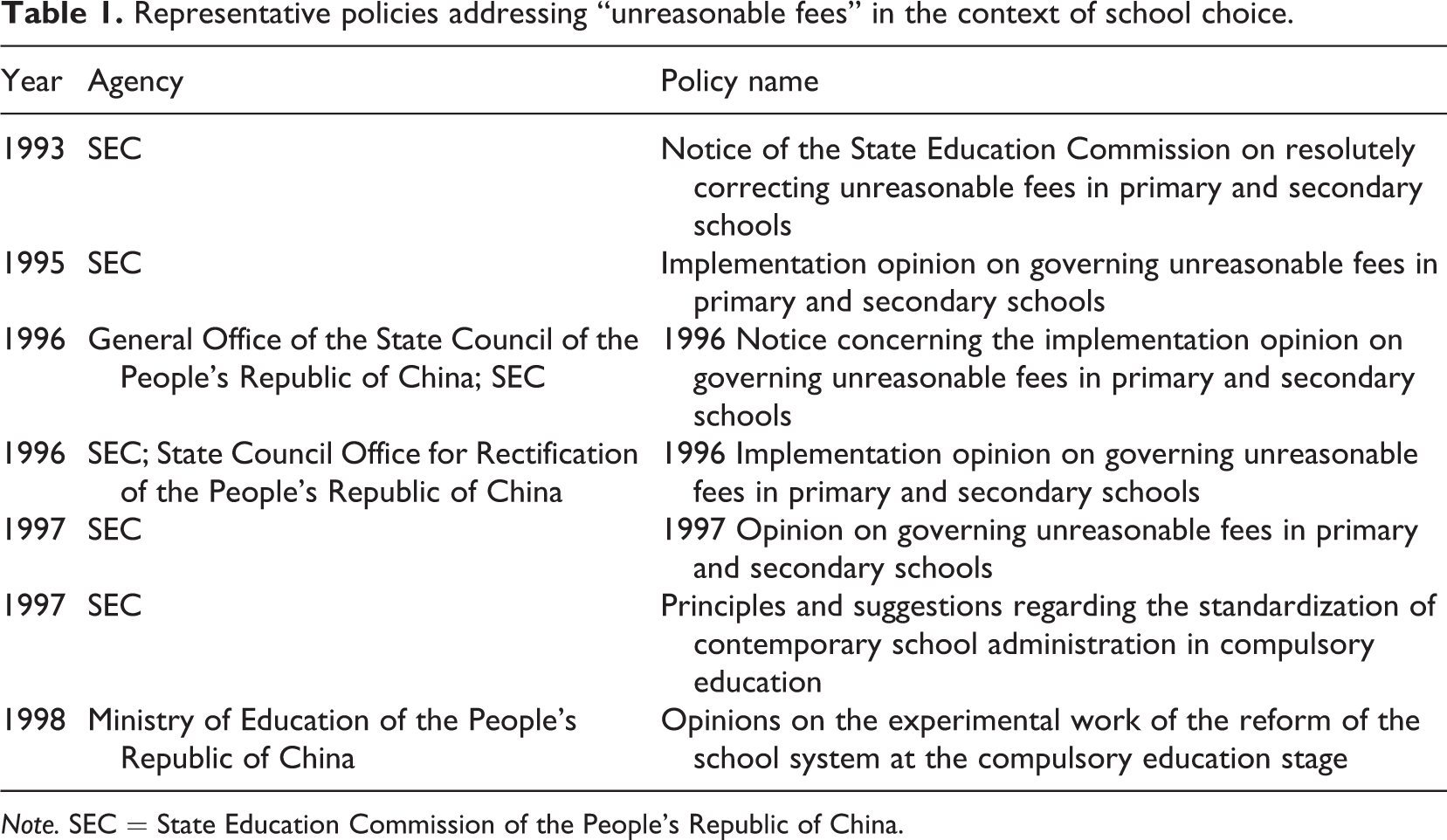
Note. SEC = State Education Commission of the People’s Republic of China.
Shifting toward equity and equality in education
By the beginning of the 21st century, the government had become increasingly aware that the gap among different schools has been enlarged. This quality gap, in turn, fueled a series of social conflicts (including those related to school choice). As a result, “reducing the gap,” “balanced development,” and “educational equity” became the dominant values of education policy during this period. School choice governance was thus incorporated into the framework of “educational equalization” (Wu & Shen, 2006). In 2006, the newly revised Compulsory Education Law reaffirmed the legal status of “educational equality,” emphasizing that public schools implement test-free, proximity-based admissions while ceasing the practice of keeping a key school system. Since then, the Ministry of Education has also published various guidance and orders, requiring local education administrative departments at all levels to increase the rational allocation of educational resources. These efforts include the following: encouraging movement among principals and teachers, improving enrollment policies, sharing quality education resources, accelerating the transformation of lower-preforming schools, reducing class size, standardizing the practice of school administration, and improving the overall school performance. The goals of these efforts were to promote equality among compulsory education schools, to ensure each student’s admission to the appropriate nearest school and to alleviate the problem of school choice in urban settings (Ministry of Education of the People’s Republic of China, 2010). It can be said that the basic orientation of China’s school choice governance policies was established in the first decade of this century.
The present: Comprehensive governance to achieve “quality and equity”
The abovementioned policies attempted to solve the problem of school choice by reducing the performance gap among schools. However, school choice is a complex matter, and the policy results were not ideal. Parents still often feel forced to resort to “underground” methods to secure admission for their children at desirable schools. The public’s dissatisfaction with the school admission system has grown. In recent years, ideas such as “education that satisfies the people,” “achieving a higher level of quality and equity in compulsory education,” and “building a modernized educational governing system” have gradually become a national focus. The governance of school choice has entered a new phase featuring comprehension, legalization, districtization, and standardization.
Integration of school choice governance
In 2010, The National Medium- and Long-Term Education Reform and Development Plan (2010–2020) initiated the process of “comprehensive reform” in the field of education. On the issue of school choice, the Ministry of Education proposed 10 policy measures including “balanced resource allocation,” “standardized enrollment procedures,” “improvement of lower-performing schools,” “expansion of quality resources,” “increasing supervision and accountability,” “guiding social opinion,” and so on. These 10 measures marked the arrival of a more comprehensive stage in the governance of school choice (Xinhua Net, 2010). At this time, the coordination between the central and the local governments (including the Ministry of Education and its provincial and city counterparts) has increased to focus on the overall design of the national education system while still encouraging active local experimentation. Through this approach, school choice governance tools have become increasingly diverse and integrated (Dong, 2014).
Implementing a test-free, proximity-based admission system in accordance with law
Compared with the past, the legal status of test-free, proximity-based admission in compulsory education has been strengthened. In particular, in 2013, the Third Plenary Session of the 18th Central Committee of the CPC passed the Decision of the Central Committee of the Communist Party of China on Comprehensively Deepening Reform on Certain Major Issues, reemphasizing the fundamental importance of this policy. Since 2014, the Ministry of Education has issued annual guidance on how to implement test-free, proximity-based admissions and has promulgated a series of regulations regarding appropriate school enrollment practices. With these measures, the legal status of school choice issues has been greatly clarified.
Promotion of school “districtization” and “grouping”
Following the Third Plenary Session of the 18th Central Committee of the CPC, the government has embarked on implementing a “school district management” system and a “student matching” system in primary and secondary schools (Ministry of Education of the People’s Republic of China, 2014a). Specifically, according to the principles of geographic proximity and balanced school performance, primary schools and middle schools are now grouped for overall management. By optimizing the location of schools, the arrangement of school districts and certain other technical measures (such as lotteries), the government hopes to achieve its test-free, proximity-based admissions policy. In terms of school administration, the government seeks to promote the establishment of school alliances and groups, collaboration among schools, the balanced distribution of teachers and administrators within school districts, and the sharing of teaching resources. Additionally, the government has emphasized the need to improve teaching management, teacher training, teacher assessments, and the quality of classroom instruction and extracurricular activities. By allocating students to primary, middle, and high schools on the basis of geographic proximity, the number of students enrolled in “hot” schools will be roughly equal in each district, which will promote the relative balance of students (Ministry of Education of the People’s Republic of China, 2014b, 2015).
Standardizing the private tutoring market
China’s school choice problems are inextricably linked to the market for private tutoring. The strong demand among parents to enroll their children in the best schools coupled with the government’s suppression of school choice has driven the demand for private tutoring (especially English and mathematics tutoring, which can help students secure admission to high-quality schools). In 2017, the government increased its regulation of private tutoring centers in Shanghai. In early 2018, the Ministry of Education and three other departments issued the Notice on Effectively Reducing the Extracurricular Burden of Primary and Secondary School Students and the Implementation of Government Action Regarding Private Tutoring Agencies. This policy seeks to standardize the regulation of the market for private tutoring services across the country in three stages: first, by investigating the safety, access qualifications, and subject-based training content of tutoring organizations; second, by punishing those who organize illegal subject-based academic competitions; and third, by curtailing the illegal involvement of schools and teachers in private tutoring organizations (including the practice of collusion between schools and tutoring organizations in the admissions process; Ministry of Education of the People’s Republic of China, 2018a). At the same time, the Ministry of Education also issued an announcement stating that “in principle, competitions for compulsory education should not be held; and—without the approval of the Ministry of Education—activities such as competitions, listings, naming, and recognition should not be labeled as ‘National’” (Ministry of Education of the People’s Republic of China, 2018b). The increased regulation of private tutoring organizations and academic competitions has further reduced room for school choice.
The future: New policy challenges under the “new format” of education
Over the past two decades, the Chinese government’s rejection of school choice and respect for balanced development have remained consistent policy themes. However, the 19th National Congress of the Communist Party of China made it clear that one of the main conflicts in current Chinese society is the conflict between the people’s growing need for a better life and unbalanced economic development. In education, this conflict is manifested in the conflict between people’s demand for high-quality, personalized education services and the limited availability of such services (particularly in the light of their uneven distribution across the country). At the same time, Chinese education is taking on a “new format” that is different from the past: Training institutions and educational technology enterprises are beginning to play a key role in the supply of education services. The methods and forms of education supported by new technologies are constantly evolving, and the organization of the entire education industry is also quietly changing (Wang, 2018). Under these circumstances, the increasing demand for school choice has become a fundamental policy issue that cannot be ignored (Wang & Tian, 2018).
Regarding school choice, the Chinese academic community has long supported the approach of “guiding” instead of “blocking” (Zeng, 2010). In the light of the new format of education in China, it is necessary to address the current rationality of school choice as a policy goal (Wang, 2018). This raises the question: What is the future direction of China’s policies on school choice? The author believes that the following conflicts need to be addressed in the decision-making process.
First, how to balance fairness and quality? For a long time, the balanced development of China’s basic education system and the governance of school choice have been based on the policy consensus of achieving education and social equity. With the concept of “fairness and quality” education development, fairness is important, but quality is even more indispensable. In particular, after achieving a basic balance, localities have generally begun to move toward the goal of “quality and balance.” Although people’s understanding of what constitutes quality is not the same, school choice has gradually become an important parameter to measure the quality of a country’s and region’s education systems. The paradox is that if school choice is permitted under the current policy framework, it will add legitimacy to the educational advantages currently enjoyed by certain privileged groups within Chinese society. A lack of equity in the education system will damage the public’s acceptance of the system. China may not be able to provide an education system that is acceptable to the public if the country continues to ignore the growing demand for school choice. In the long run, ignoring the demand for school choice will not promote competitiveness and quality, and it may further intensify educational anxiety and exacerbate the outflow of talent.
Second, how to balance the needs of the country with the needs of the individual? Undoubtedly, education in China develops a clear “nationalism” approach since the beginning of its modernization journey. After reform and opening up, China gave priority to the development of education, and education also serves the state (Yuan, 2018). However, an education system driven by a strong nationalistic ideology is always limited in its tolerance for freedom of choice. Given the continued influence of nationalism and collectivism and the historic absence of school choice in Chinese compulsory education laws and cultural traditions, a wholesale cultural update is necessary to give the concept of school choice legitimacy within the framework of compulsory education admissions policies.
Third, how can the government and the market work together? China once embarked on a short-term attempt to reform the market for basic education. Private schools and public-to-private school transformations expanded aggressively. The policy of “No choice in state schools, choices allowed in minban schools (‘people-run schools’), and famous school (usually those ‘hot’ state schools) encouraged to run minban schools” (Ding, 2004) provided an opportunity for parents to choose schools for their children the italics emphasis is originally given because this word “minban” is presented in Chinese spelling. However, this policy was suspended because it contributed to “chaos” in the school-choice process and worsened the ecology within the compulsory education system (Ministry of Education of the People’s Republic of China, 2006). The overall pattern of state-dominated compulsory schooling system was further solidified. 1 In contrast, the popularity of the private tutoring market shows that while the market mechanism has a limited role in the supply of formal education, it satisfies the needs of parents in certain educational contexts (Wang, 2018). At the same time, the phenomenon of parents paying a premium to buy houses in high-quality school districts (thereby making it difficult, if not impossible, for lower-income families to live in such districts) has emerged in recent years and has presented new challenges to the government’s proximity-based admissions system. Looking to the future, we must face the needs of parents to choose schools for their children. Obviously, these needs cannot be fully satisfied by the government or the market alone. It is necessary to reconstruct the relationship between the two on the supply side. The key is how to best integrate government- and market-based initiatives.
Fourth, how to coordinate higher- and basic-education policies? Certain researchers have pointed out that the main conflict between China’s educational supply and demand underlying the school choice problem in the conflict between the “equality” orientation of basic education and the “elite” orientation of higher education. The key policies supporting the renovation of higher education in China (e.g., “211,” “985,” and “double first-class”) have reduced competitive pressure at the top of the education system and, correspondingly, at the bottom, but—at the same time—have fueled the desire among parents to have additional options with respect to school choice (Wang, 2018). School choice is not only an issue driven by policies at the compulsory education stage, it must also be considered while designing policies for the overall education system. This level of coordination represents a unique challenge.
Finally, how to meld local with global? In the context of globalization, the diversity of educational choices cannot evade the impact and challenges of internationalization. The well-known new media writer, Li (2016), vividly described the process of school choice from elementary to middle school in Shanghai. Li likened the process to five “spectral routes” from “East” to “West,” revealing the complex ecology of “international” and “local” cultural forces that shape parents’ thoughts about school choice. At present, China’s education reform embraces both international and traditional culture. This compound policy orientation is reflected in the issue of school choice governance. It is especially apparent in the context of school administration when attempting to integrate international and local elements to form different types of schools to meet the evolving needs of parents and students. In tackling this challenge, breakthroughs are needed in both theory and practice.
The issue of school choice in China has complex economic, political, and cultural roots. Therefore, governance must be a systematic project. There is no doubt that China’s researchers and policy makers face a monumental task in shaping China’s school choice policies to meet the challenges presented by the new era. It might be somewhat difficult to accurately predict the specific direction of policy-making on the choice matter, but it is undeniable that the parents’ rational demand for more choices for their kids’ education needs to be addressed in the future. In designing policy, it is important to abandon the dualistic thinking of “either/or” and replace it with a more nuanced approach to policy-making that treats different stakeholders from a holistic perspective and takes into account the impact individual policies may have on other entities and the educational ecosystem as a whole (Wang, 2018). This is clearly the proper way to dealing with those “wicked” social problems in the complex era.
Footnotes
Declaration of conflicting interests
The author(s) declared no potential conflicts of interest with respect to the research, authorship, and/or publication of this article.
Funding
The author(s) disclosed receipt of the following financial support for the research, authorship and/or publication of this article: Peak Discipline Construction Project of Education at East China Normal University (2017).