



Abstract
This study examined probation practitioners’ views on written psychological case formulations used to support work with people presenting complex personality difficulties. A survey explored whether these documents function as meaningful tools for understanding behaviour and informing supervision, or whether they risk becoming procedural paperwork. Most practitioners found formulations helpful for clarifying risk and guiding planning, though confidence in producing them independently was low. Time pressures and limited organisational support were key barriers, while consultation and training enabled use. Findings highlight the need for supportive structures to sustain psychologically informed practice within probation settings.
Keywords
Introduction
The conceptualisation and management of people who are high risk of offending and have personality difficulties within forensic contexts remains complex and contested (Jarrett et al., 2025). This is evident particularly in probation settings where psychological understanding must be translated into practical strategies for risk management and rehabilitation (NHS England, 2023). Historically, the shift from descriptive typologies to the pathologisation of personality traits post-World War II marked a pivotal moment in psychiatric discourse, prompting critiques of diagnostic rigidity and calls for more holistic approaches (Horwitz, 2013; Tyrer and Mulder, 2022), shaping the way we view personality traits. Adolf Meyer’s early advocacy for ‘whole person’ assessment laid the groundwork for psychological case formulation, a dynamic, contextualised alternative to static diagnosis (Meyer & Turkat, 1979 as cited in Turkat (2014)), to understand those presenting with difficulties. This historical context has shaped overtime the way we understand and manage people with personality difficulties in forensic contexts.
In England and Wales, these developments are reflected within the Offender Personality Disorder Pathway, a national joint initiative between NHS England and His Majesty’s Prison and Probation Service (HMPPS) that provides psychologically informed services across prisons, probation, and secure health settings (Skett and Lewis, 2019). It exists to provide services for people in prison or on probation whose risk to others is assessed as being linked to their personality functioning (Joseph and Benefield, 2012; NHS England, 2023). Prior to the existence of the Offender Personality Disorder pathway, it was identified within the Bradley Report that there was a lack of support for these individuals (Ministry of Justice, 2009). In fact, they were being excluded from interventions and considered that their personality functioning difficulties were ‘severe’ and their risk ‘dangerous’.
In January 2003 the National Institute for Mental Health England (NIMH(E)) published the document ‘Personality Disorder: no longer a diagnosis of exclusion’ (Snowden and Kane, 2003). The document identified the failing of systems and services that aim to meet the needs of those given a diagnosis of personality disorder. In 2006, the prevalence of personality ‘disorder’ within the criminal justice system (CJS), compared to the general UK population, was considered high (Coid et al., 2006). The Bradley Report (Ministry of Justice, 2009), called for a review of the treatment options for this group, and specifically of the Dangerous and Severe Personality Disorder programme (DSPD). A range of recommendations for health and social care services as well as the criminal justice system were developed.
One of the developments informed by the recommendations made, was the Offender Personality Disorder (OPD) pathway (Skett and Lewis, 2019). This was first introduced in 2010, it aims to reduce risk associated with serious re-offending and improve mental health, within a high risk, high harm group. It consists of a series of connected interventions and activities jointly between NHS England and HMPPS. The OPD Pathway targets individuals with complex personality difficulties linked to serious offending, emphasising relational approaches, specialist consultation and workforce development (NHS England, 2023). Within this framework, the Psychologically Informed Consultation Service (PICS) offers probation practitioners access to psychological consultation and written case formulations.
A written case formulation provides a structured psychological summary integrating developmental history, personality functioning, behavioural patterns, and risk mechanisms into a working hypothesis intended to guide supervision and intervention planning (HM Prison and Probation Service & NHS England, 2020). For example, a formulation might outline how early experiences of inconsistent care giving, contributed to heightened sensitivity to rejection, leading to perceived criticism with withdrawal or reactive aggression. It may link these patterns to risk-behaviours, including non-engagement within supervision, self-harm, social isolation, mistrust of authority, and avoidance of emotional vulnerability. The written formulation would typically conclude with collaborative (between probation and PICS practitioner) psychologically informed recommendations, for instance, using predicable routines in supervision, validating emotional responses before addressing behaviour and coordinating community services. This provides practitioners with a coherent narrative that not only explains behaviour but also guides risk management and relational strategies as explained in the guidance for practitoners (HM Prison and Probation Service & NHS England, 2020).
Despite guidance from professional bodies on case formulation, such as the British Psychological Society (2011), the lack of a unified definition and consistent application has led to variability in structure, purpose, and clinical impact (Eells et al., 1998; Hart et al., 2011). This ambiguity is especially problematic in probation, where practitioners must navigate diagnostic uncertainty, systemic pressures, and high-risk behaviours with limited psychological training and resources, in a forensic context (Jarrett et al., 2025). Recent developments, including the Power Threat Meaning Framework (Johnstone, 2018; Johnstone and Boyle, 2025) and increased attention to sociocultural context, challenge traditional formulation practices and therefore call for a re-evaluation of their role in probation.
The OPD Pathway supporting probation services, operates at the intersection of mental health and criminal justice, where indirect psychological interventions, such as consultation and formulation, aim to enhance practitioner understanding rather than directly treat service users (HM Prison and Probation Service & NHS England, 2020). In this context, written case formulations are positioned as tools for embedding psychologically informed practice, yet their effectiveness depends on how they are constructed, shared, and supported within organisational systems (Brown and Völlm, 2016; Groome et al., 2024; Radcliffe et al., 2018).
Empirical evidence on the impact of written formulations in probation is limited. While some studies suggest they enhance practitioner confidence and understanding (McMullan et al., 2014; Wheable and Davies, 2020), others question their added value beyond verbal consultation (Knauer et al., 2017). Radcliffe et al. (2018) highlights factors such as supervsion and ongoing organisational support significantly shape the utility of written formulations. In unsupportive environments, formulations may be perceived as burdensome or redundant, raising critical questions about their role in probation practice (Bealey et al., 2026) and whether their development should be reserved for specialist practitioners (Groome et al., 2024). Whilst Groome et al. (2024) also highlights the emotional impact and time pressures of writing the formulations for OPD psychological practitioners. This brings to the forefront a dilemma regarding its utility within the OPD pathway.
This study addresses a key gap in the literature by examining how probation practitioners engage with written case formulations produced by the Psychologically Informed Consultation Service (PICS) within the OPD Pathway. It explores whether these documents are experienced as helpful and usable tools or merely procedural documents and identifies the contextual barriers and enabling factors that influence their implementation. By focussing on probation practitioners’ perspectives, this research contributes to a more nuanced understanding of psychologically informed practice in community justice settings and offers practical recommendations for enhancing the relevance and sustainability of written formulations in the OPD Pathway.
Study context and aims
This study explores the practical relevance of written case formulations produced by the Psychologically Informed Consultation Service (PICS), a specialist psychological support service within the Offender Personality Disorder (OPD) Pathway in England and Wales. The OPD Pathway is a joint health-justice initiative that delivers psychologically informed services for individuals within the criminal justice system who present with complex personality difficulties. Within this context, PICS produces case formulations, structured psychological summaries that integrate a person’s developmental history, behavioural patterns, and risk mechanisms to guide decision making. This study was conducted within two probation regions in England participating in the national OPD Pathway programme.
PICS supports probation staff in the supervision of over 3000 individuals who have screened into the OPD Pathway, either in the community or during transition from custody. As part of its consultation model, PICS has produced over 1000 written case formulations for these individuals. These formulations are developed through multidisciplinary consultation and intend to provide a psychologically informed understanding of the links between personality functioning, risk and supervision needs. While these formulations are intended to enhance case understanding and inform psychologically informed supervision strategies, their actual use in practice and perceived value, remain unclear. In particular, it is not known whether probation practitioners draw on these formulations in their day to day work or whether they risk becoming procedural documents within an already pressured system. This study therefore investigates the extent to which written formulations are utilised by probation practitioners and identifies the organisational, relational, and systemic factors that influence perceived utility. In doing so, it contributes to wider European debates about the role of psychologically informed practice in community justice settings and the appropriate professional remit for developing written formulations within the OPD pathway.
Method
Participants
The sample comprised 27 qualified probation practitioners who voluntarily participated in the study. Participants were recruited from those who had engaged with the PICS, a community-based service within the OPD Pathway operating across two large regions in the North West of England Cheshire and Merseyside. Data collection occurred over a 3-month period, from March 19 to June 18, 2025. Surveys were placed on their team channels inviting them to take part. Although the survey link was able to be accessed by all qualified probation staff accessing the team’s channels (n = 279); it was targeted at qualified probation practitioners who had recently received a PICS case formulation letter. During this time period over 80 case formulations were completed for 60 probation practitioners. Therefore, although participants represented a low percentage (10%) of qualified probation practitioners across Chesire and Merseyside, they were considered representative (45%) of those using the PICS service at that time.
Materials
Survey instrument
A quantitative survey was developed and administered via the Qualtrics platform. The survey included a combination of demographic questions and structured items using multiple-choice, dichotomous (yes/no), and Likert-scale formats. Survey content was informed by previous literature highlighting the need to understand the function and utility of written formulations within the OPD Pathway and the contexts that enable or hinder their use. The survey aimed to assess probation practitioners’ perceptions of the utility, application, and contextual enablers or barriers to the use of written case formulations. Items were designed to capture both the frequency and perceived impact of formulation use, as well as practitioner confidence, understanding, and engagement with the OPD Pathway.
Procedures
Participants were invited to complete the survey via a secure Qualtrics link distributed through internal communication channels within the probation service. The survey was anonymous and took approximately 15 minutes to complete. Participants were provided with an information sheet and consent form prior to beginning the survey. They were informed of the voluntary nature of participation and their right to withdraw at any time without consequence. The survey was designed to be completed independently, with no researcher involvement during data collection. Participants were encouraged to reflect on their experiences with written case formulations received through PICS and to consider both individual and organisational factors influencing their use.
Data analysis
Quantitative data was analysed using descriptive statistics to summarise participant demographics and survey responses. Frequencies and percentages were calculated to explore patterns in formulation use, perceived utility, and contextual influences. The analysis aimed to identify both common trends and variability in how written formulations are used across different practitioner contexts.
Ethical considerations
Ethical approval was obtained from an appropriate institutional ethics committee. Full details will be provided on acceptance. Participants received a detailed information sheet and consent form via the Qualtrics platform. They were given the opportunity to ask questions prior to participation and were informed of their right to withdraw at any stage. A debrief sheet was provided upon survey completion, and all data were stored securely in accordance with GDPR and institutional data protection policies.
Results
Descriptive statistics were used to explore probation practitioners’ use of the PICS written case formulation letter and the factors influencing its application.
Usefulness and application of the written case formulation
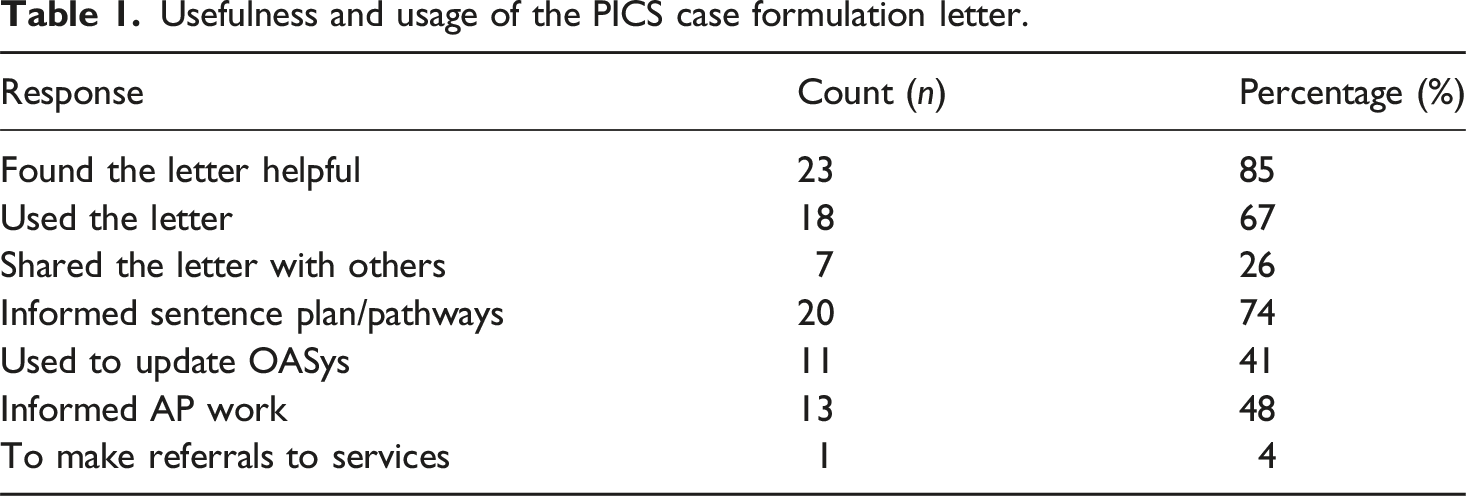
Usefulness and usage of the PICS case formulation letter.
Confidence in writing a formulation
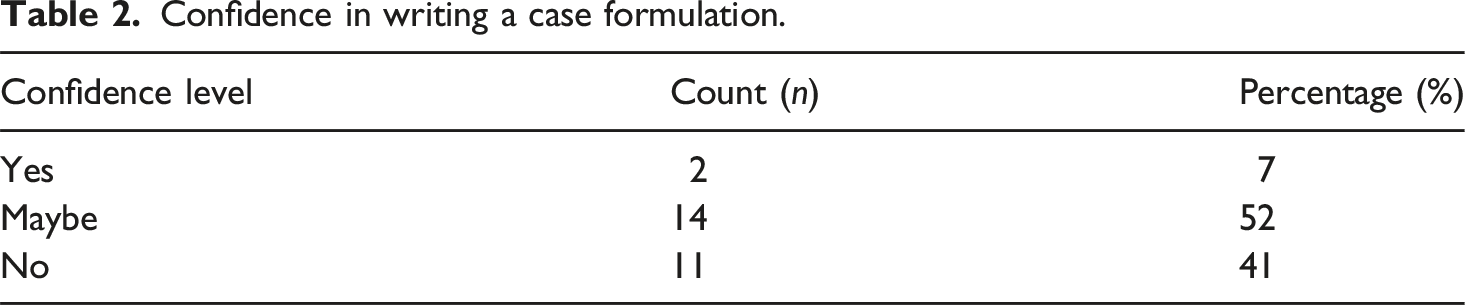
Confidence in writing a case formulation.
Sharing understanding with the person on probation
Willingness to share understanding with the person on probation.

Barriers to using the written case formulation
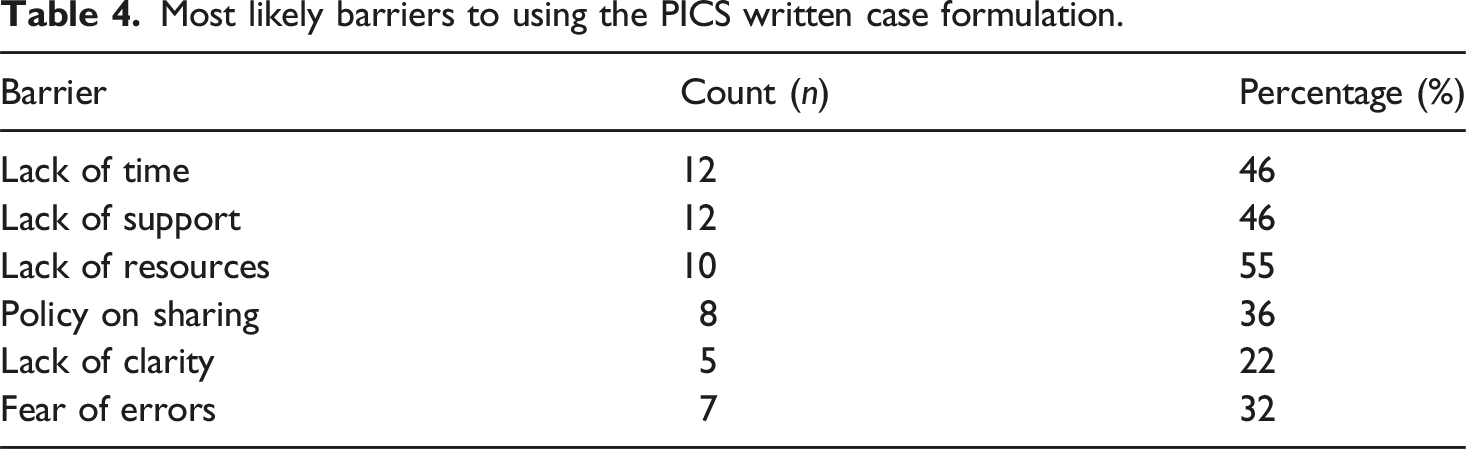
Most likely barriers to using the PICS written case formulation.
Supportive contexts for using the written case formulation
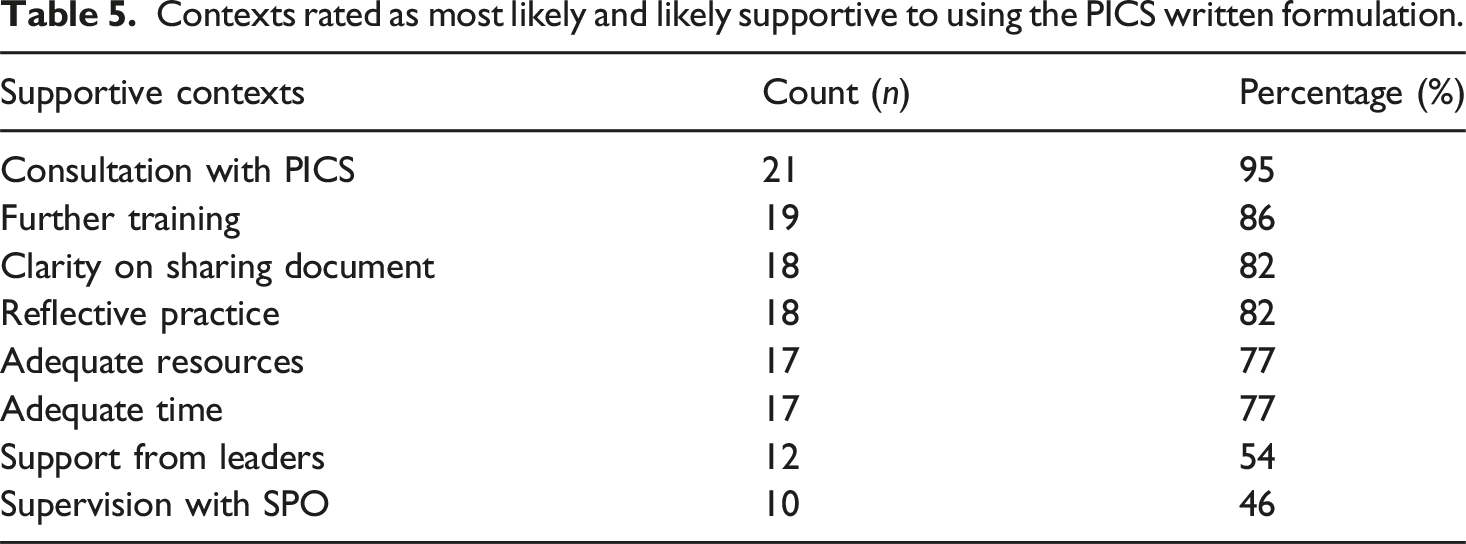
Contexts rated as most likely and likely supportive to using the PICS written formulation.
Discussion
This study examined how probation practitioners engage with written case formulations produced by the PICS within the community OPD Pathway. The findings contribute to a growing, though still limited, body of literature on the practical utility, perceived value, and contextual challenges of written formulations in probation-led forensic settings. In line with the study’s aims, the results offer insight into how these documents are used in practice, the barriers that inhibit their implementation, and the organisational conditions that support their effective use.
Key findings and interpretation
A substantial majority of participants (85%) found the PICS written case formulation helpful, and 67% reported using it in their practice. These findings align with previous research suggesting that written formulations can enhance understanding and support case management (McMullan et al., 2014; Wheable and Davies, 2020). The fact that 74% of respondents used formulations to inform sentence planning and pathway decisions suggests that these documents are not merely theoretical but serve a functional role in guiding intervention. However, the extent to which they influence actual outcomes, such as risk reduction or pathway progression, remains unclear and warrants further investigation.
Confidence in independently producing such formulations was notably low: only 7% of participants felt confident, while 41% expressed a lack of confidence. This highlights a significant skills gap and raises questions about the feasibility of expecting non-specialist practitioners to generate psychologically informed formulations without targeted training and supervision. These findings echo broader concerns about the accessibility of psychological tools in non-clinical settings (Knauer et al., 2017) and support the argument that formulation should remain within the remit of trained psychological specialists. However, recent work has also highlighted the challenges faced by specialists in producing PICS formulations, particularly when formulating risk without direct contact with the individual, the emotional impact, and time pressures (Groome et al., 2024). This complexity highlights the need for a nuanced understanding of who is best placed to construct formulations and under what conditions.
Interestingly, while 82% of participants indicated they would share their understanding of the formulation with the person on probation, only 26% reported sharing the written document with other professionals. This discrepancy may reflect policy restrictions, uncertainty around information governance, or a lack of confidence in articulating psychological insights to non-specialist audiences. It also suggests a missed opportunity for interprofessional collaboration and continuity of care, particularly if formulations are not being used to inform multi-agency planning.
Barriers and supportive contexts
The most frequently cited barrier to using written formulations was a lack of resources, reported by over half of participants. Time constraints and limited support were also commonly identified, echoing longstanding implementation challenges in probation settings (Brown and Völlm, 2016; Radcliffe et al., 2018). These findings suggest that even when practitioners value formulations, systemic pressures may inhibit their use. Only 32% of participants in this study identified fear of error as a barrier to its use This may reflect growing practitioner confidence through having psychologically informed support (Ramsden et al., 2014, 2016) or, alternatively, a lack of awareness of the risks associated with misinterpretation, perhaps representative of the pressure’s probation practitioners are under (Westaby et al., 2023, 2025).
Policy restrictions on sharing formulations were noted by over a third of participants, highlighting the need for clearer organisational guidance. Without such clarity, practitioners may default to risk-averse practices that limit the collaborative and relational potential of formulations. Conversely, several supportive contexts were identified. Consultation with a PICS practitioner was the most frequently endorsed enabler (95%), followed by further training (86%), clarity on sharing policies (82%), and opportunities for reflective practice (82%). These findings reinforce the importance of embedding psychologically informed practice within a supportive organisational culture.
Mechanisms of impact
The mechanisms through which written case formulations exert their influence, such as reflection, containment, and collaboration, are well-documented in the literature (Radcliffe et al., 2018; Ramsden et al., 2014). However, these mechanisms are not automatically activated by the presence of a formulation; rather, they depend on the conditions in which the formulation is introduced and used. For example, reflective thinking and mentalisation are more likely when practitioners have access to supervision and time for thoughtful engagement (Ooi and Fisher, 2023). Similarly, empathy and insight are fostered when formulations are grounded in service user narratives and shared sensitively across teams (Jarett et al., 2025; NHS England, 2023; Thompson et al., 2024). Practitioners identified consultation and reflective practice as key enablers of formulation use, suggesting that written formulations are most effective when embedded in a relational and psychologically informed framework. This highlights the value of services like PICS, which act as a bridge between psychological theory and frontline practice, offering both expertise and containment in high-risk, high-complexity environments.
Implications for practice
These findings have several implications for the OPD Pathway and for probation practice more broadly. First, they support the continued use of written case formulations as a tool for enhancing understanding and strengthening psychologically informed approaches to risk management. Although the OPD pathway is specific to England and Wales, the underlying principles, integrating psychological insight into routine probation practice, supporting staff working with complex personality difficulties and improving relational work with high-risk individuals, are relevant to many European jurisdictions.
Second, the results highlight the importance of specialist psychological input in the development of formulations. Probation staff in the study reported low confidence in independently producing such documents, suggesting that formulation work may require advanced competencies that are not routinely embedded in probation training across Europe. Investment in accessible training, ongoing supervision, and clearer organisational expectations may therefore be necessary for jurisdictions wishing to adopt or adapt psychologically informed consultation and formulation models.
Third, the findings emphasise that the usefulness of written formulations is highly context dependent. Their impact rests not simply on the document itself, but on the relational, organisational, and systemic conditions in which practitioners operate. This includes caseload pressures, the availability of reflective spaces, the degree of interagency collaboration and the extent to which psychological thinking is embedded within probation culture. For European contexts without an established health, justice partnership like the OPD Pathway, these findings offer insight into the organisational infrastructure needed to support the meaningful integration of psychological approaches into probation.
Limitations and future research
While this study offers valuable insights into the use of written case formulations within the community OPD) Pathway, several limitations must be acknowledged. The sample consisted of 27 probation practitioners from two regional services in the Northwest of England, PICS in Cheshire and Merseyside. Although this allowed for in-depth exploration within a defined context, the findings may not be generalisable to other OPD services or regions with differing organisational cultures, resource levels, or training infrastructures or to European probation services operating under different, organisational, legal, or critical frameworks.
Data were collected via self-report surveys, which are inherently subject to social desirability and recall bias. Participants may have overestimated their engagement with written formulations or underreported barriers due to perceived professional expectations. Moreover, the study focused exclusively on practitioner perspectives. While some respondents reported sharing their understanding of the formulation with individuals on probation, the voices of those subject to the formulation process, as well as those of the psychological practitioners who produce them, were not included. This limits insight into how formulations are experienced by the range of service users and whether they contribute to engagement, insight, or perceptions of fairness.
The cross-sectional design captured a snapshot of perceptions at a single point in time. As such, it cannot assess longitudinal changes in formulation use or impact, nor can it establish causal relationships between contextual factors and formulation utility. Although organisational barriers such as time, resources, and policy ambiguity were identified, these were not explored in depth. Factors such as leadership support, team dynamics, and inter-agency collaboration likely influence formulation use, these are likely to vary significantly across European jurisdictions and were outside the study’s scope.
Future research directions
Future research should examine how written case formulations are used over time and whether their content becomes meaningfully embedded into probation practice, including risk assessments, sentence planning and multiagency reporting. A key area for further study is the extent to which practitioners accept, adapt or diverge from formulation recommendations and how these choices align with final risk-management decisions, identified needs and OPD Pathway progression. Comparative work across OPD regions and international probation systems would help clarify how organisational culture, training structures and resource availability shape formulation use and perceived value.
To build a fuller understanding of the formulation process, studies should incorporate the perspectives of individuals on probation, alongside both probation practitioners and the psychological practitioners who produce the documents. This could illuminate issues of transparency, engagement, procedural justice, and the relational impact of being the subject or recipient of psychological formulation. Given the low confidence among practitioners in independently producing formulations, future research should also evaluate different models of training, supervision, and competency development for non-specialist staff.
Finally, implementation-focused research could investigate the mechanisms through which formulations exert their influence, such as reflection, emotional containment, or increased empathy and identify the organisational conditions that activate or constrain these processes. This may include examining the role of digital tools, shared platforms, and structured reflective spaces in enhancing accessibility, collaboration, and the sustainability of psychologically informed practice, particularly in resource-pressured environments.
Conclusion
This study explored the use and perceived value of written case formulations within the community OPD Pathway, focussing on the PICS in the North West of England. Although situated within the UK OPD Pathway, the findings have relevance for wider European probation systems concerned with complex, high risk supervision. The findings contribute to a growing body of literature that recognises the potential of psychologically informed practices to enhance understanding, guide intervention, and support relational work in complex forensic contexts.
The results indicate that written case formulations are generally well-received by probation practitioners, with most participants reporting that they are helpful and practically useful, particularly in informing sentence planning and pathway decisions. This aligns with evidence that structured psychological input can offer a containing and integrative framework for practitioners working with complexity. However, the study also revealed significant variability in how formulations are used, shared, and understood. Confidence in independently producing formulations was low, and systemic barriers such as time, resources, and policy ambiguity were frequently cited. These findings suggest that while written formulations have the potential to enhance practice, their effectiveness is highly dependent on the context in which they are implemented.
The study reinforces the importance of specialist psychological input in the development of formulations, particularly within high-risk, high-complexity environments like the OPD Pathway. It also highlights that sustainable use requires organisational structures, training pathways, and operational guidance factors relevant across probation systems internationally. Services like PICS play a critical bridging role between psychological theory and frontline probation practice, offering both expertise and containment.
Ultimately, this research highlights that written case formulations are not static tools but dynamic processes that require relational, reflective, and systemic support to be effective. Their value is maximised when embedded within broader organisational cultures that support psychologically informed ways of working. Future research should continue to explore these dynamics, particularly through longitudinal, comparative, and service-user-informed methodologies to ensure that formulation remains a meaningful and ethical component of forensic psychological practice. Cross-jurisdictional studies would be especially valuable in examining how different European models integrate psychological consultation and formulation practice in ethically robust and sustainable ways.
Footnotes
Acknowledgements
We would like to acknowledge the Cheshire and Merseyside Probation Practitioners; the OPD Cheshire and Merseyside Psychological Consultation Service (PICS); North West Probation Service; Samantha Nelson (National Probation Service); Leonie Williams, North West OPD Services Business Manager and Karen Rooney North West Probation Lead for OPD services, for their support and contributions with this study.

Ethical considerations
Ethical approval was granted by Cardiff Metropolitan University, Cardiff School of Sport and Health Sciences Ethics Committee (Project Reference Number: PGR-9460). Additional approval was obtained from the HMPPS National Research Committee (Ref: 2024-1289) and Area Probation Leads.
Consent to participate
Participants received a detailed information sheet and consent form via the Qualtrics platform. This included consent to publish. They were given the opportunity to ask questions prior to participation and were informed of their right to withdraw at any stage. A debrief sheet was provided upon survey completion, and all data were stored securely in accordance with GDPR and institutional data policies.
Author contributions
Dr Daniel Stubbings made a substantial contribution to the design of the work; the acquisition, analysis; interpretation of data; revising it critically for important intellectual content; gave approval of the version to be published and takes accountability for all aspects of the work.
Dr Christine McKnight made a substantial contribution to the design of the work; the acquisition, analysis; interpretation of data. They also contributed to revising it critically for important intellectual content and gave approval of the version to be published and takes accountability for all aspects of the work.
Dr Michael Petalas made a contribution to the design of the work; interpretation of data; gave approval of the version to be published and takes accountability for all aspects of the work.
Ms Lisa-Jo McGuirk made suggestions for further and future research; provided a probation operational perspective to the design; gave approval of the version to be published and takes accountability for all aspects of the work.
Funding
The authors received no financial support for the research, authorship, and/or publication of this article.
Declaration of conflicting interests
The authors declared the following potential conflicts of interest with respect to the research, authorship, and/or publication of this article. The lead author of this publication has research support from and is an employee of the core community Psychologically Informed Consultation Service (PICS) in the Offender Personality Disorder Pathway. The terms of this arrangement have been reviewed and supported by Cardiff Metropolitan University.
Data Availability Statement
All secondary data referenced in this study are publicly available through the cited literature, with DOI links provided where possible. The primary data collected via a Qualtrics survey are not publicly available due to confidentiality and ethical considerations involving participant privacy.