



Abstract
In Hungary, restorative justice involves a wide range of professionals: probation officers, police, lawyers, judges, prosecutors, social workers, and teachers—alongside potential offenders and their communities. This approach raises key questions: How can so many stakeholders work together across disciplines towards a common goal? How can conflict be used to strengthen community bonds? Can justice be achieved by addressing and repairing harm? These questions guide the exploration of restorative justice as a modern element in criminal justice. This paper examines Hungary’s mediation system within the Probation Service, focusing on how mediation functions and its role in justice. Since January 1, 2007, mediation has been available nationwide, adding new responsibilities to probation officers’ work. We review the tasks of these officers in mediation, assess their effectiveness, and analyze how mediation supports reintegration in the justice system, aiming to repair harm and foster accountability among offenders within their communities.
The concept of mediation
Mediation represents a transformative and restorative approach to conflict resolution, focusing on healing, empathy, and mutual understanding rather than punishment and retribution. Unlike traditional punitive systems, mediation provides a platform for both the victim and the perpetrator to engage in a constructive dialogue aimed at repairing the harm caused. The process fosters transparency, allowing the victim to share their emotional experience and helping the offender understand the profound impact of their actions. This exchange is instrumental in facilitating a sincere apology and meaningful expressions of regret from the perpetrator, ultimately leading to emotional healing for both parties. Simultaneously, the offender is given the opportunity to take responsibility for their actions and engage in reparative actions that consider their capacity for change, providing a pathway for personal growth and accountability (Umbreit and Armour, 2016).
What distinguishes mediation from traditional forms of justice is its emphasis on long-term resolution and the prevention of future offenses. Mediation enables both parties to work collaboratively toward a mutually acceptable solution, addressing the underlying causes of the conflict and promoting deeper understanding. This approach, which integrates emotional and psychological healing, has been shown to reduce the likelihood of recidivism by helping both victims and offenders to engage in meaningful self-reflection and relationship repair (Latimer et al., 2005). In addition to resolving legal disputes, mediation facilitates the creation of healthier interpersonal relationships, thereby contributing to stronger, more cohesive communities (Morris and Maxwell, 2001).
Moreover, mediation offers significant societal benefits by alleviating the burden on the criminal justice system, which is often overwhelmed by lengthy trials and overcrowded correctional facilities. Traditional criminal justice processes, which rely heavily on punitive measures, are costly, time-consuming, and can exacerbate social problems, such as recidivism and community disintegration. Mediation, by contrast, offers a quicker, more cost-effective solution, which reduces strain on courts and prisons while still ensuring justice is served. Studies have demonstrated that mediation can lower the cost of legal proceedings and reduce the pressure on overburdened judicial systems (Shapland, 2011). Furthermore, mediation aligns with the principles of restorative justice by focusing not only on punishing the offender but also on repairing the harm caused and restoring relationships within the community (Zehr, 2002). This holistic approach not only meets the needs of the individual parties but also promotes societal well-being by fostering inclusion, accountability, and reconciliation.
The potential of mediation to transform the way we approach justice is profound. By offering a human-centered, collaborative, and non-adversarial process, mediation challenges the traditional paradigms of justice, which often prioritize retribution over restoration. It provides an opportunity to address the emotional and psychological needs of both victims and offenders, which are often neglected in conventional legal proceedings. Furthermore, mediation encourages the development of communication skills and promotes conflict resolution strategies that can be beneficial beyond the immediate context of the dispute (Boulle, 2005). This transformative approach holds the promise of creating a more restorative, compassionate, and effective justice system.
Research on restorative justice consistently supports the effectiveness of mediation in reducing recidivism rates, improving offender accountability, and providing victims with a sense of closure and justice. In countries like Canada and New Zealand, restorative justice programs, which include victim-offender mediation, have seen significant success in reducing re-offending and increasing victim satisfaction (Shapland et al., 2007; Strang et al., 2006). These findings highlight the broad applicability of mediation as an alternative to traditional punitive measures and its potential to reshape justice systems worldwide.
As society continues to recognize the limitations of punitive justice and its impact on social reintegration, the need for more restorative approaches like mediation becomes increasingly apparent. Mediation offers an inclusive, rehabilitative alternative to the adversarial nature of traditional legal systems, providing a pathway toward reconciliation and lasting change. Through its focus on emotional healing, accountability, and mutual understanding, mediation stands as a powerful tool capable of transforming the justice system into one that emphasizes restoration over punishment
Basic principles of mediation
Protecting the community - By effectively implementing community sanctions, supervising in the community, assessing and managing the risks of re-offending, probation officers contribute to strengthening community protection.
Restorative Justice - The principles of restorative justice are paramount in all of the Probation Service’s functions. While the primary restorative justice role of probation officers is to conduct mediation in criminal and misdemeanor cases, probation officers also promote restoration of damaged community relationships, accountability of offenders, and the needs of victims in their other activities.
Reintegration of offenders - Interventions by probation officers help to correct criminal behavior, strengthen the skills necessary for the reintegration of offenders and improve their social reintegration. Through their child protection activities, probation officers help to reduce the criminal vulnerability of children.
Who are the mediators?
The duties of probation officers, excluding those directly tied to implementing sentences, are conducted by the Metropolitan and County Government Offices. In more populous counties and the capital, probation officers are hired by the Department of Guardianship and Justice within governmental offices, while in smaller counties, they are employed by the Department of Public Authorities. The Minister of Justice is accountable for overseeing the professional management of probation officers’ activities, while the State Secretary for Judicial Relations holds responsibility for exercising professional management powers. (igazsagugyiinformaciok.kormany.hu)
In the second paragraph of the Principles we read Restorative Justice, that is, we can clearly see that there is already a role for probation supervision in the administration of restorative justice. I see the future in this segment of the justice system, mediation is already used in the West as a form of reparation, but in this country it is still in its infancy, it has a long history in the justice system. But it has great potential to ease the burden on the courts. In my daily work, I see that sometimes 10-11 months elapse between the investigation of a crime and the pronouncement of a final judgment. Although, according to the provisions of the Hungarian Criminal Code, active repentance would be possible for minor crimes, which would certainly relieve the overburdened courts.
International outlook
The Minister of State for Judicial Relations in the Ministry of Justice stated that there is only one legal tool capable of offering “immediate, unconditional, and complete restitution” for harm resulting from a crime or offense. He noted that while the number of mediation processes is on the rise annually, Hungary’s utilization of mediation stands at merely two percent in prosecutions, contrasting with 8-10% in Western Europe. In 80% of these instances, mediation is mandated by the prosecutor. Additionally, there’s a noticeable decline in property-related offenses being mediated, while the occurrence of traffic offenses undergoing mediation is increasing (Rab, 2006)
The statement mentions a trend of 8-10% in Western Europe. It can be seen that this form of reparation is widespread in the EU Member States and in Western Europe.
In the United Kingdom, reconciliation can take various forms, including forgiveness, restoring the situation to its original state, providing services to the victim or community, among others. The UK employs two main models for reconciliation. One involves mediation being an option before charges are filed, and either the prosecutor or the police can instigate the process. This approach is predominantly utilized for juvenile offenders, exemplified by initiatives like the Cumbria project. Here, mediation serves as a direct diversion for juveniles who have admitted their guilt, meaning their criminal case doesn’t proceed to court. (Rab, 2006)
In Germany, programs facilitating victim-offender mediation for juvenile offenders were established in the mid-1980s. Following the effectiveness of these initial programs, similar procedures were extended to adult offenders in the late 1980s. State officials and social services are responsible for conducting the mediations. Monetary compensation is a frequently utilized form of reparation, and to guarantee that all offenders can fulfill this obligation, a fund has been established to provide advance payment. Offenders are then accountable to the fund for fulfilling their public benefit work. (Rab, 2006)
In Austria, mediation has been utilized for juvenile offenders since 1999 and later extended to adult offenders. Mediation for conflict resolution usually takes place outside of the courtroom, often instigated by the prosecutor, and assisted by a probation officer. During the mediation process, the juvenile defendant is urged to engage in negotiations with the victim to offer compensation for any damages caused. Non-compliance with these negotiations poses the looming risk of punishment, reminiscent of the “sword of Damocles.” (Rab, 2006)
In Switzerland, mediation can be initiated independently of the legal process, giving juvenile offenders the chance to negotiate with the victim during the enforcement phase. The model program has yielded favorable outcomes. (Rab, 2006)
In Norway, mediation programs serve primarily to empower communities in resolving conflicts. The inception of these programs was influenced by Niels Christie's work, “Conflict as Property.” The pilot program commenced in 1981 in Lier, a small town with 18,000 residents, where social perceptions hold significant sway compared to larger cities. The community mediation center handles cases that have already been reported to the police, predominantly involving burglaries, car thefts, and vandalism. When a thief is caught in the act, they are informed about the option of mediation, and the victim is subsequently approached about participating in mediation. Both parties are made aware that if mediation fails, criminal proceedings may still ensue. If both parties agree to mediation, a face-to-face meeting is arranged between the offender, the victim, and the mediator. Any resolution reached in this “social court” requires unanimous consent from both parties. Enforcement is ensured by the potential for criminal proceedings to proceed if necessary. (Rab, 2006)
In Finland, mediation was first implemented in the mid-1980s, initially addressing both criminal and civil matters. However, nowadays, the focus has shifted primarily to criminal cases, with approximately 20 programs currently in operation. In all instances, mediation occurs prior to any judicial proceedings. Most cases handled involve minor, private crimes, with the majority being property-related offenses. Consequently, the most common form of reparation sought is monetary compensation. In cases of private prosecution, the mediation process typically leads to the termination of criminal proceedings. For other cases, the fate of criminal proceedings is determined by the prosecution based on the outcome of the settlement. (Rab, 2006)
In France, mediation has been available since 1993, allowing parties to initiate the process upon the prosecutor’s request. However, this approach has yet to yield significant breakthroughs in diverting criminal proceedings. (Rab, 2006)
The possible adaptation of foreign legal practices to the Hungarian law system
The Norwegian mediation model provides a compelling framework that could be effectively adapted to the Hungarian legal system, particularly in terms of community-based conflict resolution. In Norway, the approach empowers local communities to manage conflict resolution, which could be replicated in Hungary by establishing community-based mediation centers, especially in smaller towns or neighborhoods where social cohesion plays a crucial role in resolving disputes. (Zehr, 2002) These centers could be responsible for handling minor criminal cases like property crimes, such as burglaries, car thefts, and vandalism, similar to how Norway addresses such offenses. (Umbreit and Armour, 2016). The involvement of the local community would enable Hungary to meet the needs of both individuals and the wider society by encouraging restorative justice and a more collaborative approach to resolving conflicts (Latimer et al., 2005). A key aspect of the Norwegian model is the influence of social norms within smaller communities, which helps resolve issues more amicably. (Morris and Maxwell, 2001) In Hungary, this approach could also work, particularly in communities where trust and personal relationships are central. To facilitate this, public awareness campaigns would be essential to educate the population about restorative justice principles and the benefits of alternative dispute resolution. (Boulle, 2005) Shifting societal perceptions from punitive justice to conflict resolution methods like mediation could help foster a culture of reconciliation rather than retribution (Shapland et al., 2007). In Norway, the police play an important role by informing both offenders and victims about the possibility of mediation when criminal offenses occur (Strang et al., 2006). This system could also be adapted in Hungary by training police officers and judicial staff to recognize cases suitable for mediation. During interactions with individuals involved in minor crimes, police could introduce mediation as a viable alternative to formal legal proceedings, thus reducing the burden on the judicial system and offering individuals an opportunity to resolve their conflicts outside of the court process. A fundamental feature of the Norwegian mediation model is the face-to-face meeting between the offender, the victim, and the mediator. This process helps both parties engage directly and personally, allowing for mutual understanding and emotional healing. In Hungary, a similar mediation process could be adopted, but it would require skilled mediators trained in restorative justice practices. These mediators would be equipped with the tools necessary to facilitate conversations between the parties, helping them reach an agreement that acknowledges the harm caused and promotes healing. Adapting this model to Hungary would require consideration of the local legal and cultural context. Hungary’s legal system differs significantly from Norway’s, and public attitudes toward restorative justice may vary. (Morris and Maxwell, 2001) It could be beneficial to pilot such programs in specific regions or communities, gathering feedback and adjusting the model as necessary. Additionally, Hungary would need to update its legal framework to recognize mediation as a legitimate alternative to traditional legal proceedings and ensure that the outcomes of mediation can be enforced. (Boulle, 2005) Implementing community-based mediation in Hungary may face challenges, such as resistance from legal professionals and the general public, who may be more accustomed to traditional punitive measures. (Boulle, 2005) Furthermore, the necessary resources, training, and funding would need to be in place to support the initiative. Safeguards would also need to be established to protect victims and ensure fairness, particularly in situations where power imbalances exist between the parties. (Zehr, 2002) In conclusion, the Norwegian mediation model presents a promising alternative for conflict resolution within the Hungarian legal system. By emphasizing community involvement, restorative justice, and reconciliation, it offers a path toward reducing the burden on Hungary’s overcrowded legal system while fostering long-term healing and conflict prevention. (Latimer et al., 2005; Umbreit and Armour, 2016) With the right adaptations to suit Hungary’s legal and cultural landscape, community-based mediation could play a significant role in creating a more compassionate and effective justice system. If mediation agreements are successfully fulfilled, it could pave the way for a restorative justice system that strengthens the legal process while emphasizing the healing of relationships. However, when parties fail to comply, returning the case to court would ensure that the mediation system maintains its integrity and effectiveness. (Shapland, 2011).
Hungarian trends
In Hungary, since 1 January 2007 it has been possible for the parties to settle their conflict arising from a criminal offense within the framework of a mediation procedure. Since 1 January 2014, the use of mediation procedures has also been possible for less socially dangerous offenses (misdemeanors). The methodology is the same for both criminal and misdemeanor mediation. Mediators are professionals in conflict management who help the parties to identify their needs and feelings and thus resolve the problem. If they consider it necessary, they may involve experts or other stakeholders or supporters in their proceedings, who can provide expertise or support to help the parties answer their questions. The mediation process complements the traditional framework of criminal justice as an instrument of restorative justice. For serious offenses, the State must act strictly, but for less serious offenses or misdemeanors, alternative solutions should be sought, thus reducing the burden on the criminal justice system. As of 1 July 2018, mediation can be used in more serious cases as a complement to the enforcement of the State’s criminal powers, primarily to help victims to deal with their grievances. From the parties’ point of view, mediation is a process in which the parties involved have a more prominent role than in the traditional procedure, since the offender and the victim are equal parties whose autonomous decision and work determine the outcome of the mediation procedure and thus of the criminal proceedings. It is also faster and cheaper than the traditional process. No can we ignore the fact that, for decades, our procedural law the possibility, known for decades in procedural law, of establishing the damage caused by the crime and of including a civil penalty for the victim in the criminal judgment. It is unfortunate that Hungarian criminal courts are reluctant to make use of this option, even though it could save victims a great deal of time and money. The Criminal Procedure Act introduced the postponement of indictment as a new institution, which was introduced as a conditional suspension of prosecution in the new Criminal Procedure Act to be introduced in July 2018. The primary purpose of this would be to terminate the proceedings if the conditions set out in the decision of the prosecution are met, such as compensation for the victim’s damages and the order of probation supervision. These conditions are fulfilled with a conditional suspension by the prosecutor, but I would not say that the procedure is as effective as mediation, since the accused person is in contact only with the probation officer during the procedure and the conflict is not resolved in a way that is satisfactory to both parties and that actually alleviates the harm suffered by the injured party. (Czenczer and Hollósvölgyi, 2022).
Mediation in criminal matters
In criminal cases, the reparation of the harm caused by a criminal offense may lead to the end of criminal liability or to an unlimited reduction of the sentence through mediation. These legal effects are triggered by mediation in criminal proceedings for offenses against life, limb and health, against human freedom, against human dignity and certain fundamental rights, against transport, against property and against intellectual property, punishable by imprisonment of up to five years, under Act C of 2012 on the Criminal Code. The referral of a case to mediation is conditional on the suspect’s confession to the offense, the consent of the victim and the suspect to mediation and the absence of any statutory disqualification. The prosecutor’s office decides whether to refer the case to mediation and to suspend the criminal proceedings for a maximum period of 6 months. The detailed provisions of the mediation procedure are regulated by Act CXXIII of 2006 on Mediation in Criminal Matters.
Mediation in misdemeanor cases
Act II of 2012 on misdemeanors, misdemeanor proceedings and the misdemeanor registration system, based on the regulation of mediation in criminal matters, regulates the general principles and framework of mediation in misdemeanor cases. 1 Accordingly, the district court or the offense authority (primarily the police) suspends the proceedings for 45 days in order to conduct the mediation procedure, provided that the parties have given their consent, the person subject to the proceedings has admitted his or her responsibility and there are no disqualifying circumstances. The law also provides for the possibility of referring the case to mediation in the case of an adult subject to proceedings punishable by detention and for certain traffic offenses, and for all offenses in the case of a juvenile. The time limit for the proceedings may be extended once by 30 days to comply with the terms of the agreement.
The mediation process in Hungary
Mediation procedures within the Hungarian Probation Service have seen a significant expansion in recent years, particularly in the context of criminal and misdemeanor cases. In 2023, specially trained probation officer mediators from both metropolitan and county government offices played a central role in facilitating these processes. The mediators are equipped with appropriate professional experience through a mentoring program, which is an essential component of their training. This program allows them to acquire the necessary skills and knowledge by working alongside experienced mediators.
The core method used in these mediation procedures is the victim-offender mediation technique, which aligns with the principles of transformative mediation. This approach aims to foster dialogue between the victim and the perpetrator, empowering both parties to actively participate in the resolution of the conflict. An important aspect of this method is that it goes beyond punitive measures and focuses on repairing the harm caused by the offense, encouraging personal accountability, and restoring the relationship between the parties involved.
One of the key goals of the ongoing development in mediation methods within the Hungarian Probation Service is to expand the mediators’ restorative toolbox. This involves integrating various restorative practices that can be used in different contexts. For example, the Ministry of Justice’s Judicial Services Law Academy has organized specialized training courses for mediators in the use of the “conciliation circle” method. This approach is a restorative community conflict management method that allows for the involvement of a wider community, beyond just the victim and the perpetrator, in the conflict resolution process. It helps to process the events in a deeper, more multifaceted way, contributing to long-term conflict reconstruction and healing by mobilizing community resources.
The data provided by the Ministry of Justice for 2023 offers valuable insights into the outcomes of mediation procedures carried out by the Probation Service. As we delve into the statistical data, we will analyze the number of mediation cases initiated, the success rates of these cases, and identify any trends or challenges that have emerged in the process. By examining these results, we aim to assess the effectiveness of mediation as an alternative dispute resolution mechanism and its potential for further development within the Hungarian justice system.
Mediation in criminal matters in 2023.
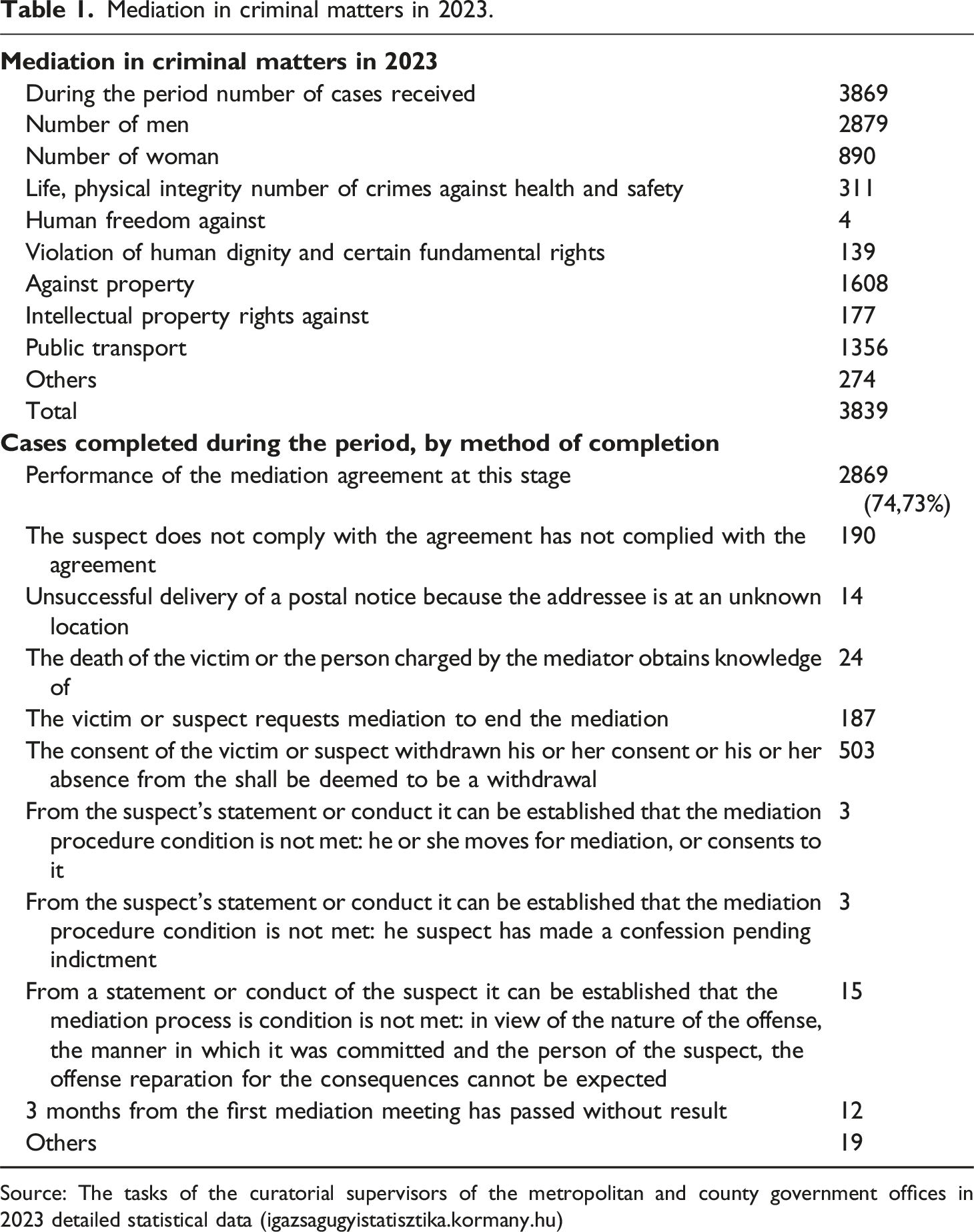
Source: The tasks of the curatorial supervisors of the metropolitan and county government offices in 2023 detailed statistical data (igazsagugyistatisztika.kormany.hu)
Mediation in misdemeanor cases in 2023.
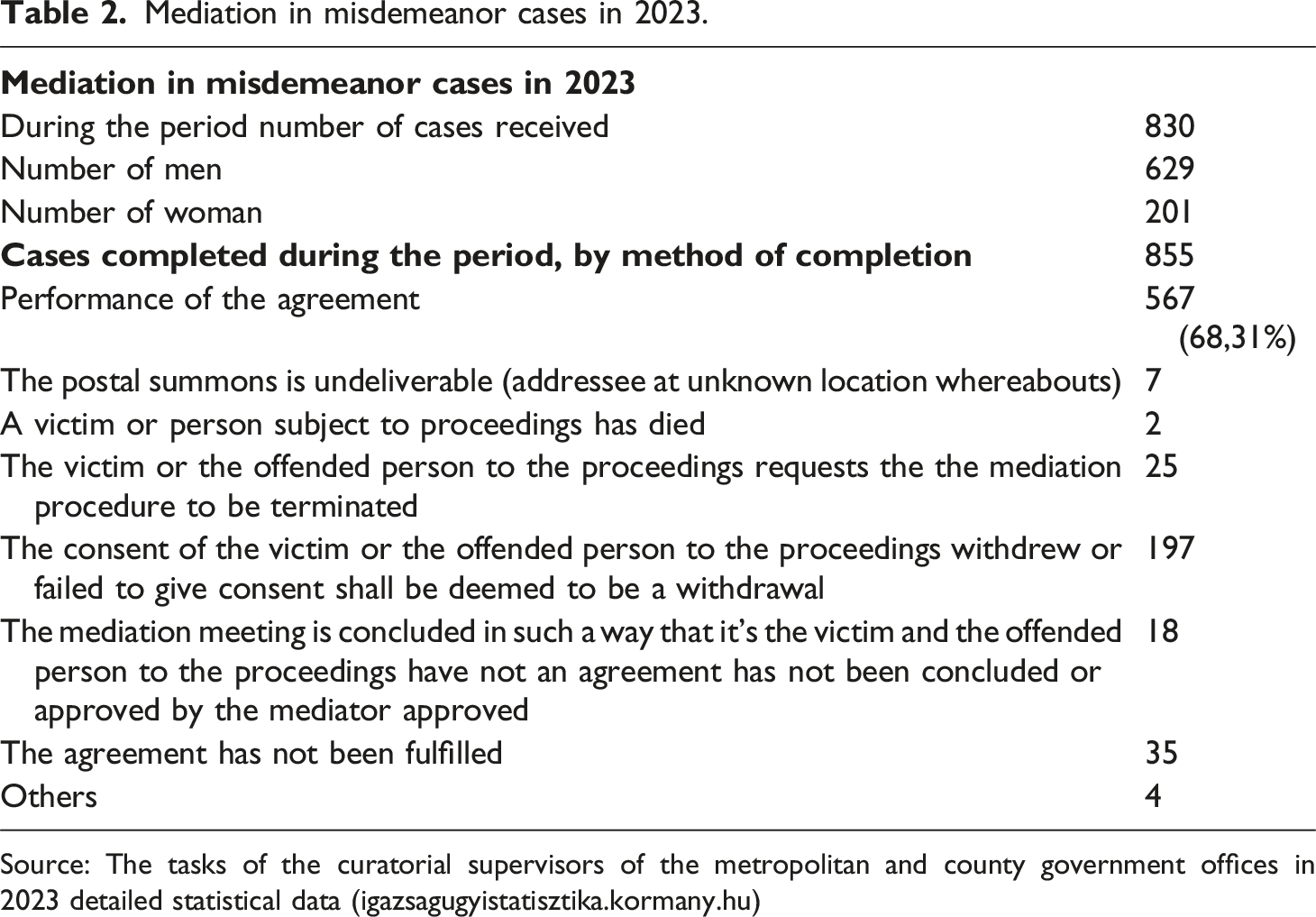
Source: The tasks of the curatorial supervisors of the metropolitan and county government offices in 2023 detailed statistical data (igazsagugyistatisztika.kormany.hu)
In 2023, a total of 4699 mediation cases were initiated, comprising 3869 criminal cases (82.34%) and 830 misdemeanor cases (17.66%). These figures demonstrate the widespread use of mediation, especially in the context of criminal justice. A total of 3508 cases (74.65%) were successfully resolved through the performance of mediation agreements, with 2869 criminal cases and 567 misdemeanor cases leading to positive outcomes. This success rate emphasizes the potential of mediation as a tool for conflict resolution, particularly in the realm of criminal law, where it provides a valuable alternative to traditional punitive measures.
Notably, the gender distribution within these cases showed that 74.65% of the participants were men (3508), while 25.35% were women (1191). This disparity is something worth exploring further, as it may reveal insights into gender dynamics in mediation processes, especially considering how different social and psychological factors may affect the willingness and participation of men and women in conflict resolution.
However, not all mediations were successful. A total of 1091 cases (23.22%) were unsuccessful, with the primary reasons for failure being the withdrawal of consent by victims or suspects (700 cases, 64.16%), non-compliance with agreements by suspects (225 cases, 20.63%), and logistical or procedural issues such as undeliverable notices, deaths, or delays exceeding 3 months (88 cases, 8.06%). Other issues, including the nature of the offenses or a lack of viable agreements, accounted for 79 cases (7.25%). These barriers highlight areas where improvements can be made to increase the overall success rate of mediations. For instance, refining the mediation process to ensure that all parties are fully informed and that logistical challenges are minimized could significantly reduce the failure rate.
Looking at long-term trends, between 2007 and 2023, a total of 85,807 mediation cases were conducted, revealing the sustained growth of mediation as an alternative dispute resolution mechanism. Criminal mediation consistently demonstrated high success rates, with 80–85% of cases concluding in agreements, 85–90% of which were honored. This is particularly relevant for cases involving reparable harm, such as property crimes, where mediation allows the offender to take responsibility for the damage caused and make amends in a way that benefits both the victim and the wider community. These high compliance rates suggest that mediation is an effective means of achieving reparative justice, as it focuses on repairing harm rather than punishing offenders.
Misdemeanor cases showed a slightly different trend, with lower agreement rates (50–60%), but remarkably high fulfillment rates for those agreements, exceeding 90%. While the reduced engagement in misdemeanor cases compared to criminal cases may be attributed to the generally less severe nature of the offenses, the high fulfillment rate indicates that even in less serious matters, mediation remains an effective tool for resolving disputes. The high success of agreement fulfillment in both criminal and misdemeanor cases points to mediation’s ability to foster mutual understanding and accountability between parties.
The success rates in criminal mediation are consistently high, which further affirms its suitability for addressing offenses involving reparable harm. The fact that 85–90% of mediation agreements are honored highlights the reliability and effectiveness of this alternative approach to justice. By offering an opportunity for offenders to directly engage with the harm they have caused, mediation encourages a more restorative form of justice that goes beyond punitive measures and promotes accountability. It provides both victims and offenders with an opportunity to repair relationships, rather than focusing solely on the imposition of sentences.
Despite the generally positive outcomes, barriers such as the withdrawal of consent, logistical issues, and procedural delays persist. These obstacles underline the importance of refining the mediation process to ensure better outcomes. Addressing these challenges could lead to higher success rates and an expanded application of mediation in various legal contexts. Ensuring that the mediation process is accessible to all parties, providing adequate follow-up, and improving communication between mediators, victims, and offenders are key strategies that could enhance the overall effectiveness of mediation. Additionally, tailoring the mediation process to address the specific needs of the parties involved—such as providing extra support for victims or dealing with power imbalances—could further improve the success rates of mediation.
Overall, the statistics illustrate that mediation is a highly viable, efficient, and restorative approach to conflict resolution in both criminal and misdemeanor contexts. It not only alleviates the burden on traditional judicial systems by reducing the number of cases that require court intervention, but it also promotes a shift toward a more restorative, community-centered model of justice. The success of mediation in achieving high compliance rates with agreements underscores its potential as a cornerstone for future criminal justice reforms. The increasing body of research supporting the effectiveness of restorative justice practices, such as victim-offender dialogue and mediation, suggests that these approaches could play a central role in shaping a more rehabilitative and inclusive justice system.
By addressing the current barriers and expanding the use of mediation across different types of cases, mediation could play a pivotal role in reducing recidivism, improving community relationships, and offering both victims and offenders a meaningful path toward resolution.
Summary
In conclusion, mediation represents a promising and practical embodiment of restorative justice, addressing not only the harm caused by crime but also the systemic challenges faced by the Hungarian justice system. The 2023 data illustrates the effectiveness of mediation, with nearly 75% of cases reaching a successful resolution through agreements and historically high compliance rates of 85–90%. This demonstrates mediation’s potential to resolve conflicts efficiently while fostering mutual understanding and accountability between offenders and victims.
Unlike traditional punitive measures such as fines or public interest labor penalties—which often lead to further complications like imprisonment due to non-compliance—mediation offers a resolution that benefits all parties involved. By fulfilling the terms of a mediation agreement, offenders avoid criminal convictions, and victims receive a sense of closure. This approach reduces the strain on overcrowded prisons, overburdened court systems, and parole services, offering an alternative that prioritizes reconciliation and community reintegration over punishment and exclusion.
For mediation to achieve its full potential, however, a cultural shift is necessary. Hungarian society must embrace the principles of restorative justice, such as peaceful conflict resolution and assertive communication, to foster a more inclusive and rehabilitative justice system. This change would ensure that mediation not only remains effective but also becomes a cornerstone of criminal justice reform in the years to come.
What does restorative justice promise? However, my experience as a probation officer in Hungary highlights a significant gap: at the investigation stage, many victims and offenders are not presented with mediation as an alternative dispute resolution method. As a result, numerous cases that could potentially be resolved through mediation are brought before the courts, leading to a congested legal system. This issue reflects the need for a shift in attitude at all levels, including among victims, suspects, and the police. A change in mindset—especially a cultural shift toward restorative justice—could improve the situation, making mediation a more widely utilized option early in the legal process. In the Hungarian context, the adoption of the Norwegian model of involving police from the start could be particularly effective. Research indicates that early intervention with restorative justice processes reduces not only the burden on the courts but also fosters better outcomes for victims and offenders alike. By incorporating mediation as an alternative from the outset, Hungary could see a reduction in case backlogs and more positive, restorative outcomes for all parties involved. With the right training and cultural shift, the integration of mediation into the early stages of criminal cases in Hungary could emulate the success seen in Norway, creating a more efficient, compassionate, and restorative justice system. Albert Einstein’s words perfectly encapsulate the need for such a transformation: “We cannot solve our problems with the same thinking we used when we created them.” Mediation reflects a new way of thinking—one that moves beyond the traditional punitive framework and envisions a justice system rooted in restoration, accountability, and the rebuilding of relationships. By adopting this approach, Hungary can take significant steps toward a more just and equitable society.
Footnotes
Declaration of conflicting interests
The author(s) declared no potential conflicts of interest with respect to the research, authorship, and/or publication of this article.
Funding
The author(s) received no financial support for the research, authorship, and/or publication of this article.
