



Abstract
Time on parole is not only marked by the supervision and support of probation officers but constitutes a particular time in the concerned people’s lives. The experience of this transition period has constituted a topic of research, but most studies have neglected a thorough conceptualisation of the notion of experience and relied empirically on oral data such as interviews. We propose a conceptualisation of experience as lived and embodied, reflected and communicated, and, finally, sedimented. To capture these various dimensions, we developed a multisensorial methodology that explores emotions and places as well as narratives on the experience of the time on parole. Our results concentrate on a group of formerly incarcerated people who are rarely discussed in research: people who were well integrated into society before and who manage to organise their lives afterwards fairly well. They experience distinct challenges and encounter obstacles produced by the criminal justice system itself.
Introduction
Being sentenced to prison represents a significant rupture in a person’s life. Depending on the length of the sentence and the nature of the prison regime, 1 release and reintegration into society can be experienced as a further rupture (Martin, 2018). Even if leaving prison is associated for most people with positive feelings of freedom and regained self-determination, it is a long process with notable challenges at various levels, especially after a long sentence. The ‘external’ elements of normal life such as housing, financial situation, employment, social relationships, and valuable leisure time have to be rebuilt or regained (Schartmueller, 2020). This is not always easy: There is the stigma of being an ex-prisoner; giving structure to one’s life after a long period under the control of a penal institution does not happen by itself; and, finally, changing ingrained rhythms and habits imposed by others and finding one’s own way of life, ideally without reoffending, constitute challenges that are, among others, addressed as pains of release (McKendy and Ricciardelli, 2021) or pains of re-entry (Durnescu, 2019). The vast literature on desistance deals with these issues and discusses what supports people in this process (to name just two: Ezell and Cohen, 2005; Maruna and Toch, 2015).
We were interested in this rupture from confinement to freedom and focused particularly on the threshold period of parole and potentially mandatory community supervision, as this period represents life confined by the rules of the penal system while being outside the walls of penal institutions. We explored the lived experience of people during this transition period. Although there has been a significant number of international studies on the experience of community supervision and post-prison supervision for about a decade (Durnescu, 2011, 2019; King, 2013; Koffeld-Hamidane et al., 2023; McNeill and Beyens, 2013; Sturm et al., 2022; Visher and Travis, 2003), scientific knowledge about probation and parole in Switzerland is scarce. To our knowledge, the few existing contributions focus exclusively on interviews with probation officers but not on the experiences of probationers themselves (Lambelet et al., 2022; Ros et al., 2019, 2020; Sommerfeld, 2010; Wegel, 2019). The Swiss context might allow for interesting insights that complement international findings, as it is characterised by a highly structured model of transition from custody to final release that is defined by the principle of progression. This means that a trajectory through the system of criminal justice includes a sequence of different institutions from closed to increasingly open settings. The well-structured mandatory part of post-prison care and control while on parole is accompanied by quite scarce criminal justice institutions and services that provide support on a voluntary basis for released people after surveillance of the probation service.
Concerning research beyond Switzerland, the literature on the experience of probation and parole shows some gaps at various levels: (1) The notion of experience is often quite vague and implicitly reduced to perceptions or evaluations of the people concerned. (2) Another element at the conceptual level is that much research focuses on the supervisee’s experience as an offender (Debuyst, 1995). The focus is then often reduced to the experience of the penal system, supervision, and the probation officer. (3) Finally, at the methodological level, access to ‘experience’ is rather limited and often collected through semi-structured interviews. As a result of their research in several European countries, Durnescu et al. (2013), however, recommend favouring an approach that allows for capturing the experience in the process of making it rather than (only) a retrospective reconstruction of the experience.
By applying a multisensory methodological approach, we aim to work towards filling this gap. Before presenting the methodological approach and our findings, we outline guiding conceptual ideas and provide a brief overview of post-prison reintegration in Switzerland so that readers can situate our findings and conclusions within the national context.
Post-prison reintegration
Conceptually, post-prison reintegration is strongly linked to the notion of rehabilitation. An important reference here is the well-known work of Burke et al. (2019) and their elaboration on the four dimensions of offender rehabilitation. These dimensions allow the process of rehabilitation to be broken down into different domains, each with its specific challenges: (1) The first dimension is personal rehabilitation, which specifies personal development towards desistance that relates to ‘promoting positive change at the individual level’ (McNeill, 2012: 14). Personal development in terms of growing self-confidence and a new identity as desister appear as crucial elements for rehabilitation (King, 2013). (2) The second dimension is judicial rehabilitation as a sentencing process. Having ‘paid’ for the crime committed, the offenders regain their legal rights and requalify as citizens. However, ‘paying’ for the crime has a twofold meaning for an important number of people. Besides a prison sentence, monetary payments in the form of ‘punishment debts’ (compensation claims and fines) and court costs add up to this ‘payment’ (Todd-Kvam, 2019). These obligations, in combination with a potential overall difficult financial situation, may then put the desistance process at risk (Gålnander, 2023). (3) The third dimension is moral rehabilitation, which is the moral work on what one has done to the victim and to society. (4) Finally, the fourth dimension is social rehabilitation, which includes the goal of regaining social status – of reintegrating into the community and civil society after a period of exclusion. Several studies point to the difficulties of (re)building relationships after release (Schartmueller, 2020) and the pains related to it due to social isolation (Durnescu, 2019) and social disorientation (McKendy and Ricciardelli, 2021). Nugent and Schinkel (2016) suggest the idea of creating communities of mutual aid or co-desistance to connect desisters ‘with others who have the same hopes and ambitions, and who have to overcome the same obstacles’ (p. 581) (about the idea of peer support as well, Nixon, 2020).
Based on empirical work, Rubio Arnal (2021) furthers the abovementioned notion of rehabilitation to a model of post-prison reintegration englobing two more dimensions, namely, the material dimension, including accommodation, welfare/financial security or healthcare, and the civic-political dimension, including civic knowledge, attitudes, and engagement. The material dimension in terms of stable housing and employment is revealed as a main factor for post-prison reintegration in Austria by Schartmueller (2020) and, particularly for employment by Sheppard and Ricciardelli (2020).
Thus, post-prison reintegration as the process of ‘adjusting to the outside world’ (McKendy and Ricciardelli, 2021: 7) appears as a multidimensional phenomenon that may turn out very differently for every person according to their individual resources, social and material environment, and the receiving community. Schartmueller argues therefore for a ‘better understanding of the social context individuals are released into after prison to better meet their individual needs and to counteract recidivism’ (Schartmueller, 2020: 17).
Swiss context
Switzerland is a relatively small country with a population of just under 9 million people. The 26 federal states (cantons) have considerable autonomy in many areas of social policy. This also applies to the criminal justice system, which is framed by the Swiss Criminal Code at the federal level and strongly shaped by legislation on the cantonal level regarding the implementation of sanctions. To ensure a minimum of (regional) standardisation, the cantons are united in three ‘concordats’ (two for the German-speaking cantons and one for the French- and Italian-speaking cantons). In the concordats, certain standards and recommendations for prisons and probation are discussed, drawn up, and tested.
The imprisonment rate in Switzerland was 72.9 per 100,000 inhabitants in 2022. Compared with other European countries, this is a relatively low rate, similar to that of Germany, Denmark, and Ireland (Aebi et al., 2023). With regard to reintegration into society after a custodial sentence, in 2021, 7817 people were released from prison in Switzerland in 2021. Almost 75% of them had been sentenced to less than 6 months, where conditional release is not the rule. About 25% (1963 persons) had a sentence of more than 6 months, of which 90% were on conditional release (Federal Statistical Office, 2022b). Around one-third of those persons on parole had mandatory community supervision. Parolees represent about half of the persons under community supervision that probation services count in total (probation and parole) (Federal Statistical Office, 2022a).
After a certain time in custody (depending on the total length of the sentence), the so-called model of progressive execution of the sentence allows under certain conditions (e.g. good behaviour of the prisoner) for the granting of accompanied and later unaccompanied temporary release and, possibly, outside work. These relaxations in the enforcement of the sentence should enhance reintegration. After two-thirds of the sentence has been completed, a prisoner can apply for conditional release, which allows the authority to observe him or her outside the prison walls before the final release from the sentence. In-patient therapeutic measures know the same progression steps that, in this case, do not depend on fixed dates but on objectives defined and testified by psychological expertise. Probationers in both regimes may be required to undergo outpatient treatment and/or community supervision during parole. 2 After the end of the sentence, persons are ‘out of the system’, which means they are no longer supervised by the penal system and integrate – if needed – the usual social assistance system.
Understanding and investigating experience with a multimethod approach
Conceptualising experience for our research
We aimed to approach the experience of post-prison reintegration in a broad sense and with a wide understanding of what this experience might encompass. In general, experience is a widely used concept with an elastic understanding (Lambelet, 2019). Therefore, we need some elements to define the term. With Dewey (1976), all experience is characterised by several features that can be summarised as follows:
Experience has two facets: an active and a passive one. Simonsen (2013) argues for this duality with her concept of the human body as a ‘phenomenal, lived body’ (16). The body is active in the sense that it reacts to the environment and affects it, whereas it is also passive in the sense that it is affected by the environment. Experience is of a composite nature, bringing together perceptions, sensations, thoughts, and actions. Experience is thus a complex phenomenon and can be understood at the bodily, affective, and emotional levels as well as at the reflexive or pragmatic level. Experience is global; therefore, the dimensions of life cannot be isolated or separated from each other. Experience, in this understanding, is always mediated through social relations and socialisation. This aspect invites us to understand experience as something to be grasped in its totality, both spatially and temporally. Finally, experience is evolving, constantly constructing and reconstructing itself. Schütze (1999), in his research on biography, introduced the term ‘sedimentation of experience’ to emphasise the evolutive aspect. Each new experience builds on and modifies previous experiences.
These characteristics invite us to think epistemologically of experience in a broad understanding that has the potential to grasp the different components for a holistic picture. This includes that we aim to capture with our methodological approach the affective-corporal and the reflective dimensions. The latter can, thereby, be manifested on the individual level by relating the experience of parole to one’s whole life in a processual (biographical) and spatial understanding and, on the collective level, relating one’s experience with that of others in the same situation – hence, among people on parole. Inspired by Barbier’s (2013) three-stage concept about the ‘work of experience’, we developed three dimensions for our research project that informed our methodological approach, as we will show below: (1) Lived or embodied experience is what a person lives at a given moment or time and is largely affective and pre-reflexive in nature. It manifests itself physically in the thoughts and in the relationships with oneself and others at the very moment of the experience. (2) Reflected or communicated experience is what a person voices to him-/herself (inner dialogue) or to others – whether in personal relationships, in professional relationships, or in a research context. To verbalise the lived experience is to put it into a communicative form. (3) Finally, sedimented experience consists of the work of elaborating – alone or with others – the lived experience and has a component of giving meaning to what has been experienced, to put it in relation to the previous life course as well as a possible future, and to look at it in relation to the whole panoply of one’s life or to the lives of others with similar experiences. These exchanges may develop into a sedimentation of experience(s), whether of one’s own multiple experiences or through dialogue with the experiences of others.
Methodological approach
The three dimensions outlined above are translated into three methodological strategies: experiencing affective situations, reflective explanation in individual interviews, and reflective sharing with peers in focus groups. These three strategies for data collection are used and combined in three different steps of data collection: semi-structured interviews, go-along interviews, and focus group meetings. To illustrate, choosing paths and places for the go-along interview provides insights in desisters’ embodied experience; at the same time, it is guided by the participants’ reflected and communicated experience, to name one of the combinations of methodological strategies in a step of data collection.
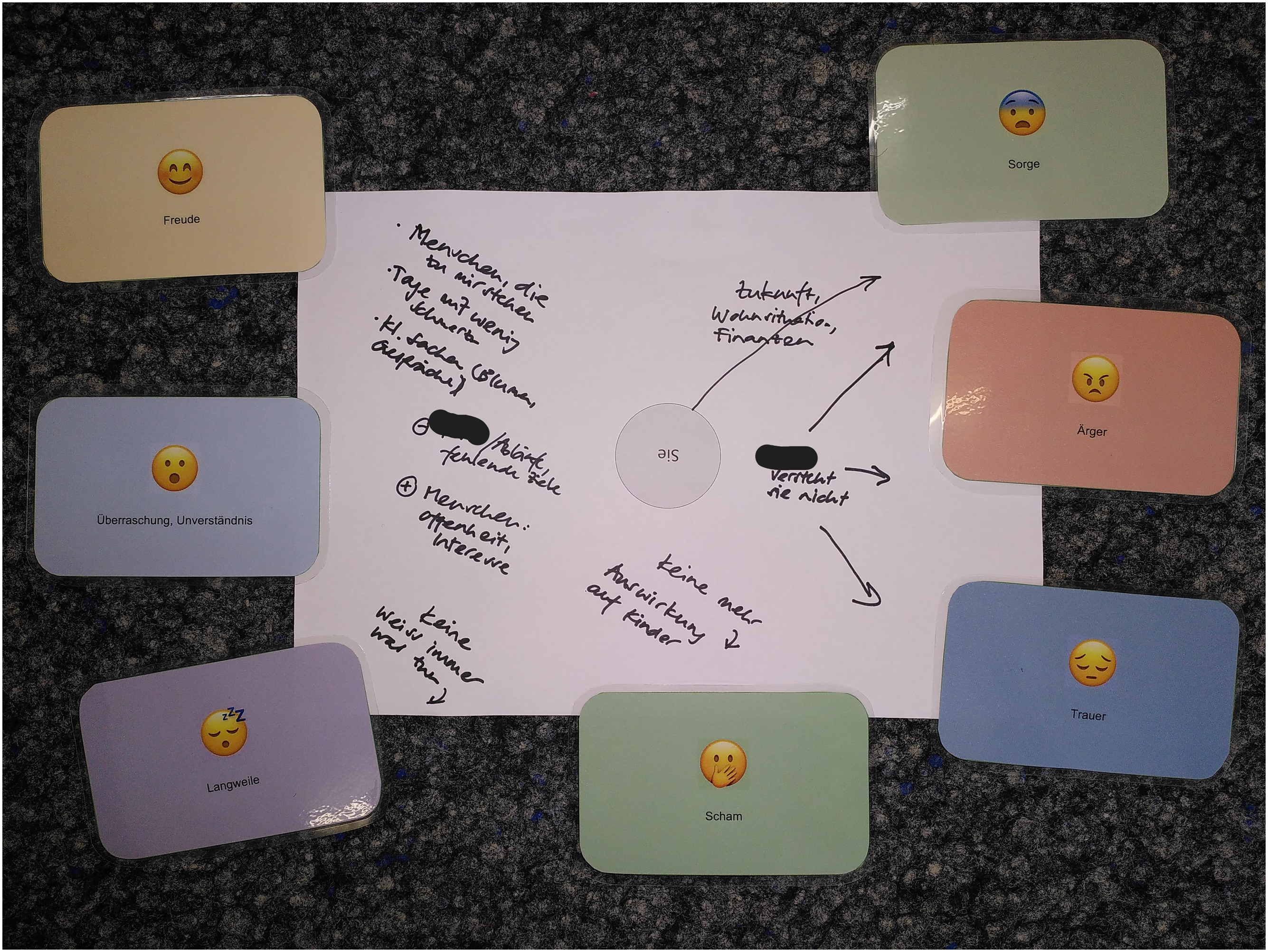
As a first step, we conducted a semi-structured interview with each participant, supported by graphic elicitation techniques. The reason for beginning with the second dimension of our conceptualisation lies in the assumption that talking about one’s life is a mode of sharing thoughts that is familiar to the participants and facilitates participation. Throughout this first interview, a ‘biographical mapping grid’ (Schubring et al., 2019) guided a short biographical review to explore some important events and people in the interviewee’s past. These were linked to the current situation of reintegration after prison and the lived experience of this period. During the interview, we presented the interviewees eight emotion cards spread out on a white sheet, with a symbol in the centre representing the interviewee. We invited them to use the different emotions as a starting point to talk about specific situations during their time on parole and how they experienced them. By taking notes on the sheet of paper and relating the emotions to the person in the middle and to various themes and situations that emerged during the interview, a ‘relational map’ slowly emerged (Copeland and Agosto, 2012).
To expand on these narratives created at the table, we invited the participants to a second meeting about a month later in the form of a go-along interview (Kusenbach, 2003). This links to the first element in the conceptualisation: the lived and embodied experience. The participants created a walking tour of places and paths that were important to them in this period of their lives. During these walks, we experienced together the space, the emotions, and the narratives of these places. The physical experience allowed us to deepen the narratives of the first interview and to discover new aspects of their lived experience.
Finally, in a third step, we invited the interviewees to participate in a focus group meeting (Morgan, 1997) in order to discuss their experiences with others in a similar situation. This step links to the third element of our conceptualisation: the sedimented experience. We stimulated discussions with anonymised quotes from the first interviews and invited participants to reflect on these quotes and share their views on the topic. These discussions allowed us to explore a collectively sedimented or condensed experience of reintegration after prison.
The sample of this study was relatively small but we used a methodological approach in order to deepen each case. We covered a broad range of possible demographic and sentence-related characteristics. In total, the study includes 16 participants from two cantons: one German-speaking and the other French-speaking. The sample includes male (10) and female (6) participants of all ages, from young adults to retired people, and of different socio-professional statuses. Three were in stable employment, one was in informal but stable employment, one in part-time employment with complements of social assistance, six were on disability insurance, three were on social assistance, and two were on a retirement pension. In terms of time spent in prison before release, the study also covers a wide range, from a few months to more than 10 years in custody. Similarly, the length of the participants’ probation period ranged from one to a maximum of 5 years. To complete the range of profiles, we had participants who tended to be at the beginning, middle, or end of their parole.
Fourteen people took part in the second interview. Two were missing due to personal difficulties. The two focus groups consisted of seven and three people, respectively. The relatively small number in the mainly German-speaking region was due to language barriers in the group and short-term absences due to illness.
For the analysis, we transcribed the entire data corpus and integrated it into software for qualitative data analysis. We coded the interviews using categories identified inductively in the data and deductively from the interview guide (e.g. employment situation, housing, and relationship with the probation officer).
Participants were approached by their probation officer and received a flyer describing the project. If they were interested, the probation officer gave us the contact information and was not involved further. Or they contacted us directly themselves. Ethical issues were more pronounced during the feedback we gave to the two probation services at the end of the project than in publications in general. They knew who had participated, and we had to ensure that probationers could not be identified. During the whole process of data collection, we tried to offer our sincere interest and appreciation of the persons we met. We hope that the participants’ attendance to three meetings in total is a proof thereof.
Although the research expanded a conceptualisation of experience and translated it into an empirical approach, there are limitations. The number of participants was relatively small, which reduces the potential for comparisons intra-group. In particular, we realised that the influence of the probation office as gatekeeper to the participants proved to have a strong structuring power on the sample. The cantonal differences seemed to relate to a selection bias of the cantonal probation services and not to cantonal differences per se.
The nature and quality of our research data
As an introduction to the results section, we will provide insights into the nature and quality of data that we obtained with the three steps of our research methodology. The first, the semi-structured interviews, allowed for connecting the actual experience of parole in two directions: In the biographical mapping grid (Figure 1), participants could relate important events or persons in their past on a timeline with their present situation; and the emotional map (Figure 2) enabled us to guide the conversation around emotionally intense situations and encounters during their probation period without limiting them to the experience of parole and in relation to the probation officer but by widening to all dimensions of life. Most participants used this moment to include their experiences in prison as a cornerstone for their current situation. For them, prison and parole are intrinsically interwoven and less separated as we conceived of it before starting the research. Through the set of emotion cards, participants were stimulated to think about various emotions and how they are reflected in their experience of parole. While joy and particularly anger/frustration were emotions that easily came up, the suggestion of emotions such as shame, sadness, and (positive or negative) surprise allowed, after some time, vivid and meaningful narratives to emerge. These might not have come up without the visual suggestion. Biographical mapping. Emotional mapping.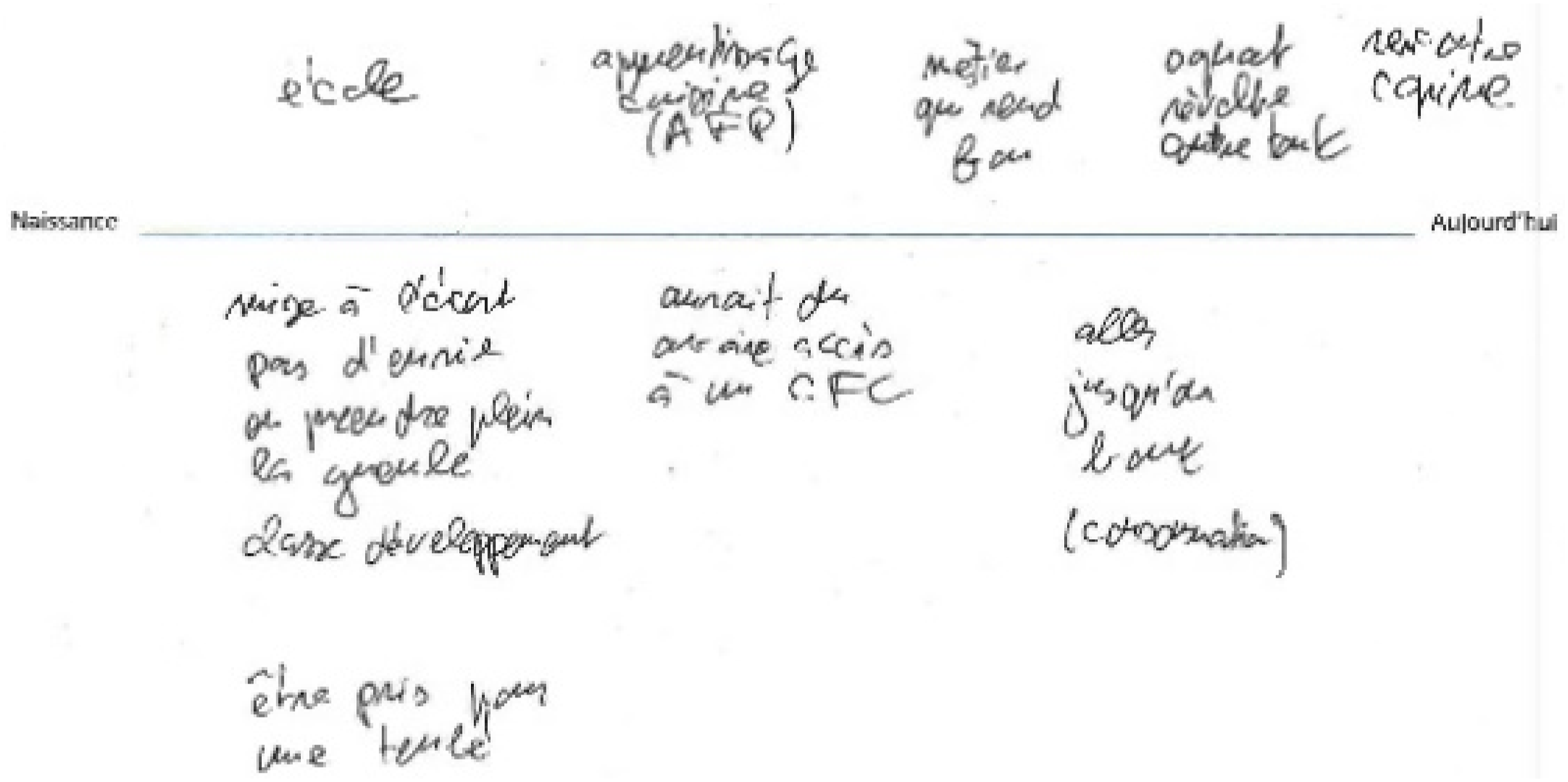
The second individual meeting in the form of a go-along interview addressed a different level of experience, namely, the bodily and sensory perception of places and spaces. We invited participants to freely suggest places or a path that represents or has a significant meaning for them during the probation period (Figure 3). The suggestions were highly diverse and emphasised various facets of life under parole. While one participant invited us to his apartment as a place where he spends most of his time and which represents a safe place for him after years of unsteady lifestyle and prison, another person guided us to a lookout tower in a natural environment where he goes to relax. From up there, we had a wonderful view of his hometown, and he showed us important places from up there and talked about them and the significance of this special place for him over time. Some others came up with walks to positive places (mostly in nature) that help to recharge their batteries as well as to negatively connotated paths, such as the walk to the probation service. Others again invited us to go with them to everyday places such as the playground, a café, or the family business. Their choices set the starting point for the interviews that developed along the objects and atmospheres we perceived around us. In general, the places chosen by the participants allowed for connecting their experiences before incarceration with the actual situation, whether they took up former habits to find recovery or whether they highlight a lifestyle different to their criminal past. Path of walking interview (pink).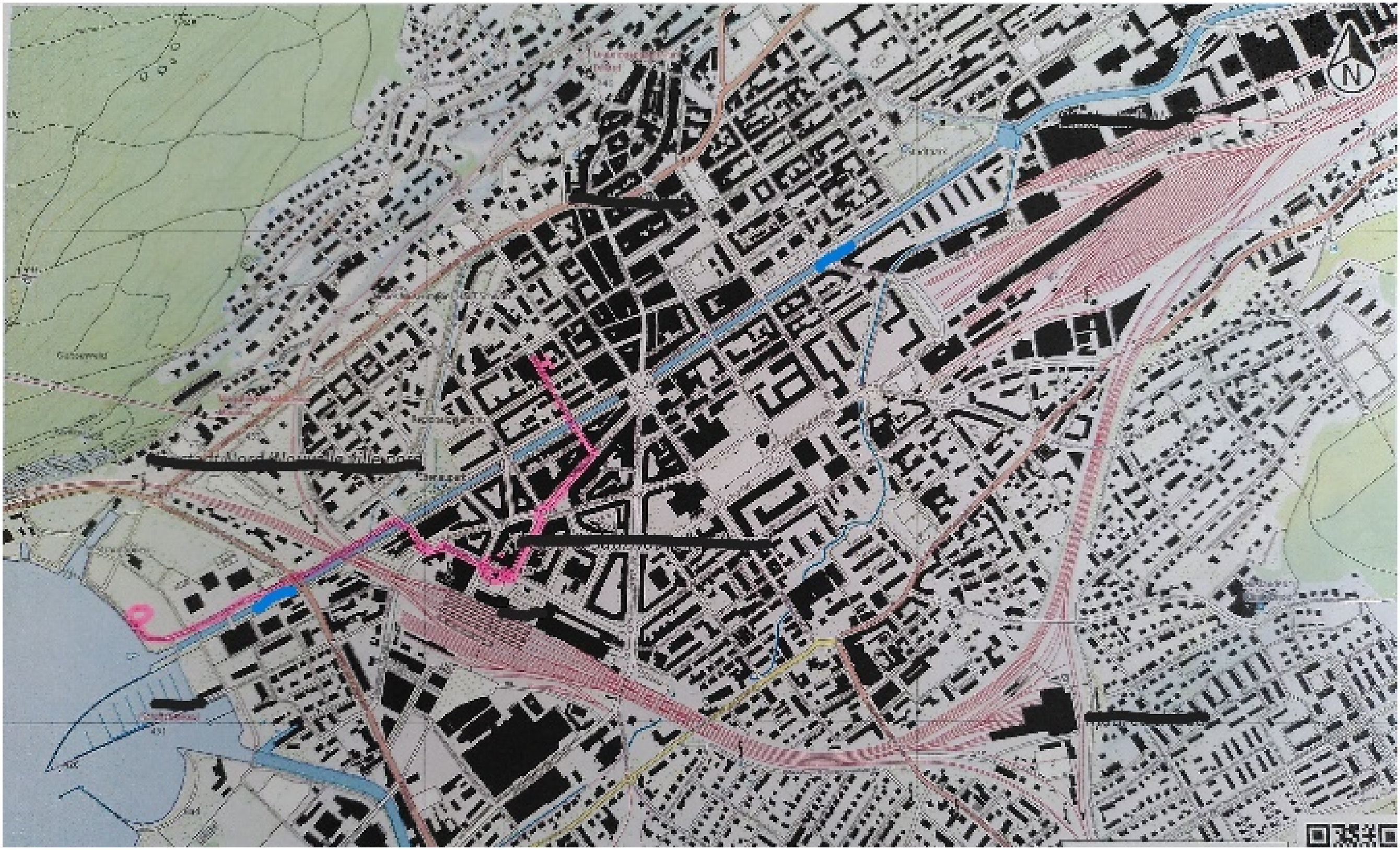
Finally, the two focus groups allowed the participants to discuss their experiences. We presented an overview of the topics that emerged during the interviews and laid anonymised quotes on the table as points of departure for the discussion. Besides elaborating on the nuances of a topic through the experiences and reflective thoughts of the participants, these discussions also served as peer group support for several people and were highly appreciated as suggested in the literature (Nixon, 2020; Nugent and Schinkel, 2016). In one group, participants exchanged hints on how to deal with certain constraints during probation, and in the other, several persons motivated one of the male participants to persevere during a difficult phase and to take control of his life again.
Lived experiences of post-prison reintegration
Experiences, as we argued with Dewey, are neither isolated in time and space nor one-dimensional but integrate various levels of (pre-) reflexive facets such as emotions, thoughts, feelings, and actions. Unsurprisingly, we found very different narratives of parole experience in our data. Sixteen persons represent 16 different stories and ways of experiencing the ‘same’ situation of parole after a prison sentence. While literature on desistance often depicts people after release as having a ‘limited and often diminished life’ (Nugent and Schinkel, 2016: 568), characterised by social isolation, goal failure, and lack of hope, we encountered a group of people among our sample that shows very different characteristics. We will therefore concentrate on these rarely researched people who were well integrated before their often long incarceration and managed to organise their lives again after release.
The long shadow of incarceration and the need to disembody incorporated experience
Although we focus on a part of the sample that is characterised by successful reintegration in several dimensions, it became clear throughout the interviews that it was not always easy to achieve and maintain the liberating sensation. The embodied experience of prison life, particularly through long sentences, requires sometimes significant personal work to disembody incorporated habits and allow the (re)embodiment of autonomous and self-determining practices. Katharina, a woman in her thirties, who talked about her experiences during the first time in her own apartment after conditional liberation, gave an example:
‘I took a week off from work to settle into my new home. But, in my head, I switched immediately to [name of the prison]. For quite a long time, I had the feeling that I could only store and organise my things in my bedroom. From the transition house in prison, I was used to only having my room for my own and the rest of the house was semi-public in the institution, for everyone. So, I put everything in my bedroom. My mom said, “no, you have space; you can also put things in the living room.” I hesitated. I wanted to contradict. I stuck to my tiny sleeping room. It took some time until I realised that the whole apartment is mine. When I think about it now, it’s stupid, but at that moment, it was really strong; it was not easy to let go off the controlling thing inside me’ (Katharina, 36 years, employed).
Starting a new life after a long prison sentence is a deep corporal experience that penetrates daily life and is, according to Katharina, hard work. She admits that, even 3 years after release, she finds it ‘difficult to go somewhere, without a plan, just like that. I can’t do that anymore. It seems senseless. Why should I walk without a plan through the city?’ She sees these thoughts as the real consequence of the constraints of the penal system. For every temporal release or work outside the prison walls, she had to present a detailed plan that she was only allowed to deviate from with a very good reason (e.g. train delay that has to be proved).
While moving around freely is of great significance for all participants in our study and certainly beyond these groups of persons, for some, being on parole equally erased any national boundaries that could constrain their liberty of movement. During temporal release from prison, one is only allowed to move around within Switzerland. Parole, however, has no national limits and allows for travelling around Europe and the world, as some participants had already done or planned at the moment of the interview. Going on holiday abroad – and thus linking with the old life before imprisonment – is seen as a ‘normal need’ as Tobi put it: ‘I haven’t had a holiday for 9 years. I just need that now’ (Tobi, 46 years, employed).
Spending holidays abroad is then not (only) a socioeconomic issue, as all these persons have regular income that allows for it. It is also and mainly a liberating moment of being able to self-determine one’s own physical movements. However, there is a catch to this supposed freedom, as we will show in the next section.
A quite different type of corporeal experience is the one of Amélia, a woman in her thirties. She was sentenced to 1.5 years of prison, followed by electronic monitoring and then parole at the moment of the interview. She gave birth to her first child in prison and lived there until the baby was about 15 months old. Being deprived of digital devices means for her that she has hardly any photos of this time: ‘Until he was 1 year and something old, I don’t have any photos of my son. I have a few when he was a baby. I don’t have any photos of me pregnant. I do have one of me when I was in prison, when my mother asked to have a photo taken. But, sometimes, when I think about it, it hurts, because I’ve dreamt all my life of being pregnant, and then when I look on my phone, there’s a hole’ (Amélia, 32 years, part-time employed).
She admits that, as a result of this ‘hole’ in her memories of the very early age of her child, she now takes excessive photos of everything they do, as if the increased number of photos taken could fill the gap on her phone. However, the long shadow of the period of incarceration remains manifested by the missing pictures. The question arises, when is a person really liberated from prison (experience) or as Todd-Kvam and Todd-Kvam (2022) stated, when does the process of desistance come to a closure?
Crossing borders as an experience of conditional freedom
While on parole, people enjoy freedom to move around as they please. However, restrictions remain. As some participants mentioned, they still need to get a written confirmation from their probation officer that they are officially allowed to do so. This is necessary because, for certain offences, particularly those which entail long sentences, a convicted person is recorded in national registers that are ‘activated’ through passport controls. Tobi and Katharina – who are mentioned above – told us about humiliating experiences at the airport, where police officers revealed their past through the passport control: ‘They brought me back to reality. I crossed the border – I am someone who likes to travel – then I came back, and they arrested me and put me in jail at the airport, with the simple reasoning that I was registered in RIPOL.
3
The problem was that a customs officer at the airport just saw that [at the control] there is a green or red light, where red means “directly go to jail.” My necklace, mobile phone, and everything are put in a [box]. Then you have to sign a paper. It goes on for three hours without you knowing when you can get out […] And then, at some point, they tell you, “you can go now; the authority has given the green light.” It's just, they want to show you that you are not free’ (Tobi, 46 years, employed).
At that moment, the hard-earned normality gives way to the status of a criminal. It is as if a puzzle piece snapped back into place and they again experience a treatment similar to that in prison with detention, deprivation of personal belongings, and general mistrust. Tobi feels that even if he did everything right, the offence committed 15 or more years ago is attached to him like a sticky mark. It is experienced as a humiliating practice for those affected, and it creates a feeling of powerlessness and discouragement, as Katharina put it, after recounting her experience at the airport checkpoint:
‘The people behind me were waiting. I was standing there at the counter for the passport control; I started to sweat. I knew I haven’t done anything wrong. I knew that I was allowed to leave the country. The officer asked questions about the letter of my probation officer with the permission to leave the country. […] Then he tried to scan the letter; he looked at me like this when he returned my ID and the letter and said it was okay. I just said, “thank you,” took my bag, and walked through. Then, I just sat on the floor. I couldn’t do anything, and all I wanted to do was cry. It was so humiliating for me’ (Katharina, 36 years, employed).
Katharina described vividly how she was affected by this situation and her bodily reaction at that moment. She further elaborated on her first reflex to avoid potentially critical situations in the future by no longer travelling during the remaining years of her time on parole. She revealed her inner dialogue, torn between desperation and a certain resistance to limit herself in her liberty to travel. Despite her satisfying working and housing situation and fulfilling social relationships as elements of good reintegration, she didn’t feel entirely recognised as a citizen again or, in other words, judicially rehabilitated (Burke et al., 2019). This last point seems to be important for a certain number of people, especially those who had a good level of integration before their offence(s) and who have managed to return to what is considered a ‘normal’ life. Hans, a retired participant at the age of 67, expressed his satisfaction of being considered a ‘normal Swiss citizen’ again, which refers to Rubio Arnal’s (2021) civic-political dimension of reintegration. Hans associated this status with paying taxes, being active in associations and sports clubs, and taking part in votes and elections.
The described experiences show an ambiguity that these people feel confronted with during parole. While they are supposed to live the life of a normal citizen – to what they largely conform – they are continuously reminded of the abnormality of their current situation. In the focus group, they shared experiences of this type and realised that it is not their individual problem but characteristic of this type of situation. Importantly, the discussion touched not only on the problem of the stigma but equally on the experiences of dealing with it and the knowledge about the rights they have in such a situation. This allowed them to develop sedimented knowledge and enriching individual experiences with that of others.
Envisioning the future with offence-oriented therapy?
Several persons in our sample had the order for psychotherapeutic treatment during parole. This is particularly true for those convicted of serious violent and sexual offences. Most of them had already undergone forensic therapy during their time in prison or throughout their measure. In general, most of the concerned participants in our study showed interest in therapy and were open to working on their personal development with their therapist. However, the offence-centred focus of forensic therapy challenges people’s commitment to it. Talking for years about the offence and all the circumstances surrounding it gives ex-offenders the feeling of being reduced to the moment of the crime. Considering other factors of the past – which the participants may consider important for understanding how they became who they are – so as to finally reconstruct an identity for a future life without deviance is, according to several participants, sometimes missing.
‘[The therapist in prison said] we have our rules; we have our programme – 7 years on the subject of [the type of crime]. And every psychologist says that after three or four years, you've talked yourself out of the subject. I had to go through that for seven years!’ (Hans, 67 years, retired).
Even if one could argue that therapy focussing on the offence is oriented towards the future, as it is aimed at avoiding future reoffending, it doesn’t feel like that for the concerned person. Further interviews in our study second this feeling of being stuck in the past with the therapy: ‘And they slow me down every time to ask me the same questions again about where I am with my offence’ (Ryan, 43 years, social assistance). In his case, the feeling is intensified by the fact that due to structural problems in the forensic-psychiatric service, he regularly gets a new therapist and has to start the therapy anew by again explaining the criminal act.
Whereas some participants appreciate the openness of their therapist to general issues of personal development, they still experience a focus on the risks of reoffending. Even more, therapists must report any risks to the probation service and the authorities. For Tobi, who was convicted of sexual offences, this poses a problem, as he could not speak freely to the therapist:
‘I want to be able to say to a therapist, “look now, this happened” – maybe not exactly an offence yet, but maybe just the feeling that problems could arise. I want to tell him that so we can talk about it. But I don’t feel safe that he won’t just report it’ (Tobi, 46 years, employed).
Tobi states that he lacks a person of confidence with whom he can work on offence-related issues openly – for instance, when being close to recidivism – without risking his legal re-entry process. While he tells us in the interview about a confidant that supports him on a voluntary basis, he regrets that the professional therapist is not able to assume to provide unconditional support. The judicial system identifies the need for psychological support to overcome potential criminal behaviour and puts it in place. At the same time, it counteracts the therapeutic confidential relationship and thus the success of therapy by the obligation of open reporting between therapist and authority with the aim to better predict, control, and avoid risks of recidivism.
Debts and costs as (lifelong) second punishment
The last major challenge for this group in our sample was the debt accumulated through the legal process. The interviewees identified various types of debts in their encounters: (1) the obligatory reimbursement of court costs after a guilty verdict. These costs are mostly suspended during the sentence and are activated again when the person proves a regular income through the annual tax declaration; (2) compensation payments to victims or ‘punishment debts’ that are continually paid in small amounts throughout the time in prison; and (3) debts to private companies or health insurance companies accumulated due to the inability to settle these obligations during pretrial detention.
The reimbursement of legal costs (1) was particularly frustrating for certain interviewees. In their eyes, they had put a lot of effort into finding a job and not having to rely on social assistance when they left prison. Katharina reported receiving, after 2 years of being out of prison, a bill from the court for a relatively high amount compared to her income, which was supposed to be paid immediately. She admitted to being particularly stressed by the unexpected bill: ‘I fought so hard to get a job, to get a flat. I worked so hard to prove that I could and would do it. I didn’t want to be like the others who go back to prison. I didn’t want that. [...] And then, suddenly, I get this bill. I was desperate, angry, and frustrated. It pulled the rug out from under my feet’ (Katharina, 36 years, employed).
Tobi expressed a similar feeling when he said that he regularly received invoices from the court to pay back the costs of the different proceedings he underwent. As soon as he paid one instalment, the next one arrived in his letterbox. Worst of all, he doesn’t know how much he still needs to pay. He is frustrated because he has worked hard to get a job to work ‘outside’ while still ‘living’ in prison to prove his motivation and ability to reintegrate into society. After his conditional release, he received a bill from the prison service for a large amount of money to be paid. He was invoiced for his stay in prison while working outside (to prepare for his reintegration after conditional release). The letterbox represents for him a ‘place’ with intense emotions related to this experience of not escaping from the loop of invoices from the judicial system, as he explained during the walking interview.
Mirko was even harsher when he talked about his enormous compensation payments to the victim: ‘And after all these years in prison [with the gigantic debts], you have to pay for the rest of your life’ (Mirko, 43 years, informal employment). He interpreted such large sums of money to pay all the judicial costs and compensation payments as a hindrance for working and for reintegrating professionally, as he would never be able to complete the payments. Tobi had a more dramatic statement: According to him, the debts result in a push factor towards recidivism.
While the participants in the study done by Gålnander (2023) proved of huge debts remaining from the time before prison and the study of Todd-Kvam (2019) reports a difficulty of managing financial issues, the profile of the people we address in this article is characterised by a relatively healthy financial situation except the debts resulting from conviction as well as court costs. The feeling of unfairness and double punishment as well as inescapability, especially to avoid risking the parole, seems to be quite stressful for the participants. For Tobi and Katharina, the feeling of unfairness seems to be nourished by the perception that their efforts to fulfil the expectations of reintegration are not recognised. Being charged for ‘living in prison’ while working outside to prepare a good reintegration process and reactivating the debts as soon as a successful professional integration and therefore a salary is proved through tax declaration, are perceived as demotivating obstacles. However, they continue upholding their aspiration of working, contrary to the effect the debts have on Mirko and which is also identified by Todd-Kvam (2019).
Conclusions
We aimed to develop a conceptual and methodological approach for apprehending the experience of people on probation in a holistic way. Rather than asking how they deal with probation service, we were interested in the time of probation as a lived and embodied experience that is communicated and thereby also reflected internally as well as in conversation with other people. Finally, it is also sedimented in the sense that people on probation need to make sense of this period in their life and find a meaningful understanding of the time they are going through. We therefore chose a multisensorial approach that included interviews on biographical aspects, on emotions to grasp their everyday lived experience, walking interviews to acknowledge for places, and materialities of their experiences, as well as group discussions with other people on probation to reach out for shared notions, explanations, and practices.
While the materials presented in the analysis might look like regular interview data, the focus on the multiple layers of experience allowed us to deepen our understanding on how it feels to live under community supervision, and the different methods helped us maintain the focus on the experiential perspective. The rich materials showed that life after custody is multifaceted and that probation officers and the conditions imposed by the sanction only represent one facet among many. This joins the three key dimensions or reintegration highlighted by Rubio Arnal and McNeill, 2024, namely, the interdependency of the various dimensions in the rehabilitation process, the multilaterality, and temporality (for the experience of temporality see as well Lambelet et al., 2024). To understand the challenges and needs of people on parole, it is therefore paramount to not focus solely on the support they receive from probation services but rather apprehend this period in their lives in a holistic way.
We concentrated on a selection of our sample that constitutes people with a high level of integration before incarceration and, accordingly, a strong rehabilitation afterwards, particularly regarding the material, social, and personal dimensions, while experiencing a dis-integration to some extent on for instance legal and civic dimensions. This group represents a contrast to the convicted people discussed in general in desistance research. While the latter struggle to find adequate housing, find stable paid employment, pay back their debts, and rebuild strong and supportive social relations, the group we presented in this article deals adequately with these issues. At the same time, they also experience struggles, of which we discussed four: (1) The long shadow of the period of incarceration and how it is inscribed in bodily practices requires a process of disembodiment in order to become a free person again; (2) accounts of restricted mobility and controls at the border represent moments of shame and humiliation; (3) psychiatric therapy that is aimed at reducing the risk of reoffending is strongly experienced as a focus on the past; and (4) debts weigh heavy on formerly incarcerated people and constitute a major obstacle for reintegration.
These struggles represent situations and constellations that potentially result in intense emotions of being trapped in the stigma of the former convict. The participants related feelings of being powerless and frustrated due to the adversities they face in the penal system despite all the efforts and positive thinking they ascribe to it. In sum, the system itself produces obstacles that result in a more difficult reintegration for these people, above all in terms of judicial rehabilitation. As a result, the criminal justice system threatens its own goals of reintegration.
Footnotes
Declaration of conflicting interests
The author(s) declared no potential conflicts of interest with respect to the research, authorship, and/or publication of this article.
Funding
The author(s) disclosed receipt of the following financial support for the research, authorship, and/or publication of this article: Haute école Spécialisée de Suisse Occidentale.
