




Abstract
Individuals who have served prison sentences face challenges in reintegrating into society, with recidivism often used as the primary indicator of reintegration success. This systematic review analyzed 38 studies with adult participants who had served a sentence or were in the last year of prison, identifying criteria for successful reintegration after release and risk and protective factors. Success factors cover intrapersonal (health, drug abstinence), interpersonal (social support, community involvement), institutional (institutional and community support), and community domains (employment and housing). Protective factors include emotional stability, family and community support, education, employment, financial stability, and access to health and social services. Risk factors include drug use, health problems, difficulties with family and social adjustment, job and financial instability, low education, housing instability, and discrimination. The findings underscore that reintegration is a complex and multifaceted process, requiring targeted programs to reduce recidivism and stigma and promote effective reintegration into society.
The criminal justice system has evolved from a punitive focus on punishment and deterrence to a rehabilitative approach aimed at social reintegration (Cullen & Gendreau, 2000). Despite this shift, various factors have compromised rehabilitation efforts (United Nations Office on Drugs and Crime [UNODC], 2006). Currently, over 10 million people are incarcerated worldwide (Fair & Walmsley, 2021), with reincarceration rates ranging from 17.6% to 54.9% (Yukhnenko et al., 2020, 2023). Importantly, most incarcerated individuals will return to society (Fair & Walmsley, 2021).
Reintegrating into the community after release is critically important for individuals who have been incarcerated. In fact, the issue of desistance from crime among formerly imprisoned persons is a major societal concern and has been the subject of extensive research (Dufour et al., 2023). Several theories explain desistance from crime, including individual and agential theories of desistance (e.g., the age-crime curve; maturational reform; rational choice theories), social and structural theories (e.g., social learning theories; differential association; informal social control theories), and interactionist and situational theories (Paternoster & Bushway, 2009; Weaver, 2019). Each highlight different aspects of the desistance process, which is complex and influenced by individual, cultural, structural, and relational factors (Weaver, 2019). An integrated model that considers both individual and social factors seems to be the most promising way to understand desistance in a holistic way (Weaver, 2019).
Reintegration is a complex and multifaceted process influenced by factors at different levels—individual, interpersonal, community, organizational, and political. Bronfenbrenner’s ecological systems theory provides a framework to understand how these factors interact synergistically, shaping an individuals’ reintegration and post-release outcomes (Russell et al., 2022). The theory defines five levels that interact in an individual’s social environment and impact their behavior: intrapersonal factors (characteristics of the individual), interpersonal factors (social networks), institutional factors (social institutions and organizations with formal and informal rules), community factors (relationships between organizations and institutions), and public policies (laws and policies) (Bronfenbrenner, 1977).
Individual factors, such as physical and mental health, personal motivation and coping mechanisms, shape reintegration experiences, and goals (Russell et al., 2022). These factors are exacerbated by community and interpersonal barriers, including limited access to health care, substance use treatment, and the need for trusted care providers, while receiving the prescriptions and support necessary for mental and physical health. Organizational and political obstacles further complicate reintegration, as poor release planning and systemic disconnects hinder access to community support before leaving prison (Russell et al., 2022).
In addition, other factors influence reintegration experiences, particularly relevant being an individual’s high personal motivation to remain free and abstinent from substance use. This motivation is mainly shaped by coping mechanisms, family dynamics, social networks, and obtaining a stable (rather than temporary) job, which provide structure and incentives for working on post-release goals. Access to housing and financial support is, in turn, partly conditioned by the management of costly and complex policies, as well as the availability of employment opportunities in the community (Russell et al., 2022).
The literature shows that several factors can make the reintegration difficult, including variables associated with imprisonment such as the scarcity of human and financial resources and the lack of opportunities to work on their difficulties and risk factors (e.g., Khoshnami et al., 2022). Indeed, although intervention programs that address criminogenic needs as well as educational and employment programs have been proven effective in reducing recidivism (e.g., Bozick et al., 2018; Gannon et al., 2019; Nur & Nguyen, 2023), only a small number of persons in prison actually receive it (Khoshnami et al., 2022; Sousa, Cunha et al., 2024). As a consequence, many individuals enter prison with various social and personal issues, such as financial instability, employment difficulties, mental health problems, substance abuse, and weak support networks, and they will leave prison facing not only the same issues but also new challenges (e.g., loss of housing, employment, and relationships) (Berghuis, 2018). In addition, variables related to the community itself, such as social stigma which can compromise a successful reintegration (Varghese & Raghavan, 2019). A prison sentence can potentially result in long-term discrimination, social exclusion, injustice, and a loss of empowerment, with individuals often being viewed as unworthy by community members (e.g., Blandisi et al., 2015). This discrimination is based on the premise that incarcerated individuals are incorrigible, resistant to change, a bad influence, dangerous, and lifelong criminals (Baffour et al., 2021). All these factors can affect crucial aspects of their lives, including employment, housing, academic or professional development, and establishing family or pro-social relationships (UNODC, 2018). In the process of transitioning from prison to the community, individuals may experience feelings of powerlessness and the inevitability of falling back into negative networks and criminal activities, factors that are associated with recidivism (Larsen et al., 2019).
Evaluating a Successful Reintegration
Several studies focus on recidivism (or its absence) as the main indicator of successful community reintegration (Goodley et al., 2021; Olson et al., 2016). According to the scientific literature, the determining factors for success or failure in reintegration into the community can be associated with family and community relationships (Chikadzi, 2017; Davis et al., 2012), job stability (Davis et al., 2012; Garland et al., 2011; Morozova et al., 2014), housing stability (Garland et al., 2011), access to social services (Chikadzi, 2017; Larsen et al., 2019), and personal perceptions of life (Davis et al., 2012). Scientific evidence indicates that successful reintegration results from holistically addressing factors predisposing individuals to criminal behavior, considering people’s physical and social needs during and after imprisonment (Travis et al., 2001). It is recognized that individuals must be prepared for reintegration into society while still in prison (Griffiths et al., 2007).
Employment is an important component of the re-entry process because, in addition to being a stable source of income, it can provide a sense of structure and responsibility for individuals returning to the community (Visher et al., 2011). Many individuals may struggle to find employment due to discrimination and stigma on their criminal record (Chikadzi, 2017). Consequently, faced with this instability, individuals are more likely to experience physical and mental health problems, such as relapse into drug use (Visher et al., 2011). Poor human and social capital makes daily life outside prison difficult and is a major barrier to successful re-entry into community (Connolly & Granfield, 2017). Deficits such as poor interpersonal skills, low levels of education, illiteracy, poor cognitive or emotional functioning, and/or lack of financial planning and management skills are common challenges faced by many individuals who perpetrated crimes, making their success in the community challenging (Griffiths et al., 2007). It is important to ensure continuity of care or provision of services from prison to the community through, for example, employment programs, substance abuse treatment, social support, and access to health services. This increases the likelihood of positive results in terms of reducing recidivism and costs (Duwe & Clark, 2017).
Current Study
Remarkably, a comprehensive exploration of reintegration criteria and the associated risk and protective factors within each domain is absent in existing literature. This gap hinders the development of targeted treatment plans within prison settings aimed at promoting the social reintegration of detained persons prior to release. Furthermore, it obstructs the criminal justice system’s ability to consider pertinent indicators when making sentencing decisions (Cullen et al., 2011; Stemen, 2017; Visher et al., 2011). To fill this gap in knowledge, we carried out a systematic review on the criteria indicative of successful reintegration into the community and the corresponding factors associated with each of the criteria for successful social reintegration, within an ecological framework. By filling this knowledge gap, our research can provide valuable information for the reintegration of people in prison, for example, by helping judges to assess whether to grant parole by focusing on criteria other than the risk of reoffending. It can also provide access to intervention programs that help with the social reintegration (e.g., work, housing, employment, health) of people in prison (Cullen et al., 2011; Visher & Travis, 2011).
Method
This systematic review was developed according to the Preferred Reporting Items for Systematic Review and Meta-Analysis Protocols (PRISMA-P) (Moher et al., 2015; Page et al., 2021). Moreover, the review protocol was registered on OSF REGISTRIES (reference: 10.17605/OSF.IO/T3ZGU).
Inclusion and Exclusion Criteria
Studies meeting the following criteria were considered for inclusion: (a) empirical studies using quantitative, qualitative, or mixed methods and case study (excluding literature reviews, theoretical articles, and commentaries or letters to the editor); (b) studies involving women and/or men who served a prison sentence or who are in the last year of imprisonment (aged 18 or over); (c) studies focusing on the criterion for successful social reintegration after imprisonment; (d) studies written in English; and (e) studies with a cross-sectional or longitudinal design. The selection of target participants considered those who had already completed their reintegration process or were in the final phase of their sentence, and, given the longitudinal nature of the studies, their reintegration was monitored over time. The exclusion criteria included (a) books; (b) conference presentations; (c) systematic reviews and meta-analyses; (d) papers that were not peer-reviewed (i.e., gray literature); and (e) papers involving participants incarcerated in juvenile institutions, psychiatric hospitals, and community institutions. No restrictions were made regarding the year of publication.
Information Sources and Search Process
Medical subject headings (MeSH) and other keywords were combined using Boolean operators (OR and AND) to form the following search equation: (offend* OR inmate OR prison*) AND (reintegrat* OR reentry OR “social integrat*” OR “community integrat*”). In May 2024, the search equation was applied to six electronic databases, targeting titles, abstracts, and keywords: B-On, Scopus, EBSCO, PubMed, Web of Science, and Sage Journals. In addition, reference lists of several studies and systematic reviews were examined.
Literature Selection Process and Data Extraction
The references obtained from the databases were loaded into Rayyan, and duplicated articles were removed (Ouzzani et al., 2016). Titles and abstracts were reviewed to determine whether the articles met the inclusion criteria. Articles that met the inclusion criteria were retrieved and read thoroughly for the final decision. Two independent researchers conducted the evaluation of the articles based on the established inclusion/exclusion criteria. Disagreements were resolved through discussion, and any remaining discrepancies were addressed by a third researcher, as described in the protocol for this systematic review.
A codebook was developed to extract data from all included manuscripts, focusing on key features such as reference information (e.g., authors, year); sample characteristics (e.g., sex, size, ethnicity/race); design (e.g., type of study design); characteristics of data collection (e.g., data collection method); reintegration criteria; main results; and strengths and limitations.
Quality Assessment
The Mixed Methods Appraisal Tool (MMAT; Hong et al., 2018) was used to assess methodological quality. The MMAT starts with two screening questions (e.g., “Are there clear research questions?”; “Do the collected data allow to address the research questions?”). Five items are considered to assess the methodological quality of studies, depending on their quantitative design (e.g., randomized controlled trials, non-randomized trials). Each criterion is categorized as “Yes,” “No,” or “can’t tell,” allowing for a quality score ranging from 1 to 5. Two investigators independently assessed the methodological quality of the studies.
Data Analysis
The included studies were reviewed through a qualitative synthesis, detailed in the “Results” section. The findings were presented both narratively and in tabular format.
Results
Initially, 7843 articles were identified in the selected databases. After removing 3297 duplicated articles, the titles and abstracts of 4546 articles were analyzed. The eligibility of 41 studies was assessed by reviewing their full texts against the inclusion and exclusion criteria. As a result, 38 articles were considered eligible for inclusion in the systematic review, and data were extracted from each of these studies. The main reasons for exclusion included (a) sample of participants recruited in psychiatric hospitals and community institutions and (b) inadequate population age (e.g., individuals under 18 years of age) (see Figure 1).
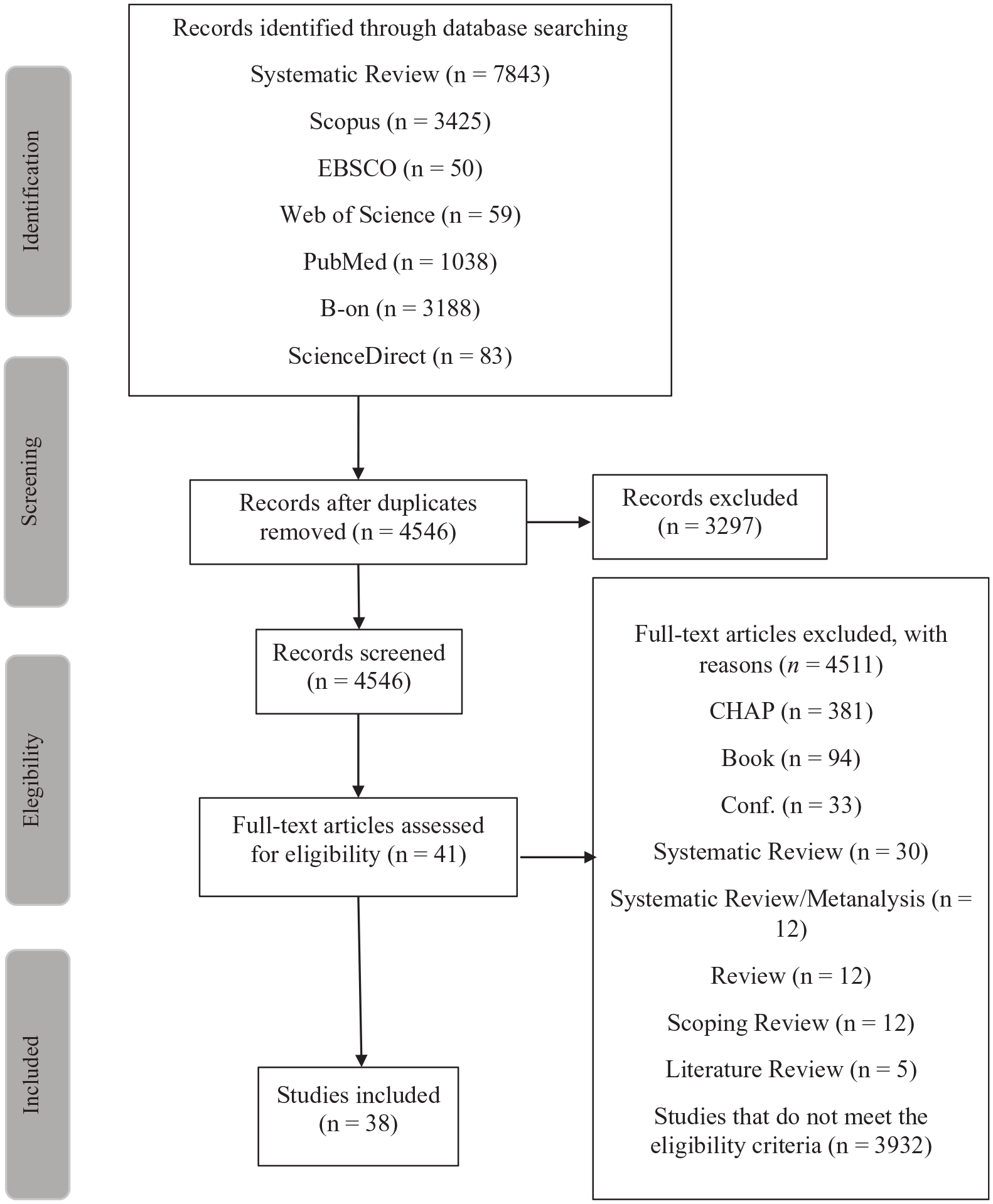
PRISMA Flowchart of Selection of Studies
Quality Assessment
The research designs identified included qualitative cross-sectional (n = 21), qualitative longitudinal (n = 5), mixed longitudinal (n = 7), quantitative longitudinal (n = 2), mixed cross-sectional (n = 2), and case study (n = 1).
Of the included studies, 22 studies showed all criteria of excellence (DeVeaux, 2022; Doyle et al., 2021; Fahmy, 2021; Liu et al., 2022; Santhosh & Mathew, 2021; Western et al., 2017), and 16 presented four out of five criteria of excellence (Andersen et al., 2020; Bahr et al., 2005; Chikadzi, 2017; Koski & Bantley, 2013; Schartmueller, 2020; Shinkfield & Graffam, 2009).
Characteristics of Included Studies
Study Characteristics
The studies were published between 2001 (O’Brien, 2001) and 2023 (Mohammad et al., 2023; Peled-Laskov et al., 2023; Tripodi et al., 2023): 2001 (n = 1); 2005 (n = 1), 2009 (n = 1), 2010 (n = 1), 2011 (n = 3), 2012 (n = 2), 2013 (n = 2), 2014 (n = 1), 2015 (n = 1), 2017 (n = 5), 2018 (n = 3), 2019 (n = 4), 2020 (n = 3), 2021 (n = 3), 2022 (n = 4), and 2023 (n = 3). More than half of the studies were conducted in the United States (n = 24), four in Australia, and two in India. The remaining were from South Africa (n = 1), Romania (n = 1), Iran (n = 1), Brazil (n = 1), Czech Republic (n = 1), Israel (n = 1), Austria (n = 1), and Indonesia (n = 1) (see Table 1).
Descriptive Characteristics of the Included Studies.
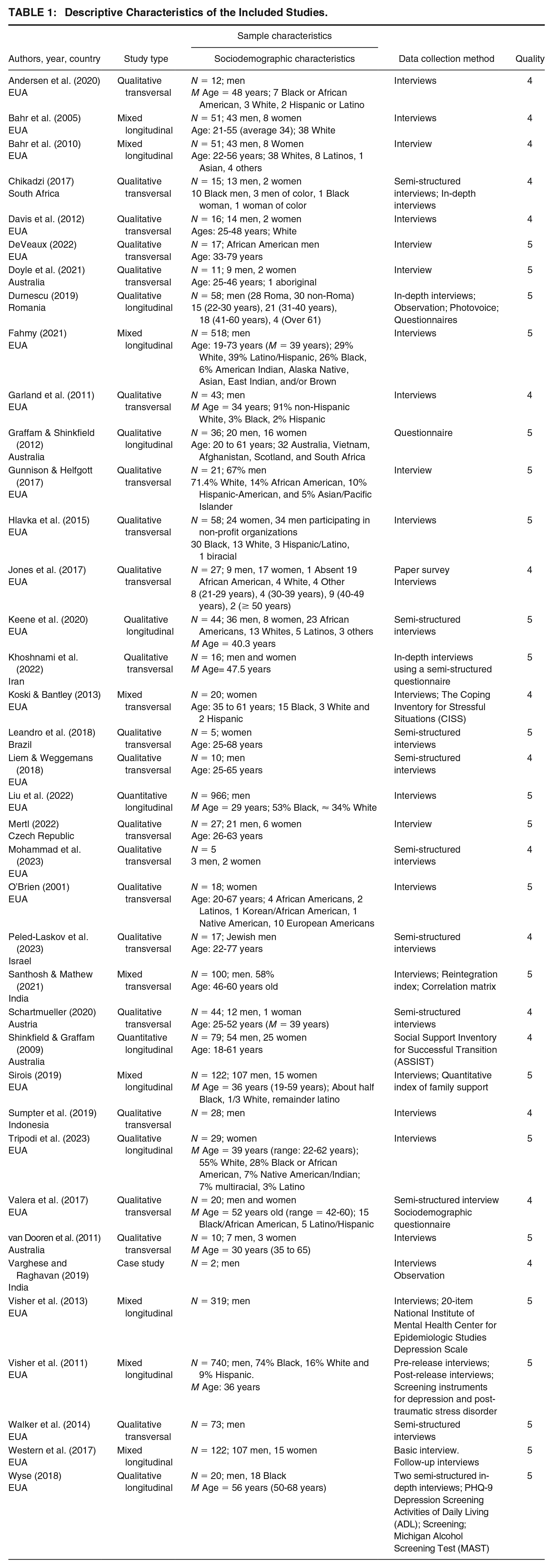
Regarding sample characteristics, sample sizes ranged from two (Varghese & Raghavan, 2019) to 966 (Liu et al., 2022). The age of the participants ranged from 18 years old (Shinkfield & Graffam, 2009) to 79 years old (DeVeaux, 2022). In addition, about half of the studies (n = 20; 50%) included both males and females in the sample, with approximately one-third (n = 14; 37%) including exclusively males (see Table 1). Moreover, only four (10%) studies were composed exclusively of women (Koski & Bantley, 2013; Leandro et al., 2018; O’Brien, 2001; Tripodi et al., 2023). In eight studies, the participants were recruited in prison prior to their release (Durnescu, 2019; Fahmy, 2021; Shinkfield & Graffam, 2009; Sirois, 2019; Tripodi et al., 2023; Visher et al., 2011, 2013; Western et al., 2017), and in 30 studies, the participants were recruited after completing their prison sentence in the community (e.g., Andersen et al., 2020; Bahr et al., 2005; Chikadzi, 2017; DeVeaux, 2022; Graffam & Shinkfield, 2012; Khoshnami et al., 2022; Peled-Laskov et al., 2023; Walker et al., 2014). Thirteen studies included diverse samples in terms of ethnicity/race, including White, Black (African American), Hispanic/Latino, and Asian participants. In addition, two studies included exclusively White participants (Bahr et al., 2005; Davis et al., 2012), two included Black and White participants (Chikadzi, 2017; Liu et al., 2022), one focused specifically on African Americans (DeVeaux, 2022), another on Aboriginal populations (Doyle et al., 2021), one compared Roma and non-Roma groups (Durnescu, 2019), one included Non-Hispanic Whites, Blacks, and Hispanics (Garland et al., 2011), and one centered on Black participants (Wyse, 2018). The studies included showed considerable variation in the distribution of ethnicities across samples. White participants comprised between 14.8% and 74.5%, while Black participants ranged from 3% to 90%. The proportion of Black or African American participants varied from 28% to 75%, and Hispanic or Latino participants ranged from 5.2% to 39%, with a subcategory of Latino participants accounting for 3% to 15.7%. African American representation specifically ranged from 14% to 75%. For specific groups, the percentage of Roma and non-Roma participants ranged from 48.3% to 51.7%. Hispanic participants varied between 2% and 10%, while other subcategories included 91% non-Hispanic White, 55.5% European American, 9.1% Aboriginal, 7% Native American/Indian, 7% multiracial, 6% American Indian, Alaska Native, Asian, East Indian and/or Brown, 5.5% Korean-African American, 5.5% Native American, 5% Asian/Pacific Islander, and 1.7% biracial. However, only four studies (DeVeaux, 2022; Durnescu, 2019; Garland et al., 2011; Visher et al., 2011) explored the role of ethnic/racial factors in social reintegration.
Measures
In most of the included studies, the data collection method involved interviews or semi-structured interviews (n = 26) (see Table 1). Moreover, in other studies (n = 12), different methodologies were employed, including the integration of interviews and psychometric instruments. The instruments used were as follows: Social Support Inventory for Successful Transition (ASSIST) (n = 1; Shinkfield & Graffam, 2009), Patient Health Questionnaire-9 (PHQ-9) Depression Screening (n = 1; Wyse, 2018), Activities of Daily Living (ADL) Screening (n = 1; Wyse, 2018), Michigan Alcohol Screening Test (MAST) (n = 1; Wyse, 2018), the Coping Inventory for Stressful Situations (CISS) (n = 1; Koski & Bantley, 2013), and the 20-item National Institute of Mental Health Center for Epidemiologic Studies Depression Scale (n = 1; Visher et al., 2013) (see Table 1). Eight studies have created their own tools to study social reintegration (Durnescu, 2019; Graffam & Shinkfield, 2012; Jones et al., 2017; Khoshnami et al., 2022; Santhosh & Mathew, 2021; Sirois, 2019; Valera et al., 2017; Visher et al., 2011).
Outcomes
The factors related to successful social reintegration will be presented according to Bronfenbrenner’s ecological systems theory (Bronfenbrenner, 1977), namely intrapersonal, interpersonal, institutional, and community factors. Intrapersonal factors include physical and mental health (n = 17), self-esteem (n = 3), personal transformation (n = 2), drug and alcohol abstinence (n = 7), and assertive coping strategies (n = 2). Regarding interpersonal factors, the following stand out: social support (n = 27), community involvement (n = 9), adaptation (n = 3), and fatherhood (n = 2). Institutional factors include institutional and community support (n = 7). Finally, community factors include employment stability (n = 32), housing stability (n = 23), financial stability (n = 12), favorable neighborhood environment (n = 1), and education (n = 1).
In relation to intrapersonal factors, physical and mental health includes the presence or absence of a diagnosis of a physical and/or mental illness and access to medical services inside prison and after release, regardless of the type of illness and whether or not individuals have health insurance. Self-esteem encompasses an individual’s self-assessment and interactions with others, including feelings of inferiority, decision-making about life goals after prison, and the ability to evaluate personal capacities. Personal transformation involves changes in life projects and identity, including a desire to turn past experiences into positive contributions, such as helping children, individuals who have been in prison, and people recovering from substance abuse. Moreover, drug and alcohol abstinence involves abstinence from the use of drugs and alcohol. Finally, assertive coping strategies refer to methods for dealing with stressful situations.
Concerning interpersonal factors, social support includes the stability of emotional, instrumental, family, and friend support. It refers to the bond and assistance provided by family, friends, and community members, both practically and emotionally. Community involvement entails the active interaction of individuals with people in the community. It involves positive reintegration into community life through reconnecting with and participating in relationships, roles, and local social networks. It also implies having a valid identity, access to resources such as transportation for daily tasks, and compliance with supervision requirements. Adaptation refers to adjusting to the environment outside prison, including family and community dynamics. Finally, fatherhood includes traditional ideals of fatherhood and the father’s involvement with his child(ren) immediately after leaving prison.
Regarding institutional factors, the institutional and community support includes assistance from legal services and social support programs.
Concerning community factors, employment stability involves the proportion of time spent in employment in relation to the number of days since release from prison. It is manifested by the desire to have a stable, legitimate job, and to become a contributing member of society. It is also linked to the desire for financial independence. Furthermore, housing stability includes the proportion of time spent in the same residence since release from prison. It is manifested by the desire to own their own home at an affordable price, without having to go through transitional housing, stay with relatives/friends, or sleep on the street. Financial stability refers to the income individuals have to meet basic necessities after leaving prison, while education encompasses the opportunity for study both during incarceration and after release. A favorable neighborhood environment refers to a setting that is free from drug use and criminal activity.
Protective Factors
Intrapersonal Factors
Changes in thinking and behavior, including resilience (Hlavka et al., 2015; Jones et al., 2017; Khoshnami et al., 2022), the use of task-oriented coping strategies (Koski & Bantley, 2013), a sense of effectiveness in managing daily life (O’Brien, 2001; Visher et al., 2011), personal motivation (Davis et al., 2012; Tripodi et al., 2023), and a desire to turn past experiences into positive contributions by helping others and supporting their family (Andersen et al., 2020; Hlavka et al., 2015) were associated with better social reintegration (see Table 2). Older age is also associated with higher success rates (Bahr et al., 2010).
Social Reintegration Criteria of The studies Included in the Systematic Review

Interpersonal Factors
The results revealed that family ties and friends and community involvement (Andersen et al., 2020; Bahr et al., 2010; DeVeaux, 2022; Liu et al., 2022; Shinkfield & Graffam, 2009; Sirois, 2019), the capacity to repair familial roles and involvement with children (O’Brien, 2001; Visher et al., 2013), family visits during incarceration (Santhosh & Mathew, 2021), and engagement with religious communities (Hlavka et al., 2015; Jones et al., 2017) were associated with better social reintegration.
Institutional Factors
Having support from social services and/or participation in support services (DeVeaux, 2022; Graffam & Shinkfield, 2012; Hlavka et al., 2015; Jones et al., 2017; Mertl, 2022; Tripodi et al., 2023; Valera et al., 2017; van Dooren et al., 2011; Varghese & Raghavan, 2019), along with counseling and support for addressing past trauma (O’Brien, 2001; Varghese & Raghavan, 2019), the ability to participate in rehabilitation programs after release (Doyle et al., 2021; Garland et al., 2011; Mohammad et al., 2023; Peled-Laskov et al., 2023; Western et al., 2017), and financial support (Mertl, 2022) contribute to better reintegration outcomes. In addition, certain prison-related factors are protective, such as attending drug treatment classes (Bahr et al., 2010), as granting temporary licenses (Santhosh & Mathew, 2021), supervision by probation officers (O’Brien, 2001; Santhosh & Mathew, 2021), having work or study opportunities before and during incarceration (Schartmueller, 2020; Visher et al., 2011, 2013), and savings from prison employment (O’Brien, 2001).
Community Factors
The studies revealed that access to treatment for drug use (Bahr et al., 2010; Davis et al., 2012; Gunnison & Helfgott, 2017; Schartmueller, 2020; Sirois, 2019), access to health services (Garland et al., 2011; Valera et al., 2017), higher levels of education and/or educational opportunities (Davis et al., 2012; Doyle et al., 2021; Liu et al., 2022; Varghese & Raghavan, 2019; Western et al., 2017), a stable job and/or employment opportunities (Andersen et al., 2020; Bahr et al., 2005, 2010; Doyle et al., 2021; Durnescu, 2019; Keene et al., 2020; Peled-Laskov et al., 2023; Varghese & Raghavan, 2019), owning a home (Andersen et al., 2020; Durnescu, 2019; Keene et al., 2020; Shinkfield & Graffam, 2009), financial stability (Varghese & Raghavan, 2019), and effective management of barriers to re-entering society (Koski & Bantley, 2013) were associated with better social reintegration (see Table 2).
Risk Factors
Intrapersonal Factors
The results showed that drug use in the post-release period (Bahr et al., 2010; Khoshnami et al., 2022; Koski & Bantley, 2013; Tripodi et al., 2023; Visher et al., 2011), mental and physical health problems (DeVeaux, 2022; Graffam & Shinkfield, 2012; Liu et al., 2022; Sirois, 2019; Visher et al., 2013; Western et al., 2017), emotional instability resulting, for example, from the breakdown of relationships (Davis et al., 2012; Khoshnami et al., 2022; Koski & Bantley, 2013; Western et al., 2017), traumatic experiences in childhood (Western et al., 2017), and criminal behavior (Western et al., 2017) were considered risk factors.
Interpersonal Factors
The findings stated that support instability (i.e., being rejected by family and community and/or lack of support) and/or family dependency (Bahr et al., 2005; DeVeaux, 2022; Jones et al., 2017; Sirois, 2019; Wyse, 2018), social isolation (Bahr et al., 2010; Durnescu, 2019; Liu et al., 2022; Mohammad et al., 2023; Schartmueller, 2020; Sirois, 2019; van Dooren et al., 2011), family and social adjustment difficulties (Bahr et al., 2005; Davis et al., 2012; Garland et al., 2011; Schartmueller, 2020; Sumpter et al., 2019; Tripodi et al., 2023; Valera et al., 2017; van Dooren et al., 2011), difficulties in meeting parental obligations (Bahr et al., 2005), being discriminated against for being a individual who have been in prison (Andersen et al., 2020; Chikadzi, 2017; Hlavka et al., 2015; Santhosh & Mathew, 2021; Visher et al., 2011), and social stigma (criminal record) (Khoshnami et al., 2022; Leandro et al., 2018; O’Brien, 2001; Visher et al., 2011; Walker et al., 2014) were associated with difficulties in reintegration.
Institutional Factors
The results revealed that lack of identity documents/immigration status (Durnescu, 2019; Garland et al., 2011; Schartmueller, 2020), lack of access to medical records (Mohammad et al., 2023; Valera et al., 2017; van Dooren et al., 2011), lack of pre-release planning (Valera et al., 2017), lack of support during and after release, involving, for example, adequate vocational training and psychological treatment, and lack of support services (Gunnison & Helfgott, 2017; Mohammad et al., 2023; Santhosh & Mathew, 2021; Walker et al., 2014; Western et al., 2017) were associated with worse reintegration after prison. Finally, non-compliance with parole conditions (Garland et al., 2011) and probation requirements (Hlavka et al., 2015), debts and debts related to parole requirements (Mertl, 2022; Peled-Laskov et al., 2023; Visher et al., 2011; Walker et al., 2014), long prison sentences (Santhosh & Mathew, 2021), restricted bonds with family during imprisonment (Visher et al., 2013), and family and friends’ history of crime and drug use (Bahr et al., 2005, 2010; Davis et al., 2012; Koski & Bantley, 2013; Leandro et al., 2018) increase post-release maladjustment (see Table 2).
Community Factors
The following factors were considered risk factors: difficulties accessing healthy food (Mohammad et al., 2023), neighborhood environment instability (Chikadzi, 2017; Liu et al., 2022), job instability and/or financial difficulties (Santhosh & Mathew, 2021; Shinkfield & Graffam, 2009; Sirois, 2019; Valera et al., 2017; Western et al., 2017; Wyse, 2018), low levels of education (O’Brien, 2001), housing instability (Garland et al., 2011; Jones et al., 2017; Keene et al., 2020; Khoshnami et al., 2022; Mertl, 2022; Mohammad et al., 2023; Schartmueller, 2020; Sirois, 2019; Tripodi et al., 2023; Valera et al., 2017; Walker et al., 2014; Western et al., 2017), lack of education/vocational training opportunities (DeVeaux, 2022; Mohammad et al., 2023), lack of work experience/work opportunities (Bahr et al., 2010; Doyle et al., 2021; Hlavka et al., 2015; Leandro et al., 2018; Sumpter et al., 2019), social inequality (Leandro et al., 2018; van Dooren et al., 2011), and gender discrimination (O’Brien, 2001; van Dooren et al., 2011; Visher et al., 2011).
Discussion
The challenge of preventing recidivism among persons who have been in prison is a significant societal issue and has been widely studied (e.g., Dufour et al., 2023). Then, successful reintegration into the community after incarceration is crucial. However, the current literature lacks a comprehensive exploration of the criteria for social reintegration and the associated risk and protective factors. Then, the aim of this systematic review was to identify risk and protective factors for successful social reintegration for men and women who have served a custodial sentence.
A total of 38 studies met the inclusion criteria, with over half published within the last 9 years, reflecting the growing interest of the scientific community in this topic. These results may be attributed to the growing concern over recidivism rates among individuals who have previously been incarcerated, as their re-entry into the justice system incurs economic burdens and additional victims (e.g., Zane et al., 2023). At the same time, research on protective and risk factors for successful reintegration is less diverse, with nearly half of the studies being conducted in the United States with mixed samples. These data are consistent with what has been found in systematic reviews involving work with persons who perpetrated crimes (e.g., Pinto e Silva et al., 2023; Sousa, Gouveia, et al., 2024). However, these findings may be influenced by the fact that women and men have different criminogenic needs and distinct prison experiences (e.g., Bijlsma et al., 2022; Goulette, 2020), which can influence the influence of these variables on their reintegration. Moreover, the country of publication can also influence the outcomes. For instance, in South Africa, despite existing legislation on the rehabilitation and reintegration of individuals, there are shortcomings, such as rejection by family members (leading to ostracism), stigmatization by society, job instability, difficulties in adapting to the environment, and inadequate health care after release, which hinder reintegration and increase the likelihood of recidivism (Chikadzi, 2017).
In addition, while more than half of the studies included information about participants’ ethnicity, a minority of studies (DeVeaux, 2022; Durnescu, 2019; Garland et al., 2011; Visher et al., 2011) addressed ethnic or racial factors in the context of social reintegration experiences. This gap is particularly concerning, as individuals from ethnic minorities are known to face discrimination and significant obstacles during the social reintegration process (e.g., DeVeaux, 2022; Durnescu, 2019; Visher et al., 2011). Understanding how these groups adapt to and overcome such challenges is essential for effective reintegration strategies. It is therefore essential that public policies and interventions are adapted to consider cultural differences, systemic discrimination, and the adaptation strategies used by minority or over-represented groups during their reintegration process. Reintegration programs should account for the impact of ethnic and racial discrimination while addressing the cultural realities of minority groups. These programs must also take the unique challenges faced by these groups, including social stigma, discrimination, lack of social, institutional, and community support, and limited economic opportunities. By integrating these considerations, reintegration efforts can become more inclusive and effective in supporting marginalized individuals.
The present systematic review’s findings revealed several factors that can be either a protective or a risk factor for the reintegration of these persons, according to their presence or absence. Specifically, institutional factors both within the prison (e.g., participation in rehabilitation programs, supervision by prison staff, and opportunities to develop educational and employment skills) and outside the prison (e.g., access to intervention programs and medical care) were identified. In addition, intrapersonal factors (e.g., personal change), interpersonal factors (e.g., support from family and friends, receiving family visits in prison), and community factors (e.g., education, employment) also played significant roles. Our results are in line with other studies that indicate that these factors do not operate independently in the social reintegration experiences of individuals who have served a custodial sentence (e.g., Hu et al., 2020; Russell et al., 2022). Indeed, reintegration is a process that involves factors acting at different levels (individual, interpersonal, community, institutional, and political) (Russell et al., 2022). These factors have an impact individually, as well as influencing each other at various levels (Russell et al., 2022). On an intrapersonal level, individuals with physical and mental health problems can see their state of health worsened by institutional factors, such as difficulty in accessing their medical records, lack of continuity of health care after leaving prison (Mohammad et al., 2023), and the inability to have health care due to financial difficulties (Mohammad et al., 2023; Peled-Laskov et al., 2023). In addition, individuals with a chronic physical or mental health condition work less time (Visher et al., 2011). Even individuals who are abstinent from drug use can face reintegration difficulties due to a lack of treatment after leaving prison (institutional factor), as well as community factors such as family members who use drugs (Bahr et al., 2005; Bahr et al., 2010) or engage in criminal behavior (Bahr et al., 2010) and an unfavorable neighborhood environment (Liu et al., 2022). On the contrary, these factors can have little impact on individuals’ social reintegration if, on an intrapersonal level, they have internal motivation and the desire to turn past experiences into positive contributions (Andersen et al., 2020; Davis et al., 2012; Khoshnami et al., 2022), which is supported by social support (Davis et al., 2012; Tripodi et al., 2023), an interpersonal factor. The latter has a significant impact on the success of social reintegration, especially when there is support from family, friends, and community members, both in practical and emotional terms (Bahr et al., 2005; Bahr et al., 2010; Chikadzi, 2017; DeVeaux, 2022). Social support has a direct impact on community factors, such as finding stable employment (Bahr et al., 2005), and is further reinforced by institutional factors, such as re-entry programs (Doyle et al., 2021; Garland et al., 2011; Mohammad et al., 2023). Employment stability significantly impacts other criteria, as it enables individuals to achieve financial independence, meet basic needs, and gain autonomy, thereby reducing their dependence on social support (Andersen et al., 2020; Davis et al., 2012; Doyle et al., 2021; Mohammad et al., 2023; Shinkfield & Graffam, 2009). Job stability also influences mental health, particularly personal transformation, and the development of self-esteem (Garland et al., 2011) and facilitates access to health care (Shinkfield & Graffam, 2009; Sirois, 2019). On the contrary, access to housing and financial stability depends on stable employment opportunities. These employment opportunities are impacted by individuals’ criminal records, stigma, and discrimination (Tripodi et al., 2023; Varghese & Raghavan, 2019).
In addition, some of the factors that hinder successful reintegration (risk factors) are among the foremost eight risk factors that contribute to a higher likelihood of reoffending (Bonta & Andrews, 2016), specifically: family/marital issues, lack of educational or employment achievement, absence of pro-social leisure activities, and substance abuse. First, these findings underscore the need for enhanced psychological interventions within prison settings that address individuals’ criminogenic factors and support their well-being. The research indicates that certain treatment modalities, such as third-wave therapies (e.g., Acceptance and Commitment Therapy, Compassion-Focused Therapy and Schema Therapy) (Cunha et al., 2024; Sousa, Gouveia, et al., 2024) can effectively address factors crucial for successful reintegration. Second, the results highlight the necessity for educational and training programs in prisons, which the literature has shown to be effective in crime prevention and improving employment prospects (e.g., Bozick et al., 2018). Finally, the results highlight the need for prison policies that promote family visits and closer supervision by professionals.
The results also allow for the reformulation of theoretical models on social reintegration, based on the protective and risk factors identified in the various studies. In practice, it allows professionals working with people serving custodial sentences to plan and manage the transition from prison to the community, focusing on each individual’s protective and risk factors, personalizing interventions, and increasing their quality and effectiveness. It allows for the creation of support programs for employment and vocational training, promoting a reduction in recidivism and financial independence. The creation of support programs for safe and stable housing facilitates the search for employment and reduces the risk of relapse into criminal behavior. Providing social support helps rebuild relationships and find a sense of belonging in the community. Ensuring continued access to physical and mental health services, as well as financial support programs, empowering individuals to manage their finances through grants. The development of social (re)integration programs promotes the development of social skills through participation in community activities (Bahr et al., 2010; Cullen et al., 2011; Stemen, 2017; Visher et al., 2011; Visher & Travis, 2003).
Despite the contributions, this systematic review also has some limitations. First, even though no restrictions were placed on the research country, most of the included studies are fairly homogeneous, with most conducted in the United States. In addition, many studies feature small, specific participant samples (Bahr et al., 2010; Mohammad et al., 2023). This homogeneity limits the ability to generalize the findings to other countries. Therefore, future research should include a more diverse range of samples to gain a better understanding of these phenomena. Second, although several studies mentioned ethnicity, only a small number of them (DeVeaux, 2022; Durnescu, 2019; Garland et al., 2011; Visher et al., 2011) examined the impact of ethnicity, race, or community factors on social reintegration. Given that re-entry challenges vary based on the community size and an individual’s race or ethnicity (e.g., Frazier, 2014; Garland et al., 2011), future research should investigate these factors to better understand the experiences and barriers faced by overrepresented or minority groups and to improve reintegration strategies. Third, this systematic review only included peer-reviewed English-language studies. The exclusion of papers published in other languages may have impacted the findings of the review. Fourth, the data collection methods used in many studies may lead to bias and social desirability effects, as they rely on self-reporting instruments (e.g., interviews; questionnaires) (Doyle et al., 2021; Garland et al., 2011). Finally, several studies are based on a single evaluation point after release from prison (Davis et al., 2012), while longitudinal studies often focus only on the initial period following release (Walker et al., 2014). To gain a better understanding of the social reintegration process, it is essential to conduct studies over an extended period after re-entry, allowing for the evaluation of the effectiveness of intervention plans and programs aimed at successful reintegration.
Conclusions and Implications
This systematic review identified several criteria for successful social reintegration of individuals after a period of imprisonment and risk and protective factors. As previously mentioned, employment and housing stability, as well as social support, are key criteria for successful social reintegration. Specific intervention plans for individuals in prison, such as the implementation of policies focused on social reintegration criteria, enable the successful social reintegration of individuals, promote social inclusion, and decrease recidivism.
Future studies are encouraged to follow individuals who have served a custodial sentence over a longer period of time. It is important to carry out studies with female participants in order to understand the process of social reintegration, as well as to see if there are specific needs of women that differ from men and require a different type of intervention. The importance of evaluating the effectiveness of specific interventions aimed at successful social reintegration and the protection of individuals’ rights both during and after imprisonment is highlighted. At the same time, future studies should focus on professionals’ perspectives on the social reintegration of individuals after their period of imprisonment.
In terms of policy implications, it provides knowledge about the criteria for successful social reintegration and the factors associated with them, making it possible to promote economic, social, and political conditions for individuals after prison that facilitate their reintegration. For example, through the creation of employment and vocational training support programs, housing support programs, access to health services, financial support programs, and social (re)integration programs. In terms of implications for practice, professionals should focus on creating programs that offer continuous support in terms of educational, professional, and technical skills and mental health, both in prison and in the process of social reintegration. In prison, individuals should have access to an individualized assessment to identify their needs and then have access to programs that meet those needs. Psychosocial support is important, as is maintaining ties with family members (e.g., through access to visits), as well as access to education and/or technical training and/or work during imprisonment.
Footnotes
Authors’ Note:
This work was conducted at CIPsi, School of Psychology, University of Minho, supported by the Portuguese Foundation for Science and Technology (FCT; UID/01662: Centro de Investigação em Psicologia) through national funds, and also funded by FCT under the HEI-Lab R&D Unit (UIDB/05380/2020). The authors have no conflicts of interest to declare that are relevant to the content of this article.
