




Abstract
Electronic monitoring (EM) serves as an alternative sanction to incarceration. An important aspect that remains only scarcely debated in the literature is EM’s punitiveness and, more specifically, exactly how punitive EM is in comparison to different forms of incarceration. Responding to this gap, we propose a systematic meta-analysis of relevant studies that scrutinizes and compares different studies on EM and its punitive effects (or perceptions of its degree of punitiveness) in relation to incarceration. Ultimately, there is no simple and straightforward answer: EM’s level of punitiveness differs with the various sociodemographic variables of respondents included in the studies and the various characteristics of the penal system. It is necessary to assess the degree of punitiveness of EM to determine the conditions under and terms with which it should be applied, for example, as a humane substitute for incarceration or as an additional pain of the penal system.
Introduction
Debates about alternative and new forms of sanctioning and surveillance are often related to questions of cost, punitiveness, level of security and preventive and rehabilitative effects. Such questions of implementation and effect emerge in opposition to ethical questions regarding the rights of offenders. Assessing the quality of alternative forms of sanctioning and surveillance is a demanding task, especially for the governments responsible for the sanction.
These debates apply in particular to electronic monitoring (EM), a technology-based form of detention. Since EM was introduced in 1984 in the United States and in the late 1980s in Europe (first in the United Kingdom and Sweden, followed by Denmark in 2005, Finland in 2006 and Norway in 2008) (Killias et al., 2010), researchers have been interested in EM’s level of punitiveness compared to other forms of detention. Situating ourselves within this discussion, we conducted a meta-analysis of research in different countries to determine the degree of punitiveness of EM. This article makes an important contribution to understanding EM by revealing the degree of punitiveness of EM.
An important distinction has to be made regarding whether EM is used instead of incarceration or as an added restriction, such as a condition for parole (Kilgore, 2012, 2015), because it has an important effect on the question of its punitiveness. We will come back to this later. Although EM is used to implement different court orders (e.g. restraining orders and curfew), its level of punitiveness has thus far mostly been investigated in the context of house arrest. Accordingly, in this article, ‘EM’ always refers to electronically monitored house arrest.
In the following, we first focus on the relation between EM and punitiveness. Then, we describe our data collection methods, the resulting data corpus and our strategy of analysis. Based on these data, we assess the punitiveness of EM in general and then categorize its pains by translating the pains of imprisonment (Sykes, 1958) to pains of EM. To present a deeper understanding of the issue, we explore the role demographic variables play in EM experiences. We review offender perspectives and subsequently discuss the points of view of related individuals and of the general community. To conclude, we present our findings, outline the study’s limitations and make suggestions for future research.
Punitiveness of electronic monitoring
In criminological theory, the punitive aspect of penalty is a central aim of the correctional system. Referring to Cohen (1994), Matthews (2013: 352) defines punitiveness as a stance that ‘involves the infliction of pain, harm and suffering on individuals in a coercive but impersonal manner by specialist, often legally empowered, agencies’. Punitiveness is therefore inflicted on individuals subject to the correctional system by legal enforcement authorities with the intention of causing some form of pain or deprivation. It therefore involves a sanction that constitutes an excess above the social norm of freedom of movement and agency, which is experienced by offenders and assessed by society. Unsurprisingly, the articles included in our meta-analysis focus on both the experience and the assessment of the punitiveness of EM.
To analyse the punitiveness of EM, we based our conceptual approach to punitiveness on the pains of imprisonment (Sykes, 1958; see also Payne and Gainey, 1998; Payne et al., 2014). According to Sykes, incarceration results in five pains: deprivation of autonomy, deprivation of goods and services, deprivation of liberty, deprivation of heterosexual relationships and deprivation of security. In contrast to other researchers, we chose to also deduce pains from the data and allow for new pains specific to EM. Therefore, some of the pains discussed later correspond to pains of imprisonment (deprivation of autonomy and deprivation of liberty) and point towards equal degrees of punitiveness of EM compared to incarceration, and other forms of pain are similar to those by Sykes (pains affecting relationships instead of deprivation of heterosexual relationship). Others are again specific to EM because they relate to wearing an EM device or its costs (deprivation of employment-favourable conditions, physical and financial pains).
More specifically, EM is a measure that uses an electronic device to monitor the movement and localization of an offender. It is generally implemented by fitting a device with a bracelet on the ankle or wrist. While older generations of EM connect to phone lines in buildings, newer ones are equipped with GPS or GSM 1 technology that provides continuous information about wearer’s localization. EM is used to check offenders’ compliance with orders such as curfew and house arrest. Ultimately, it allows authorities to control the movement and localization of offenders and offers an alternative to forms of custody characterized by the total separation of the offender from their social context, including living and working environments (Whitfield, 2013: 157).
In general, EM is used for very diverse purposes and is often coupled with other measures and rehabilitative programmes. It can be used to monitor offenders’ attendance of rehabilitative or therapeutic programmes as well as to control limits imposed on time and space in sanctions such as house arrest. In general, EM is used for bail enforcement (United States), front door schemes in which enforcement authorities directly apply EM as an alternative to short-term custody and back door schemes in which offenders are subject to EM after an early release from custody or also as an additional element of parole. Along these lines, we distinguish EM as a substitute for incarceration from an element added to pre-existing treatments or types of sanctions. This is not only a distinction in the way EM is implemented, but also has important effects on its perceived punitiveness.
Apart from various studies that analyse a specific programme or experimental setting for testing EM, some articles address the topic at a broader level. Schmidt’s (1998) analysis of the usage of EM in the United States is an early example that presents the type of equipment used and the different types of programmes evaluated. This important early study focuses on initial experiences with EM in the United States. More recent literature reviews EM’s use in other national contexts such as Denmark (Payne et al., 2014) and Australia (Kornhauser and Laster, 2014). In addition to those articles that are more oriented towards the enforcement authorities, Bülow’s (2014) analysis of EM highlights six ethical standards and assesses the ethical implications of EM, including questions about the privacy rights of offenders and the public (e.g. with reference to data storage). Other issues concern the stigmatizing effect of EM. These aspects are directly linked to questions of punitiveness, as discussed by Eisenberg (2017). She argues that EM becomes an additional punishment – including net-widening effects (e.g. Kilgore, 2015: 9) – when added to other forms of treatment, which leads to the question of whether EM can be part of a humane approach in the criminal justice system (Kilgore, 2015).
Research question
Eisenberg (2017), Payne and Gainey (1999) and Kilgore (2012, 2013, 2015) point to the importance of assessing the punitiveness of EM. In particular, their contributions clearly show that it is necessary to discuss the punitiveness of EM in-depth and to look closely at various factors from the level of jurisdiction and type of sanction as well as sociodemographic aspects. While Eisenberg (2017) opens up an important discussion, she reviews existing literature rather than carrying out a meta-analysis based on existing studies, and Payne and Gainey (1999) conduct a single study with a sample of 29 offenders monitored by EM. We continue this discussion with a meta-analysis based on a corpus of studies from different countries published over almost 20 years. We address the following questions: Is EM house arrest experienced as punitive? Are there specific pains of EM? How is the experience connected to offenders’ sociodemographic characteristics? How is EM perceived by non-wearers? How is EM perceived by the community at large? We conclude by linking these questions back to the characteristics of the criminal justice system.
Data and method
To answer these questions, we use a meta-analysis based on a corpus of systematically collected peer-reviewed articles. To ensure that articles varied across journals, disciplines and, as much as possible, jurisdictions, we searched various databases, including ProQuest, Social Sciences Citation Index, Sage Journals, Wiley Online Library and Google Scholar. To narrow EM to the correctional context, the keyword ‘electronic monitoring’ was combined with the keywords ‘crime’, ‘prison’, ‘correction’, ‘penitentiary’, ‘detention’, ‘carceral’ and ‘recidivism’. The search was restricted to articles published between 1970 and 2020 and was further reduced to approximately 230 articles with subjects related to the penal system.
The articles primarily focus on subjects such as recidivism (Anderson and Telle, 2019; Gable, 2007; Marklund and Holmberg, 2009) and compliance (Hucklesby, 2009); political trends and uses (in single countries or jurisdictions) (Beyens, 2017; Boone et al., 2017; Campello, 2017; Haverkamp and Woessner, 2016; Kensey et al., 2010; Laurie and Maglione, 2020; Nellis, 2005); costs and benefits of EM (Belur et al., 2020; Omori and Turner, 2015; Sukhodolov et al., 2017; Yang, 2017); the problem of net-widening (Kantorowicz-Reznichenko, 2015); social, economic, psychological and educational effects on offenders (Andersen and Andersen, 2014; Deuchar, 2012; Fallesen and Andersen, 2017; Schwedler and Woessner, 2017) and non-offenders’ attitudes towards EM (Furnham et al., 2010; Hucklesby, 2011; Shahbazov, 2019). Meanwhile, some articles focus on technological development (Spalevic et al., 2016), privatizing trends in justice sanctions (Nellis, 2014; Paterson, 2007), issues of space and time relating to EM (Devresse, 2012a) and the ways EM affects an offender’s environment (Devresse, 2012b). Some of these articles concentrate on offenders with specific offences such as sexual offences, domestic violence (Erez and Ibarra, 2007), driving under the influence or, more generally, serious crimes and misdemeanours.
Characteristics of articles on punitiveness and severity of electronic monitoring of house arrest.
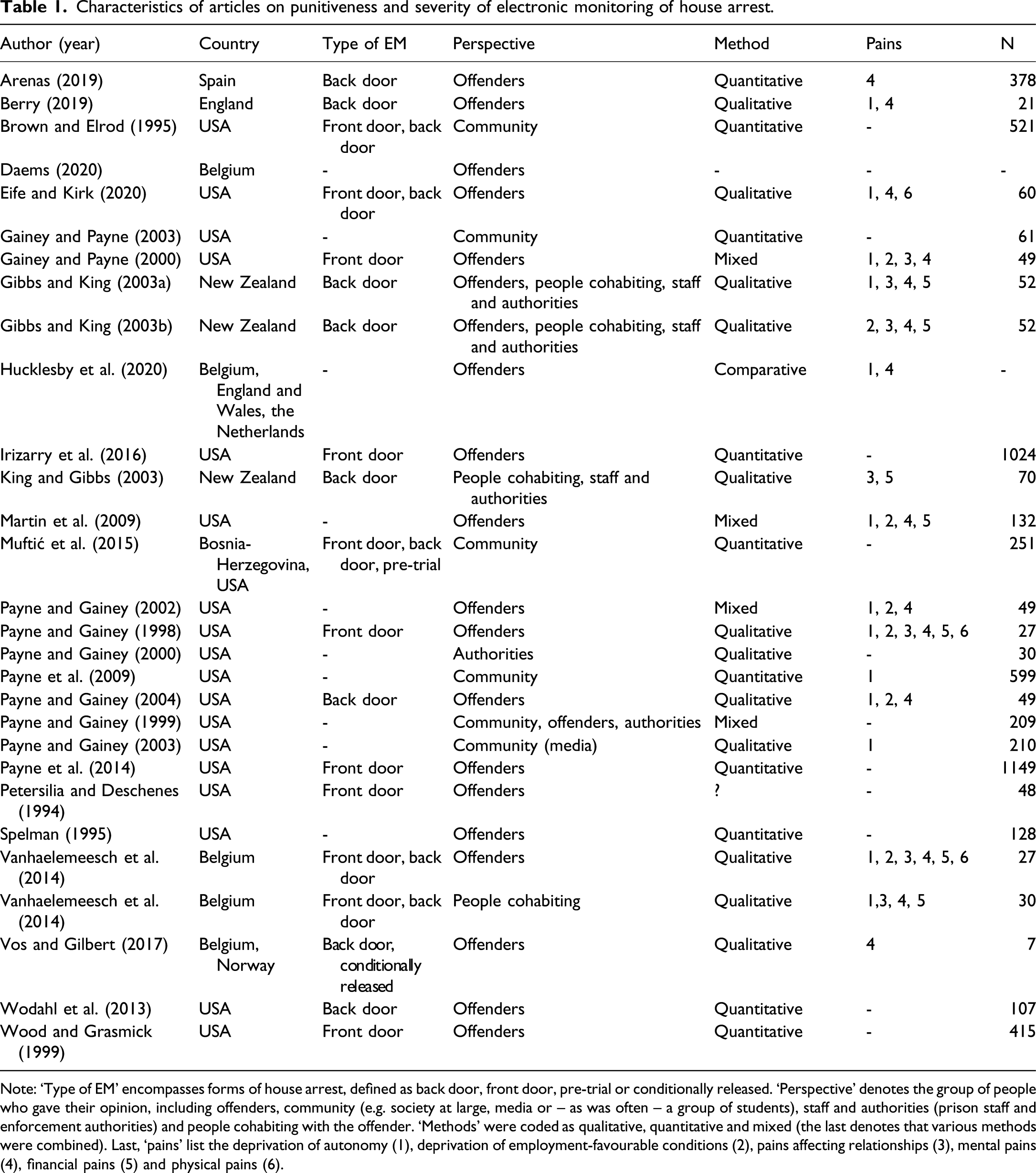
Note: ‘Type of EM’ encompasses forms of house arrest, defined as back door, front door, pre-trial or conditionally released. ‘Perspective’ denotes the group of people who gave their opinion, including offenders, community (e.g. society at large, media or – as was often – a group of students), staff and authorities (prison staff and enforcement authorities) and people cohabiting with the offender. ‘Methods’ were coded as qualitative, quantitative and mixed (the last denotes that various methods were combined). Last, ‘pains’ list the deprivation of autonomy (1), deprivation of employment-favourable conditions (2), pains affecting relationships (3), mental pains (4), financial pains (5) and physical pains (6).
The articles were published between 1994 and 2020. Nineteen are based on data from the United States. Among these, eight are by Brian Payne and Randy Gainey, who carried out their research in the US state of Virginia. Other articles are based on data from European countries (Belgium, Bosnia-Herzegovina, the Netherlands, Norway and Spain) and from New Zealand.
The data collection methods vary. The majority of articles are based on quantitative surveys of data, and many use only a small sample. Others are based on qualitative research methods (Berry, 2019; Eife and Kirk, 2020; Gibbs and King, 2003a; King and Gibbs, 2003; Payne and Gainey, 1998, 2000, 2003; Vanhaelemeesch et al., 2014; Vanhaelemeesch and Vander Beken, 2014; Vos and Gilbert, 2017). Five articles use mixed methods (Gainey and Payne, 2000; Martin et al., 2009; Payne and Gainey, 2004; Petersilia and Deschenes, 1994; Williams et al., 2008).
Articles also vary with respect to the perspectives they analyse. Nineteen articles focus on the perspectives of directly or potentially affected persons such as offenders with or without experience with EM. Meanwhile, other articles focus on the perspectives of non-offenders such as students (Gainey and Payne, 2003; Muftić et al., 2015; Payne et al., 2009), registered voters in the US state of New York (Brown and Elrod, 1995), involved staff and administrators (Payne and Gainey, 2000) or coresidents of offenders with EM (Vanhaelemeesch and Vander Beken, 2014). Still other articles combine various perspectives to compare them, such as those of offenders and students (Payne and Gainey, 1999) or offenders, family members and friends of offenders, probation officers, security managers and prison board members (Gibbs and King, 2003a; King and Gibbs, 2003).
Results
Assessing the punitiveness of electronic monitoring compared to imprisonment
To our knowledge, Petersilia and Deschenes (1994) were the first to consider EM in their research about the punitiveness of various sanctions. Notably, they developed an instrument to measure the punitiveness of sanctions including EM. In interviews, offenders were asked to compare different sanctions with 1 year in detention (1 year was equal to 100 points). The authors did not explicitly list EM as a sanction but instead as a condition of probation. They found that offenders rated house arrest with 24 h of EM as the most difficult condition with which to comply.
Whereas others (Spelman, 1995; Wood and May, 2003) used the same instrument and adapted it in line with the mathematical aptitudes of the respondents, Wood and Grasmick (1999) developed a simpler but still similar survey instrument for quantitative research. This survey instrument measures how many months of an alternative sanction, including curfew with EM, respondents would endure to avoid medium-security imprisonment (for another assessment of the punitiveness of EM by using Crewe’s notion of tightness, see Hucklesby et al., 2020).
The results of these studies reveal a mixed picture. Some studies support the preference for EM over incarceration (Payne et al., 2014; Wodahl et al., 2013; Spelman, 1995). However, this preference depends on the length of the sentence because inmates’ preference for EM is limited but seems to increase with duration (Wood and Grasmick, 1999). To avoid longer sentences (8 or 12 months), only 14% declined EM, whereas to avoid shorter sentences (4 months), 22% declined EM. The shorter the sentence, the less respondents were willing to substitute it with an EM sentence of a longer duration than the incarceration time. Further, the preference of EM over incarceration also depends on the type of facility. While county jail and boot camp are perceived as more severe than EM, medium-security prison is seen as less severe (Wood and May 2003).
The qualitative and mixed-method studies give a nuanced picture of EM’s punitiveness. Home detention might be seen positively, but it has negative effects on the family (Gibbs and King 2003a). Other studies affirm that respondents interpret incarceration as more punitive than EM is (Gainey and Payne, 2000; Gibbs and King, 2003a; Martin et al., 2009; Payne and Gainey, 1998, 2004; Vanhaelemeesch et al., 2014). In general, qualitative studies point to the fact that subtler differences exist than those revealed by simply comparing EM to incarceration. In summary, our query into the general sense of how punitive EM is compared to incarceration presents no unified answer. This ambiguity suggests that we must take a closer look at different aspects of punitiveness such as the pains of EM.
Pains of electronic monitoring
Besides looking at the punitiveness of EM in general, the articles also differentiate punitiveness into different pains related to EM. Across all articles in our corpus, we identified six categories of pain.
Deprivation of autonomy
Payne and Gainey (1998) show that electronically monitored offenders also experience the pains of restricted freedom that Sykes attributes to prisoners. The interviewed offenders experienced a restriction of freedom because they had to stay in their homes and could not go shopping, visit a church or eat out as they wished or only in a very limited manner (Gainey and Payne, 2000; Martin et al., 2009). Moreover, restricted freedom of movement is also a problem of time pressure: Offenders have a strict daily schedule and only a few narrow time slots to perform specific tasks. Notably, the pain of restricted freedom of movement and choice, coupled with continuous surveillance, causes stress (Gainey and Payne 2000).
Such restriction can become particularly painful when offenders have social responsibilities. A single mother, for example, stressed how important it was for her to be allowed to take her children to school, and this was negotiated with the Prison Board as a permitted outing on her home detention order. She declared that if she had not received this permission, she would have breached orders to ensure her children arrived at school (Gibbs and King, 2003a). We heard similar accounts about the importance of synchronizing EM with family duties in an evaluation we conducted (Richter et al., 2020).
Deprivation of employment-favourable conditions
Often, EM leads to difficult conditions for employment. For instance, EM generates restrictions and related monitoring and scheduling that interfere with employment-related requirements. Offenders rated work-related problems higher than they did restrictions related to drug use (e.g. mandatory drug or alcohol tests), disruptiveness (e.g. interruption of sleep by check-in calls) and privacy issues (e.g. limits to the length of phone conversations). Others mentioned that alterations in the work schedule or duties (e.g. having to work outside) concerned them because their employers would have to provide verification to their probation officers. Other problems mentioned included the inability to work overtime and issues related to work-required travel (Martin et al., 2009). Notably, offenders in countries where the system allows for more flexibility (e.g. Belgium) did not mention these problems. For example, offenders under EM were able to work overtime, change their shifts or accept late starting times (Vanhaelemeesch et al., 2014).
Pains affecting relationships
While EM can be a means to maintain relationships and, for instance, to care for family members and in particular for children (Arenas, 2019), EM can also negatively affect social relationships. Offenders report increased tension and arguments with coresidents in part because offenders with EM must spend much more time at home and are unable to get out of the way of their coresidents (Gibbs and King, 2003a; King and Gibbs, 2003; Payne and Gainey, 1998; Vanhaelemeesch et al., 2014). In addition, temporal and spatial restrictions defined by an EM-controlled schedule also require family members or coresidents to accept and adapt to involuntary restrictions. Often, offenders on parole are men coming from a hypermasculine prison context who need to readapt to a female-led household, which accentuates gendered problems (Kilgore 2013: 131). Further, EM is based on tight planning and predefined schedules. However, family life has its own dynamics and everyday life is not always foreseeable because accidents may occur and people may fall sick. Reacting to such situations without breaching sanctions is difficult if not impossible for people with EM (Kilgore 2013).
And yet, the contrary also happens: Some offenders report that EM helped them to improve their relationships because it enabled them to spend more ‘quality time’ with others and strengthen bonds or rebuild relationships after spending time in prison (Gibbs and King, 2003a; Vanhaelemeesch et al., 2014). Along these lines, they also value that EM allowed them to be close to their partners, children and significant others (Payne and Gainey, 1998) by increasing interaction within the family (King and Gibbs, 2003).
Deprivation of liberty results in mental pains
Offenders report various forms of mental pain, such as shame that arises because offenders must tell others that they cannot go out and that they are confined to the house because of their status as offenders and the limitations of EM. Moreover, some found wearing a visible device embarrassing because it marked them as offenders (Gainey and Payne, 2000; Martin et al., 2009; Payne and Gainey, 1998; Vanhaelemeesch et al., 2014). In addition, the transport from jail to house arrest with EM can result in a painful experience when officials use the occasion to demonstrate power (Eife and Kirk, 2020).
The confrontation with freedom, restricted according to the schedule set by the enforcing authorities, is also painful for offenders. The freedom they gain with EM over incarceration weighs less than the device’s constant reminder that this freedom is conditional. The restricted freedom of EM exists on the threshold between freedom and incarceration. While in prison, offenders can focus on life inside prison and are not forced to think about liberty outside prison (Vos and Gilbert, 2017). When outside prison, offenders compare their situation to the situation of free people they encounter and suffer from the ‘watching others effect’ (Payne and Gainey, 1998).
Further emotional pains are mentioned by offenders from Belgian and Norway who state that the permanent threat of being sent back to prison is a source of stress (Vos and Gilbert, 2017). Meanwhile, younger detainees from New Zealand say that being on house arrest and having considerable spare time makes them feel depressed, bored and trapped in the house. On the other hand, older detainees or those with young children did not report these emotions and were able to occupy themselves with work in the house (King and Gibbs, 2003).
Financial pains
Financial pains can arise directly because offenders must pay for the EM device or contribute to monitoring fees (Martin et al., 2009; Payne and Gainey, 1998). Indirect costs can also arise: Offenders who cannot work overtime anymore may lose part of their income (Payne and Gainey, 1998) or have to invest in additional equipment such as a phone (Martin et al., 2009; Vanhaelemeesch et al., 2014) to ensure availability. Moreover, travelling costs can also arise such as those related to a ticket to visit their probation officer (Vanhaelemeesch et al., 2014). Such financial demands particularly penalize people from low-income households who have limited possibilities to adapt their work to the demands of the EM schedule. In some jurisdictions, this also results in a pronounced penalization along racial lines (Kilgore 2013).
Physical pains
Some respondents report that the device hurts their leg while sleeping, they sweat underneath the bracelet (Vanhaelemeesch et al., 2014) or the device is generally uncomfortable (Payne and Gainey, 1998). The device restricts offenders in their choice of clothing and shoes. In particular, if offenders want to cover the device, they must wear loose clothing and cannot wear boots.
Applying Sykes’ concept of pains of imprisonment to the application of EM shows EM can have similar pains as incarceration, while new pains are also linked to this alternative sanction. At the same time, the pains are not experienced evenly and we often found contradictory reports about whether certain aspects of EM are experienced as pain or an opportunity. We will therefore look into differences among offenders to assess the factors that further explain EM’s punitiveness.
The influence of demographic variables
An explanation of the varying degrees of pain due to EM lies in offenders’ sociodemographic characteristics. Regarding gender, one can speak of a gender gap (Holdworth and Hucklesby, 2014) because EM was designed for men but is often given to women. Because women are often categorized as low-risk offenders and often have family duties, they seem the ideal candidates for EM. Although EM might offer the possibility to stay at home and take care of family and children, feasibility entirely depends on the way the schedule is set up. EM can also be rejected because an inflexible schedule can hinder women in meeting their care duties even while being present (Wood and Grasmick, 1999). A gender difference in emotional pain may arise because women might suffer more than men do from the visibility of the bracelet and feel greater shame and embarrassment (Gainey and Payne, 2000; Payne and Gainey, 1998, 2002). At the same time, women are not solely defined by gender, and individual factors such as lifestyle, family status or knowledge of the criminal system can influence individual experiences of EM (Holdsworth 2020).
Aside from gender, age also influences emotional pain. The visibility of the bracelet bothers offenders older than 40 more than it does younger offenders (Payne and Gainey, 2002). Losing the possibility of going for a walk whenever they wish is a greater stress for older offenders than it is for younger. Older offenders tend to have prior experiences with the carceral system. For instance, Irizarry et al. (2016: 10) suggest that ‘older respondents are more likely to be familiar with the criminal justice system and may thus be more sceptical of correctional alternatives’.
Race or in other countries ethnic or national background also influences the perception of the pain of EM (Irizarry et al., 2016; Kilgore, 2015; Wood and May, 2003). Due to overexposure to punitive and discriminating experiences with the criminal justice system, Black people (or migrants in other contexts) often perceive EM as more punitive than incarceration is (Kilgore 2015). While incarceration provides a predictable frame, alternative sanctions are seen as more of a gamble. Because Black offenders experience the criminal justice system as racially biased, they rate alternative sanctions and EM as additional sanctions rather than as options (Payne and Gainey, 2002). This race-biased punitiveness of the US system in particular is also reinforced by the disproportionate EM-based monitoring of Black people on parole (Kilgore 2012, 2013, 2014).
Further, one’s level of education also affects one’s perception of pain. Offenders who failed to earn a high school diploma or complete compulsory education rated the punitive effect of EM higher (Wodahl et al., 2013). The level of education is also linked to the type of work one has and the individual experience with EM. For instance, office work is more easily adaptable to tight schedules and location fixes, but uncertain work conditions are difficult to maintain with predefined schedules. Still other studies found no evidence that education level would influence the odds of an offender’s preference of EM over prison (Irizarry et al., 2016). The influence education level has on the punitiveness of EM therefore remains uncertain.
Finally, family and marital status influence perceptions of EM pains. As Irizarry et al. (2016:9) point out, ‘inmates with full-time responsibility for their children have nearly twice the odds of preferring electronic monitoring than inmates without children’. Wodahl et al. (2013), to the contrary, report that single offenders are more willing than married offenders are to spend more days with EM to avoid additional time in jail. Although Wodahl et al. do not explain this relation, other studies point to the possibility that married people feel greater shame about EM in the presence of close relatives than single people do (Gainey and Payne, 2000).
The pain of family, friends and relevant others
People cohabiting with the offender, such as family members, close friends, partners or flatmates, stated they felt they had to sacrifice some of their routines and time to support the offender (Gibbs and King, 2003a) and, along these lines, coresidents often adjusted their daily life to support the monitored offender (Vanhaelemeesch and Vander Beken, 2014). For example, they adapted their work and hobbies to the schedule of the monitored offender, making spontaneous undertakings more difficult. Often, other family members had to run the errands and ‘pick up the slack’ (Martin et al., 2009).
Further, family, partners and other people cohabiting with the offender reported that EM caused tension and stress in their relationships (Gibbs and King, 2003a). Coresidents often reduced their original role (e.g. as a partner) to take on the roles of assistant, social worker and controller (Vanhaelemeesch and Vander Beken, 2014). EM can thus have profound and often negative consequences for relationships.
Coresidents might also perceive mental pains. Interviewed coresidents from Belgium said they feared EM being revoked, which caused them anxiety (Vanhaelemeesch and Vander Beken, 2014). Feelings of guilt can also add to the mental pains of coresidents (Gibbs and King 2003a). Interviewed coresidents felt guilty when they went out without the monitored offender whose schedule and space restrictions did not allow the same.
Offenders’ financial pains affect the people cohabiting with them, especially their partners. Gibbs and King (2003b) note that cohabiters stated they were out of pocket because the monitored offenders could only work part time and needed financial support.
The view from the community
Another perspective of EM includes the community, comprised persons neither wearing EM nor affected as cohabitants. In general, EM is widely accepted as an alternative to incarceration. In particular, the respondents supported EM for minor offenses such as stealing or damaging property valued at less than US$1000 or driving under the influence (Brown and Elrod, 1995). Moreover, as a measure for pretrial detainees, EM is in general supported, largely because supporters believe it will reduce costs associated with incarceration. Most respondents also stated that pretrial detainees should not be jailed prior to conviction simply because they are unable to make bail. The data suggest that respondents perceive electronic house arrest as controlling the offender in a way that makes the general public feel less vulnerable to the potential harm they may cause by reoffending.
It is also helpful to compare community members’ (in this case students) perceptions of EM directly with those of offenders who experience EM (Payne and Gainey, 1999). The students were sceptical of EM, especially regarding the dimension of punishment. The students inconsistently viewed the specific conditions and restrictions associated with EM as more punitive than the offenders did. One explanation is that the students rated the conditions and restrictions of EM in light of their lives as free citizens (Payne and Gainey, 1999). In contrast, offenders compared the pains of EM to the pains of incarceration.
The public admits divergent opinions about EM. Assessments of the impact of minority member status on attitudes towards EM (Payne et al., 2009) show that white and non-white college students have significantly different attitudes about the punitiveness and inequality of EM. White students were more likely to agree that the sanction deters misconduct, whereas Black students were more likely to agree that the sanction was a severe punishment. Black students were also more likely to agree that the sanction discriminates against the poor, turns the home into a prison and perpetuates a racist system and that wealthy offenders are more likely to receive EM. The question remains whether the different perceptions of Black and white students are directed specifically towards EM or to the US penal system more generally.
Conclusions
Our aim was to assess the punitiveness of EM. While in many studies, and to some extent in the article, EM is compared to incarceration; we cannot provide an evaluation of the punitiveness of EM in comparison to incarceration. Rather, we found a series of factors that convert EM into an instrument of punishment rather than an instrument that offers opportunities to the offenders.
We followed two strategies to discern aspects of punitiveness. The first was to identify different pains due to EM based on Sykes’ (1958) pains of imprisonment. Analysing 29 articles, we identified six pains of EM that in part match the pains Sykes identified and in part add new pains that are characteristic of the EM setting. Deprivation of autonomy emerged when movement was limited by tight geographical restriction and time schedules. Meanwhile, EM mostly mitigates deprivation of goods and services, but a deprivation of favourable employment conditions emerges. With reference to relationships, the increased presence of the person with EM in the family or in the shared apartment can cause relationship problems. Deprivation of autonomy results in mental pains such as stigmatization, the pressure of experiencing only limited freedom and the fear of not meeting the conditions of EM and being sent back to prison. Financial pains emerged when EM reduced offenders’ incomes or mandated additional costs (e.g. phones or direct EM costs). Finally, physical pain related to wearing the bracelet occurs. Although we could identify pains, the studies did not clearly show whether offenders in general experienced these pains and whether they contributed to the punitive character of EM.
While our review of the different pains involved with EM provides deeper insight into EM, it does not provide a clear answer to the question of EM’s punitiveness. Nevertheless, we uncovered a pattern pointing towards differences not so much in the type of sanction but instead among convicts. For instance, we found that convicts with familial duties are often affected by the pains of EM differently than convicts without familial duties are. Nevertheless, our findings remain ambivalent. For example, one study states that convicts with familial duties suffer from the restricted freedom of EM, whereas in other studies caregivers explain that they can meet their duties because of EM’s flexibility.
We therefore followed a second strategy and compared the studies along social categories such as gender, age, race, education and familial or marital status. Regarding gender, women and men were differently affected by the pains because of their differing social roles and related familial responsibilities; work conditions were characterized, for women in particular, by work on-demand and flexible work hours, as well as potentially experiencing more shame in social relations. Age often indicated previous incarceration, and older convicts who knew incarceration were less inclined to accept EM than younger convicts were. The way the criminal justice system is perceived in general, and in particular, its bias towards people of colour and people with migrant background, influences the perception of EM. Levels of education provide a link to class and therefore help to ease some of the pains such as the financial burden or the work-related pains that are more pronounced in flexible and precarious jobs. At the same time, educational background did not provide a clear explanation of the perception of EM’s punitiveness either. Finally, familial status was particularly relevant with regard to familial duties and relationships: On the one hand, family life correlated with approval of EM because it enables users to meet their familial duties; on the other hand, offenders felt that their continuous presence in the home and their financial needs represented a burden for other family members. To sum up, the punitiveness of EM is strongly linked to a person’s social, familial and professional life and their status in society.
The individual characteristics of offenders’ lives, as well as the structural aspects of class, race and gender bring us back to the criminal justice system. While the jurisdiction as such did not provide a factor that explains the punitiveness of EM, nevertheless important contextual aspects interplay with the differences and needs at the personal level. One important element is whether EM is offered as an alternative (instead of incarceration) or whether it is used as a measure on top of a sanction (Eisenberg, 2017; Kilgore 2015). The use of EM as a means of controlling people on parole turns it into an additional punishment because it substantially restricts freedom of movement and deprives people of the dynamics of family, work and life in general. Parole is freedom under the condition of not reoffending and is therefore jeopardized by additional control which results in punishment.
Another factor is the way EM is framed. The scheduling and monitoring by the parole officers has a decisive effect on how EM is perceived. This also explains in part the differences among the studies. While some studies explicitly state that a flexible framing of EM made the instrument acceptable for people, others did not provide information on this point. Whether schedules can be altered by the people wearing EM, whether parole officers accept important reasons such as delayed trains or the accident of a family member as explanations for not adhering to the schedule and whether real life and its changes are accepted as a fact instead of insisting on the predefined schedule changes how EM is perceived.
The punitiveness of EM lies therefore not in the instrument as such. It can be used as a technique of control and punishment or it can provide the means of an alternative sanction to incarceration. The outcome depends on the ways of sanctioning. If EM is used instead of incarceration, then it represents an alternative, otherwise it turns into an additional punishment (Kilgore, 2015). If EM is meant to provide an alternative to incarceration, then it also requires a framing that adapts to the life situations of the people wearing the bracelet and the people in the household; that is, it requires a certain degree of flexibility (Holdsworth, 2020).
Footnotes
Declaration of conflicting interests
The author(s) declared no potential conflicts of interest with respect to the research, authorship, and/or publication of this article.
Funding
The author(s) disclosed receipt of the following financial support for the research, authorship, and/or publication of this article: Partial funding for this article was provided by an evaluation mandate on the current use of EM from the Office of Corrections and Rehabilitation, Canton of Zurich, Switzerland.
Note
Author Biographies
 ).
).