




Abstract
Opt-in, open-ended mentoring for people with convictions, allowing them to dip in and out of services without sanction arguably offers a service configuration to match the paradigm of the zig-zag, nomadic desistance journey. Balancing supporting individual’s agency while avoiding fostering dependency is tricky. What are the conditions which support the former and avoid the latter? We aim to answer this question by drawing on the lived experience of mentees and mentors collected during the evaluation of a mentoring scheme in England. We consider whether mentoring is unequivocally a ‘good thing’. Despite its ubiquity, the evidence for its effectiveness is mixed. We suggest that it is possible to get too much mentoring, and advance the evidence base in the United Kingdom and internationally in other jurisdictions by proposing enhancements to the ‘effectiveness framework’ set out by the prison and probation service in England and Wales.
Introduction
Mentoring has long featured as policy and practice for people with convictions in the United Kingdom and other jurisdictions. These include the volunteering and mentoring programme in England and Wales (Wadia and Parkinson, 2015), support for prison leavers in Wales (Maguire et al., 2010), social support for sexual offenders in Canada (Wilson et al., 2009) and post-release mentoring for women in Australia (Brown and Ross, 2010). The Probation Reform Programme in England and Wales 1 continues this by specifying ‘. . . locally sourced mentoring and advocacy to those most in need . . . enabling a whole system response to desistance’ (Her Majesty’s Prison and Probation Service (HMPPS), 2020: 33). Taylor et al.’s (2013) rapid evidence assessment (REA) of intermediate outcomes for mentoring interventions noted considerable variation in their aims, content and the nature of the mentor–mentee relationship. The mentoring intervention examined here is opt-in; and open-ended with individuals engaging and disengaging without sanction; arguably offering a service configuration to match the zig-zag desistance journey (Glaser, 1964) or rhizomatic understanding of a desister as a ‘nomad’ (Phillips, 2017). As noted by Healy (2013), to travel this desistance journey, an individual needs to grow and develop their agency and identity capital, but needs support to do so successfully. In this article, we argue that finding the right balance in the mentee–mentor relationship between enabling agency and developing capital, while avoiding dependency is tricky. We ask is it possible to receive too much mentoring? Can you get too much of a ‘good thing’? Or is the issue one of timing – the wrong type of support at the wrong time? We aim to answer these questions by drawing on the lived experience of adult mentees and mentors through re-analysis of qualitative data collected during the evaluation of a scheme in England.
We commence by examining the nature and purpose(s) of mentoring including the extent to which engendered agency features. We explore agency and dependency within the rehabilitative literature; and turn to therapy research to understand how dependency might occur. We describe the mentoring scheme in this study; our methodology and its limitations. We present the findings and discuss the implications for policy and practice in the United Kingdom and other jurisdictions proposing enhancements to the HMPPS (2019) framework/guidance for effective mentoring; using engagement and disengagement as proxy measures of desistance; consider the optimal duration of mentoring and its resourcing; and how these can be tested through further research.
Purpose of mentoring
Mentoring has been defined as a: ‘. . . one-to-one non-judgemental relationship. An individual (mentor) gives time to support and encourage another (mentee)’ (HMPPS, 2019). Elsewhere, ‘a voluntary relationship of engagement, encouragement and trust’ (Aitken, 2014: 11) That mentoring is ‘a fuzzy concept which is in fashion but short of facts’, Aitken (2014: 9) alludes to it’s paradox within criminal justice in the United Kingdom and other jurisdictions. Generally viewed as a ‘good thing’ by policy makers and practitioners, it has been an adjunct to formal probation – additional support for adults on intensive community orders (Wong et al., 2012); managing the transition from prison to community (Maguire et al., 2010); and through the lived expertise of peer mentors addressing ‘limiting social conditions’ against a backdrop of ‘. . . established aims to correct, improve, and manage, individual “offenders”’ (Buck, 2019: 1). However, the evidence for its efficacy is limited (see among others, Brown and Ross, 2010; Finnegan et al., 2010; Jolliffe and Farrington, 2008 2 ). As noted by Taylor et al. (2013), the diversity of schemes makes it difficult to generalise about their effectiveness and good practice. Their review suggested that some mentoring may influence reoffending, acting as a ‘bridge’ to other services and providing continuity of support ‘through the gate’. Tentative evidence from the review suggests that mentoring may improve engagement in other programmes and interventions. But there was very limited evidence that mentoring could improve coping abilities, and family and peer relationships, and reduce pro-criminal attitudes. Evidence regarding knowledge transfer and capital development is also limited, for example, women’s post-release mentoring in Australia functioned as ‘friend rather than role model’ (Brown and Ross, 2010: 48). While these were ‘meaningful friendships’, there was little evidence that there was a ‘transmission of a distinct body of knowledge or skills from mentor to mentee’ (Brown and Ross, 2010). In addition, Wadia and Parkinson’s (2015: 48) evaluation of post-release schemes cautioned that mentoring ‘will not be relevant or appropriate for all offenders’.
These findings have recently been reinforced by a summary of evidence (HMPPS, 2019) which draws on Taylor et al.’s (2013) work and the process evaluation of informal mentoring delivered by voluntary organisations (Wadia and Parkinson, 2015). As noted by Buck (2018), much of the research into mentoring has been ‘. . . largely functional, aiming to evidence reduced reoffending rates’ (p. 191). Buck’s (2018) own work has helped illuminate the micro-dynamics of the peer mentee–mentor relationship identifying the ‘core conditions’ of peer mentoring as caring, listening and setting manageable goals, supported by others such as Nixon (2020). Their work suggests that there are distinctions to be considered in the dynamics of the relationships between peer mentees and peer mentors based on shared experiences as distinct from the relationship between a mentee and non-peer mentor. Detailed later in this article, the mentors in our study were a mix of peer and non-peers. However, due to the limitations of the data, it was not possible to examine differences that arose from this. In relation to Buck’s point about ‘largely functional’ research, our article aims to balance a ‘functional’ approach with an examination of the dynamic tension between the role of mentoring in engendering agency and creating dependency and how their fine balance can be tipped.
What do we mean by agency?
Much rehabilitative literature has argued for the importance of agency and identity capital as a critical factor in people’s desistance from crime (Healy, 2013). Described as the ‘missing link’ in understanding desistance (Laub and Sampson, 2003: 141) and as perhaps even the most important predictor of desistance by LeBel et al. (2008), Laub and Sampson (2003) observed that people with convictions are ‘active participants in constructing their own lives’ (p. 281) within the constraints of structure and context. Their observation provides the definition of agency that we have adopted for this article; to empirically test the data and examine the relational processes between mentors and mentees which support and/or potentially hinder an individual’s rehabilitation. Importantly, King (2013a) also highlights how desistance involves the envisioning of an alternative future identity, and that this is just one aspect of agency in the desistance process. However, such agency is conditioned by social context and this may delimit the range of future possibilities available (King, 2013a).
While agency/self-efficacy was not identified as an outcome in Taylor et al.’s (2013) REA of mentoring outcomes, it is one of the seven dimensions of the Intermediate Outcome Measurement Instrument (IOMI) devised for mentoring and arts interventions developed by the researchers involved in the REA (Maguire et al., 2019). It was observed in young adult mentees (Wong et al., 2018) and in other voluntary sector mentoring schemes (Wadia and Parkinson, 2015). More recently, it appears implicit within the Probation target operating model in England and Wales. 3 This features ‘mentoring/social inclusion’ as enabling a successful transition (such as from custody to community), and for individuals to better ‘. . . manage challenging situations and to engage with services and opportunities’ (HMPPS, 2020: 42). The desistance literature more broadly emphasises individual agency/self-efficacy as one of the changes which occurs through the interconnected processes of primary, secondary and tertiary desistance (McNeill, 2016; McNeill and Weaver, 2010; Nugent and Schinkel, 2016).
Dependency
To date, limited attention has been paid in the rehabilitation literature for the potential for someone with a conviction to become dependent on their case worker/support worker. One of the few studies to highlight this is Maguire et al.’s (2010) evaluation of pre- and post-release mentoring where ‘. . . the mentor had been to some extent manipulated by the client to act as a ‘taxi’ to agencies and to deal with all their practical problems for them’ (p. 42). There appear to be good reasons for this absence related to the nature and the duration of the relationship.
The requirement for individuals to comply with probation supervision, instrumental or otherwise (see among others, Sorsby et al., 2017, and Robinson and McNeill, 2008), means that sustaining an individual’s engagement through their order is the dominant focus with dependency on the supervisor (arguably) being less of a concern. Operationally, this has been manifested in the United Kingdom through enhancing probation practitioner skills (Raynor, 2019), providing a framework for quality supervision (Shapland et al., 2012), and establishing a model for effective engagement (Copsey and Rex, 2013). Notably, but understandably, none of these practice frameworks accounts for the potential for dependency within the probation supervisor–supervisee relationship. What about the issue of duration? Court orders have a pre-determined start and end-point, giving a limited time to ‘build a trusting relationship, promote compliance, increase hope and sustain motivation’ (HMPPS, 2020: 33). It is an open question whether the duration of court orders are sufficient to provide the ‘hooks for change’ (Giordano, 2016; Giordano et al., 2002) necessary to sustain the desistance journeys of people with convictions. Of course, the iatrogenic effects of too much intervention (as well as too little) are enshrined within the Risk Needs Responsivity (RNR) 4 influenced operating model for probation staff – matching the level of services/resources to risks (National Offender Management Service (NOMS), 2015). However, this is rarely if ever applied to the relationship itself between probation supervisee and supervisor.
What about where compliance is not an issue? Dependency has also not been a concern among the growing but still relatively under-developed evidence base around services that individuals voluntarily engage with; whether time limited or non-time restricted. The short hand for this being the literature on voluntary sector criminal justice services (see among others, Tomzcak, 2017; Tomzcak and Buck, 2019; Hucklesby and Corcoran, 2016). However, it is necessary to look beyond just the voluntary sector. While voluntary, opt-in, support for people with convictions has long been the sector’s preserve (Martin et al., 2016; Wong et al., 2018), it is not exclusively so. The open-ended non-time limited mentoring which is the subject of this study was provided by a community rehabilitation company 5 and one of the providers of time limited pre- and post-release mentoring examined by Maguire et al. (2010) was a private company. Because of the voluntary nature of such mentoring, people with convictions may choose not to engage. Wadia and Parkinson (2015) found that many individuals: ‘. . . subsequently withdrew or disengaged either before or after being allocated a mentor’ (p. 46). The reasons were the multiple issues they faced, the chaotic nature of their lives and that they were not ready to change (Wadia and Parkinson, 2015). However, for those who continued to engage, see Maguire et al. (2010) and the subjects of this study, understanding the dynamics of the mentee–mentor relationship is important to engender a necessary balance of capital and agency development while avoiding mentee dependency.
Given the absence of dependency within the rehabilitative literature, we turn to therapy research to understand how dependency might occur. The working alliance is important when exploring dependency, in both therapy and other professional helping relationships (e.g. Ross et al., 2008). The alliance refers to a collaborative relationship between helper and the helped with the quality of the partnership being dynamic in time and content (Horvath et al., 2011). This can see some patients achieve independence and agency in directing their life effectively, while others place heavy and inappropriate demands on their therapists (Clemens, 2010).
Three dimensions of dependency have been proposed that provide helpful insight: passive–submissive dependency, active-emotional dependency and the lack of perceived alternatives (Geurtzen et al., 2018). A passive-submissive dependent patient is docile, timid, dull, apathetic and weak, and fails to take much initiative in their treatment, showing a submissive and helpless stance. Active emotional dependency refers to patients’ emotional neediness in the relationship with the therapist, seeking emotional support from their therapist. The lack of alternatives dimension describes dependency occurring in an interpersonal relationship when one or both partners perceive that they are lacking attractive alternative options to gain the same outcomes (Geurtzen et al., 2018). In mental health care patients, relying on the therapist to reduce their symptoms, instead of through a different type of treatment; support of a partner, family or friends; or relying on their own abilities/efforts. In the context of mentoring between mentees and mentors (peer and non-peer), there is the potential (as suggested by Geurtzen et al., 2018) for dependency to be a ‘two-way street’, for mentors (peer and non-peer) lacking attractive alternative options to become dependent on their relationship with mentees. This potential appears to be suggested in some of the peer mentoring literature (less considered in relation to non-peer mentoring), as noted by Nixon (2020) ‘. . . it is ambiguous as to “whose life” it [peer mentoring] actually impacts upon, because peer mentoring has reciprocal benefits for both mentee and mentor’ (p. 2).
The scheme
The mentoring scheme which is the subject of this study was part of a liaison diversion service 6 in England. The scheme provided custodial healthcare support (physical healthcare in custody), liaison and diversion services (an identification, assessment and referral service), and mentoring. Commonly, those who voluntarily took up mentoring support – opting in and out without sanction – had been through the service more than once. The mentors comprised peer mentors (individuals who had previously had convictions) and non-peer mentors. Support was non-time limited and consisted of practical help with mentees’ housing, drug support, finance, mental and physical health needs. Mentors made appointments for mentees with services and often attended with them. They also provided emotional support and encouragement. The duration of the relationship ranged from 1 to 24 months. The scheme actively recruited former service users and supported their development as mentors. At the same time, mentors were also recruited from the wider local community. Initial training and ongoing in-service training was provided to all (peer and non-peer) mentors.
Methodology
A process evaluation was undertaken on the entire liaison and diversion service, including the mentoring scheme. Stakeholder interviews were conducted with mentors and service users for the purpose of evaluation. Secondary analysis was conducted on qualitative interview data. The secondary analysis aimed to answer the following research question: ‘What are the conditions of the mentoring relationship that supports an individual’s agency and avoids fostering dependence?’ The primary qualitative data used were gathered during the fieldwork of the evaluation. This comprised an opportune sample of 45 interviews with 16 service users, 12 project staff, 14 partner agencies and 3 strategic managers examining mentoring and other aspects of the service.
The 16 service users (15 adults and 1 juvenile) were all mentees. Their offences included drugs, violence, robbery, theft, criminal damage and public order offences. Mentors identified mentees who would be willing to voluntarily participate in the research and the mentees were then contacted by the research team and their informed consent gained.
The process evaluation aimed to explore
The before and after processes which existed pre and post the commencement of the service;
The qualitative experience of service users, staff and partners;
The benefits and dis-benefits of the service; and
What changes to the service processes would improve its delivery.
Secondary analysis was conducted on these primary data using thematic analysis to identify, analyse and report patterns (themes) (Braun and Clarke, 2006) guided by the research question. Data were read and re-read several times. Coding identified data features that the researcher considered pertinent to the research question. All initial codes relevant to the research question were incorporated into a theme. Thematic maps supported the developing understanding of themes and their inter-relationships. Themes were refined to ensure a coherent pattern.
An inevitable limitation of secondary analysis is that the specific information sought by the research question was not explicitly collected. However, the research question for this re-analysis arose from the primary data analysis. There were indications that the balance between agency development had tipped towards fostering dependency. Secondary analysis of the primary data therefore was an appropriate mechanism for exploring this further. This ensured a match between the research question and the primary data. Qualitative data analysis is ‘normally’ evaluated by reference to the context in which the data were originally produced (Fielding, 2004) and the researcher who completed the secondary analysis also participated in the primary data collection process and analysis. Nevertheless, there are inevitable limitations of a reliance on a convenience sample, limiting the generalisability of findings.
The authors conducted the original independent evaluation of the mentoring service and the secondary analysis of data. Ethical approval for undertaking the original evaluation and this study was obtained from the ethics committee of the university which the authors are affiliated to. Access to the interviewees was secured through the commissioners of the evaluation (and the mentoring service) and the provider organisation and their partners.
Findings
The findings from this (secondary) thematic analysis of interview data explored the conditions of mentoring which supports an individual’s agency and avoids fostering dependence. They are presented thematically as mentor characteristics, shared driving, mentee characteristics, shared goals and length of relationship.
Mentor characteristics
The most prominent mentor characteristics observed by mentors and mentees to be directly associated with engendering mentee’s agency were a sense or perception of genuine care, compassion and interest in the individual mentee. This aligns with Buck’s (2018) highlighting of care and listening as two of the three core conditions of peer mentoring, and genuine care as one of six factors in quality supervision (Shapland et al., 2012). Interviews indicated that trust was engendered by the mentor ‘caring’ which facilitated the mentor being able to guide the mentee. If a correct balance of trust and guidance was reached, a mentee’s agency was supported and the mentee appeared able to build their agency towards addressing needs and challenges, guided and supported by the mentor. However, in circumstances where dependency was observed, mentees trusted their mentor but seemed to consider that their mentor was better skilled in fixing problems than themselves. The mentee had put all their trust in the skills of the mentor to ‘fix things’ rather than developing confidence and their own agency in addressing goals and tasks.
Importantly, analysis indicated that such a tipping point was some way into a mentoring relationship. The early stages of a developing mentoring relationship saw the trust and confidence of mentees being built by a mentor who was assisting and supporting the mentee responsively. There were many examples that mentees recounted retrospectively: ‘she’s helped me get to my appointments. I’ve had to go on assessments but I wouldn’t go on them but . . . she sort of gave me a boost to make sure I went’ (mentee). This trust and support had led to the steady development of a mentee’s agency and confidence and being able to identify outcomes linked to their own agency: ‘I’ve given up smoking all together. I’ve not drank for three months’ (mentee). In comparison, accounts where dependency could be observed had similar foundations, but the dynamics had remained with the mentor assisting and supporting the mentee to a point where the mentee had become more dependent and reliant on their mentor to ‘fix’ things: ‘she helps me out with any bill and anything there that I need sorting out. I leave it up to (my mentor). I leave it up to my mum and they both discuss it between them’ (mentee).
A mentor’s responsivity appears critical to ensuring that the mentoring relationship can steadily and organically build the agency of the mentee. Accounts detailed the inevitable issues and challenges that can present during a mentoring relationship and instances where it is necessary and entirely appropriate that the mentor supports, assists and guides the mentee. It was apparent that small, steady steps are needed to assist a mentee in developing their own agency. They were perceived to be more effective if they were incremental and also responsive to the individual mentee and their presenting needs.
Shared driving
Accounts of the dynamics of mentoring suggest that the relationship successfully progresses through many dynamic and responsive phases with ‘shared driving’; a form of ‘co-production’ with an important function of enabling agency, but if not carefully managed it can also foster dependency. One mentee described their mentor relationship as ‘like you’ve got a sat navigation system’ (service user). A mentor described this as ‘ I say you give 50 per cent, I will give 50 per cent’ (mentor).
Some phases of the relationship were driven by mentees, especially initial phases. Mentees would lead the ‘agenda’ and content of meetings through collaboration and discussion. In other phases, often when there was an issue or need, the mentor took over the ‘driving’ and steered the nature and content of meetings to support the mentee address the need: . . . if you’re bombarding someone with a drug team number, a mental health number, a GP number, a housing number . . . or you’re just sending that person off to go and do all these half a dozen things . . . it works better, you know, that they can come to me, we can discuss their issues, we can prioritise things, and I can set the ball rolling on things and keep the person obviously involved. (Mentor)
Importantly, when the relationship is responsive and collaborative, the driving appeared to remain shared but could be steered by either a mentor or mentee.
These findings concur with Weaver et al.’s (2019) inclusive justice and co-producing change and their suggested practice principles, particularly that user involvement is best enabled where organisations or services provide a continuum of opportunities for participation. Mentee’s interest and motivation towards their active contribution have varied over the course of their mentor relationships. Together with patience, incremental steps and meaningful opportunities, the availability of a continuum of opportunities for participation reflecting different opportunities to participate to different degrees and in different ways (Weaver et al., 2019) likely supports ‘shared driving’ along an individual’s desistance journey.
Analysis indicated that the dynamics of the relationship can be affected by a take-over, rather than temporary steer of driving by either the mentor or mentee. When a mentor took over the driving for an extended period, feelings of apathy (by the mentee) and a reduction of perceived trust and collaboration emerged: ‘there were times when I reached a low, I just couldn’t be bothered’ (mentee). Outcomes were not felt to be realised ‘steps backwards’ (mentee).
In these cases, the mentee had become more passive with a reduced individual agency. For example, one service user reflected how the mentoring service and his mentor ‘has everything there that needs to be done, everything is getting done and she is sorting everything out’ (mentee).
Interestingly, there was no evidence that dependency had affected the longer-term self-esteem or well-being of the mentee. Mentees who had moved along from dependency towards authentic co-production and collaboration reflected positively on their current confidence and health.
Mentee characteristics
The necessary characteristics of a mentee that supported the mentee’s agency included motivation towards positive life goals. Examples of life goals included being substance free, employability and ceasing offending. Motivation appeared to exist on a continuum with initial motivation to engage in mentoring crucial to engagement itself. However, motivation also emerged from accounts as a key and essential characteristic that is necessary to enable the relationship to support and engender a mentee’s agency. Without motivation towards attaining their life goals, a mentee appeared to become passive and lacked agency: ‘I didn’t care about my future, I was using, I was not being good, so I didn’t care about my life and doing things I needed to’ (mentee). In many accounts, it was apparent that mentee motivation fluctuated for many reasons, not solely as a consequence of the dynamics of a mentor–mentee relationship. External circumstances, mental health, substance misuse and family relationship dynamics were all associated with variations in a mentee’s motivation to achieve positive goals. However, an absence of motivation to achieve goals was associated with passivity and dependence.
Shared goals
Throughout accounts, the importance of clear and purposeful shared goals was evident: ‘we made our plan, didn’t we and we’ve stuck to it and we’ve worked through things’ (mentee). Importantly, there was flexibility in goals and sought outcomes over time: ‘there are other things that will start to crop up and obviously, hopefully she can help or direct me with some of those as well’ (mentee). However, shared planning and collaboration, together with responsivity and realism were important features of enabling agency, rather than fostering dependency. One mentor described the importance of realism and responsivity, together with collaboration: housing, substance misuse and benefits – can turn into easily half a dozen or more things. But then it’s identifying those needs again with the service user, making sure that they are wanting to progress on things. Again, it’s that thing, no point me saying you need to come off heroin if you’re not ready to. (Mentor)
Training content and quality is no doubt an essential element of mentor skills in this area.
It was apparent that positive experiences of mentoring that appeared to be leading towards successful outcomes and an engendered agency of a mentee featured goals that had been formulated together and shared planning towards these goals, that is, co-producing change Weaver et al. (2019). The objective of sharing the driving was to foster a sense of ownership by the mentee. In contrast, where goals were seemingly imposed albeit with the best intentions of mentors, or imposed by other social circumstances, it appeared that this led to mentee passivity and dependence.
Interestingly, the goals of the mentor when describing the service provided insight to the expected degree of collaboration and agency expected by the mentor of the mentee. Some mentors viewed mentoring goals as ‘stopping them reoffending’ (mentor) whereas others described long-term goals that involved engendered agency: ‘to make the changes in their life that cause them to reoffend in the first place’ (mentor).
Importantly, the concept of shared goals resonates with ‘assisted desistance’ (King, 2013b), that is, organisations supporting individuals to desist from crime; however, as suggested (King, 2013b), there are too many factors at play for an organisation to ‘cause’ desistance. The data suggest that shared goals enabled agency, rather than fostered dependency thereby assisting an individual’s desistance journey.
Length of relationship
The data included mentoring relationships of reported varying lengths, from 8 weeks to 24 months. Each relationship was different; with different phases, some intensive, some less intensive; and on occasion, mentees had disengaged from the relationship for a time.
Analysis did not indicate an optimum length of relationship; however, it highlighted that sub-optimal relationships were too long. However, as evidenced by the engagement literature (see Bateman and Hazel, 2013; Copsey and Rex, 2013; Shapland et al., 2012), a relationship could be sub-optimal where this is too short – something that is more readily recognised than relationships being too long. A relationship that was ‘too long’ was not evident in duration (months or days), but in the attributes of the relationship. Where dependency was apparent, the relationship was viewed to have achieved outcomes but had then tipped towards the mentor driving the relationship for an extended period fostering dependency rather than agency. The extended period of mentor driving was often significant, over a number of months. Relationships that continued to foster agency were not ‘too long’ because they continued to balance collaboration and build agency. This appears to align with Jolliffe and Farrington’s (2008) REA of youth mentoring and reoffending that: ‘. . . programmes that had a longer duration (total time period) were not more effective than shorter programmes . . .’ (p. 8); although this finding was not attributed to the dynamics of the relationship but to difficulties in recruiting high-quality mentors, or because mentoring (perhaps inevitably) continued for longer with ‘more antisocial youths’.
In summary, one of the main outcomes of a suboptimum and too long relationship was a mentee’s fostered sense of dependency.
Discussion
The post–Transforming Rehabilitation (TR) Probation Reform Programme (HMPPS, 2020) in England and Wales suggests a renewed faith in the importance of the relationship between probation supervisor and supervisee. Generally, our findings confirm the importance of the quality of the relationship between the person with convictions and whoever they are working with, whether it is a probation officer or mentor. However, they also perhaps unexpectedly highlight how such relationships can be iatrogenic – when dependency occurs. While we acknowledge the limitations of the data, our findings on dependency nevertheless provide useful learning for the commissioning and delivery of mentoring provision in the United Kingdom and other jurisdictions and is explored in this section.
Enhancing the ‘effectiveness’ framework
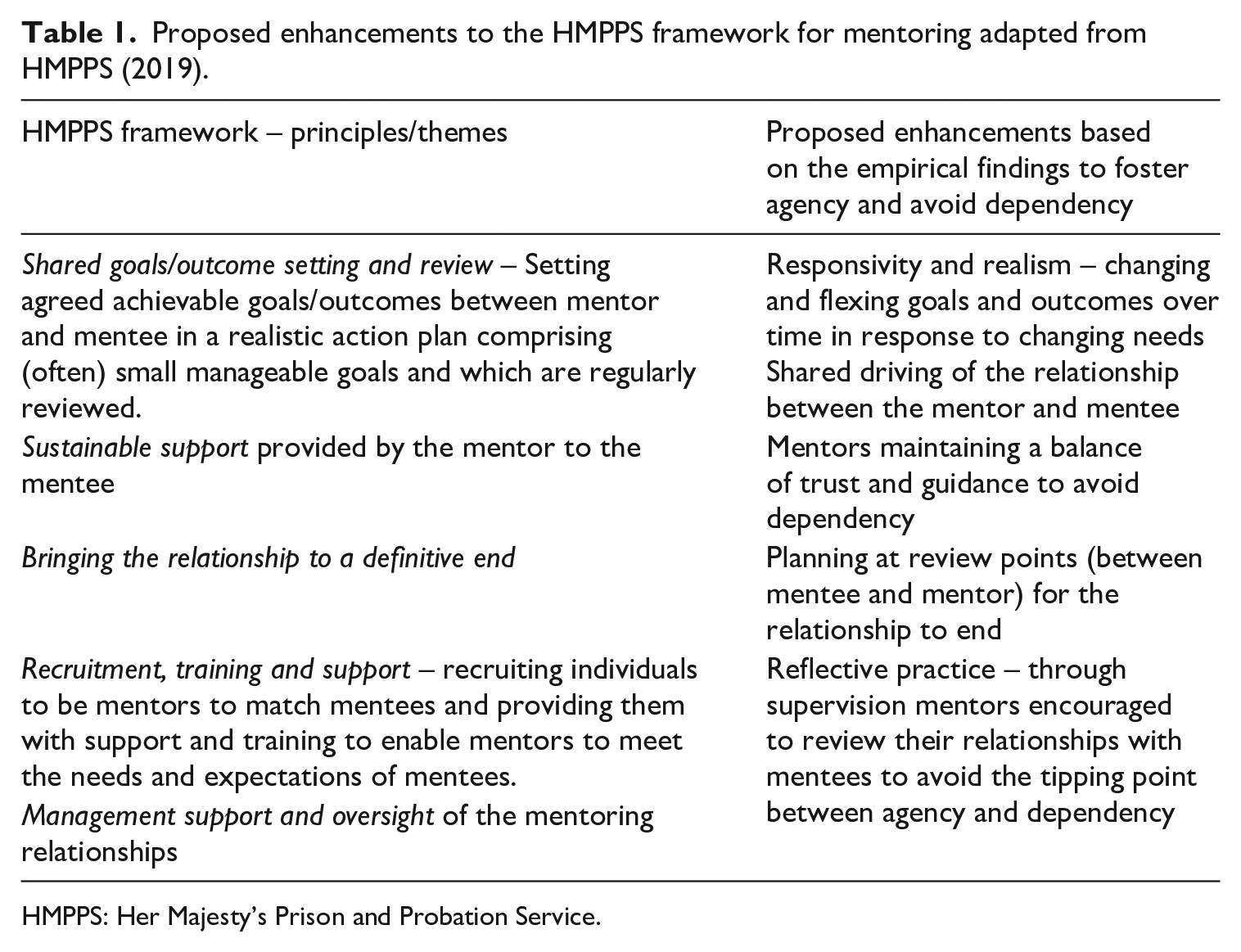
The HMPPS (2019) framework/guidance identifies ‘what we know works well’ and where mentoring is ‘less likely to work well’. These are grouped around the principles/themes detailed in the left-hand column of Table 1 with enhancements to the framework, based on the empirical findings (from this study) intended to engender agency and avoid dependency; which we propose that policy makers and practitioners adopt.
Proposed enhancements to the HMPPS framework for mentoring adapted from HMPPS (2019).
HMPPS: Her Majesty’s Prison and Probation Service.
The principle of shared goals/outcome setting and review through a realistic action plan (HMPPS, 2019) is an explicit expression of service-user involvement which has become mainstream justice policy in the United Kingdom (see among others, HMPPS, 2020). However, the more implicit principle of flexing goals and outcomes over time in response to changing need identified in this study is perhaps less well-acknowledged although intuitively it makes sense. There are clear parallels with Clemens’ (2010) description of how initial therapist–patient relationships that evolve into a working alliance include a patient achieving a growing independence and sense of agency in directing his or her own life effectively. It is the importance of shared driving between mentee and mentor – a key finding from this study – which bears particular attention given its current absence within the HMPPS framework (HMPPS, 2019). This finding appears reflected in the informal mentoring programme that found mentors needed to ‘. . . work with offenders to set the pace of the relationship’ (Wadia and Parkinson, 2015: 5). A responsive mentoring relationship with shared driving should manage the balance between building social capital and engendering agency. Facilitating shared driving is a requirement, currently absent from the framework (HMPPS, 2019) for mentors to maintain a balance of trust and guidance to avoid dependency.
The importance of bringing the relationship to a definitive end identified in the framework (HMPPS, 2019) receives support from our study, which also suggests that this needs to be an explicit goal which should be planned and reviewed alongside other outcomes and goals in the shared action plan. While training, support and management oversight have been specified within the HMPPS framework (HMPPS, 2019), the findings suggest that the framework should be augmented to include a specific requirement within the mentor supervision process for them to regularly review their relationships with mentees to avoid the tipping point between agency and dependency.
Relationship episodes
Explored above, understandably much of the literature about engaging people with convictions is focused on just that – how to engage them. It therefore seems to go against the grain to posit that attention also needs to be paid to identifying when and how disengagement from a mentoring relationship should occur. The issue of agency versus dependency is also largely absent from the existing frameworks on effective engagement: the NOMS engaging practitioner model (Copsey and Rex, 2013), the principles of quality supervision (Shapland et al., 2012) and the multi-faceted model of engagement for disaffected young people developed by Bateman and Hazel (2013). Neither is it considered in the voluntary sector model of engagement with people with convictions proposed by Wong et al. (2018).
What do our findings suggest? There appears to be an inherent tension between non-time limited open-ended support as described by Martin et al. (2016) and our findings which suggest that engendering mentee agency requires that the relationship needs to end. It would also appear to contradict the notion of support which has the potential to flex to accommodate the zig-zag (Glaser, 1964), nomadic (Phillips, 2017) desistance journey. Perhaps open-ended mentoring needs to be conceptualised in terms of support episodes rather than a single continuous (open-ended) relationship between mentees and mentors. These would have clearly defined start and end points. Where individuals may start with the mentoring service then leave; in the future return and leave again; and so on – often several more times; each of these would be a support episode. It would also be beneficial to understand why a mentee has exited the scheme and what their social capital and agency needs were. A mentee could feel their needs have been met and their social capital has developed (e.g. access to suitable housing) but they may exit the service without having developed their agency. This would likely see the mentee subsequently return. Longitudinal research is required to study the dynamics of the mentee returner and mentor relationship in these follow-on episodes.
Disengagement as an outcome?
The nature of engagement and its sustained and dynamic process through a mentoring relationship is clearly important to delineate. Our findings indicate the need to build a working alliance that is dynamic in time and content, based on the quality of the partnership that develops between helper and the person being helped (Horvath et al., 2011). Looking towards the three dimensions of dependency described by Geurtzen et al. (2018), our findings provide some descriptive evidence of passive-submissive dependency but more descriptive evidence towards a lack of perceived alternatives. Mentoring should minimise the likelihood that continued mentee engagement is not based solely on opportunity and availability, but also motivation (Geurtzen et al., 2018). Taylor et al. (2013) noted that engagement can be both a process outcome and an output of mentoring. If engagement is to be used to measure effectiveness, then understanding the nuances of this are required in order that engagement does not become the blunt instrument that reoffending has become as an outcome measure (see among others, McNeill and Weaver 2010; Wong, 2019). Recently, one of the authors (Wong, 2019) has proposed using engagement as a proxy measure of desistance – a way of quantitatively allowing for ‘“survival analyses” of desistance efforts’ as proposed by McNeill and Weaver (2010: 11). Combining this with data on criminogenic and non-criminogenic needs met or not met and measures of changes in well-being and agency, engagement could be used to provide proxy measures of the three theorised interrelated (and non-linear) processes of primary, secondary and tertiary desistance (McNeill, 2016; McNeill and Weaver, 2010; Nugent and Schinkel, 2016). However, this study also indicates that assessing the extent to which service-user independence occurs within engagement is also critical. Assessing the effectiveness of mentoring, Maguire et al.’s (2010) approach which combines impact and outcome related data under six headings – continuity of service through the gate, quality of engagement post-release, bridging to other services, ‘distance travelled’, reoffending and qualitative evidence – has much to commend it as a useful starting point.
The projected outcomes for mentoring/social inclusion in the HMPPS (2020: 42) target operating model for the Probation Reform Programme: ‘successful transition e.g. from custody to community’ and ‘more able to manage challenging situations and to engage with services and other opportunities’ would appear to be amenable to the approach adopted by Maguire et al. (2010). However, the findings from our study suggests that successful disengagement where the mentee and mentor mutually end the relationship or relationship episode (viewed as a successful conclusion, Wadia and Parkinson, 2015) could also be considered as a performance measure. Although realism about the limitations and ‘success rates’ of mentoring is required, Wadia and Parkinson (2015) found that only 3 in 10 (95 of 289) relationships reached a ‘. . . positive, “successful” conclusion, where the offender and mentor mutually ended the relationship’ (p. 5). However, where a mentee has gained from the relationship – arguably the critical important outcome – whether or not it is mutually ended is less critical.
Duration
The duration and format of mentoring is not specified in the Probation Reform Programme operating model, this is to be devolved to regions to source according to local needs (HMPPS, 2020). The evidence on how long mentoring should last is mixed. As noted earlier Jolliffe and Farrington (2008) conclude that longer programmes (for young people) were not more effective than shorter ones. Tarling et al. (2004) suggests that mentoring should last at least 12 months. Wadia and Parkinson (2015) recommend that mentoring should be offered as long as required. The envisioning of an alternative future identity and developing the social and individual capital to achieve it demands responsive and quality support. In the absence of quality, the view of one or both partners that they are lacking attractive alternatives to gain the same outcomes (Geurtzen et al., 2018) could be a very likely scenario. Our study suggests (like much of life) it’s not how long the mentoring relationship lasts but the quality that matters.
Resources
Of course, the duration and format of mentoring is inevitably influenced/limited by resources. A balance must be achieved between social support and individual, therapeutic support. Maguire et al.’s (2010) question – ‘How thinly should the jam be spread?’ – is apposite (p. iv). However, this is a matter not just of meeting demand – how much support can be afforded to individuals who need it – as not everyone who needs it is motivated at that time to make use of it (Wadia and Parkinson, 2015). It is also one of supply – the availability of skilled capable mentors, peer and non-peer (Buck, 2018; Wadia and Parkinson, 2015) – and the training, support (to avoid emotional fatigue and burnout) and management oversight and input required, including the brokering of agency relationships for inwards and onwards referrals (Maguire et al., 2010; Wadia and Parkinson, 2015; Wong et al., 2012, 2017). Mentoring that develops social and material needs must be complemented by elements that engender individual agency in order to balance and avoid dependency. Even where these conditions are met, careful nursing of these resources is important.
The development of agency should be considered holistically. The importance of brokering other professional involvement while supporting and building family and community relationships is reinforced by therapy research. Geurtzen et al. (2018) discuss a derogation effect in the lack of perceived alternatives dimension of dependency as being when a person receiving the help and support of a professional therapist may start to perceive other (non-professional) options, such as the support of friends and family, as less attractive or less valuable. Equally, there is the potential for dependency to occur on the part of the mentor (peer or non-peer). While this was not observed in our study, we suggest that further research is required to examine this, particularly (as indicated earlier) in relation to peer mentors and mentees.
Effective monitoring and managing the mentee–mentor relationship and the balanced dynamics of building agency and self-efficacy and avoiding dependency to enable the mentee to achieve their goals are important for the mentee (and arguably the mentor also). Such ‘successful conclusions’ also free up capacity, allowing mentors to support other individuals. Further points bear emphasis. First, there may be a latent but erroneous assumption (among policy makers and commissioners) that the seemingly ‘non-professional’ informal mentoring can be delivered cheaply or for free. Studies suggest it can’t (see among others, Wong et al., 2017). Second, the deployment of peer mentors needs careful consideration and implementation to fully acknowledge that ‘peer mentoring is far from an unskilled addition or alternative to established rehabilitation approaches’ (Buck 2018: 203). Third, allied to this, a broader social change role of peer mentoring that goes beyond the function of mentoring should be encouraged (Buck, 2019).
Learning from doing
The commitment to commission mentoring as part of the Probation Reform Programme in England and Wales (HMPPS, 2020) is welcome; however, devolving this responsibility to regional Probation Services and Wales without an overarching and consistent evaluation framework is a missed opportunity to enhance the evidence base. This is akin to past mistakes such as the post-Corston (2007) 7 commissioning of demonstration projects for women with convictions in England where limited prior consideration was given to establishing data gathering processes which could enable effectiveness to be assessed (Hedderman et al., 2008). Furthermore, given the likely pre-dominance of voluntary sector agencies being commissioned to deliver mentoring, it will do little to enhance the limited evidence more generally around voluntary sector led support services (Hedderman and Hucklesby, 2016).
Conclusion
Is mentoring a good thing? The evidence for its effectiveness – despite its ubiquity and popularity among criminal justice policy makers and practitioners – remains mixed. Brown and Ross’s (2010: 31) observation that mentoring is one of the least well-developed justice interventions theoretically and empirically still holds true, notwithstanding the welcome work of Buck (2018, 2019); Nixon (2020) and others (HMPPS, 2019; Maguire et al., 2010, 2019; Taylor et al., 2013; Wadia and Parkinson, 2015). Is it possible to get too much of it? Our study (notwithstanding its limitations) suggests that it is. Finding the balance between supporting an individual’s agency while avoiding dependency matters, although further research is required to understand this better. We suggest that balance can tip towards dependency when mentoring develops social and material needs without providing individual, or indeed therapeutic support that engenders individual agency. More generally, mentoring should not be regarded as a one size fits all panacea for people with convictions (Brown and Ross, 2010; Wadia and Parkinson, 2015). Furthermore, more detailed guidance is required to enable the effective commissioning of mentoring services in the United Kingdom and other jurisdictions. The HMPPS ‘what works well and not so well’ framework (HMPPS, 2019) – with our proposed enhancements – is a reasonable start, but only goes some way towards to avoiding mistakes in what kind of mentoring should be commissioned, for how long and to serve what function.
Footnotes
Funding
The author(s) received no financial support for the research, authorship and/or publication of this article.
