



Abstract
This contribution describes the way electronic monitoring (EM) is organized and implemented in the Netherlands. It will become clear that the situation in the Netherlands is characterized by, in particular, two features. The application of EM is highly interwoven with the Probation Service and its reintegrative objectives, a characteristic that dominates the organization and use of EM to a great extent. Paradoxically, EM is hardly used in the Netherlands as an autonomous (stand-alone) replacement for short prison sentences. The most straightforward explanation for this situation is that the Netherlands does not really need EM to replace prison capacity since its prison population already decreased drastically since 2005. A second explanation is that the intense involvement of the probation service in the enforcement of electronic monitoring has as a side-effect that these sanctions are not accepted as punitive sanctions, but fully framed into the rehabilitative perspective.
Introduction
This contribution describes the manner in which electronic monitoring (EM) is organized and implemented in the Netherlands. The focus is on the extent to which it is integrated with the reintegrative aims of the Probation Service and how this can be explained from a cultural perspective, following the suggestion of Nellis (2014) in his earlier efforts to understand the use of EM in Europe. To give a better understanding of the context in which EM is applied, we start with describing the main fluctuations in the scale and composition of the prison population, since it becomes clear from a comparative perspective that the extent to which EM is used, is often related to the need for prison capacity (Hucklesby et al., 2016). We continue with discussing the political and societal background in which EM originated and developed. After describing the different modalities of EM and how often they are used, we explain the reintegrative approach of EM in the Netherlands and how this approach is put into practice. It will become clear that the situation in the Netherlands is characterized particularly by two features. The application of EM is highly interwoven with the Probation Service and its reintegrative objectives, a characteristic that dominates the organization and use of EM to a great extent. Paradoxically, EM is hardly used in the Netherlands as an autonomous (stand-alone) replacement for short prison sentences. In the final section, we will try to explain these peculiarities in the context of a few dominant characteristics of the Dutch criminal justice system and the general development of community sentences and measures.
The research on which this contribution is founded was conducted in the context of an EU-funded comparative research project involving five jurisdictions, namely: Belgium, England and Wales, Germany, the Netherlands and Scotland. Because the focus of this research project is on mapping and exploring the practice of electronic monitoring in the different jurisdictions, qualitative research methods were most appropriate. At the initial stage of the fieldwork, a number of observations were carried out at different organizations involved in the execution of EM, more specifically the Dutch Probation Service, the Transport and Support Service (since 2014, responsible for the installation, replacement and de-installation of equipment) and Tyco (private organization and the operator of the monitoring centre of EM in the Netherlands at the time of the research). Between January and April 2015 observations were carried out on 18 separate days. The objective of the observations was not only to map and investigate the working processes of EM but also to identify key practitioners to be approached for an interview. In total, 34 interviews were carried out between January and May 2015. Thirty-six respondents were involved in these interviews; at two occasions two respondents joined the interview. Half of the respondents were representatives of either the Dutch Probation Service or the Addiction Probation. However, interviews were also carried out with the other organizations involved in the operation of EM, namely: the Public Prosecution Service, the judiciary, the Transport and Support Service, the Prison Service and private parties. During the interviews topic lists were used that had been constructed based on a general interview template and on the observations. The topic lists were revised several times during the course of the data gathering process to include new relevant topics or subtopics that were discovered.
Scale and composition of the Dutch prison population
To understand the context in which EM is applied in the Netherlands, it is also important to have an idea of the size of the prison population and its main fluctuations in recent years. The highest number of prisoners in 25 years was measured in 2005, with a total number of 15,206 prisoners (Custodial Institutions Agency, Dienst Justitiële Inrichtingen [DJI], 2015: 29). By that time, the numbers had quadrupled since 1985. Boone and Moerings (2007) explain that the main increase took place between 1985 and 2005 and for six different categories of prisoners. They came to the conclusion that while the category of convicted offenders in prison had already started to stabilize, or even fall, from 1996 there had been an impressive increase of the other categories of prisoners: prisoners on remand, mentally ill offenders in penal-psychiatric institutions (TBS-clinics), irregular immigrants awaiting deportation (i.e. not for any offence!) and youngsters detained for child protection reasons (i.e. not for any offence either!). The doubling of prisoners in remand detention could be explained in particular by the increased detention of small drug smugglers (‘body packers’), ‘repeat’ offenders (mainly drug addicts) and foreigners without valid papers. They explained the ‘cell explosion’ by the increasing intolerance and indifference to the problems of these vulnerable groups (Boone and Moerings, 2007: 51–76). This conclusion fits nicely to the main conclusions of Downes and Van Swaaningen (2007) who focused more on the macro-sociological explanations for the growing prison rates in the Netherlands in that period. They point, for example, to the severe budget cuts in welfare-provisions in the 1980s that resulted in a situation in which social problems were no longer solved by social policy, but were referred to the police and the criminal justice system (Downes and Van Swaaningen, 2007).
The total number of prisoners has dropped significantly in the period 2005–2014 (DJI, 2015). Between 2005 and 2009 the number of prisoners dropped radically. After 2009, the number stabilized, but in 2012, 2013 and 2014 numbers dropped again. Compared with 2005, in 2014 the population has dropped with 35% to 9909 prisoners. 1 Figure 1 shows the development in the population of prisoners in the period 2010–2014.
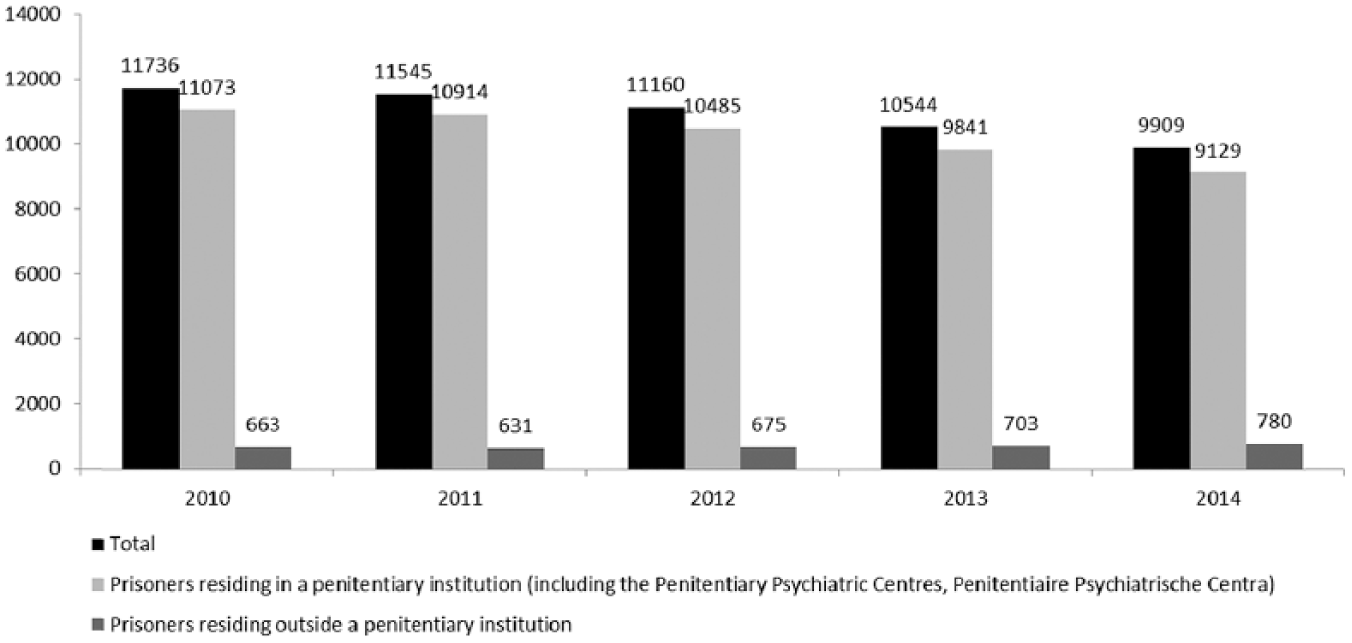
Prison population: 2010–2014.
With a prison population of 63 per 100,000 prisoners, the Netherlands belongs, together with Sweden and Finland, to the European countries with the lowest prison rates, according to the SPACE data of the Council of Europe (corrected by including the number of persons who are placed under a hospital order, DJI, 2015: 41). What the main factors for this dramatic fall are still hotly debated in the Netherlands. Van Swaaningen (2013) and Boone and Van Swaaningen (2013) come to the conclusion that the developments as explained by Boone and Moerings (2007) are also most influential in explaining the fall of imprisonment rates, but these do not particularly relate to a (reverse of a) punitive turn. Others suggest that the diminished need for prison capacity is mainly driven by the reduced result of criminal prosecution of a limited number of serious offences (Berghuis, 2015) or the considerable reduction of crime rates (Van Dijk, 2010). For the development of EM, it is important to realise that in the absence of overcrowding owing to a shortage of prison cells, no economic drive exists to replace imprisonment by electronic monitoring. On the contrary, the decrease of the Dutch prison population has dramatic consequences for the Dutch prison staff, often loudly expressed in the media, which can easily function as an inhibitory factor for the development of further alternatives for prison.
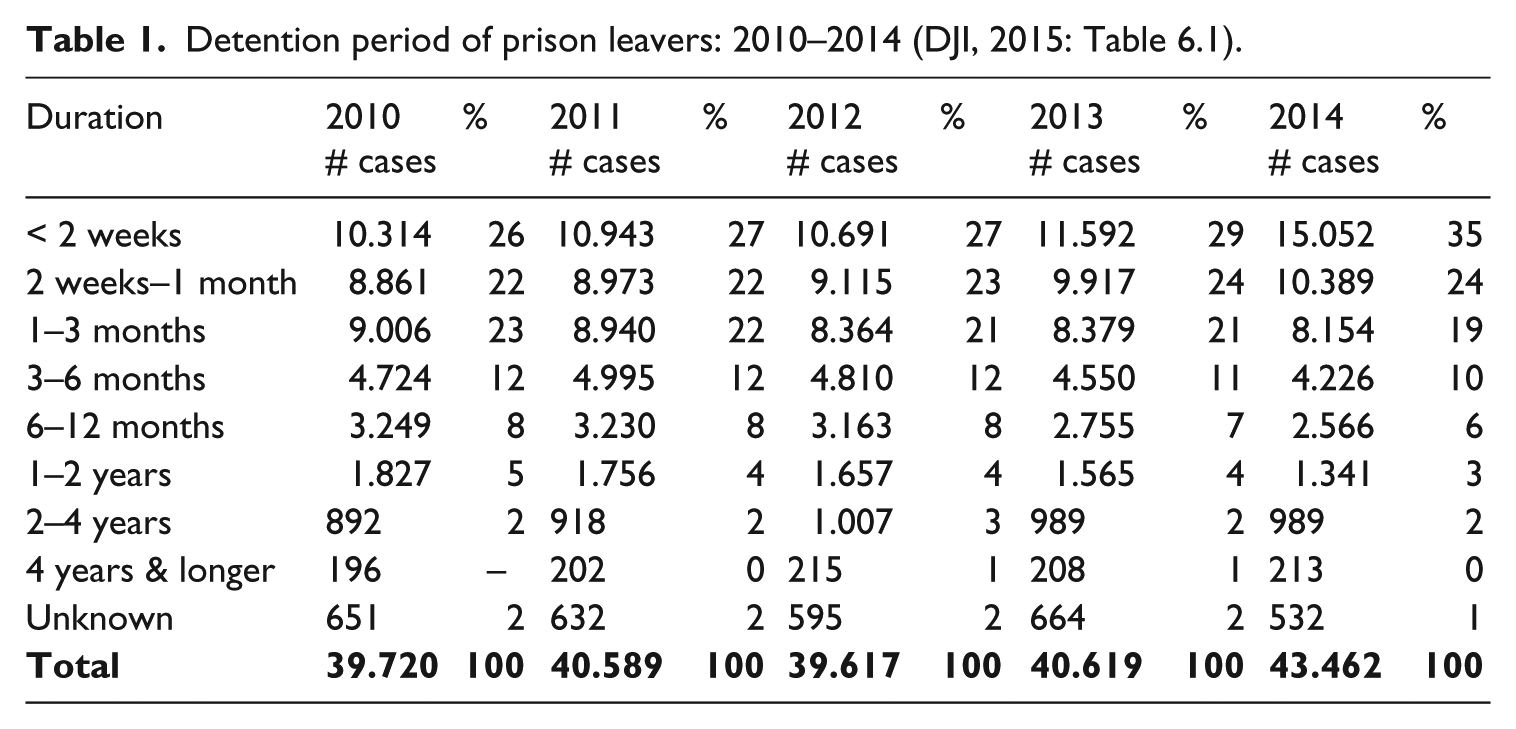
With regard to the central topic of this study, the composition of this small remaining prison population is something to be aware of as well. Compared with other countries, the Netherlands still has a remarkably high proportion of pre-trial detainees amongst the total prison population of 46% in 2013 (DJI, 2015: 31). Another category that is overrepresented in the Dutch prisons are those serving a very short period of time in prison. As becomes visible in Table 1, 35% of the prisoners that left prison in 2014, stayed in prison for a period of less than two weeks. This is much more compared with 2010, when 26% of the prisoners stayed in prison for less than two weeks. Sixty percent stayed less than one month (compared with 48% in 2010), while 89% left prison within six months. Of the 21,867 unconditional prison sentences that were imposed in 2015, 37.1% had a duration of less than one month and more than 75% of less than six months. Pre-trial detainees and prisoners serving short sentences are considered as very suitable for EM, in the other jurisdictions involved in this study. Why this only partly counts for the Netherlands will also be explained in this contribution.
Detention period of prison leavers: 2010–2014 (DJI, 2015: Table 6.1).
The political and societal background of EM in the Netherlands
The first Dutch media publication on the use of EM in the United States, where it originated, came in 1987. In this period, the Dutch government was looking for solutions to ease prison overcrowding and cell shortage. Against this background, it was no surprise that the possibility of EM was quickly picked up by politicians. In 1988, a working group was installed to explore the potential of electronic house arrest for providing an alternative to imprisonment. This working group came to be known as the ‘Schalken Committee’. In its report, the committee suggested that electronic house arrest could be valuable in terms of rehabilitation, provided that it would be combined with an intensive support program and ‘meaningful activities’ such as schooling or work. It also stated that electronic house arrest could have an economizing effect, with the side note that this effect could be reduced by ‘net-widening’ effects, which means including people in the penal system that otherwise would have been kept out. The committee further advised giving judges the exclusive authority for imposing electronic house arrest in order to prevent arbitrariness. Some other concerns were expressed regarding the intrusiveness of the modality and how continuous control may be interpreted as a sign of distrust towards the monitored person. All in all, the committee did not take a clear position but instead pointed at the importance of a broad debate on the desirability of electronic house arrest. In response to this report, the Minister of Justice asked in June 1989 for the advice of many organizations involved in the criminal justice system. According to Van Swaaningen and Uit Beijerse (2013), only the police was plainly positive as far as EM was applied as an alternative to an unconditional prison sentence and not as an alternative to remand. The Probation Service rejected EM altogether, because surveillance with only minimal human input would be incompatible with the rehabilitative ideal of the Probation Service (Van Swaaningen and Uit Beijerse, 2013: 173). The debate culminated in a symposium with 70 experts from several organizations. The majority of the persons present were not enthusiastic about the implementation of electronic house arrest either in the context of custody, as an alternative to detention or towards the end of a prison sentence (Van Gestel, 1998).
Following this symposium, the advice was formulated to refrain from electronic house arrest while other alternatives were being explored. But between 1985 and 1990 the prison population doubled and the debate on how to cope with these increasing numbers continued (Van Swaaningen and Uit Beijerse, 2013: 174). Eventually, in 1994, a newly formed project group sent a recommendation to the Minister of Justice, in which it advised starting a pilot with electronic house arrest in two forms: in combination with a community service order and as an alternative to the last phase of a prison sentence in the context of detention phasing. This plan was approved and in 1995 a two-year experiment started in the north of the Netherlands. Despite the earlier resistance within the organization, the Probation Service became the organization responsible for the implementation of EM. The interviews conducted within the current research make clear that some leading persons within the organization at the time agreed with cooperation, as they were convinced of the fact that a refusal would have major consequences for the organization. Also, Van Swaaningen and Uit Beijerse (2013: 175) state that the Probation Service was put under pressure: if they remained unwilling to start a pilot on EM, the Minister of Justice would be forced to look for other (i.e. private). From that time, the one experiment with EM followed the other (Van Swaaningen & Uit Beijerse, 2013: 173).
In 2003, facing a pressing cell shortage, the modality of electronic detention or ‘home detention’ was introduced. Electronic detention could be imposed as a means of executing an unconditional prison sentence of up to 90 days for offenders without a ‘security risk’ who report themselves to the prison without coercion, so-called self-reporters. As opposed to the electronic supervision modalities, as described above, the sole objective of electronic detention was to reduce the shortage of prison cells. It was announced in the 2000 Green Paper ‘Sanction in perspective’ as an alternative for short prison sentences that could annually save the Dutch taxpayer 115 million guilders, but that did not have a rehabilitative function. Between 2003 and 2005, 2145 offenders were placed under electronic detention, of which 1998 did not seriously violate the conditions, according to an evaluation of the Inspection for Sentencing Implementation. Contrary to the rehabilitative forms of EM, it was not the Dutch Probation Service that was made responsible for the execution of electronic detention, but the Prison Service of the Department of Justice. The Inspection for Sentencing Implementation was rather positive about the use of the electronic detention modality. Despite the fact that the offenders involved usually belonged to the medium risk category of offenders, actual recidivism was relatively low. It concluded in its inspection report that electronic detention was an effective alternative for a short prison sentence. However, the implementation could be improved (Inspectie voor de sanctietoepassing [Inspection Justice Department], 2007).
Electronic detention was also heavily criticized. The Council for the Administration of Criminal Justice and the Protection of Juveniles emphasized that home detention should always be combined with some form of support or assistance and that the prisoner should have the opportunity to work. Furthermore, the Council stated that the principal goals of home detention in terms of retribution, deterrence and rehabilitation would have to be made explicit. This point is also emphasized by Van Swaaningen and Uit Beijerse (2013), who are concerned that the main rationale behind any form of EM simply tends to be cost reduction. In June 2010, the Minister of Justice decided to end the practice of electronic detention awaiting new legislation that would codify EM as a principal punishment and as a condition to suspend remand (Van Swaaningen and Uit Beijerse, 2013: 181). However, this law never came into force, because the need for home detention as a substitute for prison declined in the context of a cell surplus and the new State Secretary of Security and Justice was personally a strong opponent of EM.
In 2013, the Master plan of the Dutch Prison Service for 2013–2018 was published. It describes the intended changes in the prison system aimed at reducing the expenditures of the Prison Service with up to 340 million euros in 2018 (DJI, 2013). Electronic detention is presented as one of the important instruments for realizing these cuts and a new Bill on Electronic Detention was proposed in the same period as the Master plan. Two modalities are mentioned. The first is the ‘backdoor modality’ to be applied after half of the prison sentence has been served but before conditional release. The second is the ‘front-door modality’, which is meant to be a substitution for any prison sentence shorter than six months, unless the possibility for electronic detention is explicitly ruled out in the verdict. It is estimated that the implementation of electronic detention will facilitate the reduction of existing prison capacity by 2033 places. For juvenile offenders, the aim is to increase the imposition of EM as an alternative to remand (DJI, 2013).
The second proposal caused a wave of criticism. In the political arena, the dominant opinion was that EM was a far too mild alternative for detention. Therefore, EM was not acceptable as an alternative for short prison sentences. Most Advice Committees that commented on the Bill were positive about EM as an alternative for short prison sentences, but only if it would become an autonomous sentence that could be imposed by the judge (courts). More enthusiasm existed for the ‘back door modality’, although several concerns were expressed in relation to this modality as well, in particular concerning the replacement of the existing system of detention phasing by electronic detention and the exclusion of certain groups of prisoners of electronic detention as a result of contraindications and conditions that would be required (Boone and Van Hattum, 2014; RSJ [Council for the Administration of Criminal Justice and Youth Protection], 2013).
In September 2014, the electronic detention Bill was rejected by the Upper House. To the senate, abolishing the existing system of detention phasing was unacceptable and electronic detention did not provide a workable and legally substantiated alternative.
Legal modalities of EM and numbers
Since its introduction, the use of EM has been remarkably stable until 2013, despite the fact that it can be used in many modalities since the start. However, since the introduction of the digital desk (an online tool that enables judges, prosecutors and probation officers to digitally request probation advice on the desirability of EM in a specific case) in 2013, there has been a steady increase in the use of EM. Based on the registrations at Dutch probation organizations, a total of 2250 electronic tags were connected in 2015. This represents an increase of 100% compared with 2013, when 1028 connections were realized.
EM can be applied in several legal modalities and by many different actors. Figure 2 shows that the penitentiary programme that can replace the final phase of a prison sentence is clearly the most commonly used EM modality (746 times in 2015). Participants of a penitentiary programme are monitored by EM for at least one third of the duration of the programme. The decision to apply a penitentiary programme is made by the Probation Service, in close cooperation with the prison service. Much less use is made of EM in the phase of conditional release. This has probably to do with the fact that only a minority of the prisoners is conditionally released and special requirements are only applied scarcely. In cases where conditional release follows a penitentiary programme it is, moreover, not very logical to make use of EM again, because in that case the prisoner just has a period of EM behind. EM is increasingly used as a condition for prison leave, however, although it is not explicitly mentioned as a condition in the law. In the sentencing phase, EM can be used as a condition of conditional release to monitor a location ban or a location order, but this modality was only applied 82 times in the period between January–October 2015. Incidentally, it is also used as such in the context of a conditional hospital order for offenders who cannot be held responsible for their deeds, but this happens so incidentally that this modality is not included in Figure 2. 2 In the current study it appeared that judges are still rather reluctant in the Netherlands to apply EM as result of a lack of knowledge and fear for potential technical failures. This could, on the one hand, explain the growing use since the introduction of the digital desk (as mentioned above), and, on the other hand, the underuse of EM in the pre-trial phase, although this use is also growing in the last two years.
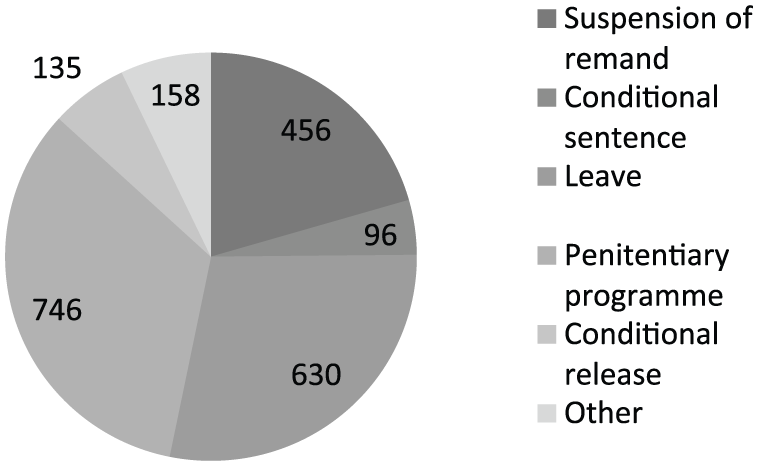
Number of connections per modality 2015.
The reintegrative approach of EM
As is described in the introduction, EM was never accepted as an autonomous replacement of a prison sentence without supervision (stand-alone measure) in the Netherlands. This is a striking difference with, for example, the community service order. This sentence was codified relatively short after its introduction in the Dutch sentencing system as an autonomous sentence that could only be imposed by an independent judge, mainly because it was considered to be a too severe sentence to apply with less legal guarantees (Boone, 2010, 2016). EM is always applied as an additional tool to control the conditions of a conditional sentence (in particular a location ban or a location order) to enhance the credibility of such sanctions and enlarge their effectiveness. This character is reflected in the answers our respondents gave to the question regarding what they considered to be the most important objectives of EM. Rather unanimously, respondents with different backgrounds mentioned the reintegrative objectives of EM before the more retributive or preventive aims. One of the main objectives of EM is considered to be improving the monitoring of the behaviour of participants. Monitoring is needed to make sure that probationers abide by the conditions that are attached to their supervision. Probation officers indicate that EM provides an easier and more effective means to monitor whether people obey the rules that are set. More specifically, the EM technique allows them to see if someone is at home during their curfew hours (in case of a location order) and/or if they stay away from exclusion zones (in case of a location ban).
For people who participate in a penitentiary programme, monitoring is found to be of particular importance. Officially, prisoners who are in such a programme fall under the responsibility of the Prison Service, because they are still in detention, although not in the sense of staying inside a penitentiary institution. Therefore, the conditions attached to the programme, such as a curfew, need to be monitored appropriately according to our respondents. One of the respondents articulates this as follows:
I think it is good to monitor. I also think that it is good to give someone gradually more freedom, because it is quite something when you come from a closed setting and you go outside. So in that sense it serves as a safeguard . . . I believe it has added value because you can expect that when the tag is removed no participant will think at 10.30pm, ‘I should be in a hurry now to be at home at 11pm’. And the later at night, the bigger the temptations. Well, the intention is to bring someone back into society. (Prison service 1 – Penitentiary facility administration manager)
In the pre-trial phase, an important objective of releasing suspects with EM according to several respondents is that they can continue their work or education. The same counts when suspects are caring for children or parents. With EM, they can be released and continue their normal daily life, but their whereabouts can still be monitored. Judges also indicate that EM serves the purpose of enforcing the conditions that are attached to a conditional sentence or a conditional release from prison. EM is not perceived as a behavioural condition in itself, but it can enforce other conditions attached to a sentence or conditional release (criminal court judge 1). Summarizing, the idea is that by means of EM re-offending can be prevented. This is achieved directly by monitoring the behaviour of participants and indirectly by giving participants the chance to continue their work or education, while on EM. A structured lifestyle and a paid job are seen by many professionals as protective factors against crime.
The second main objective of EM is realizing behavioural change by providing support. EM is part of the supervision that the Probation Service provides and it supports the probation officer in steering the probationer towards changing their behaviour. First, EM can help the probation officer to set boundaries, to talk about the probationer’s behaviour and to make them aware of the fact they are being monitored. Second, the emphasis can be shifted towards the own responsibility of the probationer and freedoms can be gradually increased. According to probation officers, EM has a strong structuring effect on the life of participants, which was also observed in earlier research (Berends et al., 2008).
A curfew, monitored by EM, means that someone is not allowed to be out on the street at night anymore. Therefore, the day and night rhythm of the participant normalizes and the temptations provided by criminal friends are minimalized. Probation officers see EM as a tool that helps them to change the lifestyle and the behaviour of the participant. The final end result should be a reduction in re-offending. The following quote illustrates the vision of probation officers on the role of EM in their work:
. . . it can offer conditions that you’ll need to realize behavioural changes that last when the tag is removed. But, I believe, it cannot be a goal in itself, without support, because then you’ll achieve nothing. When the tag is removed you lose that person, because mentally you have changed nothing. (Probation officer 5)
Changing the lifestyle of the participant is also achieved by providing an incentive to pick up work or education, because when the participant does not have any daytime activities, while on curfew, they are only allowed to leave their home for a couple of hours per day. Starting a job or education means that the participant can go outside of the house during the day.
I: So, you believe that EM can contribute to structuring the life of a person? PO: Yes. I: How does that work? Can you tell a little bit more about that? PO: Yes, because in the first place they will be motivated to start school or a job, because otherwise they will be at home all day. Well, they don’t really like that. So, then they will start school or a job. Because then they will have more free time, with the tag. From there, they will be on the streets with friends less often, they will have to get up early in the morning. Often you call them, around 2pm and they are still lying in bed. But then they will have to get up early and go to school and in the end they go to bed early at night because they are tired. And that helps a lot. Because they will not be on the streets at night. So, it can contribute to structure and day-and-night rhythm. (Probation officer 11)
How the reintegrative approach is put into practice
The dominance of the reintegrative approach is visible in the way in which EM is organized. Below, we describe five characteristics of the implementation of EM in the Netherlands that make more concrete how the reintegrative approach is put into practice.
Involvement of probation officers
As stressed before, the Probation Service plays a major role in the implementation of EM in the Netherlands. In case EM is considered as a condition to a penitentiary programme, an advice of the Probation Service is always taken into account. Also, when EM is opted to be applied in another modality, an advisor of the Probation Service advises on the appropriateness of EM following a request of the probation officer, prosecutor or judge. After a positive decision, the case is handed to a probation officer who is responsible for carrying out the feasibility study (see below). When the outcome is positive and the probationer is actually tagged, a probation officer is always present during the installation of the equipment. Next, the probation officer takes all the decisions with respect to the granting and withdrawing of liberties. Moreover, in contrast with other jurisdictions involved in this study, the response to violations is related more to the person than to the type of violation. The circumstances of individuals are taken into consideration during the initial response of probation officers to violations rather than after formal breach proceedings have started (Hucklesby et al., 2016: 27).
Individualized decision-making
No categories of offenders are officially excluded from EM. The criteria for qualifying for EM are identical to the criteria for qualifying for a certain modality in which EM can be applied. EM is also applied to juveniles, but much less often than to adults. In the interviews, however, certain contra-indications were mentioned regarding the application of EM. EM is deemed to be inappropriate for people who are seriously addicted or who are suffering from serious psychiatric disorders. With regard to the first group of people, it was explained that when people only live to score drugs it is very difficult for them to comply with the rules that are attached to EM, such as being at home on time. Also, the context of an offence can be a contra-indication. When the (alleged) offence has been committed from the house of the person, for example in case of cyber-crime or drug-dealing, EM is often not recommended by the prosecution service, because it could easily enhance the risk on recidivism. This is also the case when the situation at home is not stable or safe, for example when domestic violence occurred or too many people stay at the place.
A characteristic of the practice of EM in the Netherlands is that it is decided on an individual level whether EM is feasible or desirable under certain circumstances. The feasibility study plays an important role in this respect. A feasibility study is carried out by means of a home visit to the place where the potential participant wishes to live. It is carried out by the probation officer who most likely will carry out the supervision of the participant in the later stages of the process. The results of this investigation are reported in written form to the advisor, who incorporates it in his final social enquiry report. A home visit takes approximately thirty minutes and in general it is conducted by the probation officer alone. Next to technical feasibility, the social circumstances of the place are taken into account as well. It is important that the home owner is able to pay the rent or mortgage and the electricity bills. Therefore, it is important that no outstanding fines or other debts exist, especially not with the energy company because of the risk of losing the house. It is important that the participant will have his own bedroom and place to sleep, because he might have to be at home during a considerable time of the day. The probation officer informs the cohabitants about the implications of EM and needs the consent of the principal occupant of the house. Although the feasibility study almost never results in a negative advice, it is considered to be an important part of the decision-making process, according to our respondents deriving from the probation service.
Added value
The general approach is that EM should only be added to a supervision order in case this enhances the possibility that the offender will comply with the rules. In case a supervision order can also be successfully implemented without supervision, EM could be omitted. EM can have added value because it provides the probation officer with information they can use in his or her conversation with the person involved.
Every Monday, the national coordinator sends a weekly report of each participant to the supervising probation officer. This report consists of a listing of all the notifications in a given week. The probation officers can use the weekly reports in their meetings with participants. They can, for example, discuss issues such as regularly coming home a couple of minutes too late or problems with charging the tag. Probation officers can also consult the national coordinators in case they would like to have more information generated by the tag. They can, for example, ask for GPS-trails of a given evening, as is explained by one of the coordinators:
And sometimes probation officers ask us for information. ‘I’d like to know what he is doing on Saturday night, because the local police officer says he is hanging around with his old group. Can you check for me where he was the last two Saturday nights between this and that time?’ Well, we can do that. The probation service can check these data and talk about it with the client. Exchanging information with a third party is something we don’t do just like that, but a probation officer can receive every trail, if he wishes so. And they make use of that. (Addiction Probation Service 1 – national coordinator).
Daily activities
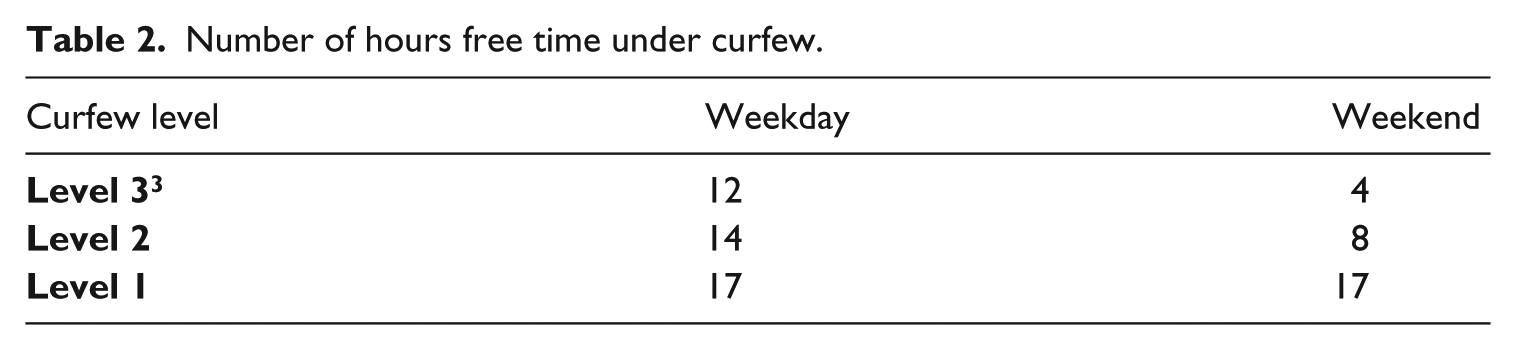
A well-known metaphor in the Dutch debate on EM is the ‘beer on the couch’, which was used by the former State Secretary to express his concern that electronic monitored people would stay at home all day, doing nothing else but drinking beer. This critical approach towards EM as a stand-alone measure without a reintegrative programme, is widely shared by our respondents, in particular those who are part of the Probation Service. In case of a penitentiary programme (the most used modality), EM should be combined with daily activities of at least 26 hours per week, this can be work, education or a combination of both. These strict requirements do not count for the other modalities, but when a location ban is imposed and the probationer does not have daily activities, he or she has to stay at home for 22 hours a day. According to our respondents, these severe restrictions stimulate people to put more effort in finding a job or other activities. In general, meaningful daily activities are considered to be of utmost importance according to an overwhelming majority of our respondents. Structured, daily activities give satisfaction and positive social contacts and have as a positive side effect that people have less energy to go on the streets at night. Another valuable aspect according to some of our respondents is that people have something to lose, such as a job. Probation officers help probationers to find meaningful activities and to continue with it. Besides daily activities, regular contacts exist between the supervisor and the person under supervision. The number of fixed contact moments depends on the supervision level (see Table 2). The supervision level reflects the risk score given to a probationer. At supervision level 3 they have two fixed contact moments a week, at supervision level 2 one, and at supervision level 1, one talk every two weeks. Next to the compulsory meetings, supervisors may join participants to appointments at the municipality, an employer or a treatment facility.
Number of hours free time under curfew.
Phasing
As said, EM is mostly applied at the ‘back door’ of the sentencing process as an execution modality of the prison sentence (penitentiary programme) or during the early release phase. The dominance of the reintegrative approach is visible in the way EM is implemented. In the back door stage, increasing the hours of free time is standard practice. When a participant starts in level 3 the period of the programme is divided in three parts, and when the participant behaves well and sticks to the rules they are promoted to the next level after one-third of the programme (see Table 2). Probation officers indicate that it is desirable that participants have functioned in level 1 before EM is ended, because otherwise the gap between the number of free hours in level 2 and total freedom is too large, although it is possible that the curfew remains in place without being electronically monitored. The probation officers take decisions with regard to increasing freedoms by themselves and this is not discussed with a mandator. To take these decisions, probation officers discuss cases with colleagues. They indicate that they regularly have meetings in which current cases are discussed and they find it important to always consult a colleague when they are not sure about which decision they should take in a case. The following quote illustrates this practice:
We can promote or degrade someone. So someone goes from level 3 to level 2. It has to be agreed by the team, team wide, I cannot decide that on my own, but it is decided during a case meeting. When we promote someone to level two, different freedoms are applied. Then you get more hours. But it can also be the case that someone in a penitentiary programme has to remain tagged, but then he enters his second one-third or last one-third and we can phase depending on how someone is doing in the programme. It could be that we decide a participant is given 17 hours of freedom seven days a week for the last period. But he stays tagged. We don’t discuss that with the mandator. That is the framework in which we can decide ourselves. (Probation officer 6).
These freedoms concern the number of curfew hours and do not apply to a location ban. Location bans are generally not changed structurally during the period on probation. Incidental changes can be made with regard to both the curfew hours and the location ban. The contribution to rehabilitation is taken into consideration here. For example, there may be a family event.
Discussion: Contextualizing the Dutch approach
This contribution demonstrates that the main objective of EM in the Netherlands is to enhance the rehabilitative potential of other non-custodial sanctions. The enhancement applies, in particular, to the penitentiary programmes that are applied in the final stage of a prison sentence and conditions added to conditional custodial sanctions in all stages of the criminal justice process. This characteristic can be explained by the early adoption of EM by some leading figures in the Probation Service. This integrated or ‘goal oriented approach’, as it is named by the Probation Service itself, is visible in all aspects of its application: selection of candidates, the emphasis on meaningful daily activities, the gradual system of awarding more free time and the response to violations (more related to the person than to the type of violation). If EM had become an instrument that was mainly in hands of the Justice Department, it could easily have formed into another shape. In contrast with the views of probation officers, our respondents of the Justice Department attached much more value to the potential of EM to protect victims or society in general. More specifically, they highly considered the potential of EM to signal to victims and society in general that their interests are taken into account when granting liberties to suspects or offenders. As a matter of fact: respondents of the Justice Department attached much less value to the idea that EM should only be applied in case it has ‘added value’ and that it should be omitted in case a supervision order could also be successfully implemented without EM. The application of EM has already changed in recent years as a consequence of the increasing approval of the point of view of the Justice Department. EM is, for example, applied automatically when liberties are granted, in the form of leave, a penitentiary programme or conditional release, to suspects or offenders of high impact crimes. As a consequence, EM is used increasingly as a condition of leave – as an instrument of the prison service – without any interference of the Probation Service. Because of these developments, it remains highly uncertain which direction the application of EM will take in the coming years.
An important question that arises in the context of the Dutch approach is what can explain the stubborn refusal of EM as an autonomous alternative for short prison sentences? With a prison population of which 60% stays in prison for less than one month (see Table 1), it seems that EM can be extremely useful in this modality. EM as a stand-alone sentencing option for less serious offences is common practice in most other countries involved in the comparative study this contribution is part of. Also, Sweden, a country that has a comparable rehabilitative approach towards EM (although embedded in a society in which social-democratic values still seem to be much more alive), has used EM deliberately to reduce short prison sentence (Nellis and Bungerfeldt, 2013), while a similar proposal has been firmly rejected again in the Netherlands in 2013. We can think of two major reasons. The most straight forward explanation is that the Netherlands does not really need EM to replace prison capacity since its prison population decreased already drastically since 2005 with unemployment of prison staff as a result. The comparative analysis conducted as part of this study (Hucklesby et al., 2016) shows that the size of the prison population is strongly connected to the use of EM. It is true for the Netherlands that the only period in which EM was used as a stand-alone alternative for short prison sentences, was between 2003 and 2005 when there was an urgent need for prison cells. Even then, this modality was strongly rejected, however, by different parts of society and therefore ended despite its relative success. A second explanation is that EM is accepted in the Netherlands only as a tool to improve resocialization of offenders, predominantly in the final stage of their prison sentence, but not as a punitive sentence in itself. This explanation is in line with the development of other forms of community sanctions (e.g. community service orders) and can probably be explained by the intense involvement of the Probation Service in the execution and enforcement of community sentences. This has as a side-effect that these sentences were fully framed into the rehabilitative perspective (Boone, 2016). Therefore, EM is seen by the general public and politicians as a soft and non-punitive alternative to imprisonment. It is not perceived as ‘a real sentence’ with enough punitive elements to replace prison sentences. EM is accepted as a useful extra tool for the Probation Service to monitor probationers during the resocialization process, but not as an autonomous sanction, with punitive as well as rehabilitative characteristics.
Footnotes
Funding
The author(s) disclosed receipt of the following financial support for the research, authorship, and/or publication of this article: This research project ‘Creativity and effectiveness in the use of electronic monitoring as an alternative to imprisonment in EU member states’ (Hucklesby, Beyens, Boone, Dünkel, McIvor and Graham, 2016) has been produced with the financial support of the Criminal Justice Programme of the European Commission (JUST/2013/JPEN/AG/4510). The contents are the sole responsibility of the authors and can in no way be taken to reflect the views of the European Commission.
Notes
Author biographies
Prof. dr.