



Abstract
This article examines probation practitioners’ experiences of supervising an individual who commits a serious further offence (SFO). In particular, it explores the impact on staff of the Probation Service's processes for reviewing practice following an SFO. The article draws on findings from two small-scale qualitative studies, which investigated the perspectives of practitioners and managers with experience of these processes. The findings show that an SFO and its aftermath have a negative impact on the emotional well-being of staff, that there are concerns about procedural fairness, and that there can be a focus on the actions of the individual practitioner rather than on wider systemic failings. The article advocates for a change in process to improve the quality of practice and foster an organisational culture that treats staff with respect and care.
Keywords
Introduction
This article discusses probation practitioners’ experiences of supervising an individual who commits (while subject to, or having recently been subject to, that supervision) a serious offence. In particular, it explores the impact on the practitioner of the Probation Service's processes for examining the sufficiency and effectiveness of supervision and decision-making in the period leading up to the serious further offence (SFO).
The article begins with an introduction to the concept of the SFO as developed by HM Prison and Probation Service (HMPPS) in England and Wales. It then presents findings from two recent small-scale studies which investigated, in slightly different ways, the perspectives of probation practitioners and managers with experience of the SFO review process. The findings from these studies show that the present bureaucratic arrangements tend to have a negative impact on staff well-being, are seen to focus on attributing individual blame and hence limit opportunities for systemic learning. Drawing on these findings, the article argues for changes in the process that would acknowledge its emotional toll and lead to improved practice at all levels of the organisation.
As co-authors, we bring our differing professional understandings to this article. Jane Dominey is a university-based academic, Steve Calder is a senior manager in HMPPS who has experienced SFOs both as a practitioner and as an operational manager and has been involved in influencing policy in this area, and Lindsey Whitham is an SFO inspector at HM Inspectorate of Probation (HMIP). The process of writing the article highlighted for us that, while we agree on many points, our dissimilar work histories and personal values mean that we do not agree about everything. For example, while sharing an understanding of the complexities of these issues, we differ in the extent to which we are critical of the way that serious further offending is conceptualised and in our view of how its prioritisation sits among the many other demands placed on the Probation Service. The conclusions in this article stem from our constructive conversations about the organisational response to SFOs and reflect our shared views.
The serious further offence
The Probation Service in England and Wales is responsible for supervising around 169,000 individuals in the community following the imposition of a community sentence or release from prison (Ministry of Justice, 2025a). Reoffending while subject to statutory supervision is not uncommon (for example, around 13% of community orders are terminated early for conviction for a new offence (Ministry of Justice, 2025a)), but there is a particular focus, politically and in practice, on the SFO. A further offence is an SFO if the conviction is on a specified list of sexual, violent, and terrorist crimes and was committed while the individual was (or had recently been) subject to probation supervision. The SFO framework is intended to capture those offences that cause death or serious harm to the victim. For example, murder, causing death by dangerous driving, sexual assault of a child under 13 and inciting terrorism overseas are on the automatic SFO list. By contrast, robbery (without firearm or serious injury) and supplying Class A drugs are not. These two offences are manifestly serious, but were not deemed sufficiently serious to be added to the SFO list: robbery is an example of an offence where the harm to the victim could be understood as potential rather than actual and supplying Class A drugs, while an offence with significant consequences, is not always viewed as having a direct identifiable victim.
There are a number of different ways of thinking about the prevalence of SFOs. One is to consider the proportion of supervisees who are convicted of an SFO – only a fraction of one per cent of the probation caseload (HMIP, 2025). An alternative is to consider the trends in the overall numbers of SFOs. Ministry of Justice statistics record both SFO notifications (the communication from a probation region to HMPPS that a supervisee has appeared in court charged with a relevant offence) and SFO convictions. The number of SFO notifications has increased over recent years with last year's figure of 872 being a record (Ministry of Justice, 2025b).
Figure 1 charts the number of SFO convictions since 2014/15.
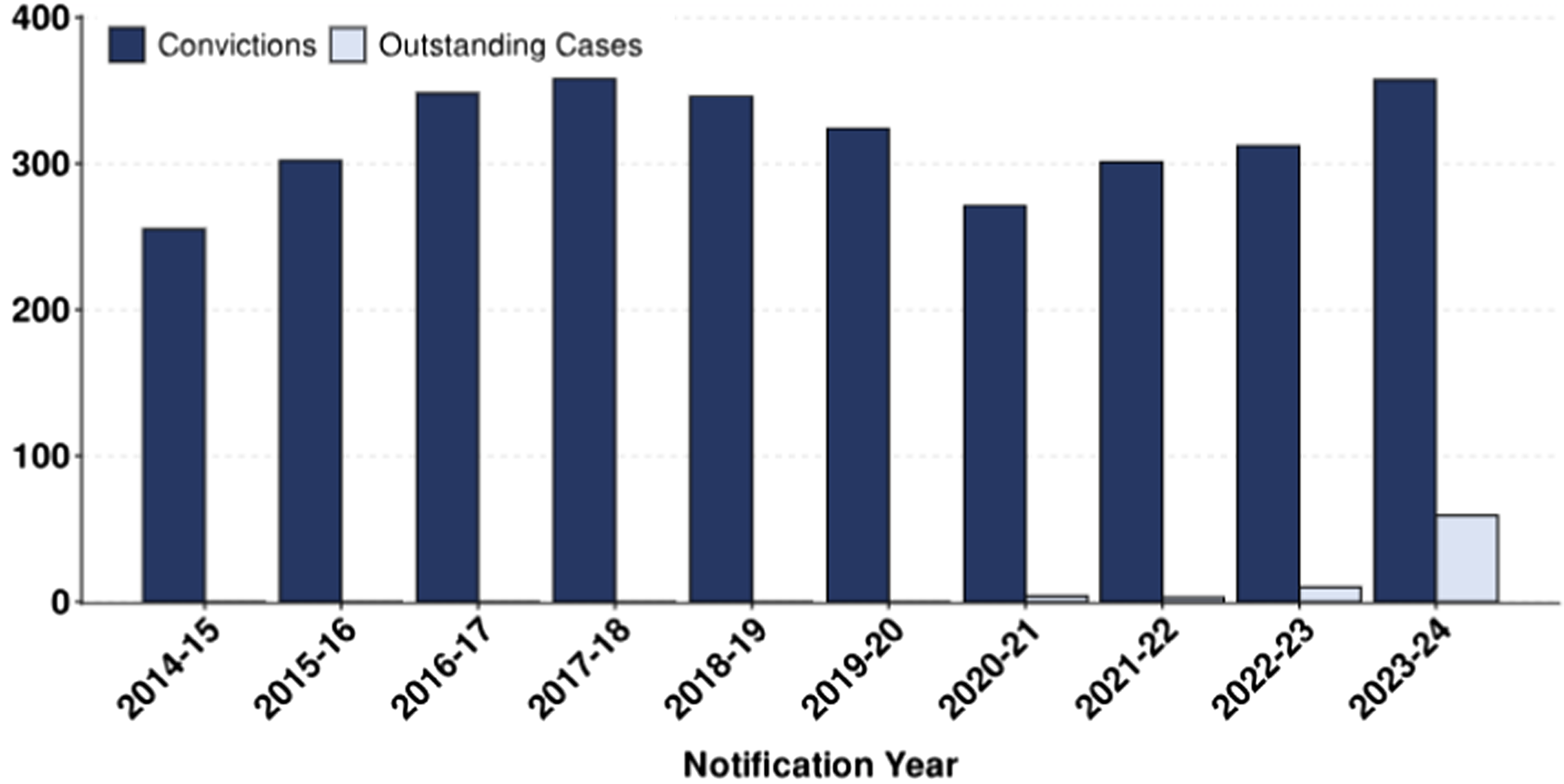
Number of SFO convictions by year of notification as at 30 September 2025 (Ministry of Justice, 2025b).
Many (around 40% to 50%) of notifications do not lead to an SFO conviction as the individual has the charges withdrawn, is acquitted, or is convicted of a lesser offence, and the time period between SFO notification and eventual disposal of the case is often months and can be years (Ministry of Justice, 2025b).
The number of SFOs is, in part, a function of the number of people subject to statutory supervision; new types of supervision and longer periods of supervision (linked with longer prison sentences) increase the population from which an SFO can be committed. For example, the introduction of statutory post-sentence supervision in the Offender Rehabilitation Act (2015) is identified as contributing to the rise in SFOs seen in the period from 2014/15 to 2017/18 (Ministry of Justice, 2025b).
Criminal behaviour has the potential to cause many harms – to direct victims, to perpetrators and those around them, and to the community more broadly. Crimes (including violent and sexual crimes) with direct personal victims can lead to physical and psychological injury with lasting and life-changing impact. While the purposes of probation supervision may be contested (Robinson and McNeill, 2023), the Probation Service aims to support desistance and reduce the likelihood that supervisees will re-offend. Further offending by people on probation is a negative outcome for probation both because of its impact on people and communities, but also because it signals weakness in organisational effectiveness.
The rise of risk management as a key task for the Probation Service is well documented (see, for example, Robinson (2016) and Kemshall (2016)). It is now more than 20 years since Garland (2001) identified that community supervision emphasised risk-monitoring functions over social work approaches. In a climate where ‘above all, the public must be protected’ (2001:12), SFOs can be seen to represent significant failure.
SFOs are not, though, a straightforward measure of the success (or otherwise) of the public protection work of the Probation Service. Firstly, the SFO captures a particular sort of reconviction, and reconvictions are constructed by the behaviour of various criminal justice actors. Harmful behaviour must result in a conviction to become an SFO. Secondly, the Probation Service has no easy way of measuring the ‘near-miss’ – situations which, perhaps as a result of skilful work or good fortune, might have led to the commission of a serious offence. This matters as evidence from other sectors suggests there is potential useful learning from near-misses (Woodier, 2025). Finally, while there is acknowledgement that some level of further offending is inevitable (HMIP, 2024a), this message sits uncomfortably with public debate about the successes and failures of public protection. The media rarely follows the work of the Probation Service, making an exception to report coroner's comments and independent reports examining the most egregious SFOs (Duffin, 2023; Weaver, 2024).
The Probation Service has established a procedure for responding to SFOs (HMPPS, 2021). This sets out the actions to be taken and timescale to be followed from the point that a possible SFO is identified at a first court appearance through to the production of a written review with associated action plan (the task of specialist probation staff called ‘reviewing managers’). The policy sets the framework for the ‘early look’ (a prompt initial review of a case), the quality assurance of the SFO review, gives guidance about communication in those cases deemed to be high profile (usually as a result of likely media attention), and has a section about employee care.
HMPPS (2021:5) sets out four audiences and purposes for its SFO procedure: reassuring the public that the Probation Service is reviewing its practice, informing victims about the individual's supervision (and any shortcomings), communicating to ministers and senior officials about high profile cases, and identifying best practice and areas for improvement along with an action plan for implementing changes. There are repeated themes that continue to emerge in SFO reviews including: the timeliness and completeness of risk assessments and enforcement processes, and better information sharing between agencies (Pearson and Carey, 2025).
The SFO review process is subject to inspection by HMIP. HMIP has a number of responsibilities here: it examines and rates around one-fifth of the SFO reviews produced by HMPPS, responds to requests from the Secretary of State to review a specific case, and produces an annual report. Its most recent report details the findings of its quality assurance work, draws on information gathered from victims and families of victims of SFOs and highlights a significant and growing backlog of uncompleted SFO reviews (HMIP, 2025).
This article is concerned particularly with the practitioner experience of this process. It describes the emotional and psychological impact of the process and considers ways in which a focus on the practitioner can restrict opportunities for wider organisational learning and development.
The studies
This article draws on findings from two small-scale studies (Study 1 and Study 2) both undertaken in part fulfilment of the requirements of a master's degree. Study 1 is the work of Steve Calder and Study 2 is the work of Lindsey Whitham. The two studies asked different questions about the probation response to SFOs but came to some similar conclusions about its shortcomings and gaps. In particular, findings about the consequences of the SFO review process for organisational culture and learning emerge in the two pieces of work. This article brings together findings from both studies, a synthesis that we undertook by reading and re-reading the data before identifying and agreeing its key shared themes. We then build the argument that, seen through the lens of the probation practitioner, the current response to serious further offending is stressful, confusing, and often misses opportunities for practice improvement.
Study 1 set out to research how the SFO review process was understood and perceived by both practitioners and those with a decision-making role in the process. It asked questions about the impact of the process on probation practice and organisational culture. It did this by adopting a qualitative approach with a research design comprising four focus groups with probation practitioners and 12 semi-structured interviews with probation managers and SFO reviewers. The research was conducted in the summer of 2023 in two different regions of England. 22 practitioners (six PSOs and 16 POs) participated in the focus groups; half of these practitioners had firsthand experience of supervising someone who was convicted of an SFO. The sample of interviewees was made up of six SFO reviewing managers and six managers (in Head of Performance and Quality and Head of Probation Delivery Unit roles).
Study 2 was concerned about the emotional and psychological impact of an SFO and the subsequent organisational response on the case-holding practitioner and asked about the extent to which this supported or hindered learning and recovery. This study also utilised a qualitative approach, gathering data from 14 semi-structured interviews with practitioners from three English probation regions (no region was involved in both studies). Participants in Study 2 were purposively sampled on the basis that they had experienced a concluded review within the past three years. Fieldwork was conducted in the summer of 2024.
Permission to undertake this research was obtained in both cases from the HMPPS National Research Committee. Ethical approval was additionally obtained from the university. In both cases, potential participants were given full information about the research, about the researcher and their dual student/employee status, and about the way that data from the study would be used and findings disseminated. Participants in both studies consented to participate on the understanding that data from the studies might be used in research beyond the student's dissertation.
Both researchers were aware that their fieldwork had the potential to trigger emotions including anxiety, distress, and anger. They provided participants with sources of support, ensured that there were opportunities for people to stop an interview or withdraw from a focus group, and – where necessary – checked back with a participant after the interview.
This article uses identifiers to protect the anonymity of the research participants. The identifier provides limited information about the participant. For example: S1FG1 is the identifier for a practitioner in Study 1 Focus Group 1, S1R1 identifies an SFO reviewer in Study 1, S1M1 identifies a senior manager in Study 1, S2P1 identifies a practitioner in Study 2.
Experiencing and learning from SFOs
Bringing together data from both studies highlights the impacts and consequences of the Probation Service response to serious further offending. These findings demonstrate the way that this response is perceived and experienced by practitioners. They also suggest avenues for development and improvement. We will first consider the emotional impact on practitioners of supervising someone who commits an SFO before moving on to explore how the SFO investigation process is experienced. This section concludes with findings about what is learned from the current process for responding to SFOs.
The emotional impact on staff
The emotional impact on a practitioner of supervising someone who commits (or is accused of committing) an SFO is significant. The impact is multi-faceted: emotions arise from the shock of the incident, distress about the consequences for everyone affected by the harm caused, and the sense of responsibility for what has happened. However, the subsequent scrutiny and investigation also trigger painful emotions for practitioners who feel judged and fear punishment. These emotional impacts have traumatic consequences which last well beyond the conclusion of the formal review of the case.
As a focus group member in Study 1 succinctly commented: First I thought “what the hell!,” then I thought of the victim, then I started worrying about what was going to happen to me. (S1FG4)
For practitioners who have an established working relationship with a supervisee, the new offence is not just a shock with concern for the victim but also brings sadness for the perpetrator as an individual and about the consequences that this event will have for their future. I felt really sad mainly about the fact that he had killed someone and really injured a family, like it was a really horrific offence. But for me it was having to read about it and I had a video call with him when he was remanded and that was really sad, because then I almost felt bad for him that he's about to go to trial and he was sobbing at the fact that he'd taken someone's life. So, for me it was mainly sadness and that worry of what would happen (to him). (S2P10)
Participants in both studies consistently made the point that they came to work with the intention of supporting people on probation to do well. Finding out that someone on their caseload had caused serious harm felt like a personal and a professional failure. Regardless of the outcomes of subsequent investigations, practitioners felt a sense of responsibility and guilt. I have experienced many SFOs over the course of my career and they’re very unpleasant. You know something awful has happened and you, naturally every practitioner […] feels responsible even if they're not […] I don’t know anybody that doesn’t feel some degree of hurt, responsibility or accountability, regardless. (S1M3) My first thing wasn't so much about me. It was “could I have done anymore for him?,” there was a huge sense of failing him. That real sense of, oh my god, this is this man's life. He's going to go back to prison. He's vulnerable. And when you have that working relationship with them, there's that huge sense that in some way you failed them. (S2P1)
The emotional impact for practitioners closely involved with SFOs does not end tidily when the investigations and enquiries are complete. The reality of the offence and the sense of responsibility have lasting psychological weight. I have to assume responsibility for that sort of risk. Someone's committed a horrific crime. I'm somewhat involved and I’m responsible. I want to say that's traumatic. It feels a bit dramatic saying that because when you think of trauma, you think of child abuse and horrific stuff, but it is something that sits with you. And if you do open that box back up, it is actually really hard not to get upset going over it … and I guess that is trauma, isn't it?’ (S2P5) I got given the CPS
1
, and he hit him over the head with this ornament while they were using drugs. He had his head bashed in, and now, when I go around and look at ornaments, I just want to get rid of them. I think it's like any traumatic event you remember the detail. (S2P1)
This is not to argue that there is a homogenous response from practitioners to the emotional impact of an SFO. While the majority of study participants spoke in terms of trauma and guilt, a minority identified different emotional patterns. I know people who have been much more distressed than I have. Maybe that's just the way my personality works. I'm not particularly volatile. Emotionally, I'm not someone who particularly gets upset, but the way I cope with it is perceiving it in quite a sort of angry and cynical way. I don't think anyone can go through an SFO and come out blithely unaffected by it. (S2P8)
Practitioners were emotionally affected by the new offence. They were distressed by its impact on victims and the perpetrator; they felt a sense of personal responsibility and failure. However, the emotional impacts of the SFO extended beyond the offence itself to the experience of the subsequent formal investigations. These processes include the work of the police, criminal courts, and coroner's service as well as the actions taken by the Probation Service.
Accounting for professional decisions, either in a police interview or as a witness in court, is an unfamiliar and stressful experience for practitioners with the potential to intensify feelings of guilt and responsibility. You get butterfly stomach, like, “oh, my God, I've done something really wrong here.” He was in court for murder, and I had to give a police statement and they said, “I need you to tell me how he presented on this day and what was happening.” So, it really did feel like I’d done awfully wrong. (S2P5)
Practitioners in both studies whose practice had been investigated by the Probation Service also spoke about feelings of stress, helplessness, and lack of control. I think it gets forgotten we don’t get enough support or probation don’t know how to support us […] it's quite traumatic, goes on and on and you don’t know when the end is, you’ve got no control over the process. (S1FG4)
An interviewee in Study 2 explained that the experience of the investigation had consequences for their subsequent return to the office. I remember the room. I remember the smell of the room. I remember what the person was wearing. I used to come in and throw up in the toilets regularly because I would come in with such anxiety just from walking through the same door. When something like that happens, it absolutely rocks the core of individuals. (S2P1)
The SFO review process as experienced by practitioners
In addition to this lasting emotional impact, data from the studies also illustrates other aspects of the Probation Service response to SFOs that practitioners question. These factors include: queries about the extent to which the response is viewed as fair, observations about how best to support affected staff, questions about the purpose of the SFO review, and frustration about a lack of focus on the overall context of the new offence.
Study participants understood that SFOs required an investigation but raised questions about its effectiveness and fairness. Practitioners found themselves caught up in a bureaucratic process, not clear about what would happen when and taken by surprise by requests for information or instructions to attend meetings. I didn't know the process. Then when I did get contacted, it wasn't until seven months after the actual SFO…. The way the e-mail was posed, it was as if I had already known that it was being investigated, but I didn't, obviously. And even my manager at the time got it and she emailed me saying, “oh my God, what's going on?” Because we're both confused that in all that time no one said anything to us … he said they had a backlog, but I should have still been notified because it was a high profile SFO. It was all over the news and it was gruesome. (S2P13) I think unless you work in the unit, you don’t really understand the process. (S1R6)
In addition to being unfamiliar the process was sometimes experienced as unjust. The sharpest examples of this came from practitioners who felt that investigating interviews were not trying to explore the events that led up to the offence but more adversarially unearth mistakes and poor practice. He just asked me the same question just reworded trying to catch me out. It felt like being interviewed by the police for something I've done wrong, rather than a reflective discussion of what had happened in the case. (S2P6) I'm going to share this because I just think it is a long time ago […] but at the point, I was going through my interview, you know, I actually felt quite confident, to be honest, because I felt I've done everything that I could possibly have done with this case and the ACO phrased one question one way and then phrased it a different, way and he actually, it's very unprofessional, but he.. but actually went “gotcha” and that has stayed with me my entire career. (S1FG1)
In addition to this feeling of unfairness practitioners had questions about the culture of the process and the extent to which this jarred with an ethic of care and support for staff. Individually tailored responses were seen to be lacking. Everything we expect practitioners to deliver to people on probation we need to do [to] our own staff. A person-centred approach that is personalised. Bring in some human kindness, which is not difficult. (S2P1) I had one session and just didn't find that particularly helpful…. It felt very detached. It didn’t offer any comfort. Offering PAM assist
2
is to cover themselves because it's part of a list of what happens when someone goes on to an SFO. (S2P5)
One study participant contrasted the way that the SFO review process was instigated with the way that it was withdrawn in the event that the supervisee was not convicted of a serious offence. There's absolutely no aftercare if the person is acquitted or found not guilty, or it's dropped by the CPS. They don’t come back to you and say sorry…. It's just like get on with it, it's not an SFO. Now be thankful it's not and that's the attitude being portrayed by the service- be thankful. (S2P2)
When asked about sources of support, practitioners with first-hand experience of an SFO pointed to the importance of immediate team members. Yeah, from my manager but nothing from the organisation. (S1FG4) The most support came from colleagues a lot who have either gone through SFOs before, or they know exactly what it's like to be on that front line with that workload. The colleague that offered to come to court with me, I mean that was probably the most reassuring part of it all. (S2P5)
SFOs are reviewed for a number of reasons: to provide victims with an explanation of the Probation Service role in the management of the perpetrator's case, to identify poor individual and organisational practice, to capture learning for the future, and to enable politicians to hold the service to account. These purposes sometimes conflict. For example, a report that looks at length at compliance with policy frameworks may not provide a clear narrative for victims or provide answers to politicians’ questions about what went wrong.
Study participants acknowledged these conflicting purposes and reflected on their implications. The SFO review services many audiences … it's very politicised … you know victims, PPG
3
, ministers […] because they are written for so many different audiences it's a very confused process and document now. (S1M3)
Two interviewees in Study 1 stressed that the needs of victims should be a priority in the review process. As a reviewing manager, I do really think that the kind of primary audience now for what I'm writing is the victim and the victim's family and that's where the layer of accountability sits. (S1R2) I think people lose sight of the victim in this, as an organisation we need to do better […] it's trying to serve two purposes, an internal management review and to satisfy the victim's family, quite frankly I don’t think it does either […] I think we can get lost in all the technical stuff, victims just want to know what went wrong and what are we doing about it (S1R1)
The practitioners whose work is being scrutinised in the SFO review are not part of the ‘audience’ for the written report. They are not routinely provided with a copy of the report and, further, the evidence from both studies suggests that practitioners (whether or not they had direct experience of supervising someone who committed an SFO) feel the review process to be lacking in transparency.
S2P12 and S2P7 had both experienced an SFO on their caseloads: I wanted to see the context of it from start to finish … seeing the SFO report would be really helpful for my learning. I’ve never received the learning points. And my SPO has not received them. It left me thinking what was the point? It's just like getting a new case and not having a pre-sentence report. If there was one written it just doesn’t make sense not to share it as without it there's no context to it. (S2P12) Nobody ever told me that the independent review would be published in the public domain. I found out myself when I googled it. It's terrible. Terrifying. I’ve never been to a coroner's court before, and you know there might be cameras, people watching and judging, wondering if I’ve done something wrong. I was just completely and utterly anxious. (S2P7)
Finally, study participants argued, from their personal experience, that the post-SFO review focused too much on the actions of individual practitioners and insufficiently on the wider organisational context. This added to the weight of blame felt by the practitioner while giving a misleading message to the public and blunting the opportunity for organisational improvement. That's not to say that individuals aren’t guilty of poor practice. Although I would even then say it's very rare that there's a case where the practice was just because someone didn't give a shit or was incompetent. I think it would almost always be in the context of overwork, lack of training, not being given enough supervisory oversight, that kind of thing, and yet the individual officer is generally made to experience the feeling that they might as well have committed the offence themselves. That's how it impacts on the person. That they seem to be the perpetrator. (S2P8)
There is growing interest in the Probation Service in the ‘human factors’ approach (HMIP, 2024b) which recognises that practitioner errors can be symptoms of these systemic issues. However, at present, the focus of the SFO review and the subsequent publicity feels to be about practitioner accountability. I’m just thinking about recent media cases […] and once again it's all about the practitioner […] and a lay member of the public see that and don’t think there's probably organisational issues, but probably that the practitioner was a bit shit. (S1FG1)
Evidence from both studies indicates that the review process has become increasingly complex, adding layers in response to policy changes rather than streamlining them. Practitioners also describe feeling distant and excluded from a process that seems over-engineered and disconnected from their experience.
What is being learned
Finally, the findings from both studies shed light on the learning (individual and organisational) that is generated by the SFO review process. While some of this learning is positive and likely to be in line with the organisation's intentions, other learning appears detrimental for probation practice.
One key finding across both studies is the widespread view among practitioners that the SFO process is about attributing blame rather than improving and developing practice. I would agree with the others, I haven’t actually experienced an SFO, but every SFO I’ve heard about is blame and they use learning as a cover-up […] so when we were talking about accountability like the first words that were coming to me were like, who's to blame. (S1FG1) If nobody gives us the confidence that in an SFO, individuals won't be pilloried, scapegoated for no particularly good reason then we are inevitably going to protect ourselves, whether we do it consciously or unconsciously, and that will be replicated by managers throughout the organisation. I don't think for me there's been any positive learning come out of it at all except increased back covering … but I would argue that too much is over egging and not having faith in your own practice or your own judgement. (S2P11)
The fear of being found responsible for an SFO leads to risk-averse practice. For participants in Study 2, with first-hand experience of supervising someone who committed an SFO, this was particularly sharp. Their post-SFO practice was often more cautious and less confident. Now I want [my casework records] to be perfect so if there is an SFO, I can evidence that I've done everything I can to the best of my ability to try and prevent that. You feel very exposed and very vulnerable in terms of your practice being picked apart, so now I write [risk management plans] with everything in, everything is extra and isn’t needed but it's just to be able to say it was there, and I ask my manager to put an oversight entry on every decision made in case something goes wrong … then I have the evidence. (S2P6) 100% I go over the top now, and it's forcing me to do extra…. Now I'm just like screw it, I'm putting referrals in left, right and centre … it's anxiety that drives some of the decision making now rather than rational assessment. (S2P12)
However, this feeling of scrutiny extends well beyond those practitioners who are directly affected by an SFO. If practitioners believe that the purpose of the SFO review process is to find an individual to hold to account for practice failures, defensive and process driven practice becomes a logical response and the appropriate use of professional discretion and expertise is undermined.
SFO reviews generate action plans which set out the steps that will be taken in response to the review findings. Some participants spoke critically of these plans, suggesting that they were not a useful or meaningful way of capturing learning for the organisation. The effectiveness of action plans is currently viewed as constrained because they are seen as repetitive and formulaic, with a focus on minor practice decisions rather than the wider organisational context in which the new offence was committed. I have a real bee in my bonnet about the action plans, they all look the same just change the name […] There is this kind of script that isn’t really about learning for me. (S1M3)
A participant in Study 2 spoke negatively about the superficial learning objective set for them following an SFO. ‘One of the tick box goals was to do the seven-minute professional curiosity. That is massively condescending to me because if I hadn't worked out what professional curiosity was after 30+ years. I am naturally sceptical. In fact, if you really think my professional curiosity was amiss, then at least do me the honour of asking me to do something proper. Don't give me something that I find online, and I say, oh, yeah, ask questions. (S2P8)
The majority of the evidence from both studies suggests that much of the learning from the current process of reviewing SFOs encourages practice that is cautious and process-driven. There were, though, some more positive voices (at least amongst managers) reflecting the steps that the probation service is taking to act constructively following an SFO. We have a really good setup […] our P&Q head
4
feeds the themes into our continuous improvement agenda. (S1M6)
Conclusion and implications
This article is about the aftermath of an SFO for probation practitioners. It has explored the impact of an SFO and the associated investigations on the emotional well-being of staff. It has highlighted concerns about procedural fairness. It points to frustrations about the focus on individual practitioners rather than the wider context of the new offence, with opportunities for learning not being captured effectively at the right level in the organisation. It has shown that the impact of the review process, on practitioners, can lead to practice that is cautious and risk averse.
Drawing on the findings from our studies, we suggest ways in which the Probation Service might develop its approach to reviewing SFOs. In doing this, we acknowledge the need for thorough and timely investigations when serious offences are committed by people on probation, not least to provide information and explanation to the victims. We also recognise that work to amend the SFO process is underway in HMPPS with the establishment of a task force ‘to promote an SFO learning culture and enhance staff support’ (HMIP, 2025).
Some forthcoming policy changes are likely to reflect the concerns raised in this article. We offer three points for consideration. The first is about the care provided for practitioners following an SFO on their caseload. The distress about the offence (and its consequences for victims and perpetrator) is compounded by the distress caused by the subsequent investigation (leaving the practitioner feeling isolated and blamed). Trauma-informed support is a proper response to a traumatic incident. In some cases, this input will need to go beyond the assistance provided to all staff around poor mental health or occupational stress. It is also important that, where specialist support exists, practitioners and their managers know what is available and how to access it.
The second point is about the tone and atmosphere surrounding the SFO review process. For so long as this is perceived as being about allocating blame, opportunities for organisational learning and individual practitioner development are hampered. The Probation Service is not the only organisation that faces the challenge of learning from serious incidents (or learning from circumstances where a serious incident was narrowly avoided) and can draw on practice from safety critical industries including aviation and healthcare where the focus is on the systemic and organisational failures more than on the individual error. Probation culture can and must move further in this direction. This can be achieved by building on initiatives that are already underway (for example the adoption of a human factors approach (HMIP, 2024b)). In addition, there is scope for the Probation Service to learn more from near-miss situations (e.g., serious incidents that fall short of the SFO criteria) but also to develop ways of learning from excellent practice (for an example of this from the health service see Kletter et al., 2020).
Third, and finally, it is hard to escape the conclusion that the Probation Service has built a review process that is bureaucratic, technical, and poorly placed to meet the varying needs of diverse stakeholders. These stakeholders include politicians and the general public, as well as the particular victims of the new offence. Work commissioned as part of the most recent HMIP annual report highlights the extent to which victims of SFOs can feel dehumanised, inadequately supported and perplexed by the current process (HMIP, 2025). This does not sit well with the wider research evidence that suggests that victims are helped by interactions that treat them with respect. They value information that answers their questions in a clear and timely manner and offers reassurance that organisations will learn from their mistakes (Lawal et al., 2025; Murray et al., 2025).
This article suggests that practitioners often feel caught up in a process that is about judgement and blame rather than learning. Opportunities for learning are hampered by a process that is experienced as lacking transparency and which does not routinely share its findings with the practitioners subject to investigation. While organisational concerns about confidentiality are cited as the reason why the SFO reviews and action plans cannot be shared, practitioners who are impacted by an SFO should be informed of the findings and related actions to support a more transparent and less fragmented learning process.
Current SFO reviews invest a great deal of time and energy applying a fixed investigatory process to a specific set of further offences. Delays and backlogs in the system are a problem for everyone: victims must wait for information, practitioners spend longer caught up in investigations compounding their anxiety, and any useful learning (at either the organisational or individual level) risks being lost.
This article has focused specifically on probation practitioners and managers. It advocates for changes to the current SFO review process, particularly by acknowledging the emotional toll on those practitioners directly involved and meeting their needs for support and ensuring that the outcomes of SFO recommendations lead to learning and development at all levels of the organisation. The Probation Service's response to all significant incidents (including SFOs) should both have the potential to improve the quality of practice and build a culture that treats staff with respect and care, recognising the emotional and professional impact these events can have on practitioners.
Footnotes

Funding
The authors received no financial support for the research, authorship, and/or publication of this article.
Declaration of conflicting interests
The authors declared no potential conflicts of interest with respect to the research, authorship, and/or publication of this article.