



Abstract
As qualitative research progresses, a precise understanding of the specific techniques that are still underdeveloped in literature is key. This discursive article provides a comprehensive overview of pattern matching analysis, a method that compares theoretical patterns derived from existing theories with empirical data to assess the agreement between theory and observed phenomena. Given the lack of consensus on the procedure for conducting this technique, this review addresses the gap in the qualitative literature. The significance of pattern matching analysis is emphasized because of its capacity to bridge theory and data, allowing refinement or qualitative testing of the theory. This article reviews and highlights the approaches and procedures used for pattern matching. It proposes meaning overlap as a guiding criterion for discerning the congruence between theoretical and empirical patterns. This study presents pattern matching as a versatile and formal method, emphasizing its potential for testing and refining theories in deductive qualitative research.
Keywords
Introduction
Qualitative research methodologies have evolved over the decades by incorporating deductive approaches as a means to explore phenomena. In this approach, theories serve as a framework for understanding reality and building new knowledge. However, there are situations in which qualitative research requires not only the foundation of a theory but also its evaluation and knowledge of its transferability, the accuracy of its fit with a phenomenon, or to adapt it to different contexts and periods beyond previous studies. This poses a challenge, because qualitative research traditionally follows an inductive approach aimed at generating concepts and building theory.
When research projects aim to assess the transferability or testing of a theory, research is conducted using a deductive approach (Fife and Gossner, 2024; Sinkovics, 2018). This approach is grounded in theory, which informs the design and development of the study. Among the various qualitative methodologies that enable a deductive approach is pattern matching analysis.
Pattern matching involves comparing anticipated outcomes, as predicted by theory-derived patterns, with observations reflected in empirical data patterns collected during research. The method begins by formulating propositions derived from theory, which serve as predictions for the studied phenomenon. The analytical phase examines the relationships between the propositions and patterns present in the collected empirical data, focusing on the identification of congruences or divergences between the two patterns.
The example of Khatri et al. (2024), which explores self-leadership traits using business mogul and entrepreneur Elon Musk as a case study, illustrates the application of pattern matching in qualitative research. The researchers began by systematically reviewing the literature to identify key theoretical dimensions of self-leadership. Based on these dimensions, they formulated them into theoretical patterns (e.g. “Individuals who are self-observant are self-leaders”). Subsequently, empirical patterns were extracted from speeches and interviews by Musk in the media, and a comparative analysis was conducted to assess the degree of alignment between theoretical and empirical patterns.
Despite the acknowledged potential of pattern matching in qualitative research, a systematic understanding of its procedures, applications, and implications remains underexplored compared with other methods. This discursive article seeks to fill this gap by providing a more comprehensive overview. It compiles different perspectives on pattern matching, providing researchers with an overview of its rationale, proposed procedures, as well as guiding criteria and examples regarding its implementation.
Pattern matching allows us to revise the consistencies and discrepancies between theories and observed phenomena. This involves comparing data with predefined theoretical categories, assessing whether observed patterns align with the theory and its predictions, or revealing new insights for further exploration or theoretical refinement (Bouncken et al., 2021; Pearse, 2019a, 2019b; Sinkovics, 2018). Although its application in qualitative research is less widespread, pattern matching offers a formal and flexible framework that links data with theory to produce robust findings and grounds for revising theoretical frameworks.
Although pattern matching has been employed in qualitative research, its use is not as extensive as other qualitative analytical methods. The idea of pattern matching was attributed to Campbell (1975; Cao, 2007; Hyde, 2000; Sinkovics, 2018; Trochim, 1985), who proposed it as a way of comparing theoretical implications with observed data to assess the validity of the theory. He maintained that this process requires explicitly stating the predictions, collecting evidence through observation, and then comparing the results to determine if they match the theory. In his proposal, illustrated with the ethnographic study of culture through case studies, the scientist emphasized keeping a detailed record of matches and mismatches (like a check box of hits and misses) to probe the theoretical body through case study research. Other of the earliest references to pattern matching can be found in Trochim (1985), who argues that the research process depends fundamentally on the interaction between conceptual ideas and empirical reality, that is, it essentially involves gauging the extent to which observations harmonize with theory.
Despite the limited diffusion of pattern matching, this method provides the qualitative researcher with a formal framework for deductive inquiries. By adopting a formal approach that incorporates predefined theoretical categories, pattern matching has benefits that manifest in different ways. On one hand, this method provides structure to the study design by orienting it toward the shaping of theoretical and empirical patterns and their consistencies, both when examining the transferability and applicability of a theory. On the other hand, the data collection procedure, by informing the type of data required to conduct overlap analysis. And, to the subsequent analysis of those data, by providing a procedure for identifying overlaps between theoretical and empirical data. In addition, by examining whether the data fit or contradict a pre-existing theory, the findings provide a basis for critiques and contributions that strengthen the theory. Furthermore, the pattern-matching procedure is transparent at each stage, enabling other scholars to understand the analysis undertaken and increasing the credibility and reproducibility of the research (Johnson and Onwuegbuzie, 2004).
The following sections present the basis of the method, the proposed procedures, and the guidance criteria for its implementation.
Rational underpinnings of pattern matching
An important starting point for understanding pattern matching is to consider it both as a logic and a technique of qualitative analysis (Bouncken et al., 2021). This idea is consistent with the initial reflections of Trochim (1985) and the developments of other authors (Almutairi et al., 2014; Attard Cortis and Muir, 2021; Hak and Dul, 2010; Sinkovics, 2018). As a logic, pattern matching provides a framework for comparing theoretical predictions with empirical observations. As a technique, it follows procedures for conducting this comparison systematically.
Pattern matching examines the overlaps between patterns based on the theory used in a study and those present in the empirical data collected for that study, describing the coincidences and discrepancies between the two components. It provides guidelines for designing and conducting research to apply the described logic for data recollection and analysis (Bitektine, 2008; Bouncken et al., 2021).
For example, template analysis (King and Brooks, 2018; King et al., 2017) is a qualitative thematic analysis methodology based on pattern-matching logic (Sinkovics, 2018). In this design, the researcher iteratively develops a template of themes in cycles in which subsets of data from the dataset are analyzed until a final template is configured. When this design is used deductively, researchers create the preliminary template with a priori categories drawn from theory or previous studies, thus acting as a preliminary theoretical template. The template is then applied and compared to subsets of the empirical data, following a pattern matching logic by elucidating the alignment between a priori theoretical themes and the data analyzed (Figure 1); at each iteration, the initial theoretical template is refined.

Pattern matching logic in deductive template analysis.
If viewed as a logic of iterative comparison between themes in the template and data, it could be argued that pattern matching is more of a heuristic tool that serves as a guiding framework rather than a methodological procedure. However, the literature provides procedures for formally conducting pattern matching as an analytical technique.
For example, Panuwatwanich et al. (2009) conducted a mixed-methods study using pattern matching to validate a model of innovation diffusion in architecture, engineering, and design firms. Their research is also suitable for flexible pattern matching. The authors first conducted a quantitative study to develop a model describing the relationships between constructs in their study (which served as the empirical pattern, that is, organizational culture for innovation (OCI) and innovation diffusion outcomes (IDO). In a second qualitative case study, pattern matching was applied to confirm the validity of the empirical model by comparing the expected predictions based on the constructs of their model with the data obtained through interviews.
As a technique, pattern matching procedure is not a rigid or confirmatory exercise aimed solely at identifying the presence or absence of matches between predicted and observed patterns. Rather, it serves as an analytical means that requires interpretative engagement by the researcher to deepen the understanding of the data and to yield insights. As with any qualitative process, the researcher’s interpretative perspective is central to achieving nuanced and insightful analysis. From this perspective, theoretical propositions, while informing the analytical process, must be critically examined against empirical data through the lens of reflective interpretation. This critical reflection is essential for challenging existing theoretical frameworks, uncovering unexpected patterns, and exploring alternative explanations of the phenomenon under investigation. Furthermore, pattern matching does not conclude with the identification of coincidences or divergences but extends to the interpretative analysis of these findings, aimed at explaining the phenomenon under investigation and contributing to the enrichment of the underlying theoretical framework.
Different types of pattern matching
Sinkovics (2018) classified three different types of pattern matching: full, partial, and flexible pattern matching.
The concept of full pattern matching spans the initial theorizing, conceptualization, definition, and specification of theoretical patterns in addition to the matching analysis of those patterns with observed data. This approach is useful for research that examines causal relationships and elaborates upon their explanations. To establish causality and validate it, researchers must develop alternative explanations through conceptualization and operationalization prior to conducting data collection by systematically considering different theoretical frameworks or conceptual perspectives from the literature to apply them to the phenomenon under investigation. The goal of full pattern matching is to determine the theoretical explanation that best fits the observed data and provides a complete understanding of the phenomenon. Sinkovics (2018) argues that this version of pattern matching, aimed at establishing causality, also incorporates quantitative elements in the procedure and is not much different from some traditional hypothesis testing methods (such as t-test and ANOVA). This stance places it far from the traditional qualitative approach and has not been further developed.
To illustrate full pattern matching, consider the study by Butler et al. (2024), who examined how Relational Cultural Supervision affects the development and self-efficacy of counselors in training by employing quantitative and qualitative techniques. Empirical data were obtained through interviews and surveys using a pre- and post-assessment design with a 37-item instrument specifically designed to assess this construct. The authors established the following patterns: Theoretical pattern: Receiving Relational Cultural Supervision, an interpersonally sensitive style of supervision, may influence the counselor-in-training’s level of self-efficacy. Empirical pattern: Receiving interpersonally sensitive styled supervision does influence counselor-in-training’s levels of self-efficacy. Empirical pattern: Receiving interpersonally sensitive styled supervision does not influence counselor-in-training’s levels of self-efficacy.
Grounded on the data from interviews and quantitative findings obtained from surveys, Butler et al. (2024) proceeded to compare the observed patterns and the theoretical proposition and concluded coincidences or discrepancies. Hoffmann (2007) is another example of full pattern matching. Here, the author examined how the configuration and evolution of alliance portfolios impact firm performance, using a theoretical framework based on contingency and co-evolution theories. Pattern matching was conducted to analyze the data using quantitative and qualitative components.
While full pattern matching focuses on the examination of causal relationships, partial pattern matching takes a different approach by integrating the researcher’s conceptual perspective.
Partial pattern matching seeks to integrate a researcher’s own mental models into a theoretical construction. Sinkovics (2018) explains that pattern matching can be approached in both top-down and bottom-up ways. While both methods aim to engage the researcher’s mental models in the theorizing process, they do so from distinct perspectives. The bottom-up approach follows an inductive process, based on empirical observations and data. In contrast, the top-down approach operates within the theoretical domain and serves as a potential starting point for a comprehensive pattern matching process. This approach relies on the interaction between existing literature and the researcher’s mental framework.
On the other hand, flexible pattern matching offers a greater degree of adaptability in relating theoretical and empirically observed patterns and is suitable for exploratory rather than explanatory purposes (according to the categorization by Yin, 2018). Techniques under this categorization have been the most extensively used in the methodological literature and qualitative studies.
Outlook of flexible pattern matching
Flexible pattern matching encompasses techniques that allow adaptability to design. It begins with the constitution of an initial theoretical pattern that provides a structure for investigation. As data are empirically collected, emerging patterns are identified among those that may or may not match the initial framework. Subsequently, theoretical propositions are iteratively examined to incorporate these new insights, ensuring consistency with the observed data. The process of comparing empirical patterns with existing theories uses the logic of replication to test the validity of emerging propositions. The researcher can build a theoretical pattern based on established theories, previous studies, or their own knowledge. Empirical patterns can be identified by a procedure informed by theory or by the application of another analytical means.
Flexible pattern matching is suitable for exploratory research, in which the goal is to build new theories or review existing theories based on empirical observations. This approach balances the structure with flexibility and ensures methodological rigor.
The case study research proposed by Yin (2018) is a qualitative design that suggests the use of pattern matching analysis. Although the author does not explicitly categorize this technique as Sinkoviks does, case studies using this technique align with his definition of flexible pattern matching due to their design and procedural characteristics. Yin (2018) proposed pattern matching as one of several analytical strategies when conducting case studies. The author argues that pattern matching can be used to confront competing explanations. In this approach, alternative explanations are evaluated to determine whether they account for the conditions not considered in the original theory. To do this, before data collection begins, the theory to be tested must be stated along with at least one competing theory. The patterns predicted by both the main and competing theories were then compared with the data. Yin proposed pattern matching as an analytical strategy to strengthen internal validity in a case study (Mishra, 2021). Internal validity is strengthened by identifying whether there is a match between the patterns observed in the empirical data and those present in the theoretical propositions that explain the phenomenon under investigation. It should be noted that Yin presented a conceptual proposal for pattern matching analysis, rather than a procedure for its application (Cao, 2007).
The research conducted by Hyde (2000) serves as an example of a flexible pattern matching application. In an investigation of the habits and preferences of independent vacationers, the author inductively developed 14 theoretical propositions as part of their own study, for example: “An integral element in independent travel is the enjoyment the independent traveler experiences from not planning the details of their vacation.” After establishing this theoretical framework, new data collection was conducted through interviews with travelers, whose empirical results were contrasted through multiple coders, with the 14 initial propositions. Independent judges assessed the adequacy of these propositions by comparing them with summaries and excerpts from the interviews, determining whether the data supported each idea or whether adjustments to the propositions were required. Although the Wilcoxon signed-rank test was used to measure consistency among the judges, this statistical analysis was not used for pattern matching. The procedure was based on the guidelines of Yin (2018) and Woodside and Wilson (1995), establishing theoretical propositions prior to data collection, formulating an alternative theory for contrast, and employing independent judges to assess the correspondence between the data and both theories, reporting matches, and mismatches.
Another example of flexible pattern matching can be found in Cao et al. (2004), in which the authors conducted a case study aimed at investigating change management in a higher education organization from a critical systems thinking perspective. The researchers developed a theoretical pattern of expected outcomes based on critical systems thinking, which was then compared with the empirically based pattern in the case study, using a series of systemic criteria. The analysis categorized the patterns according to criteria derived from critical systems thinking (i.e. improvement). An excerpt from the patterns in Table 1 shows a discrepancy between them.
Excerpt of patterns in Cao et al. (2004).

In their methodological argumentation, Cao et al. (2004) refer to the patterns as “pragmatic reality” and “theoretical ideals,” and the latter predict the expected outcomes of the examined phenomenon. Pragmatic reality describes what the actual case is, whereas the theoretical ideal refers to what it should be. The authors explain that this technique is applied through the logical application of linking the data between the empirical pattern observed in the case and a theoretical pattern of expected outcomes, which could have occurred on a theoretical basis.
Implementation of pattern matching analysis
To translate pattern matching from theory to practice, the two procedural frameworks proposed in the literature are presented below.
Almutairi et al. (2014) proposed three-stage procedure for pattern matching implementation in case study research, following Yin’s (2018) tradition of this design. The authors delineated the pattern matching process into three phases.
1. Establishing the study proposition.
The study proposition is formulated as a general hypothesis that guides the research and can be derived from the existing literature, theoretical foundations, or intuitions based on the researcher’s experience. This approach allows for the identification of an expected pattern or relationship of interest that will guide the analysis without fragmenting it into multiple propositions or reducing it to constructs of a larger theory.
2. Test the empirical pattern with the predicted one.
In the analysis, the patterns derived from the empirical findings are compared with the propositional pattern to determine the degree of agreement between the two. This comparative process evaluates whether the empirical findings align with the predicted pattern, indicating that the proposition is supported.
3. Provide theoretical explanations and elaborate on the findings.
When the patterns align with the empirical results, theoretical explanations and interpretations are developed. Otherwise, when the patterns do not match, alternative explanations are formulated to explore how and why such discrepancies occur.
In addition, Bouncken et al. (2021), based on Trochim (1985) and Sinkovics (2018), proposed a five-step guideline for implementing the flexible pattern matching method, which is as follows:
1. Formulation of research question (s).
This question guides the study and justifies the use of a pattern matching technique.
2. Generation of theoretical patterns.
Patterns deduced are established a priori, that is, before data collection. Pattern generation can be performed based on pre-existing theoretical information, a clearly established conceptual framework, previous research, the researcher’s knowledge, or hunches.
3. Theoretical sampling and data collection.
The selection of participants and cases is determined using the established theoretical framework of the study. With the theoretical patterns generated as a basis, theoretical sampling is followed to select relevant data to examine the theoretical framework.
4. Analyzing and matching data
This can be performed as data are collected and analyzed iteratively, and back and forth between the theoretical patterns and the empirical data to discern patterns observed in the latter. The analysis is considered to reach saturation when the matching process provides sufficient information to answer the research question, and no new insights are identified.
5. Interpreting and theorizing. The results of the comparison between the theoretical and empirical patterns are reviewed, and improvements or alternatives when mismatches between the two are identified.
Review and integration of proposed pattern matching procedures
Although the underlying logic of pattern matching is present in both procedures, it is possible to identify some commonalities and differences beyond the number of steps in each procedure.
The development of Almutairi et al. (2014) did not incorporate the different typologies of pattern matching proposed by Sinkovics (2018) and Bouncken et al. (2021). Perhaps, this explains why the latter starts the process with the research question, arguing that the question will guide the type of pattern matching to be applied. They explain that when the researcher is not clear about a meaningful research question, it is convenient to follow a top-down process typical of partial pattern matching, which will lead to relying on the preceding literature to further state the research question. However, this suggestion seems more appropriate for pattern matching as logic than as a technique, which is the optics for proposing a procedure. Thus, the research question does not seem to be a conditioning factor for initiating the pattern matching process.
In the establishment of theoretical patterns, authors agree that they can derive from theory, previous research, or from the knowledge or intuition of the researcher. The proposals also exhibit differences: while Almutairi et al. (2014) stated a study proposition, presenting it as an example of a single general hypothesis, Bouncken et al. (2021) referred to several theoretical patterns. The distinction lies in the fact that Almutairi et al. (2014) maintain a general approach to the theoretical proposition, whereas Bouncken et al. (2021) proposed a disaggregation of the theory into its components to establish several propositions. The latter is a procedure commonly observed in the literature that applies the method.
For example, Khatri et al. (2024) analyzed self-leadership traits for resilience using business mogul Elon Musk as a case. Based on a systematic review of the preceding literature, the authors planned 13 propositions for the theoretical pattern of their study. The following are some examples:
P1: Individuals who indulge in self-goal setting are self-leaders.
P2: Individuals who are self-observant are self-leaders.
P6: Individuals who embed natural rewards into their work activities are self-leaders.
P9: Individuals who make use of positive self-talk are self-leaders.
Regarding sampling and data collection, Almutairi et al. (2014) did not explicitly detail the suggested strategy for the selection of participants or cases, while Bouncken et al. (2021) established theoretical sampling as a deliberate stage, where the selection of data is consistent with the previously established theoretical sampling, guaranteeing a correspondence between the selection of information and the theoretical framework. However, the data may not always be obtained through this sampling technique, for example, if it is a dataset of a larger study, or even if it comes from another investigation. In such cases, it could still be evaluated whether pattern matching is a technique that makes sense for the purpose of the study so that theoretical sampling, while desirable, does not appear to be prescriptive.
Regarding data analysis, both agree that it is an iterative process between the theoretical patterns and the data collected through which they seek to examine the patterns in these data. However, they do not include guidance on how to organize data or conduct analysis to discern the matching of patterns, or whether prior to such discernment, an analysis should be conducted to identify the empirical patterns.
Cases in the literature show that two paths can be taken to organize empirical data: (i) analyze data deductively, informed by the theoretical propositions established a priori, as with a codebook (Pearse, 2019a, 2019b), or by conducting a deductive template analysis (King and Brooks, 2018); or (ii) organize the data by inductive coding, using data-driven qualitative techniques that allow for finding categories or themes (Attard Cortis and Muir, 2021), which are then established as the empirical pattern. Depending on the study design and the nature of the examined phenomena, the researcher will evaluate which avenue is appropriate.
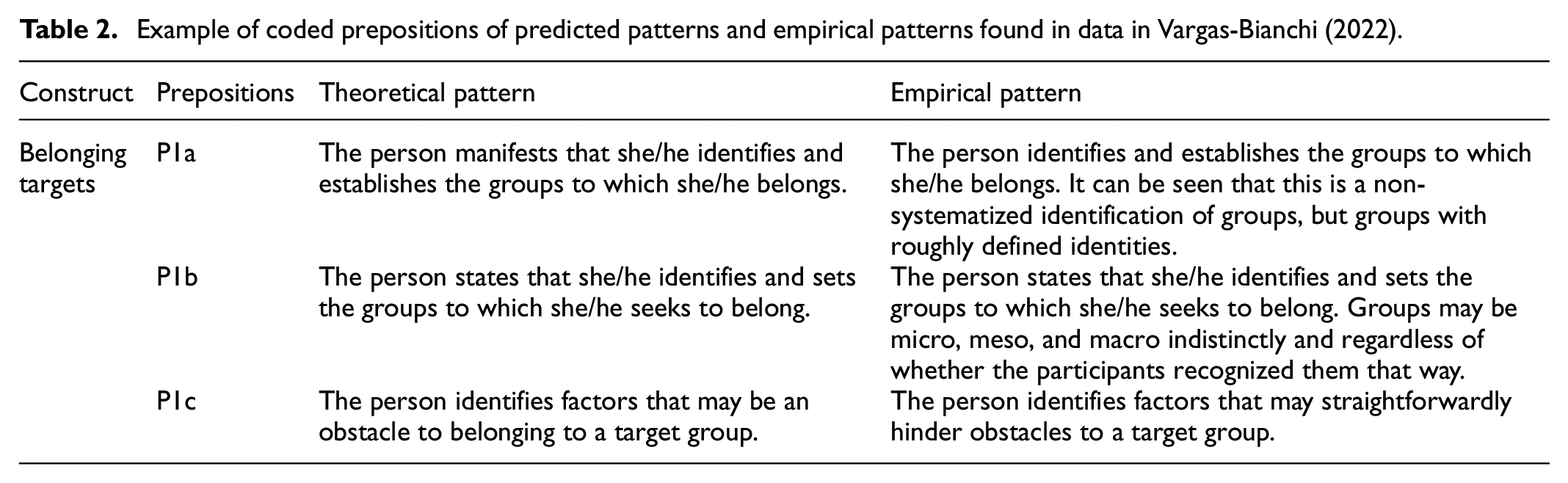
For example, Vargas-Bianchi (2022) followed the second path by analyzing the transferability of a theory on consumption behaviors motivated by the desire for group affiliation. This study began by formulating propositions based on constructs from a theoretical model. Each proposition is associated with a code and definition, thus giving rise to a theoretical pattern. Subsequently, empirical data collected through interviews and a follow-up questionnaire were subjected to structural coding analysis, resulting in the creation of an empirical pattern. Finally, patterns were compared to identify similarities and differences. Discrepancies between the patterns led to the proposal of a refinement of the original theory. For this process, a table was used to organize each of the components mentioned above to provide an integrated analysis. Table 2 presents a partial example of this data.
Example of coded prepositions of predicted patterns and empirical patterns found in data in Vargas-Bianchi (2022).
In addition, little guidance has been given on how to discern the patterns. The authors themselves suggest that criteria or measures are still needed to assess the degree of concordance or discordance of the patterns and evaluate the results. A box of hits and misses has been suggested to record the matches (see, e.g. Pearse, 2019a), but without specifying what is considered to be a hit or miss or a criterion for discerning it.
Finally, only Boucken et al. (2021) suggested a guideline on when to stop the analytical phase, resorting to the concept of saturation when no new coincidences are found between patterns.
Consistent with the foregoing, both analytical procedure frameworks proposed in the literature could be condensed into three stages, incorporating the precision of each and considering the practices observed in the studies that use the method: (i) establishment of theoretical patterns, based on theory, prior research, or knowledge; (ii) analysis of pattern matching to discern consistencies and divergencies between predicted and observed patterns; and (iii) interpretation and theorization to confirm or further refine the theory (Figure 2).
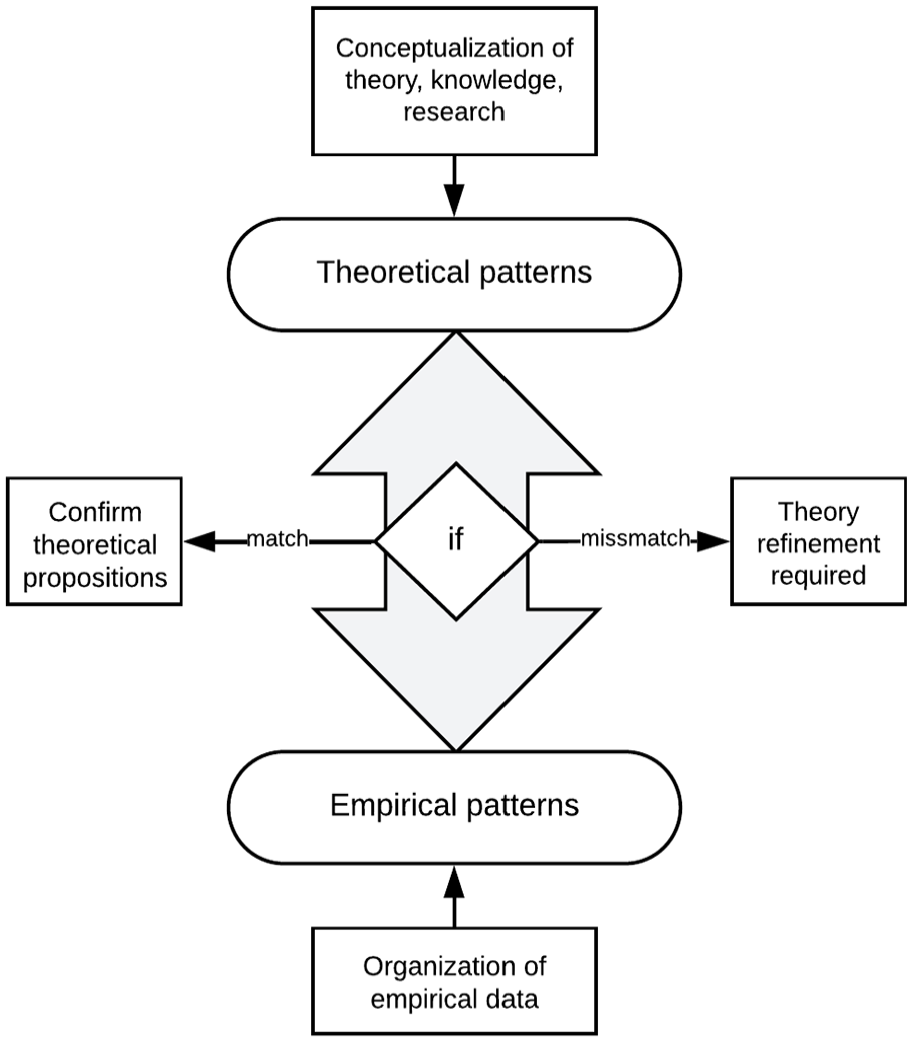
Condensed three-stage framework for pattern matching analysis.
Still, additional guidance would be of value to discern consistencies and inconsistencies between theoretical patterns and empirical data during the second step. Meaning overlap can be a suitable ground to elaborate on this orientation.
Meaning overlap of patterns
By examining the procedures proposed by the authors and reviewing the studies that employ pattern matching analysis, it is evident that its application involves an iterative process of identifying and determining the “meaning overlap” between theoretical patterns and patterns in the empirical data.
Meaning overlap refers to the degree to which core concepts or findings from theoretical and empirical patterns share common elements, thereby indicating a match.
This overlap occurs at the conceptual or abstract level, referring to cases in which two components share common elements, properties, or areas of meaning, resulting in significant convergence in their definitions or interpretations. In other words, overlapping occurs when patterns inhabit the same meaning space, their core definitions point to the same underlying phenomenon, or the core meaning of each pattern intersects. Described informally, it can be said that they both “speak of the same thing.” For example, concepts such as “justice” and “fairness” manifest such meaning overlap. Examples of the overlaps (or their absence) in research are presented (Tables 3 and 4).
Meaning overlap example (Attard Cortis and Muir, 2021).

Absence of meaning overlap example (Cao et al., 2004).

This criterion follows a logic similar to that implemented when subjectively assessing intercoder reliability (Guest et al., 2012). Intercoder reliability indicates the degree to which two or more analysts consistently code for the same dataset. When analysts identify discrepancies between the codes they assign, they address them through mutual discussion and reflection to achieve alignment between their codes, or with the coding scheme if they have one. The mutual discussion is at its core a meaning-alignment review between codes.
As expected, this overlap becomes more complex when the research addresses more abstract realities or intricate phenomenological perspectives of participants, involving the interpretive frameworks of both the subject and researcher. This complexity highlights the challenges of qualitative analysis as meanings often emerge from contextual interactions. The interpretive role of the researcher is critical when conceptual boundaries are not always clearly defined. Pattern matching does not involve precise or statistical criteria or comparisons and is open to the interpretive discretion of the researcher in its application (Panuwatwanich et al., 2009). In this base, interpretive analysis and hermeneutic work become central to the work of examining the overlaps of meanings among the predicted and observed patterns. It is appropriate to acknowledge the pattern matching interpretative nature and the role of researcher reflexivity in shaping outcomes.
General recommendations for conducting pattern matching analysis
After reviewing the literature on this method and the experience of conducting pattern matching analysis in a research study, I propose three recommendations to facilitate the application of this technique:
Precision of propositions. Theoretical propositions must be precisely stated to allow their operationalization during the analysis. It is necessary that their level of abstraction be balanced with information that allows meaning overlapping to be assessed when confronted with the data collected. Following Yin (2018), it is advisable to avoid proposing very subtle patterns so that the comparison process focuses on robust coincidences or discrepancies, whose interpretations are less likely to be challenged.
Using a table for analysis. Develop a table that includes the components used to analyze matching patterns. A table or similar visual representation of these components makes it possible to comprehensively visualize all the essential parts, which simplifies the process of comparative analysis.
Iterative reflection. Several cycles of analysis can be conducted to thoroughly examine the data, considering both similarities and disparities between patterns in depth. This practice promotes qualitative reflexivity grounded in theory, which in turn helps avoid jumping to conclusions and advances toward nuanced and insightful analysis.
Concluding remarks
This article provides an overview of the different perspectives on pattern matching analysis and guidance regarding its implementation. What does this mean for patterns to be matched? A match can be considered when there is an overlap between the meaning of the theoretical proposition and the pattern identified in empirical data. However, this overlap is not always evident and can vary in degree. As such, overlap is determined through the researcher’s analytical and reflective work, which underpins the identification of a match or mismatch. As Panuwatwanich et al. (2009) argue, pattern matching does not involve precise comparisons in a statistical sense but rather follows the interpretive analytical discretion of the researcher.
Pattern matching typically employs a deductive approach to test and advance existing theories on observed data. This method is proposed when conducting case study research to compare expected theoretical patterns with actual case data, thus reinforcing the internal validity of the study. However, pattern matching can be implemented as a data analysis technique in other qualitative designs, such as thematic analysis, particularly those that accommodate deductive approaches (Boyatzis, 1998), template analysis (King and Brooks, 2018), or phenomenological analysis (Sundberg et al., 2017). By grounding pattern matching in these broader qualitative designs, researchers can better appreciate its flexibility and rigor by using it as a tool for theory testing and refinement.
While pattern matching offers a robust framework for aligning empirical data with theoretical propositions, several limitations and challenges can be acknowledged.
First, an inherent risk is that it may become a mere confirmatory exercise in which theoretical propositions and empirical findings are treated as simple checkboxes, where researchers may unconsciously prioritize data that support theoretical expectations while overlooking contradictory evidence. This superficial approach can limit the analytical depth by overlooking the nuances and subtle aspects that are essential in qualitative analysis. To mitigate this risk and promote deeper analysis, it is advisable for researchers to reflect on the causes that explain the coincidence or lack of coincidence between the data and theoretical propositions. Inquiring into these underlying factors not only sharpens reflection but also broadens the understanding of both theory and empirical structures, ultimately enriching the interpretation of the phenomenon under study. As noted before, the effort of interpretative analysis of the researcher is central to reducing the impact of biases on the findings.
Another challenge lies in the rigidity under which the researcher can understand predefined theoretical propositions, which may limit the discovery of novel insights that emerge from the data and determine the extent to which theoretical and empirical patterns share a conceptual meaning. To mitigate these possibilities, the exercise of critical reflexivity is desirable, continually questioning assumptions and actively seeking evidence to disprove them. Researchers should consider whether particular factors explain the overlap or mismatch between the data and theoretical propositions. Triangulation, by incorporating multiple data sources or analytical perspectives, can also increase the rigor of pattern matching and ensure more balanced analysis.
Moreover, employing an iterative process in which patterns are revisited and refined considering new data can help prevent the premature closure of the analysis and allow for the exploration of unexpected findings. By addressing these challenges with deliberate strategies, researchers can harness the strengths of pattern matching while minimizing the potential pitfalls.
Pattern matching provides a valuable framework for examining the relationships between theoretical components and empirical data. As a logic and technique, this design allows the examination of theoretical domains specific to the field under study to identify their scope, possibilities for revision, transferability, and improvement of theoretical proposals, and facilitates the identification of areas of convergence, divergence, or new patterns not initially anticipated. Its inherent adaptability makes it a valuable design for qualitative research.
Pattern matching still has room for future inquiry, such as its integration procedure with various qualitative designs and traditions, in addition to case studies and template analysis, as well as examining its relevance with several types of data and collection techniques, to enrich analysis and interpretation.
Footnotes
Declaration of conflicting interests
The author declared no potential conflicts of interest with respect to the research, authorship, and/or publication of this article.
Funding
The author(s) disclosed receipt of the following financial support for the research, authorship, and/or publication of this article: The research was funded by the Instituto de Investigación Científica (IDIC) of the Universidad de Lima.
