




Abstract
Although qualitative research is often equated with inductive analysis, researchers may also use deductive qualitative approaches for certain types of research questions and purposes. Deductive qualitative research allows researchers to use existing theory to examine meanings, processes, and narratives of interpersonal and intrapersonal phenomena. Deductive qualitative analysis (DQA; Gilgun, 2005, 2019) is one form of deductive qualitative research that is suited to theory application, testing, and refinement. Within DQA, researchers combine deductive and inductive analysis to examine supporting, contradicting, refining, and expanding evidence for the theory or conceptual model being examined, resulting in a theory that better fits the present sample and accounts for increased diversity in the phenomenon being studied. This paper acts as a primer on DQA and presents two worked examples of DQA studies. Our discussion focuses on the five primary components of DQA: selecting a research question and guiding theory, operationalizing theory, collecting a purposive sample, coding and analyzing data, and theorizing. We highlight different ways of operationalizing theory as sensitizing constructs or as working hypotheses and discuss common pitfalls in theory operationalization. We divide the coding and analyzing process into two sections for parsimony: early analysis, focused on familiarity with the data, code generation, and identification of negative cases, and middle analysis, focused on developing a thorough understanding of evidence related to the guiding theory and negative cases that depart from the guiding theory. Theorizing occurs throughout as researchers consider ways in which the theory being examined is supported, refuted, refined, or expanded. We also discuss strengths and limitations of DQA and potential difficulties researchers may experience when utilizing this methodology.
Keywords
Qualitative research is often equated with an inductive, bottom-up approach to data analysis (Gilgun, 2005, 2019). However, over the last few decades multiple authors have addressed the utility of deductive approaches to qualitative research, in light of the generative and sensitizing role theory can play (Bingham & Witkowsky, 2021; Bitekine, 2008; Crabtree & Miller, 1999; Fereday & Muir-Cochrane, 2006; Pearse, 2019). Deductive approaches to qualitative research use various forms of a priori theory to examine meanings, processes, and narratives of individual and relational phenomena. Proponents argue that deductive qualitative research promotes the advancement of science by allowing previously published literature, whether empirical or non-empirical, to be (re-)examined, leading to greater support, refinement, or refutation of the ideas being studied (Casula et al., 2020; Gilgun, 2014; Pearse, 2019).
Deductive qualitative analysis (DQA; Gilgun, 2005) is a specific approach to deductive qualitative research intended to systematically test, refine, or refute theory by integrating deductive and inductive strands of inquiry. The purpose of the present paper is to provide a primer on the basic principles and practices of DQA and to exemplify the methodology using two studies that were conducted using DQA. We also discuss the strengths and limitations of the methodology and potential pitfalls that researchers should be aware of when using DQA.
Qualitative Paradigms
Prior to providing a detailed description of DQA, we feel it is essential to acknowledge the differing epistemological and ontological assumptions that exist within qualitative research and to situate our paper within this tradition. Broadly speaking, ontology addresses the nature of reality and being, whereas epistemology addresses valid ways of knowing. Although distinct, ontology and epistemology are generally considered interrelated. Differing ontological and epistemological assumptions lead to vastly different interpretations based, for example, on whether the world is objectively observed, subjectively interpreted, or actively constructed. Multiple ‘lenses’ may be adopted by researchers, including positivist, post-positivist, constructivist, interpretivist, subjectivist, critical realist, and many others. Jane Gilgun, the chief proponent of DQA, writes from a primarily post-positivist perspective, focused on theory validation, hypothesis testing, and theory refutation (Gilgun, 2019). We note that several of the terms Gilgun (2019) uses to describe DQA are typically associated with quantitative research. These terms emphasize the overarching deductive orientation of DQA. However, in DQA, these terms are used more flexibly than in quantitative research (see for example the discussion of working hypotheses below).
In this paper, we have written primarily from an interpretivist perspective. Some of our assumptions, such as that knowledge is constructed through interaction, researchers inherently influence their research, and critical reflexivity is essential to good science, may not be compatible with or appropriate for other perspectives. We urge researchers embarking on a project using DQA to critically examine their own epistemological and ontological assumptions and intentionally determine how they will use the processes of DQA to address their specific research question(s).
Contemporary Approaches
Deductive qualitative analysis is one of several approaches to deductive qualitative research. For example, Crabtree and Miller’s (1999) template approach to qualitative research promotes the use of a codebook template to structure analysis. Their hope was to facilitate parsimony of coding by only attending to data that fit a pre-defined framework. Researchers using templates and pattern matching begin deductively by establishing a conceptual framework or codebook to structure the analysis (Bingham & Witkowsky, 2021; Crabtree & Miller, 1999; Fereday & Muir-Cochrane, 2006; Pearse, 2019). Researchers operating deductively then apply this conceptual framework or codebook to the data, either as a preliminary analysis (Bingham & Witkowsky, 2021; Crabtree & Miller, 1999; Fereday & Muir-Cochrane, 2006) or as the main analysis of the study (Pearse, 2019). Lastly, in several of the approaches, researchers summarize evidence supporting or not supporting their initial conceptual framework and compare their findings with other potential theoretical explanations (Pearse, 2019; Yukhmenko, 2014).
Deductive qualitative analysis has many similarities with these other contemporary approaches but differs in several key respects. DQA 1 has its roots in the Chicago school of sociology, the same school of thought that gave rise to grounded theory (Gilgun, 2019; Glaser & Strauss, 1967). DQA is a qualitative methodology that facilitates theory development by providing researchers with a systematic way to empirically examine existing theory (Gilgun, 2014, 2019). In doing so, researchers engage in both deductive and inductive analysis concurrently, examining evidence that supports, contradicts, refines, and expands the existing theory. In her writings, Gilgun (2013, 2015) conceptualizes DQA and grounded theory as complementary approaches – while grounded theory is meant to generate theory (Timonen et al., 2018), deductive qualitative analysis is primarily suited to theory testing, refinement, refutation, and reformulation.
Although DQA shares several similar practices with other approaches to deductive qualitative research, it differs from these approaches by providing a more direct way to operationalize theory, intentionally incorporating both deductive and inductive analysis, and emphasizing negative case analysis to prevent premature conclusions or confirmation bias. We will illustrate each of these differences in the following section.
Process of DQA
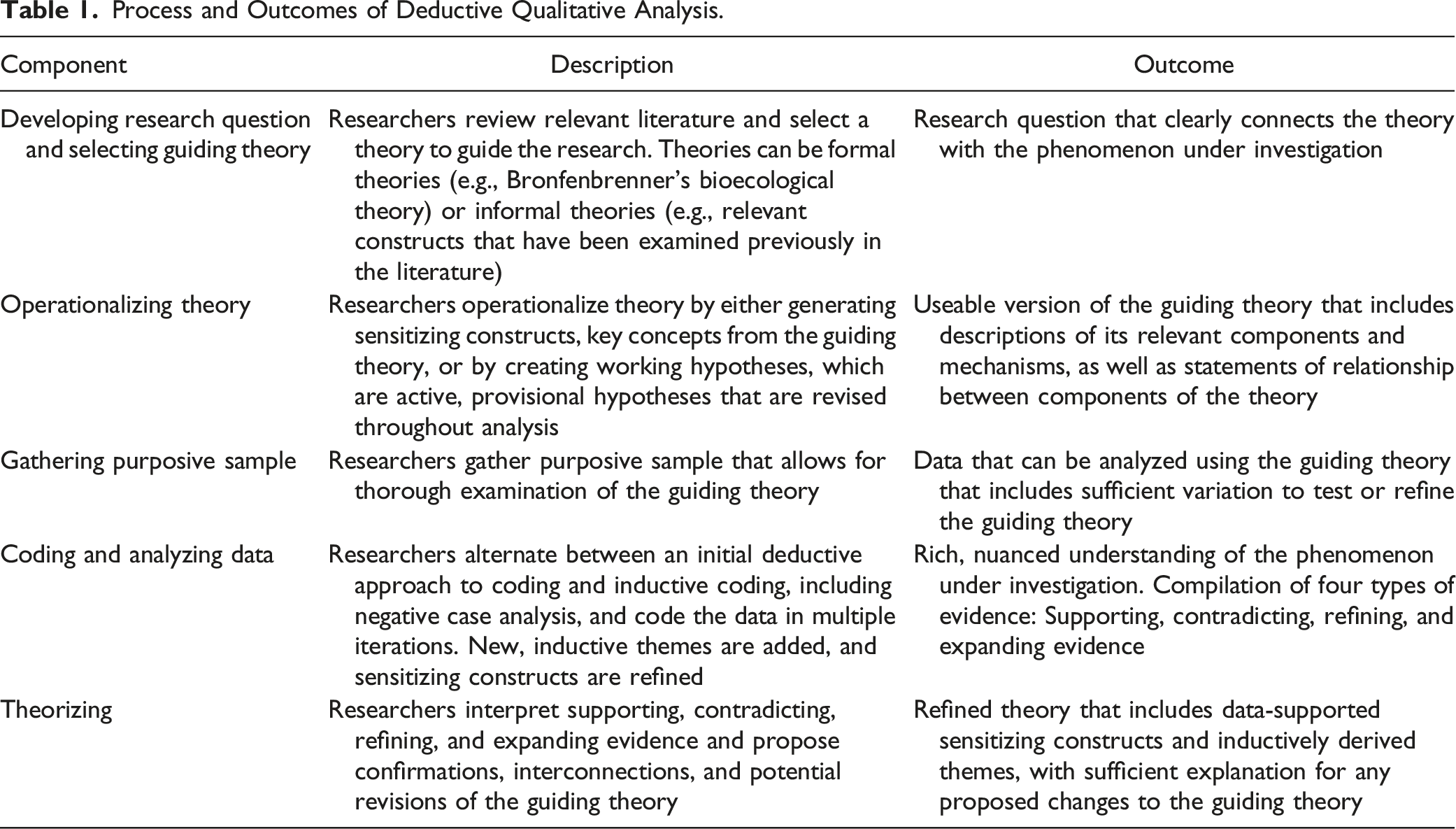
Process and Outcomes of Deductive Qualitative Analysis.
Selecting a Research Question and Guiding Theory
Researchers using DQA begin by engaging in two inter-related processes: crafting a research question and selecting a guiding theory. However, before researchers embark on a DQA study, they first must determine whether DQA is an appropriate methodology for their research question(s). DQA may be an appropriate methodology when researchers seek to test, evaluate, or refine a particular theory in relation to a phenomenon of interest (Gilgun, 2005). At other times, however, evaluating the guiding theory is not the primary aim of the study. In these instances, DQA can be an appropriate methodology for allowing researchers to use an existing theory to guide their analysis in a reflexive, intentional way. For the purposes of this paper, we focus on the use of DQA to evaluate and refine existing theories, hypotheses, and conceptual models.
After researchers have determined that DQA is the methodology they would like to use to answer their research question(s), they next select a guiding theory or conceptual framework and then finalize their research question. In our case, we were led to DQA because our research questions required a methodology that would allow us to systematically use theory while at the same time testing the guiding theory. In order to select a theory that will be relevant and useful, we have found it helpful to conduct a thorough literature review on the topic to understand what is already known and what theories have already been applied to the topic of interest.
Merriam-Webster’s dictionary defines theory as “an idea or set of ideas that is intended to explain facts or events” (Merriam-Webster, 2022). In DQA, the word theory is defined broadly so as to encapsulate many types of ideas, hypotheses, and propositions that provide an initial focus to the research. Theory may take many forms, such as formal theories (e.g., attachment theory (Mikulincer & Shaver, 2007) or Bronfenbrenner’s (2005) bioecological systems theory); conceptual frameworks based on a review of the literature; and results from previous qualitative, quantitative, and mixed methods research. Researchers’ own prior clinical or professional experiences may also provide potential theoretical material (Gilgun, 2019).
After researchers have selected a guiding theory, they then revise the research question such that it clearly connects the research question with the guiding theory. The final form of the research question(s) should clearly connect both aspects and suggests the researchers’ intention to holistically explore a process or phenomenon using both deductive and inductive analysis. The theory or conceptual framework that researchers start the project with can be referred to as the initial theory, preliminary theory, guiding theory, or hypothesized model (Gilgun, 2005, 2014). In determining what form or level of theory is appropriate for their research project, we recommend that researchers thoughtfully consider the primary research question, desired aims of the project, and their familiarity with relevant literature.
Example 1: Common Factors in Couples and Family Therapy
This study was led by the first author and began with his desire to qualitatively test the existing meta-theory of common factors that are unique to couples and family therapy (CFT; Sprenkle et al., 1999, 2009). Common factors are defined as common elements that drive therapeutic change across different therapy models. The meta-theory of CFT-specific common factors theory is largely rational and has not been extensively empirically tested, although there is modest support for some of the proposed common factors (D’Aniello & Fife, 2020). The research team concluded that DQA was an ideal methodology that allowed us to empirically examine the meta-theory of CFT common factors, including the importance of each of the proposed CFT common factors, as well as possible additional factors. For this study, we developed three research questions: (1) What common factors are exemplified in CFT sessions conducted by expert therapists? (2) What evidence in therapy sessions of expert therapists supports or contradicts the meta-theory of CFT-specific common factors? and (3) How can the existing meta-theory of CFT common factors be improved?
Example 2: Couple Healing From Infidelity
The second author worked with the first author and one other author to examine the process of couple healing from infidelity. More specifically, we wanted to empirically examine Butler et al.’s (2022) model of couple healing from infidelity that had been developed based on clinical experience, attachment theory, and Miller’s and Rollnick’s (2013) concept of ambivalence. For this study, the primary research question was, “What is the process of couple healing from infidelity?” The secondary research question was, “To what extent does Butler et al.’s (2022) model of healing describe the healing process of the couples in this sample?” After reviewing Gilgun’s (2014) work, we determined that DQA was an ideal methodology for the desired goals of the project.
Operationalizing Theory: Sensitizing Constructs and Working Hypotheses
Once researchers have selected their guiding theory, making it useable requires that they operationalize it. In DQA, two forms of operationalization are common: constructing sensitizing constructs based on key elements of the guiding theory; or generating working hypotheses, testable propositions or tentative statements of relationship that are refined as indicated during the analysis (Casula et al., 2020; Gilgun, 2014, 2019). In either form of theory operationalization, the influence of the researcher as an interpretive agent is paramount, requiring intentional, critical decision making. Sensitizing constructs (and working hypotheses) are useful because they sensitize the researcher to particular aspects of the data; at the same time, they also desensitize them to other potentially relevant information (Blumer, 1969; Gilgun, 2013; Knapp, 2009). Thus, researchers need to be intentional in how they operationalize the guiding theory. Within the process of DQA, inductive analysis and negative case analysis (discussed in the Coding and Analyzing section) are both intended to allow researchers to garner the generative benefits of theoretical sensitization while minimizing the risk of shallow analysis and premature conclusions.
Sensitizing Constructs
Sensitizing constructs are concepts from the guiding theory or hypothesized model that “help researchers to focus their inquiries and to notice and name aspects of phenomena they might otherwise have overlooked” (Gilgun, 2019, p. 6; see also Blumer, 1969). In plain terms, sensitizing constructs are concepts that would be salient in the present sample if the theory were supported (Gilgun, 2014). To operationalize theory using sensitizing constructs, researchers select key concepts from the guiding theory, craft a tentative definition, and articulate the role of each concept in the guiding theory, as well as interrelationships between the concepts. Depending on the guiding theory, sensitizing constructs may be obvious or a matter of choice, few or multiple, and distinct or interrelated. As the point of DQA is to evaluate existing theory and consider potential refinements, researchers must spend sufficient time with the guiding theory to create meaningful sensitizing constructs. Otherwise, there is the risk that the theory as operationalized will bear little resemblance to the original theory, or worse, become little more than a straw man version – easy to refute, but not leading to scientific advancement.
Working Hypotheses
The second form of theory operationalization is creating working hypotheses. While Gilgun (2019) introduces the concept of using DQA to generate and test hypotheses, Casula et al. (2020) significantly elaborate on her ideas by introducing the concept of a working hypothesis. According to Casula et al. (2020), a working hypothesis is a “hypothesis or a statement of expectation that is tested in action” (p. 6) and then revised throughout analysis. They emphasize that a working hypothesis is active, provisional, and performs ‘work’ in the sense that it moves the analysis forward. To operationalize theory using working hypotheses, researchers create a preliminary working hypothesis at the outset of the study based on the guiding theory. As analysis continues, researchers continually revise the hypothesis based on their analysis, attempting to fit the hypothesis to the data rather than constraining the data to the hypothesis. Due to our limited experience using working hypotheses in DQA, we focus our discussion on sensitizing constructs and direct interested readers to Casula et al.’s (2020) article for more information.
Example 1: Common Factors in Couples and Family Therapy
In this study, the research team generated sensitizing constructs based on Sprenkle et al. (1999, 2009) meta-theory of CFT common factors. As their meta-theory only includes a few proposed common factors, we included each of them as a sensitizing construct. The sensitizing constructs we included in our analysis were: expanded direct treatment system, expanded therapeutic alliance, relational conceptualization of client difficulties, disrupting dysfunctional relational patterns, and privileging clients’ experience. As a research team, we carefully discussed and defined each of Sprenkle and colleagues’ proposed common factors so that they could act as sensitizing constructs in our analysis. We intentionally composed a research team with members with varying levels of experience with common factors and took steps to increase the reliability of team members’ ability to recognize when a therapist-client interaction supported, contradicted, refined, or expanded each proposed common factor.
Example 2: Couple Healing From Infidelity
In the second study, the second author found it quite challenging to operationalize the model of couple healing from infidelity developed by Butler et al. (2022). Their model is multi-faceted, sequential, and theoretically rich, and it was difficult to select which aspects to directly include for examination. After careful consideration, we determined that the four stages of healing for each partner in Butler et al.’s (2022) model would allow us to adequately capture the salient aspects of the model without reducing our analytic utility by examining too many aspects. The sensitizing constructs we included in our analysis were the defining dynamics that characterized each stage. For non-straying partners, these were: infidelity as attachment betrayal trauma, containment of pain and anger, and releasing containment and subsequent ambivalence. For straying partners, these were: ambivalence, recommitment, and moral burden. We also included couple healing as an additional sensitizing construct. While these sensitizing constructs provided a useful framework, we necessarily could not include every aspect of the model. We discuss this limitation in more depth in the theorizing section.
Gathering a Purposive Sample
As is common in qualitative research, DQA relies on purposive sampling to allow for in-depth exploration of the topic of interest. Interviews, focus groups, blogs, or other common forms of qualitative data are all appropriate for DQA. Ideally, to add breadth and depth to their findings, researchers should intentionally gather a sample of variations of the phenomenon of interest, including negative cases that nuance the theory being evaluated (Gilgun, 2005, 2014). Negative cases may refer to a participant whose experience sharply defies or contradicts the guiding theory, or instances within participants’ data that do not align with the guiding theory’s constructs or predictions.
While multiple forms of data can be used with DQA, the method of data collection and nature of the data can place some constraints on the claims researchers can make from their analysis. When collecting primary data through qualitative interviews, researchers should ensure that their interviews are appropriately structured so as to address the sensitizing constructs or working hypotheses generated earlier (see also Pearse, 2019). If a participant does not bring up a sensitizing construct of their own accord, the interviewer has the freedom to probe as to whether this sensitizing construct was salient for this individual. In contrast, when using secondary data or collecting data without direct interaction with participants, it is not possible for the researcher to probe about specific sensitizing constructs. Therefore, a strong claim of a contradicting finding – that a sensitizing construct was not salient for a participant or set of participants – arguably requires direct interaction with participants, whether through interviews or member checking.
Example 1: Common Factors in CFT
To answer our research questions in this study, we used video recorded sessions of family therapy model developers and expert therapists demonstrating seven CFT models (n = 14; two therapists/videos per model). We selected this sample because it provided us with expert therapists in multiple therapeutic orientations, thereby allowing us to examine the presence and efficacy of the proposed common factors in therapy sessions with couples and families. At the same time, because we did not directly interact with our participants, we were careful about drawing conclusions that suggested modification of the theory under investigation.
Example 2: Couple Healing From Infidelity
To answer our research questions in this study, we used a previously collected sample of seven publicly available blogs written by non-straying partners who had stayed with a partner following infidelity and exhibited a degree of healing by the end of their blogs. We chose to use online blogs to examine Butler et al. (2022) model of healing because it allowed us to access longitudinal accounts of the healing process, affording us the ability to examine partners’ experiences over time. The blogs ranged in duration from 6 to 20 months of consistent postings and totaled 731 single-spaced pages. Because we used secondary data for the study, we were careful to avoid making unwarranted claims for modifying Butler et al.’s (2022) theory.
Coding and Analyzing
In qualitative research, coding refers to assigning labels to segments of data that describe the meaning or nature of the data. Analyzing involves considering the relationships, similarities, and differences between different data segments. Throughout coding and analyzing, researchers use both deduction and induction to attend to four types of evidence: supporting, contradicting, refining, and expanding evidence. Supporting evidence is evidence in the data that supports both the salience of the sensitizing constructs and their role in the process or phenomena. Contradicting evidence is evidence that contradicts or refutes the importance of the sensitizing constructs in the process or phenomena. Refining evidence is evidence that supports the importance of the sensitizing constructs but offers refinement to their role, interrelationship, or salience. Expanding evidence is inductively derived evidence supporting the inclusion of additional constructs in the theory.
Gilgun (2014, 2019) states that the coding process in DQA mirrors that of grounded theory (Charmaz, 2014; Corbin & Strauss, 2015; Glaser & Strauss, 1967), including negative case analysis, a conscious search for instances that add additional dimensions to, depart from, or contradict the theory being examined. However, she does not provide details on the process of coding and analysis in DQA. We therefore provide a description of our application of DQA during coding and analysis. Because the balance of inductive and deductive analysis shifts throughout the course of the research, we have found it helpful to divide this process into two phases: early analysis, consisting of initial deductive coding based on the sensitizing constructs derived from the guiding theory and intentional use of inductive processes as researchers actively look for expanding evidence; and middle analysis, focused on identifying preliminary themes, engaging in negative case analysis, and compiling supporting, contradicting, refining, and expanding evidence. We discuss theorizing, which could be viewed as later analysis, in its own section. We view these divisions as largely heuristic and do not mean to imply that there are any sharp divisions in the iterative, recursive process of analysis and theorizing.
Early Analysis
In early analysis, researchers immerse themselves in the data, focusing on data that are relevant to the research question(s) guiding the study (Charmaz, 2014; Corbin & Strauss, 2015; Glaser & Strauss, 1967). Researchers achieve this immersion through multiple readings of the data, in-depth memos, and, where applicable, team meetings. Coding during early analysis is both deductive and inductive. The sensitizing constructs act as deductive preliminary or initial codes, providing researchers with a potential lens with which to analyze the data. However, researchers also deliberately operate inductively, carefully examining the data for evidence of new concepts not included in the theory. We note that simply including a sensitizing construct as part of the initial preliminary framework does not mean the sensitizing construct will persist throughout analysis. Similar to what Charmaz (2014) suggests, sensitizing constructs must earn their place within the results of study and be grounded in the data. As analysis progresses, researchers may alter the definitions, roles, or importance of sensitizing constructs from the initial theory; these alterations can constitute a significant refinement to the original theory.
In addition to deductive and inductive analysis, researchers engage in negative case analysis, defined as attending to instances in the data that seem to contradict or offer revisions to the initial theory (Gilgun, 2005, 2014). Negative case analysis constitutes one of the primary sources of theory examination and revision. The intent of negative case analysis is to allow researchers to be guided by theory while protecting against unexamined, a priori conclusions (Gilgun, 2014, 2019). Therefore, rather than neglecting these instances, researchers deliberately look for and include these cases as a means of refining the existing theory and fitting it to the present sample (Gilgun, 2015). In early analysis, the emphasis is on identifying potential negative cases; in middle analysis, this focus shifts to directly assessing how they contradict, refine, or expand the initial theory.
To facilitate consistency of coding and to document changes in understanding over time, we recommend researchers create a codebook listing each code, its definition, and an exemplary instance where the researchers applied the code. Because of the complex interplay between supporting, contradicting, refining, and expanding evidence, we have found memos (Corbin & Strauss, 2015; Saldaña, 2016) and discussion with others to be invaluable in deepening analysis and allowing others to challenge one’s thinking.
Middle Analysis
As analysis continues in DQA, there is a gradual shift in emphasis from code generation to identifying preliminary themes, analyzing negative cases, and understanding supporting, contradicting, refining, and expanding evidence. Researchers review their coding and condense their findings into preliminary themes that are salient based on their analysis. These themes can consist of the sensitizing constructs (and any revisions to them) as well as themes inductively developed from the data. As with grounded theory, each theme should be organized around a central idea, although they may have significant variation within them (Corbin & Strauss, 2015; Glaser & Strauss, 1967).
Researchers also analyze the negative cases they identified during the analysis (Gilgun, 2014). The process of analyzing negative cases requires clearly delineating any similarities and differences between them and more typical cases in terms of sensitizing constructs and new themes. For sensitizing constructs, these differences may include the importance of the sensitizing construct, the role it plays, its sequence in comparison to other participants or the guiding theory, or connections between different sensitizing constructs. Differences may be directly stated or implied, although we urge caution in reading too much into instances in which participants have said little. These differences are then incorporated into the analysis and the reformulated model, adding dimensionality and nuance to the results (Gilgun, 2014).
Once researchers have summarized their preliminary findings and carefully engaged in negative case analysis, they are positioned to effectively compile and deepen their understanding of evidence that supports, contradicts, refines, or expands the hypothesized model. In doing so, researchers directly examine the balance of evidence from all participants and determine whether the sensitizing constructs are supported as originally conceptualized, contradicted by one or more negative cases, revised in terms of role, importance, or timing, or whether evidence indicates new constructs should be added to the initial theory.
We have found that a revised codebook serves as a useful tool to allow for these comparisons because it links the original operationalization of the theory with each type of evidence from the data for each sensitizing construct and additional inductively derived themes. In this codebook, researchers can separate out each of the four forms of evidence and systematically determine whether revision to the guiding theory is warranted (Gilgun, 2019). They also include new constructs in the codebook that were generated inductively during the coding process and compile evidence for their role and salience.
Example 1: Common Factors in CFT
In the first study, our process of analysis began by choosing to divide the research team into two groups, each analyzing a separate subset of the data. In early analysis, we used tentative sensitizing constructs, drawn from an existing meta-theory of CFT common factors, to provide an initial deductive analytic framework. At the same time, we actively operated inductively, examining the data for additional common factors. Examples of these inductive codes include assessing interpersonal patterns, reframing problems, facilitating client interactions (enactments), validating, expressing empathy, highlighting/reinforcing change, facilitating perspective taking, and challenging clients. Each group developed promising themes and then came together to discuss similarities and differences. We then revised our codebook to include relevant codes and themes and analyzed the remainder of our sample for supporting, contradicting, refining, and expanding evidence.
In middle analysis, we summarized our findings into prominent themes, themes that multiple participants exemplified in a variety of ways. We also engaged in negative case analysis. The meta-theory informing the study proposed that disrupting dysfunctional interactions was a common factor in CFT. However, our analysis indicated that therapists were much more focused on facilitating constructive interactions than on interrupting negative ones. As we analyzed and interpreted this evidence, it led us to consider a revision of the meta-theory. We gathered and summarized supporting, contradicting, refining, and expanding evidence for each of the concepts from the initial theory (see Appendix A and B for examples of deductive and inductive coding and analytic memoing in early and middle analysis).
Example 2: Couple Healing From Infidelity
In early analysis for this study, we used sensitizing constructs from Butler et al.’s (2022) model as a preliminary conceptual framework. It was admittedly difficult to integrate deductive and inductive analysis into this project. All the data were coded multiple times, and the coding was significantly different based on whether we prioritized inductive or deductive analysis. Only at the end of the project were these strands successfully integrated.
To begin our coding, we labeled data excerpts with the names of sensitizing constructs. Using MAXQDA 2018, we created a codebook and coding scheme that matched our emergent analysis. As we coded inductively, we nested inductive codes that aligned with our sensitizing constructs within this deductive conceptual framework. For example, after coding three of the blogs, the sensitizing construct of attachment betrayal trauma housed inductive codes such as experiencing trauma, feeling betrayed, losing trust, and rewriting positive memories. On the other hand, meaning making for individuals and couples was an inductive code that did not fit within the conceptual framework, and so during early analysis we placed it in its own category.
During middle analysis, we summarized and defined the prominent themes suggested by our analysis. This included altering the definitions of several of the themes that were based on our sensitizing constructs. We engaged in negative case analysis by critically examining evidence in the data related to the sensitizing construct of ambivalence. In the hypothesized model, ambivalence was a key explanatory concept that applied to both straying and non-straying partners in turn. However, the participants in our sample reported committing to their relationship early in the process, and only some of them reported experiences that supported ambivalence. Based on our summary of the evidence across participants, we determined that ambivalence was an important early dynamic for some participants or their partners, but that it was transitory rather than prolonged in our sample. Additionally, our sample suggested the importance of individual healing for non-straying partners within the broader process of couple healing. We refined the existing therapeutic model with attention to healing for non-straying partners throughout the process of couple healing.
Theorizing
The final component of DQA is theorizing, which involves interpreting evidence for each of the themes, proposing interconnections between them, and providing a rationale for any revisions or expansions to the initial theory. Although we refer to theorizing as the final component of DQA, theorizing occurs throughout the entire study as researchers operationalize their guiding theory, analyze data, gather evidence, identify and examine negative cases, and explore the utility of the guiding theory with the present sample (Gilgun, 2014; Valencia Mazzanti & Freeman, 2022). Nevertheless, there is a shift of emphasis once researchers have adequately coded and analyzed their data and developed themes that are appropriately broad and deep.
The result of DQA is a re-examined and potentially refined theory (Gilgun, 2015). While grounded theory attempts to generate new theory, the purpose of deductive qualitative analysis is to empirically examine and revise an existing theory such that it is more precise or accurate to the present sample, which may include altering or replacing components of the theory if there is evidence to do so (Gilgun, 2015). To promote high quality theorizing, researchers utilize an iterative analysis strategy akin to grounded theory’s constant comparison method (Glaser & Strauss, 1967), comparing different instances within and between participants, as well as connecting nascent findings with the initial theory, the revised theory, and other relevant literature (Gilgun, 2013). Researchers then propose confirmations and revisions of the initial theory that align with the analysis and ground the results in the data.
Although not discussed by Gilgun, we connect high-quality theorizing in DQA with Knapp’s (2009) concept of critical theorizing. Critical theorizing refers to the intentional practice of both (1) critically examining the assumptions and implicit biases of theory and (2) engaging alternative theories in meaningful dialogue. Critical theorizing is yet another mechanism by which researchers can gain the utility of having a guiding theory while counteracting the desensitization that encourages confirmation bias. In practice, critical theorizing could involve researchers comparing their nascent findings with relevant findings from other researchers and interpreting their data with this alternative lens. While this may or may not change the published results, the practice helps researchers to situate their findings and enhance the quality of their analysis.
In the process of theorizing, researchers define the primary themes, consider supporting and contradictory evidence for each of them, and determine from the data aspects of the initial theory that are supported and whether revision to the initial theory is merited. They also define new concepts that were not in the initial theory and provide evidence for their importance and possible ways they fit into their revised model. Researchers may also draw upon existing theory to explain any differences between the revised theory and the initial theory (Gilgun, 2014). The final revised model consists of the elements of the initial theory that were supported by the data, revisions to those elements suggested by negative cases, and additional themes that were generated inductively during the coding process (Gilgun, 2014).
Writing the results and discussion sections is a key component of theorizing in DQA because it helps to move conceptual understanding into written conclusions. In terms of organization, it may be helpful for researchers to organize their results in a similar manner to the guiding theory (e.g., presenting a revised model when the guiding theory was a model). In the discussion section, researchers can explain and contextualize the conclusions from their results, review supporting evidence for the initial theory or hypothesized model, discuss revisions and expansions to the initial theory, and offer specific, provisional implications of the results.
Example 1: Common Factors in CFT
Theorizing took place during each stage of the analysis, becoming more focused as the analysis of the prominent themes deepened. As we compared our findings to the guiding theory, we contrasted the definition of each common factor we developed through our analysis with our original definition based on Sprenkle et al. (1999, 2009) meta-theory. In our results, we labeled the common factors the same as the sensitizing constructs proposed in the original theory when our analysis indicated strong supporting evidence. For the common factors that our analysis suggested possible revisions, expansions, or contradictions, we provided evidence that supported our new articulation and explained our rationale for the changes in our discussion section (see Fife et al., 2023 for complete results).
The process of writing the results and discussion sections of our paper played a significant role in our theorizing because in the process of collecting exemplary evidence in support of our conclusions we encountered evidence that further refined our conclusions. In writing, the findings we generated through team analysis and discussion were further refined, and we came to better understand the nuances of the revised and new themes we identified. In one case, this led us to propose an alteration of the provisional theory based on a reconceptualization of one of the initial common factors, shifting from disrupting dysfunctional interaction patterns to facilitating constructive interactions.
Apart from the published results, we considered the theoretical foundations and clinical applications of the different therapy models, which allowed us to understand their unique differences and salient shared processes. During our literature review, we engaged in theorizing by examining different ways that common factors are manifest across therapy models, such as emotion-focused therapy and narrative therapy. This exploration informed our analysis of these factors. While this did not directly revise our findings, it did alter the way we situated our findings within the field of couple and family therapy.
We also engaged in critical theorizing throughout the process by examining other proposed common factors in the literature, including individual-therapy common factors. We seriously considered these individual therapy common factors and allowed evidence for them to inform our exploration of common factors specific to couples and family therapy. Although we gathered evidence for these other common factors, we included only common factors unique to couples and family therapy in our published study.
Example 2: Couple Healing From Infidelity
In the second study, our theorizing process involved both engaging in critical reflection upon the hypothesized model based on the data and considering different conceptual lenses with which to view the data. To accomplish the first form of theorizing, we created a comprehensive table detailing supporting, contradicting, refining, and expanding evidence for each sensitizing construct for each participant. Through team discussion, we then came to a consensus about whether the balance of evidence primarily indicated support, contradiction, or a need for refinement for each of the sensitizing constructs. As a team, we also discussed evidence for the additional, inductively derived concepts and determined whether they constituted a meaningful expansion to the hypothesized model. Our final results included supported themes, refined themes, and additional themes inductively derived from our analysis (see Gossner et al., 2022 for complete results).
To further our theorizing, we wrote two drafts of the results, one earlier in the process and one at the end. Each team member reviewed both drafts and offered comments on the strength of evidence for each theme. Based on this feedback, the first author revised the results section and compiled more evidence for each conclusion. At the end of the process, all team members endorsed the conclusions.
We engaged in critical theorizing informally throughout the project as we considered different models of healing from infidelity and different ways of interpreting the data based on these models. For example, while Butler et al.’s (2022) model directed us towards couple- and individual-level relationship maintenance strategies, Williams’ (2011) socio-emotional framework – oriented towards relational justice – altered our interpretation of these dynamics and helped to balance our description of them. We engaged in formal critical theorizing as we surveyed other extant models of healing from infidelity and considered how our findings were compatible with, expanded on, contradicted, or refined earlier models. While the majority of our critical theorizing is recorded only in memos and team meetings, we included some of the salient elements of our critical theorizing in our discussion section.
Trustworthiness and Reflexivity in DQA
In qualitative research, trustworthiness is the extent to which the analysis can be trusted as reliable based on the researchers’ quality of analysis and following of established standards for study conceptualization, data collection, analysis, and interpretation (Connelly, 2016). The specific practices required to promote trustworthiness of analysis may differ based on the epistemological and ontological assumptions of the researcher (see Guba, 1981 for a description of trustworthiness from a positivist epistemology and critical realist ontology; see Williams & Morrow, 2009 for a description of potentially pan-paradigmatic standards of trustworthiness). Doing DQA in a trustworthy manner requires that researchers make intentional, well-informed decisions throughout the process and transparently document their reasons for doing so.
Multiple practices within DQA are intended to promote the trustworthiness of the analysis and results. An important early consideration is determining that DQA is an appropriate methodology the primary research question(s). When selecting and operationalizing theory, researchers should carefully ensure that the definitions of sensitizing constructs closely align with the way the sensitizing constructs are defined in the initial theory. Throughout analysis, researchers using DQA should situate all themes within the data and revise or discard themes (including those based on sensitizing constructs) if there is evidence that suggests the need to do so. Critical theorizing, negative case analysis, and memoing are intended to deepen analysis and guard against confirmation bias and personal biases that could unduly distort results (Gilgun, 2014; Knapp, 2009; Saldaña, 2016).
Although not by any means exclusive to DQA, research using DQA benefits greatly from a research team. This not only helps to ensure that the project follows DQA rigorously but also provides a critical sounding board to voice, question, and re-examine preliminary conclusions. Team analysis is helpful because researchers can discuss developing ideas with others with varying life experiences, experience levels, and perspectives (Gilgun, 2005). Using a research team also increases the likelihood that the results will account for the complexity and variability of the phenomena being studied (Gilgun, 2013). Without using a research team, the possibility of pre-mature conclusions and confirmation bias increases significantly.
In interpretivist forms of qualitative research, reflexivity is a companion to trustworthiness that involves the researcher analyzing and critically challenging their own influence on the research process from study conceptualization throughout the final stages of the project (Arias López et al., 2023; Berger, 2015). As reflexivity involves becoming aware of the influence of previous understanding on the present project, it is closely aligned with theory selection and operationalization in DQA (Gilgun, 2013, 2019). It also extends to other general areas such as the researcher’s sociocultural background and identities.
Example 1: Common Factors in CFT
In the first study, we promoted trustworthiness by allowing each team member to formulate their own conceptualization based on the data and then to compare their conceptualization with that of all other team members. Each team member was given the opportunity to share their perspective, with an equal opportunity to challenge one another’s conceptualizations. This helped bring multiple perspectives to bear on the data.
We also promoted trustworthiness by intentionally identifying and examining negative cases, instances in the sessions that contradicted the guiding theory or suggested revisions to it. These instances factored prominently in our analysis and helped to prevent premature conclusions and to ensure that our conclusions were not based only on our experiences. Memos, team meetings, and deliberate group analysis were also helpful.
To promote reflexivity, from the earliest stages of project conceptualization, we used a research team to discuss and understand our own perspectives on common factors and on how these influenced our interpretation of the data (see Fife et al., 2023 for a further description of reflexivity and team characteristics). Our understanding of common factors influenced our sample selection and how we attended to the data; rather than wondering whether we were going to find common factors, we examined whether the common factors proposed by Sprenkle et al. (1999, 2009) were accurate and sufficient for the present sample.
Example 2: Couple Healing From Infidelity
As the second author had never used DQA before, using a research team was critical to promoting trustworthiness in this project. The second author performed the majority of coding and analysis in this project, but the use of a research team brought multiple perspectives to bear and helped to deepen and contextualize conclusions. By being able to collaborate with others, the analysis shifted from being the perspective of one analyst to being balanced by multiple other perspectives.
Reflexivity in this project was promoted primarily through team meetings and personal memoing (see Gossner et al., 2022 for a further description of reflexivity). The authors were involved in multiple studies on infidelity during the same time period, and so reflexivity became a critical practice to ensure that the analysis for each study was suited to and interpreted from its respective dataset. Direct conversations between the first and second author helped to promote this reflexivity. The second author also found it helpful to keep a reflexivity journal to keep each project straight and to promote both trustworthiness and reflexivity.
Strengths, Limitations, and Challenges
Our use of DQA allowed us to develop appreciation for its strengths as well as its limitations. The primary strength of DQA over other forms of deductive qualitative research is that it allows for theory and hypothesis testing by directing attention to supporting, contradicting, refining, and expanding evidence. Negative case analysis helps to prevent premature conclusions and promotes theory refinement. Additionally, DQA allows researchers to combine deductive and inductive analysis within the same project. We found this conceptualization to be invaluable in our desire to examine and refine existing theory.
We also note the utility of DQA in mixed methods research. Like many quantitative investigations, mixed methods studies are typically informed by a guiding theory and are used to evaluate and refine the theory (Greene et al., 1989). Using DQA allows mixed methods researchers to analyze qualitative data with the same theoretical framework they are using for their quantitative results, thus facilitating integration. Sensitizing constructs can be developed from the initial theory or derived from the analysis of quantitative data collected for the study.
At the same time, DQA has several limitations. We hope that this article has addressed the most problematic limitation, namely the lack of any primers or comprehensive descriptions of how to carry out a DQA study from beginning to end. However, other limitations remain as part of the process. First among these is faulty theorizing, either through operationalizing theory in a disingenuous way (e.g., a straw man theory) or falling prey to confirmation bias (e.g., finding only what one looks for). Another challenge based on our experiences is developing the discussion section of the written report. Due to the purpose and structure of a DQA study, there is significantly more information to present, contextualize, and discuss than in most other qualitative approaches. Discussion sections typically include the significance of the findings, comparisons with previous research, theoretical and practical implications, and limitations and future directions. In addition to these elements, a DQA discussion section includes a comparison between the results of the study and the initial theory, including ways the theory is supported, contradicted, refined, and/or expanded.
Conclusion
Theories are social constructions, open to examination and revision (Mazzanit and Freeman, 2022). Theory development, testing, and refinement are necessary to avoid theoretical myopia and stagnation and to promote theoretical advancement and innovation (Fife, 2020). When scholars rigorously examine existing theories by comparing them to new data, diverse samples, and alternative perspectives, the quality of the theories is likely to improve, as the strengths of the theories are supported and inadequacies or errors within the theories are refined or refuted. Deductive theory evaluation and testing are typically associated with quantitative research methods (Bitektine, 2008). However, DQA is a qualitative methodology that allows for systematic empirical investigation of existing theory, thus expanding the utility of qualitative research. As with any theory, the results of DQA studies are provisional and subject to examination, refutation, and revision based on future research evidence.
In this paper we have presented a brief primer on DQA and illustrated the process of DQA using two worked examples. As illustrated with our examples, we found DQA to be particularly useful in answering the research questions we had regarding existing theories in our field of study. We invite researchers from diverse disciplines and epistemological and ontological traditions to engage with DQA as a potentially useful methodology and to consider ways in which it can enhance their own theorizing and advance their respective disciplines.
Supplemental Material
Supplemental Material - Deductive Qualitative Analysis: Evaluating, Expanding, and Refining Theory
Supplemental Material for Deductive Qualitative Analysis: Evaluating, Expanding, and Refining Theory by Stephen T. Fife, and Jacob D. Gossner in International Journal of Qualitative Methods.
Footnotes
Author’s Note
Portions of this paper were presented at the Theory Construction and Research Methodology portion of the 2021 annual conference of the National Council on Family Relations.
Acknowledgments
We express appreciation to Jason Whiting who provided valuable feedback on an earlier draft of the manuscript.
Declaration of Conflicting Interests
The author(s) declared no potential conflicts of interest with respect to the research, authorship, and/or publication of this article.
Funding
The author(s) received no financial support for the research, authorship, and/or publication of this article.

Supplemental Material
Supplemental material for this article is available online.
Note
References
Supplementary Material
Please find the following supplemental material available below.
For Open Access articles published under a Creative Commons License, all supplemental material carries the same license as the article it is associated with.
For non-Open Access articles published, all supplemental material carries a non-exclusive license, and permission requests for re-use of supplemental material or any part of supplemental material shall be sent directly to the copyright owner as specified in the copyright notice associated with the article.
