



Abstract
This paper proposes a combination of text mining and acceptance research as a methodological approach (“acceptance mining”) to facilitate the development of innovative technologies in niches. At the example of recharging infrastructures for electric vehicles, the approach is explored on a sample of over 20,000 user comments collected from social media and discussion forums. The results indicate that acceptance mining provides valuable insights into the demands of the public during all phases of niche development which allow shaping niches in socially acceptable ways. In particular, the method reveals requirements and risks of niche-development measures such as shielding, nurturing, and empowering niches as perceived by the public. The results are discussed regarding the potentials of acceptance mining for developing innovations in niches as well as its limitations and possibilities for optimization. Acceptance mining and its application to a case study are especially of interest for researchers and practitioners involved in niche development; the study results provide valuable insights for professionals engaged in developing recharging infrastructures for electric vehicles.
Keywords
Introduction
Novel technologies are often developed in protected spaces—so-called niches (Raven et al., 2010)—to increase their maturity and competitiveness to the extent that they can be established in the mass market. Niche development usually involves a small number of players who determine the direction in which the niche is shaped. Despite user-centered and participatory design approaches, the public usually (if only) participates in the late phases of this process. However, underestimating the weight of public opinions may lead to delays in the rollout of technologies or social rejection (Lee et al., 2019). New methods are required to capture the public’s perception and integrate it into the niche development. This paper proposes “acceptance mining” as such an approach. Acceptance mining combines text mining methods and acceptance research: Large text corpora (such as social media comments) are analyzed in automated ways to identify topic-related patterns, which are further examined qualitatively in depth. The method is described in detail in Section 3 and applied at the example of recharging infrastructures (networks of recharging stations) for electric vehicles (see Section 4). The study investigates which insights can be gained for niche development from public discussions in social media. The use of social-media comments allows access to extensive topic-related data sets which reflect the “unbiased” public opinion.
The study is part of the interdisciplinary large-scale research project “Flexible Electric Networks.” In the project, solutions for a sustainable direct-current (DC) grid and related technologies are developed in Germany. Part of the project is to examine which social-economic factors determine the successful diffusion of DC technologies from the niche into the mass market. As asynchronous current is the predominant technological basis for the energy infrastructure, niche development plays an important role in developing DC technologies. Particularly in the context of electromobility, DC technologies are essential for the expansion of recharging infrastructures.
Two research questions are investigated in the study:
Quantitative analysis: Which types of niche-development measures are in the focus of public discussions?
Qualitative analysis: Which specific aspects of niche development measures are discussed by the public?
The results are discussed regarding the approach’s potential for developing technologies in niches (Section 5.1), its limitations, and possibilities for optimization (Section 5.2). Acceptance mining and its application to a case study are especially of interest for researchers and practitioners involved in niche development and the communication of novel technologies. The results of the study provide valuable insights for professionals engaged in developing recharging infrastructures for electric vehicles.
Theoretical background
Public involvement in niche development
Niche development of technological innovations is researched by various disciplines and covers topics such as solar (Mirzania et al., 2020) or wind power (Yang et al., 2020a). The term niche is defined in differing ways; Raven et al. (2010) distinguish several common accentuations, for example, niche as protected space or as experimental demonstration projects.
Research on niche development can be divided into two predominant research strands: “multi-level perspective” (MLP) and ’strategic niche management (SNM). This paper focuses on the second research strand as this approach explores intra-niche development processes (Kemp et al., 1998; Raven et al., 2010; Smith and Raven, 2012). In this context, several measures are considered to facilitate successful niche design in protected environments (Smith and Raven, 2012):
Shielding innovations against mainstream selection pressures,
nurturing innovations to facilitate their development, and
empowering innovations to become competitive and thus marketable.
Typically, innovations are developed in small protected spaces by networks of niche players (nurturing) and supported by legal regulations or funding (shielding) until the innovation can be scaled up to enter the market, and the protection can be broken down (empowering) (Kemp et al., 1998). Niche development usually consists of different phases. According to Boon et al. (2014), the early phase of niche creation is associated with nurturing measures: Niche players articulate their expectations, form networks, and exchange knowledge to facilitate mutual learning (Verhees et al., 2015). In addition, shielding activities are initiated in this phase. In the intermediate phase of niche maintenance, shielding activities are continued and supported with additional nurturing activities such as developing internal niche practices based on mutual learning and network building. In the late phase of phasing out, the niche is opened, and practices developed within the niche are institutionalized. This can either be accomplished by adapting the practices to the existing rules of a regime (fit and conform) or by changing these rules to adhere to the practices (stretch and transform). Both approaches are considered to be part of empowerment activities (Smith and Raven, 2012; Yang et al., 2020b). According to Raven and Geels (2010), there is a considerable need to investigate “the relation between niche development paths and broader national characteristics such as public attitudes toward technology and innovation, political discourses, and trust relationships between government, market, and civil society.” In this context, it is relevant to examine the role of the public in developing technologies in niches.
The early phases of niche development usually involve a small community of technological and economic players (Kemp et al., 1998). Here, the public is given (if any) a passive role. Studies show that niche empowerment can be hampered if public demands are not considered in the development phase (Lee et al., 2019). In contrast to conventional niche-development principles, alternate approaches are initiated by the public itself: so-called “grassroots” approaches differ considerably due to their fragmentation and lack of formalized learning (Seyfang and Longhurst, 2013). Nevertheless, such activities reveal significant potential for social innovations (Sharp, 2018). Studies show an increasing interest in harnessing the potential of such public contributions for conventional technology development in niches (Mccarthy, 2010). By incorporating the public’s opinion into niche development, niche players gain access to various resources, such as prospects for expanding technologies into other markets (Odlin and Benson-Rea, 2021). Studies on the public involvement in niche development use predominantly qualitative methods such as interviews (Hatzl et al., 2016), case studies (Martin et al., 2015; Wolfram, 2018), or a mixed-methods approaches (Hargreaves et al., 2013; Lang et al., 2020; Seyfang and Longhurst, 2013; Seyfang et al., 2014). Few recent approaches examine larger datasets, for example, social network analysis, to investigate discussion dynamics in niche-related online discussions (Rantala et al., 2020).
Acceptance studies in niche development
Niche development often refers to the policy or market perspective and associated acceptance concepts. Despite this predominant focus, a third perspective—the social acceptance of technologies—has been gaining importance in recent years (Devine-Wright et al., 2017). In this context, insights from acceptance research help to understand the complex interplay of societal factors and make informed decisions on the use of technologies (Jakobs, 2019). Definitions of “technology acceptance” from the viewpoint of the public vary depending on the discipline (e.g. sociology, psychology, communication science) and focus (e.g. research on attitudes of those affected or on technology impacts). Generally, technology acceptance is described as a multi-layered construct of interacting variables such as the experience, voluntariness, perceived usefulness of a technology (Venkatesh et al., 2003), and conventions of social groups (Renn, 1998). More recent approaches conceptualize acceptance as an (individual or collective) evaluation result (Jakobs, 2019): Acceptance evaluations are understood as a process in which a subject (person or group) evaluates an object under certain contextual conditions at a certain point in time. The evaluation is carried out in that the subject evaluates the object with regard to certain evaluation aspects based on classification scales assigned to these aspects. The evaluation aspects are specified by the basis of comparison (sum of all value concepts against which the object is measured). The results of this classification action are compared to the desired results given by the basis of comparison. From the view of the subject, some aspects are considered to be more relevant than others from which a weighting of these aspects results.
Acceptance studies of electromobility have revealed several of such evaluation aspects, for example, cost, range, driving pleasure, transport capacity, and car-sharing options for e-cars (Curtale et al., 2021; Ehrler and Hebes, 2012; Globisch et al., 2018, 2019; He et al., 2016; Huang et al., 2021; Muhlback and Hendrikx, 2015; Schlüter and Weyer, 2019). Aspects that have been little investigated concern recharging infrastructures for electric vehicles, for example, the design of recharging stations (Philipsen et al., 2015), the recharging behavior of consumers (Globisch et al., 2019; Kavianipour et al., 2021), and the perception of the underlying grid infrastructure (Sechilariu et al., 2018; Tarroja and Hittinger, 2021).
Technology acceptance is predominantly studied using methods such as surveys (Globisch et al., 2019; Schlüter and Weyer, 2019; Sherren et al., 2021), simulation (Kavianipour et al., 2021; Tarroja and Hittinger, 2021), and interviews (Ehrler and Hebes, 2012; Scherhaufer et al., 2017). More recent approaches analyze large data sets such as registrations of electric vehicles to examine the adoption rate (Illmann and Kluge, 2020).
To the authors’ knowledge, few attempts have been made to combine research on niche development and technology acceptance (Digmayer and Jakobs, 2021). Such studies mostly relate to the phase in which a niche is opened to the market (Illmann and Kluge, 2020; Schlüter and Weyer, 2019). While approaches to analyze large amounts of data have been used for various research topics (Cariceo et al., 2018; Fournier-Tombs and MacKenzie, 2021; Martínek, 2021; Rantala et al., 2020), there is still a lack of methods to examine the public acceptance of niche-development measures. What is missing, in particular, are attempts to investigate the potential of public opinions for different phases of niche creation and niche-development measures.
Methodology
Data collection
The data collection focuses on user-generated comments posted as a reaction to articles and threads related to recharging infrastructures for electric vehicles. Comments were extracted with automated scripts using the Jsoup library (Hedley, n.d.) from German social media, news portals, and discussion fora. The data was stored as text files, including their title, content, date of creation, and source. The body contains 23,743 comments which were posted between 2012 and 2021.
Data preparation
The goal of the data preparation was to clean the database from off-topic comments as far as possible in an automated way. The first step was to make the textual data processable for text-mining tools. For this purpose, the comments were POS (part of speech) tagged using the spaCy library (SpaCy, 2022). The second step was to reduce the database to comments related to (1) the recharging-infrastructure technology and (2) to niche development. For this purpose, a word cloud was created with terms related to recharging infrastructures for electric cars. The cloud was created by annotating keywords in 50 scientific papers using the software MaxQDA and contains 24 substantives (e.g. recharging point), six verbs (e.g. recharge), and five adjectives (e.g. fast recharging). The data basis was searched for topic-related comments. Comments which did not contain words from the cloud were discarded. The cleaned database contains 12,705 comments. A second word cloud was created with terms related to niche development again based on a literature study. The cloud contains 57 substantives (e.g. niche), 34 verbs (e.g. learn), and 17 adjectives (e.g. shielded). Based on this cloud, the second corpus was searched for comments related to niche development. 2448 comments were identified in this process and transferred into a third corpus. The contents of both word clouds are shown in Figure 1.

Visual representation of the word cloud.
Data analysis
The data analysis comprises five steps: In the first step, the third corpus was analyzed manually for comments related to the acceptance of recharging-infrastructure developments based on the definition of technology acceptance by Jakobs (2019). For this purpose, comment sections were annotated which reference aspects of the niche development of recharging infrastructures (related to the three main categories shielding, nurturing, and empowerment) and reflect them in an evaluative manner. Such sections include both simple evaluative statements (e.g. when a niche aspect of recharging infrastructures is rated as dis/advantageous for society) and evaluative comparisons to other technological developments (e.g. when a niche aspect is rated as immature compared to another technology). Six hundred eighty-six comments did not include references toward the main categories and thus were discarded. The remaining comments form the fourth corpus.
In a second step, the sentiments of all comments in the fourth corpus were calculated using the “German sentiment classification library with Bert” library (Guhr et al., 2020). Sentiments represent the (positive, neutral, or negative) attitude of a user about a certain topic (Chandrakala and Sekharan, 2012). To cross-check the results the sentiment analysis, the data were processed in a second way: The data were translated with Google Translator and examined with the “natural language understanding” service of IBM Watson. The service calculates a value between -1 (very negative) and 1 (very positive) for the sentiments of texts on basis of the choice of words. For each of the three phases, the mean of sentiment values for all comments was calculated.
In a third step, multiple references to the main categories were examined within the fourth corpus. One hundred thirteen comments included references toward two of the main categories, 18 comments referenced all three categories. All references were transferred in a fifth corpus which contains 1892 annotations in total.
In a fourth step, the annotations of the fifth corpus were sorted by the time at which they were published. Three periods were distinguished:
The period before May 2016, in which few activities were initiated to form a niche for recharging infrastructures (10.2% of all annotations in the fifth corpus),
the period between May 2016 and October 2019, in which comprehensive shielding activities were set into motion to facilitate the niche development (46.09%),
and the period after October 2019, in which efforts were made to converge the differing niche approaches and prepare the technology for the mass market (43.71%).
In a fifth step, subcategories to the three main categories were developed. Subcategories were derived deductively for nurturing (expectations, learning, networks) and empowerment (integration in existing infrastructures, transformation of existing infrastructures). Subcategories for shielding (legal shielding, economic shielding, shielding by commercial niche players) were derived inductively. In 139 of the annotations of the fourth corpus, multiple subcategories were addressed: 137 annotations referenced two subcategories, two annotations referenced three subcategories. The total amount of references to subcategories thus sums up to 2031. The annotations were transferred into a sixth subcorpus.
Results
Quantitative results: Public perception of recharging infrastructures in the different phases of niche development
The focus of Internet discourses related to niche aspects of recharging infrastructures has changed over the years (see Figure 2): In 2012, nurturing-related niche aspects (and especially the expression of expectations) accounted for the majority of discussion posts—subsequently, the importance of nurturing as a topic of online comments decreased. From the niche initialization in 2016, users focused on the meaningfulness and efficiency of associated shielding measures. From 2018, the data show an increase in the discussion of how the technology should be integrated into the existing energy and transport infrastructure with empowerment measures. From 2021, with the EU’s decision to abandon combustion engines in favor of electric vehicles, the importance of shielding in the commentaries increased again.
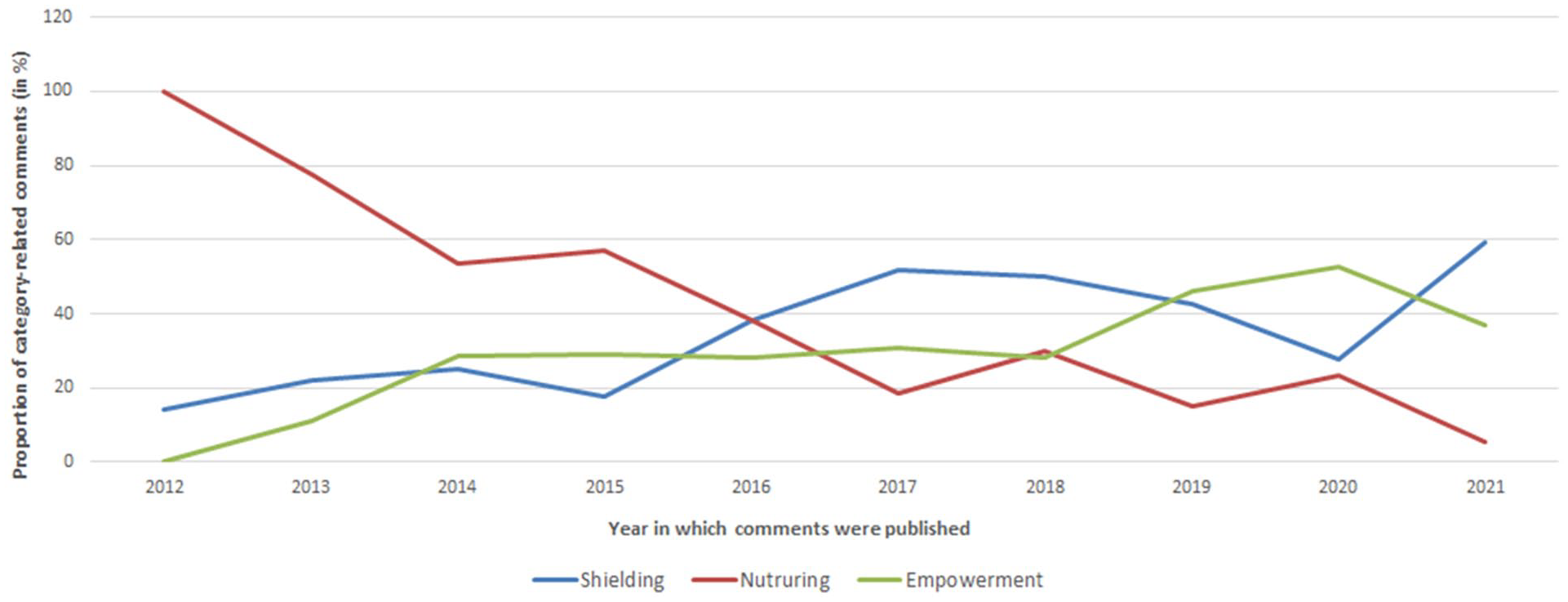
Proportion of comments related to the main categories depending on the year in which they were published.
Regarding the individual phases (see Figure 3), three main trends were identified across the three niche phases: the increasing relevance of shielding and empowerment and the decreasing importance of nurturing.
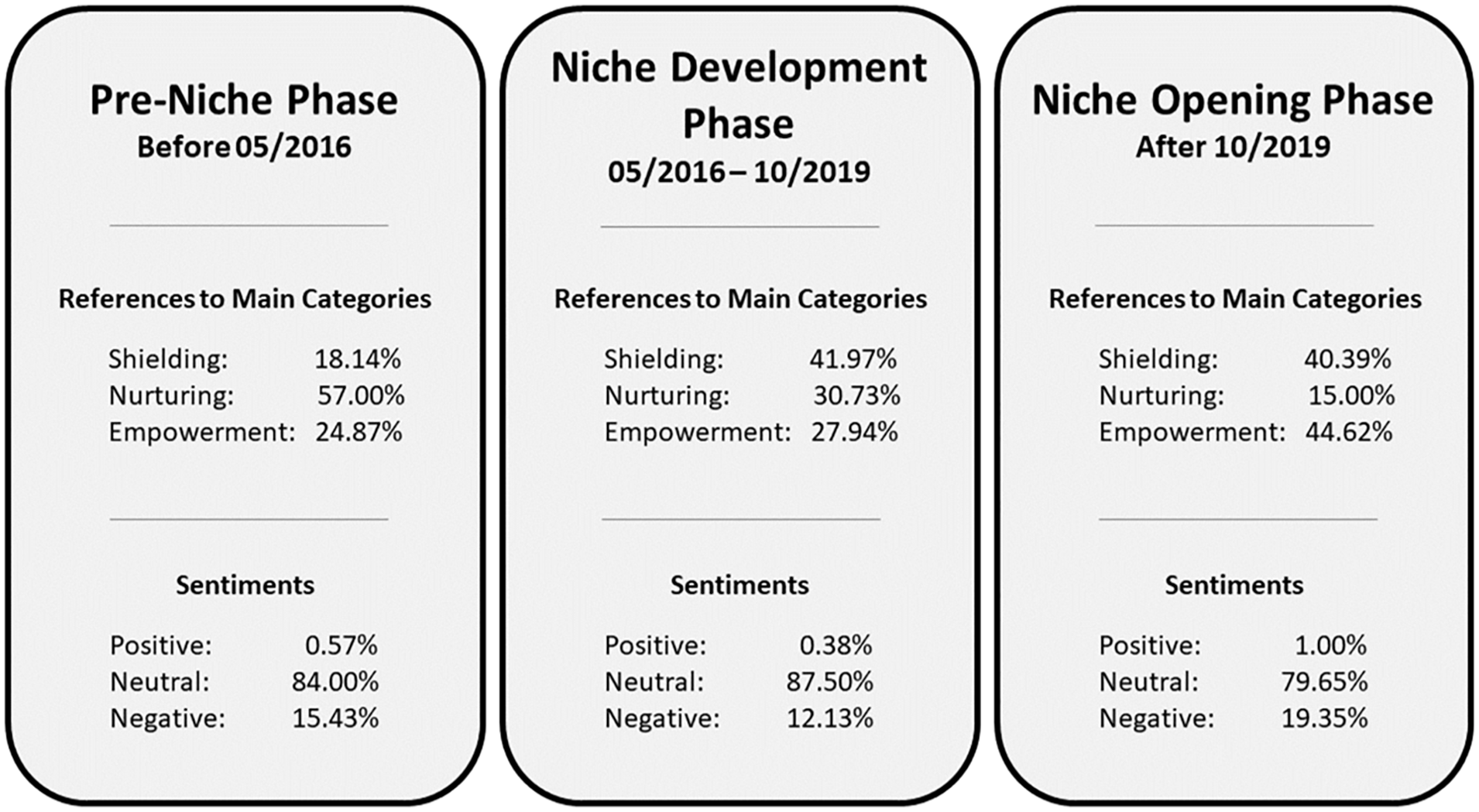
Proportion of comments related to the main categories and sentiments depending on the phase of niche development.
In addition, the sentiments of the user comments were investigated. The data indicate a constant low level of positive and a constant high level of neutral expressions within the comments. The most striking phenomenon concerns negative sentiments: While these decrease from the pre-niche phase to niche initialization, a rising trend is evident toward the niche opening. This phenomenon is mainly due to several negative comments in 2021 (35% negative sentiments).
The results of the second sentiment analysis confirm this finding: For the first phase, the analysis show a sentiment of −0.22, meaning a moderate negative perception of the topic. This trend tends to a more neutral sentiment in the second phase (−0.21) and a slightly more negative sentiment in the third phase (−0.27).
Qualitative results: Public perception of niche-development measures
Shielding
On the one hand, shielding measures are essential tools for establishing niches and removing competitive pressure to prepare novel technologies for market maturity. On the other hand, shielding measures often represent significant interventions by state or commercial institutions in the market economy. Because of this, such measures are viewed critically by the public in particular. A common theme here is perceived equity and justness: if shielding measures result in certain groups being disadvantaged, this can lead to open rejection of the technology. Three different shielding measures are discussed in relation to recharging infrastructures: governmental initiatives of (legal and economic) shielding and the influence of organizations.
Government-initiated legal shielding
Legal shielding measures (18.46% of all annotations in the sixth subcorpus) create regulatory foundations on which a niche can be established and shaped free from the influences of competing technologies. However, this puts alternative technologies at a competitive disadvantage. Various controversies about the appropriateness of such measures were identified in the data. In particular, shielding measures are often fundamentally criticized if the shielded technology is not perceived as being superior to competing technologies. In the case of recharging structures for electric vehicles, there is debate about whether promoting electromobility over hydrogen (especially in aspects of sustainability) may be a fundamentally wrong decision for the future, as the following extract from a user comment exemplifies: Producing and dismantling batteries is not really environmentally friendly. Instead, we should opt for cheap and sustainable hydrogen!
The data further indicate that the public reflects critically on whether shielding measures are initiated for the common good or driven by the influence of particular interest groups: Our government wants to ban Tesla from further expanding its supercharger network. This is a clever move by the German automotive lobby to prevent foreign manufacturers from building an independent network of superchargers near highways.
A drastic step in shielding is the ban of alternative technologies. Such measures are viewed critically, in particular, if the public perceives that the shielded technology will not be able to meet its requirements at the time of the ban. In the e-mobility discussion, this phenomenon becomes evident in the comments from July 2021 following the enactment of the EU “Fit for 55” regulation. The regulation aims to phase out internal combustion vehicles in favor of electric vehicles. This measure is rejected in the majority of the comments. Reasons stated for the negative perception are to a high extent insufficiently developed recharging infrastructures: Declarations of intent and 5-year plans do not help. And in many places, the necessary infrastructure is missing. If politicians want to ban the internal combustion engine, they must first create the necessary conditions for alternatives.
The above example highlights that measures are rejected that appear unfair from the public’s perspective. At the same time, however, there are also indications in the data of desirable legislative initiatives. In the following quote, one commentator suggests that a general obligation for a uniform billing method should be sought for all recharging station operators: The solution to the problems with the variety of billing methods is straightforward! The government should oblige recharging-station operators to accept a centrally issued e-mobility card. The recharging stations report the card number and the amount of energy used to the central office and are billed using the local billing system.
Government-initiated economic shielding
In addition to legal regulations, government-initiated shielding (15.02%) is also achieved using financial measures. Besides subsidies to technology development in niches, these include support for the dissemination of the technology. In the case of recharging infrastructures, financial measures can be found in the form of state participation in the purchase of electric vehicles or by influencing recharging fees. In this context, it is evident from the data that social media users discuss, in particular, the means by which reduced recharging fees are compensated. For example, it is critically perceived that reductions for electric car owners and recharging station users could be passed on to the general public: Charging e-car users a reduced grid fee means nothing other than that this “reduced” fee is imposed on the general public – the amount of money required to maintain and run the grid does not change, and the general public would have to finance the reduced revenue for recharging-station users.
Financial support through purchase incentives is critically questioned in social media if such measures only serve commercial interests and not the common good. In the case of recharging infrastructures, commentators question the usefulness of promoting electric vehicles in terms of sustainability: dismantling cars that run on petrol and producing new e-cars is perceived as much more polluting than CO2 emissions from internal combustion engines: I am against a premium for e-cars as this measure only aims to sell many new electric cars and does not help the environment because thousands of new cars will be built with significant environmental impact. And even 100% green electricity from recharging stations cannot compensate for this additional pollution.
Shielding initiatives by organizations
Social media comments allow the reconstruction of the public evaluation of shielding measures initiated by private niche players (5.37%). Such evaluations seem to be influenced by the reputation and perceived trustworthiness of niche players. In the case of recharging infrastructures, initiatives of the car lobby, petroleum companies, electric car manufacturers, insurance companies, and environmental associations are particularly discussed. Shielding measures that are initiated by such niche players and directed against the expansion of recharging infrastructures for electromobility for commercial reasons have a negative impact on public perception. In the following commentary, it is assumed that mineral oil companies will not adapt gas stations to the requirements of electromobility as long as the gasoline business still generates profits.
The only reason why the major petroleum companies are not yet converting their filling-station networks for electromobility is probably to be found in the still sufficient availability of crude oil as a resource. As long as there are enough combustion engines, the companies will shy away from the additional costs of retrofitting, which slows down the spread of recharging stations and especially direct-current stations.
The data suggest that such initiatives lower the perceived trustworthiness of niche players. If individual players are distrusted, this could affect the acceptability of the niche. At the same time, indications of desired behaviors were identified in the data. In the following quote, a user suggests initiatives for the promotion of electric mobility and private recharging stations by insurance companies: There is the long-outdated mindset, which unfortunately is strongly pushed by insurance companies, that an old car would not be worth anything anymore. It would be desirable if incentives for switching to electric vehicles were created through appropriate promotion of wall boxes and lower insurance rates.
Nurturing
Nurturing comprises measures to develop a niche further once it has been initialized. From the public’s point of view, it is particularly important that such measures are used to shape niches in socially acceptable ways. In this context, the comments analyzed discuss expectations of niche development, questions about learning processes, and suggestions for networking between niche players.
Expectations
In web comments, social media users express expectations toward technologies under development and the general conditions of their niche design (20.9%). Such statements allow examining factors under which a technology will be accepted or rejected at market launch. In the case of recharging infrastructures, comments include expectations about spatial (e.g. the number and placement of recharging stations), economic (e.g. favorable billing systems), environmental (e.g. the sustainability of recharging processes), and service-related aspects (e.g. what types of apps should support the use of recharging stations). Users express concrete values based on which they assess the maturity of the niche toward opening up to the mass market: In addition to the range, the recharging time and the network of recharging stations are also essential. With at least a range of 500 kilometers, a DC recharging station at every gas station, a recharging time of 80 percent in under 5 minutes, and a car price under 30,000€, I’m in.
The results indicate that the public compares statements of niche players to their own expectations. Such comparisons are used to draw conclusions about the sense of responsibility of these niche players. In the case of recharging infrastructures, statements made by recharging-station operators and electric-car manufacturers are evaluated in terms of sustainability: I think that mobility options should be environmentally friendly as a whole. Manufacturers have recognized the public awareness of sustainability and are doing their best to occupy this topic in their promotions. However, electricity for the recharging station is still produced by coal-based power plants. The manufacturers are certainly aware of this issue. Nevertheless, they do not address it, which is irresponsible.
Another valuable input for niche development is the identification of current issues which should be addressed to ensure the acceptability of the technology. The following quote identifies four such problems for recharging infrastructures: What are the real problems today? Broken recharging stations with incompetent operator hotlines, chaotic payment systems, stations blocked by internal combustion vehicles or other electric cars that have long since been fully charged, a lack of legal framework for the private installation of recharging options.
Furthermore, the comments include suggestions for solving existing problems that the public believes are compatible with the actual demands of everyday life. The following quote discusses an alternative battery recharging option: Vehicle batteries should be removable by a slide-in or clip-on system. In this way, you can conveniently recharge your battery at home instead of having to search for a recharging station.
Learning
In some cases (2.71%), commentators compare the development of the current niche with other niches. In this way, criteria are made explicit against which the public measures niche developments. In particular, perceived “best-case examples” are named in this context, which can be used as objects of comparison for learning processes in niche development. Such examples include regional, national, and international cases. In the following excerpt, Norway is emphasized as a positive example for facilitating the use of electromobility and recharging infrastructures: In Norway, e-car drivers are exempt from tolls and have to pay low fees at recharging stations. I think this is an excellent approach to promote electromobility, from which we can learn. In comparison, I currently see a lack of good initiatives in Germany.
Networks
Some comments refer to the perception of cooperations and networks between different (potential) niche players (3.03%). Specific demands are stated for public and private players to combine their efforts, which commenters believe could facilitate niche development. The following quote calls for vehicle manufacturers to pursue efforts toward battery swapping capabilities in cooperation: Vehicle manufacturers should initiate a joint venture to facilitate battery-swap stations, which should be built at strategic points in cities. In this way, you could get a fully recharged battery within seconds.
According to the commentators, collaborations should not only be established between e-mobility companies. Rather, they suggest that companies and shops located near recharging stations should be involved in niche-development networks. The commentators expect such cooperations to result in benefits both for electric car users and for the companies involved: Stores and restaurants have already noticed how beneficial it is when the owner of a Tesla, for example, charges for half an hour and is then attracted as a customer.
In contrast to desired collaborations, commentators also name situations in which niche actors work against each other to the disadvantage of the public: We now have quite a bit of plug diversity in e-cars and recharging stations which has a lot of disadvantages for the public. Why are manufacturers working against each other instead of agreeing on one connector type?
Empowerment
Empowerment comprises measures to open up the niche and establish the technology developed within it in the mass market. In the context of recharging infrastructures, comments discuss both measures to integrate recharging-station networks into existing transportation and energy supply infrastructures, as well as measures that modify and transform such existing infrastructures.
Integration in existing infrastructures
Some of the comments (9.21%) discuss how recharging stations for electric vehicles can be added to existing supply infrastructures without considerable reconstruction measures. In particular, they refer to locations where recharging options can be retrofitted without high efforts: garages in the private environment and parking spaces at the premises of companies. The data indicate that tenants cannot have wall boxes installed in private garages without the landlord’s consent due to existing legislation. Commentators demand a change in legislation to be granted more rights in the private expansion of recharging infrastructures. Other tenants do not have access to garages and rely on public parking spaces where it is often impossible to recharge an e-car overnight. According to the commentators, this issue can be remedied by a massive expansion of public recharging infrastructures in parking lots (see “transformation of existing infrastructures”). An alternative to this approach is perceived in successively retrofitting company-owned parking lots with recharging stations. In this way, recharging can take place during working hours which would lower the need for nighttime recharging. Retrofitting could take place during weekends and holidays so that daily business is not affected. In the following quote, one user cites employer-provided recharging stations as a necessary condition for purchasing an electric vehicle: If there were recharging possibilities near my workplace, nothing would speak against buying an e-car anymore. If I ever change jobs, company-owned recharging stations would be a good reason to apply to a particular company.
Transformation of existing infrastructures
Several comments (25.31%) address how the existing supply infrastructures need to be transformed to adapt networks of recharging stations adequately. Overall, there is a consensus that existing recharging-station networks fall short of meeting the public’s current and anticipated future needs. Regarding recharging infrastructures, the data indicate that commentators expect a massive expansion of recharging and parking facilities. However, such requirements are considered as being difficult to fulfill with respect to the development of urban areas: For a complete switchover from combustion engines to electric cars, one would require large groups of recharging stations or even entire houses. Especially in the megacities of this earth, this space consumption would be critical.
Commentators point out, in particular, the need for the expansion of DC fast rechargers that allow electric car owners to travel longer distances with short recharging stops. In the following quote, an acceptable ratio of recharging time to travel time is stated: A DC recharging network must provide sufficient charging power to provide a reasonable ratio of charging time to travel time. Something like 1:4 would be acceptable.
In addition to specific requirements for the niche development, the comments reveal demand for knowledge about future developments and corresponding plans by niche players. In the following quote, a commentator asks about official plans to replace outdated models with more advanced recharging stations: It makes little sense to build large recharging infrastructures now because the technology is still not mature, and the development leaps too steep. Everything that is installed today will have to be replaced at some point - is there a long-term government plan for this?
Discussion
Potentials of acceptance mining for niche development
The niche literature describes shielding, nurturing, and empowerment measures as necessary for successful niche development (Smith and Raven, 2012). The results of this study suggest that public opinion develops around these measures but is usually not involved in niche development. Several commentators express displeasure that frequently discussed drawbacks of recharging infrastructures for electric vehicles are not considered in development. The results can be interpreted in a way that the expectations of the public and the niche players develop separately and are thus subject to different evaluation criteria. A lack of alignment of these differing expectations in the early and middle stages of niche development seems to entail negative reactions from the public, especially in the late stages when the technology and the direction of niche development become noticeable to the public. In addition, the public seems to reflect on technologies critically whose development is the exclusive domain of a small circle of niche players and does not facilitate grassroots approaches through which alternative directions of niche development could be demonstrated.
The niche literature particularly highlights nurturing activities for sharing knowledge and aligning expectations regarding niche development. Approaches such as strategic niche management recommend active demand-side measures to change public preferences (e.g. information campaigns) (Kemp et al., 1998; Smith and Raven, 2012). The results of this study indicate that the public negotiates arguments for and against a technology on social media as the niche develops, forming its own set of expectations. Demand-side measures of niche players are critically examined against such expectations. If the expectations of the niche players and those of the public differ considerably, the public perception can be negatively affected. The data indicate a willingness to reject electromobility and related recharging infrastructures. Accordingly, it would be advisable to survey public acceptance during niche initiation, monitor it continuously, and incorporate it into all phases of the niche development. The goal should not be to change public preferences but to encourage an exchange of views that facilitates compromises on controversially perceived evaluation aspects of the technology. This study shows the potentials of acceptance research for niche-development processes through the demonstrative application of analysis methods for large corpora. Acceptance mining allows investigating which measures of a niche development are in the focus of the public at a certain point in time. In addition, aspects can be identified on the basis of which the public evaluates the status, maturity, and social acceptability of a niche. In some cases, specific scales can be identified by which aspects are evaluated (see Jakobs, 2019). Such scales are usually either dichotomous (e.g. payment systems for recharging stations are assessed as either practical or impractical for everyday use) or ordinal (e.g. how many DC fast-charging stations should be available per 100 km). Dichotomous and ordinal scales are of particular interest for niche development if the evaluation carried out on them is perceived as mandatory for social acceptance. Such aspects represent key criteria in the public’s view that change the acceptability from a positive to a negative attitude (and vice versa). Key arguments should be carefully considered in niche development. Information about key arguments from user comments can be used to form the basis for communication and cooperation between niche players and the public at eye level. The following summarizes the potential of acceptance mining for each of the niche-development measures.
Shielding: The study of the public opinion on shielding measures reveals concrete points of criticism that can be used to improve these measures. In particular, overarching themes such as perceived injustice and discrimination can be identified, which determine public discourse and must be addressed in the communication with the public to establish a basis of trust. This is particularly necessary as the findings reveal considerable trust issues regarding the motives of niche players, which are perceived as contrasting with demanded niche-development objectives such as the common good. Low trust in niche players seems to influence both the perception of the niche development and the technology developed in the niche. Trust issues should be addressed as early as possible in niche development.
Nurturing: The consideration of public opinion enables conclusions to be drawn about requirements of public life from which expectations for the design of niches arise and based on which niche development is evaluated from the public’s point of view. Several comments also state concrete values such as the number of expected recharging stations per parking space or the acceptable recharging speed, which can be used to assess current niche developments. The results also show a variety of information needs that should be taken into account in the communication of niche development. In this way, adequate interaction with target groups can be achieved even before the niche is opened. Another important input of acceptance mining for niche development is the identification of positively perceived role models against which the current niche is evaluated (e.g. Norwegian recharging infrastructures as role models for the German equivalent). Similarities and differences between such role models and the current niche development should be integrated into communication efforts.
Empowerment: Acceptance mining provides input to develop concepts for the integration of the technology in the market with regard to the personal (e.g. low-threshold approval procedures for the expansion of wall boxes in multi-tenant apartment buildings), professional (e.g. recharging options at company facilities as an incentive for employees), and public life (e.g. suitable recharging options at major events). In addition, the method provides indications of preferred technology variants such as DC fast-charging stations. The comments contain a wide variety of suggestions that could be integrated into niche development using co-creation approaches. In this way, shortcomings of the niche design are identified during development that can lead to bottlenecks when technology is brought to market. Some comments indicate a willingness to support niche development actively. Such positive attitudes toward niche development can be used to involve the public in niche development, for example, in round tables or co-creation workshops with niche players.
Limitations of acceptance mining and possibilities for optimization
Despite the multiple potentials, the exploratory application of the acceptance-mining approach reveals some limitations and opportunities for improvement. A major limitation is the lack of ability to examine commenters’ demographics and expertise backgrounds to draw conclusions about the perception of differing social groups. Because such data often cannot be reconstructed, interview studies based on the results of acceptance mining are recommendable for this research purpose. Another limitation is the restriction to social acceptance factors. According to Devine-Wright et al. (2017), results from the analysis of social acceptance concepts could be contrasted with those of the policy and market perspectives to cross-check findings from multiple sources and thus increase the reliability of the approach. For example, in the case of recharging infrastructures, numbers about the diffusion of recharging stations could be cross-checked over the period of the acceptance study. Further advantages, disadvantages, and optimization possibilities result from the individual sub-steps of the automated and manual analysis, which are discussed below.
Automated analyses allow the identification of texts related to the topic. As the results show, user comments often contain content not relevant to niche development of technologies which must be sorted out to facilitate subsequent manual analyses. The efficiency of this selection process largely depends on the quality of the underlying search patterns. To improve the process, it would be recommendable to evaluate existing word clouds on a test corpus of social media comments before using them. In this step, terms that are not representative should be removed from the word cloud and replaced with terms that are frequently used by commenters. In this way, the hit accuracy of the automated steps could be increased while the effort of the subsequent manual (qualitative) steps is further reduced.
The automated evaluation by means of sentiment analysis allows for quickly executable measures to get an overview of trends in public perception. However, in this way, it is not possible to identify underlying reasons for these trends and especially for sudden changes in public opinion. An example of this issue is the increase in negative sentiment in 2021 identified in the study. The manual analysis revealed that the majority of these negative sentiments results from the perceived imminent ban on internal combustion vehicles in favor of electric vehicles by the EU “fit for 55” regulation in combination with the perceived insufficient expansion status of recharging infrastructures. This finding indicates that manual analyses can reveal connections in the data that would remain undiscovered in solely automated analyses.
Another approach to improve the automated part of acceptance mining could be achieved by incorporating deep-learning methods in two ways: First, shallow neuronal networks could be used to capture the probability of occurrence between words (Mikolov et al., 2013). In this way, synonymously used words can be identified based on natural language data which could improve the quality of the word clouds. Second, deep neuronal networks could be used to cluster the data captured in word embeddings (Goldberg, 2015) and thus improve the classification of on/off-topic comments. However, this approach will require larger annotated corpora for training purposes. The task becomes more difficult as the number of aspects increases, for example, the interplay between niche development aspects and acceptance aspects, so manual annotation of an automated pre-filtered corpus is the most accurate method.
The manual analysis allows identifying concrete reasons for the public perception and evaluation, which can further be used for acceptance-related decision-making processes. The particular advantage of this step is that differences in the assessment of already known evaluation aspects and aspects not yet considered in the literature can be identified via the qualitative investigation. Purely quantitative classification of findings into deductively set categories is not able to capture this fine-granular spectrum of public expressions of opinion. The major drawback of this step is the labor-intensive and time-consuming manual annotation. Increasing the number of coders improves the reliability of the findings but additionally increases the workload—especially when coders need to be trained beforehand. However, good pre-filtering in the automated steps can help to reduce these efforts. Developing linguistic markers to identify expressions of acceptance to be used with the text-mining tools could further reduce the amount of subsequent manual analyses. Acceptance markers could include, among others, indications toward arguments. However, recent studies (Lytos et al., 2019) emphasize that argument mining is still in a premature stage at which it is challenging to capture human-level reasoning. Another way to optimize the manual steps with multiple coders is to use collaborative annotation tools that offer structured category creation and intercoder agreements in case of differing annotations.
Conclusion
Although text mining is already extensively used for market research purposes, there is a lack of approaches to make technology acceptance cues from Internet discourse usable for niche development by means of text mining. The “acceptance mining” approach proposed in this paper was tested using the example of recharging infrastructures for electric vehicles.
In particular, the approach allows examining the public perception of niche-development measures in different phases of the niche and turning points in the sentiments. The qualitative analysis of user comments provides insights arguments for this perception which can be used to develop niches in socially accepted directions. Further research should improve the method with regard to the discussed weaknesses and apply it to other niches.
Footnotes
Declaration of conflicting interests
The author(s) declared no potential conflicts of interest with respect to the research, authorship, and/or publication of this article.
Funding
The author(s) disclosed receipt of the following financial support for the research, authorship, and/or publication of this article: Funded by the Federal Ministry of Education and Research (BMBF, FKZ 03SF0592), Flexible Electrical Networks (FEN) Research Campus.
