



Abstract
Merton proposed middle range theories, not as ends in themselves, but as bases for a consolidation to explain broader phenomenon. More than a half century has passed since Merton’s consolidation proposal and in that time a number of experimentally tested middle range theories have been developed. Certainly, the next step should be a consolidation. Yet, to our knowledge, no one has previously offered a consolidation of experimentally tested theories and applied it for explanation. This paper offers a consolidation of middle range theories formulated to explain the rise of the pristine state. Two theories of this consolidation, Status Characteristics Theory and Elementary Theory, form the core of what Analytic Sociologists have called a toolbox of theories. Our toolbox forms an integrated consolidation in two ways. First, the social structures modeled by the theories form a path-dependent process of increasing benefits gained by the elites of the structures. Second, the end conditions of each step of the process are the initial conditions of the next. Whereas the theories in our toolbox have previously been seen as applying exclusively to microstructures, we have encountered no difficulties in scaling them up to apply to macrostructures. While we hope the consolidation has validity in explaining the occurrence of pristine states, this paper’s significance lies in its demonstration that today social theories can be consolidated and applied for explanation.
The topic of this paper is theory as method. Since Merton (1968) proposed that middle range theories “not remain separate but are [to be] consolidated into wider networks of theory” (p. 68), explanation using multiple theories has remained an aspiration of many scholars, including analytic sociologists (Hedstrȍm and Udehn, 2009). This paper does not propose yet another approach to explanation through multiple theories. Instead, it offers an arrival: A fully developed example of an historical explanation using multiple theories.
The goal of the paper is to show that a consolidation of theories with explanatory potential is possible, not at some future date, but at the current state of knowledge in sociology and related social sciences. The overall structure of the consolidation offered here is that of a toolbox (Hedstrȍm and Udehn, 2009: 31), the theories of which are linked in a path-dependent process. For example, two theories pulled from the toolbox are Status Characteristics Theory (Berger et al., 2014) and Elementary Theory (Willer et al., 2014). Those two are used to build diagrams of social structures made dynamic by mechanisms (Hedstrȍm and Bearman, 2009: Chapter 1 passim). The overall formulation is given by consolidating those two and other theoretics into the path-dependent process.
The authors emphasize that the significance of this paper does not depend on the ultimate validity of its theory consolidation. While we hope the consolidation has validity, the paper’s significance lies squarely on its demonstration of how theories are consolidated and how that whole is applied for explanation. Because all theories are full of content, we cannot present a content free consolidation of theories. What we can do and will do is alert the reader when one theory is pulled from the toolbox while the other just used is returned. Nor is prior knowledge by the reader of the explanandum needed. The theory consolidation is aimed at explaining the development of pristine states out of the less centralized structures that proceed them. Early sections of the paper describe thar phenomenon while tracing Robert Carneiro’s circumscription theory and evaluating its scope.
Here is the path-dependent process that consolidates the theories. Following Pierson (2000), by path-dependence we mean “a social process grounded in a dynamic of ‘increasing returns’” (p. 251). We offer what Mahoney (2000) called a power explanation in that the process is driven by increasing benefits gained “by an elite group of actors” (p. 517; see also Goldstone, 1998: 843ff). That process connects what Udehn (2001) called “structurally individualistic” models. Four chiefdom social structures and one for state structure are formed into a theoretically consolidated whole.
To show that there is a path-dependent process we will need to relate the social structures through which the process moves to increasing benefits to an elite group. More specifically, we need to show that, up to and including the development of the state: (1) there were social structures where control and exploitation benefited elites and (2) tracing through time, each successive structure benefitted elites more than the structure previous to it. 1 Furthermore, the integration of the consolidation requires that the final social conditions of each step of the process be the initial social conditions for the next step. 2 Exploitation and control, the two necessary functions required for chiefdoms and early states to reproduce, are the two faces of power theorized by Marx ([1867] 1967) and Weber ([1918] 1968) respectively. We are influenced by both.
The mode of exposition throughout is to form a structurally individualistic model (Udehn, 2001) for each step of the process while grounding the models in extensive ethnographic and prehistorical studies. Our intent is that all inferences we draw from theory to empirical case be based on the theory-tools being applied. The confidence we have in the theory-tools employed rests on the extensive experimental testing each has survived (Willer and Emanuelson, 2021: 156ff). It is our conviction that theories tested under controlled laboratory conditions provide a particularly strong basis for historical explanations.
Theory as method
Theory is the method of the sciences for explanation and prediction (Willer and Emanuelson, 2021). It designs experiments and historical investigations by combining abstract and empirical components in the following way. The theoretically-driven design of sociological experiments begins by building a diagram that is an abstract representation of a social structure. Figures 2 through 5 of this paper are abstract diagrams that represent an array of social structures. The diagram becomes a dynamic model when it is set in motion by its mechanism. Here are examples. Figure 2 is a status structure in which the mechanism is influence produced by status and number of those higher in status over those lower. Figures 3 and 4 are power structures in which the mechanism is the actions of rational actors placed in the positions of the diagram and acting on values embedded in the positions. The actors’ beliefs are the diagram itself.
In experimental research, once the model is built, the next step is to build the replica, the design of the experiment. The replica is a wholly empirical representation corresponding to the abstract model. For example, the layout of the experiment rooms in which subjects interact were the configurations of Figures 3 and 4. The replica for power structures is set in motion by the motivated actions of experimental subjects. The model is analytic. The replica is synthetic. The dynamics of the model are predictions for the replica. Having run the replica, when its dynamics correspond to those of the model, the test is a success: the scope of explanation of the theory from which model was drawn has been extended. Further investigations result in a toolbox consisting of multiple model structures with known properties.
To our knowledge, all successful physical theories, from Archimedes’ ([232 BCE] 1897) laws of levers through Watson (1969) double helix, like the models used in this paper, had at their core a way of picturing their phenomenon. With the possible exception of game theory, these theoretical methods have been strangely absent in the social sciences.
The historical applications of theory found in this paper simply reverse the foregoing steps. Here investigation begins with the theory toolbox that contains a series of experimentally tested social structural models with known properties and dynamics. Then the investigation pulls those models out of the toolbox and compares them to historical social structures in order to uncover their properties and dynamics. Mill ([1843] 1967) maintained that the world was full of regularities while Fisher (1935) asserted that the world was regular in its irregulates. It is quite impossible to know whether the world is or is not filled with empirical regularities, but we can say that applying the toolbox’s models imposes order on the world.
While our program of experimental investigations produced an array of social structural models—some of which are employed below—it would be unreasonable to expect that the toolbox would necessarily contain all the models needed for an historical explanation. For example, we had devised models for the influence-based chiefdom and for the coercion-based chiefdom. It was evident, however, that there was an unbridgeable chasm between the two. An influence-based social structure could not evolve directly into a coercion-based structure. The end and initial conditions did not match up. Further study of history led to the recognition of a previously unrecognized social structure where, through ongoing conflict, indirect coercion evolved.
Returning to the laboratory, investigations of structures with indirect coercion demonstrated rates of coercive exploitation of nearly same order as direct coercion. Furthermore, the initial conditions for indirect coercion linked nicely to end conditions of influence-based structures and the end conditions of indirect coercion structures linked nicely to the initial conditions of coercive-based structures. Adding the model for indirect coercion, the theory toolbox contained the needed social structural models.
Do any of these models correspond to Merton’s middle range theories? A definitive answer may not be possible. As Hedstrȍm and Udehn (2009) point out: Merton used the notion of middle range theory mainly in a negative way, to distance himself from grand theory on the one hand and raw empiricism on the other (p. 27).
Merton’s (1968) view of theory, that it consists of “logically interconnected sets of propositions” (p. 39) reflects mid-century views of mainstream philosophy of science, but not our understanding. The examples he cites, “theory of reference groups” and “relative deprivation” (Merton, 1968: 40) few would today count as theories. It may be that the models in our toolbox, being theoretical and having middling scope, qualify as middle range theory. In any case, Merton’s call at the midcentury for middle range theory was inspired.
Merton (1968: 53) did not reject the possibility of developing “more comprehensive theory,” but rather saw the task as long-term, cumulative, and aspirational. It is only through incremental advancements of a diverse array of middle-range theories, and their subsequent consolidation that comprehensive theory could emerge.
We sociologist can look instead toward progressively comprehensive sociological theory, which. . .gradually consolidates theories of the middle range, so these become special cases of more general formulations. (1968: 51)
Unfortunately, Merton did not put forward the steps by which the consolidation of middle-range theory could occur. The toolbox used here is a method of consolidation. It bolsters Merton’s argument in favor of middle-range theory. The method’s flexibility in application makes it more adept than any grand theory at handling empirical complexity in the same way a bucket of diverse Legos can be combined in any number of ways to unique effect.
Circumscription theory of state development
Carneiro’s (1970) “circumscription theory” links intensified conflict due to increasing population pressure to state development. Increased population produces population pressure when space to expand is circumscribed. Geographic circumscription occurs when oceans, desert, and/or mountains restrict expansion. A population is socially circumscribed when surrounded by hostile neighbors. Population pressure led to increasing conflict over land and, as conflict over land intensified, some villages were defeated by others. Defeated villages, when blocked by circumscription, could not escape, and thus faced subordination by the victor. Subordination meant a loss of autonomy and an obligation to pay tribute. The result of this process was an amalgamation and unification of what had been independent villages into complex chiefdoms and then into states. Figure 1(a) displays the main outlines of the theory. 3
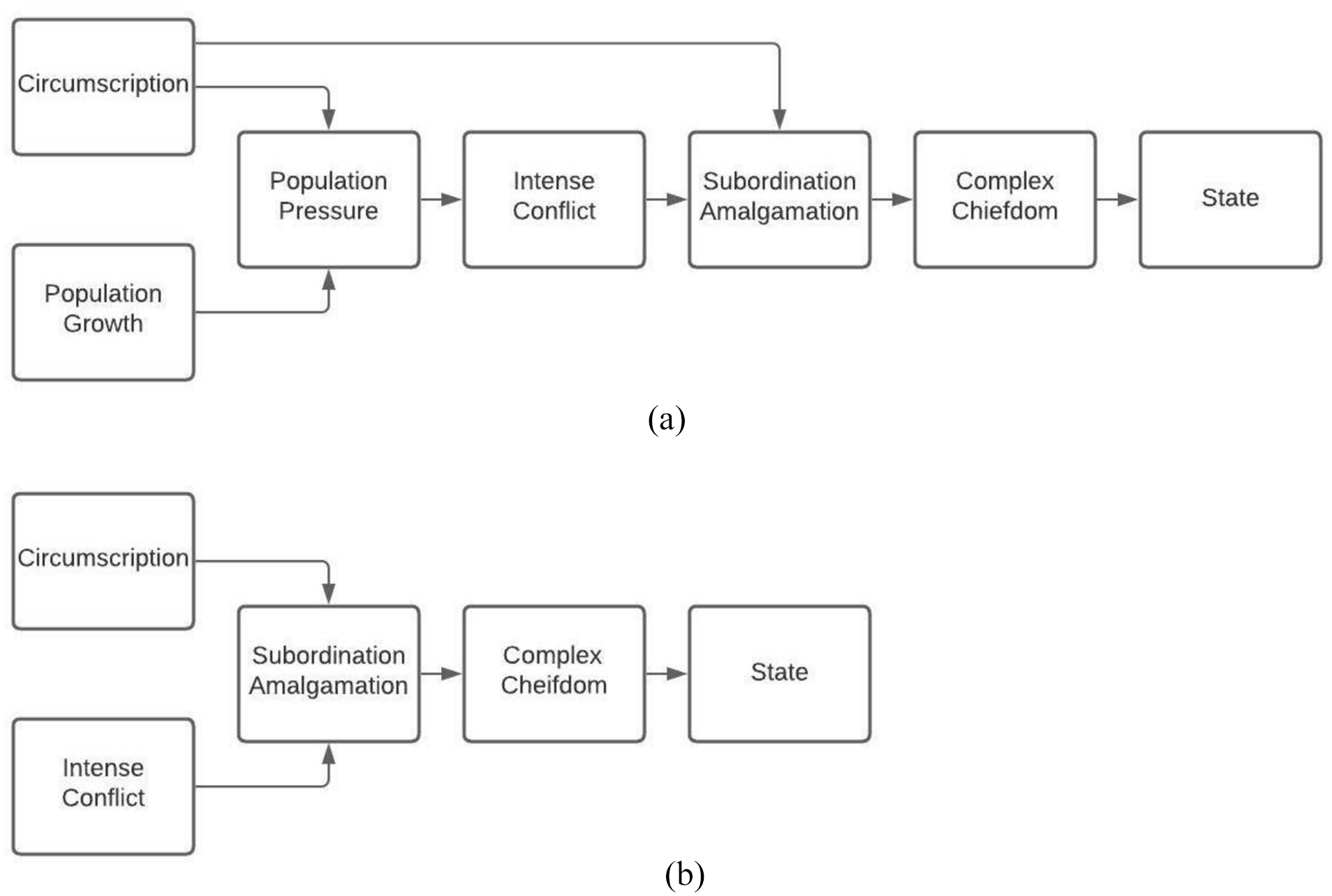
Carneiro and Marcus on the origin of the state: (a) Carneiro’s theory of the origin of the state and (b) Carneiro–Marcus theory of the origin of the state.
A measure of the significance of circumscription theory is that, since first published more than 50 years ago, no serious attempt has been made to propose a theory in which the state developed by peaceful means. A second measure is that, while circumscription theory has been subject to 50 years of criticism, it has survived with but a single alteration. The core ideas of the theory that remain are that the origin of the state is in increasing conflict and that circumscription in blocking escape allows exploitation in the form of tribute and then taxation. The mistake that led to the single alteration was that Carneiro linked the cause of increased warfare to overpopulation. According to Butzer (1976), Pollock (1999), and Liu et al. (2004), the Nile, Tigris-Euphrates, and Yiluo river valleys (respectively) were not overpopulated prior to or immediately after the rise of states. Whatever its explanatory power elsewhere, certainly a theory of the origin of the state must explain those three key instances.
Though Joyce Marcus may not have been the first to point to the mistake of using population pressure as the driving force behind increasing conflict, the significance of her work with Flannery on rise of the Zapotec state demanded special attention. In tracing the process of state development of the Zapotec in the Oaxaca valley, they knew from archeological investigations that it was not overpopulated. Those investigations also indicated that the chiefdoms in the valley were in constant warfare as shown by defensive palisades, burned, and ruined buildings. Under the pressure of war, the Zapotec left their settlement on the valley floor with its fertile and well-watered land, and moved to the less fertile, dryer but more defensible land of Monte Albán from which they came to dominate the valley. Marcus (2012) proposed that population pressure be dropped from the theory and “competitive interaction” (p. 75)—which is to say “conflict process”—be substituted.
When we see local populations leave desirable areas of resource concentration, move to defensible locations far from water sources and good agricultural land and invest in walls or moats, it is a good bet that safety is their main concern. Both Mexico and Peru provide prehistorical examples. (Marcus, 2012: 75, 76).
Marcus’ proposal was the only alteration Carneiro (2012) accepted for his circumscription theory.
The Carneiro–Marcus circumscription theory avoids falsification, but at a price. As seen in Figure 1(b), the theory is now simplified and, since parsimony is valued in theory, that simplification is good. However, the simplification significantly reduces the theory’s explanatory power. Now circumscription and increasing conflict between chiefdoms cause the origin of the state. But why conflict increases is not explained. To explain that conflict and its intensification we employ a toolbox of social structural theories.
Status-lineage and the path toward the state
Since Morgan (1877) and through the middle of the 20th century, the mistaken idea that the egalitarian clan was the only social structure between band and state was so fully taken-for-granted that Paul Kirchoff’s “The Principle of Clanship in Human Society” . . . the first work to fully conceptualize the clan-gens problem. . . was rejected by journal editors from the year 1935 when it was first submitted until 1955 (Service, 1985).
In fact, Kirchhoff (1959) had been anticipated by Fustel de Coulanges’ (1864) study of prehistoric gens of Athens and Rome, and by Firth’s (1936) ramage. When Kirchoff was finally published the dam broke with ethnographic studies by Leach (1954) and Oberg (1955), and the first of a series of publications by Goldman (1955, 1957, 1958, 1960) on status-lineage. For the many names given to this social structure—gens, ramage, gumsa, and conical clan—we employ Goldman’s status-lineage. 4 As Service (1985) explains, status-lineage societies are “found in all major continents, irrespective of language family, culture area, or race. Its size, density, and complexity of population and society is greater than that of the egalitarian-clan-type of tribe and less than that of the archaic civilizations” (p. 131).
Status-lineage chiefdoms
Status-lineage is a descent group in which statuses are inherited. Individuals of the group can trace or remember their own and other’s genealogy. Beyond memories of individuals, there may be specialists in genealogy who, sitting in panels, judge an individual’s descent (Malo [1898] 1903: 254). While inheritance of status may be on the male side, the female side or both, all three are patriarchal. 5 Though the theories we employ can cover all three descent types, because patrilineal is simplest to diagram and interpret, space demands a focus on that form. Now we will model status-lineage chiefdom as a succession of four structures: the first centralizes influence, the second and third power in two forms, and finally the combination of lineages in a complex chiefdom. Only then can we turn to the status-lineage as a dynamic structure and trace the source of its instability.
The status structure of the chiefdom
Figure 2 diagrams a simple patrilineal status-lineage structure in which lower numbers designate higher statuses. “F” is the founder, number 1 is his first-born son, 2 the first-born of that son, and similarly tracing the senior line to the right. Tracing down number 8 is the founder’s second-born son for whom 9 is his first-born son and 10 his second—and similarly for the whole of the diagram. Larger diagrams follow the same logic. For simplicity each father is shown with two sons with the first son inheriting the father’s position. The result is a very large status difference between first and second son, much larger than between second and any further sons.
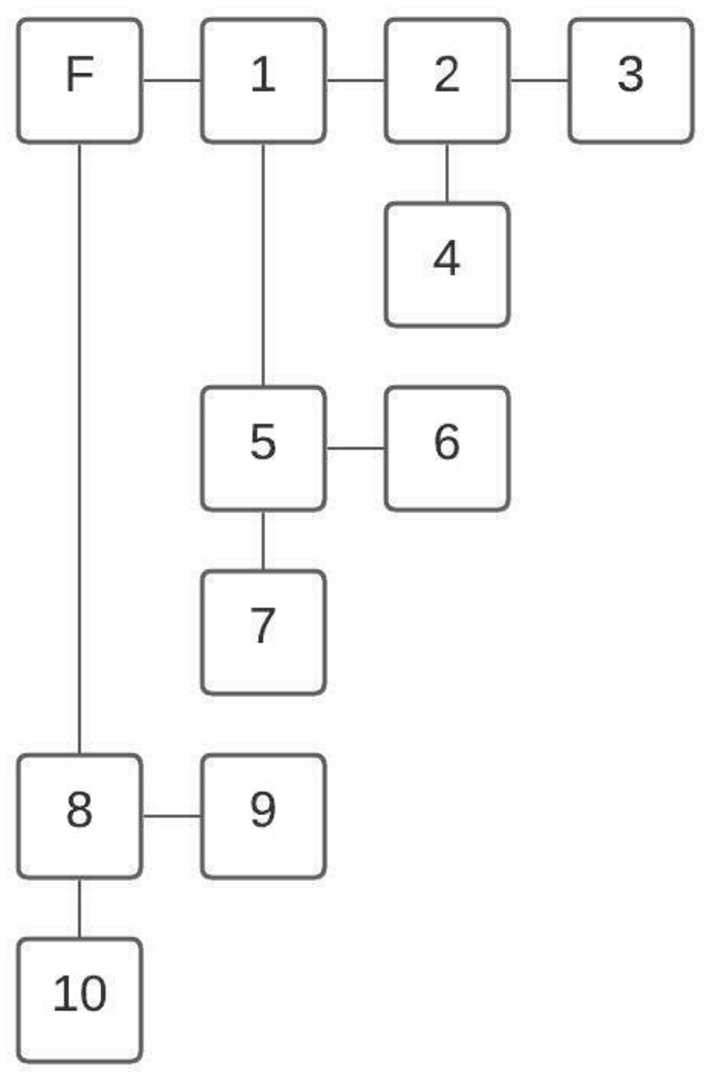
A status-lineage structure.
To find status in the lineage structure we dipped into the theory toolbox and pulled out Hage and Harary’s (1996) method that assigns a unique status to each position. The Hage-Harary method begins at the founder and counts across the senior line to the right assigning statuses in order. Having reached the end of the senior line, it traces back to the left assigning statuses down each branching as they occur. Beyond assigning statuses, the Hage-Harary method uncovers two embryonic cadet lines of 5 => 6 and 8 => 9 => 10. 6
Status and influence
Returning to the theory toolbox, we now deploy Status Characteristics Theory (SCT) to link status to influence. SCT associates distinct expectations with the differential states of status characteristics and the relative influence of actors via others in accordance with shared orderings of expectations among group members (Berger et al., 2014). Accordingly, SCT predicts that expectation orderings result in influence inequalities (Lovaglia and Houser, 1996). To apply SCT requires that a number of scope conditions be satisfied. For example, through a collective task orientation, individuals are motivated to achieve a successful task outcome. Of the collective tasks undertaken by chiefdoms such as collective hunting and war, successful outcomes are a central concern. Recent theory and experimental investigations by Melamed and Savage (2013a, 2013b) show that the extent to which ego is influenced is the joint result of the status and number of alters. No longer limited to the dyad, now SCT can be applied to infer influence in status structures like that of Figure 2. 7
Since influence follows status, the position labeled 1 can influence position 2 and any other higher numbered position. Since influence also follows number, positions 2 and 3 can influence any lower status position or pair of positions—and similarly through the structure. It follows that Figure 2, because it is a tree with no status reversals, is a well-ordered status structure. Inferring from Simpson et al. (2012), since it is well-ordered, the direction of influence is unambiguous and collective action problems can be solved.
Since the power-based coercive chiefdoms evolve out of influence-based chiefdoms, and, since power and influence are often confounded, it would be good to differentiate them here. Following Willer et al. (1997), B is influenced by A when A’s communication changes B’s beliefs and B’s behavior based on those beliefs. By contrast, A exercises coercive power over B when A’s threat governs B’s behavior. For example, if I pay my taxes because I come to believe that I should, I have been influenced to do so. If I pay my taxes to avoid imprisonment, I have been subject to coercive power. Leaders influence. Rulers coerce. As in the tax payment example, very frequently influence and power can operate simultaneously. In the chiefdom, the effects of status-influence do not vanish as coercive power develops. To the contrary, it is because the two work together to the benefit of the chief and his circle that we infer that there is path-dependence in the developmental process.
The status-influence chiefdom, the simplest form of chiefdom, is a system of privilege where the centralization of influence assures that style-of-life follows status. For example, the chief’s largely empty claim to being generous allows chiefs to profit from their systems of redistribution (Sahlins, 1958). Why chiefdoms are warlike we address below. Here we note, following Kelly (2000), that unlike the clan, the chiefdom is well enough organized that it can wage war. As Kelly (2000) found, war and stratification go hand in hand. He found that war was almost wholly absent in egalitarian, segmented societies (p. 146), whereas in ranked structures such as chiefdoms, war, not peace, is the normal condition (see also Carneiro, 1991, 1998, 2012; Earle, 1991b; Marcus, 1998).
With the addition of constant war, the end condition of the status-based chiefdom matches the initial conditions for the indirect coercive chiefdom. As already said, we take up the explanation of war below.
Indirect coercive chiefdom
War between and among chiefdoms produces the power relations of indirect coercion within each. Indirect coercion occurs in the chiefdom when the chief and ruling circle demand support from members of the chiefdom so that they can defend them against hostile outsiders real or imagined. Unlike direct coercion, the chief and ruling circle, while benefiting from indirect coercion, do not threaten to sanction those who are being exploited. Instead, they threaten to withdraw protection. As a result, the exercise of indirect coercion does not require the concentration of the means of violence. 8 It is sufficient that relations between a chiefdom and its neighbors be hostile and that the chief and ruling circle claim to defend the chiefdom—for a price. Experiments by Emanuelson and Willer (2015) compared rates of exploitation between structures of indirect and of direct coercion and found them to be of the same order. The two forms were both capable of the exploitation form of power. It does seem doubtful, however, that indirect coercion, even when paired with influence, would be as effective at the control form of power as direct coercion.
Moving from influence to power, we put SCT back in the toolbox and pull out Elementary Theory (ET; Willer, 1984; Willer et al., 2014). ET, with its flexible modeling procedure, will be used to model the relations and structures of three types of the chiefdom and the state. Figure 3 is a diagram for a small indirect coercive structure. The diagram becomes a theoretic model through the addition of a mechanism. The mechanism is the rational actor who acts from the nodes of the diagram where they acquire their values and beliefs. Here and below, ET deploys an array of social structures that have known properties having been investigated in the laboratory. Among those structures are indirect coercion as applied here and direct coercion below.
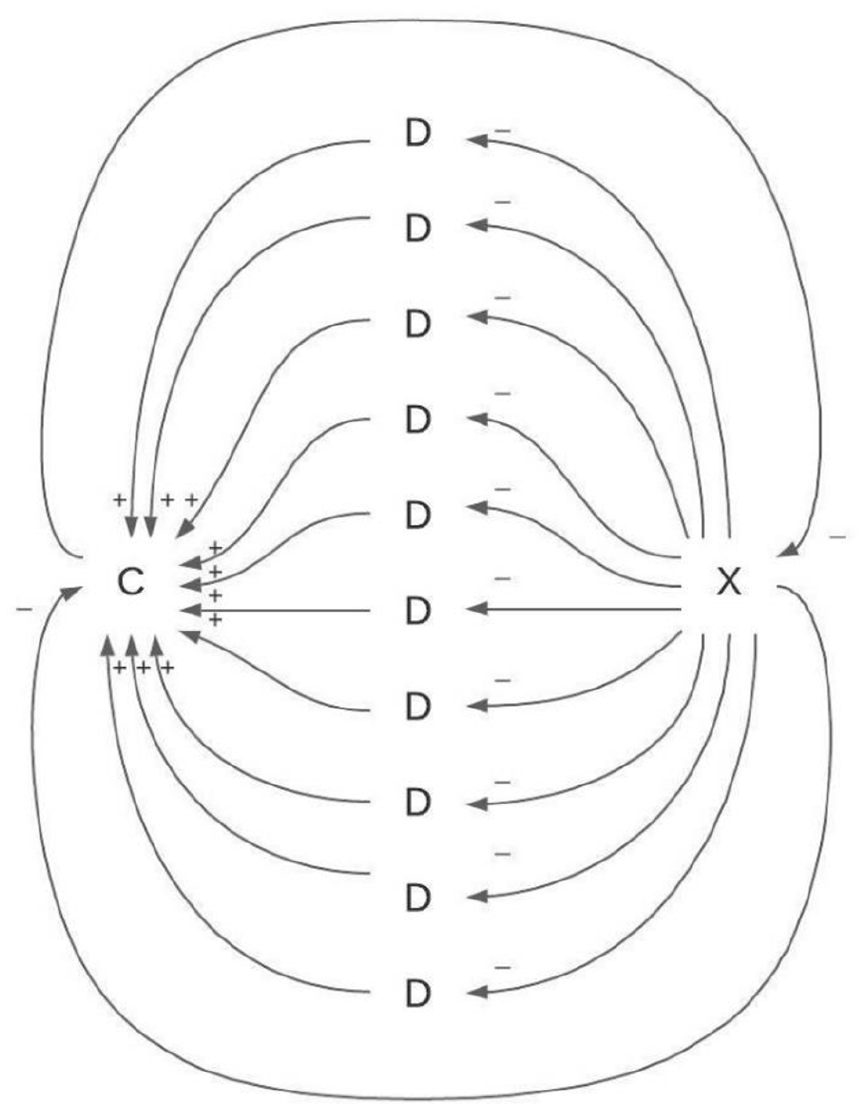
An indirect coercive structure.
The transition from influence-based chiefdom to indirect coercive-based chiefdom is a step along a path of increasing returns for the chief and ruling circle. The increased returns flow by indirect coercive exploitation to the chief. As will be remembered, Carneiro emphasized circumscription as necessary for the development of the state. For all forms of coercive chiefdom, social circumscription is not problematic. War produces hostile relations among chiefdoms that make flight difficult if not impossible.
With the development of indirect coercion, the chiefdom structure undergoes a fundamental transformation. Now a warrior grouping fully emerges as a new status ranking, a warrior caste. That ranking stands between the chief who is first among equals and a lower status group, the commoners (Flannery and Marcus, 2003). Becoming a member of the warrior caste is to be upwardly mobile in a society in which statuses had previously been assigned at birth. 9 With the development of the warrior caste, the end conditions of the indirect chiefdom, the conditions for the third step of chiefdom development have been satisfied. 10
Direct coercive chiefdom
Turning to the direct coercive chiefdom, we return the model for indirect coercion to the toolbox and pull out the model for direct coercion. Further linking those two chiefdom types, we find its development is path-dependent in that greater value can now be extracted by the chief and his warrior caste than in the previous two forms. While no chief can coerce alone, a chief with a loyal, privileged caste of warriors, that evolved through indirect coercion, can coerce commoners, control their productive activity, and extract tribute by force threat (Petersen, 1982). The coercive chiefdom can solve collective action problems, resolving them such that the chief and warrior caste benefit. Combining Marx and Weber’s forms of power, exploitation and control, coercive chiefdoms can extract more tribute through each relation than influence-based and indirect coercive-based chiefdoms. 11 Furthermore, coercive chiefdoms are generally larger than the other two types. Figure 4 diagrams a small coercive structure.
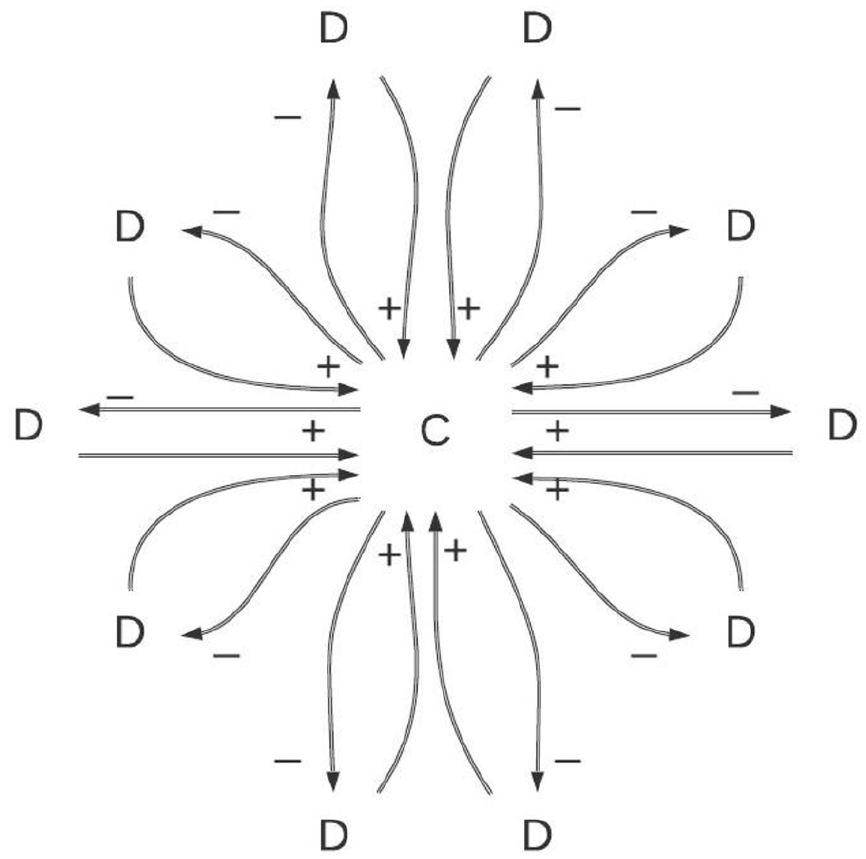
A direct coercive structure.
Though experiments show that indirect and direct coercion have similar capabilities in extracting value, the coercive chiefdom should be more effective than the indirect chiefdom because, with the development of the coercive chiefdom, indirect coercion does not vanish. To the contrary, the chief can use both forms of coercion together. Similarly, the chief’s influence does not somehow disappear with the development of coercion. Because it does not, the chief with both influence and indirect coercion can be expected to extract more than the chief with influence alone. And the chief with direct coercion will also have indirect coercion and influence to aid in extraction of tribute from commoners.
Through direct coercion and the warrior caste, property in land comes to be privatized (Hudson and Levine, 1996). For example, in Hawaii, under Chief Kamehameha, commoners were coercively separated from their land (Kirch, 2010: 184ff). While Kamehameha sought to own all land, some land came to be owned by members of his warrior caste. At the same time, the chief and warrior caste denied that commoners were related to them in any way—they were not a part of the status-lineage structure. More generally, to extract value from land, chiefs came to use land as benefices, that is, as payments for services to members of the warrior class. In that way the warrior class was being transformed into aristocracy and landed gentry. (See also Earle, 1991a.)
With the development of direct coercion and the warrior caste, the chiefdom is becoming more and more like a state. For example, Weber ([1918]1968) defined the state as: A compulsory political organization with continuous operations will be called a “state” insofar as its administrative staff successfully upholds the claim to the monopoly of the legitimate use of physical force in the enforcement of its order. (p. 54: italics original.)
Certainly, chiefs are experts at legitimation and direct coercion requires something like a monopoly of physical force. What is missing is organization and an administrative staff. The significance of that absence is seen in how chiefs collect tribute. Hawaii provides an example. According to Kirch (2010), the then chief of the Big Island collected tribute by traveling from place to place collecting tribute at each stop—much like kings of European Feudalism. Had the chief an administrative staff, he could have exercised power-at-a-distance instead of traveling from place to place to exercise power directly (Willer, 2003).
Complex chiefdom
While the status-lineage is itself size-limited as an organizational structure, status-lineages can, like building blocks, contribute to the size of a resulting complex chiefdom. Imagine a series of Figure 4 coercive structures connected at the chief positions. As put by Flannery (1999), “Chiefdoms grow complex by taking over their neighbors, demoting the latters’ chiefs to subchiefs or replacing them” (p. 4). In other words, a complex chiefdom consists of a number of conquered, subordinated chiefdoms led by a paramount chief and warrior caste. The complex chiefdom has the advantage of numbers in warfare relative to unallied adjacent chiefdoms. As a result, complex chiefdoms tend to grow by incorporating the chiefdoms around them.
As reported by Kurella (1998), just prior to the Spanish invasion, the Columbian part of the north Andean region contained two competing complex chiefdoms. Both had formed by conquering smaller chiefdoms. For both, Kurella traced three settlement levels: the large village of the paramount chief, the midsized villages of chiefs, many of whom had been autonomous chiefs prior to being conquered by the complex chiefdom, and smaller villages headed by a “cacique.”
Chiefs were entitled to receive tribute from their subjects in the form of labor. . . and military conscription as well as gold, emeralds, and foodstuffs. . .. Where there was no legitimate successor to the village cacique, the paramount chief had the right to take over his lands and give them away as a reward to warriors (Kurella, 1998: 196).
Note that the paramount chief took over lands, but, lacking organization to administer them, did not hold the lands or claim ownership of them, but passed them on to favorites.
As in all chiefdoms, in complex chiefdoms coercive power is limited to power over adjacent positions. Being too large for direct coercive power to extend through the structure, the chiefdom parts are held together by marriage and other familial relations among those at the chiefdom level. For example, in the Trobriand islands, the paramount chief takes many wives each of whom “is always the sister or some relation to the headman of the subject village” (Carneiro, 1981: 77). It follows that the cohesion between the parts of the complex chiefdom is weakest at the chiefdom level and is weaker than the cohesion within any of its parts. 12
For stability, structures as large or larger than complex chiefdoms must solve the problem of power-at-a-distance (see below). Prior to that solution as noted by Anderson (1994), Wright (2006) and others, there will be cycling between chiefdom and complex chiefdom structures. While cycling signals that state formation is imminent, cycling will continue until the problem of power-at-a-distance is solved.
Status-rivalries and war
Why are chiefdoms warlike? To answer that question, we will return to the toolbox to pull out the results of experimental studies that show the relation between downward mobility and solidarity. Together they will show that Chiefdoms are warlike because there is an inherent instability in their structure that leads them to war. That instability is the result of the downward mobility that is an integral part of the status-lineage structure. We will first show that status-lineages are beset by downward mobility and then relate that mobility to war.
That downward mobility is inherent in chiefdoms can be seen by tracing the shaded position across the three time periods of Figure 5(a–c). In Figure 5(a) the shaded status position, the second son of the founder, has the second ranked status position. At a later time, as shown in Figure 5(b), after his older brother has had two sons, the status rank of the second son of the founder has declined to fourth. As time goes forward, the older brother’s sons have had sons of their own and, as a result, the second son of the founder’s status rank has declined to eighth.
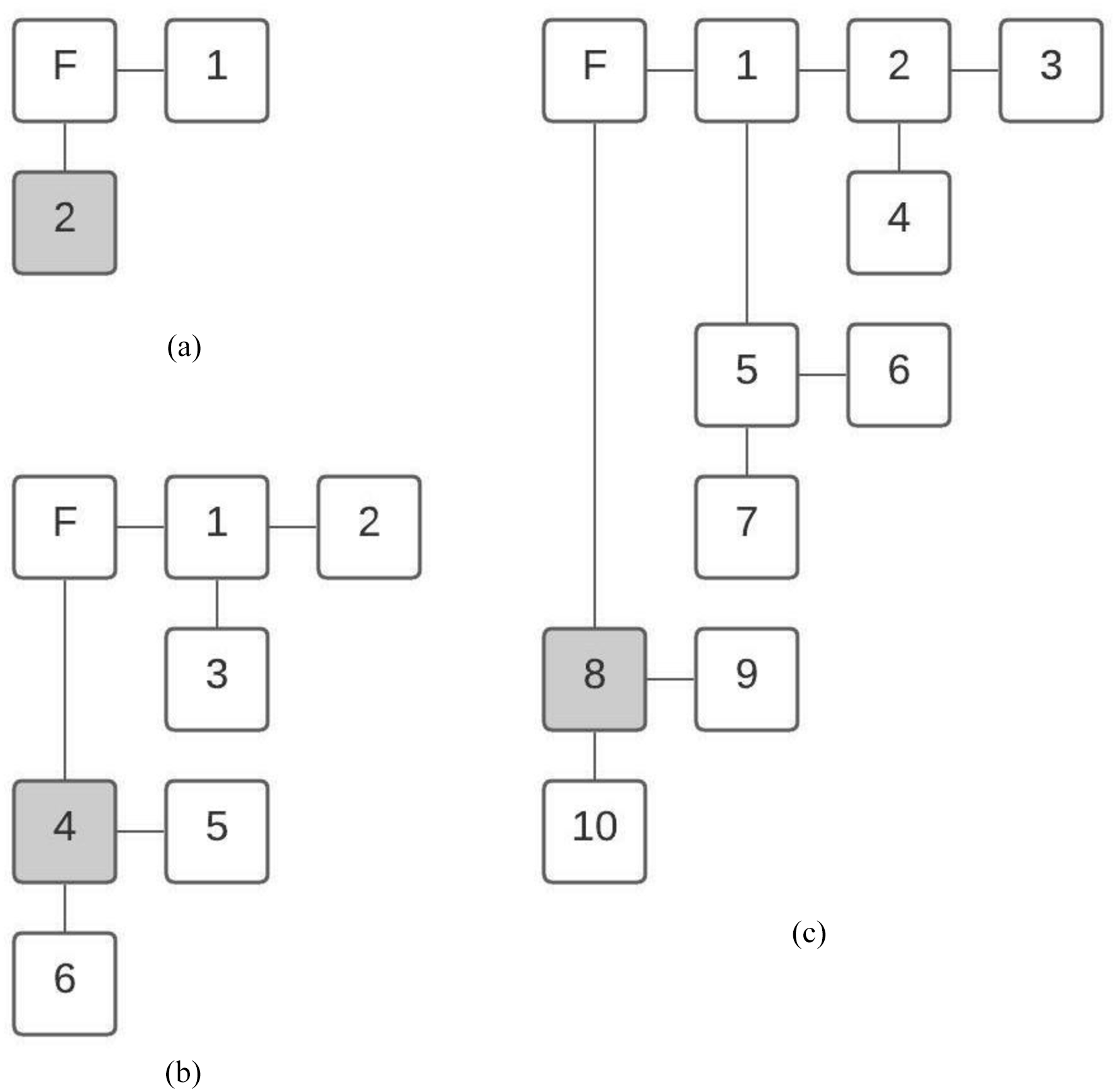
Downward mobility in a status-lineage structure: (a) the founder and one generation, (b) the founder and two generation, and (c) the founder and three generation.
But for the first-born sons who are on the senior line, all in the status-lineage are plagued by downward mobility. To see that that downward mobility is quite general, note the ranking of any position across any of the time periods. For example, in Figure 5(b) the second son of the founder has had a son of his own. That son’s status is initially fifth. Later, in Figure 5(c), his status rank has declined to ninth. Goldman (1960) attributed status-rivalries to inequality: “The psychology of status is such that inequality provokes rivalry, if not through the entire society, then surely in its upper status ranges” (p. 691). To the contrary, we suggest that the prime source of rivalries is not low status but loss of status. 13
Status-rivalries disrupt lines of influence and thus the ability of influence-based chiefdoms to organize activities. Experiments by Barclay and Benard (2013) show that disrupting a status ordering disrupts its lines of influence and thus its ability to organize. Experiments by Kilduff et al. (2016) show that status disagreement leads to withdrawal of contributions and lower group performance. Pettit et al. (2010) showed that the effect of status loss was greater than the effect of an equivalent status gain 14 (see also Benard, 2012; Benard and Doan, 2011). The effect of downward mobility is by no means wholly subjective. Objectively, loss of status goes hand in hand with loss of benefits that flow to those of high status.
Given status-rivalries, it is evident that the line of path-development of the chiefdom is not a superhighway. Instead, it is better thought of as a narrow path bordered on both sides by precipices down which any chiefdom could fall, and many did fall, due to status-rivalries.
Why does downward mobility make chiefdoms warlike? The answer is that, through war, chiefs and their circles can counter the disruptive effects of status-rivalries thereby maintaining their privileged positions and their ability to organize activities. An array of notable theory-driven experimental studies relates external conflict to internal interest situations. Experiments by Bornstein (2003) and Bornstein et al. (1990, 2002) demonstrate that the threats of intergroup conflict interact with group payoffs to reduce free riding and increase group cohesion. Puurtinen and Mappes (2009) found that intergroup competition resolves collective action problems by increasing group cooperation. Further studies show that external threats increase support for leaders (Gavrilets and Fortunto, 2014; Van Vugt et al., 2008). 15 Turning to evidence outside the lab, Hayden and Villeneuve (2012) found that Futuna chiefs exaggerated external threats to promote cooperation and suppress competition within. Pursuing war to increase solidarity and support of leaders is a policy that is still practiced. As documented by Willer (2004), the President of the U.S., George W. Bush, when facing rapidly declining support, demanded higher taxes and increased powers and subsequently pursued war justified by imaginary threats of mass destruction by Iraq.
As coercive chiefdoms transform from ranked to stratified, commoners are denied family status. They are not downwardly mobile. They are already at the bottom. But having little or no influence on polity policy, it matters not whether they experience status rivalries or not. Since policy is formulated by chiefs and members of the warrior caste, downward mobility and associated status-rivalries can still have their effect.
From complex chiefdom to state
For modeling the organizational structure of the state, we keep at hand the model for direct coercion and pull out from the toolbox ET’s model for hierarchies (Willer, 1987) and ET’s model for power-at-a-distance (Willer, 2003). Of those two, the first explains that actors in hierarchies who are not fixed in their positions are subject to power exercised by superiors. The second model traces power beyond adjacencies and shows that that exercise requires structural power conditions between each pair of levels. Power-at-a-distance and hierarchical power are the two organizational conditions that distinguish the state from coercive chiefdoms.
Thus far we have seen that chiefdoms are warlike because war increases the solidarity of the underlying status-lineage structure that is threatened by status-rivalries. Struggling against status-rivalries, the successful chiefdom evolves through a path-dependent process acquiring more and more qualities of state structure. 16 By “state” we mean a polity with centralized coercion administrated by a purposefully designed organization.
In the coercive chiefdom, warrior and commoner classes supplement lineage ranking thus transforming, at least in part, the stratification of the chiefdom from a ranked to a class/status structure. Successful coercive chiefdoms conquer other chiefdoms thus becoming complex chiefdoms. These processes, being driven by social structural dynamics, do not need population pressure as a cause, and thus provide the dynamic missing in the Carneiro-Marcus theory.
With the development of complex chiefdoms, however, comes cycling—or at least more rapid cycling than seen in the coercive chiefdom. Being too large for direct coercive power to extend through the structure, 17 the complex chiefdom parts are held together by marriage and other status-lineage relations connecting chiefs to the paramount chief. It follows that the cohesion between the parts of the complex chiefdom is weakest at the chief level and weaker than the cohesion within any of its chiefdom parts. As explained by Redmond and Spencer (2012), “complex chiefdoms are inherently unstable and subject to cycles of growth and dissolution” (p. 23). To which Flannery (1999) adds that cycling between simple and complex chiefdom could go on for centuries (p. 5). 18 Greater stability comes only with the transition to the organizational structures of the state that allow the exercise of power-at-a-distance.
We agree with Wright (1977), Redmond and Spencer (2012), and Flannery and Marcus (2012a) that the form of the state is distinguished from the complex chiefdom by the division of administration into distinct tasks. When administration is divided into separate tasks, each task is carried out by a bureau. Having multiple bureaus, the state is bureaucratic. The establishment of multiple bureaus is also central to Weber’s (([1918] 1968) formulations on organization (pp. 1025–1044).
Elias’ (1994) investigation of the development of the French state out of decentralized feudalism suggests that the developing division of administrative tasks of the evolving state reflects an underlying developing division of labor in the society of that state (259ff). He points out that during feudalism land was the means of production and the division of labor was minimal. As a result, the only effect of war was to temporarily shift boundaries of fiefdoms. By contrast, as the state began to develop in France, when boundaries were extended, so was the economy and its division of labor. As a result, expansion was no longer temporary.
With the division of tasks, “decision-making can be delegated with minimal fear that subordinate elements in the hierarchy will engage in effective independent action” (Wright, 1977: 383; see also Roundtree and Turner, 1998). Specialized administrations can “delegate partial authority effectively to subordinate military officials and civil administrators at considerable distances from the capital” (Redmond and Spencer, 2012: 34.). By contrast, as explained by Spencer (2014): Since central authority in a chiefdom is not permanently divided into multiple specialized parcels, any delegation of chiefly authority approaches total delegation (p. 46).
As in the developments within chiefdoms traced here, anthropologists see conflict as necessary for the full development of the bureaucratic state. In Flannery and Marcus’ (2012) ethnohistorical investigation of early states: In the four cases we examined, not one kingdom was the offspring to a rank society that simply got bigger. There is apparently no social steroid that can trigger that kind of growth. Instead, all four kingdoms arose through the forced unification of a group of competing rank societies. (p. 362)
Beyond increased size, the social units being unified became part of what Flannery and Marcus (2012) call “an empire,” albeit a small one. States are distinct from complex chiefdoms because they have purposefully developed organizations with divided functions that were wholly lacking in chiefdoms. Said somewhat differently, states have administrative structures. Chiefdoms do not. The development of state organizations is widely attested archeologically by the development of rings of third level and even fourth level settlements around the ruling city (cf. Flannery and Marcus, 2012: 369ff).
In two important regards the transition from complex chiefdom to the state is consistent with developments within chiefdoms as traced here. First, the movement from complex chiefdom to state extends the path-dependent process with increased opportunities to gain greater wealth for those who rule the developed polity. Second, development of the state out of a complex chiefdom resolves a structural instability, in this case, the weak linkage of the parts of the complex chiefdom. That structural instability is fully resolved through the development of administrative structures.
Since states arrived before money, officeholders of the state were necessarily paid in kind by some combination of plunder and benefice. A benefice is payment attached to the office usually in land, possibly including unfree or semi-free labor tied to the land (Weber, [1918] 1968). This may be called, as Weber does, “patrimonial rule” where officials, recruited from the warrior caste, are endowed with incomes in land. It is a relatively simple structure that has “offices vested with powers and authorities” that Kurtz (2012: 69) insists is central to power exercise in the state.
The founding of patrimonial rule is a straightforward extension of the ruler’s household. The ruler’s power over the organization is based, not as in modern bureaucracies on a system of promotion in the hierarchy, but on the ability of the ruler to hire and fire officials—and upon the inability of officials to reciprocate. Unlike modern bureaucracy where positions are filled from below, patrimonial rule is characterized by “peer recruitment.” By “peer recruitment” we mean that office holders are moved horizontally from status positions outside the organization to corresponding status positions inside. Given peer recruitment there is no system of promotion. As long as office holders do not own their positions, however, they can be moved between positions at the whim of the ruler. Nevertheless, as soon as patrimonial rule is established, a struggle for power over the ownership of the benefices begins (Weber [1918]1968: 1042ff). The patrimonial official who comes to own its benefice cannot be hired or fired and need not be obedient. The result is power decentralization and a weakened state. It takes an active ruler to maintain against his officials a degree of power centralization in patrimonial rule.
Conclusion
More than half a century ago Robert Merton proposed that sociology should develop theories of the middle range and, once developed, consolidate them to gain expanded scope. Though his proposal for middle range theory is widely known, as quoted in the introduction, Hedstrȍm and Udehn (2009) explain that Merton gave few details on how such theory should be built. His proposal to consolidate middle range theories to gain broader scope, while certainly meritorious, was also little developed in his writings. As a result, though we cannot say that this paper was guided by Merton’s proposals, we can say that it was inspired by them. Our central aim here was to show how a consolidation of experimentally grounded theories of middle scope is possible at the current state of knowledge in sociology. That is to say, the purpose is methodological. Whether or not the consolidation explains its phenomenon, the paper’s significance lies squarely in its demonstration of how theories are consolidated and how that composition is applied for explanation.
The overall structure of the consolidation offered here takes the form of what Hedstrȍm and Udehn (2009) called a theory toolbox. The toolbox contains experimentally grounded theories and models drawn from them. The models take a “structurally individualistic” form (Udehn 2001) in that social structures are explicitly drawn and are made dynamic by actions of actors whose values and beliefs are acquired from the structures.
While the models are drawn and applied one at a time from the toolbox, the application forms a unified whole because (1) the social structural conditions developed at each step form the initial conditions for the model of the next and (2) the movement between steps is driven by a path-dependent process. Alerting the reader when a model is pulled from the toolbox and when one just used is returned, highlights how multiple theoretics are applied in concert. Importantly, we have encountered no micro-macro problems in applying experimentally tested theory to large social structures.
Because the initial conditions of each subsequent structure are produced by the structure previous to it, all steps of the process are necessary, and, when consolidated by path-dependence, appear to be sufficient to cover the development of the state. None of the theories and models deployed here sees ruling groups as planning transitions between structures. None assumes that formation of the state is the goal of any historical actor. The histories to which our theory toolbox applies were certainly made by the people who lived them, but not under conditions chosen by them.
What are the challenges faced by researchers seeking to employ a theory toolbox for historical and contemporary explanations? Our answer can only reflect the challenges we faced. It is certainly not a necessary part of the theory toolbox methodology that the theories and models drawn from the box be authored by the same people who developed them. While with colleagues we formulated and tested the Elementary Theory models employed here (Willer et al., 2014), we doubt that our authorship was necessary for applying the theory. Nevertheless, when we found that the toolbox had a missing link, that the end conditions of the status-based chiefdom did not link to the initial conditions of the coercive chiefdom, previous experience with theory-driven experiments helped us develop and test the indirect coercion model that spanned the gap.
But the challenges faced in employing a theory toolbox are by no means limited to the workings of theory as a method. No one can apply theory to a phenomenon without some understanding of it—and the more understanding the better. We found it to be no small task to acquire the knowledge of early social structures needed to apply the theory toolbox. That we had any success at all is a testament, not so much to our study as to the excellence of the archaeological, anthropological and historical sources we studied. References throughout the paper are an indication of our indebtedness.
Insofar as the workings of the theory toolbox is concerned, we see no reason why it cannot be applied to other structurally driven social changes. That we cannot be more specific is due not to limitations of how toolboxes work. Instead, what we can say with assurance is constrained by our lack of detailed knowledge of other social changes to which the toolbox could be applied.
What are the limits of a methodology that employs a theory toolbox? Since this may be the first fully developed use of a theory toolbox, but for some generalities, it may be too early to say anything definitive. Nevertheless, some few things come to mind. Though theoretic methods are as old as the sciences—they can be traced at least to Archimedes. (232 BCE)—the idea is alien to many social theorists and methodologists. Every graduate program in sociology teaches statistical methods, as well they should. But very few offer courses in theoretical methods. It may well be, whatever the breadth of potential applications of theory as a toolbox—as a research method—that few are ready to practice it.
Nevertheless, the analytic sociology movement is by no means the only movement that has searched for ways to employ theory as a research method. For example, one of us published on theoretic methods more than four decades ago and many scholars have contributed since then. Today there are multiple social theories where knowledge is cumulating. The field has progressed since Merton. These considerations bode well for new investigations using theory toolboxes.
Footnotes
Declaration of conflicting interests
The author(s) declared no potential conflicts of interest with respect to the research, authorship, and/or publication of this article.
Funding
The author(s) received no financial support for the research, authorship, and/or publication of this article.
