



Abstract
Because university-based research ethics committees tend to focus on ethical dilemmas common in biomedical research in laboratory settings, a growing number of researchers and community-based organizations have articulated the need for alternatives to such committees in community-based research. While there is a robust academic literature on ethical dilemmas in such social research, there remains a need for practical tools to use in collaborations between communities and researchers. In this research note, I present potential memoranda of understanding between academics and communities that might be used when formal community-based research ethics committees do not exist. I focus on two hypothetical scenarios, in which a researcher works with an established group or organization, and in which a researcher is just one of several researchers working with the same community. I forward a framework that conceptualizes researchers as critical friends of communities in their research, highlighting questions of emotional labor, community benefits, and what I call generative conflicts. I hope that researchers and community-based organizations find this note to be a useful starting point for constructive dialogs on reciprocity in community-based research.
Keywords
Introduction
“Nothing about us without us!” (Davies, 2001) This demand speaks to a core principle of Community-Based Research (CBR)—that research and policies focused on specific communities should not be implemented without meaningful input from and collaboration with the ultimate stakeholders.
CBR and related methodologies (such as Participatory Action Research (PAR), Community-based Participation Research (CBPR), Appreciative or Asset-Based Inquiry, Collaborative Inquiry, and Practice-Based Research) have gained considerable traction in the social sciences over the past few decades (Wallerstein and Duran, 2003). Such research can examine the “knotty relation” between dominant and counter-narratives, creating the space for new, radical possibilities (Fine, 2017). However, ethical research protocols and informed consent practices have not kept pace with increasingly frequently implemented and continually evolving CBR practices. Most university-based research ethics committees (RECs) focus on ethical dilemmas common in biomedical research in laboratory settings, with less attention to social research in the field, especially in projects where community members are themselves considered co-producers of knowledge. Further, some researchers lament that as participatory methodologies have gained legitimacy, “PAR” has also become a sort of “buzzword turned fuzzword” (Leal, 2010), a label that researchers have used for projects employing qualitative or ethnographic methods even when they ultimately treat community members as traditional subjects and informants, rather than collaborators.
There is a need, then, for researchers to consider alternative research ethics protocols that consider what meaningful, context-appropriate CBR ethics might look like. This research note builds upon conversations from two convenings at the City University of New York (CUNY) Graduate Center. The Gittell Collective, Public Science Project, Racial Equalities working group affiliated with the Center for the Humanities at CUNY, alongside the URBAN Research Network New York node, gathered university-based academics, community-based researchers, and community activists to discuss key questions and practices that center the ethical considerations and needs of communities, rather than academic institutions, in public scholarship. In particular, activists and community-based organizations articulated the desire for a practical tool to use in deliberating methodologies and research ethics, in conversation with researchers. In response, this research note presents hypothetical memoranda of understanding (MOUs) that can be used in lieu of or in addition to university-based REC protocols and forms.
In the remainder of this research note, I briefly review prevailing critiques regarding institutional REC processes and CBR. I then outline some ethical dilemmas that inform community and activist perspectives of CBR, and the need for alternative ethics reviews. Drawing upon both firsthand experiences and past convenings of both researchers and activists from within and outside academia, I present potential memoranda of understanding between academics and communities that might be used when formal community-based RECs do not exist. I focus on two hypothetical scenarios, in which a researcher works with an established group or organization, and in which a researcher is just one of several researchers working with the same community. I hope that researchers and community-based organizations find this note to be useful, a starting point for constructive dialogs on reciprocity and mutual accountability in CBR.
A need for new research ethics agreements
In the United States, revelations regarding unethical research, including the infamous 1932–1972 U.S. Public Health Service Tuskegee study—in which hundreds of African American men with syphilis were never informed of their contraction of the disease, nor treated, even after the development of successful treatments—resulted in the National Research Act of 1974 (Centers for Disease Control and Prevention, 2020). This act established a system of RECs, called Institutional Review Boards (IRBs) in North America, based in universities. While such IRBs aim to protect participants in social science research, they tend to emphasize ethical questions commonly raised in biomedical research conducted in laboratory settings, regarding individual-level risks, for delimited periods of time. A recent case illustrates how IRBs sometimes fail when community-level informed consent and longer-term relationships are also at stake. In this case, researchers at the Arizona State University in the United States collected and shared blood samples from the indigenous Havasupai Nation for diabetes research; they later shared these samples with other researchers studying inbreeding, schizophrenia, and migration theories. The Havasupai Nation and individual participants claimed that these later studies violated their informed consent and cultural beliefs, and they banished university employees from entering their land. In 2010, Arizona State University paid a settlement and returned the blood samples to the Havasupai Nation (Cross et al., 2015; Drabiak-Syed, 2010).
Other ethical dilemmas, including those more commonly raised in social research and fieldwork, often remain unaddressed. In fact, some academics have suggested that IRBs impose ill-fitting medicalized, paternalistic, and individualistic assumptions in research ethics to community-based social research, both in the United Kingdom and in the United States (Brown et al., 2008; Noorani et al., 2017). Globally, too, most human research guidelines tackle use of human materials, embryos, and data collection in biomedical research (Office for Human Research Protections, 2020).
Some IRBs also work to protect universities’ legal interests and assert ownership of research findings as intellectual property; in some cases, IRBs have acted to uphold institutional power in lieu of community empowerment, prompting community members to call such practices “like Tuskegee in reverse” (Malone et al., 2006: 1917). Such procedural approaches fly in the face of CBR ethical principles of collective ownership of data and co-production of knowledge.
In the gatherings that helped to shape this research note, participants raised several foundational concerns. First, activists expressed being wary of colonizing, extractive models of research, and of past problematic research practices in their communities. In particular, they repeatedly raised questions of “drive-by” or “helicopter research,” in which scholars (often doctoral students) collect data for a short academic year and never return to even report their findings (Wallerstein and Duran, 2003). They also questioned the cultural competency of research teams, and whether the study design was appropriate for the specific community context. Some activists expressed “research fatigue,” stating that they are tired of answering the same questions again and again (driven by academic and foundation priorities). They questioned why significant questions and their prioritized research agenda remained unexplored, and why research timelines tended to abide by academic calendars and publication deadlines, rather than practice-, campaign-, and policy-focused timelines as well. Most of all, they raised concerns regarding time and labor (Davis and Craven, 2016; Hale, 2008).
Second, activists emphasized that instrumental and normative concerns are irrevocably interwoven in CBR. They valued community-based research not only because it often helps to produce higher-quality research, or because it bestows certain types of legitimacy upon both researchers and communities in collaborations, but also because it shares power and treats them seriously as co-thinkers. Sure, compared to traditional, hypothesis-testing research, CBR can allow researchers to collect more nuanced disaggregated data, to trace a greater range of possible causal pathways and theories, and help to surface or produce higher-quality responses and policy implications in social research (Fine and Torre, 2006; Massey and Barreras, 2013; Warren et al., 2018). But participants in the convening asserted that community members also have a right to research—to gain strategic knowledge—and engage in intellectual pursuits themselves (Appadurai, 2006). They wanted to assert the right to not just provide higher-quality data, fine-grained details, or personal stories to research, but to co-interpret the meanings, themes, and causal theories as well. Research should not remain the domain of university-based academics.
CBR thus aims to act as an alternative and sometime-corrective to research in which researchers articulate priority research questions for the community, collect data and develop analyses that they take back to their universities, and advance their own careers—often, in the name of “helping” marginalized communities, but without explicit benefits for the communities.
In the United States, a relatively new Federal Policy for the Protection of Human Subjects passed in 2017. It states that surveys, interviews, other forms of communication between researchers and human adults, and other low-risk projects can, beginning in 2018, be exempt from institutional REC review, though it is up to individual universities to implement the new rules (Schweder and Nisbett, 2017). Nevertheless, many of the issues raised regarding accountability to and reciprocity with communities—such as those regarding ecologies of care, bottom-up accountability, and impact validity—remain relatively understudied and unaddressed (Pulido, 2008). For instance, existing institutional reviews are less likely to allow for adjustments or changes once a research project has begun, or to account for power inequalities within a community or organization of co-researchers (Boser, 2006). While protocols regarding individual-level protections have been well established, some questions—such as how ethics protocols might better address community-level risks (especially longer-term ones), and how they might assess the cultural competency of research team members—remain understudied (Cross et al., 2015).
How can we ensure that research is capacity-building, and not just taking of community members’ energy and resources? How do we operationalize ethical principles for productive collaborations? Whereas “research ethics are often divorced into approval processes at the institutional level and ethical practices. . . at an individual or interactional level,” a growing number of researchers have called attention to the false division between these categories, and some have advocated for “incorporating the development” of REC proposals into the research process itself (Brydon-Miller and Greenwood, 2006; McGowan, 2020: 2). Research ethics reviews can engage investigators to reflect deeply on their process, from the perspective of all stakeholders; they can reflect a commitment to situated ethics and build in moments of reconsideration and revision. This would help investigators to acknowledge, if not quite anticipate, emerging ethical challenges and shifting research contexts (Wiles and Boddy, 2013).
While the literature on ethical dilemmas and methodological innovations in CBR is robust, there remains a need for more mutual learning opportunities and materials on research ethics to assist researchers and community partners, and to address advocacy and inquiry concerns regarding newer methodologies and technologies of representation (Denzin, 2017; Shore, 2007). As Vasudevan and Novoa (2022: 18) write, even in the participatory and pluriversal planning literature, contributions regarding research ethics remain secondary to theoretical or pedagogical ones, and discussion of “the ‘hidden’ aspects of community-based commitments. . . or the decisions that scholars had to make in terms of community involvement” remains scarce. This, in turn, obscures the important role that many researchers in building “relations with communities. . . assisting in creating networks of solidarity between grassroots and civil society organizations, and helping to strategize and ensure the sustainability of community-based practices” (Vasudevan and Novoa, 2022: 15).
One particularly exciting line of work has been that of formal community advisory boards (Cox et al., 1998) or other community-based review processes (CRPs), such as the Bronx Community Research Review Board in New York City, Special Service for Groups in Los Angeles, Hispanic Health Council in Hartford, and Papa Ola Lokani in Honolulu. Through such boards, researchers receive feedback from community members, complete required forms and address questions they might not have considered otherwise, and design projects that address concerns that contribute to not just academic literatures but the communities they engage as well (Community-Campus Partnerships for Health, 2012; Friesen et al., 2017; Guishard, 2015). These boards can also operate differently than university-based review boards by thinking through the perspectives of the community or organization, as well as individual participants (Stoecker, 2008). Indigenous nations have been leaders in developing community-based RECs (Cross et al., 2015). A review of over 100 community review processes showed that most worked with both institutional RECs as well, suggesting that CRPs fulfill previously unmet needs and goals, and that it is possible for CRPs and institutional RECs to collaborate in productive ways (Shore et al., 2011). These findings suggest that CRPs have great potential, but also that the share of community-based research projects with formal CRPs remains fairly small.
Both community members and researchers still need tools to support ethical practice in community-based research, and to attend to what power dynamics for mutuality (rather than dominance) might look like (Boser, 2007). In response to dialogs and action item requests from activists on research ethics, I present example memoranda of understanding for two hypothetical scenarios in which formal CRPs do not exist. I hope that these MOUs can be used as pedagogical tools and perhaps reach audiences beyond academia, especially smaller community-based organizations that do not yet have the resources or tools to broach ethical dilemmas and organizational needs when approached by interested scholars.
Working toward memoranda of understanding in CBR
The sample MOUs below do not outline methods (like participant observation, survey, secondary data analysis, or semi-structured interviews), but they do reflect specific methodologies (here, critical, community-based theoretical approaches used to analyze and justify the theoretical models and specific methods chosen). I present them with the premise that we cannot ignore ethical tensions or wishfully hope that they do not come up; CBR collaborations are fraught with power inequalities (Armstrong and Ludlow, 2020). Talking about potential questions and tensions explicitly can help researchers to better address inevitable questions and engage in ecologies of mutual care, reciprocity, and accountability. Brydon-Miller and Greenwood (2006), for instance, name emphasizing predictability versus process, protection versus participation, confidentiality versus credit, and coercion versus caring as just some of the key tensions to address. In this section, I emphasize three points: the need for clarity in the choices being made, the importance of acknowledging emotional labor, and the opportunity to articulate potential alternative outputs as community benefits.
Activists at the convenings that inspired this research note made pithy, practical requests. For instance, they wanted the research ethics agreements to be called MOUs because their constituents would understand such language, and “memos” felt less legal and bureaucratic than “protocols.” They requested that if possible, the MOUs should avoid academic jargon and empty promises, instead working toward “clarity through specificity” in agreed-upon activities and methods (Cornwall, 2008). On a related note, they maintained that more community participation is not necessarily better in collaborative research. Asking community members to participate in every step of the research process might not be feasible or fair, and in a collaboration where different members have different resources and positionalities, “equal” divisions of labor are impossible, and certainly not equitable.
In particular, activists expressed concern about what might be called the emotional labor involved—labor in managing either their own or others’ feelings and public emotional displays consistent with what was required in their job, or in this case, the research collaboration at hand (Hochschild, 1983). This could entail less visible preliminary work and trust-building, impression management, folding the chairs at the ends of meeting after meeting, or thinking together through strategic or logistical issues, even if none of it is quite related to the research questions at hand (McGowan, 2020). For instance, some researchers at the convening spoke of how difficult it was to maintain “neutral” demeanors during fieldwork, as per their training, when they were actually quite passionate about larger goals being pursued by communities or social movements. Activists, in turn, spoke about the great amount of work and time it took to “train” and “manage” researchers or especially student researchers, even when the research did not necessarily benefit the community or they felt patronized, and to remain calm and courteous while doing so. Participants also spoke about how “draining” it sometimes felt to repress dissenting opinions, concerns that they feared might be dismissed as “extraneous,” or to mitigate disagreements within the collaboration. These examples of emotional labor emphasize how, for community participants, informed consent might not be sufficient for a community-based research collaboration. Researchers also have an ethical duty to contribute to the dignity and well-being of participants. Past research suggests that employers can address the consequences of emotional labor by allowing workers to express genuine emotions (Barry et al., 2019); in the context of CBR, this suggests that MOUs should explicitly give participants opportunities to express disagreements and engage in reflexivity.
Activists also asked for explicit discussions on what community benefits might look like. After all, CBR collaborations often produced academic outputs that benefited researchers more than non-academic outputs that primarily benefited the activists. Activists at the convening thus emphasized the need to specify potential alternative or creative outputs that they might be able to use either in their mobilizing efforts—such as short video explainers on relevant issues, a public exhibit of oral histories and galvanizing events, jargon-free presentations of debates in the academic literature, or strategizing workshops on similar efforts in other locales—or in publicizing and advancing their campaigns—such as newspaper editorials, radio interviews, or press conferences. These often need to be completed on a shorter timeline than academic publications.
Through these sample MOUs, collaborators might consider questions such as:
What do reciprocity and accountability look like, in this collaboration?
How are we being respectful of one another’s labor (including emotional labor), time, and priorities?
How do we treat seriously our roles as co-thinkers, intellectuals? How do we encourage critical inquiry by everyone, and work together when we do not all agree on something?
How do we make sure that we respect each person’s voice in the collaboration, that no one is sidelined/overlooked, and that we respect each person’s right to opacity (Glissant, 1997) and privacy?
Ultimately, who benefits from this collaboration?
The scenarios below draw upon the convenings described above and over a decade of CBR fieldwork and teaching but, like the ethics cases presented in Unsettling Research Ethics (Baloy et al., 2016), they are fictional. I have used elements of both sample MOUs as a researcher working with a community-based organization, and as one researcher among many working with a public project that involved many grassroots groups and community members. In my experience, participants did not use the samples as models to be copied and pasted, but as prompts for further conversation. Our collaborations became more fruitful when we tailored our MOUs to better reflect each research project’s specific sociopolitical and spatial context, as well as the positionalities of each participant and researcher in the collaboration.
Hypothetical Scenario 1
Collaboration between a specific researcher/research team and a community-based group/organization
In the first scenario, a researcher works with a community-based organization that has a clear structure (with staff, key community member leaders, maybe a board of advisors, and in some cases, an in-house researcher). In many cases, the CBO has had experiences with researchers before, and has some preferences on what good collaborations look like, based on those experiences.
In this first scenario, it might be helpful to flesh out some hypothetical characters as well. Professor Blue would like to work with Green Power, an environmental justice group that primarily works with working-class African American and Latinx communities, in a CBR project. She approaches a Green Power staff member, Ms. Red, in the organization about the possibility of pursuing a project on how Green Power’s campaigns have responded to fracking and climate change deniers, and how individual member leaders see themselves vis-à-vis other organizations in the larger environmental justice movement, especially those dominated by middle-class White leaders. Ms. Red expresses interest in the project, though she is much more interested in research that helps Green Power work with local politicians and win some new anti-fracking legislation than research on Green Power members’ reflections on identities and the environmental justice movement.
Ms. Red is also a bit wary because a year ago, lots of community members spent time answering the same questions the foundations always ask them, and they never found out what happened with that past project. She wants to make sure that the same thing does not happen this time. She is also excited that because Professor Blue identifies as a woman of color, she might be sensitive about and relate to community perspectives in different ways than other researchers and foundation officers she has worked with.
Professor Blue and Ms. Red put aside time for at least two phone or in-person conversations about their potential research collaboration. During the first conversation, they outline their missions, and what research questions they were each interested in. They also discuss why they might be interested in such a collaboration. Through this conversation, they end up outlining a few principles and values they wanted to assert together. They also begin to figure out a feasible timeline for fieldwork for the project—they do not want to add to their workloads during stressful times, or right before looming deadlines, for instance. They also discuss other stakeholders in the project. Who else should they talk to, to flesh out details?
For the second conversation, Professor Blue visits the offices of Green Power to meet with both Ms. Red and at least one other staff member and non-staff community leader. Professor Blue presents what she understands to be the key research questions, proposed timeline, and general contours of the project. Together, they discuss whether the proposal so far makes sense, and flesh out some other expectations: How often would they meet? What sorts of methods might be appropriate? What sorts of products might they produce? In terms of organizing focus groups, for instance, who would call members to remind them of meeting times? Could Professor Blue pay for food and childcare during those focus groups? How often would Professor Blue present her hunches and findings? And could she help the Green Power leaders to present their research together, at conferences? Although Ms. Red mentions co-authorship of articles, the member leaders themselves say that they do not feel comfortable with academic jargon, and that they want to focus their energies on activities that have immediate impact in their community or on policymakers, not in academia (Professor Blue is secretly a bit relieved, as her departmental chair told her that she needs more sole-authored articles, not co-authored ones, to get tenure. She is still thinking about different sorts of products to collaborate on, regardless.).
Professor Blue writes up some more details for her memorandum of understanding with Green Power, and she and Ms. Red sign it (See their sample MOU in Figure 1 below. Underlined language reflects this specific scenario.). Concurrently, Professor Blue has been working on her university’s IRB application, and finally gets approval. Research begins.
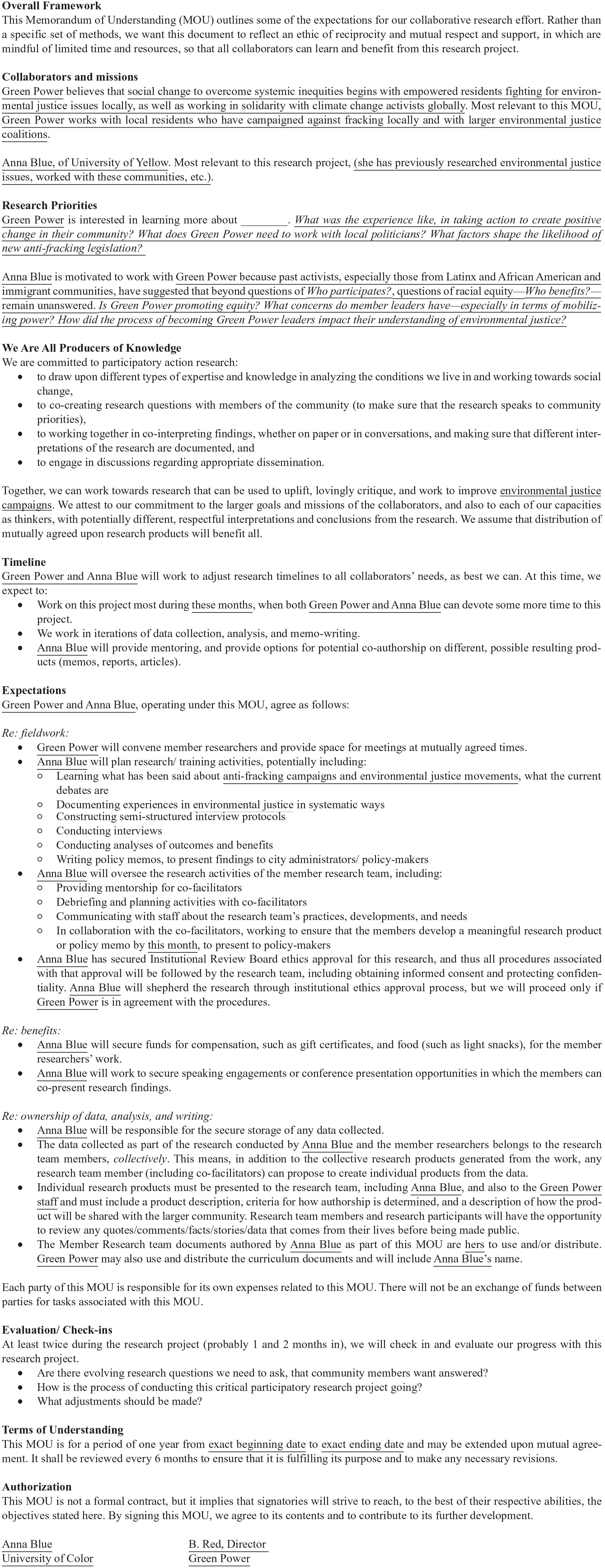
Memorandum of understanding. Between A. Blue and Green Power for the Anti-Fracking Environmental Justice Project, January–September 2019.
Some considerations
After a couple of months of fieldwork, Green Power also wants Professor Blue to help translate academic research into readable reports for both Green Power members and policy-makers. Professor Blue is happy to do so. Some tensions arise, however, when Ms. Red tries to push the organization to strike a deal with a local power plant, for a safety campaign on the polluting effects of its plants. While Ms. Red suggests that this deal would serve as an achievement for Green Power, Professor Blue, based on her research, wonders whether it would instead serve as a bad precedent, one suggesting that continued pollution and environmental racism would be tolerated as long as training programs were implemented. While getting the local power plant to do anything would be an achievement, the educational campaign would in some ways transfer the burden of safety from the power plant onto local residents, as if they could keep safe as long as they were informed—when no one should be exposed to these dangerous pollutants in the first place.
Meanwhile, the local newspaper picks up on Professor Blue’s policy report, and gives her the chance to write an op-ed on Green Power’s efforts. Professor Blue mentions the training program idea, but manages to contextualize it as one potentially helpful but small response among many, especially vis-à-vis a much larger need to address climate change and environmental racism now. She works with Ms. Red and a couple of the more active Green Power leaders on her op-ed draft. Once she submits the op-ed, however, the newspaper editors give her new edits and ask for revisions at what feels like (for an academic) a ridiculous pace, usually asking for turnarounds in 12 hours. They want to publish this op-ed by Thursday! Professor Blue does the best she can, but she does not hear feedback on the revisions from Ms. Red and the member leaders in time for the deadline, and sends it in anyway. The op-ed gets published.
For the most part, folks are satisfied with the op-ed, and quite pleased with the publicity. As Professor Blue spends more time with Green Power, however, she also meets and talks with member leaders who disagree with Ms. Red on a number of issues—including the training program. Professor Blue is quite impressed with many of their points, ones that she had not thought of before, and which Ms. Red had never mentioned. She also begins to notice more disagreements and inequalities within the organization (She cannot tell whether the disagreements are partly due to power inequalities, cultural differences and misunderstandings, interpersonal clashes between individuals with strong personalities, substantive disagreements, or all of the above). She wonders whom she has been inadvertently leaving out of her data, or whom she’s become closer with and why, and how she can accurately document, analyze, and do justice to the complex dynamics at Green Power. She feels relieved, though, that she is not the only one with certain critiques of the organization’s current campaigns, and that some member leaders have similar analyses.
One member in particular takes a keen interest in Professor Blue’s work, to the point that Professor Blue decides to discuss with this member whether they would like to be a co-author on at least one of her planned journal articles. The member is very excited about the idea, and is taking some time to think about whether she would like to serve as co-author, or keep all of her contributions confidential. Either way, Professor Blue feels reinvigorated by this conversation, and she redoubles her commitment to making clear the contributions each individual made to the research process in any article she publishes.
Between Professor Blue’s heavy teaching workload and her out-of-town trips to attend to her father’s ill health, and the Green Power member leaders’ own lives, the interviews are also going a bit slower than expected, and a couple of focus groups get canceled. Ms. Red is getting antsy, too, wondering why Professor Blue’s analyses are not done, and why Professor Blue is not enthusiastically agreeing with everything she says, the way she did at the beginning.
Although Professor Blue worked hard to anticipate ethical dilemmas, engage community members with reciprocity and accountability, and address issues of reflexivity, she was nonetheless caught off guard by tensions and events in her fieldwork. In retrospect, she especially wishes she had built in (and implemented) more moments of reflection and revision in her fieldwork, and thought through more opportunities for polyvocality, disagreement, and critical inquiry in her public work. She also wishes that she had sensitive discussions with members, folks besides Ms. Red, from the beginning (On the other hand, she knows that the members might not have opened up for a while, until they knew that they could trust her, and she was not about to report their views to Ms. Red and others.).
What other issues are likely to have arisen, besides those mentioned in the hypothetical scenario?
What is the positionality of each member of the collaboration? In considering our positionalities, we do not ask that each person divulge private or autobiographical details, though some may be relevant. Rather, we ask each person to consider how our backgrounds—in terms of work experiences and disciplinary training, social understandings, and racial, gender, sexuality, and other identities—inform how attuned we are to the policy and especially discursive debates surrounding the topic of our research collaboration. How do these backgrounds inform how we are perceived by others in the collaboration? For instance, in what ways might we as researchers be perceived as “insiders,” someone that community members can relate to, or someone who readily picks up on social signifiers outsiders might miss, and in what ways might we be perceived as “outsiders,” someone with a different educational background, or someone who can ask “naïve” questions that compel community members to articulate assumptions that insiders would have taken for granted? What sorts of power, resources, bodies of knowledge (including embodied, local, and technical knowledge), and ways of knowing feel most familiar to each of us?
What tensions in the hypothetical scenario can perhaps be addressed by developing and implementing a research MOU, like the ones in Figures 1 and 2? What ethical tensions must be addressed in other ways?
Hypothetical Scenario 2
Collaboration between a specific researcher and a larger group of researchers working with the same community
In the second scenario, a researcher is not the only one working with a specific community, on a broadly conceived research topic. For instance, especially if Green Power has been involved in some successful lawsuits or launched successful campaigns in the past few years, there may be researchers other than Professor Blue eager to work with Green Power. Although it may be impossible to establish and maintain contact with every researcher engaging a large institution/process/community, researchers should make every possible effort to do so, in order to coordinate resources and research projects, and to be respectful of community needs and mindful of the cumulative impacts and dynamics of various research projects (See a sample MOU that Professor Blue might sign as part of a Local Environmental Justice Research Board in Figure 2).
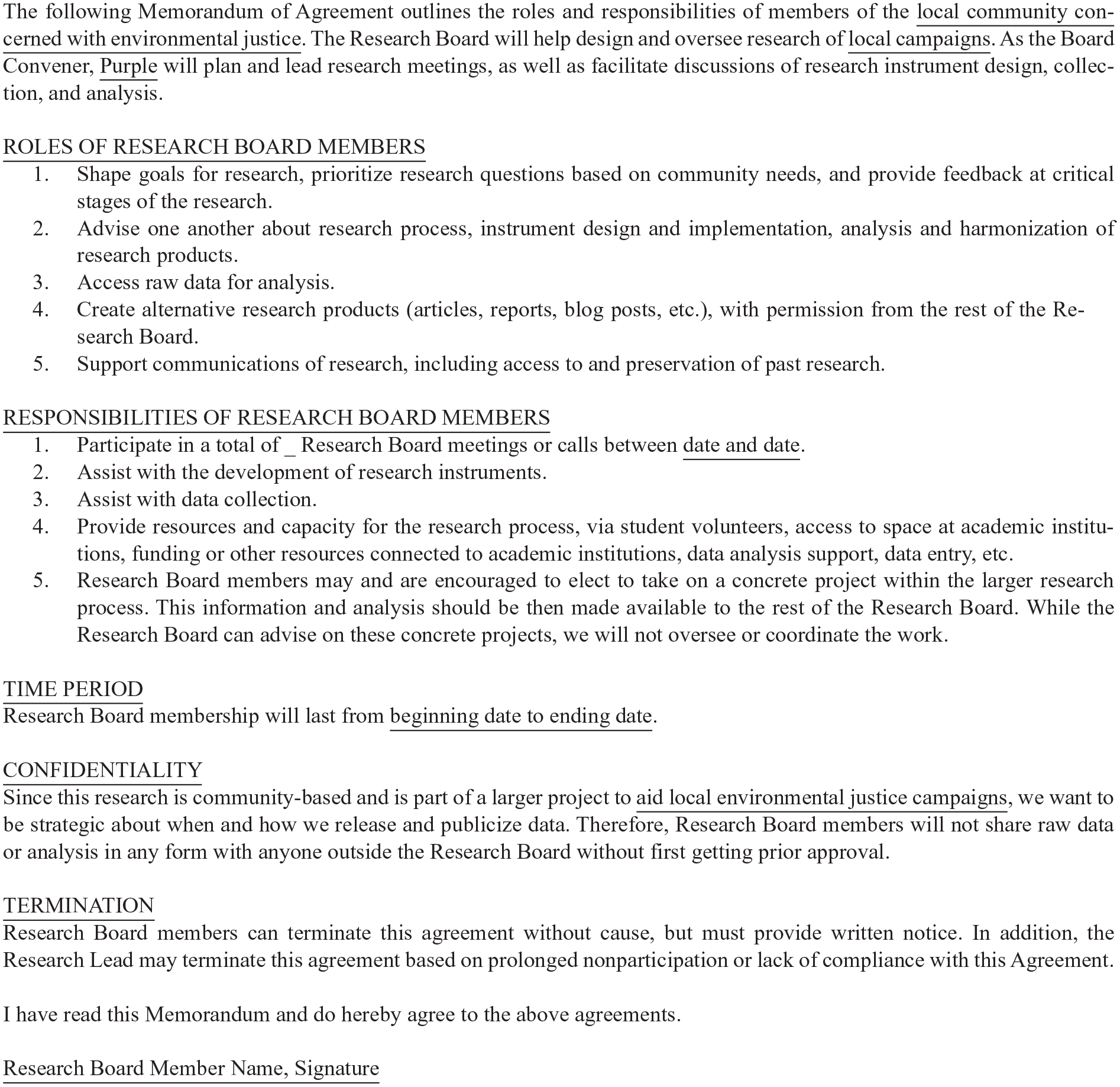
Memorandum of understanding, Local Environmental Justice Research Board.
Researchers should aim to involve not just all university-based researchers working with this community, but also community-based researchers and community members, in a research board. Figure 2 can serve as a beginning template for similar research board MOUs. It is easiest to implement if one local researcher or organization serves as a Research Lead or Board Convener, helping to coordinate meetings. Underlined language must be adjusted to fit the context; other text should be considered for revisions as well.
Engaging in CBR as critical friends
This research note attempts to make a contribution to the literature on CBR by interrogating and speculating on how researchers might operationalize and navigate alternative epistemologies and methodologies, through research ethics protocols. The hypothetical scenarios above suggest that, without overextending the metaphor or conflating research ethics with interpersonal ethics, it may be helpful to think through what it means for researchers to serve as what I call critical friends to the community. As friends, we engage in reciprocity, mutuality, respect, and accountability. We have a social contract that becomes endangered if one of us is abusive, or not acting in good faith. Still, it is impossible to articulate every aspect of our implicit contract as friends—a very exacting, meticulous, tit-for-tat sort of exchange of favors or gifts, for instance, probably feels transactional, calculating, and decidedly not friendly to most of us. Nor can we anticipate and adequately prepare for all moments of crisis; our negotiations and collective adventures mostly happen organically. Hopefully, we share a number of core values, but it is okay if we do not agree on everything. Critical friends have established enough rapport and trust to discuss matters in which we profoundly disagree, or if one of us feels that the other is pursuing efforts that are not in our long-term interest. Acting as critical friends requires us to call out/call in others with care and respect, paying attention to how larger forces have shaped difficult decisions.
Using this framework might also allow us to foreground the sorts of emotional labor and community benefits that help to guide research ethics, and are often overlooked by Institutional Review Boards (McGowan, 2020). For instance, in the hypothetical scenario, we can think about how Professor Blue might engage Ms. Red (and others at Green Power) as a critical friend. How might, or should, Professor Blue raise issues of governmentality (Foucault, 1991), in which member leaders of Green Power shape campaigns as corporations and state agencies would like them? Professor Blue might engage Green Power to create safe spaces for critical reflection and substantive debates on their goals and strategies—while assuring Ms. Red that she is not about to air unflattering critiques in public-facing, alternative outputs like newspaper editorials or press conferences.
How might we work toward generative conflicts, disagreements that lead to constructive dialogs and help us to better understand the complexity of the situation at hand? Such generative conflicts demonstrate that we take each other seriously as thinkers, that no one is secretly patronizing the other and dismissing their opinions as uninformed or foolish. They allow us to grapple with contradictions and complexity in our work, and compel us to resist superficial consensus—especially when quite often, the appearance of consensus serves as a mask for domination (Freeman, 1972).
In addition to the sorts of research MOUs sampled above, two other sorts of collaborative research products may be particularly helpful. The first, “who we are and why we write,” might serve as a brief manifesto, outlining individual and collective positionalities, as well as brief discussions of technical and local bodies of knowledge and expertise, and how these relate to the collaboration’s core values and findings. The second, a “statement on ethical misuse or misinterpretation of these findings,” compels us both to resist sociological flattenings (that people of any community or population tend be this way or that, because survey results suggest, say, that a majority expresses this view) and essentialisms, whether positive or negative, and to collectively think through larger public debates and lines of discourse surrounding the communities or policies at hand (Sandwick et al., 2018). How might we uplift the accomplishments of individual community members, say, without allowing such data to reify specious arguments regarding deservingness and minority exceptionalism? On the flip side, how might we include data on real-life struggles and conditions, or inequalities within our organizations and movements, without fueling deficit perspectives on community? Alongside fieldwork and analyses that foreground complexity, how might we engage in strategic positivism, when the United States Congress has banned federal funding for even simple counting of deaths due to gun violence, and has considered banning funding for geographic mapping of residential segregation of housing inequalities? (Wyly, 2009)
Remaining challenges in working outside of the university ethics system
Significant challenges to working outside of the university-based ethics system remain. RECs act as gatekeepers and arbiters of scholarly rigor as well as ethics, and community-based MOUs do not have the sort of institutional or disciplinary legitimacy that REC approval does. University RECs vary widely in their familiarity with qualitative approaches, public scholarship, and CBR, and the goals of CBR projects—such as contributing to social justice campaigns and democratizing the production of knowledge—contrast the traditional research goal of knowledge for its own sake (Cross et al., 2015). Ultimately, some RECs may view critical, participatory CBR as incommensurable with their official policies.
One particularly fraught issue concerns ownership and dissemination of data. For example, community-based participants do not always wish to keep their responses anonymous and confidential, and in fact sometimes wish to publicize their research (and their involvement in such research) in order to attract attention to the campaigns. While many RECs allow for proper attribution and credit to participants in publications, especially when the quotes at hand deal with public policy or political life, not all do. Cross et al. (2015: 1016) argue that RECs should facilitate ethical relationships between researchers and communities throughout the research process in flexible and negotiated ways, rather than applying pre-determined rules and procedures after the research question is articulated and before fieldwork formally begins; however, for this to happen, RECs must “act on their ethical obligation to self-improvement.” Some of these changes cannot be made or negotiated by single researchers. In such situations, researchers might continue to try as best they can to be “in but not of” the university (Harney and Moten, 2013; Kelley, 2018), to enact research ethics that abide by community prerogatives as well as the REC’s.
Further, even with all of the listed caveats, the hypothetical scenarios in this research note are quite limited. First, the scenarios are clearly set in a Global North context, and the details and textures of what Nagar (2019) poignantly conceptualizes as hungry translations and radical vulnerabilities on uneven terrains remain unaddressed. Future work might examine and articulate potential agreements that collaborations in a wider range of contexts. Second, many instances of CBR occur between a specific researcher and communities or individuals without formal organizations. In many cases, such groups or individuals have not had experiences with researchers before. The researcher must take on even more responsibility, then, to begin constructive discussions on what good collaborations look like. In such cases, the researcher might consider constructing an advisory board of community members and perhaps some allies, who might work with the researcher to navigate ethical dilemmas, co-interpret findings, and think about questions of dissemination to maximize impact. This group could meet over a meal on a quarterly basis, for instance, or engage in workshops facilitated by the researcher in order to increase their capacities as co-researchers. The researcher might also consider writing an Assent Form to be signed by at least some of the community members the researcher works with, especially those that the researcher wishes to work with more closely. This MOU or Assent Form should go further than university-based REC consent forms, and discuss expectations regarding ownership of data, analysis, and writing. In these scenarios, questions of whom the researcher works the most closely with (and perhaps who end up with some representative power vis-à-vis the community at large) remain paramount. If possible, presentations of findings or analyses should engage community members beyond those the researcher works with most closely.
I hope that this research note can serve as a working document for community members and activists as well as researchers. CBR researchers need more sustained conversations with community members to collectively imagine alternative research ethics agreements that contribute to meaningful democratization of knowledge production, a broadening of models of expertise, and greater ranges of modes of inquiry and dissemination. Community-based ethics reviews might help researchers to not just pay attention to what to avoid, but also what to work toward—namely, radical possibilities for social change and ecologies of care.
Footnotes
Acknowledgements
The author would like to thank Erika Grajeda, Michelle Fine, Maddy Fox, and anonymous reviewers for their helpful feedback on earlier versions of this article, to all participants of the workshop on collaborative research that inspired this article, and to the Gittell Collective, Public Science Project, and Racial Equalities working group at the Center for the Humanities at the City University of New York Graduate Center for their support of the workshop.
Declaration of conflicting interests
The author(s) declared no potential conflicts of interest with respect to the research, authorship, and/or publication of this article.
Funding
The author(s) received no financial support for the research, authorship, and/or publication of this article.
