



Abstract
The use of ‘design’ within qualitative research on crime and victimisation, and within the social disciplines more generally, has seen very little commentary or discussion. ‘Design’ is referred to throughout as the professional and scholarly practice rather than the ‘research design’, that is, the practical plan for the methods used to generate data. Design in this former sense has historically drawn on both arts and engineering to give form to garments, products and visual communication. This article presents a case study, followed by a reflective discussion, of a research project in which research through design methods were used to construct two focus groups involving lesbian, gay, bisexual and transgender young people and police liaison officers as part of a hate crime project. Participants were asked to design reporting devices that would respond to hateful behaviour. Through the design process, participants materialised their own experiences of hate and embodied emotional responses to those experiences. The authors argue that there are methodological, ideological and practical benefits for incorporating research through design methods within qualitative research on crime and victimisation. Design offers a way of critically and creatively reimagining how research methods are understood and utilised, challenging how criminological methodologies traditionally operate.
Introduction
There are three broad research strategies to achieve insight into crime and victimisation: descriptive research, explanatory research or exploratory research (see Bowes, 2018). While the first two aim to articulate why and how phenomena occur, exploratory research is used when little is known about a phenomenon (Bowes, 2018), as is the case with lesbian, gay, bisexual and transgender (LGBT+) young people’s experiences of hate crime. In order to address increasingly complex questions relating to crime and victimisation, methodological innovations are under continuous advancement. Creative methods, such as art-based, technology-based, mixed-methods, and transformative (e.g. participatory and de-colonial) research are being used more than ever (Kara, 2015) to push the boundaries of the criminological imagination (Davies and Francis, 2018; Seal and O’Neill, 2019). However, many of these methods draw on long established creative practices, which introduce their own epistemological and methodological assumptions into criminological research. In this article, we discuss how the methods used in an interdisciplinary study into LGBT+ young people’s experience of hate crime were shaped by a creative practice; namely, design. More specifically, we examine how using design methods allowed us to reconfigure the discursive norms around hate crime in dialogue with the young research participants in order to better understand their experiences of hate crime. Furthermore, we reflect on some of the methodological challenges that come from the disciplinary differences between design research and the formal methods commonly used in criminological research. Here, we refer to ‘design’ as the professional and scholarly practice, rather than the ‘research design’, that is, the practical plan for the methods used to generate data (Harding, 2019). Design in this former sense has historically drawn on both arts and engineering to give form to garments, products and visual communication (Costanza-Chock, 2020).
Over the past two decades, design practices have broadened and advanced to include the design of digital media, services and social innovations (Costanza-Chock, 2020). Although predominately a professional practice, there is a strong academic tradition of design research. This is typically broken up into three paradigms: first, the study of design practices and outcomes (research into design); second, research that seeks to inform design (research for design) and finally, research through design (RTD) which uses design practices themselves to produce knowledge about a broad range of phenomena (Durrant et al., 2017; Frayling, 1994). The third paradigm, RTD, informed the methods used in this study to conduct two focus-group style exploratory workshops involving LGBT+ young people and LGB&T police liaison officers. 1 The purpose of these workshops was to (a) scope the reporting needs of young people who experience anti-LGBT+ hate and (b) establish the types of mechanisms LGBT+ young people would prefer to utilise when reporting their experiences of hate. This article describes these workshops in the form of a case study to provide a reflective commentary on how design practice, specifically RTD, can be used in research on crime and victimisation. The authors argue that there are ideological, methodological and practical benefits to incorporating design strategies within speculative and exploratory social research. This article describes some specific design techniques, which readers may utilise as inspiration for their own research. It must be emphasised, however, that simply following the steps we took would not constitute a meaningful engagement with a RTD methodology.
The research discussed in this article represents a creative way of producing data that is more inclusive of imagined possibilities and meanings. Given the sensitivities involved when conducting exploratory and speculative research on victimisation, particularly with young people (our participant’s ages ranged from 14 to 19), we argue that design methodologies provide techniques and strategies that can support participants and researchers to co-produce criminologically meaningful data. We proceed by outlining the background of design research and techniques, before describing the workshops we facilitated with LGBT+ young people and police liaison officers. We then move to reflect on the strategies used within these workshops and discuss the benefits of incorporating design specifically research on crime and victimisation.
Background literature: methods in design research
Design accounts for the majority of goods, services, media and technologies that surround us every day and yet, remains relatively obscure in the popular imagination. Due to the professional culture of design celebrating the capacity to be everywhere and nowhere – by concealing the work of designers in everyday life – a definitive account of design’s processes and procedures for producing these products is something that has frustrated design research almost from its outset (Yee and Bremner, 2011). For interdisciplinary collaboration, this tendency towards professional self-erasure in design is in tension with the requirements for the methodological transparency emphasised in research (Pedgley, 2007).
In response to such paucity in definitively accounting for design’s processes, early design researchers sought to systemise design practice into a formal methodology akin to the scientific method (Cross, 1993). However, along with the wider modernist project that prioritised ‘technical rationality’, the design methods produced as part of this movement quickly fell apart as they still failed to critically account for the complexities of design in practice (Schön, 1983). Resultingly, contemporary incarnations of design methods take less of a scientific frame and offer a more humanistic approach, which seeks to translate design processes into step-by-step procedures that can be used by non-expert designers (Buchanan, 1992; Kimbell, 2011), such as the five-step method of ‘design thinking’ outlined by IDEO and Riverdale Country School (2012). While the procedural steps in design thinking arguably democratise the field, by allowing non-designers to replicate design processes (Brown, 2008), such formulaic approaches have been widely critiqued for not only flattening design practices and pedagogy into a neat commercial product (Hill, 2012), but also presenting Western design practices as the universal model of design (Khandwala, 2019). As a result, step-by-step procedures, such as those found in design thinking methods often exclude or conceal non-Western design traditions and fail to account for the way that these methods require translation across different social, cultural and political contexts (Tran O’Leary et al., 2019). Calls for more situated and pluralistic accounts of design processes, which are sensitive and adaptive to multiple ways of being and designing, have therefore started to gain ground (Smith et al., 2020).
In response to some of these criticisms, reflective practice has become a key element of design research, particularly in the RTD paradigm (Dalsgaard and Halskov, 2012). Although a component of many Action Research methodologies (Leitch and Day, 2000), reflective practice offers a way for designer-researchers to produce knowledge that is directly connected to the experience of design in practice and, thus, can better account for the messiness, risk and nuance that design methods have historically occluded (Sadokierski, 2019; Schön, 1983). This is not to say that RTD does not use or make reference to specific ‘methods’; indeed, within this article, we drew on numerous established design methods, such as context mapping (Visser et al., 2005), the magic machine workshop method (Andersen, 2017) and defamiliarisation (Bell et al., 2005). However, the understanding of what a method is and how it can, and should, be used is shaped by the centrality of practice within RTD rather than procedure. The advantage of reflective practice as a deeply situated approach to research is that it allows researchers to produce knowledge in ways that are responsive and sensitive to participant’s specific wants and needs (Wright and McCarthy, 2018).
Consequently, RTD has been used in a wide range of interdisciplinary research into sensitive topics including those that address core criminological concerns, such as supporting domestic violence survivors (Clarke et al., 2013), reducing recidivism through developing resilience (Gamman and Thorpe, 2015) and imagining the future of policing (Gerber, 2018). However, while RTD’s framing of methods has many advantages for research on crime and victimisation, as it is something that can be creatively deployed as part of a situated practice, it also has consequences for the kinds of knowledge produced and challenges the way that methods are reported and interpreted. The multiple, non-linear, ways in which RTD methods get interpreted and applied can already be seen in interdisciplinary fields, such as Human Computer Interaction (HCI), which studies how people interact with digital technology and draws upon multiple disciplines including computer science, psychology, anthropology and design.
Methods utilising RTD should therefore not be understood as formulaic procedures or equations that can be carried out by different people in a variety of contexts to produce more or less the same results. For example, multiple qualitative researchers can interview participants using the same interview schedule to generate a specific pattern of themes in the data produced. For RTD, it is not simply a matter of following a methodological formula, giving participants craft materials, instructing them how to make something and meaningful data are produced as a result. Instead, design methods are patterns, exemplars or recipes, which the individual design researcher must adapt, reconfigure or combine in response to what is at hand in a given situation (Andersen, 2017). This unfixed creative approach has been described as a form of methodological bricolage in which the researcher ‘views research methods actively, rather than passively, meaning that the researcher actively constructs methods with tools at hand rather than accepting and using pre-existing methodologies’ (Yee and Bremner, 2011: 4). Thus, the creation of artefacts, products and images to materialise what is being researched through creative methods, is not as simple as gluing, sticking and assembling but is a deeply reflective, dialogic process that responds to events occurring in the moment. In a similar vein as traditional qualitative methods, there is not a minimum formula or requirement for conducting design research. For example, qualitative researchers may choose a single method such as an interview or a focus-group method or a survey, but they can also adopt a mixed-methods approach and utilise all three. The aim of methodological bricolage is to empower researchers to adopt and adapt their research methods in response to their research needs.
Admittedly, this ad hoc approach to research introduces a high degree of indeterminacy, risk and improvisation that may appear contrary to the principles that make social scientific research rigorous, reproducible and generalisable. However, it should be noted at this point that the way RTD understands ‘methods’ is not completely at odds with that found in the social sciences. Indeed, this practice-oriented approach to methods in design is directly informed by discussion of methods from within social sciences; the idea of methodological bricolage in design research is directly taken from Denzin and Lincoln’s (2005) use of the term in The Sage Handbook of Qualitative Research, for instance. Furthermore, RTD shares significant commonalities with approaches more widely used in the social sciences such as autoethnography, participatory action research, and, of course, creative and inventive methods (Kara, 2015). RTD, therefore, gains much of its methodological rigour from giving a situated and reflexive account of methods in use (Zimmerman et al., 2007). The indeterminacy, risk and improvisation present in RTD are arguably vital components of design as a creative research practice as they allow us to remain open to the unexpected answer to our research questions (Gatehouse, 2020; Yee and Bremner, 2011). This is why design is of a particular methodological benefit to expanding the sociological and criminological imagination within exploratory and speculative research.
In summary, design research has played a significant role in the development of speculative and inventive methods in the social sciences (Michael, 2011) reflecting the future orientation of design practice in general: ‘Designers imagine images, objects, buildings and systems that do not yet exist. We propose, predict and advocate for (or, in certain kinds of design, warn against) visions of the future’ (Costanza-Chock, 2020: 15). Thus, by its very nature, design is often applied to research that emphasises exploratory and speculative knowledge production. In this article, we discuss the advantages that using research through design had for an under researched area of criminology – young people’s experiences of anti-LGBT+ hate crime – which warranted an exploratory and speculative research frame. Design therefore offers a way of critically and creatively reimagining how research methods are understood and utilised, challenging how criminological methodologies traditionally operate. We proceed by presenting our research as a case study, to reflectively discuss how design methods were incorporated into research on crime and victimisation.
Constructing the workshops
Our aim for the workshops was to explore young people’s experiences of anti-LGBT+ hate crime, establish their attitudes towards current reporting mechanisms and co-produce different kinds of mechanisms that may result in higher rates of reporting. This co-productive element is perhaps heightened in the case of exploratory research in which participants are asked to not just consider past or current experiences but to consider future scenarios or alternative presents (Auger, 2010; Coulton et al., 2016).
Young participants were sampled from two youth and community groups in the North East of England, where collaborative and creative activities are used, through group work, to strengthen and respect communal agency. LGB&T liaison officers were sampled from a local police force who were present for only the first half of the first workshop. As researchers, we aimed to balance the potential benefit of allowing the young people to engage in a dialogue with criminal justice professionals while remaining mindful that in the presence of police authority figures, young people’s capacity to express themselves may be inhibited. Liaison officers therefore left in the second half of the workshop to allow young people the agency to engage in dialogue with each other away from police officials.
Given such paucity in research on youth experiences of ‘hate’, a central concern in devising the research methods for the workshops was how to co-construct hate crime discourses that were meaningful and accessible to all parties involved. The researchers incorporated methods from RTD, in particular, participatory design research, into exercises taken from youth work practice, so that participants felt a sense of familiarity with what was being asked of them. While not an exact science, the National Youth Agency (2019) encourage a holistic yet professional understanding of youth work that is an educational process that engages with young people in a curriculum that deepens a young person’s understanding of themselves, their community and the world in which they live and supports them to proactively bring about positive changes.
Youth work activities, such as teambuilding exercises, icebreakers, thought experiments, opportunities for being challenged and playful behaviour aim to promote agentic forms of self-expression and exploration (Coffey and Farrugia, 2014). As such, we used icebreakers, ‘making’ activities and group discussions in order to simulate a ‘youth group’ style in the form of a research focus group. To complement the methods and ethos of youth work practices, we drew many of the RTD methods from participatory design. Guided by the principals of having a say, mutual learning and co-realisation (Bratteteig et al., 2012), participatory design is a branch of design research in which practitioners work to enable non-designers to engage in a range of design activities, from shaping development of platforms, products and tools for immediate development (Irani and Silberman, 2013) to very broad discussions of future visions (Light and Akama, 2014).
For research purposes, participatory design provides a set of methods, principles and theories that can facilitate non-designer’s participation in RTD (Muller, 2009). In the case of these workshops, we drew upon a combination of performative, speculative and embodied methods for engaging young people in open ended discussions of their current experiences of hate crime and their needs and desires for reporting such experiences. Applying these participatory RTD methods to existing youth work practices allowed participants to compose and design visual and embodied means of representation. Arguably, utilising flexible and multimodal forms of expression move beyond the limitations of talk-based methods, such as interviews, and overcome rationalistic and logocentric subjectivities (Buckingham, 2009).
The workshops were held a week apart. Each workshop began with an icebreaker, in order to introduce each participant to one another and create a communal space to co-produce data. Workshop 1 was designed to investigate LGBT+ young people’s reporting needs. In this workshop, the researchers presented written scenarios of events that could be deemed hateful to participants. Participants were asked to hang these scenarios, individually, on a ‘washing line’ in order from most likely to report to the police (left) to least likely to report to the police (right). Through this activity, participants articulated their own experiences of anti-LGBT+ hate with the entire workshop group. In preparation for the second workshop, participants were placed in smaller groups and given masking tape to carry out a digital life mapping exercise. We asked participants to plot their digital lives in order to identify the types of digital technologies they use, how often they use them and for what purpose.
Workshop 2 invited participants to use materials to design ‘magic machines’ that could hypothetically report anti-LGBT+ hate. Participants were provided similar scenarios to those in the first workshop and were asked to create a device with magical features that could report and respond to the specific scenario. We chose to frame the design activities with fantasy elements as this grants people the potential to push past realist limitations and logical thinking in order to explore unresolved solutions. Both workshops were audio recorded and photographed (faces of participants were blurred to only document their designs) to generate transcripts and still images that could be analysed by the researchers. It is a common place for design research to used traditional qualitative methods to analyse the design process and outcomes (Brulé and Finnigan, 2020). Transcripts were therefore analysed using Braun and Clarke’s (2006) six step thematic analysis method to generate codes and stories that were then organised into core themes. This article does not have the full scope to outline the analysis of findings. Readers can find our analysis of this data here: (Pickles, 2021).
In the next section, we discuss these activities in detail and describe our goal of enabling the young people to participate in meaningful discussions pertaining to their experiences of hate crime and reporting. From there, we discuss the methodological observations and reflections that emerged from the workshops.
Materialising hate crime: a case study
Icebreakers
In line with youth work traditions of teambuilding and focus-group facilitation, both workshops opened with a dual-purpose icebreaker. Icebreakers functioned as a way to (a) introduce the theme of the workshop and (b) allow all participants to learn each other’s names and become comfortable with one another other. Rimando et al. (2015) argue that when icebreakers are incorporated within research, a space is created for participant and researcher to become comfortable and more at ease with each other. Icebreakers, generally, are used ‘to create a positive atmosphere, relieve tension or formality within the group, and encourage early participation and collaboration’ (Jarusriboonchai et al., 2015: 4366). Furthermore, as this was an LGBT+ participatory workshop, establishing everyone’s name and pronouns (he/she/they) was essential. Previous research on pronoun usage with LGBT – specifically transgender – individuals indicates that determining and prioritising correct pronouns acknowledges gender identities beyond the binary he or she and creates a communal bond of acceptance, while strengthening feelings of inclusion (Frazer and Dumont, 2016; Newhouse, 2013; Wilkerson et al., 2011).
In order to encourage creative thinking beyond the digital possibilities, our icebreakers were used to ‘set the scene’ of the workshops and enhance imaginative speculation. We anticipated that when asked to perform creative tasks, many participants may have been anxious about working collaboratively using creative methods, which, as a consequence, could have limited their suggestions to technologies they were more familiar with, like a smartphone application. This, as can be seen by GayArtist’s suggestion, did occur:
We are trying to think about designing something that is going to help young LGBT people like yourself report hate crimes more
so like an app?
Yeah an app is one possibility but what we’re going to do today is make you little designers.
Thus, participants were asked to introduce themselves, their names, their pronouns and answer a workshop specific question.
Workshop 1
Workshop1 aimed to capture what types of hate-based scenarios young people would report to criminal justice agencies and explore the types of digital technologies they utilised in their everyday lives. Reflecting this focus on participant’s past and present experiences, the Ice Breaker question in the first workshop asked if they were an app, what app they would be and why. Below are examples of the some of the responses given:
– Tinder because I’m out there with everyone and I like making social connections
– OKCupid because I’m really inclusive and open minded.
– Twitter for the controversy
These responses generated insight into how participants personified and viewed digital applications in terms of their practicalities and usage. This allowed participants to not just identify and position themselves within ‘demographic categories’ but creatively express their personal identities.
Workshop 2
Workshop 2 prompted participants to design hate crime reporting devices in response to the scenarios that were discussed in the first workshop. In order to encourage imaginative thinking and gain insight into the desires of how young people wanted hate crime to be responded to – potentially superseding what is practically possible in reality – participants were asked to introduce themselves again and state what type of magical power or superpower they would like and why:
– my superpower would probably be making groups of people see the other person’s point of view . . . it would be really good in terms of transphobic families; I’d like to do that to mine
– my superpower would be mindreading so I know which bitches are stabbing us in the back.
– if I had a superpower, I’d love to like leave my body and enter other people’s bodies
This activity prefaced the design-making process. We encouraged participants to consider that much like their superpowers, the devices they created could feature many magical properties. Without such a creative approach, the responses elicited from participants may not have been captured in material form.
Mapping hate
In order to make tangible the reporting needs of participants, the researchers asked young people to organise hypothetical scenarios that could be deemed hateful:
So, I have developed a washing line and we have come up with scenarios, some are hate crimes and some are more generic . . . I think it is really important to understand what you perceive as hate crime and how extreme you think certain events are. So, on the washing line at one end you can put the things that you wouldn’t report to the police and on the other end you can put the scenarios that you would report. So, if everyone has got two scenarios who wants to go first?
The process of this exercise facilitated a group discussion on the nature of reporting while allowing young people to make individual decisions on what scenarios they would or would not report. The agency of young people within adult–youth relationships, as was present in this research, exists as a socially and discursively bounded dynamic that needs to be reflexively acknowledged throughout the entire research process (Holland et al., 2010). Thus, the researchers did not want to guide participants into structuring the scenarios into any given hierarchy; the washing line exercise allowed for anti-LGBT+ hate to be a spectrum with which participants could co-construct their experiences. This can be seen by Alex’s quote:
I’ll go first. So, this one says. Tess and her girlfriend walk down the road. Someone sat in their garden spits at them and narrowly misses them. I wouldn’t necessarily report that to the police. But I would probably report it to someone like James or another youth worker, because if they thought that it needed to be reported to the police then they could probably say it is on this road and then they would be easier to identify. I wouldn’t report it to the police because I mean it is homophobic but they haven’t like physically hit you or anything. So, it would probably just be brushed aside by the police as one of the less import things. Especially like from my area.
We were also careful to consider how the presence of uniformed police officers might have influenced the responses that the young people gave. We mitigated this by asking the police officers to leave halfway through the workshop to give the young people opportunities to express themselves away from the perceived scrutiny of these authority figures. There was an observable change in mood when the officers left, as the young people become qualitatively more expressive and less self-conscious in their responses. For the researchers, this was a clear illustration of how young people’s agency can be unintentionally curtailed to suit adult agendas within youth-oriented research.
As can be seen by Figure 1 and Table 1, no direct hierarchy emerged from the washing line exercise as each participant articulated their individual subjective position on reporting.
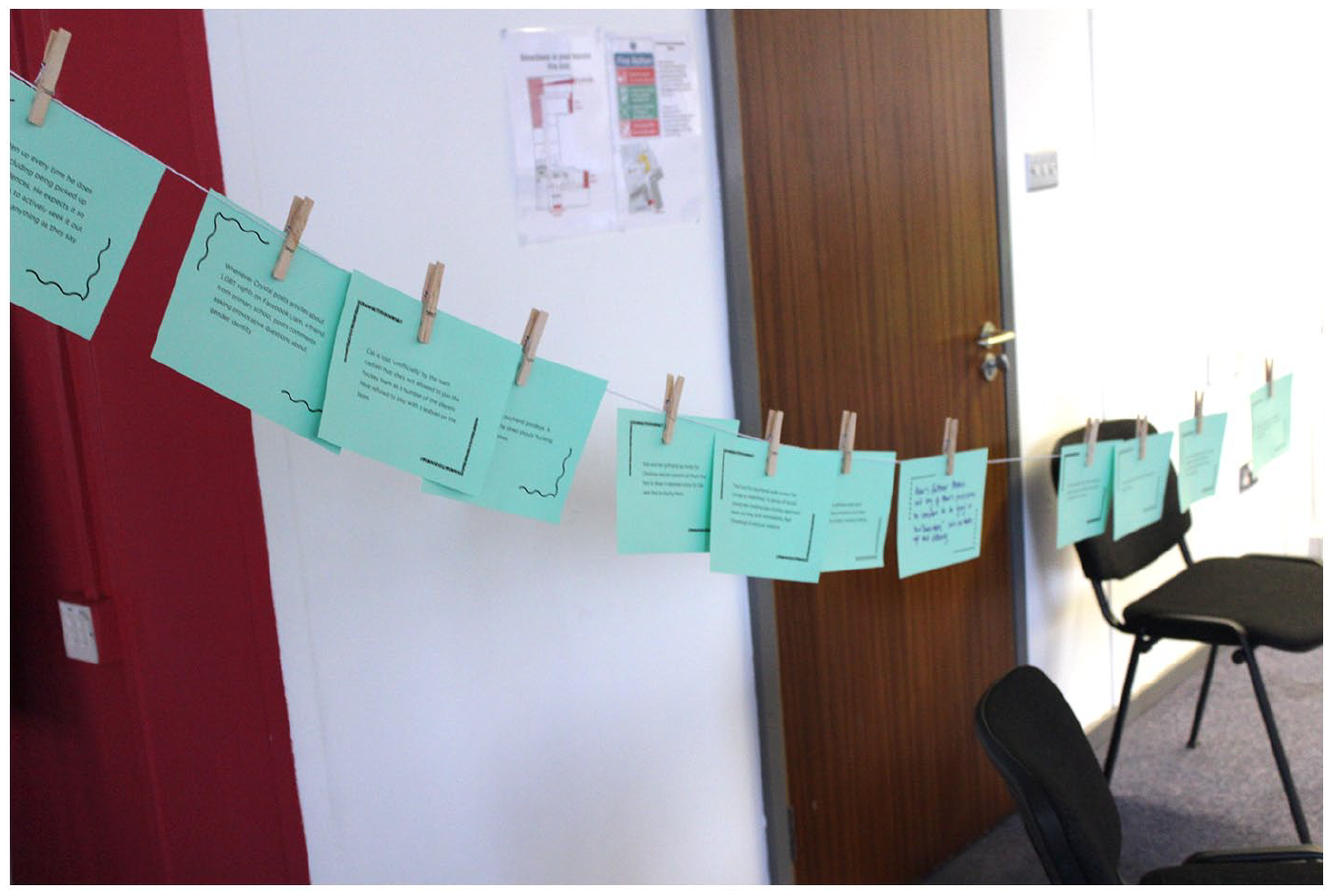
Washing line exercise.
Final placement of scenarios from ‘most likely to report’ to ‘least like to report’.
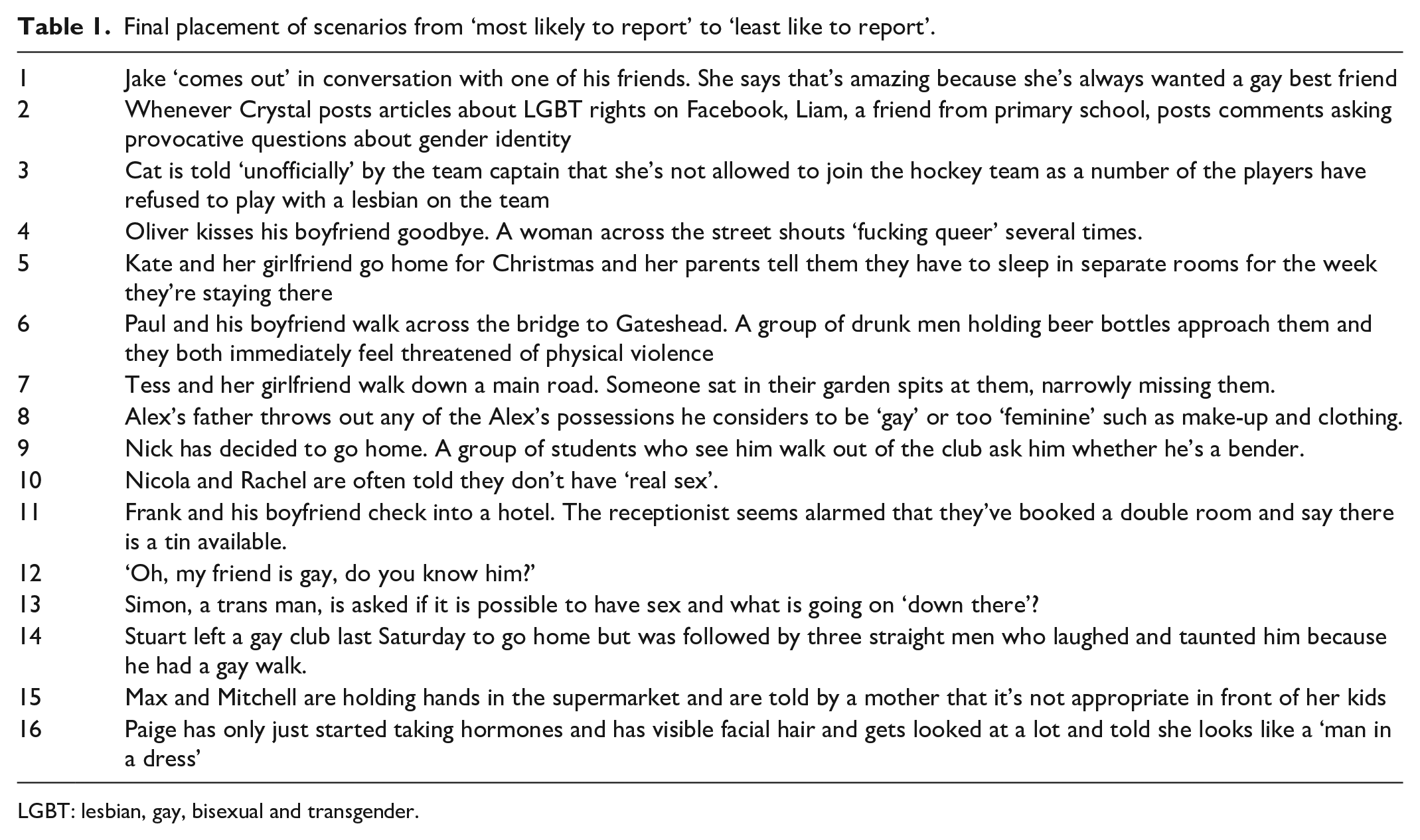
LGBT: lesbian, gay, bisexual and transgender.
Mapping the digital life
Following the washing line exercise, we asked participants to map their digital lives in order to explore how they used technology in their day-to-day experiences. The rationale for this was to expose the technological innovations that young people may potentially use to report hate:
So, what we now want is, using masking tape, to make a map of your digital life. Because it would be a really good idea to understand what apps to use, what devices are important to you, do you like sending photos, do you like using texts, do you like chatting with people? So, maybe if we give you 10 minutes.
In design terms, this activity was a form of rapid context mapping. Context mapping is a widely used participatory method that builds a picture of the social, cultural and material setting that potential designers might enter (Visser et al., 2005). Normally, this is an in-depth activity that might take place over several sessions. However, as we had limited time with the participants, we used a condensed version of this technique by asking participants to work in small groups to ‘map’ their digital lives using masking tape and marker pens. These materials were simple to use but flexible enough to allow participants, among themselves, to negotiate what form the map should take. In asking the participants to use commonplace materials in an unusual way, we utilised the common design research tactic of ‘defamiliarisation’ (Bell et al., 2005), a process in which common place objects are presented or used in strange or unfamiliar way. Since there is no obvious ‘right’ way to perform the task at hand, this technique helps to level the playing field between participants as all are equally unfamiliar with the task, allowing for a variety of responses.
The participants were split into two small groups, each of which developed their own means of representing their digital lives with the materials provided. These materials also encouraged collaboration between participants by allowing them work at a scale that required physical co-operation as well as verbal discussion. Once the maps were completed, participants were asked to give both the researchers and other participant groups a ‘tour’ of the maps (see Figure 2). This acted as a starting point for a conversation into how they navigate these online spaces, both generally and in relation to hate crime:
Ok, so the length of the line depends on how much we use it between wor. 2 Facebook as the longest line and this is the people that we use it for. And we connected email and Twitter and Skype all with Facebook because it is generally family members and other friends. Google is a long line because we use it all the time to connect and find contact details and learn about other people. And then Instagram connects with Facebook because it is generally the same thing. And then Pinterest only I use it so it is a very short line. But I connect with everyone on Pinterest so. And this one is Snapchat and that connects with friends and Instagram more generally, because generally it is sort of a picture messaging app.
And are you out on Facebook?
I am not openly I am gay on Facebook but in the past I have had photos and all that kind of thing. And I will share all the LGBT articles. I have privacy settings like I block my mum but like people can’t comment on things that I have said all on my pictures and things because of my settings unless they are on my friends list. My Instagram is open.
Mines private
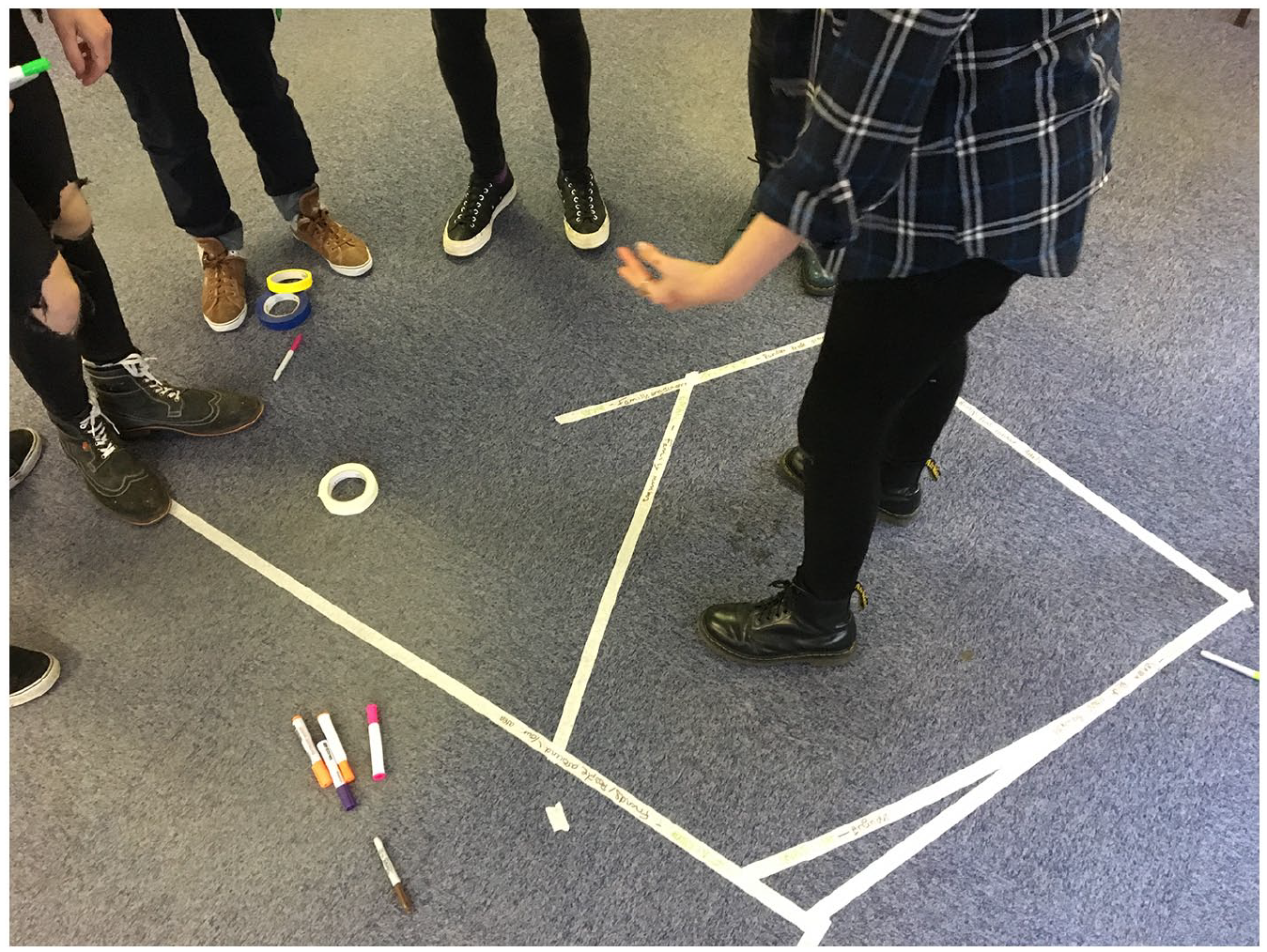
Mapping the digital life.
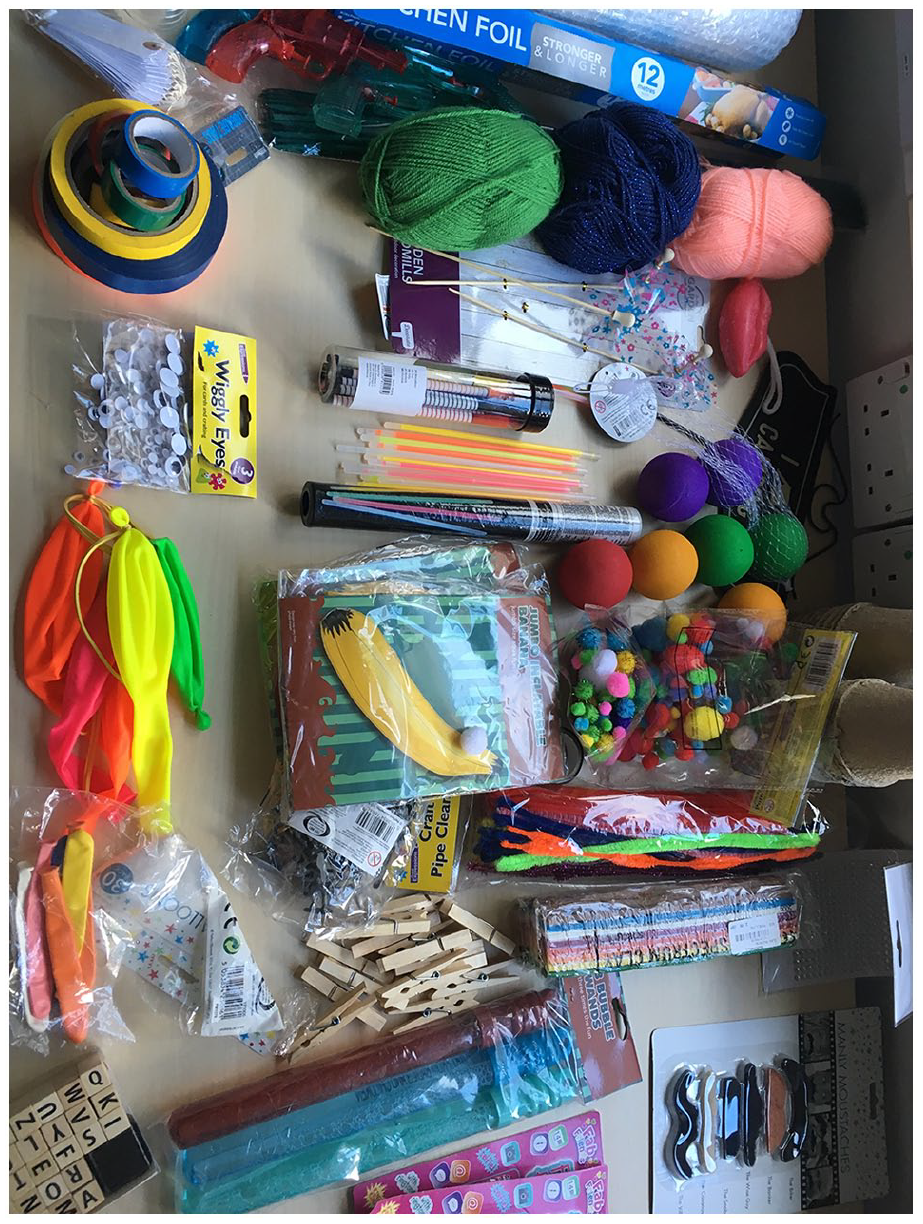
Craft materials.
This activity reflects the dialogical approach to generating data that results from participatory design’s core principles of having a say, mutual learning and co-realisation. Derived from Bakhtin’s idea of creative understanding, participatory design’s creative potential enables all those participating to see ‘mutual differences in perspectives on the situation’ where ‘both parties can read into each other and the situation meanings and possibilities that each alone could not see’ (Wright and McCarthy, 2018: 574). The activity positioned all participants as competent actors, capable of describing their experiences and realities on their own terms. However, it did so in dialogue with our agenda and perspectives as researchers. By encountering and responding to one another, designer and user can expand their individual expertise and create a dialogical relationship that is ‘characterised by equality in difference’ (Wright and McCarthy, 2018: 577, emphasis added).
Designing hate crime devices
In the second workshop, we outlined the purpose of designing reporting devices to participants and provided them with an array of craft materials to work with: What we’re going to do today is tell a bit of a story. We’re going to start off with a problem, which is a problem of not reporting, and then almost like you have a super power, you’re going to create a device . . . you’re going to create a device with a super power that is going to overcome that problem . . . if we get a bit too like ‘this is an app and these are the things an app can do’ it can shut down our minds too much, so we’re trying to open our minds to possibilities, and it’s also more fun this way.
This built on the ‘magic machines workshop’ developed by Andersen and Wakkary (2019), who argue that such workshops create a temporary discursive space in which ‘we may consider complex, difficult and naive things; and propose solutions that, while they may not solve anything as such, touch upon notions of dread or desire’ (p. 112). For example, in asking participants to make ‘magical’ reporting devices, we are not asking them to make serious design proposals but instead to feel out other ways that these experiences could be recognised and reported in relation to their fears and desires connected to their experiences of hate.
It is important to acknowledge that asking participants to work creatively created doubt in some young people. For example, Alex stated quietly to one researcher ‘I’m not creative enough to work on my own’ who needed reassurance that the task asked was not a test of creativity. It has been acknowledged previously that young people, when faced with anxieties such as these, may feel pressured to give the ‘right answer’ or say what they believe adults want them to say (Clark, 2005; Fargas-Malet et al., 2010). When these anxieties are verbalised, increasing reflexivity in the participant by encouraging them to reflect on their anxieties, brought about by the research process, can assist in helping participants identify where their discomfort comes from when producing design artefacts.
Discussion: the advantages of designing for criminology
Using this case study as an example, we argue that there are methodological, ideological and practical benefits for incorporating design practice within social research on crime. In particular, the design setting provides a non-judgemental space in which to experiment with ideas, concepts and experiences. In the context of this case study specifically, incorporating design techniques enabled participants to articulate violence within a performative space, allowed the researchers to overcome criminological linguistic barriers when translating concepts such as hate crime to participants, and encouraged the expansion of the criminological imagination.
Within the case study outlined, producing artefacts that concentrated on specific contexts of our participants lives allowed them to articulate their experiences of victimisation, while making tangible their emotions and materialising potential solutions. As with other art-based methods, participatory research through design is a good fit for working with young people. However, it must be stressed that this is not because young people are somehow more ‘creative’ than adults; it is because design offers the means to reconfigure some of the inequalities that shape dialogues between researchers and participants (Lyon and Carabelli, 2016). In our case, activities were structured to allow participants the ability to demonstrate their expertise and resilience as a resource that both challenged and countered their positionality as ‘victims’ of hate crime. While we, as researchers, shaped the territory on which we engaged with the participants, we were careful to include space for the participants to make it their own. Although such methods do not undo these structural inequalities entirely, they do offer a means through which these power dynamics can be renegotiated through carefully crafting such dialogic spaces. For the social sciences, this offers a means of engaging not only with young people but a wide variety of ‘vulnerable’ populations.
While this article does not have the scope to present full analysis of the findings (which readers can access here: (Gatehouse et al. 2018)), the participant’s reporting devices included pronoun correctors in the form of guns, hate crime bombs, suits of armour and army men that attack online trolls to ‘stab in the fingers, if they get stabbed in the fingers then they can’t write anymore’. The semiotics of such devices suggests that violence, anger and defence were able to materialise within the safety of the research. Understandably, young LGBT+ participants demonstrated anger and frustration over their experiences. Whereas traditional focus group and narrative interview methods allow participants to describe and articulate their experiences, allowing them to design artefacts to represent their emotions enabled participants to make tangible and visually represent their thoughts and feelings. Interestingly, the research space became a performative space, where violence was articulated in a humorous, safe and contained way.
Articulating violence within a performative space
Space exists both within the imagination and within material reality. Seal and O’Neill (2019) posit that imagined space is crucial for criminological scrutiny as ‘the imagination can transgress established patterns of thinking and acting, and can re-envisage existing power relations’ (p. 8). Specifically, imagined spaces that are transgressive involve ‘deconstructing derogatory representations but also finding those which offer liberation and democractic potential’ (Seal and O’Neill, 2019: 9) by breaking boundaries and taboos as their foundation. The magic machines activity was introduced in such a way to encourage the participants to imagine it as taking place in a space set apart from ‘reality’. This created a heightened sense of playful performativity, in response to which imagined violence was articulated by the young people in a number of different ways.
The hate crime bombs, guns and other violent responses that were designed by young people enabled them to imaginatively respond to their experiences of hate within the space created. These magical machines allowed them to blend their own tangible experiences of hate, existing within the space of their memories and articulate imagined responses. The researchers did not interpret these as literal attempts to create bombs, guns and enact violence against hate crime perpetrators. Rather, we provided a non-judgemental space to explore imagined possibilities through transgressive acts. Traditional qualitative methods usually focus on requiring participants to describe, retrospectively, their experiences and thoughts. Rarely do such methods allow individuals to imaginatively respond to their own experiences in a materially embodied yet non-judgemental context. Designing reporting devices that symbolically respond to their shared experiences of hate, provides participants a platform to express and materialise their emotions towards these experiences. Thus, the methodological approach taken in this research sought to move beyond traditional research methods of posing questions, generating meaning and gathering data in the pursuit of criminological enquiry.
Within this space, we focused on using creative methodologies and imaginative strategies in order to blur traditional categories of how crime and victimisation is understood, that is, that expressing violence is ‘bad’ and calmly describing emotions is ‘good’. Frauley (2015) argues that the practice of imaginative criminology seeks to understand crime by breaking doxic – assumptive and naturalised – propositions of crime. For example, Whenever for instance, graffiti is studied as art rather than as vandalism what is happening is that the legal categorisation of graffiti as vandalism is abandoned in favour of a characterisation that is independent of the bureaucratic categories of the criminal law and criminal justice administration. (Frauley, 2015: 621)
This approach destabilises how activities deemed as deviant, or criminal, are epistemologically and ontologically understood. Utilising a phenomenologically sensitive approach, as advocated by Shaw (2004), takes into account that such meanings are fluid, changing and are attributed contextually within everyday life. The violence articulated by young people took place within the parameters of this research. Manifesting negative emotions and symbolic gestures of violence within a secure environment – particularly one that encourages experimentation of emotion within an imagined space – can be a form of catharsis. For instance, within psychotherapeutic settings, the case is made for clients to process and express their emotions – rage, anger, hate and violent thoughts – in order to work through their feelings within a safe and non-judgemental environment (Pascual-Leone et al., 2012). While the researchers in this project are not qualified to establish a psychotherapeutic setting, the ideological and methodological principles of securing a safe environment through the design process allows for individuals to autonomously express their emotions. Methodologically, this is advantageous to capturing data that is authentically and emotionally pertinent to participants.
Overcoming criminological linguistic barriers
As already highlighted, current hate research is adult-centric, with the views and experiences of young people remaining neglected. Consequently, youth experiences of hate are often academically viewed as ‘bullying’ (Pickles, 2021), meaning that linguistically ‘hate crime’ as a term is difficult to operationalise with young people. In line with critical research – which understands that the dominant values of society are shaped by structurally powerful groups (Burke, 2019) – this research recognised young people as a marginalised group within hate crime scholarship. Utilising design in conjunction with youth work practices was desired, in order to avoid reproducing a deficit model where young people’s articulations are curtailed by adult-centric constructions. The playful nature of design provides a language for individuals experiencing victimisation to embody those articulations and manifest potential solutions to those issues.
Youth researchers within the social disciplines are increasingly in pursuit of enabling young people to participate in research within a safe, ethically sound and reflexive environment. The power dynamics between the adult researcher and young participant in enabling young people to participate in sensitive research, while mitigating potential risks of emotional harms, is a continuing balance (Lohmeyer, 2019). The use of creative methods with children and young people specifically has become a well-established means of developing youth-centred research methodologies. Using methods that rely less on adult forms of speech and self-expression, such as drawing, photography or videography, can allow for alternative expression that bypass adult-centric language (Gillies and Robinson, 2012); for example, hate crime. However, it is also important to recognise that these methods are still used in the context of an adult driven research agenda and thus a power imbalance remains between researchers and the young people participating (Gallacher and Gallagher, 2008). Thus, creative methodological approaches such as those offered here should be considered when facilitating youth participation.
However, the social disciplines as a whole carry institutional, disciplinary and cultural terminology that is often inaccessible to adult lay audiences. Qualitative researchers frequently have to operationalise these concepts to participants so that their meaning is understood (Bryman, 2012; Harding, 2013). Outside of youth research, criminological terminology, such as ‘hate crime’, can carry a variety of meanings for lay audiences of all ages. Utilising design within criminological research can help overcome such language barriers by emphasising the individual and embodied contexts in which participants navigate. This does not invalidate traditional methods of research but highlights the need for critical reflection on the methods used and on researcher reflexivity. For instance, rather than view compliance to partake in these activities as ‘good’ and non-compliance as ‘bad’, the design strategies we employed provided a context in which both compliance and non-compliance with a given task was meaningful data per se by respecting the choices made by participants.
For example, as noted in Gatehouse et al. (2018), many of the ‘reporting devices’ produced in our study did not explicitly ‘report hate crime’ as their primary function. In this sense, participants did not fully comply with the task given to them and by extension our framing of the study. However, non-compliant devices helped us, as researchers, open up new lines of inquiry. Design research as a form of dialogue requires an ‘openness to the new and unexpected in the other, and an ability to reconfigure the self in response to this surprise’ (Wright and McCarthy, 2018: 575). Thus, design provides the opportunity for the co-creation of criminological knowledge through both individualised and collectivised agency.
Expanding the criminological imagination
Research through design offers criminology a means through which to develop methods that expand the criminological imagination. Built upon Mill’s (1959) classic The Sociological Imagination, the Criminological imagination seeks to highlight ‘clear connections between the actor, the event and location of the criminalized incident and the structural, spatial, and historical determinants shaping definitions and applications of the label of “crime”, deviance and illegality at that particular time’ (Barton et al., 2011: 4). By recognising and providing embodied means to articulate the individual, social and historical lives of participants, RTD enables criminological research to further empathise and imagine the violence, victimisation and harm one can experience. A distinctive feature of RTD is the use of carefully crafted bespoke methods (Gaver et al., 1999, 2004; Wallace et al., 2013) that use a broad range of material, cultural, and embodied forms of expression in an arrangement that creates a cultural ‘third space’ in which researchers and participants can meet in dialogue (Muller, 2009) beyond answering interview or survey questions. Such practices that centre a bidirectional dialogical relationship between researchers and participants (Wright and McCarthy, 2018) emphasise ongoing reflective practice and researcher reflexivity. This includes critical reflections that seek to understand the tensions of negotiating the ethics and risks of these relationships (Balaam et al., 2019; Light and Akama, 2012) to produce meaningful data. These dialogues allow research discourses to be shaped by both participants and researchers in collaboration and share in their differing power relations. While we have highlighted specific design techniques – context mapping, magic machine workshop and defamiliarisation – that criminologists and social scientists may wish to incorporate in their own qualitative research, it is important to emphasise that RTD is not a pickup subject that non-designers can employ using standardised procedures, but is an ongoing, collaborative, responsive and reflexive practice.
Criminology as a discipline often deals with incredibly sensitive and emotionally laden material, especially issues relating to victimisation. Consequently, it is rare for criminologists to draw easy conclusions and provide discrete solutions to occurrences that are shrouded in ambiguity, ambivalence and complexity. The strength of qualitative research is its focus on exploring the meaning behind such difficult social phenomena. However, the appropriateness of using conventional qualitative methods to interpret and analyse data produced by such methods has been subject to extensive debate and discussion within design research for many years (Boehner et al., 2007). To their merit, design methods often produce rich data that invite multiple divergent readings through embracing ambiguous and ambivalent forms (Gaver et al., 2004). Since the fundamental aim is to expand possible interpretations of data, design methods are not always compatible with representationlist methodologies that aim to determine what the data ‘really means’ (Lenz Taguchi, 2012). Indeed, when analysing the data, this tension was felt between the co-authors, who come from different epistemological academics positions and therefore ‘saw’ the data in different ways.
The ability to invite multiple, imaginative and divergent interpretations make design research methods a good fit for speculative and exploratory qualitative research by allowing us to consider not just things as they are but things as they might be. In the context of this research, real hate crime reporting mechanisms will not include bombs, guns or anthropomorphic toy soldiers to stab online trolls. Speculative design methods enable one to experiment with ‘impossible’ responses and validate the emotions, feelings and need for resolutions, as demonstrated by participants. The design process allows us to remain open to further meaning making by ourselves or by participants (Gatehouse, 2020), such as bridging adult-centric constructions of hate crime to youth experiences of bullying. Combined, these offer a means to expand the criminological imagination through dialogue with research participants by giving all kinds of participants an active say in how criminology imagines them.
Conclusion
In this article, we have presented a case study which demonstrates some of the potential benefits of incorporating design research into criminological inquiry. We have presented some of the ways that using research through design within social scientific, qualitative research provides ideological, practical and methodological benefits for the gathering of data. First, subjectivities, meaning and experiences are able to manifest within a performative space and thus be articulated without judgement. This space is specifically emphasised as a space where co-construction of meaning occurs between participant and researcher, mitigating implicit power dynamics between these parties and reframing their methodological positions as ‘researcher’ and ‘participant’ to one of co-architects. Second, linguistic terminology that is ever present in social scientific research is able to be challenged, adopted or discarded by considering and promoting the individual and embodied contexts that participants navigate. Third, as researchers are often trying to capture subjectivities that they themselves may not have experienced, design offers an inclusive set of strategies that allow researchers to empathise with the experiences of participants and probe imagined possibilities to address or respond to these experiences. By presenting our design strategies as a case study, this article contributes to methodological knowledge and practice while providing an interdisciplinary and flexible process that allows for the rigorous collection of data that reflects individuals’ real experiences of the phenomenon at hand.
In order for Criminology to fully engage with RTD has to be understood as a research practice and methodology in its own right. This approach does introduce greater degrees of indeterminacy, risk and improvisation into research methodologies, but it is only through the presence of these qualities that a method can truly be said to be creative. We have described the methods we devised for these workshops and we hope that this can be used as an exemplar and an inspiration for others to inform their own research methods. Readers are welcome to incorporate some of the specific techniques that we have outlined in this article. It must be emphasised, however, that simply following the steps we took would not constitute a meaningful engagement with a RTD methodology. We invite researchers wanting to use creative methods generally and design methods more specifically, to adopt a similar active, reflexive and inventive approach to the one we have described.
Combining RTD methods with Criminology was not simply the case of applying established design methods to criminological research questions. Instead, it took the hard work of bringing together two different practices, disciplines and epistemologies. The co-authors, who came from different disciplines – design and criminology, respectively – had to learn each other’s languages and ways of working. This interdisciplinary work requires trust, mutual respect and, most of all, a willingness to change in much the same way as our dialogical engagement with the participants. It is precisely these requirements that also give such collaborations their capacity to expand and reformulate the criminological imagination.
Footnotes
Declaration of conflicting interests
The author(s) declared no potential conflicts of interest with respect to the research, authorship and/or publication of this article.
Funding
The author(s) disclosed receipt of the following financial support for the research, authorship, and/or publication of this article: The research was funded by an AHRC grant.
