



Abstract
This article discusses the issue of conceptual asymmetry and associated analytical challenges, with the concept of educational poverty serving as an empirical example. The notion of educational poverty has been introduced by Allmendinger to describe, analogously to material poverty, a severe shortage or complete lack of educational qualifications. Poverty may be considered to be the opposite of wealth, but absence of poverty is not so obviously the same thing as wealth – in fact, it almost certainly is not. Neither is absence of wealth the same thing as poverty. However, both poverty and wealth are measured using the same raw measure, monetary resources in the case of material poverty or wealth and educational certificates in the case of educational poverty or wealth. This asymmetry and related issues lead to interesting conceptual and methodological challenges in analysing factors contributing to the twin outcomes of educational poverty and wealth, as well as the absence of each. These conceptual or methodological challenges are the focus of this article. Given that both poverty and wealth are experienced by only a minority of individuals, the article also addresses the question of whether explaining relatively rare events requires a different approach than explaining more commonly occurring events or outcomes. The analysis of asymmetry requires the use of a method which is able to distinguish between the presence of an outcome and its absence. This capability is one of the features of Qualitative Comparative Analysis, making it an eminently suitable method for this issue. The empirical example draws on the German National Educational Panel Study. The analyses focus on the four outcomes of educational poverty and its absence and educational wealth and its absence, demonstrating that different pathways are associated with each.
Keywords
Introduction
In this article, I discuss the issue of conceptual asymmetry and associated analytical challenges, drawing on the example of educational poverty, a fairly novel concept I describe below. The following example illustrates the way in which I use the term ‘asymmetry’: The two concepts poverty and wealth may be conceived of as being at two ends of a continuum, with poverty the opposite of wealth. However, while poverty and wealth are measured using the same raw measure, monetary resources, the absence of poverty is not obviously the same thing as wealth – in fact, it almost certainly is not. Neither is absence of wealth the same thing as poverty. This asymmetry and related issues lead to interesting conceptual and methodological challenges in analysing factors contributing to the twin outcomes of educational poverty and wealth, as well as the absence of each. These conceptual and methodological challenges are the focus of this article. Addressing asymmetry is important for a number of interrelated reasons: researchers need to understand why simply using the same raw measure for asymmetric, opposite concepts may be misleading, even if this measure may reasonably be used to operationalise each. Operationalisation in turn is informed by theory which, again, differs between asymmetric concepts. It is not plausible that the same theories can be used to explain both poverty and wealth. Accordingly, researchers need to be clear as to which concept they are studying and how it relates to the opposite pole. This conceptualisation then has implications for which potential explanatory factors for the concept ought to be studied and which potential effects. A final purpose of this article is to demonstrate these issues empirically. Much of the existing work in this area (with the exception of Ragin and Fiss, 2017) has been theoretical and conceptual, so this article, while drawing on the theoretical and conceptual work, adds to this body of research by offering an empirical illustration.
My empirical example is not material poverty/wealth, but educational poverty. Since this is a fairly recent notion, I comment briefly on its meaning and origins: Material poverty is a well-established term to describe a situation of material deprivation so severe that participation in normal societal activities is not possible. Peter Townsend (1979), author of a seminal study in the field, describes poverty as follows: Individuals, families and groups in the population can be said to be in poverty when they lack the resources to obtain the type of diet, participate in the activities and have the living conditions and the amenities which are customary, or at least widely encouraged or approved, in the societies to which they belong. Their resources are so seriously below those commanded by the average family that they are in effect excluded from ordinary living patterns, customs and activities. (p. 31)
More recently, the concept of educational poverty has been introduced to describe, in an analogous way, a severe shortage or complete lack of educational qualifications. The term was coined by Allmendinger (1999) and the concept has since been used and developed mainly by German and other continental European scholars (e.g. Baumert and Maaz, 2020; Blossfeld et al., 2019; Lohmann and Ferger, 2014; Quenzel and Hurrelmann, 2019a; Solga, 2011; Solga and Powell, 2006). Material poverty is commonly measured by some indicator based on resources (e.g. income), while educational poverty can be measured based either on educational credentials in the form of certificates or, relatedly, the number of years spent in education. 1 Resources and certificates by themselves, however, are merely raw measures which have to be understood in context and cut-off points have to be defined in order to be able to differentiate those living in poverty from those who are not. Thus, as with material poverty and wealth, these raw measures have to be converted in suitable ways to operationalise, separately, educational poverty and educational wealth.
While the focus in this article is methodological and conceptual rather than on the substantive content of educational poverty as a concept per se, this article begins with some preliminary remarks on similarities and differences between material and educational poverty and wealth since a shared understanding of these will be helpful in appreciating some of the challenges arising from the asymmetry inherent in this concept. This is followed by a discussion of the issue of asymmetry in connection with the concept of poverty. Given that both poverty and wealth are experienced by only a minority of individuals, 2 I then explore whether explaining relatively rare events requires a different approach than explaining more commonly occurring events or outcomes. I also explore in some more detail the issues that arise from the need for transforming raw income or education data into meaningful measures of poverty and wealth. The conceptual section closes with a brief overview of how the potential explanatory factors for the illustrative empirical analysis were chosen. This is followed by an introduction to the method of analysis, multi-value Qualitative Comparative Analysis (mvQCA), chosen for its capacity to embrace asymmetric analysis, and an overview of the data used for the empirical example, the German National Educational Panel Study (NEPS). I then present the empirical results, closing with a discussion of the findings along with methodological and conceptual issues arising from them.
Conceptual issues
Educational versus material wealth or poverty
Before outlining the issue at the core of this article, asymmetry, some preliminary remarks on the relationship between material and educational poverty and wealth are in order, given my chosen empirical example. The inability to participate in what are considered normal societal activities is at the centre of Townsend’s definition of (material) poverty. A lack of educational qualifications can similarly be expected to prevent such participation. However, material poverty tends to be less stable than educational poverty since individuals and families may move in and out of poverty depending on, for example, finding and losing work. By contrast, educational certificates, once obtained, remain tied to the individual indefinitely. 3 To alleviate material poverty, it is possible in principle to transfer resources to the individuals affected, but educational certificates have to be earned (although provisions can be made to make it easier for people to do so who have not acquired such certificates earlier in life). These differences notwithstanding, the authors mentioned earlier have shown that educational poverty can be an analytically fruitful concept and that it differs in important ways from related concepts such as inequality (see also Glaesser, 2021).
As noted earlier, wealth is the opposite of poverty, but educational wealth has not been an explicit analytical focus of the scholars working on educational poverty. 4 However, as I will show in this article, it is instructive to pay attention to both poles of the poverty-wealth dimension, and therefore, I now discuss briefly how educational wealth may be conceptualised. By analogy with material wealth, educational wealth might be defined as a very high level of qualifications, for example, a degree (the definition suggested by Allmendinger et al., 2018: 52) or a doctorate. Where material wealth is concerned, a key distinction between wealth and income is that the former is cumulative: ‘Whereas income measures the flow of financial resources at a particular time, wealth is a cumulative stock that reflects years of prior circumstances and decisions’ (Killewald et al., 2017: 380). Similarly, educational wealth is cumulative given that it is the result of many years’ studying, certified by the corresponding qualifications. Another similarity is the fact that material wealth can be inherited, and while the same is not directly true of educational wealth, advantages can be passed on from parents to their children in a way which greatly facilitates the children’s gaining educational qualifications.
I do not wish to overstate the parallels, however. As with poverty, there are obvious differences between material and educational wealth. But for the discussion which follows, it is important at least to try and envisage what forms educational wealth might take, and what its causes and consequences might be.
Asymmetry: poverty is not the same as not-wealth and vice versa
The very existence of the term ‘wealth’ suggests that something exists which cannot be described simply as being the absence of poverty. Wealthy people differ in their lifestyles and their opportunities and prospects from the large group of individuals who are not wealthy, some of whom will actually be poor, but by no means all of them. In comparison with people who are neither poor nor wealthy (and certainly in comparison with poor people), wealthy people are able to spend more on everyday consumption (food, car, holidays, activities, etc.), which accounts for the difference in lifestyles, and they are able to save more for the future, that is, to fund their retirement or periods of reduced means, and to pay for their children’s education (or indeed their own) which leads to better prospects. Crudely, then, there are the following three groups: (1) the poor whose lack of funds prevents them from buying goods considered normal in their society and from participating in activities considered normal, (2) the large and heterogeneous group of people who are able to afford such goods and activities but not more expensive ones and/or who may have to choose between goods and activities because they cannot pay for all those they might like to engage in, and (3) the wealthy who are not normally prevented from consumption and activities by lack of money. Not-poor people are those in groups 2 and 3, and not wealthy people in groups 1 and 2.
Thus, the two words poverty and wealth and the concepts they describe fulfil a useful function. Poverty and wealth are an example of what Goertz (2020) describes as concept pairs or ‘bipolar concepts’ (p. 20). Crucially, one end of such a pair is not simply the absence of the other, it has its own specific meaning. Accordingly, Goertz (2020: 81) suggests that it is useful to distinguish between a pole’s opposite and its negation. The opposite of poverty is wealth, the negation of poverty is not-poverty. However, while an analysis of one pole of a concept pair does not always involve a focus on the other pole – researchers are frequently interested either in poverty or in wealth, but not both – it can be instructive to consider the various possibilities: presence and negation of one pole, for example, poverty and not-poverty, and presence and negation of the opposite pole, that is, wealth and not-wealth.
Accordingly, if potential reasons for why individuals find themselves at one or the other of the two poles of a concept pair such as poverty-wealth are to be studied, theoretical expectations may have to be formulated separately for each end, since it cannot be expected that the absence of some factor which has been identified as causing one pole will necessarily cause either its opposite or its negation. For example, while a large inheritance can cause wealth, the absence of such an inheritance does not cause poverty (the opposite of the wealth pole). The absence of an inheritance does not even necessarily cause not-wealth (the negation of the wealth pole), since other ways of becoming wealthy exist, such as being a professional premier league footballer, becoming wealthy through earnings, or winning the lottery. 5 Goertz (2020) also discusses the ‘heterogeneity of negations’: ‘It is not uncommon that the positive pole is a pretty focused concept, which has as a consequence that the negative pole can be quite – or even extremely – heterogeneous’ (p. 82). Again, this point emphasises the need for explicit attention on the various possibilities: positive pole, negation and opposite (and its negation).
Like Goertz, Lieberson (1985) cautions against assuming symmetry in causal relations, though his conceptualisation differs from Goertz’s. He notes, ‘. . . it is perfectly possible that an asymmetrical pattern operates in which Y is responsive to increases in X but unresponsive to decreases in X’ (Lieberson, 1985: 176). For example, a policy change may lead to change in behaviour, but removing the policy may not change the behaviour back again, with a possible reason being that a lasting change in culture was a result of the policy change. Clearly, this is not the same as analysing the two ends of a concept pair in the sense introduced by Goertz, though the ideas are related insofar as it cannot simply be assumed that causes operate in the same way on an outcome regardless of the levels of both cause and outcome and the direction of change in the level of the putative cause.
While Goertz and Lieberson, in the books cited here, discuss asymmetry, bipolar concepts and the implications for analysis mainly from a theoretical, conceptual point of view, Charles Ragin (1987, 2000, 2008) has developed a method suitable for investigating various forms of asymmetry and asymmetric kinds of causation, in a conceptualisation of asymmetry closer to Goertz’s work than Lieberson’s, though Lieberson has also influenced Ragin. Based on set theory and focusing on cases (rather than variables), Ragin’s method is QCA, and since I employ one of its variants, mvQCA in the empirical illustrations in this article, I will give a brief introduction to the method in section ‘Method’. Here, I note some theoretical points Ragin makes in outlining some of his considerations in developing QCA. He notes that the analysis of an outcome must be conducted separately from the analysis of its ‘negation’, that is, the absence of this outcome, in order to allow for a possible asymmetry between the results of the two analyses. Drawing on the example of class voting, he argues that the question of which conditions are impediments to class voting is not the same as the question of which conditions are productive of class voting (see Lieberson, 1985 on the asymmetry of social causation). Thus, the asymmetry of fuzzy-set
6
analysis dovetails with theoretical expectations of asymmetric causation. (Ragin, 2005)
Ragin also employs these ideas in his book with Peer Fiss (Ragin and Fiss, 2017) where they conduct separate analyses of the outcome of being in material poverty and its negation, that is, not being in poverty. In doing so, they employ explanatory factors which are based on the same raw measure but do not capture the same types of cases, for example, high-income family of origin as well as not-low income family of origin. Their findings suggest that such an approach offers the possibility of more nuanced analyses of the social processes under study. Clearly, while I have focused mainly on asymmetry in outcomes in this section, the same considerations apply to explanatory factors: their presence may have effects which are not symmetrical vis-à-vis the effects of their absence. An example is the presence versus the absence of an inheritance as outlined above: the presence of a sufficiently large inheritance causes wealth, but the effects of the absence of an inheritance are not necessarily either not-wealth or poverty. In fact, it is difficult to conceive of a theoretically coherent hypothesis as to the effects of the absence of an event such as an inheritance since they are not likely to be specific.
In the analyses presented in this article, I draw on these ideas, bearing in mind possible asymmetric relationship among the factors I study. In doing so, my conceptualisation is closer to Goertz’s and Ragin’s than to Lieberson’s, since their work is more closely relevant for my particular chosen focus of analysis.
Rare events: are they inherently harder to explain?
There is an asymmetry in rare events, arising quite simply from the fact that they are not a common experience. In this section, I therefore focus specifically on rare events and how to explain them. Ragin and Fiss (2017) find that it is easier to find quasi-necessary and quasi-sufficient conditions for the avoidance of poverty than for poverty. In another form of asymmetry, there is a big difference in frequency of the two, with poverty less common than its absence. Indeed, with a concept pair such as poverty and wealth, the relative unusualness of these states may be seen to be one of their defining features. Therefore, in this section, I discuss the explanation of rare outcomes or events.
Historians frequently aim to explain why some particular rare event such as a specific revolution occurred. In other social science disciplines, the focus is more often on attempting to find patterns which help explain outcomes for a larger number of cases. Abell (2001, 2009, 2011) suggests that statistical modelling is not ideally suited to explaining rare events, but that it can contribute to identifying regularities as part of the context in which a rare event may or may not occur. Assessing the performance of statistical models in explaining rare events has its own challenges: Ragin and Fiss (2017), in the book cited earlier, review earlier, conventional regression-based analyses of the data they themselves employ, noting that these models perform well in classifying cases not in poverty, but badly in classifying those in poverty, based on the index of percentage of correctly classified cases as a goodness-of-fit measure. Since most cases are not in poverty, simply classifying all cases as not in poverty would result in reasonably good indices of model fit on this measure.
This is not to suggest that rare events are always hard to explain. Given sufficient knowledge of mechanisms and the presence of causal factors in a case, it is possible to predict fairly accurately who is going to experience a specific rare disease, for example. But for outcomes which are harder to explain, Abell (2001) suggests using large n methods to gain an insight into relevant contextual factors as a way forward.
Finally, it is helpful to bear in mind a point Lieberson (1998) makes: there is a difference between explaining why an event is rare and explaining how it comes about. For example, we know why most children in Western societies learn to read: they live in literate societies where parents or teachers teach this important skill, which is why illiteracy is a rare event. But given this societal effort and the importance of being able to read, how does illiteracy in some children come about? 7 Knowing why it is rare for children to be illiterate is of limited use in explaining the few cases in which this arises, since they live in the same literate society with effort being expended to teach them. It can be a starting point though: there may have been less effort than in the majority of cases, for example, if they come from homes with no books and no interest in reading. But they still attend school which is successful in teaching similar children to read. Indeed, Lieberson (1988: 133–134) suggests that explaining how a rare event comes about is much more difficult than explaining why it is rare.
Operationalisation
I briefly wish to expand on a point mentioned earlier, the importance of operationalisation and measurement. One obviously important element of this is to choose appropriate measures for the construct or concept under study, for example an occupation-based measure rather than income in the operationalisation of social class. Another aspect is to be aware of what a score on a particular measure actually means in practice, and here, an awareness of any asymmetry in a concept to be operationalised is helpful. To return to the example of material poverty, income can clearly be a useful indicator for measuring it, but only if substantive and theoretically informed criteria are used in order to decide on a cut-off value or a range of values which represent poverty. Variation above and below this point or range may well be meaningless with respect to the concept of poverty: whether someone earns twice or three times the average income makes no difference to whether they are classified as poor – they are not. The raw measure of income has to be meaningfully transformed in order to be an indicator of the particular concept under study (see also Note 4). Goertz’s (2020) example is years of education: the raw data do not make a good indicator of the underlying concept ‘educated’ (pp. 103–106). To use Goertz’s term, ‘semantic transformation’ has to be undertaken in order to get from a raw measure such as years of education to the concept ‘educated’, with semantic transformation defined as a ‘methodological device’ which connects ‘semantics, meaning, and definitions with some related quantitative measures or indices’ (Goertz, 2020: 19). His discussion of semantic transformation underlines the importance of context: ‘educated’ can represent different levels of education, whether measured in years of education or formal qualifications, in different historical and geographical contexts, and this will have to be taken into account in operationalisation.
Potential factors contributing to educational poverty, wealth and their absences
The factors I employ in this article to analyse educational poverty, wealth and their absence are sex, parental education and parental class. They have been shown in numerous studies (e.g. Breen et al., 2010; Bukodi and Goldthorpe, 2012; Glaesser and Cooper, 2012; Müller and Pollak, 2004; Shavit and Blossfeld, 1993) to be relevant to educational outcomes, with well-established theoretical models regarding potential underlying causal mechanisms. Two of the most thoroughly explored such models are cultural explanations such as Bourdieu’s habitus and cultural reproduction theories (Bourdieu, 1974, 1977; Bourdieu and Passeron, 1977), and rational action theory as proposed and examined, among others, by Boudon (1974), Breen and Goldthorpe (1997), Blossfeld and Prein (1998), and Goldthorpe (1998). The role of sex is an interesting one: girls and women seem to have gone from achieving less in the education system to outperforming boys and men (Buchmann et al., 2008), though this has not necessarily translated into advantages in the labour market.
The substantive focus of this article is educational poverty, alongside the key methodological focus of asymmetry. While the study of educational poverty differs in some ways from the broader analysis of educational outcomes across the board which was the focus of the studies cited earlier, sex, parental education and parental class seem to be obvious candidates for potential explanatory factors given their established role in explaining a wide range of educational outcomes and their inclusion among possible explanatory factors by proponents of the concept of educational poverty (Allmendinger, 1999; Baumert and Maaz, 2020; Blossfeld et al., 2019; Quenzel and Hurrelmann, 2019a, 2019b; Solga, 2011).
Method
Method of analysis
The method used for the analyses in this article is QCA in its mvQCA variant. I do not have space here to fully explain the method, but the references given in this section provide readers unfamiliar with it with an introduction. The interpretation of the findings as I present them will also help the reader understand the method.
Briefly, then, QCA was developed by Charles Ragin (1987, 2000, 2008). Based on set theory and Boolean algebra, it offers a way of systematically analysing conjunctions of factors as potential necessary and sufficient conditions for an outcome. Data are arranged in a truth table which shows all the possible combinations of values on the conditions under study and their relationship with the outcome. The conjunction of factors in any row of the truth table characterises a particular type of case. This truth table forms the basis for Boolean minimisation which may be described as a way of logically summarising all the possible combinations of factors leading to the outcome. Ragin developed crisp and fuzzy variants of QCA, with the former employing dichotomous variables indicating either full membership or non-membership of a set, and the latter allowing partial membership of a set. Lasse Cronqvist introduced an extension to crisp set QCA, the variant mvQCA in which crisp sets with more than two categories may be used (Cronqvist, 2003, 2009). Originally developed for the use with small to medium n, QCA has since been fruitfully employed with large n (e.g. Cooper, 2005; Glaesser and Cooper, 2012; Ragin, 2006b; Ragin and Fiss, 2017). QCA’s strengths are that it enables the researcher to analyse complex connections among factors in a systematic way, allowing for multiple pathways to the outcome and investigating the effects of combinations of factors. Another key feature of QCA, from the point of view of the focus of this article, is its ‘inherent asymmetry’ (Ragin and Fiss, 2017: 99, see also p. 154). A regression analysis with an income measure as an indicator of poverty as the outcome would describe how a unit change on, say, parental income as an independent variable would affect poverty, but the results would be exactly the same if avoidance of poverty were to be the outcome of interest (see Ragin and Fiss, 2017: 69).
I use the mvQCA variant in this article because it is the most suitable for the type of data I analyse: all my measures are usefully coded as two or three category factors (for details, see the following section). Another feature of QCA is central to the argument in this article, as I have already outlined in section ‘Asymmetry: poverty is not the same as not-wealth and vice versa’: QCA makes it possible to analyse the presence and the absence of an outcome separately, allowing for the possibility that the presence of a condition can lead to the presence of the outcome without the absence of the condition leading to the absence of the outcome. The analyses were performed using the R package QCApro (Thiem, 2018).
Data and measures
The data come from the German NEPS: Starting Cohort Adults, doi:10.5157/NEPS:SC6:11.0.0. From 2008 to 2013, NEPS data were collected as part of the Framework Program for the Promotion of Empirical Educational Research funded by the German Federal Ministry of Education and Research (BMBF). As of 2014, NEPS is carried out by the Leibniz Institute for Educational Trajectories (LIfBi) at the University of Bamberg in cooperation with a nationwide network (see also Blossfeld and Roßbach, 2019). Its aim is to collect longitudinal data on all aspects of education in formal and informal contexts, covering certificates as well as competences, and enabling researchers to investigate causes and consequences of educational outcomes. Data are collected in six cohorts, covering respondents at birth, at the start of nursery, in school years 5 and 9, at the start of university, and as adults. General data collection started in 2011, with new waves added every 1 or 2 years. For the adult cohort, on which this article draws, data collection actually started as early as 2007, and the data include, amongst other things, retrospective information on educational experiences and data on parents’ educational and occupational statuses. This article uses data on respondents with no missing data on respondent’s education, joint parental education and joint parental class, n = 15,413.
Before explaining the measures used in this article, I briefly describe the German education system. The German secondary school system, while varying between the federal states, is largely selective. The three school types and associated qualifications are Hauptschule, offering the basic form of qualification of Hauptschulabschluss which allows the recipient to enter vocational training for mostly manual trades, Realschule, offering the intermediate qualification of Mittlere Reife which is suitable for most forms of vocational training, and Gymnasium which offers the Abitur as the university entrance qualification. Finding a job without any form of qualification is especially difficult, but so is finding a job for those who have some form of school qualification but no vocational qualification or degree. Hauptschule leavers are at a disadvantage compared to other school leavers with regard to securing both an apprenticeship and a job. Various reforms have resulted in changes to this basic tripartite system, but at the time of my respondents’ schooling, it was dominant.
One outcome I study in this article is whether or not the respondent was in educational poverty, coded EDU.POOR = 1 for those in educational poverty and EDU.POOR = 0 for those who were not, with educational poverty defined as having no qualification at all or just Hauptschulabschluss as the highest school qualification but no vocational qualification. The other outcome, educational wealth, is indicated by whether or not the respondent had a degree from either a university or Fachhochschule (university of applied sciences), coded DEGREE = 1 for graduates and DEGREE = 0 for all others.
I used three factors – or conditions, as they are called in QCA – in the mvQCA analysis. They are sex (coded MALE = 1 for men and 0 for women), parental education (coded EDU.P = 2 for degree, 1 = for Abitur without a degree, Mittlere Reife with or without vocational qualification and all forms of vocational qualification regardless of school qualification, 0 = no qualification or just Hauptschulabschluss). Parental class is based on Goldthorpe’s class scheme and was coded EGP3.P = 2 for service class, 1 = intermediate class and 0 = working class. For both parental measures, the higher of mother’s and father’s status was used (or, if there was just one parent, that parent’s status).
Results
In this section I present, separately for educational poverty and educational wealth, the conditions associated with both the presence and the absence of these two outcomes.
Educational poverty
In QCA, a truth table is the basis for Boolean minimisation of combinations of conditions which are necessary and/or sufficient for the outcome, but it is also a helpful device for setting out, in a systematic manner, the relationships between conditions and outcome as well as the relationships of the different conditions with each other. In formal logic, a sufficient condition for some outcome is one where all the cases with the condition also have the outcome. In other words, the set of cases with the condition is a perfect subset of the cases with the outcome. However, in the real world, relationships are not usually so perfect, so a measure of how closely a condition approximates sufficiency is useful. Ragin (2006a) introduced such a measure, using the proportion of cases with the condition who also have the outcome as an indicator of consistency with quasi-sufficiency. 8 A necessary condition is one where the set of cases with the outcome is a subset of those with the condition, that is, not all cases with the condition have the outcome, but without the condition, the outcome is impossible.
Table 1 is the truth table for the three conditions, sex, parental education and parental class, with the outcome of being in educational poverty. The column headed ‘n’ gives the number of cases with the combination described in the respective truth table row. The two columns headed ‘consistency EDU.POOR {1}’ and ‘consistency EDU.POOR {0}’ give the consistency with sufficiency for each row for the outcome and its absence, with {1} indicating presence and {0} indicating absence. This last column has been added for convenience, since, in principle, it can be read off the penultimate column: it simply gives the proportion for the cases not in educational poverty, obtained by subtracting the proportion of those in educational poverty from 1. This simple calculation is possible because, in the case of crisp and mvQCA, the consistency figure is simply the proportion of cases in the row who display the outcome. So, for example, the first row contains the 530 cases who are female, with parents who have no or very low qualifications and who are working class. In total, 21.5% of them were educationally poor (and 78.5% were not). Given that the truth table is ordered in descending order of consistency with sufficiency for the outcome of educational poverty, the rows with higher proportions of cases in educational poverty are found nearer the top of the table.
Truth table with ‘educationally poor’ as the outcome.
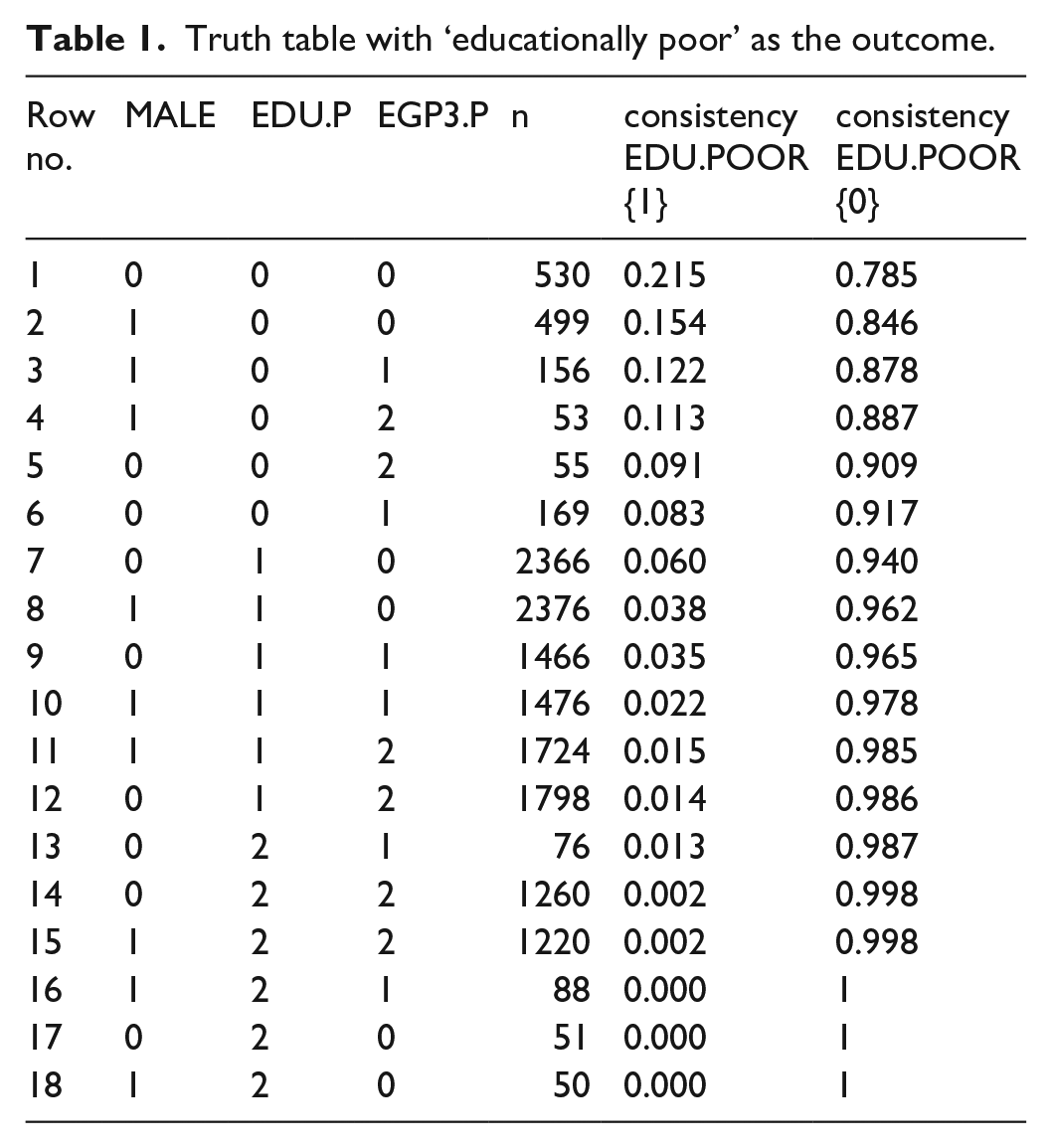
The consistency figure is used to set a threshold above which a configuration of conditions may be considered to be consistent with (quasi-)sufficiency. 9 This threshold is set by the researcher, depending on how close to perfect sufficiency a relationship is desired. There is some leeway for setting this threshold, but it would not normally be below 0.7, so none of the values found in the column headed ‘EDU.POOR {1}’ in Table 1 comes at all close to what might be considered a value indicating quasi-sufficiency.
Several things are noteworthy about Table 1. Considering the combinations of conditions (represented by rows), it is clear that some are more common than others. Rows where parental education and class diverge (e.g. rows 4 and 5) have far fewer cases than those where they match (e.g. rows 14 and 15). Regarding the relationship of conditions with the outcome, the order of the configurations is instructive: the rows are perfectly ordered by parental education, with the lowest parental educational status at the top and the highest at the bottom of the table. This indicates that respondents whose parents have low or no qualifications are at the greatest risk of experiencing educational poverty themselves. Furthermore, within parental educational status groups, the risk varies with parental class: within two types of parental educational status, 0 and 1, the risk is highest for respondents with working class parents. (There is no such relationship within the highest type of parental education, but this is because educational poverty is so rare here already, leaving not much scope for class to make a difference.) This suggests that the combination of low parental education and low parental class is particularly disadvantageous.
Clearly, educational poverty is a fairly rare outcome. In addition, none of the combinations of conditions in Table 1 approach consistency with quasi-sufficiency at acceptable levels. It would therefore not normally be attempted to obtain a Boolean minimisation to capture a solution of the truth table describing a conjunction of quasi-sufficient conditions for the outcome. However, it is instructive to consider whether there are any combinations of conditions which make the outcome more likely than, say, the mean in the sample, thus obtaining some sense of the context in which such an outcome might occur, in the sense suggested by Abell (2001, 2009, 2011) in section ‘Rare events: are they inherently harder to explain?’. This is not the usual way of proceeding and it should not be interpreted to suggest that (quasi-)sufficient conditions can be identified in this way, but rather as a way into gaining a better understanding of the background against which rare events may be more likely than in general.
The overall mean in this sample is 0.039, that is, just under 4% of respondents are educationally poor. Thus, I chose 0.04 as the cut-off for consistency. The top seven rows therefore pass into the minimisation, producing the following solution:

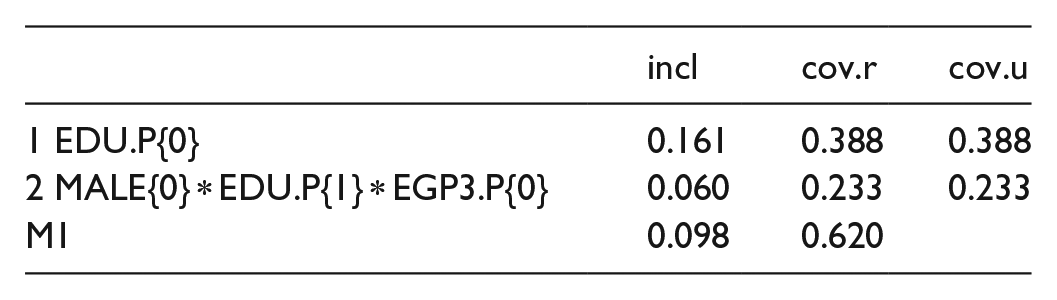
There are two combinations of conditions which are associated with a higher than average risk of being educationally poor. They are (1) having parents with no or low qualifications or (2) for women, having parents with a vocational qualification who are working class.
In a next step, I analyse conditions associated with the outcome of not being educationally poor, an outcome which is far more common than experiencing educational poverty, setting a more conventional threshold for consistency with sufficiency of 0.9 (thus, truth table rows 5–18 enter the Boolean minimisation process). The solution:

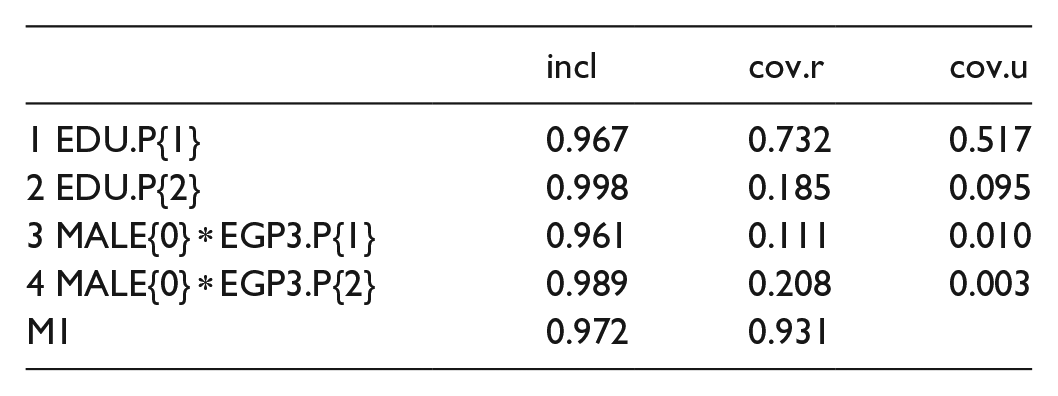
There are four combinations of conditions which are quasi-sufficient for not being in educational poverty. They are (1) having parents with a vocational qualification or (2) parents with a degree or, (3) for women, having parents in the intermediate class or, (4) for women, having parents in the service class. Another way of summarising this is that not having parents with low or no qualifications constitutes one pathway to the outcome, the other pathway, for women only, is to have parents who are not working class. The figures above, on a scale of 0–1, provide information on the consistency with sufficiency for every combination of conditions (the column headed ‘incl’) and raw and unique coverage (in the columns headed cov.r and cov.u, respectively). The coverage figures indicate the empirical relevance of each combination of conditions, with unique coverage calculated 10 for cases who only have the conditions specified by the particular path, and raw coverage for those on the path who also have conditions specified by other paths. Coverage is a measure of quasi-necessity.
Note the double-headed arrow in the solution summary: it indicates that this combination of factors is jointly sufficient and necessary for the outcome at the chosen cut-off level. Thus, compared to the analysis of educational poverty, it is fairly easy – in the sense of identifying conditions which are jointly (quasi-)sufficient and (quasi-)necessary – to identify conditions which are associated with the avoidance of educational poverty. In addition, even for the least privileged group as defined here, women of working class backgrounds whose parents had no or low qualifications, it is fairly common at 78.5% to achieve some form of vocational qualification, thus avoiding educational poverty. This is perhaps not surprising given Germany’s school and vocational training system which means that it is to be expected that most young people will achieve a minimum level of qualifications. This last sentence could constitute a part of the explanation for why the outcome of educational poverty is relatively rare, but does not help us in the attempt to explain why and in whom it arises, illustrating Lieberson’s (1998) point noted above.
The two analyses presented in this section were not of the same kind: since it was not possible to identify (quasi-)sufficient and/or (quasi-)necessary conditions for the outcome of educational poverty, the analysis focused instead on identifying conditions associated with a greater than average likelihood of experiencing this outcome. For the outcome of avoiding educational poverty, however, it was possible to identify a solution denoting jointly quasi-sufficient and quasi-necessary conditions. This in itself points to an asymmetry between the two outcomes, but, in addition, the conditions identified in each type of solution are not the same, nor mirror images of each other – another form of asymmetry.
Presence and absence of educational wealth
As outlined in the conceptual part of this article, given the asymmetry of the concepts, it is not sensible to assume that the absence of poverty is the same as wealth, not least because this would mean, empirically, that the vast majority (just over 96%) of respondents would be categorised as educationally wealthy. In this section, therefore, I employ a measure which might conceivably be seen to indicate educational wealth: having a degree. I use the same conditions as with the analysis of educational poverty. Table 2 is the truth table.
Truth table with educationally wealthy (degree) as the outcome.
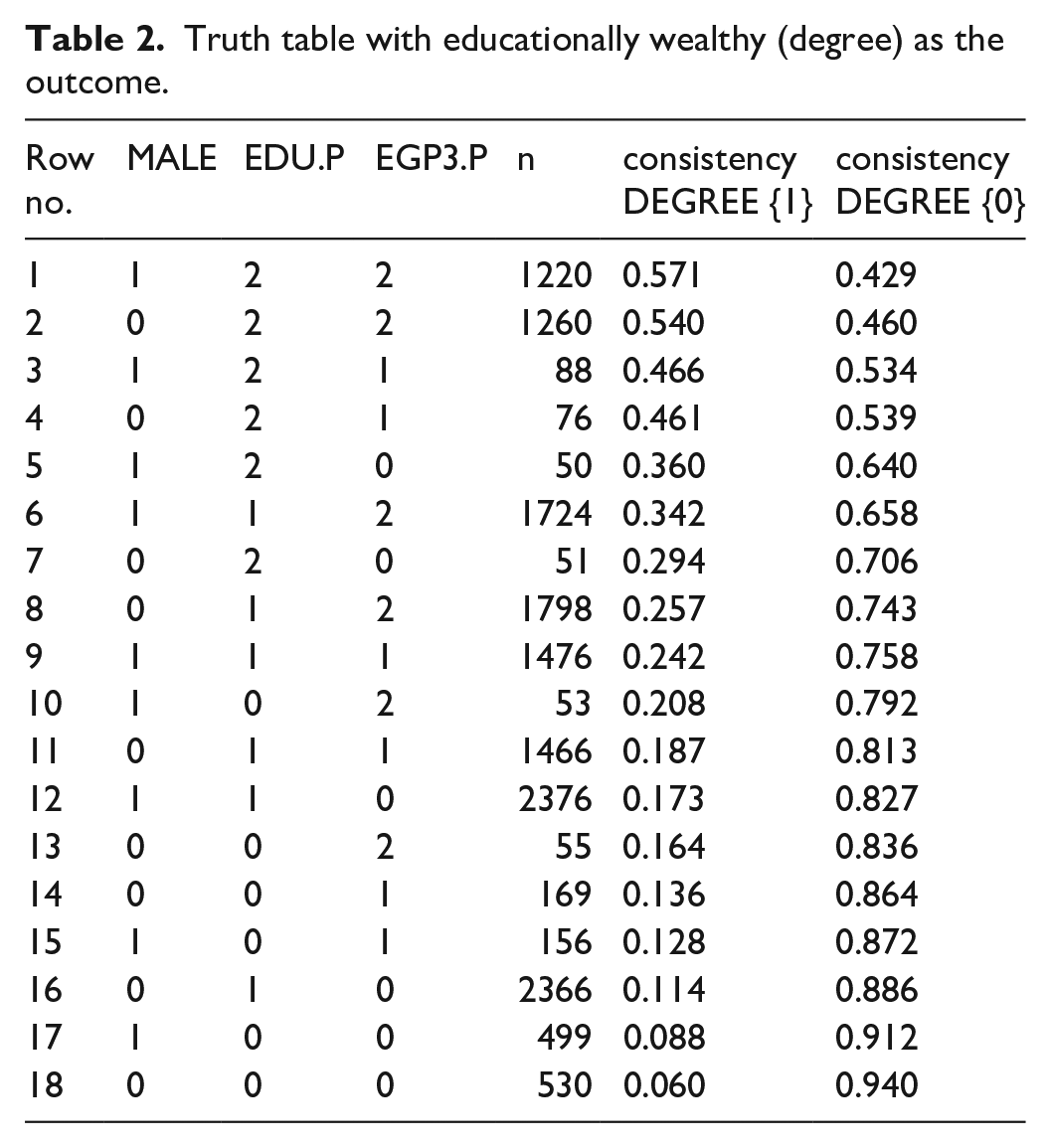
The rows here are not quite as neatly ordered as those in Table 1, but there is still a strong tendency for rows describing respondents with more highly educated parents to be nearer the top of the truth table, and, within such rows, for parents in higher social classes to be nearer the top than lower ones, indicating that the proportions of such cases gaining degrees is higher.
As with educational poverty, there are no rows approaching consistencies which would conventionally indicate (quasi-)sufficiency for the outcome of having a degree. Therefore, I use the same approach as before, using the average of cases with degrees as the cut-off for identifying a Boolean solution which will describe cases with a higher-than-average likelihood of gaining a degree. On average, 25.9% of respondents have a degree, resulting in a cut-off for consistency with (quasi-)sufficiency of 0.26. This is the solution:

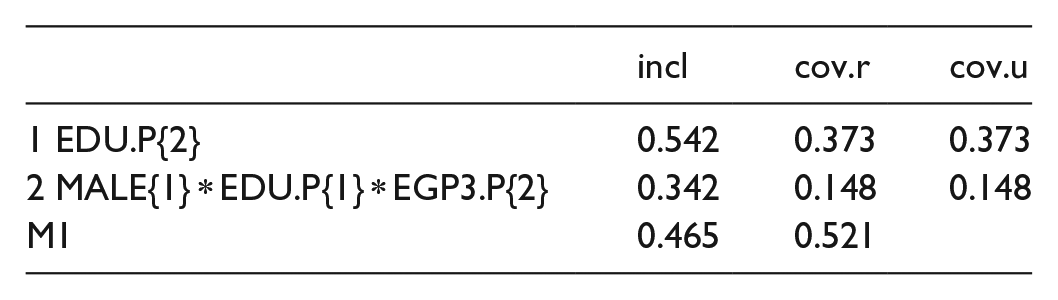
(1) Respondents whose parents hold a degree and (2) men whose parents have a vocational qualification and are in the service class are the two types of cases who have a higher-than-average proportion of graduates. As before, I analyse, in a further step, the outcome of not gaining a degree, using a more conventional cut-off of 0.9.
The solution:

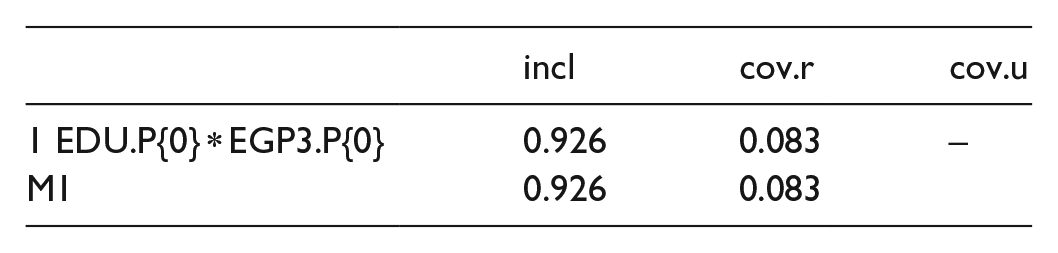
The combination of having parents who have low or no qualifications and who are working class is (quasi-)sufficient (although far from necessary, given the low coverage figure) for remaining without a degree. This time, it was possible to identify quasi-sufficient conditions for failing to gain a degree – the more common outcome by far – though, unlike for the previous outcome of educational poverty, I was not able to identify, using the factors I have, quasi-necessary conditions for failing to gain a degree.
Discussion
Asymmetry and rare events
While there are some interesting substantive insights to be gained from the analyses presented earlier, I will, in these closing remarks, focus on the issue of asymmetry. Rare events are inherently asymmetric, which is why I extend my discussion to these not least since, empirically, educational poverty was shown to be relatively rare. I have been able to show that the four outcomes, (1) educational poverty, (2) avoiding educational poverty, (3) educational wealth and (4) failing to acquire educational wealth each had distinctive pathways leading to them, or rather, in the case of (1) and (3), leading to their likelihood being greater than average. This suggests, first, that it is important to be clear about the focus of any research so that the researcher can be sure that his or her analyses are pertinent to this focus and do not, for example, reveal more about the absence of the focal outcome than its presence, 11 and, second, that QCA is a suitable method for analysing and teasing apart the varied pathways leading to such opposing and asymmetric outcomes. Not only did my analyses show the divergent combinations of conditions for each outcome, but they also illustrated that it can be possible to find a combination of sufficient and/or necessary conditions for the absence of an outcome, but not its presence. Clearly, as noted in section ‘Asymmetry: poverty is not the same as not-wealth and vice versa’, a substantive study of the issues would have to formulate explicit theoretical expectations for the two poles separately, rather than, as I have done in my illustrative empirical example, to assume that the same factors would be relevant for each.
As it happens, one of the two outcomes I studied, educational poverty, was relatively rare, but this in itself is not a reason for not being able to identify such combinations of conditions. For example, we can easily identify a necessary condition for the very rare event of winning the lottery: it is buying or having been given a lottery ticket. Or a rare but easily detectable gene defect may be sufficient (and/or necessary) for developing some disease. We have also seen that, even though they were not the focus of my analyses, explanations for why an event is rare are not the same as (nor even necessarily part of) explanations for who experiences it (Lieberson, 1998; see section ‘Rare events: are they inherently harder to explain?’). It seems likely that educational poverty is rare in Germany because of compulsory schooling coupled with incentives for completing vocational training, but this possible explanation is not, in itself, relevant for the question of who experiences educational poverty despite this supportive context. Similarly, explanations for the fact that only around a quarter of respondents receive degrees probably are connected to the cognitive and motivational demands of completing a university course coupled with the fact that it is perfectly possible to succeed in the labour market and in society more generally without a degree, but these factors played no part in explaining who is or is not likely to gain a degree in my analyses.
Implications for further research
Clearly, from a substantive point of view, there is much more to be learnt about causes of educational poverty: while I have been able to show which groups are largely able to avoid educational poverty and which groups experience a higher-than-average likelihood of experiencing it, more research is needed to establish who, within the latter groups, is at the greatest risk. The factors I have studied seem to be a good starting point, but they primarily illuminate the context in which educational poverty may become a risk. The role of parental education and class seems clear and not surprising given existing knowledge about home background with regard to educational outcomes. The role of sex is less clear: it is not as pronounced as parental factors, but whenever it did feature in the pathways leading to the outcomes I studied, it seemed that women were at a disadvantage since there were more pathways associated with disadvantageous outcomes for them compared to men. But given the increase in the level of education achieved by women, it would be worth investigating changes over time, not least because mothers’ educational achievement has also changed over time, and this may have implications for their children.
In order to establish whether educational wealth, as the opposite of educational poverty, is a useful concept, more work is needed. Unlike educational poverty, this has not so far been the focus of much theoretical or empirical work. Clear expectations would have to be formulated as to its possible causes and consequences in order to decide whether it is a fruitful concept. Materially wealthy individuals are able to lead a life which differs in many respects from that of the merely comfortably off, but the differences are not likely to be, at first glance, to be as great between many graduates and many non-graduates, at least in Germany. Thus, educational wealth may be a less useful concept than educational poverty. The latter certainly is a state denoting a markedly different way of life compared to individuals who are not in educational poverty (e.g. Allmendinger, 1999; Solga, 2011). This divergence in the content of the two concepts illustrates, yet again, the asymmetric nature of the bipolar concept educational poverty-wealth. Thus, for my purposes, whatever its merits in substantive terms, the notion of educational wealth served as a fruitful conceptual tool to demonstrate the challenges arising from the study of an asymmetric bipolar concept.
Other fields are also likely to benefit from a clear conceptual focus on the opposite and the negated poles of whichever is the central concept of study. Relevant examples of such bipolar concepts include those provided by Goertz, for example, material poverty-wealth, democracy-autocracy, or peace-war. I have been able to show that QCA 12 is well suited to analysing asymmetric relationships frequently inherent in bipolar concept pairs. From a methodological point of view, future work ought to address the issue of how an outcome, its absence and its opposite may each be associated with its own set of causal conditions which may differ between these various outcomes, as well as further exploring the extent of asymmetry in bipolar concepts in a range of substantive fields. In doing so, a formal comparison, using both simulated and real data, of several methods with regard to how they perform in the face of asymmetry would be interesting.
Footnotes
Acknowledgements
The author would like to thank Barry Cooper for his immensely valuable comments on this article, and also Martyna Swiatczak for her helpful feedback.
Declaration of conflicting interests
The author(s) declared no potential conflicts of interest with respect to the research, authorship and/or publication of this article.
Funding
The author(s) received no financial support for the research, authorship and/or publication of this article.
