




Abstract
Assuming a methodological posture, this work extends the increasing legitimacy of the sociocultural in qualitative studies. Confronted by sociological questions with potential anthropological answers, this study straddled ethnographies and invoked attributes from both conventional and focused ethnography in a responsive focused ethnography. Responsive-focused ethnography transcends the strictures of traditional sociocultural dichotomies in understanding contemporary institutional arrangements. Experience during its deployment hints a responsive explorative frame for cultural excavation devoid of any illusions of the hidden nature of sociocultural reality. Deployment of this model also demonstrated the possibility of more holistic focused ethnographies with utility in addressing sociological questions with anthropological understandings across diverse contexts.
Keywords
Introduction
The re-centring of the sociocultural in spheres of life has given rise to a plethora of research methodologies. Concomitant with this methodology, proliferation has been a shift from the psychological to convention subversive methodologies in search of contextualised sociocultural understandings. It is within this proliferation that ethnography in its various forms has emerged as an alternative methodological approach in researching sociopolitical systems. Since its development and legitimation at the end of the 19th century, ethnography has evolved into many contemporary forms and resultantly described as a methodology in flux (Rashid et al., 2015). This evolution has been precipitated by the uptake of ethnography as a method of choice across disciplines inclusive of sociology, anthropology, education, medicine, business, public health and the arts. Such extensive uptake and the varied sociological phenomena investigated have resulted in the diversification of this methodology into various forms of ethnography such as critical ethnography, visual ethnography, institutional ethnography, autoethnography and focused ethnography. The adaptability of ethnography and its resultant metastasis has been a double-edged sword. On the one hand, ethnography has become a multifaceted, intricate standardised methodology, while on the other hand it has been observed to have been progressively losing its traditional tenets and practices that have defined it as a robust research methodology. This study explores the latter and proposes an alternative model for ethnography accommodative of both the anthropological and sociological. This work does not seek to transpose focused ethnography or is appositional to it but rather was modelled around focused ethnography but with an anthropological slant. It was an effort to re-centre ethnography in focused ethnography. The study scaffolding this work was conducted in an educational setting, and its inadvertent rationale is captured in the conversations below, which set off a methodology dilemma I grappled to resolve and here propose as an alternative for sociocultural studies.
Setting off – the dilemma
It was a normal school morning day, and after the morning brief we would hang around the staffroom and reflect. As the ‘science trio’, as we were referred in our school, we had our corner in the staffroom, and our conversation on 21 January moved from procurement to the new grade 11 classes. And my two colleagues (white and Asian) made the following remarks: Mr. Kay, I’m not going back to that class. They just can’t keep their mouths shut. They can’t allow me to teach. I think we need to reshuffle them, because there are a whole lot of black foreign learners in that class and they are also speaking in their own language. (Personal communication, science teacher 1*) So, they say they don’t want to be taught by me, they would rather come back to you. Tell me what is it that makes these learners do what they do. I’m not a racist, but honestly, I don’t know how to handle them anymore. They are frustrating me. I want to teach them, but they limit me, they are so limited. Why can’t they be just like all the other kids, I mean just normal and regular? (Personal communication, science teacher 2*)
It was within the context of understanding what the teachers and urban Black youth were like in this setting; how what they were doing or not doing was influencing this context; what was it that they were doing or not doing; and ultimately why they were both doing what they were doing, that a sociocultural study became an imperative. The questions and remarks by my colleagues served as the official story, and from them I began to entertain the possible existence of another unofficial narrative that would make their challenges more understandable. It became my view that addressing what my colleagues brought up needed to go beyond focusing on the questions raised or the phenomena observed, to exploring the fundamental assumption belying enactment, giving premium to cultural capital and its exchange in context. It seemed prudent to explore teacher culture and urban Black youth culture in loco. I needed to generate context-based understandings of the learner and teacher culture and through this anthropological understanding attend to the sociological challenges materialising. Banking on the adequacy of culture in interrogating my colleagues’ challenges came with the challenge of placing this working in a paradigm and executing it through a methodology that resonated with the research agenda and accommodated the anthropological and sociological dimensions. In adopting culture as a progressive viable exploratory construct in addressing this challenge by default, I had settled for ethnography. Why ethnography?
Orientation to inquiry or methodology is influenced by three important aspects. First, it arises from the formal theories associated with specific academic disciplines. Second, methodologies arise from the nature of objectives, research questions, as well as levels of analysis and interpretation of findings. Finally, orientation of inquiry is influenced by the manner in which empirical work is to be conducted or the study is to be designed (Charmaz, 2008). With regard to the first aspect, this study arose and was anchored in formal theories from disciplines such as sociology, anthropology, politics, education, philosophy and other social sciences. With regard to the second aspect, through the research objectives and questions, my interest lay in the exploration of the nature, operation and influence of cultural structures in an educational setting. Such overtures pointed to the need for a design (last aspect) that could cope with the natural and emerging rather than blindly embracing essentialised and reified truths. It was my view that the scope of my methodology had to be located within the dynamism of everyday reality. Oriented this way, the methodology would coincide with my interpretive priorities that centred the social nature and origin of human interaction and practices. My methodology had to be premised on the assumption that agents were knowledgeable, autonomous actors who constituted and were constituted by their constructions. A methodology that readily matched this mould for me turned out to be in the domain of ethnographies (Cruz and Higginbottom, 2013; Knoblauch, 2005; Morse and Richards, 2002).
According to Fetterman’s (2019) conceptualisation of ethnography, I was confronted with a situation in real time, in a natural setting that warranted in-depth studying to gain an in-depth understanding of both overt or explicit and tacit or salient dimensions of particular cultures. Thus, according to Spradley (1979), I had the work of describing culture, studying their behaviours in their natural, normal environment (Hammersley, 1992), embarking on a process of learning about people from them (Roper and Shapira, 2000) and producing descriptions and interpretation of their livelihood and common sense about their world (Wall, 2015). Describing culture and learning about people from people as an outsider revealing their values, beliefs, knowledge, artefacts, enactments and power dynamics are the essence of ethnography usually referred to as conventional or classical ethnography (Andreassen et al., 2020).
Due to my colleagues’ questions, I had to scrutinise specific social phenomena and interrogate context-bound practices, beliefs and processes, held by participants endowed with specific knowledge about the problematic sociocultural phenomena in socially and functionally differentiated contemporary society (Higginbottom et al., 2013; Knoblauch, 2005). Focus research on elements of one’s own discrete sociocultural reality, specific episodes or interactions in discrete communities to glean knowledge relevant for change management or development (Andreassen et al., 2020; Higginbottom et al., 2013; Knoblauch, 2005). I needed to be a pragmatic insider and deploy a proficient means of collecting data to get the emic perspective and ultimately generate strategies and interventions to resolve the problematic context (Rashid et al., 2015). All I had to as outlined in this paragraph is what constitutes focused ethnography. The latter has been regarded by Knoblauch (2005) as sociological ethnography which is different from the classic anthropological ethnography described above. Below, I present a comparison of focused ethnographies to classic anthropologic ethnographies before I discuss focused ethnography and the rationale of this work (Table 1).
Comparison of focused ethnographies to conventional/classical ethnography (synthesised from Cruz and Higginbottom, 2013: 39; Higginbottom et al., 2013: 4).
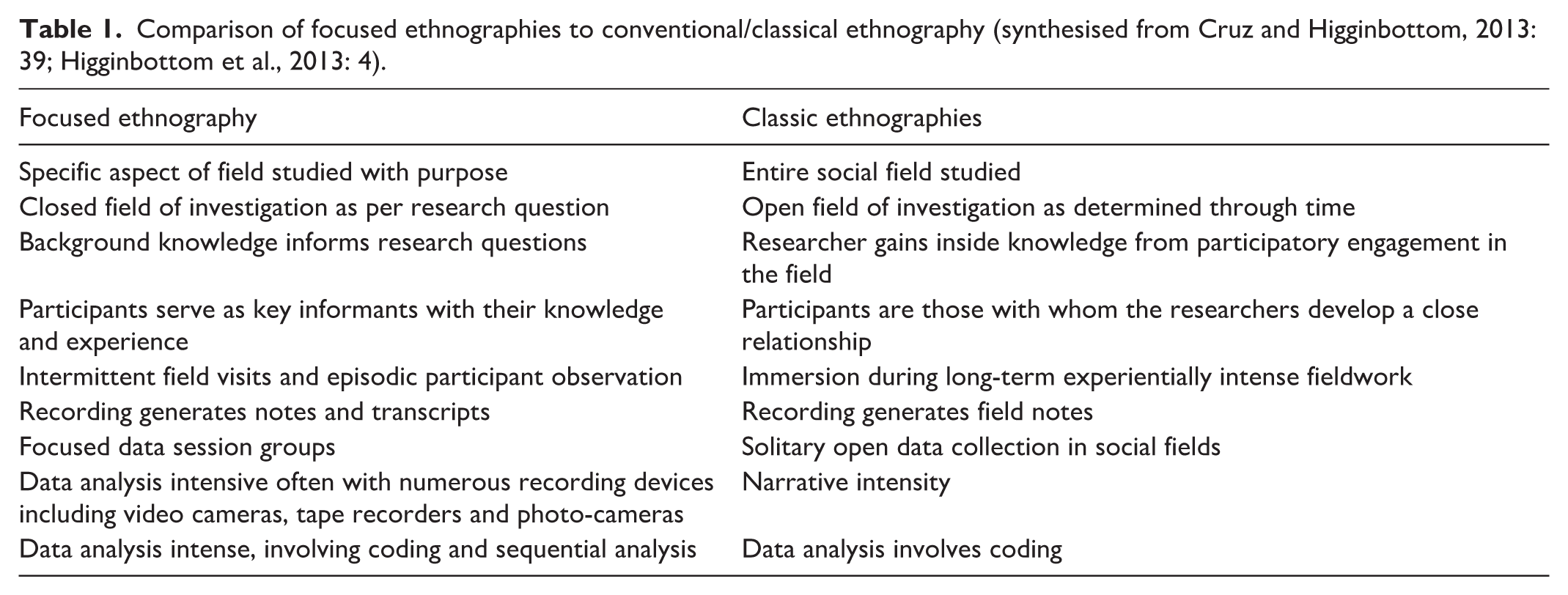
Despite this dichotomy, Higginbottom et al. (2013) have coalesced characteristics shared by all ethnographies: scrutiny of context-bound social phenomena; elicitation of non-ordinal data; non-statistical sampling techniques; thick descriptions as products of analytic; and centring human agency in interpretation. The ultimate goal of ethnography is interpretation of culture and generation of thick descriptions that capture three aspects of culture, namely, cultural enactments; cultural knowledge and cultural artefacts (Spradley, 1979).
After juxtaposing my research agenda on the methodology possibilities, it became apparent that the work I intended to pursue was straddled across the anthropological or classic ethnography and focused ethnography. I intended to excavate, decipher and harness the sociocultural to help the institutional context come to terms with its own culture (s) as well as gathering data in relation to questions raised by both insiders (teachers about themselves) and outsiders (teachers about their learners). My research intentions made both ethnographies preferred methodologies that scaffold this work.
Methodology in transitions – a tale of two ethnographies
Etymologically, the term Ethnography is rooted in the Greek language from two terms: ethnos meaning nation and graphe meaning picture or written representation (Almagor and Skinner, 2013). Originally developed as a research strategy rooted in anthropology, classic ethnography, hereafter only referred to as ethnography, is an interpretive form of social research which is focused on describing culture or groups of people in natural settings. From a functional perspective, ethnography is a process and associated outcomes of describing cultural behaviour (Schwandt, 2000) involving learning about people, with the researched people serving as the primary source of data (Roper and Shapira, 2000). Ethnography culminates in a written description of group cultures without pre-defined questions other than to gain an in-depth understanding of a specific culture (Wall, 2015). This deep understanding is brought about by the deployment of multiple data-collecting methods which include participant observation, interviews and documentary analysis over long-term cultural immersions (Fetterman, 2019).
The contemporary understanding of ethnography (Classical Ethnography) has been that researchers conduct their studies among alien, exotic and relatively bound groups (Yon, 2003). However, new metaphors and conceptualisations of culture and the application of ethnographic techniques in other fields, particularly sociology, have brought a paradigm shift in ethnography which has given rise to two main types of ethnography: macro-ethnography, which focuses on broadly defined cultures and is associated with the genre of classic ethnography, and micro-ethnography, which is concerned with more narrowly defined and highly fragmented social systems ( (Cruz and Higginbottom, 2013). The latter type of ethnography is also referred to as ‘focused ethnography, micro-ethnographies, rapid appraisals’ (Higginbottom et al., 2013: 2).
Focused ethnography is an evolved form of classical ethnography which is not in opposition to the latter but rather a complementary method (Andreasen et al., 2020). While both search and expose cultural attributes, enactment and power dynamics, focused ethnography explores episodic interactions, context-bound phenomenon or processes within discrete communities (Higginbottom et al., 2013). This evolution from classical ethnography has arisen from new kinds of questions and new reasons for undertaking ethnographic studies (Wall, 2015) as well as a shift towards methodologies that accommodate people’s experiences and realities as constructed from their subjective understandings (Knoblauch, 2005). It is from these understandings that focused ethnography emerged as a viable, pragmatic methodology in exploring distinct issues or communal experiences in specific social settings where prolonged immersion is not feasible (Higginbottom et al., 2013). Whereas the product of classic ethnography is usually thick descriptions and interpretation, focused ethnography generates understandings of the experiences of segments of social systems (Roper and Shapira, 2000). It is from this notion that Knoblauch (2005) conceptualises focused ethnography as an applied research methodology used in the investigation of specific social fields in a culturally diverse, highly fragmented and differentiated contemporary society. The functionality of focused ethnography according to Cruz and Higginbottom (2013) lies in its capacity to solicit information on distinct issues, situations, shared experiences or puzzling phenomena associated with limited elements of society in specific contexts. Contrary to classic ethnography, such contexts need not necessarily be exotic or foreign to the researcher because the focus of this methodology is not the amassing of knowledge but rather specific understanding of the complex specific contextual realities (Cruz and Higginbottom, 2013). Executed in the latter, focused ethnography as a methodology accommodates the participants’ perspectives (emic) while simultaneously allowing the infusion of the researcher’s analytical and conceptual frames of reference (etic) in interpretation (Roper and Shapira, 2000).
Making the case – missing links in contemporary ethnographies
The multifaceted evolution and concomitant diversification of the ethnography have not escaped the challenges associated with methodological changes. While exploring the transformation of ethnographic practices, LeCompte and Schensul (2010) posits that ethnographers in the 21st century are confronted with the challenge of meaningful ethnographies capable of informing community development. The overarching challenge according to Rashid et al. (2015) is the disappearance of traditional practices and the compromise of principles associated with ethnography. Cognisant of these shortcomings, critics have implored a rethinking of the methodology vis-à-vis its focus, research strategies, design and analysis. This is not a pronouncement of a requiem for ethnography but a prompt to rethink how ethnography can be strengthened or an alternative modelled with multi-disciplinary utility but still imbued with the spirit of ethnography.
According to LeCompte and Schensul (2010), culture is the central element of ethnography, even though in applied ethnography the focus has shifted to investigating cultural processes and how groups navigate human problems. Post-structural research has elevated cultural variables and negated culture as exploratory constructs in cultural systems. Such approaches have had little influence on epistemic generation and have had limited impact on human practice (McKinney and Soudien, 2019) because they do not tackle the fundamental assumptions (culture) (Schein, 2016) undergirding observed artefacts. In this regard, it is argued that negation of culture or superficial artefact integration in institutional research and in intervention initiatives has hamstrung progressive post-structural agendas. While culture is at the core of ethnography, it is also the construct that has led to the methodological metastasis, yielding the various forms of ethnography in terms of contexts, processes and products (Whitehead, 2004). Critiques cognisant of the centrality of culture in ethnography posit two culture nuanced challenges in ethnography. First, the conceptualisation of and consensus on culture have been problematic (Rashid et al., 2015). The second challenge has been the total disregard of culture in ethnographies while focusing cultural attributes, sociological problems or social phenomena in social fields (Cruz and Higginbottom, 2013; Knoblauch, 2005). Examples of the latter include an exploration of laboratory practices, technology use, deaf identity or experiences with chronic pain (Knoblauch, 2005; Rashid et al., 2015). Focused ethnographies of this nature have been indicted for not focusing on culture and while it is supposed to be the core precept in ethnographic research. The call from critics is to put culture responsively in focused ethnographies, failure of which they are just another form of qualitative methods and not ethnographic in the truest sense.
Focused ethnographies have also been criticised for myriad other shortcomings such as the inadequate address of research techniques, methods and reliance on models that assume stasis and homogeneity (Murchison, 2010); and the perceived challenge of deficiencies in positivistic exactitude, robustness, credibility and consistency (Higginbottom et al., 2013). Related to the latter has been the contention that ethnographies have failed to disclose researcher positionality and determinants of their research decisions (Hogan et al., 2009). So although researcher subjectivity is celebrated, the subjective nature of the enquiry has been dismissed as lacking a solid foundation for rigorous scientific analysis. Related to the latter, focused ethnographies have been critiqued for their limited grounding in philosophical foundations by failing to foreground ontological and epistemological underpinnings (Rashid et al., 2015). Critics contend that the short-ranged character of focused ethnography renders them superficial (Knoblauch, 2005). Finally, ethnographies are being indicted for their end-product which has been labelled catalogue of cultural traits or a rudimentary conceptual gestalt without the trademark comprehensiveness characteristic of ethnography (Murchison, 2010).
Despite the critique captured above, focused ethnography remains a methodology imbued with potential and utility across disciplines. It has emerged and maintained its usefulness as a viable research methodology that is highly adaptive and has produced insightful sociocultural accounts that have informed practice and policy. It is this promise that galvanised this work in response to the critics voice through modelling an ethnography that straddles the anthropological and sociological while responsive to contemporary research demands. This methodological proposition I have termed responsive focused ethnography (RFE). Inspiration for such overtures is drawn from scholars like Whitehead (2004: 6) who encourages us to ‘employ any and all means necessary and prudent to create the most holistic understanding of the cultural system . . .’ It is from this premise that this work proceeds. I hasten to point out that the modelling proposed here is not oppositional to focused ethnography but an attempt at keeping focused ethnography true to its ethnographic roots while attendant to contemporary research needs. Thus, it is a mosaic of both the sociological and the anthropological, premised on the spirit of latter and the adaptability of the former.
Straddling the chasm – framing RFE
In this section, I present thinking tools that guided and informed this work. Cohen et al. (2017) refer to such tools as assumptions guiding decisions, actions, analysis and interpretations. These assumptions are in three areas: ontology (nature of reality), epistemology (nature of knowledge) and methodology (method to knowledge) (Cohen et al., 2017). After presenting assumptions informing this work, I discuss the concept responsive in RFE and the concept culture.
Ontology deals with the nature of reality and what we can know about it (Cohen et al., 2017). From my theoretical (organisational culture) and conceptual frameworks (Bourdieu, Foucault and Motivational theory), reality was a human construct premised on subjective experiencing of the environment external to the being. Assuming a historical realist position and regarded reality became a subjective construct influenced by sociopolitical factors that coalesce and become reified into extant discrete social structure. With these assumptions, the reality I was researching and exploring was not an isolated phenomena but an amalgam of many complex historically nuanced dynamically interacting variables.
Epistemology is regarded as the theory of knowledge (Cohen et al., 2017). From motivational theory (Self Determination Theory), Foucault’s ideas on knowledge and power, and Bourdieu’s concepts of habitus, field and capital, I held the notion that human beings are knowledgeable, agentic, purposeful, perceptive, evaluative and comment on their agentic experiences. With the individual being the locus of knowledge, knowledge is subjective and transactional. Through interactions and relationships, knowledge is produced and reproduced.
Methodology is about how knowledge about a context is acquired (Chowdhury, 2014). A subjective and transactional epistemology implied a dialogic methodology, and any external explanation of social phenomena that ignored the agents’ ontology and epistemology was a futile venture in establishing the truth. Meaningfully gaining knowledge about the context had to proceed through dialogues and freer communicative platforms that accommodated the multiplicity of social experiences. Thus, knowledge and knowledge generation had approached as social, situated, subjective, interested and historical with meaning emanating from interpretations of this subjective knowledge.
My ontology, epistemology and methodology placed this work within a loose aggregate of approaches termed the interpretive paradigm (Walsham, 2006). Key postulates include humans consciously act and their actions are endowed with meaning; meaning is based on experience and context; meanings are based on subjective categorisation and organisation of experiences; experiences are subjective and multiple; and interpretation of meaning constitutes reality and truth; (Chowdhury, 2014; Smart, 1998; Walsham, 2006). Reality is thus produced and reinforced by agents as they act and interact with other agents in social relationships or organisations. With this understanding, the purpose of research is to understand through interpretation how agents or groups of agents through their engagement in the social processes enact their meaning-endowed realities (Goldkuhl, 2012).
What is Responsive in RFE
I borrow the term Responsive from the computing world as coined by Ethan Marcotte (2010) in his coding book Responsive Web Design. Responsiveness calls upon designs to optimise flexibility of content across diverse quality requirements and output technologies. Responsive designs attend to the everchanging needs of the users and their technologies. Responsiveness by virtue of fluidity proffers an optimal experience and easy navigation despite variances. The rationale for responsiveness being that it is impractical, if not impossible, to keep up with user needs and application requirements in dynamic, fragmented, differentiated and disparate contexts. Just as it is not realistic and scientifically sustainable in the computing world to create a web version for each resolution or new device, this work in suggesting an RFE envisages optimisation and robustness in ethnography based on methodological responsiveness. Such an approach curtails the continued proliferation of ethnographies as critiqued. Such an RFE through embedded conceptually nuanced fluidity has the potential of accommodating the dynamism of ethnographers’ focus and the myriad sociocultural realities that constitute social fields. I use the term sociocultural hinting the approach’s potential to straddle the sociological and the anthropological.
However, entertaining the possibility of an RFE presents the challenge of creating a fluid conceptual framework and research design. In the next section, I tackle these two challenges and use examples from a study scaffolding this work.
Grappling with the slippery, slithery concept – culture
RFE is premised on the notion that culture is everywhere, porous and unbounded, and as such can be investigated and explored everywhere. Culture is human and ubiquitous as human groupings, and grouping is a cultural phenomenon (Schein, 2016). The postulate in this assertion is groups constitute culturally and implicitly construct culture. Conceptualising culture for RFE involved consideration and accommodation of contemporary theorisations and dominant cultural discourse, particularly the work of Tylor and Boas.
Tylor’s work: Primitive Culture premised on Neo-Darwinism presents culture from a unilineal evolutionist perspective. This perspective promulgates the psychic unity of mankind while attributing cultural variations to humanity being at different levels of progress towards civilisation. For Tylor, culture in its widest ethnographic sense is ‘that complex whole which includes knowledge, belief, art, morals, law, custom, any other capabilities and habits acquired by man as a member of society’ (Schoenmakers, 2012: 39). Tylor’s conceptualisations commodifies culture as an overt pluralisable, discontinuous, rationalised, categorised, universalistic, coherent set of artefacts that can be objectively interrogated being synonymous to temporal enactments and manifest habits of agents (Schoenmakers, 2012).
The work of Boas in the latter part of the 19th century brought about a paradigm shift vis-a-vis culture and cultural development. Arguing for cultural plurality and relativity, Boas posits, . . . the history of human civilisation (culture) does not appear to us determined entirely by psychological necessity that leads to uniform evolution of the world over. We rather see that each cultural group has its own unique history, dependent partly upon the peculiar inner development of the social group, and partly upon the foreign influences, to which it has been subjected. (Boas, 1920: 286)
Boas’ (1920) positing makes culture dynamic and relatively pluralisable, and its development historical and hybridised. This view provides for sociocultural disparateness and fragmentation. Such a conceptualisation implies that cultural understanding comes from an exploration of the environmental, psychological, historical and all other influential conditions that a group may have been subjected to.
Conflating Boas’ postulates with those of theorists like Bourdieu (1973) and Sewell (1992), Alexander (2003) places the locus of culture in the domain of affect constituted by stable, salient, guarded structures which are internal to the agent (Sewell, 1992) and man being a mnemonic device for the imprinting of these internalised dispositions (Bourdieu, 1973). An internal locus makes culture an abstract aspect of social life (Sewell, 1992) beyond Tylorian observable artefacts. Culture ceases to be a variable but symbolic capital that each social group is endowed with from their participation in social spaces and historicity (Bourdieu, 1973). Combining preceding ideas, culture can be conceptualised as historically determined behavioural patterns, symbols, deeply located schema and material forms passed on from generation to generation through socialisation and not heredity. Such conceptualisation has utility in the development of a unitary scientific approach to both anthropological and sociological ethnography. A notion of culture as dynamic and pluralisable provides for the possible existence of multiple cultures and multiple discrete realities in a single context as encapsulated in various definitions of focused ethnography. By shunning from the singular Tylorian ‘cultures’ of modern man, it provides a framework for an examination and analysis of different peoples’ culture in both macro- and micro-contexts, which is the essence of conventional or classic ethnography. Finally, an abstract culture implies methodology to go beyond observable artefacts and observable reality to glean deeply located symbolised cultural understandings.
An abstract and symbolic framework provides a pre-existing architecture of culture that is transposable across groups and contexts endowed with the capacity for standardisation as well as more poised engagement in ethnographies. The capacity for standardisation is crucial for making ethnography responsive and circumvents the blind approach ‘capture all’ practice of classical and the limitedness of focused ethnographies. Though human behaviour cannot be modelled with certainty, I entertained a possibility in modelling cultural understanding based on a pre-existing frame. It became my view that cultural analysis and thick descriptions could be made within a pre-existing frame. What was critical was a conceptualisation of cultural dimensions and key questions that needed to be addressed in a standard ethnographic account. Such a possibility is evident in cultural studies elsewhere, for example, in the following non-exhaustive list: levels of culture (Schein, 2016), levels of intercultural sensitivity (Cushner et al., 2012) and levels of cultural awareness (Howell, 1979).
The compromise – modelling culture for RFE
My dilemma on commencement of this work was how to generate cultural understandings for a thick description (anthropological ethnography) while answering sociocultural questions (sociological ethnography). This dilemma was premised practical challenges; the difficulty in delimitating cultural excavation, consensus on what constitutes a standard account of culture (conventional ethnography) and the time constraints for extensive fieldwork juxtaposed on the temporary nature of some fields (focused ethnography). Resolution of this dilemma demanded that I modelled culture with sociological and anthropological utility as the first step.
Based on my conceptualisation for this work, I visualised culture as having dimensions that coalesced to give a dynamic organic whole called culture. These dimensions I envisaged hinged on etic accessibility, with Dimension I being the most accessible and Dimension IV the least accessible. In exploration, cultural understandings for each dimension are evoked by a question. Below is a schematic representation of the dimensions of culture and associated questions of an RFE (Figure 1).
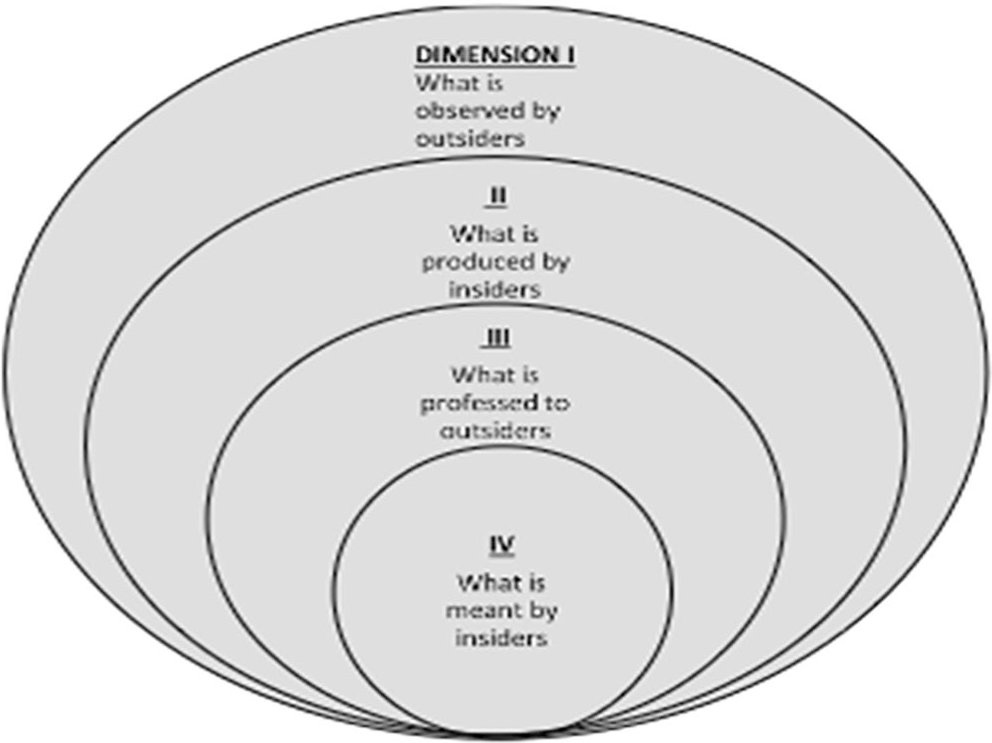
Schematic representation of cultural understanding dimensions and related questions.
Dimension I
The first dimension of culture accommodates a Tylorian conceptualisation by focusing on the observable, material or artefactual components of the sociocultural world of any group. These components are readily accessible to the ethnographer without much intrusion on the group and yield extensive descriptions of the research context. Dimension I includes artefactual components such as clothing, food, music, spatial distribution and placement, recreational enactments, technologies and archived materials. Culture descriptions in this dimension are mainly annotations of what is without delving into the how and why of functionality and capture all artefacts located in the field irrespective of the origin. Due to its surface locus and superficiality, this dimension is not stable. Its dynamism is fuelled by adaptative changes; hence, artefact production and reproduction are dependent on immediate physiological and psychosocial needs.
Dimension II
This dimension of culture is still superficial and observable and presented as descriptions. This dimension consists of artefacts that are only produced and reproduced by the group. Dimension II cultural components are enduring and have utility for group cohesion and survival. These artefacts are produced as a matter of necessity and are peculiar to the group, without which the group experiences dissonance. Culture at this level is relatively stable because this dimension is based on components that hold the group together while fulfilling their needs for belonging and competence. Components in this dimension include language patterns, social rituals and so on.
Dimension III
This is an abstract dimension and is what the group espouses and wants outsiders to know about them. This dimension exists and is expressed symbolically through voice both active (perspectives) and passive (participation and non-participation). This is a dimension that is passed on intergenerationally through socialisation and is the public/official rationalisation for the group’s existence. This dimension is the standard account and though abstract is not jealously guarded and is professed by any member of the group to ethnographers. This dimension usually included the what and how levels of understanding, and participant professions do not explain why they do what they do but rather what they do and how they do it.
Dimension IV
This is the last and least accessible dimension. It is highly abstract and forms the most stable framework for the existence of the group. This dimension is the reason why the group exists. Not all members of the group have access to this dimension and is accessed by key members and the founders of the group. This dimension of culture includes the why levels of understanding. Any meaningful intervention or change agenda has to excavate in this dimension. Culture exploration in this dimension proceeds by capturing interpretations or meanings rendered by founders and key informants to observations from the preceding dimensions, I–II, and what is espoused in dimension III.
The modelling of culture above provided the theoretical grounding and implied pragmatic steps for deciphering and mapping sociocultural understandings.
Methodological considerations in RFE
In executing this RFE, I identified three areas that needed to be attended to by my methodological decisions. First, I needed to capture macro- and micro-contextual realities of the field or cultural setting. Second, data collection had to capture discursive enactments by participants. Finally, I had to solicit explanations for observed enactments. This triad of considerations was guided by three questions: What was the nature of the field? What were the agentic enactments in the field? Why were agents enacting as they are in this field?. These were the questions I needed to address as I deployed RFE.
My ontological, epistemological and methodological understanding in this work proceeded with three key informing focal elements. First, I strived to make it people-centred because I regarded reality as socially constructed and it could only be made meaningful by those in that social context (Cohen et al., 2017). Recognising the intricate connection between agents and their knowledge, it was my view that this study had to be informed and respond to experiences and realities of the participants in the research context. Understanding the puzzling phenomena observed by my colleagues within RFE implied excavating the subjective meanings at the heart of the phenomena. This excavation had to follow multiple routes, use multiple methods and engage multiple agents at both macro- and micro-context level. Acknowledging the knowledgeability of agents and equating knowledge with power (Foucault, 2008), this study had to be power-conscious. Being power-conscious implied interrogating the deployment of power by various agents in the field context.
While I concur with Schein (2016) on the value of long-term immersion as is typical in ethnographies, field experience proves it impractical since some fields have temporal or shorter life span (longitude) or high levels of sociocultural fluidity. For example, educational institutions operate in semesters or as in the study operated over four school terms, a functional aspect which implied a change in multiple variables. In this regard, RFE through embracing attributes of focused ethnography had provision for limited field immersion. The sufficiency of such an ethnography was also engendered in Wall’s (2015) contention that time spent in the field does not guarantee that all data collected will be of any relevance – in some cases, useful and pertinent data can be gathered with minimum time investment. The notion embraced is that in RFE limited field time can be compensated by a higher data intensity and volume from multiplicity of sources. Length of immersion ceases to be a key determinant of output quality, but rather quality is judged by emergent cultural understandings from the participants’ point of view and the dynamics of the context. With this understanding, field immersion was over three school terms, translating to nine calendar months, which proved to be sufficient.
A criticism levelled against ethnographic work is silence on the role of researcher historicity and prejudice vis-à-vis how it can possibly affect the study situation and field encounters. In line with this principle, as part of RFE, I include declaration of ethnographer positionality. As I declared my positionality, I exposed and pre-empted the role of my voice and how my bias was included, how I approached participants’ voice, and how I viewed and used research methods in this study. I acknowledged that I was part of the context I was researching, and my position and reactivity to it, as suggested by Hammersley (1992), was something I had to cherish, exploit and even celebrate. Like a fish in water, I was able to interact with the participants in ways that were not distant so as to inhibit the generation of deeper insights or too close to sacrifice objective interpretation. As a fish in water, I positioned myself in ways that objectified my relations to participants so that emerging findings were not a simple projection of my unconscious relations to the participants. Thus, my positionality embedded within my sociopolitical habitus was intimately tied up with the methodology and methods that I drew on as I explored the puzzling phenomenon.
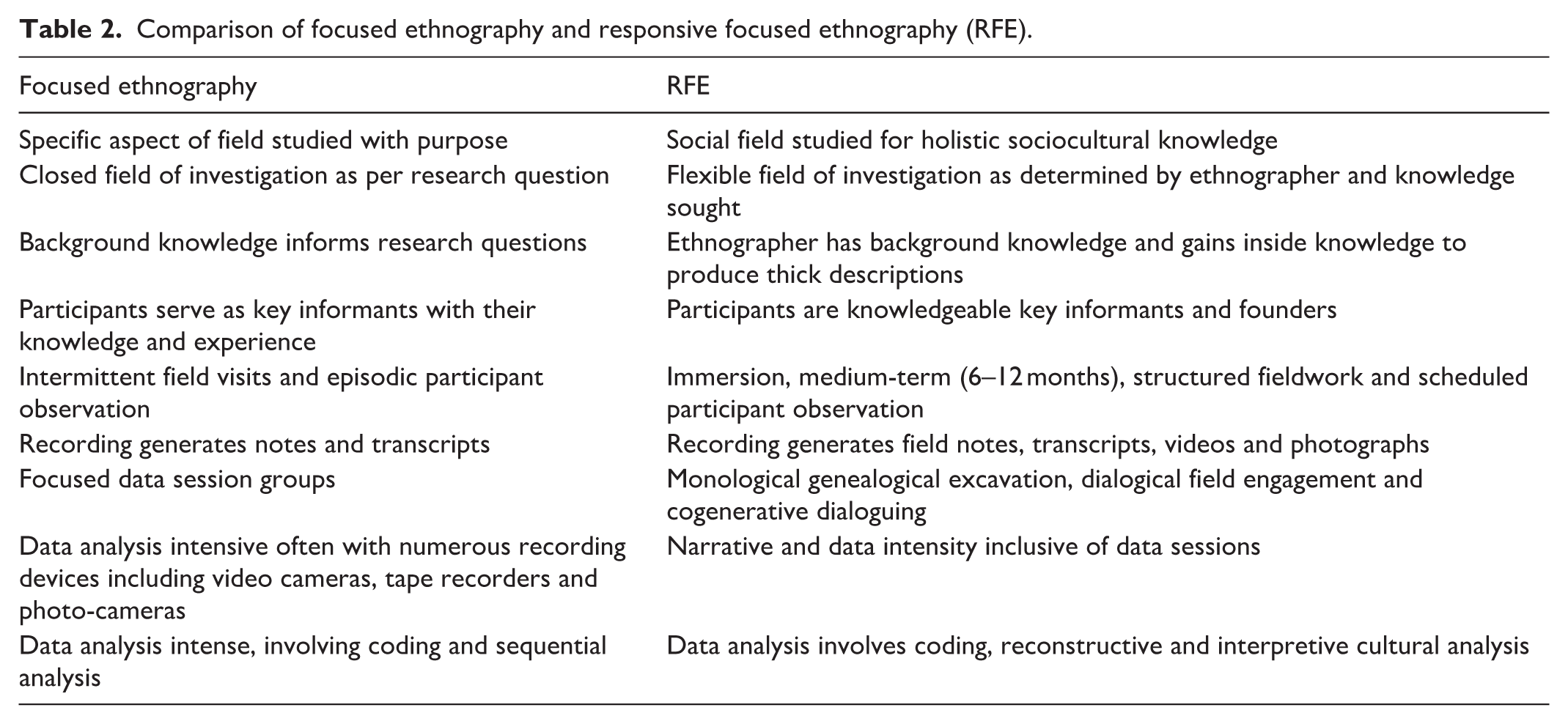
Table 2 summarises the methodological attributes of RFE and how they compare to focused ethnography.
Comparison of focused ethnography and responsive focused ethnography (RFE).
Deploying an RFE
In the following sections, I describe the deployment of the RFE model through a conflation of dimensions and related methodological considerations. My methodology involved juxtaposing the dimensions of culture with four embedded stages, namely, monological genealogical engagement, dialogical engagement, reconstructive cultural analysis and interpretive cultural analysis as shown in the Figure 2.
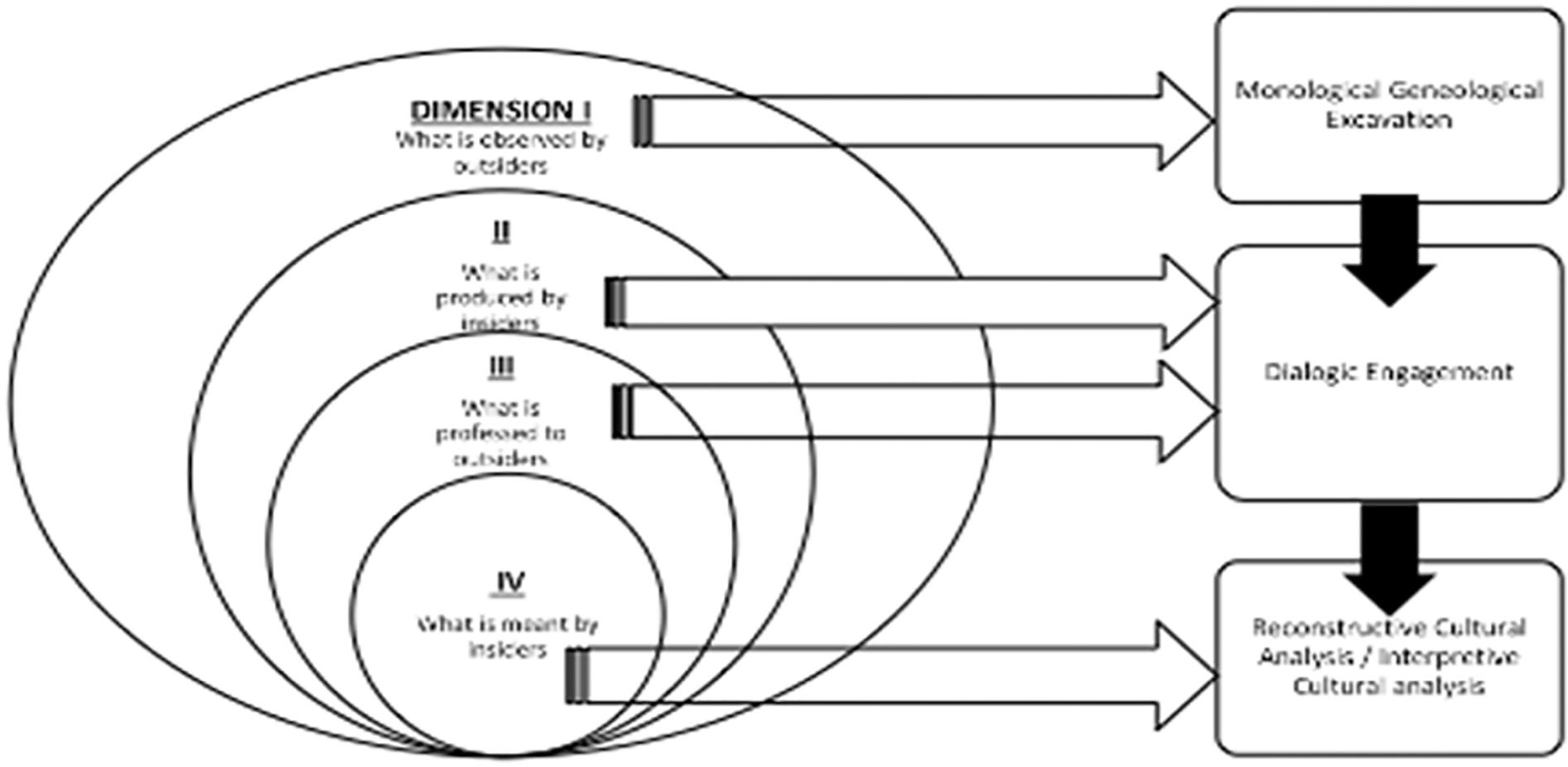
Model showing dimensions of culture and related methodologies.
Each of these dimensions and related stages/methodologies are discussed further.
Dimension I – monological/genealogical engagement
The first dimension of the RFE seeks to capture the overt artefacts and addresses the question, What is observed by outsiders? Methodologically I termed this stage monological genealogical engagement/excavation. Monological genealogical excavation aligns with Foucault’s (2008) idea of writing the history of the present. This stage is monological in the sense that it only involves the researcher writing field notes, photographing and generating videos of artefacts without engaging with participants. It is genealogical in that it is an ontology of the present or what Foucault terms a search for processes of ‘descent’ or ‘emergence’ of the present reality. The purpose of genealogy as posited by Foucault (2008: 130) is not nostalgic but rather ‘is to let knowledge of the past work on the experiences of the present’. Ingrained in genealogical excavation is the extensive gleaning of historical materials to ‘trace the erratic and discontinuous processes whereby the past becomes the present’ (Garland, 2014: 372). Thus, the methodological endeavour in this stage of research is to capture artefacts while rethinking about observed phenomena.
Addressing the first-dimension question generates naturalistic descriptions of the setting through what is observed, captured and documented.
The hallmark of this stage is the passive unobtrusive recording of all artefacts or overt cultural manifestations. With an attitude of ‘almost complete ignorance’, data collection starts from a diagnosis of the current situation in an endeavour to generate a description of all the artefacts in the field (Spradley, 1979: 4). In the RFE, cultural descriptions generated at this stage include history of the context, its organisation, typical itineraries, legislative instruments and forms of cultural artefacts. During this stage, observation of the nature of power and its operationalisation (Foucault, 2008) and the transacting of cultural capital through interactions with cultural significance (Bourdieu, 1973) are recorded. The primary method of data collection is scheduled regular observation and retrieval of secondary data. Secondary sources of data include archival material, incident reports, statements of events; policies, biographies, code of conduct, staff handbooks, minute books (if not classified); and annual reports, logbooks and photographs. These secondary data are crucial in confirming and contrasting data in subsequent stages.
Below is an excerpt from the study showing a sample of data that is generated in this stage:

Dimension II – sifting
The second stage is guided by the question, What is produced by insiders? This question prompts a targeted solicitation of observable cultural phenomena associated only with the group or target phenomenon. It involves sifting through the research setting in search of artefactual material associated with the group or the phenomena under exploration. The underlying assumption for the second question is that not all observed phenomena in the macro-context may be attributable to a group unless the group enactments and artefacts are established. For example, in educational or health institutions, the macro-context is the whole institution and the micro-context can be the grade, class, faculty or unit, respectively. It is important, therefore, before exploring the How and Why question in the third and fourth dimension to establish the group’s operational parameters, functionality, the artefacts they solely produce and other symbolic representations. The What question in the second dimension creates an opportunity for research to self-correct erroneous ascription of monological excavations to a group and an opportunity to further access overt cultural manifestations associated with the sociocultural phenomena under study as shown in the excerpt below which was sifted from the school depository:

Dimension III – dialogic engagement
Cognisant of the fact that open dialogic methods are necessary in establishing deeper aspects of culture such as values and deeply located symbolic structures that constitute the group, the third stage and dimension is oriented towards this. The third dimension may be considered a democratisation of the research process through solicitation of participants’ input. The essence of the third stage is the activation of the participants’ voice through solicitation of what groups do, how they do it and why they do it. In the third dimension, the question that guides and informs the RFE is, What is professed to outsiders? Unlike observation and archival material collection which are monological, the second phase is dialogic. Building on observations and informant reports, the purpose of this stage is to gain an insider’s or emic perspective (Yin, 2017) through rigorous involved dialogic communicative engagement.
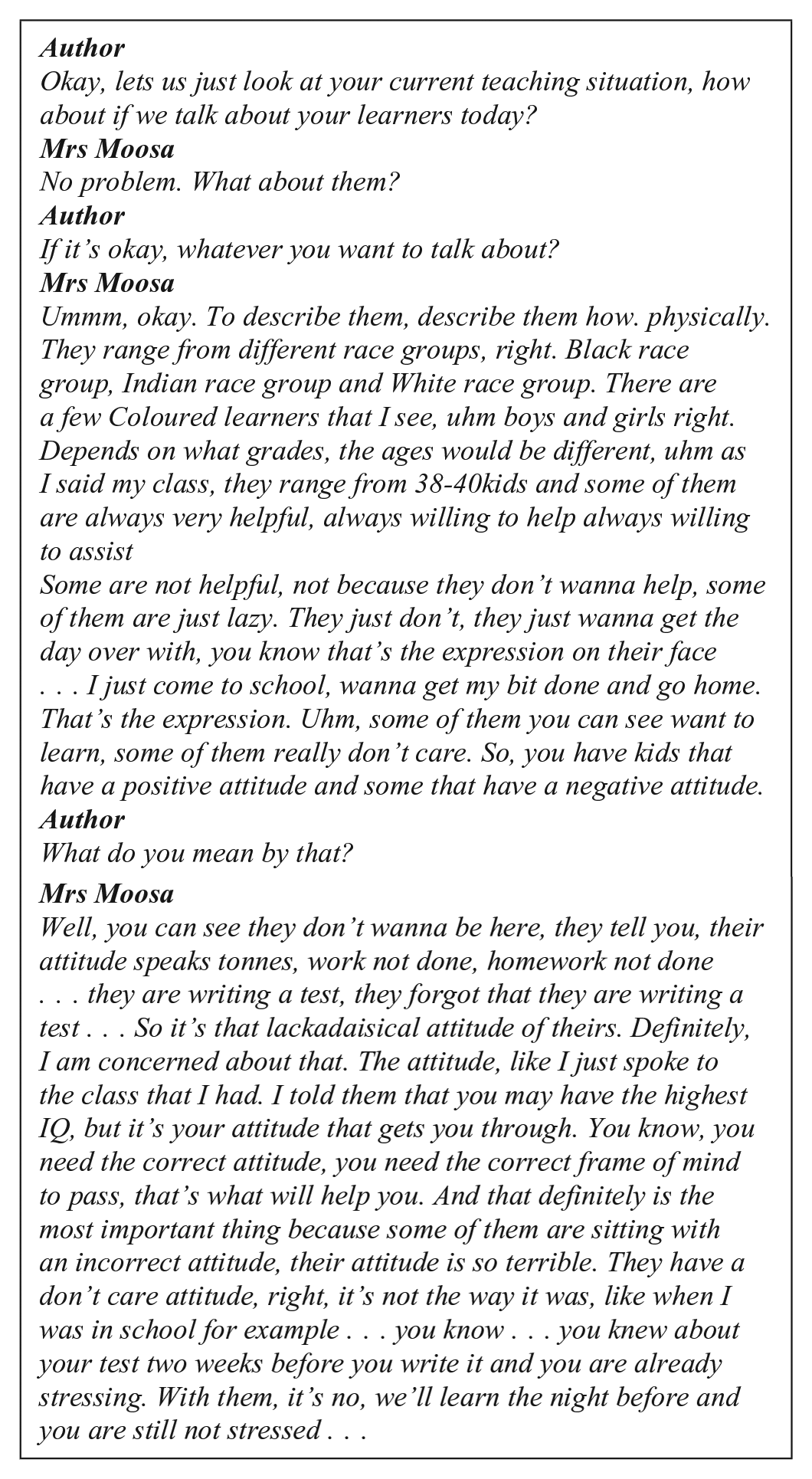
Dialoguing involves both semi-structured and unstructured interviews (cogenerative dialoguing). Interviewing is regarded as the dialogic mainstay in ethnography. While scholarly work advocates for interviewing as having currency in this dimension, it is important to acknowledge the constraining nature of pre-set agenda and discussion schedules in gathering anthropological descriptions. In response to the latter in RFE other than interviews, cogenerative dialoguing is also deployed. In cogenerative dialoguing, all participants as agents with equal urgency collaboratively generate the discussions pertaining to the phenomena and through consensus validate outcomes of the discussion. Cogenerative dialoguing is an acknowledgement of agentic equality and autonomy which obliterates the strictures imposed by research positioning. Obliteration of strictures is crucial because ethnographers cannot always project with certainty whether their schedule will be relevant in gleaning cultural understanding about the group or phenomena under study. Thus, cogenerative dialoguing elevates the participant voice without bridling by circumventing constraining pre-judgements. Below is an extract from a cogenerative dialogue I had with a teacher about her experience teaching urban black youth:
Dimension IV – cultural analysis
The last stage in the deployment of RFE addresses the question, What is meant by insiders? Addressing this question in this dimension maps the webs of meaning of groups or cultural understandings. Answering this question is the essence of cultural understandings of the group that have utility in understanding the matter under exploration. Primarily, cultural analysis in ethnographies is about the identification and classifications of data to tease out the group’s culture and hence explain the observed phenomena. In RFE, cultural analysis involves two forms of analysis, reconstructive and interpretive cultural analyses.
Reconstructive cultural analysis
Reconstructive cultural analysis follows the qualitative approach to analysis which entails breaking data into more manageable parts and developing codes from the data in search of cultural patterns (Bogdan and Biklen, 2007). The essence of this form of cultural analysis is the identification and classification of data to tease out deeper cultural tenets and understandings, hence explaining the observed phenomena. Such a process involves an iterative and self-reflective process that results in the interpretive generation of new insights on the cultural phenomena from the data (Cruz and Higginbottom, 2013).
Reconstructive cultural analysis proceeds by revisiting transcripts and archival material (policy documents, logbooks and so on) and coding what is interpreted as the cultural elements of the cultural phenomenon of interest. Such coding involves matching artefacts with responses to why agents did what they did. This is done for all the artefacts identified, and coded values are validated by consensus with the participants or even with knowledgeable peers in data sessions (Knoblauch, 2005). Data analysis software like QSR NVivo can be used in coding and thematic analysis. Where social validation by consensus cannot be established, such cultural elements are not regarded as part of the thick description.
The most daunting and intimidating stage in cultural analysis is how to translate data analysed into part of a thick description of a group’s culture. This level of analysis is inferential and addresses the research question(s). Inferencing begins by checking whether the cultural attributes gleaned explain all of the observed elements/artefacts. Only recurring cultural attributes which have been socially validated by key informants or founders are considered. This terminal thematic reconstructive organisation yields groups of cultural structures that can be categorised. From these broad thematic categories, nodes are developed with which deeper cultural descriptors can be deciphered. These nodes and subsequent deciphered descriptors are pertinent for writing ethnographies. It is at this stage and from these deciphered descriptors of assumptions that description of culture or sociocultural phenomena is done and analysis at this point in a focused ethnography would have addressed the research question(s). This process is represented below as data in a study were analysed:
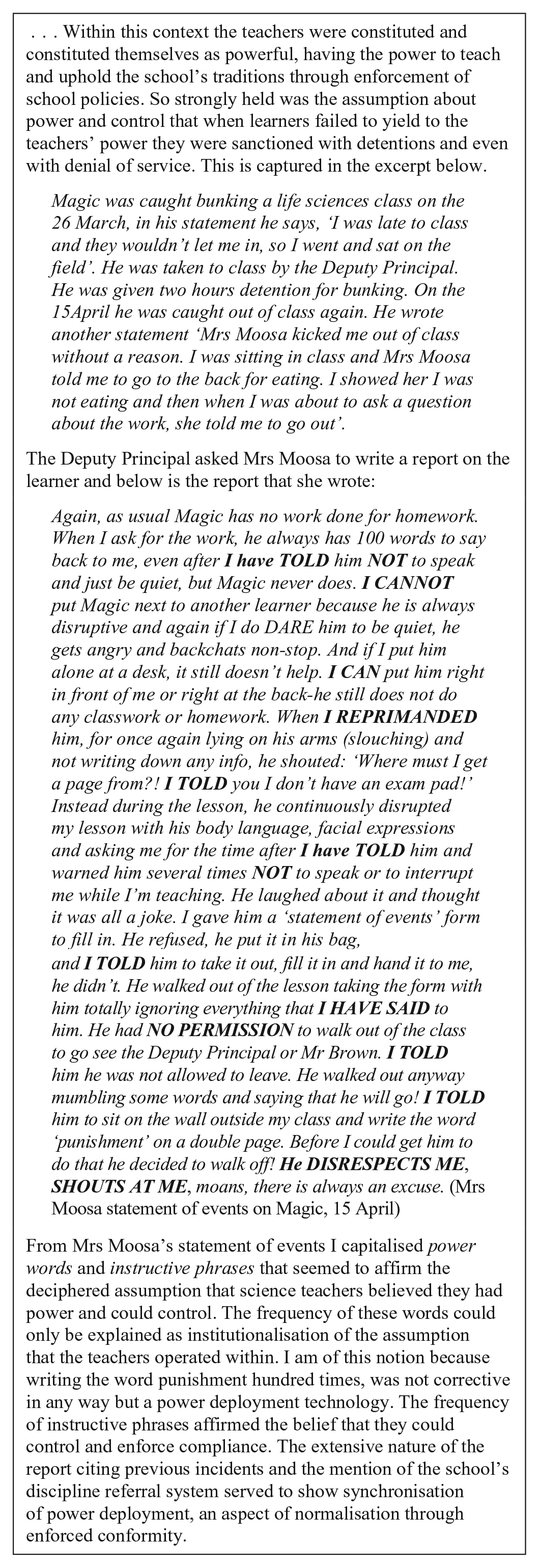
However, addressing research questions is not the end game in RFE as the essence of ethnography is a description of culture and why a certain culture is produced and reproduced. This is the essence of interpretive cultural analysis.
Interpretive cultural analysis
The rationale for interpretive analysis in RFE is bi-pronged. First, ethnographies are not isolates but are embedded in extant reality and theory. Second, interpretive cultural analysis makes findings useful and pragmatic, thus making analytical inferences more important and more empowering than mere empirical generalisations. The belief is that the depth of cultural understanding in RFE is enhanced when the deciphered culture is subsumed on other cultures and interpreted using theory and other empirical studies outcomes. Carspecken and Carspecken (1996) inadvertently argue that it is essential to conclude cultural studies with assessing the fitting or matching of the data-based reconstructions with existing theory. However, it is important to highlight the futility of simply matching findings with broader existing theory, and therefore the effort should be directed at highlighting the reasons for the fit or lack thereof. Thus, implicitly abstractions of the data generated have to be built in ways that generate analytical inferences that apply to the research context and better explain the context and its discourse (Carspecken and Carspecken, 1996).
This stage involves placing output from reconstructive cultural analysis through the crucible of the macro-context epistemes and existing theory. Using existing theory, reconciliation between relationships, reconstructions or interpretations and the context in which the participants live and function is made possible. In this stage, the ethnographer is informed by Geertz’s (1973) concepts of experience-near and experience-distant. The experience-near is what the participants use to define, interpret and readily understand. The experience-distant is what the ethnographer uses to advance their research agenda. The responsibility of the ethnographer is to capture the participants’ experience-near constructs and connect them to established theory in order to construct the architecture of sociocultural reality and make interpretations about sociocultural reality.
Making interpretations about sociocultural reality uses strategies suggested by Bogdan and Biklen (2007). First, published studies are considered for their relevance to research and evaluative potential of the research context. Second, an attempt is made to anticipate the assumptions the audience who are to read the research output would have, and as such, attempts to interpret for them understandings generated need to be made. Despite interpreting and placing this work in existing sociopolitical theory, in RFE the centrality of participants’ voices during this stage remains critical. Thus, during interpretative cultural analysis, participants’ voices are embedded in thick descriptions through direct verbatim citations. This evident presence of participants’ voices enhances the credibility of the ethnography through limiting chances for those who read to question what the participants meant to say.
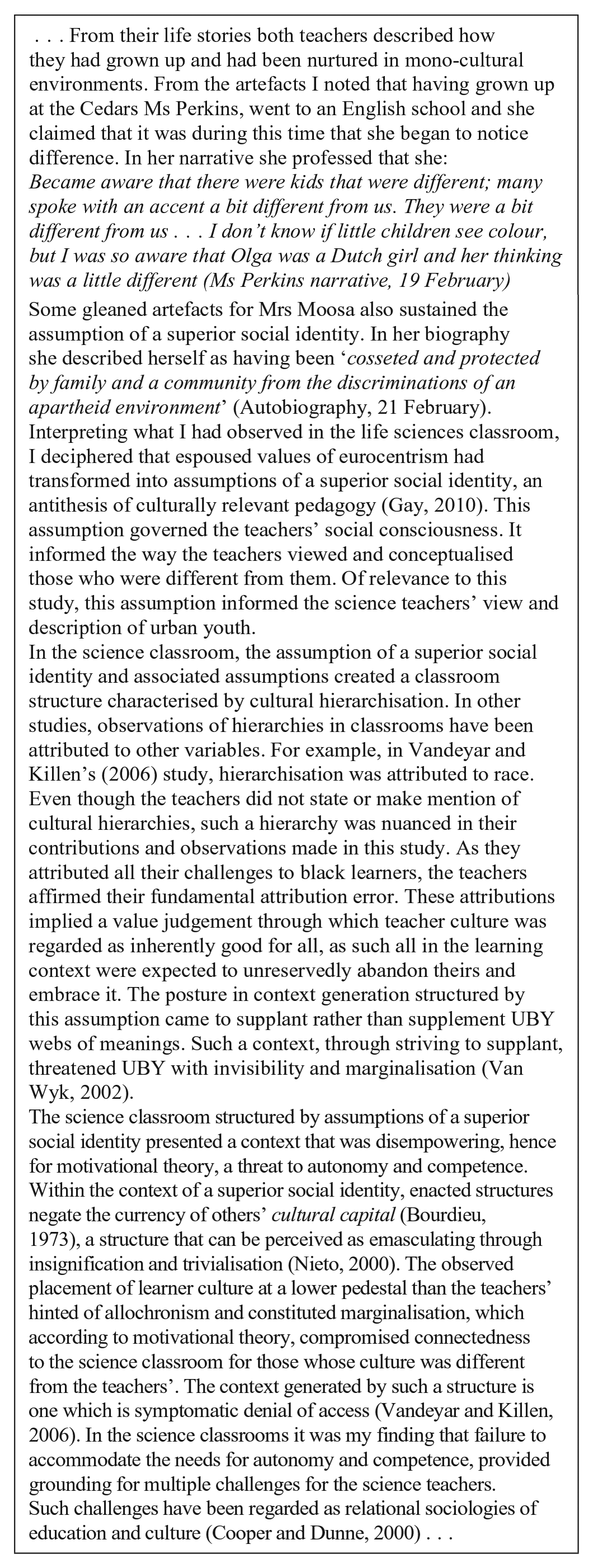
For example, in the study referred in this work, strategies mentioned above were used. First, data-based abstractions were cross-matched with conceptual frameworks, which included motivational theory, culturally responsive pedagogy, Bourdieu’s social theory and Foucault’s notions of power. Second, interpretive cultural analysis was done in the context of contemporary research findings and research expectations. During interpretative cultural analysis, published studies were explored for their relevance to this study and used in analytical interpretation. Finally, despite interpreting and placing this work in existing sociopolitical theory, the centrality of participants’ voices remained central even during this stage through their inclusion as direct verbatim citations. Below is an excerpt of the thick description that captures what is propositioned in the fourth dimension of RFE:
What emerges from the preceding discussion of the fourth dimension is that holistic understanding or verstehen (Schwandt, 2000) is an infallible precondition for deciphering and interpreting meanings imposed by agents on sociocultural contexts. Thus, within interpretative cultural analysis, the ethnographer’s work is reconstructive and uses the produced knowledge about social phenomena for theorisation in order to construct and interpret the architecture of social reality. It is at the end of such an endeavour that ethnography would have responded to the anthropological expectations and sociological questions.
Matters of rigor
For RFE, rigour is premised on factual accuracy, interpretive accuracy and ethnographer positionality declarations. Factual accuracy resonates with notions of trustworthiness or truthfulness of the report. To enhance factual accuracy, an audit trail of the research methodology for each stage of RFE has to be availed. Factual accuracy is also enhanced by the usual methods of triangulation which deploy multiple methods in studying the same phenomenon. Member checking, peer debriefing and data sessions were other strategies aimed at enhancing factual accuracy. In all this, the ethnographer remained open, sensitive to the evolving context and relinquished any ideas that were poorly supported by data regardless of the excitement and potential they seem imbued with.
Interpretive accuracy measures the extent to which a report represents the cultural phenomena in ways that correctly communicates what participants in a culture intend to convey. Schein (2016) suggests two criteria for interpretive accuracy that have utility for RFE. First, if cultural analysis is to be considered credible, an independent observer entering the same organisation should witness the same phenomena. Second, if analysis is trustworthy, one should be able to predict how the organisation or participants would handle future issues. To accommodate the two criteria and satisfy the need for interpretive accuracy, reflexive dialoguing during thematic analysis needs to be invoked. This approach resonates with the idea of communicative rationality under which discursive engagement is encouraged and the best argument is allowed to prevail. The prevailing argument from such a platform has the adequacy to render trustworthiness to interpretations.
Within ethnography, thick descriptions are subjective, hence have been criticised by positivists as tainted by the researchers’ sociohistorical biases and deep-seated assumptions. However, in RFE, this possibility is not problematic because ‘to understand is to understand differently’ (Chowdhury, 2014: 436). The implication of this statement is that it is impossible to interpret objectively due to the dynamic nature of meaning and the transient nature of ethnographer value systems. It is for this reason that interpretive cultural analysis pursues understanding from the subjective experiences of individuals and researchers included. Ethnographer prejudicial distortions are curbed by encouraging positionality declaration through which the ethnographer engages with his biases and prejudices prior to interpretation (Bourdieu, 1973). However, bias is further curtailed by RFE as meaning is cogeneratively and dialogically negotiated; hence, notions of static interpretations are regarded as erroneous. Thus, interpretive cultural analysis remains a mutually reinforcing network and guarantor of credibility, hence rigour.
Conclusion
This work presented a non-context-bound RFE which was developed as a blended methodology for generating anthropological understandings and sociological responses. This endeavour was not out of insular necessity but a search for an alternative lens with a capacity to impact research practice through an accommodation of the anthropological and sociological. This model provides a framework on three fronts. First, it directs research as it bares the areas that need to be excavated. Second, it has implications for methodology. Finally, on data analysis and interpretation, the model proposes a pathway for channelling data to generate meaningful and adequately representative thick descriptions with potential for theoretical advancement.
Footnotes
Declaration of conflicting interests
The author(s) declared no potential conflicts of interest with respect to the research, authorship and/or publication of this article.
Funding
The author(s) received no financial support for the research, authorship and/or publication of this article.

*
Participant names are pseudonyms.