




Abstract
Management theory and practice are characterised by the ‘theory–practice gap’. A way of addressing this divide is to engage in reflective practice, in this instance, a creative auto/biography. This different way of presenting an old issue demonstrates how the original teachings of the management pioneers remain relevant today. The central issues are the purpose of the organisation and the role of both leadership and employees in unlocking human competence in pursuit of organisational performance. The concepts ‘autonomy’ and ‘control’ transpired as crucial, which could easily be misunderstood or misapplied. This personal reflection presents evidence on which to base change, enhancing the well-being of employees, societies and the profit of organisations. This article contributes to knowledge by making inaccessible knowledge, accessible and inclusive, and the expectation that the meaning emanating from this reflection will result in the management audience to reconsider management, advancing management science and benefitting society at large.
Keywords
Act 1: prelude
Management theory, research and practice are often described by the ‘theory–practice divide’, an ongoing debate, despite efforts of evidence-based management as a means to close the gap (Goldman et al., 2015; Knudsen, 2017; Morrell and Learmonth, 2015; Perriton and Hodgson, 2012; Ramsey, 2011; Rynes and Bartunek, 2017; Vermaak and de Caluwé, 2017). However, Pfeffer and Sutton (1999) describe this phenomenon as a ‘knowing–doing’ gap. Practitioners deem theory not actionable (irrelevant), while scholars question the rigour of theories on which management practices rely. In fact, some scholars maintain that a number of managers, contrary to scientific understanding, rely on their personal experience to the exclusion of more systematic knowledge (Parker-Follett, 1970 [1925]; Rousseau, 2006), whether explanation (Sutton and Staw, 1995) or understanding (Weick, 1995). The consequence of such practice is hardship, not only on the part of employees but also for the broader society (Rousseau, 2006) in the form of reduced well-being. This situation is aggravated by the fact that the management discipline is susceptible to fads (du jour; Goldman et al., 2015; Rynes and Bartunek, 2017; Willmott, 2013), a matter which is worsened by the fact that the contemporary management audience does not have access to the original texts of the pioneers, but rather to what is attributed to them by current texts (McMahon and Carr, 1999), which may be a distortion (Gilbreth, 1986 [1914]). Nevertheless, the ‘theory–practice divide’ has been present since the early publications on management (see Owen, 1970 [1825]; Smith, 2010 [1759]) and thus goes further back than what we may recognise or acknowledge. However, regardless of its depth and the degree of entrenchment, this divide can be bridged by engaging in reflective practice (Schön, 1983) by both scholars and practitioners (Tight, 2007), which is a characteristic of professional competence (Mann et al., 2009) and beneficial and essential (Delamont, 2009) for progress.
Reflection is defined in many ways. For the purpose of this article, it is understood to mean a purposeful action aimed at an outcome (which may be unexpected), representing a form of thinking (and feeling). Hence, nothing is taken for granted, but the professional looks deeper than the observation (description) and makes sense of it (analyses it), works meaningfully by reinterpreting the issue from different perspectives or in different contexts and linking the theory to practice (synthesis), resulting in new learning and understanding (evaluation), producing knowledge (Gray, 2007; Kember, 2008; Mann et al., 2009; Moon, 2002; Schön, 1983). It is acknowledged that a range of factors, such as emotion, language, social context, politics, historical setting and the researcher’s standing in society (both personally and professionally) play a role in this process of knowledge production (Alvesson et al., 2008; Mills, 1959; Nkomo, 2015), which is subjective in nature and linked to the identity of the researcher (Farrugia, 2013; Goffman, 1959; Willmott, 2013). Reflection is regularly undertaken as part of research (Willmott, 2013) using several techniques, such as auto/biographies (in its various forms), in creative ways (Alvesson et al., 2008; Daskalaki, 2012; Davidson and Letherby, 2014; Douglas, 2016; Douglas and Carless, 2013; Farrugia, 2013; Kara, 2013; Kirkman and Letherby, 2008) to provide accounts of ourselves (Zussman, 2000) and others (Alvesson et al., 2008).
By auto/biography, I mean, [n]ot simply a shorthand representation of autobiography and/or biography but also [a] recognition of the inter-dependence of the two enterprises. … In writing another’s life we also write or rewrite our own lives; in writing about ourselves we also construct ourselves as somebody different from the person who routinely and unproblematically inhabits and moves through social space and time. (Morgan, 1998: 655)
An auto/biographical approach enables us to reflect on the relationship between the self and the other, and the self and society, and then to show how personal troubles are in fact also public concerns (Mills, 1959), while putting the subjective in the knowledge (Letherby, 2003, 2013), without compromising trustworthiness (Kempster and Stewart, 2010). Moreover, the auto/biography has value as stated by Pelias (2008: 186): [P]erformance itself is a way of knowing. This claim, axiomatic for performers, rests upon a faith in embodiment, in the power of giving voice and physicality to words, in the body as a site of knowledge … it insists upon a working artist who engages in aesthetic performances as a methodological starting point.
Hence, my account is presented in the form of the libretto of an opera based on a true story, where said libretto makes use of the original words used by the pioneers. The structure of my piece adheres to one possible structure of an auto/biographical account, an auto/biographical introduction, followed by my role of interpreting the auto/biographies of others and then some final auto/biographical reflection.
Opera is fitting for this purpose given that it is part of music, and ‘music as mirror’ reflects the greater realities of the society within which the composer, artist and writer live and work (Greenberg, 1997). Opera is a drama, which combines soliloquy, dialogue, scenery, action and (nearly) continuous music, the whole of which is greater than the parts (Greenberg, 1997). The music is subservient to words, as it ensures clear articulation, while the music depicts feelings and emotion (Greenberg, 1997). The libretto (song) also serves as ‘a way to counter silence, while finding a voice of resistance and transcendence’ (Douglas, 2016: 978).
The scene
I find myself at the southern tip of ‘Dark Africa’, by training as a management scientist (PhD), then joining academe 10 years ago after spending 22 years in practice (both public and private sectors). Currently, I fulfil the role of research professor at a higher education institution. My research focus area is strategy, specifically competitive advantage and particularly the role people play in shaping a competitive advantage. Hence, my research theme is shaping competitive advantage by unlocking human capital. ‘Human capital’ refers to the knowledge, skills, attitudes, health and well-being of people who are developed and valued for their economically productive potential. Human capital development can be achieved in a number of ways, namely schooling, on-the-job-training, healthcare and lifestyle (Becker, 1962). Strategy, a complex construct (Ansoff, 1988), is multidimensional (Pettigrew, 1987), multi-levelled (Grant, 2016), drawing on multiple disciplines and the tool organisations use to achieve their goals (Ansoff, 1988; Grant, 2016). To be effective, strategy should be based on competitive advantage (Gunter McGrath, 2013; Porter, 1985), which has been described in various ways. The description is most that it is something the organisation does better than the competition in attracting customers on the basis of economic value offered (Barney, 1991; Peteraf and Barney, 2003; Porter, 1985; Smith, 2003[1776]). Competitive advantage consists of three interrelated dimensions, namely the arena where the firm chooses to compete, customer value and access to resources to provide customer value in the chosen arenas (Nienaber et al., 2002). Of these dimensions, resources, and particularly human resources (HRs), are the most important (Chandler, 1962; Grant, 1996, 2016), above all, unlocking their competence to contribute to organisational goal achievement.
Competence is generally seen as clusters of knowledge, skills and attitudes required for task performance, and being able to function effectively according to certain expectations or standards, which are context-bound, subject to change and to learning and development processes (Hochschild, 1983; Siikaniemi, 2012). However, White (1959) points out that ‘competence’ refers to the desire to master one’s environment and attain valued outcomes within it. Thus, competence encapsulates acquiring and successfully applying knowledge and skill. A number of mechanisms are available to unlock competence, notably talent management and employee engagement. These concepts, however, are not without criticism. Nevertheless, ‘talent management’ refers to the recruitment, development and retention of the right number of staff, at the right time, with the right knowledge, skills, experience and motivation, across occupations and hierarchies, available to implement strategy (Gallardo-Gallardo and Thunnissen, 2016; Krishnan and Scullion, 2017; Nienaber and Sewdass, 2016). However, talent management efforts can be thwarted as a result of voluntary staff turnover. Thus, it has been argued that management, in addition, should pay attention to employee engagement. ‘Employee engagement’ refers to employees’ choice to invest their authentic selves willingly and fully, physically, cognitively and emotionally in their work roles (Kahn, 1990; Saks, 2006), promoting connections to work and others (Kahn, 1990). Employee engagement is influenced by the psychological conditions of meaningfulness, safety and availability (Kahn, 1990), which in turn are influenced by organisational factors (Saks, 2006), such as leadership, trust, job design and competitive advantage (Nienaber, 2017).
It is significant to note that employee engagement surveys worldwide report low levels of employee engagement (Aon, 2017), implying less than optimal organisational performance. These surveys highlight the important role of the direct line manager in the level of employee engagement (Harter, 2015; Nienaber, 2017). I am not the first – nor the last – to grapple with this conundrum. What pains me, however, is the way in which employees are portrayed in some literature, as well as the way in which some organisations treat their employees. A typical top-down management style seems to be prevalent in organisations (see Heyden et al., 2017; Hochschild, 1983; Moore and Grandy, 2017), while some literature typifies employees according to the profile of Theory X (McGregor, 1970 [1966]). I cannot accept this view and commensurate action because it violates peoples’ autonomy, as autonomy is central to my values. Moreover, autonomy is regarded as a basic human right and rooted in moral philosophy (Rachels and Rachels, 2010). Increasingly, it seems that the human aspect in organisations is neglected in favour of the mantra of profit maximisation, contrary to the organisation’s purpose (Goldman et al., 2015; Grant, 2016; Hochschild, 1983; Smith, 2003 [1776]2010 [1759]) and despite organisations’ espoused allegiance to the triple bottom line – balancing profit, people and planet. In addition, some researchers in the management community seem obsessed with recent literature, which means that literature produced over the last 5 years and anything older, including the work of seminal authors, are regarded as outdated. This attitude reinforces the idea of a single truth as proposed by positivist researchers to the exclusion of any other view, doing a disservice to the advancement of management science.
Influenced by the key concepts of existentialism, and specifically Sartre (1993), I subscribe to the notion that we are free to choose what to value and how to live, no matter how oppressed we may be, and we can transcend the burden of our facticity, even though the cost of choice may be high. Further, in choosing values for myself, I choose values for humankind. I choose to be free; hence, I choose freedom (liberty) for every person and every person should respect my freedom as I respect his or her freedom, which is compatible with morality (Moore and Grandy, 2017; Rachels and Rachels, 2010; Smith, 2010 [1759]). ‘Freedom’ is a contentious term and topic and discussed in a range of literatures from philosophy to feminism to psychology, to mention a few. Freedom essentially means autonomy, which is associated with the experience of volition and self-endorsement of one’s behaviour (deCharms, 1976). To be free means that we are autonomous beings, who regulate or govern ourselves, reflecting one’s will, which is fully endorsed by the individual in accordance with the abiding values and interests of the individual (Rachels and Rachels, 2010; Ryan and Deci, 2006; Smith, 2010 [1759]) without violating the freedom of others (Fears, 2011; Nichols, 2008; Rachels and Rachels, 2010; Smith, 2010 [1759]).
Freedom thus means that one has the capacity to be one’s own person, to live one’s life according to reasons and motives that are taken as one’s own and not as the product of manipulative or distorting external forces or fate; thus, freedom means to be our authentic selves (Hochschild, 1983; Mills, 1959; Rachels and Rachels, 2010; Ryan and Deci, 2006; Sartre, 1993; Smith, 2010 [1759]; Willmott, 2013), which is possible to achieve without money or power. The concept ‘authentic selves’, is not uncommon in the social sciences as it is widely researched, especially from a sociology, HRs and psychology perspective. Essentially, autonomy is intrinsically tied to identity and associated with empowerment and equality, allowing each person to become a fully self-actualised being (hooks, 2000; Goffman, 1959; Mills, 1959). Moreover, the management literature, particularly HRs and organisational development, covers studies encouraging management to empower their staff to become their authentic selves.
Identity receives attention in the (general) management literature, but not necessarily explicitly linked to autonomy (see, for example, Alvesson and Willmott, 2002; Aslan, 2017; Daskalaki, 2012; Garrety, 2008; Rothausen et al., 2017; Santuzzi and Waltz, 2016; Willmott, 2013), but most often as social constructions – people’s understanding of themselves relative to the system(s) or society serving as a link between their particular behavioural contexts and the underlying values that give people meaning, which is influenced by their position and treatment in the organisation (Alvesson and Willmott, 2002; Fiol, 1991; Hochschild, 1983).
Be it as it may, as a free person I – just as everyone else – am an active participant in becoming the person I am destined to be, rather than a passive receiver of an imposed identity, whether or not I actively and consciously engage in identity (re-)construction (see Alvesson and Willmott, 2002; Hochschild, 1983). However, I acknowledge that on occasion, we may feel overwhelmed and exhausted by our environment, and the situation may seem hopeless, and hence we may not experience volition and self-endorsement of our behaviour, rather being silenced and marginalised. Worse, we may feel compelled to comply with organisational inflicted values to survive. Compliance is influenced by a number of considerations, including the perceived impossibility of changing or improving the system, difficulty to change jobs and/or the expectation that the new employer will also dominate, the threat of technology displacing employees, occupational disease and family and financial concerns (Ghoshal, 2005; Giorgi et al., 2015; Rothausen et al., 2017; Willmott, 2013). Consequently, we may feel disconnected from our authentic selves for the sake of taking on the organisational imposed identity. Taking on the organisational imposed identity add to pressures because we need to perform ‘emotional labour – the management of feeling to create a publicly observable facial and bodily display, which is sold for a wage’ (Hochschild, 1983: 7). The organisational imposed identity presents problems of identity as the individual may encounter difficulty in distinguishing the real self from the job identity, and doing the job without losing self-esteem. Furthermore, in dealing with the chasm between the real self and the organisational imposed identity results in reduced well-being, specifically stress and burn-out (Hochschild, 1983: 187). This is an old issue, which is still prevailing (Hochschild, 1983).
Interlude
I am standing on stage rather to the side, almost like a spectator, taking in the view, and see the cast come on stage:
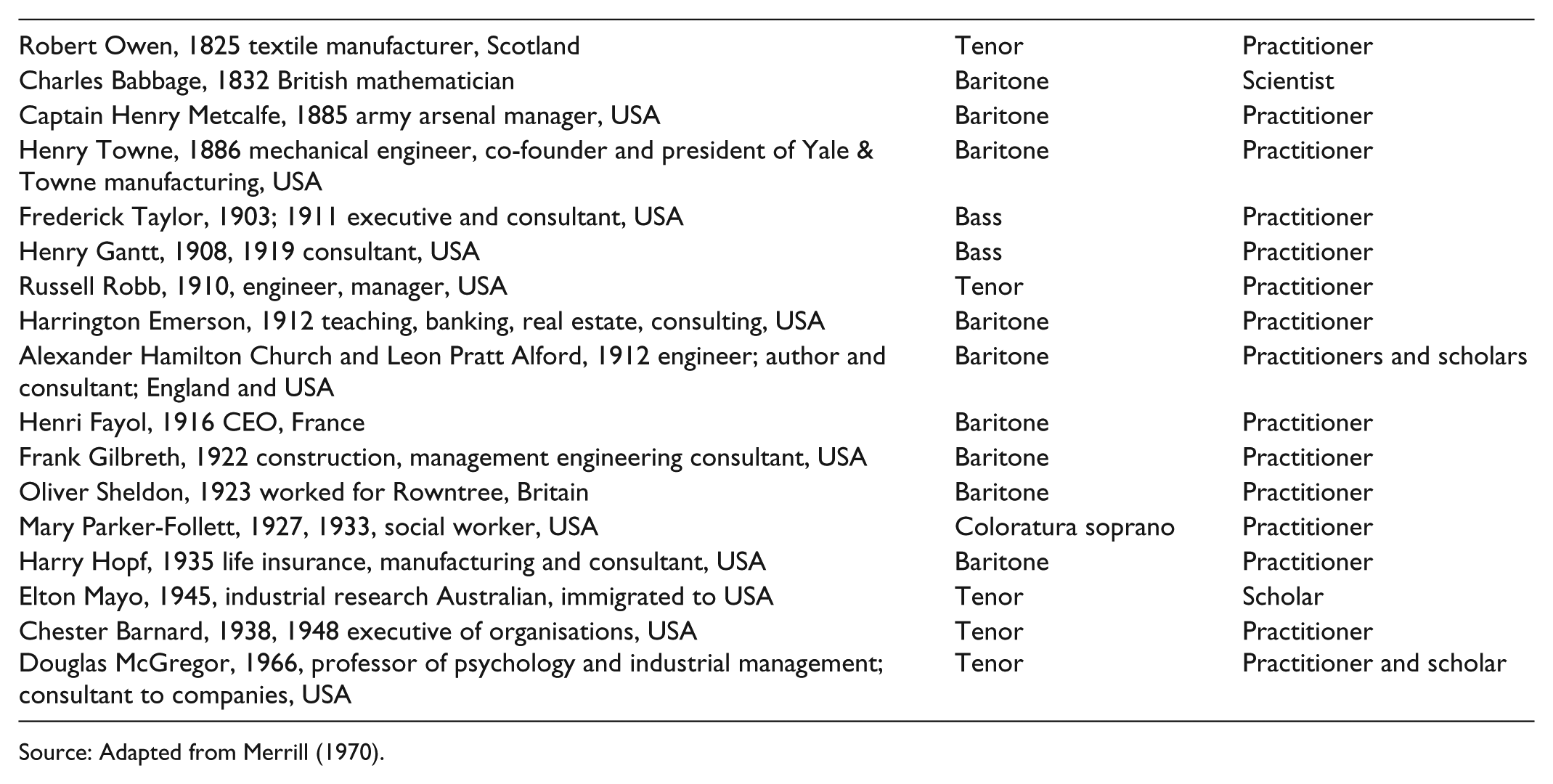
Source: Adapted from Merrill (1970).
The cast are representative of pioneers who dedicated their careers to and influenced the documentation of the body of proven general management knowledge in service of others, although (general) management has been practised for aeons. Moreover, ‘ultimate truth, if there is such a thing, demands the concert of many voices’ (Jung and Newman, 1949). Likewise, what these pioneers said still holds true today – thus their works have stood the test of time, regardless of place where it was documented (Britain, France, Scotland, United States). Managers should be familiar with this body of knowledge, or truth, just like any other professional, for example, lawyers, medical doctors, surgeons or engineers, should be familiar with their particular body of knowledge. In addition, the original works of these pioneers are not readily accessible today and thus pose the same problem to contemporary managers the pioneers faced, that is the impoverishment of management/leadership knowledge.
As an observer of this opera, I first encountered these pioneers more than 30 years ago in my prescribed text books and over the years witnessed their disappearance from prescribed texts. It may thus be that my choice is subjective, but this is my auto/biography and personal interpretation. They wrote at the latter part of the industrial revolution (±1740 to 1840) 1 and at the advent of big business (late 1800s), when mining and manufacturing were the main contributors to gross domestic product (GDP) and thus the primary employers. Occupational disease was mainly lung diseases set-on by mining and manufacturing activities, because people are not designed to work in mines and factories (Agricola (Giorgious Bauer) 1556 in Bridgman, 2002: 81) and exacerbated by tuberculosis.
In rereading the works of these pioneers, I concur with Jung and Neumann (1949): it became clear … how great are the disadvantages of pioneer work: one stumbles through unknown regions … The second generation has the advantage of a clearer, if still incomplete, picture … give a coherent account of the whole field of study, whose full extent the pioneer can only survey at the end of his life’s work.
The aim of this auto/biography is partly to present the works of the selected/chosen pioneers in a coherent whole.
Recitative
Chorus
Organisations are organs of society, with the purpose to promote and serve the interests of society. Organisations give effect to their purpose by delivering products and services needed and wanted by customers and meeting highest standards while providing employment to society members, who take pride in their work, and creating wealth, yes, wealth, which is a broader concept than profit maximisation!
Metcalfe (1970 [1885])
In managing the organisation, my system of cost control will be central to make sure profit – the lifeblood of sustainability – does not suffer. However, I must admit it is ‘part art and part science’ (p. 37), nonetheless, it seeks to study cause and effect. Hence, I beg you, please, do not misconstrue my idea to mean profit first – or even worse, profit only!
Gantt (1970 [1919])
I am dismayed as big businesses disobey – they are corrupt, because ‘they put profit above, service rendered justifies profit’ (p. 123). Hence, I argue for the return to the public service philosophy of business. I reiterate that communities and modern civilisations are dependent on the proper functioning of industrial and business systems. ‘Taking any reward or profit arbitrarily or above the level justly entitled to is to exercise autocratic power, which is a menace to society’ (p.125).
Emerson (1970 [1912])
Agreed, and this is sad, as organisational goals are not supposed to be ‘money mad’ (p.165). The focus is on people – we treat our customers fair and ensure that our products meet the highest standards of excellence. Indeed, profits are also less important than our employees’ ‘wholesome family lives’ (p. 165).
Sheldon (1970 [1923])
Colleagues, I concur, the principle is still the same
Parker-Follett (1970 [1925])
And this, my esteemed colleagues, can be achieved if we progress and admit management is a profession. We will advance to unity and agree on the motive for service. Management as profession rests on a proven body of knowledge, which we should use in service of others rather than one’s own purpose.
Chorus
Profit is important to sustain the organisation but not the definitive goal and certainly not to the detriment of employees’ well-being and, therefore the well-being of society. Thus, in a nutshell, leadership is central.
Act 2: the role of leadership in unlocking human competence
Barnard (1970 [1948])
On the nature of leadership, I can confidently state, it has been the ‘subject of an extraordinary amount of dogmatic nonsense’ (p. 432). So beware, leadership is misunderstood and misinformation abounds. Coupled with the scarcity of leaders, leadership may jeopardise the existence of the organisation to the detriment of society. Let us be clear, leadership is ‘the quality of behaviours of individuals guiding employees and their activities in an organized effort, within a system of cooperation, coupled with property and plant, which are all connected’ (p. 435). Consultation is an asset, as solutions to problems will only be accepted by agreement and understanding, which include the recognition of the problem in the first instance. Without consultation, the problem and/or solution will be that of one man (person), which will not be used and thus be ineffective.
Parker-Follett (1970 [1933])
Leadership is found in every position to ensure that everything goes right – there is no ‘bossing’ (p. 297) of staff, but simply using their knowledge in pursuit of organisational goals. Hence, for leadership to succeed, a thorough knowledge of the job to be done is required. In addition, and even more important, is [t]o grasp the total situation – a picture in its whole rather than the kaleidoscopic fragments of the parts, be it facts of the present and/or the future or the aims and purposes of men [oops, people] from which the leader must find a unifying thread (p. 300).
Do not forget the situation is dynamic, and, therefore, decisions must anticipate future developments, which is more than merely forecasting. The leader must be prepared to be a trailblazer, finding new paths based on his (her) insight and foresight, judgement, courage and faith. Hence, it stands to reason that the higher up in the organisation, the more of this quality ‘grasping the total situation’ (p. 300) is needed, and not ‘pugnacity, self-assertion, compelling personality, imposing his (her) will on others and make them do what he (she) wants done as psychologists claim’ (p. 296).
Rest assured that ‘executive leadership can be learned in part’ (p. 306), but, regrettably, not every person can be successful in this training or position, as is the case with any other profession.
While I have the word, I would like to say, authority should not be mistaken as embedded in a position, but rather springs from the knowledge and skill in applying the knowledge. As a result, the person with the most knowledge and skills about the matter at hand is the authority rather than occupying a hierarchical position.
To continue while I have the floor, in advancing management as profession, we should keep records to benefit from experience. Do not be shy. Write down the failures as well in order to find out what was encountered previously, how it was handled and what the outcome was. In this way, we will prevent repetition of previous mistakes and thus ensure progress. A jolly good idea, as proposed by Towne (1970 [1886]), is to meet at a conference designed to share experiences from across the globe, as record alone may not suffice.
Executives, I plead with you, success demands acquiring new habits and attitudes for which ‘three conditions are required: (i) detailed information about the new method; (ii) the stimulus to adopt the new method; and (iii) the opportunity to practice the new method to ensure it becomes a habit’ (p. 294). This could serve as basis for business policies, which are instrumental in guiding behaviour towards success.
Autobiographer
Leadership is key, especially their behaviour, which reflects self-endorsement, in guiding employees to achieve desired outcomes, such as organisational goals. This requires consultation and, in particular, utilising the knowledge of employees, or plainly said, their authority to pursue organisational goals.
Chorus
Leadership is fundamental in goal achievement by engaging staff.
Barnard (1970 [1948])
So, whatever the position within which the leader finds himself (herself) in the organisation, but especially at the top, he or she needs to act, and this act is lead in terms of ‘determining the purpose of the organization, allocating resources, controlling influences and inspiring coordinated action; considering the conditions of leadership; thinking about the qualities of leadership; developing leaders; and selecting leaders’ (p. 436). These are quite a lot, so I will be brief and to the point.
Determining the purpose of the organisation sets the direction indicated by goals in terms of what to do and what not, and when to stop with due input from those not only at the top but also from the staff. Purpose gives direction and meaning and allows employees to know what gets priority and what not. Thus, purpose is imperative for cooperation, the essence of success. Discretion is required in choosing ideas that will succeed in a particular situation as well as those which will foster and others that will hinder cooperation. To achieve the purpose of the organisation requires the allocation of resources – individual, technical and technological. In sum, the primary efforts of the leader are aimed at directing the enterprise as a whole, that is to ensure cooperation and coordination of actions, which are not obvious and alas not properly understood. Any act that disturbs coordination threatens the organisation. Inspiring coordination simply means that leaders induce people to convert their abilities to performance in a coordinated fashion and thus maintaining the organisation while getting the work done.
As you can imagine, different conditions call for leaders with different characteristics, talents, qualities, capabilities and personalities to ensure behaviour is appropriate to the demands of the specific situation to clinch success. Be warned that an exclusive focus on the leader is insufficient as the qualities of followers and the character of the enterprise are equally important in the success or failure of the enterprise, although these facts are not adequately recognised nor attended to. I will mention just in brief the ‘five qualities of a leader that I deem vital for success, which in order of importance are (i) vitality and endurance, (ii) decisiveness, (iii) persuasiveness, (iv) responsibility and (v) intellectual capacity’ (Barnard, 1970 [1948]: 443). I know the common opinion is vastly different from mine. But I tell you, those opinions are exaggerated and have a false emphasis, which needs correcting. Perhaps one word about responsibility, while we are addressing different views: [R]esponsibility is an emotional condition that gives an individual a sense of acute dissatisfaction because of failure to do what he feels he is morally bound to do or because of doing what he feels is morally bound not to do in a particular situation. (p. 445)
This is tantamount to freedom of will.
To conclude then, I maintain that leadership depends on three complex variables – the individual, the followers and the condition.
Parker-Follett (1970 [1933])
Coincidently, I concur but need to repeat, although the leader makes the team, followers are equally important. Followers are not passive players who thoughtlessly obey, but they are active contributors to success (or failure, perhaps). I cannot emphasise enough the importance of sharing the common purpose and inspiring the employees as if ‘following the invisible leader’ (p. 303), ‘intelligent, alert, active, self-willed obedience to the shared common purpose’ (p. 304). Collaborate and ensure that input is received from followers, be sincere and not aggressive, set the example and teach subordinates to think and make decisions for themselves, rather than to impose the decision on them. Provide them with necessities in order for them to meet their responsibility, which is explicitly defined for them.
Church and Alford (1970 [1912])
Leadership plays an important role in controlling, or as Barnard (1970 [1948]) puts it, ‘organized effort’ (p. 435). In this regard, pay special attention to encouraging your employees, reward them fairly and ensure that they have a definite share of responsibility. This will aid effort, from which all work is born, which cannot escape relationships, be it with co-workers or management.
Sheldon (1970 [1923])
At this stage, I am impelled to put in an oar. We need to differentiate between policy and administration or as you will, years later, call it leadership and management proper. Administration is subordinate to policy. Policy determines the purpose of the business by taking into account the interplay between focus and trends inside and outside of the business and industry, affecting the survival of the enterprise. Management gives effect to policy, and the actions of management also affect the survival of the enterprise. The link between policy and management is coordination of labour as humans are the agents in production, whether by head or hand.
Owen (1970 [1825])
Colleagues, I observe that my notion of the treatment of employees is also reflected in the views of Barnard (1970 [1938], 1970 [1948]), Parker-Follett (1970 [1925], 1970 [1933]), Church and Alford (1970 [1912]), Sheldon (1970 [1923]) and the rest. This theme, as you will see, is intrinsically interwoven with the concept of management and its success.
Chorus
Leaders at the top determine the purpose of the organisation with adequate input from followers. Allocate resources and ensure that each person has a defined share of responsibility. This includes that a person must do what he or she is morally bound to do. Do not forget to encourage your employees adequately, and this includes a fair reward.
Autobiographer
These ideas seem so simple. Yet, they are complex and exacerbated by the dynamic nature of the environment. Which variables should be considered and which not; more important is the implication of the decision. Luckily, all staff can participate according to their talents and by combining their efforts in arriving safely at the future destiny – from plain sailing to assisting in charting the vessel in gusty seas to averting pirate attacks. The question is whether the participants will see their role as getting ahead, getting along and above all to have meaning for them.
Act 3: the role of employees in unlocking human competence
Owen (1970 [1825])
Fellow ‘superintendents of manufacturies’ we are, of course, in business for ‘pecuniary gain’, which can be enhanced by devoting as much attention to our ‘vital machines’ as to our ‘inanimate machines’ (p. 11–12). We schedule regular maintenance for our inanimate machines, as we know they will break down if we do not take proper care of them, and this may be a costly affair. Yet, we do not care as much about our people who are ‘more wonderfully constructed’ (p. 12) as about our machines. People can benefit us far more than machines because they can think and feel, which influence their work. Well, to be precise, their output is affected by the total environment. So, let us consider our fellow subjects in terms of both body and spirit. ‘Treat them with kindness, supply them with wholesome food and other necessities of life, to prevent their bodies to prematurely fall prey to decay’ (p. 13–14). Allow them to work eight hours a day, encourage eight hours’ play to relax and eight hours to sleep to restore them for a new day’s work. For our times, it may sound strange to consider our fellow subjects who are less fortunate than we are. But I promise you, I have tried it myself and I am satisfied with the result. So, what do you have to lose? It seems to me that you can only gain. The different approach, I confess, may be horror-provoking, but the fruits will be sweeter than what you expect.
Babbage (1970 [1832])
In addition, colleagues consider labour division – allow each man (pardon me, person will be more acceptable to the contemporary audience) to specialise.
Metcalfe (1970 [1885])
‘… according to their “gift[s]”’ (p. 37) and bear in mind, ‘their knowledge goes with them, instead of remaining as is it should’ (p. 38).
Towne (1970 [1886])
My dear Metcalfe, do not be concerned, as we can capture knowledge by exchange of experience in an executive conference. You will see, this will also add to reducing labour cost without encroaching on our workmen’s (apologies I mean workers’) earnings.
Taylor (1970 [1903])
Splendid, splendid! My conclusion is ‘as long as our workers are assured of suitable, permanent reward, it will give them more satisfaction and they will be glad to devote all their energies to turning out maximum work possible’ (p. 57). I also contend that it is management’s fault that workers do as little as possible instead of as much as they can. In part, this can be corrected by the scientific selection and development of workers. Yeah, you have heard me right. And now I am portrayed as a maniac who argues for the exploitation of men (workers)! Perhaps because I spoke against management, the witch-hunt is on. But then perhaps, the ‘mental revolution’ (p. 68) that I advocated is more far-reaching than I initially thought; and the audience may not yet be receptive for this event, on account of a poor attitude.
Gantt (1970 [1908])
Taylor is right. We should pay attention to better training methods, as workers must have experience, knowledge and skills. This will benefit cooperation between workers and ‘foreman’ (I think you call this position ‘supervisor’ today or would that perhaps be a ‘team-leader’?). ‘Bosses, be the servants and teachers’ (p. 113) as your people take pleasure and pride in their work – they want to master their learning and serve. However, be careful for autocratic power, as that is a peril to industrial peace, with adverse consequences for the world.
Robb (1970 [1910])
Moreover, people at the top, like Emerson (1970 [1912]) and Parker-Follett (1970 [1933]) said, share the organisation’s purpose with the staff. You will see, once the workers know what and where the organisation is, and where it is headed, and how it fits with the environment, they will be able to make evidence-based decisions, without your permission, in support of your control. Consider the organisation as an organism, work enthusiastically and unselfishly together with regard to the whole result, rather than the immediacy of your own personal part of achievement. May I complete, knowledge of goals, processes, men (eh … people), conditions and principles of organisation and organising can stand you in good stead.
Emerson (1970 [1912])
This is true as ‘aimlessness, vagueness and uncertainty on the part of employees are but an infliction of the aimlessness, vagueness and uncertainty of the employer’ (p. 165).
Chorus
Management is at fault if employees do not perform, as employees take pride in their work. At the heart of performance is the shared common purpose of the enterprise. This is imperative for cooperation, the essence of success. Above all, make sure that employees specialise according to their talents, which will boost their physical, cognitive and emotional health and your profit as well.
Autobiographer
Management create the conditions in which staff can perform. Hence, management must ensure that staff experience their work as meaningful, have autonomy to make decisions that affect their performance and above all give feedback in a participative way that both staff and management can calibrate their efforts aimed at success.
Hopf (1970 [1935])
I am together with Robb (1970 [1910]) and implore you to enable your staff to do a proper job. However, I have to say the work of Taylor (1970 [1903]) and his associates is ‘unfortunate’ (p. 365). To progress, executives at the top, be prepared to delegate authority as this is required for ‘the optimum’, failing which will result in the demise of the enterprise. I hear you cry control, but control misunderstood can cost you your livelihood.
Church and Alford (1970 [1912])
Taylor’s (1970 [1903]) scientific management is nothing but ‘a collection of axioms’ (p. 183), while Emerson’s (1970 [1912]) principles of efficiency ‘will not detain us long’ (p. 185). We have found that economic control of effort and promotion of personal effectiveness can enhance morale. Work smart, not hard; think before you act. Control and coordination of effort go hand in hand, aimed at conservation of both plant and people to prevent consternation. Remuneration is at the heart of well-being, and signals to every employee his or her work is important and they are regarded as valuable in organisational success. Psychological health is not as obvious as physical health, and yet it is as important as physical health – if not more. And let us not forget, mechanical work is not necessarily dulling to the intellect, as the individual is free to choose to act according to circumstances, within the guidelines of the purpose of the enterprise.
Fayol (1970 [1916])
By now it is old news, equity and equality of treatment are important. Equity springs from kindness and justice ensuring harmony at work.
Gilbreth (1970 [1922])
The individual employee is my focus, as his or her productivity depends on attitude, opportunity and physical environment as much as on the use of the correct methods and ideal equipment. In all, these factors could prevent or cause fatigue, with consequences for people, profit and society.
Sheldon (1970 [1923])
Labour is wedded to progress; thus, ensure the economical use of personal and impersonal features. Luckily, we can study machines and systematise, but I am afraid the same cannot be said for people and their relations.
Parker-Follett (1970 [1925])
My dear Sheldon, what a pity that you are unable to see that knowledge of human relations can be systematised. Relationships are far more complex than machines, and thus it is perhaps more important to systematise in order to facilitate learning. In this regard, I would like to point out that ‘the question is not if management has the right to treat subordinates in a particular way, but rather how subordinates will behave in response to the particular treatment’ (p. 284). But this we have heard before from our colleague Taylor (1970 [1903]) – I know he was dismissed and chances are I will also be ignored. Nevertheless, bear in mind, people have a will of their own and they are thinking – you do not want to dominate them to be subservient or act as docile servants
Chorus
Be careful how you apply control as this may really hurt your relationship with your staff.
Autobiographer
Organisational members, from bottom to top, clear your throat, voice your input, do not be deterred if your voice is met with coldness or ignorance, try a different tone or different refrain, try to make yourself heard as you are morally bound to do as your input is vital to assist the top in control for organisational success.
Mayo (1970 [1945])
Colleagues, in listening to your accounts, it seems to me ‘the human aspect in economic theory is woefully neglected, which is quite absurd! No, humanity is not a horde of individuals motivated by self-interest, fighting his or her neighbour for the scare material for survival’ (p. 379). No, they need to feel respected as members and valued for their economic productive potential. Consultation and collaboration are important in finding solutions, especially at the coalface. Who better to consult than the experts in the line of fire! May I warn you, work relations, good and bad, spill over to outside lives affecting family, friends and society, influencing the well-being of humanity. Information sharing is the key – tell the employees the reasons, and accept their decision as self-governing team. Relationships are key, and include understanding their complaints and the grievances that provoke them, rather than accepting some outdated theory still in vogue and acting as a rogue.
McGregor (1970 [1966])
Oh my dear, previous conceptions of man (apologies, I mean people) are inadequate and in many ways simply incorrect. I concur with my colleagues Parker-Follett (1970 [1925], 1970 [1933]), Taylor (1970 [1903], 1970 [1911]) and the rest, that management is to blame for poor behaviour of employees, such as passiveness and resisting organisational change, and bear in mind that ‘force breeds counter-force’ (p. 464). Be reminded, ‘under proper conditions, unimagined resources of creative human energy could become available in organizational settings’ (p. 462). I beseech you reconsider your faulty view of people as they are not: indolent and work as little as possible; lacking in ambition and thus dislike responsibility; nor do they prefer to be led; inherently self-centred, and indifferent to organizational needs; resistant to change and gullible, not bright the ready dupe of the charlatan and the demagogue (p. 463)
– on the contrary.
I must admit, management cannot provide people with self-esteem or respect for other human beings, or with the satisfaction of self-fulfilment. But management is instrumental in creating conditions to encourage and enable people to seek satisfaction of these higher-order needs or frustrate them by failing to create these conditions. People deprived of opportunities to satisfy at work (the needs which are important to them), where they spend a good deal of their time, will behave exactly as predicted then – the exemplar of Theory X, which is reaffirmed in the performance appraisal. Theory X behaviour exposes management as a farce. Hence, I concur with my colleagues who came before me, in particular Parker-Follett (1970 [1925, 1970 (1933]) and Taylor (1970 [1903], 1970 [1911]), who argue, in brief, that management causes the behaviour of the people. Indeed, management can rejoice when employees find meaning in their work, when their capacities are fully utilised and when they accept responsibility and actively participate.
Barnard (1970 [1948])
May it be affirmed, leaders induce people to convert their abilities in a coordinated effort, which most of you have spoken about but which seems like a token.
Autobiographer and Chorus
Management is to blame for apathy as proper conditions can release energy that produces innovation. Innovation incentivises employees to bring and express their authentic selves to the work role, physically, mentally and emotionally and so realising the goals of the enterprise.
Finale
For the sake of rigour, I entered into self-disclosure and declared my subjectivity as observer and participant. I wrestle with unlocking human competence in realising organisational performance, which is essentially attaining organisational goals that are more than mere profit maximisation. We see different views abound; yet, the central theme is unlocking human competence, which is the foundation of competitive advantage, the hallmark of a sound strategy, the tool organisations use to achieve their goals. Although the pioneers did not use the exact words or labels as in contemporary times, the issues appear to be the same – that is, human well-being as opposed to profit maximisation, which was addressed as far back as 1759. Hence, my personal problems are actually public issues as pointed out by Mills (1959). In contemporary times, the popular labels used to identify these issues are talent management and employee engagement. The central issue is having the right number of employees available across occupations and hierarchies with the right competence and prepared to apply their competence in pursuing organisational goals to ensure organisational performance. Moreover, we should consider the idea of mastering, as put forward by White (1959), in addition to knowledge and skills. More important is the question of unlocking competence, ensuring that employees participate willingly and fully in strategy implementation, which is secured by leaderships everywhere in the organisation, allowing employees to use their competence (mastering their environment) to seal both personal and organisational success. My issue is thus an issue with which we, as research community, still wrestle today.
The answer seems obvious and very clear to me – autonomy – as explained earlier in the article. To reiterate, autonomy means that we are free to be the authentic person who we are destined to be as self-actualised beings; abiding by the values and interests we freely choose and endorse, without violating the freedom of others. Autonomy, as described here, is reflected in the works of the management pioneers and consistent with morality and today acknowledged as a basic human right and central to my values. Thus, I cannot comprehend that some practitioners and scholars deem autonomy not actionable or even irrelevant. In this regard, a shared, common, purpose, which is broader than a singular focus on profit maximisation, is key as it gives direction and meaning and allows employees to know what gets priority and what not. Employees are, therefore, free to act:
in accordance with the purpose of the organisation (Ansoff, 1988; Barnard, 1970 [1948); Emerson, 1970 [1912); Gilbreth, 1970 [1922); Grant, 2016; Hopf 1970 [1935]; Metcalfe, 1970 [1885]; Nienaber, 2017; Nienaber and Sewdass, 2016; Parker-Follett, 1970 [1933); Robb, 1970 [1910); Sheldon, 1970 [1923]);
according to their talents (or authority, if you will; Babbage 1970 [1832]; Barnard, 1970 [1938], 1970 [1948]; Barney, 1991; Becker, 1962; Chandler, 1962; Fayol, 1970 [1916]; Gallardo-Gallardo and Thunnissen, 2016; Gantt, 1970 [1908]; Gilbreth, 1970 [1922]; Grant, 1996; Hopf, 1970 [1935]; Kahn, 1990, 1992; Krishnan and Scullion, 2017; Metcalfe, 1970 [1885]; Nienaber and Sewdass, 2016; Parker-Follett, 1970 [1925], 1970 [1933]; Peteraf and Barney, 2003; Porter, 1985; Saks, 2006; White, 1959) and
allotted responsibility (Barnard, 1970 [1948]; Church and Alford, 1970 [1912]; McGregor, 1970 [1966]), guided by organisational policy (Nienaber, 2017; Sheldon, 1970 [1923]).
Hence, employees are afforded the opportunity to turn their potential into performance (Barnard, 1970 [1948]; Becker, 1962; Church and Alford, 1970 [1912]; Emerson, 1970 [1912]; Gallardo-Gallardo and Thunnissen, 2016; Gantt, 1970 [1908]; Harter, 2015; Hopf 1970 [1935]; Kahn, 1990, 1992; McGregor, 1970 [1966]; Mayo, 1970 [1945]; Nienaber, 2017; Parker-Follett, 1970 [1933]; Owen, 1970 [1825]; Robb, 1970 [1910]; Saks, 2006; Taylor, 1970 [1903], 1970 [1911]) which warrants a just reward – whether in terms of position and/or financial reward (Church and Alford, 1970 [1912]; Hochschild, 1983; Moore and Grandy, 2017; Taylor, 1970 [1903], 1970 [1911]; Towne, 1970 [1886]). The basic principle is respect – all human beings are placed on a moral plane, seeking freedom – what you will for yourself, will it for others as well (Alvesson and Willmott, 2002; deCharms, 1976; Fears, 2011; hooks, 2000; Moore and Grandy, 2017; Nichols, 2008; Ryan and Deci, 2006; Sartre, 1993; Smith, 2010 [1759]; Willmott, 2013). Most of the management pioneers were practitioners imbued in humanity and they all, in some form or another, subscribed to autonomy and so do I. They experienced the benefits of autonomy and urged their peers to follow suit – not only to increase their profits but also to encourage their employees to strive for self-actualisation, which in itself will facilitate autonomy (Barnard, 1970 [1948]; deCharms, 1976; Goffman, 1959; Harter, 2015; Hochschild, 1983; hooks, 2000; Kahn, 1990, 1992; McGregor, 1970 [1966]; Mills, 1959; Nienaber, 2017; Parker-Follett, 1970 [1933]; Saks, 2006; Taylor, 1970 [1903], 1970 [1911]). However, then as now, the battle was against autocratic, disrespectful behaviour or plainly bullying or coercion mistaken for assertiveness under the guise of taking control (Barnard, 1970 [1938], 1970 [1948]; Church and Alford, 1970 [1912]; Emerson, 1970 [1912]; Gantt, 1970 [1908]; Heyden et al., 2017; McGregor, 1970 [1966]; Mayo, 1970 [1945]; Moore and Grandy, 2017; Parker-Follett, 1970 [1933]; Robb, 1970 [1910]; Smith, 2010 [1759] Taylor, 1970 [1903]).
Leadership, whatever position they occupy in the hierarchy, sets the example and affects behaviours, which are affected by peoples’ hopes, fears and aspirations (see Alvesson and Willmott, 2002; Barnard, 1970 [1948]; Harter, 2015; Hochschild, 1983; McGregor, 1970 [1966); Nienaber, 2017; Parker-Follett, 1970 [1925], 1970 [1933]; Willmott, 2013). Hence, leadership is ultimately responsible for people’s behaviour – and let us consider the definition of responsibility as put forward by Barnard (1970 [1948]: 445): [A]n emotional condition that gives an individual a sense of acute dissatisfaction because of failure to do what he/she feels he/she is morally bound to do or because of doing what he/she feels is morally bound not to do in a particular situation.
Let us all give voice and do not allow it to be silenced.
Today, we still acknowledge the physical, mental and emotional nature of employees, which are all required to do a job well (Harter, 2015; Kahn, 1990, 1992; McGregor, 1970 [1966]; Nienaber, 2017; Owen, 1970 [1825]; Saks, 2006; Willmott, 2013). Yet, it seems we do not agree how to set the total person in motion to pursue organisational goals (Gallardo-Gallardo and Thunnissen, 2016; Kahn, 1990, 1992; Krishnan and Scullion, 2017; Nienaber, 2017; Nienaber and Sewdass, 2016; Saks, 2006; Willmott, 2013). Like our predecessors, we cannot agree – is it this conception or that, or perhaps neither this nor that? Although identity is central in mobilising the total person, management literature is scarce on addressing this issue directly, whether personal or social (see Alvesson and Willmott, 2002; Fiol, 1991; Willmott, 2013).
Where does this account leave me? My sense is that my research focus is significant and the theme remains relevant, while anchored in the body of knowledge put forward by the management pioneers. Hence, their soliloquy (arias) seems to be the same with hardly any deviation or conflicting ideas. The advantage of this calibration exercise is that employee health, especially psychological health, as a means of human capital development is most pertinent to me as well as to management scholars. This is not the sole responsibility of the individual. They can transcend their facticity (Sartre, 1993) all they want, but they will not be able to escape the effect of their employment fully. Specifically, how they experience their identity – that is, who they are personally and in relation to others – will affect their sense of belonging and consequently their behaviour. Leadership has a role to play in that what they will for themselves, they should also will for their employees. Leadership – if they truly are free – will act in good faith and refrain from bad faith, as the case generally might seem.
The message is, therefore, clear – autonomy is the key, and thus management seems to be a tragedy, which causes hopelessness and despair instead of prosperity for all. In this, I want to conclude that we still need to investigate some themes like authority, command, coordination, cooperation and above all the wicked word ‘control’. In contemporary times, it seems if control is entrenched as hegemony and practised as top-down management in pursuit of profit maximisation (see Moore and Grandy, 2017; Smith, 2010 [1759]; Willmott, 2013). This is contrary to the management pioneers’ view of control – the interplay between management and employees – which aims at organised effort, safeguarding cooperation and collaboration and accomplished by consultation, that is, drawing on the authority (competence) of staff, in pursuit of organisational goals, the crux of organisational success (Babbage, 1970 [1832]; Barnard, 1970 [1938], 1970 [1948]; Church and Alford, 1970 [1912]; Gilbreth, 1970 [1922]; McGregor, 1970 [1966]; Mayo, 1970 [1945]; Owen, 1970 [1825]; Parker-Follett, 1970 [1925], 1970 ([1933]; Robb, 1970 [1910]; Towne, 1970 [1886]). Hence, it can be concluded that the pioneers’ sense of control involved the conversion of employees’ abilities or competence or authority into performance, which of course is influenced by identity – particularly socially imposed. The original account of the management pioneers’ views of control seem to nurture positive relationships between management and employees, whereas the contemporary view of control results in employees’ contempt for managers, even under the ostentatious label ‘leadership’ and reflected in low levels of employee engagement and the worldwide epidemic of occupational stress.
The role of people in organisational success has captivated practitioners and scholars for almost two centuries. Despite all the attention, we generally fail to heed the words of the management pioneers. Imaginably, because their message was lost or just forgotten, because it is old. Perhaps, I am naïve or at worst deluded, to conclude that autonomy is the key to solving management problems. Autonomy, to repeat, means that we are free to be the authentic person who we are destined to be as a self-actualised being; abiding by the values and interests we freely choose and endorse, without violating the freedom of others. Autonomy, as described here, is reflected in the works of the management pioneers and consistent with morality and acknowledged as a basic human right. Nevertheless, autonomy is regularly violated by the organisational imposed identity. Thus, the fact that the answer is simply autonomy does not mean it will be easy to implement. This one can see from the management account dating as far back as 1825 and the philosophical account from 1759. Thus, putting our knowledge into action, as suggested by Pfeffer and Sutton (1999) may thus be easier said than done. Consequently, the knowing–doing gap lamented by scholars (Goldman et al., 2015; Knudsen, 2017; Morrell and Learmonth, 2015; Perriton and Hodgson, 2012; Ramsey, 2011; Rynes and Bartunek, 2017; Vermaak and de Caluwé, 2017) may persist instead of disappear.
This account is my very personal interpretation, and other scholars may come to a different conclusion. It may be possible that some researchers may be lyrical about my opera or at least regarding some of the notes I have registered, but if not, that is fine. I expect controversy as we teach our students about profit and mainly profit and sometimes, by the way, corporate social responsibility. This narrow focus on profit, almost obsessional with this metric, shifts the attention away from the essence of people who would like to participate and be successful, almost to the extent of destroying humanity. This converts people to docile beings. Thus, the managers/leaders delude themselves about the reality of harmonisation. Who would like to be employed by an avaricious organisation? The implication will be that the employee is avaricious too. Not that I am saying we are all equally good and moral in all aspects – yes, we differ, and by combining these differences wisely, we will secure success – for people, profit and planet. It sounds all too easy; however, these concepts are complex and difficult to master and may be accompanied with a fair share of ‘trauma’. I am confident that, if we persist by respecting employees’ autonomy – allowing them to be their authentic selves, instead of being false according to the imitation impelled by the organisation – the vast majority of employees will be actively engaged, occupational disease will recede and profit will flow, and thus give effect to and advance management science – and thus, reduce if not close, the theory–practice or knowing–doing gap.
Footnotes
Compliance with ethical standards
This article is a personal reflection and does not involve human participants or animals.
Declaration of conflicting interests
The author(s) declared no potential conflicts of interest with respect to the research, authorship and/or publication of this article.
Funding
The author(s) received no financial support for the research, authorship and/or publication of this article.
