




Abstract
Documenting patterns of environmental concerns has been a core effort of environmental sociology since the founding of the sub-discipline. Environmental economists, on the other hand, are pre-occupied with the valuation of non-market goods like ecosystems services and environmental policy. In this article, we argue that sociologists should cautiously embrace non-market valuation methods, particularly the contingent valuation method. We provide a motivating empirical example by considering the case of support for a fracking ban among residents of Colorado, USA. Our analysis suggests that Colorado residents’ support for a fracking ban is somewhat contingent upon the costs created by said ban. We then conclude by discussing how sociologists might extend research on non-market valuation with sociological insights.
Introduction
Since the 1970s, sociologists and related scholars have produced an astounding volume of work in the “environmental concern” tradition, documenting public attitudes on a vast range of environmental problems and related policy issues. This literature has clearly shown that public opinion around the environment is driven by a diverse array of factors, such as socio-economic status (e.g. Newman and Fernandes, 2016; Pampel, 2014), gender (McCright, 2010; Palmer, 2003; Strapko et al., 2016), spatial location (e.g. Brehm et al., 2013; Cutler, 2016; Hamilton et al., 2010; Mayer and Smith, 2017), and, perhaps most importantly, worldviews and political identities (e.g. McCright and Dunlap, 2011; Mayer, 2017a). Clearly, there are undeniable “social bases” to how people approach and conceptualize environmental issues (Jones and Dunlap, 1992; Liere and Dunlap, 1980).
Typically, environmental concern is conceptualized as a multi-component construct—an important subcomponent of environmental concern relates to willingness to make personal sacrifices for the sake of the environment (Dunlap and Jones, 2002; Xiao and Dunlap, 2007). More specifically, this component of environmental concern is often operationalized as a behavioral change or endorsement of environmental policy. Thus, sociologists have long been interested in documenting patterns of environmental policy support and understanding the drivers of said support. Indeed, understanding how societies mobilize (or do not mobilize) to emergent risks is a central task of environmental social theory (e.g. Beck, 1992) and policy is a key tool to address emergent environmental risks.
Hence, environmental sociologists have made impressive contributions to our understanding of public willingness to make personal sacrifices in the face of growing environmental problems. Our field has successfully cataloged the diverse individual and contextual factors that contribute to environmental policy support using data from scales ranging from cross-national (e.g. Diekmann and Franzen, 1999; Dunlap and Mertig, 1997; Knight, 2016), national (Hamilton and Saito, 2015; Kennedy et al., 2015) to local and regional (Hamilton and Safford, 2015; Hunter et al., 2010; Olson-Hazboun et al., 2017; White and Hunter, 2009). However, we argue that this literature could be extended by adapting methods for non-market valuation from environmental economics. These techniques facilitate the quantification of willingness-to-pay (WTP) for environmental protection. Using the example of oil and gas policy, we consider support for a fracking ban among Colorado residents. Then, we apply the contingent valuation method (CVM) (Arrow et al., 1993; Boyle, 2017; Lo and Jim, 2015; Mitchell and Carson, 1989) to show that support for a fracking ban wanes if respondents believe they may face higher energy prices. In the next section, we review the literature on non-market valuation and contingent valuation and discuss the context of fracking policy. Then, we proceed with data analysis. Finally, we conclude by suggesting ways that sociologists could extend and improve research on non-market valuation.
Literature review
Non-market valuation
A foundational idea for most of the field of economics is the notion of utility—that is, economists are preoccupied with questions of what people value and what satisfaction they derive from products and services obtained on the market. However, many important goods are not for sale in a traditional market place and have prices that are not set through the market mechanism. This broad class of goods and services is therefore non-market, though this term does not imply that they are of no value to individuals or society. Rather, because non-market goods are not assigned a value via market mechanisms, economists have developed an array of techniques to estimate the value of said goods and services. Non-market goods can include public lands (e.g. Keske and Mayer, 2014; Pate and Loomis, 1997), various ecosystem services (Brown et al., 2007; Lo and Jim, 2015; Loomis et al., 2000; Van Berkel and Verburg, 2014), and policies to promote environmental protection or sustainability (Aldy et al., 2012; Jones et al., 2017; Solomon and Johnson, 2009; Stigka et al., 2014).
There are two broad categories of methods that economists use to assign values to non-market goods. The first, called revealed preferences, leans on data related to actual behavior, such as purchase decisions. These methods are not always feasible to use for non-market goods. Thus, economists have a range of well-established techniques that rely on stated preferences. Broadly, stated preferences are what people report that they would do, typically in terms of purchasing or spending behavior, in a given scenario. One of the dominant stated preference methods is the CVM.
CVM can be traced to Bowen (1943) and Ciriacy-Wantrup (1947). Both were concerned with how to price non-market goods such as landscapes and soil quality. Separately, each advocated for the use of surveys to elicit preferences for public goods—environment goods and natural resources. Federal and state agencies used CVM studies to inform policy in the early 1950s with the rapid increase of tourists to national and state parks.
Modern CVM is a survey-based methodology whose purpose is to quantify the value that a person is willing to pay for an “unpriced,” non-market good (Arrow et al., 1993; Boyle, 2017; Mitchell and Carson, 1989). The aim of a CVM study is to approximate the “price-taking” behavior of consumers in a market for more typical goods, and the “contingent” in “contingent valuation” refers to the style of survey instrument used. Typically, the survey describes a certain situation, a non-market good, and a value for that economic good. If using a representative probability sample, aggregated WTP estimates tell how much total value a particular environmental amenity or ecosystem service might have to the public at large.
Below, we display an example of a CVM question (Keske and Mayer, 2014): As you know, some of the costs of travel often increase. If your share of the total cost of this most recent trip to the recreation area where you were contacted had been $_X_ higher, would you have made this trip to this 14’er?
This focus of this study was WTP for access to Colorado’s most desirable mountain climbing and hiking locations—“14er” is regional term for a 14,000 foot or above mountain. Each respondent is randomly assigned a different value of $X, also referred to as the bid amount. Often, the bid amount is used as a predictor in a regression equation, and the analyst can determine how price changes would shift demand.
There are several long-standing critiques of CVM. Perhaps the strongest critique invokes the problem of “hypothetical bias.” Respondents may overestimate their willingness to pay, possibly because they perceive the situation described in the survey as hypothetical. Respondents may actually pay less if presented with the choice in the “real world” instead of in a survey. Hypothetical bias may also exist when a respondent does not know much about the environmental amenity, ecosystem service, or policy in question or when surveys are poorly designed. In particular, studies which do not encourage the respondent to consider their own budget constraints may cause hypothetical bias. CVM methodologists acknowledge the problem of hypothetical bias and have developed several techniques aimed at mitigating against it—fully reviewing this literature is beyond the scope of this article (Andor et al., 2017; Champ and Bishop, 2001; List, 2001; Murphy et al., 2005). Despite high-profile criticism, an expert blue ribbon commission under the auspices of the NOAA concluded that CVM is a useful method for non-market valuation (Arrow et al., 1993). Many economists have offered endorsements of CVM (Carson et al., 2001; Chambers et al., 1998; Desvousges et al., 2016; Haab et al., 2013, 2016; Loomis et al., 1996).
The CVM approach may seem strange to many sociologists despite the fact that environmental sociologists have long been interested in public support of environmental policy or willingness to sacrifice for environmental protection or conservation.
1
However, Thomas Heberlein, professor emeritus from the Department of Sociology at the University of Wisconsin, published several key papers on non-market valuation in collaboration with environmental economists, mostly in economics journals (e.g. Bishop et al., 1983; Bishop and Heberlein, 1979). Although CVM has not been used extensively by sociologists, research in the environmental concern tradition identifies willingness to pay (or willingness to sacrifice) for environmental quality or environmental protection as a key theoretical construct. Below we list an example question used in Franzen’s (2003) analysis of the International Social Survey Program’s 2003 module: How willing would you be to pay much higher taxes in order to protect the environment?
Pampel and Hunter (2012) used a similar survey question from the General Social Survey in an American Journal of Sociology article: We are faced with many problems in this country, none of which can be solved easily or inexpensively. I’m going to name some of these problems, and for each one I’d like you to tell me whether you think we’re spending too much money on it, too little money, or about the right amount. Are we spending too much, too little, or about the right amount on improving and protecting the environment?
Notably, this type of question does not facilitate the quantification of an actual willingness to pay. The “higher taxes” mentioned have no specific costs associated with them. When respondents hear terms like “too little” or “higher taxes” we do not know what value they subjectively assume these terms describe. That is, some respondents might think that “higher taxes” means a modest increase, while others might assume a large increase. Some respondents might support a small tax increase but not support a large tax increase—that is, respondents likely consider potential costs in their calculus of whether or not to support a particular policy. CVM questions, on the other hand, allow random assignment of a specific dollar figure to the policy in question, thereby avoiding some of the subjective interpretations likely to result from questions like those above.
Our position is not that all environmental sociological studies must consider the cost of non-market goods. Rather, we suggest that by not giving costs or personal sacrifices more careful consideration sociologists may be missing an important predictor of policy support or behavioral change. To some degree, many sociological analyses in the environmental concern tradition (including those written by the authors) may suffer from their own type of hypothetical bias in that respondents may subjectively assign a value to undefined economic changes. In the next section, we describe the context of oil and gas drilling, focusing on Colorado (the site of our research) and explain how we used CVM to understand how respondents make trade-offs between economic costs and non-market environmental benefits.
Fracking
Starting in the mid-2000s, a series of technological advancements—hydraulic fracturing, directional drilling, and underground mapping—converged to facilitate a boom in domestic, onshore production of oil and gas in the United States. From 2005 to 2015, natural gas production increased by 30% (USDA ERS 2016). By 2013, 15.3 million Americans lived or had lived within 1 mile of an oil or gas well drilled since 2000 (Gold and McGinty, 2013). Colorado, the site of our research, is home to some 55,000 active oil and gas wells and has experienced a marked increase in oil and gas production since the mid-2000s, primarily due to unconventional technologies like fracking coupled with underground mapping and directional drilling.
Within Colorado, oil and gas drilling often occur within close proximity to residential neighborhoods. Residents report problems like dust and noise, while also voicing concerns about water and air pollution (Jacquet, 2012; Jacquet and Stedman, 2013; Ladd, 2013; Schafft et al., 2013)—Blair et al. (2018) find that decibel levels near drilling sites are loud enough to impact health. There are other indications that oil and gas drilling harm public health, with children and infants especially vulnerable (e.g. Helm et al., 2017; Hill, 2014; McKenzie et al., 2012, 2014, 2017). Some of the health and quality of life impacts associated with unconventional oil and gas drilling are caused by the sudden influx of transient, young male workers. These impacts vary in intensity, but can include increased crime (James and Smith, 2017), sexually transmitted diseases (Deziel et al., 2018; Komarek and Cseh, 2017), increased stress and loss of psychological well-being (Fisher et al., 2017; Hirsch et al., 2018), and a general loss of sense of control (Malin, 2014; Perry, 2012). Overall, the well-being and quality of life implications of unconventional oil and gas development for host communities is not comprehensively understood (Mayer, 2017b). Natural gas might act as a “bridge fuel” to renewable energy sources as coal is phased out, but these greenhouse gas benefits might be blunted by methane leakage (Howarth, 2014; Howarth et al., 2011; Stephenson et al., 2012).
Yet fracking has also contributed to job growth, economic development, household incomes, tax revenue, and lower energy costs (Munasib and Rickman, 2015; Newell and Raimi, 2018a, 2018b; Weber, 2012) though the magnitude of these effects range from null to modest across time and community contexts (Hastings et al., 2017; Paredes et al., 2015). Furthermore, abundant unconventional fuels have likely driven down energy costs for households and businesses—environmental activist and analyst Michael Shellenberger (Sinding and Shellenberger, 2013) claims that the job creation, tax revenue, and lower energy costs generated by the unconventional oil and gas boom was akin to a “second stimulus” for the US economy during the 2007 and 2008 economic downturn. Although oil and gas drilling likely provides some economic benefits to host communities and the broader economy, it will probably not reduce rural poverty nor halt human capital flight from non-amenity rural places (Mayer et al., 2017, 2018).
Given that fracking commences in close proximity to communities, it is not surprising that the widespread diffusion of fracking has caused significant public controversies. Several states have passed outright bans on hydraulic fracturing while still others have actively encouraged drilling (Minor, 2014; Warner and Shapiro, 2013). Some cities—such as Dallas, TX—have used local zoning regulations to restrict the location of development (Fry et al., 2015). Within Colorado, several small cities have implemented bans or moratoria on fracking within city limits (Ryder, 2017). However, the state government and the oil and gas industry have pursued legal action against cities seeking to limit drilling—the state’s position is that it should have primary regulatory authority over oil and gas development (Davis, 2014; Enockson, 2014). However, state regulators may lack the capacity to oversee the oil and gas industry (Opsal and Shelley, 2014). Another policy option for local communities are memorandum of understanding (MOUs) between specific oil and gas firms and local governments (Shaffer et al., 2017; Zilliox and Smith, 2016, 2017)—these agreements have not been widely adopted and may suffer from implementation problems. Perhaps because of perceptions that existing regulations are inadequate, prior surveys have revealed that a sizable minority of Coloradoans endorse a statewide ban on fracking (Denver Post, 2013).
Currently, state regulators do not track what wells use conventional versus unconventional technologies to produce oil and gas. However, given that these technologies spurred the boom in oil and gas production, it is likely that banning fracking could result in significant economic costs (in addition to many potential environmental benefits). In the section that follows, we describe how we applied CVM to understand public support for a fracking ban among Coloradoans. In this context, CVM is particularly useful because it allows us to capture the trade-off between environmental protection and economic considerations like energy costs.
Data, measures, and methods
Data collection and sample
Data collection occurred via a random digit dial telephone survey of Colorado residents in the latter half of 2014. The purpose of the survey was to characterize public opinion around oil and gas development in Colorado, with an emphasis on ongoing policy controversies. Because oil and gas drilling is concentrated in rural portions of Colorado, we over-sampled from rural counties with extensive oil and gas activity. To avoid coverage bias, the sample included both cell phones and landlines. We administered the survey in both English and Spanish, though some 98% of respondents completed the survey in English. A team of undergraduate research assistants enrolled at a large, public university in the Mountain West region collected the data. Before data collection, senior staff trained the research assistants in data collection protocols. We exhaustively pre-tested the instrument using a convenience sample of 60 adult Colorado residents—we made significant revisions to the instrument after cognitive pre-testing.
The final response rate was 9% using the most conservative response rate formula (AAPOR RR1)—similar research has produced roughly the same response rate (e.g. Pew, 2014). Using AAPOR RR6, which assumes that cases of no contact are ineligible, the response rate was 14%. 2 We ask that the reader bears in mind that response rates and data quality are two distinct issues—survey methodologists have demonstrated that there is little to no relationship between response rates and the quality of a survey dataset (Groves, 2006; Keeter et al., 2006; Rosen et al., 2014; Wagner, 2012). The completion rate was 95% and the typical time to completion was 13 minutes.
Our analysis occurs in three steps. First, we provide a descriptive analysis of our outcome variables. Second, we build a binary logistic regression model to understand the factors that predict general support for a fracking ban. Finally, we conduct an exploratory, correlational analysis to understand what factors are associated with switching support for the ban once costs are introduced.
Dependent variable
For our dependent variable, respondents were asked if they supported a 3-year, temporary statewide ban on fracking so that more research can be conducted on its environmental or health impacts: Another policy that has been suggested is a 3-year temporary, statewide ban on fracking so that more research can be conducted on its potential environmental or health impacts. Do you strongly support, support, oppose or strongly oppose a temporary, statewide ban on fracking?
As shown in Figure 1, about 16.4% of respondents indicated “strongly support” and 22.1% stated that they support the policy. Respondents who answered “support” or “strongly support” to this first question were then asked a follow-up: Some argue that a statewide ban on fracking would reduce the supply of oil and gas, which could lead to higher monthly utility or energy bills. Thinking about your household finances, would you still support a fracking ban if your household utility and energy bills increased by $X amount per month?
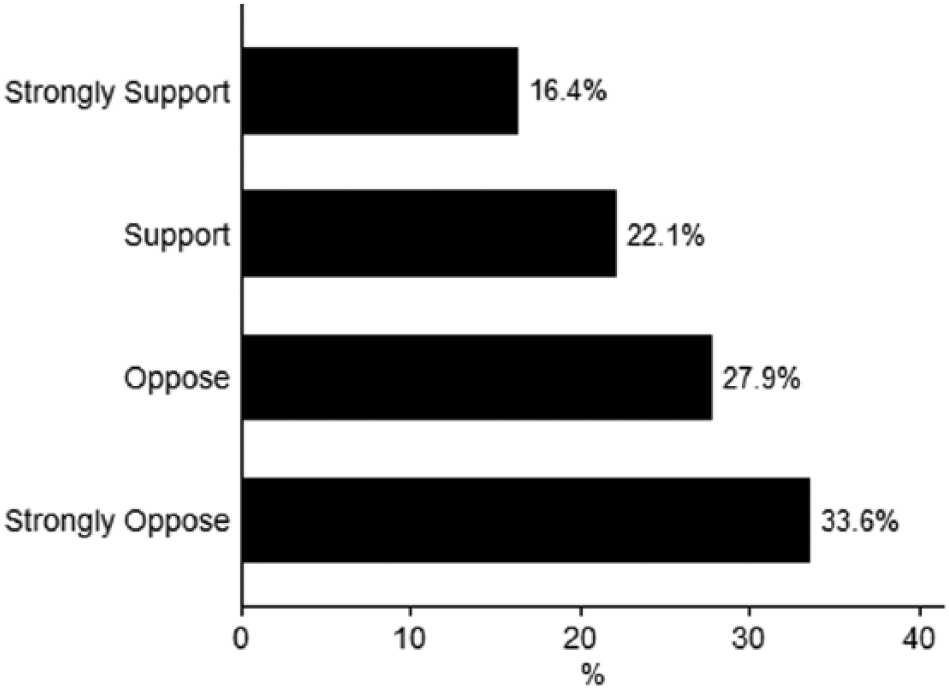
Support for a temporary fracking ban.
The $X represents a randomly assigned dollar value (also known as a bid amount) that ranged from US$2 to US$160. About 73% of respondents answered “yes” to this question, indicating that they would support a temporary fracking ban even if it raised costs for their household while the remainder switched from some degree of support to non-support. In Figure 2, we visualize the cross-tabulation between these two questions.
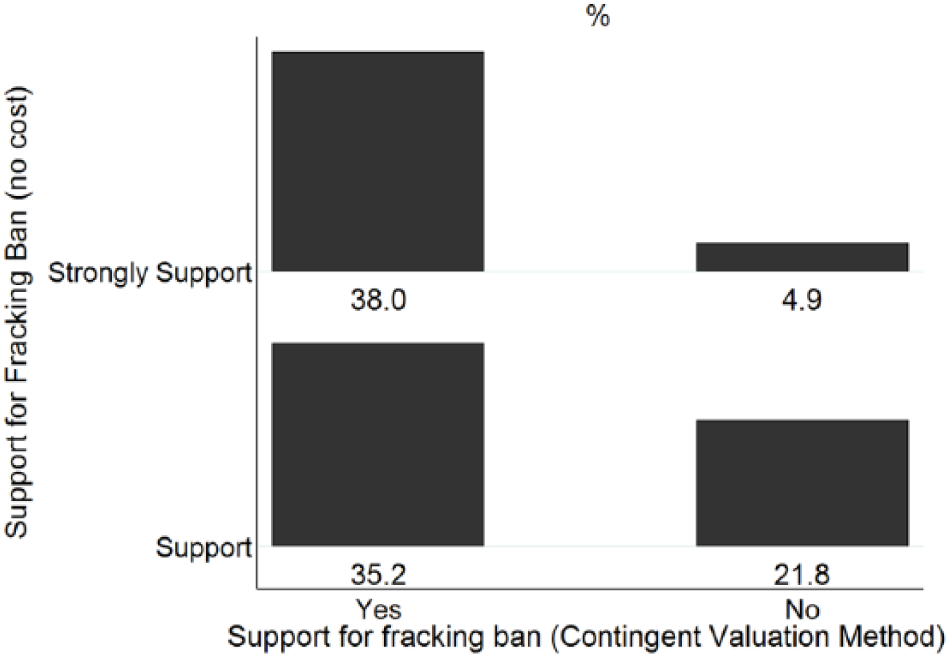
Cross-tabulation of support for a fracking ban with no cost and support for a fracking ban using CVM.
Predictor variables
We include a range of predictor variables informed by the prior research on environmental policy and unconventional oil and gas drilling more specifically. These include socio-demographic factors like income and education (both measured on ordinal scales) and a binary indicator of political affiliation (0 = not conservative, 1 = conservative). We also asked respondents about a range of possible risk and benefits from oil and gas development—these items were combined into a risk perception scale (Cronbach’s alpha = 0.94) and a benefit perception scale (Cronbach’s alpha = 0.89). 3 Both scales range from 0 to 3 where low scores are associated with lower risk or benefit perceptions.
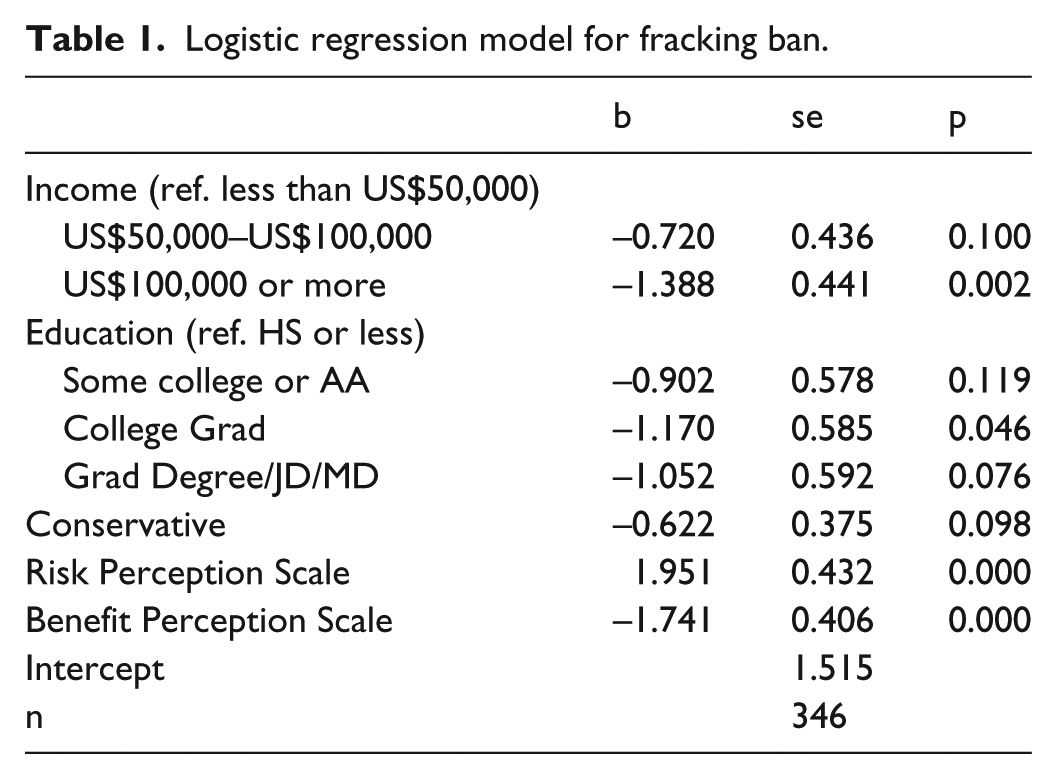
Logistic regression model for support
We recoded our original four-category indicator of support for a fracking ban into a two-category variable (0 = does not support, 1 = supports) for the purposes of our logistic regression model. Table 1 provides the results of this model, but given the notorious challenges in directly interpreting log-odds coefficients, we provide average marginal effects (AMEs) in Figure 3. Somewhat surprisingly, conservative political identity did not reach statistical significance (p = 0.98) and income and education had largely mixed effects. Individuals in the highest income group (about US$100,000) were less likely to support a fracking ban when compared to those in the lowest income group (below US$50,000). Benefit perceptions reduced support, such that a one-unit increase on the benefit perception scale is associated with a 20% lower probability of support for a fracking ban. Risk perceptions, on the other hand, increased support for a fracking ban—the AME for this variable suggests that a one-unit increase in risk perceptions is associated with a 23% increase in the probability of support.
Logistic regression model for fracking ban.
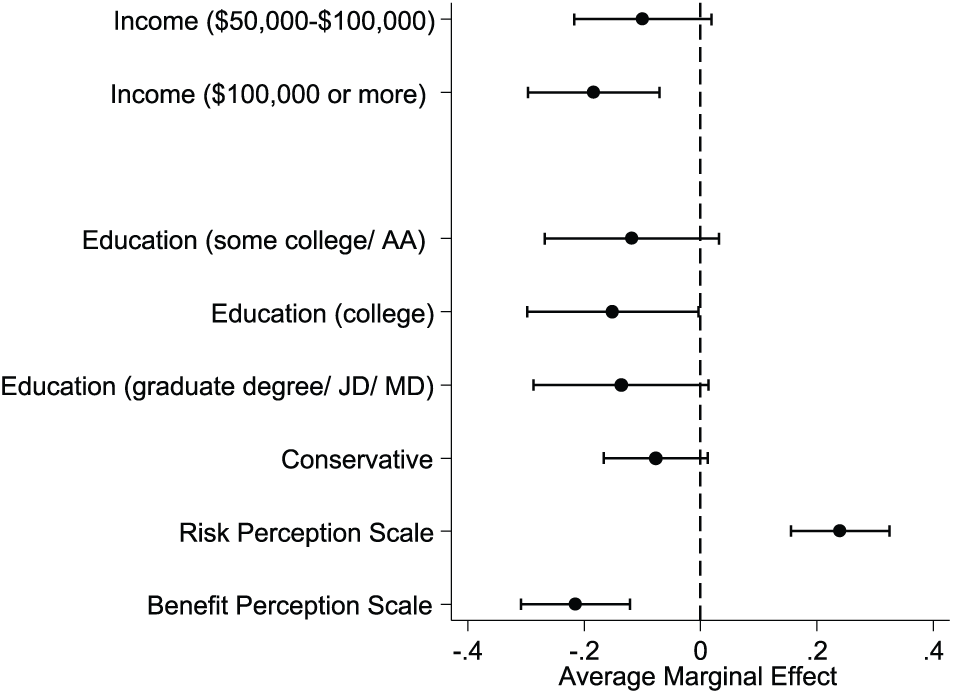
Average marginal effects, fracking ban model.
Correlates of support reversal
For the final stage of our analysis, we rely on the follow-up question shown above, where respondents were asked if they would maintain their support for a fracking ban even if costs were to rise (0 = yes, the respondent still supports a fracking ban, 1 = the respondent does not support a fracking ban when costs are introduced). As noted above, the bid amount ranged from US$2 to US$160. For this stage of the analysis, we opt for correlations instead of multiple regression methods, primarily because our purpose is exploratory and our sample size is limited. In Table 2, we estimated polychoric correlations because our variables are either categorical or continuous (Jöreskog, 1994; Poon and Lee, 1987).
Bivariate polychoric correlations between predictors and support for fracking ban using contingent valuation.
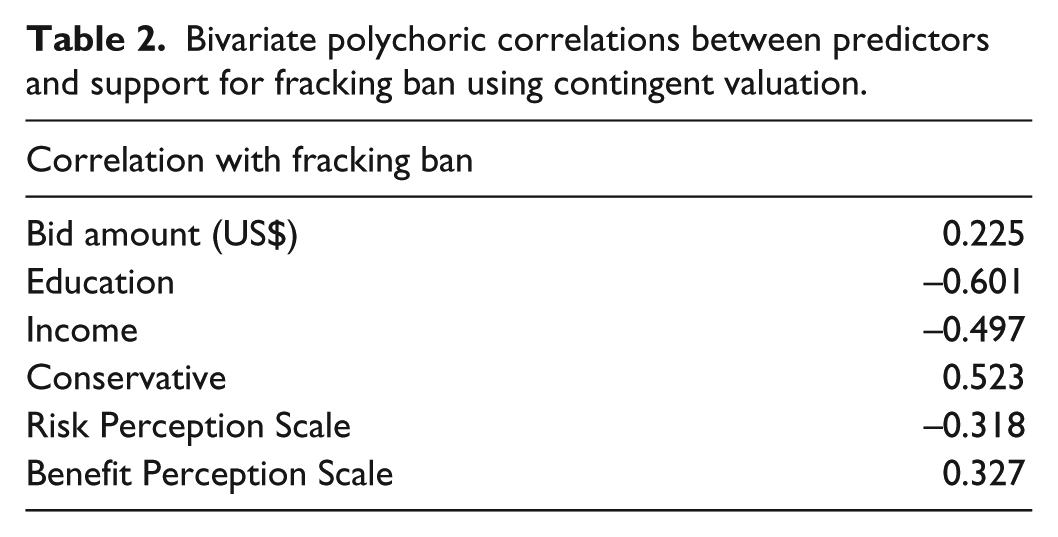
Table 2 reveals that the cost attached to a fracking ban, in terms of increased energy prices, does seem to drive some respondents to switch their answer, though the correlation is relatively modest (rho = 0.225). In other words, some respondents reverse their support for a fracking ban if they are told it will cost their household and this support reversal is more likely at higher costs. Persons who are more educated and those with higher income are less likely to switch their support, while those adhering to a conservative political identity are more apt to reverse their support. Furthermore, the negative correlation for risk perceptions suggests that risk perceptions tend to solidify endorsement of a fracking ban in the face of increased costs. Benefit perceptions, on the other hand, are positively correlated with support reversal, indicating that respondents who believe that fracking provides a range of benefits are more apt to change their support for a fracking ban if costs are introduced.
Discussion and conclusion
The purpose of this article was twofold. First, our primary aim is to introduce sociologists—particularly those working on environmental issues—to non-market valuation techniques borrowed from economics. In doing so, we hope that this article can encourage innovative research that advances our understanding of how and why people come to endorse environmental protection. Second, we provided an empirical analysis of a controversial public policy issue—a fracking ban in Colorado—and explained how the CVM could be blended with more traditional sociological methodologies. In this section, we situate our empirical findings in the broader literature. We acknowledge that this study is merely an initial foray into blending CVM into sociological analyses and provide some suggestions for future research.
First, our results suggest that cost is indeed consequential for whether respondents support environmental protection. Some 38% of respondents had some degree of support for a fracking ban, but about 27% switched their support once a cost was attached. However, the degree of correlation between the cost ascribed to a fracking ban and switching support for the ban was relatively modest. Indeed, socio-demographic, political, and attitudinal factors like risk and benefits perceptions were all more strongly associated with reversing support for a fracking ban. This suggests that costs are important but are only one factor among many that predict policy preferences.
Although we argue that CVM could improve sociological analyses, we also believe that sociological insights could improve CVM. For the most part, the bulk of CVM research in economics has neglected to considered personal attributes of individuals other than their income or related economic variables (e.g. travel costs). A niche group of CVM studies have included theoretical ideas from environmental psychology like value orientations (e.g. Spash, 1997, 2000). Rarer still are studies that include variables like race, gender, or political identity—variables that are central to many sociological analyses. Two notable exceptions are Aldy et al. (2012) and Kotchen et al. (2013). Both studies concern climate change policy and find that age, gender, and, most importantly, political ideology have statistically and substantively significant impacts on WTP. However, the use of socio-demographic predictors, value orientations, or political identity in CVM studies is overall quite rare. We suggest that sociologists could extend the non-market valuation literature by more carefully attending to how social identities, ideological factors, and value orientations predict willingness to pay. Furthermore, it is possible that different social or ideological groups may rely on different judgment criteria and, hence, the cost of a non-market policy (reflected in the bid amount) might interact with socio-demographic, ideological, or other variables. To date, this possibility appears little explored in the literature.
Another fruitful area of cross-fertilization between sociological studies of environmental concern and economic studies of willingness to pay relates to the broader social context where attitudes and preferences are formed. Environmental sociologists have increasingly recognized the importance of considering contextual-level factors (e.g. economic conditions, national or regional culture) that may or may not give rise to individuals’ policy preferences or environmental viewpoints. Hamilton et al. (2010) refer to this as the “emplacement” of environmental views—the authors find that residents of Western regions of the United States are more likely to support conservation of natural resources, net of individual-level factors like socio-demographics and political affiliation. In a similar vein, Carolan and Stuart (2014) called for social scientists to give more consideration to external, bio-physical factors.
Several studies demonstrate the importance of contextual variables. For instance, a core debate among the “global environmental concern” literature hinges on the relationship between national-level macro-economic conditions and the environmental views (e.g. risk perceptions, policy support) of individuals nested within those countries (e.g. Dunlap and York, 2008; Franzen, 2003; Franzen and Vogl, 2013; Mayer and Smith, 2017). Other studies have examined the link between temperature anomalies and beliefs about climate change (Cutler, 2016; Hamilton and Stampone, 2013; Marquart-Pyatt et al., 2014).
Our review suggests that this approach has not been applied to CVM at all—a key oversight in the existing literature as many sociological analyses suggest that contextual variables are important. The international studies cited above show that economic variables measured at a unit larger than the individual influences environmental concern, though the direction and magnitude of these effects is disputed (Fairbrother, 2013; Mayer and Smith, 2017). By extension, it is possible that economic contextual variables may influence WTP for natural amenities, ecosystem services, or environmental policies. In addition, contextual environmental variables may influence WTP. For example, Park and Vedlitz (2013) find that persons living in a coastal county are more likely to engage in pro-climate behaviors, possibly because coastal regions are most vulnerable to sea-level rise induced by climate change. Perhaps persons with more contextual vulnerability to an environmental or technological hazard have greater willingness to pay for protection, but this relationship has not been examined using CVM. Marrying economists’ focus on willingness to pay and non-market valuation with sociologists’ interest in social and ecological context could provide an innovative avenue for new research. In the future, sociologists could ask how local economic conditions, such as the rate of unemployment or the presence of fossil fuel industries, influence willingness to pay. Furthermore, sociologists may also be interested in how local, regional, or even national culture shape willingness to pay for environmental regulation, clean energy, or climate policy. Cross-cultural, contextual studies could be a valuable contribution to the CVM literature.
We have argued that sociologists should consider embracing non-market valuation and related methodologies like contingent valuation. Furthermore, we have shown that, in terms of support for a fracking ban, respondents are somewhat sensitive to price and some will reverse their support if told that a fracking ban will raise energy prices for their household. Does the analysis and argument presented here imply that all sociologists should use valuation methods? There are several reasons why sociologists should be cautious.
First, CVM surveys have a unique design. The CVM question or questions are typically the centerpiece of the survey instrument—CVM may not be appropriate for large-scale, generalist studies like the General Social Survey or International Social Survey Program nor can CVM provide a simple snapshot of public opinion. CVM studies often center on complex issues and require that researchers devote significant time providing the respondents with information pertinent to the issue at hand. Thus, CVM may limit researcher’s ability to ask other questions in a survey simply because CVM questions are complex and tend to require a great deal of space. Compared to more widely adopted survey methods, CVM is likely to induce respondent fatigue that might lead to lower completion rates. More practically, few secondary data sources include CVM questions. Sociologists interested in employing CVM will have to procure funding to conduct a survey, a task that is surely to become more difficult as social science funding is under attack by many political leaders.
A second critique of CVM is more theoretical. Some might view CVM as a symptom of a larger movement toward neoliberalized governance—particularly for the environment. That is, one might argue that by pricing non-market goods we are implicitly devaluing said goods, that researchers are contributing to a broader societal process of neoliberalization by implying that everything, including the environment, has a price. While we share some sympathies with these critiques, we also question whether non-market valuation necessarily leads to a cheapening of non-market goods. For instance, Fourcade (2011) conducted an exhaustive comparative case study of the policy response to significant oil spills along coastal France and the coastal United States (the infamous Exxon Valdez spill). French officials did not make extensive use of non-market valuation techniques, while such techniques were at the forefront of the United States’ punitive actions against Exxon. Fourcade argues that the United States was much more punitive because valuation methods, at least from a Durkheimian perspective, renders sacred non-market goods as worthy of special protection because they are so highly valued. Furthermore, economic sociologists have long explored processes of “commensuration”—a term used to describe an unfolding historical process whereby societies increasingly turn to money as a common metric of value (Espeland and Stevens, 1998; Peeters et al., 2014). Perhaps CVM and related methods could bring greater empirical richness to this robust theoretical area and be used to answer Michele Lamont’s call for a sociology of valuation (Lamont, 2012).
We hope that this article will encourage more sociologists to consider using non-market valuation methods in their research. Opportunities abound to expand foundational areas of sociological inquiry with non-market valuation methods. In addition, we believe that sociologists can make important extensions to non-market valuation by re-purposing methods like CVM.
Footnotes
Acknowledgements
The authors thank the Rural Sociological Society and The Institute for Learning and Teaching at Colorado State University for generous support.
Declaration of conflicting interests
The author(s) declared no potential conflicts of interest with respect to the research, authorship, and/or publication of this article.
Funding
The author(s) received no financial support for the research, authorship, and/or publication of this article.