




Abstract
Intuitively, groups of people, be it a business, sporting club, or international corporation are recognized by a particular flavor of consciousness. Broadly described as organizational culture, this article presents a methodology to systematically enter and explore organizational consciousness described by Helen Russ as the organizational lexion. Drawn from idealist philosophy, particularly Plato’s Theory of Forms, metaphysical mapping is a systematic subjective technique to map consciousness, described by Plato as intelligible realms. Plato uses the Allegory of the Cave and the Analogy of the Divided Line to explain the difference between the visible and the intelligible. This article presents a method to systematically enter and explore that which is intelligible within an organizational context. Case studies in Ireland, Australia, and the United States are the contexts. The methodology is significant because it provides a subjective, systematic, repeatable process to map and, therefore critique, the consciousness of groups. Organizations largely run on “vibes” on subtle feelings and beliefs. This method allows mappers to enter this field of perception and experience the pathways, behavior, and systems of the lexion from the inside. A plethora of qualitative and quantitative techniques explore organizational behavior and culture. These techniques use participant observation, surveys, and metaphor to explore what can be known through conceptual, analytical, or descriptive mental processes. Edgar Schein argues that (1) artifacts and behaviors, (2) espoused values, and (3) shared basic assumptions are categories for understanding culture. There are, to date, no techniques recognized academically that actively engage with Noetic realms, beyond the levels described by Schein. Metaphysical mapping provides material to critique, discuss, and actively work with organizational consciousness. While it has significant implications for organizational integrity and design, here it is presented as an additional qualitative tool for understanding the lexion or “meta” organization within a mixed methods framework.
Introduction
The management of organizational culture, while extensively studied, remains one of the most challenging components of work in business, community, and corporate life (Bodley, 1994; Geertz, 1973; Hofstede, 1983; Kroeber and Kluckhohn, 1963; Schein, 1984). The complexity of the subject is often approached by gaining multiple perspectives through a mixed-method framework (Hayes et al., 2016; Turner et al., 2015). Cameron and Ettington (1988) suggest the main investigative tools are studies using participate observation, metaphorical language, and quantitative research or surveys (p.16), each of which is grounded in a standpoint that is conceptual, analytical, or descriptive. There are no current methods that explore organizational culture from an experiential or Noetic standpoint, that allow researchers to enter the field of consciousness associated with the organization, that systematically map the component of organizations that is beyond the level of opinion, and that places what we describe as culture within a cosmological context. This research presents a method to address this.
Resting on an idealist philosophy suggested by Plato in the Theory of Forms, the Allegory of the Cave and the Analogy of the Divided line, this article provides a methodology to experientially explore reality at a different cosmological level. In the Republic, Parmenides and Timaeus, Plato outlines levels within intelligible realms, the highest of which is the Noetic level which is always moving toward first principles, and the lowest is the world of becoming and passing away experienced with the senses (Republic). Consciousness is intelligible realms, the realm of thinking, intuition, and higher mind states (Jowett, 1891; Louth, 2007; Miller, 1974). Exploration of intelligible realms requires a methodology that can access organizational consciousness.
Metaphysical mapping is described as a methodology for mapping the consciousness of organizations. Traditionally, broadly referred to as culture, experientially, the consciousness of an organization is recognized by the flavor of consciousness associated with a group of people gathered for a joint purpose (Russ, 2014; Sagan, 2007). This group consciousness is described by Russ (2015: 96) as the lexion. If you have recognized that Virgin Airlines feels different to Qantas you have experienced the flavor associated with the consciousness of the group. Lexion is defined “as the lore, law and dharma that upholds and bears a perfect Form” (Russ, 2015: 96). The Lex is the essence (Merleau-Ponty, 1945) or emanating Archetype (Plato, Jowett, 1891), that is, the organizational founding impulse. The lexion embodies the beliefs, attitudes, work systems, behaviors, and thoughts that are aligned with the Lex (Russ, 2015: 95). While it is beyond the scope of this article to present the lexion in detail, the lexion is described as the consciousness associated with a group or organization; it is the organizational metaphysical body.
This article presents the methodology for mapping the organizational lexion. It describes metaphysical mapping as a tool to give people access to consciousness of the organization, in what Plato described as intelligible realms.
Described by Sagan (2007) as mapping consciousness, metaphysical mapping is an experiential, subjective, systematic, and repeatable process conducted by practitioners trained to navigate intelligible realms (Louth, 2007; Miller, 1974; Russ, 2014). It is a perspective that sits alongside conventional methods and is particularly applicable within a mixed-method framework (Hayes et al., 2016; Turner et al., 2015). Metaphysical mapping gives people an experience of culture that is beyond the conceptual, descriptive, and analytic. It provides a window into a cosmological level not usually explored within organizational cultural research. It is a process of “mapping” what has previously been known intuitively. It adds an extra dimension.
This article begins with a brief introduction to three case-study organizations in Ireland, Australia, and the United States. It presents a context provided by Plato within an idealist philosophy and follows with the methodological foundations and the method used to map the metaphysical body of organizations. In the interests of brevity, the results are limited to the organizational Lex or founding impulse only. To allow comparison with more conventional methods, the results of mapping the Lex of each organization are presented aligned with the mission of each organization. Finally, the strengths and weakness of the method are discussed including the possible pitfalls and recommendations in its use.
While it is beyond the scope of this article to discuss it in detail, it is argued that developing a relationship with the consciousness of the group, that is, awareness of and alignment with the organizational lexion, has the potential to bring greater organizational alignment and corporate integrity. This methodology provides a way to enter and experience the organizational lexion. It reveals the organization’s agency and structure from the inside. It is suggested that mapping the lexion brings a new level of awareness and understanding to organizations.
The results of the metaphysical mapping presented below are a part of a larger research project where in-depth interviews, corporate analysis, surveys, and workshops were conducted (Russ, 2014). To introduce the findings drawn from the metaphysical mapping, it is important to understand a little about the three case-study organizations presented. Each organization is briefly introduced below. Note that in the interests of privacy the names of the organizations have been altered to reflect their primary function.
Introducing the case-study organizations
The Peace Organization, Ireland was nestled in the hills outside of Dublin. Established to work toward peace in Ireland in 1974, the Peace Organization aimed to resolve conflict both locally and abroad by providing a neutral and safe location where protagonists and victims of war and violence between nations can resolve conflict.
With 36 staff, a board of directors and policy council members, and a varying number of volunteers, the Peace Organization rests on values of inclusivity, nonviolence, respect, conflict transformation, environmental sustainability, voluntarism, and common vision.
Adapted from The Peace Organization website.
The Sight Foundation, USA has its headquarters in Berkeley California. It was founded in 1978 by a group of medical professionals, counter-culture activists, musicians, and compassionate individuals, all dedicated to the alleviation of suffering in the world. Most notably, there was a public health expert famous in the World Health Organization’s eradication of smallpox, a spiritual leader, and a humanitarian activist and clown.
At the time of the research the Sight Foundation focused on the prevention of blindness and Native American community health. It was an international health organization working to build sustainable programs around the globe. Its programs in preventable blindness and sight restoration were working in 14 countries. It had 18 board members, almost 60 on the advisory board, numerous volunteers, 17 staff in head office, and 13 international field staff. The Sight Foundation rested on values of selfless service and compassion in action.
Adapted from the Sight Foundation Website.
Emergency Service, Australia, was established more than 100 years ago, initially as urban-based volunteer groups and later moving into more formal arrangements with insurance companies and with the government. It had moved through several management structures and identities. At the time of the research with their headquarters in Sydney, the Emergency Service was focused on saving life and property through responding to emergency calls under the direction of the Commissioner.
Its purpose was to enhance community safety, quality of life, and confidence by minimizing the impact of hazards and emergency incidents on the people, environment, and economy of New South Wales. Financially, there were three contributors: (1) the insurance industry contributed 78%, (2) the local government contributed 12%, and (3) the State Government contributed 15% of the total budget. At the time of the research, the total paid workforce was 7356, with 6070 volunteers. The research focused on the paid workforce.
Adapted from the Emergency Service Website.
The three case-study organizations were explored consecutively in the order they are presented above. The following section presents the idealist philosophical framework provided by Plato in the Allegory of the Cave and the Theory of Forms (Jowett, 1891), as the context to understand the energetic landscape of organizations and the methodology for exploring them.
Context
Metaphysical mapping is presented as a tool to enter and explore the lexion or organizational consciousness. To understand metaphysical mapping, it is necessary to provide a conceptual framework that places organizational consciousness within a context of broader principles. Plato provides a cosmology that suggests that the consciousness of the organization exists within intelligible realms and can be explored using specific techniques (Jowett, 1891; Louth, 2007; Miller, 1974; Sagan, 2007).
This context is presented below.
Aligned with Plato (Jowett, 1891) and Merleau-Ponty, (1945), this research assumes that the world is “already there” as an “inalienable presence.” It is “all one light and [we] participate in the One without destroying its unity” (preface xiii). Rather than an objective reality, it is a subjective and intersubjective relationship where the world is “what we perceive” and it is “what I live through” (Preface xviii) and our perception brings it into being. “The phenomenological world is not the bringing to explicit expression of a pre-existing being but the laying down of being” (Preface xxii).
As one of the founders of Western thought both philosophically and academically, Plato provides a cosmological model embodying “The One” but consisting of three dimensions, each emanating from within the other. This simplified model of creation is presented as a foundation to understanding the consciousness of organizations (Besant, 1912; Jowett, 1891; Louth, 2007; Miller, 1974; Palmer, 1994; Russ, 2014; Sagan, 2007). It comprises:
Pure spirit, or “The One” out of which a multiplicity of emanations emerge. This level is nondimensional “isn-ness.” “The transcendental level of pure Being, or is-ness. Totally unchanging, beyond forms, beyond duality, uncreated and eternally self-existent” (Sagan, 2007, Absolute).
Intermediary worlds or intelligible realms that are fluid dimensional, levels of consciousness where attention is the focusing force. In this level, there is duality, limits, time, and space apply but they are fluid and there is no gravity. At this level we think, dream, and experience emotion.
Material creation or physicality, where the laws of limits, dimensionality, time, and space apply and where gravity is the focusing force. This is the level we experience with the five senses (Besant, 1912; Jowett, 1891; Louth, 2007; Miller, 1974; Palmer, 1994; Russ, 2014; Sagan, 2007).
Each emanation from “The One” is cosmologically closer to the material or physical creation. Experientially, this means that those levels that are more emanated are more accessible to the everyday consciousness of human beings. In Plato’s Analogy of the Divided Line (Parmenides), the four levels within intelligible realms are described as (1) the Noetic level or knowledge which is always moving toward first principles; (2) Dianoia, thought or ideas which can be likened to geometric or numerical principles that are always moving toward final conclusions; (3) Pistis, opinion, belief, and visible things, and (4) Eikasia, opinion imagination likeness of visible things (Fine, 1990; Jowett, 1891; Stocks, 1911).
In the Allegory of the Cave, Plato argued that behind material phenomena are perfect Forms or Archetypes (Book V11: 1165; Jowett, 1891; Louth, 2007). Perfect Forms exist in a nondimensional, less emanated (incarnated), or Noetic levels of creation. In Plato’s Phaedo, a perfect Form is the cosmic blueprint, an Archetype or perfect unchanging essence of what we experience within physical creation (Jowett, 1891; Louth, 2007; Miller, 1974; Russ, 2014; Singh, 1963). Aligned with a quote from Parmenides presented in Heidegger’s in An Introduction to Metaphysics, a perfect Form is in a state of Being, “without genesis and without decay..” … “gathering itself in itself from itself” (p. 101) as opposed to Becoming, where “everything is in state of flux” (Fried and Polt, 2000). Experientially a flash of a new idea is the reflection of a perfect Form (Lex). As suggested by Heidegger and Merleau-Ponty (1945), Being-ness is within the state of Becoming. The perfect Form can be known in the state of both Being and Becoming. An experience of Being embodies continual Becoming and experiencing the essence of Becoming takes you to Being.
In the Allegory of the Cave, Plato argues that to understand phenomena within the material realms it is necessary to become aware of cosmological levels that are less emanated (Jowett, 1891, Republic). He describes what we experience with the five senses as merely shadows on the wall of a cave, where the real phenomenon is occurring behind the fire that produces the shadows. Plato argues that the true nature of phenomena can only be understood through insight or divine inspiration that has accessed states beyond the ordinary mind (Book V11: 1165; Jowett, 1891; Louth, 2007; Miller, 1974). Sagan (2007) would call it sourcing consciousness, while Merleau-Ponty (1945) would describe it as accessing truth through seeking the essence of perception (Preface xviii).
Plato and writers from the idealist philosophy argue that it is possible to experience cosmological levels that are less emanated through an internalization of consciousness (Besant, 1912; Jowett, 1891; Miller, 1974; Sagan, 2007; Steiner, 1920), where consciousness is the organ of perception (Merleau-Ponty, 1945, Preface xviii). The ancient Greek understanding of thought varied from our modern definition. What is considered thinking in the modern society from an Ancient Greek perspective is more akin to the functioning of the ordinary mind (Besant, 1912), “our knowledge is mere opinion [doxa]” (Louth, 2007: 5). The Greeks believed they could access Noetic or Archetypal realms “because of the syngeneia [kinship] between the souls and Ideas” (Louth, 2007: 5, original capitalization). Through contemplation or an internalization of consciousness the soul realizes its kinship with the level of Forms. Louth explains that the concept of “thought” to the ancient Greeks was more akin to accessing the “higher or more real world” that is beyond the shadows on the wall described in the Allegory of the Cave presented by Plato (Jowett, 1891). Plato’s model suggests it is possible to experience realms beyond the ordinary mind.
According to Louth (2007), the way we experience Nous is knowledge by direct contact. Nous is an experience, it is a “feeling” (sentiment), “a touching, something seen” or felt (p. 4). Nous, is more akin to an “organ of mystical union” than what is interpreted by the modern words as “mind” or “intellect” (p. 5). Plato argued that Nous is being actively in-touch with the level of the Archetype or perfect Forms. “The realm of the Forms is the divine world” and real knowledge comes as “one participates in the realm of Ideas or Forms” (p. 6, original capitalization). “One touches it, one is united with it by theoria, but one cannot define it” (Louth 2007: 5). Merleau-Ponty (1945) argues that perception is the tool to gain first-order experiences of the world. He suggests that the experience of perception is always as part of a larger field (p. 4). Experientially, experiences of Nous are first-order experiences of the world where an internalization of consciousness aligns perception with the source or essence (described by Merleau-Ponty, 1945) of the field of consciousness of the organization or lexion (Russ, 2015).
While the evolution of consciousness suggests that the modern mind is more literal and materially focused than the ancient Greeks, this article argues that it is possible to explore cosmological levels that are beyond the five senses and beyond the ordinary mind (Louth, 2007; Miller, 1974; Sagan, 2007). Metaphysical mapping is a technique that allows people to systematically and collaboratively source consciousness in a way that is repeatable and critique-able (Russ, 2014; Sagan, 2007). Mapping consciousness makes it possible for people to experience Nous, mystical union, divine knowing, or immutable truths through internalization of consciousness and in so doing experience and systematically map the “meta” levels of an organization.
The methodology for exploring the consciousness of organizations is presented in the following section, but first an exploration of the nature of the research followed by a brief summary of the methods currently used to explore that which is most closely associated with organizational consciousness or lexion, namely, organizational culture. It is beyond the scope of this article to outline the linkages between organizational culture and the organizational lexion; however, the article is working with the assumption that culture, recognized by its flavor of consciousness, is the current conceptual link to the lexion.
Methodological discussion
Before we can explore the method directly, it is important to understand the nature of the research being conducted. According to Ratner (2002), objective research aims to separate the psychological constructs of the scientist from what is being studied primarily through quantitative methods. In objective research the observer aims to be a passive recipient of information about the world, they aim to be devoid of agency. Subjective research, however, considers the values, attitudes, and psychological constructs of the researcher are essential to the research process and are considered within the research boundaries. Subjective research is mostly qualitative such as Participatory Action Research (Lewin, 1946).
Metaphysical mapping goes one step further, it employs objectivity, subjectivity, and intersubjectivity (Merleau-Ponty, 1945). In metaphysical mapping the physical, subtle, and mental bodies of the researchers are the test tubes. Mapping consciousness differs from most current scientific research methods as the object and the subject are one (Sagan, 2000: 34). Merleau-Ponty suggests that perception is always a part of a larger field (p. 4). Experientially, metaphysical mapping requires that the practitioner is immersed within this field, their consciousness is merged within the organizational field of consciousness. This experience is subjective in that it occurs within the consciousness of each mapper, but it is also intersubjective because it occurs within and between the subtle bodies of the mappers. The practitioners share the space of consciousness collectively. Furthermore, to understand the field requires a shared objective critique of experiences as they occur. The mapper is the scientist and the experiment using a hermetic approach (Ratner, 2002). In metaphysical mapping the researcher employs “an active, sophisticated subjectivity to objectively comprehend subjective experience” (Ratner, 2002, para.14). Sagan (2007) describes it as the combining of “intuition and critical discernment.” It is a technique by which the “unconscious becomes conscious” (Mapping consciousness).
In a technique of this nature, perception is the research tool. In Plato’s model of the “Divided Line” (Fine, 1990; Jowett, 1891; Stocks, 1911), there are different levels of perception. In the visible world we utilize the five senses to understand reality. Within intelligible realms consciousness is the organ of perception and awareness is the focusing force (Jowett, 1891; Merleau-Ponty, 1945; Palmer, 1994; Sagan, 2000). Within intelligible realms according to Plato, we use different levels of perception: (1) closest to the visible realms is opinion, (2) next is thought, which is moving toward final conclusions, and (3) knowledge or Noetic realms, which is about sourcing the essence of things (Fine, 1990; Jowett, 1891; Merleau-Ponty, 1945). Sagan (2000) describes perception as “being, knowing and seeing” (1.4).
Similar to the Noetic vision described by Plato and Merleau-Ponty, Sagan (2000) suggests the highest level of perception as a “communion with the essence of things in which you cognize their properties and their modus operandi. You literally know them inside out”…..it is a level of perception “where to be, to see and to know are one” (section 3.2.7). It assumes, similar to Merleau-Ponty (1945) that the world is consciousness, we are conscious beings using consciousness to discern the world. What we perceive is the world because what we put attention on is the focusing force that is “the laying down of being” (preface xxii). Rather than applying the rigors of an organizational model to understand its nature, this methodology aims to develop a relationship with the organization by entering its consciousness. Mappers use and direct their organ of perception (consciousness) to uncover and awaken the Noetic level of the organization from within.
Conventionally, organizational culture is studied from a multitude of perspectives where the organization is usually “outside” the researcher. According to Bodley (1994), organizational culture has been explored from the normative perspective, the behavioral, mental, symbolic, civilized, racial, topical, functional, shared, historical, structural, and core values perspectives, which are about viewing the organization from a mental construct or framework (Cameron, 2004; Geertz, 1973; Hofstede, 1983; Pettigrew, 1979). It has been considered to be everything, from a way of thinking, feeling or believing; a storehouse of pooled learning; a set of techniques; a social legacy; a way of life; a set of standardized behaviors for recurrent problems, and a mechanism for the normative regulation of behavior (Geertz, 1973; Kroeber and Kluckholn, 1963; Bodley, 1994). The most common themes are that organizational culture is an interplay of competing values (Cameron, 2004; Hofstede, 1983), or a system of interrelationships, that it is patterns or information, that it is about meaning or values, and that it is shared, learned, or transmitted (Bodley, 1994; Cameron, 2004; Geertz, 1973; Hofstede, 1983; Schein, 1984). There is also discussion on the relationship and dynamics between structure and agency in the change process (Giddens, 1984; Morrison, 2005).
Organizational culture has been explored using a variety of methods, but mostly studies are designed to draw out the perceptions of organizational members. Various forms of surveys, interviews, and workshop exercises are used as analysis tools. Cameron and Ettington (1988) suggested three main approaches to investigate organizational culture:
Holistic studies through participant observation treating culture as an independent variable;
Metaphorical or language studies, studying cultural artifacts while treating culture as a dependent variable not manipulated by management;
Quantitative studies mainly relying on survey research or experimental manipulation. (p. 16).
These methodologies explore culture from a conceptual standpoint. They are a second-order gathering of perceptions. They do not see culture as a metaphysical reality with form and structure that can be studied from the inside. There are no first-order techniques (Merleau-Ponty, 1945), where the culture is studied from within, where researchers enter the culture to experientially explore the subtle form or lexion. In conventional organizational, cultural research questions remain as to what would be experienced if the consciousness of the organization could be mapped.
The idealist philosophy presented by Plato and followed by later researchers provides techniques that facilitate access to Noetic levels, experiences of levels of reality that are beyond the ordinary mind (Aurobindo, 1998; Besant, 1912; Steiner, 1910). Plato argues that contemplation or Noesis is the search for the essence or principles behind things (Louth, 2007; Merleau-Ponty, 1945). The esoteric philosophy provides systematic meditation techniques that allow one to enter “into contact with other fields of consciousness ordinarily hidden from intellectual insight and comprehension” (Miller, 1974: 49). Sagan (2007, Meditation section) defines meditation as
Stillness;
Internalization of the senses and of consciousness (involution);
A silencing of ordinary mental consciousness.
Note that Sagan (2007) suggests that the ordinary mind must be silent. It is this silence in the sensate that allows experiences with the profound with the immutable truths to be recognized. Miller (1974) argues that it is possible to experience sudden flashes of vision or revelation: A plunge into the depths of consciousness — a subjective action that is the essence of absorption [dhyāna] and marks a step further than thinking — with the mind completely stilled and in a poised, receptive state of awareness, results in revelation. Such revelation of inner seeing may take the form of vision, of sudden flashes and realizations of great truths otherwise left unconceived. (Miller, 1974: 48, original emphasis)
It is by engaging knowing beyond the reach of the five senses that experiences of the intelligible world can be mastered (Jowett, 1891). Through repetition of systematic techniques based on an internalization of consciousness, it is possible to repeat experiences and to map realms beyond the material or conceptual level of creation. When the ordinary mind is quiet or still and in a receptive state of awareness, flashes of knowing, profound insights, or experiences of eternal truths can be experienced. These techniques allow people to experience intelligible realms and gain tangible experiences of the landscape of consciousness of organizations (Miller, 1974; Sagan, 2000) and thereby get to know the organizational lexion (Russ, 2015).
It is important to note that perception is more than an exploration tool. Rather than achieving an objective definitive unchanging picture of the organizational lexion, a mapping exercise is more akin to engaging with it in life. The exploration process facilitates organizational awakening and transformation. Aligned with the notion of Becoming suggested by Merleau-Ponty (1945) and Heidegger (Fried and Polt, 2000), the organization and the practitioners are transformed by the mapping process. The act of perceiving alters the consciousness of both the organization and the practitioners, which in turns transforms what is possible and what will come into being. The mapping process changes the consciousness of the organizational lexion and our relationship with it.
The transformational nature of the mapping process raises questions relating to the agency and structure of practitioners, interacting with the agency and structure of the organization (Giddens, 1984; Morrison, 2005). The type and stage of training of a practitioner (their structure) aligned with their personal intent (agency) will shape what emerges during the mapping process. In a similar way, the nature and intent of the organization and its managers will shape what can be revealed. The moral agency of practitioners focused on social wellbeing in a nonprofit context, for example, will render different results from a practitioner focused on economic success in a corporate setting. This article is methodological in nature, as such is does not explore the complexity of these principles except to say that the agency and structures of both the organization and the practitioner will shape what is revealed (Bourdieu, 1977). It is also important to note that the mapping process is designed to reveal the agency and structure that is beyond the corporate mission, beyond work systems or recognized corporate structures. Mapping reveals the metaphysical. It reveals the organizational agenda that is behind the glossy corporate statements or accepted norms. It reveals the corporate agenda, the metaphysical structure, and the organizational modus operandi as it is experienced from within (Russ, 2014).
Metaphysical mapping is a systematic process to source consciousness. As consciousness is internalized, there are perceptions of light, sound, color, there is a sense of time, spatiality, geography, and weight. The process requires that whatever is experienced, the direction is to source the sensation or phenomena. Use perception to source its essence (Merleau-Ponty, 1945). Sagan (2007, Sourcing section) explains the concept: It is “discovering and realizing the truth of things behind facades and appearances. Starting from the perception of something superficial and moving towards profound states in which keys to understanding and transformation are contained.”
Sourcing perceptions is the essence of the method (Merleau-Ponty, 1945; Sagan, 2007) and this method is about sourcing the consciousness associated with the organizational lexion (Russ, 2015).
The following section describes the method designed to systematically explore the organizational lexion. It is a method to explore what we have broadly described as organizational culture in a way that transcends the analytical mind. It is important to note that the material presented is not designed to train people to map the consciousness of organizations, in the same way that an academic paper on dentistry is not intended to train a dentist. Metaphysical mapping is a process that requires training and practice. The following section describes the method used.
Method
Drawing from the esoteric traditions, metaphysical mapping is a meditation-based technique whereby trained practitioners internalize their consciousness through principles of sourcing (Sagan, 2007). By focusing their inner awareness on specific points within their mind’s eye (Sagan, Halford and Goldsmith, 1992), practitioners align their inner vision with the energetic organization and begin to develop impressions. Sensations of inner light, sound, color, time, and space give form and structure to the organizational lexion. With time, greater depth, complexity, and structure are revealed.
Metaphysical mapping is an intersubjective experience where the subtle bodies of the mapper are the experiential field. Impressions are fluid dimensional. To validate and strengthen the finding, practitioners were asked to share impressions during the mapping sessions and each organization was mapped several times on different days.
Prior to the first mapping session, practitioners gathered for a brief discussion on the organization including (for example) its mission, age, size, and geographic location and, if possible, a walk through head office.
Practitioners sat in a quiet room without potential disturbances. One practitioner agreed to lead the session. Practitioners were guided to internalize their consciousness in a three-step process:
Eyes closed;
A focused breathing technique is practiced;
Awareness is focused on the third eye, a particular energetic structure within the inner landscape of consciousness described as the gate within (Sagan et al., 1992).
The intention is to achieve a state of superior stillness, which means stillness of the physical body and stillness of subtle bodies, including a stillness of the ordinary mind. The ordinary mind is the level described by Plato as the level of opinion and thoughts (Jowett, 1891). It could also be described as the level of emotions, feelings, and reactions. Sagan (1997) describes superior stillness as “the capacity not to react when something takes place inside” (p. 15). It is more than being motionless. Awareness between the eyebrows combines with a particular breathing exercise to create a separation in the subtle bodies of the mapper (Sagan et al., 1992). As this separation occurs, the consciousness of the mapper becomes still, free of the fluctuations of the ordinary mind, and higher mind states begin to emerge from the backdrop of consciousness. Superior stillness, or connected stillness is the gateway to states of consciousness where access to Noetic levels is natural.
Once a state of superior stillness is achieved (which could take 5–10 minutes) practitioners were directed to focus their inner awareness on the landscape of consciousness associated with the organization and request access (Sagan, 1996, 5.8: 114). During the research the process of vision usually began with a focusing question. Given time, impressions would begin to emerge. Rather than an active doing, mapping was more akin to “being” in the presence of the presence of the organizational lexion, being receptive, internally quiet, and still.
As described by Louth (2007) the process is an inner tactile experience. Experientially, consciousness (or one’s inner mind) rests on or touches the feeling of the organization’s presence. It is a process where there is a kinship between the subtle awareness of each practitioner and the flavors of consciousness within the lexion, experienced as inner light, sound, color, time, and space (Louth 2007; Sagan, 2007). Experientially, it is likened to the sensations received when you touch something, the soft fur of an animal versus the sharp spikes of a prickle. Each organization felt different, each organization had different subtle levels and structures that gently emerged as the practitioners remain still and quiet within. In mapping the lexion of an organization, focused awareness directs the organ of perception (Merleau-Ponty, 1945; Sagan, 2000). Within intelligible realms, mappers experience sensations such as warmth or coolness, light or dark, density or openness; they can sense nonphysical sounds, see or sense visual images as colors and lights, but the highest level of perception is knowing through being and the direction is always to source essences (Miller, 1974; Russ, 2014; Sagan, 2007).
As suggested by Cameron (2004) and Hofstede (1983) for culture, a comparative grid of qualities can be used to clarify experiences during the session. For example, does the subtle structure currently being experienced feel more flexible or rigid, open or closed, light or dark, stale or fresh. These sensations were experienced internally, within the landscape of consciousness. It is like touching sensations of light, vibrations, qualities or flavors with your mind. Practitioners described this process as exploring the organization’s flavors of consciousness (Russ, 2014; Sagan, 2007). Experiences closer to the Archetype as described by Plato, are more refined, carrying a sense of joyfulness, while experiences closer to material reality are denser, gross, and less pure (Fine, 1990; Jowett, 1891; Sagan, 2007).
Aligned with Plato’s indications of levels within intelligible realms (Jowett, 1891), during the mapping sessions, practitioners were directed (by the facilitator) to rest their awareness within particular stations or platforms that were revealed as the session unfolded. Impressions emerged gradually. At times it was necessary to take awareness to a higher or wider platform, remembering that states within intelligible realms are fluid dimensional. If the state of consciousness became stagnant, for example, the facilitator would direct practitioners to look from a different perspective, for example, from above, from underneath or to take a standpoint outside the boundaries of the lexion. These sessions revealed the nature, shape, and psychological flavor of the consciousness associated with the organization, including the metaphysical structure, the modus operandi, its agency, and its Lex or emanating Archetype (Jowett, 1891; Russ, 2014).
Intelligible realms appeared multifaceted and multidimensional as the mappers consciousness moved through different levels of emanation. This experience aligns with Plato’s Analogy of the Divided Line, some levels appeared closer to first principles, while some levels were more akin to opinion (Fine, 1990; Jowett, 1891). Experientially, it was necessary to allow adequate time, as first impressions were sometimes covering a different reality underneath. Elements that felt intense or charged, for example, were held in case they were closer to opinion and masking a greater truth. Repeated mapping sessions showed that through greater observation something charged sometimes revealed an injustice or misalignment. Mappers felt it was important to continue mapping until there was a sense of unity, openness, and connected-ness, as if the process was complete.
The role of the practitioners was to look for the source or essence of phenomenon, to observe from different perspectives until there was a sense of a deep profound truth being revealed. An indication that something beyond the mind had been revealed was when an impression was completely unexpected; it would alter the perception of the organization or individuals within it. It also came with a sense of opening, life, and joyfulness. In Plato’s model, the immutable truth is eternal (Louth, 2007). Experiences that reflected an eternal truth were those that came with feelings of joy, life, depth, openness, and a sense of being connected to a much greater whole (Merleau-Ponty, 1945; Sagan, 2000). If something still felt hidden, it was an indication to continue mapping.
As in dreams, intelligible realms do not have the same relationship with time, space, or geography experienced within the physical (Heindel, 1909). Experiences and impressions are fluid dimensional. For example, the distance between point “A” and point “B” is always the same in the physical. Within intelligible realms the distance between point “A” and Point “B” can vary (Sagan, 2007). While mapping, it was important to recognize the laws that exist within intelligible realms (Heindel, 1909). For example, an idea cannot be contained by being put inside a jail cell, but it can be directed by being aligned with a greater flow.
There was no active “doing” in the practices; it was an act of vision or observing using the flavor of consciousness as the barometer with comparisons as a mapping technique. In a similar way to Cameron (2004) studying culture in the Competing Values Framework, practitioners questioned each other, for example, does it feel more light or more dark, more wet or dry, more old or new?
Focusing questions helped to bring greater clarity to the mapping, for example:
Describe its flavor of consciousness: light/dark, heavy/light, fluid/stuck, still/moving, warm/cool, clear/clouded, fresh/stale, open/closed, vertical/horizontal, looking up/down.
What is its intention, what does it want, or want to avoid?
What are its boundaries/jurisdiction?
What lies beyond the boundaries, what does it look like from outside?
If it had a wound in the psyche, what would it be?
What is its attitude to growth and learning?
How does it feel about people, the environment, itself?
Does it have a taste or smell?
What is its higher mode?
Are the employees aware of it, or actively interacting with it, if so who?
Intelligible realms described by Plato are made up of multiple levels of consciousness (Fine, 1990; Jowett, 1891). Experientially, practitioners were aware that experiences of the consciousness of the organizations were at times closer to the physical and at times more aligned with the Lex or emanating Archetype. At times the agency of the organization was revealed as a desire to achieve a certain outcome, at times it was clear the structure of the organization had become overly bureaucratic and was hindering its highest execution (Bourdieu, 1977; Giddens, 1984).
The practice required a nonjudgmental stillness and openness or receptivity. It was essential to silence the expectations, grasping, and chattering of the ordinary mind with a calm embracing stillness and awareness. Mental and emotional agitation or fluctuations could distort the experience leading to superficial, cheap, or deluded impressions (Russ, 2014; Sagan, 2007).
Typically, mapping sessions were between 60 and 90 minutes. Practitioners were asked to share impressions throughout the session. Impressions were recorded with a notepad and paper or with a recording device. If recorded with a device, they are transcribed at a later date.
As discussed, this research was part of a larger research project where the landscape of consciousness of five organizations was explored. In the interests of brevity, the results of metaphysical mapping presented below are limited to the findings associated with the founding impulse (Lex) as a component of organizational lexion, in three organizations.
Results: The Lex (founding impulse) in each case-study organization
Each organization was studied independently. As a way of revealing the power in metaphysical mapping, the following section presents the results of metaphysical mapping sessions in the three case-study organizations. The results are limited to the founding Archetypal impulse or Lex as a component of the lexion. Transcripts of the metaphysical mapping sessions usually conducted over a period of a few days are indicated by (mm). Transcripts of the interviews conducted with employees are indicated by (1234). Each organization was mapped on a minimum of three separate occasions.
During the mapping sessions, participants sat together with their consciousness internalized. Each mapper was focused on the consciousness of the organization, its lexion, or interior spirit. Impressions were revealed and recorded. Impressions emerged gradually depending on the focus of awareness. The mapping sessions were in-depth and revealed the structure and nature of the lexion in each organization. As a way of illustrating the possible outcomes of metaphysical mapping, the material presented here is limited to that which reflects the emanating Archetype or founding impulse (Lex) of each organization.
At one point during each metaphysical mapping session, a reflection of the organizational Lex or founding archetypal impulse would emerge as a space of great clarity, joyfulness, and life. In the reflection of the Lex there was no heaviness, no feelings of bureaucracy, limits, or insurmountable dysfunction (which may have been present at other levels within the organizational lexion). Focusing on the Lex, the space of consciousness was upturned, open, unrestricted, and there was a sense that the organization had a mission that was a part of the unity of the greater whole, the One described by Plato (Jowett, 1891) and Merleau-Ponty (1945; Russ, 2014).
For example, the Sight Foundation was “like a shot of energy from a high celestial platform” (mm); the Peace Organization was “like a river of light from a pure celestial source” (mm); and the Emergency Service was like “a fresh breeze from some high being bringing a blessing into the physical” (mm; Russ, 2014: 265).
While mapping experiences are shared and compared, each emanating Archetype was experienced as it reflected into the consciousness of the individual mappers and each mapper had their own way of interpreting the experience. Words are an interpretation of an experience (Merleau-Ponty, 1945). Interpretations are presented in Table 1.
Reflections of the Lex of each organization (Russ, 2014).
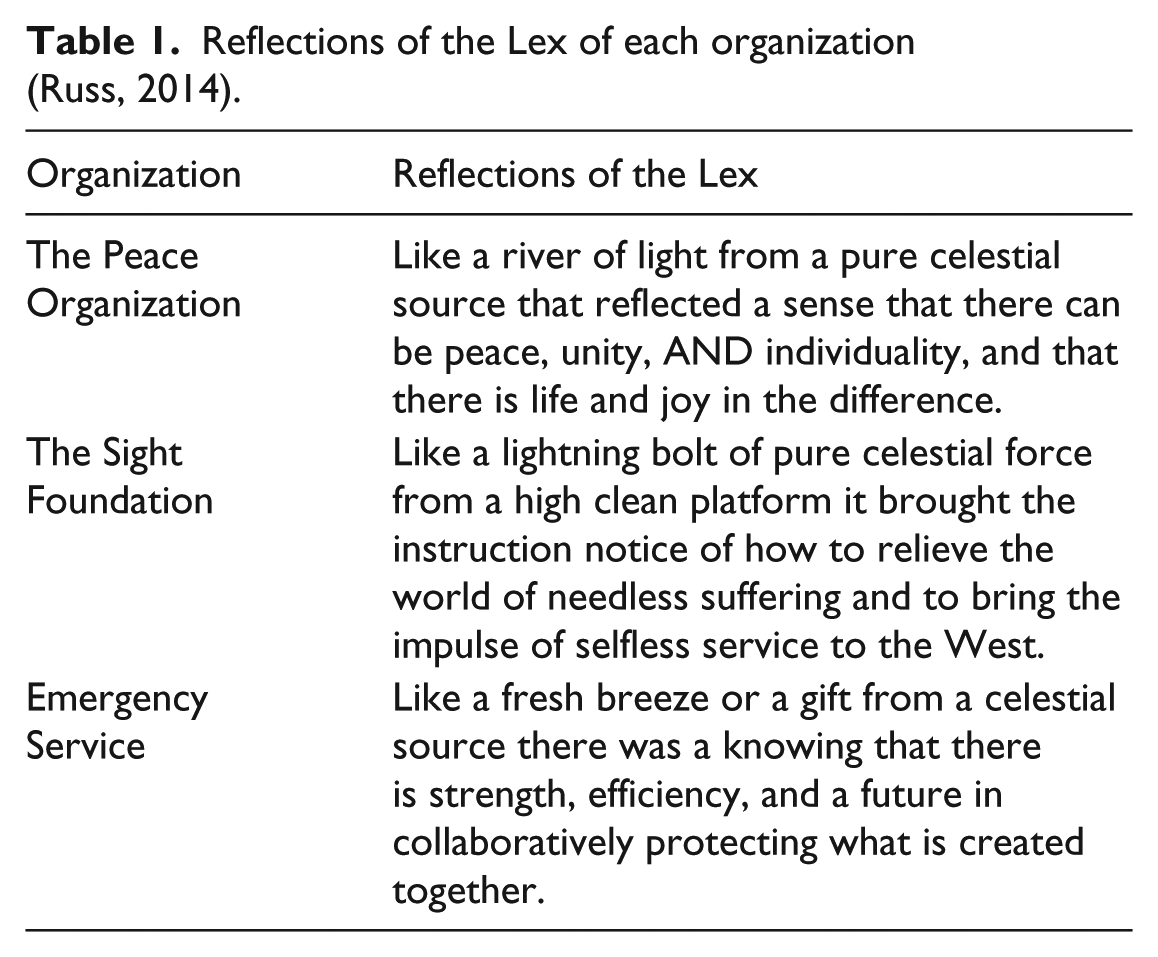
As expected from Plato (Jowett, 1891; Louth, 2007; Miller, 1974; Sagan, 2007), with each Lex came an instruction notice, a way of being, thinking, or doing that had clarity, upliftedness, joyfulness, purity, and simplicity. Each had a profound inherent Noetic structure. Each Lex carried the higher mode instruction notice for the organization embedded within its being (Fried and Polt, 2000). By experiencing this being, mappers intuitively understood the organization, its mission, its place in the bigger landscape, its threats, and the lore that governed its agency.
For example, the Peace Organization was working with both sides of the violent conflict experienced in Ireland throughout the previous century. The inherent structure of the Lex carried an instruction notice that showed mappers how people could “be” together, with peace and diversity. It carried “know how” (Russ, 2014: 265). It was as if a person had walked into the room, who had the knowledge, power, courage, and wisdom to lead us into a new way of being together. More than words, it was an experience.
As expected from Plato’s writings (Jowett, 1891; Louth, 2007), all impulses at this level were like a revelation (Miller, 1974). They were open, clean, inclusive, upturned, and aspirational. Rather than words, they were experienced as a sensation or feeling that the mappers resonated with and through this resonance there is an interpretation of the quality that is the essential essence of the organization. Following each experience of the organizational Lex, mappers reported feelings of joy, being uplifted, and emerging from the session with a smile. Each one carried a feeling of “can do.” Mappers could see the higher mode of each organization. They were filled with hope and a sense of competence and ability, as their inner landscape of consciousness had been colored by the exalted structure of the organizational Archetype. Their inner consciousness was in kinship with the purity of the Noetic level of the organization.
However, at times the mapping also revealed that the operational or structural levels of the Organization were partially disconnected from this purity. In the Peace Organization, for example; “High up, there is heartness and holding, there is a triangle of light at the top” (mm). Below this are “lines of light coming down. It is a vertical impulse and it has a feminine feeling. There are horizontal layers below it that are not as clean and people flaying around in the dark. This horizontal space is not connected to the vertical space above” (mm). The Lex was reflected into vertical lines from a high less emanated platform. The lower space was separated from the impulse by a tightness and constriction of emotional pain. “Lower down there are horizontal layers. The downstream is disconnected from what is above. The streams of light sit on top of the horizontal layer like light on top of the sea [that prevents interaction between the Noetic levels and levels associated with the conscious mind]. It is as if the impulse is trying to come through a hurt heart” (mm; Russ, 2014: 236). Here is an example where the organizational structure is preventing connection with the highest level of agency (Bourdieu, 1977; Giddens, 1984). This is an example where metaphysical mapping can reveal unseen levels that are preventing the organization from flourishing. Using conventional research methods, in this situation there may be an intuitive understanding that something is wrong, or that the organization has lost its high ideals or become routine. Metaphysical mapping can reveal what has previously been intuitive. It can reveal dysfunction at its source.
Within conventional organizational research exploration of the mission and vision is often used to improve strategic or cultural direction. As a method of comparison, the following section presents the mission alongside the Lex.
Mission and the Lex
The mission is the organization’s direction that is overt, openly discussed, and displayed in promotional material. The mission is a constructed analytical statement that provides direction for the organization. It is presented as a part of the corporate lens. The case-study organizational mission’s are presented alongside what was experienced as a reflection of the organizations emanating Archetype, its Lex, in Table 2.
Comparing the mission and the Lex, the emanating Archetype (Russ, 2014).
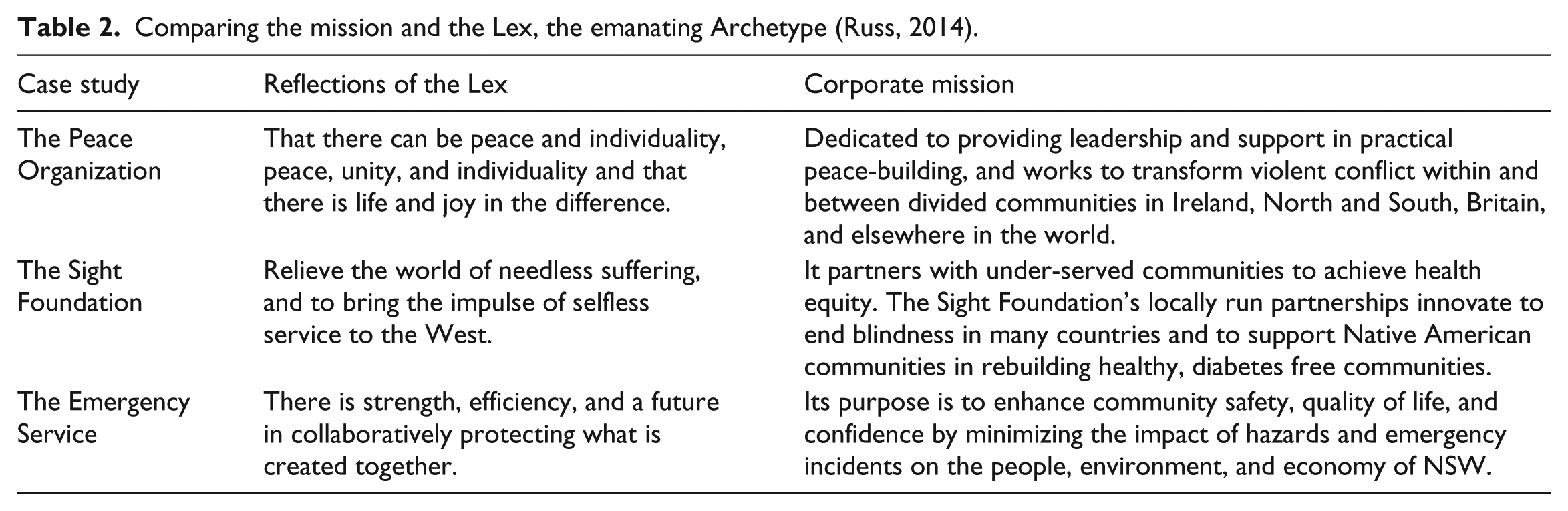
Table 2 reveals the difference in perception between what is the Lex or organizational Archetype and the mission. The mission can be clearly understood through corporate paperwork and websites. It is analytical, directional, and often pragmatic. It is understood by ordinary mental consciousness. The organizational Lex could also be compared with the organization’s essence (Merleau-Ponty, 1945), or root metaphor. Smith and Eisenberg, (1987) suggest that the idea of a root metaphor captures the essence of the “symbolic and dynamic character or organizational life” (p. 377). Neither the root metaphor nor the mission provides experiences of the Noetic space of consciousness. True to its idealist philosophy, the Lex reflects a sense of wonder and awe that inspires and aligns the consciousness of those who experience it. It could be argued that an experience of the emanating Archetype could re-inspire a culture that has become depressed or dysfunctional. It is important to note that reading an interpretation of the Lex (as above) does not bring the intensity of flavors of life and vitality that are experienced through direct interaction. The power in metaphysical mapping is that the mappers experience the life and vitality at the source of the organization, and once experienced it can be passed to other organizational members.
Seeing the organizational Lex and the mission aligned reveals the difference in the two perspectives. By combining the outcomes of metaphysical mapping with conventional methods for exploring organizations, there is potential to understand the organizations with much greater clarity and life. The following section discusses the learning gained through mapping the three organizations.
Discussion
Mapping the three case-study organizations was conducted in an action research style (Lewin, 1946). While the basic approach remained the same throughout the study, nuances and areas of interest shifted as insights informed the research.
It was clear that combining metaphysical mapping with conventional methods was beneficial within an organizational context. Prior to this research, metaphysical mapping practitioners had extensive mapping experience. However, the mappers had not conducted a series of consecutive sessions of organizations and they had not explored the results of mapping alongside conventional research techniques. The combination of methods revealed insights that were both surprising and informative such as the comparisons between the organizational Lex and the mission presented above. It was clear that metaphysical mapping does not replace conventional approaches using analytical, descriptive, or conceptual models; it adds another perspective.
For example, the metaphysical mapping revealed the Lex of the Sight Organization. It was “like a lightning bolt of pure celestial force from a high clean platform it brought the instruction notice of how to relieve the world of needless suffering and to bring the impulse of selfless service to the West” (mm; Russ, 2014: 287). Comparatively, the in-depth interviews shared the impressions of staff and board members at the organizations inception. It was “‘really clean’ [1278]. ‘Sri Neem Karoli Baba Maharajji [an Indian Guru] told me to leave the ashram and go and eradicate small pox and I completely trusted him. The organization was a continuation of that’ [1287]. ‘It had a very spiritual core’ [878]. ‘We’d made an unambiguous commitment’ [1304]. ‘There was a common denominator among us, which was the need to serve. In serving we are able to reach for the highest meaning. It has been the motivating spark all along’ [128]. ‘What became [the Sight Foundation] turned out to be a vehicle’ [494]” (Russ, 2014: 179–197). The results of metaphysical mapping can be viewed alongside the results gleaned from conventional research methods. Each informs the other.
Furthermore, the analytical and descriptive tools usually used to understand culture can be used to further analyze what is revealed through the mapping exercise, for example, Schein’s (2010) model of culture including (1) artifacts and behaviors, (2) espoused values, (3) assumptions could be used as a focusing tool during a mapping exercise as could Hofstede’s (1983) Cultural Dimensions Theory discussing, masculinity/femininity, individuality/collective, indulgence/restraint, power distance index, uncertainty avoidance index, and long-term versus short-term orientation. However, it is important to remember that the power in metaphysical mapping is that it is beyond the ordinary mind. It is beyond the analytical, opinion level of consciousness described by Plato (Jowett, 1891; Louth, 2007). So reducing the findings to a descriptive or analytical model may diminish the possible insights from conducting the process.
In a mixed-methods framework, each method informs the other. Mapping sessions suggested a line of inquiry for in-depth interviews, for example, and the interviews suggested lines of inquiry for the mappers. In the Sight Organization, for example, interviewee’s revealed challenges with the mission in that it was doing sight work internationally and working with the health of native people at home. “There is a historic trauma being played out in the Board” (Native American/White Settlers) [442]. “It’s deeper than identity. It is an internal schism” [1073] “Sight or diabetes. There is an identity crisis. Who are we, who is (the (Russ, 2014; Sight Organization]” [1181] p. 182). Mapping the metaphysical structure revealed one of four foundational pillars was full of static. “The turbulence or agitation has always been there. It wasn’t a holy marriage. One of the foundational pillars is affecting the structure. It is like dissonant voices are part of the structure” (mm; Russ, 2014: 228). Interestingly, a few months following the research (after 30 years of operation), the organization shifted its mission from health of native people to working with the sight of native people. This meant the mission was aligned globally. It was a working to improve sight across all its platforms. The element that was powerful for this research was allowing the different modes of inquiry to inform each other.
Practitioners were surprised as the lexion of each organization interacted differently to the mapping. Most lexions felt immediately open and willing to be explored. There was a sense of an appreciation of “being seen.” Mappers felt that the level of access gained was directly proportional to the level of stillness, openness, and receptivity on the part of the mappers. During the metaphysical mapping, practitioners likened the process to observing a wild animal. With agitation the animal would not come close. Sufficient stillness and the animal would reveal itself slowly at first, and fully with enough time and inner quietude.
One of the strongest impressions was that mapping the lexion not only makes it visible but there is also a sense of open interaction being engaged. At the beginning of the mapping sessions the consciousness of the organization felt impenetrable, closed, like an amorphous mass in unidentifiable and unknown landscape, dense and impenetrable. As repeated sessions were conducted, the lexion came alive, mappers would see its structure, there was a feeling that the lines of communication were open and a relationship had begun. It was exciting. Mappers experienced a sense of joy and aliveness as the process gained momentum. Other methods do not engage with the lexion, they analyze and describe it rather than engage with it directly.
There was a point during the mapping for each organization where there was a sense that the lexion had been seen. The brief for the research was to understand the structure and nature of the organizational consciousness at a given point in time. Usually within the third or fourth mapping session there was a shift in focus, as if the mapping would now take on a deeper more directed dynamic. At this point the mapping sessions were concluded as the research was limited to exploring the lexion, it was not intended to actively make shifts in its structure.
Metaphysical landscapes are mysterious, they are fluid dimensional and largely unknown realms. As suggested by Merleau-Ponty (1945), engaging with each organization in this way changed things. By becoming aware of the lexion, there was a sense of awakening and a feeling that the lexion was brought into “being” in a greater way. Mapping three case-study organizations is just a beginning, but it provides sufficient material to begin an exploration process in earnest.
Conclusion
Organizations have been studied using a variety of techniques to measure everything from attitudes to sales figures. The results of this study indicate that metaphysical mapping reveals a different perspective to conventional methods. The root metaphor, the mission, the descriptions of the type of culture present in an organization do not bring the level of life, vitality, and wonder that a mapping experience delivers. They may be objective or subjective approaches, but they do not enter the space of consciousness of the organization. They do not interact with the lexion.
Consciousness has shifted since the time of the ancient Greeks (Louth, 2007). Our everyday awareness is less conscious of states beyond the ordinary mind. Insights that are not rational, physical, or systematized are more difficult to discuss. Because everyday attention is focused on the regions within intelligible realms that are closer to dimensionality (tasks, attitudes, and that which is measurable, for example), many of the research techniques devoted to organizational culture only explore perceptions within this arena, described by Plato as the realm of opinion (Fine, 1990; Jowett, 1891). This is limiting. The results shared suggest that metaphysical mapping provides a method to enter and explore what the Greeks described as Nous. It is an opportunity to map and therefore critique what has previously been recognized intuitively. Metaphysical mapping brings a systematic, repeatable process to something that has previously been managed in a nonverbal, non-collaborative, non-critical manner.
Metaphysical mapping is a method that opens a window into another cosmological level. More than another analytical or descriptive tool, metaphysical mapping provides a way to experience intelligible realms. That which has been impenetrable can be mapped, that which has been intuitive can be explored. The implications for organizations are revolutionary. This article has only presented the organizational Lex or emanating Archetype in the three case-study organizations; however, the lexion is composed of complex nonphysical networks, pathways, platforms, and stations in consciousness. Each organization has a metaphysical scaffolding or structure (Giddens, 1984; Russ, 2014; Sagan, 2007) that is used by its members to (mostly) unconsciously navigate the nuances associated with corporate structure, that is, organizational workflows, systems, behaviors, and expectations. The lexion is made up of the links and pathways between the organizational Lex and what we experience as the culture of the organization. By engaging with the lexion, we enter the field where these nonvisible structures, behaviors, corporate systems, and beliefs are upheld.
Metaphysical mapping is a tool to unlock a field that has previously been managed intuitively without critique.
During the mapping, it was observed that if the organization is aligned with its Lex, its mission and organizational functions are more likely to be clear, clean, and in harmony. If not, the organization may have become bureaucratic, dysfunctional, or corrupt. Where the pathways between the Lex and the lower levels of the lexion were clouded or dysfunctional, there was a sense that its agency and structure were misaligned (Giddens, 1984; Morrison, 2005; Russ, 2014). The organizational essence has an Archetypal structure: it holds Archetypal principles and qualities. It is a perfect Form, living, dynamic, uplifted, open, and connected to the unity of The One described by Plato (Jowett, 1891; Louth, 2007). Revealing the organizational Lex has the potential to facilitate organizational alignment. By experiencing its reflection, mappers had an intuitive sense of the highest levels of organizational agency, it also gave them a sense of joy and life. It could be argued that an experience of the perfection of the organizational Lex allows people to understand what integrity looks like within the organizational context. It could be argued that an experience of the Lex would facilitate individual realignment with its essential Archetypal structure. It also has the potential to alert an organizational member to aspects that are dysfunctional or out of alignment. It is a tool for greater harmony between organizational agency and structure.
Metaphysical mapping is a technique that reveals this metaphysical structure. It makes the organizational consciousness visible. By making the lexion visible, organizational members have the opportunity to engage with it. Instead of the lexion operating unconsciously in the background, the process becomes interactive, critique is possible, and open discussion of its nature and flavor can be normalized. Within the concept of something seen and named is something partially understood, the process of seeing the lexion naturally facilitates organizational realignments (Russ, 2014; Sagan, 2007).
Challenges with the method
This article discusses using metaphysical mapping to explore the metaphysical landscape of three organizations. It can reveal the aspects of organizations that have previously been hidden. If the organization has become disconnected from its essence, overly bureaucratic, or dysfunctional, it is likely that there will be vested interests in keeping the status quo. It is important to consider that metaphysical mapping by nature is unconventional. It can also be controversial and unpopular as it can expose that which has been hidden, institutionalized dysfunction and/or self-interest.
Like in-depth interviews, metaphysical mapping is a subjective experience. In the same way that an interviewee could be biased or misinformed, someone inadequately trained in the technique could believe they have experienced the organization from higher mind states, but in fact may have only observed things accessible to the ordinary mind. While their perception is of value to the complete picture, it is likely that those who have an intuitive understanding of the organization will feel the results are incomplete or unreliable. It is important to remember that results are perceptions, that intelligible realms are fluid dimensional, and that a sense of looking for essences is essential. It is possible that a degree of fantasy or exaggerated story telling could bias results if the practitioner is not sufficiently experienced or if their vision is colored by vested interests. It is also important to remember the transformational nature of mapping in that what is seen is the current picture in an unfolding relationship.
While it remains an intersubjective, subjective, and objective experience, metaphysical mapping is no less valuable than other research tools such as in-depth interviews or surveys that question participants’ experience. It is essential that impressions from metaphysical mapping be analyzed alongside conventional organizational research tools. Metaphysical mapping is one lens. It is recommended that it be applied in conjunction with interviews, surveys, or workshops to provide a more holistic picture.
Future work
This research could be extended through blind studies that engage the expertise of a group of mappers within a single organization over a period of months. The mapping for this research was conducted as case studies over a period of approximately 1 month. It would be interesting to conduct three mapping sessions with an organization at several key points throughout the year.
This research was limited to five nonprofit organizations, three are presented here. It would be beneficial to conduct metaphysical mapping across a broader range of organizations including corporations, local clubs, and businesses.
While not discussed here, preliminary workshops were conducted to share the findings of the metaphysical mapping sessions with the wider organization. Further work would be beneficial to understand how to integrate the findings of metaphysical mapping into the broader organization.
In conclusion, metaphysical mapping is a tool for exploring the organizational lexion or consciousness of groups. Drawing from the work of Plato and esoteric philosophy, it provides a simple systematic, repeatable process that reveals the structure, flavor, and behavior of the organizational lexion. Organizational culture has been extensively studied, but research has been limited to the analytical categorization of culture, rather than its nature, form or structure. Metaphysical mapping is a deeply powerful technique that can reveal the structure and form of the organizational lexion. For organizations, it is revolutionary. Corporate executives, managers, and leaders have managed the lexion of their organizations intuitively. Metaphysical mapping provides the tools to allow people to develop a language for the new frontier in management. It provides insight, it opens the door to a new dimension, it allows discussion, and with discussion critique is possible.
As an additional method within a mixed-method framework, metaphysical mapping provides an additional lens. It uses the cosmology presented by Plato (Jowett, 1891), arguably the founding father of Western thought, as its foundation. Metaphysical mapping has the potential to bring life, dynamism, and alignment to organizations by awakening interaction with the organizational lexion. Metaphysical mapping could be likened to giving an organization access to its true nature.
Footnotes
Declaration of Conflicting Interests
The author(s) declared no potential conflicts of interest with respect to the research, authorship, and/or publication of this article.
Funding
The author(s) received no financial support for the research, authorship, and/or publication of this article.
