




Abstract
Like all museums, punishment museums and sites of penal tourism are inherently political and moral institutions, offering cultural memories of a collective past. As environments of narrativity, these are significant spaces in which the public ‘learn’ about the past and how it continues to inform the present. In line with recent studies about ‘dark’ tourist sites, this article argues that the crime/punishment museum and jail cell tour can – and should – be understood as an ethnographic opportunity for narrative analysis. Rather than focus on just the findings of such an analysis, this article seeks to provide a practical guide to data collection and analysis in the context of criminological museum research. Offering illustrative examples from a study of Texan sites of penal tourism, it demonstrates how the history of punishment – as represented in museums – is an important part of cultural identity more broadly, playing a significant role in how we conceptualise (in)justice, morality and the purpose of punishment. In short, this article discusses how we can evoke the ethnographic tradition within museum spaces in order to interrogate how crime and punishment are expressed through narratives, images, objects and symbols.
Introduction
In the past few decades, cultural representations of punishment have proved fruitful sources of data, with scholars focussing on cultural products such as news reports (see Kudlac, 2007), movies (see Sarat, 1999), TV series (see Cecil, 2010; Cecil and Leitner, 2009) and documentaries (see Dow, 2000). In line with these studies, a new methodological paradigm has developed within criminology and penology in which punishment museums and jail cell tours are understood as significant sites of cultural production and consumption. A collection of publications, including Wilson (2008), Welch and Macuare (2011), Walby and Piché (2011, 2015), Welch (2015) and Fiander et al. (2016), and the forthcoming Palgrave Handbook on Prison Tourism (Wilson et al., in press) have together shone a light on tourist sites associated with punishment.
Yet while these publications offer eloquent and often evocative descriptions of the sites under investigation and provide truly insightful discussions about the exhibits and their importance within a given cultural context, the research process itself is understandably backgrounded in favour of analytical findings. Walby and Piché (2016) have reflected on the use of visual methods in penal tourism research, but this is one of the only detailed discussions of precisely how the researcher went about data collection and analysis. Likewise, Noy (2001) provides a fascinating account of the similarities between tourism and ethnography, and Sturge (2007) provides an examination of how translation – within the context of the museum – is a textual practice. Yet these are both highly theoretical texts, with Noy (2001) writing from a tourism perspective and Sturge (2007) writing as an expert on translation and communication.
In short, unlike facilitating a focus group or undertaking semi-structured interviews, there is no textbook offering a step-by-step guide of how to approach the museum as a criminologist. As such, with no experience of curatorship studies, starting a museum analysis as a researcher (experienced or otherwise) can be a somewhat daunting endeavour. What follows, then, is an explanation of the process that I – as a researcher interested in punishment – went through in order to write the book Prisons and Punishment in Texas: Culture, History and Museological Representation (Thurston, 2016). Drawing from examples discussed in the book, this article de-mystifies the process of criminological museum data collection and analysis. It will begin by examining why we should approach the museum as a narrative environment, followed by an account of how I undertook my research with regard to both data collection and analysis. Finally, this article discusses writing up a museum-based project. It is hoped that this article, along with Walby and Piché (2016), might encourage a discussion about methodologies within criminological museum research.
Why should we study museums as narrative environments?
Museums are best understood as narrative environments which perform a variety of important functions. As Preziosi (2012) suggests, circulating knowledge using narrativity makes that knowledge accessible to a greater audience. However, what differentiates the museum from many other forms of cultural storytelling – such as books, film and news reports – is that this is primarily achieved within spatially defined boundaries. In addition, museum narratives will consist of objects, text, images and sound, all of which work together to create a story. More specifically, though, visiting a museum dedicated to punishment and ‘experiencing’ the stories told within are particularly important from a cultural perspective because museums are intended to be representations of reality (Brown, 2009). Rather than a fictional account, as Prentice (2001) makes clear in a discussion about ‘evoked authenticity’, museums tell stories using historical narratives which serve to validate the very existence of the museum (see Lennon and Foley, 1999; Stone, 2006). While polysemy is possible, museums as meaning-makers are nevertheless awarded a level of authority that other cultural storytellers rarely achieve (Walby and Piché, 2015, 2016). Visitors may perceive the experience as authentic, yet the museum narrative is the product of a process of interpretation and negotiation; these are still socially constructed stories.
This is important because museums perform an explicitly pedagogical function. For example, here the sites analysed sought to ‘teach’ their audience about the reality of punishment in Texas. These museum stories are therefore place-positioned, making them inextricably linked to collective identity (Hooper-Greenhill, 1994; McLean, 2007). However, punishment museums – like all museums – have functions beyond pedagogy: they are often designed as much to entertain as they are to educate. As sites of ‘edutainment’, the museum narrative is both real and contrived, authentic and spectacular, blurring the boundaries between fact and fiction (Huyssen, 1993).
Moreover, the museum can be both a reflection of public sentiment and a site which can (re)construct public opinion in support or opposition of the status quo. Yet we can go further. These museums are not solely about punishment, they also offer characterisations of offenders, victims, correctional staff, police officers and – more broadly – about justice, fairness, morality and dangerousness. In other words, sites of penal tourism document certain events while simultaneously providing a social commentary on the place-positioned reality they seek to construct. As sites which help us ‘make sense of ourselves’ (Kaplan, 1994), museums are cultural arenas in which history – or more specifically, a memory of history – is given meaning and significance (see Brockmeir, 2002; Clemons, 2008; Fehr, 2000).
So, with this in mind, how should we approach the museum from a methodological perspective? How – as researchers – can we uncover and analyse their narratives? As already mentioned, there are no chapters in methods textbooks and, within criminology at least, there are very few descriptive accounts detailing what a museum analysis actually entails. What follows is an account of my own experience of undertaking a museum analysis. The original research project involved visiting four1 of the punishment-related tourist sites in Texas which included three museums (two of which had jail cell tours) and the Texas Department of Corrections Cemetery (also known as The Joe Byrd Cemetery). It was by approaching these sites as ethnographic environments of narrativity that I was able to understand the museum as a storied space.
Evoking the ethnographic tradition: data collection in tourist sites
With any ethnography, deciding what should be considered significant will be guided by the questions and aims that drive the research. In my own project, I sought to examine the extent to which Texan punishment stories employed the cultural scripts of fear, vengeance and closure to justify the Texan commitment to the death penalty and other forms of harsh justice (see Thurston, 2016 for a full discussion). As such, I wanted to examine how inmates were characterised, how the purpose of punishment was portrayed and, more specifically, how Texas – as a cultural collective – narrated (and justified) its own relationship with harsh punishment. This meant that all aspects of the museums were potentially significant. The data collected at the punishment museums consisted of photographs, ethnographic field notes, recordings of interviews with museum staff and of audio exhibits, descriptions of tourist behaviour and floor plan drawings. In addition, while the majority of data came from within the walls of the museum, other spaces around the sites were also significant. For example, both the Texas Prison Museum and the Beaumont jails have monuments outside of the formal museum (Figures 1 and 3): As I was leaving the Beaumont Police Museum I got a chance to look at the memorial in the reception area. It commemorates the memory of four police officers who died in the line of duty. It reminded me of the monument outside the Texas Prison Museum which – according to a plinth at its base – honoured the men and women who served in the correctional system. These spaces [along with others I would find later on my travels] seem to feed into a bigger story that Texas is telling about its relationship with punishment, a story in which Texas is defiantly fighting a ‘war on crime’; a war in which there have been casualties. These are military style monuments and memorials erected in memory of brave officers – soldiers, even – who lost their lives in battle. (Field notes: 17 January 2013)
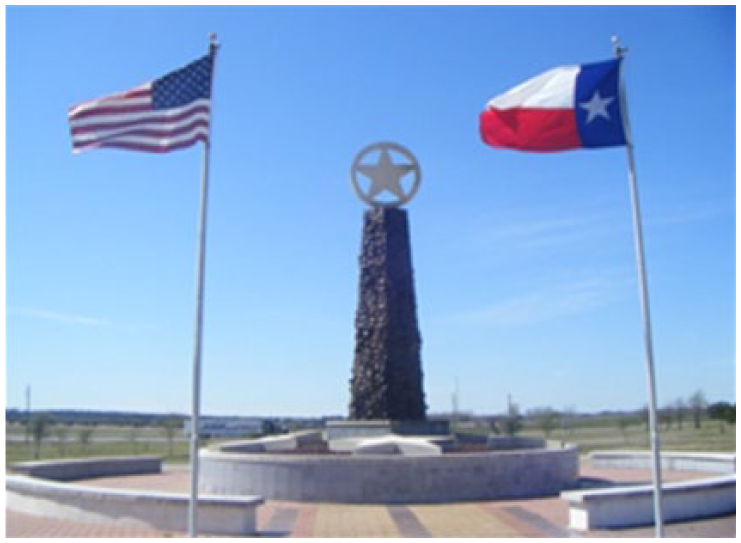
Texas Prison Museum Memorial in Huntsville.
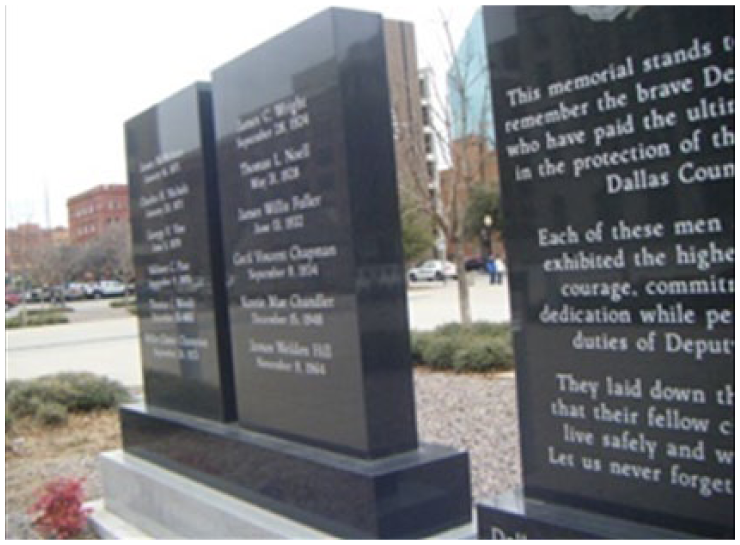
Dallas Police Memorial to fallen heroes.
Beaumont Police Station reception.
Similarly, the gift shop is commonly cited by museologists as an important part of the museum experience (see Howard and Dierking, 2002). Showing a souvenir to friends and family or giving it as a gift means the museum experience will continue to be remembered and rehearsed with different audiences; the stories told within the museum will likely loop and spiral far beyond the museum itself. Writing about the ‘Clink’ prison museum in London, Welch (2015) states, ‘a trip to the Clink does not remain in the past … tourists can keep a living memory that forever connects them with the sited-ness of the former prison’ (p. 4; italics in original). Similarly, Luscombe et al. (2015) argue that souvenirs act as ‘symbolic reminders’, providing a ‘tangible vehicle through which to preserve memories’ (p. 6). Photographs taken while in the site and objects purchased from the gift shop work to cement the experience within the personal biography of the visitor, further exercising the cultural power of the museum (see Welch, 2015: Chapter 2).
Most of the sites I visited were quite small and did not have gift shops, but the Texas Prison Museum in Huntsville had an extensive collection of souvenirs for sale. Inmate crafts drew much attention from visitors, as did the usual array of magnets, stationery and clothing. However, it was the tone of these gift shop items which revealed a somewhat comical dimension to the relationship Texas shares with its own punishment identity (Figures 4 to 6): There are some very sombre exhibits in the museum, but other elements of the tourist experience are far from macabre. As you enter the site you can pay $3 for the ‘cell for you’ experience. Staff will dress you in an orange prisoner jumpsuit and take your picture inside a cell. I spoke to Jim [museum director] and he said that the kids really enjoy it. The gift shop also sells ‘comically’ titled books like ‘Meals to Die For’ (a cookbook containing the recipes for executed inmates’ last meals) and sweatshirts with ‘Texas Prison Museum: preserving the best bars in Texas’ printed on them. There’s even a pink tee with a cartoon chain gang on it. Texas seems to be mocking the more extreme elements of punishment; playing up to its own punitive identity. (Field notes: 16 July 2013)

‘Meals to die for’ cookbook.
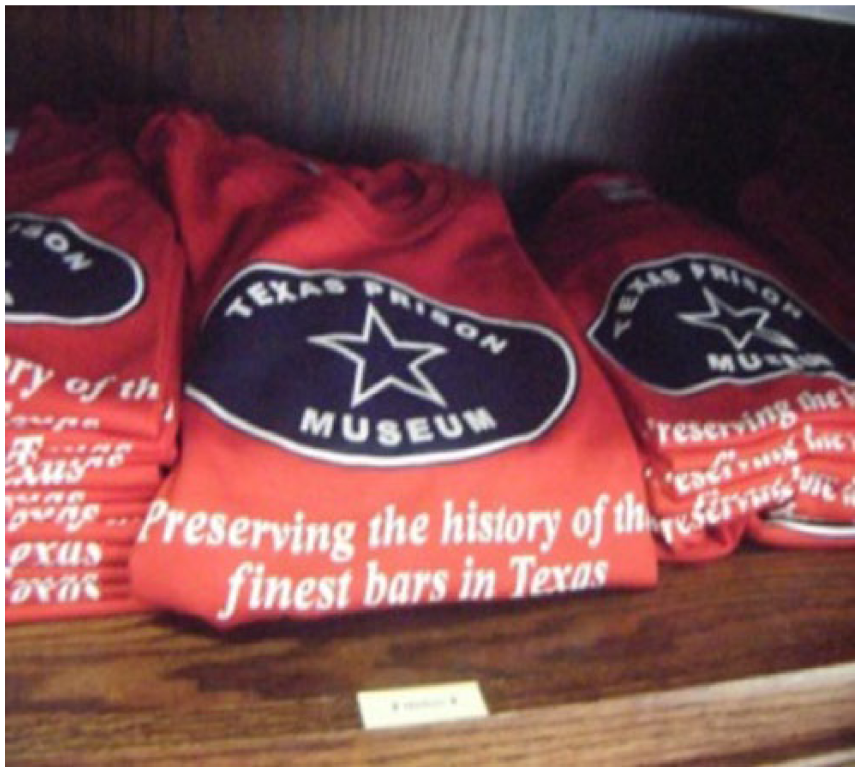
‘Preserving the best bars in Texas’ t-shirt.
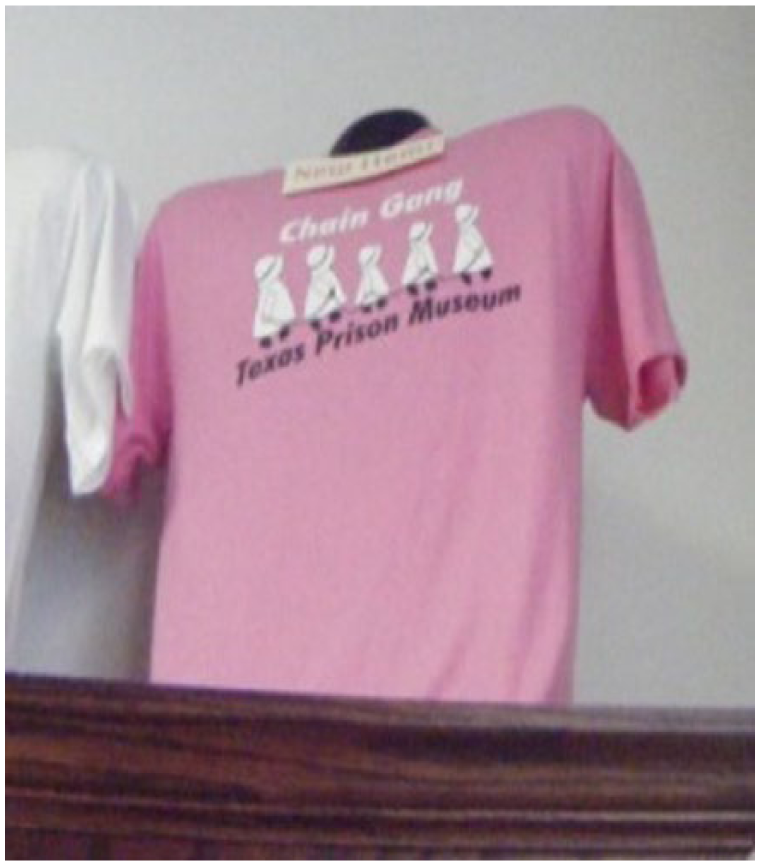
‘Chain gang’ t-shirt.
So while the monuments were sombre reminders that inmates are capable of killing prison officers, the gift shop introduced a far more comical tone suggesting that Texas embraces its punitive reputation. I will provide some examples of the actual exhibits later in the article, but at this juncture suffice to say the data collection process was unstructured so as to be flexible enough to accommodate anything which was deemed significant in and around the tourist sites.
Similarly, whenever museum staff or volunteers were interviewed, I used a semi-structured or an unstructured approach. This was to encourage the interviewees to tell their own stories about their museum, revealing what they understood to be relevant and important. After each interview, I would ask for a guided tour around the museum. Walking and talking enabled me to follow the curator or staff member (literally around the exhibits) while asking questions and seeking elaboration. It was never my intention to interrogate or undermine the veracity of these museum accounts, but rather to analyse the museum as a story of and about a cultural collective. This eclectic approach to data collection – photographs, interviews, observation, audio recordings – was in large part directed by the nature of the sites themselves. The character of the data was diverse, and thus, the methods used to collect it reflected that diversity (see Walby and Piché, 2016).
Evoking the ethnographic tradition: analysing museum data using narrative analysis
The last few decades have seen an explosion of interest in narrative and narrative analysis within the social sciences (Elliott, 2005; see also Gubrium and Holstein, 2008), yet there is still much debate as to what a ‘narrative’ actually is, when one begins and ends and how researchers should go about identifying them within wider discourses (Presser, 2009; Riessman, 1993). Mishler (1995) recommends the process should be based on the three functions of language: meaning, structure and interactional context. These functions can be analysed through ethnographic museum research, as outlined below.
Museum stories: examining the narrative meaning
First, to analyse the ‘meaning’ of the narrative, as advised by Preziosi (2012) and Gubrium and Holstein (2008), I examined the internal content of the narrative in detail. Museums are rich multi-dimensional narrative environments, and in studying them, I collected and analysed objects, images, textual descriptions, interactive displays, experiential opportunities, tour guides’ stories, museum leaflets and spatial aesthetics. Visual and audible dimensions were thus also incorporated into the narrative analysis; for example, posters, objects, film, music, audio, logos, maps and even the use of space and lighting were all considered as ‘visual’ data. As Silverman (2011) suggests, visual analysis need not just be the study of an image, but can instead be ‘the study of the scene’.
Once this detailed collection of the narratives/environment was complete, I examined the meanings within the stories which had been documented. This part of the analysis considered the significance and meaning given to events, people and practices within the museum’s story. In order to illustrate how this was achieved, I have included two extracts from my field notes, both of which were written while in the Texas Prison museum. The first extract relates to the ‘Electric Chair’ exhibition (Figure 7), and the second relates to the cabinet which contained the lethal injection needles: Most become quiet as the electric chair enters their view, almost respectful as they gaze at it, and, one assumes, imagine its destructive force. A sense of unease seems to surround many of the adult visitors, helped by the security measures which add gravitas to a setting that scarcely needs it. They become awkward, their eyes shifting away from what they are here to see, their bodies moving away faster than their morbid curiosity seems to desire. Yet they always glance back, one last glimpse of what might be an uncomfortable reminder of their own mortality. The chair is treated like a protected artefact, a sacred object from a time past. (Field notes: 15 July 2013)
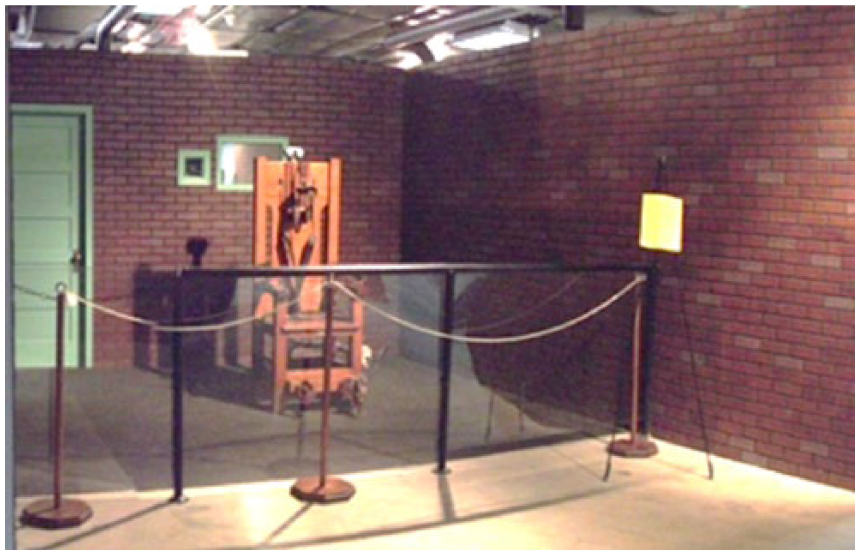
Electric Chair: Texas Prison Museum (Huntsville).
From an analytical perspective, this was particularly interesting when we consider the way in which the needles (replicas of those used in lethal injections) are exhibited within the museum: The positioning of the needles in the museum is really interesting. There is far less symbolism, less performance. There is no mock execution chamber or gurney, the needles are placed at the bottom of a cabinet which is – somewhat counter intuitively – about the abolitionist movement. Like news reports of modern executions, the museum makes the needles a non-event. Devoid of spectacle, visitors could nearly pass them by. Maybe it’s because they are not ‘real’ and are instead replicas. Unlike the chair, death does not cling to the air around them. Even in a museum portrayal, modern execution is synonymous with sterility while death by the chair is – in one poster – evocatively described as ‘riding the thunderbolt’. (Field notes: 17 July 2013)
These two field notes illustrate how important the internal content of the narrative is within a museum analysis. By approaching the setting ethnographically, I explored how the posters, the objects and the aesthetics of space constructed meanings about punishment. More specifically, the museum put forward a particular narrative framework within which to interpret Texan punishment. By juxtaposing the past and the present, the old against the new, the electric chair is characterised as an artefact of a bygone era, while lethal injection becomes synonymous with a more modern, more ‘civilised’ way of punishing (see Thurston, 2016, in press for a full discussion).
Museum stories: examining the narrative structure
In addition to examining the construction of meaning via narrative content, I considered the ‘structure’ of the narrative. Elsewhere, this has been referred to as the ‘form’, the ‘narrative trajectory’, the ‘plot’ and the ‘sequence’ (Elliot, 2005). In some ways, this is quite challenging in the context of a museum study. Unlike punishment stories told in many other cultural products, tourist site stories are not typically chronological, nor do they always adhere to an event-driven plot trajectory. That said, I identified thematic structures within the stories. For example, by considering the stories told about recurring ‘characters’ (be they the prison guard, the inmate or the prison itself), I could identify narrative trajectories by recognising the ‘journey’ the characters go on within the story.
This second stage of the analysis is illustrated primarily with quotes and images rather than field notes in order to show how diverse museum data can be. The tours, from which the quotes are taken, were guided by serving police officers in the Beaumont Police and Jail Cells Museum and the Old Eastland County Jail House Museum. It is outside the scope of this article to offer a full discussion about the characterisation of the inmate within the tours/museums (see Thurston, 2016); however, when speaking about prisoners, more often than not, the guides tended to evoke the character of a ‘dangerous criminal’ (Figures 8 to 10): They’d thrash around in here, the crazy ones; clawing and stuff. They’re the most dangerous in my opinion, because they were just so unpredictable you know? (Peter: Eastland) Some of them would get crazy, like animals, so none of them could have proper plates or knives; nothing like that. Some days they’d be fine, but other days they’d be fixing to use them as weapons. You’d be amazed at what can be made into a weapon, ingenious really. (Tom: Beaumont)
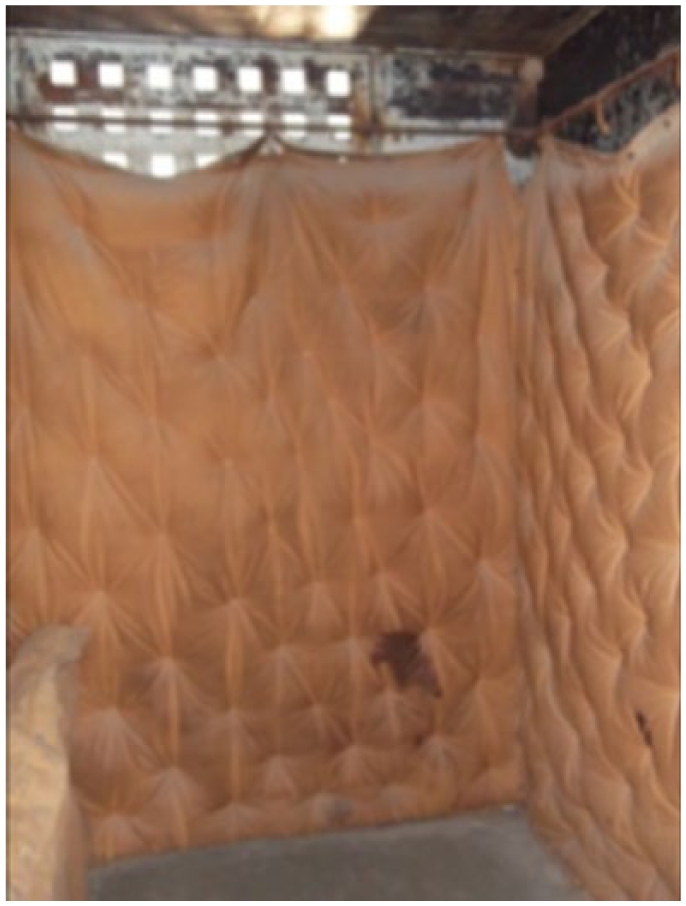
Padded cell (Eastland jail cell tour).
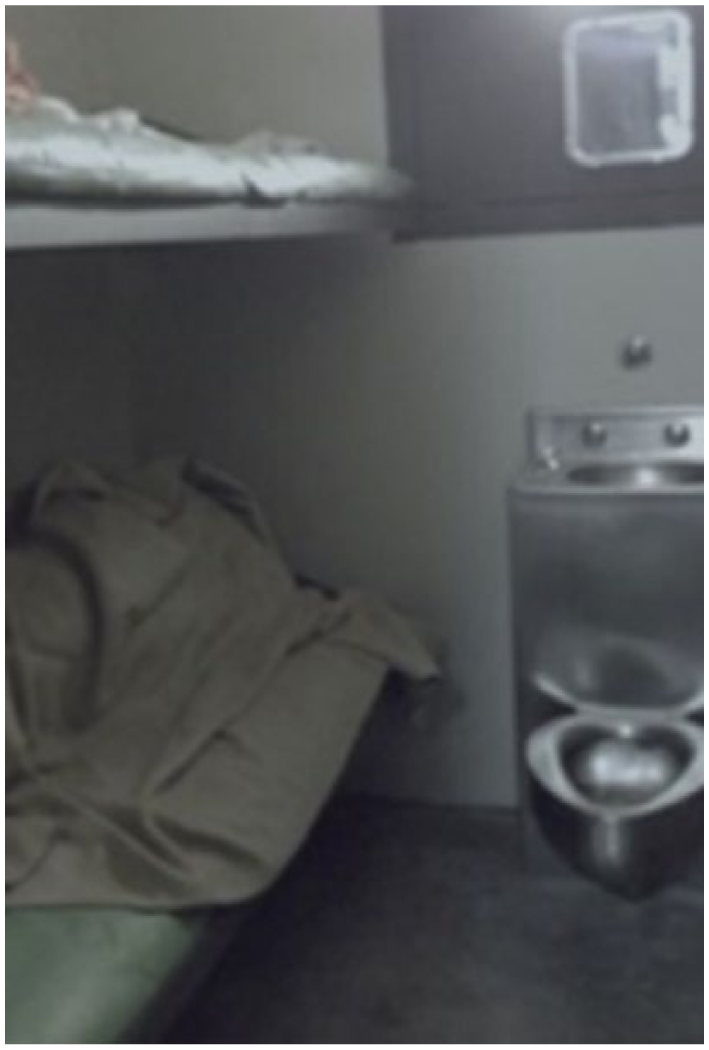
Decommissioned cell (Beaumont tour).
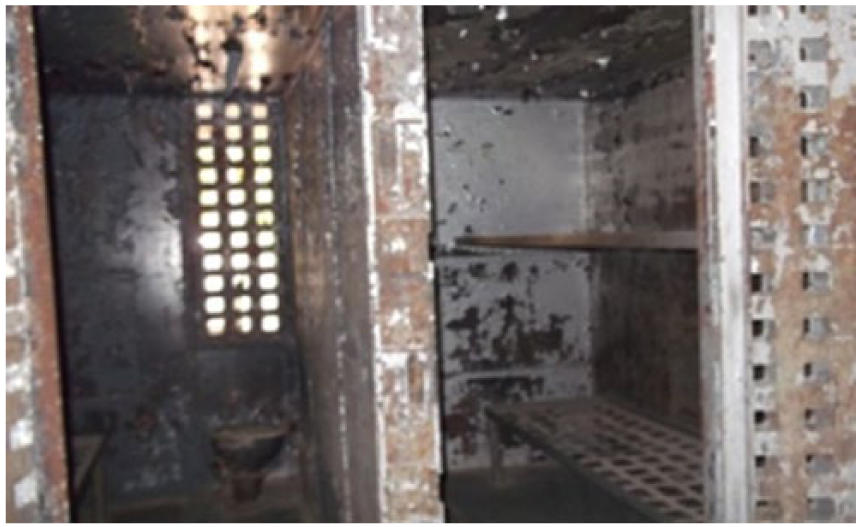
Decommissioned cell (Eastland tour).
This characterisation of inmates as fearsome and dangerous is particularly interesting when considered alongside other stories being told in Texan tourist sites. After watching countless visitors move around the Texas Prison Museum, it became clear that the space was designed to be toured in a specific way. Cabinets near the entrance focussed on escape attempts, prison gangs and contraband weapons (again, stories about dangerous inmates), yet towards the middle and end of the museum experience, this characterisation changed. The tourist experience concludes with displays about the use of inmates to train guide dogs, prisoner crafts such as carpentry and leatherwork, a cabinet which contains a selection of dolls made by the women of death row and – of course – the gift shop which sells prisoner-made items (Figures 11 to 13).
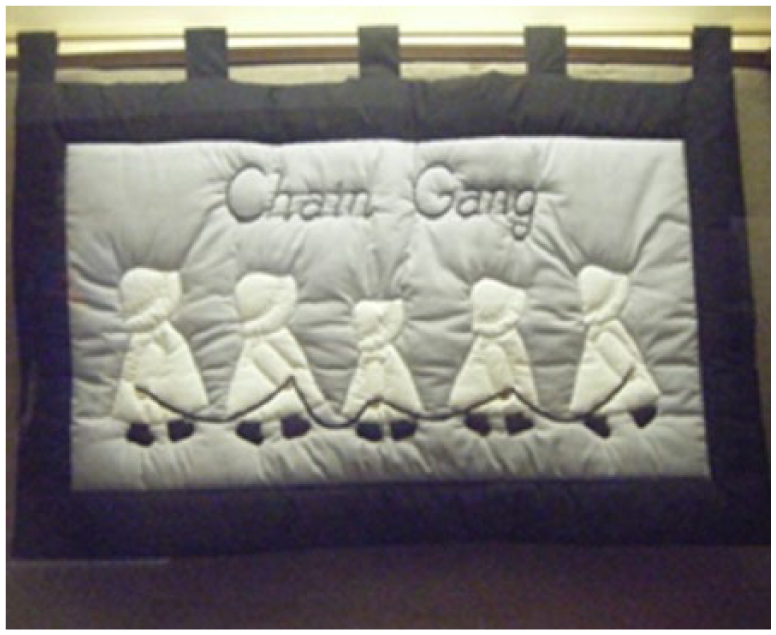
Chain gang tapestry (Texas Prison museum).
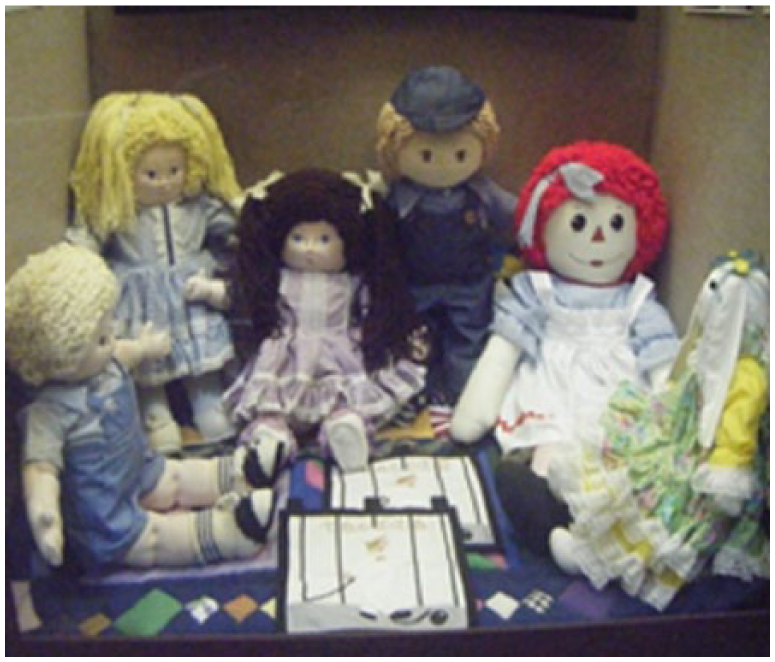
Dolls from Death Row (Texas Prison museum).
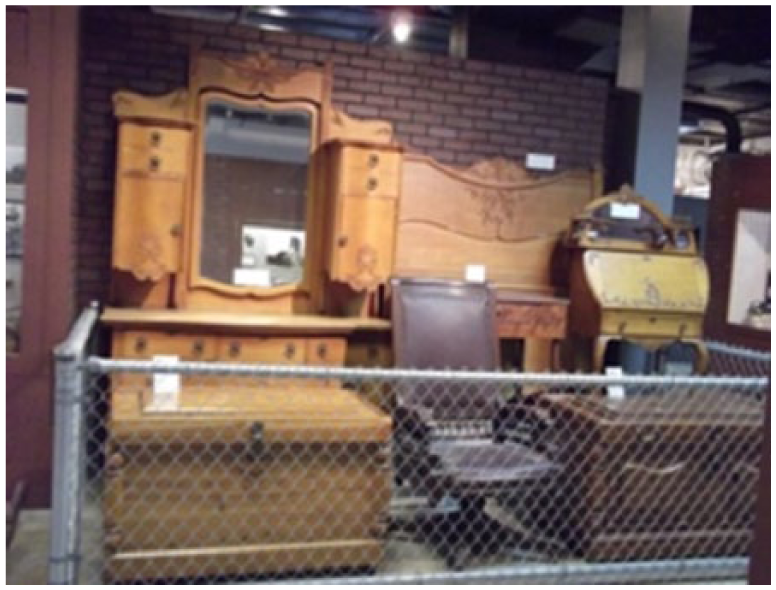
Prisoner carpentry (Texas Prison museum).
Here, we find a surprisingly sympathetic portrayal of prisoners. The story told here is that these inmates no longer pose any immediate threat or danger; after all, they have access to scissors, saws, needles and guide dogs. Observing people engage with the exhibits revealed that the tourist goes on a kind of journey with the protagonist: the prisoner begins as a character to be feared, but by narrative’s end the prisoner has (to some degree) been humanised. In turn then, the Texan prison is depicted as an environment capable of transforming these once dangerous criminals into reformed and responsible inmates.
It is notable that the Texas Prison Museum does not suggest anywhere that prisoners (humanised or otherwise) are not deserving of their punishment. As discussed in the previous section, modern punishment in Texas is portrayed as ‘civilised’ (in comparison with what came before), but that is not to suggest Texas is – in any way – soft on crime. A video played to visitors as they enter the museum makes this clear. The narrator states, While today’s prisons are safer and more humane than years ago it’s still a hard way of life. The state of Texas does not operate a country club prison.
Similarly, there is no indication that the women who crafted the ‘dolls from death row’ (pictured above) should not be executed or that inmates who engage in purposeful activity (such as training guide dogs) should be given an opportunity for early parole. Moreover, these stories do not include any images of, or quotations from, specific prisoners. The museum displays inmate artwork, leatherwork, carpentry and tapestry – which together represent an attempt to humanise the prisoner – yet they also serve to silence the inmate voice. Rather than a declaration of reform from a prisoner’s mouth, these are implicit assertions made by the museum. By implying the rehabilitative ideal through non-verbal communicative gestures, the museum will likely sidestep any suggestion that Texas is soft on crime.
Jewkes (2014) suggests there has been a ‘cultural acquiescence’ towards harsh punishment in recent years, underpinned by a tendency to construct ‘moral distance’. Offenders are seen as ‘evil’, and thus, the rehabilitative function of the prison becomes overshadowed in cultural discourse by the more pervasive (and often more persuasive) narrative that punishment should be retributive. The Texas Prison Museum engages in this type of acquiescence: there is no suggestion anywhere in the museum that the ‘reformed inmate’ should not be executed, nor that any inmate – however dependable or responsible – should receive a reduction in sentence. The museum removes these stories of rehabilitation from wider debates about the appropriateness of execution or the effectiveness of long sentences by avoiding them entirely. As I discuss at length elsewhere (Thurston, 2016), visitors are invited to imagine the inmate as capable of reform, but they are simultaneously invited to support their punishment due to its retributive features.
Museum stories: examining the interactional context
Finally, as advised by Mishler (1995), I explored the ‘interactional context’ or performance of the punishment museum and tour narratives. This process was similar to what Gubrium and Holstein (2008) term ‘narrative ethnography’. The aim here was not only to examine the content and structure of the stories but also to consider who was telling the story, where the stories were being told and who the intended audience was. I identified three aspects of the interactional context as particularly significant: evoked authenticity, tour story dynamics and narrative tensions.
Recognising evoked authenticity
Through observation, it quickly became clear that the sites evoked a staged version of authenticity in a number of ways (see Walby and Piché, 2015). First, the museums employed countless symbols associated with the state of Texas, such as the single ‘lone star’, the state flag, the state colours and the map of Texas. These not only functioned to place-position the story (and ultimately create an insider/outsider dynamic) but also added legitimacy to the narratives at work within the museums/tour guide stories. In addition, the location of the sites could likewise be understood as an authenticating feature, and as Stone (2006) contends, ‘locational authenticity’ is probably the most crucial feature of any dark tourist site. The Texas Prison Museum and The Joe Byrd Cemetery are a short drive from Texas State Penitentiary in Huntsville (which is also known as ‘The Walls Unit’ and is home to the Texan execution chamber) and the jail cell tours in Eastland and Beaumont are conducted within their respective police stations. Moreover, the occupations of the tour guides and other site staff further authenticate the experience as legitimate. All guides in Eastland and Beaumont were serving police officers; many who work in the Texas Prison Museum are retired prison officers, and the museum’s director (Jim Willet) is an ex-warden of the Walls Unit. In short, as Walby and Piché (2015: 231) argue, whether the ‘staged authenticity’ is spatial, tactile/visual or more existential, its presence will nevertheless ‘reinforce claims about the purported realities of incarceration found therein’.
Recognising the significance of the self
In addition to examining the evoked authenticity which surrounds the museum as a storyteller, it is also important to consider who the story is being told to. Unlike traditional ethnographies, the notion that one needs to recognise the significance of the self when conducting a museum analysis seems – at first glance – somewhat counterintuitive. After all, the researcher’s facial expressions, gender, ethnicity, body language, tone, dress and so on will not impact the way the museum presents its exhibits or the content of the narrative itself. However, while the museum displays could be observed without impact, I am in no doubt that my identity influenced the stories told by the tour guides: Many of the people I have interviewed so far have been men and there seemed to be a kind of paternal dynamic to the interactions. Many asked about my travel plans and warned me of the dangers associated with travelling the greyhound buses alone; one Sheriff even offered a squad car as transport back to my motel. I think it comes from their profession – they were all police officers and maybe feel the need to protect me? I am a woman, I am short [4 ft 11in/1.5 m] and I look young for my age. What was interesting though, is the ways in which the dynamics of the exchange changed once they realised I was maybe not what they had first envisioned me to be. For example, in one site the guide told me lots of stories in which he offered his own opinions about punishment, policing, prison and crime. We then sat down for a coffee and attention turned to me. It became clear that he had misjudged my age (he thought I was much younger) and my level of study (he assumed I was an undergraduate). He asked how I was able to afford my trip and I told him about the scholarship. His manner changed after that series of interactions. From reviewing the transcript he changes his address (I think unconsciously) from ‘Miss’ to ‘Ma’am’ and our exchanges became much more formal; his responses much more guarded. (Field notes: 20 September 2013)
As with most qualitative studies, the data collected were shaped by my own actions, reactions and identity. The stories being told were co-constructed by the tour guides and myself; we together created the content and trajectory of the narratives. Rather than ignore, displace or undermine these effects, I embraced them as part of evoking the ethnographic tradition and wherever possible attempted to be conscious of them during the analysis process. In short, the analysis of qualitative data is always interpretative and thus ‘the self’ can never be entirely removed from the research process.
The hermeneutic features of the analysis, also discussed by Alvesson and Sköldberg (2000) in terms of ‘researcher intuition’, make demonstrating the construction process ‘openly and honestly’ of great importance. However, the challenges associated with reflexivity ring particularly true when the data are collected from museums rather than a tour or interview. The audio-recorded interviews and guided tours can be played back, and through listening, we can recognise the ‘ethnographic I’. We can hear what we said and when we said it. The museum data do not consist of one audio transcript, though, and the ‘ethnographic I’ cannot be so easily identified. Exploring the role of the self within the analysis of exhibitions and displays is thus rather difficult. While museum researchers can ‘re-live’ the data (through photographs, recordings, floor plans and so on), we cannot do so in order to pick out how we are ‘responding emotionally and intellectually to the person being interviewed’ (Mauther and Doucet, 1998: 126).
As such, I took the advice offered by Hollway and Jefferson (2000) and continually asked myself four questions throughout the analysis. What did I notice? Why did I notice what I noticed? How can I interpret what I noticed? And how can I know that my interpretation is the right one? The breadth offered within these questions suggests the reflexive self is not only a feature of the data collection but should be an integral aspect of the research process in its entirety. Hollway and Jefferson (2000) are inviting us to continually question the credibility of their own interpretations.
Explaining narrative tensions
Finally, an important stage of the interactional context of museum narrative(s) is to identify and seek to explain tensions within the stories. Museums are relatively stable narratives, and thus, to find a contradiction within them – however subtle – can be revealing. That said, identifying the contradiction in the first instance is not always easy. These sites tell multiple stories using a variety of mediums about a whole host of characters. However, while the stories are diverse and the characters within them complex, there will be common themes.
For example, I found the content and structure of the museum narrative(s) meant that – taken together – these were stories of Texan defiance, toughness and bravery in the penal sphere – stories which celebrated the Texan approach to punishment (see Thurston, 2016 for further discussion). However, while these masculine scripts of toughness, defiance and bravery were identified across all sites, there were nevertheless some tensions within and between these stories. To be clear, the vast majority of stories being told were unsurprisingly celebratory tales of Texan toughness, yet there were also two emotionally charged spaces in which visitors were encouraged to question their own commitment to harsh punishment: a photographic display and an audio exhibit.
The photographic display (pictured below) consisted of 16 photographs in two rows of 8. One side of easels held pictures of, and statements made by, family members of murder victims. The other side held images of, and statements made by, family members of people who have been executed. Accompanying the display is a framed statement made by Barbara Sloan (the artist) in which she describes the families of those who have been executed as the ‘forgotten victims of crime’. Within the statement, she also explains why she felt the need to undertake the project (Figure 14): I started thinking about the families that execution leaves behind … It really is a moving conversation to speak with a parent, any parent, who has lost a child.
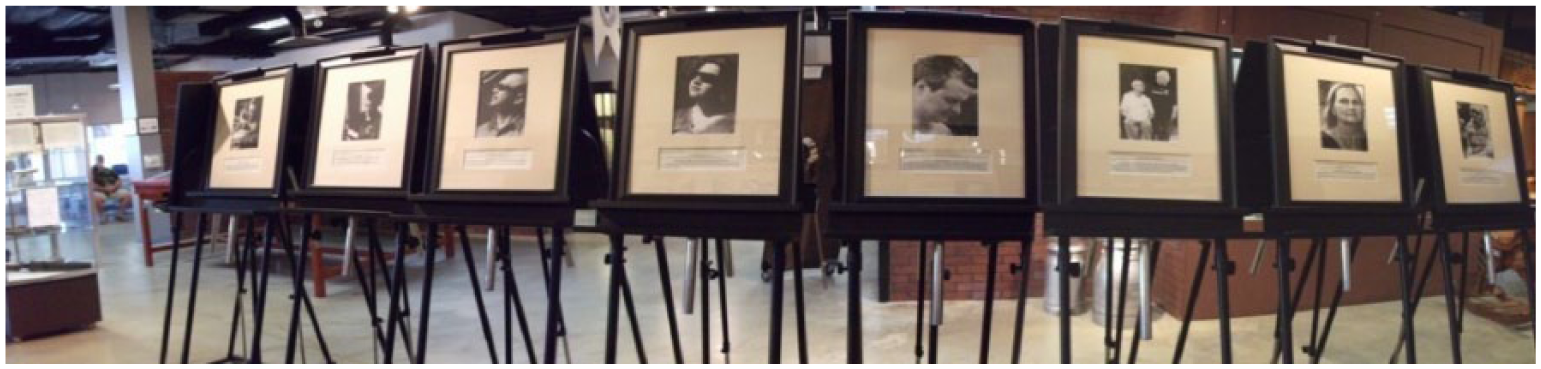
Photographic display in the Texas Prison Museum (Huntsville).
This display not only introduced an emotional tone to the museum, it also created a tension within the narratives at work: it had the potential to threaten the moral legitimacy of capital punishment. For some patrons, it might be viewed as an attempt to make them question the death penalty from a moral perspective because execution makes victims of innocent people (the families of the condemned). Yet the photographic exhibit was not the only tension within the museum’s story of execution. In another display – an audio exhibit – visitors were again told a story which was somewhat surprising considering the Texan reputation for punitiveness.
The audio, which emitted from a small display entitled ‘witness to an execution’, consisted of a mixture of music and people speaking about their experiences of being in the chamber during an execution. The accompanying display tells the visitor that the people speaking are members of the ‘tie down’ team 2, spiritual advisors, associated press personnel and ex-warden Jim Willet. In one section of the audio, each interviewee states how many executions they have witnessed, encouraging the listener to consider (if not outright question) the Lone Star State’s enthusiasm for the death penalty.
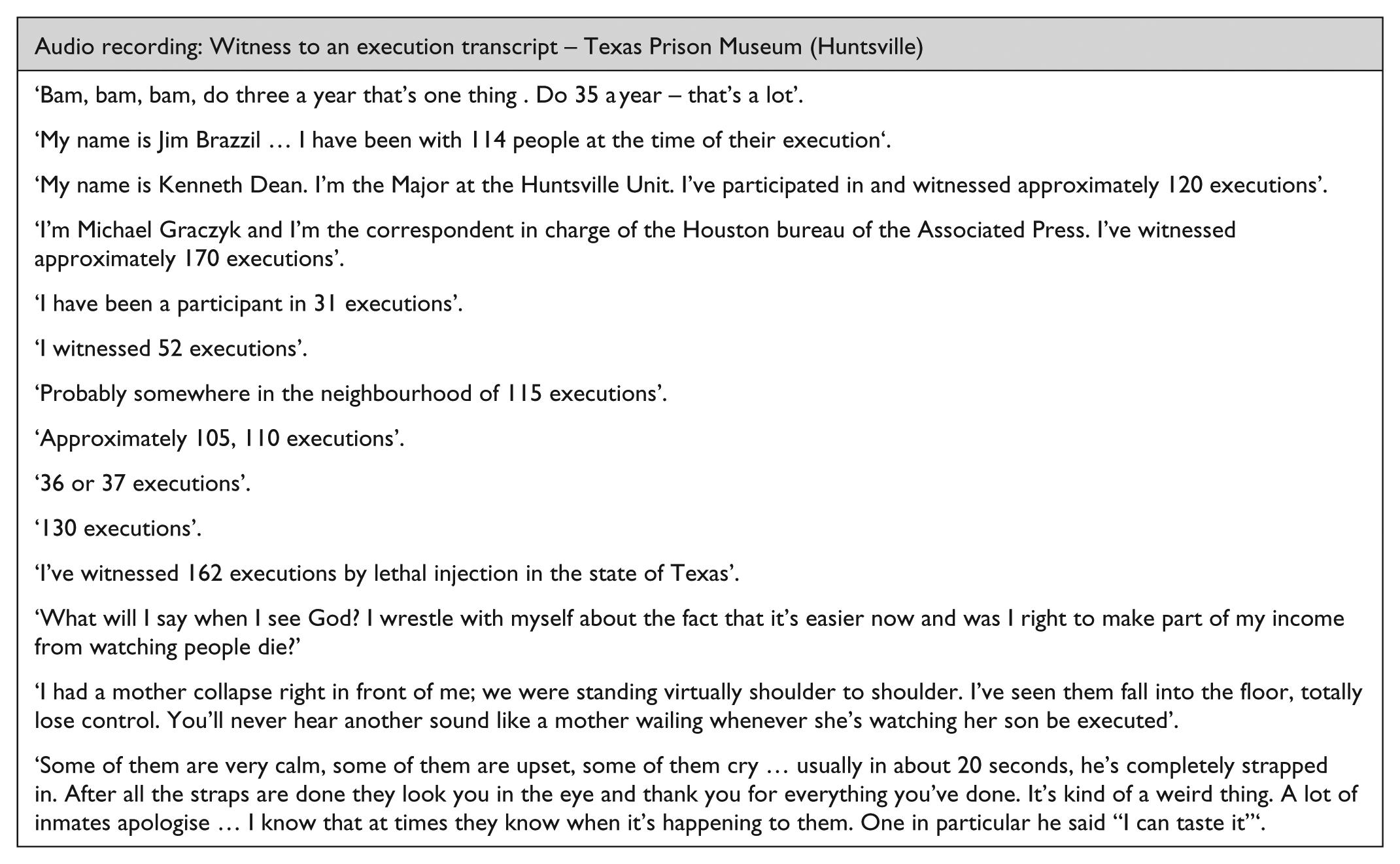
It is not within the scope of this article to offer a full discussion of the exhibits (see Thurston, 2016), but I have included these two – the photographic and audio displays – as illustrative examples because they clearly represent tensions in what was otherwise a fairly coherent narrative celebrating the Texas tough identity. I have included them here because they show that explaining these tensions requires examining ‘who’ was telling the stories. After interviewing Jim Willet, the Texas Prison Museum director, it became clear that both of these exhibitions were created by museum ‘outsiders’. The audio was edited by a local radio station and the photographs taken by a local artist; Jim Willet had not commissioned these exhibitions, he had simply agreed to display them. In short, it became clear that the tension created by these exhibits was likely the result of someone else trying to tell their (somewhat different) stories of execution.
Evoking the ethnographic tradition: the final stages of museum research
The style adopted when writing up an analysis is an important aspect of any piece of research. Van Maanen (1988) suggests that scholars can write different types of ‘tales’, including the reality tale, the confessional tale and the impressionist tale. The reality tale is one in which – once the data is collected – the researcher is essentially removed from the findings and discussion they present. Within these reality tales, the researcher takes on a kind of interpretive omnipresence, as if by watching from a distance they are seemingly everywhere but at the same time nowhere other than in the methodological accounts. In contrast, confessional tales are laced with references to the biography of the researcher. The participant–researcher relationship is not only reflected upon during data collection but also becomes an integral part of the analysis and write up.
Finally, the impressionist tale is one in which the researcher becomes the storyteller. The aim of the impressionist tale is to ‘draw the audience into an unfamiliar story world, and allow it as far as possible to see, hear, and feel as the fieldworker saw, heard and felt’ (Van Maanen, 1988: 103). Often following the same chronology as the data collected, the impressionist tale attempts to lead the reader on the analyst’s journey, encouraging them to feel part of the research process.
My own approach to writing up the Texan museum research was aligned most closely with the impressionist tale. Van Maanen (1988) suggests that those wishing to write impressionist tales should aim to ‘evoke an open, participatory sense in the viewer’ by using new techniques (p. 101). Throughout the book (Thurston, 2016) on which this article is based (and to a lesser degree within this article as well), I have provided examples, photographs, diary extracts and an audio recording transcript. This was an attempt to familiarise you – the reader – with the Texan punishment museums and guided tours and to place you within the narrative environment of the research site.
Conclusion
I have been careful to refer to my own approach as ‘evoking’ the ethnographic tradition. My approach to analysing a dark tourist site such as The Texas Prison Museum or the jail cell tours is not quite the same as a traditional ethnography. Ethnography provides a rich account of ‘people and the social processes they are embedded in’ (Drake et al., 2015: 1). Seeking to understand the perspectives of people by observing their everyday life experiences, ethnography can give a voice to often marginalised and excluded communities. Evoking the ethnographic tradition in punishment museums will not provide a window to the lived experience of prison; it will not allow the researcher to encounter the ‘flesh-and-blood people’ who are serving sentences (Jewkes, 2015). Instead, punishment museums offer a cultural representation of the prison as a social reality. The lived experience of incarceration might be present within the museum narrative, but the author of that experience is not the prisoner. These are not stories told by inmates, they are stories told about inmates by curators and tour guides.
That is not to suggest, however, that parallels cannot be drawn. While the object of study is different (lived reality vs representation), the ways in which the researcher approaches their object of study are nevertheless similar. As this article has demonstrated, an awareness of ‘the scene’ in its entirety is a vital element of both museum research and traditional ethnography; interviews, observation, field notes and photography are our tools. We might also consider the curator of a museum as taking on a similar role to the ‘gate-keeper’ in traditional prison ethnography. Choosing which stories to tell in a museum is much like choosing which prisoners can and should be interviewed by researchers. Prison ethnographies and museum research also share an appreciation of the difficulties associated with interpretivist methodologies, auto-ethnography and how we might examine our own stories as part of the research process. As I have suggested, my identity and personal biography have influenced how and why I undertook the research I did, yet I want to make clear that the impact of ‘doing’ the research, of entering (and exiting) the field was distinct. My experiences were far removed from the poignant accounts from those who have undertaken traditional prison ethnographies (see, for example, Fleetwood, 2009; Jewkes, 2012, 2015, and various chapters in Drake et al., 2015). Sadness, regret, fear, helplessness – these are not the emotions I felt when in the museums. The relationship between the researcher and the prisoner – in museum research – is often characterised by distance rather than closeness. In short, museums represent incarceration, but they should not be confused with experiencing the reality of incarceration, either as a prisoner or as a researcher.
In conclusion, this article is an invitation of sorts to those researchers who do undertake more traditional prison ethnographies. They will have observed the pains of imprisonment and heard the stories of the incarcerated, and it is these first-hand experiences – and the knowledge they produce – which can provide an important backdrop for museum research. Prison ethnographers are well placed to examine how prison reality compares to prison representation and thus contribute to this growing body of interdisciplinary scholarship. Tourist sites are storied spaces which offer ethnographers a unique opportunity to examine the meanings which surround punishment, and this, I would suggest, is an opportunity not to be missed.
Footnotes
Declaration of conflicting interests
The author(s) declared no potential conflicts of interest with respect to the research, authorship and/or publication of this article.
Funding
The author thanks the Ian and Christine Bolt Scholarship Fund (University of Kent) which was used to fund the research undertaken in Texan punishment museums.