




Abstract
Recording the lives of people in marginalised communities can be enhanced through the use of a range of participatory methods, relating our selves in ways that go beyond traditional interviews and oral history. Innovative artistic methodologies may catch and render contingent identities, our fluid and variously bounded selves, which are dependent on context, performance and narrative. This article reviews a community-led storytelling project that has generated reflexive narratives and a variety of storytelling methods by and for people marginalised by sexuality and gender. Queer Stories, undertaken by OurStory Scotland, became the world’s first project to focus on multi-media storytelling with a nationwide lesbian, gay, bisexual and transgender community for public representation and national museum archiving. The aesthetic extension of narrative methods, through performance, fiction and display, reaches new publics and enables narrow identifications, fixed in dominant representations, to be challenged: stereotypes can be subverted and boundaries of identification undermined through the recognition of shifting frames of identity. Storytelling, through aesthetic distance, mutual identification and inclusive community ethics, fosters awareness of the contingency of all identity.
Keywords
Introduction – a story of community engagement
Social researchers, policy makers and community artists are increasingly involved in the common work of social engagement. 1 A common practice for art or social research that seeks to engage with communities is to develop new forms of participation. Innovative methodologies can encourage community involvement, enable alternative expression, recognise shifting identifications, record untold narratives of life and reach new publics.
This article tells the story of a storytelling project engaged in community research, art participation and creative methodologies for narrative collection and presentation. The project that became OurStory Scotland, a Scottish charity dedicated to collecting, archiving and presenting the stories of the lesbian, gay, bisexual and transgender (LGBT) community in Scotland, had its origins in a question posed to Diverse Artists, a group based at the Glasgow LGBT Centre. The question was how to ensure that the stories of our community are not lost: how can we record, archive and present them. Presentation was not an afterthought: to reverse the standard process of first collecting material and then considering how to exhibit it, the group decided to hold an exhibition and invite participation from anyone in the local LGBT community who had ‘ever felt left out in the various versions of history presented in books, museums and documentaries’. 2 This same invitation made clear the centrality of research to the project, including consideration of ‘the forms in which accounts of lives can be expressed and published: this involves working on the forms of recording, interpreting, expressing, publishing, exhibiting and performing accounts of lives’.
From the initial conception this has been a community-driven research project, aimed at encouraging engagement not only through the collection of material (researching the stories of the LGBT community and organising their secure archiving), but also through the presentation of material to a variety of audiences within and beyond that community. The traditional oral history method of the one-to-one interview, ‘to grab a tape recorder and go out and record the memories of our elders before they were lost’ (Kennedy, 1998: 344), which may use ‘a single, initial narrative-inducing question to elicit an extensive, uninterrupted narration’ (Jones et al., 2013: 11), and which in its personal biographical form has increasingly become the main mode of qualitative data collection in the social sciences (Atkinson, 2005), has been extended through the focus on storytelling to include a variety of participatory art endeavours and narrative methods, both verbal and nonverbal, fictive and factual. The geographical boundaries of the project also had to be extended beyond the immediate locality, to achieve the nationwide coverage implicit in the project’s name. To undertake community research on this larger scale, funding was sought and obtained from SCARF, the Scottish Community Action Research Fund, which observed ‘considerable demand from communities to be able to carry out research for themselves’ (McHendry and Cuthbert, 2010).
This does not mean that community-led research has to keep academic research at a distance, but rather that the aims and objectives of the project are generated by the community and that academic researchers are supportive rather than directive, subsidiary rather than leading or equal partners. In this sense, it differs from the most widely discussed model of community-engaged research, especially in the field of public health, that of Community-Based Participatory Research based on partnership between academic and community researchers (Ross et al., 2010). In community-led and community-driven research, otherwise conceived as owned and managed by the community (Heaney et al., 2007), academic researchers and other specialists are consulted to further the aims generated by members of the community. In the case of OurStory Scotland, all those involved in managing and researching the project are community volunteers. Where those with an academic background or connection become members of the project, they join as volunteers, are made aware that this is a project led and shared by the community, and are bound by community ethics as discussed below.
This careful delineation of priorities should not make the connection with academic research appear hesitant or cautious, as from the beginning specialist advice has been sought: feedback to and from researchers, curators and artists has been crucial to the development of the project (Valentine, 2012), encouraging reflexive narratives of narratives.
Reflexive narratives
The stories which constitute the material of the project, and which purport to refer to ourselves and our world, are themselves put together to compose other representations, through performance, exhibition or research, including the type of researcher story that is ‘the account of piecing together of the other composing competing past/present/future claims-making stories which are told of and in and about whatever the social setting is that we are investigating’ (Stanley, 2009: 1:8). For personal narratives, as suggested in a study of emotions, the most fruitful is a multidimensional approach that ‘is by necessity a reflexive one or, more accurately, one which works with different, overlapping kinds of reflexivity including epistemic, lay, methodological and emotional reflexivities’ (Brownlie, 2011: 462). Doing justice to the complexities involved is not achieved by an integrated account ‘smoothing out inconsistencies but, conversely, by giving space to, at times, competing reflexivities and jagged findings within and between methods’ (Brownlie, 2011: 478).
Reflexive narratives may challenge dominant accounts, though the available interpretative repertoire may be resistant to shift (Colombo, 2003). Nevertheless, reflecting on the way we narrate, or narrate the reflexive narratives of others, develops the potential to act on narratives reflexively, changing our practice and expanding our repertoire of stories and storytelling. This was encouraged by the initial conjunction of community research and art participation in OurStory Scotland, that was given a substantial boost by an award in 2005 from the Scottish Arts Council Lottery Fund, to collect, archive and represent Queer Stories throughout the country, becoming the world’s first project to focus on multi-media storytelling with a nationwide LGBT community for public representation and national museum archiving. The stories, from the lives of LGBT people in Scotland, continue to be collected: they are archived as the OurStory Scotland Collection at the National Library of Scotland and in the Scottish Life Archive at the National Museum of Scotland, providing an ongoing heritage that challenges dominant stereotypes.
The heritage does not reside solely in the content of the stories, but in innovative methods of collecting, presenting and re-presenting stories – the variety of narrative acts (Valentine, 2008) developed by and for people marginalised by sexuality and gender. These methods were devised to be appropriate to the contingency of identity, catching and rendering our fluid and variously bounded selves that are dependent on context, performance and narrative, rather than forcing or reinforcing restrictive identifications. Alternative forms of storytelling enable multiple representations of identity and, as this is a long-term open-ended project, the development of narratives over time, relating our selves again.
The sections that follow in this article consider the methodological implications of the recognition that selves are related, the restrictive identification provided by framing difference in dominant representations, the misplaced zeal of the artist who urges participants to come straight out with a clearly defined name and narrative, the use of fiction in collecting and representing narratives of our selves, the moving portraits that emerge when differences over time are incorporated, the broader compass of identification conferred by aesthetic distance, and the opportunities for mutual identification, the generation of community ethics and relating further beyond a fixed or narrow frame, as the story has no end.
Related identities
People are more ready to engage in community research that relates – that connects with their priorities, reflects on their lives and says something about themselves. Community engagement in research has the potential to increase a community’s ability to address its own concerns while enhancing researchers’ understanding of community interests (Ahmed and Palermo, 2010). Achieving this potential depends on appropriate methods of engaging and representing community identification.
Social engagement is already implicated in the production of identity. We identify ourselves with or against others: in definitions of self, the other is at least implicitly identified (Valentine, 1998): I am this, one of us, but not one of those. Furthermore, identity is related to others not just through connections and contrasts, but also in the sense of narrating our selves. To explain who we are, we name and narrate. Turning points become especially significant in these narratives, providing pivotal moments in plot development through which differences over time are explained or explained away, accounted for or discounted (Strauss, 1997). In this way, a tale is told that I am what I am, whatever track it has taken to reach where I am. We cannot say who we are without providing at least the beginnings of a tale, the tail end of which may turn out to be our current identification.
According to this dynamic and relational view of narrated identity, the self is composed and re-composed in different context, for different audiences, and often rehearsed beforehand. This does not imply that the individual achieves or even seeks to create composure in the sense of a stable and unitary self: ‘we must remember that a respondent will rarely present to us a unitary, composed self. The story told to the researcher is just one of many possible versions’ (Abrams, 2010: 50), and we need presume ‘no stable or unitary identity; what the individual presents to the world, and to themselves, changes hour to hour’ (Abrams, 2010: 57). Storytellers may be aware of this themselves: in OurStory Scotland, encouraged by the use of multiple media over time, participants have shown a remarkable degree of tolerance of change, ambiguity and contradiction in their ways of relating identity.
If narrative is so central to identification, it is not surprising that storytelling has been a popular and neglected art form: everyone does it, so it fails to conform to rarefied definitions of art. It has often been associated with the folk art of pre-literate societies – ‘other’ people telling ‘ethnic’ tales. Its failure to privilege the written word may account for its low esteem, as is similarly the case for oral history in academic history departments. Storytelling is a Cinderella subject in universities (in Scotland there has been but one university lecturer in storytelling), though its potential for access and participation has been increasingly recognised by art funders, such as Creative Scotland. Storytelling is one of the most readily accessible ways in which we can participate in art, relating our selves.
Participation in art is especially vital for those identified as other, irremediably different, characterised by the definitional and narrative power of the mainstream. Despite pretensions to a postmodernity that embraces diversity, some differences are a cause for identity fundamentalism (Valentine, 2002), in which selves are framed, fixed and imposed. We need to provide ‘different ways of reflecting on the development of identities from those provided by more traditional discourses’ (Cant, 2013).
Representational power is not equally shared, which makes participation in the redefinition and recounting of self-images especially significant for marginalised communities who cannot identify with dominant representations. Storytelling is central to this, particularly if conceived in the broader sense that includes visual and non-verbal narrative methods. Storytelling projects with marginalised selves require social researchers to develop qualitative methods that ‘capture the porous and overlapping nature of these identities’ (Kramer, 2011: 18) and to challenge the narrow identifications fixed in mainstream perspectives. Innovative methods of storytelling contrast with formal bureaucratic methods of collecting data that leave no space on the form for someone like Steph:
web audio extract – Oral History 12: No Space on the Form for Me
Framing difference
One of the most common stories heard in storytelling with the LGBT community in Scotland is the realisation of difference, the inability to identify with the restrictive ways in which difference has been framed, and the desire to fit in rather than fall out:
I’ve known I was ‘different’ since I was in primary school. I told myself I fancied boys but as I got older I realised I just liked the idea of fancying boys because it was ‘normal’. (Louise)
3
A few of us convent school girls realised we were different when we met up in the nuns’ laundry room at school. (Tania) I knew I was different when I was about 6, but could only put a name to it when I was 12. My background led me to try and suppress my nature, and what I was taught at church didn’t help. (Neil) The religious side of my family made me feel different. Because of that it has taken me years to come out. I am now 37 and been out for 4 years. I no longer feel suffocated or restricted, I feel I belong – at last. (Mitchell)
The restrictive framing of media images of difference, of readymade characters and preordained plots, relayed and amplified by family, friends, school and neighbourhood, makes it difficult for self to identify with/as the alien beyond the bounds of normality:
She said I’d know a lesbian if I saw one because she’d be wearing men’s clothes and have a moustache and be smoking a cigar … For years I thought I couldn’t possibly have been a lesbian because I wore skirts and high heels and liked make-up! (Maria) Was I a lesbian? I didn’t think so, after all I was nothing like any of the women in the book, and if anything could convince you weren’t a lesbian, reading that miserable book could. And anyway I wasn’t sporty either. And I went out with boys, I liked music and dancing … I spent the next 20 years of my life in denial. I tried to fit in and be like everyone else. I got married, had children but was aware all along that things were not right. I tried to bring my children up to be aware of differences. But I was not at all happy in myself and refused to recognise what my feelings for women were. (Laura)
Margaret provides an eloquently reflexive account of how she and others dismiss people as fitting a type that does not fit in, association with whom may make an uncomfortable fit:
web audio extract – Oral History 4: Taking Time Out in George Square
4
The framing of gender incorporates a restrictive range of feelings and relations, so that stepping outside of this frame is portrayed as being or loving the wrong gender. Butler (1991) points out that ‘all gendering is a kind of impersonation’, and that ‘the naturalistic effects of heterosexualized genders are produced through imitative strategies’ (p. 21). Goffman (1974) similarly notes that ‘behaving like a women on or off the stage is a socially defined portraiture’ (p. 285). All portraits are framed, if only at the margins of the picture. The problem lies not with framing as such, but with unequal representational power to shift the focus and alter the frame, to redefine and recount.
It is this that has provided the raison d’être of ‘ourstory’ projects such as that of OurStory Scotland, in which people who have been framed (set up, subject to the imposition of fixed identities) have the chance to turn the tables, to relate their story to others, to celebrate and promote the history and experiences of their varied and constantly shifting community in their own words and images. They may thereby unsettle ‘the certainties and comforts of the current intellectual fetish for carefully bounded difference’ (Alexander and Alleyne, 2002: 549).
Straight out
Straight champions of LGBT people often favour the straightforward declaration of difference and encourage us simply to come out, even if who and what we are is not readily encompassed. This encouragement, often for laudable socio-political ends, is well-meaning rather than malicious. It is a common pitfall of the straight artist working with the LGBT community.
A striking example occurred when we worked with a professional theatre company on a project to dramatise our tales. A sympathetic facilitator opened a workshop by calling on each of us, sitting in a circle, to stand up in turn, come straight out and chant our identity. She began by singing out herself: ‘I’m a hettie’, and passed the obligation to the next in the circle. The straight facilitators seemed to have no difficulty in declaiming their clearly bounded identity, yet the LGBT participants all gave complex, creative and ambiguous identifications. Haber declared that he was no-one (meaning no single identity), to which the facilitator’s response was ‘how sad’. He was interpreted as lacking pride in a clear identity. The implicit model of acceptable identification is pride through confrontation – the celebratory declaration of a certain maligned identity accompanied by defiance against opponents.
There is a tension between a celebration of difference and ‘an assertion of sameness and shared humanity’ (Sandell, 2012: 205). Proclaiming difference may be at the cost of fixing an identity as fundamentally other. The straightforward coming out story is not the only tale that can be told, nor even the most common. Saying nothing can leave dominant definitions intact, but speaking out may bestow a framed portrait that defines you henceforth. The dilemma is how to refer to difference without making it appear to sum up your identity:
One thing I did find was that because I was with men people always assumed heterosexuality. When I told people about being bisexual they often didn’t know why I told them as they didn’t see it as relevant because I was with a guy. I don’t see it as a major part of my identity, but I do see it as part of me – without being open about it, how can I fully talk about my past or my thoughts or whatever? (Sarah)
A storytelling venture that does not pre-ordain acceptable identification opens up the opportunity to relate our selves in our own words and images, to construct portraits that are provisional rather than fixed. As in Duchamp’s challenge to the boundaries of art, where the discarded and shameful are raised to aesthetic reflection, the exploration of neglected narratives of marginalised communities removes readymade figures from their conventional context, exposing the contingency of identity (Scanlon, 2003). This practice is emancipatory in itself, and if furthermore the narratives are recorded, the result is a heritage of stories that may enable more subtle and fluid identification than envisaged within predominant frames.
True fictions
To further the practice of aesthetic reflection, in the composition and presentation of complex provisional portraits, researchers may turn to fiction. Remaining true to ethnographic research and the narratives of participants, a fictional account is composed that constitutes ‘ethnographic fiction’ (Inckle, 2010: 209) or ‘fictive reality’ (Jones et al., 2013: 18). Inckle’s (2010) study of self-injury demanded a method appropriate to the ‘complex and deeply sensitive and personal nature’ of the subject-matter, to ‘capture and convey the complexities and multifaceted layers’ (p. 217), while remaining ‘faithful to the core themes of the accounts’ (p. 209). The sensitive issues addressed by Jones (2013) in his study of older lesbian and gay lives in rural areas are explored through the medium of film, engaging in ‘imaginative and creative invention while remaining true to the remembered realities as told through the narrations of others’ (p. 10).
Such fictions do not claim factual status, although ‘when the words “fact” and “fiction” are used, they are not defining two distinct and unimpeachable categories. They are more properly extremes of a continuum’. (Davis, 1996: 9) What is suggested is that the fictions would be recognised by those represented as true to their lives, faithful to their stories. This may be checked with the participants in the research project, and indeed, the researcher may be a participant too, or have personal experience of the social reality portrayed. In OurStory Scotland, the fictions were almost always developed by the participants, who were responsible for the fidelity of their own fictions. The exception was a drama project where professionals developed the script and directed the performance. This distinction between professionals and participants creates opportunities and dilemmas.
Drawing on ethnography and participants’ narratives, fiction offers several benefits. Fictional presentation can make it easier to weave together a number of themes with greater coherence than would appear in disparate extracts of participant narratives. For example, Frank (2000) is able to depict various forms of hunger and their management in the context of a strip club. In addition to thematic coherence, composite characters can be created that increase anonymity, where this is desired, that enable portrayal of what is typical but not found in any one participant, and that relate to each other in ways that separate interviews may not reveal. The danger with composite characters is that of over-coherence, in accordance with aesthetic demands or a researcher’s agenda, in contrast to the complex and contradictory identities in participant narratives. Researchers may be aware of this and use fiction to explore complexities and contradictions: Lee (2005) explores divisions and conflicts in musician identities, where a musician’s ‘involvement in the story-writing process helped him gain a deeper understanding about the tension within himself’ (p. 659), while Inckle (2010) notes that ethnographic fiction ‘can explore the complex and often contradictory aspects of self-injury in a way which is meaningful and constructive without being limiting and finite’ (p. 216). Furthermore fiction, and artistic representation more generally, may offer wider dissemination and more powerful identification with characters: written fiction affords the possibility of ‘engaging the readers in a play of complex identifications’ (Frank, 2000: 483), while the professionally made film that is the main output of the project led by Jones (2013) ‘is a potentially empowering device for raising the profile of marginalized voices’ (pp. 12–13).
Early on in OurStory Scotland, we recognised the power of theatrical presentation to raise the profile of neglected narratives, and within a month of formally establishing the project, we had embarked on a collaboration with a professional theatre company. This was to last almost 2 years and culminated in performances of seXshunned in 2004
5
(Figure 1). The process was genuinely collaborative, with participants telling their stories, devising fictions true to their lives, contributing to the final script and acting in the final production. The cooperation was not without its divergences and conflicts, as noted above in the injunction to come straight out, and more significantly in an understandable difference in priorities: the theatre company had aesthetic and political goals to fulfil, while participants were concerned that the drama remained true to their lives and to the stories that had already been collected on the project. The key area of contention was religion: the stories we had selected for dramatisation were pitted against tales made up under the guidance of the director, who devised a range of stereotyped oppressors that did not reflect the complex and contradictory relationships with others that emerge through the actual narratives of the participants, for example, of John who notes the accommodating role of churches in the early days of the struggle for gay rights in Scotland:
web audio extract – Oral History 5: Bachelor Clan and Scottish Minorities Group
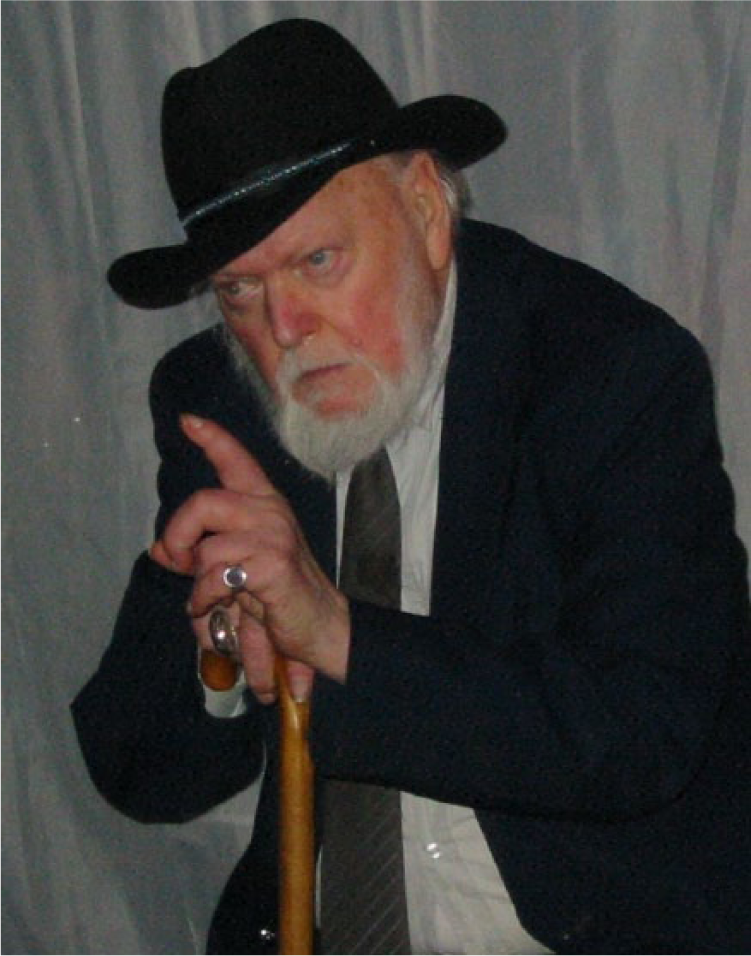
Monte introducing seXshunned at The Arches Glasgow 2004.
For the theatre professionals, simple confrontation was deemed more dramatic: we had to hold out to include the more subtle stories that do not always set up heroic outsiders against a homophobic establishment. Collaborating with professionals means knowing when to ‘let go’ (Jones, 2013: 15), a judgment that has aesthetic and ethical dimensions. As a recalcitrant group, we refused to let go on this point. The debate was worth it, our stories were included in preference to a stereotyped portrayal of a homophobic priest, and everyone could relate to the result.
While demands for aesthetic coherence and momentum led to some purely invented scenes, often the characters and their trajectories were composites based on different participant stories. For example, one contributor’s spoken story about meeting partners in the 1950s was re-worked as a dramatic monologue by another, and performed by a different actor. The original narrator was happy that he could still recognise himself in the production. At a further remove is the public view, where story and characters gain a life of their own.
While audience interpretation gives an additional dynamic to narration, where the contributors are the audience for each other the process may be both generative and productive of mutual identification, as noted below. Where storyteller and audience are distinct, others’ interpretations are often surprising. All interpretation involves filling in the gaps, and in some of our storytelling, we have deliberately left large gaps. At a workshop in 2009 at the Gallery of Modern Art in Glasgow, we developed a skeletal storytelling method (Figure 2). Skeletons are stories that give the bare bones of a life story, with perhaps the suggestion that skeletons kept in the closet are being given an airing. The story may span a short period or a lifetime, but in either case, the skeleton is outlined in a short series of stages, as in five factual statements in a sequence. When told a skeletal story, people will inevitably flesh it out, filling in missing details and providing links and explanations that may be quite at odds with the experience of the person who provided the original skeleton. In a sense life stories of whatever length are skeletal, as we can never tell it all, but a skeleton makes the gaps more apparent, and the creative interpretation of the audience more obvious. Others will always read more into a life story, and read it differently, creating a fiction of their own. This was more than simply amusing for participants: it revealed the assumptions of the other, the way that all performance and interpretation of self is composition, and the fact that things could have worked out differently. Everyday interpretive fictions revealed the contingency of identity.
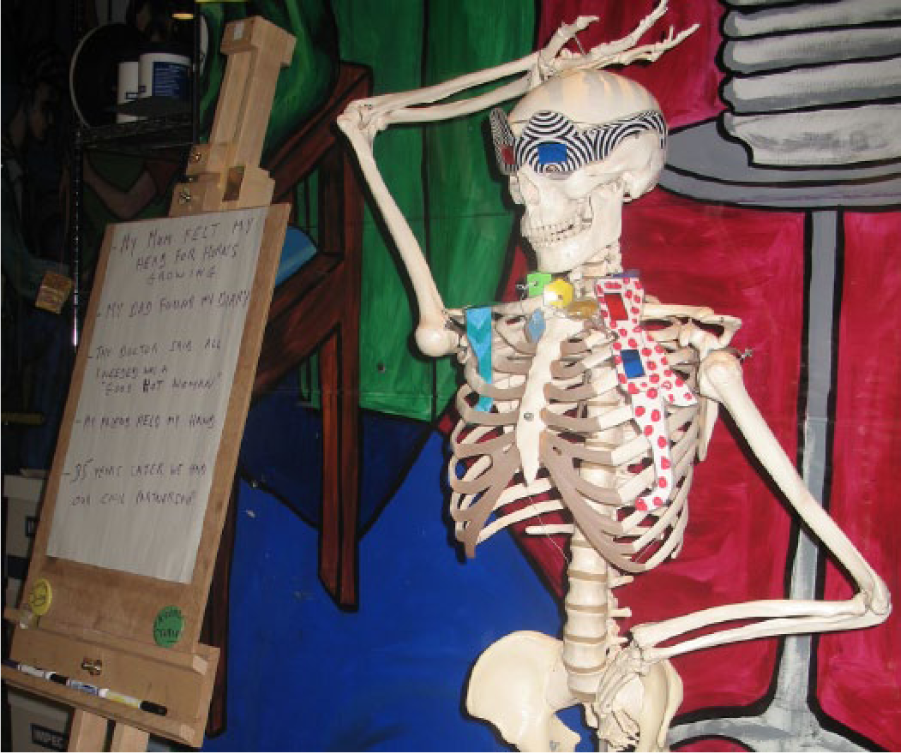
Skeletal story at Gallery of Modern Art Glasgow 2009.
One deliberately fictional storytelling exercise that encourages the exploration of contingency is where the contrast is made between actual and potential, what occurred and what might have been, what was and what if:
As a heterosexual woman, I kissed my girlfriend on the lips, not the usual peck on the cheek, but a soft, wet, sensuous kiss on her full lips … What if our boyfriends weren’t there. Would it have gone further? (Janette)
‘What if’ stories look forward to alternative futures from a point in an obdurate past and encourage us to consider how the intentional and the accidental might have changed our lives, our selves.
Deliberately false fictional storytelling was part of an experimental workshop we held on Valentine’s Day 2010 in Musselburgh. ‘Loves True and False’ worked so well that we incorporated it into our Love Out of Bounds project, described below. Each participant considers a true and a false story of love from their lives, and then tells these to the whole group, followed by the members in turn saying which they think is the true story and why. Although they were not told to see this as competitive, the participants interpreted it as a game in which winning means the group believes your falsehood and fails to spot the true story. In practice, this meant that individuals considered the assumptions the others were likely to make, and chose a true story that would be contrary to their expectations. Similarly, the false story was framed to coincide with what others presume of oneself, and was often a true story with a twist, a key fact altered to render it false. In this way, we tended to collect two true stories from each participant, an unexpected true story and a true story lying behind the false, and additionally revealed what we assume are others’ views of self, demonstrating how we relate to others in terms of our expectations of their expectations.
Innovative methods of storytelling, that include fictions true and false, have the potential to illuminate contingent identity and the way we relate to others. An aesthetic preference for confrontational dramas of life built on stark and static characters does not do justice to our untidy emotional lives (Brownlie, 2011), our moving stories of complex and contradictory selves that develop through and with others and via complicated journeys that could have taken many different turns.
Moving portraits
Telling your story paints a moving portrait. This is true even for apparently static depictions, where the self is claimed to remain the same, or is frozen in a snapshot of time. There is still a dynamic, often phrased as a discovery or journey:
My journey has been a fluid discovery of myself, claiming and rejecting identities, trying to find the one that fits best. Through that process I have come to realise that I have been, and therefore am, all of the labels, but mostly I’m just me. (Nick) It was only aged 17 where I actually realised that my attitude towards women was different to other girls. I felt a sense of love that was similar to the sense of love I had for men. People would often joke and poke fun at the ‘chemistry’ I had with one of my close female friends and it was then when I truly realised that I was bisexual, that it was a part of me rather than something just affecting me from the outside… it was the realisation of the affection with my female friend in early 2003 that could really be named as the turning point in my life and identity as a woman. (Hannah)
The use of turning points in relating one’s story is so common that it emerges as the single most popular way for participants to narrate – through key episodes that mark out plot development. This became formalised early in the storytelling project by providing participants with episode forms, which they could use to write about a significant moment or stage in their lives. This contrasts with soliciting a memory: the idea of personal retention may suggest memory as individual rather than social, with an implication of self consistency or coherence that is absent from episodes. Portrayals through episodes are moving in both senses (dynamic and emotional), as becomes even clearer in public storytelling where an episode or longer reflection on a life is spoken out: the narrative act moves, through timing, tension and tone. Speak out performances were enacted throughout the country, recorded for exhibitions, and culminated in a public storytelling ceilidh in Glasgow, reclaiming for a marginalised community the ceilidh tradition of music, dance and storytelling, while subverting its gender conventions.
The venue for the ceilidh was the normally austere Trades Hall, decorated for the occasion with episodes and images, along with giant portraits of the Nessie Girls (a group of gay and transgender women from Inverness). Colourful imagery encouraged vibrant performance, which in turn was recorded for video presentation at exhibitions. A reinvented legend of the thistle (Scotland’s national flower) in rainbow colours was portrayed in words and images, 6 episodes were displayed on rainbow-coloured paper, and participants could write the ultimate short story, the one-liner, on coloured labels to tie on a story tree (Figure 3).
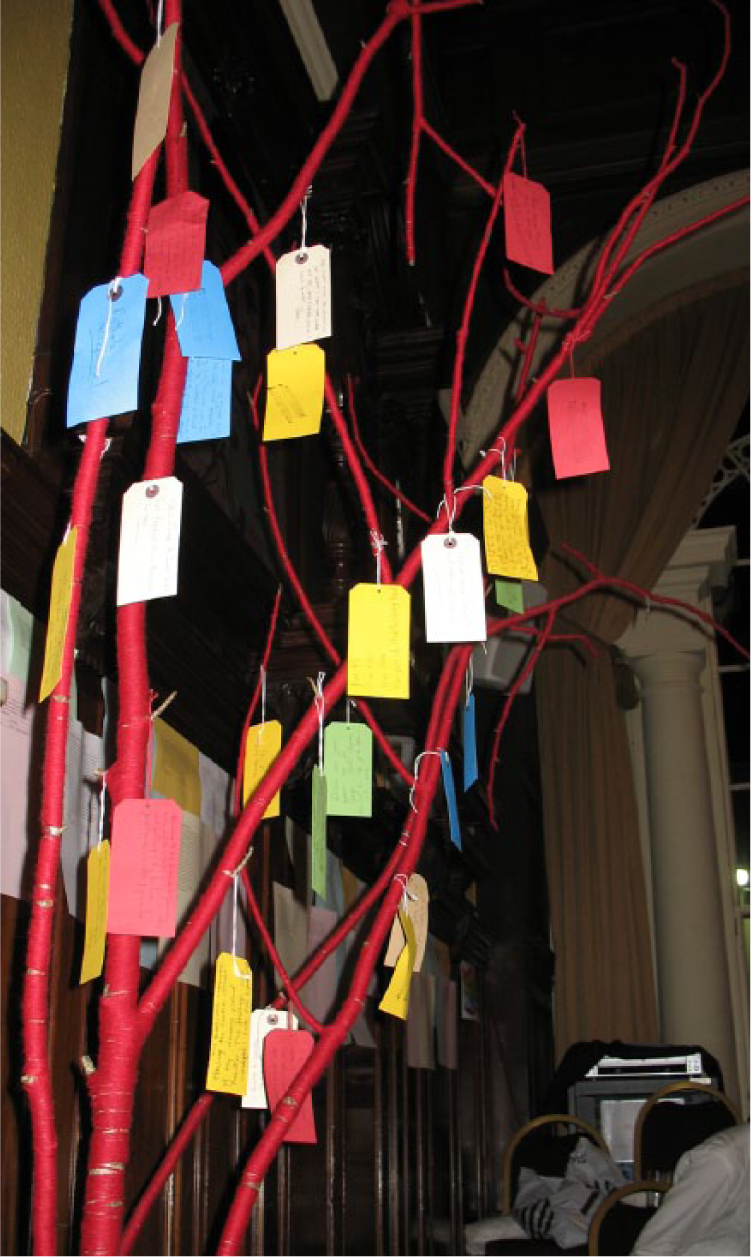
StoryTree at OurStory Ceilidh 2006.
Colour is also a feature of the purely verbal narratives, from the description of one’s sexuality through choice of colour in large-scale questionnaires displayed as an installation, to the colourful descriptions in written episodes:
At 18 I finally gave in to my true nature, and had my first gay relationship. It was as if the world had changed from black and white to colour. (Neil)
Visual imagery turned out to be so central to storytelling that it moved from being incidental to intentional. One way to encourage the depiction of an episode is to work with mental snapshots: time is given for the scene to be recalled in pictorial terms before being related through words. Verbal and visual storytelling can take their cue from each other. At Dundee Contemporary Arts, we explored this through episodes, leading to the construction of colourful prints, which in turn became the focus of retelling. Verbal extracts were writ large as Text Out (text taken out of a written episode and displayed in large colourful stencils in the style of Ruppersberg) with the full text beneath. Images brought to a workshop were re-worked visually and then retold verbally.
Further interactions between the verbal and the visual were encouraged through comic strips and mask-making. The comic strip or storyboard portrayed an episode in stages, or a sequence of episodes, to provide a moving portrait through time, which was elaborated not only through the words on the cartoon, but through the participant (as artist-cum-performer) giving a broader verbal context for the drawings. 7
Masks were painted at a workshop involving participants from teenage to 77 years. The implicit distinction between wearer and mask, contrary to the notion of ‘complete identification with the mask’ (Tseëlon, 2001: 21), was amplified by a common choice to divide the mask into two sides, left and right portraying different facets or depths of self, and in some cases to use the reverse too. The mask was then described verbally and video-recorded. Rather than speaking through the mask, almost all chose to hold the mask beside them in performance, increasing the distance for reflection on self-image:
web video extract – Video 1: Masks
Aesthetic distance
In creatively re-working the narrative of self, participants gain aesthetic distance from an unreflected production of identity. In evaluation of workshops and events, reference was commonly made to the supportive atmosphere that encouraged ‘sharing of stories’, the ‘exploratory nature of the process’ and the opportunity to ‘think about who I am’. These three aspects – sharing, exploration and reflection – reinforce each other in an informal learning process. 8 A sense of shared experience supports artistic exploration, that promotes reflection on identity, which in turn encourages the aesthetic representation of self and common identification through shared narrative.
One of the most effective venues we have used for storytelling is the OurStory Tent which we constructed for Pride in Aberdeen (Figure 4). The tent incorporated aesthetic distance through humour (Madame Hystoria, 9 a comic caricature, inviting you in to have your story told), through liminal space (an inside out, a public privacy), and through temporal shift to narrative memories (the fortune-teller and the pantomime dame). The support of displayed episodes from previous storytelling, and the encouragement of others sharing their stories, gave confidence for disclosing the confidential, for reflecting on similarity and difference, continuity and change.
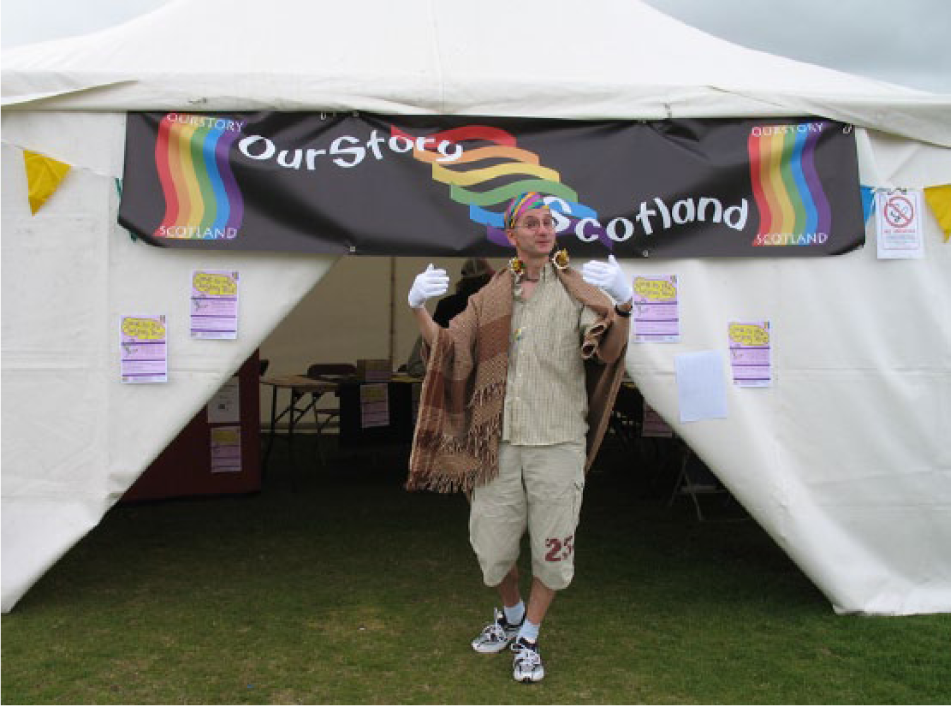
OurStory Tent with Madame Hystoria in Aberdeen 2006.
A reflective story, looking back on one’s life, already has a built-in distancing, which does not have to signify the rejection of past selves, nor a sense that one’s current identity has sole validity. This is most eloquently expressed in Nick’s episode, contributed in the OurStory Tent, in which he sums up his fluid identities as ‘I’m not that, I’m all that’. The episode has a visual reference, an envisaged framing of his two (female and male) birth certificates with Nick laughing at their inadequate attempt to proclaim who he is. This episode was subsequently followed up, taking Nick at his word and making the picture: a photograph of a laughing Nick framed by the two birth certificates. This picture was later on display when Nick performed his storytelling at the OurStory Ceilidh:
web video extract – Video 4: OurStory Ceilidh Nick
In visual storytelling workshops, several participants observed that they would not have been able to express themselves directly in words, but that the visual exploration had allowed them to reflect on their identity in a way that subsequently enabled them to speak out to camera, with the visual support of their artwork beside them. The mediated expression of identity took some of the focus away from self and provided the necessary distance for a public reflection. This distance may comprise several layers or stages, as the narrative is progressively re-produced through different art forms: a story may be encapsulated in a photograph that is refashioned in a series of cartoons or screenprints that becomes the focus for a video-recording of a spoken story.
Further aesthetic distance is provided where the presentation of self is a co-production. In visual representation, images may be taken and reworked by several different people. To express the multiple identities of Steph, a photo was taken during an oral history recording, and was later re-worked as a series of screenprints. Two groups of four were then displayed in Andy Warhol style to represent Steph’s identities in terms of gender and in terms of sexuality. The screenprints were then used by a different artist to make two lanterns, each with subtly different screenprints on its four sides. The mobile nature of the lanterns was captured by a video artist. Steph gave permission at each stage, was present at the opening of the exhibition where the lanterns were a central feature, and photographed them for publication on the web (Figure 5).
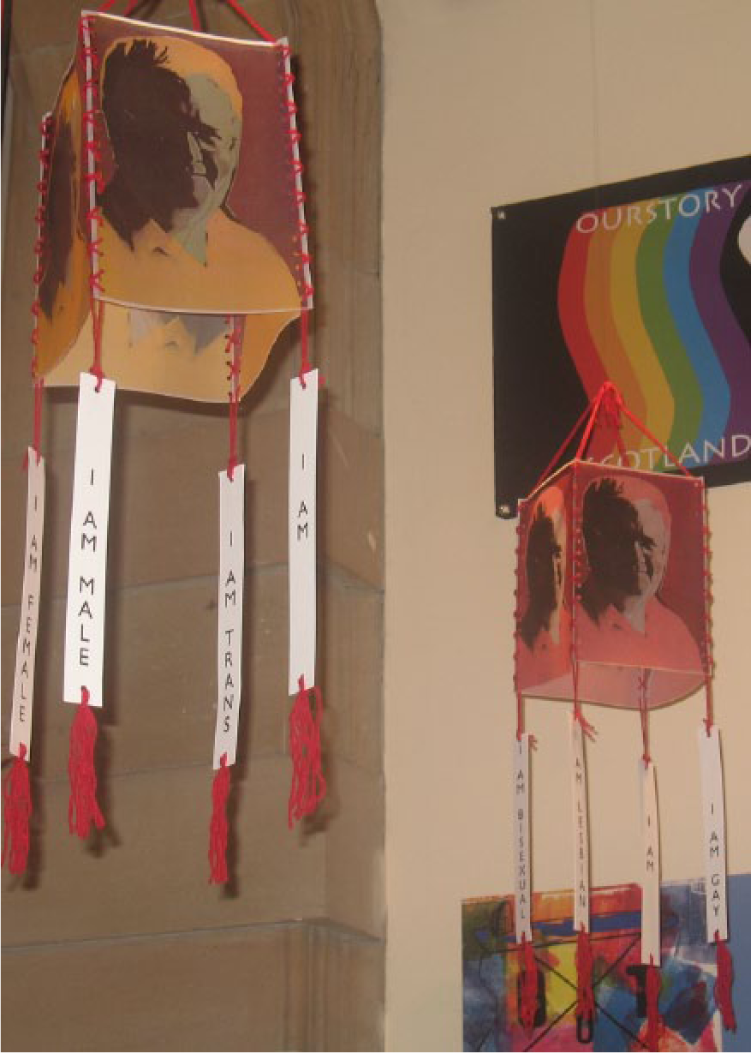
Steph’s Multiple Identity Lanterns.
Another example of the visual re-production of identity can be found in the Nessie Girls: photographs taken of gay and transgender women involved in oral history recordings in Inverness were used as the basis for an artist to create caricatures, 10 which were then seen and approved by the participants, before being projected by a different artist onto large-scale cloth prints that were used to subvert the austere atmosphere of the venue for the OurStory Ceilidh in Glasgow. One of the women spoke out her story at the ceilidh in the presence of her own giant caricature, just as earlier in Inverness several of the Nessie Girls had participated in group photographs and collective storytelling in front of the original caricatures.
Similarly, Kimie’s story, filmed as she spoke about the mask she had made at the mask workshop, later featured as one of the bare bones in a skeletal version of Kimie’s life story constructed by another participant (Figure 6). The life story was in turn represented visually through a large collage that included family photographs that Kimie had used to discuss her origins and attachments, and the skeletal life story was read out at a performance opening an exhibition that included the collage. The latter stages of this representation occurred after Kimie’s death, and for several members of the project, it was a way of marking a remarkable life.
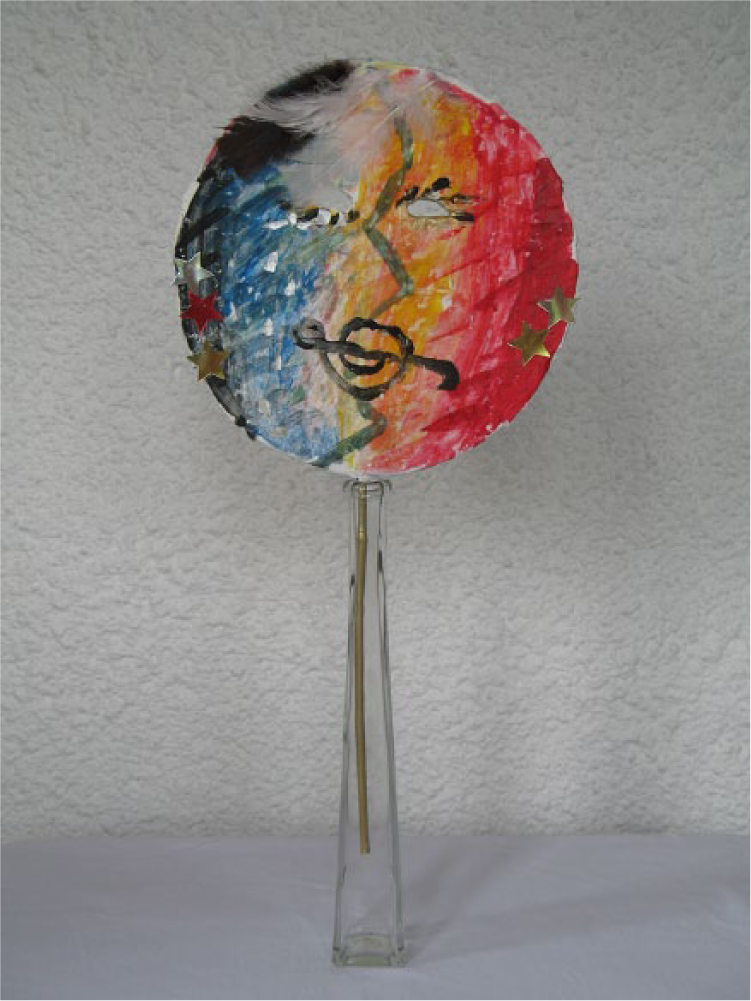
Kimie’s storytelling mask.
Verbal storytelling can also be a co-production. The story of one may be shaped by another and represented in public by a third. This occurred in several of our storytelling events. A quilt representing Lynne’s life was interpreted verbally by her bereaved friend, and performed in public by a different storyteller who did not know Lynne and who had the necessary distance to enable her to tell the tale without breaking down.
There are ethical questions that have to be addressed here: even where permission has been granted for use of a narrative, there is the danger that a story could be felt to have been stolen or misrepresented. Where the person concerned is still living, and where contact details are still available, their involvement or at least agreement at each stage is advisable. Some are understandably concerned to keep control over representation of themselves at all stages, and wish to be the one to perform any portrayal. Perhaps more surprisingly, others are happy to see transformations of their narrated identity in the work of others. Co-production of identity, reflecting the sociological reality that none of us is sole author of ourselves, contributes not only the aesthetic distance that encourages exploration but also the mutual identification of co-producers and audience.
Mutual identification
Mutual identification is a constituent feature of narrative exchange, where stories are swapped in a supportive atmosphere. In Dumfries, this took the form of listening to another’s narrative, one-to-one, and then telling it out to the group. The retelling provided both aesthetic distance for the original narrator and a sense that one’s story had made some connections, albeit through a degree of transformation that turned it closer to fiction. In Glasgow’s People’s Palace, the exchange began with each participant choosing an episode from a set, reading it out to the group, and commenting on why they chose this particular tale: the choice and explanation revealed identification across conventional boundaries of the LGBT community.
The potential of narrative exchange for community development, generating solidarities across divisions, can be further enhanced in intergenerational work. Workshops with LGBT Youth Scotland have explored their interpretation of materials donated for an LGBT reminiscence box 11 (Figure 7), and their reading of a selection of episodes without the conventional identifiers of gender, sexuality or age, so that participants could identify with people whose stories they might have assumed to hold no relevance for themselves. 12 A sense of the history of the community was provoked through attempts to place the episodes, clues removed, in a timeline. This helps the group to reflect on its assumptions about difference and change.
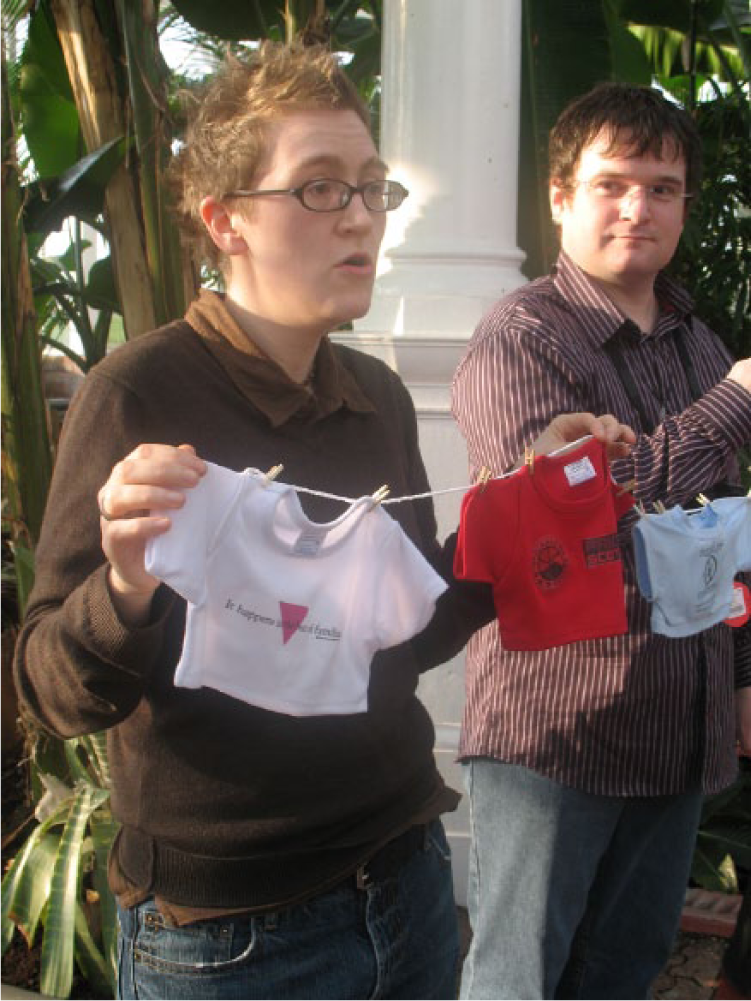
Reminiscence Box workshop.
Further workshops with LGBT Youth Scotland enabled participants to develop skills in digital storytelling for presentation in Our Vivid Stories. 13 In contrast to a scripted film directed by a professional filmmaker (Jones, 2013), the role of the professional filmmakers in Our Vivid Stories was to facilitate 11 young people, aged 16–18 years, in making their own multimedia movies, telling their stories in their own voices, illustrated by photographs, drawings and stopframe animations. Four of the young people went to accompany their movies when Our Vivid Stories was shown at the London Lesbian and Gay Film Festival 2010. The months of building confidence in the group, and the incidence of crossover whereby some participants appear in others’ movies, aided the process of mutual identification and ownership.
The composition itself may be generated as a group product. In a collage workshop in Glasgow in 2010, a group collage was constructed in addition to individual ones (Figure 8). In a music and poetry workshop, 4 months earlier, participants created a group poem composed of phrases from each participant: in later public performance of stories at St Mungo Museum, the lines of the poem were spoken in turn without assigning to performers their ‘own’ line, just as stories were read out irrespective of their origins, as the performance was a shared creation with which all could identify, relating to each other (Figure 9).
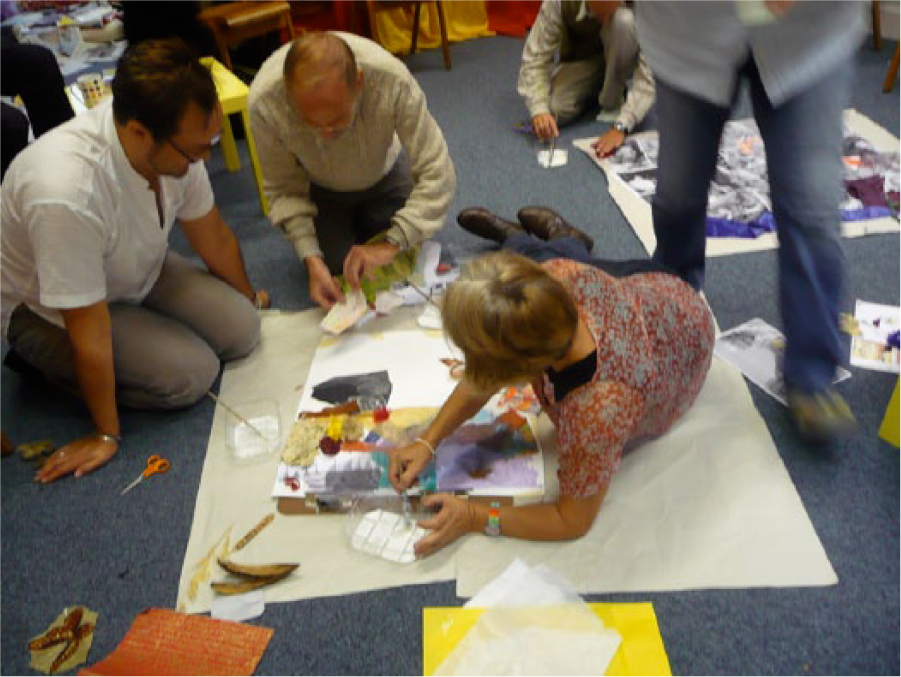
Collage workshop Glasgow 2010.
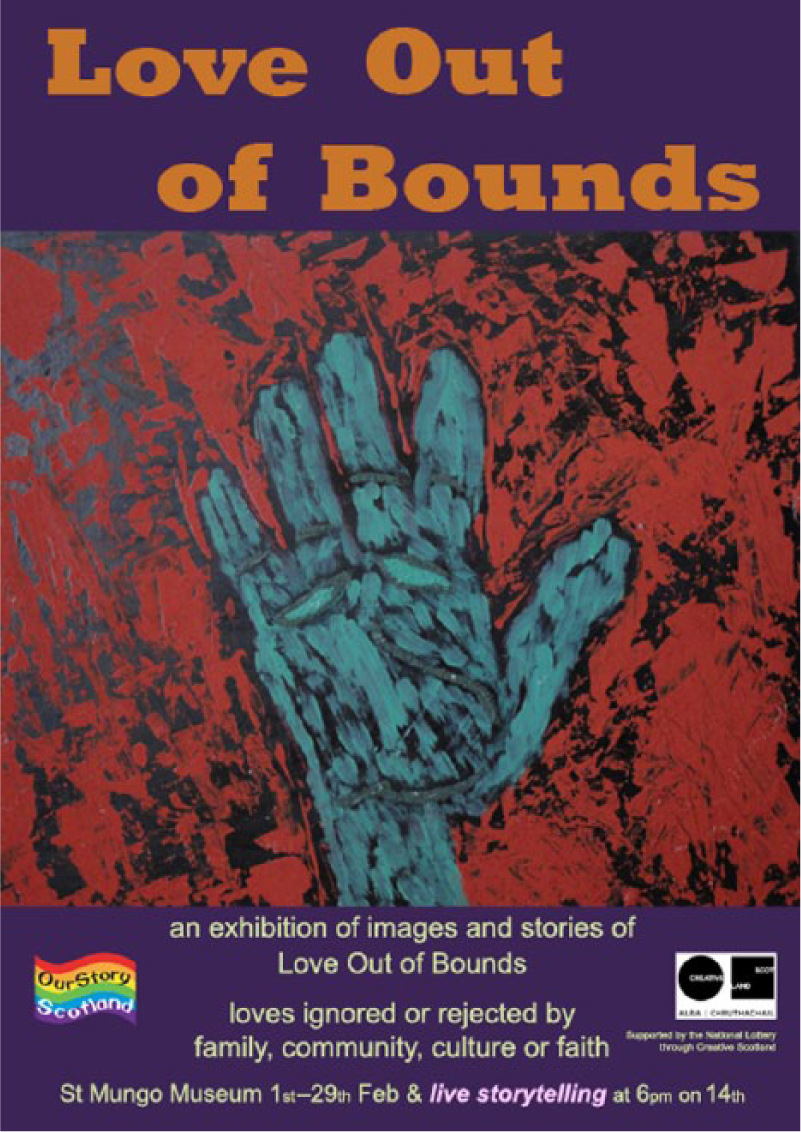
Poster for Love Out of Bounds at St Mungo Museum Glasgow 2012.
The need for community support can itself generate mutual identification that builds bridges. In larger cities, the LGBT community may be fragmented into particular identities that are thought to have little in common with each other, but in smaller cities or with a more dispersed population these fragments may be too small to subsist or too isolated to be effective. In the Highlands of Scotland, with Inverness as a focal point, diversity has been seen as a strength rather than a problem, and cross-boundary connections are made that have surprised those in larger cities. In a study of a support group for Vietnamese American lesbians, bisexual women and female-to-male transgenders in Los Angeles, Masequesmay (2003) found that ‘managing diversity within the group becomes a dominant theme of group interactions’ (p. 196) and that a hierarchy is constructed that centres on lesbians and thereby marginalises bisexual women and transgender men. The Nessie Girls in Inverness have shown a different pattern, summed up in their cleverly selected group name that hints affectionately at making fun. Humour is a common device to deflect the potential hostility of others. The Nessie Girls brought together gay women and transgender women in an exchange of stories, a display of caricatures, and public storytelling in front of the display. Mutual identification was thus furthered through their collectively chosen name, joint display and shared storytelling that balances the common and the particular.
In storytelling workshops in Inverness and Dundee, the collective support among participants was extended outwards in a vision of Supporting Stars, depicted in two-dimensional delineations or three-dimensional mobiles. In contrast to the family tree, that hides or excludes so many LGBT lives, Supporting Stars show radiating lines with the self depicted centrally or as the omnipresent source that gives significance to the mapping of support. This was a deliberate attempt to portray friendship and support networks that have been overlooked or discounted through heterosexist assumptions, and the Supporting Stars were celebrated not just visually but verbally as participants spoke out about the invaluable connections they had portrayed.
In portraying self with others, we are constantly redefining ‘us’, reconstructing ourselves and the boundaries of our community. This is especially significant for LGBT people, who have so often been portrayed as tragic lonely characters or odd figures of fun. For this reason, our oral histories, dramas, storytelling performances and visual depictions have represented couples and groups that show mutual identification beyond the bounds of singularity.
Community ethics
Storytelling has profound implications for collective representation and community development, and this constitutes one of the principal motives for participation on the part of storytellers and of the volunteers who collect, archive and present the stories. It is not just the ethics of results, the ‘final’ product, which is the issue here. The process of production, which is always a co-production, has implications for how the community sees itself and the pride it can take in its narrative heritage. Most of our workshops have been defined from the outset as collective ventures, whose products would belong to the collectivity (for public representation and archiving) rather than to separate individuals. Individual attribution may be desired or shunned, appropriate or irrelevant, but whoever the nominal creator, the work belongs to all and is donated to help form OurStory.
The ethics of collective production also have implications for the role of the artist. A professional artist may be one of our voluntary storytellers, in which case they participate on the same collective basis as others, but where they are given a special commission or an organising or curating role, even though individual attribution and acknowledgement may be made, the work is still conceived as collective in production and ownership. Artists who work with us know this in advance and operate generously on this basis, for the artistic activity and heritage of the community.
Community ethics for researchers were developed early in the project, partly through the resolution of a potential conflict of interest. Our website had included areas of private research, and the boundaries between the collective and individual were unclear. Through negotiation, it was resolved that any exclusively private research was removed from the collective website, and that all material presented to OurStory Scotland for the website was done so on the basis that the Charity was granted an ongoing right to publish: while attribution is sometimes individual, publication by the collective is always permitted. 14 This acted as a model for other work presented to OurStory Scotland, and helped to shape and reinforce its community ethics, which in turn would attract further like-minded volunteers.
Community ethics are not just a principal motivation for participation, but are built into the constitution of the charity with reference to community development, heritage, education, welfare, equality and diversity. Ethics are thus at the heart of the storytelling, and are conceived as positive purposes, rather than hurdles to be surmounted via an ethics committee set up to assess risk of negative outcomes. Storytellers in the LGBT community, who have had experience of the benefits and dangers of disclosure, are apt to be aware of the balance of contributing to an artistic process and heritage, versus the risk of making the vulnerable even more so. This balance is often removed from the remit of ethics committees, that act as moral guardians dominated by the concerns of dangers to safety. Ethics committees are rightly concerned that professionals and researchers should not benefit at the expense of the subjects of study, but their establishment may be part of a risk aversion strategy dictated by fears of litigation, rather than conceived in terms of a balance of moral choices where the individual or community is able to make its own informed decisions on ethical questions, benefits and risks. Ethical deliberation is thus conventionally framed in terms of avoidance rather than achievement, risk rather than benefits, the privatised individual rather than an evolving community.
This is not to imply a rosy cosy view of community. Some of the stories we have collected make reference to rejection, that may come from within as well as outwith the community, especially where ambiguous roles challenge preconceived boundaries:
I started hearing comments from people I thought were my friends: ‘bisexuals are just greedy’ (Rose)
Yet through the inclusive process of storytelling with the LGBT community, there has been a growing recognition of diversity and fluid boundaries that in turn has encouraged further storytelling that reveals identities that do not conform to neat boxes, and instead form part of a differently conceived family or community:
Family is an increasingly fluid concept in our society but this in no way diminishes its importance … we form a network of friends which in many ways gives (to my own feelings) an even better means of support than the conventional family, being founded on equality, mutual respect, shared values – and sense of fun! When these values are all that really matter, our family is one of great diversity so there is a culture of constant stimulus and challenge. (David)
Relating further
In a conference presentation of the work of OurStory Scotland, a question was asked about how heterosexuals could get involved in this kind of storytelling. In one sense that is not our responsibility, which is to rescue the neglected narratives of the LGBT community – stories that have been distorted or ignored partly through the predominant assumption of heterosexuality:
It was the first time that people looked at me and didn’t assume that I was straight. (Lex)
Yet, while heterosexuality is a dominant discourse, it is commonly unreflected, and an impregnable boundary around our storytelling would be counter-productive, as it would not challenge what is taken-for-granted as both normal and natural. Collective identities can empower but can also entrap, and the strategic tactic of identity politics may end up confining us within a new oppressive norm, as ‘the principle of exclusion is built into these collective identities’. (Speck, 2001)
Heterosexuality is already involved in our storytelling, and not just as the contrasting other, but as supporting stars or still further as part of ourselves. Haber recounts trying to explain to his parents the nature of his relationship with his partner, without putting a label on it, just as in a drama workshop he had earlier declared no-one single identity:
My mother interpreted my explanation in terms of her Christian concept of universal love for all men. My father said it was nothing new – he had had a good friend in his younger days. Although neither had really understood my explanation, at least they had tried, in their own way, to understand me. But they had understood enough – from then on they supported me and my partner, and Mum never mentioned again about getting married. (Haber)
Jenny similarly remembers her many sources of support:
I am continually surprised by the positive support I have and receive from my straight friends and colleagues … we laugh together through the difficult times in our lives. (Jenny)
Our stories reveal not only a community with straight involvement, but paths that wind through heterosexuality:
Realising that it was ok to feel attraction to women after many years of marriage, motherhood and heterosexuality. Allowing myself to act on these feelings. (Ann)
Many of our contributors have identified as straight for part of their lives, and many have connections with others whose sexuality is irrelevant or unclear:
I’ve known her for years, and I’m sure she’s straight – but who cares? – no-one should be boxed in and labelled – pride is open to all persuasions! (Jim) She said she was straight but everybody is bi … She told me later that she was bi but more gay and that we are ‘special’ friends. Since then we have become even more close and although we are not seeing each other we love each other very much and more than friends. (Sarah)
While some of the stories of lesbians and gay men refer to gender ambiguity, for some transgender people moving between genders can mean moving into or out of heterosexuality: as heterosexuality incorporates difference, a change of gender can mean you move across the definitional boundary that separates same (homo) from different (hetero).
Even where there appears less ambiguity or transgression, ostensibly contrasting sexualities share many of the same life experiences. This includes family life, where prejudice may touch those close to us:
Parenting is the same whether you’re gay or straight, it is just sad that there is prejudice which our children experience also. (Marion) I have always seen my parents as the archetype of heterosexual couples: married for years, two children. My views came to a sudden doubt and uncertainty when I heard my mother saying to my partner that she had ‘beautiful eyes’. Beside the feeling of uneasiness that this created, I realised that I had never before even envisaged that my mum could potentially be a lesbian. What if she was? I always assume that I cannot decide people’s sexuality but in this very instance I realised that I had strong prejudice against my own mother. (Nathalie)
The only heterosexuality that would fail to engage with our storytelling is the exclusive stronghold of ‘normality’, unquestioned, naturalised and imposed, a dominant frame that precludes identification with the common humanity of our stories. For there is so much with which to identify. Who cannot identify with love lost and found, with escape attempts from the straitjacket of gender, with secrets hidden and shared, with support from surprising sources, with a first kiss, with hands held in special friendship?
Heterosexuals are involved in our storytelling not just as part of the LGBT world, and through identifying common experiences, but also as storytellers themselves, often made more reflective of their sexuality and its borders by being framed as outsiders in a predominantly LGBT storytelling context. Jose recalls her liberal Spanish mother’s attempts at border control:
Although she was very liberal, and against the prevailing dictatorship of Franco, she worried about my unconventional ways and friends. She herself had very unconventional friends, many of whom were artists. Yet she worried that I was a bit too wayward myself and she wanted to keep me in a frame. (Jose)
Straights have been included in our larger storytelling events and exhibitions (Figures 10 and 11), at least as viewers 15 and often as participants, though actual numbers are unknown as we do not perform gender/sexuality ID checks. In preparation for our exhibition RoundABout, 16 workshops were held in unorthodox settings for creating art: bars and clubs that are ‘mixed’, which means that they cater for an LGBT and straight clientele, as is typical of ‘the scene’ in Aberdeen. Artworks included storytelling using graffiti and racks of white dinner plates displayed at the large windows of the venue, that fronts onto a busy shopping street in the city (Figure 12). Large format questionnaires in the exhibition revealed people’s selection or rejection of identity labels, and their choice of colour to describe their sexuality.
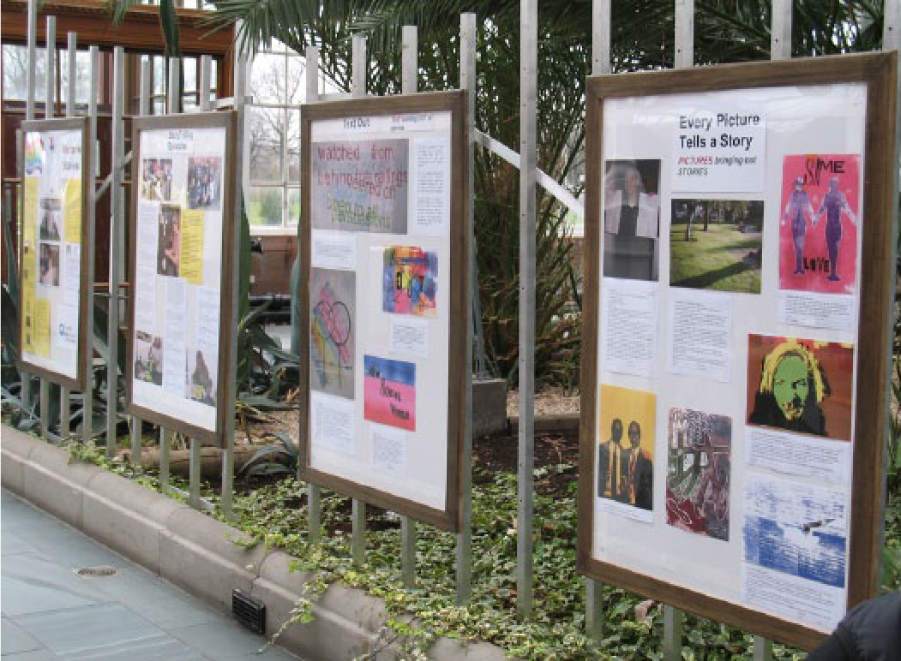
Display at People’s Palace Glasgow 2007.
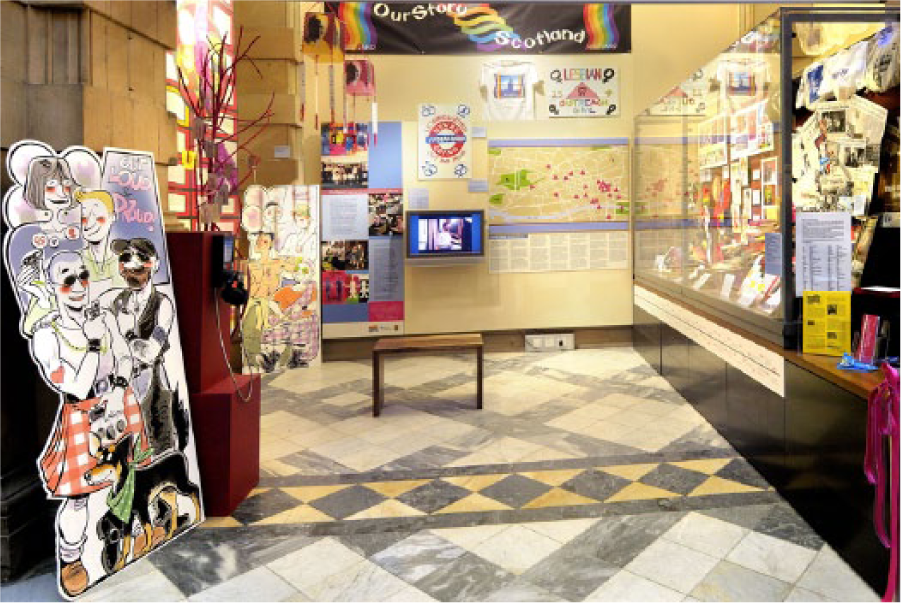
OurSpace exhibition at Kelvingrove Museum Glasgow 2008.
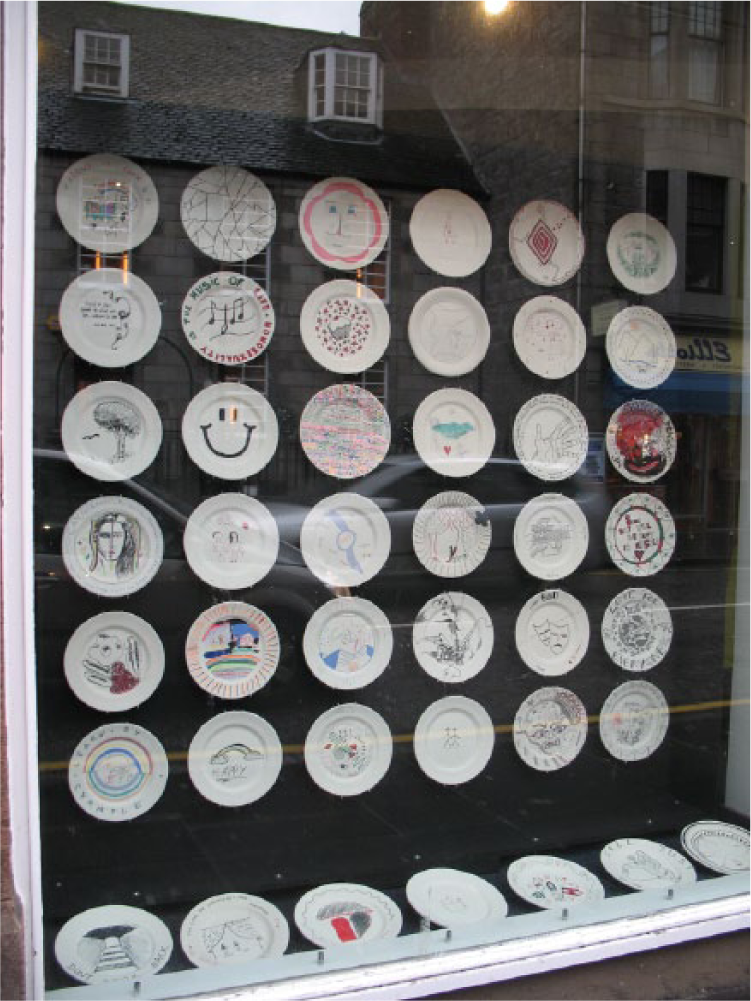
Display of painted dinner plates for Round ABout exhibition Aberdeen 2008.
Love Out of Bounds, our most recent project, crosses the boundaries between communities and brings us together to share stories of loves untold. We find common ground between straight and LGBT people, and people from majority and minority ethnic communities, as participants relate their stories of love ignored or rejected by their family, community or culture. 17 A story of coming out as lesbian to Grannie, a gypsy traveller, sparks memories in another participant of her Jewish mother’s warning tale of what can happen if you go off to live with a man in a caravan. A woman from a polygamous Pathan background tells that she had the love of two mothers, which finds echoes in a Japanese woman’s account of the love of two fathers: her legal father and her mother’s lover. The story of an Afro-Caribbean Scottish man, whose relationship with his Pakistani girlfriend had to be kept invisible for fear of shaming her family, contrasts with the depiction of a Ghanaian mother’s acceptance of her children’s partners through boundless love ‘smoothing differences, engaging changes’.
Heterosexuals as outsiders in an LGBT context may find it easier to recognise contingent identity and to relate across boundaries, just as there are potential links between the LGBT community and other marginalised groups. Here, we may witness some surprising boundary transgressions. Gary, remembering his schooldays in Northern Ireland at a Protestant School, recounts his sexual encounters with Robert, who makes it clear he is ‘no poof’ and even gives out leaflets to Save Ulster from Sodomy. To counter this, Gary crosses a different boundary:
I sort of got my own back by joining in a paint bomb attack that some Catholic boys from the neighbouring Christian Brothers school launched on the Save Ulster from Sodomy stall. (Gary)
Members of other marginalised communities may see parallels with a common outsider status, and can draw on the range of storytelling methods that have been generated by this project:
18
I’ve always related very well to gay people – is it because I’m a mixed race woman, I relate to being an outsider in society, and being called names, and of course also being a victim of racism and prejudice myself. (Tesesa)
A storytelling project that develops innovative methodologies to engage with a diverse range of participants can reveal the contingency of the in/out opposition: anyone can be inside or outside depending on the definition of the frame. Being an outsider may furnish a built-in reflection that not only makes for good storytelling but can liberate us from the fixed frame of identity. This gives outsiders the edge over an unreflected straight standpoint but, as we have seen, even dominant identities can be revealed as provisional and context-bound, reliant on others in the definition of self. Storytelling, through aesthetic distance, mutual identification and inclusive community ethics, can foster awareness of the contingency of all identity: with Nick and Haber, we can say we are all and none.
Footnotes
Acknowledgements
This article has had the benefit of the comments of Julie Brownlie and two anonymous reviewers. OurStory Scotland storytelling has been undertaken with the help of numerous volunteers, artists and museum personnel, and with substantial awards from Creative Scotland, formerly Scottish Arts Council. OurStory Scotland, established in 2002, is a registered Scottish charity (no. SC035729: Scottish Charitable Incorporated Organisation) dedicated to collecting, archiving and presenting the life stories and experiences of the lesbian, gay, bisexual and transgender community in Scotland: 
Declaration of conflicting interests
The author(s) declared no potential conflicts of interest with respect to the research, authorship, and/or publication of this article.
Funding
The author(s) received no financial support for the research, authorship, and/or publication of this article.