



Abstract
This paper explores the benefits and possibilities of using recorded sound as a tool for expressing the stories behind photographs for archival purposes through an ethnographic study of Lest We Forget (LWF), a grassroots initiative that documents and explores cultural memory pertaining to the United Arab Emirates. The goals of this paper are to further the dialogue about the value of transdisciplinary research toward the end of greater preservation and sustainability of cultural heritage; and to make an argument about the value of community members creatively responding to photographs, and archival materials from their own culture, using sound. What I have found is that creative response is a theory of knowledge that allows a community to retain ownership of their heritage and their imagination of the past, present, and future, and an emerging methodological process that, when used, ensures a living archive.
Keywords
Introduction
This paper explores the benefits and possibilities of using recorded sound as a tool for documenting and sharing memories and stories, through an ethnographic study of Lest We Forget (LWF), a grassroots initiative that documents and explores cultural memory pertaining to the United Arab Emirates (UAE). Sound, specifically oral history and recorded memory, have the capacity to re-presence historical moments and events for a listener, supported by the unique sonic characteristics captured through memory recall of personal emotional events. Creative projects developed from sound recordings of oral histories are important to the preservation and dissemination of cultural heritage, intergenerational understanding within communities, and the development of modern-day archives. The process of developing sound based creative works can uncover new knowledge about a community’s cultural heritage, as well as new ways artistic research can contribute to developing a collection of community memory. In this paper I will discuss the distinctive methods of collection and analysis applied to the recorded oral histories of the Lest We Forget Project and look at the literature that ties recorded sound and creative response to ethnographic research and archives. This paper will consider the role of artistic research and practice for the development of new knowledge in the preservation of cultural heritage, through an exploration of the collections and exhibition approaches used by the Lest We Forget Project.
This paper is based on research conducted of the Lest We Forget Project from 2011 to 2016 in Abu Dhabi, the capital of the United Arab Emirates. The development and collection of Emirati cultural heritage through LWF, entails a fusing of artistic practice alongside traditional archival techniques. Photographs, objects, and oral histories are contributed to the collection by Emirati families, then become the inspiration for the development of creative responses, made by the all-female LWF team comprised of university aged Emirati student interns, staff, and their Creative Director. The creative responses are placed alongside the original objects, photographs, and ephemera used to inspire their creation, and become the material that fill the pages of the art books published by and about the collection, and exhibition spaces curated by LWF that aim to bring the collection to the public. The focus on developing a cultural heritage collection using creative response, facilitates inter-generational exchange where university-aged students retell the stories of their parents and grandparents through creative translations, while maintaining important cultural values around family privacy.
Lest We Forget was born out of a Zayed University class project, developed by Dr Michele Bambling, who was the Founding Creative Director of LWF. Dr Bambling was Assistant Professor at Zayed University Women’s College, one of the National Universities of the UAE, teaching curatorial practices and visual art. The National Universities are sex segregated and admission is free to Emirati Citizens. Dr Bambling asked her female Emirati students to bring family photographs into class as part of an assignment. Many students expressed their families lack of comfort at the idea of sharing images from home albums, which led Dr Bambling to assign students with the task of having discussions with their parents and grandparents about the photographs and the traditions, cultural practices, and events they capture (see Figure 1).
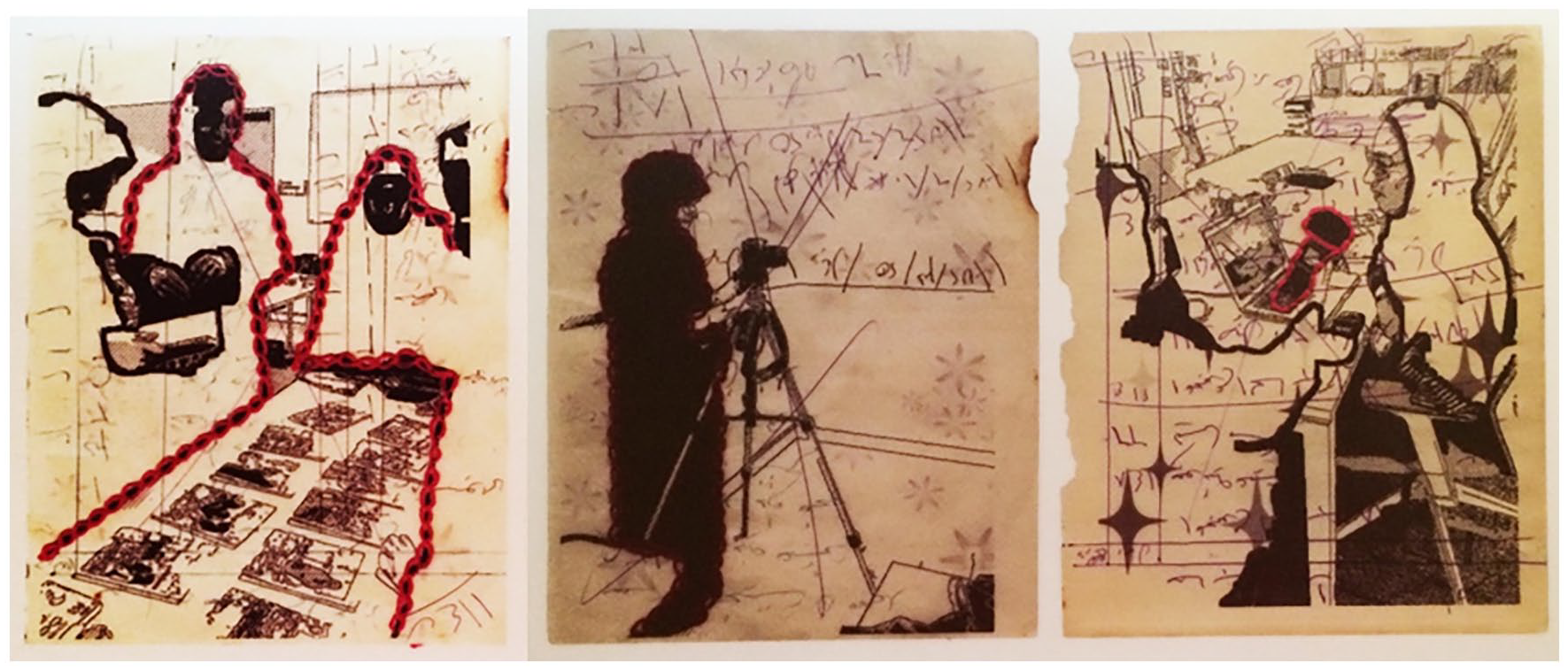
Zayed University Student’s experimenting with creative response for CACE Gallery Exhibition.
The students conducted interviews with their family members about the stories behind the photographs and brought those stories instead of the photographs into the classroom. Class discussions were dominated by exploring their family’s privacy concerns and uncovering the information contained within the vernacular photographs. The interviews the students conducted captured interesting stories, trends, memories, and history of their individual families and the history of Emirati culture. The students discussed their experiences interviewing their families and the privacy concerns that caused difficulty in doing the project. This classroom project became the inspiration for the development of creative responses, a translation of family memories into digital narratives, audio recordings, films, digital imagery, and games. To date, the LWF team has developed and opened eight exhibitions, published five books, begun a national archival collection, and held hundreds of workshops and talks organized around the themes of national identity, vernacular photography, culture, ephemera, adornment, architecture, and heritage in the UAE.
In March 2013, the exhibition Lest We Forget: Emirati Vernacular Photography 1950–1999 was installed, by Dr Bambling and her students, at Zayed University’s CACE Gallery where it gained publicity and exposure in the community. The project received backing from The Sheikha Salama bint Hamdan Al Nahyan Foundation, and Dr Bambling was invited to be creative director of the project.
My involvement in the LWF project began in 2011 and extended to the middle of 2016, while I was living in the UAE. I worked with LWF as a contributing artist, educator, and collaborator, teaching workshops, mentoring, providing technical guidance for the collection development, digital preservation, and metadata documentation, and I aided in the development of content and design for parts of a web-based collection. My most public facing contribution to LWF was the design, curation, and content development for the sonic narratives room of the 2015 Emirati Family Photographs 1950–1999 exhibition held at Warehouse 421 in Abu Dhabi.
Emirati society
In 1971 when the seven Trucial States—Abu Dhabi, Dubai, Sharjah, Ajman, Um Al Quwain, Fujairah, and Ras Al Khaimah—unified under the first president of the UAE, Sheikh Zayed bin Sultan Al Nahyan, the total population was 272,211. According to the UAE’s Federal Competitiveness and Statistics Authority Census data from 2005 (FCSA, 2005), the total population of the UAE in 2005 was 4,106,427 and of that, the Emirati population of the UAE was 825,495—making the Emirati population roughly 20% of the overall population. According to the World Bank, the population of the UAE as of 2018 was 9.63 million. The UAE has undergone rapid modernization over the last 50 years; prior to which, the people living in what is now known as the UAE where largely nomadic and semi-nomadic Bedouin communities. In the Bedouin tradition, tribes settle in one geographic area and then move together as a community based on factors including the climate, access to water, and time of year.
Presently the UAE’s main source of wealth is its oil reserves, which have supported the countries rapid development and modernization. The leaders of the UAE have invested heavily in the country’s development through a documented trend of bringing foreign workers and expertise to projects in the UAE. This includes the development of vast infrastructure systems throughout the country, including power and water; planned urban development projects, new architectural feats; aviation development; the targeted growth and development of industries including hotels and hospitality, hospitals and medical systems, and more recently educational and cultural organizations. The LWF project is documenting this very fast and dramatic shift from Bedouin society to globalized metropolis at a critical moment in time when culture and heritage is a focus for the government, and the oldest living generation of Emiratis can still remember the Bedouin lifestyle, customs, and traditions.
Methodological approaches: Artistic research and digital ethnography
I am interested in the ways digital media practice, ethnographic research methods, and the theoretical dimensions of culture and preservation sit together in this project, and what we can learn from the intersections, synergies, and outcomes of this work. For example, consider the transdisciplinary aspects of the project, specifically the role played by creative practice and digital technologies including the impact on the sustainability and preservation of cultural heritage. Through an exploration of the techniques used by the LWF project, with a deep dive into the work I was most involved with—bringing recorded sound of oral histories and storytelling into the project—I will discuss the creative methodologies used by the LWF project, and the digital ethnographic methods I employed in analyzing their work that informs the findings in this paper.
Investigation into the LWF project raises questions across the disciplines of digital media studies, ethnographic studies, archival studies, and creative practice. As a result of its transdisciplinary nature, it is difficult to find a single methodology through which to explore and analyze the project. A disciplinary methodology could limit a comprehensive exploration of the knowledge produced by this work; in that it would necessarily omit contributions outside its scope. In order to find appropriate methods for this research, I identified key areas within each of discipline and then looked for the points of overlap. There are several scholars currently working to develop methods that connect varying combinations of two of the disciplinary frameworks-digital media, ethnographic research, arts practice, and the archives. These include Parikka’s (2013) work in media archaeology, Foster’s (2004) work in bringing art into the archives, Sterne’s (2012) and Labelle’s (2015) work on sound culture, Pink et al.’s (2015) work in digital ethnography, and Dombois et al.’s (2012) work on artistic practice as research, to name a few. However, I haven’t found research that clearly states a connection between all these areas.
The hermeneutics of disciplines are different; as a result, it can be challenging to see the interconnectedness of research analyzed using different hermeneutic frameworks. Developing research projects that are multidisciplinary from the outset requires thought into how best to analyze research. In this way, the creative practice research of the LWF project serves to challenge different epistemological and hermeneutic approaches to research and analysis, and the findings of this project serve as an opportunity to create new knowledge, as well as modes and methods of thinking about this type of work.
My analysis of the LWF case study is largely rooted in a digital ethnographic methodology, which looks at ethnographic practice in a digital media arena. This methodology allows for a synthesis of findings in archival, ethnographic, and digital media domains. It does not however lend itself to the creative practice aspects of the project, for which I employ an artistic research methodology that allows for the unpacking of the creative practice elements of LWF, and discovery of areas of knowledge making that cross the disciplinary and methodological thresholds.
Formative work exploring the impact of the digital on ethnographic research, took shape mainly in the fields of Sociology and Anthropology. Scholars of digital sociology explored transformations in digital media that resulted from the “digital age,” see for example, Turkle (2005, 2011) who writes about the impact technology has had on human relationships and socializing, and Robinson and Halle (2002) who write about the extent to which technology and specifically digitization transforms the ways people engage with and access the arts. Digital Anthropology took shape in a similar fashion, with scholars interested in how approaches to using digital media impact ethnography, including the use of mobile phones, social media, and networked community activism. See for example, Gershon (2010) who conducts an ethnography of Facebook and other new tools her students used to end relationships, and Geismar (2013) who researches the way digital technologies, catalogues, and representations are altering our museums. And I would add to this list, LWF’s publications on vernacular photographs, adornment, architecture, and Sheikh Zayed, all of which use creative response to traditional archival materials as an approach to collections development and a way of sharing the archive back with the community.
This research focuses on the development of a vernacular photography and memory collection, Lest We Forget, about a young nation that has undergone dramatic change over 50 years. Much of this change is connected to a globalizing world, technological revolutions, and the rapid loss of culture and tradition as modernity has taken hold. In Virtual Ethnography, author Hine (2000) offers a discourse about the consequences of the digital world on ethnography as well as the new areas of consideration and inquiry brought about by digital innovation. Pink et al. (2016: 1) defined digital ethnography as an approach to doing ethnography in a contemporary world . . . [it] also explores the consequences of the presence of digital media in shaping the techniques and processes through which we practice ethnography, and accounts for how the digital, methodological, practical and theoretical dimensions of ethnographic research are increasingly intertwined.
Using a digital ethnographic method, I have analyzed the LWF collection to understand how the data speaks to a rapidly modernizing Emirati society, as well as the relevance of the digital world on the collection’s existence. And I consider the role played by millennial members of Emirati society who have employed digital media tools and practices to grasp an understanding of the analog cultural practices and traditions of their parents and grandparent’s generations.
The LWF Collection relies heavily on creative practice as a means of re-telling and disseminating stories of Emirati culture and memory. LWF employs artistic research methods in the development of their collection and exhibitions, and the project heavily utilizes creative practice techniques. In the introduction to Artistic Research: Charting a Field in Expansion, editors De Assis and D’Errico (2019) attempt to define artistic research by explaining that it happens where art and academia intersect, and that this type of research places materiality and processes at its core. They describe artistic research as “operating within a transdisciplinary horizon of practices . . . situated beyond classical disciplinary partitions” and explain that artistic research “happens concretely at the level of specific artistic practices” (2019: 1). They offer the following definition, “artistic research de-scribes a particular mode of artistic practice and of knowledge production, in which scholarly research and artistic activity become inextricably intertwined” (De Assis and D’Errico, 2019: 3) . Artistic research warrants a fundamental questioning of the role of traditional disciplinary boundaries and sense making, while placing importance on redefining these same things. Within LWF we see Assis and D’Errico’s definition of artist research applied to the archiving of cultural heritage.
When this project began, I thought ethnographic methods would be a straightforward fit for LWF and considered the oral history recordings made by Emirati students as both a part of the research on Emirati cultural heritage and as material to be used in developing creative materials for the Lest We Forget Exhibition. However, in this project, ethnographic research and artistic practice are placed so closely in relation to one another that their boundaries become blurred making it necessary to find a framework for looking at these two parts together. I looked outside of and beyond the footholds of the individual disciplines of Ethnographic Research and Creative Practice, in order to find scholars who are disciplinary boundary crossers. These scholars place disciplines with limited scholarly overlap in conversation with one another. A good example is the work of Samuels et al. (2010) in “Soundscapes: Toward a Sounded Anthropology,” where the authors speak about the relationship between anthropology and soundscape.
It is our hope that by tracing the genealogies and histories of the concept of the soundscape we will promote such attention and enable anthropologists and other scholars of culture to engage the full potential of sound—and in sound—for the theoretical project of anthropology. (Samuels et al., 2010: 340)
The authors consider the relationship between the soundscape and anthropology to be mutually beneficial, whereby a focus on sound allows anthropologists to uncover historical relevance through a sounded context; one that they may have otherwise overlooked. The authors also write about the historical relationship anthropologists have with sound as a tool for research, particularly in the form of field recording, which has often been devalued.
A multi or transdisciplinary approach to inquiry and investigation is also critical to the development of new epistemologies. Many disciplinary subfields are theoretically related to their parent disciplines, though they may deviate slightly; for example, ethnomusicology as a discipline grew out of anthropology. Considering the theoretical frameworks of individual disciplines in relation to one another, allows for a robust and dynamic dialogue about the interconnected nature of different theories of knowledge that can result in the development of new ways of knowing. While the relationship between disciplinary subfields and their parents are easy to identify, the relationships between unrelated disciplines can be more difficult. It is for this reason that I have used artistic research methods in conjunction with new methods and modes for archival collections development to explore and analyze the LWF project.
Lest We Forget: A collection of vernacular heritage
In November of 2015, LWF opened the new gallery space at Warehouse 421 in the Mina Port of Abu Dhabi, with their exhibit, Emirati Family Photographs 1950–1999 (see Figure 2). Each room in the exhibition housed a different installation and was built around one of the themes from the book of the same name, which was published in conjunction with the exhibition. The collection and curation of the photographs in the book intentionally straddle categories one might find in a traditional archive including decades and geographies. These categories sit alongside more vernacular categorizations including birthdays, weddings, and travel. The book is an overview of the vernacular photography collection of LWF, which includes stories about the photographs from the families who contributed them, and creative responses to these photographs and stories collected and created by Emirati college students, some of whom are related to the contributing families and others who are not. The book uses die cuts, transparencies, and color photographs on thick art paper all bound with a sewn binding and placed within a black box to give the book the shape and feel of many of the family albums that were shared from the Emirati community. Within the pages of the book, readers can find photographs from 1950 to 1999 alongside family stories about the photograph written in both English and Arabic.
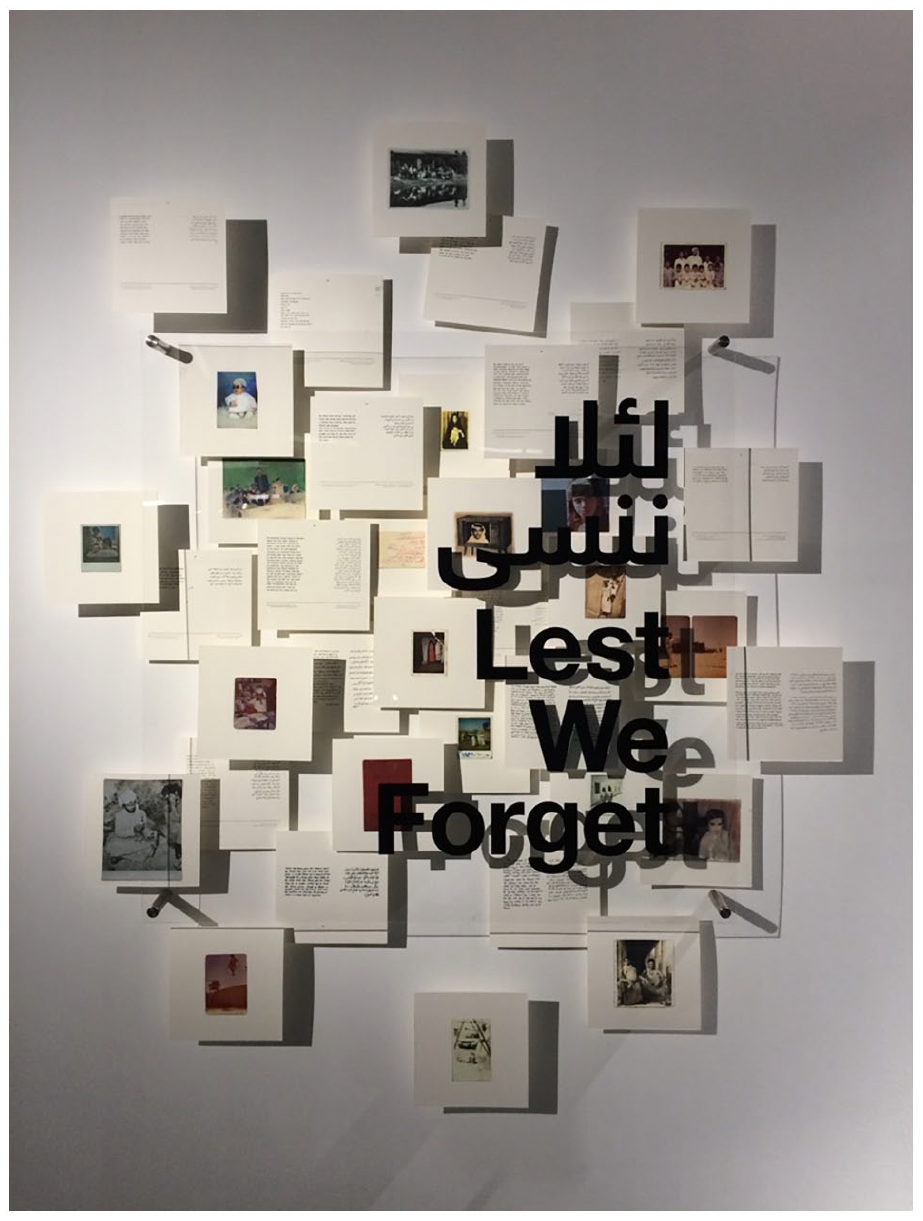
Entry wall collage for Lest We Forget Exhibition.
One example of a theme-based room in the exhibition is the telephone room, which is organized around the book theme of “Aloo,” a colloquial way of saying “hello,” or things that pertain to the telephone. The following is an example of a page of the book that was included in the telephone room installation, which shows a couple telephoning home during their Haj Pilgrimage in Saudi Arabia. Figure 3 is taken from page 254 of the Lest We Forget book and is overlaid with a transparency of a hand-written story from the student’s interview with her mother about the photograph.
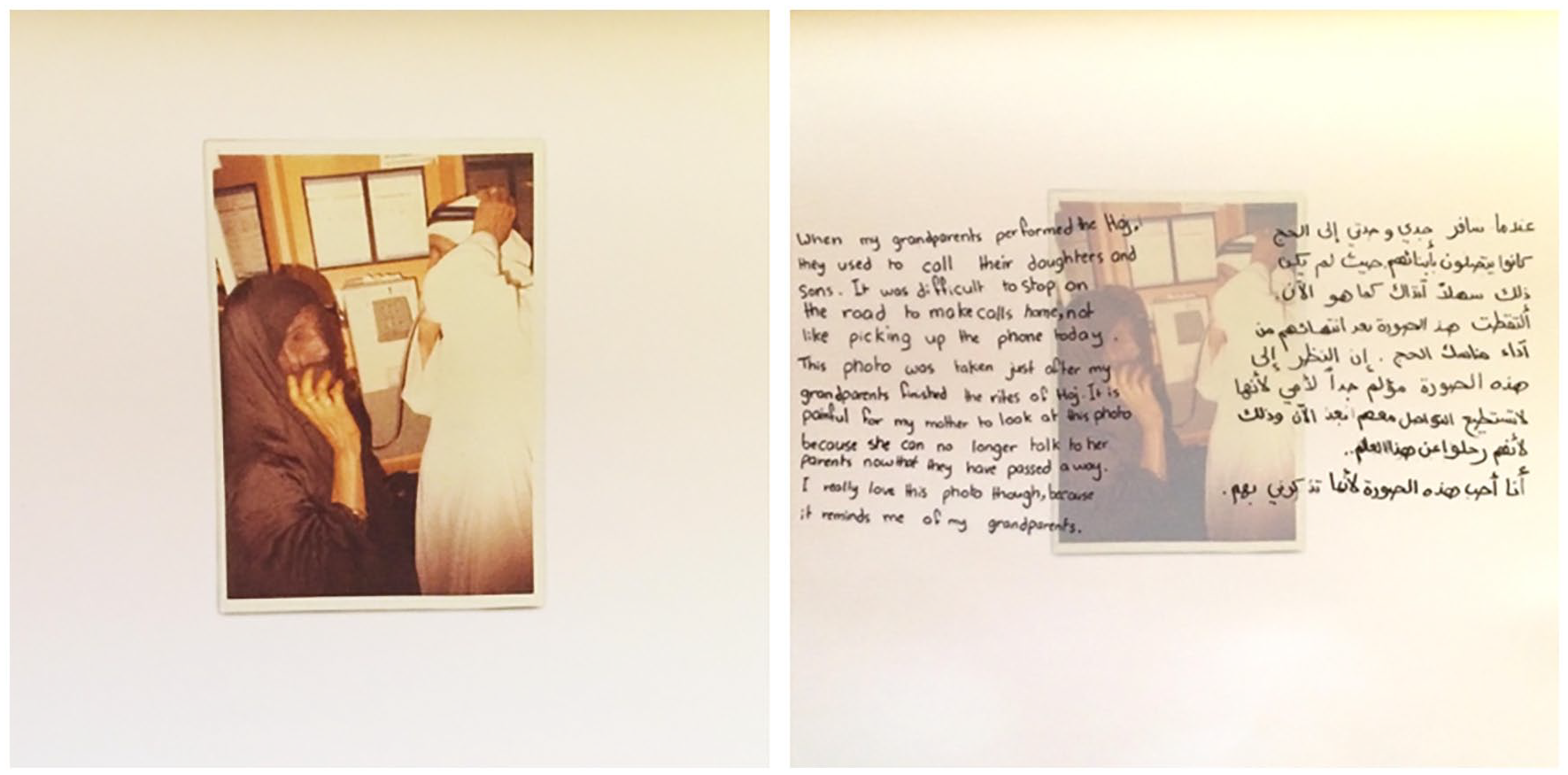
Source: Bambling (2015).
The English story reads as follows.
When my grandparents performed Haj they used to call their daughters and sons. It was difficult to stop on the road to make calls home, not like picking up the phone today. This photo was taken just after my grandparents finished the rites of Haj. It is painful for my mother to look at this photo because she can no longer talk to her parents now that they have passed away. I really love this photo though, because it reminds me of my grandparents.
Visitors enter the telephone room, a small sparsely furnished space with two chairs and two rotary telephones. On one telephone, a visitor can dial a number between 0 and 9 to listen in on a pre-recorded telephone conversation; this is meant to mimic a child’s experience picking up a telephone in their home—before cell phones—and listening in on their parents’ conversation. The second telephone provides visitors with an opportunity to record their own story, from memory, of a telephone conversation that they overheard as a child.
From a collection standpoint, this room does several different things simultaneously. It uses vernacular photographs of people speaking on the phone to bring life to the historical cultural practices of using the phone in Emirati society, as well as some of the stories and topics that were discussed when phone calls were made. This helps to identify the value placed on telephone calls, and the frequency with which people had phones in their homes at different points in history. The telephone room of the exhibition also uses the student’s creative responses to the stories of telephone themed photographs, to brainstorm and create a new layer of heritage. This layer, the phone where once can dial in between 0 and 9 to hear a recorded conversation, was made by the university students of their childhood memories about the analog phone; an object that is no longer in most of their lives and certainly not in the lives of their younger nieces, nephews, and children.
The creative responses in this room were recorded stories or audio plays, where student’s re-enacted pre-scripted narratives of their memories listening in on their parent’s phone calls. The idea for the development of this installation room came from discussions between students, after several interviewed their family members about similar photos to the one above, where memories of “listening in” were recalled. The genius in this installation is that it bridges the gap between the generations ahead of (young children) and those behind (parents and grandparents) the university students who created the recordings. The students engage simultaneously with their own memories, and the re-creations of memories of older family members, to develop an experience one hears when they pick up the rotary phone. While many of the older generation did not have telephones in their homes as children, and the younger generations are oriented toward cell phones, the students who developed this exhibition envisioned a link, by recreating stories inspired by their parents and grandparents’ photos and memories, of what the practice of listening in was like, and sharing it with all generations. These creative phone call responses also serve another purpose in that they solicit the memories and stories from visitors to the room, by asking people to record their own “listening-in” experiences about the telephone with their own families. These additional stories become new collection material that can then be stored with the LWF collection.
Page 254 is affixed to the wall of the telephone room, alongside several other pages from the “Aloo” section of the book. The pages on the wall serve as a link, tying together the sonic and written responses to the telephone photographs that the university student interns wrote (the pre-recorded conversations on the rotary phones), with the original photographs that served as the inspiration for these stories along with the actual stories of what was happening in the photograph. This room, along with several others in the exhibition, solicit participation from visitors of the gallery in the process of developing creative responses to their own family photos around the themes of the installation, or in this case sharing oral histories about their own family tied to the theme of telephone.
In addition to the exhibitions and books, LWF favors workshops, interviews, and in-person engagement to support their collections development rather than relying on a web presence. The collection would likely not gain the same support or participation from the local community if it existed online. As Foster (2004: 4) tells us, “In most archival art the actual means applied to these ‘relational’ ends are far more tactile and face-to-face than any Web interface.” The tactile, interactive inter-generational creative response approach to developing LWF has had several outcomes. LWF does not have a public web presence to date. This has been an ongoing conversation, but largely issues around privacy of families and individuals, their photographs, and their stories motivate the decision for collection materials to be disseminated through exhibitions and physical art books rather than publicly available online.
In a culture where privacy is prized, think back to the Zayed University classroom of students reluctant to share family photographs, a cultural heritage collection gaining trust from the community is harder and more important. From the onset the LWF collection has been developed by Emirati students who have sat with their own families looking through photo albums. The collection’s curation has been a collective process involving students, interns, and the LWF staff in conversation with the Creative Director. When a community develops their own cultural heritage collection, ethical representation becomes an embedded focus of the collection, one which may or may not receive much discussion, but which is driven by a desire to document and represent the community in a way consistent with the communities’ priorities. Matters of ethical consideration pertaining to the use and expression of material culture and the distribution and access to collection materials has also been a topic of great consideration for LWF. From the very first student exhibition at Zayed University, the project has gained momentum within the community, because it has provided a safe space and means for sharing vernacular community materials within and back to the Emirati community in contextualized and defined spaces. While the sharing of private materials may be contested by some in the community who choose not to share their own materials, all materials that are shared, exhibited, and included in LWF’s publications are done with the permission of the owners. As a collection that does not have a physical repository of materials, but rather which digitizes photographs, collects oral histories, and borrows material objects for purposes of exhibiting, the LWF collection has taken an approach to colleting where materials of cultural and personal family value are retained by families. This approach to developing a community collection, ensures that each family retains ownership over their own materials, and control of when and where they can be showcased or displayed.
Community workshops on recorded sound
My involvement with LWF began when Dr Bambling asked me to develop a 6-week workshop to teach a recently recruited batch of student interns from Zayed University about recorded sound and oral history. The workshop focused on the development of sonic creative responses to descriptions and memories of vernacular photographs. I was asked to help students understand how to conduct interviews of their family members and how to use those interviews to inform the development of a framework for telling stories of those same memories, while remaining true to the interview and making the story accessible to people outside of the family.
The interns spent the 6-weeks learning how to record, edit audio, and use sound to tell stories in order to develop digital narratives in response to the photographs. While some of the photographs selected belonged to the intern’s family others did not, and so this process was as much about individual memory where relevant, as it was about the community’s collective memory. The sonic creative responses were informed by discussions in the workshops on topics including historical and cultural differences in gender, clothing, travel, cars, and antiquated technologies, as well as the real stories behind the photographs when these were known. The workshops’ primary goal was for the interns to develop 82 sonic narratives, in both Arabic and English, which would be showcased in conjunction with 82 vernacular photographs in the exhibition at Warehouse 421. Figure 4 shows the table of the 82 photographs for which the sonic narratives were being developed. The narratives were accessible to visitors through the exhibition app, where they could see the photograph, read the transcripts of the interviews about the photograph, and listen to the sonic narratives created by the interns.
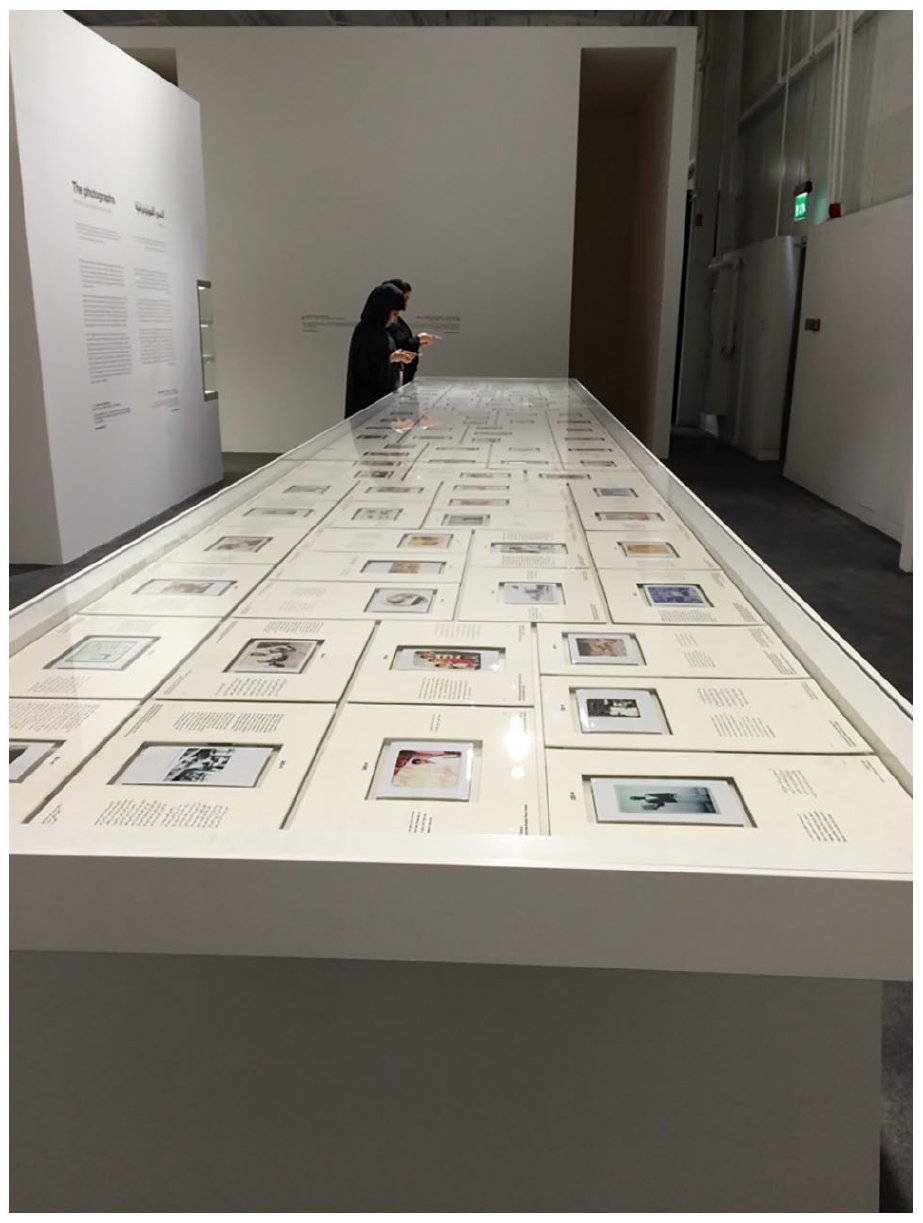
Recorded sound table, where each photograph and written story, correspond to a recorded story about the people and event within the image.
The workshops were designed to introduce the interns to the relationship between form in visual and sonic materials, sound mapping, the notion of recorded sound accompanying visual material, geographic content, and helping guide a listener through a curated sonic experience. The workshop ran twice per week for the whole day. I developed a curriculum in advance of the workshops that aimed for one meeting per week, but it became clear once we began that an additional weekly critique would best support the intended outcomes of the workshop.
During the first workshop we listened to examples of different online collections with recorded sound, learned how to discern good quality recorded audio from bad, and learned some of the language to differentiate qualities of recorded audio, for example, the sound being too hot, recorded at too high a level or too close to the sound source. The interns learned about listening, interview questions, how to choose a good environment to record an interview, ambient noise, handling noise, pop filters, and a variety of other practical recording tips and tricks.
The initial workshops focused on looking at other projects that connect storytelling and interview with photographs, like the New York Times One in Eight Million project, where photographs and recorded interviews are edited together to tell a 2-minute story of a resident of New York City. As a collection of individual character stories, the aim of the One in Eight Million project is to highlight or get at the essence of New York City as a place, a culture, and home to millions of people. The students were given a variety of exercises to help further their understanding and skill set, based on the examples discussed in the workshops. They were asked to create a plan for their own sonic narratives including what sonic environment they wanted to communicate, and how they would capture the sonic material and then share it back for a listener. Initially interns worked together in groups to conduct mock interviews, and to become familiar with the process, the equipment, and hearing their own voices recorded, a challenge for all newcomers to recorded sound.
The interns were also provided an introductory overview to recording on the Zoom H5 recorders, and hands-on practice editing on Audacity and Logic Pro, digital audio workstations for editing and mixing sound. We covered different skills and techniques based on needs that were identified through in-class critiques of one another’s interview recordings. For example, while creating a creative response for a photograph of children in school celebrating National Day, one of the interns wanted to layer an interview of another intern’s memory of her own childhood school days spent celebrating National Day, on top of the UAE National Anthem. The interns recorded themselves singing the National Anthem, which you can hear in the file Lest We Forget National Anthem.wav (see Supplemental material). This discussion led to a workshop on layering audio, panning, mixing, and basic automation of sound.
The second meeting each week was critique day, where the interns would share their works in progress. This is where the group developed aesthetic and design choices for the expression of their creative sonic narratives. Early in the process, the interns raised questions about style, language, and length for these narratives. Collectively we decided that each digital narrative would be in both Arabic and English, in the first person, and roughly 30 seconds in length. The critique sessions served as an opportunity for the interns to share their work, receive feedback and give feedback to their peers. Critiques also served as the key moment during the workshops where Dr Bambling and I provided input to help shape their creative endeavors.
I noticed at the beginning of the 6-weeks of workshops that the interns, who themselves were very new to the LWF Project, were often more literal than creative in their responses to photographs. Their initial inclination was to record a description of what was happening in a photograph, rather than to tell a story or share a memory about a personal reflection on the photograph. LWF’s approach to creative response was structed to provide students with opportunities to think critically about their own heritage, and to engage deeply on an analytical level about their national identity. In the context of this project the engagement with the cultural is an engagement with the critical and so Dr Bambling and I used the workshops as an opportunity to guide the interns toward a more reflective, self-reflexive, and personally engaged approach in their responses, in other words handing the interns agency through creative response. The process of creative response asks the student interns to interpret and make sense of their own material culture through exploring their unique personal connection to their community, an approach that aims to mitigate outside input that might incorrectly assume a knowledge of Emirati culture. Dr Bambling and I functioned in a facilitator role helping the interns better understand and critically engage with their own cultural heritage, in a way that a purely critical or descriptive approach could not access. An example of this facilitation can be illustrated through an activity where interns were asked to record themselves speaking about a memory that was triggered by looking at the photograph, or something that the photograph reminded them of. Another would be interns interviewing members of their family who were either in the photograph, or who remember the period or moment when the photograph was taken. The hope was that hearing older-generation members of their family speak about their own pasts, a period of history the interns could not remember, might help increase intern interest in their own past. Additionally seeing the way others reflect on photographs might provide the interns with new ideas for their own responses.
Most critique days began by taping color photocopies of the 82 photographs around the room. One at a time, the interns would share the recordings they worked on that week, and as the full-group discussion was under way, they were encouraged to walk around the room and place comments, via post it notes, next to the photographs being discussed. By the end of the critique everyone had given verbal and written feedback and the space was filled with their creative ideas and thoughts (see Figures 5 and 6).
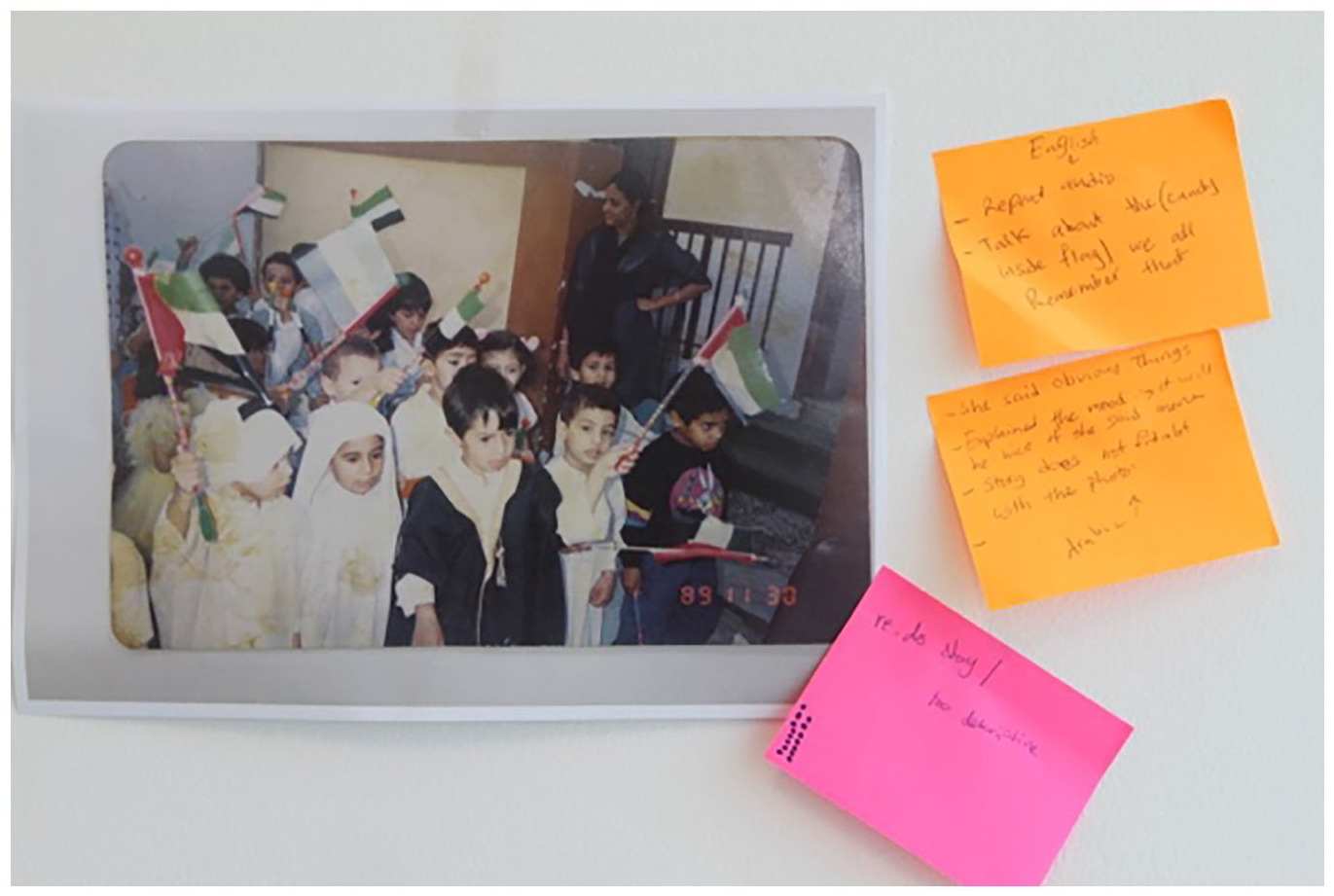
Source: Photo credit Diana Chester.
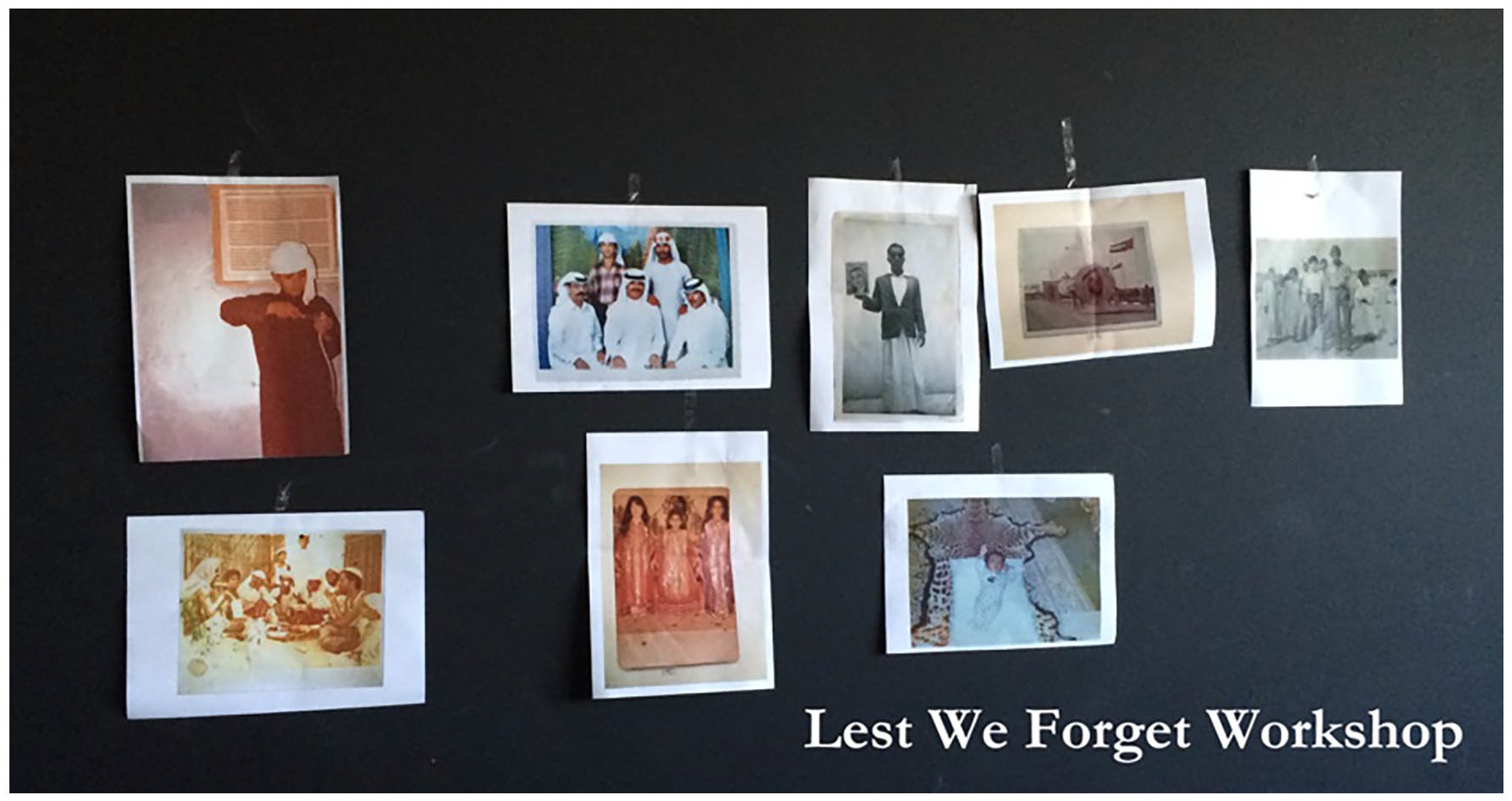
Source: Photo credit Diana Chester.
The interns would work collectively on a batch of photographs, helping one another develop content and recordings by brainstorming collective memories about the photographs and what the visual elements reminded them of. In one example, there was a photograph of a boy in a costume against a wall; the narrative for the photograph was about the wallpaper behind the boy in the photograph. Several interns agreed that the photograph reminded them of their childhoods, (the early 1990s) when every home seemed to have a very similar pattern and color of wallpaper. They also shared stories of relatives and family members who lived in other parts of the Arab world including Egypt and the Northern Arab countries, who had similar wallpaper, drawing conclusions about how similar materials must have been popular and available in the region at the time.
We found that as the interns went through the process of collectively sharing what each photograph reminded them of, new and often surprising details emerged about elements of historical and collective memory. The process of creative response allows for memory and subjectivity, not based exclusively in fact, which leads to the emergence of ideas and story through the human imagination where details can be added that would otherwise be missed. This is to say that through collective memory the interns were able to assemble a collage of memories that became the basis for the creative response that was created for an individual photograph. This memory collage relied on the memories of some to inform the ideas and touchpoints for others. In most cases where collective memory was relied upon to assemble a creative response, the details included in that response were not based on the factual experience of any one person, but rather an assemblage of concepts, ideas, and memories constructed by all. In these instances, the factual nature of a memory or a personal account of an historical event is not what matters most. Instead, the ability of the group of interns to create a collective memory through discussion, and to iteratively develop the scope of that memory to include each other’s varying ideas and related recollections, allows for a memory and ultimately a sonic creative response that more deeply gets at aspects of cultural identity and representation than an individual story could.
Traditional theoretical frameworks do not often leave space for conversation, imagination, exploration, and the subjective interpretation and retelling that comes along with the creative response processes. This approach to learning about one’s own culture, history, and memory adds tremendous value as is evidenced through the LWF project. By reminiscing and projecting their own lives onto silhouettes of the lives of their parent’s and grandparents’, the interns are working to subconsciously recreate culture, and in so doing they get at something that is at the core of their cultural identity. The LWF project is a good example of why we need to value more creative storytelling in an academic context, because it reveals things that would not otherwise be revealed.
Traditionally individual family photo albums are thought of as individual collections. But when the interns were going through each other’s stories and looking at 100’s of photos at a time, a way vernacular photographs are not typically viewed, they were able to ascribe value and importance to aspects of their community heritage, in a way they hadn’t before. Of course, they valued their family and relatives, but did not understand why people outside of their family would find things about their family stories valuable or interesting.
Associations about time and place became an organic through-line of the narratives and stories the interns recorded. The process of collectively reflecting on a photograph from the past created a space in the present where collective history and culture was celebrated, appreciated, and recognized. As a group of university-aged students who have lived through their country’s development from a low-lying city to a skyscraper-filled skyline, they had a strong grasp of the transformation of their nation as it has undergone tremendous change over a short period of time. However, their understanding of their parents and grandparent’s lives and experiences were far less developed.
The interns bonded over photographs that allowed them to reach back into childhood memories of a UAE that no longer exist. There was one photograph of a young boy in a kandura (traditional male dress), standing against a wall with an old air-conditioning unit (see Figure 7). This photograph helped the interns to connect with one another over shared memories. In the photograph the boy is holding the chord of the air conditioner in one hand and what looks like a screwdriver in the other.
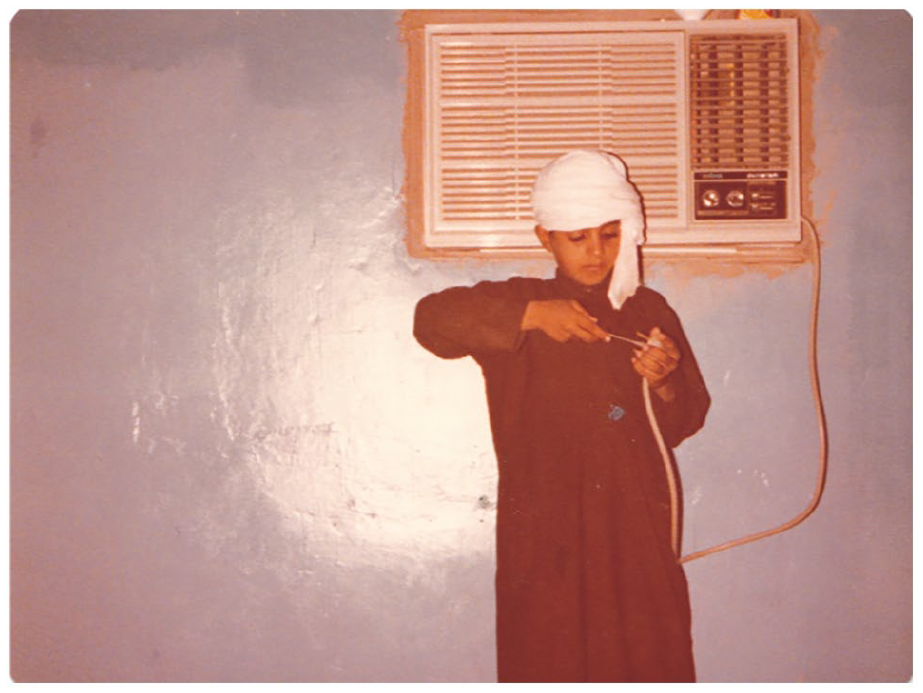
Source: Bambling (2015).
The interns initial brainstorming for this photograph was a discussion about their memories of these old-style air conditioning units, and how there was one in each room. In a country where temperatures in the summer routinely climb to 115 degrees Fahrenheit, or 46 degrees Celsius, air conditioning is a daily part of life. Today most accommodations in Abu Dhabi have central air conditioning systems, making these stand-alone units obsolete. The interns shared memories about how long it had been since they had seen the old-style air conditioner, and how prominent these units had been in their lives growing up. One of the interns recalled an aural memory of the sound of the old units. This memory caused an eruption of joy and a cacophony of laughter and comfort. Each intern shared her memory of the noise that the units made, how loud they were, how they masked other sounds, and on and on. The sonic narrative that ultimately accompanied the photograph in the exhibition was recorded by one of the interns who still had an old air conditioning unit in her family home. The recording begins in relative silence, followed by the clicking of a knob being moved from the off position to a high level of cooling, and then the familiar ramping up of the loud blower noise. Listen to file aircon.wav (see Supplemental material).
For the interns, the practice of sharing common experiences and of recalling historical familial and cultural references—inspired by objects, places, and styles from one another’s photographs—led to a greater interest in the lives and experiences of their parents and grandparents. Common themes emerged from the family photographs that allowed for groupings to be made. These included but are not limited to birthdays, weddings, international travel, telephones, babies, and studio portraits. These groupings served as the preliminary foundation for the organization of the book, Emirati Family Photographs 1950–1999, which served as a guide for the organization of the exhibition of the same name.
The interns decided it was critical to record an English and Arabic version of their narrative for each photograph, as this would allow them to reach a broader audience. There was also agreement that some of the older generation Emiratis may not be comfortable with the English recordings, while some of the younger generation of Emiratis may be less comfortable with the Arabic recordings. The process of negotiating how to articulate the same ideas in Arabic and English was a big topic of discussion and one that was not easily remedied. To facilitate this process the interns would play back their recording in Arabic and in English, and the group would discuss whether or not there was a symmetry maintained in the meaning of both recordings, and if the way things were expressed in both sounded and felt right. A recording that sounded good in Arabic often did not translate well into English and vice versa. As a result, most of the recordings did not strive for a direct translation from Arabic to English or English to Arabic, but rather they developed two similar narratives that informed one another and felt appropriate for the two languages.
One of the best examples of this comes from a photograph of an old man holding a rile while sitting on a majlis, a traditional living room with a modular seating area for community meetings and entertaining guests. The back of the photograph was inscribed with a handwritten poem in Arabic, which in English translates as follows: “I am getting old; my gray hairs are laughing at me. All ships are sailing, only mine isn’t. My ship and my lover’s ship are loaded with passion. I will dump my load, lest my secret is exposed.”
The interns decided to read the poem in the Arabic version of the recording, as it sounded poetic and they felt it captured an historical component that helped to situate the photograph within a time period in which fishing was a form of livelihood, and hand-writing letters and notes was popular. You can listen to the recording entitled man with gun_arabic.wav (see Supplemental material). However, given the way the poem translates in English, they felt that the English recording that accompanied the photograph should not include language from the poem and instead they created a narrative that correlated visual elements of the photograph with emotional elements that were highlighted in the poem. The recording was a sonic description of the man’s character and strength.
Within the group, the interns had varying comfort levels with Arabic and English, and within Arabic—with the Emirati dialect of Arabic versus Fusha, Modern Standard Arabic. Many of the interns identified themselves as either more comfortable recording their voice in Arabic or English and would then partner with someone who was more comfortable in the other language. Some interns were comfortable recording in both languages, but few were comfortable with both Emirati Dialect Arabic and English.
Another negotiation within the group was whether the Arabic narratives should be recorded in Fusha, so that the material was accessible to a wider audience throughout the Arabic-speaking world, or whether they should record the Arabic in the Emirati dialect so that it was truer to their culture and more linguistically accurate to how the thoughts and ideas would be expressed. In the instances where the interns interviewed older family members, the recordings were often in the Emirati dialect. A younger member of the family or a friend of the same sex would record the English versions of these narratives. When recordings in the Emirati dialects were shared with the group during critique, there was strong consensus that the Emirati narratives had a stronger presence and felt more accurately descriptive of the photographs. As a result, the Arabic narratives in the exhibition alternate between Fusha and the Emirati dialect.
There is a relationship between creative decisions of a self-reflexive nature and those that are concerned with how Emirati community is reflected. As the interns further developed and honed their own creative response practice through the development of the sonic narratives, they also made more decisions about how information should be curated and presented in the exhibition based on the feeling and aesthetic of the presentation, as in the case with when and how to use Emirati Dialect. The connection between imagination, storytelling, personal reflection, and critique lies at the center of how the interns made their curatorial choices. These choices directly impacted which stories of Emirati society would be vocalized, be they the wallpaper or the boy’s uniform, the air conditioner or the sounds of childhood, and how their history and their families’ stories would be told, often in their own voices, and shared broadly with the public.
A living archive
Through spending time with the LWF team, teaching workshops on sonic creative response and contributing to the collections approach and process developed by Dr Bambling and her student’s at Zayed University, I have found that creative response is a way to strategically connect to a cultural consciousness. What I mean by this is that the process of using creative response as a technique for building the LWF Collection of Emirati photographs, objects, and ephemera alongside responses to these objects, has created a bridge between the academic discipline-specific application of knowledge, and in this case the Emirati community who holds that knowledge. The process of creative response as it has been employed through the LWF project, allows for a truthful form of storytelling, one that accesses community consciousness, memory, sense-based recollection, and allows folks in the academic sphere like Dr Bambling, to offer academic knowledge to situate this interior knowledge into a collection.
While the idea that there is value in creatively reconstructing the past is not new, it is often left out of the academic discourse because it is not valued. Morrison (1998) in her essay, “The sight of Memory,” talks about the absence of a written history about the interior lives of Black slaves or any marginalized groups, and how historically these groups were omitted from these discourses even when they were the focus. She goes on to explain how for contemporary writers like herself to recapture these histories of feeling and experience it becomes necessary to rely on memory and collective recollection in order to get at a history that was not documented, and one that may not be easily expressed in words. She says, “I must trust my own recollections. I must also depend on the recollections of others. Thus, memory weighs heavily in what I write, in how I begin and in what I find to be significant” (Morrison, 1998: 190). Bedouin culture is akin to Morrison’s description of slave memory, in that it is not a tangible history but one of many oral traditions, poems, and stories. As such it is important to recognize the value that creativity brings to reconstructing a community history where recollection replaces facts, and collective memory constructs the past.
The goals of this paper were to further the dialogue about the value of transdisciplinary research toward greater preservation and sustainability of cultural heritage; and to make an argument about the value of community members creatively responding to photographs and archival materials from their own culture, using sound. What I have found is that creative response is a theory of knowledge that allows a community to retain ownership of their heritage and their imagination of the past, present, and future, and an emerging methodological process that when used ensures a living archive.
Having students and student interns collect photographs and stories from their families proved to be a way for the younger generation to connect with and learn about their family and cultural history. However, doing this type of collection work within a group of their peers also allowed them to take ownership and interest in that history. Collectively developing an archive of vernacular photographs brings into the classroom many stories, histories, and questions about a shared cultural, social, geographic, and national history that the students became interested in exploring.
I stated earlier that a focus of this research is to make sense of the value and importance of millennial members of Emirati society using digital media tools and practices to grasp an understanding of the historical and analog cultural practices and traditions of their parents and grandparent’s generation. This is important not only because many of these practices have been lost or are threatened to be lost, but because the process of learning about one’s own heritage from one’s family is powerful and too often rare. The practice of developing digital creative art in response to one’s family or community heritage-an artistic response that is imprinted with modern technologies, techniques, and the means for understanding history-and then placing these two pieces side by side, the original and the creative response, this is what makes an archive living.
Utilizing this method creates an archive that reflects the role of technology and development on the people and the culture, it gives explanation to why and even how some cultural practices have shifted while recognizing the origins of the cultural practice. These digital creative responses in the form of sonic narrative, breathe modern life into historical heritage. When these creative responses sit side by side with the original photographs in books and exhibitions, they reflect the evolution of a society and the cultural practices within it, as well as the way modernization and globalization impact the thinking of the people within the society and the application of that thinking to the way they choose to preserve their identity, making the archive living.
Supplemental Material
sj-wav-1-mio-10.1177_20597991221129794 – Supplemental material for Using creative response to sonically translate vernacular photography: The Lest We Forget project in the United Arab Emirates
Supplemental material, sj-wav-1-mio-10.1177_20597991221129794 for Using creative response to sonically translate vernacular photography: The Lest We Forget project in the United Arab Emirates by Diana Chester in Methodological Innovations
Supplemental Material
sj-wav-2-mio-10.1177_20597991221129794 – Supplemental material for Using creative response to sonically translate vernacular photography: The Lest We Forget project in the United Arab Emirates
Supplemental material, sj-wav-2-mio-10.1177_20597991221129794 for Using creative response to sonically translate vernacular photography: The Lest We Forget project in the United Arab Emirates by Diana Chester in Methodological Innovations
Supplemental Material
sj-wav-3-mio-10.1177_20597991221129794 – Supplemental material for Using creative response to sonically translate vernacular photography: The Lest We Forget project in the United Arab Emirates
Supplemental material, sj-wav-3-mio-10.1177_20597991221129794 for Using creative response to sonically translate vernacular photography: The Lest We Forget project in the United Arab Emirates by Diana Chester in Methodological Innovations
Footnotes
Author’s note
The research discussed in this paper took place in Abu Dhabi, United Arab Emirates.
Declaration of conflicting interests
The author declared no potential conflicts of interest with respect to the research, authorship, and/or publication of this article.
Funding
The author received no financial support for the research, authorship, and/or publication of this article.

Supplemental material
Supplemental material for this article is available online.
Author biography
References
Supplementary Material
Please find the following supplemental material available below.
For Open Access articles published under a Creative Commons License, all supplemental material carries the same license as the article it is associated with.
For non-Open Access articles published, all supplemental material carries a non-exclusive license, and permission requests for re-use of supplemental material or any part of supplemental material shall be sent directly to the copyright owner as specified in the copyright notice associated with the article.
