



Abstract
Since Peterson's influential work on musical omnivorousness, researchers have debated whether broad musical tastes serve as markers of high socioeconomic status in modern Western societies. However, existing measures rely on simple genre counts or problematic a priori assumptions about genres’ social associations. This study introduces a novel continuous measure of musical taste breadth that accounts for both the number of liked genres and their sonic-social distance, based on expert ratings.
Using a representative German sample (N = 2,086), we tested core assumptions of omnivore theory while examining relationships between taste breadth and sociodemographic factors through Sinus lifestyle milieus. Our similarity-weighted measure revealed greater differentiation than simple sum scores.
The results challenge general assumptions on cultural omnivorousness. While breadth increased slightly with socioeconomic status, effect sizes were small, with high-status individuals liking only one additional genre on average. Contrary to expectations, classical music lovers showed only average taste breadth, while fans of funk, jazz, and non-European music demonstrated the broadest tastes. The most pronounced differences emerged along cultural distance rather than social hierarchy: High-status groups preferred culturally distant genres (soul, blues, non-European music), while low-status groups favored familiar, domestic genres (Schlager, German traditional music).
Linear regression models revealed that individual attitudes—particularly openness to experience and reorientation toward new values—were stronger predictors than socioeconomic status alone. These findings suggest that broad tastes are not a strong means of vertical social distinction in contemporary Germany, but that tastes have become increasingly aligned. Social distinction now operates primarily through high-status rejection of domestic “trivial” genres rather than broad inclusive tastes, highlighting the importance of considering both sociological and psychological factors in cultural taste research.
Introduction
Since Richard Peterson challenged Pierre Bourdieu's classic homology theory (1979; see also Frith, 1978; Gans, 1974) in the 1990s with his “discovery” of the elitist cultural—and particularly, musical—omnivore (Peterson, 1992; Peterson & Kern, 1996; Peterson & Simkus, 1992; review van Eijck, 2000), the theoretical and empirical discussion of the forms and extent of the connections between social class, taste, and cultural consumption patterns has continued with great intensity and on a broad empirical basis. Peterson's thesis of a structural change in music-related social distinction away from the clear association between social class and specific “highbrow” musical genres toward an opposition of high-status individuals with broad, inclusive tastes (omnivores) and low-status individuals with narrow tastes (univores) quickly generated a broad response (for overviews and reviews of the earlier relevant work, see Gebesmair, 1998; Kunißen et al., 2018; Peterson, 2005; van Eijck, 2000; important subsequent studies are Amrhein, 2023; Chan & Goldthorpe, 2007; Leguina et al., 2016; Neuhoff, 2001; Purhonen et al., 2010; Rankin & Ergin, 2017; Savage & Gayo, 2011; Sullivan & Katz-Gerro, 2007; van Eijck & Lievens, 2008): It has been studied across different countries and tended to be frequently confirmed, although not always or to the same high degree. It was differentiated, modified, and further developed. The exact interpretation of the findings was discussed, as were possible causes, relevant factors, and potential further developments. Alternative theoretical frameworks and conceptualizations have also been proposed (Glevarec & Pinet, 2017; Rimmer, 2012). However, there were always researchers who continued to find extensive overlap between socioeconomic status groups and taste publics and therefore adhered to the thesis of social distinction through music based on specific genres (for a detailed discussion of this research, see Shepherd, 2003; see also more recently Atkinson, 2011; Berli, 2018; Parzer, 2016; Tampubolon, 2008).
It could have been a wake-up call for omnivorousness research that Peterson himself was unable to replicate his original findings based on survey data from 2002 and 2008; the omnivorous taste pattern suddenly seemed like a historical outlier or a methodological artifact (Rossman & Peterson, 2015; the results from the 2002 data were already presented at a conference in 2005 Rossman and Peterson, 2005, August) and also mentioned in Peterson, 2005; see also López-Sintas & Katz-Gerro, 2005, and Brisson, 2019). But scholars continued to study omnivorous patterns of cultural tastes and consumption, despite some terminological and conceptual weaknesses of the original construct. (1) It does not accurately name the social phenomenon to which it was directed: For one thing, members of the social elite never really like “all” (omnia) of the music genres they had to rate (in the original Peterson & Kern 1996, the average was only 2.23 out of 5 so-called lowbrow and 2.12 out of 3 middlebrow genres for 1992). Second, the association of musical selection or listening behavior evoked by the “vore” (from the Latin vorare: to devour) is imprecise. The underlying data from the Surveys of Public Participation in the Arts (SPPA) only represent liking ratings, that is, they record musical attitudes and not actual listening behavior. (2) In the later studies on musical omnivorousness, many of which also drew on national surveys, the targeted construct is sometimes abstracted from questions about musical taste (liking) and sometimes from those about music consumption behavior (listening), which undoubtedly results in conceptual blurring and—in addition to different genre lists and scaling—a lack of comparability. (3) The concept of omnivore vs. univore suggests a dichotomous categorical distinction without ever defining a threshold. (4) It was taken for granted that a stable and exclusive association between musical genres and social classes existed, not acknowledging the possibility that such associations could differ across countries or larger cultural areas or that they could change with time.
Notwithstanding such difficulties, we think that the questions of how many different types of music someone likes or listens to and whether this is associated with sociodemographic characteristics and personality traits of that person remain relevant for the sociology and psychology of cultural tastes. To produce more coherent and meaningful results, however, we propose adjusting the underlying concept and its empirical operationalization in the following ways: Omnivorousness should be renamed and reconceptualized more neutrally as breadth of (musical) attitudes or consumption behaviors, providing a continuous, not a dichotomous, measure that could function as one of several meaningful dimensions of musical taste alongside the usually and often exclusively measured dimensions of content or intensity (Schäfer & Sedlmeier, 2009). Research should follow Sullivan and Katz-Gerro's (2007) differentiation between a broad taste attitude and a broad musical consumption behavior (their term: “voraciousness”). When computing breadth scores, a simple summative approach that merely counts the number of liked or listened genres (“omnivorousness by volume”, Warde et al. 2008) should be avoided, since it misses Peterson's original criterion of the socially transgressive nature of omnivorous tastes (Amrhein, 2023). Instead, one should find a way to acknowledge not only social but also musical (dis)similarities of genres (Fabbri, 2007; Moore, 2001). So far, solutions have been proposed that also count how many cultural boundaries are crossed within a taste repertoire (“omnivorousness by composition”, Warde et al. 2008, cf. Kunißen et al., 2018). To do so, this understanding needs to assume more or less stable and exclusive associations of genres with social groups or socially defined cultural preference schemes—such as, for instance, the ones established by Schulze (1992) and replicated by Amrhein (2023)—which usually maintain the sociological differentiation between an elitist high-culture scheme of preference and supposedly lower schemes (cf. Kunißen et al., 2018). As predictors, not only social class should be considered but also other sociological and psychological variables, to arrive at a comprehensive understanding of what drives individual differences in breadth of musical taste.
Schulze (1992), using Germany as an example, observed proximity and distance to three everyday aesthetic schemata (high-culture schema, tension schema, trivial schema) for the various milieus, primarily influenced by age and level of education, to each of which he also assigned a musical genre (classical, rock, pop). Age and education proved to be the most important and stable demographic factors (see also Hermann, 2004; Müller-Schneider, 2000). The first combination of socioeconomic and lifestyle parameters in the study of musical taste groups was carried out by Katz-Gerro (1999) using US survey data from 1993. Le Roux et al. (2008) and North & Hargreaves (2007a, 2007b, 2007c) presented detailed studies of the correlations between musical taste, lifestyles, and social affiliation in the United Kingdom. Otte (2008) took stock of previous research on musical taste and lifestyle. All of these studies yielded multifaceted results. Although the taste publics were often closely associated with certain lifestyle aspects, they showed varying degrees of association with the socioeconomic groups, for example in that some of them were relatively exclusive to only one group, while others occurred equally frequently in all of them (Katz-Gerro, 1999), or in that socioeconomic indices were only statistically related to some taste characteristics (North & Hargreaves, 2007c). Such findings, along with general sociological observations of increasing social fragmentation and individualization as well as changes in music distribution and music consumption, thus also raise the question in current musical taste research of to what extent musical taste—or individual aspects of it—is still a means of social distinction in developed Western societies (North & Hargreaves 2008; Peterson 2005).
In this article, we will address and discuss several pertinent questions around breadth of musical taste and its social nature based on a representative German sample. The focus is on two aspects: 1. We will present a new similarity-weighted measure of breadth of musical taste that goes beyond a mere sum score but also does not rely on sociological a priori categorizations of genres into cultural schemes. Instead, it acknowledges the fact that individual musical genres are not equally distant from each other but can be more or less similar to each other. This approach follows recent research that seeks to derive “clusters and boundaries between genres” from the data itself (cf. Johnston et al., 2019, p. 368). However, while the existing research estimates the similarity between genres from the ratings of the respondents (ibid.), for example, via factor analyses, and thus implicitly assumes that genres that are co-consumed or co-liked are also similar, we propose to generate similarity metrics based on how music experts judge the similarity of genres. 2. We will explore characteristics of breadth of music taste in our sample while testing existing hypotheses and previous findings on the association of breadth with sociodemographic and other factors. On the one hand, social groups will be compared with each other in terms of the breadth of their tastes; on the other hand, we will investigate which personal factors statistically predict breadth of taste. In addition to social class, the role of age has been pointed out by Lizardo and Skiles (2015) and Amrhein (2023), for example; other factors known to be influential for musical taste in general, such as political and social attitudes, education level, or personality traits, would also be obvious candidates.
This study is based on data from a comprehensive representative survey on the musical tastes and music-related behaviors of the German population—to our knowledge the first of its kind. A theory-based questionnaire appropriate to the subject matter was created specifically for this purpose, as the items on music consumption in existing questionnaires, such as national surveys in particular, typically do not address the question of interest here. Furthermore, the social subdivision of the sample is not only carried out according to the classic model of three vertical strata but also using the 10 Sinus-Milieus© (see Method section for more detailed information), which have not been considered in music taste research to date. With this, we take up the fundamental sociological debate dating back to the 1980s as to whether class or stratum (and thus a vertical model based primarily on education, occupation, and income) is still the central factor for social group formation and the associated attitudinal and behavioral tendencies in post-industrial societies or whether its significance is being replaced by other potentially group-defining identity characteristics, which can also include cultural consumption patterns (Maffesoli, 1996; Pakulski & Waters, 1996). In addition, further demographic, psychological, and music-related attitude factors are used. As a result—using the example of a Western European country—a more differentiated picture of the dimension of the breadth of musical taste depending on social affiliation and other factors such as milieu-relevant attitudes is drawn.
Method
Sample
The sample (N = 2,086) is representative of the German resident population aged 18 and over (for descriptive statistics see Table 1). To achieve representativeness, quotas based on official German statistics were used for sampling with regard to the characteristics of gender, age, education, and federal state. As the sociodemographic variable of Sinus-Milieus was also of interest, the survey was conducted in cooperation with Sinus Markt- und Sozialforschung GmbH, Heidelberg. Sinus-Milieus represent 10 distinct social subgroups into which individuals can be categorized based on a comprehensive assessment of not only their social status but also their value orientations (Barth et al., 2017). The typical way to represent milieus is to place them in a two-dimensional space with the x-axis showing the value orientation (in three grades: tradition, modernization, re-orientation) and the y-axis showing the social status (lower and lower middle class, middle class, upper and upper middle class; https://www.sinus-institut.de/en/sinus-milieus; for graphical representation see also Figure 5 in the discussion). The company IPSOS Public Affairs was commissioned to compile a representative sample and carry out the survey in the field. A mixed-mode method consisting of online and computer-assisted personal interviewing (CAPI) was chosen to compensate for the typical underrepresentation of certain populations in purely online surveys. The participants for the online survey were selected using a sampling tool from the IPSOS panel of over 160,000 members based on the quotas created and invited to participate by email.
Sociodemographic and psychological characteristics of the sample.

Note. N = 2,068. Age in years; education was coded from 1 (low) to 3 (high); personality traits were assessed using Likert-type scales ranging from 1 to 5.
The CAPI survey was conducted by a total of 156 pre-trained interviewers. The interviewers selected participants from the IPSOS panel according to the quota plan and contacted them by telephone. The interviews were then conducted either immediately or at a mutually agreed time.
A total of 2,086 complete data sets were collected between December 2016 and February 2017 (nonline = 1,196, nCAPI = 890). The survey took an average of 20 min in the online version and 38.5 min in the CAPI version. There were minimal deviations from the specified quotas. Participants with deceptive or inattentive response behavior were marked or excluded by IPSOS.
Participation in the survey was voluntary, took place with informed consent, and could be terminated at any time without negative consequences for the participants. As is typical for IPSOS, panel members received points for participating in a survey, which they could either donate to charity or convert into vouchers. The study design was ethically approved by the Ethics Council of the Max Planck Society (No. 2024_12).
The data set contains the responses of N = 2,086 participants with representative distributions in terms of gender (49.1% female), age (M = 50.7, SD = 18.16), education level (lower education: 36.0%; middle education: 30.2%; higher education: 31.9%, 2.0% missing), and state of residence. The distribution across the 10 Sinus-Milieus© is also representative for 2016 (Established (EST) = 10.4%; Liberal Intellectuals (LIB) = 7.2%; Performers (PER) = 8.5%; Cosmopolitans (COS) = 7.4%; Adaptive Navigators (ADA) = 8.9%; Social Ecologicals (SOC) = 7.2%; Modern Mainstreamers (MMS) = 13.3%; Traditionals (TRA) = 13.5%; Precarious (PRE) = 9.4%; Hedonists (HED) = 14.1%). 1
Design and Variables
A self-developed questionnaire was used for the survey, which, in addition to various dimensions of musical taste (multi-dimensional inventory of musical taste, MIMT), also collected sociodemographic characteristics, the BIG-5 personality traits, and affiliation to one of the 10 Sinus-Milieus© as possible predictors and confounds.
The sociodemographic variables were formulated and subdivided according to official German statistics. Among other things, questions were asked about year of birth, gender, highest level of education, monthly household income, and size of place of residence. The BIG-5 personality traits were collected using the German version of the BFI-10 (Rammstedt et al., 2013). The assignment to the Sinus-Milieus was based on the battery developed by the Sinus Institute, in which the degree of personal agreement or disagreement with 29 statements on society, work, and private life is indicated using a four-point Likert scale. Dividing the population into Sinus-Milieus enables a more differentiated representation of sociocultural diversity than the typical three-tier (lower, middle, and upper class) model, as it combines two dimensions: namely factors relating to socioeconomic background and attitudinal aspects such as basic normative orientation, life goals, lifestyle, and attitudes. In this way, not only groups of people with comparable formal education or professional position can be identified, but also groups of like-minded people. The 10 Sinus-Milieus were developed in the 1970s and have since been constantly updated and used in numerous studies, particularly in the fields of social and market research (Barth et al., 2017). The milieus are mapped onto the two dimensions of socioeconomic status (SES) and basic attitudes as follows: SES low: Precarious (PRE), Hedonists (HED), Traditionals (TRA); SES middle: Modern Mainstreamers (MMS), Adaptive Navigators (ADA), Social Ecologicals (SOC); SES high: Established (EST), Liberal Intellectuals (LIB), Performers (PER), Cosmopolitan Avant-gardes (COS); attitudes tradition: TRA, EST; modernization: PRE, MMS, SOC, LIB; and reorientation: PER, COS, ADA, HED (SINUS Markt- und Sozialforschung GmbH, 2018).
In terms of its actual topic, the questionnaire contained a total of 22 questions addressing attitudes toward music and music-related behavior. Only those questions that were included in the analyses with regard to the underlying question here are presented below. The content of musical taste was operationalized as a basic attitude of liking or disliking 14 general styles of music (Blues, Country, EDM, 2 Funk, Jazz, Classical, Metal, Pop, Rap, Rock, Schlager, Soul, Non-European music, German traditional music). Each style was to be rated on a five-point rating scale (1= do not like at all to 5 = like particularly well), which was designed to be decidedly bipolar, that is, based on theoretical considerations, we attempted to distinguish the rejection of a style from mere disliking using a middle scale point labeled as “neutral” (Ackermann, 2019; Bryson, 1996). To limit non-construct variance, participants also had the option to indicate that they did not know a given style.
Expert Similarity Ratings
Expert ratings of the similarity of the genres included in the original questionnaire were obtained to be able to create a weighted measure of musical breadth. To this end, we approached people who had a professional music background, for example, a university degree in musicology, and worked in music-related professions that bring them into permanent contact with a large variety of music. In the end, six experts provided ratings of the similarity of each pair of genres, that is, 91 pairs in total, on a Likert scale ranging from 1 (not at all similar) to 5 (very similar) and also indicated how confident they were in their rating. For each genre pair, we computed the main similarity rating from those experts who did not indicate being not confident at all (means of similarity values for all genre pairs can be found in Table S1, supplement). For example, genre pairs like blues and funk (M = 3.8), blues and soul (M = 4.4), and blues and jazz (M = 4.7), but also metal and rock (M = 4.2) and German Schlager and traditional music (M = 4.0), were rated as very similar, whereas pairs such as soul and German traditional music (M = 1.2), rap and German Schlager (M = 1.2), classical and rap (M = 1.5), or EDM and German traditional music (M = 1.3) were rated as rather dissimilar, which is in line with musicological knowledge about the musical, social, and historical (dis)similarities of those genres. For use as a weighting factor, however, we reversed the similarity scale by subtracting each mean similarity rating from the scale maximum (5), such that higher values indicate greater dissimilarity, that is, distance between genres. Throughout this article, we refer to our measure as similarity-weighted because it is ultimately grounded in expert similarity ratings, even though the formula operates on the reversed values, which we refer to as distance for clarity.
Results
Breadth of Musical Taste: Measure and Descriptive Statistics
For our similarity-weighted measure of breadth of musical taste, we considered both the number of liked genres (as a sum score) and their distance from each other. For participants who liked at least two genres, we applied the following formula:

This formula ensures that breadth increases not only with the number of liked genres but also with the distance between them, such that liking many closely related genres results in a lower breath score than liking fewer but more distant genres. The product is normalized by the mean distance of all genres. Participants who only liked one genre were given a breadth score of 0. People who did not like any genre were assigned missing values. Since we were curious to see whether the breadth of musical taste differs depending on the threshold used to define a “liked” genre, we calculated breadth scores for two subsets of our dataset: participants who liked the genre somewhat or particularly (ratings 4 and 5; “likers”) and participants who liked the genre particularly (only ratings of 5, “fans”).
Of the 2,086 participants, n = 1,635 liked at least one genre particularly (subset “fans”) and n = 2,038 liked at least one genre somewhat or particularly (subset “likers”). Breadth of musical taste ranged from 0 to 13.8 but was heavily right-skewed with M = 3.87 and SD = 2.52 in the subset of likers and M = 1.35 and SD = 1.54 in the subset of fans.
Figures 1a and 1b plot the mere sum of (particularly) liked genres against our measure of breadth and illustrate that the new measure provides added value through differentiation, particularly for participants who liked two to eight genres and particularly liked two to six genres.
(a) Scatterplot of musical taste breadth (similarity-weighted measure) by the number of liked genres, illustrating heterogeneity in breadth among individuals who like the same number of genres. (b) Scatterplot of musical taste breadth (similarity-weighted measure) by the number of particularly liked genres, illustrating heterogeneity in breadth among individuals who like the same number of genres.
Revisiting Previous Findings on Musical Omnivorousness
In a first step, we examined the main claim of the original omnivore hypothesis, namely that breadth of musical taste and SES are positively related. Therefore, one-way analyses of variance (ANOVAs) were conducted to examine the differences in scores of musical breadth between participants of high, middle, and low SES, once again in both groups of likers and fans (mean values and standard deviations are given in Table 2).
Musical taste breadth for likers and fans of musical genres by SES.

Both Welch-ANOVAs revealed significant, yet small effects of SES on musical breadth for Germany, F(2, 1329.45) = 28.17, p < .001, η2 = .03 (likers) and F(2, 1068.44) = 11.33, p < .001, η2 = .01 (fans). Post hoc comparisons using Games–Howell tests were conducted to further explore these differences. Post hoc tests showed that in the subset of likers, all groups differed significantly from each other (all p < .01), while in the subset of fans, those with medium and high SES did not differ in terms of the breadth of taste (medium vs. high: p = .06; medium vs. low: p = .04; low vs. high: p < .001).
In total, 48 individuals liked no genres with a rating of 4 or 5, 24 of whom belonged to the low SES group, 14 to the medium group, and 10 to the high group. Considering the fans, that is, the people who stated that they liked genres very much with a rating of 5, there were a total of 451 people who did not like any of the genres very much, 186 of whom were from the low SES group, 136 from the middle, and 129 from the high.
In a second step, we addressed the implicit assumption, underlying the original omnivore thesis, that musical genres are closely associated with a social status group in the form of cultural schemes such as highbrow, pop, and traditional. In the existing literature, however, there is no consensus on how to demonstrate this association. Here, we used ANOVAs to explore whether preferences for specific music genres were connected to SES. Mean liking ratings for each genre were compared across SES groups (low, medium, high). We found significant, but small effects (all η2 ≤ .04) of SES on the liking ratings for all genres, with the exception of EDM. Post hoc comparisons employing Games–Howell tests revealed that participants from the high social class reported significantly higher liking scores for almost all genres compared to individuals from the low and/or middle social classes. Only German Schlager and traditional music were most liked by the low stratum and least liked by the high one (see Figure 2; mean values and significance tests are presented in Table S2 of the supplementary materials). But apart from Schlager and German traditional music, liking patterns across socioeconomic groups looked very similar, which did not corroborate the idea that each group is associated with a socially homologous set of music genres. In all social groups, pop music was liked the most.
Liking ratings for genres, differentiated by SES.
An ANOVA using the other dimension of the Sinus-Milieus, the attitude dimension, as category, however, revealed stronger differences (see Figure 3): Here, the three groups of tradition, modernization, and reorientation significantly differed in their liking of all genres except blues and country, and effect sizes ranged from η2 = .02−.10 (small effects for Metal, Pop, Soul, and Non-European music; medium effects for Rap, Rock, Schlager, and German traditional music; interpretation follows Cohen, 1988). Post hoc tests revealed significant differences within most genres (EDM, Metal, Pop, Rap, Rock, Schlager, and German traditional music) for all comparisons. For Funk, Jazz, Soul, and Non-European music, there was no significant difference between the tradition- and modernization-oriented groups. Only classical music showed an independent picture: Here, only the values for tradition and reorientation differed significantly from one another. While the reorientation group showed overall the strongest preferences for all genres, it had the lowest means for classical, Schlager, and German traditional, which in turn were most liked by the tradition group. (Results of the ANOVA and Post hoc comparisons are displayed in Tables S4 and S5 in the supplementary materials.)
Liking ratings for genres, differentiated by attitude.
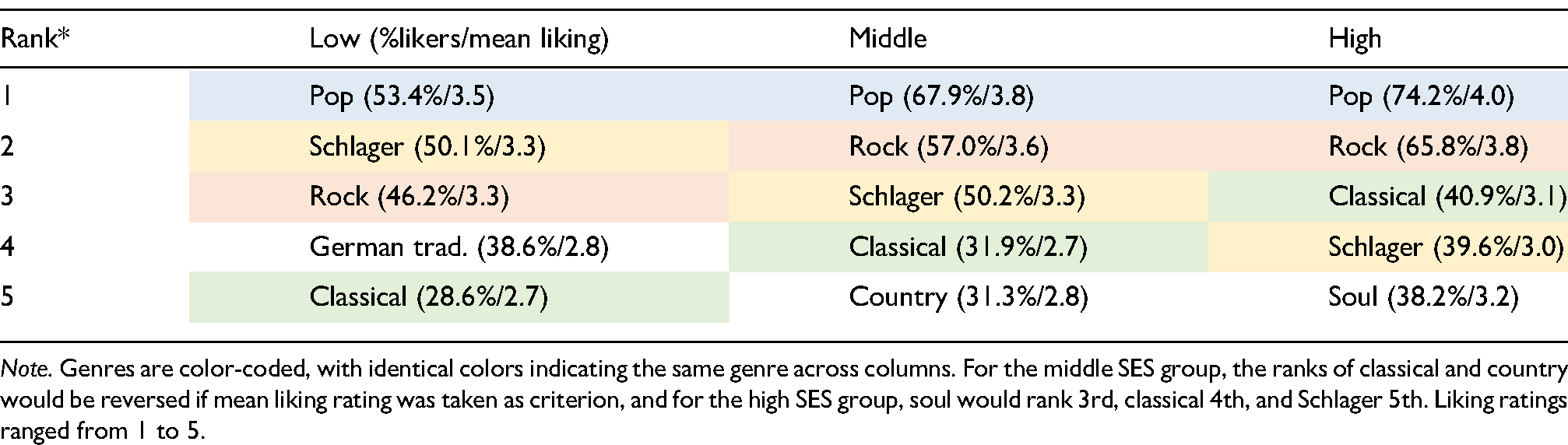
In yet another approach, we ranked the top five preferred genres (Table 3) for each SES group according to percentage of people who liked it and compared them with the mean liking ratings. Here, pop, rock, Schlager, and classical music were among the top five of all three SES groups, although at different ranks (Schlager decreased in rank from low to high (from rank 2 to rank 4 (%) or even 5 (mean liking)), whereas classical increased in rank from 5 to 3 (%) or 4 (mean liking)). In addition, one genre was specific for each group (low: German traditional music; middle: country; high: soul).
Top five genres for each SES according to percent of people who like it; also, mean liking rating for each group are given.
Another claim of the original omnivore thesis is that people with a highbrow musical taste—defined via high preferences for classical music—have the broadest taste. To test this hypothesis with our data set, we computed the mean breadth of musical taste for the likers and fans of each of our genres. The mean values and standard deviations for both likers and fans are depicted in Figure 4. People who like classical music (very much) do not show particularly broad taste but range only in the middle. Instead, people who like funk, jazz, and/or non-European music are the ones with the broadest tastes in our sample, while people who like pop, Schlager, and German traditional music have comparatively narrow taste.
Musical taste breadth for likers and fans of the different genres. Note. Error bars represent standard errors of means.
Relationships Between Breadth of Musical Taste and Sociodemographic Variables and Personality Traits
In the following, we report the results of associations between breadth of musical taste and sociodemographic and personality variables, for the subsets of likers and fans, based on linear regression models. Descriptive statistics can be found in Table 1; regression models can be found in Table 4. The sociodemographic variables considered in this analysis included: age, age2 (as Purhonen et al.'s (2010) and Voronin's (2022) findings provide evidence of a quadratic relationship between age and musical taste), gender, education level (categorized as low, medium, and high), SES (categorized as low, middle, and high), and milieu-related attitude (tradition, modernization, and reorientation) based on the Sinus-Milieu classification of each participant. The BIG-5 personality traits were used as descriptors of personality.
Linear regression models to predict breadth of musical taste for likers and fans from sociodemographic and personality variables.

Note. CI, confidence interval; LL, lower limit; UL, upper limit. BFI, Big Five Inventory; E, extraversion; N, neuroticism; O, openness; C, conscientiousness; A, agreeableness; Significant values are boldfaced.
In the group of likers, education, age2, high SES, an attitude toward reorientation, and traits of extraversion and openness proved to be relevant predictors, with moderate explanatory power (R2 = .16, interpretation follows Cohen, 1988). Among fans, education, age2, a tendency toward reorientation, extraversion, and openness were significant predictors, with weak explanatory power (R2 = .10). Individuals with broader musical taste were generally more educated and open and more likely to belong to reorientation-oriented Sinus-Milieus. Among likers, these individuals were also more extraverted and tended to have higher SES. Overall, individual attitudes (openness, reorientation) were stronger predictors than SES alone.
Discussion
Applying a newly developed continuous similarity-weighted measure of breadth of musical taste and describing social differences with the help of Sinus lifestyle milieus, this study re-examined previous findings and theories on musical omnivorousness as a marker of high SES based on a representative German sample.
We based our analyses and research questions on the findings of Peterson and Simkus (1992) and Peterson and Kern (1996), who identified a structural change in US Americans’ taste among the highest social class from classical music snobs to musical omnivores, and on studies that have already found diverging results from Peterson's in that, for example, different types of omnivores were postulated and characterized (Kunißen et al., 2018) and their prevalence was considered over time (Amrhein, 2023). Consequently, we investigated whether there are correlations between individuals’ breadth of musical taste and indicators of their social status.
Added Value of the Newly Developed Measure Compared to Previous Approaches
Musical genres are neither equidistant from each other nor is there a shared understanding of how many genres exist and what types of music should be defined as main genres and which as subtypes. Accordingly, mere sum scores of musical taste breadth depend strongly on the selection of musical genres that researchers present to their participants, which is why this approach, originally used in Peterson’s and others’ studies, has been criticized (Amrhein, 2023). Researchers have sought to account for the purported socially transgressive nature of omnivorous—that is, particularly broad—tastes by creating measures for “omnivorousness by composition” (e.g., Gebesmair, 2004; Warde et al., 2007). This approach, however, implies the existence of fixed and stable associations of genre preferences with social groups, an assumption that should not be taken for granted.
Our newly developed measure of breadth of musical taste accounts for the sonic-social similarity or distance between liked genres without making a priori assumptions about their social belonging. Instead, we used expert ratings of the (dis)similarity of genres as a weighting factor. The added value of this approach becomes evident when comparing the sum and the new measure, as illustrated in Figure 1: The breadth of people that seemed to be the same according to the summative approach showed a large range of approximately two scale points when computed based on our measure. This means that, for example, a person who said they liked three relatively distinct genres reached the same level of breadth as a person who said they liked five rather similar genres—a result we think represents the relationship between the breadths of their tastes better than the relatively large difference of 3 vs. 5 would suggest. Our measure could also be used to study the breadth of disliked or rejected music, given that social distinction via musical taste may work particularly well through rejection and exclusion (Bourdieu, 1979) and that recent empirical work on musical dislikes has shown them to be important aspects of people's taste (Ackermann & Merrill, 2022; Merrill et al., 2023; Warde et al., 2008).
We are aware that it requires additional effort to survey the proximity/distance of genres, particularly since these distances can be expected to vary depending on the cultural and historical context and thus would have to be recalculated for any study conducted at a different time or place than ours. However, it could be informative to collect qualitative (from musicological genre experts) and quantitative (via expert ratings) similarity assessments for the most relevant musical genres in those cultural regions for which studies of breadth of musical taste have been conducted so far, and repeat them at regular intervals of, for example, five years to gain well-founded insight into the temporal dynamics and size of this variation. Future advancements in AI-based similarity detection methods may also help to mitigate this issue. Currently, however, this is not possible since, for example, existing genre classification algorithms consider neither the sonic-social double nature of musical genres nor their cultural relatedness (Born, 2020; Green et al., 2024).
In calculating the similarity and distance measures, we employed expert ratings that considered both musical and sociological aspects of genres. Lizardo (2024) put forth an alternative approach that is also based on distance measures but considers the relationship between individuals and genres. He arrived at a differentiation of genres that is not conceptually defined a priori but rather based on the choice behavior of the people surveyed. The subsequent analyses yielded comparable results to those proposed by Johnston et al. (2019), namely a taste profile that is differentiated by SES within genres.
Although it was important to us in our study to use predetermined genre terms, as they are still used in social discourse, we recognize the added value of including analyses at the subgenre level. The studies of Lizardo (2024), Johnston et al. (2019), and Siebrasse & Wald-Fuhrmann (2023) provide evidence to support this approach. Future research could build on this point to further refine our understanding of musical taste breadth.
Results Regarding Breadth of Musical Taste in Germany in Light of the Original Omnivore Thesis
Overall, people in Germany at the time of data collection (2016/17) did not have particularly broad musical taste, given that the mean score of liked genres was only 3.87 out of 14 (and of particularly liked genres only 1.35). We used three approaches to test assumptions stemming from the original omnivore theory: We tested whether people with high SES have broader musical taste than people with low and medium status (1); we investigated whether preferences for specific genres are related to status groups (2); and we explored whether people with a taste for classical music have broader tastes than others (3).
(1) As the omnivore thesis would suggest, breadth did increase with SES, but only slightly so. On average, people with high SES liked only 1.0 genre more out of 14 genres than people with low status. SES was also a significant, but not very strong predictor of breadth for likers but not fans in a regression model that had generally only moderate explanatory power. This suggests that there is no strong relationship between SES and breadth of musical taste in Germany to date—a finding that supports the thesis of increasing status-independent individualization and integration of elements of high- and pop-culture, including musical taste (Gilleard & Higgs, 2005). This also contributes to findings of previous quantitative studies on breadth of musical taste in Germany that had inconsistent results (Amrhein, 2023; Gebesmair, 2004; Kunißen et al., 2018; Neuhoff, 2001; Otte, 2008; Rössl, 2006). The earliest study by Neuhoff (2001) found high-status people to still have rather narrower breadth than other participants for both musical consumption (types of concerts visited) and taste (liked genres) and even a tendency toward snobbism. Other and also more recent studies, however, showed at least slight tendencies toward greater breadth for high-status people, with education as a main factor (Kunißen et al., 2018). Recently, Amrhein (2023) compared data on musical taste from the national ALLBUS surveys in 1998 and 2014, classified genres following Schulze's (1992) influential categorization of three schemes of everyday aesthetics that also included music taste (“Spannungsschema”/tension scheme, e.g., rock, metal, current charts, EDM; “Hochkulturschema”/high cultural scheme, e.g., classical, jazz, world music; “Trivialschema”/trivial scheme, e.g., Schlager and German traditional music), and computed the number of people who showed one of four types of omnivorousness, that is, a preference for at least one of two representative genres from two or three cultural schemes. He found that people who like genres from all three schemes (which he called the “Allesfresser-Omnivor”) were less frequently found in the high-status group (14% vs. 22% and 20% in the two other groups), mainly because of the low liking of this group for music from the trivial scheme. (2) Contrary to what could be expected from existing research, our findings did not substantiate class-specific taste patterns in Germany. Mean liking differences for genres existed but were again only small. Also, the liking patterns across all genres were very similar for the three social strata, with pop and rock music being the top two for all groups. That the high social stratum reported higher liking levels for nearly all genres examined, including supposedly middle- or low-brow genres (genres from the tension scheme or trivial scheme) such as country, EDM, or rap, at first seems to support the omnivore thesis from a different angle. Only the specifically German genres Schlager and German traditional music were liked most by the lowest stratum and least by the highest, which resonates with Amrhein's (2023) findings. However, the effect sizes were again very small. Also, classical music can no longer be seen as the defining genre for the social elites, since it ranked only fifth for this group. Instead, genres that showed the largest liking differences across social strata, such as blues, jazz, and soul (in addition to pop and rock), were mostly genres with an African American origin. This suggests a class-related taste difference in Germany that stretches along the dimension of cultural closeness vs. distance. While the lowest social group particularly liked mainstream (pop, rock) and domestic (Schlager, German traditional) music—that is, culturally close and familiar genres—the highest social group also liked genres whose origin was culturally very distant from them (genres with a mean rating > 3.0: soul, non-European music, blues). This finding is related to Meuleman and Lubbers’ (2014) study on preferences for domestic vs. foreign musical artists as a marker of education level and social status in the Netherlands (see also Katz-Gerro, 2017; Meuleman et al., 2018). Given that the “trivial” genres (according to Schulze, 1992) are also the domestic ones, it should be discussed whether it is really their assumed simplicity or their familiarity that makes them more appealing to low-status individuals. (3) We took yet another approach to testing our data against the original omnivore hypothesis that claimed that people with highbrow musical preferences have broader tastes than others. When we compared breadth of taste of people who liked classical music (very much), we found a different result. Those people had only average breadth compared to people who liked genres such as funk, jazz, soul, and non-European music (very much). In contrast, people who liked pop, Schlager, and German traditional music (very much) tended to be univores. Again, the dimension of domestic vs. foreign/culturally distant musical genres appeared as relevant (Meuleman and Lubbers, 2014). This distinction also becomes relevant because classical music, jazz, and blues are often considered to belong to the same cluster of typically highbrow or “sophisticated” genres (Rentfrow, Goldberg and Levitin, 2011). But while classical music can be classified as a highbrow but domestic genre, the other genres are highbrow and foreign and therefore related to broader tastes.
Overall, breadth of musical taste cannot be seen as a particularly strong form of social distinction in Germany today. Rather, we find very similar tastes in all SES groups, and therefore also no strong social associations of certain genres, with the exception of the domestic genres of Schlager and German traditional music that also emerged in Amrhein's (2023) analyses. Apparently, social distinction via music at the genre level in Germany is nowadays restricted to high-status people disliking domestic music from the trivial scheme that is indeed most liked by low-status individuals. This is similar to an older finding by Bryson (1996), where high-status US Americans (still) rejected those genres that low-status individuals liked the most (in this case, gospel, country, and heavy metal). Such findings rather corroborate Bourdieu's earlier distinction-by-genre rejection thesis (1979), although a temporal change seems to emerge: Social distinction via musical taste is becoming primarily an indicator of high-status people and relies on ever fewer genres, namely those domestic musics that are most strongly associated with low-status listeners. People with low and medium SES, in contrast, adopt broader and more diverse tastes (Amrhein, 2023).
Social Strata and the Breadth of Musical Tastes
However, the precise operationalization of social class has varied considerably in previous research, which may at least in part account for diverging results (Kunißen et al., 2018). In the initial study (1992), Peterson used occupational groups as an indicator, as did Peterson and Simkus (1992); in 1996, Peterson and Kern used musical taste as such to define highbrows. Although highbrows also tend to have higher incomes and higher levels of education, classifying individuals as highbrows based on their musical taste seems tautological at first glance. Purhonen et al. (2010) employed correlations with education and income, Amrhein (2023) used education, and Voronin (2022) used occupational prestige, education, income, and the class to which people assign themselves. As can be observed, the methodology employed is not uniform and will likely affect the relationships found with breadth of musical taste. In our study, we used the assignment to Sinus-Milieus as an indicator of status, both in accordance with the established conceptualization (SES) as well as in consideration of attitudes and values. Sinus-Milieus offer a description of social groups that combines classical hierarchical concepts such as class and SES with approaches that rather focus on milieus characterized by attitudes and lifestyles and emphasize the active role of the individual with regard to the choice of a milieu or lifestyle and its expression (DiMaggio, 1994; Schulze, 1992; Weber, 1972).
Our data was collected in 2016/17 using the Sinus-Milieu model current at that time. In 2021, the SINUS Institute released an updated model that reconfigured some milieus (e.g., merging the Liberal Intellectuals and Social Ecologicals into a Postmaterialist Milieu and introducing a new Neo-Ecological Milieu), while retaining the same theoretical framework and two-dimensional structure (SINUS Markt- und Sozialforschung GmbH, 2021). As the institute emphasizes, an older model does not become obsolete with a new release, since it accurately captured the milieu landscape at the time of its use. More importantly, the key dimensions underlying our analyses—SES and basic value orientation—are structurally stable across both model versions, so our findings are not affected by the subsequent update.
In our study, the hierarchical aspect of SES appeared to be only a weak predictor of breadth of taste. Instead, we found that education, an attitude toward reorientation (taken from the Sinus-Milieus), and in particular openness predicted breadth. While the linear effect of age was not significant, age2 showed a significant negative association, which indicates an inverted U-shaped pattern. Similar effects have also been reported by Purhonen et al. (2010) and Voronin (2022). However, as Amrhein (2023) points out, age is not a consistent predictor across studies. In general, taste—projected onto the milieu chart (see Figure 5)—becomes broader not only with increasing socioeconomic status (y-axis) but primarily with the increase in a basic attitude toward reorientation (x-axis), which seems to be the social complement to the personality trait openness and is related to education level and cohort (age2).
Means of musical taste breadth by Sinus-Milieus for likers and fans, calculated using the formula that incorporates both the number of liked genres as well as the genre distance (see Section Breadth of Musical Taste: Measure and Descriptive Statistics).
But overall, the predictive quality of the models proved to be weak. We see two possible explanations for this: Either social or similar factors are indeed playing a much smaller role in increasingly individualized Western societies (Gilleard & Higgs, 2005), or the typical ways of measuring social group affiliation and musical taste are not distinctive enough. The first alternative is supported by previous studies that explored the role of socioeconomic versus lifestyle aspects for cultural tastes. For example, age and education appeared to be the most important and stable demographic factors to predict belonging to a milieu characterized by a specific pattern of cultural consumption (Hermann, 2004; Müller-Schneider, 2000; Schulze, 1992). The second alternative has been explored by research that focused on relationships between musical taste groups, lifestyles, and social affiliation, such as Katz-Gerro (1999; using US survey data from 1993), Le Roux et al. (2008; UK), North & Hargreaves (2007a, 2007b, 2007c; UK), or Otte (2008; Germany), which yielded multifaceted results. Although the taste publics were often closely associated with certain lifestyle aspects, they showed varying degrees of association with the socioeconomic groups, for example in that some of them were relatively exclusive to only one group, while others occurred equally frequently in all of them (Katz-Gerro, 1999), or in that socioeconomic indices were only statistically related to some taste characteristics (North & Hargreaves, 2007c). Such findings, along with general sociological observations of increasing social fragmentation and individualization, and changes in music distribution and music consumption, have already raised the question of to what extent musical taste—or individual aspects of it—is still a means of social distinction in developed Western societies (North & Hargreaves 2008; Peterson 2005). Our results suggest that this means has lost importance in terms of social distinction (at least in today's Germany) compared to attitudinal factors.
Apart from our attempt to describe social groups in a more nuanced way via Sinus-Milieus, an investigation at the subgenre level could also achieve better descriptive and predictive quality. In an earlier study, it was shown that likers of certain musical genres can be grouped into several subgroups depending on their liking ratings for several related subgenres. Often, these subgroups consisted of one group with a sophisticated taste, one or two with a mainstream taste, and one or two others that only liked very few, simpler subgenres of the genres and also showed strong sociodemographic and personality differences (Siebrasse & Wald-Fuhrmann, 2023). A similar finding was reported by Johnston et al. (2019), who referred to studies that show that preferences for highbrow music carrying symbolic capital could be found within the genres at the subgenre level. A differentiation of genres into subgenres on the one hand and of social groups into lifestyle milieus on the other could therefore provide added value and possibly better predictive quality and should be investigated in a next step.
Limitations and Future Perspectives
A valid measure of breadth of musical taste offers several possibilities for further research: It makes it possible to estimate and compare the typical distribution of breadth of taste in specific populations in cross-temporal and cross-cultural approaches and to explore which genres are particularly often liked in combination with each other. Also, a comparative study of which genres are most often associated with narrow breadth and which ones with large breadth could be made. While in this study we exclusively focused on breadth regarding liked music genres, the number of disliked genres (tolerance, following Kunißen et al., 2018), as well as breadth regarding actual listening behavior (consumption), could also be assessed. Such a combination would yield a truly multidimensional measure of an individual's openness regarding musical engagement.
Several extensions of our similarity-weighted measure seem desirable: First, it could be refined by examining musical taste at the sub-genre level, which includes exploring which genres and sub-genres frequently co-occur; this could be realized with latent profile analyses at genre and subgenre levels. Additionally, the use of AI and algorithmic methods for the automated analysis of genre proximity or distance values could significantly enhance and simplify the scalability of our model. The integration of more musical aspects, which could be derived theoretically on the one hand and analyzed with the help of AI on the other, would further enrich our approach.
The weighted measure we developed and presented in this study represents a preliminary step in this direction, surpassing the mere summation of liked genres. Future studies should also consider cross-cultural assessments of perceived genre proximity and distance. Evaluating these perceptions across different countries and cultures, with a broader spectrum of genres, would shed light on the generalizability and robustness of our findings.
Overall, the question of how musical (and generally, cultural) tastes can best be described and which social and other variables influence them seems still open to debate and will most likely remain open, since the cultural goods they address and the social constellations in which they emerge and become meaningful keep changing. Therefore, all scientific insights and explanations need to be acknowledged as regionally, culturally, and historically specific and therefore preliminary. Recently, for example, Hanquinet and Taylor (2025) have pointed out within- and cross-national differences in musical tastes in six European countries and have not found strong evidence for a transnational elite with very similar taste. And Glewarec & Nowak (2022) have shown temporal changes in youth's musical taste across 40 years of research. Historical and cultural comparisons would therefore be particularly valuable, once standards of measuring tastes, breadth of tastes, social affiliation, and other relevant variables have been agreed upon by the community of researchers. Therefore, this study—apart from the criticism it raised of some of the earlier approaches in this field—is limited to German musical tastes today. It allows meaningful comparisons with studies on present musical tastes in other countries or with previous studies on Germany. But it cannot claim to have found a general pattern of the relationship between breadth of musical taste and sociodemographic characteristics, which simply does not exist. Instead, it raises the question of which variables may explain taste differences in cases where social factors prove to have only little or no influence. Our study corroborated earlier findings of the importance of attitudes (e.g., Voronin, 2022) and personality traits. This suggests that in future, research on cultural taste and consumption should not be restricted to either sociology or psychology, but should combine variables and explanations from both fields. In addition, knowledge about the individual cultural or art forms that musicologists and other humanities scholars could provide is necessary to identify meaningful categories and (sub-)classes, assess their aesthetic properties, identify sociocultural associations, and help with interpreting results.
Finally, a limitation concerns the transparency of the Sinus-Milieu classification. The assignment of participants to milieus, as well as the derivation of SES and attitude categories, follows standard procedures of the SINUS Institute that have been validated in decades of applied and academic research (Barth et al., 2017). However, the proprietary nature of the milieu indicator—the algorithm mapping responses to the 29 attitude statements onto the 10 milieus—limits full reproducibility. This is a general constraint of working with commercial segmentation tools that should be borne in mind when interpreting our results.
Supplemental Material
sj-docx-1-mns-10.1177_20592043261435500 - Supplemental material for Beyond Simple Sums: Similarity-Weighted Measure of Musical Taste Breadth and Social Stratification in Contemporary Germany
Supplemental material, sj-docx-1-mns-10.1177_20592043261435500 for Beyond Simple Sums: Similarity-Weighted Measure of Musical Taste Breadth and Social Stratification in Contemporary Germany by Anne Siebrasse and Melanie Wald-Fuhrmann in Music & Science
Footnotes
Acknowledgments
We are grateful to our colleague Dr. Klaus Frieler for his advice on statistical issues and to Lorna Bittner from our graphics unit for her help with the figures. We also want to thank Dr. Fabian Greb who provided valuable input in an early stage of this project.

Ethical Approval Statement
All procedures were ethically approved by the Ethics Council of the Max Planck Society (No. 2024_12) and were undertaken with written informed consent of each participant.
Funding
The authors received no financial support for the research, authorship, and/or publication of this article.
Declaration of Generative AI and AI-Assisted Technologies in the Writing Process
During the preparation of this work, the authors used Claude 4.0 to improve language and readability since they are not native English speakers, to check the formatting of references, and for a draft of the abstract. After using this tool, the authors reviewed and edited the content as needed and take full responsibility for the content of the publication.
Data Availability Statement
The datasets generated during and/or analyzed during the current study are not publicly available, as this was not explicitly mentioned in the original consent form. Data are available from the corresponding author on request and after signing a data sharing agreement.
Action Editor
Andrea Schiavio, University of York, School of Arts and Creative Technologies.
Peer Review
Eva Schurig, Carl von Ossietzky Universitat Oldenburg, Department of Music.
Kathrin Schlemmer, Katholische Universitat Eichstatt-Ingolstadt.
Supplemental material
Supplemental material for this article is available online.
Notes
References
Supplementary Material
Please find the following supplemental material available below.
For Open Access articles published under a Creative Commons License, all supplemental material carries the same license as the article it is associated with.
For non-Open Access articles published, all supplemental material carries a non-exclusive license, and permission requests for re-use of supplemental material or any part of supplemental material shall be sent directly to the copyright owner as specified in the copyright notice associated with the article.
