



Abstract
Musicians rely heavily on core skills like rhythmic stability, sightreading, and musical memory for optimal performance. However, the specific impact of sleep on musical skills remains relatively understudied, despite prior research showing that sleep benefits broader cognitive and motor skills. This suggests that sleep could also facilitate musicians’ skill acquisition and proficiency. To address this gap in knowledge, the current study examined the effects of a sleep extension intervention on musical abilities and psychological flexibility in musicians. Fifty participants were divided into control and intervention groups, and their sleep was tracked using wearable technology. Rhythmic stability, sightreading, memory, psychological flexibility, and sleepiness were assessed at baseline, after 1 day, and after 7 days. The intervention group received 60 to 90 min of additional nightly sleep above their baseline measurements. From baseline to the final assessment, statistically significant improvements were found in the intervention group compared to the control group for rhythmic stability (4.50%, p < 0.001), sightreading (7.12%, p < 0.002), and musical memory (38.24%, p < 0.036). Additionally, psychological flexibility scores significantly increased in the intervention group (Mdiff = 3.16, p < 0.001) while remaining stable in the control group, with a significant between-group difference (Mdiff = 3.40, p < 0.001). These findings highlight sleep’s facilitative role in the improvement of musical motor skills, cognitive function, memory, and psychological resources that may enhance musicians’ resilience and adaptability in performance contexts. The results suggest that sleep extension may optimize musicians’ abilities and success, emphasizing the importance of prioritizing sleep in the lives of musicians. This study underscores the pressing need for further investigation into the sleep patterns of musicians, with an emphasis on empirical evidence that could ultimately inform best practices for sleep management within this specialized field.
Keywords
Introduction
Sleep strongly influences domains of the brain critical to musical performance, including cognitive function, motor skills, and memory (Cunha et al., 2023; Dinges et al., 1997; Gais et al., 2006; Li et al., 2024; Walker et al., 2002). These domains represent foundational elements for musicians, who must simultaneously coordinate complex cognitive processes with refined motor skills while recalling extensive musical material during performance. Despite the unique cognitive and physical demands of musical performance, research specifically addressing sleep’s impact on musicians remains relatively scarce.
Dinges et al. (1997) conducted pioneering research demonstrating that sleep restriction, defined as a reduction of sleep below an individual’s baseline, leads to impaired attention, alertness, and decision-making abilities. Dinges et al. recruited young adults with an average age of 22.9 years and subjected them to a battery of tests under baseline sleep conditions and during 7 days of sleep restricted to 33% below their baseline. The results revealed significant performance decrements even with relatively modest reductions in sleep duration. While this study was conducted on a general population, the findings suggest that inadequate sleep may negatively affect musicians’ cognitive performance during musical tasks, which frequently demand sustained attention, rapid decision-making, and error monitoring under pressure. Though research specifically examining sleep’s effects on musical cognition and auditory performance remains limited, Karahan and Kayabekir (2023) demonstrated that a single 24-h period of sleep deprivation resulted in statistically significant decreases in rhythmic and melodic dictation abilities among second-year music teaching students.
Studies by Walker et al. (2002) and Fischer et al. (2002) highlighted sleep's significance for fine motor skills development and performance in general populations. Their research demonstrated that motor skills specifically benefited from post-learning sleep periods, as participants showed enhanced performance after intervals that included sleep compared to equivalent waking intervals without sleep. The implications for musicians were substantial, as fine motor skills were essential in music performance. According to Altenmüller and Jabusch (2010), musicians’ performance quality depended critically on precise and complex fine motor skills. Watson (2006) further documented how instrumental musicians relied on dexterity, coordination, and fine motor control to achieve both technical accuracy and expressive nuance. Furuya and Altenmüller (2013) found that expert musicians developed specialized motor skills characterized by movement efficiency and adaptability specific to their instrumental requirements.
Tucker and Fishbein (2009) found that sleep plays a crucial role in memory consolidation, enhancing information retention and recall. This occurs through sleep-dependent processes that facilitate conversion from short-term to long-term memory storage. While this research was not specifically targeted at musicians, the findings suggest sleep may significantly influence musicians’ ability to perform accurately from memory—a skill particularly vital for soloists and ensemble musicians who frequently perform complex repertoire without written notation.
While it has been observed that musicians have an advantage over non-musicians in certain memory tasks (Talamini et al., 2017), there are only a limited number of studies that touch directly on the impact of sleep on musical skills. Allen (2013) conducted research examining how overnight sleep affects the consolidation of newly learned musical skills in musicians. Allen tested 60 undergraduate and graduate (non-pianist) music majors who learned to play 13-note piano melodies with their non-dominant hand. The study's 12-h interval between initial learning and subsequent testing represents an important middle ground in memory research—longer than the brief intervals (1–3 min) typically used in traditional memory tests like the Rey 15-item test (Mazurek et al., 2015), yet shorter than the extended periods of weeks or months that musicians typically devote to memorizing performance repertoire. Allen's results showed that participants who learned only one melody and slept before retesting demonstrated significant overnight improvement (11.4% increase in performance), while those who learned a second interfering melody before sleep showed no such improvement. This provided evidence that sleep specifically benefits the consolidation of musical skills, and that this process can be disrupted by interference from learning similar tasks before the memory consolidation of sleep.
In a complementary study involving pianists, Van Hedger et al. (2015) found both motor and conceptual errors increased over waking 12-h periods, while conceptual errors significantly reduced over the same elapsed time when it included sleep. The study required pianists to learn short piano pieces and distinguished between conceptual errors (related to musical structure, such as playing incorrect notes in the context of music theory) and motor errors (physical execution errors like adjacent note substitutions and timing variability). Results showed that both motor and conceptual errors significantly increased over a 12-h waking retention interval. However, following a night of sleep, conceptual errors were significantly reduced (while motor errors showed no improvement). These findings align with research in non-musical domains but neither study examined effects of adjusting sleep duration. This suggests further exploration of sleep extension's effects on musicianship is warranted to determine whether more sleep might provide additional benefits beyond normal sleep periods.
Simmons and Duke (2006) conducted one of the first investigations examining how sleep impacted musicianship, finding significant sleep-dependent improvements in timing and accuracy when participants played keyboard melodies. Seventy-five non-pianist music majors at the University of Texas at Austin were recruited to take part in the study. They were taught novel 12-note melodies which they performed with their non-dominant hands. Improvements were noted in retests that followed an interval of sleep, but no improvements were observed following intervals that did not include sleep. Their results demonstrated sleep-based improvements in performance accuracy when compared to waking intervals of the same duration. This study is important in that it demonstrated that musical skills benefited from sleep-dependent consolidation processes, though these findings did not directly address the specific impact of sleep extension on the performance of established musical skills.
Sleep extension—sleeping longer than habitual baseline amounts—may optimize cognitive and motor performance by helping individuals achieve recommended sleep amounts (Kamdar et al., 2004). This approach recognizes that many individuals in modern society operate with chronic sleep restriction. Researchers have identified a trend towards increasingly problematic levels of chronic sleep debt. Examining the survey results of 27,399 people with data drawn from the National Health and Nutrition Examination Survey (NHANES) between 2005 and 2018, Nie et al. (2024) found that sleep disorders and troubled sleeping were increasing. Recent analyses of data collected using an under-mattress sleep tracking device have found that of the 67,254 people studied, only 15% of them slept 7–9 h per night for at least 5 nights a week (Scott et al., 2024). In a study that defined short sleep as averaging under 6 h of sleep per night, Yan et al., (2024) found that the percentage of Chinese adults who identified themselves as short sleepers increased rapidly from 9.7% in 2010 to 17.1% in 2018.
Mah et al. (2011) conducted a comprehensive sleep extension study with 11 male collegiate basketball players. Their investigation employed a within-subjects design comparing a baseline period of habitual sleep with a sleep extension intervention. Using actigraphy and sleep logs to measure sleep duration, researchers documented that participants increased their total sleep time by an average of 110.9 min during the intervention period. Athletic performance was assessed through basketball-specific measures including sprint time, free throw accuracy, and three point shooting accuracy. Following sleep extension, participants demonstrated significantly improved sprint times (16.2 s at baseline vs. 15.5 s post-intervention), free throw percentage (9% improvement), and three-point field goal percentage (9.2% improvement).
Additional performance measures used by Mah et al. (2011) revealed even broader benefits from extended sleep. Psychomotor Vigilance Task testing showed significant improvements in reaction time, while Epworth Sleepiness Scale scores decreased significantly, indicating reduced daytime sleepiness. Profile of Mood States assessments demonstrated improved mood with increased vigor and decreased fatigue subscales. These findings established that among elite collegiate athletes, obtaining additional sleep produced measurable improvements in sport-specific performance metrics, cognitive function, and subjective well-being, suggesting that sleep duration may be an underutilized factor in performance enhancement.
Given the multi-faceted nature of musical performance—requiring simultaneous attention to pitch, rhythm, expressive nuance, and technical execution—musicians may be particularly receptive to the benefits of optimized sleep. However, research examining whether extending musicians’ sleep enhances core musical competencies is largely absent from the literature.
Until relatively recently, accurately measuring sleep duration in the field has been a challenge for researchers. A review by de Zambotti et al. (2019) examined the growing field of wearable sleep tracking technology and its applications in research and clinical environments. The review distinguishes between two generations of wearable sleep trackers: first-generation devices that rely solely on motion detection, and newer multisensory devices that incorporate additional physiological measurements including heart rate, heart rate variability, skin conductance, and temperature. While polysomnography (PSG) remains the gold standard for sleep measurement, these consumer wearables offer potential advantages including continuous long-term monitoring, lower cost, and the ability to collect data in natural environments. Second-generation multisensory devices show improved capability in classifying sleep stages compared to motion only devices, though accuracy of detailed sleep staging varies considerably.
Wearable devices have continued to be introduced and have shown promise in addressing this issue. Miller et al. (2020, 2021) conducted two studies comparing one such device, the WHOOP strap, a wrist-worn health and sleep tracker, against polysomnography (PSG), the gold standard for sleep measurement. Their findings support the WHOOP strap as a viable tool for field research when laboratory-based sleep monitoring is impractical or undesirable.
The initial study (Miller et al., 2020) evaluated the WHOOP strap using manually-entered sleep times against PSG in 12 healthy adults across 86 sleep opportunities. Results demonstrated that the WHOOP device provided reasonable accuracy for two-stage sleep categorization (sleep/wake), with 89% overall agreement. The researchers concluded that when bedtimes are manually entered, WHOOP offers a reasonable field alternative to PSG.
In their follow-up study (Miller et al., 2021), researchers expanded their validation to compare both auto-detection (WHOOP-AUTO) and manual bedtime entry (WHOOP-MANUAL) against both PSG and research-grade actigraphy (ACTICAL). This study with 6 participants across 54 sleep opportunities found that WHOOP-AUTO correctly identified 100% of sleep opportunities. For two-stage categorization, WHOOP-AUTO achieved 86% agreement with PSG, while WHOOP-MANUAL achieved 90% agreement. Notably, both WHOOP functionalities outperformed ACTICAL in agreement metrics.
These findings collectively establish the WHOOP strap as a valid research tool. The device offers automated sleep detection capability and provides similar accuracy whether using auto-detection or manual entry modes. These characteristics make it particularly valuable for research applications where laboratory-based measurements are cost-prohibitive or logistically impossible.
Research suggests that sleep and psychological flexibility may be interrelated factors affecting musicians’ performance. Psychological flexibility—the ability to fully contact the present moment and adapt behaviors in pursuit of goals (Hayes et al., 2006)—represents a vital capacity for musicians who must adapt to changing performance conditions, manage performance anxiety, and maintain focus despite distractions. This construct enables adaptations to situational demands, awareness of internal experiences, and engagement in value-directed actions (Kashdan and Rottenberg, 2010). Interventions increasing psychological flexibility showed promise for reducing music performance anxiety and improving performance quality (Juncos and de Paiva e Pona, 2022), suggesting its importance for optimal musical functioning.
Psychological flexibility in musicians can be assessed using the Musician's Acceptance and Action Questionnaire (MAAQ: Zenobi et al., 2023), a domain-specific adaptation of the more general Acceptance and Action Questionnaire-II. The MAAQ is designed to assess the capacity to accept difficult experiences and take value-based action amid challenging performing circumstances. Validation studies with university and professional musicians (n = 128) demonstrated good internal consistency (α = .84) and satisfactory construct and discriminant validity (Juncos et al., 2022). Some limitations of the MAAQ should be noted when interpreting results: the validation study used a relatively small sample size, and, as with many Likert-scale instruments, responses may be subject to central tendency bias, where participants avoid extreme response options, potentially reducing measurement sensitivity. Despite these limitations, the MAAQ represents an important advancement in domain-specific assessment of psychological flexibility in musicians.
Significant links exist between sleep health and psychological flexibility in the broader literature. Research examined relationships between aspects of psychological flexibility and poor sleep outcomes (Zakiei et al., 2024), with evidence pointing to bidirectionality in this relationship (Ryan et al., 2025). Psychological flexibility correlated with both insomnia severity (Booker et al., 2018) and overall sleep quality (McCracken & Gutiérrez-Martínez, 2011). However, research has not specifically examined sleep's impact on psychological flexibility in musicians, despite the potential importance of this relationship for performance optimization.
While sleep restriction appears detrimental to performance, it remains unclear if deliberately extending sleep could augment performance across various musical abilities. This study addresses this gap by comparing musical skills following sleep extension versus habitual sleep, potentially informing strategies for optimizing musicians’ practice routines, learning processes, and performance preparation. The findings will help elucidate the degree to which extended sleep influences core musical skills, contribute to understanding sleep's role in musicians’ performance abilities, and may inform practical strategies for enhancing musical training and performance.
Methodology
Study Design and Participants
The study employed a two-group design with one group receiving a sleep extension intervention while the control group maintained typical sleep patterns. This approach allowed for direct comparison between extended sleep and habitual sleep conditions. The study sample consisted of 50 musicians (21 males, 29 females), aged 18–55 (M = 33.18, SD = 9.57).
Intervention group participants were instructed to add 90 min of sleep above their baseline average, with flexibility in implementation methods (earlier bedtime, later waking, napping, or combination approaches). This target was selected based on previous sleep extension research showing beneficial effects with similar durations (Mah et al., 2011). This approach allowed for realistic assessment in a free-living study where participants managed their own schedules.
While this approach enhances ecological validity by examining sleep extension within participants’ typical daily lives, it introduces potential confounding variables as other lifestyle factors (diet, exercise, daily activities) were not directly controlled. Baseline measurements began on either Sunday or Monday, ensuring all participants’ intervention periods included a weekend to account for potential weekday-weekend sleep pattern differences.
Inclusion criteria were musicians aged 18–55 who were current full-time tertiary music performance majors or professional musicians.
An a priori power analysis using G*power 3.1.9.4 (Faul et al., 2009) determined that with Cohen's d = 0.9 (Cohen, 2013), significance level of 0.05, and equal group sizes, the minimum sample required to detect a significant difference with 80% power was 42 participants. Although sleep extension studies with musicians had not been previously conducted, large effect sizes have been observed in studies with athletes (Mah et al., 2011) which found effect sizes of 0.757 in three-point accuracy, 0.918 in free throw accuracy, and 1.215 in sprint times with average sleep extension of 110.9 min, providing a reasonable basis for anticipated effect size.
Participants were randomly assigned to control (n = 25) or intervention (n = 25) groups with no significant differences in gender distribution (44% male for intervention vs. 40% for control; p = 1.000) or age distribution (p = 0.264). Most participants (40%) fell in the 26–35 age range. The study included diverse instrumental specializations with representation across string, woodwind, brass, and keyboard families, enhancing generalizability across instrumental specialties (Table 1).
Frequency (%) of demographics.
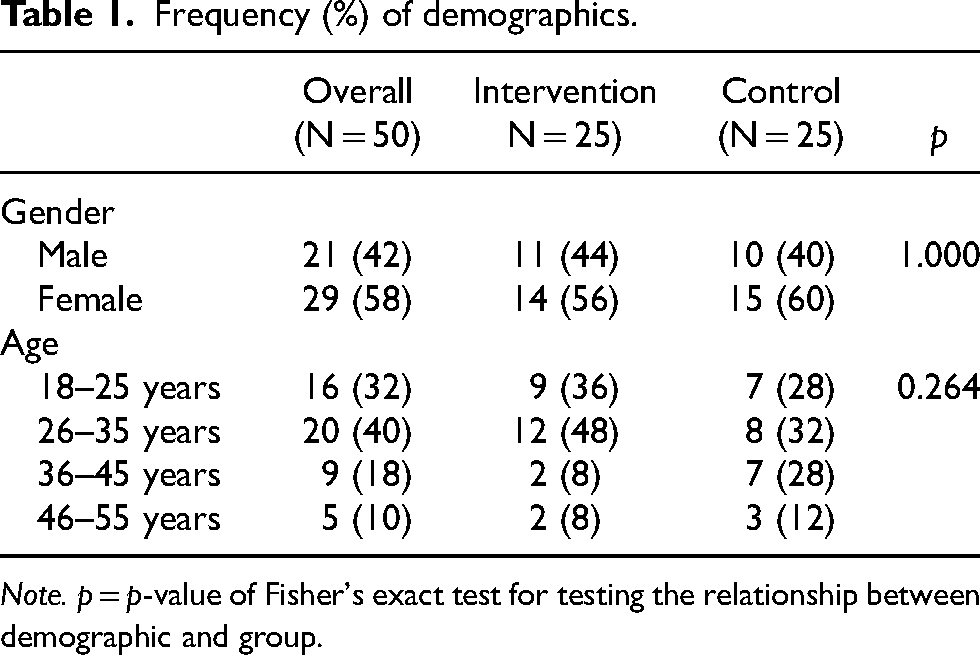
Note. p = p-value of Fisher's exact test for testing the relationship between demographic and group.
Sleep Measurement
To objectively measure sleep duration, participants used WHOOP band wearable devices utilizing photoplethysmography sensors to monitor physiological parameters including heart rate, heart rate variability, respiratory rate, skin conductance, body temperature, and movement (Miller et al., 2021). These data were processed using proprietary algorithms to estimate total sleep time. The devices were selected for their combination of accuracy, user-friendliness, and non-invasive application in free-living environments.
Participants wore the WHOOP band on their wrist during sleep throughout the study. Data transmitted via Bluetooth to a smartphone application compiled sleep statistics including total sleep time. This automated collection reduced participant burden and minimized self-report biases.
Performance evaluation studies show the WHOOP device demonstrates reasonable accuracy compared to polysomnography (the gold standard for sleep assessment). Miller et al. (2020) found it overestimated total sleep time by an average of 8.2 ± 32.9 min (not statistically significant) and demonstrated 89% agreement for two-stage sleep categorization (wake vs. sleep), though only 64% agreement for four-stage categorization. This level of accuracy was deemed sufficient for measuring the substantial two-stage sleep duration differences targeted in this study. A subsequent study found similar sensitivity and specificity to actigraphy for two-stage categorization (Miller et al., 2021).
Following De Zambiotti et al.'s (2019) caution regarding wearable devices for detailed sleep staging, this study focused on total sleep time as this parameter demonstrated greatest reliability in performance evaluation studies. Sleep stage distributions were excluded from analysis due to lower confidence in their accuracy.
Assessment of Musical Skills
Musical skills were assessed using tests for rhythmic stability, sightreading, and memory developed specifically for this study. These domains were selected as they represent core musical competencies relevant across instrumental specialties and many musical genres, providing standardized metrics for assessing musical proficiency.
The BEATLAB MINI Rhythm Trainer assessed tapping accuracy in synchronization with metronome beats. This device was selected for its precision in measuring rhythmic accuracy and consistent, objective scoring. It offers six sensitivity settings and utilizes a contact microphone to capture tapping accuracy relative to the reference beat.
After three practice rounds to ensure familiarity with procedures, participants completed six scored rounds of increasing difficulty. Each round consisted of a one-measure audible count-in followed by eight measures where participants struck a paper pad with a drumstick in time with the metronome signal. The goal was close alignment with the audible beat, requiring both perceptual accuracy and motor precision. Scores out of 100 were generated and recorded for each round.
For sightreading assessment, novel musical passages were composed to ensure no prior exposure could confound results. Using standard repertoire poses potential validity issues as participants may have varying familiarity with materials. Because assessments occurred at two timepoints (beginning and end of study), two comparable musical fragments were created using a compositional formula ensuring similar difficulty. The specific compositional framework used to generate consistency in difficulty across the two sightreading excerpts can be found in Appendix A.
Each fragment spanned 25 measures in 4/4 time with no sharps or flats in the key signature, beginning with simple whole notes and progressively incorporating more complex elements every two measures. Passages began in each instrument’s middle range (Miller, 2015) and progressed from diatonic stepwise motion to larger intervals, accidentals, and more complex rhythmic structures. Dynamic markings and articulation details were intentionally excluded to maintain scoring consistency.
Scoring was calculated per-beat, with one point deducted for each beat containing pitch or rhythm errors from a perfect score of 100. A metronome at 100 beats per minute (BPM) provided an objective reference for both performers and the adjudicator. If participants stopped playing, all remaining unplayed beats counted as missed.
For musical memorization, participants had 5 min to practice a novel composition initially and 5 additional minutes at each re-test. The musical material was 25 measures long in 4/4 time. It included rests, syncopations, dotted rhythms, and both sharp and flat accidentals. Tests were administered at baseline, 24 h later, and 7 days later. The multi-timepoint assessment allowed examination of both short-term and medium-term musical memory processes. Scoring matched the sightreading approach, assessing both accuracy and completeness.
All sightreading and memory tests were scored by the same experienced adjudicator who was blinded to intervention condition to maximize consistency and prevent potential scoring biases.
Psychological Flexibility and Sleepiness Assessment
Psychological flexibility was measured using the Musician's Acceptance and Action Questionnaire (MAAQ) (Zenobi et al., 2023), which assessed participants’ capacity to accept difficult experiences and take value-based actions amid challenging performance circumstances. This instrument was selected because of its demonstrated superior predictive validity compared to general psychological flexibility measures when assessing music-specific outcomes, including performance quality, flow experiences during practice and performance, and avoidance behaviors in musical contexts. Higher scores indicate greater psychological flexibility, reflecting enhanced capacity to manage performance-related thoughts and emotions while maintaining goal-directed behavior.
The Stanford Sleepiness Scale (SSS) tracked participants’ subjective sleepiness (Hoddes et al., 1973), with ratings from 1 (fully awake) to 7 (sleep onset soon). This scale was selected for its simplicity, validated status, and widespread use in sleep research (MacLean et al., 1992; Shahid et al., 2011).
Participants completed these instruments a total of three times: following the baseline measurement period (before the start of the intervention), after one day of the intervention, and at the conclusion of the intervention.
Study Timeline
The study followed an 11-night/12-day timeline consisting of orientation, baseline sleep tracking, intervention period, and three assessment points. This timeline balanced adequate measurement of baseline sleep patterns, sufficient intervention duration to observe effects, and practical constraints on participant time commitment.
During orientation, participants received standardized information about study procedures and WHOOP device usage along with informed consent documents. They then tracked sleep for four nights to establish baseline measurements.
After the fourth night, Assessment 1 established baseline performance levels, measuring sleepiness (SSS), psychological flexibility (MAAQ), rhythmic stability, sightreading, and memory. The intervention group then extended sleep by 90 min above baseline for one week, while the control group maintained normal patterns. This one-week intervention period was based on previous research showing measurable effects within this timeframe (Mah et al., 2011).
After the fifth night (approximately 24 h after Assessment 1), Assessment 2 measured sleepiness, psychological flexibility, and memory to examine rapid effects before the full intervention period concluded. After the 11th night, Assessment 3 repeated the full testing battery from Assessment 1, allowing comparison of pre- and post-intervention performance across all measured domains.
Participants in both groups maintained continuous sleep tracking throughout the study period, ensuring data on sleep patterns from orientation through final assessment.
Analysis Methods
Data analysis used SPSS version 23. Descriptive statistics (means and standard deviations) summarized central tendencies and variability within each group. Absolute change scores were computed as: new value—old value, directly quantifying the magnitude of change in each measure.
The statistical analysis had three main objectives: (1) examining relationships between sleep increase and musical skills (rhythmic stability, sightreading, memory) from baseline to final assessment; (2) investigating relationships between sleep increase and psychological measures (MAAQ and SSS) from baseline to final assessment; and (3) exploring effects of a single night’s sleep increase on memory, MAAQ, and SSS.
Paired t-tests examined differences in test scores between assessments within each group, while two-sample t-tests examined differences in change scores between groups. For sleep quantity, this analysis served as a manipulation check verifying the intervention successfully increased sleep duration in the intervention group compared to controls.
Statistical assumptions were verified according to established guidelines (Kim, 2013; West et al., 1995). For paired t-tests, assumptions included continuous dependent variables, independent observations, and approximate normal distribution. For two-sample t-tests, assumptions included independence of observations, approximate normal distribution of data, and homogeneity of variance (examined using Levene’s test).
When normality assumptions were not satisfied, non-parametric alternatives (Wilcoxon signed-rank test for paired comparisons, Mann–Whitney U test for between-group comparisons) were performed. When variances were not equal but normality was satisfied, Welch–Satterthwaite t-tests were used. All tests used a significance threshold of p < 0.05.
Results
Raw data collected as part of this study and an additional supplemental statistical analysis report focused on relative change is available via the Open Science Foundation (OSF) data repository at: https://osf.io/rd8n3/?view_only=189456534792479d95ea38ecb6efaca6.
Sleep Duration
WHOOP band sleep tracking devices quantified total nightly sleep during baseline (4 nights) and intervention (7 nights) periods. Mean sleep duration significantly increased from 360.52 min (baseline) to 446.52 min (intervention) for the intervention group (Mdiff = 86.00, SDdiff = 12.70, t(24) = 33.854, p < 0.001), representing an increase of approximately 1 h and 26 min per night. The consistency of this increase is reflected in the relatively small standard deviation of difference scores.
For the control group, mean sleep duration remained stable (358.28 to 358.84 min; Mdiff = 0.56, SDdiff = 19.05, t(24) = 0.147, p = 0.883), confirming that these participants maintained habitual sleep patterns throughout the study.
Between-group comparison confirmed the intervention successfully increased sleep duration compared to controls (Mdiff = 84.44, SEdiff = 4.58, t(48) = 18.658, p < 0.001), establishing the foundation for examining effects of sleep extension on outcome measures (Table 2) (Table 3).
Descriptive statistics of study measures.

Note. N = sample size, M = mean, SD = standard deviation, Min = minimum, and Max = maximum.
Results of two-sample t-tests.

Note. For sleep quantities, Ass1 = baseline and Ass2 = during study intervention. For all other measures, Ass1 = Assessment 1, Ass2 = Assessment 2, and Ass3 = Assessment 3. Mdiff = mean difference; SEdiff = standard error of the differences; F = F-statistic; t = t-statistic; df = degrees of freedom; p = p-value; Cohen's d = Mdiff/SDdiff (representing effect size), where SDdiff = SEdiff*sqrt(50). Wilcoxon signed-rank test for sleep quantities for the intervention group: W = 0, SE = 37.113, z = −4.379, p < 0.001.
Rhythmic Stability
Mean rhythm scores increased from 67.49 to 69.81 for controls (Mdiff = 2.32, SDdiff = 0.81, t(24) = 14.243, p < 0.001) and from 59.75 to 65.06 for the intervention group (Mdiff = 5.31, SDdiff = 1.80, t(24) = 14.783, p < 0.001). While both groups improved, potentially reflecting practice effects or increased testing familiarity, the intervention group showed significantly greater enhancement compared to controls (Mdiff = 2.99, SEdiff = 0.39, t(33.465) = 7.584, p < 0.001).
This between-group difference indicated sleep extension specifically benefited rhythmic stability performance beyond improvements seen with normal sleep patterns. Rhythmic stability appeared to be enhanced by increased sleep duration.
Sightreading Skills
Mean sightreading scores increased slightly for controls (63.94 to 64.92; Mdiff = 0.96, SDdiff = 1.67, t(24) = 2.874, p = 0.008) and substantially for the intervention group (63.08 to 68.72; Mdiff = 5.64, SDdiff = 2.12, t(24) = 13.308, p < 0.001). While statistically significant, the control group's improvement represented a very small practical change of less than one point on the 100-point scale, whereas the intervention group showed a more substantial improvement of over 5 points.
The intervention group exhibited significantly greater enhancements in sightreading abilities (Mdiff = 4.68, SEdiff = 0.54, t(48) = 8.673, p < 0.001), improving the ability to accurately perform new music at first glance without preparation far more than controls (Figure 1).
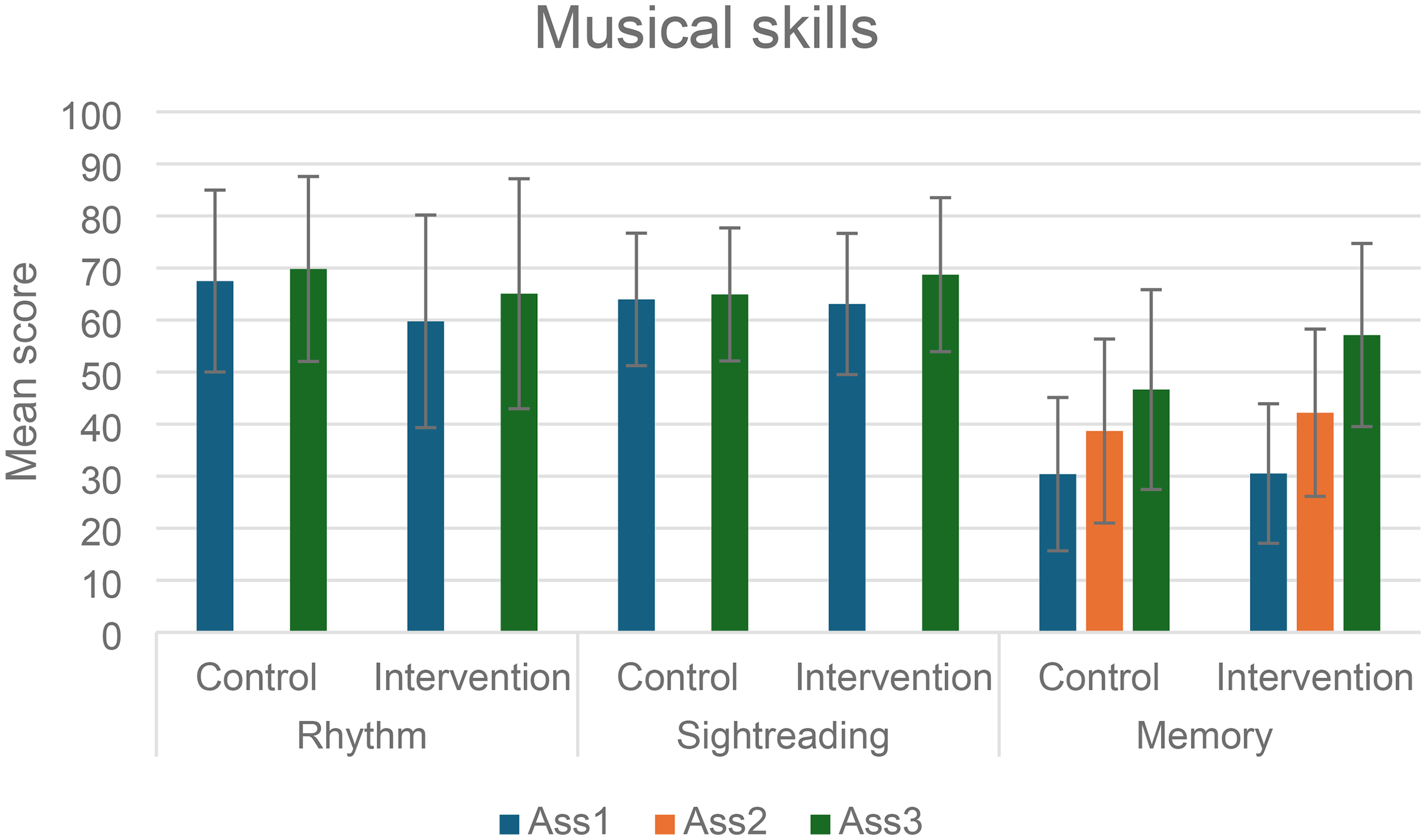
Combined mean skills scores for all study participants.
Memory Skills
Memory scores increased for both controls (30.40 to 46.64; Mdiff = 16.24, SDdiff = 5.97, t(24) = 13.592, p < 0.001) and the intervention group (30.52 to 57.12; Mdiff = 26.60, SDdiff = 6.95, t(24) = 19.131, p < 0.001). The substantial improvement in both groups likely reflected cumulative effects of repeated practice sessions during testing, as participants had multiple opportunities to work with the same musical material.
Nevertheless, the intervention group showed significantly greater improvement (Mdiff = 10.36, SEdiff = 1.83, t(48) = 5.651, p < 0.001), suggesting an additive benefit of sleep extension beyond practice effects alone.
Psychological Flexibility
MAAQ scores remained stable for controls (29.76 to 29.52; Mdiff = −0.24, SDdiff = 1.01, t(24) = −1.186, p = 0.247) but significantly increased for the intervention group (28.16 to 31.32; Mdiff = 3.16, SDdiff = 1.72, t(24) = 9.163,
Between-group differences were significant (Mdiff = 3.40, SEdiff = 0.40, t(38.771) = 8.504, p < 0.001), highlighting sleep extension's impact on this important psychological resource for musicians dealing with performance pressures. Enhanced psychological flexibility through sleep extension may have implications for performers’ resilience and adaptability in challenging performance contexts.
Subjective Sleepiness
SSS scores remained stable for controls (3.76 to 3.84; Mdiff = 0.08, SDdiff = 0.40, t(24) = 1.000, p = 0.327) but significantly decreased for the intervention group (3.64 to 2.20; Mdiff = −1.44, SDdiff = 0.87, t(24) = −8.277, p < 0.001), indicating reduced sleepiness. Differences between groups were statistically significant (Mdiff = −1.52, SEdiff = 0.19, t(33.715) = −7.938, p < 0.001).
This confirms the subjective experience of alertness improved with extended sleep, potentially contributing to observed performance improvements through enhanced attentional capacity and cognitive processing.
Short-Term Changes from Assessment 1 to 2
After one night, psychological flexibility remained stable for controls (Mdiff = −0.40, SDdiff = 1.73, t(24) = −1.155, p = 0.260) but significantly improved for the intervention group (Mdiff = 0.84, SDdiff = 1.28, t(24) = 3.280, p = 0.003), with significant between-group differences (Mdiff = 1.24, SDdiff = 0.43, t(48) = 2.878, p = 0.006). This indicated that even a single night of extended sleep can begin to produce measurable changes in psychological flexibility.
Short-term subjective sleepiness showed no significant changes for either controls (Mdiff = −0.12, SDdiff = 0.67, t(24) = −0.901, p = 0.376) or the intervention group (Mdiff = −0.24, SDdiff = 0.66, t(24) = −1.809, p = 0.083), with no significant between-group differences (Mdiff = −0.12, SDdiff = 0.19, t(48) = −0.638, p = 0.526). This suggests that changes in subjective sleepiness may require more than a single night of extended sleep to become apparent, contrasting with cognitive and psychological measures showing more rapid changes.
Short-term memory improved for both controls (Mdiff = 8.28, SDdiff = 3.47, t(24) = 11.930, p < 0.001) and the intervention group (Mdiff = 11.68, SDdiff = 3.34, t(24) = 17.495, p < 0.001), with the intervention group showing significantly greater improvement (Mdiff = 3.40, SDdiff = 0.96, t(48) = 3.530, p < 0.001). This indicated that memory benefits begin emerging after just one night of extended sleep, though they continue developing with additional intervention nights.
These findings helped characterize the temporal dynamics of sleep extension effects, with some benefits emerging more rapidly than others. One night of additional sleep led to significantly greater gains in psychological flexibility and memory skills, but not subjective sleepiness (Figure 2).

Mean change scores.
Discussion
This study examined the impacts of sleep extension on musical skills and psychological flexibility in musicians. Extending nightly sleep led to significant improvements in rhythmic stability, sightreading, memory, and psychological flexibility compared to controls maintaining existing sleep patterns. Reported sleepiness significantly decreased from first to final assessment, though changes weren’t significant after just one night.
These results align with research showing sleep benefits reaction time, mood, alertness (Kamdar et al., 2004), memory consolidation (Atienza et al., 2004; Fischer et al., 2002; Walker et al., 2002), and motor skills learning (Walker et al., 2002) and indicate that these cognitive and motor benefits are observed specifically in the musical domain.
The findings contribute uniquely to research on sleep extension interventions in other populations showing performance benefits, including college athletes (Mah et al., 2011; Schwartz & Simon, 2015), military personnel (Ritland et al., 2019), and esports competitors (Moen et al., 2022). While previous studies found improvements in athletic skills, reaction time, and cognition, this study is the first to demonstrate similar gains in musical skills, underscoring that sleep extension may broadly enhance performance across diverse domains requiring fine motor control and cognitive precision.
The study's novel contribution lies in its demonstration of the impact of sleep extension on multiple musical assessments and on its benefit to psychological flexibility in musicians, though it should be noted that psychological flexibility was assessed via self-report (MAAQ) rather than performance-based measures. While the significant improvement in self-reported psychological flexibility over the intervention period is notable, more research is needed to determine whether such substantial changes typically occur in this timeframe. The bidirectional relationship between sleep and psychological flexibility suggested in recent literature (Ryan et al., 2025) provides a potential mechanistic explanation, as sleep health has been shown to affect cognitive functioning that may support psychological flexibility. Given psychological flexibility's importance in performance quality (Juncos & de Paiva e Pona, 2022), this finding has implications for musicians’ overall performance ability.
This study accords with Allen (2013) and Van Hedger et al. (2015) in suggesting sleep enhances recently learned music after one night. The gain exhibited by the intervention group in musical memory from assessment 1 to 2 parallels findings from these previous studies on improved aspects of musical recall following a single night of sleep.
Further studies would be needed to determine if these results would hold true had the study cohort started with a longer sleep duration at baseline. While sleep duration averages for the population of Hong Kong-based professional musicians and music majors are unavailable, the findings from this cohort offer intriguing comparisons with existing research. The control group's average of 5.9 h of sleep appears low compared to general population recommendations, yet aligns with documented sleep patterns observed in adjacent, but not specifically overlapping, populations.
Ip et al. (2001) found that even among the general population of middle-aged Chinese men in Hong Kong (ages 30–60), self-reported sleep duration averaged only 6.9 h. Though difficult to prove without targeted research, it seems reasonable that musicians in the present study—facing demanding practice schedules, performance pressures, and in many cases academic requirements—would trend below this general population figure. This difference becomes more plausible considering Ip's (2001) research relied on self-reported measures rather than the objective WHOOP device measurements employed in this study.
Perhaps more striking is Yang et al.'s (2005) study of Korean adolescents, which revealed alarmingly low sleep durations paralleling the findings reported here. Their work documented profound sleep deprivation among teenage students, with self-reported school-night sleep times of just 6.02, 5.62, and 4.86 h for 10th, 11th, and 12th-graders respectively. Although not a direct match of study population, Yang's (2005) investigation identified academic demands and performance pressure as key contributors to sleep deprivation—factors likely relevant to collegiate and professional musicians who operate in competitive environments.
These studies suggest that the sleep restriction observed in the study participants, while concerning from a health perspective, reflect broader patterns of insufficient sleep, particularly in environments where sleep deprivation becomes normalized in pursuit of excellence.
While promising, causal inferences must remain limited. Factors other than sleep extension may have contributed to observed improvements, including increased motivation among intervention participants who knew they were extending their sleep. Additionally, the study did not control for potential changes in daily routines or lifestyle habits that may have occurred alongside sleep extension. Future research should isolate sleep extension’s specific effects by controlling for these variables, perhaps through more controlled laboratory conditions or blinded study designs where feasible.
The free-living nature of this study, while enhancing ecological validity, introduces variables that cannot be fully controlled. However, this approach also reflects how sleep extension would likely be implemented in real-world settings for musicians, making the findings particularly relevant to practical applications in music education and performance contexts.
Future studies could employ more sensitive sleep measurement tools like polysomnography to precisely quantify sleep architecture, stages, and quality beyond the total sleep time measured here. Examining relationships between specific sleep stages and musical skills could provide deeper insights into underlying mechanisms. Studies with younger musicians in developmental stages might be particularly valuable given the importance of sleep for learning and skill acquisition during formative years.
While efforts were made to standardize scoring through blinded assessment, future well-funded studies could further reduce subjectivity by using multiple blinded adjudicators and assessing inter-rater reliability. Finally, examining sleep extension effects over longer periods (months or years) could determine whether observed benefits persist and potentially increase with sustained optimal sleep habits.
Conclusion
This study provides initial evidence for beneficial effects of sleep extension on musical skills, psychological flexibility, and sleepiness among musicians. The findings highlight the importance of prioritizing sleep for optimal performance, suggesting that many musicians may be performing below their potential due to chronic sleep restriction.
The results have important practical implications for music education and professional settings. Incorporating sleep hygiene education within music programs, conservatories, and professional musicians’ routines may lead to tangible performance benefits with relatively low implementation costs. Strategic scheduling of rehearsals and concerts to allow adequate sleep could help optimize both individual and ensemble performance quality. For touring musicians who face particular challenges maintaining consistent sleep patterns, developing sleep optimization strategies could be especially valuable.
Music educators and performers should consider sleep an essential component of performance preparation rather than a luxury to be sacrificed for additional practice time. The findings suggest that extending sleep may actually enhance the efficiency of practice and skill development, potentially offering a more balanced approach to musical excellence that integrates both adequate rest and focused work.
While further research is necessary to establish causality and explore long-term effects, this study lays groundwork for future investigations into sleep's role in musical expertise development. The findings underscore sleep extension's potential to significantly enhance musical skills and psychological flexibility among musicians, potentially opening new avenues for optimizing performance and fostering resilience in creative pursuits.
Supplemental Material
sj-docx-1-mns-10.1177_20592043251385420 - Supplemental material for Effects of Sleep Extension on Musical Performance Skills
Supplemental material, sj-docx-1-mns-10.1177_20592043251385420 for Effects of Sleep Extension on Musical Performance Skills by Benjamin Pelletier in Music & Science
Supplemental Material
sj-docx-2-mns-10.1177_20592043251385420 - Supplemental material for Effects of Sleep Extension on Musical Performance Skills
Supplemental material, sj-docx-2-mns-10.1177_20592043251385420 for Effects of Sleep Extension on Musical Performance Skills by Benjamin Pelletier in Music & Science
Supplemental Material
sj-docx-3-mns-10.1177_20592043251385420 - Supplemental material for Effects of Sleep Extension on Musical Performance Skills
Supplemental material, sj-docx-3-mns-10.1177_20592043251385420 for Effects of Sleep Extension on Musical Performance Skills by Benjamin Pelletier in Music & Science
Supplemental Material
sj-docx-4-mns-10.1177_20592043251385420 - Supplemental material for Effects of Sleep Extension on Musical Performance Skills
Supplemental material, sj-docx-4-mns-10.1177_20592043251385420 for Effects of Sleep Extension on Musical Performance Skills by Benjamin Pelletier in Music & Science
Supplemental Material
sj-docx-5-mns-10.1177_20592043251385420 - Supplemental material for Effects of Sleep Extension on Musical Performance Skills
Supplemental material, sj-docx-5-mns-10.1177_20592043251385420 for Effects of Sleep Extension on Musical Performance Skills by Benjamin Pelletier in Music & Science
Supplemental Material
sj-docx-6-mns-10.1177_20592043251385420 - Supplemental material for Effects of Sleep Extension on Musical Performance Skills
Supplemental material, sj-docx-6-mns-10.1177_20592043251385420 for Effects of Sleep Extension on Musical Performance Skills by Benjamin Pelletier in Music & Science
Supplemental Material
sj-pdf-7-mns-10.1177_20592043251385420 - Supplemental material for Effects of Sleep Extension on Musical Performance Skills
Supplemental material, sj-pdf-7-mns-10.1177_20592043251385420 for Effects of Sleep Extension on Musical Performance Skills by Benjamin Pelletier in Music & Science
Supplemental Material
sj-pdf-8-mns-10.1177_20592043251385420 - Supplemental material for Effects of Sleep Extension on Musical Performance Skills
Supplemental material, sj-pdf-8-mns-10.1177_20592043251385420 for Effects of Sleep Extension on Musical Performance Skills by Benjamin Pelletier in Music & Science
Supplemental Material
sj-pdf-9-mns-10.1177_20592043251385420 - Supplemental material for Effects of Sleep Extension on Musical Performance Skills
Supplemental material, sj-pdf-9-mns-10.1177_20592043251385420 for Effects of Sleep Extension on Musical Performance Skills by Benjamin Pelletier in Music & Science
Footnotes
Acknowledgments
Many thanks to Alice Rosen, a member of the Hong Kong Philharmonic Orchestra, who served as the blind adjudicator for the musical skills tests and Hong Kong Baptist University for their support of this research.
Action Editor
Emily Payne, University of Leeds, School of Music
Peer Review
Linda Alario, Boston University, College of Fine Arts
Sarah Allen, Southern Methodist University, Music
Data Availability Statement

Declaration of Conflicting Interests
The author declared no potential conflicts of interest with respect to the research, authorship, and/or publication of this article.
Ethics Statement
This research involving human participants was approved by the Research Ethics Committee of Hong Kong Baptist University and conducted in accordance with prevailing standards of research ethics in the academic community. All participants provided informed consent prior to participation as outlined in the Study Information Sheet detailing the nature of the study, research procedures, potential risks and benefits, and handling of data. Participants were informed of their right to withdraw from the study at any time without penalty.
Funding
The author disclosed receipt of the following financial support for the research, authorship, and/or publication of this article: This work was supported by the Hong Kong Baptist University, (grant number HKPFS).
Supplemental Material
Supplemental material for this article is available online.
Appendix A
This is the specific compositional framework used to generate consistency in difficulty across the two sightreading melodies. Each directive refers to a two measure-long section except for the final (12th) section:
References
Supplementary Material
Please find the following supplemental material available below.
For Open Access articles published under a Creative Commons License, all supplemental material carries the same license as the article it is associated with.
For non-Open Access articles published, all supplemental material carries a non-exclusive license, and permission requests for re-use of supplemental material or any part of supplemental material shall be sent directly to the copyright owner as specified in the copyright notice associated with the article.
