



Abstract
Research on the ergogenic effects of music on athletic performance usually includes multiple antecedents simultaneously. Consequently, this study set out to isolate a single antecedent using a highly controlled experiment. More specifically, the aim of the study was to investigate the effect of pre-task, slow- and fast-tempo music on arousal, affective state, perceived exertion, and anaerobic rowing performance by isolating music tempo as the sole intrinsic musical factor. Forty young adults (male = 23, female = 17) participated in three trials where they all were exposed to no-music, slow-tempo, and fast-tempo music conditions in a randomized order. The music was exclusively composed for this study and equally novel for all participants. It was based on the same electronic track with a techno-orientation rendered to both 110 (slow-tempo) and 140 (fast-tempo) BPM. Following music exposure, the participants were momentarily asked to report levels of felt arousal and affective state before being instructed to perform a 30-s maximal rowing test on an ergometer. Upon completion of each rowing test, subjects were then asked to report their perceived exertion. Both fast- and slow-tempo pre-task music exposure led to increased arousal and positive affective state when compared to no music. Fast-tempo music led to a significantly higher mean power output than slow-tempo music. No significant differences were found for peak watt output or rating of perceived exertion when comparing all conditions. These findings suggest that exposure to pre-task music may offer positive psychological benefits prior to commencing anaerobic sporting tasks. Results also suggest that fast-tempo music may have an ergogenic effect on anaerobic performance.
Introduction
Music is an integral part of many athletes’ sporting preparation (Karageorghis, 2017). A plethora of research done over the past two decades suggests that music has value that extends far beyond pure entertainment; with results indicating that music facilitates an array of psychological and psychophysical gains that may contribute to improved athletic performance (Terry et al., 2020). The psychological benefits of listening to music may include improved affective states (Bishop et al., 2007) and arousal regulation (Loizou & Karageorghis, 2015), while psychophysical effects such as reduced perceived exertion at low to moderate intensities have also been found (Patania et al., 2020).
To gain a more in-depth understanding of the performance benefits of music, researchers have focused on discovering and defining the various factors and moderators that may influence our response to music. Following two decades of development, Karageorghis (2016a, 2016b, 2020) proposed a conceptual model that details an array of antecedents, moderators, and eventual consequences that may play a role in influencing potential performance benefits of music exposure in the sport and exercise domain. The model is presented as a “broad and holistic representation of relationships identified within the literature” (Karageorghis, 2020, p. 936). It portrays intrinsic musical factors (e.g., tempo, rhythm, and lyrical content) and extrinsic musical factors (e.g., cultural associations) as the antecedents, while the moderators are a combination of personal (e.g., age, gender, musical upbringing) and situational factors (e.g., when, sound source, location, activity type); all of which may influence the possible ergogenic effects (Karageorghis, 2020).
Although empirical evidence has helped researchers to understand the underlying mechanisms and to develop comprehensive frameworks, most research has focused on the effects of in-task music (see Karageorghis, 2020; Terry et al., 2020). While these results may prove beneficial during training or recreational bouts, their transferability to the competitive stage of sport is limited due to the banning of personal listening devices by most governing bodies of sport (e.g., United States Track & Field Association, International Olympic Committee). However, a common strategy among athletes is to listen to music prior to actual competition (Bishop et al., 2014). Less is known about the effectiveness of pre-task music, although it seems to have potential benefits on performance (see e.g., Terry et al., 2020). Related to the effect on athletic performance, pre-task music is suggested to have a “residual effect” that serves as “psych-up” or “psych-down”, that is, priming an optimal activation for physical performance (Karageorghis, 2020; Karageorghis et al., 2017)
While the motives for listening to music pre-competition may vary (Terry & Karageorghis, 2006), most athletes report that the act increases their level of activation, endurance, motivation, and performance (Aslett et al., 2017; Laukka & Quick, 2013), highlighting the need for research that can help quantify these self-reported improvements in athletic performance.
Previous studies suggest that pre-task music may have more of an acute ergogenic effect on short, predominantly anaerobic bouts rather than long-duration tasks (Karageorghis, 2020; Smirmaul, 2017). In sports that require short bursts of muscular or anaerobic power, pre-event activation and arousal (i.e., psychological state) is believed to be, at least by the athletes themselves, a crucial requirement for achieving maximum performance (Laukka & Quick, 2013). Furthermore, a study by Loizou and Karageorghis (2015) included affective state and arousal as self-reported measurements in their methodology and reported pre-task music as a potential way to enhance athletes’ psychological state. Nevertheless, there appears to be limited research on the effects that pre-task music may have on psychological performance factors such as affective state or arousal.
According to the conceptual model from Karageorghis (2020) and empirical work from, for example, Grgic (2022), an increase in performance induced by pre-task music may have several simultaneously operating antecedents, such as music tempo, volume, lyrical content, harmony, melody, and personal preferences. One intrinsic musical factor that has been suggested to have a particularly important ergogenic effect is the tempo of the music (see e.g., Crust, 2008; Edworthy & Waring, 2006; Karageorghis & Jones, 2014), normally presented as beats per minute (BPM). An ergogenic effect is commonly reported with faster tempo (> 120 BPM) music (Grgic, 2022; Terry et al., 2020).
Smirmaul (2017) analyzed six studies in his review that had investigated the effect of fast-tempo, pre-task music on anaerobic power. Of these, four studies observed significant increases in peak power, while three studies observed increases in mean power (Smirmaul, 2017). Although these results suggest that fast-tempo pre-task music may likely give an ergogenic effect, only one of the reviewed studies considered the effect music had on their affective states or self-perceived arousal levels going into the task (Smirmaul, 2017); two important supplementary factors that may influence an athlete's performance.
While most experiments have assessed tempi ranging from 120–140 BPM to elicit arousal, they usually include multiple antecedents and/or moderators simultaneously, or otherwise fail to control for potential confounding factors. That may be considered problematic from an internal validity standpoint seeing as the individual effect of each antecedent remain unknown. By isolating a single antecedent as the manipulated factor, internal validity concerns are addressed, even though it may reduce the external validity. Consequently, this study aimed to manipulate music tempo as the sole antecedent.
According to Laukka and Quick (2013), some athletes participating in high-intensity events may choose to implement slow-tempo music, rather than fast-tempo music, to achieve focus and control their excitement. Despite this, studies on pre-task music that have compared slow-tempo music, fast-tempo music, and no-music conditions in the same investigation seems to be scarce. One study comparing slow-tempo with fast-tempo observed no difference in power output among participants (Yamamoto et al., 2003). However, the findings from this study should be further scrutinized considering factors such as music selection (Slow – Chopin; Fast – Rocky/Top Gun theme) and a small sample size of six participants. Furthermore, existing studies fail to address whether the music track's potential for arousal can be identified when only manipulating its tempo. We sought to negate this challenge by using the same track rendered without loss of quality in two different tempi.
The present study aimed to isolate the tempo of music as the sole intrinsic musical factor (and thus the independent variable). More specifically, the purpose of the present study was to investigate the influence of pre-task, slow- and fast-tempo music on arousal, affective state, perceived exertion, and anaerobic rowing performance in a controlled environment designed to manipulate only the tempo of the music. Based on the abovementioned propositions in the conceptual model from Karageorghis (2016b), the following hypotheses were formulated:
A musical track played (pre-task) at fast tempo (140 BPM) will lead to higher self-reported arousal, higher positive affective state following exposure, and higher peak watt and mean watt produced during a 30 s maximal effort on a rowing ergometer compared to the same track played (pre-task) at slow tempo (110 BPM). Both pre-task music conditions will lead to improvements in all performance-related factors over silence.
Methods
Participants
Sample size was estimated using G*Power 3.1 (Faul et al., 2009). Using a priori analysis function (repeated measures, within factors, one group, three measurements), the sample size was computed as a function of significance level (α = .05), statistical power (1-β = .95), and a to-be-detected low-to-moderate effect size (f = .20). The required sample size was determined to be N = 34. Thus, a convenience sample of 40 military recruits (male = 23, female = 17) aged from 18 to 22 years (M = 20 years, SD = .9) from the Royal Norwegian Airforce Training Centre in Kristiansand, Norway was recruited to the study. The sample was deemed appropriate because the military recruits were considered homogenous (e.g., age, interests, and generational similarities). Informed consent was obtained from all participants. Inclusion criteria for participation were that participants were free from illness or injury, considered themselves to be in good physical condition (physically fit and ready to exercise), and had no prior experience in competitive rowing.
All participants were informed that participation was voluntary, anonymous, and that they could withdraw from the study at any time. Participants were blind to the hypothesis of the study.
Instruments
Work output was measured in watts (W) using three Concept II model D rowing ergometers, with all stroke and power data processed via PM5 monitors utilizing the ErgData application (Concept II, Morrisville, VT, USA). Drag factor was set at 125 for all tests to produce stable, consistent results (Metikos et al., 2015). All tests were performed at an ambient temperature of 20–22 °C. All three rowing ergometers were isolated by partitioning and facing towards the wall. Arousal was measured by presenting participants with the Felt Arousal Scale (Svebak & Murgatroyd, 1985). Participants then indicate their level of self-perceived arousal on a scale from 1 (low arousal) to 6 (high arousal). Affective state was measured by presenting participants with the Feeling Scale (Hardy & Rejeski, 1989). The Feeling Scale is a number scale from −5 to +5 (−5 very bad, 0 neutral, and +5 very good); used to reveal the degree of pleasure or displeasure a participant may experience. Rating of perceived exertion (RPE) was measured by presenting the participants with a Rating of Perceived Exertion Scale (Borg, 1998) and asking them to indicate their level of perceived exertion from a scale of 6 (no exertion) to 20 (maximal exertion). Standardized instructions were provided for all scales at all tests.
Design and Experimental Procedure
The participants met up at a purposely fitted room on-base at the Royal Norwegian Airforce Training Centre. They were gathered in a neighboring room where information about the study and the testing protocol was presented. Participants completed a questionnaire containing demographic information and training frequency. They were then informed that the protocol involved three maximal efforts on a rowing ergometer, with 30 min recovery time between bouts, in addition to answering short questionnaires before and after and post each bout. During the recovery period, the participants were in a separate room with comfortable seating, with fruit and water available. They were not informed how long the effort would last, though instructors emphasized the importance of maximal effort from the start and throughout the entire bout.
Trials were performed with three participants at a time on separate, partitioned (separated by moveable walls) rowers. Participants were instructed to seat themselves into the ergometers, adjust the footrests, and to not touch the handles until further instruction. Ergometer monitors were covered to ensure minimal distraction and blindness to elapsed time. Before each trial, the participants completed a 5–10 min self-paced warm-up that should consist of low-intensity rowing on the rowing ergometer. The order of conditions each participant was exposed to was randomized for all trials, using a digital random sequence generator (1–3). Participants were then each given Bluetooth headphones and instructed to listen while seated on the ergometer until further instruction. After three minutes of exposure to either fast, slow, or no music (noise cancelling activated), the participants were instructed to rate their level of perceived arousal on the Felt Arousal Scale (Svebak & Murgatroyd, 1985) and their current affective state on the Feeling Scale (Hardy & Rejeski, 1989). Upon completion, a 3-s countdown occurred before participants were instructed to perform at maximum. After 30 s, participants were instructed to stop rowing. They were then immediately asked to rate their level of perceived exertion on the Borg Scale of Perceived Exertion (Borg, 1998).
Music
The music used was based on a single non-lyrical electronic track with a techno-orientation, composed specifically for this project by an undergraduate music student at the corresponding author's university under the supervision of one of the coauthors. We use the term track that follows Zak's (2001) definition: “[W]hen we hear a record, we experience both song and arrangement through the sounds of the track” (p. 24) The artist was advised of the approximate age/sub-culture of the trial participants, along with its intended use. The track was composed, mixed, and mastered in the music software FL Studio by the undergraduate student. The track's original tempo was 130 BPM. As most tracks with a techno-orientation, the music had a clear four-on-the floor bass drum that marked the track's tempo. This form of drum programming (Hawkins, 2003), typical of the genre, was considered to diminish the potential for a large variance between experienced tempo for the participants and the actual sounding event (Danielsen, 2016). Naturally, we sought to negate such a variance since the participants experience of the tempo was important for the study. As Danielsen et al. note (2015), the pulse is not always clear in music and if a listener fails to catch it, the experience of the music's groove might change completely (p. 133). Thus, a techno-oriented track with a clear pulse was selected and designed. The track was MIDI-based (Théberge, 2020) with minimal uses of time-warping (Danielsen, 2020). This meant that precisely the same musical elements were contained in both versions, only they were played at substantially different tempi without introducing sonic artifacts or changes to the overall pitch often associated with tempo manipulation. The final track was also chosen for its suitability to be rendered to both 110 and 140 BPM. Participants in all conditions used wireless headphones (Bose Noise Cancelling Headphones 700) at equal moderate volumes (60–65 dBA), with the music played from individually connected iPad tablets while the noise cancelling was turned on.
Statistical Analysis
The statistical analyses were performed using IBM SPSS v. 25 (SPSS Inc., Chicago, IL, USA), and Jamovi v.1.6 (jamovi.org). All data were considered normally distributed following an investigation of mean-median difference, skewness, and kurtosis and visual inspections of Q-Q plots and histograms. Repeated-measures ANOVAs were used for power output results, as well as the self-reported results for affective state, arousal, and perceived exertion. If there was a significant main effect, t-tests with Bonferroni adjustment were used for post hoc analysis. Partial η2 effect size was calculated for effects in the repeated-measures ANOVA (small = .01, medium = .06 and large = .14; Bakeman, 2005). Cohen's d was calculated to determine effect sizes for the pairwise post hoc comparisons (small = .2, medium = .5 and large = .8; Cohen, 1988) using the procedure described by Dunlap et al. (1996). The significance level was set at p < .05 for all analyses.
Results
Work Output Variables
Absolute power was measured in watts (W). Table 1 shows the difference in power output during 30-s maximal rowing after being exposed to either no music, slow-tempo music, or fast-tempo music. Repeated-measures ANOVA was performed for peak power and mean power results. In peak power, the results showed no statistically significant within-subject change across the three conditions (F[df] = .24[2], p = .788). For the mean power output, the results showed a statistically significant within-subject change across the three conditions (F[df] = 3.95[2], p = .023, ηp2 = .092). Bonferroni-corrected post hoc analyses yielded a significant difference between the slow-tempo music and fast-tempo music conditions (t[df] = −3.32[39], p = .006, Cohen's d = .33), with the fast-tempo condition outperforming the slow-tempo condition. A descriptive plot of watt-production every two seconds throughout the tasks are presented in Figure 1. As illustrated, the visual presentation indicates similar trajectories in the three conditions; a steep increase of power the first eight seconds, peak watt obtained after 8 to 10 seconds followed by a slow decrease of watt-production from 12 to 30 s. Visually we can observe a tendency to steeper increase in watt produced the first six seconds of the task in the fast-tempo music condition compared to the other conditions. Similarly, there was a trend of higher watt-production around 14–16 s.
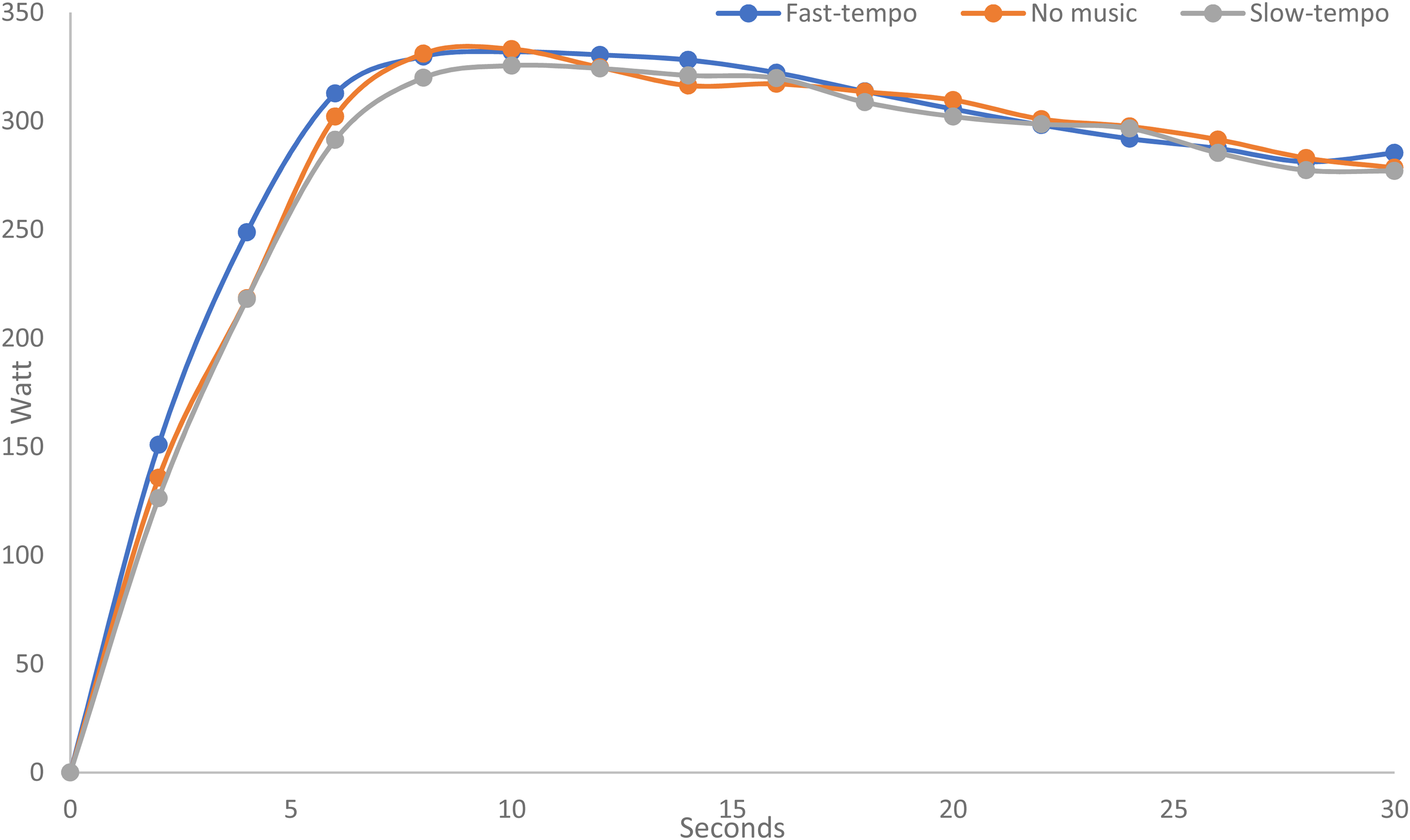
Plot of watt-production every two seconds throughout the task, according to condition.
Work output variables.
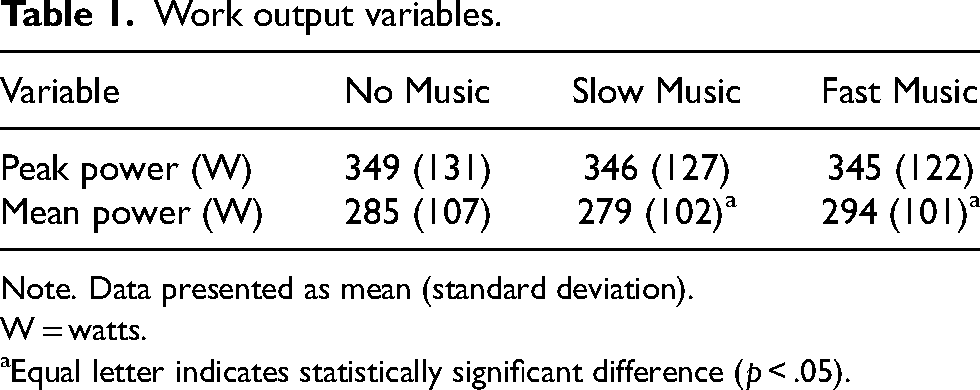
Note. Data presented as mean (standard deviation).
W = watts.
Equal letter indicates statistically significant difference (p < .05).
Affective State
Figure 2 displays the results gathered using the Feeling Scale. A repeated-measures ANOVA analysis revealed a statistically significant within-subject change across the three conditions (F[df] = 7.01[2], p = .002, η p 2 = .152). Bonferroni-corrected post hoc analysis revealed a significant difference between the no-music and fast-tempo music conditions (t[df] = 3.36[39], p = .005, Cohen's d = .534). In other words, level of self-reported affective state was higher in the fast-tempo music condition compared to the no-music condition.

Means and standard deviations for self-reported affective state using the Feeling Scale. −5 = “very bad”, + 5 = “very good”. a = equal letter indicates statistically significant difference (pbonferroni = .005).
Arousal
Figure 3 displays the results gathered using the Felt Arousal Scale. A repeated-measures ANOVA analysis revealed a statistically significant within-subject change across the three conditions (F[df] = 47.6(2], p < .001, η p 2 = .549). Bonferroni-corrected post hoc analysis revealed a significant difference between the no-music and slow-tempo music conditions (t[df] = 6.45[39], p < .001, Cohen's d = .333). A significant difference was also revealed between the no-music and fast-tempo music conditions (t[df] = 8.39(39], p < .001, Cohen's d = .355). In other words, level of self-reported arousal was higher in both music conditions compared to the no-music condition.

Means and standard deviations for self-reported arousal using the Felt Arousal Scale. 1 = low arousal, 6 = high arousal. a-b = equal letter indicates statistically significant difference (pbonferroni < .001).
Rating of Perceived Exertion
Figure 4 displays the results gathered using the RPE scale. A repeated-measures ANOVA analysis revealed no significant within-subject change across the three conditions (F[df] = .427[2], p = .654, η p 2 = .011).

Means and standard deviations for rate of perceived exertion using Borg Scale of Perceived Exertion. 6 = no effort, 20 = maximal exertion. No statistically significant differences found among any conditions.
Discussion
The primary purpose of this study was to determine the effects of pre-task slow- and fast-tempo music on anaerobic performance and psychological factors during a 30 s maximal intensity bout of rowing. More specifically, we set out to determine what effect the intrinsic musical factor tempo as the single manipulated factor had on the potential ergogenic effects. Findings revealed that RPE, peak watt and mean watt values were similar among the music and no-music conditions. However, when comparing the slow-tempo music and fast-tempo music conditions, exposure to fast-tempo music led to a significantly higher mean watt output during the 30-s trial. Moreover, listening to fast-tempo music led to significant improvements in self-reported affective state when compared to no music. Furthermore, listening (pre-task) to both slow- and fast-tempo music led to increased self-reported arousal, compared to silence.
Our findings regarding peak power mirrored a previous study on recreationally active individuals (Fox et al., 2019). However, in contrast to our findings, previous studies using the Wingate anaerobic cycling test (Chtourou et al., 2012b; Eliakim et al., 2007; Jarraya et al., 2012) have observed significantly higher peak power values after listening to fast-tempo music compared to a no-music condition. Although the incongruence cannot be explained entirely through the present study, one may suggest that the manipulated intrinsic factor of music tempo cannot be claimed to be the sole driver of increased output from powerful muscle contractions over (relatively) short periods of time. As previously suggested (e.g., Chtourou et al., 2012a), an increase in power output may be attributed to motivational levels in individuals. A highly controlled experimental design intended to manipulate one single musical factor (tempo), may not be sufficient to trigger motivational gains in individuals. As per the intricate interrelationship of multiple antecedents and moderators presented in the theoretical model from Karageorghis (2016b), it seems relevant to paraphrase Bronfenbrenner (1979) and argue that the principal main effect is likely to be interactions (p. 38).
Most studies investigating the effects of pre-task music on anaerobic performance have made comparisons between a fast-tempo music condition and a control condition of no music (Chtourou et al., 2012b, 2017; Eliakim et al., 2007; Jarraya et al., 2012; Loizou & Karageorghis, 2015). Two studies involving a slow-tempo music/fast-tempo music comparison may shed light to our findings (Atan, 2013; Yamamoto et al., 2003). In the present study, fast-tempo music led to significantly higher mean watt output compared to the slow-tempo music, while both Yamamoto et al. (2003) and Atan (2013) observed no significant mean power output differences between the two music conditions. However, Yamamoto et al. (2003) measured plasma epinephrine, norepinephrine, and dopamine concentrations in their subjects before and after music exposure, observing that slow-tempo music significantly depressed sympathetic activation, while fast-tempo music led to increased adrenergic activation. Thus, the present study confirms that the sedative and stimulative effect of music may at least partly be because of variations in music tempo (Karageorghis, 2016a, 2016b, 2020).
The present findings identify the intrinsic musical factor tempo as an antecedent of psychological outcomes in short, strenuous exercises. In the present study, both music tempi evoked higher arousal compared to silence, whereas the fast-tempo music evoke affective responses in the listeners. Our findings regarding improved affective state and increased self-reported arousal following music exposure echo previous studies specific to pre-task music (Bishop et al., 2007; Loizou & Karageorghis, 2015), supporting the notion that music can enhance pre-task psychological states and affective state. As previously mentioned, both affective state and arousal have been argued to be essential pre-event psychological factors for athletic performance by athletes themselves (Laukka & Quick, 2013).
No significant differences were observed in the rate of perceived exertion (RPE) between the conditions. These findings coincide with the results of previous pre-task music experiments that have utilized similar exercise protocols (Chtourou et al., 2012b; Fox et al., 2019; Jarraya et al., 2012), suggesting that RPE is not significantly affected by pre-task music exposure prior to maximal bouts of exercise. Indeed, as summarized by Karageorghis (2020), music typically reduces RPE only in sub-maximal work intensities. However, in line with our study, both Chtourou, Chaouachi, et al. (2012), Chtourou, Jarraya, et al. (2012), and Jarraya et al. (2012) observed increases in power output despite the absence of any significant change or increase in RPE. One may argue that while music led to increases in work output, a concurrent inhibition of the physiological feedback signals associated with physical exertion (Rejeski, 1985) may have continued following exposure. Previous studies exploring the neurophysiological effects of in-task music have demonstrated that affective stimuli such as music may reduce brain connectivity across the frontal and central regions of the cortex; a phenomenon associated with reduced exercise consciousness (Bigliassi et al., 2017). In addition, it has been previously suggested that even during high-intensity exercise, affective stimuli such as music may influence our feelings and interpretations of physical effort and fatigue (Hutchinson et al., 2018; Hutchinson & Karageorghis, 2013).
Strengths and Limitations
The present study adds to a limited number of research aimed to further our understanding of how the musical element of tempo may facilitate the anaerobic performance gains of pre-task music. The use of music tempo as the sole manipulated factor in a highly controlled experiment should be considered a novel contribution to the field. However, all research studies have limitations that must be considered when interpreting the results.
The choice of music in the present study was carefully considered. Although music tempo was the independent variable for the experiment, the certainty of the present study's ability to eliminate all potential confounding effects may be difficult to establish. While factors such as lyrical content (non-existent in the present study) and sound volume (standardized in the present study) could be considered easy to account for, aspects such as personal preferences (e.g., music genre, harmony, melody) are more difficult. In addition, one may question the external validity of such a highly controlled experiment, as pre-selecting (previously unknown) music to incite arousal could be considered unnatural, as sporting participants would typically choose their own playlist (Laukka & Quick, 2013). Moderating factors such as genre-familiarity, personal associations, or musical preferences may vary considerably even between similar-aged participants, and as such may have influenced our trial results to some degree. Thus, even though the present study aimed to investigate the potential of music tempo to induce anaerobic performance, the role of music tempo in interaction with other aspects remains unknown.
Conclusion
In summary, this study further contributes to the line of research investigating the effects of pre-task music in sporting performance, particularly anaerobic performance. It builds on previous findings by isolating the effect of music tempo on a range of performance factors. The results indicate that fast-tempo music may improve an athlete's affective state, and both fast- and slow-tempo music may increase felt arousal. Furthermore, fast-tempo music may lead to a significantly higher mean power output than slow-tempo music.
Footnotes
Acknowledgements
We would like to thank the undergraduate music student Martin Brudevoll Vosseteig for developing the music for the study.
Action Editor
Eckart Altenmüller, Institut für Musikphysiologie und Musikermedizin, Hochschule für Musik, Theater und Medien Hannover.
Peer Review
Matt McCrary, Hochschule für Musik, Theater und Medien Hannover.
Babett Helen Lobinger, Deutsche Sporthochschule Köln, Institute of Psychology.
Author Contribution
Conceptualization: CGP, TH, and RH; data curation: CGP and AL; formal analysis: CGP, TH, AI; project administration: TH, RH, AL; writing – original draft: CGP; writing – review and editing: CGP, TH, RH, AI, ARW, AL. All authors reviewed and edited the manuscript and approved the final version of the manuscript.

Declaration of Conflicting Interests
The author(s) declared no potential conflicts of interest with respect to the research, authorship, and/or publication of this article.
Ethics Approval Statement
The study was approved by the Norwegian Centre for Research Data and the Ethics Committee at the corresponding author's university (ref. 19/08666).
Funding
This research did not receive any specific grant from funding agencies in the public, commercial, or non-profit sector.