



Abstract
Prosocial behaviors and executive function are staples of child development. Engagement in music has been associated with enhanced prosocial behaviors and executive function skills in children and youth. Yet, research concerning the role of formal music programs in the development of these important behaviors and skills remains elusive. The aim of this exploratory study was to investigate the role of a 5-week music program on prosocial behaviors (instrumental helping and sharing) and executive function skills (cognitive flexibility and working memory/inhibition control) of 103 kindergarten children from two public schools in a large urban center in the United States, serving predominantly Latinx children from underserved communities. Our data suggested that the short music program positively influenced children's cognitive flexibility, but not working memory, nor prosocial skills (sharing and helping). Findings are discussed in light of earlier studies, methodological issues, and limitations, and in relation to developmental and cultural issues surrounding child participants. Implications for future research and practice are outlined.
Keywords
In recent years, much attention has been given to musical activities in early childhood and how they might influence many different aspects of children's lives. The early years of birth to age 5 are known to be a time when children's motor, cognitive, social, emotional, linguistic, and musical skills develop quickly. Although the development of specific skills within each of these areas is relatively well understood, the associations between them are less so. Such associations have been studied within the context of the transfer of learning; when learning in one context influences—positively or negatively—learning in another context (Perkins & Salomon, 1992).
Transfer of learning is crucial to education (Bransford & Schwartz, 1999). Educators, irrespective of their field of expertise, aspire to have an impact in contexts that extend beyond the walls of schools and other educational settings (Bransford & Schwartz, 1999; Perkins & Salomon, 1992). This aspiration is associated with far transfer, or transfer between two domains that are not obviously, related such as music and IQ (Loui & Guetta, 2018). As Schellenberg (2020) suggested, far transfer goes hand-in-hand with beliefs in liberal-arts education, where the emphasis is usually placed on the development of a set of skills and dispositions, along with critical, ethical, and moral reasoning that will help students lead productive and meaningful lives (Braun, 2019). But far transfer is rare (Bigand & Tillman, in press). Near transfer, or that occurring between closely related contexts or domains (Loui & Guetta, 2018; Perkins & Salomon, 1992), is more likely to occur, especially when there is considerable overlap between learning situations and transfer domains (Schellenberg, 2020).
There is some convincing evidence concerning near transfer of music learning and auditory processing (see White et al., 2013), phonological awareness (Anvari et al., 2002), phoneme discrimination and other linguistic skills Linnavalli et al.. 2018; Slater et al., 2014), beat production and synchronization (Slater et al., 2013), and attitudes toward music (Barrett et al., 2020). As noted, evidence for far transfer has been less convincing (see Bowmer et al., 2018; Loui & Guetta, 2018; Schellenberg, 2020), and many questions remain. It is unclear, for example, how different forms of music education may influence areas such as children's social development. While much theorizing and qualitative data suggest a transfer between music education and social skills (see Eerola & Eerola, 2014), few quantitative studies were found to offer such evidence (e.g., Welch et al., 2014, 2020; Williams et al., 2015). Likewise, the extent to which music skills may transfer into different executive function skills and children's overall cognition remains poorly understood (see Bowmer et al., 2018). But why does this matter?
Understanding whether music learning transfers into other domains is important for both theoretical and applied reasons. Theoretically speaking, the study of the transfer of learning, in and through music, offers insights into the development of the human mind and brain (see Goldstein et al., 2017), and lends support to the idea of child development as holistic, embodied, integrated, and dynamic (see Lerner & Benson, 2013). From a more applied standpoint, studies on music and transfer of learning may assist with the design of learning theories and curricula that support development, while capitalizing on the ubiquity of music in childhood.
In recent years, two areas have received considerable attention from developmental music researchers interested in the transfer of learning: prosocial behaviors and executive function. Prosocial behaviors can be defined as voluntary actions intended to benefit others, such as helping, sharing, volunteering, donating, and comforting (Padilla-Walker & Carlo, 2014). Each prosocial behavior is unique in that specific demands are made on individuals: for example, sharing incurs costs to the sharer, while instrumental helping (e.g., picking up an object that someone else dropped) does not (Dunfield, 2014). Despite the uniqueness of each prosocial behavior, as a collective, prosocial behaviors are vital for the development and maintenance of harmonious relationships (Padilla-Walker & Carlo, 2014).
Often viewed as staples of social competence in children of all ages, prosocial behaviors have also been associated with executive function (e.g., Moriguchi et al., 2020; Williams et al., 2015; Williams & Berthelsen, 2017). Executive function, in turn, is another multidimensional cognitive construct (see Miyake & Friedman, 2012), and one that is associated with “the goal-oriented regulation of one's own thoughts, actions, and emotions” (Moriguchi et al., 2016, p. 3). Executive function involves several complex cognitive processes including planning and self-control, cognitive flexibility, inhibitory control, and working memory (Zelazo et al., 2016). Developing rapidly during the early years, executive function influences the development of peer interactions, theory of mind, and academic achievement in children (Moriguchi et al., 2016; Zelazo et al., 2016). Both executive function (Best & Miller, 2010) and prosocial behaviors (Caprara et al., 2000) in childhood predict academic achievement and later success in life, with executive function also being described as vital for the development of artistic abilities (Goldstein et al., 2017).
But where does music feature in this conversation? Why would music skills potentially transfer to these two specific areas? In the next section, we offer theoretical explanations as to why prosocial and executive function skills may be candidates for transfer from early childhood music education, with a focus on recent studies conducted with preschool-aged children.
Musical Activities and Prosocial Behaviors
Case studies and ethnographic work suggest a link between prolonged participation in music education programs, social and prosocial skills, and community building (Adderley et al., 2003; Dagaz, 2012; Eerola & Eerola, 2014; Rzonsa, 2016). Such studies are predicated on the idea that prolonged participation in collective forms of music-making may foster cooperation and strengthen one's sense of belonging and group affiliation, potentially leading to prosocial development (see Graves, 2019). A key feature of collective music-making, including group music education, is engagement in interpersonal movement synchronization. The alignment of bodies and voices to an underlying beat that is characteristic of interpersonal movement synchronization has been described as “especially effective in tapping interpersonal similitude and coordination” (Rabinowitch & Meltzoff, 2017, p. 2). Collective music-making is also an effective and flexible means of interpersonal communication; it modulates emotion and mood while being semantically ambiguous, offering opportunities for individuals to attach personal meanings to music without compromising the joint enterprise (Cross, 2005; Cross et al., 2011). As such, collective music-making may afford opportunities for individuals to engage in mimesis and imitation in a safe space, generating a sense of togetherness, which, in turn, may lead to the emergence of prosocial skills (Rabinowitch & Meltzoff, 2017). Affiliation is, therefore, a key mechanism in children's prosocial responses (Torréns & Kärtner, 2018), including in musical contexts (Cirelli et al., 2016).
The early years of birth to 5 are often described as an optimal time for the development of social and prosocial skills. Yet studies on the association between musical experiences and prosocial behaviors in the early years have yielded mixed findings. Some laboratory studies have focused on short musical encounters or instances of collective musical play with a partner (i.e., another child or an adult). Prosocial effects of short musical interactions have been found in some of these studies which involved infants (e.g., Buren et al., 2019; Cirelli et al., 2017), and preschool children. Kirschner and Tomasello (2010), for example, found that 4-year-olds who engaged in musical play cooperated more with peers than same-aged children, who only played together in the absence of music. Beck and Rieser (2020) found similar results. Preschoolers (aged 3–5 years) in their study displayed more helping behaviors toward the researcher after engaging in a musical play. Kirschner and Ilari (2014), in turn, found no associations between short drumming sessions and prosocial skills of German and Brazilian preschoolers (aged 3–5 years) toward the researcher. Interpreting findings from these short-term musical encounters in light of far transfer is obviously difficult.
Studying children's participation in structured music programs over time may offer more insights into learning transfer between musical activities and prosociality. Most studies to date have focused on middle childhood and adolescence, and their findings have been equally mixed. Good and Russo (2016) found prosocial effects (sharing) associated with a short session of choral practice during a summer camp for elementary school-aged children. Schellenberg et al. (2015) found one year of group instruction through the ukulele to only influence the prosocial skills of children who started off with low scores. Alemán et al. (2017), in turn, found no effects of the El Sistema program on prosociality in a large, randomized control trial study of Venezuelan students. Likewise, Ilari et al. (2018) found no significant differences in the prosocial skills of children from three groups: an El Sistema-inspired program, sports, and passive controls after three years. In contrast, some recent correlational studies revealed associations between collective music-making and prosocial skills in childhood. Williams et al. (2015) found an association between the frequency of shared home musical activities over time and children's prosocial skills in a large sample of Australian families (N = 3031). Ilari et al. (2020) found a moderate correlation between instrumental helping and the time that children (aged 3–4 years) from affluent backgrounds had spent in an early childhood music program. Cirelli et al. (2020) also found an association between siblings’ musical play and prosociality. Although they did not investigate prosocial behaviors directly, Welch et al. (2014) also found a significant correlation between 6000+ children's sense of social inclusion and singing skills nurtured through an in-school national program called “Sing Up” (see also Welch et al., 2020). Even if findings from the latter studies may look promising, causality cannot be inferred. More research is clearly needed to examine the potential transfer of learning from formal music programs into children's prosocial skills, particularly in early childhood.
Musical Activities and Executive Function
When compared to prosocial skills, executive function has received much more attention from the scholarly community. Executive function skills recruit specific brain structures located in the prefrontal cortex (PFC; see Miller & Cohen, 2001). The PFC “has been associated with central executive functions, involved in selecting relevant information and ignoring irrelevant information for the task at hand. To accomplish these functions the PFC must have access to information from structures associated with sensory perception, memory, and emotions” (Barbas, 2009, p. 909). As discussed earlier, executive function is a multidimensional construct (Miyake & Friedman, 2012) that involves a series of complex cognitive processes such as planning and self-control, cognitive flexibility, inhibitory control, and working memory (Moriguchi et al., 2016). These processes are key for children to be successful in school and later in life (Diamond & Lee, 2011).
Some consider executive function to be the prime candidate for learning transfer from music skills to cognitive functioning and academic achievement (Jaschke et al., 2018). Their reasoning is based on the idea that learning to play a musical instrument or to sing makes a considerable demand on planning, attention, and working memory. Inhibitory control or the ability to inhibit a dominant response and focus on a relevant stimulus in the presence of an irrelevant one (see Moriguchi et al., 2016) is another skill that is needed for one to play, sing, compose, and listen to music, alone and with others (Fasano et al., 2019). Musicians are also known to have refined movement–auditory connections (Trainor et al., 2009), which suggests that there is an integration of top-down and bottom-up cognitive processes (see Bowmer et al., 2018).
Despite much theorizing, studies on the transfer of learning from music to executive function skills in early childhood have also yielded mixed results. Moreno et al. (2011) compared two groups of Canadian children aged 4 to 6 years, who underwent a 20-day computer-based music or painting program. They found significant group differences in inhibitory control, with children in the music group showing more improvement than controls. Jaschke et al. (2018) conducted a longitudinal study to examine the development of executive function skills in 147 Dutch children (aged 4–7 years) over the course of 2.5 years. Children were assigned to four groups: two different forms of music education, visual arts (active control) and passive control. Results suggested that, over time, children in both music groups scored higher than controls on tests of inhibitory control and planning. Halberg et al. (2017) found the effects of Suzuki music instruction on attention control of American kindergartners (age 5 years), who received 5 weeks of instruction. Similarly, Shen et al. (2019) also found positive effects of 12 weeks of music education on executive function skills of Chinese children (age 4 years). By contrast, in an examination that compared participation in music and Lego building programs, Bugos and De Marie (2017) found no significant group differences in inhibition control in 4- to 5-year-olds following 6 weeks of music education. Likewise, Bowmer et al. (2018) found no significant group differences in executive function skills of British children aged 3 to 5 years who were participating in 8 or 16 weeks of early childhood music education and a control group, although scores for the music group in one inhibition task (i.e., Luria's peg tapping) were approaching statistical significance. One other recent British study of the role of a professionally mentored 6-month singing program with inner city 5- to 6-year-olds suggested that there was a significant improvement in aspects of executive function related to inhibition (peg tapping) and phonological working memory (nonsense word repetition) (Welch et al., 2020). Although differences in curricula, length of music programs, and methodologies may have accounted for these contrasting findings, further research is needed to examine how in-school music programs may have an impact on children's executive function. This is particularly true in the case of populations that are not served well by music programs such as children from underserved communities attending high-needs schools.
Study Aims and Hypotheses
Studies on learning transfer from collective music education programs have typically focused on cognitive (e.g., executive function) or social/prosocial skills. Furthermore, limited data exist on the potential impact of early childhood music education on young children's prosocial skills and this is particularly true for children from ethnic-minority groups attending high needs schools. The aim of this exploratory study was, therefore, to investigate the impact of a 5-week music program on prosocial behaviors and executive function skills of kindergarten children from two public schools serving low-income families (i.e., Title I schools) in the United States. Early childhood music education is typically play-based and involves moving and playing instruments together in time, listening to music in multiple ways including “in one's head,” taking turns, sharing instruments and props, and singing songs with prosocial lyrics. We were interested to learn if participation in a short-term music program could enhance children's performance on measures of cognitive flexibility and working memory (i.e., executive function). We were also interested to learn if participation in the same school-based early childhood music program could boost children's helping and sharing behaviors.
Method
Sample
One hundred and three children (54 girls) aged 4 to 6 years (mean age = 4.7 years, standard deviation [SD] = 0.47) were recruited from four kindergarten (K) and two transitional-kindergarten 1 (TK) classrooms in two public schools in a large city in the United States. An additional 23 children took part in all music classes but their data were not included in the final analysis due to the posterior report of developmental delays in language or cognition (n = 4), missing several days of school, and not being present at the posttest (n = 12), or changing schools (n = 7). Children were randomly assigned to two groups: experimental (n = 51) and control (n = 52). The groups had similar numbers of children from K and TK, and there were no significant differences in the age distribution (4-, 5- and 6-year-olds) between the groups at preintervention (baseline) testing, χ2(2) = 0.68, p > .05, nor by gender, χ2(2) = 0.24, p > .05. The experimental group received 5 weeks of in-school music classes, twice a week, for 40 min each. Three music classes were created (two in one school and one in the other), each with children from two different classrooms. Music classes were held in one of the classrooms (e.g., A) and in the presence of one of the kindergarten teachers (e.g., teacher A). Meanwhile, control children met in the other classroom (e.g., B) and engaged in collective activities that included reading (individually and teacher-led), coloring, arts and crafts, and small group projects (e.g., building a puzzle) under the guidance of the other kindergarten teacher (e.g., teacher B). The activities offered to the control group were distinct from children's everyday work in the sense that teachers did not carry on with the regular curriculum, but developed activities that children from two different classrooms could engage in. As in the music group, children in the control group had the opportunity to interact with peers from a different classroom. Children in the control group received the same 5 weeks of in-school music classes once all data were collected.
Child participants were attending two Title I elementary schools in a large urban center. According to official school data for 2017 to 2018, 50% of the student body in both schools was composed of English language learners whose first language was Spanish, and 78% were of Latinx ethnicity. Approximately 91% of students in the two schools qualified for free or reduced-price lunch, which is an indication of low socioeconomic status (SES). All children were reported to be healthy and assented to participate in the study. Parents signed consent forms and permissions were also obtained from teachers and school officials. The study was approved by the Institutional Review Board of the University of Southern California.
Music Curriculum
The two participating public schools belong to a school district that relies primarily on the work of itinerant music teachers at the elementary level, as well as on local resources. Itinerant music teachers in the aforementioned school district often work in five different schools each week (i.e., one school a day), serving ∼7 classes in each school, and for a designated period (i.e., ranging from a few weeks to an entire trimester), before moving on to another school. The two schools that participated in our study offered occasional music programming for their students consisting of 30′ weekly music classes for kindergarten children for periods of 5 to 10 consecutive weeks. These classes were usually offered through a partnership between the schools and a local university.
Based on these existing educational practices within the schools and funding availability, we designed a 5-week, in-school music curriculum consisting of two weekly music classes that were offered to mixed groups of 12 to 15 children from two different kindergarten or transitional-kindergarten classes. Music classes were taught by pairs of music teachers (i.e., university students majoring in music), who were trained by early childhood music specialists through a university community engagement program. All music teachers received training on child development in the early years and on the music curriculum, which was designed for the present study based on curricula developed earlier by the Creative Futures team (see Bowmer et al., 2018).
The music curriculum consisted of 10 40-min classes, each with seven main components: (1) “Hello” song, (2) action songs, (3) playing instruments, (4) movement activities, (5) songs and instrumental music using props, (6) relaxation activities, and (7) “Good-bye” song, which used the same melody as the “Hello” song with different lyrics (see Figure 1). Given the central role of sequencing, predictability, and routine in early childhood music education planning, music teachers were asked to keep components 1 and 7 constant and to include all seven components in the same order in their classes. Teachers were given a list of suggested repertoire to use in their classes, but had the freedom to select songs and musical materials for components 2 to 6. Table 1 offers a description of musical activities in each lesson component and their potential associations with prosociality and executive function.
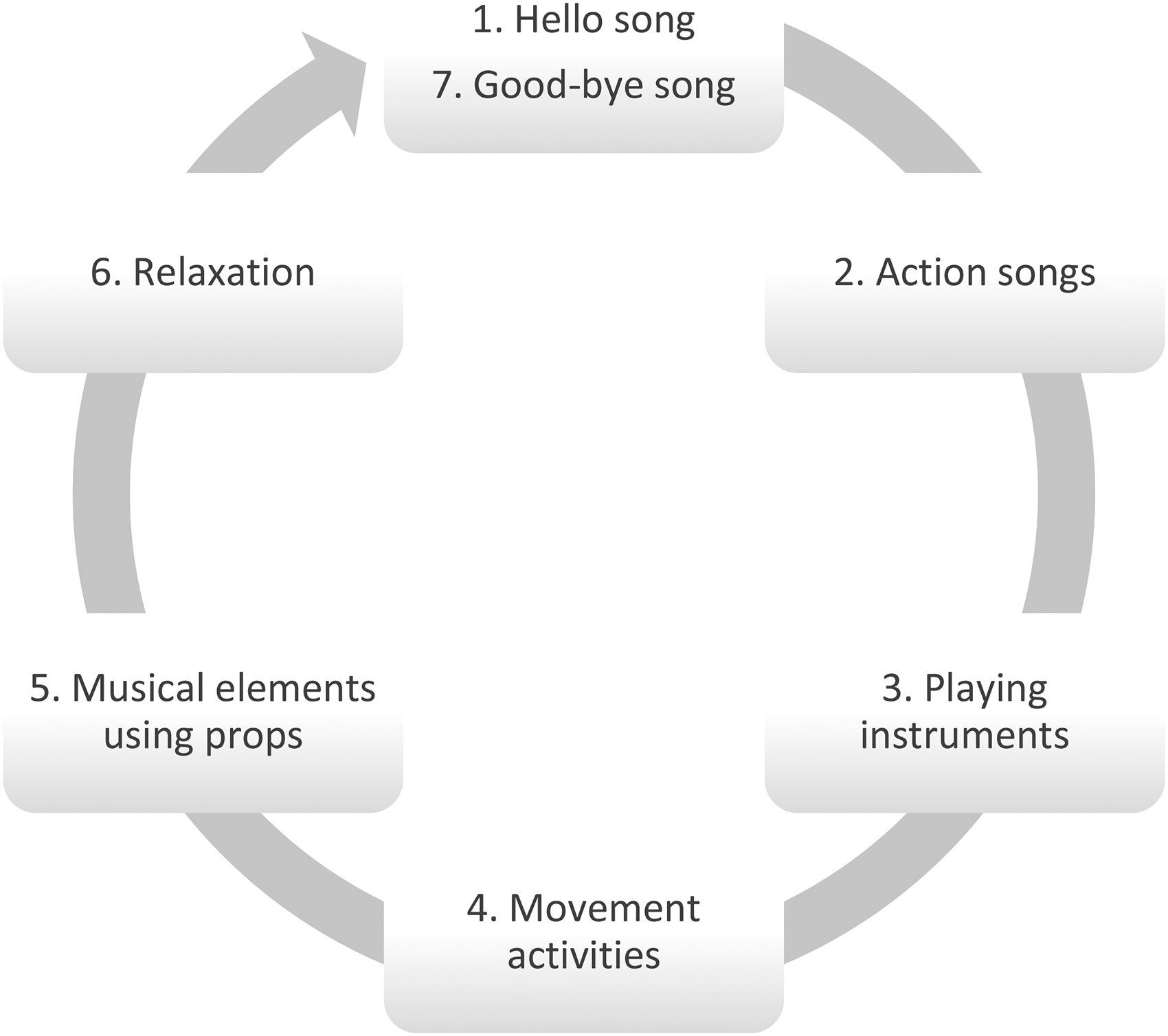
Schematic representation of music lesson plan.
Musical activities within each lesson component and potential associations with executive function (EF) and prosocial skills.

Measures
Child participants were asked to complete four measures twice (pre and post): a prosocial game measuring instrumental helping and sharing and two measures of executive function. Because we were working with children who were English language learners and the tasks required some language comprehension, a subset of the sample (n = 68) also completed a fifth measure, the Peabody Picture Vocabulary Test—Fourth Edition (PPVT-4) at the beginning of the study.
The Prosocial Game: Helping and Sharing
We used a prosocial game that had been developed and piloted in an earlier study with young children (Ilari et al., 2020). We chose to study instrumental helping (i.e., assisting another person to achieve an action-oriented goal) and sharing (i.e., sharing resources with another person) because these skills are known to emerge early in development through children's interactions with family, friends, teachers, and community members (Eisenberg et al., 2013). Instrumental helping and sharing were tested in the same “game,” but analyzed separately.
The prosocial game involved building a house with blocks for three animal friends, Mimo, Timo, and Simo. A desk with two chairs was placed at one end of the room. In the opposite end, there was a small table with six red cups containing wooden building blocks, paired in three rows. Right next to the cups there were two cardboard houses. The researcher and child sat on the chairs and engaged in storytelling. The researcher told the story of a giraffe named “Mimo,” who needed a new house and invited the child to build a house for Mimo, using wooden blocks. Child and researcher walked together across the room, each picking up a red cup from the first row and returning to their seats. They had the same number of blocks (i.e., 6) and took turns placing them on the table, as they built the house. Once the house was completed, the story went on. The researcher explained how Mimo was very happy with the house, but also was lonely and missed his friends Timo and Simo, a lion and an elephant, who were hiding in two houses across the room. As the child located the houses and picked one to visit, she was also asked to name a song (e.g., “Twinkle, Twinkle, Little Star,” “You’re welcome,” and “ I’m a little teapot”), and sing a verse or phrase with the researcher, to wake up the animal. At the end of the sung rendition the researcher pulled a cord and the animal “appeared,” much to the child's delight. The child and researcher picked up the toy animal and red cups from the second row, each with the same amount of blocks, and walked back to the desk to build the house. On their way to the desk, the researcher “accidentally” tripped and dropped the blocks, waiting for 5 s to see how the child would react. As she dropped the blocks, she murmured, “Oh, oh!” and waited to see how the child would react to the “accident.” The child's reaction was annotated in a log, in terms of actively helping by picking up blocks (5 points), not picking up any blocks but waiting politely by the experimenter until the problem was solved (4 points), beginning to help and then leaving with an excuse (3 points), not helping but offering an excuse (2 points), or ignoring the problem altogether (1 point). Children received one point for simply playing the game until the end, and 0 points if they refused to play or dropped out of the game. Following the “accident,” child and researcher built the second wooden house, taking turns to place their blocks, and the story went on. The pair headed then to the second (and last) cardboard house and clapped a rhythmic pattern together (e.g., three beats, to signal “knock, knock, knock”) to wake up the last animal. Unbeknownst to the child, the remaining cups had an uneven number of blocks: the child's cup had six and the researcher's three. As they took turns building the house, the researcher ran out of blocks. She looked at the child in complete disbelief, “Oh no! I don’t have any more blocks!” If the child shared a block, the researcher thanked them and carried on with the game, until all blocks were utilized. But if the child did not share, the researcher made a second complaint, “All gone!” If the child did not share, a final complaint was made, “I wanted more.” Children's reactions were annotated in the log: they received 5 points if they shared immediately after the first complaint, 4 points if they shared after the second complaint, 3 points if they shared after the third complaint, 2 points if they did not share but offered an excuse, and 1 point if they ignored the problem altogether but still took part in the game.
Dimensional Change Card Sort: Cognitive Flexibility
The Dimensional Change Card Sort (DCCS; Zelazo, 2006) is a standard measure of cognitive flexibility, a component of executive function. In the DCCS, children are asked to sort cards according to a given dimension: color or shape. Two L-shaped sorting trays were placed side-by-side on a table. Two target cards were fixed to each tray: one with a red apple and one with a blue car. The researcher pointed to and named each target card. Next, the researcher demonstrated how to sort cards based on color using two different cards and then uttered, “Now it's your turn. So, remember, if it's blue it goes here, if it's red, it goes here” (see Zelazo, 2006). In the first phase (i.e., preswitch), children sorted six cards based on color. In the subsequent phase (postswitch), the researcher stated, “Now we are going to play another game. We’re not going to play the card game anymore. We are going to play the shape game. In the shape game, apples go here and cars go here” (see Zelazo, 2006). Children were asked to sort six new cards based on shape. Children who sorted five or more cards correctly in the post-switch were invited to play the border version of the DCCS. In the border game, children were asked to sort the cards in the following way: if there was a black border on the card, they should sort it by color; if there was no border, they should sort it by shape. Cards were shuffled and presented in random orders, and the order of presentation of dimensions was counterbalanced. Scoring of the DCCS was done following Zelazo's (2006) recommendation. Children received 0 points if they sorted 0 to 4 cards correctly in the preswitch phase; 1 point if they sorted 5 to 6 cards in the preswitch phase, but sorted 0 to 4 cards correctly in the postswitch phase; 2 points if they sorted 5 to 6 cards in both the preswitch and postswitch phases, but sorted fewer than 9 cards correctly in the border version; and 3 points if they sorted 5 to 6 cards in the preswitch and postswitch phases, and sorted 9 or more cards in the border version.
Spin the Pots: Working Memory and Inhibition Control
Spin the pots is a task that measures working memory and inhibition control in young children (Hughes & Ensor, 2005). Eight small red cups (i.e., “pots”) each with a different picture (e.g., circle, triangle, and heart) on it were placed on a Lazy Susan tray. The researcher invited each child to place six colorful stickers under six of the eight pots. The researcher covered the tray with a scarf and spun it. The scarf was then removed, and the child was asked to lift one of the pots, to find a sticker. The goal was to find all six stickers in the least amount of trials. Children were allowed a maximum of 16 trials and the task ended once all six stickers were found. To obtain a single score for each child, we subtracted the number of errors from 16.
PPVT-4, Form A
The PPVT-4 is a standardized test of receptive vocabulary (Dunn & Dunn, 2007). The test includes 19 sets, each with 12 items of increasing difficulty. Sample items are presented first, followed by test items. The researcher utters a word and asks the child to point to the image that corresponds to it, on a page with four different colored images. The sets are age-normed, and the ceiling is reached when the child makes more than eight errors in a given set. The PPVT-4 yields a raw score that is converted into a standard score that is normed for age and grade/time of administration (Fall/Spring).
Procedures
Each child was tested individually in a quiet room at the participating schools. The researcher greeted the child in their classroom and the two of them walked together to the testing room. Testing sessions included the prosocial game and the two executive function tasks, which took ∼15 min. None of the children refused to play the prosocial game or to complete the executive function tasks. Due to scheduling issues at the schools, the language test (PPVT-4) could only be administered to 68 children (34 from each group) on a separate day, lasting between 10 and 25 min. This measure was completed only once and prior to the start of the music program. Children and teachers received stickers and a small gift as a token of appreciation for their time.
Results
To examine the effects of the music program on the dependent variables, we calculated means and standard deviations for all measures (Table 2). Next, multilevel analyses were performed in Mplus version 8.4 (Muthén & Muthén, 2017), in which the estimator used was the maximum likelihood with robust standard errors (MLR). The MLR accounts for the nonindependence of the observation (i.e., children nested in classes), and subsequently, the standard error was computed, considering the multilevel structure by the command in Mplus called (TYPE = complex), as proposed by Asparouhov (2005), using a sandwich estimator (Asparouhov, 2006). In the adjusted model, the regressions were controlled for gender, age, and outcome measure preintervention (baseline). The level of significance was set at 5%.
Descriptive statistics: means and SD for all measures.

Note. SD=standard deviation; DCCS=Dimensional Change Card Sort.
Table 3 depicts the effects of the early childhood music program on prosocial behaviors (instrumental helping and sharing) and executive function skills (cognitive flexibility and working memory/inhibition control) among kindergarten children. No statistical difference was found between the groups, indicating a lack of evidence of the music program on instrumental helping, sharing, and working memory/inhibition control. The only statistically significant outcome in the adjusted analysis was cognitive flexibility, coefficient 0.41, 95% CI [0.15–0.68], p = 0.002, which means that on a scale of 0 to 3 points, the increase in cognitive flexibility was 0.41 higher in the intervention group compared to the control group. Figures 2 to 5 depict pretest and posttest scores for music and control groups, for each dependent variable.

Children’s pretest and posttest scores for helping (N = 103).*

Children's pretest and posttest scores for sharing (N = 103).*
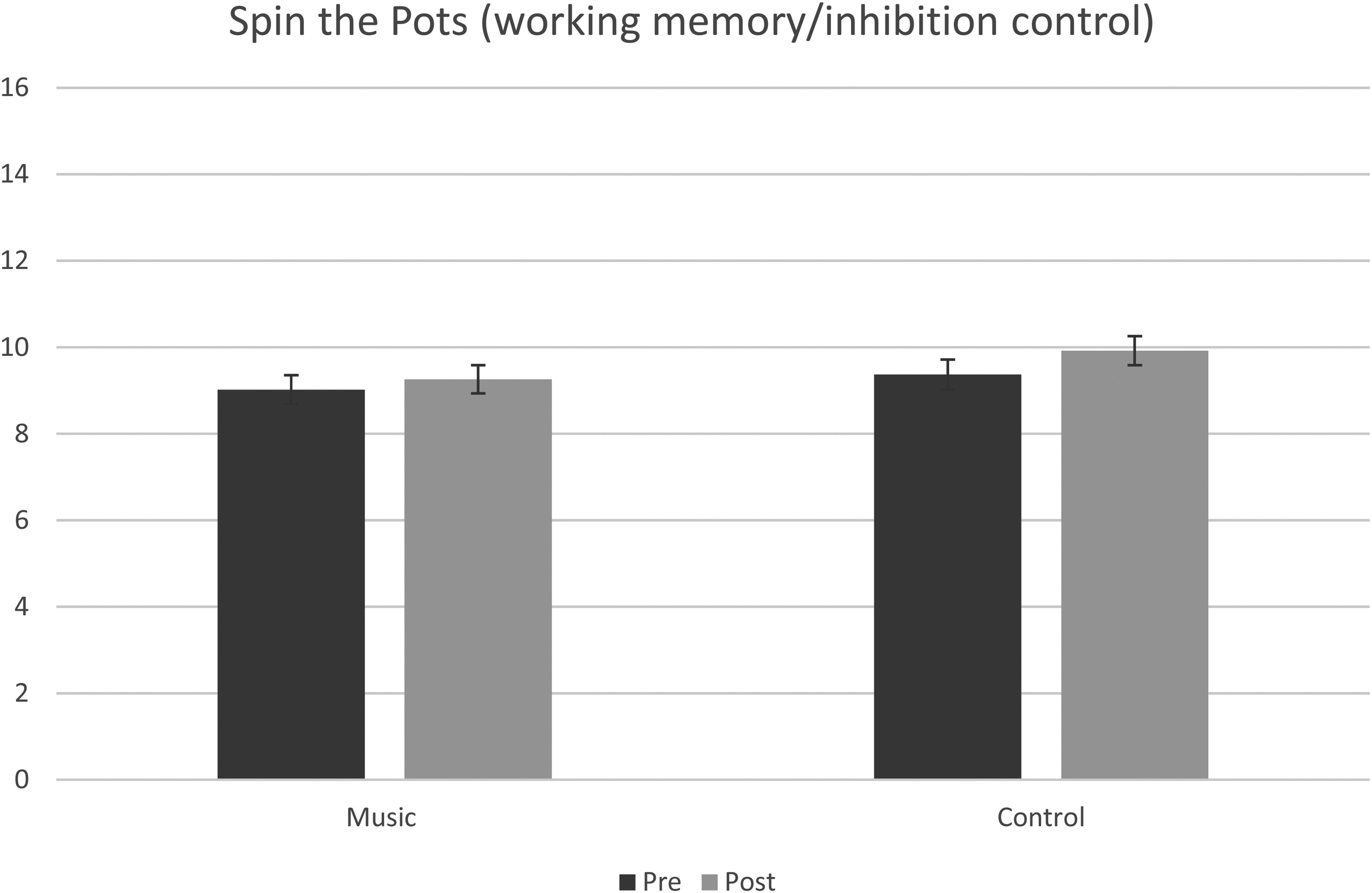
Children's pretest and posttest scores for spin the pots (N = 103).*

Children's pretest and posttest scores for dimensional change card sort (DCCS; N = 103).*
Unadjusted and adjusted analysis of the distribution of executive function and prosocial skills among kindergarten children participating in the evaluation of the music program (N = 103).

Analyses adjusted for sex, age, and outcome at baseline.
As this study was conducted in schools, students recruited from within the same class could have shown similarities. We used intraclass correlation coefficients (ICCs) to calculate student similarity. For analyzed outcomes, the lowest observed class ICC was for helping, ICC = 0.01, 95% CI [0.00, 0.87]; and the highest class ICC was for working memory/inhibition control, ICC = 0.08, 95% CI [0.01, 0.40]. For cognitive flexibility, class random effects compose ∼5% of the total residual variance, ICC = 0.04, 95% CI [0.004, 0.36], suggesting that they were slightly correlated within the class.
In some earlier studies (e.g., Flook et al., 2015; Schellenberg et al., 2015), participation in music programs was particularly beneficial for children with low prosocial skills preintervention. To address this question, we used a median split to divide the children into low- or high-performance groups, based on their scores at the pretest. Mixed-designed ANOVAs were performed to analyze children's scores as a function of the testing session (pre–post, repeated measures) and two between-subjects factors (group and initial score at the pretest). We found significant two-way interactions between testing time and prosocial scores at the pretest for both helping, F(1,99) = 34.62, p < .001, partial eta squared = .259; and sharing, F(1,99) = 8.31, p = .005, partial eta squared = .077. Children who started off with lower scores on both measures of prosociality showed more improvement at the posttest than their higher-scoring peers. However, there were no significant three-way interactions for either measure, suggesting that changes in prosocial scores were unrelated to group assignment.
In terms of receptive vocabulary, the mean score (grade norm) for the PPVT-4 was 87.75 (SD = 11.9), which is slightly lower than the mean standardized values for this population of 100.4 (SD = 15.6) (PPVT-4 Manual). Children in the control group scored higher on the PPVT than children in the music group, t (67) = −2.06, p = .04. Yet PPVT scores were not correlated with any of the four measures, as seen in Table 4. We also ran bivariate correlations for all studied variables and at both testing times. Results indicated that there were some significant, yet weak correlations between the prosocial scores (Table 4). An exception was a moderate correlation between sharing at the pretest and posttest. A negative, weak correlation between helping at the pretest and DCCS scores at the pretest was also found.
Correlations for all study variables.

Note. M=mean; SD=standard deviation; DCCS=Dimensional Change Card Sort; PPVT=Peabody Picture Vocabulary Test—Fourth Edition.
Significant at the 0.01 level (2-tailed).
Significant at the 0.05 level (2-tailed).
Discussion and Conclusion
The aim of our study was to examine whether a short-term music program could enhance prosocial behaviors (instrumental helping and sharing) and executive function skills (working memory/inhibition control and cognitive flexibility) of kindergarten children attending two public schools in California. The duration of the program was certainly the main factor and a limitation of our study. In terms of prosocial behaviors, there were no significant differences in children's scores for the instrumental helping task at the pretest and posttest. In earlier studies, prosocial gains were found for longer musical interventions, many of at least one school year (e.g., Rabinowitch et al., 2012; Schellenberg et al., 2015). Thus, five weeks of music education are likely insufficient to transfer into children's prosocial skills. Another issue to consider is the fact that the research protocol included a very brief musical interlude when the researcher invited the child to sing a musical phrase or verse of a song to “wake up the animal.” In some cases, children suggested a song and sang along, while other children remained quiet as the researcher sang. In other cases, children did not sing nor seemed interested in singing, showing signs that they were clearly eager to move on with the game and build houses. Even if this brief musical engagement during the prosocial game was less purposeful than in previous laboratory studies (Beck & Rieser, 2020; Kirschner & Tomasello, 2010), we cannot rule out the possibility that it may have had an impact on children's prosocial behaviors toward the unfamiliar adult (i.e., the researcher). The adult researcher was also in a position of power, and not a peer nor an equal partner. It is possible, then, that children's helping and sharing scores could have reflected compliance with school norms. Additionally, and irrespective of group assignment, children who started off with lower prosocial scores for both helping and sharing showed higher scores at the posttest, which suggests some developmental, and not intervention effects.
We also wondered if our results for the prosocial tests could be related to children's cultural background and ethnicity. When we compared pretest scores from this study with scores obtained from a correlational study that used the same prosocial game with a more affluent population (Ilari et al., 2020), we noticed that mean group scores for both helping and sharing were slightly higher in the current study (e.g., means for helping: music group, this study = 3.25, SD = 1.46; control group, this = 3.67, SD = 1.75; and mean for helping, earlier study = 1.80, SD = 1.67). While children were younger in the earlier study (mean age = 46 months) none was of Latinx ethnicity. Latinx cultures are collectivist, and value familismo (i.e., the family as the core in society see Calzada et al, 2012) and personalismo (i.e., the great value placed on interpersonal relationships, see Valencia, 2004). Prosociality is integral to both familismo and personalismo; helping and sharing are cultural expectations that are exercised at home from early on. That is, it is possible that children's prosocial scores were merely a reflection of their upbringing. These results are also consistent with earlier works that have highlighted the role of social status in modulating prosocial behaviors in children and adults (Pfiff et al., 2010). Individuals from disadvantaged social groups such as ethnic minorities and stemming from low SES have been described as “more attentive and affiliative compared with their advantaged counterparts” (Guinote et al., 2015, p. 731). That is, individuals from disadvantaged social groups may act more prosocially as a way to build a niche to counteract their disadvantages and increase their social support and status (see Guinote et al., 2015; Pfiff et al., 2010). It is possible then that the relatively high prosocial scores of children in our study as compared to those from Ilari et al. (2020) reflected these important cultural and social markers of identity. These are questions for future research to explore.
Instrumental helping, however, is often described as a simpler task than sharing (Eisenberg & Spinrad, 2014). Even if both helping and sharing require recognition of one's negative experience and appropriate response, these behaviors make different social cognitive demands on the prosocial individual. Instrumental helping requires the recognition of an instrumental need and assistance with goal completion. Sharing, in turn, requires the recognition of an unmet material wish, the desire for equality, and the ability to suppress a desire to control resources (Dunfield, 2014). Consistent with the literature (Dunfield, 2014; Eisenberg & Spinrad, 2014), children in our study showed an overall tendency to help more than to share, as seen in their mean scores. Furthermore, all children irrespective of the study group shared more blocks with the researcher at the posttest. Aside from signaling developmental effects, these results are also consistent with the different demands placed on children by each prosocial task.
In terms of executive function, we found significant group differences favoring the music group for cognitive flexibility. This finding aligns with those from earlier works that found long-term (Jaschke et al., 2018) and short-term (Halberg et al., 2017; Shen et al., 2019) early childhood music programs to influence children's executive function skills. The music curriculum involved activities that required children to inhibit their attention to one dimension and focus on a different one, such as changing words in a song, taking turns to sing or clap, or performing different gestures in response to musical elements. These activities may have assisted in the development of children's cognitive flexibility. It was intriguing, however, that we did not find group differences for working memory/inhibition control. While we cannot rule out the possibility that 5 weeks of music education did not enhance children's working memory, an alternative explanation lies in the choice of “Spin the pots” as the selected measure. This task was originally designed for toddlers and younger children than our studied population (see Hughes & Ensor, 2005). It is possible that our negative results reflected a choice of task that was not as engaging for kindergarteners, which may explain the lack of correlation in the pretest and posttest scores for this measure. To better understand how students in our study performed in this task, we contrasted their mean scores with those from Bowmer et al., (2018), who tested 4-year-olds undergoing a similar music program. Based on earlier theorizing (see Morra et al., 2021), we expected children in our study to score higher on the task than their younger peers. Yet children in this study showed lower mean scores (between 9 and 10 points) than their British counterparts (between 11 and 12 points). While lack of motivation might have been an issue, it is also possible that the activities in the curriculum were not sufficient to develop working memory/inhibition control in the music group. Some have further suggested that spin the pots is a measure that might benefit from some calibration, as the task is complex and involves working memory and inhibition control (Morra et al., 2021). Perhaps manipulating difficulty levels by creating different conditions within the task (see examples in Morra et al., 2021) would have made this measure more suitable for our study participants. Still, the fact that we found transfer effects for one but not both measures of executive function is consistent with earlier works (Bowmer et al., 2018; Hennessy et al., 2019), and with the idea that behavioral forms of self-regulation as executive function skills develop in nonlinear ways (Montroy et al., 2016). Future research is obviously needed to tease out these factors.
It was also interesting that prosocial scores correlated with one another, whereas helping and DCCS scores at the pretest were negatively correlated. At a first glance, one could interpret these findings as contradicting those of Hao (2017), who found no significant correlations between inhibitory control and prosocial behavior (donating) in Chinese children aged 4–6 years. Yet, tests measuring cognitive flexibility often tap into inhibitory skills, a phenomenon that Miyake and Friedman (2012) termed “task-impurity problem.” Given the complexity of executive function, future studies could perhaps benefit from the inclusion of a wider range of tasks and the adoption of a latent-variable approach (see Baggetta & Alexander, 2016: Miyake and Friedman, 2012).
Still, in terms of correlations, vocabulary scores did not correlate with any other scores. Vocabulary scores were also lower than those reported for the studied population in the PPVT manual. This is not completely surprising given that our sample was composed of English language learners, many of whom did not learn English until they entered formal schooling. While the tasks employed in our study were straightforward, we cannot completely rule out the possibility that children's language skills might have influenced their performance on the tasks. However, at the time of testing, only two children could not communicate in English and requested to speak Spanish with the researcher.
Our curricular choices are also worthy of commentary. In earlier works (e.g., Flook et al., 2015; Rabinowitch et al., 2012), scholars developed curricula that were arguably more tailored toward the development of executive function skills and prosocial behaviors than the one employed in this study, which was quite typical for early childhood education. But we would be remiss if we did not comment on the influence of individual teachers and classroom cultures on children's development. As we interacted with classroom teachers and observed them as they assisted the music teachers during music classes, we noticed different teaching styles and modes of interactions with students, with some teachers appearing to be more nurturing than others. Yet we did not conduct systematic and extensive observations of classrooms nor did we collect interviews from all teachers. Therefore, in our analysis, we used multilevel models that controlled for school and classroom of origin. Future studies should make an effort to systematically document teacher–child relationships, peer interactions, classroom, and school cultures, as they are likely to influence children's learning and its potential transfer into near and far areas (Ferreira et al., 2016; Pianta & Stuhlman, 2004). In-depth interviews with classroom and music teachers on their teaching styles and priorities, along with systematic observations of children in schools, are likely to offer additional insights into children's prosocial skills and executive functioning. We also suggest that researchers develop and use data collection tools that are culturally sensitive and that take into account the values and socialization processes of the cultural groups that they are studying (Gauvain & Perez, 2015).
To conclude, our data suggest that a short, 5-week music program positively influenced children's cognitive flexibility, but not working memory/inhibition control nor prosocial skills (sharing and helping). Regarding cognitive flexibility, it is unknown whether the effects that we found were sustained, as children were not retested after the posttest as in other studies (Shen et al., 2019). Given that any transfer effect observed in music intervention studies with children is likely to be small (see Bigand and Tillman, in press), and even susceptible to “disappear” due to maturation and growth (e.g., when control groups “catch up” over time, see Costa-Giomi, 1999; Hennessy et al., 2019), it is important to include multiple data collection points in the future, along with qualitative data (see Yoshikawa et al., 2008). Additionally, we cannot rule out the possibility that our findings might have been due to children's engagement in a novel activity, given that we did not have an active control group (Schellenberg, 2020). Even if control children in our study were doing something that deviated from their routine and with different peers, these activities were less controlled than those in the music program. Still, the fact that transfer effects between music education and cognitive flexibility emerged following a short-term music education program is relevant, particularly when we consider our study population: children from high-needs schools situated in areas of high poverty. Executive function skills are negatively affected by poverty (Allee-Herndon & Roberts, 2019), yet are vital for child development, given their associations with academic skills and later success in life (Diamond & Lee, 2011; Fitzpatrick et al., 2014). Our research also hints at the role of children's cultural background alongside social expectations and group affiliation on prosocial responding. Thus, our modest findings support the need for future work on learning transfer from early childhood music programs to executive functioning and prosocial skills in a wide range of settings, using mixed methods, and with children from varied ethnic, socioeconomic, and cultural backgrounds.
Footnotes
Author Contributions
B.I., A.B., K.M., J.K. and G.W. designed the study. B.I., S.H., T.H. recruited participants and collected data. B.I., A.B., K.M and G.W. analyzed data. All authors contributed to manuscript preparation. B.I. and G.W. worked on revisions and final manuscript preparation.
Declaration of Conflicting Interests
The authors declared no potential conflicts of interest with respect to the research, authorship, and/or publication of this article.
Funding
The authors received no financial support for the research, authorship, and/or publication of this article.

Peer Review
Haley Kragness, University of Toronto, TEMPO Lab.
Minna Huotilainen, University of Helsinki, Department of Education.
Tanja Linnavalli, University of Helsinki, Faculty of Educational Sciences, CICERO Learning.
Action Editor
Suvi Saarikallio, Department of Music, Art and Culture, University of Jyväskylä.