



Abstract
Articulating notes on the clarinet requires the control of many factors, one of which is the behavior of the tongue. It is hypothesized that one of the mechanisms to produce notes in the altissimo (highest) register involves the lowering of the tongue dorsum. The study sought to answer the question of whether different tonguing techniques interfered with the required lowering of the tongue dorsum in this register, making adequate note production difficult. Four professional clarinet players performed diatonic scales across the chalumeau, clarion, and altissimo registers using two techniques—single and double tonguing. Movements of the tongue dorsum and tongue blade were recorded with 3D Electromagnetic Articulography. The movement data revealed that, for all players, a low position of the tongue dorsum was indeed associated with a higher success rate of producing adequate notes in the altissimo register. Single tonguing was the most effective technique due to ability of the tongue dorsum to lower during the highest register. For three of the four players, failed note production in the altissimo register when performing double tonguing related to a high tongue dorsum position; one participant, however, was successful in performing double tonguing in the altissimo register, despite a high tongue dorsum position. This latter finding suggests player-specific strategies to successfully realize double tonguing in the altissimo register.
Keywords
Introduction
To produce a good-sounding note on the clarinet, the player must master a whole range of techniques, one of which concerns how to articulate individual notes. For example, musicians can realize a sequence of notes without separating them, an articulation referred to as “legato,” or space the notes in a non-legato manner, resulting in articulations such as “staccato” or “marcato.” To realize these latter articulations, the tongue manipulates the airflow and mouth pressure by constricting the vocal cavity and manipulating the reed (e.g., Pamies-Vila et al., 2018). In this article, we refer to this technique as tonguing. The current study examines how the position of the back of the tongue contributes to adequate note production in the highest register when realizing two common types of tonguing. The first is single tonguing (ST) in which only the part of the tongue behind the tongue tip (from now on referred to as “tongue blade” 1 ) articulates the individual notes by moving upwards and touching the reed (e.g., Palmier-Vila et al., 2018). The second type is double-tonguing (DT) in which both the tongue blade and the back of the tongue (i.e., tongue dorsum) are involved while moving in opposite up-down directions; the tongue blade presumably behaves as in single tonguing while the tongue dorsum controls the air supply and mouth pressure by touching the soft palate (e.g., Gingras, 2004; Klug, 1997; Sullivan, 2006).
In clarinet playing, three registers are distinguished: the lowest chalumeau register from concert e3 to a4, the clarion register, from b4 to c6, and the highest altissimo register from d6 to c7 (Pino, 1998). One of the most difficult skills to master in clarinet playing is effective tonguing across these registers. Clarinet players agree that ST is the most effective type of tonguing across all registers and the easiest to acquire, while DT is considered effective until approximately f5 and becomes increasingly more difficult in the altissimo register (Gingras, 2004). Besides the difficulty in coordinating finger and tongue actions, a complicating factor is that the vocal tract shape as well as the inter-oral pressure required for a successful production of a note differs depending on the register (Almeida et al., 2013; Benade, 1985; Clinch et al., 1982; Fritz & Wolfe, 2005; Gardner & Stone, 2015; Klug, 1997; Li et al., 2014, 2016; Scavone et al., 2008). Consequently, producing a high-quality sound across all registers requires a complex coordination, between the respiratory system that provides air support and the muscles of the tongue and jaw modulating the shape of the oral cavity (Pàmies-Vilà et al., 2018; Sterling et al., 2009).
Learning how to coordinate all these factors is challenging because many of the contributing components for effective tonguing and note production, such as the movements of the tongue, are not visible and players do not have a good sense of the actual position of the tongue when playing (see e.g. Patnode, 1999). Even more so, players frequently adopt different strategies to produce a high-quality sound (e.g., Fritz & Wolfe, 2005). To effectively instruct a student on how to improve production, it is thus necessary to get a deeper understanding of the actual mechanisms underlying successful note production across registers and the behavior of the tongue (e.g., Klug, 1997).
Many studies have shown that players adjust their vocal tract shape by mimicking vowel configurations and that, depending on the register, a different vocal tract configuration is selected to influence reed vibrations (Chen et al., 2011; Clinch et al., 1982; González & Payri, 2017; Guillemain, 2007; Gardner & Stone, 2015; Lulich et al., 2017; see for an extensive review Scavone et al., 2008; however see Backus, 1985, for reporting a negligible effect of the vocal tract shape on the quality of a note). Especially in the altissimo register, the vocal tract shape changes (Fritz & Wolfe, 2005; Gardner & Stone, 2015) to provide enough inter-oral pressure to produce notes (Pamies-Vila et al., 2018; 2020; Scavone et al., 2008). X-ray fluoroscopic data (Clinch et al., 1982; Wheeler, 2010) and ultrasound data (Lulich et al., 2017) show that during non-articulated and portamento style playing, the tongue dorsum moves downward in the highest registers and upward in the lower registers in successful note productions, indicating that the players respectively enlarge and diminish the size of the oral cavity. Vocal tract shape in the lower regions seems to mainly affect the timbre of a note (Scavone et al., 2008).
Most of the studies, investigating the importance of vocal tract shape on the produced notes, examined non-articulated or portamento style playing. Few studies studied the influence of tonguing on playing (Guilleman, 2007; Pamies-Vila et al., 2018; 2020). Pamies-Vila et al. (2020) showed that during attacks of a note, especially in the altissimo register, vocal tract adjustments influenced inter-oral pressure, such that the inter-oral pressure and the pressure at the mouthpiece were similar, whereas without adjustment the inter-oral pressure was much smaller. This indicates that the pressure within the vocal tract must be high enough to initiate a note during staccato playing, and one of the techniques players use, is shaping their vocal tract in a certain manner. Pamies-Vila et al. (2018) showed that the overall mouth pressure is identical during legato, staccato, and portato articulations. However, during legato and portato the pressure is continuous, but during staccato, mouth the pressure varies during note transitions.
Maintaining inter-oral pressure by lowering the back of the tongue is relatively easy to acquire in non-articulated scales, portamento, and staccato style playing; a complicating factor arises when the tongue must move upwards to manipulate the air flow during different tonguing techniques, while maintaining a sufficient low position of the tongue dorsum in the higher registers, such as in DT. The current study uses Electromagnetic Articulography (EMA) to explore the relationship between the overall position of the tongue dorsum and the success of producing notes in the altissimo register, while executing single and double tonguing. The studies investigating tonguing techniques used pressure measurements to indirectly infer information about the vocal tract shape and tonguing, which does not reveal the behavior of the tongue during these actions (Guilleman, 2007; Pamies-Vila et al., 2018; 2020). EMA allows for the continuous recording and observation of movements of individual parts of the tongue during playing (see the Procedure section for in-depth description of the system), which sheds light on the actual vocal tract adjustments.
It is hypothesized that a low position of the tongue dorsum predicts a higher success rate of note production in the altissimo register. In addition, it is hypothesized that ST is the most successful because only the tongue blade is actively manipulating the air flow during tonguing, while the tongue dorsum can freely lower. During DT, on the other hand, the tongue dorsum must create an appropriate large vocal tract configuration needed for note production while at the same time must be raised when manipulating the air flow, which hampers accurate note production.
Methods
Participants
Tongue movement and acoustic data were collected from four male professional players (P1, P2, P3, P4). All participants received clarinet training at institutions geared to training musicians for a career in music and are still performing worldwide (see Table 1).
Age in years of the onset of clarinet instruction, onset of professional training, and current age of the four participants (P1, P2, P3, P4).

The four participants were familiar with ST and DT techniques. Each player used their own B-flat clarinet, including their preferred reeds and mouthpiece. One player, P4, used lower teeth protection.
Material
The players were instructed to play diatonic scales, ranging from the lowest possible note on the instrument (e3) to the highest possible note (c7), and back down to e3, in single quarter notes (see Figure 1) and in four-note repeating 16th notes (Figure 2).
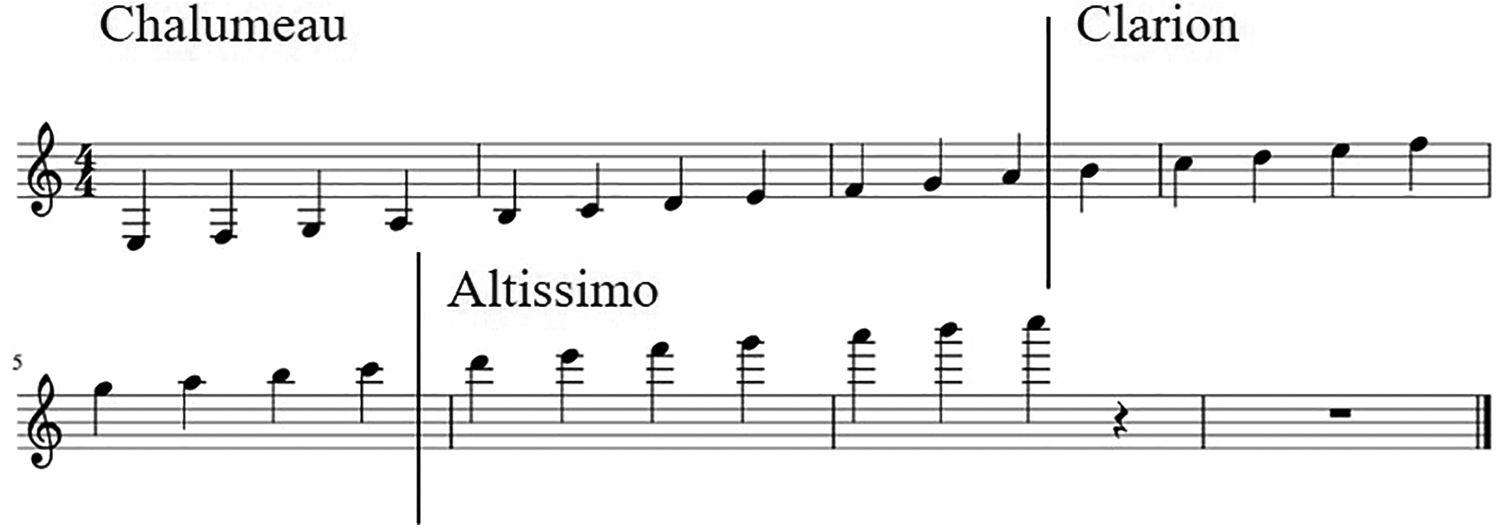
Range and registers of produced notes.

The same range as in Figure 1 but produced with 16th notes. Only the first part of the chalumeau register is shown in this figure.
Two tonguing techniques were explored: Single tonguing (ST) and double tonguing (DT). Legato style playing (LEGATO), in which the notes were not separated, was included to serve as a reference to calculate the lowest position of the tongue dorsum in the altissimo register (see Analysis section); it was assumed that LEGATO was not restricting the movement of the tongue at all, other than moving downwards to produce the notes in the higher registers. For each tonguing type, the scales were produced one note at a time (Figure 1) as well as repeated four times (see Figure 2). LEGATO style playing was only performed with one note at a time.
Although the factor of vowel configuration and its effect on quality was not the focus of the study, the players were instructed to perform ST and DT across registers with three different vocal tract shapes: /i/ as in English “bee,” /y:/ as in German “über,” and /α/ as in American English “cop,” resulting in 12 scales. P4 and P2 performed several additional scales with no specific vowel-like configurations, resulting in 9 ST trials and 8 DT trials for P4, and 8 ST trials and 8 DT trials for P2. If a player was unable to perform the scale with the vowel shape requirements, then the player was instructed to choose any vowel configuration. The players were instructed to play the scales at a self-selected comfortable rate.
Procedure
Movements of the tongue blade and tongue dorsum were recorded using 3D electromagnetic articulography or EMA (Model AG501; Carstens Medizinelektronik BmbH, Germany). EMA is a valid, reliable, and accurate technology to record 3D movements of the tongue and has been widely used in speech production research over the past 30 years to measure movements of the tongue, lips, and jaw (see e.g. Kroos, 2012; Savariaux et al., 2017; Slis & Van Lieshout, 2013; Van Lieshout, 2021; Van Lieshout & Moussa, 2000). EMA uses electromagnetic fields with different frequencies generated by nine transmitters, which are attached to a cube-like structure, inside which the head of the player is located (see Figure 3). To measure movements of individual parts of the tongue, coils with a 0.25 cm diameter are attached to surface locations of interest. When the coils are placed in the magnetic field, a current is induced, proportional to the distance of the coils to each of the transmitters. For the current study, coils were attached on the surface of the tongue blade (1 cm from the tip), 2 tongue body (2 cm from the tongue blade coil), and tongue dorsum (3 cm from the tongue blade coil), using surgical glue (Periacryl Blue, Gluestitch). P1 had additional coils on the right and left side of the tongue blade (1 cm from the tongue blade coil). 3 Additionally, four coils were attached behind the ears, on the forehead, and on the nose to track head orientation and head motion (Figure 3; see also Henriques & Van Lieshout, 2013; Van Lieshout & Moussa, 2000). The authors ensured that the players were comfortable with the set-up. Those participants who experienced some initial discomfort due to the coils and wires adjusted quickly during the initial part of the experiment, when no experimental data were collected.
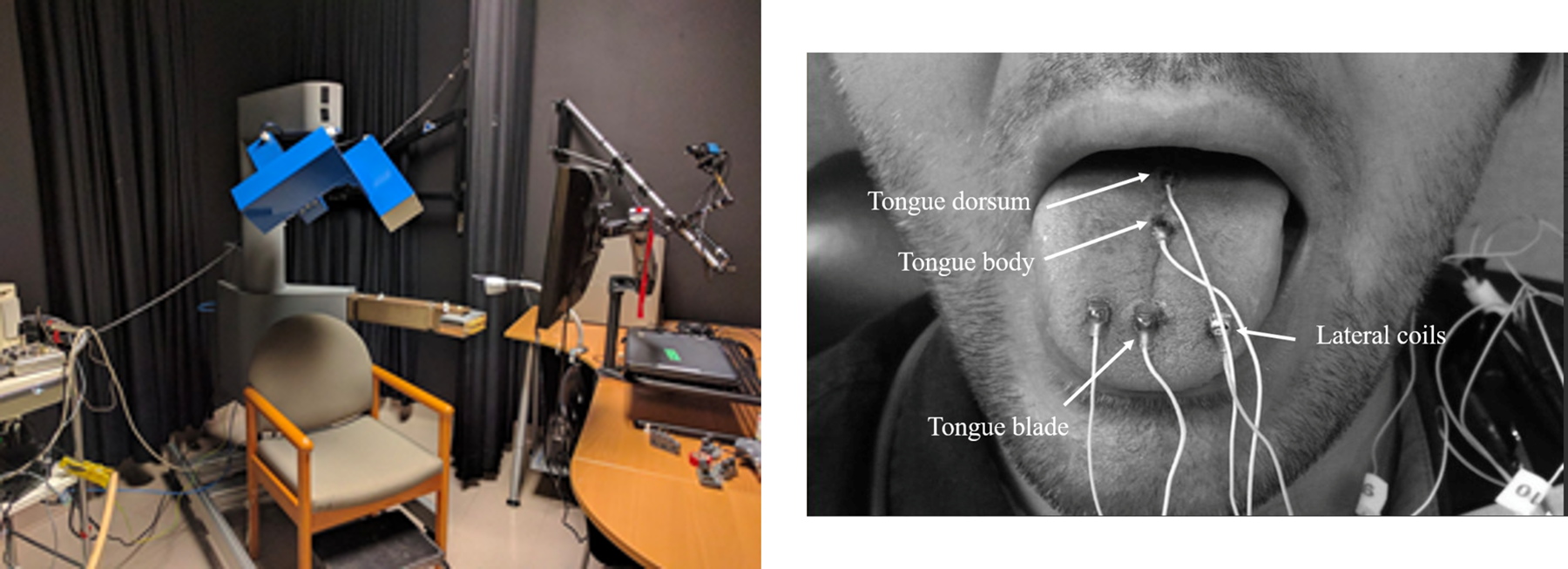
The left figure shows the EMA AG501 system and set-up, used during the study. The right picture shows a player with the five coils attached to the tongue blade, tongue body, tongue dorsum, and lateral sides, respectively.
The player was seated on a chair inside the magnetic field, below the transducers (see Figure 3 and Video 1 in Supplemental Material.
Before the session started, a bite plane, consisting of a spoon-shaped plastic device with a bubble level, was used to determine a standardized reference head position relative to which time-specific individual positions of the articulators for all trials were expressed (Henriques & Van Lieshout, 2013). The articulatory movements were sampled at a frequency of 250 Hz. 4 Simultaneously with these movement recordings, the acoustic signal was recorded with a sample frequency of 44.1 kHz. Video 2 (see Supplemental Material shows an example of the raw movement data that are sampled simultaneously with playing.
Analysis
Before the movement data were analyzed, a head correction was performed, to ensure that the participant-specific occlusal plane was aligned with the standardized reference head position mentioned above (see Video 2; Henriques & Van Lieshout, 2013). This is necessary because the participant can move his head during the experiment. Recordings of tongue blade and dorsum movements were analyzed with EGUANA software developed at the Oral Dynamics Lab at the University of Toronto. 5 Movement data were low-pass filtered with a cut-off frequency of 15 Hz. All the scales were analyzed, even when the quality of the note was compromised, 6 as long as the player used the appropriate tonguing technique.
Definition of Success Rate
To investigate which tonguing techniques were most successful in the altissimo register a measure of success was defined. To this end, the scales were divided into five Parts, based on the three registers: Part 1: Chalumeau register; ascending (e3 to a4); Part 2: Clarion register; ascending (b4 to c6); Part 3: Altissimo register (d6 to c7); Part 4: Clarion register; descending (c6 to b4); Part 5: Chalumeau register; descending (a4 to e3). The pitch of the notes was determined and converted to semitones in PRAAT, a software package commonly used in phonetic research (Boersma & Weenink, 2020).
For each register and tonguing type (ST, DT, and the reference articulation LEGATO), a success rate was calculated by comparing the notes that the players were instructed to play, as indicated in the scale in Figure 1, with the executed notes measured acoustically. If the expected and calculated semitone were not identical, the player was deemed not successful, and the single note event was labelled “incorrect.” In case the expected and calculated semitone were identical, the event was labelled “correct” in terms of pitch. Missing notes were also labelled as “incorrect” when calculating the success rate; success rate thus is a relative measure and depends on whether the player was able to produce the notes in the altissimo register correctly during LEGATO, that is, when no tonguing is required. No judgements were made about the quality of the sound. For each register, the final success rate was calculated as follows: number of successful notes divided by the number of total expected notes in a register (tabulated for all participants). The highest possible success rate score was “1” (= 100% correct; see Table 2 for an example).
An example of a scale in which the first and second registers were completed without any errors, meaning that these registers scored a success rate of “1” in this example (number correct/total number).a

a The highest register contained 13 notes, from d6 up to the highest note (c7) and back down to d6. In the example, there are five mistakes (two missing notes and three wrong notes, leaving eight correct notes), resulting in a score of 0.61 (8/13).
All players were able to perform LEGATO in the altissimo register, in the sense that they produced at least up to a6.
Figure 4 and Table 3 show that no player reached 100% success in the altissimo register, even during LEGATO playing. The “incorrect notes” during LEGATO were caused by factors such as the wrong finger configurations or accidental skipping of notes. All players, however, showed the highest success rate in the altissimo register for LEGATO or showed a similar success rate for LEGATO compared to ST (see Figure 4 and Table 4).

The success rate for individual players (P1, P2, P3, P4) grouped by tonguing technique (LEGATO, ST, DT) and register (Chalumeau, Clarion, and Altissimo), collapsed across vowels and repetition/no repetition.
Highest note reached for each tonguing type in at least one of the scales played with a certain tonguing type, separately for each player (P1, P2, P3, P4). The expected note was c7.

LEGATO = legato playing; ST = single tonguing; DT = double tonging.
Table 4 summarizes the mean and confidence intervals of success rate for different registers and tonguing techniques across players.
Mean success rate and upper and lower boundaries of confidence intervals (alpha = 0.95) for LEGATO and the two different tonguing techniques ST and DT and each register (Chalumeau, Clarion, and Altissimo).
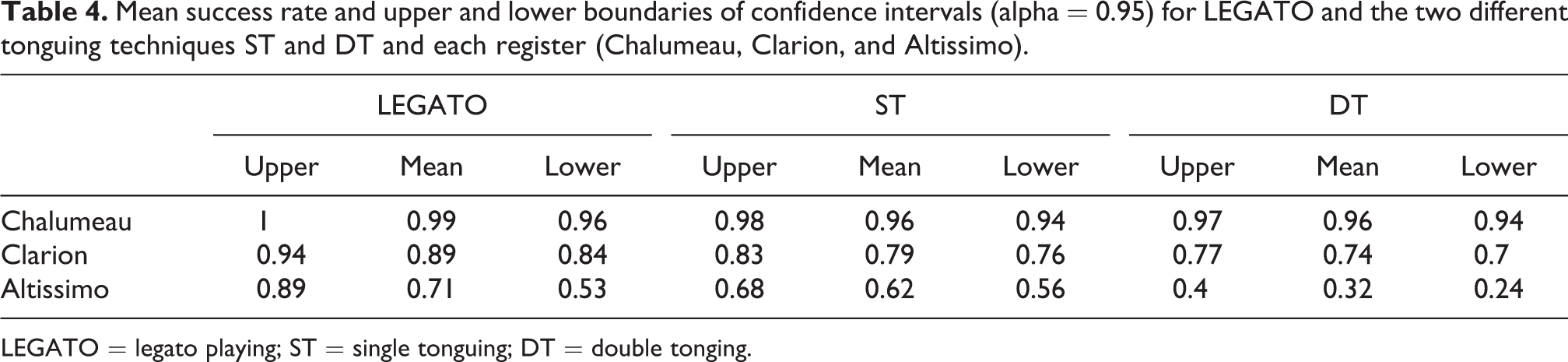
LEGATO = legato playing; ST = single tonguing; DT = double tonging.
Measure of Tongue Dorsum Position in Altissimo Register
The current study investigates whether success rate in the altissimo register depended on the position of the tongue dorsum. To this end, the lowest position value of the tongue dorsum movement in the altissimo register was determined during LEGATO playing. This value served as a reference because the working hypothesis was that during LEGATO the tongue dorsum was completely unrestricted and thus could move down freely with increasing pitch. One could argue that the tongue dorsum is also unrestricted during ST; however, due to biomechanical linkage to the tongue blade, the tongue dorsum position might be affected by ST. Figure 5 shows that all the players indeed lowered the tongue dorsum with increasing pitch and raised the tongue dorsum with decreasing pitch during LEGATO. Especially during the altissimo register the tongue dorsum lowers and remains relatively stable during the chalumeau and clarion registers (see Scavone et al., 2008). Both this observation and the fact that all the players performed LEGATO with the highest success rate supported our approach to consider LEGATO as a baseline trial.

Tongue dorsum movement during LEGATO across the three registers: Chalumeau, Clarion, and Altissimo, ascending and descending, for the 4 players. On the horizontal axis: time (s) and the vertical axis the movement displacement (mm/deg) of the tongue dorsum.
Next, the lowest position of the tongue dorsum in the altissimo register during a specific tonguing technique was determined. Finally, the difference between the lowest tongue dorsum position reached in LEGATO and the lowest position reached during performance of the scale with ST or DT (DIFFPOS) was taken as a measure of how low the tongue dorsum moved in the altissimo register (see Figure 6). When DIFFPOS was 0, the tongue dorsum reached the exact same position in the experimental trial as in LEGATO. In all cases, the position of the tongue dorsum during LEGATO in the highest register was lower than the tongue dorsum position during ST and DT.
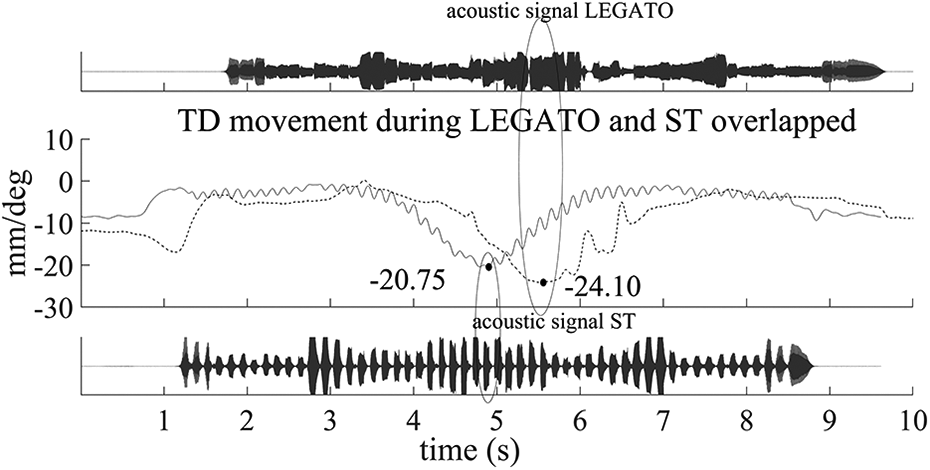
The dotted line indicates the movement of the tongue dorsum across registers during LEGATO for player P1; the solid line represents the tongue dorsum movement during ST; the smaller movements of the tongue dorsum superimposed on the overall change in position are caused by the physical link of the tongue dorsum and the tongue blade. When the tongue blade moves up (not shown here) during ST, the tongue dorsum is passively moving along to a small degree as well. The light grey area in the acoustic signal marks the highest note reached, and the circled area highlights the accompanying tongue dorsum location. The two black dots indicate the lowest positions of the tongue dorsum during LEGATO (−24.10 mm) and ST (−20.75 mm). The difference between these two lowest values is a measure of how close the tongue dorsum position during ST is to the tongue dorsum position during LEGATO (reference); in this case the difference (DIFFPOS) was −3.35 mm.
Statistical Analysis
Before analyzing the data, it was validated whether the players had performed the appropriate tonguing techniques (rather than substituting an easier technique in place of a difficult one: for example, they performed ST instead of DT). To this end, the mean upward movement amplitudes of the tongue dorsum and tongue blade during ST and DT were extracted automatically with MATLAB scripts (see Figure 7) across the 22 notes during the chalumeau register (11 ascending and 11 descending) and reported for each player in Figure 8. The movement amplitude is the distance from a local minimum (low tongue dorsum and tongue blade position to allow the airflow) to an adjacent local maximum (a higher tongue position when the airflow is constricted).

An example of tongue dorsum movement (P2) during DT (right) and ST (left) across registers. The distance from “a” to “b,” marked with the two dots, indicates one instance of a movement of the tongue dorsum going up for constriction of the airflow.
It can be observed in Figure 8 that all the players indeed performed DT and ST with “alternating tongue dorsum-tongue blade” and “tongue blade only,” respectively; the mean amplitude of the tongue dorsum movement in DT is larger than in ST, indicating that the players performed DT correctly.

The mean amplitude and standard error of the tongue dorsum and tongue blade during Double Tonguing (DT) and Single Tonguing (ST) for each player in the chalumeau register; On the vertical axis: movement range (mm) and on the horizontal axis the tonguing techniques.
Because the distributions of success rate and DIFFPOS violated the normality assumption, and the sample size was small, non-parametric tests were used to investigate the various factors.
A Spearman rank correlation test, using the stat_cor function from the library ggpubr in R (R Core Team, 2020) with DIFFPOS and success rate as dependent variables, pooled across four players and tonguing techniques, examined whether the DIFFPOS of the tongue dorsum correlated with success rate in the altissimo register. In addition, Spearman rank correlation tests evaluated the correlation between success rate and DIFFPOS for each player separately across all individual productions. Only the success rate in the altissimo register was considered because the lowest position of the tongue dorsum was calculated during note production in this register.
The conditions “vowel” and “repetition/no repetition of notes” (as exemplified in Figures 1 and 2) did not reveal statistically significant differences across players and tonguing, so the data were collapsed across these two conditions. 7
Results
Plotting the DIFFPOS values of the tongue dorsum against the values for success rate during the altissimo register in Figure 9 revealed a weak negative association between the values of DIFFPOS and success rate (rs = −0.29, p < .03). This meant that a negative trend was observed regarding the relation between DIFFPOS and success rate. It can be observed from Figure 9 that especially ST showed smaller DIFFPOS values and higher success rate values. DT realizations did not show a reliable pattern when the data were collapsed across players.

Scatterplot with success rate on the horizonal axis and DIFFPOS (mm) on the vertical axis. The circle on the left indicates the low Success rate value on the x-axis and the higher values of DIFFPOS on the y-axis; the circle on the right marks the high success rate on the x-axis and the low value of DIFFPOS on the y-axis.
Inspecting the correlation values between DIFFPOS and success rate for each player individually (see Figure 10), it was observed that the degree in which the DIFFPOS of the tongue dorsum related to the success rate in the altissimo register depended on the player. P2 (rs = −0.77, p <.001), and P3 (rs = −0.72, p < .01) showed a higher success rate when DIFFPOS values were lower.
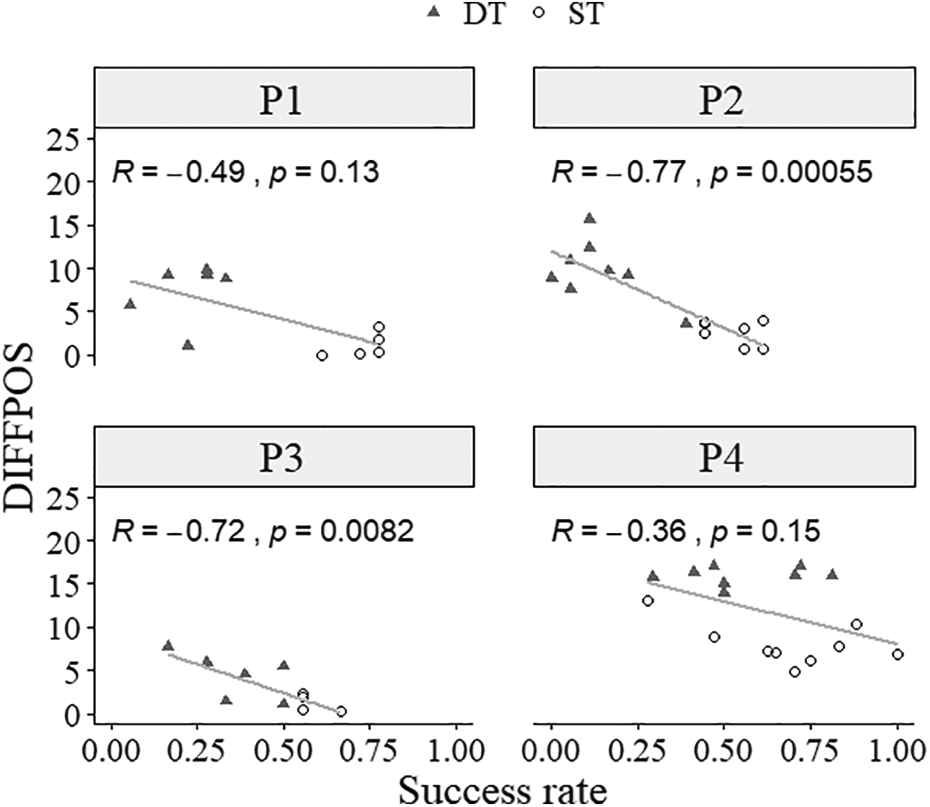
Individual plots with on the vertical axis DIFFPOS; horizontal axis: Success rate in the altissimo register. Values for DT are indicated with a triangle, values for ST with a dot.
For these two players, two groups were distinguished: ST, showing a low DIFFPOS value and higher success rate and DT, which resulted in a low success rate and high DIFFPOS value. P1 showed a moderate correlation and the same division into two groups but this value did not reach a significant level.
P4 (rs = −0.36, p = 0.15) showed a different picture than the other three players. Although ST showed a decline in DIFFPOS values with higher success rate values, DIFFPOS values during DT did not correlate with larger success rate values and were always very high. Despite this high position, the player was relatively successful with a subset of DT realizations. Figure 9 already showed a larger amplitude of the tongue dorsum during the chalumeau register for this player compared to the other players. To investigate the behavior of the tongue dorsum in the other two registers, the amplitudes of this articulator were plotted for the 4 professional players for all the registers (see Figure 11). Inspecting Figure 11, it is revealed that P4 showed a very large amplitude of the tongue dorsum in DT in general across all registers compared to the other players.
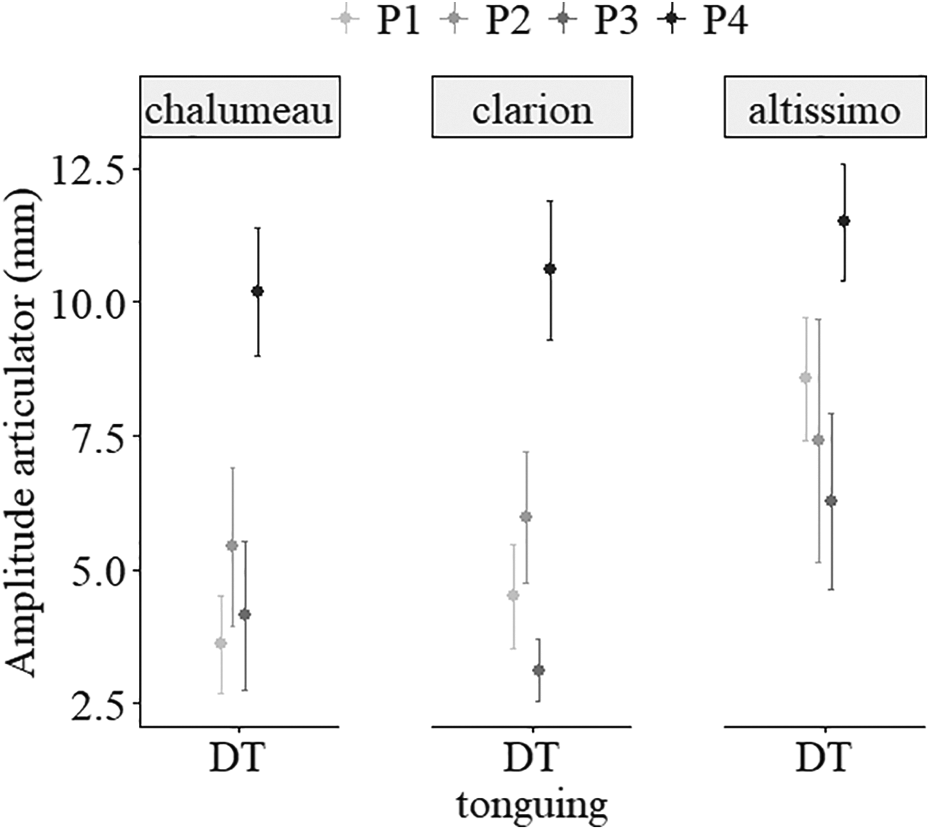
Tongue dorsum amplitudes when articulating notes during DT for the 4 professional players P1, P2, P3, P4 in the chalumeau, clarion, and altissimo registers.
Discussion
Our study adds new data regarding the behavior of the tongue during different tonguing techniques. It supports the hypothesis that a low position of the tongue dorsum is associated with a higher success rate in the altissimo register for all the players when performing ST and LEGATO. It was observed that during ST style playing, all the players showed a lower tongue dorsum position in the altissimo register, closer to the position during LEGATO. In addition, compared to DT, all players performed ST in the altissimo register successfully. This suggests that the success of ST in the altissimo register resulted from the fact that the tongue dorsum was unconstrained to freely lower during note production in the altissimo register. This finding that especially during the altissimo register, the vocal tract shape changes by lowering the tongue dorsum is consistent with the literature discussed in the introduction (Clinch et al., 1982; Fritz & Wolfe, 2005; Gardner & Stone, 2015; Lulich et al., 2017; Pamies-Vila et al., 2020; Scavone et al., 2008; Wheeler, 2010).
During DT, three out of four professional players failed to reach the same low positional value of the tongue dorsum as in LEGATO and ST playing and were not as successful in note production in the altissimo register. This finding supports the hypothesis that the tongue dorsum was not able to lower and shape the vocal tract such that note production was possible in the altissimo register. During DT, the vocal tract shape, required for note performance in the altissimo register, is affected by the behavior of the tongue dorsum before an attack. The upwards movement distorts the preferred shape of the vocal tract to build up enough intra-oral pressure (see e.g., Pamies-Vila et al., 2018; 2020). As mentioned in the introduction, Pamies-Vila et al. (2018) showed that the overall mouth pressure is identical during legato, staccato, and portato articulations but that ST results in varying mouth pressure during note transitions. It is speculated, based on the findings in the current study, that because of the continuous reshaping of the vocal tract configuration during DT intra-oral pressure cannot be maintained or restored fast enough to initiate a note for several players.
However, one player maintained a relatively high position of the tongue dorsum during DT compared to LEGATO and still managed to be relatively successful during the altissimo register compared to the other players. If the tongue dorsum position is the most important factor for successful note production, it is unclear how a relatively high tongue dorsum position, and a failure to maintain the vocal tract in a preferred shape, enabled the relatively successful playing in altissimo register for P4. Other factors likely contribute to this success or failure. The successful player displayed a much larger amplitude of the tongue dorsum when performing the up-down movements required in DT. It is speculated that P4 was thus able to reshape the vocal tract in between the tongue dorsum attacks in such a manner that mouth pressure was restored and note production was possible (see Pamie-Vila et al., 2018); this player might have had an exceptional control over his vocal tract shape that enabled him to and raise the tongue dorsum for the attack and lower the tongue dorsum fast enough to assume the preferred position during sound production. Another possibility is that this player lowered the jaw somewhat or moved the lips away from the tip of the reed to release the pressure on the clarinet mouthpiece, reducing reed damping; personal communication with one of the players revealed that this technique is frequently applied to produce correct notes in the altissimo register (see also comment in Scavone et al., 2008).
Other factors that potentially affect the possibility to perform DT in the altissimo register are the physical properties of the pharyngeal cavity, and the type of the reed and mouthpiece. A larger physical vocal tract size potentially does not require much lowering of the tongue as enough pressure can build up in the oral cavity. However, we used a relative measure by taking the lowest position during LEGATO as a reference, so biomechanical differences have been normalized in a sense; during LEGATO, P4 lowered the tongue dorsum considerately, just like the other players. If a larger vocal tract size were the underlying reason for the differences between payers, LEGATO style playing would have revealed this factor. A limitation of the current study is that the players used their own clarinet, reed and mouthpiece. A certain reed or mouthpiece might respond differently to the manipulated airflow, depending on the properties, resulting in higher or lower success rates. Scavone et al. (2008) mentions that a stiffer reed, for example, facilitates playing in the higher registers. It must be considered however, that professional players spend a considerable amount of their time choosing the best combination of mouthpiece, reed, and clarinet to realize their individual optimal sound. It is therefore assumed that the instrument configuration, with which they participated in the study, is absolutely the best available for each of the players and they will perform the most optimal on this chosen instrument. Therefore, it is likely that the success of the fourth player also depends on additional, yet unknown, factors. Future studies, using the same or a different clarinet, mouthpiece, and reed, can shed light on how these factors interplay with the vocal tract shape preferences and tonguing techniques.
Footnotes
Acknowledgements
The authors would like to thank the participants for their time and effort, as well as the reviewers for their valuable comments.
Contributorship
The first author was responsible for the analysis and writing of the manuscript with input from all authors. The first and second author reviewed the literature and formulated the study. The second author conceived the study and contacted the players to participate in the study. The third author collected the EMA data. The fourth author gained ethical approval and facilitated the lab.
Action Editor
Claudia Fritz, Sorbonne Université, Institut Jean Le Rond d’Alembert.
Peer Review
One anonymous reviewer.
Andre Goios Borges De Almeida, UNSW, School of Physics.
Declaration of conflicting interests
The authors declared no potential conflicts of interest with respect to the research, authorship, and/or publication of this article.
Ethical Approval
This research was approved by the University of Toronto Research Oversight and Compliance Office - Human Research Ethics Program (Approval Number: # 34504).
Funding
The authors received no financial support for the research, authorship, and/or publication of this article.

Supplemental material
Supplemental material for this article is available online.
Notes
References
Supplementary Material
Please find the following supplemental material available below.
For Open Access articles published under a Creative Commons License, all supplemental material carries the same license as the article it is associated with.
For non-Open Access articles published, all supplemental material carries a non-exclusive license, and permission requests for re-use of supplemental material or any part of supplemental material shall be sent directly to the copyright owner as specified in the copyright notice associated with the article.
