




Abstract
Although Western tonal syntax can generate a very large number of chord successions of various lengths and degrees of complexity, some types of music, from Renaissance dances to recent pop, tend to rely more heavily on the repetition of relatively simple, short harmonic patterns. Doll recently identified short chord progressions commonly found in North American and British popular music and proposed that these chord progressions can be stored in long-term memory in the form of harmonic schemata that allow listeners to hear them as stereotypical chord progressions. However, considering the challenges that many listeners face when trying to consciously grasp harmony, it seems likely that the feelings of remembering chord progressions varies from listener to listener. To investigate these potential differences, we asked 231 listeners with various levels of musical training to rate their confidence on whether or not they had previously heard six diatonic four-chord progressions. To control for the effect of extra-harmonic features, we instantiated the chord progressions in a way that resembled the piano of a famous song and controlled for participants’ familiarity with that song and whether they had played its chords. We found that ratings correlated with typicality for the two groups of participants who had played an instrument for at least one year and to a lesser extent for the other participants. Additionally, all our players thought of specific songs more often and mentioned songs that better matched the stimuli in harmonic terms. What we did not find, however, was any effect associated to how long participants had played an instrument or the type of the instrument they had played. Our research supports the notion that both musical training and extra-harmonic features affect listeners’ feelings of remembering chord progressions.
Introduction
Many books (Doll, 2017; Radley, 2008; Salzman & Sahl, 1977; Scott, 2000), articles (Moore, 1992; Richards, 2017; Winkler, 1978) and online resources about harmony in popular music (Anderson et al., 2011; Manzo, 2005; Shaffer et al., 2014; Torvund, 2005) provide examples of songs that use the same or similar chord progressions. However, authors of those materials do not usually speculate about the likelihood that listeners can make such harmonic associations on their own or that such associations can, either consciously or unconsciously, affect their experiences of a song. Nevertheless, the very fact that those authors feel compelled to share examples of harmonically similar songs with their readers suggests they believe that, at least for some listeners, such associations are not completely obvious. Research does show that not all listeners experience harmony in the same way. For instance, musical training has been associated with greater attention (Farbood, 2012; Norgaard, 2017; Sears et al., 2014; Williams, 2005) and sensitivity to harmony (Bigand & Poulin-Charronnat, 2009; Brattico et al., 2013; Corrigall & Trainor, 2009; Koelsch et al., 2002; Kopiez & Platz, 2009; Loui & Wessel, 2007; Steinbeis et al., 2006; Wolpert, 2000) as well as a greater ability to identify songs from their chord progressions (Jimenez & Kuusi, 2018). Additionally, the amount of improvisation that musicians have done (Goldman et al., 2020) and the specific pieces they have played (Cullimore, 1999; Jimenez & Kuusi, 2020) have also been found to affect how musicians perceive, remember, and conceptualize harmony. Those findings are consistent with the common perception that the identification of chord progressions is one of the most challenging tasks in aural skills and ear training courses (Chittum, 1969; Radley, 2008; Rogers, 1984) and that those challenges do not seem to be limited to young musicians or professionals who do not play harmonic instruments (Jimenez & Kuusi, 2018). In fact, labeling errors as well as considerable disagreement regarding the chords for specific songs can be found not only in harmony annotations posted by amateur musicians in online chord-label repositories such as https://ultimate-guitar.com and https://e-chords.com, but also in transcriptions by professional musicians with many years of experience transcribing music (Koops, et al., 2020; Ni, et al., 2013). Considering the challenges that many listeners apparently face when trying to consciously grasp harmony, it seems likely that the way that harmonic resemblance between songs affects the experience of specific songs varies greatly from listener to listener. In the present article, we attempt to shed light on the perception of such associations by investigating listeners’ Feelings of Remembering chord progressions.
Extra-harmonic Features
Lists of songs that share the same chord progressions do not usually contain information about extra-harmonic 1 features such as rhythm, melody, timbre, and tempo. 2 This omission is understandable since the focus of these lists is harmony. Yet, holistically, the songs might be very dissimilar because of extra-harmonic features. Although it is possible to ignore extra-harmonic features and focus exclusively on harmonic similarity, research suggests that this type of listening requires conscious effort and is not the most common way of experiencing music. For instance, extra-harmonic features have been found to be more perceptually salient than harmony (Cullimore, 1999; Farbood, 2012; Halpern, 1984; Mélen & Deliège, 1995; Poulin-Charronnat et al., 2004; Williams, 2005), and some of those features have been found to affect sensory (timbre; Beal, 1985; Cho et al., 1991) and long-term memory for harmony (rhythm; Jimenez & Kuusi, 2018). In the specific case of chord progressions, it can be argued that most listeners cannot easily associate two songs that use the same chord progression unless the songs share other musical features. This argument has already received empirical support from Jimenez and Kuusi (2018) and is a tacit assumption in the way some music theorists such as Philip Tagg have approached harmony when analyzing specific pieces of music (Tagg, 1979, 1991, 2009) and in the fact that harmonic similarity is often insufficient to legally prove “substantial similarity” (Finell, 1990; Liebesman, 2018). Considering that extra-harmonic features tend to be more salient than harmony, it would make sense that similarity in terms of chord progressions would be perceptually subordinate to other types of concurrent connections. That is, new songs can remind listeners of familiar songs if they also resemble each other in terms of extra-harmonic features, and although such associations may be facilitated by harmonic resemblance, harmony by itself is less likely than extra-harmonic features to trigger associations between songs. Our research provides insights regarding the extent of this subordination.
Memory Tests
Listeners’ ability to notice similarity of chord progressions can be tested at the level of short-term, intra-experimental long-term, and pre-experimental long-term memory. For instance, asking listeners to determine whether two musical passages that are played one immediately after the other use the same chord progression would test the perception of harmony at the level of short-term memory. On the other hand, asking listeners which chord progressions from a set of many were heard in a previous set tests the perception of harmony at the level of intra-experimental long-term memory. In the present experiment, we focus on pre-experimental long-term memory (i.e., memory for the harmony of songs participants were already familiar with before taking the experiment) because it allows us to simultaneously investigate a wide spectrum of experiences related to harmony, including (a) song-specific harmonic associations, (b) listeners’ general familiarity with harmonic patterns they have heard in many songs, and (c) a “grey” area of harmonic associations with various degrees of song-specificity. Although it is difficult to control for which songs participants are familiar with, we considered this approach a better match for our purposes. For instance, even though it is possible to neutralize the effect of participants’ life-long listening history in short-term and intra-experimental long-term memory tests that use chord progressions (Jonaitis & Saffran, 2009; Loui et al., 2009), such neutralization reduces the ecological validity of the results because it depends on stimuli being very different from the music participants are familiar with. Furthermore, results from intra-experimental long-term memory tests may not adequately represent the everyday experiences of most listeners since there is evidence of a strong correlation between the number of times participants have previously been exposed to the musical targets and recognition rates (Szpunar et al., 2004) and because the memory consolidation that takes place over long periods of time has had a significant effect on the outcomes of previous memory tests (Marshall & Born, 2007; Miles et al., 2016; Morgan-Short et al., 2012).
Feelings of Remembering for Chord Progressions
In this article, we use the term “Feelings of Remembering” to describe listeners’ impression of having heard a chord progression before. This umbrella term is meant to describe the wide range of experiences we are interested in; experiences that range from vividly clear song-specific associations to the general feeling of having heard a chord progression before. We will use the term Feelings of Remembering instead of other terms that have been used in research on memory for well-known melodies such as “feeling of familiarity” (Daltrozzo et al., 2010; Huijgen et al., 2015; Plailly et al., 2007), “feeling of knowing” (Peynírcíoğlu et al., 1998; Rabinovitz & Peynírcíoğlu, 2011), and “recognition without identification” (Kostic & Cleary, 2009) because, in the context of music research, those other terms already have well-established definitions connected to specific experimental paradigms.
Common Chord Progressions
Although Western tonal syntax can generate a very large number of chord successions of various lengths and degrees of complexity by relying on a rich repertoire of harmonic transformations (e.g., prolongation, inversion, modulation), some types of music, from Renaissance dances to doo-wop, tend to rely heavily on the repetition of relatively simple, short harmonic patterns (Scott, 2000; Stoia, 2013; Ward, 1953, 1967). Doll (2017) recently identified 77 different chord progressions, most of which are commonly found in North American and British popular music of what he refers to as the “rock era,” which extends from 1950 to the present and includes styles as diverse as funk, reggae, and country music. Doll proposes that each of these frequently used chord progressions can be stored in long-term memory in the form of harmonic schemata that allow listeners to hear those chord progressions as stereotypical.
We decided to use some of the chord progressions listed by Doll to study harmony-driven Feelings of Remembering. We used the progressions because their pervasiveness in contemporary popular music facilitated our search for appropriate participants and the design of an experiment of relatively high ecological validity. We used three initial criteria in our process of selecting the chord progressions:
Aims
The present study investigates Feelings of Remembering triggered by instantiations of common pop/rock chord progressions. This study specifically focuses on the extent to which such Feelings of Remembering (a) are affected by listeners’ experience playing musical instruments; (b) relate to the general typicality of the chord progressions; and (c) are influenced by extra-harmonic associations to a specific piece of music.
Method
Pilots
We ran two pilot experiments. In the first one, we asked various familiarity-related questions about 24 chord progressions, all possible permutations of chords C, F, G, and Am. We expected some of those chord progressions to trigger Feelings of Remembering because, in the context of mainstream popular music, they met the three criteria described above. Additionally, we anticipated that the set of 24 chord progressions was likely to trigger a wide array of Feelings of Remembering because it included chord progressions that differ from each other in terms of their level of typicality 4 and hence, the likelihood that our participants had been exposed to them during their lifetimes. Finally, the fact the set only included permutations of the same four diatonic chords facilitated the interpretation of our results because differences in the participants’ responses could not be attributed to participants’ general familiarity with individual chords (e.g., major chords, tonic chords), to response biases related to highly salient harmonic features (e.g., strong sensory dissonance, highly chromatic transitions), or to participants’ heterogeneity in terms of their familiarity with harmonically contrasting musical repertoires (e.g., rag-time vs. heavy metal, baroque vs. R&B), but could only be attributed to the order of the chords.
Although consecutive stimuli were always played in different keys, tempi, and instruments (piano and guitar), some participants reported that after listening to several stimuli, chord progressions started to sound too similar and that they were not able to differentiate them in terms of familiarity. Based on these reports, we decided to reduce our number of stimuli by choosing a subset of only six chord progressions for the main experiment (see section “Stimuli”).
Another relevant result from the first pilot test was that several chord progressions, in particular AmCGF, reminded the nontrained participants of Adele’s “Hello,” a very popular song released in 2015. 5 A factor that may have played a role in the association was the close harmonic and extra-harmonic similarity between our piano stimuli and the piano accompaniment of “Hello.” In order to further explore the association, we ran a second pilot test in which the tempo and register of the stimuli were modified to more closely resemble the piano accompaniment of “Hello.” The second pilot test confirmed that our type of experimental stimuli tended to trigger associations with Adele’s “Hello” more often than associations with any other song. Because of these findings, we decided to take into consideration “Hello” in our selection of participants, creation of stimuli, and the experimental design for our main experiment.
Participants
Altogether 323 participants (192 male, 131 female; mean age = 32.7, SD = 11.4) completed the experiment either in group-testing sessions or online. Participants of the group-testing sessions (32) were volunteers recruited among music students enrolled in various music programs in Finland. These music students completed a paper version of the questionnaire and were tested in small groups. Online participants (291) were recruited among users of various https://Reddit.com subreddits related to popular music (e.g., r/WeAreTheMusicMakers, r/PopHeads) and workers from Amazon Mechanical Turk (MTurk), a crowdsourcing platform that provides access to more than a hundred thousand potential participants (Difallah et al., 2018). For online data collection, the software PsyToolkit was used (Stoet, 2010, 2017). In order to access the online experiment, participants were first required to correctly answer a multiple-choice question about a short introductory video (https://www.youtube.com/watch?v=Yom8YjroBe8). Specifically, participants were asked whether a guitar, violin, cello, electric guitar, or other instrument was heard at the very end of the video. Visitors whose response to the video was incorrect were required to watch the video again, after which they were given a second (and final) chance to answer the question correctly. This question was designed to verify that participants were listening to the audio of the experiment and able to understand the language of the survey. No musical training was required to answer the question. The online version of the experiment was visited a total of 1037 times by 979 different visitors between September 3, 2017 and March 2, 2018. Of the 473 visitors who were able to correctly answer the question about the video, 291 completed the online experiment in its entirety. This completion rate (62%) is comparable to completion rates from other online experiments (Bosnjak & Tuten, 2003; O’Neil & Penrod, 2001; O’Neil et al., 2003; Tuten et al., 2004). It is likely that the degree to which participants liked the music used in the experiment (chordal stimuli and Adele’s 2015 song “Hello”) influenced completion rates. Additionally, since liking and familiarity with music tend to be strongly correlated (Chmiel & Schubert, 2017; Madison & Schiölde, 2017), it is also likely that participants completing the experiment in its entirety were in general more familiar than dropouts with the type of music used in the experiment.
In addition, we took measures to maximize the homogeneity of our participants in terms of their familiarity with the type of music used in the experiment: we discarded responses from 16 participants who reported being not very familiar with “rock or other types of popular music (pop, EDM, etc.) from the 1990s, 2000s, or 2010s.” Further, since we were especially interested in the effect of listening to Adele’s “Hello,” we discarded responses from 41 participants who reported never having heard “Hello” before the experiment. Finally, in order to minimize noise in our data set, we excluded 39 participants who selected the option “can’t say” for one or more of the 12 main chordal stimuli. Although selecting the option “can’t say” may have been in some cases a consequence of participants being unsure of what to respond, several “can’t say” responses were accompanied by participants indicating that the audio stimulus did not play, a malfunction likely related to poor internet connection.
The total number of participants whose responses were included in our main analysis was 231 (205 online, 26 group-testing; 133 male, 98 female; mean age = 31.5, SD = 10.9). Altogether 162 participants had played some instrument for more than a year (either harmonic instruments like keyboards, accordion, and guitar; melodic instruments like trumpet, French horn, and violin; or rhythmic instruments, like drums/percussions). The 231 participants were divided into three groups according to whether they had played an instrument and whether they had played Adele’s “Hello” on a harmonic instrument (e.g., piano or guitar). The following is the specific question we asked participants about whether they had played “Hello”:
How many times have you played the chords of this specific song on a harmonic instrument (e.g., piano or guitar) in your life? Do not count times when you played the same chords but in the context of playing a different song.
The question was asked after participants listened to three excerpts from the original commercial recording of Adele’s “Hello.” Throughout this article, and for the sake of simplicity, we will refer to participants that responded this question with a number different from 0 as “Hello players.” However, readers should keep in mind that the category “Hello players” does not include participants who only sung or played the melody of “Hello” without having also played its chords. Participants who had not played “Hello” on a harmonic instrument were divided into two categories. In the group “Players,” the participants had played an instrument but not the chords of “Hello.” In the group “Listeners,” the participants had not played any instrument (and hence had not played “Hello” either). 6 Table 1 provides general information about the participants in the three groups.
Three participant groups.

Although there were almost more than two times more male participants than female in the group Players, there is no evidence to our knowledge of a gender effect on harmonic awareness in the literature. In order to see if the groups differed in terms of age, years of playing main instrument and years of studying music theory, an ANOVA was conducted. It showed that the three groups do differ. The post hoc tests showed that the group Listeners differed from the other two groups, but Hello players did not differ from Players. The statistics are given in Table 2.
ANOVA analysis and post hoc tests. Three variables and three groups of participants.

*The variances of the groups did not differ for age but did differ for the other variables; hence, Bonferroni and Tamhane post hoc tests were used accordingly.
Most participants reported having heard Adele’s “Hello” more than 10 times in their lives and were able to provide the name of the artist or the name of the song after listening to excerpts of the song that did not include the word “Hello.” When asked about how much they liked the song, most participants chose the option “I like it but do not love it.” This pattern was similar for all three groups of participants.
Stimuli
The six chord progressions used in the main experiment were CAmFG, 7 CGAmF, CGFAm, AmFCG, AmFGC, and AmCGF. CAmFG is a chord progression commonly associated in pedagogical materials with the doo-wop style, whose peak of popularity was in the late 1950s and early 1960s, and that is still used relatively often today (Doll, 2017; Rosenberg, 2014). CGAmF and AmFCG, have become extremely common in mainstream popular music since the mid-1990s (Anderson et al., 2011; Doll, 2017; Richards, 2017; Rosenberg, 2014). In the specific case of CGAmF and AmFCG, Richards (2017) found that these two chord progressions are included in more than 10% of the 2517 songs that reached the Billboard Year-End Hot Singles charts between the years 1990 and 2016. Additionally, we chose AmCGF because of its relation to Adele’s “Hello” (see Figure 1a). To complete a fully symmetric set of six progressions, we also included CGFAm and AmFGC, which allow us to have three chord progressions starting with C (CGAmF, CAmFG, CGFAm) and their Am rotations (AmFCG, AmFGC, AmCGF). This symmetric set of chord progressions had three important characteristics. First, the initial chord in short chord progressions has been argued to be particularly important in creating the feeling of a tonal center in popular music (Doll, 2017; Murphy, 2014; Stephenson, 2002; Temperley & de Clerq, 2013). Having an equal number of chord progressions starting on C and Am chords, meant that any response bias related to chord quality (major vs. minor) of the first chord and the general mode of the chord progression (major vs. aeolian) would be more evenly distributed and easier to detect during our analyses. Second, our set of six chord progressions contain chord progressions that are highly dissimilar from each other in terms of their root motions (e.g., CAmFG contains root motions of descending third and ascending second whereas AmCGF contains root motions of ascending third, ascending fifth, and descending second). This dissimilarity was important for our study in that it can decrease the likelihood of participants hearing all six chord progressions as sounding “the same.” The third and perhaps most important characteristic of the set of six stimuli used for this study is the differences between the chord progressions in terms of their levels of typicality according to https://HookTheory.com. In our inspection of the data from https://HookTheory.com we only counted songs in which the chord progression was looped (i.e., played two or more times in immediate succession) in order to exclude songs in which the target chord progression was partially concealed. The accuracy of the chord labels obtained from our https://HookTheory.com search was verified independently by two music theorists. The resulting song counts (that can be seen in Table 3), suggested that the selected four-chord progressions were diverse in terms of typicality and thus suitable for the purposes of our study. The group of 249 songs considered in Table 3 will be referred to in this article as the “HookTheory” corpus.
Comparison of the six chord progressions in our experiment, ordered by frequency in HookTheory.

* The “a” and “c” indicate the first chord in the rotation.
** “R” indicates rotation. In this article, AmFCG, CAmFG, and AmCGF were considered as the “original” chord progressions and CGAmF, AmFGC, and CFGAm as the “rotated” chord progressions based on their frequency of occurrence in HookTheory.
Chord-progression names
AmFCG, CGAmF, and CAmFG have been given a variety of names in books, articles, and online resources. Although many of our readers may be accustomed to using letter chord names to refer to chord progressions, in the remainder of this article, we will generally refer to the chord progressions used in the experiment with names that highlight the holistic (harmonic + extra-harmonic) connection to “Hello” or their rotational relationship to other chord progressions (see Table 3, last column).
Extra-harmonic Features of Test Items
In the main experiment, all chord progressions were composed using piano tones (Bösendorfer sound from LogicPro X) and instantiated in a way that resembled the piano introduction of Adele’s “Hello” not only in terms of timbre but also in terms of chord spacing, voice-leading, and tempo. We did this in order to boost the chances of triggering Feelings of Remembering related to this specific piece of music, which would in turn help us test the effect of harmonic and extra-harmonic features on participants’ Feelings of Remembering. However, in order to avoid making the song association too obvious, the instantiation of the chord progressions differed from the beginning of Adele’s song in other extra-harmonic attributes, such as key and degree of syncopation (see Figure 1a, 1b, 1c and Table 4).
Similarities and differences between the beginning of the target song and the chordal stimuli used in the experiment.

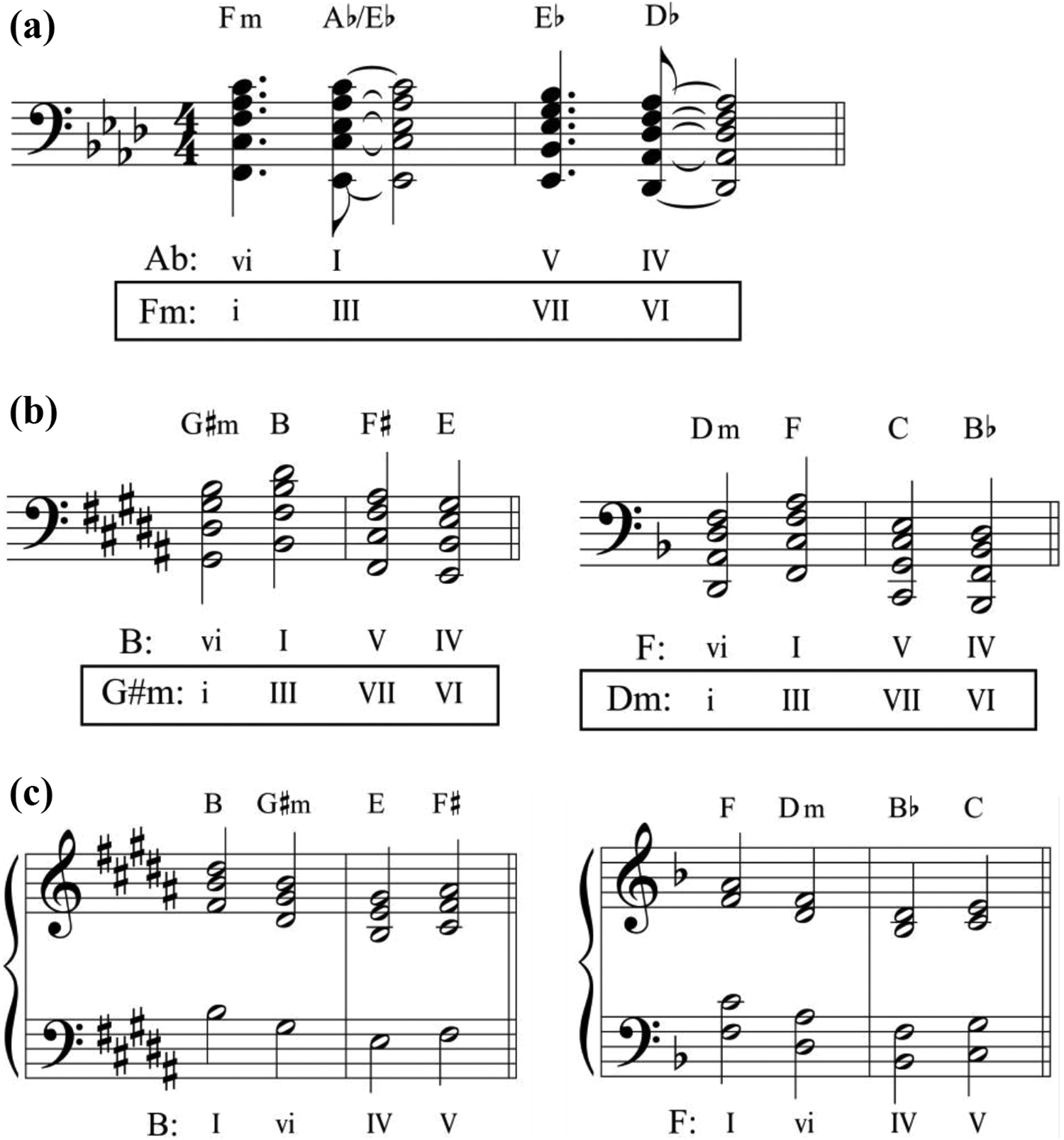
Transcription of the beginning of Adele’s “Hello” (2015). 1b. The two low octave variations of the beginning of Adele’s “Hello” used in the experiment. 1c. The two high octave instantiations of the doo-wop progression used in the experiment.
As shown in Figure 1b and 1c, the progressions were played in two keys, either B/G m or F/Dm. In addition, two versions of each chord progression were prepared: a low-register version (hereafter, low8ve) closely resembling the register used by the target song, and a middle-register version approximately one octave higher than the target song (hereafter, high8ve). A cursory inspection of songs from the HookTheory corpus revealed that both low and middle registers are used in popular pop/rock songs that feature prominent piano block chords.
Procedure
In the main experiment, participants were shown a one-minute video-clip that explained how the same chord progression can be played using different rhythms, registers, instruments, etc. Then participants were randomly assigned to either low8ve or high8ve conditions and to different orders of the stimuli. Before participants were tested on the main 12 chord progressions (six in B/Gm and six in F/Dm), they heard four other chord progressions. These four preliminary trials were meant to get participants used to the experimental task and the specific type of stimuli in order to minimize order effects. Responses provided for those four trials were not analyzed. In the experiment, the participants were asked how confident they were of having heard at least one pop/rock song that used the four-chord progression they heard. Each confidence-rating trial was immediately followed by an invitation for participants to write their own comments. The pre-determined orders of chord progressions were composed so that two successive chord progressions were played in a different key (e.g., DmFCB , GmEFB, FCDmB) and no chord progression was repeated until all six progressions had been played (e.g., GmBFE, the transposed version of DmFCB, was only played after the other five progressions had all been heard for the first time). This way of playing the chord progressions was meant to maximize musical independence between the successive progressions and independence between the confidence ratings of the two versions of the same progression. After all the main 12 chord progressions were played, participants were asked how many chord progressions had triggered memories of specific pieces of music and to provide any details about the pieces. After evaluating the 12 progressions, the participants were asked to identify the name of the artist and the title of the song or part of the lyrics of 15-sec audio excerpts from the bridge, chorus, and verse of the original commercial recording of Adele’s “Hello.” These three excerpts were always played in the same order, and only after having attempted to identify all of them were the participants told that the three excerpts belonged to the same song. The purpose of testing identification for the three different sections of the song was to assess the memorability of each section of the song, which we expected to be useful for fine tuning our way of analyzing the effect of the target song on the rating of each of the six chord progressions. After listening to these three audio excerpts, participants were asked about their familiarity with the song, whether they had played the song on a harmonic instrument, and whether some of the chord progressions from the first part of the experiment had triggered memories of the song. At the end of the experimental session, participants provided information about their musical background and general familiarity with different musical styles.
Results
As stated, we were interested in seeing how the harmonic and extra-harmonic resemblance between the stimuli and Adele’s “Hello” as well as the participants’ instrumental training and having played the chords of “Hello” affected their confidence in having heard songs that use the chord progressions of the stimuli (confidence ratings, CR). We also studied the correlation between CR and the HookTheory typicality of the chord progressions. In addition, we examined how many and what types of song names the participants provided.
Key and Register
We first examined the effect of transposition and octave changes for the CR. Average ratings for the F/Dm and B/Gm stimuli were highly correlated, r = 0.98, p < .001, indicating that key changes of the stimuli did not affect the CR. We, further, analyzed the high and low octave confidence ratings for the six progressions separately. Since the CR were not normally distributed but strongly skewed to the left for all progressions, a nonparametric Mann-Whitney U Test was used. We found no effect (see Table 5 and Figure 2). This suggested that playing the chord progressions in either a middle register (high8ve) or low register (low8ve) did not affect participants’ Feelings of Remembering. Based on the fact that neither key nor octave changes affected the CR, we decided to consolidate the ratings for F/Dm and B/Gm into a single score for each of the six main chord progressions and to not separate participants in terms of whether they had been assigned to low or high octave conditions.
Results of the Mann-Whitney U Test for differences between CR for high and low octave chord progressions.


Box-plot figures with medians (thick red line), interquartile range (box), range (vertical line), and outliers (circles) of the Confidence Ratings (y-axis) for high and low progressions.
CR vs. Typicality
We calculated the average CR for the three groups of participants—Hello players, Players, and Listeners—separately for the six chord progressions. The averages were relatively high (the lowest being 4.24), indicating that, for the most part, participants felt that they had heard pieces using the progressions (see Figure 3). Figure 3 also shows the frequency of occurrence of the progressions in HookTheory. Whether the average CR correlated with the frequency of occurrence of the chord progressions in the collection was examined separately for the three participant groups. For the two groups of participants who had played an instrument (Hello players and Players), the correlations were very high and statistically significant (r(6) = .846, p = .034 and r(6) = .924, p = .009, respectively); for the group Listeners, it was rather high but not statistically significant (r(6) = .689 p = .130).

Average confidence ratings (scale from 1 to 7) and standard errors as error bars for the six progressions and the three participant groups together with HookTheory frequency values (scale from 1 to 128) for the six progressions.
We also calculated individual correlations between each individual participant and the HookTheory frequency of occurrence (see Figure 4). We noticed that the correlations were generally lower and there was more variation in the group of Listeners than in the other two groups. In the group of Listeners, some participants’ CR was very highly correlated with the HookTheory, but the group was also very heterogenous in terms of the correlations. Further, Figure 4 shows that the correlations between CR and HookTheory are higher for Players than Hello players. Taken together, the correlations suggest that playing an instrument and having played “Hello” affected Feelings of Remembering.

Box-plot figures with average (x), medians (thick red line), interquartile range (box), range (vertical line), and outliers (circles) of individual correlations between CR and HookTheory frequency values for the three groups of participants.
CR Differences between Participant Groups
In order to better understand the effect of instrument playing and playing “Hello,” we analyzed the CR for each chord progression separately. For the same reasons given earlier, we used a nonparametric Independent-Samples Kruskal-Wallis Test to see if there were overall group differences, and we used pairwise comparisons to analyze the differences between the participant groups. The analyses are given in Table 6 (see also Figure 5 for box-plots). As can be seen, the CR did differ in all progressions. The biggest pairwise differences were generally between Listeners and those who had played an instrument. A difference between the Hello players and Players was only found for the Hello-R progression, indicating that playing “Hello” had an effect on the CR for this progression. Since neither of the progressions Hello nor Hello-R were frequent in HookTheory, one might assume that playing “Hello” chords would affect the confidence ratings of these particular progressions. However, this was the case only for Hello-R.
Overall group differences of CR for the six progressions and pairwise comparisons between participant groups. In the pairwise comparisons the significance values have been adjusted by the Bonferroni correction for multiple tests.

* Indicates that the test statistic is significant at a 5% confidence level
** Indicates that the test statistic is significant at a 1% confidence level
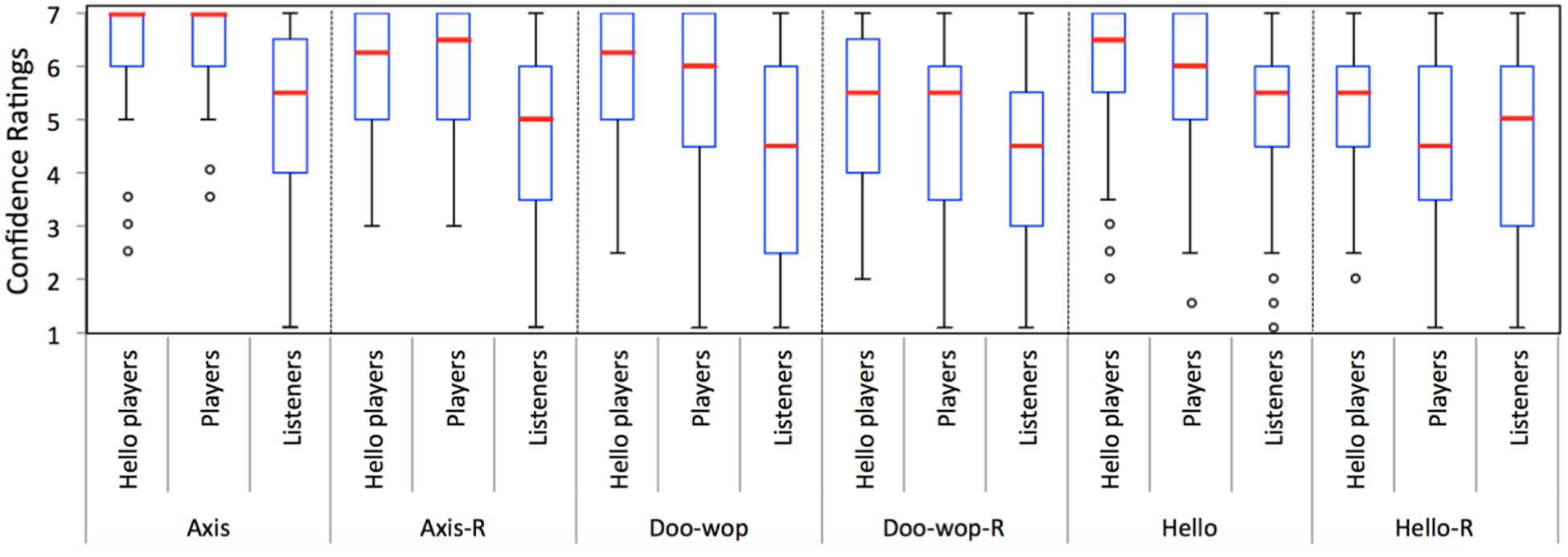
Box-plot figures with medians (red thick line), interquartile range (box), range (vertical line), and outliers (circles) of the Confidence Ratings (y-axis) for the six progressions and three groups of participants.
It is important to remember that participant groups were created based on whether they had played an instrument or not, and if so, whether or not they had specifically played “Hello.” Taken together, ratings for the majority of progressions were different between participants who had played an instrument, both Hello players and Players, and those who had not played an instrument, whereas ratings for only one of the six chord progressions was different between Hello players and Players. The result can be interpreted to indicate that playing an instrument modified the ways in which listeners processed harmony by ear and that playing an instrument was a stronger factor on perception than having specifically played “Hello” on a harmonic instrument.
Type of Instrument
In order to clarify the role of instrument type, we further analyzed the effect of harmonic versus melodic instruments on the CR of the progression Hello-R. We formed a combined variable of the three participant groups and the type of instrument they reported playing (melodic, harmonic, none) and ran a nonparametric Kruskal-Wallis test, but found no effect (test statistic = 10.247, p = .069).
Frequency of Song-specific Feelings of Remembering
After participants had provided confidence ratings for all 12 chord progressions, we asked them how many of the chord progressions triggered memories of songs and to name those songs. When analyzing the number of progressions that triggered songs, we weighted the progressions that triggered Adele’s “Hello” by 2 because of the harmonic and extra-harmonic similarities; all other songs had the weight 1. The weighted number of progressions that triggered songs was divided into four groups (0 progressions; 1–4 progressions; 5–8 progressions; >8 progressions). We cross-tabulated the three groups of participants and the four groups of triggered songs; the resulting chi-square test showed a statistically significant connection between the participant group and the number of progressions that triggered songs. As seen in Table 7, the number of chord progressions triggering songs was different for the three groups of participants. With Hello players, the share is smallest for 0 progressions and largest for >8 progressions, while with Listeners the pattern is the opposite. With Players all shares are relatively equal, showing no particular pattern.
Cross-tabulation and chi-square test between participant groups and types of naming songs that were triggered by the chord progressions.

Type of Song Naming
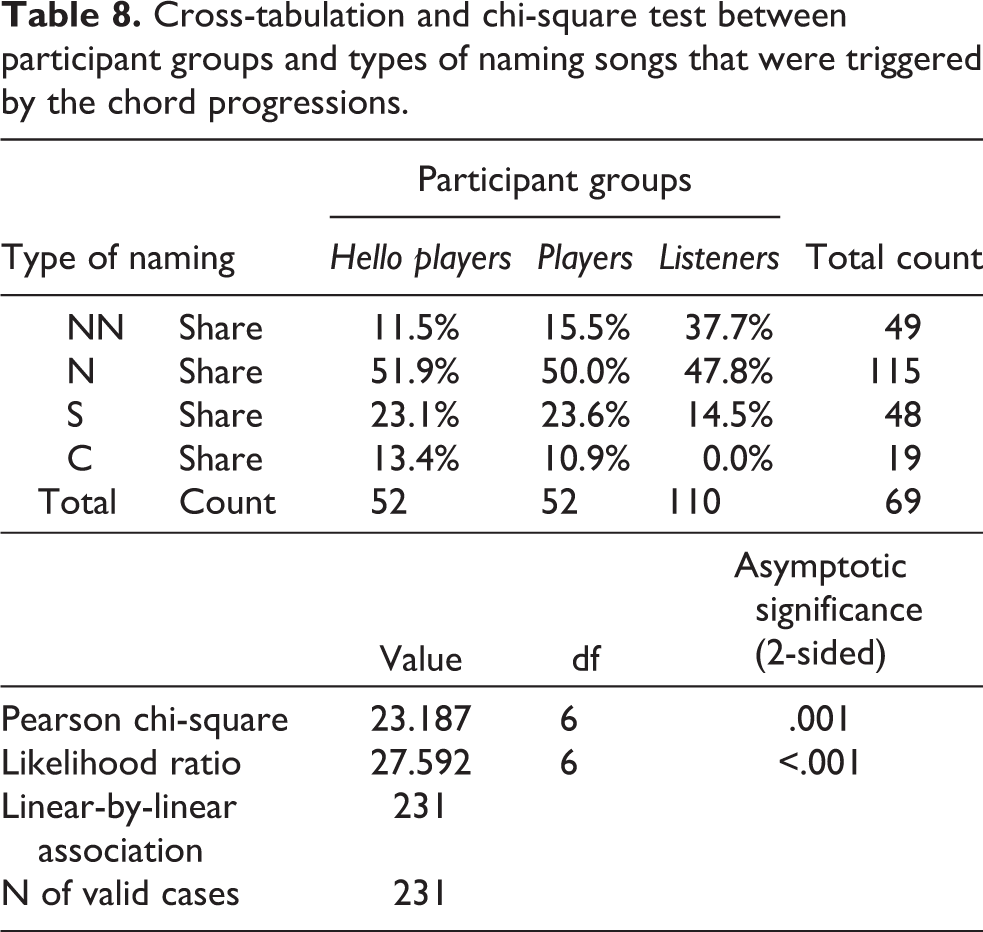
We also examined what types of naming the progressions triggered. We defined the naming as follows: NN = reported not thinking of any songs; N = reported thinking of a song but did not name it; S = named at least one song; C = named at least one chord-progression (e.g., doo-wop). As seen in Table 8, Listeners either did not think of any songs (line NN) or did not mention any (line N), while Hello players and Players named more songs (line S) and gave more chord progression names (line C) than the Listeners. The effect was statistically very significant: chi-square (6, N = 231) = 23.187, p = .001.
Cross-tabulation and chi-square test between participant groups and types of naming songs that were triggered by the chord progressions.
Thinking of Adele’s “Hello”
Since it was likely that those who had played the “Hello” chords thought of “Hello” in the experiment more often than other participants, we analyzed the effect of having played “Hello” on thinking of “Hello” from chords. As seen from the chi-square test results in Table 9, the connection was statistically very significant. While it is not remarkable that playing “Hello” chords would influence one’s thinking of “Hello,” nearly 42% of those who had not played “Hello” chords also reported having thought of it during the experiment, which suggests that simply listening to a song is enough to store short harmonic-textural mental representations of the song in long-term memory, and that these representations can be later activated by musical passages that resemble but are neither harmonically nor extra-harmonically identical to the song.
Cross-tabulation and chi-square test between thinking of “Hello” and playing “Hello” chords.

Harmonic Matching
We also analyzed how many songs or chord-progression names participants provided immediately after hearing each of the progressions and how well the responses matched with the progressions. The data can be seen in Table 10. Hello players and Players provided names more often than Listeners, but the share of mismatching songs or progression names was smaller for Hello players than Players. With the Listeners, most of the named songs or progressions mismatched with the progressions presented in the experiment, indicating that their memories of songs were most likely triggered according to the extra-harmonic features or according to inexact harmonic content. However, in our experiment, even the harmonically mismatching songs that were provided by the participants were harmonically related to the stimuli since no participant mentioned songs that used chromatic chords in the potential target sections of the songs, and most of the songs mentioned by participants used permutations of the chords C, G, Am, or F or subsets of that group of four chords.
Number of songs or progression names mentioned immediately after each progression.

Discussion
Our study aimed at investigating the extent to which Feelings of Remembering triggered by common pop/rock chord progressions (a) are affected by listeners’ experience of playing musical instruments; (b) relate to the general typicality of the chord progressions; and (c) are influenced by extra-harmonic associations with a specific piece of music. We found that participants who had played an instrument for at least one year were more confident than other participants about knowing songs that use the chord progressions presented in the experiment. This tendency was present for all six chord progressions regardless of their typicality (according to HookTheory). Additionally, we found that compared to other participants who had played instruments, participants who had played Adele’s song “Hello” on a harmonic instrument showed a tendency to be more confident about having heard songs that use the progression Hello-R, the least typical of the chord progressions used in our experiment.
In addition to an effect on CR, playing an instrument also had a strong effect on naming songs and chord progressions. Those who had played an instrument thought of songs more often and were more exact in providing songs or chord-progression names that matched the experimental progressions. These results are consistent with the notion that participants with little or no experience playing instruments have difficulty focusing on harmony over extra-harmonic features. However, despite these effects of playing an instrument, we found no effect for how long the participants had played an instrument, nor the type of instrument they had played (harmonic versus melodic). It is possible that the experimental stimuli were too similar in both harmonic and extra-harmonic features to reveal the effects of playing harmonic instruments for conceptualizing chord progressions.
We also found a very high and statistically significant correlation between the confidence ratings and HookTheory for participants who had played an instrument for at least one year regardless of whether they had played “Hello.” The correlation was rather high, yet not statistically significant for the Listeners’ group.
The chord progressions used in the experiment were relatively similar both harmonically (the same four chords were used in all progressions) and with regard to extra-harmonic features. All progressions were played with piano sound, slow tempo, and using parallel voice-leading. These extra-harmonic features were meant to promote an association with the opening piano of Adele’s “Hello,” and that association was expected to be strongest for the stimuli that featured the chord progression from that part of the song. The confidence ratings for that “Hello” progression show a small peak in all groups of participants. Even though the Hello progression is rare according to HookTheory, it gained the second highest CR from both Hello players and Listeners. For Listeners, it is possible that the resemblance of extra-harmonic features is the leading explanatory factor; for Hello players, in addition to that resemblance, the fact that the participants had actually played those chords is also likely to have affected the result. We also found that having played “Hello” on a harmonic instrument had an effect on thinking of “Hello” after hearing the progressions, which is understandable. Although the extra-harmonic resemblance between “Hello” and the progressions is likely to have facilitated the association with that song, neither the key nor the register in which the chord progressions were played was found to affect confidence ratings. It is possible that the commonalities between our stimuli and the beginning of “Hello” in terms of root motion, timbre, tempo, rhythm, and voice-leading resulted in a general resemblance that was too strong to be easily offset by changes in key or register.
The tendency to think of “Hello,” a song released in 2015, could have been affected by participants’ age. In fact, recent research has found that listeners tend to have more vivid memories for songs that they first heard when they were teenagers and young adults (Platz et al., 2015). However, we found no evidence that the differences between our three groups of participants were driven by age differences. If age had an effect on “Hello,” Listeners (who were oldest group of participants) should have given the Hello and Hello-R progressions comparatively low CR when compared to the other progressions, but the opposite was actually the case.
One of the limitations of the current study is its use of a highly homogenous set of chord progressions, which may, among other things, help to explain why CR did not vary much. Stimuli varied only in terms of the order of their chords, always using the “same” four diatonic chords in root position and never including added notes (e.g., sevenths, ninths). Although some of these chord progressions are very commonly used in popular music from the rock era, they represent just a small fraction of all chord progressions that can be found in popular music and other types of tonal repertoires. Further research is needed using chord progressions with more varied types of sonorities. Additionally, future research could investigate the effect of using extra-harmonically heterogeneous stimuli on listeners’ Feelings of Remembering, but such research would need to find a way to minimize or account for the perceptual salience of a heterogeneous musical surface.
Footnotes
Contribution
IJ, TK, and CD conceived and designed the study. IJ constructed and recorded the stimuli and conducted the study. IJ and CD collected additional data. IJ and TK analyzed the data. IJ and TK wrote a first draft of the manuscript. All authors edited and reviewed the manuscript and approved of the final version.
Declaration of conflicting interests
The author(s) declared no potential conflicts of interest with respect to the research, authorship, and/or publication of this article.
Ethical Approval
This research was approved by the Research Ethics Committee of the University of the Arts Helsinki (Approval number: Ref.No/05.51.11/2016).
Funding
The author(s) disclosed receipt of the following financial support for the research, authorship, and/or publication of this article: This project received financial support from the Kone Foundation, grant number 086829.

Action Editor
Trevor Agus, Queen’s University Belfast, SARC, School of Arts, English and Languages.
Peer Review
Jackson Graves, École Normale Supérieure, Département d’Études Cognitives.
One anonymous reviewer.