




Abstract
In this study, we tracked the development of rhythmic entrainment, prosociality, and theory of mind skills in children attending music and sports programs and in a control group over the course of three years. Forty-five children (mean age at onset = 81 months) drummed in two contextual conditions – alone and social – completed the Reading the Mind in the Eyes test and prosocial tasks (helping and sharing). All children improved in their ability to entrain to external rhythms over time, with the music group outperforming controls in the entrainment-social condition. Developmental effects were found for theory of mind, but no significant group differences. Although there were no significant group differences for prosociality, following three years of music education, entrainment scores in the alone condition were positively correlated with the number of stickers that children in the music group gave to friends. Results are discussed in light of the nature of collective music learning through ensemble participation and its role in the development of social-cognitive and prosocial skills in childhood.
Keywords
The human capacity to detect regularities in an external acoustic stimulus and synchronize body movements and/or voices to a perceived beat is known as entrainment (Clayton, Sager, & Will, 2004; Phillips-Silver, Aktipis, & Bryant, 2010). This capacity, which is widespread in humans, can be seen when members of an audience clap together or bob their heads to the beat of music (Phillips-Silver & Keller, 2012). Underlying these common behaviors is a complex network of sensory modalities – auditory, visual, and vestibular – that involve a combination of perception, production, integration, and adjustment of body movements in response to rhythmic structures (Phillips-Silver et al., 2010). These processes are the building blocks of entrainment (Phillips-Silver et al., 2010).
Some of the building blocks of entrainment are already in place in infancy, such as the ability to perceive and extract the beat from a rhythmic pattern (Winkler, Háden, Ladinig, Sziller, & Honing, 2009). Young children, however, do not typically entrain to the rhythmic pulse (Kirschner & Tomasello, 2009). Entrainment skills develop over the course of childhood (see Drake, Jones, & Baruch, 2000; Eerola, Luck, & Toiviainen, 2006; Ilari, 2015), with formal music education serving as a catalyst in the process (Drewing, Aschersleben, & Li, 2006; Slater, Tierney, & Kraus, 2013). Other factors known to impact children’s entrainment are culture (Kirschner & Ilari, 2014), social context (Kirschner & Tomasello, 2009), and types of tasks and specific demands (Einarson & Trainor, 2016).
Aside from synchronizing to the beat, humans also share emotional states and form interpersonal bonds when they dance, sing, or play music with others (Clayton et al., 2004; Trost, Labbé, & Grandjean, 2017). Thus, entrainment has two main components: a temporal one and an affective one (Phillips-Silver & Keller, 2012). Whereas developmental studies have typically focused on the temporal component of entrainment, researchers have recently turned their attention to the affective component, as well as the intersections between the two. Affective entrainment involves not only the emergence of interpersonal bonds, but is also “related to the pleasure in moving the body to music and being in time with others” (Phillips-Silver & Keller, 2012, p. 1). This idea is consistent with research that positions entrainment as a central and unifying element of collective musical experiences (Clayton et al., 2004; Cross, 2005). Musical experiences of a collective nature provide opportunities for humans to engage in mimetic behavior and imitation within a safe space (Cross, Laurence, & Rabinowitch, 2011). Such experiences have been associated with social skills such as empathy, social affiliation, and prosocial behaviors in infants, children and adults (see Anshel & Kipper, 1988; Cirelli, Einarson, & Trainor, 2014; Good & Russo, 2016; Kirschner & Tomasello, 2010; Sellari, Matricardi, & Albiero, 2011; Wiltermuth & Heath, 2009).
Prosocial behaviors, or voluntary actions that are intended to benefit others (Eisenberg, Spinrad, & Morris, 2013; Padilla-Walker & Carlo, 2014), are considered a staple of social competence in children of all ages (Wentzel, 2015), and occupy a central role in the development and maintenance of harmonious relationships (Padilla-Walker & Carlo, 2014). Developing early in life, prosocial behaviors are continuously shaped by children’s interactions with family members, peers, teachers, and the community at large (Eisenberg et al., 2013). Recent research suggests that synchronous interpersonal movement activities may enhance prosocial behaviors and social affiliation, in early and middle childhood. Four to six year olds were more helpful to a partner following a synchronous play activity (Tunçgenç & Cohen, 2016a), and four year olds were more cooperative with their peers after they were swung synchronously rather than asynchronously (Rabinowitch & Meltzoff, 2017). Concerning social affiliation, Rabinowitch and Knafo-Noam (2015) found perceptions of similarity and closeness to peers to be enhanced in eight to nine year olds following engagement in a synchronous tapping game. Likewise, seven and eight year olds were seen to bond more with out-groups following a synchronous group movement activity, but not when group movements were asynchronous (Tunçgenç & Cohen, 2016b). Altogether, these studies support the idea that interpersonal entrainment may impact prosociality and social bonding in children.
A question that remains unanswered, however, is the role of collective forms of music education in children’s social development, more specifically in regard to empathy, theory of mind, and prosociality. To play or sing together, children need to synchronize their bodies and voices to the underlying beat of the music. Thus, entrainment is at the root of collective music education programs. Given the mounting body of evidence on entrainment and prosocial behaviors in childhood, it seems logical to assume that children are likely to develop prosocial and social skills as they learn music formally in groups. Yet, studies examining the long-term effects of collective music education programs on varied social skills of school-aged children have produced contrasting results, making their interpretation difficult. Goldstein and Winner (2012) found high school students enrolled in acting classes to score higher in tests of dispositional empathy and theory of mind than students taking music or visual arts classes. By contrast, Rabinowitch, Cross, and Burnard (2012) found an increase in empathy scores of students who underwent a specially-designed music education program. School music education was also found to enhance children’s self-esteem, but not social skills or to have an affect on problem behaviors (Rickard et al., 2013). Additionally, children who participated in school-based ukulele music classes showed higher gains in sympathy and prosociality than controls, although these effects were limited to those who had poor prosocial skills at the onset of the study (Schellenberg, Corrigall, Dys, & Malti, 2015).
Interestingly, none of the abovementioned studies concerning formal music education have directly examined the relationship between the temporal component of entrainment (hereinafter entrainment) and social skills. Studies measuring and correlating these two types of skills have typically focused on the early years of childhood (e.g., Cirelli et al., 2014; Endedjik et al., 2015; Kirschner & Ilari, 2014), although studies with older children are beginning to emerge in the literature (e.g., Rabinowitch & Knafo-Noam, 2015). Furthermore, in most studies children completed a short and engaging synchronous task, such as 30 minutes of group singing (Good & Russo, 2016), being tested immediately after the task was concluded. Thus, the long-term associations between entrainment, formal music education, and social skills in childhood remain elusive. Two additional gaps in the literature are the lack of longitudinal data on children’s entrainment skills and the absence of research examining the relationship between entrainment and theory of mind (ToM), or the cognitive capacity to detect, decode and attribute mental states to oneself and others, whilst recognizing agency and intentionality (Goldman, 2012; Goldstein, 2010). Theory of mind is central to social life as it allows individuals not only to “read the minds of others”, but also to interpret their intentions (Goldstein, 2010).
Livingstone and Thompson (2009/2010) suggested a close knit between music and ToM. They theorized that music emerged from a specific form of ToM known as affective engagement or “the degree of emotional connectedness between two or more individuals for the exchange of affective state used in the construction of mental models of conspecific emotion” (p. 85). That is, music not only communicates emotion, but is also a multimodal phenomenon that generates a safe learning space for the emergence of affective engagement (Livingstone & Thompson, 2009/2010). Trained musicians are notorious for interpreting the intentions and emotions of fellow musicians through body gestures, facial signs, and other non-verbal cues (Biasutti, Concina, Wasley, & Williamon, 2013). Such behavior has been linked to ToM (see Giovagnoli & Raglio, 2011; Phillips-Silver & Keller, 2012), raising the question as to whether long-term participation in formal music education during childhood may lead to enhanced mind reading.
Theory of mind, prosociality and entrainment are connected. Whereas theory of mind has been associated with children’s prosocial behaviors (Imuta, Henry, Slaughter, Selcuk, & Ruffman, 2016), entrainment has been linked to prosocial behaviors in infants and young children (Cirelli et al., 2014; Tunçgenç & Cohen, 2016a). Yet, to our knowledge, no study has measured all three in school-aged children using a longitudinal design. The aim of our study was, therefore, to track the ability of child musicians and controls to entrain to external rhythms in two contextual conditions, alone and social, over the course of three years. A second aim was to examine the associations between rhythmic entrainment, prosocial behaviors (helping, sharing), and ToM in participating children.
Method
Ethics statement
Study protocols were approved by the IRB of the University of Southern California. Parents/legal guardians signed consent forms and verbal assent was obtained from each child at the onset of the study. Adults received hourly compensation for their child’s participation, and children received small prizes (e.g., stickers, small toys) following each testing session.
Participants
Seventy-five children were recruited for an ongoing longitudinal study (Habibi et al., 2014). Over time, 11 children discontinued participation in their after-school programs or relocated. Due to technical issues, drop-outs, or time constraints, an additional 18 children did not complete one or more tasks at the onset of the study, and one child did not complete tasks three years later, though all 19 of them are still enrolled in the study. Here, we report data from 45 children (18 girls, mean age at baseline = 81 months, SD = 6.88), who completed all entrainment, ToM and prosocial tasks at baseline (the onset of the study and prior to induction into their extracurricular programs), and at Y3 (three years later). Given the large number of measures (i.e., brain, cognitive, socio-emotional, musical, and motor; see Habibi et al., 2014) collected over time and the consequent demands placed on child participants, some measures were collected in alternate years. We chose baseline and Y3 for this report because these were two points in time when we had reliable data for all three measures from most participants.
Child participants were divided into three groups: music, sports, and control, based on their participation in after-school programs. Children (and their families) self-selected to be in these programs. To ensure that the groups were comparable, we collected sociodemographic information from all families, and tested children’s cognitive abilities at the onset of the study and every subsequent year thereafter. Group comparisons at baseline revealed no significant differences in cognitive and social measures between the three studied groups: music, sports, and control (Habibi et al., 2014).
The music group consisted of 17 children (six girls, mean age at baseline = 79 months, SD = 6.27), who took part in an intensive, after-school El Sistema-inspired music program (for a detailed description see Ilari, Keller, Damasio, & Habibi, 2016). The sports group included 15 children (eight girls, mean age at baseline = 82 months, SD = 7.46), who attended after-school sports programs in soccer or swimming. Thirteen children, who were not involved in any intensive after-school programs, composed the control group (four girls, mean age at baseline = 83 months, SD = 6.00). Study participants came from equally underprivileged backgrounds (mean family income = US$ 16 K), and resided in the same geographical region of Los Angeles. Most child participants were of Latino ethnicity and were being raised in bilingual households. At baseline testing, all children were attending first or second grade in public, English-speaking schools that did not offer comprehensive music education programs for their students. According to parental reports, there were no professional sports people or musicians in the immediate families of the participating children.
It should be noted that we specifically selected sports as an active comparison group because it is an equally joyful and challenging activity. Similar to learning to play a musical instrument, sports training requires focused attention, demands sensory-motor integration, and entails developing a skill via repeated practice and attention to the performances and needs of others in the group. Sports training is also fun, rewarding and socially engaging; aspects that may, in themselves, favor social development. In addition, community-based sports training programs that are free of charge are among the few opportunities that are available to children from low-income communities in Los Angeles, making the selection suitable for an active comparison. Because we wanted to account for the typical course of development in absence of after-school enrichment programs, and sports and music were commonly offered by the after-school programs in the geographical region of Los Angeles where the study took place, we opted for a comparison group of children who were not attending any systematic after-school program at the time.
The after-school programs
The three after-school programs – music, soccer, and swimming – were free of charge and catered to families from underserved communities in South Los Angeles. To join the music program, children were selected by lottery, up to a maximum of 20 per year, from an extensive list of interested families. Based on the central tenets of the El Sistema music education approach (see Majno, 2012), this collective music education program was largely based on orchestral music. Children met five times per week for a total of six to seven hours of orchestral rehearsals, sectionals, theory class, and homework tutoring, with occasional performances in venues across town and other events (e.g., master classes). All study participants played string instruments and were being taught to read music through traditional notation. Children’s musical skills were evaluated by their teachers and the program director at the end of each year.
The after-school soccer program met three times per week for one-hour practice sessions at a local school, with additional games at the weekends. Each practice session began with warm ups, team cheers and chants. Children were then divided into small groups (∼15) to practice soccer skills such as dribbling, defending, passing, receiving, and finishing. Next, children were divided into smaller teams (e.g., seven players each), and played a simulated game, to practice their skills in context and receive feedback from their coach-mentors. A “cool down” period came next, with all practice sessions closing with much emphasis on teamwork. Upon joining the program, all children received a soccer ball, uniform, and information about nutrition and health. Parental involvement was encouraged throughout the season, and the program encouraged sportsmanship over competition.
The swimming program took place at a local community center, met twice per week for one hour, and offered additional recreational activities and competitions at the weekends. Each practice session focused on stroke development, endurance, and fitness; with children practicing in small groups. Like the soccer program, the swimming program focused on sportsmanship, and included a component of safety around water. Both sports programs included educational sessions on nutrition and well-being, and were affiliated with large national organizations.
Stimuli and materials
Entrainment
Following Kirschner and Tomasello (2009), two identical, small-padded drums – one for the child, one for the experimenter – were placed across from each other on a table in the exam room. Child and experimenter sat comfortably in chairs in front of their respective drums. A piezoelectric microphone recorded the child’s response beats from inside his/her drum. Prerecorded drumbeats were played via a Macintosh laptop using Audacity (v. 2.0.6) and amplified by a 12-inch guitar amplifier at a uniform volume. To ascertain that they could complete the drumming tasks, all children were first asked to drum alone for a few seconds. Drumming tasks (counterbalanced) were presented next in two contextual conditions: alone and social. In the entrainment-alone condition, the child was instructed to play along with the pre-recorded beat, a metronome-like click sound. In the entrainment-social condition, the child was instructed to play along with the experimenter, while the pre-recorded beat played a conga-like drum timbre. There was an eight-beat count-in at the beginning of each beat task, which was removed from the audio files prior to data analysis. Child and experimenter remained in the same seating position for both tasks. The experimenter was instructed to look elsewhere (i.e., not at the child) as she or he completed the entrainment-alone task.
Rhythmic stimuli consisted of an isochronous rhythmic pattern of 120 beats per minute (bpm), each with an inter-stimulus interval (ISI) of 500 milliseconds. The alone-entrainment condition lasted 28 seconds with a total of 57 beats. The social-entrainment condition lasted 32 seconds with a total of 65 stimulus beats.
Theory of mind (ToM)
The Reading the Mind in the Eyes test – child version (Baron-Cohen, Wheelwright, Hill, Raste, & Plumb, 2001; Baron-Cohen, Wheelwright, Scahill, Lawson, & Spong, 2001) was used to examine ToM. This perceptual measure requires children to recognize mental states from images of human eyes. Twenty-eight images of eyes were presented, each with four different words or expressions (e.g., feeling sorry, making somebody do something, joking, relaxed). The experimenter read all words and expressions to the child, who was asked to carefully examine each pair of eyes and choose the corresponding word or expression.
Prosociality
To assess children’s prosociality in the form of spontaneous instrumental helping and sharing behaviors, we devised two age-appropriate tasks that were based on earlier works (Benenson, Pascoe, & Radmore, 2006; Kirschner & Ilari, 2014). At baseline, each child was invited to play a game that involved building a house for an imaginary character using wooden blocks. A table with six bags containing wooden blocks was placed on the opposite side of a long room, where a table and two chairs were situated. The child was instructed to walk across the room with the experimenter and pick up a bag with blocks inside. Next, they returned to their seats, and took turns placing the blocks on the table, one at a time, to build the house. This was done three times. The first time was considered a practice-trial to ensure that children understood the game and took turns. The second time around, the experimenter’s bag was torn and she “accidentally” dropped her blocks when walking back to the table with the child. The experimenter uttered, “Oh no!”, and then waited quietly for approximately 10 seconds to see how the child would react. The third time around, the experimenter ran out of blocks in the middle of the game. She had three fewer blocks than the child, and “complained” each time that her turn came up by uttering the following sentences: (1) “Oh no! I don’t have any more”; (2) “All gone”; and (3) “I wanted more”. Children’s reactions to each incident (helping, sharing) were annotated and videotaped for subsequent analysis.
At Y3, children had outgrown the game of blocks. Therefore, it was important to devise a more age-appropriate task that would still be compatible with the baseline task. To measure prosociality – and more specifically sharing, a prosocial behavior that is more complex than helping as it incurs costs to the child (Eisenberg & Spinrad, 2014) – we invited children to play a variant of the dictator game (see Benenson et al., 2006). Child participants were asked to choose five stickers three times during the last 20 minutes of a behavioral assessment session as a reward for completion of other tasks, for a total of 15 stickers. Once all 15 stickers had been selected, children were told that they could share any number of stickers with a pictured stranger of the same sex and age, who also participated in the study. The researcher explained to each individual child that the stranger would not have any opportunity to choose stickers. Child participants were also asked to name their best friend of similar age and of no familial relation, and were told that they could also share any number of stickers with that friend in addition to the stranger or themselves. Participants were also informed that no one would know if they shared or not, or how many stickers were shared. Cameras were turned off and the researchers left the room while the child placed stickers in a bag labeled with their name, a bag labeled with their friend’s name, and a bag with the name and picture of the stranger. Children were allotted 2–3 minutes to make their choices, after which they were distracted in another room by one of the researchers. Stickers were quickly counted without the child’s knowledge. Children took home their personal bag of stickers as well as the bag of stickers for their best friend; although they had not been told in advance that they would take their friend’s stickers with them.
Procedure
Testing sessions took place at the music program site or our university lab. Children were tested individually at the start of their participation in the longitudinal study, and at around the same date three years later. In both time points, children were tested on the social-entrainment and alone-entrainment tasks (counterbalanced) first, followed by the Reading the Mind in the Eyes test (ToM), with the prosocial task being always the last one to be completed. Entrainment and prosociality data were recorded on a Sony HDR-CX405B camcorder and subsequently transferred to a Macintosh desktop computer for data analysis. Theory of mind data were recorded on a score sheet for subsequent analysis.
Data analysis
Entrainment
We calculated participants’ instantaneous synchronization accuracy by applying circular statistics to each audio file. As described by Kirschner and Tomasello (2009), circular statistics allows one to calculate and compare the mean and variance of asynchronies of a sequence of response beats regardless of their phase direction, whether a child is drumming ahead of or behind the beat. These calculations are made by applying a time window to a sequence of response beats and moving this window beat by beat across the entire audio trial. For each time window, we calculated the mean vector (see Fisher, 1993; Mardia & Jupp, 2000; Zar, 1999), which consists of two non-parametric components: the vector’s mean direction
ToM and prosociality
For the Reading the Mind in the Eyes test, the number of correct answers was computed for each child and then collapsed across groups. The prosocial tasks at baseline were analyzed in terms of children’s spontaneous helping and sharing behaviors (or lack thereof), following Kirschner and Ilari (2014). Children received 0 points if they did not share with the experimenter, 1 point if they did not share but offered an excuse, and 2, 3 or 4 points if they shared after the third, second, or first complaint, respectively. Likewise, children received 0 points if they did not help the experimenter and did not provide any excuses, 1 point if they did not help but offered an excuse, 2 points if they helped shortly and then left without an excuse, 3 points if they waited beside the experimenter until the problem was solved, and 4 points when they actively helped by picking up pieces. Baseline scores for helping and sharing were analyzed separately. At Y3, the numbers of stickers that were shared with a friend and with a stranger were computed.
Using SPSS (v. 22), we ran repeated measures analyses for each task (alone, social, ToM), with year (baseline, Y3) as the within-subject factor, and group (music, sports, control) as the between-subjects factor. We also assessed potential differences between the soccer and swimming programs for all variables. Given that there were no significant differences between the sports programs for any of the variables (p > .05 for all), these groups were collapsed. Next, we ran two-tailed bivariate Pearson correlations between ToM scores and entrainment scores, and prosocial and entrainment scores separately for each year of assessment. All pairwise comparisons utilized Fisher’s least significant difference (Fisher’s LSD). For all analyses, an alpha level of .05 was maintained and Bonferroni correction was used for adjusting for multiple comparisons.
Results
There were no significant age [F(2, 42) = 2.74, p = .08 (Music = 79 months (5.6), Sports = 82 months (7.0) and Control = 83 months (5.6))] or sex [χ 2(2) = 1.73, p = .42] differences between the three groups at baseline. Therefore, these factors were not included in the analysis.
Table 1 displays the means and standard deviations for all tasks (social-entrainment, and alone-entrainment, ToM, prosocial) for all three groups (music, sports, control) for two time points (baseline and Y3). A two-way ANOVA with repeated measures for the social-entrainment task revealed a main effect of group (Figure 1), [F(2, 42) = 3.98, p = .02, np2 = .16]. Post hoc tests revealed the following significant differences: music vs. sport (p = .09); music vs. control (p = .009); sport vs. control (p = .30). The main effect of year was marginally significant [F(1, 42) = 3.93, p = .05], with higher scores at Y3 than at baseline for the full sample. There was no significant year by group interaction [F(2, 42) = 0.48, p = .62].
Means and standard deviations for all tasks, in all years.


Scores for social-entrainment task at baseline and Y3.
A two-way ANOVA with repeated measures for the alone-entrainment task revealed no main effect of group (Figure 2), [F(2, 42) = 0.83, p = .44]. There was a significant within-subjects effect of year [F(1, 42) = 15.35, p < .000, np2 = .27], with higher scores at Y3 than at baseline for the full sample. There was no significant year by group interaction [F(2, 42) = 0.78, p = .46].

Scores for alone-entrainment task at baseline and Y3.
A two-way ANOVA, at baseline for condition (alone, social) revealed a main effect of condition [F(1, 42) = 10.65, p = .002, np2 = .14], with higher scores on the social-entrainment task for the full sample at baseline. There was no significant within-subjects effect of group [F(2, 42) = 0.43, p = .65], and no significant condition by group interaction [F(2, 42) = 0.89, p = .41] at baseline. For Y3, a two-way ANOVA for condition (alone-entrainment, social-entrainment) revealed no significant effect of condition [F(1, 42) = 1.92, p = .17], and no significant condition by group interaction [F(2, 42) = 0.53, p = .58]. There was, however, a significant effect of group [F(2, 42) = 4.62, p = .02, np2 = 0.16], with post hoc tests indicating that the music group scored significantly higher than the control group (p = .02). The differences between music and sports (p = .1), and sports and control (p = .7), however, did not reach statistical significance.
A two-way ANOVA with repeated measures for ToM scores revealed no significant effect of group (Figure 3), [F(2, 42) = 1.18, p = .32], although there was a significant within-subject effect of year [F(1, 42) = 77.14, p < .001, np2 = .65], with higher scores at Y3 than at baseline for the full sample. There was no significant year by group interaction [F(2, 42) = 0.93, p = .40]. Scores for ToM for all groups at both years are displayed in Figure 3. With respect to the prosocial tasks, univariate ANOVAs revealed no significant group differences at baseline for helping [F(2, 42) = 2.03, p = .14] or sharing scores [F(2, 42) = 0.81, p = .45], nor at Y3 [F(2, 42) = 0.57, p = .56].
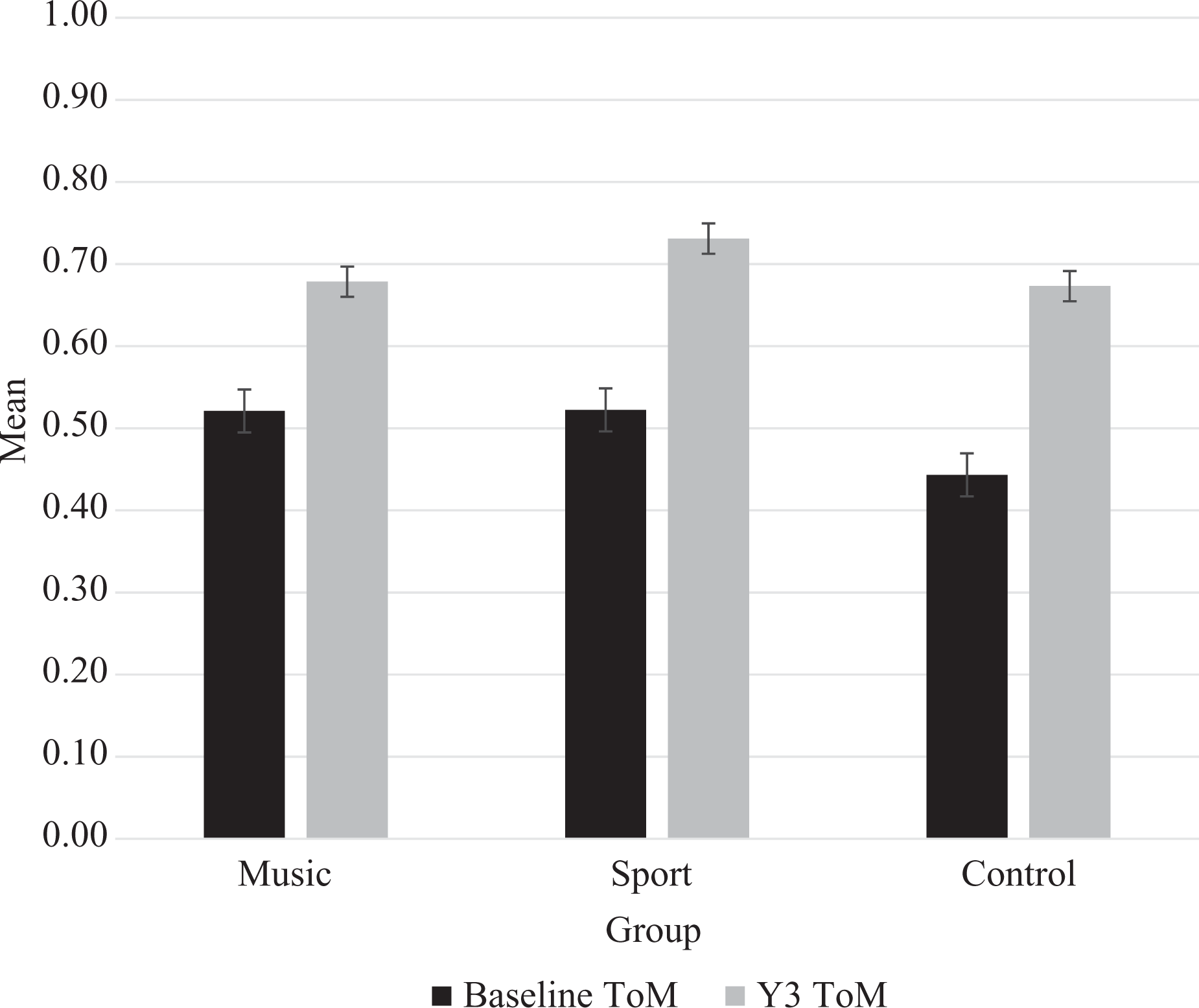
Scores for the Reading the Mind in the Eyes, a test of theory of mind (ToM), at baseline and Y3.
In terms of the associations between scores, after adjusting for multiple comparisons, the only associations that remained significant were the prosocial task at Y3 (sharing with friends) and Y3 entrainment (alone) in the music group [r = .57, n = 16, p = .01]; and between helping and sharing at baseline [r = .384, n = 43, p = .01].
Discussion
As expected, we found developmental effects in our study, with children in all groups showing improvements in entrainment and ToM over time. As in previous work (Kirschner & Ilari, 2014; Kirschner & Tomasello, 2009), context influenced children’s entrainment, with higher synchronization accuracy in the social-entrainment condition. Three years later, the music group outperformed the control group, showing a steady decrease in group variance. As a collective, children improved their synchronization accuracy in the alone-entrainment condition over time, but there were no significant group differences. The presence of the experimenter in the room when children completed the alone-entrainment task was not sufficient to boost children’s synchronization skills. Rather, it was the joint action of child and experimenter drumming together (i.e., social-entrainment condition) that produced a higher synchronization accuracy. These findings resonate with previous research (e.g., Kirschner & Ilari, 2014).
In line with earlier research (Rabinowitch & Knafo-Noam, 2015), it was also interesting that the prosocial scores of child musicians in Y3 were positively correlated with their Y3 alone-entrainment scores, depending on the recipient of their resource allocation. Children who showed higher synchronization skills in the alone-entrainment condition also shared more stickers with friends. Because this finding was exclusive to child musicians in Y3, it could be interpreted as an indication that the connections between the temporal and interpersonal aspects of entrainment (Phillips-Silver & Keller, 2012) were more robust in this group. This finding also converges with the idea that formal music education may not only enhance rhythmic synchronization skills in children, but also impacts their affect towards members of their in-groups.
Interestingly, we did not find the same prosocial effects at Y3 in the sports group, even if both the soccer and swim team programs were collective in nature, and fostered teamwork and sportsmanship over competition. Two issues may have affected our results, the first one being the time that children spent in their respective after-school programs. Children in the music program spent a larger amount of time in the orchestral program than their peers in sports. While the time devoted to the actual learning of music skills was perhaps closer to the time devoted to swimming or soccer in the sports programs, there were arguably more opportunities for children to interact with each other in the orchestral program, including during homework tutoring sessions and theory classes. Second, while rhythmic entrainment is a condition without which music cannot exist, the same is not true for soccer and swim teams. Although the timing of passes and laps matters, swimmers and soccer players do not need to be together in time at every single moment for their respective sport modality to occur.
Interpreting the body gestures and expressions of others (including eye gaze), however, is germane to collective music-making (Biasutti et al., 2013), and known to impact individual performance in sports (see Philippen, Bakker, Oudejans, & Canal-Bruland, 2012). Yet children in the music and sports groups did not outperform controls in the ToM task. All groups improved over time, performing equivalently in the Reading the Mind in the Eyes following three years of music education and sports training. Why were there no effects of music education on children’s ToM when recent theorizing suggests otherwise? First, it is possible that the task was not completely true-to-life. While musicians commonly use non-verbal communication to communicate ideas when playing in an ensemble (Seddon & Biasutti, 2009), this is often not translated into words, as in the Reading the Mind in the Eyes task. Musicians are also known to be attuned to different body gestures of fellow musicians, such as moving hands, arms, and heads, and breathing, not only eye gaze. Such attunement, which may lead to the capacity to predict the actions of co-players (see Bishop & Goebl, 2014), develops over time, through expertise and familiarity with members of an ensemble. Phillips-Silver and Keller (2012) added that the understanding of others’ affective states depends on action stimulation, which is another staple of expertise. Given that participants in our study were young musicians, it is likely that our results were affected by their developing skills in music and ToM.
Perhaps for child musicians – particularly those learning music in the Western “Art” tradition – to develop social skills such as ToM from collective music education experiences, there is a need to develop a certain proficiency in music first. We hypothesize that this process might begin with the development of musical skills including the temporal aspect of entrainment, alongside the development of performance skills within the context of an ensemble. These “basic” proficiencies – at individual and group levels – may allow young musicians to be less constrained by technical issues and consequently attend to the non-verbal communication gestures of co-players (Seddon & Biasutti, 2009), predicting their actions (see Bishop & Goebl, 2014), and intentions (Phillips-Silver & Keller, 2012). This explanation may also be applicable to specific modalities of collective sports, such as soccer and swim teams. As Brady (2004) suggested, “young children in team sports have difficulty conceptualizing a team as a set of interdependent positions whose relationships to one another change as the dynamics of the game evolve” (p. 36). Such capacity typically does not emerge before children reach about 12 years old (Brady, 2004). Therefore, it is possible that enhancements to ToM due to participation in collective sports may not occur before children develop individual, sport-related skills (e.g., technique, passes, flips, etc.). In other words, for both music and sports programs to impact ToM, children probably need to develop individual skills first, to then apply them to the group practice. Once again, this is speculative and needs to undergo empirical substantiation.
Another issue to consider is the fact that ensembles are hierarchical spaces (Brinson, 2016) that can be highly competitive (Hendricks, 2013). Orchestras, in particular, have been criticized for their hierarchical structures and competitiveness (see Baker, 2014). Spontaneous interactions and improvisation are often limited in orchestral settings if compared to jazz combos or popular music ensembles, for example. It follows then that navigating the hierarchies of an orchestra, a jazz quartet, or a marching band are arguably distinct social experiences that may require different degrees of specific social and social-cognitive skills and motivation. Ensemble size is yet another factor to consider when studying the development of social skills in and through music. D’Ausilio, Novembre, Fadiga, and Keller (2015) have suggested that interactions in large ensembles are multidirectional and marked by a high degree of uncertainty concerning the actions of others. Therefore, it is probably more difficult to develop and engage in mind reading and prosocial behaviors in large ensembles than in smaller ones. Additionally, different musical genres involve different types of musical participation, perhaps requiring a different degree of specific social skills from musicians. Thus, our lack of effect of music education on children’s ToM and prosociality could have been associated with the intricacies of social interactions in a large ensemble that were experienced by our young musicians. Future research could examine ToM and prosociality in children who play musical genres that involve a fair amount of improvisation through collective experiences (e.g., jazz, pop), or by comparing children who play in small and large ensembles.
It is also noteworthy that effects of music on social skills in childhood have been found primarily in studies with infants and young children, who were tested immediately following some type of musical intervention, such as bouncing with an adult to the beat of music (e.g., Cirelli et al., 2014), moving together in time (Tunçgenç & Cohen, 2016a) or engaging in collective forms of musical play (Kirschner & Tomasello, 2010). By contrast, our study examined school-aged children (i.e., over the age of six), who were learning music through a formal program. Children in our study were not tested immediately after lessons or rehearsals. Also, our measures of empathy and ToM focused on trait effects instead of state effects. This leads one to wonder whether the effects of musical interventions on children’s social skills may be instantaneous and short term, limited to the early childhood years, and/or more robust in participatory forms of music-making (Turino, 2008) than in formal learning programs, particularly those that tend to be of a hierarchical nature. Furthermore, future research needs to differentiate between specific prosocial behaviors that may result from rhythmic entrainment, as well as to examine prosocial tendencies of children who learn music formally towards other children, and not only between child musicians and an adult, as in the current study.
Obviously, we cannot rule out the possibility that collective forms of music education centered primarily on the acquisition of musical skills, such as orchestral programs, may not necessarily develop prosocial skills in school-aged children (e.g., Alemán et al., 2017). That effects of music education on children’s social skills have been found mainly in programs that followed specialized curricula (e.g., Rabinowitch et al., 2012) and in children who started off with low scores in these areas (Schellenberg et al., 2015) speaks to the idea that transfer between the components of entrainment may require some “add-ons”. That is, for music education programs to be effective in developing social skills, perhaps it is necessary to devise curricula that not only break down traditional hierarchies found in collective musical experiences, but also afford children ample opportunities to exercise social skills such as empathy, theory of mind, and prosociality in more direct ways. This not only aligns with research concerning social gains associated with participation in ensembles where musicians typically rehearse, observe others’ body gestures and socialize constantly, such as choirs (Anshel & Kipper, 1988), but also concurs with the idea that children may be more empathetic and prosocial with their in-groups (see Abrams, Van de Vyver, Pelletier, & Cameron, 2015; Eisenberg & Spinrad, 2014).
Still, the fact that children show higher synchronization accuracy when drumming with a partner as opposed to alone offers a strong indication that the components of entrainment are indeed associated and deeply, as previously theorized by Phillips-Silver and Keller (2012), and demonstrated by empirical research on interpersonal synchronization (e.g., Tunçgenç & Cohen, 2016a). Yet these associations are also more nuanced and susceptible to environmental factors, including types of music programs, child socialization and culture, as our study suggests.
Footnotes
Contributorship
BI and AH designed the study, recruited participants, collected and analyzed data. CF collected and analyzed data. BI wrote the first draft of the manuscript. All authors reviewed and edited the manuscript and approved the version that was submitted for publication.
Declaration of conflicting interests
The authors declared no potential conflicts of interest with respect to the research, authorship, and/or publication of this article.
Funding
The authors received no financial support for the research, authorship, and/or publication of this article.

Peer review
Bahar Tunçgenç, Kennedy Krieger Institute, Neurology. Tal-Chen Rabinowitch, University of Washington, Institute for Learning and Brain Sciences.