




Abstract
Music is a fascinating topic for evolutionary theory, natural philosophy, and narrative construction: music is a highly valued feature of all known living cultures, pervading many aspects of daily life, playing many roles. And music is ancient. The oldest known musical instruments appear in the archaeological record from 40,000 years ago (40 Kya) and from these we can infer even earlier musical artefacts/activities, as yet unrepresented in the archaeological record. I argue that, following research couched in the social brain hypothesis framework, a theoretical basis is emerging for the proposition that the (incremental) evolution of proto-music took hold in the late mid-Pleistocene, roughly 400 Kya, and perhaps earlier. Subsequently, musical activities and traditions incrementally evolved throughout modernity (from 250 Kya onwards), global dispersal from Africa (currently thought to be from 60-100 Kya onwards), and the Holocene (from 12 Kya). In this article I provide an overview of recent research and a sketch of music’s evolutionary career. I identify avenues for future research, including work in the evolution of the emotions, and the application of signalling theory to music archaeology.
In recent work (Killin, 2017; see also Killin, 2016a) I have developed a theory of the evolution of early hominin musicality couched in a socio-cognitive niche construction framework: a picture that connects dynamic developments in hominin musicality, conceived as a mosaic of traits, to what I take to be the most persuasive interpretations of the evidence at hand within the context of understanding hominin evolution generally. I have hypothesised additional factors that are consistent and independently plausible. And I have defended aspects of my methodology and several explicit assumptions. My argument therein took a diachronic narrative form and this article picks up the narrative where Killin (2017) leaves off, at roughly 800,000 years ago (800 Kya) – the phase in human evolution I designate as the “Late Acheulean” (800–250 Kya). 1 I argue that at least by 400 Kya (some) ancient hominins engaged in group activities worthy of the admittedly vague description, social “proto-music” (by which I mean not necessarily the direct progenitor of all current-day musics; rather, activities that exemplify some but not all of the distinctive features of music-making in ethnographically known forager societies). And I argue that from the social and cognitive capacities enabled, rehearsed and developed in proto-music, musical activities and traditions would incrementally evolve throughout modernity (typically considered to be from 250 Kya onwards, though one recent analysis places the earliest known modern humans as far back as 315 Kya; see Hublin et al., 2017), global dispersal from Africa (currently thought to be from 60-100 Kya onwards; see Fu et al., 2013; Rieux et al., 2014; Scally & Durbin, 2012), and throughout the Holocene (i.e., from approximately 12 Kya; Walker et al., 2009), enabling the emergence and subsequent cultural evolution of many musics of the world today. 2 Although the “chronology” presents an order of events and sense of timing, it does not attempt a precise or exhaustive chronological causal explanation: there are many details still missing, many gaps in the material record, many aspects of human cognitive evolution up for debate. Nonetheless it presents a synthesis of research in progress, considers implications for theories of music origins, and sketches a tentative model of the evolution of music. The presentation of events by way of a narrative through time can sometimes give an impression of teleology: that “proto-music”, for example, was evolving towards music. Teleological thinking must be resisted in an evolutionary context, of course; the chronological structure of the article is simply a convenience (and a familiar format in which to couch a narrative-style account).
There are of course methodological challenges for any such research agenda. One is to overcome the well-known hurdle entailed by the fact that cognition and sociality do not fossilise – only indirect traces exist. Thus it is difficult to reconstruct the socio-cognitive lives of ancient hominins with any certainty. After all, traces erode with time, and there are serious challenges for the project of understanding the mechanisms underlying the cognition and sociality of living humans (and great apes in general), let alone our long-dead ancestors. Further compounding the issue – for this topic in particular – is the fact that a large portion of research on the evolution of music is couched within the adaptation/by-product debate (see Cross & Morley, 2009; Davies, 2012; van der Schyff & Schiavio, 2017) and this is an unhelpful framework for making progress on reconstructing music’s co-evolutionary trajectory (Killin, 2013, 2016a, 2016b, 2018a; see also Davies, in press; Tomlinson, 2015) even though (proto-)musical behaviours may well have been adaptive over the course of human evolution (Cross, 2003).
One critique of this literature is that it relies too much on armchair speculation. However, theorists can move beyond mere “just so” conjecture to “how probably” scenario building (Sterelny, 2018) by proposing and evaluating accounts that develop phylogenetically plausible evolutionary scenarios that are consistent and compatible with known lines of evidence, are cast in a general co-evolutionary/niche construction framework, and make constrained inferences from the archaeological, palaeoanthropological and ethnographic records. The result is still partially speculative of course: it is a defeasible evolutionary scenario. My goal, to be sure, is not to attempt to prove all aspects of the account outlined herein, but to make it at least plausible and attractive.
In the next section I dovetail the present article with Killin (2017) by recapitulating and expanding upon my discussion of “Late Acheulean” hominins, by which I mean modern sapiens’ hominin ancestors during the period of roughly 800 and 250 Kya – the period in which I envision the evolution of social proto-music taking place. In the third section I consider the long passage of behavioural modernity, discussing the archaeological record and the musics of ethnographically known foragers. I side with the view that our ancestors were musically active and had developed musical activities and technologies well before traces appear in the material record from around 40 Kya. In the fourth section I discuss music since the Holocene transition until the Common Era. The fifth section offers some concluding remarks.
The “Late Acheulean”: 800–250 Kya
The last million years or so saw a significant increase in hominin encephalisation (Antón, Potts, & Aiello, 2014), which, in tandem with the developments in musicality already underway (Killin, 2017; see also Morley, 2013), enabled vocal-anatomic and neural co-evolution, selecting for the ontogenetically lowering larynges of humans as our ancestors became ever more verbally communicative (Belyk & Brown, 2017). Lower larynges extend the resonance chamber formed by the throat and mouth, which greatly increases vocal ranges and the sounds producible (Fitch, 2000; Harvey, 2017, pp. 106–108; Morley, 2002); the first evidence for this occurring is in Homo ergaster/erectus (Morley, 2013). Likewise, co-evolution fine-tuned the neural and anatomic mechanisms underlying auditory perception, especially with respect to hearing hominin voices (Purves, 2017).
As far as researchers can tell from the fossil evidence, at least by Homo heidelbergensis (roughly 600–800 Kya) – currently thought to be the predecessor of the Neanderthals, Denisovians and modern humans (see, e.g., Manzi, 2011, 2012) – ancient hominins were capable of producing, more or less, the kinds of vocal sounds modern humans are capable of producing, and they had executive (top-down) control over many of their vocalisations (Morley, 2013). Whether Neanderthals, also descendants of H. heidelbergensis, had anything like early H. sapiens’ linguistic-vocal capacities is hotly debated (Johansson, 2015) but it is likely that both species would have been anatomically capable of near-modern vocal musicality (Mithen, 2005). 3 Although Neanderthals made personal ornaments and bone tools (d’Errico et al., 2003), no uncontested evidence of Neanderthal musical technology (e.g., flutes) has been discovered. 4 Nonetheless, Mithen argues that Neanderthals may have been more musical than other researchers have supposed.
It is useful to consider the evolution of hominin musicality alongside a general backdrop of evolving capacities, noting other major changes. Thus I consider “Late Acheulean” technology, fire control, and prospects for proto-music, in turn.
Late Acheulean technology
Increased encephalisation (which requires a high quality diet), social and cognitive complexity, and climatic stress 5 enabled hunting techniques and technologies to increase in complexity (Barham, 2013). This includes, for example, the use and production of complex, elongated javelin-style spears, appearing alongside butchered horse bones at Schöningen, Germany around 400 Kya (Thieme, 1997). Several lines of evidence indicate that the use of spears by H. heidelbergensis in South Africa at roughly 500 Kya is very likely (Wilkins, Schoville, Brown, & Chazan, 2012). The use of projectile weapons such as spears, to my mind, implies that these ancient Homo had at least a basic understanding of ballistic principles (see also Zilhão, 2007). If an animal target is on the move, the future-projecting mind of an experienced hunter can predict the animal’s future position and compensate for its movement when aiming to throw or be ready to throw. Although this could possibly be honed associatively through long practice, I suspect the complexity of the task hints at advances in episodic cognition and the ability to be consciously aware of the past and of (probable) future states. Recalling past successes – the feeling of the grip, the angle and pressure of the throw, the balance of one’s stance, and so on – lends a higher probability to a successful throw in the present. These spears were well-crafted projectiles – tapered towards the back and heavier towards the front with the centre of gravity in the forward third of the shaft. Replicas demonstrated particularly effective penetrative power when thrown as far as even 15–20 m (Churchill & Rhodes, 2009; Rieder, 2003). This is suggestive of some degree of division of labour and specialisation of skills at least in the production, if not also use, of these javelins. They certainly evince advances in craftsmanship and raw material manipulation.
From around 500 Kya, finely crafted, symmetrical yet overwrought and unused stone handaxes appear (Kohn & Mithen, 1999; Mithen, 2005) (that is, in addition to stone tools that were used), as well as hafted tools (Barham, 2013; Wilkins et al., 2012). Consider the handaxes first. These artefacts are evidence of impulse control and careful attention. Moreover, they evince the intentional listening that supports better knapping (Killin, 2016b, 2017). They imply skill specialisation and intentional teaching, and they reveal a proto-aesthetic sensibility (an over-emphasised sensitivity to visual symmetry, and so on – see, e.g., Wynn, 1993; see also Currie, 2009, 2011). One possible interpretation of these axes is that they are honest – because costly – sexual signals (Kohn & Mithen, 1999). This interpretation is controversial, however (Nowell & Chang, 2009). An alternative is that they are pedagogical props – oversized examples for teaching and learning – or that they are social signals more generally. Either way, they represent a high point of several million years of stone artefact production, social learning culture, and perhaps also the capacity to abstract.
Until 500 Kya all known tools were made from a single source material and were hand held. 6 But from this point on, handles/shafts were increasingly added to stone tools; these hafted tools were produced not merely by reducing and shaping raw material, but by adding distinct components together. No other animals do this, not even chimpanzees (termite wands, for instance, are simple single-source items). According to Barham (2013), hafted tools are further evidence of increases in forward planning, working memory, raw material manipulation, social learning and intentional teaching. These capacities are important for complex cumulative cultural evolution in general, and for the subsequent emergence and persistence of the full-fledged musics of today.
Late Acheulean fire culture
From 790 Kya there is strong evidence of fire control (Goren-Inbar et al., 2004). Wrangham (2009) and Wrangham and Carmody (2010) suggest that cooking/fire control is even earlier (see Attwell, Kovarovic, & Kendal, 2015 for review; Roebroeks & Villa, 2011), however, the archaeological signature of early fire use is patchy and in earlier stages may represent only partial (opportunistic or sporadic) fire control. We cannot assume that once harnessed, fire became an enduring feature of ancient life. As Roebroeks and Villa note, hearths and other evidence of fire control became much more archaeologically visible from around 400 Kya, from which point there is widespread, continual evidence of skilled control of fire. The received view is that fire was harnessed opportunistically at first and over time became habitual at least by 400 Kya.
Recent research by Wrangham (e.g., 2009) emphasises the importance of fire and cooking to hominin evolution. Fire enabled the cooking of meat and underground storage organs (e.g., bulbs, storage roots, tubers), as well as food preservation techniques such as smoking and drying of meat and fish, some combination of which provided ancient hominins with the energy required for larger, more expensive brains. Fire granted our ancestors more leisure time, by extending the period with usable light, and by lessening the time spent eating. (Chimpanzees spend hours chewing their food; cooking makes foods easily consumable and digestible.) Fire enabled the reduction of gut size, since guts did not have to work so hard to extract nutrients from food digested, allowing reallocation of energy into increasing encephalisation. Fire provided heat, protection, and light. It extended the time that could be spent communicating, socialising, planning hunts, and so on. It kept vermin at bay, it provided a means for charring the ends of wooden lances into useful, hardened pointed tips, and may have assisted plant-growth management.
Gowlett, Gamble, and Dunbar (2012) point out that keeping a large hearth’s fire alive requires a lot of firewood: 50–100 kg per day. Presumably, gathering that timber would have been a coordinated, cooperative enterprise. All members of the band benefit from a campfire and all would have been drawn to it upon nightfall. And as Dunbar notes, social eating (such as sharing a satisfying meal around a campfire) triggers the release of endorphins: We feel warm and friendly towards those with whom we eat. This might explain why we find social feeding so important…Social eating of this kind seems to be universally important across all cultures, yet no one has ever stopped to ask why we do this…The obvious answer is social bonding. (Dunbar, 2014, p. 195)
According to Gowlett et al. (2012) hearths were common enough from around 400 Kya to suppose that a set of novel behaviours would take hold, associated with firelit socialising. By this time, ancient hominins were central place foragers, more organised/centralised around cooking hearths. And as big-brained hominins, it is very likely that they would become easily bored and restless, yet would have been intuitively creative, innovative and, importantly, social. So it is unsurprising that cultural activities would eventually arise that would have the effects of strengthening group identity, rehearsing coordinated action and theory of mind, and, importantly, channelling and shaping emotions. So here is where social proto-music comes in, building upon earlier foundations of hominin musicality (Killin, 2017).
Late Acheulean proto-music
As I will discuss shortly, archaeological evidence reveals music’s presence in the Upper Palaeolithic, but there is no direct material evidence of musicking during the “Late Acheulean” (although the over-large handaxes discussed above are suggestive of a general proto-aesthetic sensitivity and the ability to abstract). So we must lean on inference, suggestive circumstantial evidence, and theoretical frameworks. The social brain hypothesis
7
– of which the core idea is that social complexity was a key driver of hominin encephelisation (Dunbar, 1998; Gamble, Gowlett, & Dunbar, 2011; Gowlett et al., 2012) – offers a framework through which some progress might be made: With predicted community sizes of up to 120, we should expect selection for mechanisms to amplify the emotional basis by which lasting social bonds were forged. One selection pressure for this is clear. With larger community sizes less time was spent together as dictated by fission and fusion to balance population to resources. (Gamble et al., 2011, p. 124)
The social brain hypothesis and related research provides theorists with a framework for taking seriously these ideas. This is to entertain a perspective that is in contrast to the influential and widespread view of Richard Klein and others that “the dawn of human culture” occurred around 50 Kya, if we are to include music among the suite of cultural activities that are supposedly invented very recently by sapiens such as representational cave art and figurines, symbolic mortuary practices, and so on (Klein & Edgar, 2002; Mellars, 1989). Adler’s (2009) discussion in Nature of a 40,000-year-old bird-bone flute has the provocative title, “The earliest musical tradition”. But the search for the origins and expansion of music begins not at merely 40 Kya with the onset of European flutes (pipes) in the Upper Palaeolithic, discussed in the next section. That’s what we would say if we thought “what you see is what there was”. Rather, it is more likely that behavioural modernity evolved gradually and incrementally (d’Errico & Stringer, 2011; McBrearty, 2007; McBrearty & Brooks, 2000; Sterelny, 2011). In particular I have suggested that “proto-musical” behaviours are to be found in the socio-cultural and cognitive developments occurring, incrementally, within the “Late Acheulean” – around 400 Kya, and perhaps even earlier. This is based on my argument from hominin socio-cognitive co-evolution (Killin, 2017), the upgrades in technological production, the plausibility of a proto-aesthetic sensitivity, and using the date associated with more common and continuous hearths as social magnets as a proxy. Avenues for further empirical research include focusing on whether evidence of persistent fire control corresponds with the presence of anything potentially of musical usage and looking to use-wear or experimental analysis to constrain the range of plausible inferences.
Linking hypotheses of social expressive performance and hominin evolution with emotions, advances in technology, and a proto-aesthetic sensibility makes hypothesising about the emergence of proto-music intelligible. New research on the evolution of the emotions may well provide direct or indirect means for testing these ideas (see, for example, Peretz, 2011, for a review of the neurobiology of musical emotions: evolutionary models are one direction for future research).
The Late Pleistocene: Mid/Upper Palaeolithic musicality
Here the narrative reaches the long stretch of human modernity (from 250 Kya onwards). It is within this phase that evidence for fully-fledged (“symbolic”) languages, long-distance trade networks of over 300 km, 8 musicians and musical instruments, sculptures and cave painters, body painting and ornamentation, burials, grave goods, shamans/priests and religion all eventually appear in the material record, though not simultaneously, and not permanently from first appearance. Indeed, it is towards the end of this time period (i.e., from 40 Kya) that representational cave paintings and figurines/sculptures appear in the archaeological record (Lawson, 2012; Pike et al., 2012), including depictions of large animals and water birds, as well as part-animal, part-human creatures. The lion-headed man of Hohlenstein Stadel, the oldest known figurine, dates to around 40 Kya (Kind, Ebinger-Rist, Wolf, Beutelspacher, & Wehrberger, 2014). Venus figurines, the oldest known fully human representations, appear in the archaeological record from around 35 Kya (Conard, 2009). Nonetheless earlier traces of an aesthetic sensibility and of symbolism appear in Africa (McBrearty & Brooks, 2000). Early sapiens utilised ochre and other pigments, presumably for personal decorative effect and to colour artefacts, possibly as early as 230–280 Kya (McBrearty & Brooks, 2000) and almost certainly by 165 Kya (McBrearty & Stringer, 2007). Decorative adornments such as beads and other ornaments (including shells and animal teeth and bones) were not far behind, appearing from around 90 Kya – also disappearing, and reappearing in the archaeological record, becoming more common and continuous over time (Kuhn, 2014; Stiner, 2014; Zilhão, 2007). Blombos Cave in South Africa revealed engraved ochre artefacts dated at around 75 Kya (Henshilwood, d’Errico, & Watts, 2009). These very early markers of the artistic/aesthetic and the symbolic are quite unstable in the archaeological record. Thus it appears that behavioural modernity was an incrementally evolving, continuous process. 9
In this section I paint a picture (with broad brush strokes) of the musical behaviours, capabilities and technologies of ancient sapiens. Both (2009) notes that researchers engaged in such a project have typically privileged just one of the archaeological and ethnographic records, understanding the other as “subordinate”. Yet both lines of evidence are valuable and not mutually exclusive. Indeed, since neither one alone can offer more than a partial picture of ancient music, prospects for integration are a priority for ongoing and future research. I turn first to prehistoric music archaeology, then to (historic and contemporary) hunter-gatherer ethnomusicology. Finally I reflect on some consequences of taking seriously signalling theory in theorising about music archaeology, an avenue for future research.
Music archaeology of the Upper Palaeolithic
The oldest known musical instruments are the flutes (pipes) from the Swabian Jura in southwestern Germany (specifically, Hohle Fels, Vogelherd, and Geißenklösterle); see e.g., Figure 1. Most of these are made from bird bone (predominantly vulture radius or ulna; also swan bone); a few from mammoth ivory. They appear from around 40 Kya onwards (see Conard, Malina, & Münzel, 2009; Higham et al., 2012; Morley, 2013). Another series of finds at Isturitz in France comprises 20 or so ancient bird-bone flutes, although the age of these varies extensively, from 32–35 Kya, to 11–17 Kya (Buisson, 1990; d’Errico et al., 2003; d’Errico & Lawson, 2006; Lawson & d’Errico, 2002).

Replica of an Upper Palaeolithic flute from Geißenklösterle. 10
Since it was around this time – 40 Kya – that Cro-Magnon humans arrived in Europe, it appears that they brought the ability to make and use musical artefacts with them from Africa. I side with the view that musical technology has a much older past, currently (and perhaps indefinitely) hidden from the material record (Cross, 2012; d’Errico et al., 2003; Lawson & d’Errico, 2002).
One of the oldest flutes so far discovered (in 2008 in Hohle Fels and reconstructed from fragments: see Adler, 2009; Conard et al., 2009; Morley, 2013) is made from a griffon vulture (Gyps fulvus) radius: the preserved portion of the flute, which researchers presume is virtually the complete item, is 21.8 cm long, with a diameter of 0.8 cm. The body of the flute has been scraped smooth and finger-holes created from thinned-out concave depressions, pierced with the use of a tool. The proximal end of the bone has been manually adjusted: two V-shapes were carved into the end of the bone presumably so that it would function better as a mouth-hole (for images, see Conard et al., 2009). Cut-marks near the finger-holes suggest that the placements of the finger-holes were measured, which suggests that this aspect of the flute was designed with something in mind: perhaps a pitch standard/scale, or physical practicality, or pedagogy. 11 Reconstruction experiments of prehistoric flutes from the Swabian Jura exhibit a wide range of tones possible and establish these instruments as “fully developed musical instruments” (Conard & Malina, 2008, p. 14).
These flutes suggest a long history of musical technological production; their sophistication indicates that they must be “several conceptual stages removed from the earliest origins, even of instrumental musical expression, to say nothing of those universal vocal, manual-percussive and dance forms which must have existed independently of—and before—any need for such tools” (d’Errico et al., 2003, p. 46). As with the increasing complexity of stone tool design from the Oldowan through the Acheulean, the construction of these musical instruments bespeaks the advancement of human cognition and social learning. They are evidence of higher-order tool use, for example – artefacts that were constructed with the aid of other artefacts. Yet, we can ask, why do musical instruments suddenly appear in the archaeological record only from 40 Kya? Why no earlier unambiguous evidence? The answer is most likely not that musical instruments appeared in the world around the same time they appear in the archaeological record, but rather due to, first, contingent matters of raw materials available and used, vagaries of preservation, and post-depositional disturbance, and second, to the fact that (as far as we know) this is when modern humans arrived in Europe and made use of the caves there. 12 In the Upper Palaeolithic, avian fauna were very important subsistence resources for humans (Cassoli & Tagliacozzo, 1997; Stiner, Munro, & Surovell, 2000). Moreover, vultures are not threatening to human hunters, are common in some environments, and would have provided more resources than just raw material for flutes (possible examples include feathers for decorative effect, blood for use in ritual). Vulture bones are sturdy, hollow, long and light, so they are especially suitable as raw material for flutes. Those flutes would also be fragile, and perhaps would only survive in cave sites. 13 Finally, flutes made from ephemeral, easier-to-work resources (e.g., bamboo, cane, wood, or seaweed pipes – resources that are not amenable to preservation) very plausibly could have predated bird-bone and ivory flutes and even co-existed with them.
The ethnographic record contains a variety of musical instruments made from natural, ephemeral materials such as reeds, gourds, animal skins, and tree bark, not to mention ready-for-performance items that require little or no modification, such as bison horns, conch shells, logs, and stone. Several types of wind instruments – horn, wood, and ivory flutes and horns – that do not have finger holes, valve mechanisms, or the like, are common throughout Sub-Saharan Africa (Nettl, 1990). Items such as these could have been used as musical instruments long ago, and even if we discovered them, we may not realise that they were used in that way. Modifications (such as a hole for blowing through) may be subtle, or not part of the surviving fragment of an otherwise unmodified animal horn. Here I am imagining something like the African ivory horn depicted in Figure 2, one that might be unmodified but for (say) a puncture for use as a blow-hole. Moreover, recently some theorists have conjectured that materials such as Ecklonia maxia – a kelp common in many areas of Africa (Anderson, Carrick, Levitt, & Share, 1997) and still used today to construct natural flutes, trumpets, pipes and percussion – were used for producing various musical instruments (Epsi-Sanchis & Bannan, 2012). 14

Central African ivory horn.
Prehistoric musical instruments enable rare and fascinating glimpses into an otherwise largely hidden culture, revealing more and more about our lineage’s ancient past. Morley (2013) offers an excellent survey and inventory of prehistoric musical instruments so far unearthed by archaeologists, including 104 bird-bone and ivory flutes, 15 as well as pierced reindeer-foreleg phalanges (i.e., alleged whistles) and other proposed sound-producers such as bullroarers and various forms of struck percussion such as rasps. Kuhn and Stiner (1998), for example, identify a modified ungulate bone from around 32–35 Kya that is reminiscent of rasps found in several contemporary musical cultures. Its function as a musical artefact may be an educated guess, as is that of the alleged bullroarers and other such artefacts discussed by Morley. However, use-wear analysis might shed light on their presently murky status (as it has done before in music archaeology; see, e.g., d’Errico et al., 2003). It is possible (although of course not certain) that ancient peoples may have put their hunting technologies to other uses, including music, as well. Musical traditions/rituals could have co-opted utilitarian artefacts such as hunting bows for use as musical instruments (Lawergren, 1988) – recall that contemporary hunter-gatherer bands in Africa use bows as musical instruments (Camp & Nettl, 1955; Nettl, 1990; Wiessner, 2014; see Figure 3) – and hunting bows appear in the archaeological record from 64 Kya (Lombard & Haidle, 2011; Lombard & Phillipson, 2010). Similarly, the shafts of spear-throwers have been used as musical instruments by some Australian Aborigine tribes (Gould, 1969) and boomerangs are often used as musical clap-sticks (Stubington, 2007).

African musical bow (Obubra, Nigeria), using the mouth as a resonator.
Ancient humans were certainly capable of creating musical technologies well before they currently appear in the material record. It is a striking fact, in my view, that even the oldest known flutes demonstrate such an investment of time, energy and resources. Consider the oldest known mammoth-ivory flute (Conard, Malina, Münzel, & Seeberger, 2004), dated to around 40 Kya. Compared to bird bone, the production of flutes from ivory requires greater skill, precision work and effort. Vulture and swan radius and ulna are naturally hollow and already an appropriate size, as well as being light, sturdy and thus easier to craft in comparison to ivory which is oversized, layered, and tough to work. Ivory flute production requires that: …a section of ivory must be sawn to the correct length, it must then be sawn in half along its length, the core lamellae (layers) must be removed, and then the two halves of the flute must be refitted and bound together with a bonding substance which must create an airtight seal in order for the pipe to produce a sound. (Morley, 2013, p. 50)
Music in hunter-gatherer society
Archaeology, due to the nature of the material record, presents an incomplete picture of Palaeolithic musical activity. And as noted above, the ethnographic record reveals a variety of ways of being musical with the voice, body, and artefacts/resources that would not preserve or that require little, if any, modification. So, consider next, as Morley does, the musics of ethnographically known hunter-gatherer societies, “to examine and illustrate a wider diversity of the musical behaviours that exist”; “to ultimately inform a more inclusive interpretation of prehistoric evidence” (Morley, 2013, p. 12). The goal here is not to present a crude ethnographic analogy (contra Bowra, 1962), 16 but rather to survey some of the possible ways that our ancestors could have been musical that are exemplified in groups living in similar conditions, revealing some similarities in material resources used, predominant use of the voice and unpitched percussion (rather than melodic musical instruments), and the social, affective nature of much music. While some aspects of these musics depend on the full suite of behaviourally modern socio-cognitive capacities, quite a few do not. Many of the technological, communicative, and cognitively enabling conditions are very likely to have been in place much earlier in the Pleistocene.
Turning to the ethnographic record helps researchers explore the ways in which music plays a role in processes of cultural niche construction, and its roles in the social group and wider context. Admittedly there are all kinds of very important differences between ancient and ethnographically known foragers, and in some contexts this makes it difficult to draw useful comparisons. But if due caution is exercised, those differences are unlikely to be antithetical to the general goal of detecting living traces of ancient music, and the kinds of roles music played in ancient human social worlds. 17
Morley (2013) focuses on the music of four sets of foraging societies that employ mobile hunter-gatherer subsistence strategies, since their traditional practices do not result from the agricultural shift that characterises the Neolithic/Holocene. These are Native American, African Pygmy, Australian Aborigine, and North American Arctic groups – groups that occupy diverse ecological niches and environments, and whose evolutionary lineages are temporally as well as geographically widely displaced.
The Blackfoot and Sioux tribes of the North American Plains are (historically) nomadic foragers and hunters of bison and antelope. Their traditional music consists of monophonic song (i.e., comprising a single melodic line), accompanied by unpitched percussion such as rattles, drums, bullroarers and rasps. Religious/ritual activities, social dancing, war dances and group initiation rites all involve the production of music. Musical performance is often a communal affair and most if not all people are involved in the musical life of their community. Songs often comprise vocables – expressive vocal sounds (non-lexical syllables) – rather than words. The use of such songs in connection with symbolic activities such as rituals and rites is predominantly not symbolic or propositional. Rather, their use contributes emotionally to the context at hand (McAllester, 1996). Some songs, however, do have a more symbolic role. Blackfoot sun dances, for example, are believed to beseech vigour, well-being and prosperity (“Sun says to sing”, Morley, 2013, p. 18). Moreover, sun dances have social functions: “bringing the tribe together and permitting social interchange, gambling, and athletic contests” (Nettl, 1990, p. 180). Other songs are more iconic. The mimetic “bleating calf” song is part of the Blackfoot and Sioux hunting toolkit: this musical-hunting strategy aims to lure a herd into gathering above a cliff face. The herd is then startled over the cliff by hidden hunters – and gravity does the hard work of the kill (see Howard, 1984, p. 61; Kehoe, 1999).
The musical instruments of the Blackfoot and Sioux are primarily unpitched percussion instruments, including split wooden sticks, wooden rasps, bullroarers, hand drums (a stretched animal skin over a wooden frame), cocoon leg- and ankle-bracelet rattles, and other rattles made from cocoons, deer hooves, gourds, and turtle shells (Morley, 2013; Taylor & Sturtevant, 1996). A few melodic instruments do feature, however, including wooden and bird-bone whistles and elder-wood flutes (for a detailed discussion about Native American musical styles, see Nettl, 1990, chapter 8). Note that only a few of these items are made from materials that would be likely to survive to this day if unsheltered were they utilised by ancient sapiens.
Similarly, the Aka and Mbuti pygmy tribes of equatorial African rainforests produce polyphonic music utilising vocables (Locke, 1996). These nomadic tribes occupy dense, humid forest environments, in contrast to some other pygmy groups (for example the Efe and Baka) who live nearer to villages or farmers and have established more significant barter systems with those people, trading services for food (Hitchcock, 1999). Like Blackfoot and Sioux music, Aka and Mbuti music is also predominantly vocal, although also featuring body-percussion and handclapping, and as above, music is a communal affair in which large groups participate (Turino, 1992). As well as group-based music, there are lullabies, sung one-on-one by a carer to an infant or child (Morley, 2013).
These pygmy groups’ musical instruments include wooden sticks, various rattles, end-blown flutes made from cane, and drums made from animal skin membranes stretched over hollow logs (Locke, 1996; Turino, 1992). They are thus somewhat similar to the suite of instruments found in the musical traditions of the Blackfoot and Sioux, and likewise made from largely ephemeral materials. As Morley notes, “The majority of the music itself appears to lack any direct symbolic content” (2013, p. 21), with one exception being molimo music which is intended to “wake the forest” after a period of scant hunting success.
Australian Aboriginal societies, in some contrast to the societies just discussed, have highly symbolic, lyric song traditions tied closely to geography, land ownership, traditional storytelling and ritual (The Dreaming).
Traditionally, ownership or possession of a song is a highly valued signifier of social status: “the most knowledgeable person in a tribal community was the person ‘knowing many songs’” (Ellis, 1985, p. 1). That is: …song is one of the most important vehicles of [Australian Aborigine] communication…Through song the unwritten history of the people and the laws of the community are taught and maintained; the entire physical and spiritual development of the individual is nurtured; the well-being of the group is protected; supplies of food and water are ensured through musical communication with the spiritual powers; love of homeland is poured out for all to share; illnesses are cured; news is passed from one group to another. (Ellis, 1985, p. 17) Every action of finding the animal, the ineffectual attempt to poke it out of its retreat, the smoking it with a fire, and the killing of it by the hunters as it runs out, is rendered not only by the words of the song but also by the concerted actions and movements of the performers in their pantomimic dancing. (Howitt, 1887, p. 332)
So unlike much of the music in Blackfoot, Sioux, Aka and Mbuti societies, a large amount of cultural, geographical, and ecological information is contained and expressed through music in many Australian Aboriginal societies. However, similarly, the music is predominantly vocal with clapping and body percussion. Technological additions vary from region to region: sticks that are struck together (sometimes boomerangs, co-opting a hunting tool for musical purposes), bamboo whistles, didjeridu, leaf-, seed-, and shell-rattles, rasps, animal-skin drums, and bullroarers (Stubington, 2007). Didjeridu – traditionally a termite-hollowed wooden tube that is blown to produce a powerful drone with a rich variety of flourishes – is a culturally significant musical instrument that traditionally imitates animal calls and other natural sounds. (Of course, the instrument has now been widely adopted into Western and fusion musics.) Bullroarers have been used in ritual, as well as music performance contexts, demonstrating how musical items have been co-opted into the expression of traditional worldviews (see Sachs, 1962, pp. 96–97).
Many Aboriginal songs are whole-community songs; Ellis calls these “open songs” (Ellis, 1985, p. 55). These form the backbone of Aborigine music repertoire. Other songs, like particular ritualistic songs, or children’s songs – both songs for children and songs by children – are “closed songs”, which might reveal an aspect of social life or religious doctrine deemed appropriate for only “selected members of the tribe” (Ellis, 1985, p. 57). Ellis discusses one such closed song which tells of a young girl’s reaction to seeing her brother’s post-initiation modified penis. Closed songs such as this may be restricted because of explicit or anti-social subject matter, but the fact that songs are restricted at all, in Ellis’s view, is because it gives power – and affords respect – to the elders and people of high standing. Knowledge of songs, and control over songs, are attributes held in very high esteem.
While some songs may be tribe- or region-specific, others spread long distances, via trade networks and other cross-group interactions. E. H. Davies (1947) provides an account, before the widespread establishment of playback technologies from the 1950s onwards, of Aboriginal songs that were recognised by an indigenous person in Western Australia, 1,600 km from Denial Bay in South Australia, where the song was recorded (see also Bridges, 2006). However, for the most part, like Aboriginal languages, musical style differs markedly from group to group (Ellis, 1985).
Thus music plays a substantial and significant role in Aboriginal socio-cultural life. Children who grow up in a social environment in which much information is expressed through traditional song develop in a context that is scaffolded by these songs and their role in informational transmission and social learning (see Malm, 1967; Waterman, 1956). This is musical cultural niche construction in action (Killin, 2016a, 2018a).
I turn now, albeit briefly, to the music of the Yupik of southwest Alaska, which is also predominantly vocal. Like Australian Aboriginal song, Yupik song is largely lyrically driven (although vocables feature too, particularly ay-ya-yanga) and Yupik songs cover a diverse array of contexts and uses (Johnston, 1989). The voice is sometimes accompanied by frame drums (sea-mammal skin stretched over a wooden frame, made by a specialist drum-maker) and/or puffin-bill rattles, although the latter are rarer today (Johnston, 1989).
Vocal music is classified by the Yupik into 13 main categories, as follows: Dance songs Shamans’ songs Hunting songs Teasing songs Travelling songs Berry-picking songs Story songs Juggling game songs Jump-rope game songs Ghost game songs Bird identification songs Fish identification songs
Inqum “cooing” songs The first six of these categories are mainly for adults, and the other seven are mainly for children. Custom dictates this arrangement, and there exists no particular taboo or prohibition controlling who performs what. In some of the categories, songs are sometimes sung by adults, for children. (Johnston, 1989, p. 423)
There are several outcomes from these brief case studies. Despite great variation in musical style across societies, hunter-gatherer music is predominantly vocal, with body percussion and unpitched percussion instruments made from organic, ephemeral resources. It is likely the same is true for ancient humans, so perhaps it should be unsurprising that (so far) the earliest material evidence of musical instruments dates back merely to 40 Kya.
Hunter-gatherer songs have been called “‘tools’ for invigorating life” (Barac, 1999, p. 435). In hunting, songs are used to attract game, raise the confidence of hunters, and, as a group, celebrate a successful hunt, or lament a hunting failure. Other songs are linked to rites that make up the human cycle: birth songs, lullabies, songs for circumcision, puberty, love/marriage, sex, sickness/old age, death. Others attempt to influence the world, perhaps via the spirits, such as weather songs, or songs for enchanting hunting arrows. Both carer-to-child lullaby and group-based music widely feature cross-culturally.
While there may be specialist instrument makers, and high-status composers or owners of songs, group-based music is typically not performed by elite specialists for passive audiences – music is a whole-band, social affair, often connected to the emotional aspects of ritual or other social contexts (Morley, 2013). And forager groups tend to expect a high degree of compliance and participation in their communal traditions and rituals (Barham, 2013; Hewlett & Cavalli-Sforza, 1986). As Sachs writes: “The neat separation of amateurs and professionals, a pillar of modern musical life, presents a concept not applicable” (Sachs, 1962, p. 200). And Jordania notes: Every member of [Central African] Pygmy society is a brilliant singer who can sing in harmony and participate in traditional choral singing with complex yodeling technique. Despite their amazing musicality, pygmies do not have any professional musicians. (Jordania, 2011, p. 13)
Signalling theory and archaeology
In this subsection I propose that signalling theory from biology provides a theoretical basis for drawing some tentative inferences about roles music may have played, reflecting social complexity and differentiation in the Late Pleistocene. Ancient humans have presumably been sending/receiving signs by way of utilising material substances and objects as communicative media for a long time – perhaps at least since ochre and other pigments appear in the archaeological record, initially rarely (perhaps since 230–280 Kya; McBrearty & Brooks, 2000) and more frequently and in greater supply over time. As noted above, beads enter the record around 90 Kya. The early beads are “simple” in that they were made from easily-worked and easily-acquired local raw materials (e.g., shells of littoral gastropods, mainly Nassarius) and those that were intentionally modified were not much modified. They typically appear in the archaeological record among rubbish, presumably lost or discarded, not in large concentrations or storage caches (Stiner et al., 2013). More complex ornaments enter the record as time goes on (from 45 Kya) such as pierced animal teeth, ornaments made from ivory, ostrich eggshell, in addition to more shells appearing more ubiquitously and in greater quantity. Ornaments as grave goods appear from 30 Kya (see, e.g., Dobrovolskaya, Richards, & Trinkhaus, 2012; Formicola, 2007). Although the actual information encoded in the signs sent by way of the use of these ornaments qua communicative technologies remains obscure, it is possible to make inferences about the types of messages – their more abstract or general role. To this end, Kuhn (2014) argues that these shifts in technology – from ochre and pigments, to simple beads, to more complex ornaments (and ornaments appearing as grave goods) – reflect changes in social dynamics and complexity; that they point to the solving of coordination problems in ancient social life, and resolving of conflicts in human groups with increasingly larger populations where the interests of individuals may be less “aligned”. The idea borrows heavily from biological signalling theory, an influential framework for the study of animal communication systems that emphasises the evolutionary consequences of various signalling strategies and their adaptive potential. 19 Animal communication theory distinguishes costly from non-costly signals. As the saying goes, talk is cheap; because it is in the sender’s interest to send low-cost but false messages and in the receiver’s interest to ignore false messages, signs that are low cost typically become established only in low-stake contexts where those party to the sign have aligned interests. 20 Such signs usually function to coordinate action – food-associated vocal calls of chimpanzees and bonobos, for example, guide the foraging of other members of the group (Clay & Zuberbühler, 2011; Slocombe & Zuberbühler, 2005). In more demanding contexts, and contexts in which the individuals’ interests are not the same, signalling theory predicts that senders of signs should pay some nontrivial cost in order for them to be taken as honest, credible signs. Gazelle stotting is a typical example; stotting expends more energy than vocalising would, and thus “honestly” signals to the predator that not only has the gazelle noticed the predator, the gazelle is fit and capable of escaping (Maynard Smith & Harper, 2003). Provided that the signal is heeded, both animals avoid a pointless, energy-expensive chase.
Kuhn assumes from ethnographically known hunter-gatherers that “beads and pigments decorated bodies and clothing, and that they most often carried social information, messages about an individual’s identity, affiliations, social roles, and social standing”; “They tell well-informed viewers about the wearer’s place in kinship networks, their marital status, group affiliations, and so forth” (Kuhn, 2014, p. 43). He argues that the use of ochre and other pigments as signs does not express cost very effectively (see also Kuhn & Stiner, 2007); that simple ornaments express some cost effectively, and that more complex ornaments, as well as the action of adding material objects to burials, expresses more cost. Following signalling theory, Kuhn infers that low-cost sign use (ochre and other pigments; simple ornaments) is correlated with low-stakes contexts, probably “reflecting efforts at coordinating human actions, small-scale rituals, or social gestures promoting shared identity and cooperation” (Kuhn, 2014, p. 46). Their use may have helped to identify an individual’s specific role in some context, for example. The exact details are of course conjectural; the idea is that they were used for something, and whatever it was, it was a context in which individual interests were (more or less) aligned, given the low cost of the sign. This fits the generally received egalitarian picture of Late Pleistocene anatomically modern human social life, and suggests an increase in social complexity when beads enter the picture: beads are more durable than the application of ochre and other pigments, they can be transferred between individuals, and they express quantity in a clearer way than pigment application, so Kuhn argues that they may reflect an increase in social differentiation and diverse, but potentially congruent, interests.
In light of signalling theory, this picture of ancient human life changes somewhat with the introduction of more complex ornaments. Ivory is difficult to modify, and presumably more difficult to acquire than shells or ochre. The same goes for carnivore teeth and the canines of male red deer – possibly signs of hunting prowess, or wealth/status. And even “simple” beads take on a dimension of added cost as they begin to be traded over hundreds of kilometres, potentially as symbols of place, rarity, group associations. The costliness of these ornaments may still point to coordinated action but may also reflect social competition as a release valve for conflict due to unaligned interests. As social complexity and group size increased, the assumption is that ancient societies became less egalitarian and more internally differentiated. Complex ornaments might reflect one way that ancient humans handled conflict management (for example, status conflict between two families or subgroups within the larger group). The action of adding ornaments to burials, Kuhn suggests, is “clear evidence for a new kind of social competition, probably between the families or lineages of the deceased” (Kuhn, 2014, p. 47). Note that the ornaments unearthed at Upper Palaeolithic human burials at Sunghir in Russia – one extreme example – required thousands of hours of labour (White, 2003).
Kuhn’s discussion of ornaments fits nicely with the preceding discussion of music archaeology. Early musical activities and (possible) musical instruments can be thought of as part of a suite of communicative media. 21 Complex musical instruments demonstrable of high cost enter the archaeological record around the time of more complex ornaments, cave art and figurines, and grave goods. But these almost certainly reveal a much older prehistory of music, perhaps lost to the record. As discussed above, the types of materials used for musical instruments by ethnographically known foragers strengthens the idea that humans were musically active – presumably by vocalising and using their bodies, perhaps making and using “low-cost” instruments (e.g., from easily acquired and easily workable materials, quite likely materials that would not survive until today) – in cooperative contexts for a long time, and very likely for expression of affect (that is, if we link this scenario back to the social brain hypothesis and the proto-music scenario described in the “Late Acheulean”). Extending Kuhn’s application of signalling theory for ornaments to known musical artefacts, then, I suggest that the innovation of mammoth-ivory flutes also reflects an incrementally growing and internally differentiated social group, with increased division of labour and specialisation, and increasingly complex social affiliations and networks. 22 Mammoth-ivory flutes are an impressive display of production skill and raw material use and control/acquisition; yet reconstructions of these instruments suggest that although both ivory and bone flutes would have been capable of “a range of notes and a potential for musical diversity comparable to modern recorders and flutes” (Conard & Malina, 2008, p. 15), ivory flutes are only equivalent or even inferior to bird-bone flutes in some respects, in particular due to the effects of moisture build up (that occurs when playing the flute) on the adhesive connecting the two ivory halves (Conard & Malina, 2008). After around 30 minutes of playing, the sound quality would decline and the halves of the flute would need to be re-glued (or at least the adhesive connecting the halves would need to be “touched up”) to restore an airtight fit. Ivory flutes were thus not only costly to produce, but to maintain, if they were to be played repeatedly. Making/owning/maintaining these “big-ticket” artefacts may well reflect increasing social differentiation in the Upper Palaeolithic.
The Holocene (Neolithic, Bronze Age, Iron Age, Classical Antiquity)
Late Pleistocene hominins were musical. Signalling theory and the archaeological record suggest that the development of complex musical instruments constructed from “high-cost” materials such as ivory (more difficult to work and to acquire than other resources such as bird bone or plant-based materials) reflects a shift in social dynamics already underway. Even so, the scenario envisioned was eventually to change even more drastically, at least for art and popular music of the post-agricultural Holocene world. Following Nettl: Then, among some peoples, there must have taken place the development of a separate musical life for an educationally sophisticated and economically or politically powerful segment of the population, while the rest of the people held on to the older [group-based] musical tradition. In Western civilisation, we tend to be dominated by this more sophisticated musical culture, which includes our concert music and also the vast body of popular music. (Nettl, 1990, p. 2)
As global temperatures rose in the wake of the Last Ice Age, around 12 Kya, tundra and ice caps receded, giving way to plains and forests. In multiple geographic regions, the lifeways of many human groups switched from nomadic/forager to sedentary: societies with farming and agriculture, increased storage capabilities, and greater harnessing of natural resources (Renfrew & Bahn, 2012; Testart et al., 1982). Farming was established in the Near East by 10 Kya, spreading to Europe, South Asia and Pakistan by around 8,500 years ago (barley, wheat, goats, sheep, and eventually cattle from 6,000 years ago). Independently, millet and rice cultivation was established in various regions of China and Southeast Asia by 7,000 years ago. (This eventually made its way to Africa; sorghum wheat and millet cultivation was established in the Sahara by 5,000 years ago.) Also independently, in the Americas, various vegetables (peppers, squash, beans, and later also potato and manioc/cassava) were being farmed by around 9,000 years ago in Mesoamerica, Peru, and other South American regions. Later, maize was farmed in Mexico and Argentina by 7,600 years ago. (For more detail see Barker, 2006; Renfrew & Bahn, 2012; Scarre, 2013.) Eventually, the world’s remaining hunter-gatherer bands came to be greatly outnumbered by agricultural societies. Today, few hunter-gatherer bands continue to exist.
This agricultural shift, also called the “Neolithic Transition”, although probably not initiated by population increase (Bowles, 2011), would nonetheless enable larger population sizes and greater social complexity. Major walled settlements arose from around 8,000 years ago. Çatalhöyük’s population size, for instance, is estimated to have been 3,500–8,000 people, within its 13.5 hectares, and it was populated for around 1,400 years before its inhabitants relocated (Hodder, 2007).
In time, innovations such as pottery, writing, and metalworking would arise – signs of craft specialisation enabled by the increased market size as population sizes grew. Yet living in ever more densely populated communities gave rise to a whole new suite of stresses, selecting for mechanisms to relax those stresses and promote social bonding in these significantly larger social worlds, where, unlike in forager societies, people were not intimately acquainted with all other members of the society. Perhaps such mechanisms included the advent and stabilisation of feasting (Munro & Grosman, 2010) and the brewing and social consumption of alcohol (Dietrich, Heun, Notroff, Schmidt, & Zarnkow, 2012; McGovern, 2009). Social eating and drinking are universal social bonding activities that trigger the release of endorphins, and are very likely to have included music in some way early on, as they do today all over the world.
Mobile foraging societies are generally egalitarian, with no norms of political leadership and little, if any, heritable material wealth and I assume the same is true of Late Pleistocene foragers (despite greater social differentiation as social complexity increased), and that the Neolithic Transition to sedentary life enabled the emergence and establishment of unequal hierarchies, elites, and privileged political authorities. After a period of intermediary chiefdom-based ranked societies, state societies and hierarchical civilisations emerged by around 5,500 years ago (Renfrew & Bahn, 2012). The greater sophistication of musical instruments and musical systems, in conjunction with a more hierarchical social structure, seems to have advanced a dividing performer/audience conception (distinguishing the musicians in society from the “non-musicians” and amateurs), and saw the innovation of musical instruments more technically demanding to play and make than discussed above, implying greater investment in teaching/learning and thus specialisations in both domains (technical construction and musical performance), and reflecting much greater social differentiation (signalling theory). An “art” tradition of musical performance would arise, taking the form of musical expression as “mere” entertainment (e.g., for wealthy elites, decoupled from its prior social roles), as would increasingly demanding standards of artistry for professional musicians. In other words, in my view, the music-archaeological record (discussed below) indicates that it was during this period – in particular, between 5,000 and 2,000 years ago – that in the ancient civilisations of various regions of the world, musics qua art forms (i.e., in the vernacular sense of “music as art” – specialists performing especially for a non-participatory audience) seem to emerge in the material record, in addition to the continuation of traditions of inclusive, social, participatory music.
Thus to conclude I ought to survey music’s Neolithic presence, as the material record attests to date. This will provide a picture of how music was shaped in various parts of the world in the final stages of its emergence from our lineage’s ancient musicality. And it will reveal a general increase in complexity and costliness of musical instrument use and production. Of necessity, my discussion will be brief and will not attempt to be comprehensive or encyclopaedic.
Neolithic bone flutes, and turtle-shell shakers containing pebbles, discovered amongst grave goods unearthed at Jiahu (22 km north of modern-day Wuyang in Henan Province, China), have been dated to around 7,000 years ago (DeWoskin, 1998; Zhang, Harbottle, Wang, & Kong, 1999; Zhang, Xiao, & Lee, 2004). The flutes were in pairs; nine pairs discovered in total, as well as fragments of many others. The flutes of each pair were tuned roughly one whole tone (major second) apart, with one of the flutes in each pair being slightly longer than the other. The flutes are carefully crafted and well tuned, showing a tuning precision that indicates sophisticated divisional measurements were done to position the fingering holes prior to drilling. The flutes are seven-hole, eight-tone vertical instruments…The hole-to-hole measurements are precise divisions apparently made by applying a measuring algorithm or through the use of a template. The adjustment made by the small addition of a tuning hole over the lowest fingering hole responded to variations in pipe diameter and shape and suggest that some kind of water-level tuning process was used empirically after the primary holes were laid out and drilled. (DeWoskin, 1998, p. 106) …the playing of music was closely associated with the exercise of power and homage, with religious and secular rituals, and with state ceremony, dancing, love and death. These pieces of art depict a variety of instruments, from the simple sistrum or sekhem—a hand-held, U-shaped shaken percussion instrument—to harps, ceremonial horns, flutes and wind instruments whose sound is made by blowing across strips of reed…They also depict expert performers of high status, including members of royal dynasties and deities. The prevalence of music in Ancient Egyptian life is demonstrated by the fact that over a quarter of all the tombs at the necropolis found at the site of the city of Thebes are decorated with iconography of music-making. (Goodall, 2013, p. 8)

Three musicians, from the tomb of Nakht, located in the Theban Necropolis, on the west bank of the Nile at Thebes (present-day Luxor, Upper Egypt).

Musicians and dancers, from the tomb of Nebamun, located in the Theban Necropolis, on the west bank of the Nile at Thebes (present-day Luxor, Upper Egypt).
Relics show flautists performing in the fields at barley harvest, and pairs of stick-beaters performing at grape harvest. Relics reveal a “pressing the grapes” dance that one must assume was accompanied by music or singing. A fragment tells of fisherman songs, another of music accompanying oarsmen, presumably to encourage rhythmic rowing as well as to keep up spirits (Manniche, 1991).
Music was linked with (1) ritual, (2) daily activities of priests and other acolytes, religious scenes, and tales of the activities of the gods, (3) court activities, such as performances for kings and other elite-class nobles, (4) military activities (particularly drums and trumpets), (5) funeral rites and death dances, and (6) conceptions of – and practices pertaining to – sexuality, fertility, and gender (for review, see Manniche, 1991; see also von Lieven, 2004).
Skilled musicians were invited to perform at significant events, to accompany dance and ritual events, and to entertain the nobles and those of higher class. Minstrels and bards brought life through musical performance to myths and legends, histories, genealogies, and spread news and stories from place to place.
Ancient Egypt is not alone in the explosion of music-archaeological evidence in elite milieux. Archaeologists have unearthed lyres and harps from Ancient Mesopotamia (present-day Iraq) that date back to 3,000 BCE (see, e.g., Barnett, 1969; Galpin, 1929, 1937; Renfrew & Bahn, 2012; Woolley, 1934, chapter XII). For one example, highly decorated lyres were found in the Royal Cemetery at Ur, dated to around 2,300 BCE. From 2,600 BCE, cuneiform tablets emerge that detail and list musical instruments, and give some instruction on how to play them, perhaps providing the earliest musical notation (e.g., Kilmer, 1971; Wulstan, 1971). There are dancing girl statuettes made from bronze, and seals that depict stringed musical instruments from Ancient India, that date to around 2,500 BCE. The Indian goddess Saraswati, found in almost all Ancient Indian lore from 1,000 BCE onwards, is always depicted holding a veena – a plucked string instrument that recorded history dates back to around 1,500 BCE (Gupta, 2014) – symbolising learning and knowledge, giving rise to harmony (Kinsley, 1988).
Following the onset of the Nordic Bronze Age (roughly 1,700 BCE), bronze lurs (long, curved trumpets played by embouchure and overblowing rather than with finger holes or keys to change pitch) appear in the Scandinavian and Baltic records. Some are depicted in the rock art of the Bohuslän province of Sweden, from around 1,000 BCE, and physical specimens from around the same time have been unearthed in Denmark amongst other sites (see, e.g., Holmes & Coles, 1981; Lund, 1981). Bronze Age horns have also been discovered in Ireland (Coles, 1963).
Recorded history dates the Chinese stringed zither (a predecessor of the modern-day guqin and guzheng) to around 1,000 BCE (Wu, 1980). Tombs have revealed zithers dating back to around 500 BCE – as well as bamboo wind instruments, bronze gong chimes, turtle-shell shakers, and drums. According to oral traditions, the zither dates back at least to 3,000 BCE (see, e.g., Gaywood, 1996; Wu, 1979).
A three-tiered, chromatic-scale set of 65 bronze gong chimes dated to around 500 BCE astounded the archaeological and ethnomusicological research communities when it was discovered in the 1970s (see Figure 6). Held together in the central chamber of the Marquis Yi of Zeng’s tomb, the largest of the gong chimes weighs over 200 kg (DeWoskin, 1998; von Falkenhausen, 1993; Wu, 1979).

Bronze chime-bells of the tomb of Marquis Yi of Zeng, located in Suizhou, in northern Hubei Province, China.
The Ancient Greeks and Romans left much evidence of a pervasive, well-developed, fully musical culture (Bundrick, 2005), including orchestras, choruses, and soloist music. The music archaeological evidence (including physical remains of musical instruments, images of musicians - see e.g., Figure 7 - and writings about music and musicians) for Ancient Greece and Rome surpasses that of Ancient Egypt (see, e.g., Burkholder, Grout, & Palisca, 2014). Lutes, lyres, and harps all feature, with instrument categories branching into more distinct sub-categories (West, 1992). For example, West distinguishes Ancient Greek box lyres from bowl lyres, and further distinguishes both of these from “unknown type” lyres. The aulos, a reed wind instrument often played in pairs, is depicted in art (see Figure 8). Music accompanied dramas, feasts, private ceremonies, and public gatherings and festivals. It was employed in healing efforts and education; it was offered to the gods. There were songs/music for wool-working, rope-making, grinding, pounding, kneading, baking, working in the fields, harvesting grapes, marching, battle, and other activities and forms of manual labour. Domestic, personal music-making became a popular activity. And since women were actively discouraged from practicing reason (logos) in Ancient Greece, music-making became an avenue for female self-expression, creativity, and the communication of ideas and cultural values (Buckley, 1998; Snyder, 1998).

Music lesson painting on Ancient Greek vase, dated to around 510 BCE. The teacher is on the right; the student on the left; between them a boy narrates a text. From Vulci, about 80 km northwest of Rome.
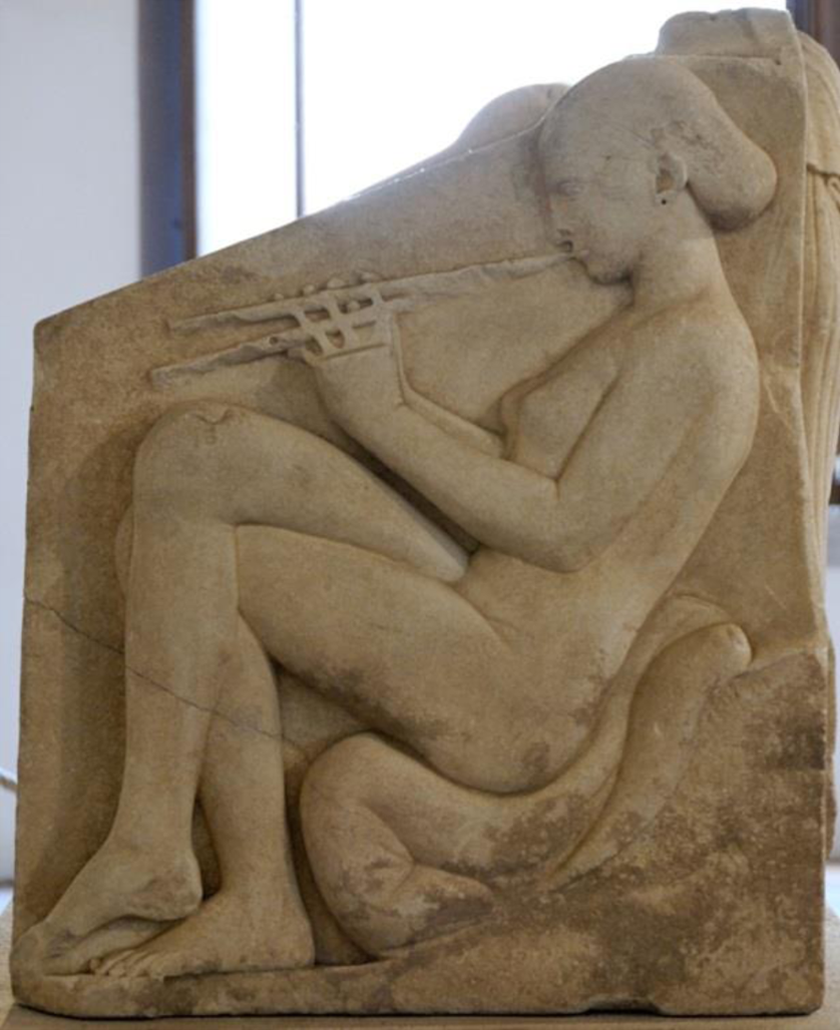
Left-hand panel of the Ludovisi Throne: musician playing two auloi, dated to around 460 BCE. Set in Thasian marble and of Western Green origin. Discovered in the Villa Ludovisi, Rome.
In Politics, Aristotle considers the importance of music in youth training, emphasising its reputation as a practice that builds character, affords amusement and leisure, and cultivates the mind (Aristotle, 1959). Plato shares similar sentiments about the importance of musical training in The Republic, and includes music as an obligatory aspect of education in his ideal state. For Plato, musical training is a more potent instrument than any other, because rhythm and harmony find their way into the inward places of the soul, on which they mightily fasten, imparting grace, and making the soul of him who is rightly educated graceful. (Plato, 2002, p. 257)
As early as the sixth century before the Common Era, the serious music of the day was organised into “artistic” forms (nomos – professionally-performed concert pieces), on the one hand, and competitive tournament/contest pieces, on the other (Bundrick, 2005). The establishment of both, as ways of making a living, would have further spurred on, via socio-cultural/economic feedback, the emergence of specialist musical performers. Festivals included competitive displays of talent in which singer-songwriters would compete; winners were selected by a panel of judges. The Pythian Games, a forerunner of the modern Olympics, were at first dedicated to musical and poetic sport; athletics, wrestling, and so, on appeared in these games later. There was also a “not-so-serious” musical culture, comprising drinking songs (skolion) and the like, knowledge of which, reportedly, was generally expected of everybody, or at least most folks, in Ancient Greece (Sachs, 1943).
The Ancient Greeks developed the first air-blown pipe organs (hydraulis) in the third century BCE, usually attributed to inventor Ctesibius of Alexandria. A remarkable mechanical innovation – and the predecessor of the modern-day pipe organ – the air sounding the hydraulis is hand-pumped into a reservoir inside a water tank (the weight of the water stabilises the air pressure) and then distributed to the pipes opened by mechanisms connected to the keys (Bicknell, 1996; McKinnon, 2001; Williams, 1980). Figure 9 depicts two musicians, one an organ player, providing the music at a Gladiator match.

Musicians playing a water organ and curved trumpet/horn. Roman mosaic, from Nenning, Germany.
So here the narrative dovetails with (written) music philosophy, history and theory (for detailed surveys, see Anderson, 1994; Bundrick, 2005; Hagel, 2010; West, 1992). The Ancient Egyptian, Greek, and Roman worlds are often seen as the beginning of “Western civilisation” and it is clear that music was a key ingredient in the lives of the people inhabiting those worlds. Humans construct their civilisations, one way or another. And it appears their worlds have long been musical ones.
Coda
In this article I have provided a partially speculative account of music’s ancient origins – an account in narrative form comprising first-order facts, plausible interpretations, and some guesswork. I have synthesised and integrated lines of evidence and theoretic frameworks from multiple research agendas, notably palaeoanthropology, archaeology, and hunter-gatherer ethnography. Admittedly, towards the end of the narrative this took the form of a report about what we know so far about music in particular ancient social worlds. Nonetheless, this is valuable for appreciating the extent of music’s ancient presence and the significance of music to ancient peoples.
I have surveyed technology, fire control and prospects for social proto-music in the Middle Pleistocene, the archaeological evidence for music in the Late Pleistocene, the musics of some ethnographically known forager groups, and considered theoretical implications from signalling theory. I have considered the career of music through the Holocene until the Common Era, including the ostensible division of music as “art” from inclusive, social, participatory music.
New material evidence or use-wear analysis might undermine or falsify some of my inferences or require re-dating some aspects of my timeline; however, evolutionary narratives such as these are always works in progress. New research into the evolution of the emotions may provide important avenues for testing hypotheses about the early evolution of proto-music, and further application of signalling theory in archaeology may shed more light too. These, amongst others, are avenues for future research.
Footnotes
Acknowledgments
I am grateful to Kim Sterelny, Stuart Brock, Stephen Davies, Gregory Currie, Richard Joyce, Ian Cross, Graeme Lawson, Iain Morley, and one anonymous reviewer, for very useful suggestions and critical feedback on previous versions of the manuscript. I’d also like to thank the participants of the “Digging Deeper: Archaeological & Philosophical Perspectives” Conference, Miami Beach, 2017, for a stimulating discussion of some of the material herein.
Declaration of conflicting interests
The author declared no potential conflicts of interest with respect to the research, authorship, and/or publication of this article.
Funding
The author received no financial support for the research, authorship, and/or publication of this article.
Peer review
Graeme Lawson, Independent Scholar.
Iain Morley, University of Oxford, School of Anthropology & Museum Ethnography.
One anonymous reviewer.