



Abstract
Few empirical studies have targeted the links between media delinquency or risk-promoting popular culture (specifically aversive music genres) with negative affective states and aggressive driving. Yet for over a decade, drivers have reported that they commit traffic violations while listening to loud fast-beat aggressive music styles. The current investigation seeks to explore aggressive driving behavior while considering the genre of music background. Most specifically, we look at aversive music styles and songs with violent lyrics. The article outlines the testimonials by drivers (N = 6,058) from six recent commercially solicited surveys with drivers which demonstrate “proof of concept” for driver aggression subsequent to driving with music accompaniment. Further, the article details a study (N = 50) employing a driving simulator with 30 paired music exemplars of 4 music genres. Half consisted of songs with hostile aggressive lyrics and half with neutral lyrics—both performed in the same music styles by the same artists. The results demonstrate that energetic music boosted excitement resulting in decreased lateral control, increased excursions from the lane, and an increased tendency to stray onto the hard shoulder. Drivers who were exposed to hostile music with violent content on the other hand demonstrated increased cruising speeds and a higher percentage of time exceeding speed limits. These differential effects of music on drivers can be referred to as either music-generated driver distraction or music genre induced driver aggression.
Introduction
In-cabin music accompaniment while driving a car is a debated variable among researchers investigating factors that have an impact on vehicular performance. Some claim that in-cabin music accompaniment is advantageous (Unal, 2013; Unal, de Waard, Epstude, & Steg, 2013; Unal, Platteel, Steg, & Epstude, 2013; Unal, Steg, & Epstude, 2012); they outline the constructive aspects of music-evoked driver arousal. Others feel that driving with music increases risk for miscalculations and inaccuracies, violations, incidents, and crashes (Brodsky, 2002; Brodsky & Kizner, 2012; Brodsky & Slor, 2013); they outline the destructive aspects of music-generated driver distraction. Perhaps the reality is that listening to music while driving offers both positive and negative qualities, while the crux of the matter is not whether or not music is reproduced in the vehicle cabin, but rather which structural features are found within the music. The current article targets an issue that has not as yet been raised in the safety literature: music genre induced driver aggression. We first attempt to fill this gap with a conceptual underpinning, and then substantiate the phenomenon through commercially solicited driver reports and survey data. With some latitude, this material may be seen as a prima facie effort to establish “proof of concept.” Finally, we present a driving simulator study that explores the impact of violent lyrics in popular songs on vehicular performance. The overall goal of the investigation was to provide a better explanation and prediction of aggressive driving behavior by accounting for music genre, rather than to target a specific music parameter or feature as an independent variable.
The main issue being raised relates to the distinction between distracted driving and aggressive driving. Traffic safety studies provide ample evidence that distracted driving involves impaired attention and/or judgment, while aggressive driving involves intentionally unsafe and inappropriate behavior. In their re-analyses of data from the 100-car study (Dingus et al., 2006), Hanowski, Olson, Hickman, and Dingus (2006) found a subset of 138 (56%) incidents that were caused by drivers themselves; these indicated both distracted driving (23%) and aggressive driving (25%). The data reveal the overriding factor for at-fault incidents subsequent to distracted driving is “deficient braking time when coming to a full stop,” whereas at-fault incidents subsequent to aggressive driving were caused by both “failing to keep a sufficient gap when changing lanes” and “willingness to pass another car just before a turn.” Keeping these factors in mind, one might wonder whether music—most specifically songs with violent lyrics pertaining to certain music styles—affects drivers differentially by generating driver behaviors associated with either distracted or aggressive driving conduct.
Emotive effects of in-car music on driver anger and aggressive driving
Anecdotal evidence from everyday road experience suggests that people who have trait tendencies to get “hot under the collar” and “infuriated” more easily, experience annoyance (and even rage) while driving and drive in a riskier manner. Mesken, Hagenzieker, Rothengatter, and de Ward (2007) found that cruising speeds were faster when drivers felt an overall affect involving anger, and the percentage of time speed limits were exceeded was far greater when drivers reported feeling angry. Other perspectives assume that mood state (i.e., the prevailing felt emotion) modifies driver behavior while in traffic (Abdu, Shinar, & Meiran, 2012). Mesken et al. claim that drivers misperceive and/or miscalculate concrete tangible driving risks when angry.
One feature of in-cabin environments that has a great potential for emotive effects on drivers is music. Specifically, the emotional valence of the music selections seems to influence how drivers control the vehicle (Brodsky, 2015). For example, Pecher, Lemercier, and Cellier (2009) found that when “happy” music was heard, drivers were easily distracted. Happy songs induced drivers to tap on the steering wheel and hum the melody aloud, resulting in decreased vehicular control, as demonstrated by lack of longitudinal and lateral control, with increased excursions from the lane, and a tendency to stray onto the hard shoulder. Conversely, “sad” songs incited drivers to focus attention on the gravity of the lyrics. Sad songs preoccupied drivers’ internal thoughts, as demonstrated by slower speeds with increased braking reaction times (RTs). Pecher et al. envisioned a host of music-generated emotions that could trigger distinctive driver behaviors: (1) joy or happiness that would distract and increase risk-taking with abundant crossing the midline of the lane; (2) excitement that would arouse and increase speed with decreased RTs and increase the frequency of errors; (3) sadness that would cue passive attitudes involving withdrawn attentional self-focus and longer RTs; and (4) frustration or anger that would lead to outraged aggressive driving styles with faster speeds, extreme use of brake/accelerator pedals, hostile verbal responses, and physical viciousness. Considering this taxonomy of music-generated ill effects, it would seem warranted to explore particular music genres—especially those that promote anger and that may foster aggressive driving.
Aversive music
Music genre is more or less a predictable categorization by which listeners identify exemplars by a commonly accepted set of conventions. For the most part, music genres are equivalent, in the sense that every music style represents an aesthetic quality that any number of individuals in the general population may prefer. Nonetheless, a few have been labeled as problem music because long-term listening and extreme fandom have been acknowledged as harmful (North & Hargreaves, 2006). Indeed in some cases, there is evidence for increased fatalities including an increased frequency of suicide (Lacourse, Claes, & Villeneuve, 2001; Stack & Gundlach, 1992).
In a landmark study, Arnett (1991a, 1991b) demonstrated that adolescents who preferred Heavy Metal music styles reported higher rates of reckless behavior, including sexual promiscuity (unprotected casual sex), drug use (marijuana, cocaine), antisocial conduct with minor criminal activity (shoplifting, vandalism, damage to property), and dangerous “stunt” driving. Roe (1995) found that adolescents who tended to listen to Hard Rock and Heavy Metal music performed more poorly in school, associated with deviant peer groups, and invested massive amounts of time watching violent television, while the opposite was true for those “with a taste for more ‘acceptable’ types of popular music” (p. 620). Roe developed a theory of media delinquency pointing to forms of antisocial behavior clustering together and associated with the consumption of socially devalued media content. Indeed, Heavy Metal music has often been perceived as a form of rebellion (Delsing, Ter Bogt, Engles, & Meeus, 2008; Dunn, de Ruyter, & Bouwhuis, 2012; Getz, Marks, & Roy, 2014; Krcmar & Greene, 2000; McCown, Keiser, Mulhearn, & Williamson, 1997; Mulder, Ter Bogt, Raaijmakers, Gabhainn, & Sikkema, 2010; Rentfrow & Gosling, 2006; Rentfrow & McDonald, 2010). It is a music style laden with heavily distorted electric guitars, pounding rhythms, and vulgar vocals, typically played at extremely loud volumes while knowing that such music exposure offends others in the environment. Although Roberts, Dimsdale, East, and Friedman (1998) could not replicate Arnett’s original finding solely based on music preference, they did find an equivalent picture when “high negative emotion” was added as a covariate. Arnett also reported that listeners who preferred Hard Rock and Heavy Metal music styles demonstrated “lower self-esteem” and “higher sensation seeking.” Sensation-seeking is the characteristic engagement in hazardous menacing activities with behavioral attitudes such as diminished risk appraisal. Zuckerman (1994) reported that sensation seekers drove at higher speeds, overtake vehicles in areas of limited visibility, tailgate cars by keeping shorter headways, and more often than not drive when intoxicated. Moreover, and as might be expected, sensation seekers prefer prototypical highly dynamic music genres such as Classic Rock and Hard Rock styles (Litle & Zuckerman, 1986; Nater, Krebs, & Ehlert, 2005). Arnett not only supported Zuckerman’s findings regarding music preferences among sensation seekers, but also demonstrated that “Metalheads” reported a host of reckless driving behaviors that were not seen for a matched group who preferred a wider array of popular music styles. Accordingly, Heavy Metal fans typically drive more frequently while drunk, more frequently above 85 mph, and more frequently without a seat belt. It is interesting to note that the same picture was conveyed by Beullens (Beullens & van den Bulck, 2013; Beullens, Rhodes, & Egermont, 2014–2016), who found that exposure to specific media among sensation-seekers not only was linked to higher levels of aggression, but also predicted levels of risk-taking in traffic and actual crash involvement. Beullens established risky driving (such as joyriding and crashes) as but one aspect of a lifestyle among sensation seekers along with other features such as high engagement with music videos and simulated driving games, both of which explicitly depict sexual and violent content accompanied by aggressive music styles including Hard Rock, Heavy Metal, Rap, and Hip-Hop.
Although the general effects of risk-promoting media on inclinations toward risk-taking have been summarized elsewhere (e.g., see Fischer, Greitemeyer, Kastenmüller, Vogrincic, & Sauer, 2011; Fischer, Guter, & Frey, 2008), it raises the question of whether specific music genres reflect media delinquency more generally. Arnett (1991a, 1991b) found that lyrics of Heavy Metal music enthusiastically encourage listeners to reject and disregard the more accepted standard rules of society, as well as target undesirable behaviors, including the transgression of traffic regulations, drug use, promiscuity, sadomasochism, Satan worship, murder, and suicide. We would point out here that the influence of lyrical content on destructive conduct is not exclusive to Heavy Metal music. For example, many studies demonstrate that listeners exposed to Hip-Hop, Rap, and Rock songs with violent lyrics also report confrontational thoughts with hostile feelings as well as act out aggressive behaviors more than matched listeners exposed to neutral lyrics (Anderson, Carnagey, & Eubanks, 2003; Carpentier, Knobloch, & Zillmann, 2003; Fischer & Greitemeyer, 2006; Krahe & Bieneck, 2012; Lennings & Warburton, 2011; Smith & Bayson, 2002). Other studies specifically target the lyrics as a component generating affect and behavior. For example, songs with pro-equality lyrics have been seen to improve attitudes and behavior toward women (Clark & Giacomantonio, 2013; Greitemeyer, Hollingdale, & Traut-Mattausch, 2015), and songs with prosocial lyrics caused a reduction in reckless and risky driving (Greitemeyer, 2013). Within the current study, we use the term aversive music as a label for music pieces that promote antisocial, dominating, degrading, and demeaning materials. To be most specific in our operationalization of the concept, we exclusively use the label violent (i.e., violent music, lyrics with violent content). Nonetheless, perhaps listeners do not easily distinguish between aversive music genres with neutral lyrics and those with violent lyrics; and antagonistic thoughts or feelings of anger, as well as tangible destructive vicious behaviors, arise from either the hostile music backgrounds themselves and/or the provocative lyrics. Certainly, if aversive music leads to both anger and more general aggressive conduct, it would be prudent to question whether such music genre induced aggressive behaviors occur within the dynamic context of driving.
Enlisting music genre to study negative driver affect and aggressive driving
Social psychology studies exploring the everyday use of music (Chamorro-Premuzic & Furnham, 2007; Delsing et al., 2008; Lewis & Schmidt, 1991; Rawlings & Ciancarelli, 1997; Rentfrow & Gosling, 2003; Rentfrow, McDonald, & Oldmeadow, 2009; Schwartz & Fouts, 2003) have not explored the effects of music genre on ordinary drivers. Even traffic safety investigations considering the impact of background music on driver distraction have not classified music genre as a contributing factor. Yet some time ago, Matthews, Quinn, and Mitchell (1998) examined the effects of loud Rock music and task-induced stress on simulated driving. The findings demonstrated that loud Rock music neither increased arousal to dysfunctional levels nor distracted drivers from the primary task, but rather supported resourcefulness when increased attention was required. Most specifically, Matthews et al. found that loud Rock music boosted driver ability to detect pedestrians (i.e., a high workload secondary task), with shorter braking RTs. The study assigned participants to one of four conditions: two music groups (listening to one song with headphones) and two non-music groups. One music group listened to “Brown-eyed Girl” [Van Morrison] and the other to “Two Princes” [The Spin Doctors]. Yet we cannot rule out that the findings were no more than effects of perceptual masking by headphones in favor of the music groups, as the non-music groups were exposed to room clatter, computer-generated engine uproar, vibrotactile feedback of the road surface, and hardware clamor of the driving simulator. Indeed, music genre is a most elusive feature and is particularly tenuous when selecting exemplars as experimental stimuli to be used as the criterion for empirical conditions. Most specifically, traffic psychology researchers are unlikely to have the broad theoretical music foundation or intensive instrument training that music psychologists have, and hence the music pieces they select might not always be fully conceptually justified or reliable. For example, although Matthews et al. enlisted two songs from an audio compilation packaged as relevant for “driving activity” (i.e., TopGear-Rock, 1994, Epic Records), the selected pieces might not have been ecologically valid. “Brown-eyed Girl” is a Pop song performed in a Folk Rock style accompanied by a clear hollow-bodied guitar, tapping tambourine, backing vocal ensemble in chorus sections, and a slow-to-medium tempo (measured at roughly 76 bpm). On the other hand, “Two Princes” is performed in a Classic Hard Rock style accompanied by distorted solid-bodied guitars, percussive snare drum rim-shots, wailing guitar solos between the chorus sections, and a medium-to-fast tempo (measured at roughly 110 bpm). As the study contrasted drivers by affective states (i.e., stress vs. nonstress) and intensity (i.e., 70 dBs vs. 90 dBs), it would have been a stronger experimental manipulation to keep musical features such as stylistic complexity within the genre as constant.
Anger is a most widely studied human emotion within the driving context. It has been considered to be both a predictor of driver behavior and a trigger of vehicular performance (Hauber, 1980). Underwood, Chapman, Wright, and Crundall (1999) claimed that interest in driver anger is because its manifestations not only relate to near-accidents, but also indicate an overriding aggressive style of driving that predisposes individuals to engage in dangerous behaviors such as tailgating, speeding, flashing lights, and crossing intersections at amber. In light of this connection, we now discuss three studies relating to music effects on aggressive driving. The first, by Wiesenthal, Hennessy, and Totten (2000, 2003), found that drivers preferred or favorite music alleviated stress and anger in congested traffic. A total of 40 participants (21–50 years old) drove a single 30-min trip on a major highway, whereby one segment featured flowing traffic and another congested traffic. The drivers were randomly allocated to one of two conditions: listening to preferred/favorite music tapes (or radio broadcast) or silence (i.e., refraining from listening to music altogether including radio and talk shows). The most preferred/favorite music styles heard by drivers in the music condition were Pop, Top-40, and Country. However, given that the conditions mandated unaccompanied driving, it is not clear what controls were put in place to ensure that these genres reliably describe the music styles actually heard, or if in fact engagement/abstinence of listening were carried out as instructed. Wiesenthal et al. reported two general effects: increased congestion caused significantly higher levels of perceived stress and aggressive behaviors, and listening to preferred/favorite music lowered levels of stress but only when drivers perceived no urgency. Unfortunately, the study proclaimed that “music had an influence on mild driver aggression in high congestion but not low congestion” (p. 130).
The second study, by van der Zwaag (Fairclough, van der Zwaag, Spiridon, & Westerink, 2014; van der Zwaag, Fairclough, Spiridon, & Westerink, 2011), explored the impact of music genre on driver affect during anger-induced driving. Drivers participated in a single 45-min simulated driving session in which stress and angry mood states were induced by three procedural hurdles: time pressure, emotional frustration, and monetary fines. Participants were assigned to one of five groups: four music conditions and a no-music condition. The music conditions presented four 10-item playlists varying in valence and energy: (1) Positive-Valence High-Energy activating joyous music (such as “Just Can’t Get Enough” [Depeche Mode] or “Foundations” [Kate Nash]); (2) Positive-Valence Low-Energy calming relaxing music (such as “What A Difference A Day Made” [Dinah Washington] or “Just My Imagination” [The Temptations]); (3) Negative-Valence High-Energy activating angry music (such as “Wait And Bleed” [Slipknot] or “One Step Closer” [Linkin Park]); and (4) Negative-Valence Low-Energy calming sad music (such as “The House Of Spirits” [Hans Zimmer] or “Silver Ships Of Andilar” [Townes Van Zandt]). Post-trip anger increased for all groups. Yet the NV/HE music group rated their post-trip anger as higher, while the PV/HE music group rated their post-trip anger as lower. Van der Zwaag et al. concluded that while music can divert a range of negative thoughts and angry feelings from arising, music also allows feelings of anger to escalate.
Finally, Fakhrhosseini, Landry, Tan, Bhattarai, and Jeon (2014) investigated the effects of emotional valence (i.e., “happy” vs. “sad” music) on driver anger. Antagonism was induced with two short video clips viewed prior to testing. A total of 53 undergraduates participating in a single 15-min session of simulated driving were assigned to one of four driving conditions: (1) Preinduced Anger With Happy Music, (2) Preinduced Anger With Sad Music, (3) Preinduced Anger Without Music, and (4) No-Anger No-Music. “Happy” music consisted of three upbeat fast-paced instrumental selections in a major tonality (including “Brandenburg Concerto No. 3” [J. S. Bach]), while “Sad” music consisted of three somber slow tempo instrumental selections in a minor tonality (including “Prelude in E Minor” Op. 28 [F. Chopin]). Although the study found no significant effects of emotional valence, nor were there differences between the driving conditions themselves, Fakhrhosseini et al. claimed that all music seemed to alleviate the ill effects of driver anger.
The relationship between violent media and traffic safety
The General Aggression Model (GAM) described by Anderson and Bushman (2001, 2002) is a relatively recent model which adopts a social-cognitive approach to aggression theory. Although GAM has been applied to a variety of behavioral and other effects (Allen & Anderson, 2017), the predominant use of GAM has been in the domain of psychological aspects of the effects of media violence (Ferguson & Dyck, 2012). The model distinguishes between aggression on the one hand and violence on the other. Specifically, GAM defines aggression as requiring three components: action, intent, and an unwilling victim. There are similarly different forms of aggression, referred to as “direct” and “indirect,” which are subsumed within the model. GAM incorporates both proximal and distal factors to explain aggression. As mentioned, the model has been particularly well studied and evaluated when looking at the effects of media violence. GAM proposes the notion that violent media content is associated with increased arousal. Namely, that exposure to violent media content through television, movies, computer/video games, and music lyrics not only associates with feelings of anger, but also with actual aggressive inclinations (Anderson et al., 2003; Fischer & Greitemeyer, 2006). Krcmar and Greene (2000) suggest a link between exposure to violent television and participation in various forms of risk-taking, especially reckless driving. More recently, Fischer et al. (2011) found that violence in movies, video games, and song lyrics increases the accessibility of aggression-related cognitions, attitudes, emotions, and behaviors. Of particular relevance here is the link between media that promotes violence and risk-taking. Most pertinent to the discussion here is the link found between risk-promoting media and risk-taking during simulated driving (Fischer et al., 2008). For example, after exposure to “risk-promoting movie sequences,” participants who engaged in a simulated car race (Need For Speed, EA Games) demonstrated more accidents (damage to car body, engine, and suspension), less time to accelerate between 0 and 160 kph, less time to complete the racing course, and higher maximum speeds throughout the course, than did participants exposed to “neutral-scene video clips.” Following these findings, Beullens (Beullens & van den Bulck, 2013; Beullens et al., 2014–2016) demonstrated that media-promoted images of risky driving (i.e., speeding, joyriding, stunt-driving) not only shaped young drivers’ perceptions of associated dangers, but also their propensity to engage in risks. Notably, Beullens found that the frequency of accumulated hours engaged in driving games and music videos throughout high school not only correlated with attitudes about joyriding, but also predicted actual crash involvement 5–10 years later.
While studies investigating violent television, movies, music videos, PC computer games, video games, and smartphone apps may be valuable in their own right, they do not provide information about the effects of exposure to music alone or songs with violent lyrics. Anderson et al. (2003) assert that the lack of real perceptible visual images in violent lyrics allows a wider array of imaginary metaphors to surface, and hence one would expect violent lyrics in songs to be even more influential than violent videos. Both Anderson et al. and Carpentier, Knobloch-Westerwick, and Blumhoff (2007) concede that aversive music genres with violent lyrics not only prime aggressive thoughts and perceptions, but inspire actual behaviors. Given this connection, it is of interest that drivers have been reporting rage-like driving patterns subsequent to listening to songs for over a decade. These reports have appeared in newsprint and the electronic media and seem to be consistent over long periods of time among a wide population in several countries. We present below six commercially solicited survey studies.
Testimonials of everyday drivers
Several surveys support the fact that the majority of drivers who committed traffic violations were listening to fast-beat Rock, Dance, or House music styles (ACF, 2009; Dibben & Williamson, 2007; Milne, 2009; Quicken, 2000; Telegraph, 2009). The American Quicken Insurance Survey found that most drivers linked Rap and Hip-Hop music to adverse effects, and 20% disclosed these specific genres as having prompted aggressive conduct. Dibben and Williamson found that 23% of British drivers involved in a previous at-fault accident reported listening to quick-paced dance-type music during the incident. We acknowledge that survey studies may be unreliable and that those solicited by commercial agencies are often implemented with less scientific rigor. However, we concede here that even though such studies were not originally intended for scientific publication, basic procedural details are missing, and that the use of inferential statistics is nonexistent, given the very limited experimental research about the effects of music on aggressive driving, it is still worthwhile to portray testimonials by large samples of everyday drivers as they nonetheless detail explicit behaviors that thus far remain undocumented.
ACF Finance
In 2009, the UK specialist subprime car dealer ACF Finance implemented a survey about the use of music in the car (ACF, 2009; Betts, 2009). ACF reported that 70% of drivers who had received a traffic fine for speeding in the previous year also admitted to having been listening to “pounding fast dance music” prior to the incident.
Auto Trader magazine
In 2009, Auto Trader magazine conducted a “Readers’ Poll” among N = 2,000 motorists regarding the music they listen to when driving (Noyes, 2009; Telegraph, 2009). The main outcome was that Rap and Hip-Hop music styles placed drivers more at-risk for road rage and car accidents. The two most favorite songs heard in the cabin were “The Real Slim Shady” [Eminem] (n = 600) and “Dance Wiv Me” [Dizzee Rascal] (n = 500). Yet almost 50% (n = 980) of the drivers believed that songs by artists such as Eminem, Dizzee Rascal, and Jay-Z had an adverse effect on their mood and driving behavior. Although 6% (n = 120) reported feeling relaxed when driving with either Rap or Hip-Hop music styles, one in five (20%, n = 500) claimed that Rap and Hip-Hop made them highly aggressive behind the wheel. It is interesting to note that roughly half of the sample felt “orchestral music” to be relaxing, and hence perceived Classical music as offering the highest level of safety. Other music genres identified as causing driver aggression were Dance (6%), Classic-Rock (6%), Pop (2%), and Classical (1%). In total, 65% (n = 1,340) claimed to have experienced some form of music genre induced aggressive driving.
Quotemehappy insurance
In 2011, the UK insurance company Quotemehappy examined the relationship between music genre and driving behaviors. A polling firm, Populus, was employed to implement the survey recruiting N = 2,050 drivers from the general public (Quotemehappy, 2011; Williamson, 2011). Quotemehappy reported that British drivers listening to Rock, Heavy Metal, or Hip-Hop were the most likely to speed, tailgate, and be involved in accidents; drivers listening to Heavy Metal or Drum&Bass were most likely to act out aggressive behaviors; and drivers listening to Pop or Classical experienced less stress. The data indicated that those who swore and made rude gestures listened significantly more to Rock (73%) and Hip-Hop (39%) (compared to 32% listening to Pop and 16% listening to Classical). Further, drivers who listened to Heavy Metal reported the highest levels of anger and aggressive driving: 75% admitted to “speeding as a driving style” (compared to 42% listening to Classical); 62% revealed that they “frequently lose their temper with other drivers on the road” (compared to 34% listening to Classical); and 11% disclosed they were recently involved in a near-crash because of “how the music affected their behavior,” which they described retrospectively as a driver demeanor dominated by overly forceful, belligerent, and antagonistic conduct. Drivers who listened to Jazz received more speeding tickets than drivers who listened to any other music genre. In addition, drivers who listened to Reggae reported more near-crashes than drivers who listened to any other music genre. Quotemehappy reported that drivers who listened to Rock (31%), Hip-Hop (20%), and Pop (13%) had been involved in at least one accident during the previous 3-year period. Finally, more than half of the drivers perceived music background as cheering them up, making the journey more pleasant, and keeping them awake and alert. Rhythm & Blues was the background most often reported to “relieve the monotony of driving.”
Confused.com
In 2013, the UK insurance price comparison website Confused.com implemented a closed-course test-track evaluation; the data were subsequently corroborated at London Metropolitan University (Brice, 2013; Dolak, 2013a, 2013b; Jolley, 2013; Katic, 2013; Philipson, 2013; Presta, 2013; Rao, 2013; Sanchez, 2013; TheMayFirm, 2013). The study measured eight driver performances during two trips totaling 500 miles. The first 250 miles served as a baseline, while the second run assessed vehicular performance variegated by six music genres monitored online via a smartphone application (“Motormate”) analyzing speed, acceleration, and braking. Confused.com reported that Hip-Hop, Rap, Dance, and Heavy Metal songs lead to more aggressive driving styles (including faster accelerations and last-minute braking), while Classical music caused more erratic behavior than Soft Rock. Confused.com compiled two playlists of 50 songs (Confused.com, 2013a, 2013b) reflecting the most recommended Safe Tunes (e.g., “Come Away With Me” [Nora Jones] or “Billionaire Feat.Bruno Mars” [Travie Mccoy]) and most Dangerous Driving Songs (e.g., “Hey Moma” [The Black Eyed Peas] or “Dead On Arrival” [Fall Out Boy]).
Kanetix insurance
In 2013, a Canadian online insurance company Kanetix subcontracted VisionCritical (a research agency specializing in marketing and branding insights) to recruit N = 1,000 participants via a third-party online forum, to explore associated links between driver music preferences and driving behaviors (CanadianUnderwriter, 2013; CNW-Newswire, 2013; McGee, 2013; MetroNews, 2013; Mulholland, 2013; Qureshi, 2013). Kanetix reported that the music people listen to while on the road not only sheds light on their past driving history, but indicates their current driving style. Kanetix disseminated infographics characterizing driving profiles across four music genres—Classic Rock, R&B, House/Dance, and Country (Kanetix, 2013a, 2013b). The infographics depicted the impact of music genre on DUIs, speeding, at-fault accidents, and aggressive dangerous driving. Subsequently, Kanetix and VisionCritical collaborated with Brodsky (2015) in an effort to reanalyze the data (Kanetix, 2013c). Unfortunately, two lacunas could not be removed from the revised dataset. First, there are twice the number of responses (n = 2,026) than respondents (n = 908)—Drivers had been allowed to indicate more than one preferred music genre. Second, responses were not exclusively for incidents occurring while respondents were driving, but may have also occurred while they were passengers. Such discrepancies invalidate the use of comparative analysis contrasting response data by distinctive categories. Hence, data were appraised by calculating grand mean scores (of equally weighted violations) as well as weighted mean scores (whereby “aggressive driving” accounted for twice the influence that “at-fault accidents” and “speeding” did; see Table 1). It should be noted that about half (52%) of the sample had never been at fault for committing an accident, and roughly 41% had never received a speeding ticket. However, when accounting for the other 600 participants, those behaving in the most “dangerous” manner listened to Heavy Metal, House/Dance, Reggae, and Hip-Hop. As can be seen in Table 1, music genres presented in columns from right to left reflect a ranked level of risk; the “safest” drivers listened to Folk, Oldies, and Pop Top 40.
Kanetix-R Music Survey (N = 908), driving behavior (%) by music genre.

Source: Provided by Kanetix (2013c).
Allianz Insurance (2014)
The UK-based Allianz “Your Cover” Insurance provided Brodsky with data from an unpublished British survey implemented between 2011 and 2012 by survey pioneers 72 Point (N = 1,000, 18–60 years old, female = 50%). The study assessed the effects of music listening on driver behavior. Brodsky (2015) concluded three general trends from the data: 23% stated that music distracts them; 13% admitted to have had a near-crash incident due to music-generated distraction; and 9% revealed previous involvement in an actual crash/accident resulting from music-generated distraction (see Table 2). As can be seen in Table 2, music genres presented in columns from right to left reveal the combined percentage (%) of near-crash incidents and crash accidents—signifying a ranked level of risk. The highest level of incidents were by drivers listening to Jazz/Blues (50%), followed by Country (42%), Hip-Hop/R&B (29%), and so on. We note a positive correlation among the “Top-3 High-Risk Music Styles”: as the level of distraction increased, so too did the frequency of incidents. Yet among the “Bottom-3 Low-Risk Music Styles,” this is not the case: as the level of distraction increased, conversely the frequency of incidents decreased. Our explanation for this finding concerns the structural features found within the music; that is, the low-risk music styles seem to support more adaptive driver behaviors better than the high-risk music styles. Finally, the study found Car-aoke (i.e., singing aloud to songs played in the cabin while driving) to be a highly prevalent activity across all music genres.
Allianz “Your Coverage” Insurance Music Survey (N = 1,000), driving behaviors (%) by music genre.
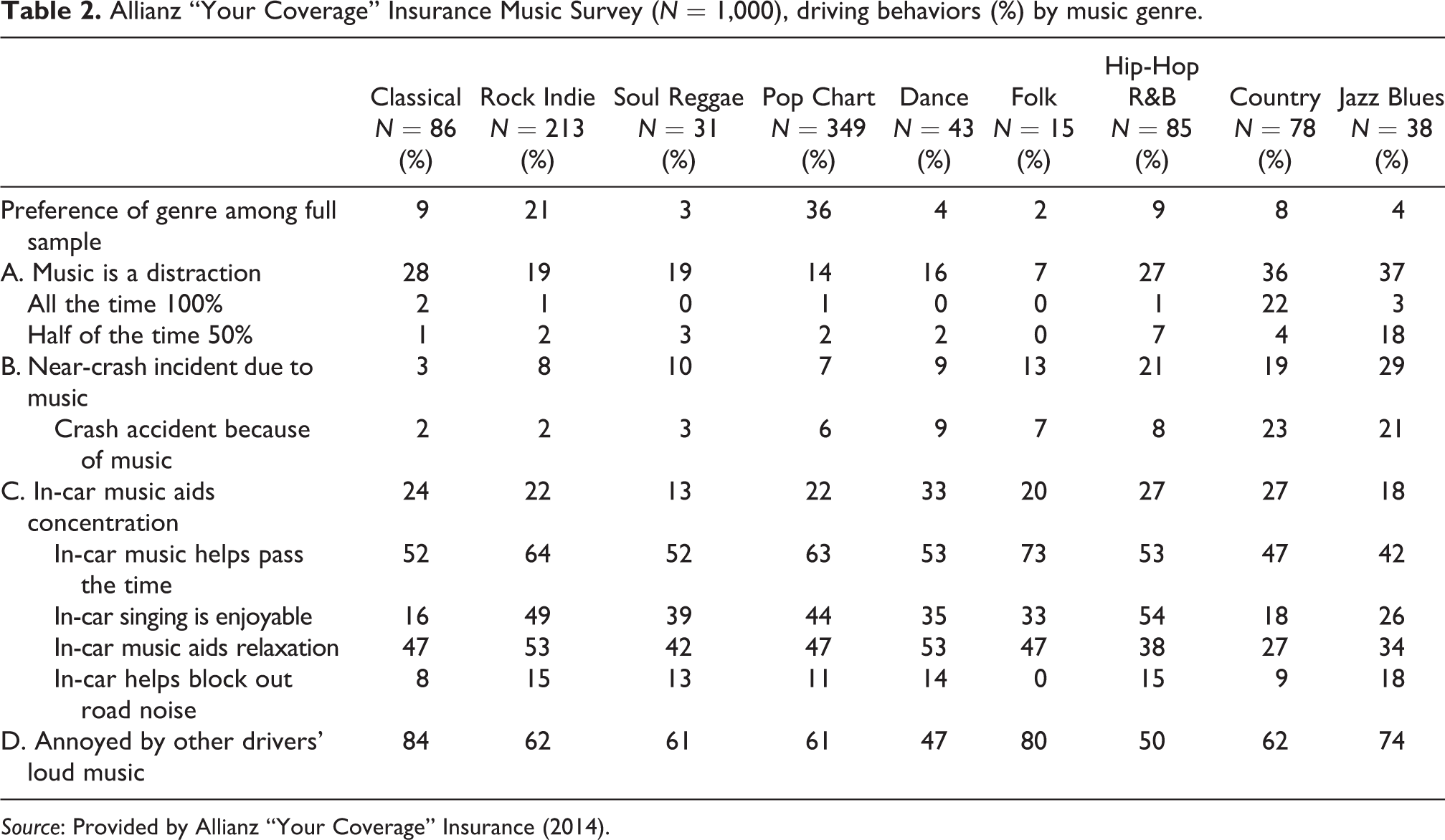
Source: Provided by Allianz “Your Coverage” Insurance (2014).
Discussion
Among other findings that surface from the above survey studies is a phenomenon Brodsky (2015) labeled as music genre induced aggression. Drivers perceived this experience differently than music-generated distracted driving. Specifically, while drivers listening to Heavy Metal, House/Dance, Hip-Hop, Rap, and Hard Rock recounted aggressive driving most often, they also conveyed that when they listen to songs with lyrics of a neutral content, the incidence of aggressive driving was roughly one in five (20%), but when listening to songs with hostile lyrics in either Heavy Metal or House/Dance genres, negative affect increased by another 28% to an overall incidence of 48%. Such a picture is similar to that reported by Smith and Boyson (2002), who investigated the prevalence of violence among a corpus (N = 1,984) of music video clips: aversive and harsh violence was most prevalent in Rap (29%), Heavy Metal (27%), and Rock (12%) music videos compared to other music genres. Finally, the survey studies are in line with Anderson et al.’s (2003) extensive critical review suggesting a link between music genres and maladaptive behaviors: those preferring Rap and Heavy Metal exhibited more hostile attitudes than those who preferred Alternative, Dance-Soul, or Country. Nonetheless, driving research has not yet explored such a link between aversive music genres and driver behavior, let alone the effects of violent lyrics on vehicular performance. With this in mind, we implemented a driving simulator study to evaluate these links.
Driving simulator study
The main purpose of the current study was to explore the impact of songs from aversive genres containing violent content on driver performance. To our knowledge, this is the first ever attempt to empirically differentiate between music-generated distraction and music genre induced aggression. We compared repeated simulated driving while listening to two pairs of exemplars, each by the same performer in the same genre, whereby one contained violent lyrics whereas the other contained neutral lyrics. Further, we compared between the same pieces as sung vocals versus instrumental renditions, to account for the possibility that some listeners might not pay attention to lyrics at all, and hence finding effects for instrumental renditions possibly point to aspects of musical genre that still evoke negative effects. Finally, we included a control condition in which participants drove without music background.
Methods
Participants
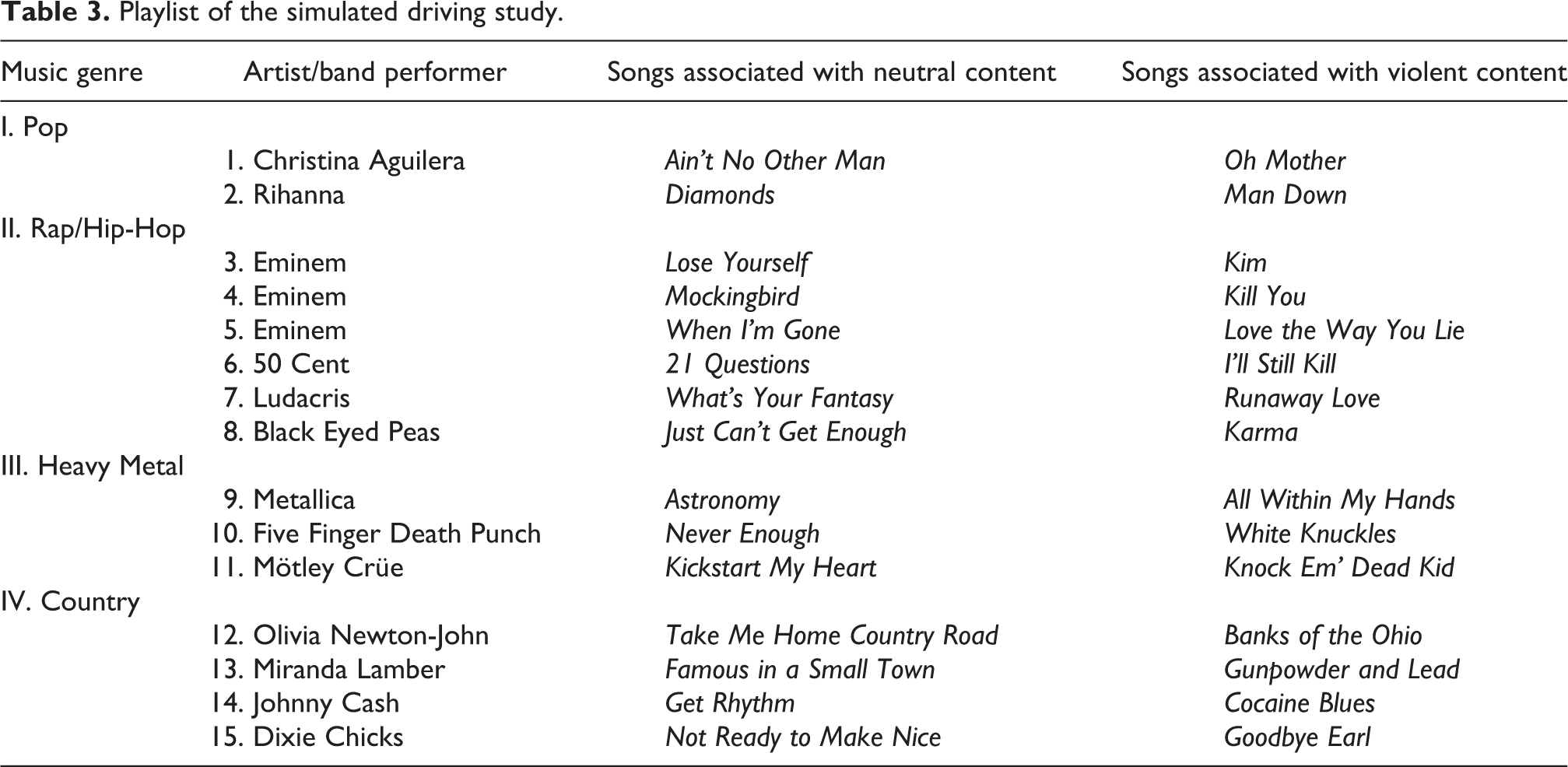
A total of 50 drivers from New South Wales, Australia, participated in the study; 37 were psychology undergraduates from Macquarie University. The inclusion criteria required that participants (1) held a valid driver’s license, (2) would self-report to always listen to music when driving, (3) wee acquainted with Pop, Rap/Hip-Hop, Heavy Metal, and Country music genres, and (4) were familiari with two music items by the same performing artist from a 30-item playlist (as listed in Table 3). The data from one participant were removed because of noncompliance. The final sample (N = 49) consisted of young adults (M Age = 19.80, SD = 2.75; 71% = female). The participants had held a driver’s license for an average of 4 years (M Years = 3.6, SD = 2.70, range = 1–14), drove on a daily basis (M Days per month = 24, SD = 9.89), and less than a third (32%) had previously received a traffic violation.
Playlist of the simulated driving study.
Driving simulator
The driving simulator was a fixed-base STISIM Drive (Model 400); this model is reported to have high ecological validity (de Winter et al., 2009). The simulator employs features found in an automatic transmission vehicle cabin; adjustable car seat with seat belt, accelerator and brake pedals, steering wheel, turning indicator, warning horn, and dashboard display (speedometer, tachometer, odometer; see Figure 1). The simulator was powered by three 2,349 Hz networked computers (Dell, DXP061) and three 17-inch monitor screens providing a 135° visual field. Vehicle and road sounds were reproduced by an external audio system (Altec Lansing, Model V54121) with speakers positioned at the left and right of the visual display; a central subwoofer for lower frequencies and vibrotactile sensations was placed under the driver’s seat. The simulator was preprogrammed to log five performance variables: speed exceedances (frequency and distance traveled), lane deviations (frequency and distance traveled), and collisions (frequency).

STISIM Drive 400 driving simulator.
Four driving scenarios were programmed: three short trips of roughly 3.75 km (2.33 miles) and one longer trip of 6.5 km (4 miles). The trips were on average of 8-min duration; they occurred during daylight hours with sunny weather, in suburban, inner city, and highway traffic environments. The roadway consisted of two lanes in each direction, at 50 kph (31 mph) speed limits for three trips that increased to 90 kph (56 mph) for one trip. Each trip included three provoking events (i.e., a vehicle tail-gaiting and honking the driver) followed by a sudden hazardous event (i.e., pedestrians jaywalking) occurring at 2:30, 5:00, and 7:30 min. A pre-study pilot (N = 16) confirmed that no event was too easy to always be avoided, and none were too difficult to always cause a crash.
Music stimuli
The experiment employed 30 songs; each containing either violent or neutral content. Violence was defined as: any overt depiction of a credible threat of physical force or the actual use of such force intended to physically harm an animate being or group of beings…[including] depictions of physically harmful consequences against an animate being or group that result from unseen violent means. (Smith & Boyson, 2002, p. 66)
An audio file was constructed in a standard fashion for each participant for each of the four trips: (1) vocal version song (V-V or N-V) [2:30 min]; (2) silence [3 s]; (3) instrumental version of same song (V-I or N-I) [2:30 min]; (4) silence [3 s]; and (5) no-music silence [2:30 min]. The music conditions (violent vs. neutral content, vocal vs. instrumental renditions, music vs. no-music) were counterbalanced across the four trips for the same participant as well as across the sample between participants. Audio files were reproduced with an Apple iPad coupled to two speakers (Logitech, Model S-02648) placed on the floor to the right and left of the simulator. Volume was controlled at approximately 70 dBA.
Design and procedure
Prior to onset, a Human Research Ethics Committee approved the study. After coupling the seat belt, each driver listened to a 2-min excerpt of each of the four songs (two V-V pieces and two N-V pieces) chosen for their trips; this exposure acclimated the drivers to the songs in an effort to offset possible artifacts that might arise from unfamiliarity. Then there was a 2-min practice drive, after which the experiment monitor left the room, and participants completed four trips, with a 3-min rest period between trips. Every participant completed each drive at their own pace. The entire session (roughly 60 min) was captured by a digital video camera.
Data analysis
Data were analyzed with five repeated measures analyses of variance (ANOVAs) to evaluate main effects of the five driving conditions (V-V, N-V, V-I, N-I, NoMusic) for each of the five dependent variable outcome measures (frequency of excessive speed, distance of driving above the speed limit, frequency of lane deviation, distance out of the mid-lane, and frequency of crashes; see Table 4). When the assumption of sphericity was violated as indicated by Mauchley’s Test of Sphericity, and Greenhouse–Geisser epsilon was <.75, then both F-values and associated significance for a Greenhouse–Geisser correction were employed. However, when the Greenhouse–Geisser epsilon was >.75, and therefore too conservative, then both F-values and associated significance for Huynh–Feldt correction were employed. Subsequently, planned pairwise comparisons ensued to test differences between the driving conditions themselves.
Outcome variables of the simulated driving pilot study.

aFrequency (n).
bMeters (m).
Results
Accelerating above the speed limit
A repeated measures ANOVA indicated a statistically significant main effect of the driving conditions (F
(2.97,142.35) = 3.342, MSe = .564, p = .022,
Distance driving over the speed limit
A repeated measures ANOVA indicated a statistically significant main effect of the driving conditions (F
(3.28,157.52) = 3.715, MSe = 27737.61, p = .011,
Lane deviations
A repeated measures ANOVA did not indicate a main effect of the driving conditions (F
(4,192) = 1.770, MSe = .182, p = .136,
Distance deviating from the lane
A repeated measures ANOVA indicated a main effect of the driving conditions that was near levels of statistical significance (F
(2.13,102.02) = 2.887, MSe = 1575.01, p = .057,
Crashes
A repeated measures ANOVA did not indicate a main effect of the driving conditions (F
(4,192) = 1.101, MSe = .160, p = .357,
Discussion
The purpose of the current study was to explore whether aggressive driving behavior might result not simply from the effects of in-car music, but specifically from aversive music genres that use hostile lyrics and content promoting violent texts and imagery. The first finding supports earlier reports by Brodsky (2002), Brodsky and Kizner (2012), and Brodsky and Slor (2013): driving with music impacts accelerated speed. In the current study, frequency of speed exceedances and the duration of driving above the speed limit were higher when driving with music, whether or not the background included lyrics. Nonetheless, a second finding demonstrates the impact of songs containing hostile content in the form of violent lyrics and imagery: Participants deviated from their lane more often and for a longer distance with songs of neutral content, whereas they accelerated above the speed limit more often and for a longer distance with songs of violent content. These findings are in line with Mesken et al. (2007) and Pecher et al. (2009), who found that that energetic music boosted excitement, resulting in decreased lateral control, increased excursions from the lane, and an increased tendency to stray onto the hard shoulder, while drivers who were exposed to hostile music demonstrated increased cruising speeds and a higher percentage of time that speed limits were exceeded. A third finding of the current study sheds light on the presence of lyrics in music while driving a car. We addressed whether the ill effects of in-car music depended on the presence of language (i.e., attention to the semantic meanings of the text or to phonological memory, retrieval, and rehearsal of singing the text); that is, the current study examined whether music void of concrete language (i.e., an instrumental version) induced similar emotional states as did the vocal renditions. This question is pertinent because there is the possibility that some drivers do not listen to lyrics presented in the songs, but rather that the characteristic features within a music style may still evoke emotional responses (both positive and negative). Critically, the study found no statistical differences between the two instrumental subtypes (violent vs. neutral content). Nonetheless, comparisons between neutral content vocal performances and the associated instrumental renditions indicated that the latter caused drivers to exceed speed limits significantly more frequently (and for a longer distance) as well as caused them to deviate more from the lane (and for longer distances). However, such differences were not applicable to exemplars with violent content; that is to say, both renditions with or without lyrics carried similar effects. One possible explanation might be that violent and/or aggressive affect associated with textual content is indeed transferred to the music itself. Finally, the study found no differences of crash rate between driving conditions (music style type or no-music background). This finding is similar to those of Abdu et al. (2012), who concluded that while induced anger certainly affects driving style, drivers in simulated driving studies are not necessarily affected to the extent that they can no longer maintain vehicular control.
General discussion and conclusion
Everyday drivers anticipate taking their music along for the ride, and they have been doing so since the 1930s when mass ownership of the automobile paralleled the growth of domestic technologies such as the radio, gramophone, and telephone (Brodsky, 2015). Now, leading up to the first century after the advent of the car radio, newly developed entertainment technologies, loudspeaker configurations, and ergonomically designed acoustic interiors have more than influenced social perceptions about in-car music. Subsequently, in-car music has leaped from simply being an accessory for driving, to being more of the purpose for using the car—at least among younger drivers. In an extensive review of the literature, Brodsky found that the range to which drivers recognize in-car music as a fundamental component of the driving experience is between 72 and 100%, and the “car” is the location most often mentioned for existentially strong experiences with music. Yet, as the current study indicates, drivers need not only account for the actual presence of music while driving, but should explicitly consider that particular aversive music genres, especially when employing violent content, may elicit emotional states that induce aggressive driving styles.
While the last decade has seen just a few initiatives exploring the more general aspects of in-car music, none have attempted to disentangle music genre as a specific variable of impact on automotive control. Nevertheless, for at least a decade, some drivers have been reporting music-related driving behaviors resulting from particular music genres among Internet posts, newsprint articles, magazine exposes, and the tabloid press. Yet little to no empirical evidence has surfaced to corroborate or dismiss such reports. Among the strengths of the current investigation, then, are our collation of these data, and in two cases the tabulation of the raw data that we were able to access and revise from the original sources. Hence, we have attempted to fill a gap toward seeking some form of conceptual underpinning to substantiate the phenomenon. Despite the noted limitations surrounding the collection of these commercially produced datasets, these materials can serve as prima facie evidence offering researchers a starting point for future explorations regarding the effects of media delinquency and risk-promoting popular culture involving aversive music genres on everyday drivers. Such ill effects were previously referred to by Brodsky (2015) as music genre induced driver aggression.
A clear strength of the current simulator study was that it specifically employed a broad range of four music genres that are known as overwhelmingly hard-hitting to begin with, and then in an effort to explore the impact of aversive elements found in music on aggressive driving it had participants also listen to another set of songs with violent content. The simulator study revealed that aversive song lyrics from particular music genres had an impact on actual aggressive driving behavior. The findings suggest that differences in potentially unsafe driving may not only be due to the general presence of music, but that such negative behaviors differ depending on the particular nature of the music itself. Hence, the investigation was successful in providing a better explanation (and perhaps prediction) of aggressive driving behavior by accounting for music genre, rather than continuing to target a specific parameter or feature of music as an independent variable (such as volume, tempo, or valance), which has been the accepted practice in the past.
The main limitation of the study is that our platform consisted of simulated driving. We acknowledge that driving simulators provide drivers with an artificial environment, and these conditions are never quite the same as real driving conditions. For example, the longitudinal and lateral accelerations are limited, and only parts of the extremely complicated transport system can be simulated. It should be noted that the differences between the simulated and the real driving environment may influence subjects’ driving behavior and performance, and hence our outcome measures (vehicular performance data collected via the driving simulator) may differ from the same measures had we collected them during real-world on-road naturalistic driving. On the other hand, we point out that the main advantages of driving simulators are their fundamentally safe environment for participants of driver behavior research, and they can be easily and economically configured to investigate a variety of human factors. Moreover, a driving simulator is linked to digital computer systems that provide online storage and the reduction of data streams into custom-made compacted arrangements of data, as well as allow for data formatting, processing, and analyses based on specific research needs, all the while controlling the experimental conditions over a wider range of variables than can usually be accommodated when employing naturalistic driving.
In terms of the General Aggression Model (GAM), our results can be interpreted as tapping into the proximal factors of that model. The situation in which drivers are placed, namely exposure to music while driving in (virtual) crosstown traffic, is able to have an effect on their internal state by producing arousal which may also lead to aggressive priming (as is the case when exposed to media violence). The outcome phase of the proximal component of GAM can be used to interpret some of the results of the simulator study. For example, Pecher et al. (2009) had previously reported that angry drivers showed increased cruising speeds and an increased percentage of time over posted speed limits. If the violent content of the songs played to the driver (a proximal situational input according to GAM) produces anger via arousal, and this results in aggression according to GAM, then we would expect an increase in the percentage of time over the speed limit (in the violent music condition in the simulated drive). This was indeed one of our findings. Furthermore, our suggestion that the textual context of the music may be transferred to the music itself is also interpretable in the light of GAM, that is, the music itself produces sufficient arousal and anger to result in speed exceedances and lane deviation. Finally, the interpretation of our last result is similarly compatible with GAM—although it does not test it directly. That is, the aggression produced may simply be insufficient to result in the grossest measure of vehicular control: crashing. In summary, the results of the simulator study may be interpreted in the context of GAM, although we point out that our aim in the current simulator study was not to test GAM.
Clearly cars are here to stay, and in-car music listening will forever be part of vehicular performance. To this end, we feel that an increased number of investigations need be undertaken by traffic-related human factor researchers, as well as by music psychologists, targeting the effects of in-vehicle background music on driver behavior and automotive control.
Footnotes
Contributorship
WB, DO, and EC researched the literature and conceived the study. WB was responsible for the survey material, driver testimonials, and overall supervision of all music science aspects of the study. DO and EC were responsible for the driving simulator, including: design, programing, ethics approval, participant recruitment, and data analysis. WB, DO, and EC, wrote all drafts of the manuscript including edited revisions and approved the final version of the manuscript.
Declaration of conflicting interests
The author(s) declared no potential conflicts of interest with respect to the research, authorship, and/or publication of this article.
Funding
The author(s) received no financial support for the research, authorship, and/or publication of this article.
Peer review
Alex Lamont, Keele University and one anonymous reviewer.