



Abstract
Stylistic and pitch-related data derived from the score of Alkan’s Petits Préludes for organ are analyzed using nonparametric correlations and multidimensional scaling, and the results used to reconstruct his compositional process. The reconstruction is then verified by comparing it to an existing cognitive model of musical composition and Alkan’s use of multiple compositional constraints discussed as an example of a strategy employed by master composers to reduce their problem space. The tidy fit of the reconstruction to the model and the agreement of the evidence with a number of previous findings and hypotheses concerning the cognitive processes underlying musical composition strongly suggests that the model and similar analyses of musical variables could be applied to works by other composers and used as a basis for or an adjunct to musicological and psychological studies of the compositional process, particularly when limited to a post hoc analysis or by a finite dataset.
Introduction
Investigations of the cognitive processes underlying musical composition are relatively scarce in music psychology and have mostly used students and novices as subjects, rather than expert composers (Collins, 2005; Donin, 2012). McAdams (2004) attributed the scarcity of such studies to the difficulty of ascertaining exactly what is happening in the mind of the composer on the basis of external manifestations of the compositional process such as talking, writing, drawing, or sketching. However, these external manifestations have themselves formed the basis of the three investigative methods so far employed in this research area: (1) the examination of the composer’s written manuscripts and sketches, (2) the examination of retrospective statements by the composer about their compositional procedures, and (3) the observation of the composer during the process of composition, often resulting in a verbal protocol (Sloboda, 1985, pp. 102–103). For example, Method 3 was used by Reitman (1965) to describe the composition of a fugue for piano, Method 2 by Sloboda (1985, pp. 125–138) to describe the composition of a choral piece, and Methods 1 and 2 by McAdams (2004) to track the composition of a piece for piano, chamber orchestra, and computer from conception to concert premiere. Moreover, the persistence of these methods as research tools is shown by recent single-case studies of the compositional process that have used them in conjunction with computer-based sketches and data collection. For example, Methods 1 and 2 were used by Donin and Theureau (2007, 2008) to track the composition of pieces for solo voices, instruments, and electronics, and all three methods by Collins (2005, 2007) to track the compositional processes of a professional composer in real time. However, although all three methods can give psychological insight into the compositional process, Method 1 depends on the availability of manuscript evidence, and Methods 2 and 3 depend on the availability of the composer. Consequently, studies in this area have been biased toward the investigation of contemporary or recent music as older music is harder to investigate, being dependent on the survival of documentary evidence such as preliminary compositional sketches or the testimony of composers concerning their working methods, both of which become scarcer the further one goes back in time (Cook & Clarke, 2004, p. 4). In this study, a fourth method for investigating the cognitive processes underlying musical composition will be used which attempts to redress this imbalance and can serve as a useful adjunct or complement to the other three methods, particularly when only a post hoc analysis of the compositional process can be carried out. As this situation applies to the vast majority of older music where no compositional sketches exist, the composer is either deceased or made no statements about their compositional procedures, or there is no possibility of observing the composer during the act of composition, the method described here therefore broadens the scope for enquiry.
Methodology
In a discussion of statistical and methodological issues in music research, Huron (1999) highlighted a major difference between unbounded-data (data-rich) and finite-data (data-poor) research fields: in the former, a high standard of statistical evidence is expected as researchers are able to collect additional data for interpretation if the available evidence is inadequate; in the latter, the scope of statistical analysis is limited as researchers have little or no control on the data available to them and are unable to collect additional data for interpretation. Noting that music research qualified as a finite-data field due to the prevalence of small datasets, Huron (1999, 2013) proposed two solutions to the statistical limitations imposed by finite data. The first is that the statistical assumptions made in unbounded-data research should be relaxed when investigating a finite musical dataset (e.g., the “standard” confidence level of α = .05 should be increased to .1 or even .2) as finite-data fields cannot be expected to satisfy the high standards of statistical evidence expected in unbounded-data fields (Huron, 1999). The second is that music researchers should avail themselves of the information provided by musical databases on the Internet and digital musical representations derived from scores to create large datasets that can then be analyzed using the empirical methods and statistical techniques employed in unbounded-data fields (Huron, 1999, 2013). This particular solution has become increasingly popular in recent years (e.g., see the two issues of Music Perception in September 2013 and February 2014 devoted to musical corpus research) and has almost become the object definition of systematic/empirical musicology—for example, “musicology that embodies a principled awareness of both the potential to engage with large bodies of relevant data, and the appropriate methods for achieving this” (Cook & Clarke, 2004, p. 5). However, an alternative solution to the statistical limitations presented by finite musical datasets is to analyze them using nonparametric (rank-ordered or distribution-free) statistical tests or graphical methods such as multidimensional scaling (MDS) as these techniques make fewer statistical assumptions about the data than tests designed for larger sample sizes (e.g., the variables are normally distributed), thereby rendering them suitable for analyzing small datasets and enabling the “standard” confidence level of α = .05 to be used (Everitt & Dunn, 2001; Tomkins, 2006).
Outline of study
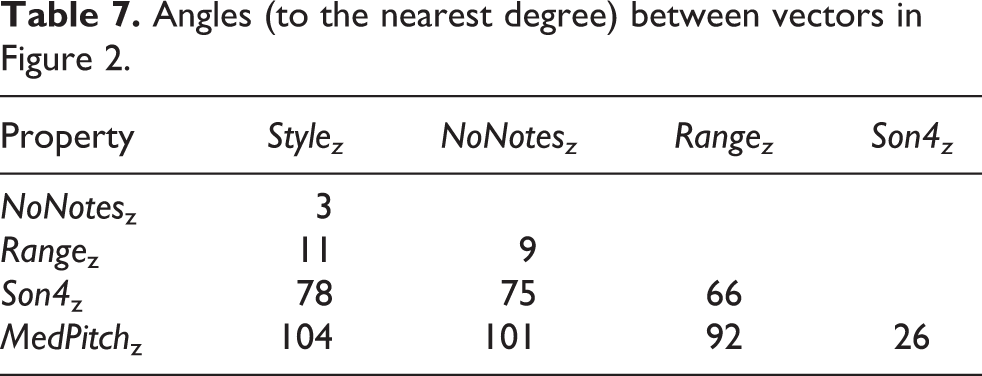
To demonstrate how the application of nonparametric and graphical techniques to finite musical datasets such as individual compositions or small corpora can result in a meaningful and consistent analysis of the compositional process, this article describes the analysis of a collection of eight organ pieces published in 1859 by the composer Charles-Valentin Alkan. Here, only a post hoc analysis of the compositional process can be carried out as there is no possibility of questioning Alkan, very few of his written manuscripts and none of his sketches exist, and he made no statements about his compositional procedures. Consequently, all the (musical) evidence is confined to the published score and the dataset is severely limited.
The study itself takes the following form. An informal observation by the author on the ordering of the pieces with respect to chronological style is confirmed by an examination of the score. The findings are then used in conjunction with nonparametric correlations to derive a set of pitch-related variables that are analyzed using MDS in order to reveal the relationships between the pieces. Converging evidence indicating a hierarchy of compositional constraints—where two sets of interrelated variables were manipulated by the composer in conjunction with a predetermined symmetrical patterning of six structural variables—is then used to reconstruct Alkan’s compositional process. Next, the plausibility of the reconstruction is assessed using two different interpretative frameworks. First, in Brown's (2003, 2012) adaptation of Sloboda's (1985) cognitive model of musical composition, the hierarchy of compositional constraints is examined to see whether the reconstruction is consistent with the model. Second, in Pearce and Wiggins’ (2002) cognitive theory of creativity in musical composition, the reconstruction is interpreted as a problem-solving issue and Alkan’s use of multiple compositional constraints discussed as an example of a strategy employed by master composers to reduce their problem space. After a further discussion of the findings with respect to the constraint-based/information-processing approach of Pearce and Wiggins (2002), the multiple strands are integrated and reviewed in the “General conclusion”.
At this point, it should be noted that the purpose of this study is not to find a precise mathematical fit of the pieces to a predetermined configuration in a multidimensional space, but to use statistical and graphical techniques to reveal the underlying structure of the composition and the organizing principles and compositional constraints used by the composer which can then, in turn, be used to reconstruct the compositional process. Furthermore, although a number of assumptions have to be made when conducting the analysis, it will be seen that (1) the findings are internally consistent and agree with previous findings and hypotheses concerning the psychological processes underlying musical composition such as those of Sloboda (1985) and Pearce and Wiggins (2002), and (2) the compositional process derived from the findings is plausible and also gives some insight into the nature of problem-solving in musical composition. The study therefore shows the value of using nonparametric statistics and MDS to investigate a finite musical dataset, suggesting that similar analyses could be applied to works by other composers and used as a basis for or an adjunct to musicological and psychological studies of the compositional process.
Background
The pianist and composer Charles-Valentin Alkan (1813–1888) was a child prodigy who entered the Paris Conservatoire at the age of six. By his mid-20s, he was widely regarded as a piano virtuoso only rivaled by Liszt, whom, with Chopin and George Sand, he counted as one of his friends. However, with the promise of a glittering concert career in front of him, Alkan retired into seclusion and a life devoted to biblical studies, and his appearances on the concert platform became more and more sporadic. His change in lifestyle is also reflected in his output after this time, where multiple works (either collections of pieces or individual pieces) are often published together in the same year with a gap of a number of years until the next set of publications (Smith, 2000). Although Alkan is best known for his large-scale works for solo piano, such as the Symphony and the Concerto (Op. 39 Nos. 4–7 and 8–10), he also wrote a large number of miniatures that were published as collections (e.g., the 25 Préludes Op. 31 or the 48 Esquisses Op. 63). In these collections, there is typically a methodical ordering of pieces by key (see Table 1) and often a systematic variation in their musical characteristics (François-Sappey, 1991b; Waeber, 2006). For example, in the Esquisses, there is an ordered variation in texture such that Ressouvenir (No. 13) consists mostly of a simple unaccompanied melodic line, Duettino (No. 14) is written for two voices, the Petit prélude à 3 (No. 17) is written in the style of a string trio, Début de quatuor (No. 31) is written in the style of a string quartet, and the Petit air à 5 voix (No. 42) consists of five-note chords throughout. Similarly, but on a larger scale, the tempi of the four movements of the Grande Sonate Op. 33, each of which represents a stage in a man’s life, get progressively slower to illustrate the increasing age of the protagonist (François-Sappey, 1991a). However, Alkan’s methodical and systematic approach to large-scale structuring is sometimes reflected on a smaller scale in some of the individual pieces in these collections. For example, Laus Deo, the final unnumbered piece of the Esquisses, is cast in a quasi-palindromic five-section form A-B-C-B′-A′ where A and A′ evoke the tolling of bells, A consists of five phrases, B and B′ employ quintuplets, both halves of C are five bars in length and written in the form of a five-part chorale, and five bass notes are used in A′ (Blacklock, 2005, p. 49; François-Sappey, 1991b).
Key sequences in Alkan’s works (lower-case letters refer to minor keys).

The work under consideration in this article, the Petits Préludes sur les huit gammes du plain-chant (henceforth, Petits Préludes—see Alkan (1859) for an online edition), appeared as two suites (Nos. 1–4 and 5–8) in the music supplements of La Maîtrise, a monthly journal for church music founded by Louis Niedermeyer and Joseph d’Ortigue, in August and September 1859. Niedermeyer and d’Ortigue were both devotees of plainchant and early church music (Garceau, 1984), and there is considerable evidence attesting to Alkan’s own interest in early music (Himelfarb, 1997; Waeber, 2003). Firstly, he held a series of Petits concerts de musique classique from 1873 to 1880, where he played works by Couperin, Rameau, JS Bach, Handel, and Scarlatti. Secondly, he published piano transcriptions of works by Bach and Handel. Finally, a significant number of his compositions are written in the style or genre ancien (e.g., Gigue et air de ballet dans le style ancien Op. 24, Dans le genre ancien Op. 31 No. 3, Duettino Op. 63 No. 14 with its reference to Scarlatti, Tutti de Concerto dans le genre ancien Op. 63 No. 15, and Petit air (genre ancien) Op. 63 No. 26)—a point which will we will return to below. Until now, the Petits Préludes have been relatively overlooked compared to Alkan’s other large-scale works. However, what attention they have received has often mentioned their concentrated, interlocked nature. For example, Smith (1988) states that the Petits Préludes are: the only music Alkan published solely for organ. These tiny pieces, for manuals alone pass progressively, in as many minutes, through the eight Gregorian modes. The sequence, which is indivisible, seems to stand outside the barriers of time and space….
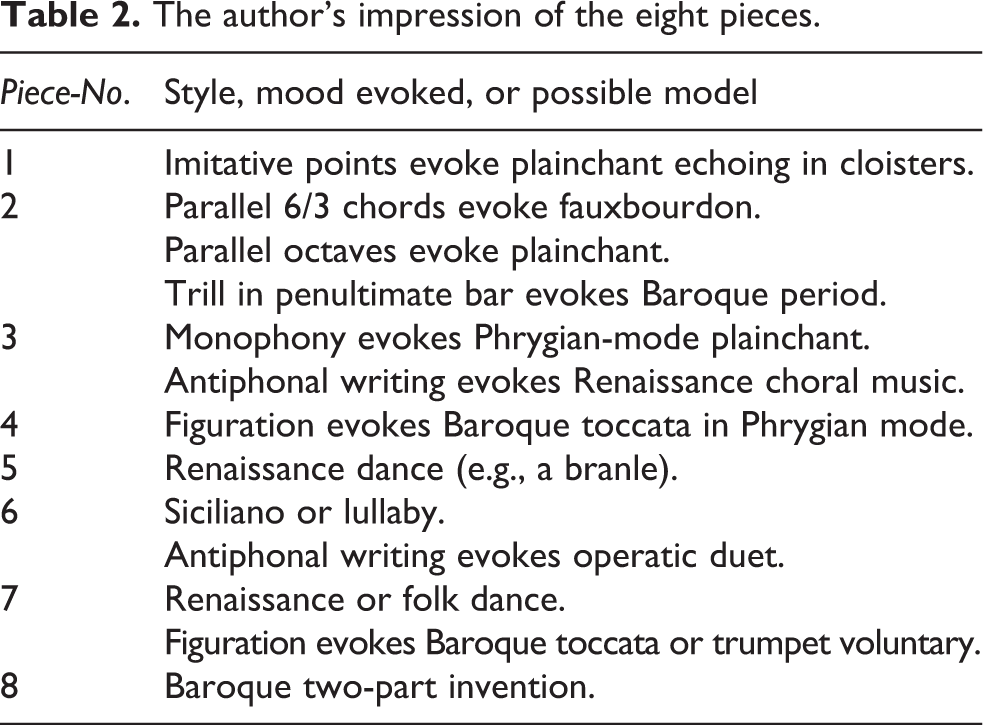
At first glance, all that the eight pieces of the Petits Préludes would seem to have in common is that each one is based on a different Gregorian mode, all pieces are harmonized modally, and all end with sustained note(s) corresponding to the modal “tonic” of the piece. However, while listening to the Petits Préludes one day, the author was struck by an apparent ordering of the pieces by chronological style where Nos. 1–4 seemed to have more of a plainchant/medieval character than Nos. 5–8, which instead seemed reminiscent of Renaissance and Baroque music. The author’s impressions of the style and possible models for each piece are given in Table 2, and it can be seen that the style characteristics clearly suggest the existence of a broad chronological progression across Piece-No. This indication that the Petits Préludes might be organized by chronological style, as well as Alkan’s propensity for large- and small-scale musical structuring, suggested that a closer look should be taken at other structural variables associated with the pieces. Table 3 shows, for each piece, the “tonic” of the Gregorian mode (Tonic), whether the mode is authentic or plagal (Mode), whether imitation occurs between the left and right hands (Im), whether parallel octaves occur (P8), the initial sonority of the piece (Ison), and whether the piece is in duple or triple metre (Metre). Table 3 clearly shows that Mode, Im, P8, Ison, and Metre follow the same pattern in each suite, and a further grouping of these characteristics also occurs such that (1) only imitation (Im) is used when Ison = single note, (2) both imitation (Im) and parallel octaves (P8) are used when Ison = chord, and (3) only parallel octaves (P8) are used when Ison = octave. The systematic ordering of these variables in each suite therefore not only strengthens the case for the existence of a broad ordering of the pieces by chronological style, but also suggests that the Petits Préludes may well be ordered on the basis of other factors or principles. With this in mind, let us consider the nature of the style progression in more detail.
The author’s impression of the eight pieces.
Structural variables (tick = present, cross = not present).

Style progression
Table 2 clearly suggests the existence of a broad progression in chronological style across Piece-No. However, this raises a number of questions. For example, did Alkan actually incorporate a style progression into the Petits Préludes in the first place and, if so, how was this achieved and would his intended audience have been able to perceive it? Fortunately, evidence to answer these questions appears if we consider the style elements Alkan used when composing the Petits Préludes, the way he combined them, and the perceptual effect of the combinations when the pieces were played consecutively.
Pearce and Wiggins (2002) have stated that “to compose music whose structure may be perceived by the listener…there must be some kind of alignment between the compositional mechanisms of the composer and the perceptual mechanisms of the listener.” According to Pearce and Wiggins (2002), this alignment occurs when both composers and listeners, due to their common experience within a specific culture, share a “conceptual space” of ideas that is defined by the corpus of existing musical compositions in that culture. Therefore, if the conceptual space of a composition needs to be shared by both the composer and listener in order for the audience to perceive its structure, then this situation should also apply in the case of the Petits Préludes for any style progression to be perceived. Now, although Alkan and his intended audience (Niedermayer, d’Ortigue, and the subscribers to La Maîtrise) had a high degree of musical training, their knowledge of early music was limited due to the few transcriptions available at the time the Petits Préludes were composed, medieval musicology being in its infancy. As a result, Alkan and his intended audience all shared a conceptual space characterized by a knowledge of early music that was limited to an awareness of obvious or superficial style elements. Therefore, to create a perceptible style progression across Piece-No., Alkan would have had to use early-music style elements available to him that would have been clearly recognized by his intended audience.
Himelfarb (1997, pp. 32–33), from an examination of Alkan’s 25 Préludes Op. 31, determined that Alkan used a number of principal style elements in his genre ancien works to evoke “l’esprit de pieces anciennes.” Significantly, although these genre ancien style elements (henceforth, GASEs) are found in only 8 of the 25 Préludes, they are present either singly or in combination in all the Petits Préludes. For example, fugal entries without development, including overlapping imitation between the left and right hands, are found in Nos. 1, 2, 5, 6, and 7 (this differs from the structural variable Im, which includes nonoverlapping imitation between the hands); Alberti basses or formulaic and repetitive left-hand figurations are found in Nos. 1, 3, 4, 5, 6, 7, and 8; homophonic sequences in parallel motion composed of 3- and/or 4-note sonorities are found in Nos. 2, 3, 5, 6, 7, and 8; monophony or evocations of monophony are found in Nos. 1, 2, 3, 4, and 6; antiphony or evocations of antiphony are found in Nos. 3 and 6; toccata-style passages using running semiquavers are found in Nos. 4 and 7; passages using parallel thirds (see Op. 31, No. 3 “Dans le genre ancien”) are found in Nos. 2, 3, 5, 6, and 7; and left-hand pedal points or drone basses are found in Nos. 6, 7, and 8. This strongly suggests that Alkan created the style progression by using different combinations of the GASEs to give each of the Petits Préludes a specific relative chronological “flavor.” To investigate this possibility, the GASEs were first laid out in tabular form for each of the Petits Préludes in which they occurred (see Table 4). Next, for each GASE, the total in terms of Piece-No. divided by the number of pieces in which that GASE occurred was calculated in order to give a measure of how “ancient” Alkan perceived it to be (see Table 4, bottom row). Finally, to find the relative location of each piece in the style progression on the basis of its GASE combination, the bottom-row GASE values were substituted for their respective occurrences in the main body of Table 4 and the mean GASE value calculated for each piece in order to ascertain its specific chronological “flavor” (see Table 4, column 10).
Bar numbers of the occurrences in the Petits Préludes of the principal genre ancien style elements (GASEs) identified by Himelfarb (1997).

aAlthough imitative points are exchanged between the hands, they are nonoverlapping.
bAs the sequence is first played in thirds, then exchanged between the hands and played in sixths, it is counted as an overlapping imitative point.
cAs the repetitive left-hand figurations in bars 1–5 and 9–12 form the lower parts of homophonic sequences, and that of bars 6–9 forms part of the imitative points exchanged between the hands, these occurrences are excluded from this category.
dDespite contrary motion in the 3- and 4-note sonorities, Alkan is clearly playing off monophony against homophony in bars 13–21.
eDespite contrary motion between the hands, this section is clearly homophonic in nature.
fAll in the left hand.
gThe alternation of the F-major chord and the E-note functions as a pedal plus lower auxiliary note.
hThe Alberti pattern on the C-major chord functions as a pedal. Also, note the internal right-hand pedals in bb. 6–7 on G, 8–9 on A, and 11–12 on A.
iPedals: bb. 4–5 on G, 8–9 on D, 15–17 on G. Also, note the internal right-hand pedals in bb. 10–11 (F and A), 12–13 (A and C).
When plotted against Piece-No. (see Figure 1), these mean GASE values show a clear monotonic increase in chronological “flavor” across Piece-No., indicating that Alkan did incorporate a style progression into the Petits Préludes and achieved this by using different GASE combinations for each piece so that both he and his intended audience perceived a monotonic progression in chronological style when the pieces were played consecutively. Furthermore, as the intended audience for the Petits Préludes consisted of Niedermayer, d’Ortigue, and the subscribers to La Maîtrise—a journal that focused on “plainchant, Palestrinian polyphony, and Bach’s organ music” (Ellis, 2005, p. 71; Garceau, 1984)—then the GASEs would almost certainly have been recognized by Alkan’s audience and the style progression perceived by them in a manner similar to the trace of the GASE means as shown in Figure 1. Finally, as Alkan and his audience all shared a conceptual space characterized by a knowledge of early music that was limited to superficial style elements, these findings strongly suggest that the hypothesis of Pearce and Wiggins (2002) that the conceptual space of a composition needs to be shared by both the composer and listener in order for the audience to be able to interpret it is correct, and that the GASE means in Figure 1 are the most accurate reflection of both Alkan’s compositional conception of the style progression and the way both he and his intended audience would have perceived it. For these reasons, as well as the fact that they provide an objective ordinal measure directly derived from Alkan’s oeuvre, the GASE means will therefore be taken as the measure of Alkan’s intended style progression and used in the remainder of this article to examine the compositional process he employed in the creation of the Petits Préludes.

The mean genre ancien style-element data from column 10 of Table 4 (GASE) plotted against Piece-No.
Analysis of pitch-related variables
The evidence above not only confirms the author’s impression that the Petits Préludes were ordered on the basis of chronological style, but also suggests that they might exhibit similar trends with respect to other musical parameters. To assess this possibility, the pieces were examined to see whether there were any other trends present, and it became apparent that there was a clear, systematic increase across Piece-No. in the number of pitches, the pitch range, and the proportion of 3- and 4-note sonorities. To confirm the existence of these trends, which would appear to be associated with the monotonic progression in chronological style across Piece-No., correlations were carried out between the GASE means and a number of pitch-related variables.
To carry out the correlations, the pieces were first converted to MIDI format and custom software was written in Matlab (www.mathworks.com) to quantify the MIDI pitches of each piece with respect to their total number, median, interquartile range, maximum, minimum, and standard deviation. In addition, the percentage occurrence of 1-, 2-, 3-, and 4-note sonorities in each piece was calculated, as well as the pitch range, which was assessed in terms of the number of pitches from the highest to the lowest note in each piece, rather than the number of semitones, as the pieces were all diatonic. Next, one-tailed nonparametric correlations (Spearman’s Rho—ρ) were carried out between the pitch-related variables and the GASE means—nonparametric because the GASE means were ordinal in nature, and one-tailed because the examination of the musical score indicated that the pitch-related variables increased in tandem with them. Significant correlations with the GASE means were found for the total number of notes, ρ(6) = .905, p = .001, the pitch range, ρ(6) = .881, p = .002, the percentage of 4-note sonorities, ρ(6) = .854, p = .003, and the median pitch, ρ(6) = .663, p = .037. These results strongly suggest that Alkan’s conception of the style progression encompassed not only the high-level effects of the GASE combinations on perceived chronological style, but also their low-level effects on musical structure. These low-level effects occur because the GASE combinations necessary to evoke later styles in the style progression such as Renaissance and Baroque not only result in fuller harmonies and textures as Piece-No. increases, but also in a corresponding increase in the total number of notes (NoNotes), the pitch range (Range), and the proportion of 4-note sonorities (Son4). For example, pieces predominantly featuring the Homophony GASE will not only have a later perceived chronological style compared to those predominantly featuring the Monophony GASE (see Table 4, bottom row), but also have a greater number of notes (NoNotes) and proportion of 3- and 4-note sonorities (Son4). Here, Range increases with Piece-No. as the pitch range expands to accommodate the increased number of notes, and MedPitch increases with Piece-No. due to its close relation with Son4, as the use of 4-note sonorities in “normal” music tends to result in chords and harmonies that lie in the middle or upper regions of the pitch range (Huron, 2001, pp. 17–18). Consequently, MedPitch will tend to be higher, rather than lower, as Son4 increases. This indicates that these four pitch-related variables are not only interdependent, but also that they can be considered as the low-level structural consequences of the decision to use different GASE combinations to achieve the style progression. Therefore, as these variables offer a quantifiable measure of the contribution of the GASEs to the resultant musical fabric of each piece, the GASE means should instead be taken purely as a measure of chronological style, yielding the following five musical variables for further analysis: (1) the GASE means/chronological style (Style), (2) the total number of notes (NoNotes), (3) the pitch range (Range), (4) the percentage occurrence of 4-note sonorities (Son4), and (5) the median pitch (MedPitch). Finally, it should be noted that while many other possible musical properties and variables could have been examined, these variables follow on naturally from one another and offer a parsimonious description of the high- and low-level structural effects of the GASE combinations on the pieces. Furthermore, limiting the number of variables to these five not only reduces the risk of ending up with a complex set of data that is hard to analyze or interpret, but also the risk of a variable exhibiting a significant effect by chance.
Analysis of musical variables
Multidimensional scaling
The interrelationships between the characteristics of the pieces were investigated using MDS, which enables us to see patterns or structures that are hidden in the data by recasting that data in the form of a spatial map that is easy to visualize and interpret. First, as the five musical variables were all measured on different scales, they were standardized by converting them to Z scores. The resulting variables—Stylez , NoNotesz , Rangez , Son4z , and MedPitchz —were then used by the SPSS ALSCAL program to create a dissimilarity matrix for the eight pieces of the Petits Préludes. Next, because the GASE means and Style variable are ordinal in nature, and because the significant pitch-related variables NoNotes, Range, Son4, and MedPitch were themselves derived from nonparametric correlations with the GASE means, a nonmetric (ordinal) rather than a metric (interval) MDS was used for the analysis. Therefore, the SPSS ALSCAL program processed the dissimilarity matrix using a nonmetric, Euclidean distance MDS model, with the data being treated as ordinal, matrix-conditional, and with tied ranks being allowed to stand. Finally, the initial MDS analysis found the stimulus configurations in one-, two-, and three dimensions and, for each dimensional configuration, the stress index or “badness of fit” was calculated. This was done on the recommendation of Kruskal and Wish (1978), who advise selecting a particular configuration as an optimal one on the basis of (1) an elbow in the plot of stress against the number of dimensions and (2) a stress value <.1. For the one-, two-, and three-dimensional configurations, the stress values were .104, .03, and .004, and the R 2 values were .96, .995, and .999, respectively. As (1) the greatest decrease in stress (the “elbow”) occurred between a one- and two-dimensional configuration, (2) the stress value for a two-dimensional configuration met Kruskal and Wish’s (1978) criterion of <.1, and (3) a two-dimensional spatial configuration is easier to interpret than a three-dimensional one, the two-dimensional configuration was selected for further analysis.
Property vectors
To interpret the two-dimensional MDS configuration, a form of linear multiple regression called ProFit analysis was used where a property of the objects is fitted onto the configuration by treating the objects’ x–y coordinates as the independent variables and the property as the dependent variable. Here, the independent variables were the coordinates of the eight pieces in the configuration, and the dependent variables were the five standardized variables used to create it (Stylez , NoNotesz , Rangez , Son4z , and MedPitchz ). This procedure was used because the spatial configuration of the cases in the configuration is based purely on the distances between them. Consequently, the axes contain no information about what each dimension represents and the variables have to be regressed over the configuration in order to interpret the dimensions objectively (Kruskal & Wish, 1978). The regression results are then used to plot lines through the configuration called property vectors, which show the direction through the configuration over which the stimulus properties increase. Table 5, which shows the regression parameters and fit statistics for each of the five standardized variables, indicates that the vectors fit the configuration very well. The predicted values for each piece on each vector (i.e., the values for each piece when a line is projected perpendicularly from each vector to each piece) were also calculated for later analysis (see Table 6). The vectors were plotted on the two-dimensional configuration by treating the unstandardized regression coefficients as single-point coordinates (for Dimensions 1 and 2, respectively) and connecting these points to the origin (see Figure 2). Here, for each vector (shown as a dotted line), the arrow at the end indicates the direction in which the variable increases over the configuration, and its length is proportional to the R 2 value in Table 5.
Regression parameters and fit statistics for property vectors in Figure 2.

Note. B 1 and B 2 are the unstandardized regression coefficients.
Predicted values for each piece on each vector in Figure 2.


The MDS configuration created from the five standardized variables with arrows showing the property vectors for each variable: S = Stylez , N = NoNotesz , R = Rangez , V = Son4z , and M = MedPitchz . Also shown are the arrows corresponding to the two orthogonal vector sets D 1 and D 2 (see text).
Figure 2 indicates that the MDS configuration results from the combined action of two sets of vectors, the first composed of Stylez , NoNotesz , and Rangez (D 1) and the second composed of Son4z and MedPitchz (D 2). To assess the degree of independence between the two vector sets, the angles between all possible pairs of vectors were calculated (see Table 7). The angle between the mean vectors for each vector set (represented by the solid lines D 1 and D 2 in Figure 2) was then calculated and found to be 89° (equivalent to a correlation coefficient of ρ = .017), indicating that the two vector sets are almost completely orthogonal (i.e., independent) to each other. This finding is also supported by the comparatively smaller mean angles between the individual components of the vector sets (8° for Stylez , NoNotesz , and Rangez , and 26° for Son4z and MedPitchz ). Next, to verify the existence of the two vector sets analytically and, more importantly, to determine their relative importance with respect to the MDS configuration, a principal component analysis (PCA) was carried out on the data. This procedure transforms a set of variables or a correlation matrix into a smaller set of orthogonal combinations called components, which account for the maximum amount of variance in the data and can be thought of as “average variables” akin to the D 1 and D 2 vector sets. Furthermore, after the components have been rotated to improve their interpretability by minimizing the number of variables having high loadings on each component while keeping them orthogonal, the degree to which each variable is correlated with a component is indicated by its component loading, and the importance of a component is determined by the proportion of the variance it accounts for. Therefore, a PCA with orthogonal varimax rotation was carried out on the Spearman’s ρ correlation matrix of the five MDS variables to extract two components, and a loading cutoff of .71 on the rotated components was chosen so that 50% of the variance in the original variable was explained by the component (Tabachnick & Fidell, 2007). The data were found to be suitable for this type of analysis as the Kaiser–Meyer–Olkin measure for the dataset was acceptable (KMO = .46), Bartlett’s test of sphericity χ2(10) = 26.03 (p = .004), all communalities were ≥.787, and only 3 of the 10 reproduced correlations were >.05 (Field, 2009; Tabachnick & Fidell, 2007). The rotated component loadings, shown in Table 8, indicate that the variables with loadings greater than the .71 cutoff were Stylez , NoNotesz , and Rangez for Component 1 and Son4z and MedPitchz for Component 2, thereby confirming the division of the vectors into the two orthogonal vector sets D 1 and D 2. In addition, the two extracted components accounted for 89% of the variance in the original variables, with Component 1 accounting for 53% of the variance and Component 2 accounting for 36% of the variance, indicating that D 1 is the more important of the two variable sets associated with the style progression.
Angles (to the nearest degree) between vectors in Figure 2.
PCA using Spearman correlation matrix: Rotated component loadings.

PCA: principal component analysis.
Alkan’s compositional process reconstructed
The findings above indicate that the MDS configuration reflects a systematic chronological progression in musical style that occurs across Piece-No. where the style progression is associated with, or realized by, increases in the values of two sets of interdependent variables: the first composed of Style, NoNotes, and Range (D 1), and the second composed of Son4 and MedPitch (D 2). Of the two variable sets associated with the style progression, the results of the PCA indicated that D 1 is the more important as it accounted for 53% of the variance, whereas D 2 accounted for 36% of the variance. Furthermore, Table 6 and Figure 2 indicate a fundamental difference between the D 1 and D 2 variables. In Table 6, the D 1 variables exhibit a monotonic increase as a function of Piece-No., which is reflected by the linear ordering of the pieces along the D 1 axis in the MDS configuration. Conversely, the D 2 variables exhibit a broad non-monotonic increase and no systematic or symmetrical ordering as a function of Piece-No., characteristics that are also reflected by the nonlinear ordering of the pieces along the D 2 axis. Initially, this would suggest that Son4 (and consequently MedPitch) was varied by Alkan in a superficial manner to ensure that there were low values for Nos. 1–4 and high values for Nos. 5–8 (see Table 6). However, if we review the statistical and circumstantial evidence from the point of view of Alkan’s compositional priorities when writing the Petits Préludes, a plausible and consistent picture appears that not only accounts for the secondary status of the D 2 variables, but also reveals that a hierarchical structure of compositional constraints determined the final form of the Petits Préludes. These constraints fall naturally into two discrete stages of the compositional process—planning and execution.
Stage 1: Planning—precompositional decisions and high-level/superordinate compositional constraints
The planning stage of the compositional process involves precompositional decisions that relate to the overall structure of the work in question. These decisions impose a set of high-level or superordinate compositional constraints that, due to their generalized nature, allow considerable leeway for the composer to work within and consequently have a high probability of remaining unaltered throughout the compositional process.
Constraint 1: Write a sequence of eight pieces, one based on each of the Gregorian modes
Although no direct evidence exists, circumstantial evidence indicates that Alkan either decided or was asked to make a compositional contribution to La Maîtrise and, aware of the interest in plainchant and early church music of Niedermeyer, d’Ortigue, and the subscribers to La Maîtrise, decided to base his composition on the eight Gregorian modes. Here, the presence of the GASEs in all of the Petits Préludes suggests that his initial conception of the work, prompted by the decision to base the composition on the Gregorian modes, was of a set of pieces written in his genre ancien idiom that his intended audience would appreciate.
Constraint 2: Impose a superstructure by (a) fixing the order of the modes to ascend in pitch from D to G with authentic and plagal modes alternating and (b) dividing this Tonic–Mode pattern into two suites of four pieces, then applying the same unique patterns for the use of Im, P8, Ison, and Metre to both suites
Firstly, both Figure 2 and Table 3 indicate that the eight pieces are arranged in order of ascending Tonic and alternating Mode along D 1. Secondly, the ordering of the pieces along D 1 preserves the symmetry of the structural variables Im, P8, Ison and Metre with respect to Suite. In both cases, none of these variables were included in the MDS. Here, the evidence indicates that the patterning of the structural variables is a superordinate constraint and one of the initial compositional decisions made by Alkan. Furthermore, as the establishment of the Tonic–Mode pattern follows naturally from the initial decision to base the pieces on the eight Gregorian modes, the symmetrical arrangement of the remaining structural variables is likely to have followed soon afterward, although both may have been conceived at the same time.
Constraint 3: Impose a superstructure by creating a chronological progression in musical style across the sequence of eight pieces
The overriding importance and all-pervading influence of this compositional constraint has been repeatedly shown above. For example, the MDS configuration itself results from the action of two almost orthogonal sets of property vectors (D 1 and D 2), which are composed of the style progression exhibited by the GASE means (Style), and four pitch-related variables (NoNotes, Range, Son4, and MedPitch), which are the low-level structural consequences of the decision to use different GASE combinations to achieve the style progression. Here, the evidence not only indicates that Constraints 2 and 3 occupy similar positions in the constraint hierarchy due to their superordinate nature and their remaining unaltered throughout the compositional process, but also strongly suggests that (1) Constraints 2 and 3 were conceived around the same time, and (2) the style progression followed from the initial decision to base the pieces on the eight Gregorian modes and was prompted by Alkan calling to mind the chronological focus of La Maîtrise on “plainchant, Palestrinian polyphony, and Bach’s organ music” (Ellis, 2005, p. 71) when he ordered the structural variables. Furthermore, it should be noted that due to Alkan’s dual conception of the style progression in terms of the high- and low-level effects of the GASEs on musical structure described above, Constraint 3 also operates at high and low levels in the constraint hierarchy. Firstly, as a high-level constraint, the GASEs employed by Alkan had to be recognizable to his intended audience in order for the style progression to be perceived. Secondly, as a low-level constraint, the evidence suggests that Alkan realized that the GASE combinations that would be needed to evoke later styles in the style progression would result not only in fuller harmonies and textures as Piece-No. increased, but also in a corresponding increase in NoNotes, Range, and Son4 due to the resultant effects of the GASEs on the structure of each piece. Therefore, it appears that Alkan made a precompositional decision to systematically increase these variables across the style progression (and consequently Piece-No.), thereby creating a second set of constraints, but this time situated at a lower level corresponding to the fine structure of the work and which were best implemented during the actual composition of the individual pieces—that is, in Stage 2.
Stage 2: Execution: Low-level compositional constraints
The execution stage of the compositional process involves the realization of precompositional decisions concerning the overall and fine structure of the work. However, decisions related to the fine structure will very often impose a set of low-level compositional constraints that, due to their specific nature and number, allow less leeway for the composer to work within and are harder to manipulate. Consequently, there is a high probability of this type of constraint being altered or relaxed during the compositional process. In what follows, due to their different treatment by Alkan, the low-level constraints hypothesized to have arisen from the adoption of Constraint 3 in Stage 1 are addressed separately for the D 1 and D 2 variables.
Constraint 4: Systematically increase Style, NoNotes, and Range across Piece-No
Firstly, the monotonic increase in the D 1 variables across Piece-No. parallels the pre-existing symmetrical patterning of the structural variables across D 1, suggesting that D 1 was established after the structural variables were fixed in Stage 1. Secondly, the monotonic increase in Stylez , NoNotesz , and Rangez as a function of Piece-No. along D 1 (see Table 6) and the small angular separations of the property vectors for these variables (see Table 7) indicates that not only were these variables conceived and treated as a unit, as described above in Stage 1, but also that this constraint remained unaltered throughout the compositional process. Here, the evidence indicates that the hypothesis that Constraints 4 and 5 arose directly from the adoption of Constraint 3 as described above in Stage 1 is correct.
Constraint 5: Systematically increase Son4 (and MedPitch) across Piece-No
Firstly, there is no systematic ordering or symmetry of the pieces with respect to the structural variables or Son4 and MedPitch across D 2 (see Figure 2 and Tables 3 and 6). Secondly, there is a larger mean angle between the D 2 component variables (26°) compared to D 1 (8°). Finally, the PCA found that D 2 accounted for a smaller percentage of the variance (36%) than D 1 (53%). Here, the evidence indicates that the constraints associated with the D 2 variables were either relaxed or less adhered to compared to those associated with the D 1 variables. Two possible explanations exist to account for this finding. The first is that Alkan may not have been concerned with strictly adhering to the organizing principles he employed when creating the pieces; however, this is unlikely, given his obsessive personality (Smith, 2000, Vol. 2, chap 15) and his strict adherence to compositional schemes such as the key sequences shown in Table 1 (François-Sappey, 1991b; Waeber, 2006). The second and more probable explanation is that Alkan found the task of manipulating the D 2 variables in a systematic manner across Piece-No. too difficult to maintain consistently due to the brevity of the pieces, each of which only occupies a single page in the original score, without violating one or more of the preexisting constraints—that is, the symmetrical arrangement of the structural variables, the style progression/GASE usage, or the monotonic increase of the D 1 variables (a situation also compounded by the interdependent nature of the D 1 and D 2 variables). Consequently, he decided to relax Constraint 5 and broadly, rather than systematically, increase Son4 (and consequently MedPitch) across Piece-No.—see Table 6. Further evidence indicating that the constraints associated with the D 2 variables were relaxed is given in Table 9, which shows details of the structural variables of the pieces lying at the extreme ends of the D 1 and D 2 axes. This table indicates that the patterning of Mode, Im, P8, and Ison is perfectly inverted for the lowest and highest pieces on the two axes. However, given the degree of patterning already built into the Petits Préludes, one might have expected No. 5, rather than No. 7, to be at the highest extreme of the D 2 axis as the inversion of the structural variables would then be perfect as Metre would be triple for all pieces, the extremes of D 1 would be occupied by the first and last pieces (1 and 8) and the extremes of D 2 by the middle two pieces (4 and 5), and each piece would have a different Tonic. However, this symmetrical arrangement does not occur, again indicating that the constraints associated with the D 2 variables were relaxed.
Structural variables of pieces at the extreme ends of the D 1 and D 2 axes.
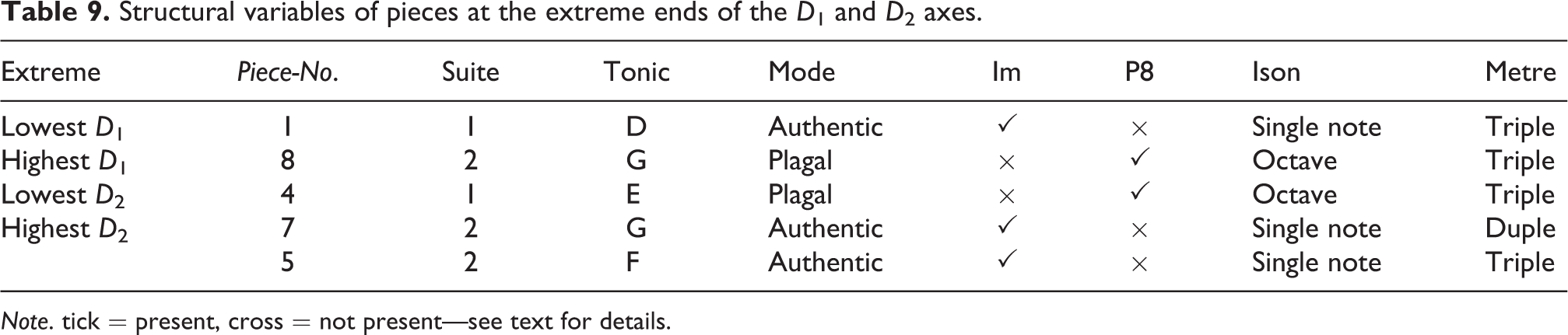
Note. tick = present, cross = not present—see text for details.
Sloboda (1985, p. 103) noted that in the compositional process there is a “persistent occurrence of superordinate structures or plans which seem to guide and determine the detailed note-by-note working out.” This idea of a composer working within a predetermined structure or pattern is also mentioned by McAdams (2004), who refers to it as “self-imposed boundary conditions.” These boundary conditions are typically planned in advance and can include the structure of the piece, pitch sets, densities and groupings, durations, sectional proportions, texture, rhythmic vocabulary, instrumentation, and so on. With respect to Alkan’s use of boundary conditions, his propensity for using systematic patterning to organize his musical material has been noted in the “Introduction” section and Table 1, his mastery of form and long-range structuring in his large-scale works (e.g., the Symphony and Concerto for solo piano, Op. 39, Nos. 4–7 and 8–10) has often been remarked on (e.g., François-Sappey, 1991a; Smith, 2000, Vol.2, pp. 119-140; Sitsky, 1974, pp. 67–70), and the statistical analysis above has brought to light the multiple and hitherto unnoticed constraints Alkan set for himself when writing the Petits Préludes. However, Sloboda (1985, p. 124) also notes that the use of multiple boundary conditions or compositional constraints has its disadvantages because: when multiple constraints build up over the course of a composition, it can become impossible to find ways of progressing which honour all the constraints. In such situations…the composer…readjusts in one of two ways: he either modifies the new material so as to bring it back in line with earlier constraints; or he may change the constraints.
Sloboda’s model of musical composition
Sloboda’s discussion of compositional constraints occurs as part of his exposition of a cognitive model of musical composition (Sloboda, 1985, p. 118). In this model, the composer takes initial ideas for motifs or themes and extends them while honoring superordinate constraints that often take the form of hierarchical structures governing sections of the work in question. In addition, the themes can take on a number of intermediate forms before arriving at their final form due to goal alteration and judgment on the part of the composer when working within the constraint hierarchy. Despite its venerability, however, this model has generally been overlooked by studies of the compositional process, possibly because its emphasis on the development of thematic material would appear to limit its use in other musical contexts. Nevertheless, its basic framework has the potential to elucidate the compositional processes associated with other musical forms, as shown by recent studies that have used modified versions of the model to account for the improvisational style of the jazz pianist Bill Evans (Gross, 2011, p. 44) and the compositional genesis and thematic/tonal structure of Debussy’s Ibéria (Brown, 2003, p. 9) and Page d’album (Brown, 2012, p. 43). This suggests that the model could be applied to the Petits Préludes to provide a post hoc verification of the above reconstruction of Alkan’s compositional process and the role of Alkan and his intended audience’s limited knowledge of early-music style elements in the process. To this end, Figure 3 shows a version of Brown’s (2003, 2012) adaptation of Sloboda’s (1985) model which has been modified by (1) the division of box G into two boxes to differentiate between high-level and low-level compositional constraints, (2) the alteration of the connections between boxes to reflect Alkan’s reconstructed workflow in Stages 1 and 2 of the compositional process, and (3) the omission of the division between conscious and unconscious processes, as the number of self-imposed compositional constraints Alkan had to address strongly suggests that he was fully cognizant throughout.

A modified version of Brown’s (2003, 2012) adaptation of Sloboda’s (1985) model of musical composition (see text for details). Curved boxes indicate transitory materials, square boxes indicate items of long-term knowledge, and lines indicate processes that transform or use the contents of the boxes. Box A represents the initial idea that prompted the piece; box B, the material on which the piece is based; box C, the composer’s workings (plans, drafts, jottings etc); box D, the finished piece; box E—added by Brown (2003, 2012) to Sloboda’s (1985) model—the intentional goals and historical constraints that shaped the composer’s thinking (e.g., abstract esthetic assumptions, concrete external conditions, the desire to compose pieces for a specific function); box F, the composer’s knowledge of broad musical systems and specific musical types (e.g., tonal counterpoint/harmony, Impressionism, Orientalism); box H, the composer’s knowledge of specific compositional styles, strategies, techniques, and models. Boxes G1 and G2, originally one box labeled “Superordinate constraints on form and direction,” represent the global prototypes or plans which provide the top-down schemas that allow the composer to divide problems into subproblems. Alkan’s compositional constraints (C1–C5) and other relevant findings are given in italics in each box.
If we make the reasonable assumption that Alkan mapped out the basic material (B) on the basis of Constraints 1 to 5 and then revised the material after relaxing Constraint 5 (C), then all the compositional constraints fit neatly into the various boxes as shown in Figure 3 using the following workflow. The initial idea (A) of basing the composition on the Gregorian modes—Constraint 1—directly gave rise to Constraints 2 and 3 (G1 and H). These high-level constraints, in turn, controlled the form of the basic material (B)—either an outline or a set of sketches—informed by Alkan’s knowledge of early music (F) and the low-level Constraints 4 and 5 (G2) which occurred as a direct result of the adoption of Constraint 3 (G1). However, at the execution stage of the compositional process Alkan judged that Constraint 5 could not be strictly adhered to without compromising the other constraints. Consequently, the basic material (B) was reworked (C) and the initial goal of a monotonic increase in Son4 (and consequently MedPitch) across Piece-No. was altered to become the broad increase found in the published score of the Petits Préludes (D). With respect to the remaining boxes, box E prompted both Alkan’s initial conception (A) of the Petits Préludes as a set of pieces written in his genre ancien idiom which an audience with a limited knowledge of early music would appreciate, and his awareness that recognisable early-music or genre ancien style elements (the GASEs) would have to be used in order for his audience to perceive the style progression (H). These style elements (H) would almost certainly have been part of the basic material (B) and, due to the high-level constraint imposed by the limited number of GASE combinations that would create a chronological ordering in perceived musical style when the pieces were played consecutively, almost certainly contributed to Alkan’s decision to relax Constraint 5 (C). This tidy fit of the compositional constraints associated with the Petits Préludes into Brown’s (2003, 2012) adaptation of Sloboda’s (1985) model therefore offers considerable support to the reconstruction of Alkan’s compositional process from the statistical and circumstantial evidence described above.
Now, Sloboda (1985) derived the core sequence of his model (boxes A-B-C-D) from compositions where superordinate constraints (G) directed the form of the initial melodic idea (A) that gave rise to the basic thematic material (B). However, the reconstruction of Alkan’s compositional process indicates that Constraint 1 served as a springboard for the remaining constraints. That is, the initial conception (A) directed the form of the superordinate constraints (G1 and H), which then gave rise to the basic material and intermediate forms (B and C) with no direct connection between A and B. Significantly, this type of workflow where superordinate constraints dominate the compositional process had been predicted by Sloboda (1985) from Hindemith’s writings. Hindemith (1952, p. 61) described the master composer as having: the gift of seeing—illuminated in his mind’s eye as if by a flash of lightning—a complete musical form…. In working out his material he will always have before his mental eye the entire picture…[and] merely has to fulfill what the conceived totality demands.
Compositional constraints and problem-solving
While this study has shown how Alkan overloaded the Petits Préludes with self-imposed compositional constraints, similar albeit less complex examples exist in his oeuvre. For example, his five books of Chants (Op. 38a & b, 65, 67, and 70) rework the structural framework of Mendelssohn’s Lieder ohne Worte Book 1 (Op. 19b) while preserving not only the key sequence (see Table 1), but also the styles and textures of Mendelssohn’s original pieces (François-Sappey, 1991b; Smith, 2000, Vol. 2, ch. 5; Waeber, 2006). Although Alkan’s habitual use of multiple compositional constraints could have been the result of his obsessive personality (Smith, 2000, Vol. 2, ch. 15), his desire to ensure the internal unity or overall coherence of a work (François-Sappey, 1991b; Waeber, 2006), or simply game-playing on his part, this characteristic trait of his can also be seen as a problem-solving strategy.
In the information-processing approach to problem-solving (Newell & Simon, 1972), the search for a solution to a problem takes place in a problem space that consists of an initial state, a search space, and a goal state. The initial state is the problem itself, the search space is where solutions to the problem are considered and tested, and the goal state is the solution. Well-structured problems are those where the initial and goal states are known and guidelines or rules are provided for traversing the problem space to the solution. However, in an ill-structured problem, neither the goal state nor the search space is clearly defined (Weisberg, 2006). Pearce and Wiggins (2002) describe the task of musical composition as being an ill-structured problem due to its following characteristics: (A1) there is no well-defined procedure for evaluating (partially completed) compositions, (B1) the initial and goal states are poorly defined and there exist many solutions and points of departure, and (C1) many of the constraints (and the rules which apply them) needed to generate a composition are initially unspecified and must be defined during the process of carrying out the task (often as a result of choosing particular alternatives).
Pearce and Wiggins (2002) then state that this ill-structured problem is solved by transforming it into a well-structured one by applying constraints throughout the compositional process to decompose the ill-structured problem into a set of smaller well-structured subproblems, thereby reducing the problem space. However, if we consider the composition of the Petits Préludes as an ill-structured problem in terms of the above characteristics in the light of Alkan’s reconstructed compositional process, then consider the following: (A2) Alkan could have evaluated the work at any stage of its completion by assessing the style period evoked by the GASE combination (S), counting the number of notes (N), determining the pitch range (R), and calculating the proportion of 4-note sonorities (Son4) for each piece to verify that these variables increased across Piece-No. (B2) The initial state was clearly defined due to Alkan’s decision to make a compositional contribution to La Maîtrise that was written in his genre ancien idiom and based on the eight Gregorian modes, and the goal state was clearly defined due to the symmetrical arrangement of the structural variables, the style progression/GASE usage, and the monotonic increase of the D
1 variables across Piece-No. Consequently, there were a limited number of solutions and points of departure available to Alkan from the initial state to the goal state. (C2) Alkan fully specified the constraints needed to generate the Petits Préludes beforehand at the precompositional stage, rather than during the execution stage of the compositional process.
Therefore, in problem-solving terms, it appears that the composition of the Petits Préludes was a well-structured problem due to Alkan’s imposition of multiple constraints at the precompositional stage of the compositional process. Moreover, Alkan is not alone in employing this compositional/problem-solving strategy. For example, Rodin (2012, p. 82) in a study of the Roman works of Josquin des Prez observes that: Josquin is by no means the only composer of his generation to weigh himself down with self-imposed contrapuntal burdens: witness Obrecht’s penchant for segmentation masses, La Rue’s fascination with strict fuga, and Agricola’s dense, “rhizomic” textures. Nonetheless the frequency with which Josquin puts on a strait-jacket before sitting down to compose is striking. [from] the time of Threni, his first entirely twelve-note work, every note has an explicit and demonstrable serial explanation. There are no ‘free passages’ or ‘free notes’. Rather, everything falls within the constraints that Stravinsky has chosen to impose upon himself. (Straus, 2003, p. 174)
It therefore seems that Alkan, Josquin, Stravinsky, and Reynolds all employed the same compositional strategy to transform an ill-structured problem into a well-structured one. That is, they maximally reduced the problem space by imposing multiple constraints at the precompositional stage, thereby enabling the problem to be more efficiently and quickly resolved at the execution stage. Given the many and varied ways of resolving compositional problems, this particular strategy can be seen as an extreme version of the one employed by the expert composers in the studies of Davidson and Welsh (1988) and Younker and Smith (1996), who first defined the general structure and then systematically worked out the details. Furthermore, it can also be seen as an extreme example of what Donin (2012, p. 19) has called synoptic planning, where one or more global concepts determine the characteristics of a composition’s musical material, and its form is designed around variations of one or more of these characteristics over time—a situation that applies particularly well to the Petits Préludes. In addition, it also confirms Sloboda’s (1985) hypothesis that the dominance of superordinate constraints in the compositional process differentiates the master from the workaday composer, suggesting that the relative occurrence of this “extreme” strategy and the importance of precomposition in the working methods of composers of differing ability and experience may be subjects worthy of further investigation.
Pearce and Wiggins’ theory of creativity in musical composition
Pearce and Wiggins’ (2002) description of musical composition as an ill-structured problem occurs as part of their exposition of a cognitive theory of creativity in musical composition. This theory, based on psychological studies of the compositional process and evidence drawn from the psychological, computational, and musicological literature, was designed to be implemented as a computational/information-processing model of composition where the perceived creativity of the generated compositions could be empirically evaluated. However, although their description was used above to argue that Alkan’s compositional process can be considered as an example of a compositional/problem-solving strategy employed by master composers to maximally reduce their problem space, the findings of this article also serve to confirm a number of other statements and hypotheses made by Pearce and Wiggins (2002) that, while not directly relevant to that particular argument, offer further support for their theory and constraint-based/information-processing approach to musical composition.
Firstly, the monotonic, almost linear increase of the GASE means across Piece-No. in Figure 1 strongly suggested that their hypothesis that the conceptual space of a composition needs to be shared by both the composer and listener in order for the audience to be able to interpret it is correct. Secondly, Pearce and Wiggins (2002) used Sloboda’s (1985) model to define three types of constraint a composer can use to reduce their problem space, all of which are accounted for by the boxes in Figure 3. The first—stylistic constraints loosely specified by the compositional type or genre—is accounted for by A, E, G1, and H; the second—internal constraints generated by what has already been composed, following some general principle of consistency or balance—is accounted for by G2; and the third—external constraints such as the need to ensure that it is physically possible for a musician to play their part, superordinate principles of harmony and structure (i.e., principles not dependent on previously composed elements of a composition or the musical genre), and the need to produce music which can be interpreted by the intended audience—is accounted for by A, E, and H. Finally, Pearce and Wiggins’ (2002) theory is based on five central hypotheses concerning the cognitive processes required for creativity in musical composition which explicitly address both internal and external constraints on the compositional process. These are, that creativity is supported by the ability of the composer to do the following:
These hypotheses are supported by the findings of this study. Firstly, Alkan’s relaxation of the D 2 variables in order to preserve the overall superstructure demonstrates his ability to cope with both multiple and changing internal constraints (H1) and his flexibility in moving between multiple features of the composition (H2). Secondly, Alkan’s dual conception of the style progression in terms of the high- and low-level effects of the GASEs on musical structure demonstrates his ability to simultaneously represent multiple features of the composition (H2), represent and process musical information in a hierarchical manner (H3), and attend to the more abstract levels of representation during composition (H3). Thirdly, Alkan’s use of the GASEs to create a style progression across the Petits Préludes perceptible to his intended audience due to their shared conceptual space demonstrates his ability to invoke an appropriate degree of expectedness in his audience (H4). Finally, whereas Alkan’s previous use of GASEs had been confined to isolated pieces in larger collections, the individual Petits Préludes incorporate specific GASE combinations in order to create the style progression, a novel and unique procedure in Alkan’s oeuvre that demonstrates his ability to transform his compositional mechanisms to generate an original work (H5). The agreement of these findings with the conceptual-space hypothesis, the three constraint definitions, and the five central hypotheses of Pearce and Wiggins (2002) therefore offers considerable support for their constraint-based/information-processing approach to musical composition and their theory of musical creativity.
General conclusion
The initial impetus for this study was the author’s informal observation of a chronological progression in musical style across the Petits Préludes, a work whose small scale and seemingly simple surface has hitherto led it to be regarded as a relatively minor work in Alkan’s oeuvre. However, a closer examination of the score, combined with a statistical analysis of musical variables and a consideration of the evidence concerning the circumstances surrounding its composition, revealed that the final form of the work was determined by a complex hierarchical structure of compositional constraints, both external and self-imposed. This constraint hierarchy was then used to create a plausible reconstruction of Alkan’s compositional process that was not only consistent with a number of previous findings and hypotheses concerning the cognitive processes underlying musical composition, but also showed a remarkable level of agreement with Brown’s (2003, 2012) adaptation of Sloboda’s (1985) model and Pearce and Wiggins’ (2002) theory of musical creativity. However, while this last finding would appear to be a natural consequence of a common constraint-based approach to composition, an important contributing factor to this outcome is that these studies explicitly addressed the effect of external constraints on the compositional process. For example, in the reconstruction, the circumstantial evidence provided by the publication of the work in La Maîtrise clearly delineated the primary external constraint imposed by the limited knowledge of early-music style elements of Alkan’s intended audience. This external constraint, in turn, directly gave rise to two internal/self-imposed constraints: Constraint 1 (the initial conception of a set of genre ancien pieces in the eight Gregorian modes which the intended audience would appreciate) and Constraint 3 (the use of recognizable early-music style elements—the GASEs—that would enable the audience to perceive the style progression embedded in the work). While these internal constraints easily fitted into Sloboda’s (1985) original model, the full fit of the reconstruction into the model only became possible due to Brown’s (2003, 2012) addition of box E (see Figure 3) which, by incorporating external constraints such as concrete external conditions and the desire to compose pieces for a specific function into the compositional process, enabled the model to accommodate the primary external constraint that gave rise to Constraints 1 and 3. Similarly, while Pearce and Wiggins’ (2002) theory of musical creativity took internal constraints on the compositional process into account, their theory also addressed the external constraint of the comprehensibility of the work to its intended audience—that is, the shared conceptual space of Alkan and his intended audience characterized by a limited knowledge of early-music style elements (i.e., the primary external constraint) that gave rise to these two internal constraints. Taken together, this strongly suggests that future models of the compositional process should explicitly address external constraints such as the circumstances surrounding a work’s conception as well as the cultural milieu in which it was composed in order to give a fuller account of the factors responsible for its final form. Furthermore, while the internal consistency of the reconstruction has shown the potential of the statistical analysis of musical variables to elucidate the cognitive processes underlying musical composition, the level of agreement of the reconstruction with the studies of Brown (2003, 2012) and Pearce and Wiggins (2002) also has ramifications for future research in this area. For example, the ability of Brown’s (2003, 2012) adaptation of Sloboda’s (1985) model to (1) accommodate internal and external constraints on the compositional process, (2) account for the role of high- and low-level constraints and the compositional-expertise and programmatic explanations for the dominance of superordinate constraints in Alkan’s compositional process, and (3) its increasing use in musicological studies (Gross, 2011; Brown, 2003, 2012) strongly suggests that the present-day neglect of Sloboda’s (1985) model in psychological studies of musical composition should be reconsidered, particularly as the findings above indicate that Brown’s (2003, 2012) adaptation of the model would provide a suitable framework for studies of superordinate-constraint dominance and precomposition in the working methods of composers across the span of Western music history. In addition, the support for the findings of this study for Pearce and Wiggins’ (2002) theory of musical creativity also suggests that a comprehensive fusion of their theory and constraint-based/information-processing approach with Brown’s (2003, 2012) adaptation of Sloboda’s (1985) model could result in a computational or cognitive model of musical composition that would serve as a robust framework for future studies of the compositional process.
By showing how the analysis of an individual-composition/small-corpus dataset using nonparametric and graphical techniques can further our knowledge of the cognitive processes underlying musical composition, this study has presented an alternative solution to those previously proposed for the statistical limitations imposed by finite-datasets in music research (Huron, 1999, 2013). However, two concerns could be raised regarding the methodology that was employed. The first is that assumptions were made concerning the underlying structure of the data that determined how the analysis proceeded—that is, the focus on pitch-related variables and the collapsing of the property vectors to form the D 1 and D 2 axes. The second is that although, as Levitin (2004) notes, there are numerous precedents in the field of music psychology that support the approach of basing studies on one composer and one musical piece and that “the study of individual composers’ practices has been very helpful as a route toward understanding the creative process from a psychological perspective,” the results obtained from and arguments based on finite-datasets such as the Petits Préludes and those found in medieval music run the risk of being specific to those datasets and not generalizable to others (Cook & Clarke, 2004, p. 4).
Everitt and Dunn (2001, pp. 7–8) have advocated a flexible and pragmatic approach to data analysis where (1) statistical methods are seen as tools to search for structure or pattern in the data, (2) significance levels are seen as criteria to guide the description of the structure of a dataset, (3) the skillful interpretation of evidence and the subsequent development of hunches are considered to be more important than a rigid adherence to a set of decision rules associated with significance tests or any other criteria, and (4) it is stressed that theories and conclusions derived from a particular dataset should be validated using further data. If their methodology is compared to the one employed in this study, then the potential concerns about assumptions and generalizability described above are diminished for three reasons. Firstly, while the statistical and graphical techniques employed in this study were used as tools to find the underlying structure of the Petits Préludes, the analysis was kept within the bounds of accepted practice as the “standard” confidence levels and statistical criteria associated with these techniques were used to define this structure. Secondly, while the study itself was the subsequent development of the author’s hunch that a chronological progression in musical style was embedded in the Petits Préludes, the assumptions made concerning the underlying structure of the data were modest, few in number, and firmly based on the interpretation of the evidence available at each step of the analysis. 1 Finally, while the findings were internally consistent, their validity and generalizability were clearly demonstrated by their consistency with external evidence concerning the cognitive processes underlying musical composition provided by other studies—for example, Brown (2003, 2012), Davidson and Welsh (1988), McAdams (2004), Pearce and Wiggins (2002), Sloboda (1985), and Younker and Smith (1996). Taken together, this strongly suggests that the use of nonparametric and graphical techniques within the methodological framework provided by Everitt and Dunn’s (2001) approach to data analysis and this study would form a robust basis for future computational/statistical analyses of finite musical datasets.
Finally, to return to the Petits Préludes, it has been noted that “Alkan’s musical structures are often meticulously worked out” and that the Petits Préludes “create an air of timelessness and even mystery” (Blacklock, 2005, pp. 5 and 42). While this study has unravelled some of the mystery and shown just how meticulously worked out the Petits Préludes actually are, King’s (1988) description of the pieces as being written in a “tightly-knit disciplined style” would appear to be somewhat of an understatement given the number of compositional constraints and the super-saturation of symmetry and patterning present in this work, the ne plus ultra of Alkan’s experiments in his genre ancien idiom, leaving one to wonder what else may be concealed in the rest of his oeuvre.
Footnotes
Acknowledgments
The author would like to thank Tuomas Eerola and two anonymous reviewers for their comments on an earlier version of this paper, and Seth Blacklock and Jacqueline Waeber for literature provision.
Declaration of conflicting interests
The author(s) declared no potential conflicts of interest with respect to the research, authorship, and/or publication of this article.
Funding
The author(s) received no financial support for the research, authorship, and/or publication of this article.
Peer review
Ashley Burgoyne, Universiteit van Amsterdam, Faculteit der Geesteswetenschappen, Institute for Logic, Language, and Computation. David Meredith, Aalborg University, Department of Architecture, Design and Media Technology.