




Abstract
The relationship between atopic diseases and cancer at various sites has been extensively studied. Previous epidemiological studies have investigated the association between atopic diseases and bladder cancer; however, the results remain inconclusive. In this study, we performed a systematic review and meta-analysis of cohort studies published thus far to evaluate the association between atopy and the risk of bladder cancer. We conducted a systematic search in PubMed, Embase, ISI Web of Science, and Scopus to identify potentially relevant studies. The pooled risk ratio (RRs) and 95% confidence intervals (95% CIs) were calculated using a random-effect model considering the heterogeneity among studies. On the basis of our selection criteria, a total of 10 cohort studies were included in our meta-analysis involving 2,341,005 participants, of whom 1720 were patients with bladder cancer. The pooled RR of bladder cancer in the group with atopic disease versus the group without atopic disease was 1.31 (95% CI: 1.10–1.56, p < 0.01), indicating a positive association between overall atopy and bladder cancer risk. In subgroup analysis, the pooled RR of bladder cancer was 1.46 (95% CI: 1.18–1.80, p < 0.001) for asthma and 1.03 (95% CI: 0.74–1.44, p = 0.86) for allergic rhinitis. The risk of bladder cancer is positively associated with overall atopy and asthma, but is not associated with allergic rhinitis.
Introduction
Bladder cancer is the 10th most common cancer worldwide, with an incidence rate of 9.6 per 100,000 men and 2.4 per 100,000 women. 1 According to the GLOBOCAN (Global Cancer Incidence, Mortality, and Prevalence) estimate, approximately 549,000 bladder cancer cases with 200,000 bladder cancer deaths were recorded in 2018. 1 The risk factors for bladder cancer include tobacco smoking, occupational exposure, and chronic inflammation.2,3
Atopic diseases such as asthma, allergic rhinitis, and atopic dermatitis are abnormal hypersensitivity reactions that affect approximately 25% of the global population, typically resulting in allergic inflammation. 4 Asthma, allergic rhinitis, and atopic dermatitis are associated with increased economic burden resulting from medical costs, psychological problems such as stress and depression, and decreased quality of life.5–7 The association of atopic disorders with cancer risk has been questioned for a long time; however, the exact relationship remains unclear. Two conflicting theories have been proposed to explain the association. According to the “immune surveillance” theory, allergy suppresses cancer by enhancing the immune response to eliminate tumor cells,8,9 which is supported by evidence indicating that that Th2-type cytokines and immunoglobulin E (IgE) suppress tumor growth. 10 In contrast, according to an alternative theory, inflammation-driven IgE production in atopic reactions may enhance tumor growth by driving cell overgrowth, 11 and chronic inflammation may contribute to the development of transitional cell carcinoma by producing inflammatory cytokines, damaging tissues, breaking DNA, and inhibiting DNA repair through nitric oxide and reactive oxygen species generation.3,12,13
The association between atopic disorders (asthma, allergic rhinitis, and atopic dermatitis) and the risk of bladder cancer has been investigated in numerous epidemiological studies.14–23 Ji et al., 18 Hwang et al., 20 Liu et al., 22 and Woo et al. 23 reported the existence of a positive association between asthma and bladder cancer, whereas other studies did not find a significant association. Hwang et al. 20 reported that there is a positive association between allergic rhinitis and bladder cancer, whereas Hemminki et al. 21 suggested a negative association and other studies failed to show a significant association. Whether atopy and atopic diseases are associated with bladder cancer remains unclear, and no previous systematic review and meta-analysis study has investigated this issue. Therefore, the aim of this systematic review and meta-analysis of cohort studies is to determine whether atopic disorders are associated with the risk of bladder cancer among general human population.
Methods
Our study was conducted according to our prespecified protocol registered in the International Prospective Register of Systematic Reviews (PROSPERO) database, and our registration number was CRD42020175875.
Data sources
We conducted a systematic literature search in the PubMed, Embase, ISI Web of Science (Science Citation Index Expanded, Conference Proceedings Citation Index-Science, and Emerging Sources Citation Index), and Scopus databases. We recorded all results published until January 2021. We performed both keyword search and Medical Subject Headings (MeSH) search to ensure the integrity of the search. We used the following MeSH terms: “allergy”; “asthma”; “rhinitis”; “dermatitis, atopic”; “urticaria”; and “urinary bladder neoplasms.” The specific search algorithm that we used is provided in supplementary material 1. We also included the studies from the reference list of the relevant studies.
Study selection
Our meta-analysis study acknowledged and followed the Preferred Reporting Items for Systematic Reviews and Meta-Analyses (PRISMA) guideline. Two reviewers (Suoyi Feng and Longzhu Ju) independently evaluated the articles and selected studies based on the inclusion criteria. (1) The study type should be original cohort study. (2) The study population should be human subjects (3). The exposure variable of the studies should be various types of atopy. Atopic disorders were defined as doctor-diagnosed or self-reported asthma (including wheezing), allergic rhinitis (including symptoms of rhinoconjunctivitis), atopic dermatitis, and urticaria. Atopy was also defined as an allergy to certain antigens confirmed with an IgE test or a skin prick test. (4) The comparison should be healthy subjects without any history or current conditions of atopic disorders and allergy. (5) The outcome variable of the studies should be bladder cancer medically confirmed by a physician. (6) The articles must provide risk estimates with 95% confidence intervals (CIs) for the association of allergy and atopic disorders with bladder cancer risk, or provide sufficient data to calculate them. If both the crude risk estimates and adjusted risks were provided, we considered the adjusted risk values first. If two or more articles were published for the same study, the article with best quality or the most recent article was included.
The exclusion criteria were as follows: (1) not original cohort studies, (2) bladder cancer not confirmed by physicians, (3) no data provided about the association, (4) no comparison groups, or (5) different exposures or outcomes.
Data extraction and quality assessment
Data extraction was independently conducted by two reviewers (Suoyi Feng and Longzhu Ju), and any disagreement was discussed in group until an agreement was reached. The included studies were assessed for quality using the Newcastle-Ottawa scale (NOS).
Data synthesis and statistical analysis
Because bladder cancer is a rare disease, the distinctions between various types of risk estimates (i.e. risk ratio, odds ratio, and standard incidence ratio) were ignored. The principal summary analysis of the pooled results is risk ratio (RR). Review Manager 5.3 and RStudio were used for all statistical analyses. A random-effect model was applied to incorporate between-study heterogeneity. Subgroup analyses were performed for each type of atopic disorder if there were two or more studies investigating association of it with bladder cancer risk. Leave-one-out sensitivity analyses were performed to test the dependency of the RR on the exclusion of each individual study. Publication bias was assessed using the “metabias” function in RStudio if the meta-analysis included at least 10 studies. Statistical significance was set at p < 0.05.
Results
Identification of relevant studies
As shown in Figure 1, a total of 3438 studies were identified through the systematic search and 10 studies were identified through the reference lists, yielding 2043 unique studies. By using our prespecified inclusion criteria, we reviewed the titles and abstracts of all unique studies. We rejected 2002 studies, leaving 41 studies for full-article assessment. After all of these studies were completely reviewed, 10 cohort studies were finally judged to have met the prespecified inclusion criteria.

Flow diagram of the identified studies.
Characteristics of studies included in the main analysis
The characteristics of the 10 cohort studies included in the qualitative and quantitative syntheses are presented in Table 1. All cohort studies identified and included in the main analysis were published in English. The analyzed cohort studies included a total of 2,341,005 participants, of whom 1720 were patients with bladder cancer. The study participants were from the United States, China, Denmark, Finland, Sweden, and Korea. All bladder cancer cases were medically confirmed. Atopy and atopic disorder cases were medically confirmed, except in one study. 14 All studies were adjusted or controlled for age and sex, and some studies were adjusted or controlled for additional factors including socioeconomic status, geographic region, education level, smoking history, frequency of alcohol consumption, body mass index, systolic blood pressure, diastolic blood pressure, fasting blood glucose, serum total cholesterol, history of diabetes mellitus, stroke, hypertension, Charlson comorbidity index, and physical activity. Studies included in the systematic review and meta-analysis had a quality score of at least 6, and the average score of the included studies was 7.4. The quality scores of the included studies are shown in Supplementary Material 2.
Characteristics of studies included in meta-analysis.

Overall association of atopy with bladder cancer risk
As shown in Figure 2, the pooled RR in the atopy group versus the non-atopy group was 1.31 (95% CI: 1.10–1.56, p < 0.01), which suggests that there was a significant 31% increase in the bladder cancer risk in participants with allergy and atopic disorders in general. Between-study heterogeneity was assessed in the meta-analysis. We found considerable evidence of heterogeneity (I2 = 83%, p < 0.01) among the included studies (Figure 2). We used a random-effect model, as previously specified, to calculate the summary effect. The leave-one-out sensitivity analysis identified the study by Woo et al. 23 as the major contributor to the heterogeneity, suggesting that excluding this study would lead to a lower level of heterogeneity (I2 = 63%) while retaining the significant association between overall atopy and risk of bladder cancer (RR: 1.19, 95% CI: 1.06–1.35, p < 0.01), as shown in Supplementary Material 3.

Forest plot of the association between overall atopy and the risk of bladder cancer.
Association of asthma with bladder cancer risk
Asthma was considered a specific type of atopic disorder, and the association between asthma and bladder cancer was analyzed in seven cohort studies. Our findings indicated that the risk of bladder cancer was about 46% higher in participants with asthma than in those without, as the pooled RR associated with asthma versus non-asthma was 1.46 (95% CI: 1.18–1.80, p < 0.001) (Figure 3). Assessment of heterogeneity suggested a considerable level of homogeneity (I2 = 83%, p < 0.01) (Figure 3). We used a random-effect model to consider heterogeneity, as previously specified. According to the leave-one-out sensitivity analysis (Supplementary Material 3), the study by Woo et al. 23 accounted for the high heterogeneity, suggesting that eliminating this study would decrease the heterogeneity to a nearly negligible level (I2 = 12%) while still suggesting a positive association between asthma and the risk of bladder cancer (RR 1.30, 95% CI: 1.20–1.39, p < 0.0001).

Forest plot of the association between asthma and the risk of bladder cancer.
Association of rhinitis with bladder cancer risk
We found no significant association between rhinitis and bladder cancer (RR: 1.03, 95% CI: 0.74–1.44, p = 0.86) (Figure 4). A non-significant 3% increase in the risk of bladder cancer was observed in participants with allergic rhinitis. The association between rhinitis and bladder cancer was analyzed in four cohort studies. As shown in Figure 4, We detected substantial heterogeneity among various studies (I2 = 63%, p < 0.05) and used the random-effect model, as previously specified. The leave-one-out sensitivity analysis suggested that omitting the study by Hwang et al. 20 or that by Hemminki et al. 21 would reduce the heterogeneity to zero level (I2 = 0%) (Supplementary Material 3).
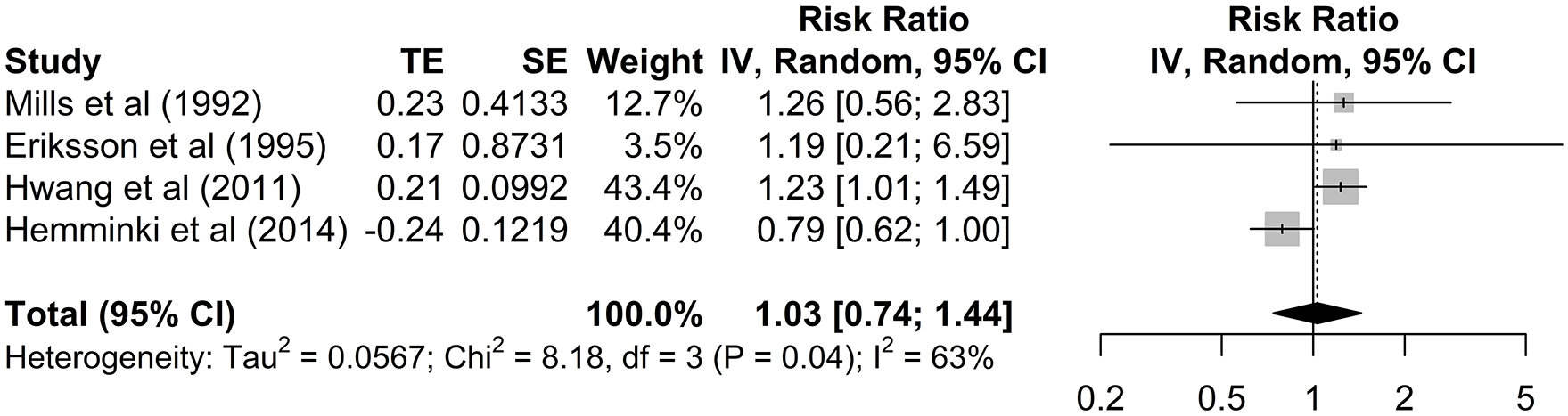
Forest plot of the association between rhinitis and the risk of bladder cancer.
Publication bias
Egger’s test indicated no publication bias among all cohort studies investigating the overall association between atopy and bladder cancer (p = 0.80). Begg’s test confirmed that there was no publication bias (p = 0.79), and the funnel plot was visually symmetrical (Figure 5). This indicates that there was no publication bias among all cohort studies investigating the overall association between atopy and bladder cancer. Because number of studies reporting on the association between asthma and bladder cancer risk or on the association between allergic rhinitis and bladder cancer risk were less than ten. No funnel plot could be made to assess publication bias, and Egger’s and Begg’s tests are not applicable because they require at least 10 included studies to be meaningfully and accurately conducted.

Funnel plot of the association between overall atopy and bladder cancer risk.
Discussion
In this systematic review and meta-analysis, we investigated the association between atopic disorders and the risk of bladder cancer as reported in cohort studies. Our results indicated that bladder cancer was positively associated with overall atopy. The risk of bladder cancer was approximately 31% higher in participants with allergy and atopic disorders in general than in non-atopic subjects. Our study also indicated that current or previous asthma increased the risk of bladder cancer by 46%. However, we did not find any significant association between rhinitis and the risk of bladder cancer.
The positive association may be explained by the occurrence of inflammation in asthma, rhinitis, atopic dermatitis, and allergies to substances. Atopic disorders, especially asthma, rhinitis, and atopic dermatitis, have been found to be strongly associated with oxidative stress, which generates reactive oxygen and nitrogen species including superoxide, nitric oxide, and hydrogen peroxide. 24 Substantive evidence indicates that the activation of inflammatory cells, such as eosinophils, neutrophils, and macrophages, contributes to superoxide, nitric oxide, and hydrogen peroxide production.24–26 Oxidative species can directly break single- or double-stranded DNA, damaging nitrogen bases, deoxyribose, RNA, lipids, and proteins.26,27 DNA damage increases the possibility of genetic mutation, transcription and translation malfunction, DNA replication errors, and genomic instability, and these factors contribute to carcinogenesis. 26 Furthermore, nitrogen oxides inhibit DNA repair enzymes, block apoptosis through nitrosylation of caspases, and stimulate tumor carcinogenesis and angiogenesis by upregulating vascular endothelial growth factor.28,29
Oxidant-induced DNA damage leads to increased tumor mutation burden (TMB), defined as the total number of somatic mutations per coding area of a tumor genome, in tumor cells.30,31 Some somatic mutations could lead to neoantigens, which are further processed by the antigen-processing machinery and presented by major histocompatibility complex (MHC) on the cell surface. 32 The resulting neoantigen-peptide-MHC complex is recognized by T cells, giving rise to immunogenicity. 32 Although atopic disorders become a risk factor for bladder cancer through the mechanism of oxidant-stimulated DNA damage and mutation, the resulting TMB enhances the efficiency of immune checkpoint inhibitors, which provide considerable therapeutic potential against many types of cancer.33,34
Our meta-analysis was designed to investigate the relationship between atopic disorders and bladder cancer by analyzing cohort studies. We included only cohort studies because such studies provide a clear definition of the temporal relationship between the exposure (atopy) and outcome (bladder cancer) variables. We also used a random-effect model to incorporate heterogeneity and reduce the bias in the analyses. In addition, our study did not find any publication bias based on Egger’s and Begg’s tests, indicating that the reported associations could not be explained by publication bias.
The immune surveillance theory states that IgE production suppresses tumor growth, whereas an alternative theory suggests that inflammation-derived IgE stimulates tumor growth.8–11 As none of the studies included in this systematic review and meta-analysis provided data for subgroup stratified analysis of the association between allergic asthma versus non-allergic asthma and bladder cancer risk, the role of IgE should be further investigated in future studies. Additionally, smoking is a potential cause of TMB; however, not all studies included in this systematic review and meta-analysis were adjusted for smoking status. It is possible that smoking status also contribute to the increased risk of bladder cancer.
A limitation of this systematic review and meta-analysis is that the definition of the exposure variable differs among various studies. Some studies define atopy and allergy based on the skin prink test or other allergy tests, whereas others define atopic disorders based on symptoms associated with asthma, atopic dermatitis, or allergic rhinitis. Some studies reported on several types of atopic disorders and allergies. To better understand this difference, we performed a subgroup analysis of the association between bladder cancer and asthma and the association between bladder cancer and allergic rhinitis. However, only one study by Hwang et al. 20 specifically investigated the association between atopic dermatitis and the risk of bladder cancer, and it is impossible to conduct subgroup analysis on atopic dermatitis. Asthma and allergic rhinitis have the same pathophysiology of Th2 inflammation, 35 and some epidemiological studies have indicated the coexistence of asthma and rhinitis in the same patients. 36 However, our study indicated that bladder cancer risk is strongly associated with asthma but not with allergic rhinitis. The reason remains unclear, and the relationship of asthma and allergic rhinitis in terms of their association with cancer should be further investigated in future studies.
Conclusion
In summary, this systematic review and meta-analysis of the association between bladder cancer and atopic disorders indicated that atopic diseases in general are associated with an increased risk of bladder cancer. Among the atopy subcategories, asthma is significantly associated with an increased risk of bladder cancer. The reason why bladder cancer is associated with asthma but not rhinitis should be further investigated in future epidemiological studies.
Supplemental Material
sj-doc-1-eji-10.1177_20587392211016117 – Supplemental material for Atopy, asthma, and risk of bladder cancer: Systematic review and meta-analysis of cohort studies
Supplemental material, sj-doc-1-eji-10.1177_20587392211016117 for Atopy, asthma, and risk of bladder cancer: Systematic review and meta-analysis of cohort studies by Suoyi Feng, Ziqi Shao, Longzhu Ju and Yiting Zhang in European Journal of Inflammation
Supplemental Material
sj-doc-2-eji-10.1177_20587392211016117 – Supplemental material for Atopy, asthma, and risk of bladder cancer: Systematic review and meta-analysis of cohort studies
Supplemental material, sj-doc-2-eji-10.1177_20587392211016117 for Atopy, asthma, and risk of bladder cancer: Systematic review and meta-analysis of cohort studies by Suoyi Feng, Ziqi Shao, Longzhu Ju and Yiting Zhang in European Journal of Inflammation
Supplemental Material
sj-docx-3-eji-10.1177_20587392211016117 – Supplemental material for Atopy, asthma, and risk of bladder cancer: Systematic review and meta-analysis of cohort studies
Supplemental material, sj-docx-3-eji-10.1177_20587392211016117 for Atopy, asthma, and risk of bladder cancer: Systematic review and meta-analysis of cohort studies by Suoyi Feng, Ziqi Shao, Longzhu Ju and Yiting Zhang in European Journal of Inflammation
Supplemental Material
sj-docx-4-eji-10.1177_20587392211016117 – Supplemental material for Atopy, asthma, and risk of bladder cancer: Systematic review and meta-analysis of cohort studies
Supplemental material, sj-docx-4-eji-10.1177_20587392211016117 for Atopy, asthma, and risk of bladder cancer: Systematic review and meta-analysis of cohort studies by Suoyi Feng, Ziqi Shao, Longzhu Ju and Yiting Zhang in European Journal of Inflammation
Supplemental Material
sj-docx-5-eji-10.1177_20587392211016117 – Supplemental material for Atopy, asthma, and risk of bladder cancer: Systematic review and meta-analysis of cohort studies
Supplemental material, sj-docx-5-eji-10.1177_20587392211016117 for Atopy, asthma, and risk of bladder cancer: Systematic review and meta-analysis of cohort studies by Suoyi Feng, Ziqi Shao, Longzhu Ju and Yiting Zhang in European Journal of Inflammation
Footnotes
Acknowledgements
We would like to thank Dr. Yuchen Feng for providing valuable advice for this study.
Authors’ contributions
Suoyi Feng collected data, selected articles, conducted analysis, visualized the data, and prepared the manuscript. Ziqi Shao collected data, selected articles, conducted analysis, and revised manuscript. Longzhu Ju collected data, selected articles, and conducted analysis. Yiting Zhang participated in systematic searches.
Availability of data and materials
All relevant data and materials are included in this study and supplementary materials.
Declaration of conflicting interests
The author(s) declared no potential conflicts of interest with respect to the research, authorship, and/or publication of this article.
Funding
The author(s) disclosed receipt of the following financial support for the research, authorship, and/or publication of this article: Funding was provided by Harbin Hamu Animal Health CO., LTD.
Consent for publication
All authors agreed and approved to submit our manuscript to this journal.

Supplemental material
Supplemental material for this article is available online.
References
Supplementary Material
Please find the following supplemental material available below.
For Open Access articles published under a Creative Commons License, all supplemental material carries the same license as the article it is associated with.
For non-Open Access articles published, all supplemental material carries a non-exclusive license, and permission requests for re-use of supplemental material or any part of supplemental material shall be sent directly to the copyright owner as specified in the copyright notice associated with the article.
