




Abstract
Stress caused due to examinations during any degree program and at any educational level has been observed at all levels so the present study was conducted to investigate the stress related to final examination in undergraduate students with reference to their academic performance. Fifty-four volunteers were divided into three groups, (n = 18), according to their academic performance, that is, Group A with low CGPA (⩽2.99), Group B with average CGPA (⩾3.00–3.59) and Group C with high CGPA (⩾3.60) and blood samples (3 ml) were taken at three-time intervals, that is, pre-examination, during examination and post examination time interval, at the Department of Physiology, Government College University, Faisalabad. Anthropometric parameters like height, weight, blood pressure, heart rate and body mass index (BMI) were also determined. Blood cortisol and thyroid hormones (triiodothyronine, T3; thyroxine, T4) and thyroid stimulating hormone (TSH)) were measured using ELISA based technique. Arylesterase activity (ARE) and paraoxonase activity (PON-1) were also measured using colorimetric method. The results showed that overall cortisol level was increased at pre-examination and during examination time intervals as compared to the post examination time interval while PON-1 and ARE were significantly (p < 0.05) decreased. With regards to T4 and TSH, a non-significant (p < 0.05) difference was observed in pre and post examination time interval. It could be concluded from the current study that semester system examinations significantly (p < 0.05) imposed stress in all students group at pre-examination interval as compare to post examination interval and this examination related stress was find more in the students already obtained low CGPA as compared to the other studied groups. Although, a correlation between academic performance and examinations stress in semester system was found but a large scale trial in multiple institutions throughout the Pakistan is required to exclude any socioeconomic factors because Pakistan belongs to developing country.
Keywords
Introduction
Stress can lead to “flight or fight,” response that can cause endocrinological and physiological maladjustments. The presence of stress in students has come under analysis as it can lead to short term or long term psychological and physical health related problems.1,2 Examination related stress is a physiological and emotional response of students to the prospect of participating in examinations. 3 Within the context of students, stress is most commonly observed during the examinations and it often reaches its threshold just before the start of examinations. 4 The incidence of examination stress has increased from 27% in 2009 to 40% in 2010 among students undergoing examinations. 5 Students entering competitive environment of universities from protected environment of home and college, feel immense pressure to perform. 6 In some cases, the examination related stress can result in a vicious cycle of low self-esteem, poor academic performance, panic attacks, anxiety and depression.7,8 Stress causes physical and emotional effects as well as cognitive symptoms such as palpitations, fatigue, headaches, restlessness, nightmares, difficulty in concentration, and difficulty in organizing thoughts.1,9 Mild stress may be temporarily helpful in performance and may give benefit a person in healthy competition during examination, while continuous stress what so ever the intensity can potentially lead to serious anxiety and depression. High stress levels also renders great difficulties in focusing on a particular task.3,10–12
Psychological stress has short-term as well as long-term effects. In short term effect, the basal cortisol level and secretion of corticotrophin releasing hormone increases so that the body adapts itself to a hyper catabolic condition. 3 Cortisol is a steroid hormone produced in response to the adrenocorticotropic hormone (ACTH) and is the end product of hypothalamic-pituitary-adrenal (HPA) axis.13–15 Cortisol hormone is mostly used in research as an established physiological measure of stress and its levels reflect psychological stress. During stressful conditions, the body increases the production of cortisol from adrenal cortex. 14 It is also linked with many psycho-biological and physiologic processes like learning and memory, cell death, neural development, metabolism, and immune function. 15 The cortisol is release by slow peripheral response to acute stress and it is proposed that it has both suppressive and stimulatory roles to body stress. 16 Chronic stress is associated with high cortisol levels, but it is a matter of open discussion whether cortisol is cause for these physiological stress responses or produced in reaction to chronic stressors. 17 The central nervous system (CNS) plays a vital role in psychological and physical processes and physiological response to a stressor. Psychological and physical stress responses are characterized by the triggering of HPA axis which releases cortisol and activation of autonomic nervous system (ANS) which releases catecholamine. The sympathetic part of the ANS is responsible for different physiological responses such as change in heart and respiratory rate, blood flow to muscles.18,19 Raised levels of cortisol affect learning skills and recollection, increase weight, heart diseases, increase cholesterol as well as decreased resilience and mental illness—particularly in young people.2,20,21
Stress also rises the metabolic burdens of body and may alter the hypothalamic- pituitary-thyroid (HPT) axis and thus change hormone levels including the thyroid status. 22 Thyroxine (T4) is an important hormone of the body and many researchers have found a relationship of stress with the thyroid diseases. 23 Level of thyroglobulin can be used to notice damage to thyroid gland.3,24 Thyroid hormone activities can be altered by cortisol levels but relationship between thyroid hormone levels and stress in peripheral blood have produced mixed results, that is, showing that a slight increase or no change in hormone levels takes place in response to mild stress or a decrease takes place after high stress.25,26
Oxidants are formed in both normal physiological as well as pathological conditions, such as hydrogen peroxide, protein peroxide, lipid hydroperoxide, and peroxynitrits. The brain consumes large amount of oxygen and has a weak antioxidant defenses therefore brain is prone to oxidative damage. Constant oxidative damage to brain lead to development of another depressive episode in person already suffering from depressive episodes. 27 Paraoxonase (PON1) enzyme related with paraoxonase and arylesterase activities and protects the body from oxidative stress. PON1 is an antioxidant bio-scavenger that responsible for lipid peroxides hydrolysis and also a main factor in the antioxidant system. Several research studies exposed that if oxidative stress become increased it can cause reduction in PON1 activity.28,29 Deficiency in these activities may lead to anxiety that the diagnosed marker of generalized anxiety disorder. 30 It has been found that paraoxonase activity become decrease in the patient of insomnia and vitiligo.31,32 As far as we could possibly know, PON and ARE activities have not been examined as yet in examination stress. The present study was conducted to explore the stress level in the students by measuring the cortisol, paraoxonase activity and thyroid levels at different phases, that is, pre, during, and post examination intervals.
Material and methods
Study plan and collection of blood samples
Comparative cross-sectional study was undertaken using stratified random sampling technique at Health Biology Research Lab, Department of Physiology, Government College University, Faisalabad-Pakistan. A Sample size of 54 under-graduate candidates was selected from 6th semester (3rd year undergraduate students) of Department of Physiology, Government College University, Faisalabad and divided into three groups according to their previous academic performance as Group A with low CGPA (⩽2.99) students, Group B with average CGPA (3.00–3.59) students and Group C with high CGPA (⩾3.60). After written consent from all volunteers (both males and females), 3 ml of blood sample was drawn at three time intervals, that is, pre-examination (1 h before conducting the examination), during examination and post examination interval (after 2 days of final examinations), then centrifuged at 2000 ×g, for 5 min to separate the serum from cellular part of blood. The study was conducted after the approval of Institutional Review Board (Ref. No. GCUF/ERC/149). As no drug or medication was used so trial registration was not applicable for this study.
Inclusion and exclusion criteria
The candidates included in this study were both males and female with ages between 20 and 25 years and were not on any kind of medication or suffering from any neurological or psychological problems. Students assessed for neurological or psychological problems by observing their previous behavior, by taking medical history and examine the physical activities. All the students included were also confirmed that they enrolled the same credit hours for current study. Student’s enrolled extra credit hours as well as enrolled any supplementary subject were excluded.
Anthropometric measurements
Anthropometric variables such as age, weight, height, and body mass index (BMI) were assessed. A questioner was filled by participant students that explain the age of students and confirmed from their national identity card. Weight as well as height of every individual was measured with the help of standard weighing machine and standard height measuring scale, respectively. BMI was determined by using formula: weight (kg)/Height (m²). Blood pressure was measured by aneroid sphygmomanometer and stethoscope and heart rate was measured by conventional method using radial artery.
Serum hormones
Cortisol (nmol/L)
Blood cortisol in serum was determined by competitive enzyme immunoassay (CEIA) method using commercially available cortisol ELISA kit supplied by AccuBind® (Monobind Inc. Lake Forest, CA 92630 USA). The sensitivity range of the kit was 156–10,000 pg/ml and absorbance of the serum was taken at 405 nm.The precision CV value was <10%.
Thyroid hormones (U/ml)
Triiodothyronine (T3) and Thyroxine (T4) levels in serum were determined by enzyme immunoassay (EIA) method using commercially available T3 and T4 ELISA kit supplied by DiaMetra® (Perugia Italy) while thyroid stimulating hormone (TSH) in serum was determined by enzyme immunoassay (EIA) method using commercially available TSH ELISA kit supplied by Calbiotech, Inc. (El Cajon, CA 92020 USA).
Stress markers
Paraoxonase activity (PON-1; U/min/ml)
The paraoxonase enzyme (PON-1) activity was determined by method as described by Nisar et al. 33 PON-1 activity was measured by using 2 mmol/L paraoxon as the assay substrate. The minimum detection limit of this assay was 80–100 U/min/L. The hydrolysis sensitivity rate was stable up to 5 min and the intra-assay CV was <10%. 33
Arylesterase activity (ARE; KU/min /L)
The arylesterase enzyme activity per minute was determined by method previously defined by Nisar et al. 33 Reaction mixture comprised of 2 mmol/L phenyl acetate with 2 mmol/L CaCl2 in 0.1 M/L Tris-HCL Buffer. The minimum detection limit of this assay was 40–55 KU/min/L and intra-assay CV was <7%. 33
Statistical analysis
The results were represented as mean ± SEM and were analyzed using SPSS statistical software (trial version 20). For analysis purpose, one-way ANOVA was used to compare CGPA and examination time interval group. Two-way ANOVA to find interaction of examination interval and CGPA on different parameters was also conducted. Post-hoc test (Tukey) was used to find significant difference between groups. A level of p ⩽ 0.05 was taken as statistically significant.
Results
Anthropometric parameters
Different anthropometric parameters like age, height, weight, and body mass index (BMI) were compared and shown in Tables 1 and 2. Heart rate during-examination interval was significantly decreased (p < 0.01) from pre-examination interval (Table 1). While, HR was increased in the post examination interval. Systolic and diastolic blood pressure was increased in group A as compared to group B and C during the pre-examination interval. Overall mean of systolic and diastolic blood pressure was significantly increased during the pre-examination interval as compared to the post-examination interval. BMI results showed the non-significant (p > 0.05) result during different examination intervals.
Comparison of anthropometric parameters with reference to examination time intervals.

N: no. of participants; SE: standard error; DBP: diastolic blood pressure; SBP: systolic blood pressure; HR: heart rate; BMI: body mass index, Values sharing different alphabets (a, b as superscript) are significantly (p < 0.05) different between pre, during and post exam for a parameter.
Comparison of anthropometric parameters with reference to CGPA groups.
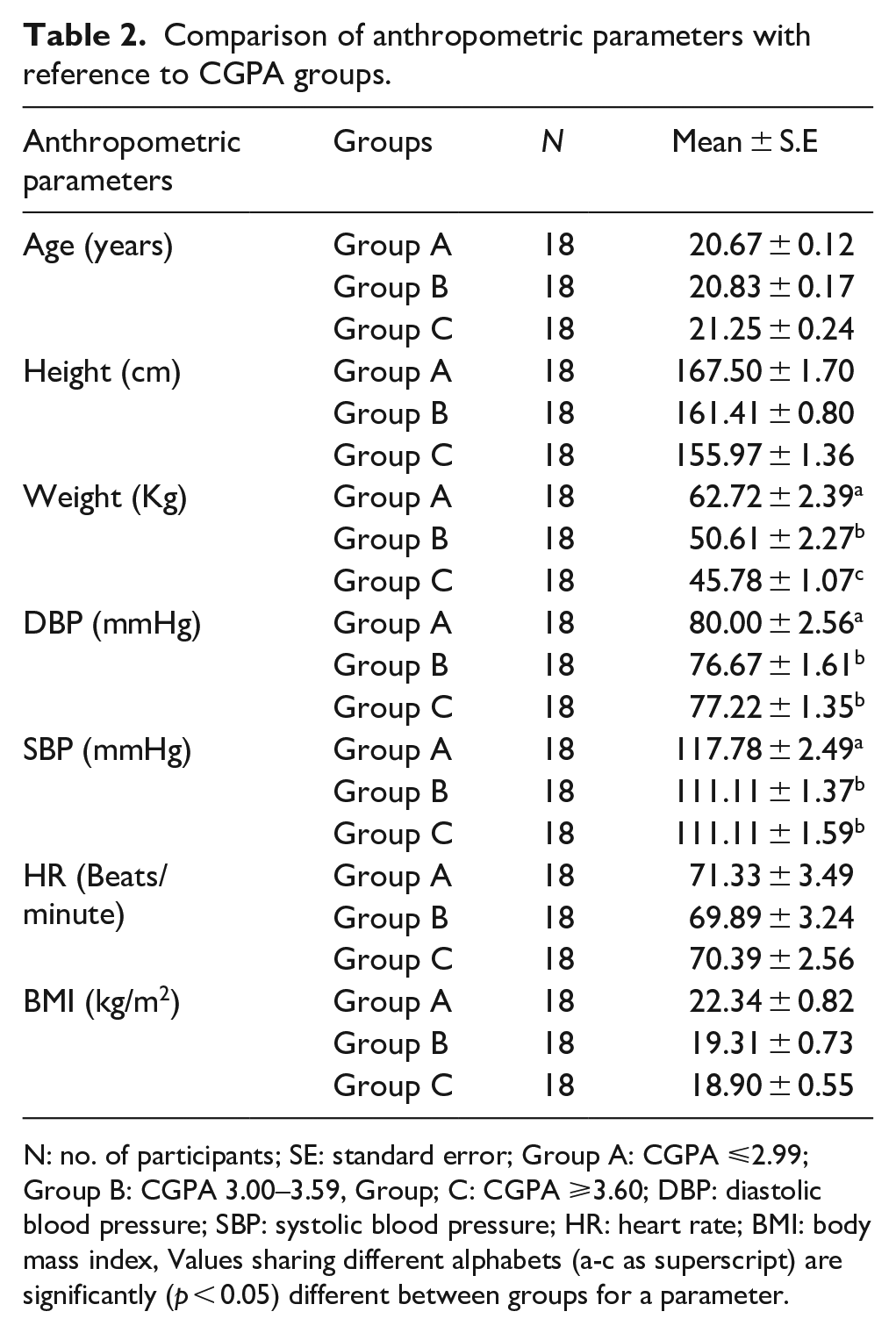
N: no. of participants; SE: standard error; Group A: CGPA ⩽2.99; Group B: CGPA 3.00–3.59, Group; C: CGPA ⩾3.60; DBP: diastolic blood pressure; SBP: systolic blood pressure; HR: heart rate; BMI: body mass index, Values sharing different alphabets (a-c as superscript) are significantly (p < 0.05) different between groups for a parameter.
Serum hormones
Results showed that cortisol level in post-examination interval was significantly (p < 0.01) decreased as compared to both pre-examination interval and during-examination interval while a non-significant (p > 0.05) difference was reported between pre-examination and during-examination interval (Figure 1). The overall mean of cortisol showed significant (p < 0.05) increase in group C among all groups and moreover, it was also reported that at post-examination interval cortisol level was lowest. The result showed non-significant interaction of T3, T4, and TSH between examination intervals and CGPA as well as overall means (Figure 2(a)–(c)). However, the overall mean of T4 showed significant increase in group C from group B and group A while there was non- significant difference in examination intervals (Figure 2(a)–(c)). On the other hand, the overall mean of TSH showed significant decrease in group A from group B and group C.

Comparison of serum cortisol level with reference to examination time intervals: (a) the mean cortisol (COR) ± SE (nmol/L) of different CGPA groups at various examination intervals, (b) the overall mean COR ± SE (nmol/L) irrespective of examination intervals, and (c) the overall mean COR ± SE (nmol/L) irrespective of CGPA groups. COR: cortisol, low CGPA (⩽2.99) students, group B with average CGPA (⩾3.00–3.59) students and group C with high CGPA (⩾3.60). Means sharing similar letter are statistically non-significant (p ⩾ 0.05).

(a) The mean thyroid hormone ± SE of different CGPA groups at various examination intervals. TSH: thyroid stimulating hormone, low CGPA (⩽2.99) students, group B with average CGPA (⩾3.00–3.59) students and group C with high CGPA (⩾3.60). Means sharing similar letter are statistically non-significant (p ⩾ 0.05), (b) overall mean ± SE Thyroid hormone irrespective of examination intervals. Group A low CGPA (⩽2.99) students, group B with average CGPA (⩾3.00–3.59) students and group C with high CGPA (⩾3.60). Means sharing similar letter are statistically non-significant (p ⩾ 0.05), and (c) overall mean ± SE Thyroid hormone irrespective of CGPA groups. TSH: thyroid stimulating hormone, means sharing similar letter are statistically non-significant (p ⩾ 0.05).
Stress markers
The result of paraoxanase activity showed significant difference between examination interval. The overall mean of paraoxanase activity was significantly low in pre-examination interval as compared to the post-examination interval (Figure 3). Similarly, overall mean of arylesterase activity was also decreased significantly during pre-examination interval as compared to the post-exam interval (Figure 4). The overall mean of ARE showed significant difference in group C from group B and group A, while pre-examination interval, during-exam interval and post-exam interval showed significant difference from one another.

Comparison of serum Paraoxanase activity with reference to examination time intervals: (a) the mean PON ± SE (U/min/ml) irrespective of examination intervals and (b) the mean PON ± SE (U/min/ml) irrespective of CGPA. Group A low CGPA (⩽2.99) students, group B with average CGPA (⩾3.00–3.59) students and group C with high CGPA (⩾3.60). Means sharing similar letter are statistically non-significant (p ⩾ 0.05).

Comparison of serum Arylesterase activity with reference to examination time intervals: (a) the mean ARE ± SE (KU/min/L) irrespective of examination intervals and (b) the mean ARE ± SE (KU/min/L) irrespective of CGPA groups. ARE: Arylesterase, low CGPA (⩽2.99) students, group B with average CGPA (⩾3.00–3.59) students and group C with high CGPA (⩾3.60). Means sharing similar letter are statistically non-significant (p ⩾ 0.05).
Discussion
Examination stress during education is a common observation in student life. Some consider examination stress as “time bomb” for mental health 34 while other consider it as an opportunity. 35 Heart Rate among various students showed significant results during different time-intervals of examination. In pre-examination interval, HR was 74.83 ± 3.50 bpm, it decreased to 60.00 ± 1.22 bpm during-examination interval which showed that students are coming in relaxed condition or less stressed condition but in post-examination interval, HR increased to 76.78 ± 2.38 bpm which was surprising but it could be due to thinking of results or some other factors. With regards to systolic blood pressure (SBP) and diastolic blood pressure (DBP) the variations were non-significant (p > 0.05). Sharma and Wavare 43 conducted study on medical students and found significant difference in SBP, DBP, and HR due to examination stress. While Clarke et al. 44 found no link between pre-examination stress and mean heart rate while exercise was linked with significant heart rate elevation. In current study, HR was observed to be non-significantly different in different groups. Similarly, study by Harvey et al. 45 found no significance in increased heart rate between low and high stress situations. Cortisol (glucocorticoid) derived from cholesterol, acted as steroid hormone synthesized in adrenal glands and is mainly involved in stress response. 36 In the current study cortisol showed significant decrease during different intervals of examinations. In pre-examination interval, cortisol was 36.79 ± 0.01 nmol/L which decreased ever so slightly to 36.78 ± 0.01 nmol/L during-examination interval and dropped to 28.07 ± 1.50 nmol/L in post-examination interval. This drop in cortisol showed decrease in psychological stress. Potey et al. 37 compared the effect of examination stress on cortisol level in control group and study group that doing regular yoga. They found that cortisol hormone level decreased significantly in study group doing regular yoga. Another similar study conducted by Rajak et al. 38 had shown a correlation between significantly decreased levels of cortisol and reduced stress. Ehiaghe et al. 39 assessed serum cortisol in young male postgraduate students and found a significant increase in serum cortisol at 1st day of semester when compared with midway of semester and on last examination morning. These results show that cortisol levels increase in stressful conditions and when stressful event ends, cortisol level resume their normal levels. In current study cortisol level was high during examinations and decreased after the end of examinations (post-examination interval).
Current study showed cortisol was released in excess quantity (36.69 ± 0.06 nmol/L) in students with high grading while the amount of cortisol in average and low grading students were approximately same (32.46 ± 1.51 nmol/L and 32.49 ± 1.49 nmol/L, respectively). This result was opposite to expectations as high grade students had high values of cortisol than average and low grade students. No previous study has been conducted in this regard. The current study also showed significant difference in release of TSH and T4 with highest values (3.85 ± 0.67 mIU/L and 12.47 ± 0.22 µg/dL, respectively) in high grade students and least values (1.57 ± 0.32 mIU/L and 11.87 ± 0.14 µg/dL, respectively) in low grade students. Previous studies showed variable results in this regard. Emotional and physical stresses might have different and contrasting effects. 40 In previous studies, increased secretion of thyroid hormone levels in serum had been observed in stressed animals and in acute psychiatric patients on admission as well in medical students during examinations. Cheserek et al. 41 conducted study to compare thyroid hormones level in control mice with high fat diet (HFD) and found increased level of TSH and T4 while decreased level of T3 in HFD mice as compare to control mice. While another studies conducted by Helmreich et al., 42 Helmreich and Tylee 25 on rat model and review article by Ranabir and Reetu 22 showed decreased level of TSH and T4 but no effect on T3 levels.
Paraoxonase and arylesterase activities also showed the significant result during pre-examination interval and post examination interval. During stress, PON and ARE activities were significantly decreased within the group. The result of the study showed a significant reduction in the paraoxanase and arylesterase activities during pre-examination interval as compared to the post-examination interval. Ozturk et al., 46 reported that the paraoxanase activity has been decreased during the exercise when oxidative stress was increased. Life style and genetic factors also effect the activity of paraoxanase. Paraoxanase and arylesterase activity decreased in the case of different diseases caused by oxidative stress including hypothyroidism, cardiac disease and acute coronary syndrome28,47,48 The result of the present study showed the examination stress can lead to decrease the activity of paraoxanase and aryl esterase enzymes.
Limitations of research
Although the results of current study revealed significant correlation in examination related stress in University students under semester system. However, Sample size is very small (54 students) because students from the same Standard/Class (6th semester) were selected to avoid any age related as well as class related variations in results so number of samples is the limitation of this study. Moreover, a large scale trial in multiple institutions throughout the Pakistan is required to exclude any socioeconomic factors related stress in students because Pakistan belongs to developing country. So by taking this baseline study we could extend this research throughout Pakistan in educational institutes with different examination systems and having students from different socioeconomic status.
Conclusion
In conclusion, the results give confidence to the observations that examination stress was high in the students with low CGPA as compared to the other studied groups. Examination stress in the students increased the cortisol level and also effects the heart rate, blood pressure, depressed the enzymatic activities of paraoxonase and arylesterase. Overall results explored that examination related stress in students was high in all groups particularly in the students already have low GCPA at pre examination interval as compare to the post examination interval. Although, a correlation between academic performance and examinations stress in semester system was found but a large scale trial in multiple institutions throughout the Pakistan is required to exclude any socioeconomic factors because Pakistan belongs to developing country.
Footnotes
Acknowledgements
We really appreciated the Health Biology Research Lab, Department of Physiology, Government College University, Faisalabad which were provided technical and moral support to complete this research work.
Declaration of conflicting interests
The author(s) declared no potential conflicts of interest with respect to the research, authorship, and/or publication of this article.
Funding
The author(s) received no financial support for the research, authorship, and/or publication of this article.
Ethics approval
All procedures were performed at Department of Physiology, Government College University, Faisalabad which were approved by the Institutional Review Board (Ref. No. GCUF/ERC/149).
Informed consent
Written informed consent was obtained from all subjects before the study.
