




Abstract
This research was carried out to investigate the effects of flavonoids ingredient from Polygonum capitatum (FPC) on blood lipid levels, vascular inflammation, and oxidative stress in high-fat diet (HFD) rats, as well as their mechanism of action. Rats fed with HFD for 6 weeks obviously displayed hyperlipidemia (P < 0.01). Treatment with FPC at 90 and 180 mg/kg body weight significantly increased serum apolipoprotein A (ApoA) and high-density lipoprotein-cholesterol (HDL-C) levels and decreased serum apolipoprotein B (ApoB), triglyceride (TG), total cholesterol (TC), and low-density lipoprotein-cholesterol (LDL-C) levels of hyperlipidemia rats. FPC also improved the serum superoxide dismutase (SOD), catalase (CAT), and glutathione peroxidase (GSH-Px) activities and decreased serum malondialdehyde (MDA), tumor necrosis factor-alpha (TNF-α), and interleukin-6 (IL-6) levels. Meanwhile, the result of reverse transcription polymerase chain reaction (RT-PCR) manifested that FPC upregulated the messenger RNA (mRNA) expression of low-density lipoprotein receptor (LDLR) and peroxisome proliferator–activated receptor α (PPARα) and downregulated the mRNA expression of interleukin-6 (IL-6), tumor necrosis factor-α (TNF-α), acetyl CoA carboxylase (ACC), and sterol regulatory element-binding protein 1c (SREBP-1C) in the hepatic. These results demonstrated that FPC exerted anti-atherosclerosis effect in hyperlipidemia rats by regulating blood lipid metabolism, improving antioxidant ability, and modulating a proinflammatory profile and the expression levels of genes referred to lipogenesis and lipid oxidation, which might be attributed to flavonoid ingredients such as luteolin-7-O-glucoside, rutin, and quercitrin.
Introduction
Atherosclerosis (AS) is a chronic inflammatory disease of the large arteries, which is characterized by plaque aggregation in the arterial wall. It is considered as the major risk factor for the development of cardiovascular diseases (CVD); 1 for instance, coronary heart disease, stroke, myocardial infarction, and cerebrovascular diseases are generally related to AS. 2 In general, daily intake of high-fat diet (HFD) could induce the development of hyperlipidemia, and the statins were widely used for treating hyperlipidemia. However, the several adverse effects would happen after oral administration of the statins, such as rhabdomyolysis, myopathy, and kidney failure. 3 Therefore, the natural plants that could prevent the progression of CVD have attracted the attention of its lower adverse effect. 4
Polygonum capitatum Buch Ham. ex D Don (Chinese name is Touhualiao) is a traditional Chinese medicine and Miao medicine which is widely distributed in China. As a folk medicine, the whole plants of P. capitatum have been used to treat urinary tract infections, dysentery, eczema, and pyelonephritis. 5 Previous literatures have revealed that P. capitatum contains high flavonoids and phenolics, and its methanol extracts showed strong free-radical scavenging ability. 6 In addition, research has proved that the flavonoid-rich extracts from Perilla frutescens leaves could exert hypolipidemic effects by inhibiting low-density lipoprotein oxidation, lowering serum lipids levels, suppressing inflammatory response, and scavenging radicals. 7 Hence, we hypothesized that the flavonoids ingredient from P. capitatum (FPC) may also possess these activities. So, this study aimed to investigate the anti-AS, anti-inflammatory, and antioxidant effects of FPC and its potential mechanism of action on high-fat-induced AS rats. In addition, the high-performance liquid chromatography (HPLC)–diode array detection (DAD) modes were used to characterize the possible bioactive constituent that is responsible for anti-inflammatory and hypolipidemic effects.
Materials and methods
Chemicals and plant materials
Xue zhi kang capsule (XZKC) was purchased from Luye Pharma (Beijing China), which is a generally accepted Chinese traditional patent medicine for treating the AS disease. In this research, it was acted as the positive control and the content of monascus was over 92%. The assay kits for total protein, ApoA, ApoB, triglycerides (TG), total cholesterol (TC), high-density lipoprotein-cholesterol (HDL-C), low-density lipoprotein-cholesterol (LDL-C), tumor necrosis factor-alpha (TNF-α), interleukin-6 (IL-6), superoxide dismutase (SOD), catalase (CAT), glutathione peroxidase (GSH-Px), and malondialdehyde (MDA) were purchased from Nanjing Jiancheng Bioengineering Institute (Nanjing, China). Luteolin-7-O-glucoside, rutin, and quercitrin were purchased from Sigma Chemical Company. All other chemical reagents were of analytical grade and purchased from Sinopharm Chemical Reagent Co., Ltd.
Preparation of FPC
The whole plants of P. capitatum were harvested from the Good Agricultural base of Tou hua liao in Shibing of Guizhou (China) in August. The dried herbs were ground and the powder was extracted twice with a 10-fold volume of 50% ethanol for 1 h in a hot water bath at 60°C. The extract was filtered and then concentrated under vacuum at 45°C to remove ethanol, water was added to the concentrates appropriately, and then, the concentrates were defatted with petroleum ether. Afterwards, the aqueous phase was collected and added into the AB-8 macroreticular resin column for 12 h, and then, the column was washed with water in order to remove water solubility impurities. The FPC was obtained by eluting with 80% ethanol, and the eluate was collected and lyophilized using a freeze dryer. Finally, the flavonoid content of FPC was measured using rutin as a reference by ultraviolet (UV) spectrophotometry.
Animal and experimental design
The animal experiments were conducted in accordance with local government and approved by the Animal Ethics Committee. The 6-week-old male Sprague–Dawley (SD) rats (190 ± 20 g) were purchased from the Experimental Animal Center (Shenyang Pharmaceutical University), housed under a relative humidity of 45%–60% and maintained at the temperature of 20°C ± 2°C and under a 12 h light/dark cycle with free access to water and food. All rats were fed with basic diet and water for 7 days of accommodation. A total of 48 rats were randomly selected and divided into six groups (eight rats per group): normal group (NC), HFD group, high-fat diet plus xuezhikang group (XZK; 30 mg/kg of body weight), high-fat diet plus high-dose FPC (HFPC; 180 mg/kg of body weight), high-fat diet plus medium-dose FPC (MFPC; 90 mg/kg of body weight), and high-fat diet plus low-dose FPC (LFPC; 45 mg/kg of body weight). The rats in NC were fed with basic diet and water, and the remaining five groups were fed with HFD for 42 days of experimental period. 8 All rats have free access to drink water and were fed with diet twice daily during the experiment. At the end of the 6-week experimental period, rats were fasted for 12 h and sacrificed by bloodletting after anesthetized with pentobarbital by intraperitoneal injection. The blood was collected and centrifuged at 10,000 r/min for 10 min to obtain the serum. Serum samples were stored at−20°C until analysis. The livers were quickly collected and washed with physiological saline. After that the tissue was homogenized with cold physiological saline and centrifuged at 4000 r/min for 10 min at 2°C to obtain the supernatant and stored at−20°C for further detection.
Detection of serum lipid profile, cytokines, anti-oxidative enzyme activities and liver index
The serum levels of ApoA, ApoB, IL-6, TNF-α, TG, TC, LDL-C, and HDL-C were measured by Elisa kit. All experiment operations were performed according to the manufacturer’s instructions. Serum levels of SOD, CAT, and GSH-Px enzyme activities, MDA, and total protein contents were measured by commercial kit according to the manufacturer’s specification. Liver index was counted according to the formula: liver index (%) = rat liver weight/rat weight × 100%. 9
Chromatogram analysis of FPC by HPLC-DAD
The chromatogram analysis was performed on liquid chromatography system (Waters 2695, USA) equipped with quaternary pumps, a degasser, and photodiode array detection. The HPLC column (250 mm×4.6 mm, 5 μm) used was Luna C18(2) and the detection wavelength was set at 254 nm. The flow was set at 1.0 mL/min and column temperature was ambient temperature. The analysis of mobile phase consisted of (A) methanol and (B) 0.1% formic acid. The following gradient was applied to elute samples: 0 to 5 min, 10% B; 5 to 55 min, 70% B; 55 to 65 min, 70% B.
RNA extraction and quantitative real-time polymerase chain reaction
Total RNA was extracted from flash-frozen rat hepatic tissue with TRIzol Reagent (Takara, Dalian, China) according to the manufacturer’s specification. The complementary DNA (cDNA) synthesis was carried out using First-Strand cDNA Synthesis Kit (Thermo, USA). Then, reverse transcription polymerase chain reaction (RT-PCR) was conducted with the SYBR Green qPCR Master Mix (Thermo, USA). The qPCR was carried out in duplicate, using glyceraldehyde 3-phosphate dehydrogenase (GAPDH) as the endogenous control. The RT-PCR amplification reaction was conducted with 40 cycles of 95°C for 10 s, 60°C for 15 s, and 72°C for 30 s with the following primer sequences: PPARα, 5′-GGAAACTGCCGACCTCAAAT-3′ and 5′-AACGAAGGGCGGGTTATTG-3′; SREBP-1C, 5′-CCCTGCGAAGTGCTCACAA-3′ and 5′-GCGTTTCTACCACTTCAGGTTTCA-3′; ACC, 5′-ACACTGGCTGGCTGGACAG-3′ and 5′-CACACAACTCCCAACATGGTG-3′; LDLR, 5′-CCAACCTGAAGAATGTGGTG-3′ and 5′-CAGGTCCTCACTGATGATGG-3′; IL-6, 5′-CTCTCCGCAAGAGACTTCCA-3′ and 5′-TGGTCTTCTGGAGTTCCGTT-3′; TNF-α, 5′-CTGCCTCTGGCTCACAAGG-3′ and 5′-CTGTGCCTCAGGGAACAGTC-3′; and GAPDH, 5′-GAACGGGAAGCTCACTGGC-3′ and 5′-GCATGTCAGATCCACAACGG-3′.
The data statistical analysis
All experiment data were presented as the mean ± SD and the experiment was replicated twice. The comparisons between groups were estimated by analysis of variance (ANOVA). All statistical analyses were performed by one-way ANOVA with Tukey’s correction and using SPSS software (version 16.0); P < 0.05 was usually considered as statistically significant.
Results
Chromatography analysis for flavonoids profile in FPC
The total flavonoids content in FPC tested by UV spectrophotometry method was ∼857 mg/g. Luteolin-7-O-glucoside, rutin, and quercitrin contents in FPC were ∼263.92, ∼257.57, and ∼120.73 mg/g, respectively. Identification of the peaks was carried out according to the UV spectra and retention time of luteolin-7-O-glucoside, rutin, and quercitrin authentic standard available in our laboratory. From Figure 1, the main flavonoids composition of FPC was luteolin-7-O-glucoside, rutin, and quercitrin after purification of ethanol extract by macroporous resin.
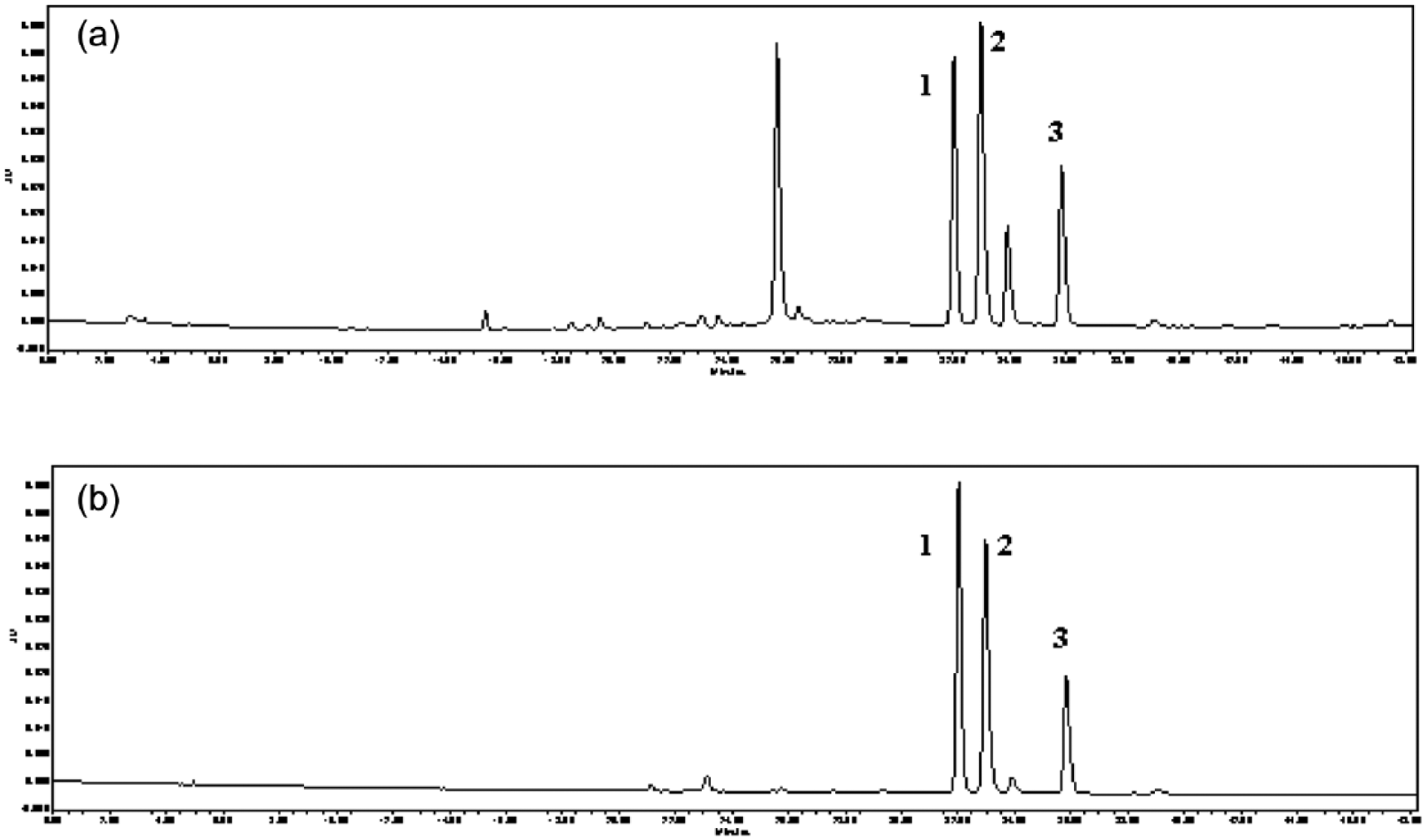
(a) The HPLC chromatogram of 50% ethanol extract fraction and (b) purified Polygonum capitatum flavonoid fraction (FPC) (Peak 1: luteolin-7-O-glucoside; peak 2: rutin; and peak 3: quercitrin).
Effect of FPC on HFD rats’ liver index and body weight
As shown in Table 1, liver index and body weight of rats in HFD group were obviously higher than those in NC group (P < 0.01). However, when treated with FPC at the dose of 180 and 90 mg/kg body weight for 42 days, there was an obvious decrease in liver index and body weight (P < 0.01; P < 0.05). Those results implied that the administration of HFPC and MFPC to hyperlipidemia rats could exert a positive effect on liver index and body weight.
Effects of FPC on serum lipid levels, apoproteins, liver index, and body weight of experimental hyperlipidemia rats induced by high-fat diet.

NC: normal group; HFD: high-fat diet; XZK: high-fat diet plus xuezhikang; HFPC: high-fat diet plus high-dose FPC; MFPC: high-fat diet plus medium-dose FPC; LFPC: high-fat diet plus low-dose; TC: total cholesterol; TG: triglyceride; HDL-C: high-density lipoprotein-cholesterol; LDL-C: low-density lipoprotein-cholesterol; ApoA: apolipoprotein A; ApoB: apolipoprotein B; SD: standard deviation; FPC: flavonoids ingredient from Polygonum capitatum.
The data were reported as the mean ± SD of eight rats per group.
P < 0.01 (vs NC group) and **P < 0.01 and *P < 0.05 (vs HFD group).
Effects of FPC on HFD rats’ serum lipid profile
As shown in Table 1, high-fat-treated rats displayed obviously lower levels of serum HDL-C and ApoA than those in the NC group, while serum levels of ApoB, TC, TG, and LDL-C were significantly higher in hyperlipidemia group when compared with NC group (P < 0.01). However, when treated with FPC at the dose of 180 and 90 mg/kg body weight for 42 days, there were showed a positive effect that obviously decreased in the serum levels of ApoB, TC, TG, LDL-C and increased in the serum levels of HDL-C and ApoA in a dose-dependent relationship (P < 0.01; P < 0.05). So, the oral administration of FPC could exhibit obviously hypolipidemic effect.
Effects of FPC on serum oxidative stress
As displayed in Figure 2(a)–(d), compared to NC group, the MDA content was obviously increased, whereas the serum levels of SOD, CAT, and GSH-Px activities in HFD group were remarkably lower than those in NC group (P < 0.01). However, FPC dose-dependent improved CAT, SOD, and GSH-Px antioxidant enzyme activities and decreased MDA content in FPC-treated group (P < 0.01; P < 0.05).

Effects of FPC on serum levels of (a) GSH-Px, (b) SOD, and (c) CAT activities and serum levels of (d) MDA, (e) TNF-α, and (f) IL-6 in HFD-induced hyperlipidemia rats. Data were reported as the mean ± SD of eight rats per group (##P < 0.01 (vs NC group) and **P < 0.01 and *P < 0.05 (vs HFD group)).
Effects of FPC on serum inflammatory cytokines
As shown in Figure 2(e) and (f), after feeding the HFD for 6 weeks, the levels of serum TNF-α and IL-6 were obviously higher in comparison with those in NC group (P < 0.01). However, the high levels of serum IL-6 and TNF-α in HFD group could be prevented by administration of FPC at the dose of 90 and 180 mg/kg body weight in a dose-dependent relationship (P < 0.01; P < 0.05). The serum levels of IL-6 and TNF-α in the HFPC group were similar to those in the XZK and NC groups.
Hepatic inflammation and lipid metabolic gene expression
To investigate the underlying mechanisms of anti-inflammation and hypolipidemic effects of FPC, the relative levels of IL-6, TNF-α, ACC, SREBP-1C, PPARα, and LDLR messenger RNA (mRNA) expression in the hepatic tissue were tested by RT-PCR analysis. As shown in Figure 3, the mRNA expression levels of SREBP-1C, ACC, IL-6, and TNF-α in the HFD rats were significantly higher, whereas PPARα and LDLR were significantly lower than those in NC group (P < 0.01). However, treatment with FPC at the dose of 180 mg/kg body weight significantly increased the mRNA expression levels of PPARα and LDLR and reduced the mRNA expression levels of IL-6, TNF-α, ACC, and SREBP-1C (P < 0.01; P < 0.05). These results were according to those of serum analysis, which implied that FPC suppressed the development of AS possibly by regulating blood lipid metabolism and inhibiting inflammatory response.

The relative levels of hepatic (a) IL-6, (b) TNF-α, (c) PPARα, (d) LDLR, (e) SREBP-1C, and (f) AAC mRNA expression to control GAPDH. The data were reported as the mean ± SD of eight rats per group (##P < 0.01 (vs NC group) and **P < 0.01 and *P < 0.05 (vs HFD group)).
Discussion
In this study, luteolin-7-O-glucoside, rutin, and quercitrin are the major flavonoid constituents presented in the ethanol extract of P. capitatum, but there is little research about the hypolipidemic effect of FPC, and the underlying mechanism is not understood well. Hence, the aim of this research is to solve it. Literature studies have proved that the development of AS is related to the processes of inflammation, hyperlipidemia, and oxidative stress. 1 There is a popular belief that the disorder of blood lipid metabolism plays an important role in the development of AS, and it is an early sign of CVD. 10 Our results have shown that FPC can improve the serum lipid profile and inhibit the liver index gain, which were according to the previous research. 11
It is generally recognized that inflammation and oxidant stress play a vital role in the initiation and development of AS. IL-6 and TNF-α are known inflammation cytokines, which play a vital role in inducing the process of inflammation in macrophages. 12 SOD, CAT, and GSH-Px are generally considered the main antioxidant enzymes in tissues to prevent oxidative stress. Our findings indicated that FPC can improve AS by attenuating inflammation and oxidative stress. The observed positive effects might due to the flavonoids in FPC and the results were according to the previous study. 13
The nuclear receptor PPARα is used to treat dyslipidemia and modulates the mRNA expression of encoding proteins that are referred to fatty acid oxidation and lipid metabolism. 14 LDLR plays an important role in lipoprotein metabolism by decreasing the plasma LDL-C content. 15 The SREBP-1C and its targeting gene ACC have been considered as the transcription factors, which modulate the expression of genes involved in the synthesis of fatty acid and cholesterol and clear the lipoproteins. Our research showed that FPC treatment downregulated the expression of SREBP-1C and ACC and upregulated the expression of LDLR and PPARα, thus suppressing the synthesis of fatty acids.
In conclusion, our investigation demonstrated that FPC can exert anti-AS effect through upregulating gene involved in fatty acid oxidation and lipid metabolism and downregulating genes involved in lipogenesis and inflammation factors. The observed anti-AS effect of FPC possibly owe to the presence of flavonoid constituent. However, the histopathological observation of thoracic aortas and livers should be well investigated in further research.
Footnotes
Declaration of conflicting interests
The author(s) declared no potential conflicts of interest with respect to the research, authorship, and/or publication of this article.
Funding
The author(s) received no financial support for the research, authorship, and/or publication of this article.