




Abstract
This research aimed to determine the explanations, processes, and implications of the Indonesian government's controversial labeling of TNPPB-OPM as a terrorist group. The labeling reflected the strategy implemented by the government to move from purely military to law enforcement approaches. Despite the split amongst government agencies during the labeling process, it was carried out to legitimize security forces with the terrorism law, deal with prolonged violent conflict, and reject the extension of the special autonomy and security situation during XX PON in the two provinces in Papua. This research found paradoxical implications and although it effectively provided a security situation, it failed to stigmatize and stereotype the Papuan Freedom Movement negatively.
Introduction: Background, significance, research questions, and objectives
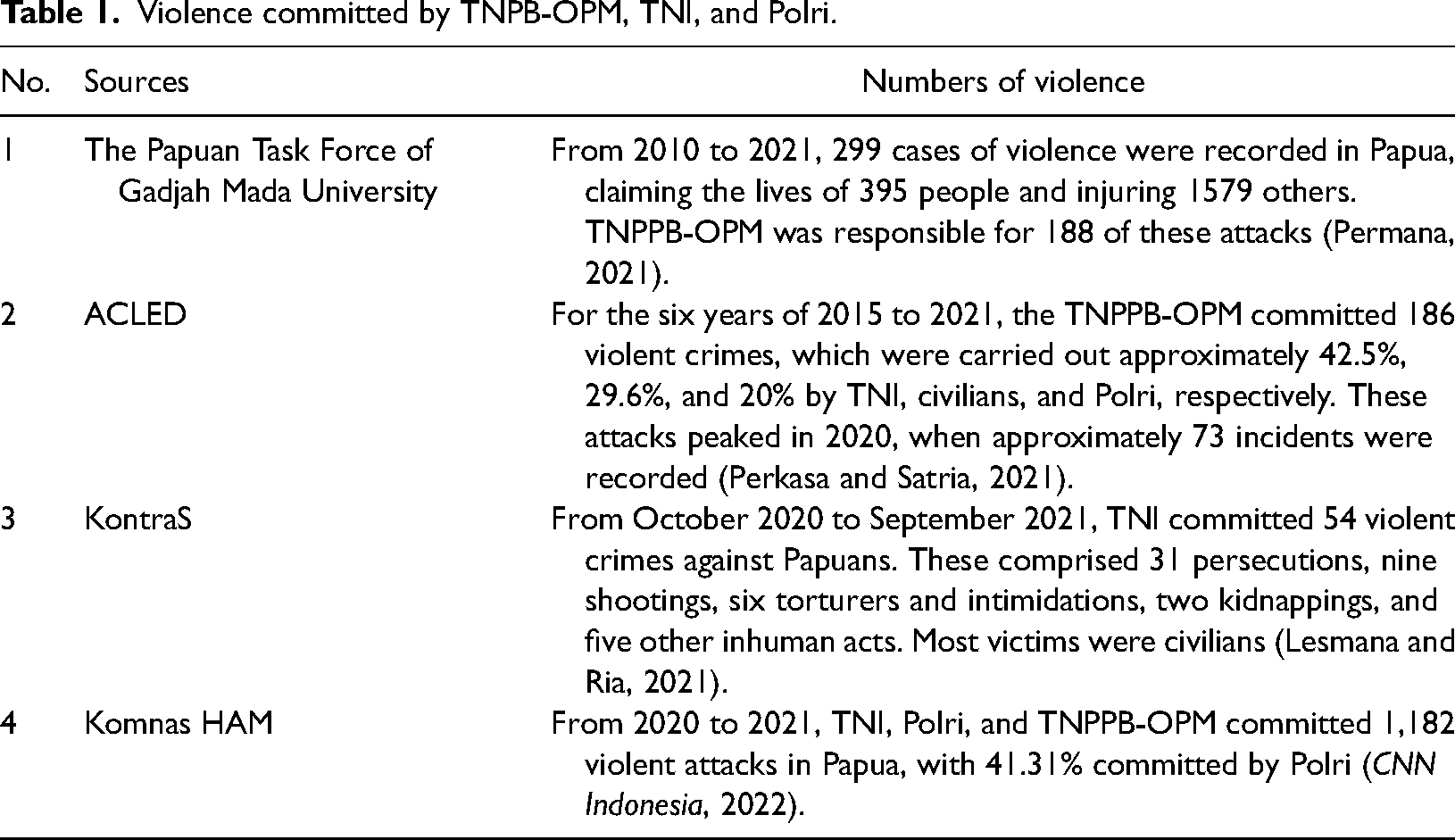
In April 2021, the Indonesian government, represented by the Coordinating Minister of Politics, Law, and Security, Mahfud MD, labeled the Tentara Nasional Pembebasan Papua Barat – Organisasasi Papua Merdeka (TNPPB-OPM; National West Papua Freedom Army – The Papua Freedom Organization) a terrorist group: “Pemerintah menganggap bahwa organisasi dan orang-orang di Papua yang melakukan kekerasan masif dikategorikan sebagai teroris” [The government considers Papuans and its organizations as terrorist groups because they were responsible for carrying out massive violent attacks] (CNN Indonesia, 2021a, 2021b). Mahfuds’ statement is a summary of the words of the vice head of the State Intelligence Agency (Badan Intelijen Negara; BIN), the National Counter Terrorism Agency (Badan Nasional Penanggulangan Terorisme; BNPT), and the People Representative Officer (Anggota Majelis Permusyawaratan Rakyat; MPR). The labeling of TNPPB-OPM has played a significant role in prolonged conflict with the Indonesian government, even as special autonomy measures were introduced in the provinces. This conflict in Papua has its origin in the controversial integration of the region into Indonesia in 1963. At that time, the military factions of the Papuan Freedom Organizations, also known as Organisasi Pembebasan Papua (OPM) or TNPPB-OPM, were caught in conflicts with the Indonesian Military, formerly referred to as ABRI (the Indonesian Army forces). The New Order government applied a military-centric approach, describing Papua as a Military Operations Area (DOM) on 11 occasions (Komisi, 2021). However, in 1998, as Indonesia experienced political reform or reformasi, the central government changed its strategy from repression and militarism to a more political approach. This transformation led to the granting of special autonomy to Papua in 2001, aimed at peacefully resolving the Papuan conflict and improving the well-being of the people. This change in policy failed to bring about a cessation of the conflict. For instance, during the 11 years of 2010–2021, 299 incidences which involved TNPPB-OPM and the Indonesian security forces took 395 people's lives and injured 1579 individuals (Permana, 2021).
This caused the government to change the label for TNPPB-OPM several times, categorizing them as Kelompok Separatis Bersenjata or KSB (The Armed Secessionist Group), Gerakan Pengacau Keamanan or GPK (The Security Intruder Movement), Kelompok Kriminal Bersenjata or KKB (The Armed Criminal Group), and Kelompok Kriminal Separatis Bersenjata or KKSB (The Armed Separatist Criminal Group), as well as terrorist groups. The controversial change in labeling from KKB or KKSB to a terrorist group occurred after a member of one of its factions, Legakak Talengen, shot a one-star general from the State Intelligence Agency (Badan Intelijen Negara; BIN) named Gusti Putu Danny Nugraha on April 25, 2021 (Tim Detikom, 2021). The labeling of TNPPB-OPM as a terrorist group signifies a shift from the previous military-centric approach adopted by the government during the New Order era. This transformation to mixed security and law enforcement strategy was particularly pronounced during the reformasi period, marked by revisions to the special autonomy package.
The decision to label TNPPB-OPM as a terrorist group has intense political implications and has sparked controversy within society. This decision prompts critical questions regarding whether such labeling can effectively resolve the ongoing conflict in the context of the special autonomy implementation in Papua and West Papuan provinces, where a peaceful and stable situation is crucial. Despite these efforts, it was reported that tensions and violence persisted in these regions. It is against this complex background that this research was conducted, with a specific focus on analyzing the political context, the labeling process, and its implications on security in Papua, as well as domestic and international actors involved in pro-referendum movements. This research addresses a relatively understudied issue and pursues three primary objectives. First, it aims to uncover the rationale and context behind the government policy of designating TNPPB-OPM as a terrorist group. Understanding the political context is significant in comprehending security policies related to labeling groups as separatist, criminal, or terrorist. Second, the research seeks to clarify the complex process of labeling, which involves multiple security institutions with varying tasks, responsibilities, perceptions, and interests. Third, any security policy, including the labeling of certain groups as terrorists, has both positive and negative consequences. This research aims to comprehensively understand the implications of such labeling on Papuan communities, neighboring regions, and the activities of both domestic and international pro-referendum activists.
Literature review
Labeling freedom fighters as terrorists does matter, but it is not particular to TNPPB-OPM. Similar other domestic movements were both internationally and locally observed. Moreover, some of them include foreign activities such as ETA (Euskadi Ta Askatasuna in Bosque, Spain), LTTE (Liberation Tigers of Tamil Eelam in Sri Lanka), Fuerzas Armadas Revolucionarias de Colombia or FARC (The Revolutionary of Armed Forces of Columbia), IRA (Irish Republican Army in Britain), Partiya Kankerran Kurdistan or PKK (Kurdish Workers’ Party in Turkey), and Chezs's freedom fighters simultaneously and the former Gerakan Atjeh Merdeka or GAM (Free Aceh Movement in Indonesia). Under President Mariano Rajov's regime, the Spanish government labeled ETA as “the terrorist band that must be eradicated from the lives of the Basques and Spaniards, without expecting any kind of consideration” (Annon, 2018).
The Sri Lanka government categorized LTTE as a terrorist organization, despite its long secessionist struggle since 1976 to ensure that the Tamil ethnic minority in eastern and northern parts of the country gained autonomy which was defeated by the Military (Sarvananthan, 2018). In 1997, the US government assisted Columbia in fighting FARC and labeled the guerilla and drug cartels terrorist groups (ICCTNL, 2017). Meanwhile, in 2008, the United States, the European Union, and Turkey designated the Kurdistan Freedom Falcons (TAK), which served as a wing of the separatist PKK and rebelled against the Turkey government from Northern Iraq, as a terrorist group. The US government further pointed out that TAK was responsible for specific violent attacks targeting tourist locations, military bases, and government buildings. In 1997, the Global Terrorism group of the UK and the United Department of State listed the liberation group the IRA as the best-known terrorist group for its indiscriminate attacks on economic facilities and infrastructure on the UK mainland which caused massive loss of life and destruction (Refworld, 1997). Meanwhile, in Southeast Asia, three countries—Thailand, the Philippines, and Indonesia—faced separatist movements, and the respective groups PULO, MILF, and GAM were labeled as terrorist organizations. These descriptions were based on the belief that the groups employed terrorist tactics to advance their separatist agendas and had secretive ties to global terrorist networks, such as Al Qaeda (Saidin and Yusoff, 2020). Specifically, in 2002, Susilo Bambang Yudhoyono, Indonesia Coordinating Minister of Politics and Security, labeled GAM (Free Aceh Movement) as a terrorist group, citing their alleged engagement in indiscriminate violence (Liputan 6, 2002). This research aims to contribute to the ongoing debate surrounding the labeling of separatist groups as terrorists. It seeks to address the gap in previous research by examining the labeling of TNPPB-OPM as a terrorist group, a topic that has never been extensively explored.
Theoretical frameworks
In 1987, Walter Lacquer made a significant declaration that formulating definitions of terrorism capable of comprising all its characteristics is an insurmountable challenge (Ahmad, 2001). Gibbs (1989) stated that describing an organization as a terrorist group has always been a controversial or contradictory issue because of its attachment to various interests, including political and ideological perceptions. Lacquer and Gibbs’ theories are in line with that of David C Rapport (2001), who categorizes the development of terrorism into four distinct waves. The theory proposed by Rapport bridges the connection between terrorism and the concepts of self-determination and freedom movements, while ignoring its moral aspects. According to the framework designed by Rapport, these are the four waves of terrorism. The first (1880 to 1920) was primarily focused on advocating for political reform by engaging in resistance against authoritarian regimes. The second (1920 to 1960) had a central mission of fighting for self-determination. The third wave (1970s) was predominantly associated with leftist movements and claimed to defend the interests of Third World countries by challenging capitalist systems. The fourth wave is characterized by motivations rooted in religious and revolutionary ideologies, as observed in the early 2000s (Ramakhrisna, 2002).
Unlike the theory proposed by Rapport, the decision of the Indonesian government to label TNPPB-OPM as a terrorist group, instead of a separatist organization, has altered its moral status. This shift is consistent with the prevailing definition of terrorism, and the Indonesian policy framework which is primarily shaped by the characteristics associated with fourth-wave terrorism. Freedom fighting is morally legitimate, while terrorism is not. Freedom fighters who hailed from the marginalized group sought to curb oppression by targeting military facilities to gain liberty wrongfully taken from them. The group was ready to stop fighting and ceased fire to accomplish their goals. Terrorism, on the other hand, is an elusive and the debated concept in social science due to being a multi-faceted phenomenon. In addition, it is also very subjective. This unlawful act is described as social deviance with a cruel agenda targeted at indiscriminate, unarmed, and unsuspecting civilians to destroy and cause severe suffering for or even total annihilation of their enemies (Susetyo, 2019). The classification of TNPPB-OPM as a terrorist group is consistent with the second wave of terrorism theory proposed by Rapport, which comprised a broad spectrum of political violence, including secession and insurgency (Susetyo, 2019). This research failed to discuss or analyze the contentious status of TPM-OPM as freedom fighters and criminal groups. Instead, it suffices to emphasize that the Indonesian government had initially labeled the TPM-OPM as a separatist and then a criminal organization. Initially, it was categorized as a separatist group, later as a criminal organization, and finally, in 2021, it was designated as a terrorist faction. This research argues that designating TNPPB-OPM as a terrorist group is a public policy which is defined as the government's statement and actions at whatever levels and forms to respond public problems (Birkland et al., 2019; Martin et al., 2022). The policy is implemented within a specific domain, supported by authoritative and coercive measures. According to Almond in Seta (2011), government institutions can either cooperate or disagree with each other as they work to promote shared or conflicting interests. This research focuses on the decision of the Indonesian government to describe TNPPB-OPM as a terrorist group and uses the labeling theory to analyze its implications for individuals exhibiting deviant behavior. This theory suggests that the act of labeling can exert a subjective and often confusing influence. Becker (1963) stated that abnormal behavior is often a consequence of regulatory and sanction enforcement against those deemed deviant. Consequently, it is imperative to analyze this labeling process (Narwoko and Suyanto, 2004).
Several other theorists have also voiced concerns regarding the potential adverse consequences of such labeling. Paternoster and Leeann (1989), Becker (1963), and Lemert (1967) stated that formal labeling of criminal offenders tends to have negative impacts, such as stereotypes, stigmatization, and exclusionary responses. It is also bound to have an enormously detrimental effect on individuals or community development (Becker, 1963; Lemert, 1967; Paternoster and Leeann, 1989). Lemert (1967) reported that labeling individuals or groups as criminal offenders reinforces and stabilizes them when entangled in crimes. Bernburg (2009) confirmed that tagging individuals and groups as criminal offenders leads to distrust and devaluation. Moreover, such persons tend to avoid routine social encounters with other people. Chagankerian (2013) stated that the effectiveness of labeling freedom fighters as terrorist groups depends on the views of both the locals and the international community. This is an efficient tool to simplify certain realities. At the same time, the labeling actors, including government officers, have the opportunity to influence people's perception of these groups, thereby resulting in negative psychological implications (Chagankerian, 2013).
Methodology
This qualitative research follows the steps outlined in Figure (adapted from Miles and Huberman, 1992). This data analysis used in the present research follows the framework proposed by Miles and Huberman (1992) concerning data collection, reduction, presentation, and conclusion. To explore the political and security contexts surrounding the labeling, a variety of data sources was used. These include documents from the Papuan Task Force at Gadjah Mada University, ACLED, human rights organizations such as KontrasS and Komnas HAM, media news, and conference papers. These sources collectively shed more light on the labeling process. Additionally, the findings of this research were triangulated by conducting interviews with police intelligence officers and AMP activists. In order to comprehensively understand the labeling process, the research also referred to existing laws that define the roles and responsibilities of security institutions, including Polri, TNI, BIN, and BNPT. This legal framework was further complemented by information and official resources from the media and Polri Institutions, respectively. These findings were then triangulated through interviews with police and intelligence officers. To assess the implications of the labeling, the research primarily relied on data gathered from interviews with police and intelligence officers, AMP members, as well as insights from academic experts such as Prof. Cahyo Pamungkas and Dr Chudry Sitompul.
The intelligence police, TNI officers, OPM, and Papuan student activists were withheld for security purposes. In addition, most of the interview sessions were conducted online due to the Covid-19 pandemic. In the reduction stage, the research systematically selected the collected data, preserving the pertinent information and discarding irrelevant contents. The selected data were subsequently presented in a structured findings and analysis, using narrative descriptions and tables consistent with the research questions. At this stage, the acquired data were organized into distinct subsections, covering topics such as Explaining the Political and Security Context of the Labeling, Labeling Process, and Implications. Finally, in the concluding phase, the investigation critically evaluated whether the research questions had been adequately addressed and the objectives successfully met.
Findings
Explaining the political and security context of the labeling
The violent attacks committed by TNPPB-OPM in later years, which legitimize security officers designating them as a terrorist group, are traced to the history of Papuans in response to the special autonomy (Otonomi Khusus; Otsus) package granted by Megawati in 2001. The 20-year implementation of Otsus, which ended in 2021, needs to be evaluated. The unsatisfactory outcomes partly motivated the domestic and international Papuan pro-independent activists to continuously campaign against the special autonomy and to persistently demand a referendum and their freedom. Political rallies were held to reject the revision of Otsus, and security tension emanated from riots against racism which escalated in several cities within Java, such as Jakarta, Surabaya, and Yogyakarta. These further degenerated into mass riots in Jayapura, Fak-Fak and Timika, Sorong, and Manokwari (interview with police officer, August 24, 2021).
Meanwhile, condemning the anti-racial actions against Papuan students in Malang and Surabaya, the rioters and demonstrators echoed their demand for a referendum and Papuan freedom. The demonstrations and riots involved various actors, including domestic and foreign OPM activists, Jokowi's opposition party politicians, and army elements in regional districts. They collaboratively capitalized on these rallies for intertwined and mutually beneficial interests. The National Police alleged that based on these three incidents, ULMWP, the West Papua National Committee (KNPB), and AMP organized mass riots (CNN Indonesia, 2019). As confirmed by an AMP activist, the nexus between Papuan domestic and international political movements to promote the referendum was evident. Relevant information was shared based on unifying their visions in terms of demanding West Papuan independence (interview with AMP member, August 25, 2021).
Human rights activists and Papuan political asylum seekers campaigned for the internationalization of these issues in forums held in London and the Philippines to attract the international community's sympathy. The global movement acquired ammunition due to racist incidents suffered by Papuan students in Malang and Surabaya. It demanded the release of 22 detainees who allegedly provoked the rallies and riots. They were sentenced by the police based on subversion allegations. Due to this arrest, international human rights activists accused the Indonesian government of poorly resolving the Papuan conflicts (Bonasir, 2019). The political context surrounding the evaluation of Otsus coincided with the organization of the National Sports Affairs (Pekan Olahraga Nasional; PON) in the three most outlying provinces that experienced a history of secessionism from October 2 to 5, 2021. These include the provinces of Nanggroe Aceh Darussalam (NAD, westernmost) as well as Papua and West-Papua (easternmost) in Indonesia (Tempo, 2021). Meanwhile, the security situation in NAD was relatively favorable but fluctuated in Papua.
The tense domestic and international political dynamics were coupled with security challenges regarding violent attacks by the officers (TNI and Polri), such as arrests, counter assaults, persecution, and torture. The armed wing of TNPPB-OPM was involved in shootings, sabotage, kidnapping, attacks, and burning of relevant public facilities. Table 1 shows the findings of diverse institutions, including the Papuan Task Force of Gadjah Mada University, Armed Conflict Location and Event Dataset (ACLED), Komisi Untuk Orang Hilang dan Tindak Kekerasan or KontraS (Commission for Disappeared People and Violence), and Komisi Nasional Hak Azasi Manusia or Komnas HAM (National Commission of Human Rights), concerning the violence perpetrated by TNPPB-OPM, TNI, and Polri.
Violence committed by TNPB-OPM, TNI, and Polri.
Explaining the labeling process
The government's decision to label this separatist faction as a terrorist group reflects the political strategy employed in dealing with the Papuan conflict, from an absolute military approach during the 32 years of the New Order to a law enforcement procedure, coupled with the development process implemented during the reform era. During the New Order regime (1967 to 1998), the government labeled the TNPPB-OPM as an Armed Separatist (Kelompok Separatis Bersenjata; KSB) or Security Intruder Group (Gerakan Pengacau Keamanan; GPK). However, they committed violent offenses characterized as terrorist activities. This was because the politics of the New Order government placed Angkatan Bersenjata Republik Indonesia; ABRI (Indonesian Armed Forces, currently known as TNI) in a dominant position, namely in politics and security (Batubara, 2020).
The New Order ruler adopted the “dual functions” doctrine of ABRI, which placed the army as the backbone of its power. However, aside from security and defense, it also exhibited political functions. This doctrine's primary mission was to defend Indonesia's sovereignty and unitary state, including dealing with secessionism and managing domestic security. The New Order government designated the Polri as the fourth force of ABRI after the army, navy, and air force (Batubara, 2020). The repressive security approach employed by the authoritarian New Order ruler resulted in injustice and prolonged violence with massive allegations of Human Rights violations. During that period, the Papua regions remained backward.
The demise of the New Order ruler, Suharto, led to the transformation of Indonesia into a more democratic country that promoted political, economic, legal, and security reforms. The government dissolved the ‘dual function doctrine’ at the outset of reform, withdrawing TNI from political practices and separating Polri from the TNI organizations (Batubara, 2020). Furthermore, the approach adopted in dealing with internal security, including terrorism and separatism, reportedly shifted from military to a more civilian procedure, as well as law enforcement supporting the spirit of democratization. This decision led to using government instruments, including those with coercive authority.
Since the outset of the reform, the Indonesian security officers had no right to label the TNPPB-KKB a terrorist group. Polri tagged this faction as KKB, while TNI referred to them as KSB, despite their atrocities. By labeling armed TNPPB-OPM as KKB, the Polri publicly branded them as a sporadic group rather than an organization committing ordinary criminal acts. Therefore, people do not need to worry about security in Papua. This placed the Polri as the leading institution to handle security issues under the civil order principle. The labeling of TNPPB-OPM as KKB has altered the TNI's role as the foremost institution that addressed security issues under the principle of military emergency, which adopted more repressive measures and ensured Polri dealt with the group based on the law enforcement policy (Fadillah, 2020). However, TNI still considers the TNPP-OPM a separatist group that continues to execute its military operation according to the security situation. It also sought to gain absolute authority in carrying out military operations concerning verses one and two of article seven Law number 34/2004, that tackling armed separatist and rebellious movements is part of its military operation, other than war activities.
In April 2021, the Indonesian government, represented by the Coordinating Minister of Politics, Law, and Security, was reported to have designated the TNPPB-OPM as a terrorist group. This was changed from the KKB and KSB labeled by Polri and TNI, respectively, to a terrorist group. Government agencies disagreed with labeling TNPPB-OPM as a terrorist group, albeit with their collaborative security measures to tackle its activities. BIN, the head of BNPT, certain politicians of the parliament, and the Coordinating Minister of Politics and Law, as described in Table 2, labeled TNPPB-OPM a terrorist group.
Government officers and politicians’ statements depicting that TNPPB-OPM is a terrorist group.
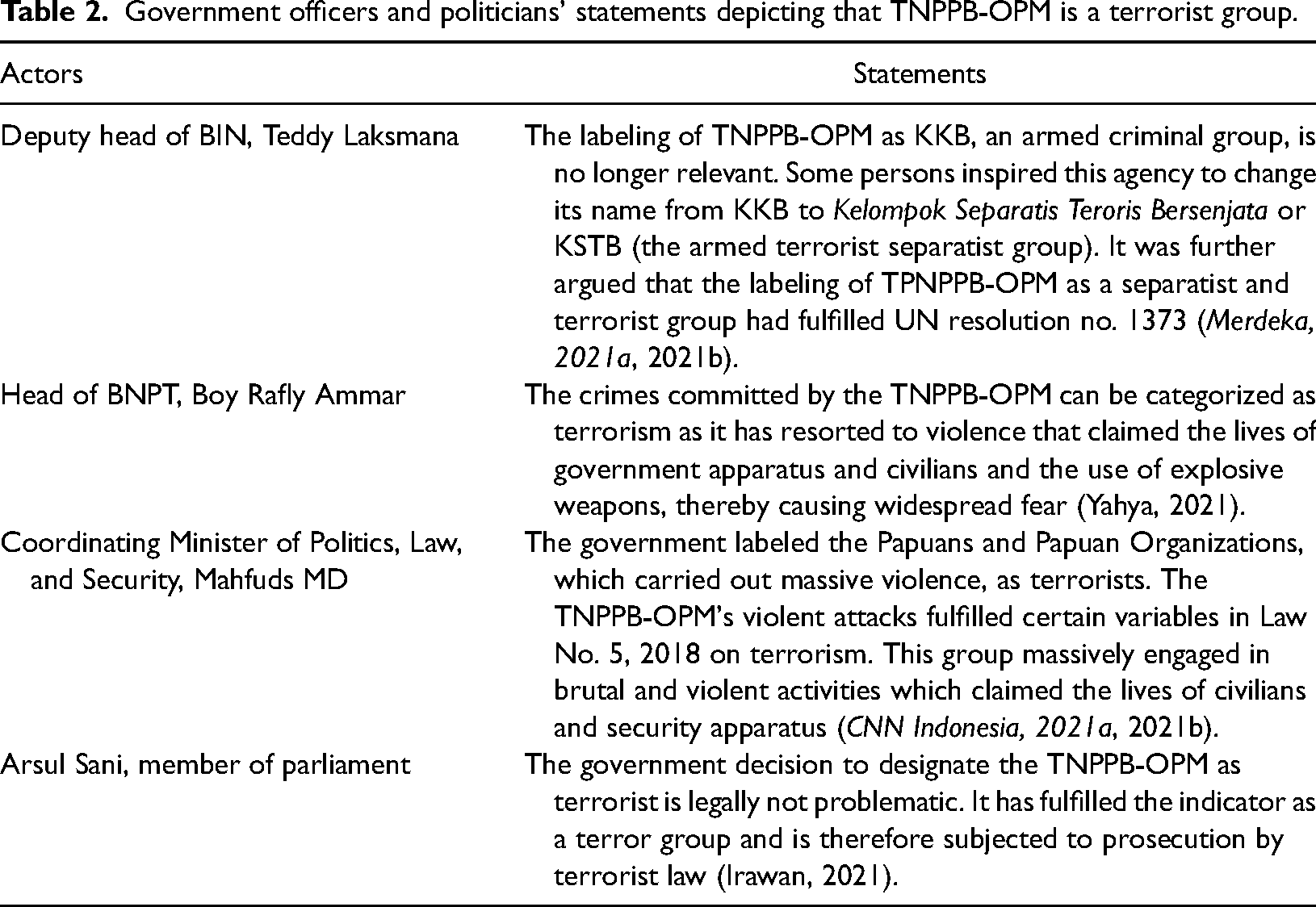
They referred to the definition stipulated in Article 5 of 2018 that “terrorism is the use of violence with ideological, political, or mere security disruptive motives to create a horror or fearful atmosphere, and also cause massive casualties including the strategic destruction of relevant international public facilities” (Article 1, Verse 2, Law Number 5/2018). It was further asserted that the labeling fits the definition mentioned above and is evidenced by TNPPB-OPM’s violent acts, including attacks on civilians, spreading fear, plotting to destroy the legitimate government, killing, and extortion. The atrocities committed by this organization have hijacked the approach to peaceful dialogue employed by the Papuan leaders and the central government, thereby leading to the autonomy policy enacted in 2001. Labeling TPNPB-OPM as a terrorist group allows the security institution to apply the law of terrorism as the legal basis to deal with the organization (Sitompul, 2021). This policy mandates BNPT and TNI, in addition to Polri, to be involved in the counter-terror measures. Table 3 presents the security institution's job description in dealing with terror threats, including those committed by TNPPB-OPM.
Security officers’ job descriptions on counter-terror measures.
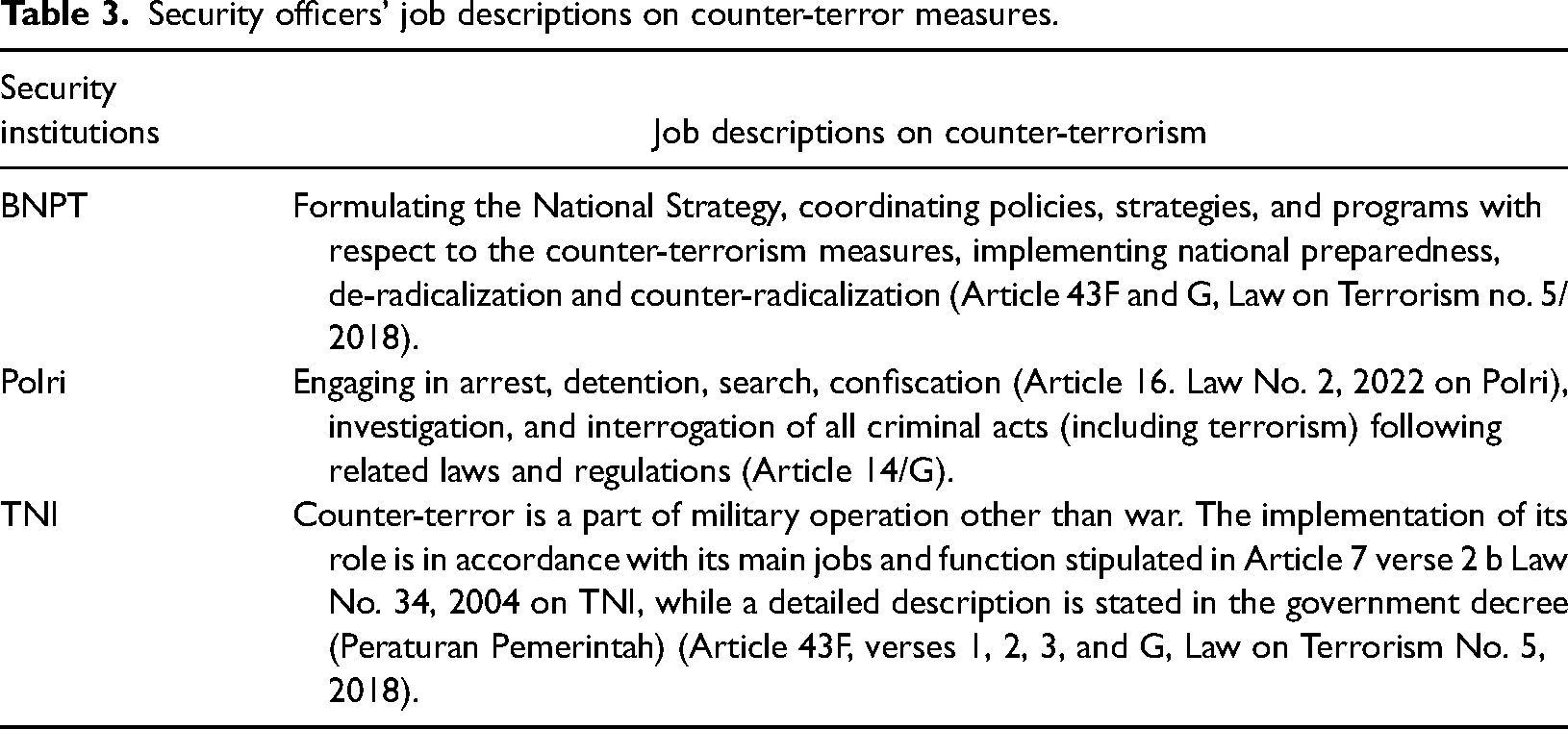
Labeling TNPPB-OPM as a terrorist organization provides leeway for BNPT and TNI in counter-terrorism actions. Moreover, the labeling of terrorist and separatist organizations proposed by the Deputy Head of BIN strengthens the involvement of TNI in countering the TPNPB-OPM as it is the only institution with the authority to deal with separatism and terrorism. By tagging this organization as a terrorist and separatist group, the TNI has two legitimacies in countering this faction. As was previously discussed, presently, TNI keeps designating TNPPB-OPM as a separatist group, albeit with its rejection of being labeled a terrorist group.
On the contrary, Polri refrained from labeling TPNPB-OPM as a terrorist organization and kept tagging it as a criminal group (KKB). The Head of the Bureau of Human Relations, Rusdi Hartono, stated, “Polri keeps designating the TPM-OPB as KKB.” Accordingly, it is yet to decide on the involvement of its Polri anti-terror squad, Densus 88, in the crackdown (Damailah Indonesiaku, 2021). By labeling the TNPPB-OPM as KKB, Polri has absolute authority and is at the forefront of enforcing laws to deal with purely extraordinary crimes committed by this group (interview with police officer, August 28, 2022). Similarly, a member of parliament from Papua, Yan Permenas Madenas, and a human rights activist disagreed with labeling the TPNPB-OPM as a terrorist group. Instead of labeling this group as a terrorist organization, it was requested that the strategy employed in tackling the TNPPB-OPM be evaluated (CNN Indonesia, 2021).
Permenas’ recommendation was supported by human rights activists and retired military officers who believe that the labeling tends to distance them from solving Papuan problems, to stigmatize its indigenes, and to have psychological, economic, security, and legal impacts. The tagging and subsequent military operation are considered “Jokowi's (President Joko Widodo) worst-ever policy on Papua” (Merdeka, 2021a, 2021b; Putri, 2021). Sidney Jones and Samuel Awon (human rights activists) described the labeling as an “unwise and regressive move” by the Jokowi administration. This is because the decision is likely to further alienate Papuans after being stigmatized as separatists. Labeling is known to hinder the development of democracy and human rights (Komisi, 2021; Supriatin, 2021).
Regardless of the legal provision of Law No. 5, 2018, on terrorism, which does not subordinate TNI below Polri, the Coordinating Minister of Politics, Law, and Security, Mahfuds MD, stated that “Polri played a leading role and TNI assisting.” Mahfuds’ directive delivered two messages. Firstly, it impressed the public with the unity and solidity of Polri and TNI. Secondly, it is centered on the fact that the countermeasures toward TNPPB-OPM are subject to the principle of law enforcement initiated by Polri rather than the military operation by TNI. Therefore, Polri continued the operation of the Nemangkawi Task Force, which was established in January 2019. Members of the task force include Polri and TNI officers, who are the main actors and assistants. This indicates that the Papuan Regional Police (Papua Regional Police Chief) and Military (Military Regional Commander) act as the operational and deputy commanders, respectively. In 2021 the Task Force deployed 1186 personnel to Mimika, Intan Jaya, Beoga, and Illaga. Ahead of the XX PON, Polri deployed an additional 6000 to Papua to ensure security, order, and stability (Nirmala, 2021; interview with police officer, 24 August 2021).
The Nemangkawi operation adopted balanced strategies of preemption, prevention, and repression. During the six months of operation, this task force claimed to have achieved encouraging results. Firstly, it succeeded in distancing and separating the civilians from TNPPB-OPM, which was likely to cause chaos. This faction was forced to flee to a remote mountainous area due to the pursuit of the Police and TNI (interview with police officer, August 24, 2021). Secondly, it mapped the landscape of the five TNPPB-OPM factions, seizing their camps and confiscating their weapons and telecommunication equipment, thereby narrowing their movement. The task force reportedly killed eight fighters in the crackdown operation and injured 11 others. However, the faction also killed 22 people (seven TNI, two Polri, and 13 civilians).
With the massive Nemangkawi operation, the Polri claimed that the TNPPB-OPM was under pressure, as some of its members had fled their camps to escape the pursuit (interview with police officer, August 24, 2021). The police also need to act similarly against politicians supporting the OPM based on charges of financing terrorism or supplying weapons. This happened to Radius or Nelson Murib, who has been under police custody for allegedly giving illegal weapons and ammunition worth 1.393 billion rupiahs to TNPPB-OPM fighters in Puncak Jaya (Humas Polri, 2021). Meanwhile, approximately 375 and 600 million rupiahs were often obtained by Murib from a member of the Tolikara local parliament (Sonny Wanimbo) and a local government officer from Puncak Jaya, respectively (Fauzi, 2021). Smuggling weapons was not a new crime due to constant supplies from the Southern Philippines since 2014 through Tobelo, North Maluku, and Sorong Waters of Papua (Nainggolan, 2014). The armed Papuan fighters often asked the local government officials for money, with constant threats to buy weapons for their violent attacks (Intelligence Officer, 2021). Several OPM factions against Otsus collaborated with the armed OPM fighters to loot security officers’ weapons. They obtained additional supplies from different sources, such as illegal purchasing from supporting smugglers (interview with police officer, August 24, 2021).
The present security situation improved, specifically in Papua's central part of the mountain. In January 2022, Polri changed the Nemangkawi to Damai Cartenz operations. Coincidentally, the provincial police of Papua also engaged in the Rastra Samara Kasih operation (Rasaka, 2022). The Damai Cartnez, a law enforcement operation that lasted for six months, emphasized more human approaches, including preventive and persuasion strategies. This is by three prioritized methods, namely intelligence as a function of detection, education, and human relation in regions with high-security vulnerability, including Yahukimo, Nduga, Intan Jaya, and Illaga. The Rasaka operation focused on 23 areas with better security (interview with police officer, August 28, 2022; Rahmawaty, 2022). To support integrated security operations and law enforcement in Papua, the Indonesian army created a military campaign called Pinang Sirih. It was coordinated by Komando Cadangan Strategis Angkatan Darat or Kostrad (Army Strategic Reserves Command), and the operation is designed to secure Indonesia-Papua Niugini border areas (Suceno, 2021). Despite the Pinagsirih Military operation, the army strived to convey a public image of promoting a human approach in dealing with TNPPB-OPM fighters. This mission appeared inconsistent when General Dudung Abdurahman, the Army Chief, urged soldiers to treat TNPPB-OPM members as brothers, despite differing views on the existence of the Unitary State of Indonesia (NKRI). The primary mission of the deployment of the army to Papua was framed as supporting development rather than waging war against TNPPB-OPM. The statement made by Dudung was seen as rhetorical, based on the connection of the army in both the Nemangkawi security operation with Polri and a purely military operation, Pinang Sirih (Suwandi and Agriesta, 2021)
There are three legal and political objectives in labeling TNPPB-OPM as a terrorist group. First, this was to counter the OPM political faction's movement abroad, which capitalized on the rejection of Otsus and the rallies on racism to approach certain countries considering the rising issues in Papua (stagnant settlement of human rights violations and the poor Human Development Index). This occurred at the Geneva UN Human Rights Commission meeting on September 9, 2019 (Merdeka, 2019). By labeling the TNPPB-OPM as a terrorist group, the government has adopted a new political strategy to destroy the reputation of the Papuan separatist movement both at home and abroad by stigmatizing them as terrorists. The labeling aims to disregard separatist groups that pledged international support to terrorism. Asides from being internationally regarded as an extraordinary and transnational crime, terrorism also discriminates against humanity. Therefore, the weakening of the TNPPB and the domestic OPM political wing caused difficulties which led to the attraction of the international community, recognition, and support. According to Bobby A Rizaldy, a member of the Indonesian parliament, the adopted strategy stimulated the international community's support, thereby making it difficult for the TNPPB-OPM fighters to obtain foreign assistance (Aditya, 2021).
Second, the government's labeling aims to influence the domestic and international communities to exclude the OPM as a self-determination entity and downgrade its reputation as a freedom fighters’ group. Incidentally, the Indonesian government initially adopted such a strategy to deal with GAM. This also includes the governments of other countries in dealing with the separatist groups, as discussed previously. The government's strategy to change the label of TNPPB-OPM from criminal or separatist to a terrorist group was to meet national security and international political objectives. These impress both communities with the negative stigma and stereotypes against TNPP-OPM as criminal offenders.
Third, the designation is a raison d’etre for security forces and law enforcement officers to use Law No. 5, 2018 on terrorism, which stipulates more substantial deterrence effects as it addresses more effective preventive and proactive measures to deal with these groups (Syaukillah, 2021). With effective deterrent measures in mind, the government seeks to tackle security challenges and simultaneously overcome political tension. Although controversial, this was a legitimate and effective strategy to curb insecurities. By applying the law, the government aims to address complex political and security interrelated challenges in Papua, thereby refraining from repressive military measures. Students and political activists who propagated the referendum and self-determination agenda were quickly associated with terrorists as they shared similar political ideologies, provided support, or joined terrorist networks. Despite the legal provision on terrorism, which allows Polri to take such harsh security and law enforcement measures, it does not serve as a reference for its crackdown. This was due to Polri's stance on designating TNPPB-OPM as KKB.
Security, legal, and political implications of the labeling
The regulation legitimizing the prosecution of suspected terrorists substantially has broader and more severe legal implications than labeling a group an ordinary criminal organization (KKB). This is because the trial of terrorism addresses the causes of terror attitudes, such as provocation, hate speech, and radicalization. Therefore, anyone supporting such acts and other related actions, such as wiretapping, should be punished. By this, law enforcement officers are authorized to arrest suspected terrorists for approximately 221 days without trial (interview with Sitompul, August 24, 2021). In expressing concern, Samuel Awon stated that “they feared activists are likely to be treated as terrorists for having relationships with members of armed groups.” It was also reported that this apprehension violated the victim's rights on a criminal charge (Civicus, 2021).
The law enforcement and security measures adopted by Polri and TNI after labeling TNPPB-OPM as a terrorist group, albeit refraining from labeling it as a terrorist group, have paradoxical security, social, and political implications. On the one hand, the security implication led to a more favorable domestic political impact. In the province of Papua, the labeling strategy, combined with security and law enforcement strategies, served as an effective preventive measure. Its purpose was to guarantee the safe and conducive environment required for the successful hosting of the National Sports Week (Pekan Olahraga Nasional; PON) (PON XX) in Papua and West Papua Provinces, including NAD (Supriatin, 2021; Tempo, 2021). The terrorist labeling, despite Pori's refraining from using it, provides greater legal authority to carry out stricter measures to potentially deal with mass demonstrations, such as the case of AMPB and AMP, where the transfer of prisoner Victor Yeimo was demanded from Brimob to Jayapura Jail (interview with intelligence officer, September 11, 2021). The Polri has the legal power to override the voices and pressures of those attempting to influence their policies, as in the case of Yeimo's imprisonment.
Following the labeling, the Polri conducted an intelligence operation in the Papuan students’ dormitories in Indonesia to prevent them from protesting and rejecting the Otsus, which was evaluated and revised in the parliament. The operation effectively prevented mass action, although a few groups of 20 to 25 protesters from the AMP activists descended on the state palace and parliament building to voice their opposition to special autonomy and the terrorist label (interview with AMP Member, August 25, 2021). During the evaluation process of the Otsus revision, approximately 70% of Papuan student organizations from AMP, AMPPI, and IMAPA rejected the extension and demanded a referendum for West Papuan independence. After amending the Special Autonomy Law in the DPR on July 15, 2021, the activists supporting and those rejecting the extension of Otsus were evenly matched. Security operations and the Covid-19 outbreak managed to quell student demonstrations on the revised Otsus law. The initiative of pro-Papuan independence to mobilize people for a mass rally without permission from Polri is presently regarded as a rebellion against the rule on health quarantine. In Mimika, the labeling changed the strategy employed by the OPM political factions into a more covert action. For example, after ratifying the revised regulation, local OPM activists held a demonstration against Otsus at the Mimika DPRD office. Despite pretending to be scavengers at the beginning of the rally, they still managed to paste a paper with the words “Reject Otsus” before being disbanded by the security forces (interview with police officer, August 24, 2021).
According to Cahyo Pamungkas, the labeling had a significant psychological impact on Papuans residing in the cities (Jayapura, Manokwari, and Nabire), who witnessed daily dynamics based on complaints and being stereotyped as terrorists. The leaders and followers of the prominent Papuan Church Council, GIDI, indigenous people, human rights activists, and students all complained about the labeling. This was evident in their social media communications (interview with Pamungkas, September 30, 2021). Their complaints confirm the disagreements of human rights activists and retired military officers who believe that the labeling has distanced them from solving Papuan problems and stigmatized the people, resulting in negative psychological, economic, security, and legal impacts. These tagging and subsequent military operations are regarded as the government's worst policy in dealing with the Papuan Issue (Utami and Merdeka, 2021). The stigmatization alienated them from the national and international associations and the development of democracy and human rights (Star, 2021).
Despite Mahfud's claim of positive security implications and that of the Nemangkawi task force related to success, the TNPPB-OPM fighters are still influential. From April to December 2021, after the designation of this faction as a terrorist group, 56 violent incidences were committed by TNPPB-OPM, TNI, and Polri in Pegunungan Bintang, Yahukimo, Intan Jaya Jayapura, Maybrat, Nduga, Puncak, and Nabire regions. These were in the form of armed conflicts among the three factions, Polri's arrest, the burning of public facilities such as schools, and the shooting of civilians and security officers by TNPPB-OPM (interview with Polri officer, 2 Jan 2022). Polri arrested 52 perpetrators who attacked civilians and burnt public facilities, claiming six people's lives (Noventa, 2021).
On the other hand, the labeling did not have significant psychological implications on Papuan origins (Orang Asli Papua; OAP) residing in remote regions, such as in Biak Numfor. It did not also affect those in the diaspora, who are mostly students studying in big cities such in Java. This was because these individuals had been occupied with their daily lives. They neither felt discriminated against nor humiliated by their neighbors (interview with AMP member, August 25, 2021; Pamungkas, 2021). The labeling has also disappointed the diplomats of leading countries that have a grave concern for Papua, such as the United States, the Netherlands, Britain, and Australia, despite official state support for Papuan integrity in Indonesia. Meanwhile, they demanded an end to violence in Papua by a peaceful resolution through dialogue and a just settlement of alleged human rights violations. In line with the expectations of foreign leaders, young lecturers from various universities in Papua expressed their belief that peaceful dialogue was the only solution to end the protracted conflict, with the expectation of becoming the social and political foundation for development (Pamungkas, 2021).
Analysis
Asides from the controversies and complexities, labeling TNPPB-OPM as a terrorist group can be seen as a rational decision. By applying the theoretical frameworks of Rapport (200), this group can be categorized as a second-wave terrorist organization with a self-determination mission. It is important to emphasize that TNPPB-OPM fits the criteria for terrorism as defined by Indonesian regulations. As Becker (1963) argues, the TNPPB-OPM terror acts served as a consequence of their protest to the revised autonomy law and sanction enforced by the Indonesian security officers. Based on the insights of Birkland et al. (2019) in Martin et al. (2022), designating TNPPB-OPM as a terrorist group is a public policy in terms of statement and action to solve any societal problems. This is evident in the implementation of various security and law enforcement measures. The multifaceted objectives of the government aimed to address both political and security challenges in Papua. This included creating a peaceful and stable environment during the deliberation of the Papuan Special Autonomy law revision in the Parliament and ensuring favorable security conditions for the National Sports Affairs XX (Pekan Olahraga Nasional; PON).
However, these two significant events faced considerable challenges in the form of widespread demonstrations and riots. The protests were driven partly by issues related to racism, opposition to the revision, and calls for a referendum. The demonstrations were organized by student organizations and received support from Papuan activists both domestically and abroad. The Papuan asylums and human rights activists abroad decided to internationalize the issue to gain the attention of the global community. This volatile situation was further exacerbated by ongoing violence perpetrated by TNPPB-OPM, including shootings, assassinations, sabotage, arson, and attacks on public infrastructure.
Almond in Seta (2011) stated that the decision-making and execution of this policy engaged multiple government institutions responsible for law enforcement and security. These institutions possessed authoritative and coercive capabilities and operated collaboratively, although engaging in occasional conflicts, to promote either common or divergent interests. This group comprised the Coordinating Ministry of Politics, Law, and Security (Menko Polhukam), the National Counter Terrorism Agency (Badan Nasional Penanggulangan Terorisme), the National Police (Polri), the Indonesian National Armed Forces (TNI), and the National Intelligence Agency (BIN). Their coercive authority manifested in activities such as arrests, crackdowns, intelligence gathering, and integrated security operations. Polri, as the primary law enforcement institution, chose to categorize TNPPB-OPM as a KKB (Armed Criminal Group) and applied criminal law, rather than terrorist policy, to prosecute pro-independence activists. The Polri paramilitary division (Brimob) collaborated with TNI and conducted the Nemangkawi security operation to combat TNPPB-OPM in the jungle and mountains. Following an improvement in the security situation, Polri initiated the Damai Cartnez and Rasaka Kasih operations. TNI, on the other hand, continued to view TNPPB-OPM as both separatist and terrorist to justify its engagement in security operations. From the perspective of TNI, it collaborated with Polri during the Nemangkawi operation as well as conducting the Pinang Sirih Military Operation along the Papua New Guinea border. Meanwhile, the Coordinating Ministry for Politics, Law, and Security, BIN, and the National Counter Terrorism Agency (BNPT) labeled the organization as a terrorist group, aiming to destabilize its separatist status.
This research is in line with the theory proposed by Lemert (1967), that labeling individuals or groups as criminal offenders tends to strengthen their participation in criminal activities. The findings revealed that incidents of violence implicating TNPPB-OPM persisted even after the special autonomy revision, including instances of kidnapping, shootings, and arson. It is important to emphasize that this research challenges the theories of Paternoster and Leeann (1989), Becker (1963), and Lemert (1967) and statements made by human rights activists and retired military officers, suggesting formal labeling of criminal offenders typically results in negative consequences such as stereotypes, stigmatization, and exclusionary responses. Instead, the investigation revealed a more complex picture by emphasizing the paradoxical security, social, and political implications of labeling TNPPB-OPM as a terrorist group. The research also partially supports the theories proposed by Paternoster and Leeann (1989), Becker (1963), and Lemert (1967), indicating that labeling has a partially negative impact on Papuans living in cities like Jayapura, Manokwari, and Nabire. These individuals experienced daily dynamics marked by complaints and being stereotyped as terrorists, contributing to the complexity of the labeling process. Nevertheless, this had minimal psychological impact on Papuan natives (Orang Asli Papua; OAP) in remote areas like Biak Numfor. Similarly, students in the diaspora such as Java were largely unaffected, as they were occupied with their daily routines and were never discriminated against or humiliated by their neighbors (interview with AMP member, August 25, 2021; Pamungkas, 2021). The findings also challenge Bernburg's (2009) theory, as the labeling did not result in devaluation or distrust of Papuans living in the mountains, or of the Papuan student diaspora who keep going about their daily activities with their non-Papuan neighbors. Nor did it affect trust and valuation from young leaders from various universities in Papua, human right activists, and foreign diplomats. Instead of condemning TNPPB-OPM, they were disappointed with the Indonesian government’s approach in the labeling. Rather, they called for a peaceful resolution to the conflict through dialogue and a just settlement of alleged human rights violations, while supporting the integration of Papua with Indonesia. They believed that such a peaceful solution can be the social and political foundation for Papuan development. Conversely for the Indonesian government, labeling proved to be an effective strategy, legitimizing its efforts to ensure a favorable security environment during the special autonomy law revision and the implementation of PON XX in Papua and West Papua provinces.
Conclusion
In conclusion, the present research reported that the controversial labeling of TNPPB-OPM as separatist groups was a political decision made to address both political and security challenges during the deliberation of the special autonomy law revision in Parliament and the implementation of PON XX in Papua and West Papua provinces. These challenges comprised domestic and foreign movements that protested against regional autonomy and advocated for independence.
The decision-making process comprised multiple security and law enforcement institutions with distinct responsibilities and interests. This resulted in different labeling approaches, despite collaboration with security operatives. Polri persisted in tagging the group as KKB to assert dominant control over security and law enforcement measures. Meanwhile, TNI preferred to label them as both separatist and terrorist groups, due to its dual justifications for engaging in the TNPPB-OPM crackdown operations. Menko Polhukam, BIN, and BNPT also labeled TNPPB-OPM as a terrorist group to destabilize its activities both domestically and abroad. The labeling had paradoxical implications resulting in partially negative consequences, especially with regards to the stigmatization and stereotyping of Papuan people living in urban areas. Its impact on Papuan natives residing in mountainous regions and diaspora was relatively minimal. The labeling also led to disappointment and protests from young scholars, human rights activists, and foreign diplomats.
Based on the findings discussed earlier, the present research identified three unexplored issues that served as agendas for further investigation. First, there was a need to investigate the implications of operations such as Nemangkawi, Damai Rasaka, and Pining Sirih on TNPPB-OPM. Second, despite the shared aspiration among stakeholders for a peaceful resolution to the Papuan conflicts, no research had explored the conditions that could motivate TNPPB-OPM and the international Freedom movement to engage in peaceful negotiations with the Indonesian government. Third, when the research was conducted, Indonesia was set to hold concurrent elections in 2024. Exploring the presidential candidates’ platforms for addressing the Papuan conflict was of interest for further research, especially in complementing the implementation of the revised special regional autonomy in this area.
Footnotes
Declaration of conflicting interests
The author(s) declared no potential conflicts of interest with respect to the research, authorship, and/or publication of this article.
Funding
The author(s) received no financial support for the research, authorship, and/or publication of this article.
