



Abstract
Terrorist groups are believed to be financed, in part, by ransoms paid for kidnap victims. As part of global efforts to counter the financing of terrorism and prevent further terrorist attacks (including more kidnappings), the international community has attempted to implement a moratorium on the payment of ransoms. Despite a unified stance, ransom payments to terrorist groups have continued. An exploratory review of 20 countries reveals significant variation between public statements and private practice when it comes to ransom payments. While it is clear that states, organizations, and individuals are paying terrorist ransoms, it is far less clear what effect this has had on terrorism itself. A review of three case studies shows significant variation in the relationship (or perhaps, lack thereof) between ransom payments and terrorist attacks. These findings suggest a need for more study on the effects of ransom payments on terrorist capabilities, and a re-assessment of existing “no-ransom” policies.
Terrorist groups’ capabilities and strategic choices are constrained or enabled by a number of factors, but one of the most impactful is their financial strength. A well-financed terrorist group has far more options than a poorly financed one. Money enables terrorist attacks and territory-expanding operations, and helps groups keep their members in food, clothing, and shelter. All of these things contribute to the strength and operational effectiveness of a terrorist group, and enhance their ability to conduct terrorist attacks. Since the terrorist attacks of 11 September 2001, the international community has embarked on a mission to counter the financing of terrorism. 1 One of the principal ways they have done so is by trying to create an international policy prohibiting the payment of ransoms to terrorists.
Many terrorist groups finance their activities through kidnapping for ransom (KfR). 2 Since 2010, over $1 billion (2020 US dollars) has been paid to dozens of terrorist groups to free hostages from several countries. 3 Some estimates suggest that KfR comprises 15 percent of global terrorist financing. 4 In response to this particular method of terrorist financing, and in order to reduce funds available for terrorism and violence, the international community has attempted to implement a moratorium on the payment of ransoms. In 2012, the Global Counterterrorism Forum’s Algiers Memorandum called on states to deny terrorists the benefits of ransom. In 2015, an addendum went further, calling on states to publicly announce and stand by “no ransom” policies. 5 And the UN Security Council Resolution 2133 (2014) called on states to “prevent terrorists from benefiting directly or indirectly from ransom payments or from political concessions and to secure the safe release of hostages.” 6
Despite the concerted efforts of the international community, ransom payments to terrorist groups have continued apace. An exploratory review of twenty countries whose citizens have been kidnapped by terrorist groups in the past ten years 7 reveals significant variation between public statements and private practice on the matter of ransom payment. While a majority of the countries in this selected sample have an official “no ransom” policy, in practice only a small minority consistently adhere to this position when their own citizens are kidnapped. 8 As discussed in greater detail below, since 2010, our research shows that there have been well over 200 ransom payments made. A few have garnered major international attention: in 2015, a record-breaking ransom of over $300 million was paid to free twenty-five individuals, including members of the Qatari ruling family. 9 In general, we find that few countries openly admit to paying ransoms, and when they do, the amounts paid are usually kept confidential. Countries that maintain an official no-concessions policy nonetheless often allow others, including victims’ family members, to pay ransoms, as in the case of the United States and Australia. In other cases, some states adhere to “no ransom” policies while maintaining large aid budgets that provide payments to countries in or near where hostages are being kept, again suggesting that ransoms are possibly being paid surreptitiously by local or third-party benefactors.
While there appears to be global agreement on the need for, and value of, a moratorium on the payment of ransoms, in practice the approach is flawed and fraying. The consensus of “no ransom” policies is a consensus in words only; in practice, there are significant levels of open and furtive non-compliance. Terrorism scholar Bruce Hoffman recently called for a re-evaluation of the US’s kidnapping policy, in part due to the lack of consensus on, and application of, the global moratorium. 10 Moreover, the uneven international application of the policy has led to terrible outcomes, in particular for hostages from states that have a publicly-declared moratorium on paying ransoms. Canada, for instance, has a known and overt policy of not paying ransoms to terrorist kidnappers. 11 Canadian hostages appear to suffer as a result vis-à-vis other nationals. As former Canadian Security Intelligence Service Assistant Director of Operations Andrew Ellis noted, citizens of countries that pay ransoms are treated better than citizens of non-paying countries. Worse still, citizens of non-paying countries are often prioritized for execution in order to further compel potential paying countries. 12 Even on a domestic level, applications of the policy are patchy. Though Canada’s position is clear, “if [the hostages] were the family of a [Canadian] federal minister or bureaucrat ... a ransom would be paid.” 13
It is time that Canada revisit and reassess its policy on KfR. Shifting global standards risk positioning Canada as a global outlier, and emerging scholarship on the subject has begun to better dissociate the assumed link between terrorism payments and terrorism violence, throwing into doubt the very basis for Canada’s policy.
Indeed, despite the important implications of Canada’s policy and approach, very little empirical research on KfR exists. While intuition suggests that groups kidnap because they seek money, publicity, and/or improved bargaining positions, noted kidnapping-for-ransom expert Danielle Gilbert nonetheless finds that these explanations have not been formally tested, such as through quantitative or qualitative analysis. 14 Other research exploring the consequences of paying ransoms suggests doing so compels future kidnapping incidents and results in greater levels of terrorism, violence, and attacks. 15 And yet the causal relationship between ransom payment and terrorist activity is contested, particularly within the emerging reality wherein many states actually do pay ransoms even if they have an overt policy not to. Given the continued evolution of the global “no ransom” strategy and general lack of scholarly attention to the subject, this policy brief provides a preliminary exploration of the relationship between the payment of terrorist ransoms and a group’s level of terrorist activity, as measured by the rate and lethality of its attacks. 16 Our intention is to use terrorism scholarship to better inform KfR policies in Canada and abroad. Three illustrative cases are used to explore these linkages, drawing lessons from al-Qaeda in the Islamic Maghreb (AQIM), Islamic State (ISIS/L), and Abu Sayyaf. 17 Next steps for KfR research and policy are provided thereafter in the conclusion.
Kidnapping for ransom: Richer but less effective
While it is becoming increasingly clear that states, organizations, and individuals are paying terrorist ransoms, it is far less clear what effect this has had on terrorism itself. The conventional wisdom upon which the “no ransom” strategy rests suggests that since ransom payments increase terrorist financial resources, the windfall will be used to mount more attacks, and that these attacks themselves might also become more sophisticated (and more deadly as a result). As Ian Collard, the head of the counter-terrorism department of the United Kingdom’s Foreign, Commonwealth, and Development Office, noted, “paying ransoms to terrorists increases their capability and encourages more kidnaps. ... Such money is then used to attack our citizens and terrorise local populations.” 18
The relationship between ransom payments and terrorist attacks is nonetheless unclear: while the general intuition that ransom payments lead to more terrorist attacks is compelling, there is little publicly-available evidence to support it. Further, while terrorist activity encompasses a broad range of behaviours, including territorial expansion, partnerships with other terrorist groups, other fundraising initiatives, recruitment, training, and so on, the international community’s primary concern regarding KfR is that it facilitates a greater number, and more severe forms, of terrorist attacks. Our analysis of AQIM, ISIL, and Abu Sayyaf uses descriptive statistics as a preliminary avenue for analysis and concludes that the relationship is far from straightforward. In fact, in only one of these cases does the relationship between ransom payments and terrorist attacks appear to move in the direction that the general intuition (upon which the global consensus is based) would suggest: ransom payments leading to terrorist attacks. Indeed, in the other cases, ransom payments are followed by declines in terrorist activity, suggesting a much more nuanced relationship between ransoms and attacks.
For instance, al-Qaeda in the Islamic Maghreb, a jihadist group that has operated in Mali, Libya, and other parts of the Sahel since the 1990s, has received at least six ransom payments since 2010, totalling approximately $100 million. KfR is believed to be AQIM’s main source of revenue.
19
In 2010 and 2011, the group received $55 million and $45 million in payment, respectively. And yet, the following year, in 2012, the number of terrorist attacks perpetrated by the organization actually declined from eighteen in 2011 to nine in 2012. Subsequent years saw the group return to an average of fifteen attacks per year until 2017, when they engaged in just a handful of attacks, as illustrated in Figure 1, despite securing no further ransoms of note after 2011. AQIM attacks, 2010–2018.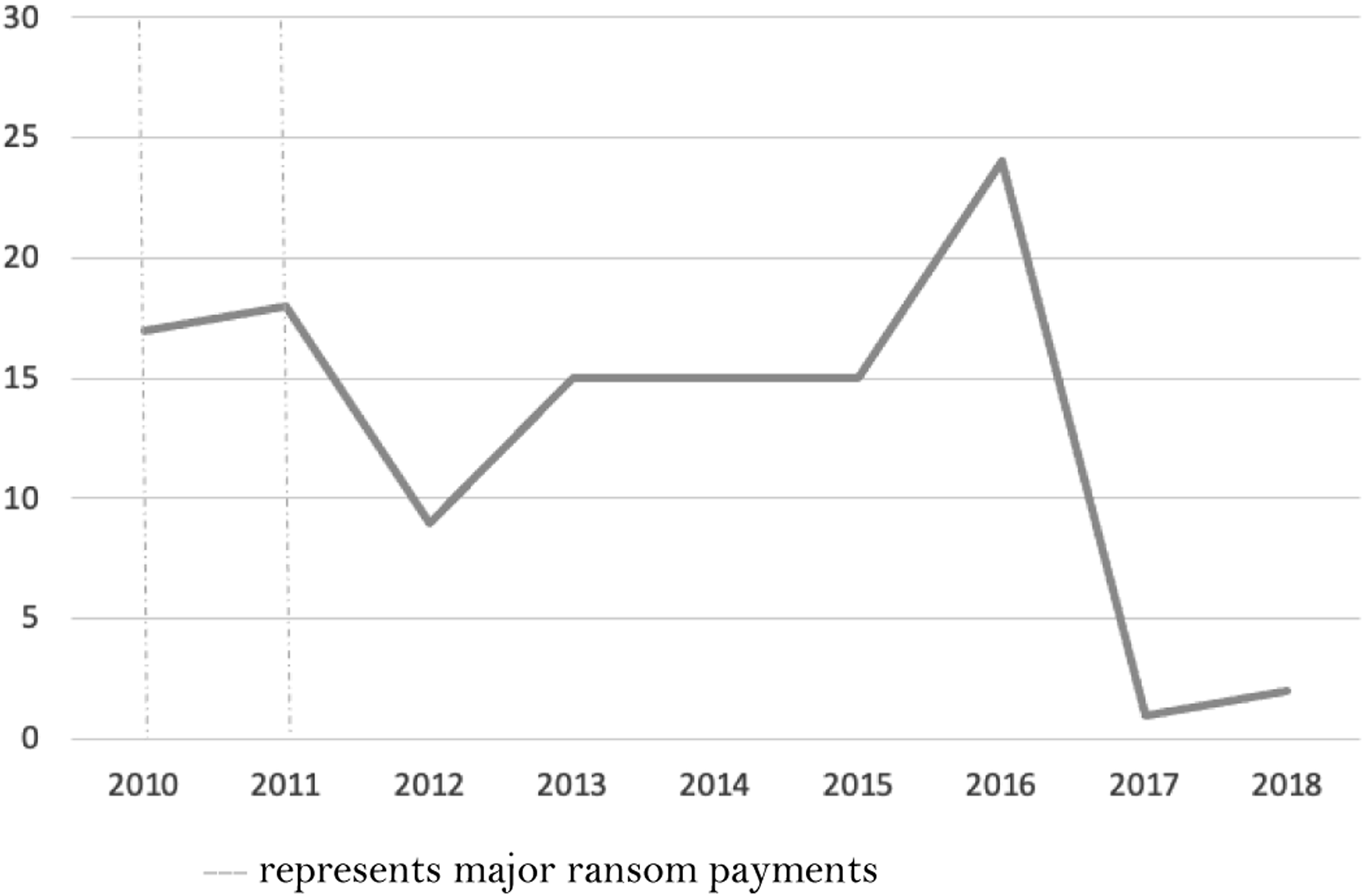
A similar pattern follows for the number of individuals killed and wounded in each of their attacks (a measure of attack severity). In the subsequent decade following the 2010 and 2011 ransom payments, AQIM attacks did not at all become more lethal. Only in 2017, an anomalous year due to one very deadly attack, did AQIM lethality rise, as illustrated in Figure 2. Casualties per attack, AQIM (2010–2018).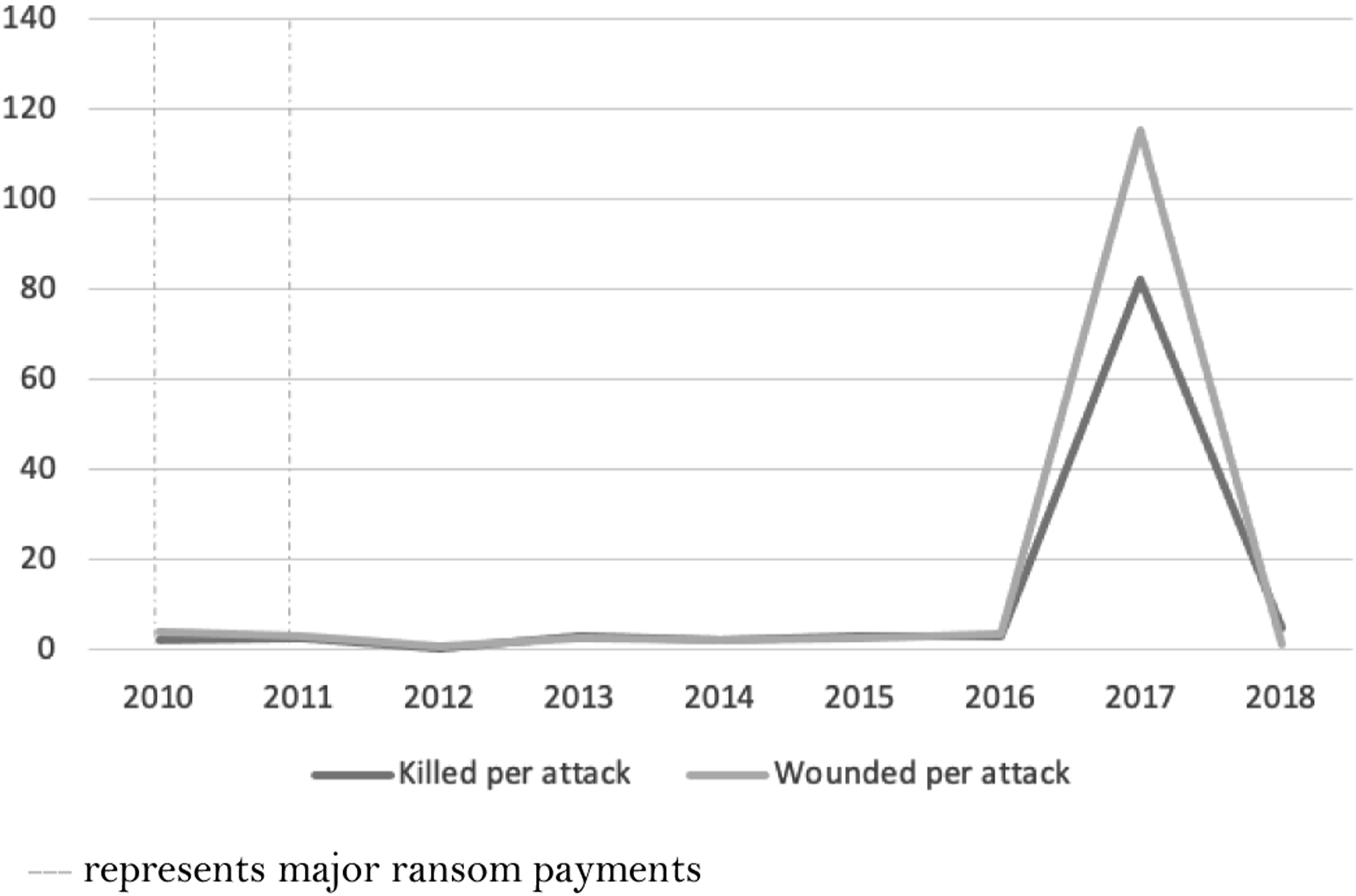
A similarly counterintuitive result holds for Abu Sayyaf, a jihadist group founded in 1991 that operates primarily in the Philippines. Between 2010 and 2018, the organization raised, on average, about $1.5 million per year in ransoms. Breaking the data down further, however, reveals a curious interplay between the group’s KfR success and the number of attacks it launched. For illustration, in 2010 and 2011, the group managed to pocket only approximately $30,000 and $108,000, respectively, for kidnap victims. Despite these measly returns, the organization nonetheless began increasing the number of attacks it perpetrated, from a low of twenty-nine in 2012, to forty-seven in 2013, and to over 100 in 2015. Conversely, despite Abu Sayyaf later managing to raise millions of dollars in ransom each year between 2014 and 2016 (for a three-year total of $9m), the number of attacks it perpetrated began to fall consistently, back to only thirty-one attacks by 2018, as illustrated in Figure 3. Abu Sayyaf attacks (2010–2018).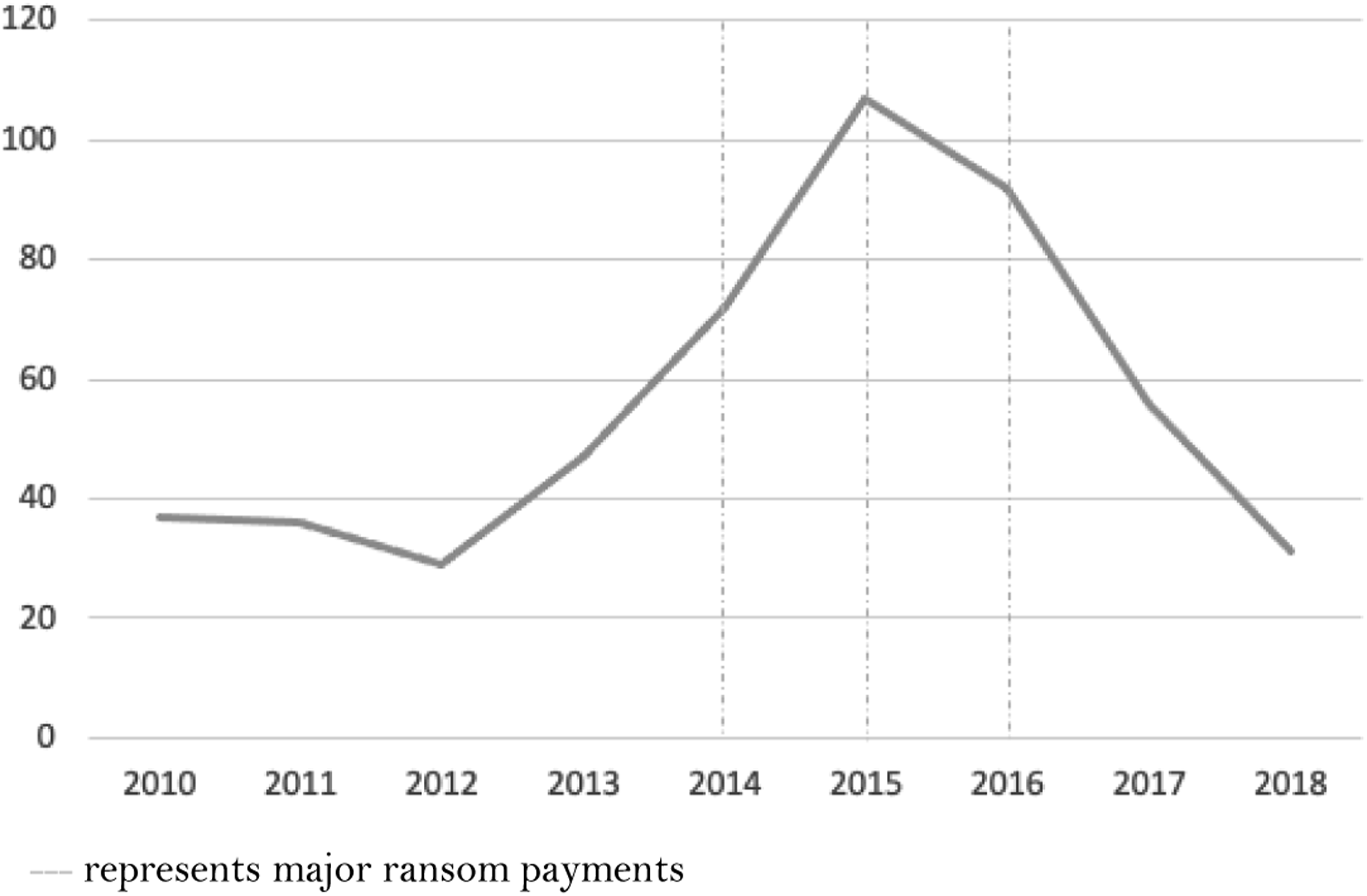
In terms of severity (i.e., injuries and deaths combined), here again, Abu Sayyaf casualty rates remained high in 2010 and 2012, despite poor KfR returns, and then remained consistently low between 2013 and 2018 (except for an atypical year in 2017), despite very good KfR returns. See Figure 4 for detail. Casualties per attack, Abu Sayyaf (2010–2018).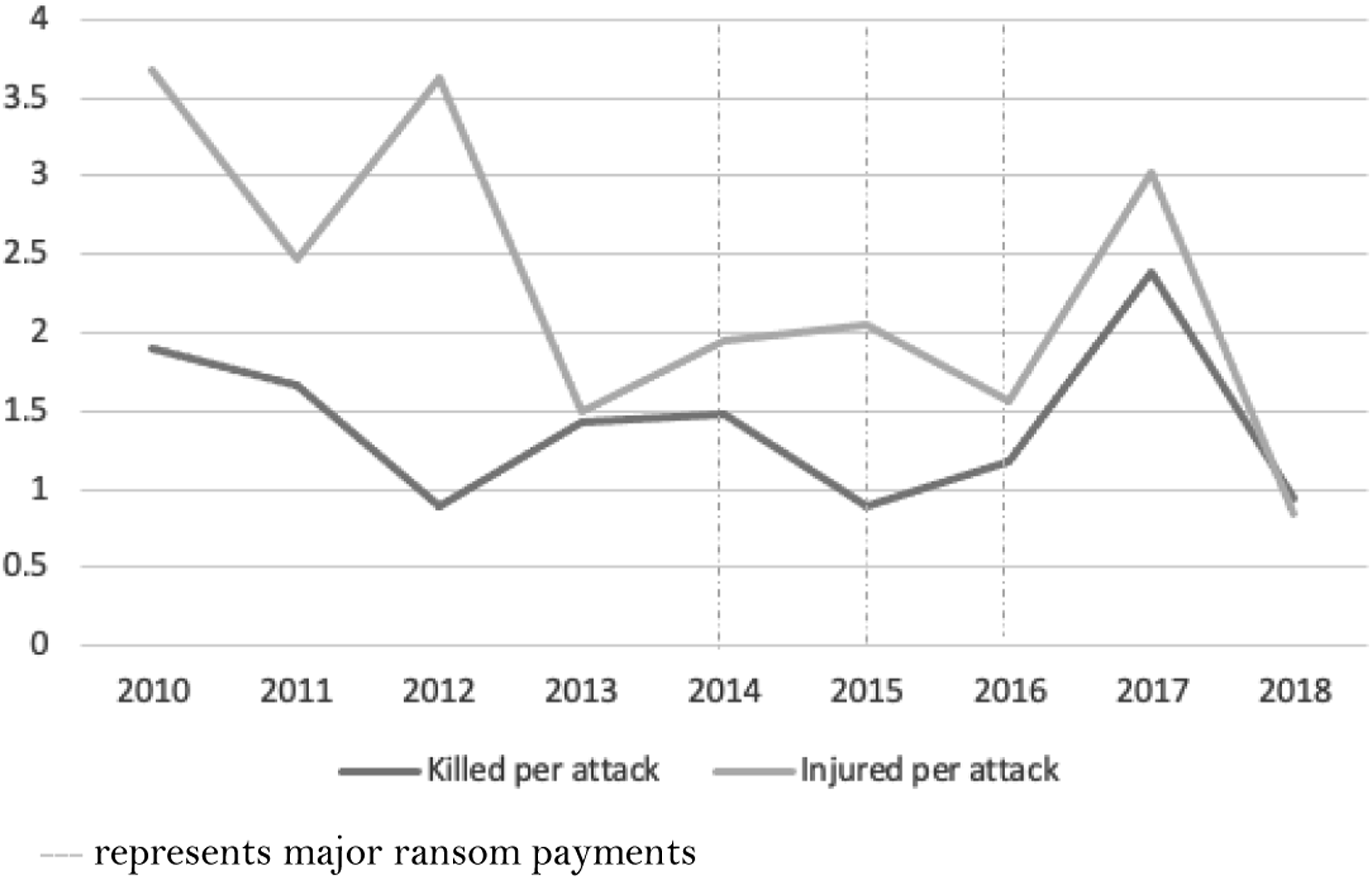
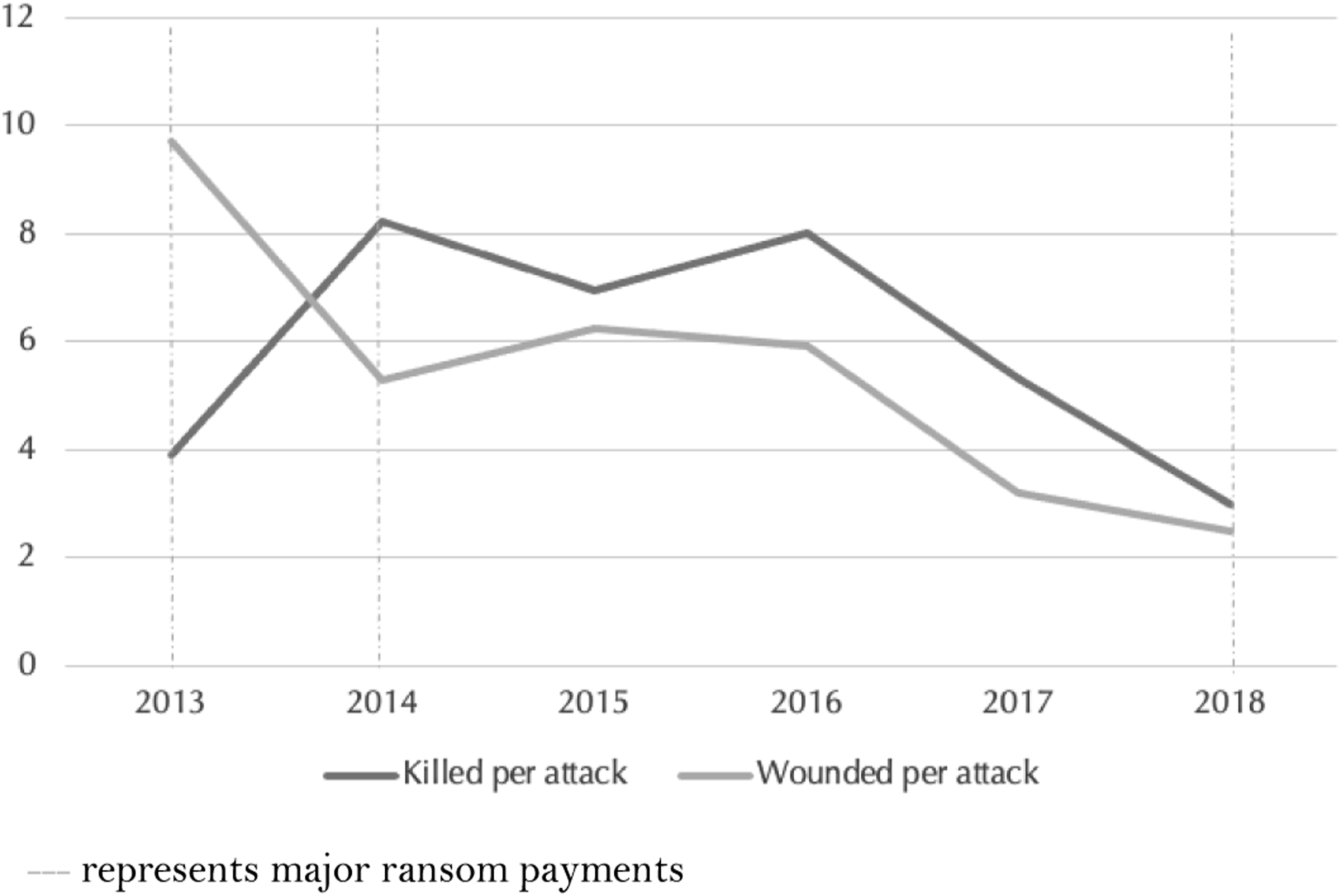
A final comparative exploration of the relationship between ransoms paid and terrorist attacks can be drawn from the Islamic State. While data for this group is only available from 2013—the organization was largely subsumed within al-Qaeda until then—it does demonstrate a potential causal relationship between ransom payment and an increase in terrorist attacks. In 2013, for instance, the group received ransom payments totalling around $46 million. The following year, it is purported to have earned another $20 million.
20
Subsequent years saw a significant immediate rise in both the number of attacks and individuals killed per attack, starting in 2014, followed by a subsequent plateau in attacks and lethality between 2014 and 2017, as illustrated in Figures 5 and 6. The organization received another substantial ransom payment in 2018; more years of data are required to determine if there has been an effect on attacks and casualties from this payment. ISIL attacks (2013–2018). Casualties per attack, ISIL (2013–2018).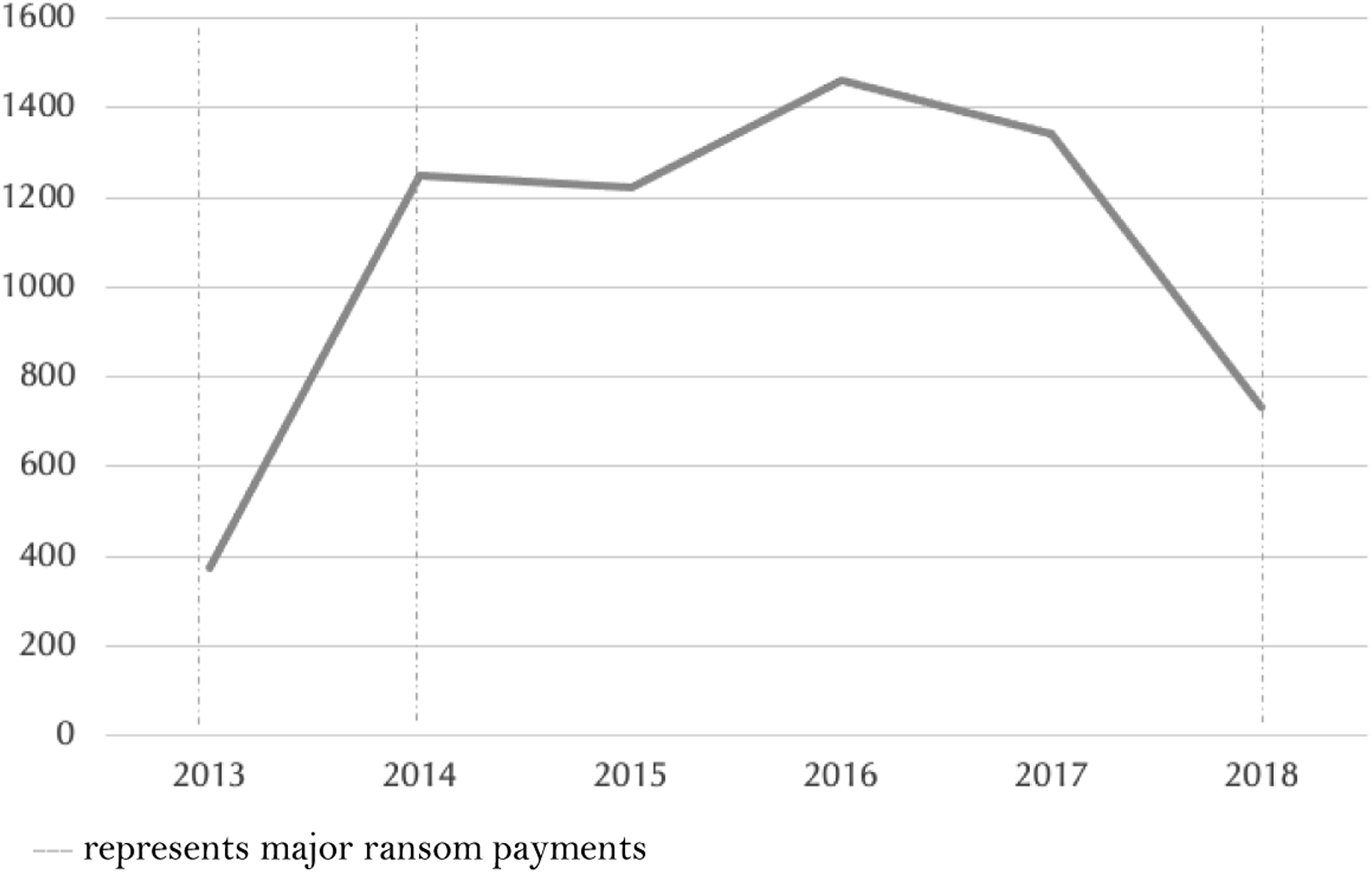
These illustrative cases, while far from exhaustive, challenge the conventional wisdom (that ultimately informs the contemporary policy) about the relationship between KfR payments and terrorist attacks. The relationship does not appear to be as straightforward as is often suggested—that paying ransoms augments the number and severity of terrorist attacks. However, there are a number of factors to consider in this analysis. First, ransom data is relatively sparse. As noted, states and other payees are naturally inclined to be secretive about handing cash over to proscribed organizations. Some uncertainty in the historical record persists as a result. Second, there are a number of other factors that can (and do) lead to different levels of terrorist attacks, including counter-terrorist operations, counter-terrorist financing activities, pressure to recruit and train new members, and pressure to achieve other goals, like holding and governing territory. Finally, depending on the overall financial status of the group, terrorist attack rates might simply lag further behind ransom payments. Certainly, more research and analysis into the KfR phenomenon and its relationship with terrorist activity is required. But our preliminary investigation should nonetheless spur much-needed debate about the continued utility of Canada’s “no ransom” policy.
Exploring the ransom-terrorism nexus: Considerations for research and policy
Terrorist groups need money to survive; that much is clear. The global collective counter-terrorism approach, and the counter-terrorist financing infrastructure that supports it, aim to deprive groups of these funds in order to prevent terrorism. But the effect certain elements of the approach have on achieving these collective goals, including the current “no ransom” policy, remains uncertain. Kidnapping for ransom, and the consequences of paying ransoms, are largely understudied and misunderstood. And yet real harms come to victims of KfR; policymakers believe that citizens whose states refuse to pay for their release are often mistreated, and ultimately killed. 21 The global counter-terrorism financing community has yet to fully reconcile the unintended consequences of some of their policy choices. 22 In response, better scholarly evidence should be used to develop more flexible and nuanced approaches and policies on whether and when states should and shouldn’t pay ransoms. Herein, several next steps are needed to both improve our understanding of the consequences of KfR and develop more appropriate ransom payment policies.
First, researchers need better access to richer data on the payments made, their amounts, and the mechanisms involved. More detailed investigation of how terrorist groups use these windfalls could shed greater light on whether, and how, ransoms contribute to their operational capabilities. These research avenues face major challenges, however, in terms of data collection, methodological approach, and interpretation, particularly in the face of an entrenched international “no ransom” norm and consensus.
Second, precisely because of the uncertainty around the effects of paying ransoms, other policy approaches for dealing with KfR should be explored, considered, and assessed, particularly in states like Canada with overt “no ransom” policies that have led to disproportionate harm towards Canadian hostages. A policy of “bargaining down” ransom prices could yield significant benefits for victims of these attacks—for instance, by allowing them to be released while preventing the terrorist group from profiting too heavily. 23 Canada, and other states with “no ransom” policies, could explore more flexible policies on kidnapping for ransom that reflect evidence of whether ransom payments lead to more terrorist attacks in particular regions or countries. A case-by-case approach might be necessary.
Finally, better information sharing between target states on prior KfR cases and outcomes, effective bargaining strategies, the use and utility of third-party intermediaries, and the development of tailored and effective approaches for particular organizations, could likewise create an environment that prevents large ransoms from being unduly paid. That would serve Canada, and future victims of KfR, particularly well.
Footnotes
Declaration of conflicting interests
The author(s) declared no potential conflicts of interest with respect to the research, authorship, and/or publication of this article.
Funding
The author(s) disclosed receipt of the following financial support for the research, authorship, and/or publication of this article: This work was supported by the Canadian Network for Research on Terrorism, Security, and Society (895-2015-1000).
