




Abstract
Mainstream western-centric welfare state research has mostly confined itself to studying social policy in consolidated democracies and tends to assume a synergy between democracy and the welfare state. This article shifts the focus to welfare states in countries with declining democratic institutions and rising right-wing populist rule to explore a complex relationship between (de)democratization and welfare state reforms. We conduct a comparative case study of two extreme cases of democratic decline, Turkey and Hungary. We employ a sequential mixed method approach. First, we assess welfare efforts in the two countries to understand which policy areas were prioritized and whether autocratizing governments retrenched or expanded their welfare states. In the second stage, we explore the trajectory of welfare reforms in Hungary and Turkey, focusing on three analytically distinguishable dimensions of social policy change: policy content, policy procedures (including timing, parliamentary procedures, veto players); and the discourses accompanying reforms. We find that democratic decline facilitates rapid welfare state change but it does not necessarily mean retrenchment. Instead we observe ambivalent processes of welfare state restructuring. Common themes emerging in both countries are the rise of flagship programmes that ensure electoral support, a transition towards top-down decision-making and the salient role of discourse in welfare governance. Overall, similarities are stronger in procedures and discourse than in the direction of reforms. Differences in spending levels and policy content do not suggest that the two cases constitute a coherent illiberal welfare state regime. Instead, we see the emergence of authoritarian features that modify their original welfare models.
Introduction
In recent years, autocratization has surged. Around the world, ‘illiberal regimes’ (Zakaria, 1997) have gradually taken apart institutions of liberal democracy (checks and balances, free press, free speech and civil society) that had previously been established. Typically, only free (but often not fair) elections, and the façade of legal institutions stay in place as remnants of the democratic regime. What kind of social policy do such illiberal regimes pursue? Is it possible to identify common patterns of social policy reforms under the ‘third wave of autocratization’ (Lührmann et al., 2020)? Are we even witnessing the rise of a new kind of welfare regime – an illiberal welfare state?
Following Marshall (1950), social rights are the last part of the holy trinity of civil, political and social rights that collectively constitute citizenship – the very foundation of liberal democracy. Many scholars conceptually link the welfare state to democracy and most research focuses on rich democracies. However, the relationship between democracy and the welfare state is ambivalent. Many welfare states were, in fact, built by authoritarian regimes (Mares and Carnes, 2009), most state socialist countries created and maintained cradle-to-grave welfare states (Haggard and Kaufman, 2008).
While recent research on authoritarian regimes and autocratizers has produced valuable insights (Eibl, 2020; Knutsen and Rasmussen, 2018; Lendvai-Bainton and Szelewa, 2021; Logvinenko, 2020; Wurster, 2019) these narratives have yet to be put together into a coherent story about welfare state development during the process of democratic backsliding. Are welfare states diminished when democracy dies? Do we see similar policies, reforms, or trajectories in geographically and economically different cases? How are social policy developments linked to the fate of democracy?
To understand connections between democratic backsliding and welfare state trajectories in differing geopolitical settings we conduct a comparative case study of two countries that have experienced severe autocratization: Hungary and Turkey. We take a critical stance towards mainstream welfare state research, which has mostly confined itself to consolidated democracies and tends to assume a synergy between democracy and the welfare state. We assess the applicability of these theories to a context of autocratization. Accordingly, we conduct an exploratory study to understand how illiberal governments have reformed welfare states while curtailing civil liberties. We do this through a sequential mixed method approach, combining an assessment of social expenditures with a qualitative analysis of welfare reform trajectories. Our research interest is closely linked to broader questions about the political context in which welfare states are built and maintained. Our theoretical ambition is to advance the ‘politics matter’ approach to social policy reforms in non-western welfare states (Cook, 2007; Huber and Stephens, 2012) to embrace countries with recently declining democratic institutions.
Our analysis reveals that democratic decline does not necessarily lead to retrenchment. Instead, ambivalent processes of welfare state restructuring unfold, with expansion in some areas and cutbacks in others. Similarities are especially striking in terms of procedures of social policymaking and discourse accompanying reforms. In Hungary and Turkey, we observe the early implementation of paradigmatic reforms, an emphasis on flagship programmes that ensure cross-class electoral support, a transition towards top-down decision-making and the salient role of discourse in welfare governance. Yet, persistent differences in spending levels and policy content caution us against proclaiming the emergence of a new illiberal welfare state regime.
The article is structured as follows. We start with a theoretical discussion of the relationship between democracy and the welfare state. After explaining our methodology and case selection we provide the political context of democratic backsliding in Hungary and Turkey. Turning to the analysis of welfare reforms, we first analyse welfare efforts under democratic decline which is followed by the detailed analysis of welfare state trajectories focusing on policy content, procedures and discourse (Bartha et al., 2020). We conclude by outlining key similarities and differences between our cases, and discuss implications for comparative welfare state research.
Democracy and the welfare state
The dominant line of argument of welfare state scholarship holds that more democracy brings more welfare. Extending suffrage to the working class, political pluralism and party competition foster the expansion of welfare spending and the universalization of social rights. In Marshall’s (1950) classic work social rights are based on civil rights and political rights: free press and speech, the possibility to organize and the representation of marginalized groups in parliament bring about welfare expansion. In this view, democracy is incomplete without social rights.
From a global perspective, the positive correlation between democracy and welfare is well-elaborated by Sen (1981). He shows that a lack of civil rights can imperil the distribution of basic goods, including food. As he says ‘(f)amines can take place without a substantial food availability decline’ (Sen, 1981: 162); it is the shift in ‘entitlement relations’ that can lead to famine or stop it. Indeed, a lack of democratic control over the (re)distribution of basic resources may lead to extreme deterioration of welfare and the capabilities of individuals, whereas the extension of civil and political rights may work as guarantees of fairer redistribution.
Various large-n studies explored connections between regime type and welfare effort, that is, social spending. Many found that democracies have higher social spending (Haggard and Kaufman, 2008; Rudra and Haggard, 2005). Some add the qualification that this relationship holds true only for relatively homogeneous countries (Jensen and Skaaning, 2015) or that only durable democracy has a positive effect on welfare effort (Huber and Stephens, 2012). Others found no clear relationship (Mulligan et al., 2004).
Few studies examine hybrid cases in-between democracy and autocracy. Applying the politics matter approach to four post-communist countries Cook (2007: 16) finds that ‘the weakness of representative institutions allowed narrow elite associations direct access to the state to defend their interest while broader societal constituencies were for the most part marginalized.’ The existence of multiple veto actors, including ministries, welfare bureaucrats, the judiciary and the management of social security funds is crucial. Their absence or weakness ‘facilitates retrenchment and rapid welfare state change’ (Cook, 2007: 19).
The puzzle under the third wave of autocratizers arises from the fact that we have witnessed social policy expansion in certain cases parallel to the weakening of democratic institutions. While recent research has helped us make sense of policy developments in some countries (Lendvai-Bainton and Szelewa, 2021; Logvinenko, 2020; Scheiring, 2020), these country- and policy area-specific narratives have not yet coalesced into a systematic, comparative analysis of the welfare state during democratic backsliding. We aim to fill this gap. Through a mixed method analysis of social policy reforms in Hungary and Turkey, we show that, contrary to what mainstream social policy scholarship suggests, autocratization does not necessarily lead to retrenchment. Rather, we observe rapid welfare state restructuring with complex outcomes that include opposing elements such as liberalization and expansion.
Methodology and case selection
To understand welfare state trajectories under democratic decline we employed a sequential mixed method approach (Creswell, 2013). First, we conducted a quantitative assessment of the development of social expenditures in the two countries. With this descriptive analysis we inquired whether governments overall retrenched or expanded their welfare states during democratic backsliding. Disaggregated spending data shows which policy areas have been prioritized under the period of backsliding. In the second stage, we conducted a qualitative analysis to explore the trajectory of welfare reforms. We utilized international datasets (Eurostat, OECD), primary policy documents and legislation, related governmental communication and secondary literature to identify important reforms. Based on Bartha et al. (2020) we distinguished three analytical dimensions of policy change: policy content (direction of reforms), policy procedures (including timing, parliamentary procedures, role of veto players); and the discourse where relevant (for example, family policies). We thus reveal when and how decisions were made, what the reforms aimed to achieve, and how they were communicated to the people. Policy procedures are especially important as this dimension reflects best the way in which political institutions work under (un)democratic circumstances. We followed Grzymala-Busse (2011) in paying attention to the timing and tempo of changes and visualized reforms in a timeline with major political events and welfare reforms (Figures A1 and A2 in the supplemental material).
We selected Hungary under Fidesz (Fidesz – Hungarian Civil Alliance – Fidesz Magyar Polgári Szövegség) since 2010 and Turkey under the Justice and Development Party (Adalet ve Kalkınma Partisi) (AKP) since 2002. Our analysis ends in 2020. We chose two ‘extreme cases’ (Gerring, 2008), that are ‘considered to be prototypical or paradigmatic’, as this method fits our exploratory approach best. Hungary and Turkey can be considered ‘extreme’ because they have witnessed the most severe autocratization in the last decade (Lührmann et al., 2020: 16). Other leading autocratizing countries do not qualify for our analysis as recent autocratization was not preceded by democracy (Thailand and Nicaragua), there were no well-developed social protection systems (India, Mali and Zambia) or the period of backsliding is too recent for thorough analysis (Brazil and Poland). What is important is that our purpose was not to examine autocratic welfare states per se (Forrat, 2012) but to understand welfare state reform during the process of autocratization. This task is difficult because we are shooting at a moving target, but it is also rewarding as we see processes in which the role of democratic institutions vis-à-vis welfare state development becomes highlighted.
While we selected Hungary and Turkey as ‘extreme cases’ of backsliding, the two countries are also sufficiently ‘diverse cases’ (Gerring, 2008) to illuminate the range of differences on possibly relevant variables. First, the two countries represent starkly different welfare state contexts. Before 2010, Hungary strove to embed its neoliberal economy (Bohle and Greskovits, 2012) and was classified as an Eastern European ‘mixed type’ of welfare regime with well-established social insurance, complex family policy schemes and recurring attempts at liberalization (Szikra and Tomka, 2009). Turkey is mostly seen as a Southern European welfare regime (Powell and Yörük, 2017), in which the family fills the gaps of the formal social security system (Akkan, 2018). Overall, Hungary has long consolidated its welfare state while Turkey is still in the process of universalizing access to social security.
Third, the two countries are in different geopolitical situations, with Hungary being a European Union member and Turkey an EU-accession candidate. While Hungary is a small country exposed to global political and economic processes, Turkey is a relatively large country with substantial political and military power. Finally, their economies also differ, with a strong service sector and notable industrial sector in Hungary, while Turkey’s economy was still shaped by the transition of the labour force from agriculture to services during AKP rule. These significant differences make the two cases ideally suited for a comparative analysis that explores welfare states under democratic backsliding in varying geopolitical and societal contexts.
Democratic backsliding in Hungary and Turkey
Think tanks like Freedom House or the Varieties of Democracy Institute measure and describe the process of rapid autocratization in Hungary and Turkey. As observable in Figure 1, Hungary recently moved from an illiberal democracy towards a hybrid regime, whereas Turkey moved from a hybrid regime towards autocracy with very few, if any features of liberal democracy left. By comparison, Russia has been moving from an illiberal democracy to an autocratic regime recently, whereas Poland has moved from a liberal to an illiberal democracy since 2015. The process of democratic backsliding and regime types.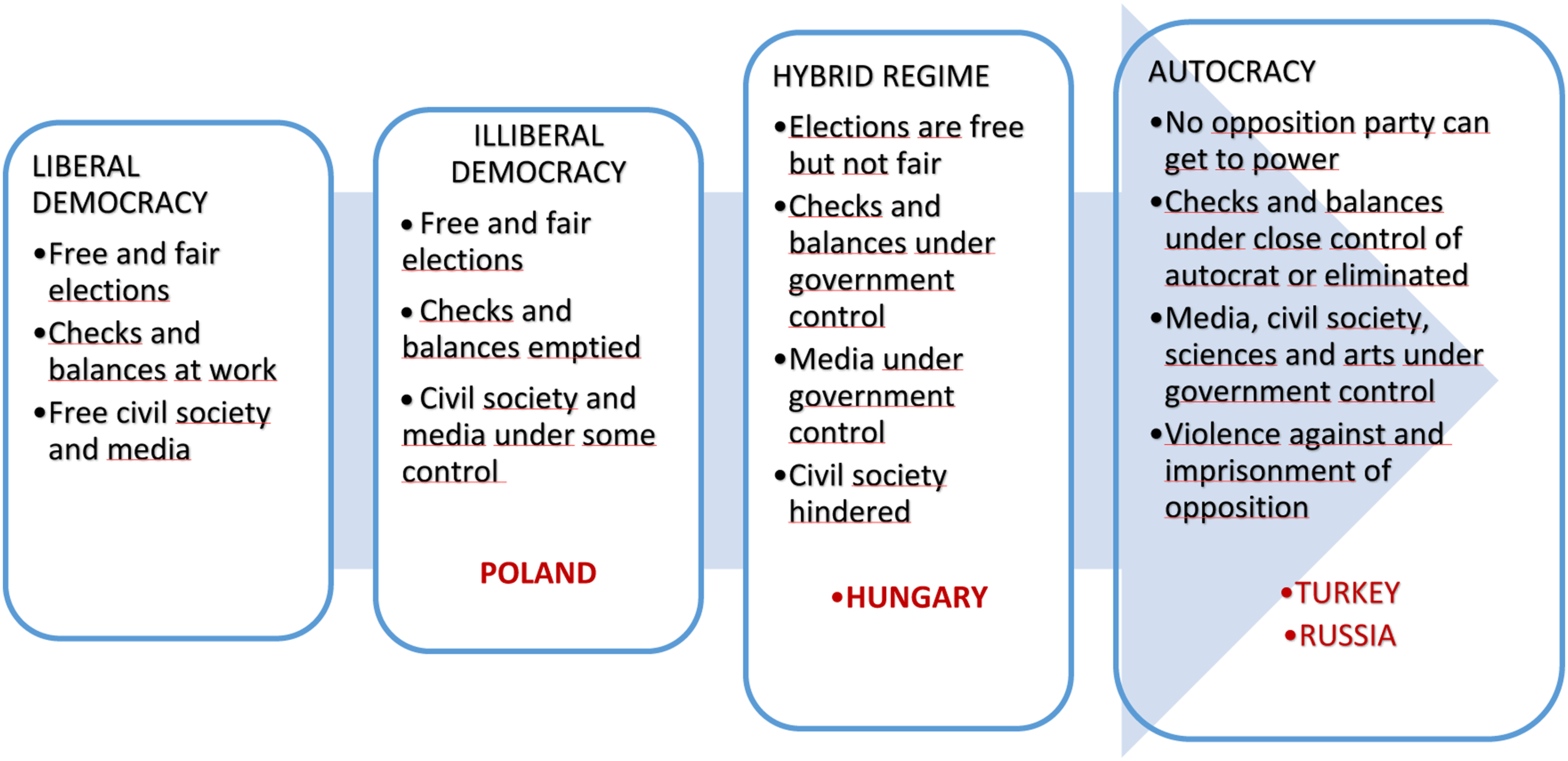
Hungary was one of the forerunners of democratic transition among the post-socialist countries during the 1990s. Having joined the EU in 2004, it faced a severe political and economic crisis in 2006–2007 followed by the harsh period of the global economic crisis. The ensuing legitimacy crisis coupled with austerity measures of the Socialist–Liberal coalition contributed to the landslide victory of the conservative right-wing Fidesz party, led by Viktor Orbán in 2010. Fidesz won three subsequent parliamentary elections thereafter. Since 2010 checks and balances were largely transferred to serve the executive power. Veto players like the Constitutional Court were sidelined early on, and the new Fundamental Law of 2011 set the foundations of the new regime. Since 2014 Fidesz colonized the media and weakened civil society and academia (Table A1 in the supplemental material). V-Dem shows a steep drop in Hungary’s liberal democracy index from 0.72 in 2009 to 0.37 in 2020, classifying the country as the first electoral autocracy within the EU (Coppedge et al., 2020). Still, analysts argue that the EU through its legal and economic power ‘externally constrains’ Hungary from falling into outright autocratic rule (Bozóki and Hegedűs, 2018).
In contrast to Hungary, Turkey was classified as an ‘electoral democracy’ by V-Dem before democratic backsliding began. The country experienced a severe economic crisis in 2001. The ensuing legitimacy crisis of secular centre-left and centre-right forces contributed to the landslide victory in 2002 of AKP, a self-described conservative-democratic party rooted in political Islam led by Recep Tayyip Erdoğan. Having won elections on the promise of consolidating democracy, AKP initially implemented significant democratic reforms in connection with the prospect of EU accession.
AKP’s rule became more divisive from 2007 onwards and since 2011 it became hegemonic. The government curtailed civil liberties, weakened the military and the judiciary’s role as veto players. The clash between AKP and Gülenists (former ally of Erdoğan) culminated in an attempted military coup in 2016. The government declared a state of emergency, detaining countless people, purging thousands of civil servants, closing civil society institutions, tightening its grip on the media and changing the political system to presidentialism (Table A2 in the supplemental material). Accordingly, Turkey’s classification in V-Dem shifted from electoral democracy to electoral autocracy, with liberal democracy index scores plunging from 0.55 in 2006 to 0.1 in 2019.
Welfare state effort in Hungary and Turkey under democratic backsliding
Hungary and Turkey started democratic backsliding at different stages of welfare state development. While Hungary inherited an encompassing welfare state from the state socialist period, Turkey was still in the earlier phase of welfare state building. This difference is reflected in welfare effort, that is, public social expenditures (Figure 2). In 2010, when Fidesz returned to power, social spending was nearly 22% of GDP. This decreased to 17% in 2018. In contrast, Turkey’s social expenditures were below 10% at the onset of AKP rule in 2002. From this level, spending increased to 12% in 2018. This indicates retrenchment in Hungary, but expansion in Turkey. Welfare effort in Hungary and Turkey.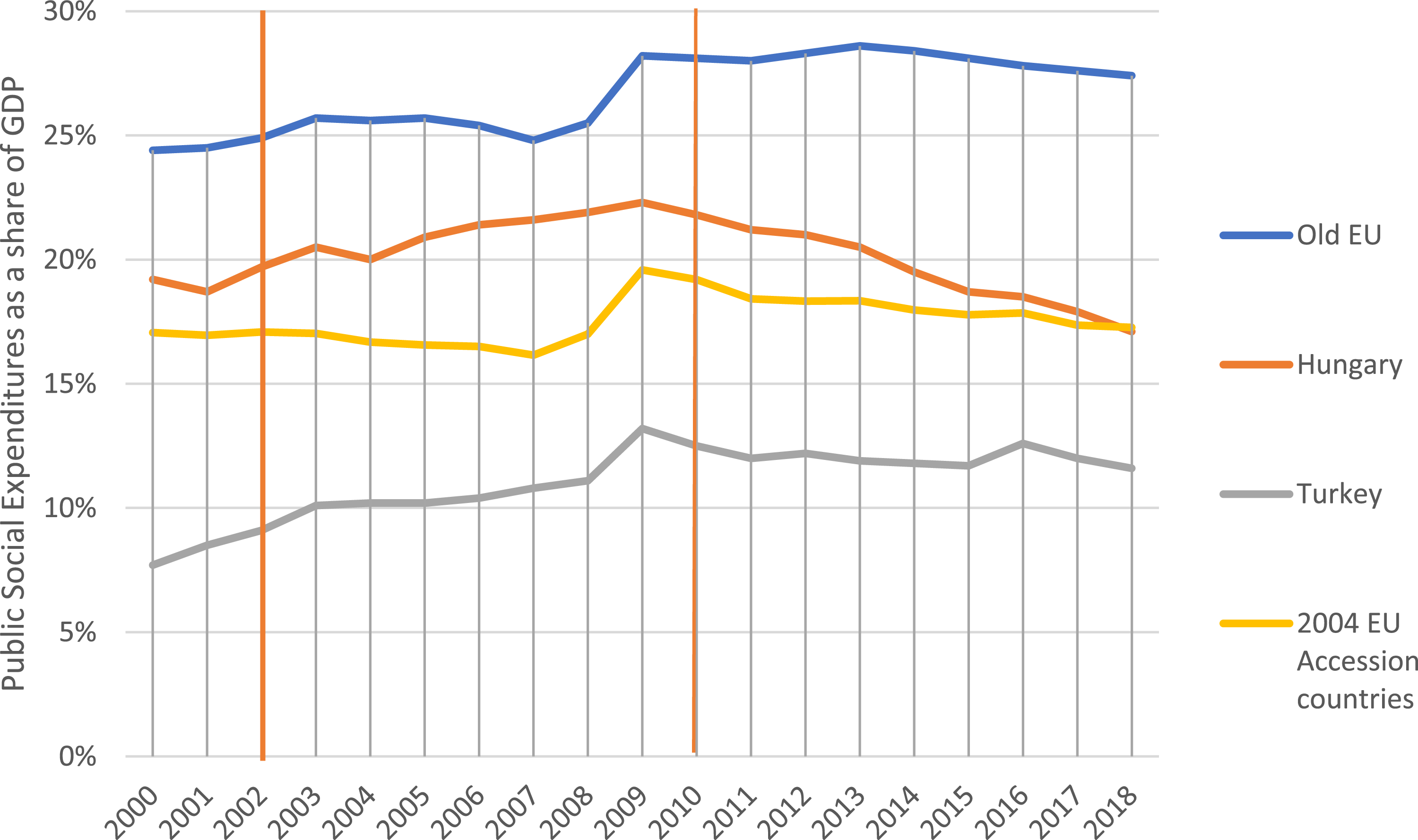
The difference between cutbacks in Hungary and expansion in Turkey has to be put into perspective, however. In Hungary the decline in gross social expenditures is partly offset by the expansion of fiscal welfare, such as tax credits to families. The OECD’s data on net social expenditures reveals that decline in welfare effort is more limited when fiscal welfare is taken into account. In Turkey, the expansion of welfare spending is not exclusive to the AKP period, but occurred also under previous governments. Finally, the different time period in the two cases complicates the analysis. The timing of welfare effort change roughly overlaps in Hungary and Turkey, with increases in the 2000s (pre-Fidesz period in Hungary) and decreases in the 2010s, in the aftermath of the global economic crisis. All this makes it difficult to draw clear conclusions from aggregate expenditure data.
Let us look at the structure of expenditures, next. Both welfare states are pension-heavy: Hungary spends around 40% and Turkey half of all social expenditures on the elderly. Regarding smaller policy areas, Hungary posts traditionally high spending on family and disability, while Turkey on survivors’ pensions, which often support widows without social insurance contribution records.
In Hungary, spending declined after 2010 in all policy areas except for housing. The decline was most pronounced in disability and unemployment. In Turkey, expenditures increased after 2002 in all policy areas except for healthcare. Expansion was most pronounced in spending on the elderly. Hitherto neglected policy areas such as family, unemployment or disability saw moderate expansion, albeit from a very low basis.
We conclude that democratic decline did not lead to radical welfare state dismantling. Spending retrenched and shifted towards fiscal welfare in Hungary, while it moderately increased in Turkey. We found an important similarity: both governments are prioritizing the elderly. Our conclusion in terms of methodology is that we need to move beyond welfare effort to uncover complex policy processes during turbulent political times. Therefore, we now turn to an analysis of welfare state trajectories.
Welfare state trajectories under democratic backsliding
Hungary
Fidesz came to power in 2010 amid a deep economic and political crisis. The previous Socialist government managed the 2008 global economic downturn with cuts to key welfare programmes. The IMF and the European Central Bank, from whom the country received loans, tightly constrained the budget. In opposition Fidesz campaigned against welfare cuts, privatization, and the role of supranational agencies. By the end of the 2000s, Fidesz successfully established itself discursively as the protector of Hungarians’ welfare. 1
Fidesz’ first year was intensive, full of paradigmatic social policy changes (see Figure A1 in the supplemental material). The government restored the length of the universal child care leave, cut from three to two years by the Socialist government. Promoting the ‘hard working’, Fidesz adopted a flat 16% personal income tax (PIT) rate in 2011 (15% since 2016), abolishing the zero-tax rate for minimum income earners while substantially decreasing the tax burden of the better-off. In addition, the government established generous family-related tax allowances promoting especially high-income families with three or more children (Inglot et al., 2012).
Among the sweeping changes was a new constitution adopted in 2011, which linked social rights to a citizen’s obligation to ‘serve the community’ (Art XIX (3) of the 2011 Fundamental Law). As Orbán announced, Fidesz’s ‘programme is to establish, instead of the western-type of welfare state that is not competitive, a work-based society’ [munka-alapú társadalom] (Orbán, 2012). The new constitution also defined the family in a traditionalist way as a heterosexual, married couple with children. Traditionalism and workfare became the guidelines for the direction of all welfare reforms in the succeeding decade.
In line with the work-based society principle, means-tested, locally administered social assistance benefits were nominally cut in 2011 and made conditional upon the acceptance of public work (simple physical labour organized by municipalities) (Vidra, 2018). The maximum duration of unemployment insurance benefit was cut from six to three months (the shortest period within the EU) and other active labour market policies (ALMP), (for example, training and mentoring) were nearly completely stopped (Molnár et al., 2019). Public works became the main social policy tool to cater for the unemployed.
Pleasing primarily multinational car companies, the cabinet adopted, despite trade union protests, a new Labour Code in 2011 that substantially weakened employees’ rights (Scheiring, 2020). It made labour contracts more flexible and strikes difficult to organize. The former tripartite consultation of labour reconciliation was replaced by a new body that included loyal civil and church-based organizations. All these measures limited possibilities to voice opposing views or to protect the interests of marginalized groups.
Driven by fiscal constraints and in line with Fidesz’s long-held anti-privatization stance in pensions, 2 the Orbán-government nationalized the assets of private pension funds and eliminated the compulsory private pension pillar altogether in 2010–11, implementing changes with extreme speed and controversial procedures (Simonovits, 2011). Meanwhile, the government excluded disability benefits from the pension scheme (Szikra and Kiss, 2017). Hungary has a minimum old age pension scheme for those not eligible for full pensions, but, unlike Turkey, the social pension has not been upgraded since 2009.
Resembling changes legislated in Turkey in 2003, the retirement of civil servants became compulsory at the age of 62 (the official pension age in 2011). This reform served a direct political purpose to remove potentially critical older civil servants and judges and replace them with loyal new cadres. But unlike in Turkey, the Constitutional Court could not impede this change because in 2010 Fidesz had amended the (old) Constitution to prevent court interference with any issues related to the state budget. Meanwhile, the government established a vast Ministry of Human Resources responsible for welfare, healthcare, education and culture. With these procedural changes, formerly important veto-players, high-level bureaucrats, judges and the Constitutional Court, were excluded from the social policy arena. The 2011 pension reform can be considered as the dress rehearsal of the illiberal regime in the welfare area both in terms of its procedures and using policy reform to directly achieve political aims.
The pension reform also eliminated early retirement opportunities. However, Fidesz granted women with 40 years of service the possibility to retire earlier than the official pension age. This change was presented as promoting grandmothers’ caring role to help young couples to have children: the reform thus linked the issue of fertility rates to the pension system. Regarding the content and the direction of reforms, they overall fit the idea of the work-based society: old-age security to people with permanent employment records was strengthened, whereas reforms had negative consequences for vulnerable groups with a scattered work record (Szikra and Kiss, 2017).
More than in the first term of Fidesz between 1998 and 2002 demography and the traditional family became central issues. The key rationale of family policy changes became the increase of fertility rates of ‘responsible’, that is, ‘working’ families. Child poverty and gender equality vanished from the agenda. Along the lines of a work-based society, parental leave benefits linked to employment were annually indexed, while universal family allowances and means-tested social assistance were not, leading to an approximately 50% loss in real value within a decade.
Following 2012, the Orbán-cabinet carried out more diverse, mainly parametric reforms, with a boost of legislation around election years (see timeline – Figure A1 in the supplemental material). In 2014, the government expanded public works. Given the large discretionary power of mayors, loyalty to the governing party played a role in distributing public works (Vidra, 2018). The programme constituted a new form of locally integrating and policing the poorest and contributed to Fidesz’s popularity in smaller settlements in succeeding elections (Szombati, 2018).
Re-focusing housing policies from the poorest to the middle class, in 2015 Fidesz introduced new housing loans (called ‘CSOK’) disproportionately benefiting working families with three or more children and excluding the unemployed and public workers. Meanwhile, the government stopped means-tested housing benefits catering for the poor. Notwithstanding the celebration of traditional gender roles, both family policy and labour market reforms included elements that contributed to the employment of mothers. The 2014 parental leave reforms incentivized mothers to return to work earlier and nursery coverage also picked up since 2016.
Benefits linked to employment reached more people as the economy recovered after 2014. The government consistently increased the statutory minimum wage, which surpassed the subsistence level for the first time since 1990. Even though wage increases overall lagged behind neighbouring countries, those on minimum wage (one-third of the labour force) experienced an improvement in their living standards. Benefit amounts linked to the minimum wage also increased. In terms of content and direction of social policy reforms we thus conclude that they targeted the working population and neglected the poor. The increased divisions between labour market insiders and outsiders contributed to exclusionary processes in social policy. Reforms disproportionately benefited the better-off, pursuing upward redistribution (Scheiring, 2020). The Hungarian welfare state under Fidesz overall strengthened stratification and shifted the former ‘mixed’ welfare system in the direction of conservative, Bismarckian welfare regime type with neoliberal, workfarist undertones.
From 2015 governmental discourse shifted from the issue of ‘hard working’ to that of ‘migration crisis’ underpinned by aggressive propaganda (Bocskor, 2018). Fidesz presented immigration from the Global South and ‘gender ideology’ as being in sharp opposition to the wellbeing of Hungarian families. Orbán announced ‘demographic governance’ in the election year of 2018. The related legislation included various grants and loans to newlywed couples and working families with numerous children. Since 2020, the anti-gender equality discourse focused on LGBTQ + minorities, depicted as the new ‘enemies’ of family values and children’s wellbeing. Overall, family policy, unlike other policy sub-fields, was accompanied by large-scale propaganda presenting varying ‘enemies,’ and the government as the saviour of Hungarian families.
In terms of timing, expansion of the two flagship social policy programmes, family policy and public works closely followed the electoral cycle and successfully served Fidesz’ electoral agenda. Three further procedural issues of social policymaking are notable. First, paradigmatic reforms were ingrained into Cardinal Acts that can only be modified by a two-thirds majority, binding the hands of forthcoming (non-Fidesz-led) governments. Second, individual members’ bills, formerly only utilized in emergency situations, were extensively used to avoid normal parliamentary procedures and reconciliation with civil actors. Third, while formal negotiation procedures were hollowed out, the government initiated so-called national consultations, a form of direct communication with the electorate to legitimize and propagate reforms (Batory and Svensson, 2019).
To sum up: Fidesz did not dismantle Hungary’s welfare state but largely restructured it, openly promoting (large, traditional) families with stable and above average incomes and punishing the workless. The idea of the work-based society was consistently translated into reforms in all areas. Following the initial boom of paradigmatic reforms, gradual changes increased benefits to people with stable employment, often before elections. The political support of the growing middle and upper classes was secured by new grants and tax credits via the most important flagship programme, family policy. Meanwhile, newly established loyalty-networks through the expanded public works programme along with adversary government-propaganda brought popularity to the ruling party among the lower segments of society.
Turkey
When AKP came to power in November 2002 the country was in a deep financial crisis and, similarly to Hungary, IMF loans constrained the state budget. A controversial pension reform in 1999, initiated by the centrist coalition government, tightened contribution requirements and increased the retirement age. As a major opposition force, AKP’s predecessor, the Virtue Party challenged the reform at the Constitutional Court. 3 Thus, when AKP was established in 2001 it inherited a discourse of criticizing governments from the left on social policy.
Initially AKP, unlike Fidesz, lacked a popular majority. The president regularly vetoed legislation or sent it to the Constitutional Court (as did the parliamentary opposition). Trade unions also challenged the government, thus AKP had to confront multiple veto-players.
Like Fidesz, AKP passed many important reforms early on (see timeline – Figure A2 in the supplemental material). In January 2003, despite being under IMF supervision, the government increased pensions, benefiting particularly low-income pensioners. Most significantly, it doubled the value of social (non-contributory, means-tested) pensions to the elderly and the disabled. In the same month, the government prepared a controversial law to decrease civil servants’ retirement age from 65 to 61. Possibly serving as a blueprint for the 2011 Fidesz reform, AKP’s initiative intended to replace critical high-level civil servants with loyal officials.
Still in its first year, following a bitter struggle with trade unions, AKP passed a new Labour Code that increased labour market flexibility. The persistent opposition of unions, however, prevented cuts to the severance pay provisions (a functional equivalent of unemployment insurance in Turkey). Thus, AKP combined expansionary reforms benefiting lower income groups (the party’s main support base) with increased flexibility pleasing employers. The government also used social policy for direct political purposes.
In the remainder of the first term, the AKP further expanded social policy. It raised social assistance spending and launched new programmes, such as conditional cash transfers for poor families (Öktem and Erdogan, 2020). Meanwhile the government increased social pensions again and raised the upper limit (cap) of social insurance contributions, thus increasing future pension benefits of high-income earners. AKP also prepared a bill to transform social assistance into a European-style minimum income protection system, but shied away from implementing it. Instead, it kept social assistance to a large degree discretionary and encouraged religiously-motivated associations to increase poor relief. Thus, social assistance remained mired in clientelism, ‘compelling compliant behaviour among the beneficiaries’ (Yoltar, 2020: 153). In health policy, AKP in 2004 expanded the ‘Green Card’ programme for the poorest, and centralized control over public hospitals to the Ministry of Health in 2005. In family policy, it boosted family allowances for civil servants in 2005 and passed legislation to introduce tax credits for children in 2007. All these expansionary measures together with strong economic growth and a rising minimum wage helped AKP construct a ‘broad-based, cross-class electoral coalition’ (Öniş, 2012) that kept the party in power.
Over time AKP’s social policy agenda became more ambivalent, combining expansionary and retrenching measures. A prime example is the crucial 2006–2008 social security reform, which merged employees, the self-employed and civil servants into one Social Security Institution. It reduced inequalities between groups to the benefit of lower social classes – a leap towards providing equal access to benefits and services for all citizens. Accordingly, government discourse accompanying the reform emphasized equal citizenship rights.
In contrast to the fast-paced early parametric reforms, AKP extensively consulted about this paradigmatic policy change with stakeholders, and even issued a white paper to explain its motives. The reform took several years: it met fierce opposition by unions and the medical association. Vetoes by the president and the Constitutional Court postponed implementation to 2008. Notwithstanding the reform’s inclusive content, Erdoğan employed his trademark divisive rhetoric to lash out against the opposition stating that: ‘We want every child to be born with social security […] but leftists and those that stand with them oppose this. They do not worry about workers, their aim is to block the system’ (Hürriyet, 2008).
In terms of its content, the reform’s centrepiece was health system transformation – a highly popular flagship scheme of the government (Yilmaz, 2013). By creating unified, compulsory insurance, coverage was nearly universalized and access to all public hospitals for the insured established. Earlier inequalities that prioritized civil servants were eliminated. The reform also fostered a continuing private hospital boom.
In pensions, later reforms brought significant retrenchment (Kapar, 2015). 4 They made the pension formula less generous, tightened eligibility criteria, increased retirement age and eliminated the benefit floor for pensions which hurt particularly low-income earners with scattered work records. The changes were only gradually phased in and thus not immediately visible.
With the 2007 elections, the policymaking context changed. Increasing its vote share AKP was able to select the president from among its ranks, thus eliminating a crucial veto point. After the 2010 referendum, which changed the Constitutional Court’s composition, the court was also eliminated as a veto point. All this made the government less concerned about opposition and union protests, which in turn changed the policymaking procedures. Instead of extensively consulting stakeholders, AKP packaged reforms in ‘omnibus legislation’ swiftly passed by parliament. Since 2016, this has been accompanied by decrees that circumvent parliament.
After 2007, AKP strengthened the private pillar in pensions: in 2012 it increased subsidies for private pensions and in 2016 it introduced a new occupational pension with automatic enrolment. However, the retrenchment of public pensions has been partly reversed in recent years. In 2018, the government created two special payments for Islamic festivities, ensuring a notable increase in pensions, including social pensions, just before elections. Before the 2019 local elections, AKP re-established the benefit floor for pensions. As a result, pension expenditure has remained high despite simultaneous expansion of private and occupational pensions. Just like in health policy, the rise of private providers has not (yet) dented the high share of public expenditure.
Regarding labour market policy AKP, like Fidesz, pushed for further flexibilization of employment regulation pleasing employers’ organizations and weakening independent trade unions (Buğra, 2018). In 2016, it amended the labour law to facilitate short-term work contracts. Partly with EU support, AKP expanded ALMP, such as on-the-job-training, vocational training courses and public works, which often targeted women. Spending on ALMP strongly increased and – resembling the Hungarian case – public works in particular has been flexibly deployed, with beneficiary numbers peaking before elections. Overall, the focus has shifted from employees to employers and from passive policies to ALMP that the government can flexibly expand depending on its preferences. This shift has been accompanied by a discursive change that emphasized employment creation, to the extent of likening new policies to a military mobilization (istihdam seferberliği). Nevertheless, labour market policies failed to reduce stubbornly high unemployment.
In recent years, family policy has become a key policy area, particularly in terms of ‘discursive governance’ (Korkut and Eslen-Ziya, 2016). Against the backdrop of a declining fertility rate AKP has increasingly employed a pro-natalist rhetoric, stressing marriage, family and child-rearing, and particularly the three-child family model. The flipside of the coin has been defamation of non-traditional living arrangements. This conservative discourse is strikingly similar to Hungary, and has translated into symbolically important measures, such as the creation of the Ministry for Family and Social Policies in 2011. The AKP tied certain entitlements to family status (Akkan, 2018) and brought (limited) early retirement opportunities for mothers, similar to Hungary. In 2015, the government announced a ‘Programme to Protect the Family and the Dynamic Population Structure’, a set of reforms resembling ‘family policy packages’ in Hungary. Legislated just before elections, it included the universalization of birth grants, a slight increase of tax credits for children, and a marriage benefit. The marriage benefit, however, has had low take-up due to its being conditional on individual contributions. This illustrates that while the AKP launched symbolically important family policies with great fanfare, the policy content remains comparatively unimpressive and thus family policy spending remains quite low. Still, similar to Hungary, there is evidence that these policies led to slight increases in fertility (Aksoy and Billari, 2018).
After 2016, benefits of people purged in response to the failed coup (mostly Gülenists, but also Kurds and leftists) became a contentious issue. Governmental discourse blaming this group as traitors and enemies of the state was accompanied by attempts to curtail their social rights. In pensions and ALMP, new regulations excluded this group, leading to lengthy court battles that kept potential beneficiaries in limbo.
In sum, the AKP-government early on expanded social policy with an emphasis on universalizing access. In later years, more diverse, parametric reforms dominated with expansion of some policies and retrenchment of others. Extensive consultation with stakeholders in the early years gave way to omnibus bills and centralized decisions, mirroring the intensified decline of democracy. Expansion of flagship programmes serving both lower and higher social strata was closely linked to election campaigns, as was the clientelistic use of social assistance that helped AKP stay in power.
Discussion and conclusions
Mainstream theories suggest that with the fading of democracy, welfare states should also decline. Against this background we asked whether illiberal, autocratizing regimes dismantled their welfare states. We also asked whether a new welfare regime type emerges – an illiberal welfare state. By exploring these questions, our ambition was to contribute to a non-western centric welfare state theory that sheds light on welfare reforms during democratic backsliding.
Similarities in the welfare state trajectories of Hungary and Turkey.
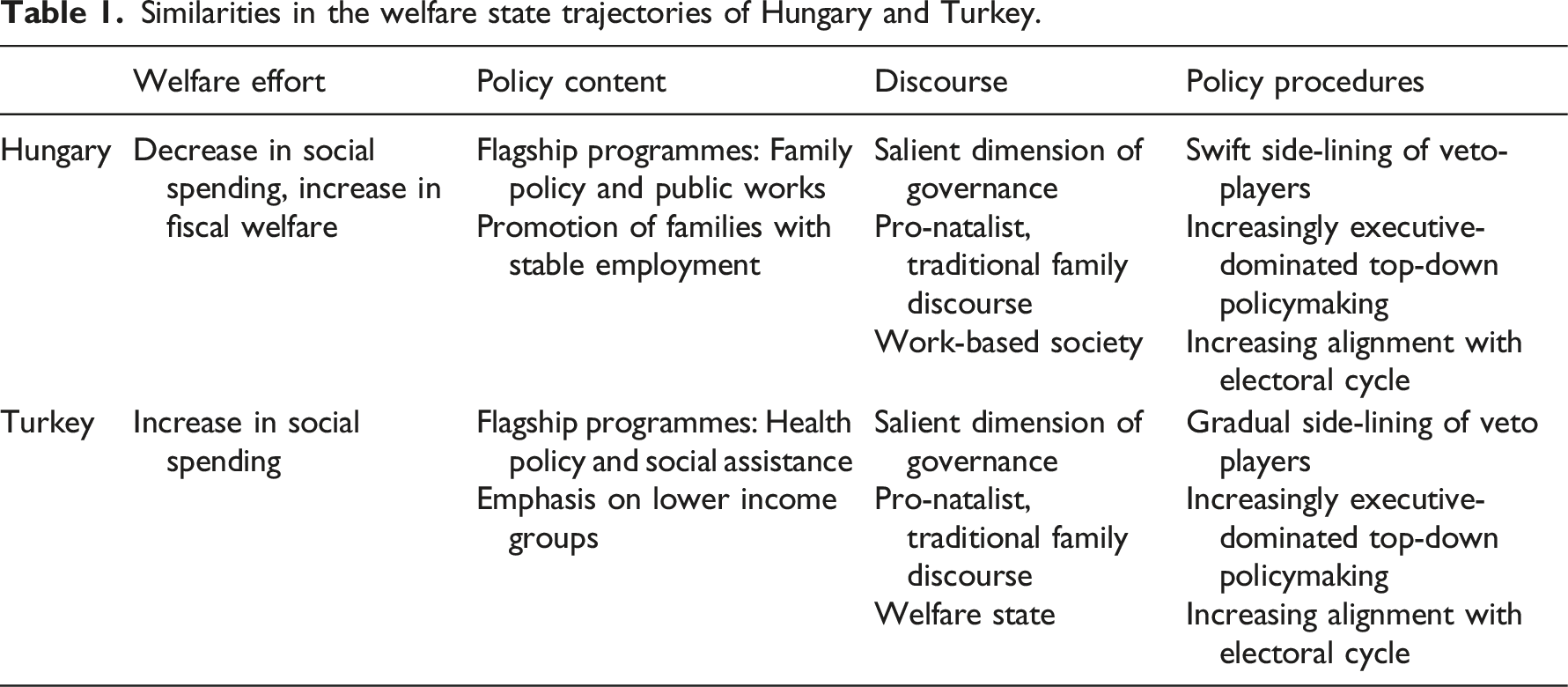
Disentangling separate dimensions of reforms helped us reveal unexpected similarities underneath major differences between the Hungarian and Turkish welfare states. Investigating the timing and tempo of policymaking our analysis showed that both governments initiated paradigmatic reforms early on. In the case of Fidesz sweeping policy change was closely linked to the dismantling of democratic institutions. Later, reforms became less frequent, and shifted to parametric, layered change. Social policymaking closely followed the electoral cycle, timing expansionary reforms prior to elections.
Related to procedures and actors we found a peculiar combination of democratic reconciliation and top-down autocratic decision-making that mirrored the increasingly authoritarian political systems. Orbán faced fewer challengers in pursuing his social policy ideas than Erdoğan, who had to adjust his visions to internal opposition. In the latter case, opposition parties, the military, the Constitutional Court, and civil society acted as contesters. While AKP initially engaged in consultation with major actors, top-down decision-making gradually gained ground as the power of veto players decreased. In contrast, Orbán successfully sidelined important veto-players at the start, including the Constitutional Court, ended the welfare ministry’s independence and swept away non-loyal bureaucrats who could possibly hinder drastic paradigmatic reforms. In both countries, the elimination of effective consultative mechanisms resulted in non-transparent policy processes. Reforms became less coherent, and usage of omnibus legislation increased. Chaotic decision-making processes often led to repeated amendments of earlier legislation. National parliaments and parliamentary committees became weightless. Opposition and civil society have limited opportunities to influence policy proposals or to come up with alternatives. Overall, the executive’s role became decisive in determining welfare policies.
Our findings confirm Cook’s (2007: 19) observation that the absence of veto-players facilitates rapid welfare state change. Contrary to her, however, we found that rapid change does not necessarily mean retrenchment or liberalization. Rather, we noted convulsive welfare change. Indeed, in terms of policy content, we found that in opposition both Fidesz and AKP criticized welfare cutbacks and after coming to power they comprehensively restructured welfare states, with some visible expansions. Such initial reforms helped strengthen electoral support especially through two flagship welfare programmes. In the first policy area – family policy in Hungary and health policy in Turkey – reforms received broad bipartisan support. This is highly unusual given the otherwise extremely polarized nature of politics in these countries. In the second flagship policy area – public works in Hungary and social assistance and public works in Turkey – tangible, but discretionary benefits helped retain electoral support among the poor. Meanwhile, both leaders pleased employers with flexible employment rules and by weakening trade unions. Finally, in some cases the precise reform content was remarkably similar. For example, both governments replaced critical high-level civil servants with loyal officials through changing retirement rules, thus (mis)using social policy for direct political purposes.
Discourse has been highly salient especially in family policy reforms where Erdoğan and Orbán employed a pro-natalist rhetoric and extolled the virtues of marriage and child-rearing, particularly emphasizing the three-child family model. Government propaganda contrasted the traditional family to changing ‘enemies’ against whom the government offered solutions. Both parties launched regular direct communication campaigns with the people in a populist vein.
Remarkable similarities should not make us overlook differences between the welfare agendas of Fidesz and AKP, however. Labour market flexibilization and pension privatization notwithstanding, the AKP did expand social security to the lower classes. Fidesz, in contrast, pursued exclusionary policies and sharpened the divide between ‘insiders’ in stable employment and lower-class ‘outsiders’. Fidesz thus broadly followed the ‘populist welfare paradigm’ (Chueri, 2022) espoused by populist right-wing parties in Western Europe, with the refinment that its harsh policies related to the unemployed rather resemble ‘exclusionary neoliberal populism’ (Scheiring, 2021). In Turkey, government and opposition alike discursively endorsed the concept of the welfare state while Fidesz built up an alternative: the ‘work-based society’. Our findings thus suggest that the two countries could not be placed under one heading of a new regime type in an Esping-Andersenian sense. What we see is the modification of their respective regime models with increasingly salient features of authoritarian welfare states. Notably, new, flagship programmes are propagated as gifts by political leaders in a paternalistic way. Social rights gradually lose their enforceability, while the state expects proper behaviour in return, including work, family arrangements and political views. Disciplinary features of social policy are increasingly prevalent especially when it comes to women (Fodor, 2022) and the poor (Szombati 2018). Adversarial and hostile campaigns against selected groups increase the vulnerability of minorities. All these features make Turkish and Hungarian welfare states ‘illiberal’ – that is, different from what we find in liberal democracies.
Overall, welfare reforms are an integral part of how these regimes build up and maintain popular support. Here, we concur with Tuğal (2022), who argues that part of the secret of Fidesz’ and AKP’s longevity lies in unconventional economic and social policies. Their core constituencies have differed as Fidesz’s electoral support was initially rooted in the middle class, whereas AKP relied on the poor. But both leaders managed to build cross-class coalitions with the help of social policy reforms (Scheiring, 2020; Yörük and Comin, 2020). Our exploratory research thus contributed to understanding the social roots of populist and illiberal regimes. Further research could reveal how exactly specific economic and social policies deliver to different support bases that in turn contribute to the longevity of autocratizing political regimes.
Supplemental Material
Supplemental Material - An illiberal welfare state emerging? Welfare efforts and trajectories under democratic backsliding in Hungary and Turkey
Supplemental Material for An illiberal welfare state emerging? Welfare efforts and trajectories under democratic backsliding in Hungary and Turkey by Dorottya Szikra, Kerem Gabriel Öktem in Journal of European Social Policy.
Footnotes
Acknowledgements
The authors would like to thank Adrienn Győry for very valuable comments and suggestions.
Declaration of conflicting interests
The author(s) declared no potential conflicts of interest with respect to the research, authorship, and/or publication of this article.
Funding
The author(s) disclosed receipt of the following financial support for the research, authorship, and/or publication of this article: This research is supported by the CEU Democracy Institute (Project: Democracy and the Welfare State. Social Policy Reforms under Democratic Backsliding).

Supplemental Material
Supplemental material for this article is available online.
Notes
References
Supplementary Material
Please find the following supplemental material available below.
For Open Access articles published under a Creative Commons License, all supplemental material carries the same license as the article it is associated with.
For non-Open Access articles published, all supplemental material carries a non-exclusive license, and permission requests for re-use of supplemental material or any part of supplemental material shall be sent directly to the copyright owner as specified in the copyright notice associated with the article.
