




Abstract
What are the long-term effects of authoritarian repression on political trust in a post-democratization context? Using the Gwangju Massacre in South Korea as a case study, this article finds that indirect and direct experience of state-perpetrated violence of the critical-period cohort—who were aged 17–25 during the incident—can have long-term negative effects on trust levels towards the government. Difference-in-difference analysis of national survey data collected in 2008 and 2012 reveals that experience with violence has long-term negative consequences on government trust. Results are robust even when including significant covariates of institutional theories and cultural theories, such as interpersonal trust, evaluation of government performance, as well as satisfaction with the economy. Drawing from memory studies, this article argues that the effects are due to collective memory formed during the critical period.
Introduction
What are the long-term effects of political violence on political trust after democratization? Despite a burgeoning literature on the long-term effects of repression on political identities and attitudes, the long-term effects of authoritarian repression on political trust in a post-democratization setting have been overlooked. Trust in government institutions is fundamental to democracy, and its legitimacy depends upon it (Dalton, 2004). Political trust is part of civic culture and is a precondition for strong democracy (Almond and Verba, 1963). The importance of political trust in a functioning democracy implies that the effect of violence on political trust is an important question that warrants examination in a post-democratization context.
This article contributes to answering the question by examining the case of the Gwangju Democratic Movement, 1 which occurred in a city located in the southwest of South Korea on May 18, 1980. Initiated as a popular social movement against the authoritarian government, the movement ended in the beating and killing of civilians and protestors by government troops, an incident which has later been coined as the ‘Gwangju Massacre’. The incident resulted in more than 5060 victims, including deaths, disappearances, and casualties, in Gwangju Metropolitan City. 2
The case of the Gwangju Massacre is suitable for answering the question due to two conditions: the unprecedented level of repression and the geographical concentration of violence. These conditions enable clear comparison of the long-term effects of state violence on the political trust of citizens in the area and those in areas that have not experienced such direct state violence. Although the dictatorship in South Korea under military rule (1961–1988) used a wide range of repressive tactics, open fire against civilians in a public space rarely occurred. 3 In comparison to repression of anti-government protests, which mostly consisted of arrests and beatings, the Chun dictatorship used an unprecedented scale of violence to contain the Gwangju movement, leading to mass killings of civilian participants, who were primarily residents of the area.
To hypothesize the relationship between political violence and political trust, I draw insights from the theory of collective memory. Collective memory refers to the memories retained by members of a group, class, or nation via community-based socialization and reinforcement of a shared narrative (Halbwachs, 1992; Walden and Zhukov, 2020). The theory of collective memory states that people who were in their “critical period”—their adolescence or young adulthood—when extreme, intense societal-level events occurred are more likely to retain the memories throughout their lives. I test the implications using survey data with geolocation information of respondents using difference-in-difference (DID) design. DID is used to estimate the causal effect of experiencing violence on political trust. I find that compared to the non-critical-period cohort, experience in political violence has causal, long-term effects on political trust on the critical-period cohort that experienced violence.
The results of this article contribute broadly to the burgeoning research on the long-term consequences of political violence on political attitudes. Extant works have examined the effect of the legacy of political violence on political behavior, such as political identities, electoral preferences, and political engagement. Balcells (2012) examined how individual and family victimization during the Spanish Civil War affects political identities and electoral preferences. Lupu and Peisakhin (2017) find that compared to those who have not experienced forced deportation, the descendants of individuals who suffered from the Soviet regime's deportation of Crimean Tatars in 1944 more intensely identify with their ethnic group, more strongly support the Crimean Tatar political leadership, hold more hostile attitudes toward Russia, and participate more in politics. Rozenas et al. (2017) show that past Soviet state violence in West Ukraine has made affected communities less likely to vote for “pro-Russian” parties today. More recently, by replicating Lupu and Peisakhin (2017), Wang and Carter (2022) found the opposite—legacy of violence is negatively associated with political engagement. In addition, there has been similar literature evaluating the short and long-term effects of violence on different aspects of social capital such as civic engagement (Barceló, 2021; Bellows and Miguel, 2009), social trust (Conzo and Salustri, 2019; Barclay and Nikolova, 2020), and trust in local and national political institutions (De Juan and Pierskalla, 2016; Gates and Justesen, 2020).
Theoretically, this article advances our understanding of collective memory of violence and political behavior. Previous works have focused on family socialization (Nunn and Wantchekon, 2011; Voigtländer and Voth, 2012); others have focused on trauma, defined as exposure to violence at infancy (Hong and Kang, 2017), and inter-generational effects (Lupu and Peisakhin, 2017; Wang and Carter, 2022). At the same time, several scholars have focused on how the collective memory of political violence affects sets of political behavior such as attitudes toward migrants and political identities (Balcells, 2012; Dinas et al., 2021). By examining the relationship between shared experience of political violence and political trust, this work contributes to the growing work that examines the relationship between the collective memory of political violence and political behavior.
This article is organized into four parts. First, it presents the historical background of the Gwangju Movement. Second, it discusses the theory of collective memory and states testable hypotheses. Third, it lays out the DID research design. Fourth, it presents results and discussion.
The Gwangju Movement, 1980
Following the coup d’etat by the military in 1961, South Korea was under military rule for 27 years until democratization in 1988. The military government was led by two dictators, Park Chung-hee (1963–1979) and Chun Doo-hwan (1981–1988). The military government ended when, in June 1987, President Chun announced the implementation of fair and free elections as a result of the June Democracy Movement.
The Gwangju Movement occurred amidst growing tension between the public and repressive events that happened during Park's reign. Several events led up to the Movement: the first was the “Y.H. Incident,” which occurred in August 1979 and resulted in police violence against protestors who were on a hunger strike. Former president Kim Young-sam, who was then a congressman in the National Democratic Party, publicly condemned Park, and as a result lost his seat in Congress. This expulsion then incited massive protests in Busan and Masan cities in October 1979 (the “Bu-Ma Protests”), that involved more than 8000 participants. Tensions arising from the public's demand for democratic transition heightened in October 1979 with the sudden death of President Park. However, the tension climaxed with a second coup d’etat by Chun Doo-hwan in April 1980.
Angered by the continued dictatorship, a group of students in Gwangju gathered to protest the martial law on May 18. The military in Gwangju, under the orders of Chun, started indiscriminately beating protestors. Unable to ignore the ongoing violence, Gwangju citizens began to join in with the demonstration. As the number of protestors increased and fighting between the military and protestors intensified, the military began to fire into the crowd. With the help of fellow citizens and industrial workers, the protestors armed themselves, which resulted in continued armed battle between the protestors and the military. The movement ended on May 27, when the military surrounded Gwangju city in its entirety, killing all remaining protestors.
Mechanisms and hypotheses
Collective memory and critical period
I draw from existing literature on historical sociology and social psychology to theorize mechanisms between state repression and political attitudes. The term collective memory, first coined by Halbwachs (1992), refers to the idea that memories are retained by members of a group, class, or nation. The term refers to shared memories of societal-level events, especially extreme, intense events. Social processes, such as community-based socialization and reinforcement of a shared narrative recounting a traumatic event through commemorations, contributes to sustaining the memory of the event (Walden and Zhukov, 2020). Given the regional concentration of state-led violence and the high level of local participation in the movement, collective memory can negatively affect political attitudes in the area—citizens may continue to perceive the government in a negative way due to state-led violence in the past.
The literature on collective memory highlights the significance of cohorts, which affect the way in which people remember historical events. Scholars of collective memory hypothesize that a generation that has been exposed to a certain event during their “critical period” are more likely to remember the event, and further, such memory has implications for other actions and attitudes. One of the earliest works to theorize on the relationship between age and historical memory is that of Mannheim (1952), who first stated that the age range of 17–25 is a critical period, when “present problems”—that is, “life's problems” located in the present—become the focus for young people, while the older generation cling to the reorientation that dramatized their youth. Other works have found empirical evidence for Mannheim's critical period hypothesis: it has been found that people who were in their late teens to mid-20s when historical events took place are more likely to remember the events relative to older generations (Schuman et al., 1994, 1998).
The theory of collective memory helps understand how experience in repression may have lasting effects on low levels of trust toward the government. Individuals who experienced the incident during their critical period are more likely to clearly remember the event compared to the non-critical-period cohort, and therefore harbor low levels of trust toward the government. Following this conjecture, I formulate the following hypothesis:
H1. Experience in political violence during the critical period decreases levels of trust towards the government.
Also, due to the historical account of how then-executive Chun directly ordered the repression of civilians, I hypothesize that collective memory will decrease trust in the central government and the executive, compared to other government branches:
H2. Experience in political violence during the critical period decreases levels of trust towards the executive and the central government, compared to trust in other government institutions.
Empirical analyses
Survey data
The dependent variable in the analysis is political trust, and the main explanatory variable is having experienced authoritarian repression, which, in this article, refers to direct or indirect experience of the Gwangju Massacre. For these variables and other control variables, this article uses survey data of ordinary Korean citizens collected from the Korean General Social Survey 2008, 2012 (Kim, 2008, 2012). The total number of observations in the merged data set is N = 1638. To measure political trust, I use the questions on government confidence, which asks how much confidence the respondent has in five different government institutions—the central government, congress, the supreme court, the military, and the executive (blue house). 4
The population of interest is people who were exposed to indirect or direct violence during the Gwangju Massacre, which I identify as residents who lived in the area when the massacre occurred. This measurement is feasible due to a high level of indirect and direct participation of local residents in the Movement. According to one source, it is estimated that approximately 90,000 citizens gathered to protest on May 21, before open firing occurred (Noe, 2013: 360).
To address problems in identifying the population of interest, which here is residents of Gwangju who directly or indirectly experienced the incident, I use information from the 2008 and 2012 survey on time of residence in the area. 5 When the respondent is found to have lived in the Gwangju area in 1980, when the massacre occurred, the variable Experience in Massacre is coded as 1, and 0 otherwise. For the variable Critical-Period Cohort, respondents who were aged 17–25 when the incident occurred—i.e. those born between 1955 and 1963—are coded as 1; 0 indicates the Non-Critical-Period Cohort, which refers to the rest of the population aged outside the range of 17–25 when the massacre occurred in 1980. The age range of 17–25 is based on the definition of Mannheim (1952) as well as findings by Schuman et al. (1994, 1998) who found supporting evidence for Mannheim's critical years hypothesis. Comparison of the results with other potential critical period ranges is shown in the robustness section.
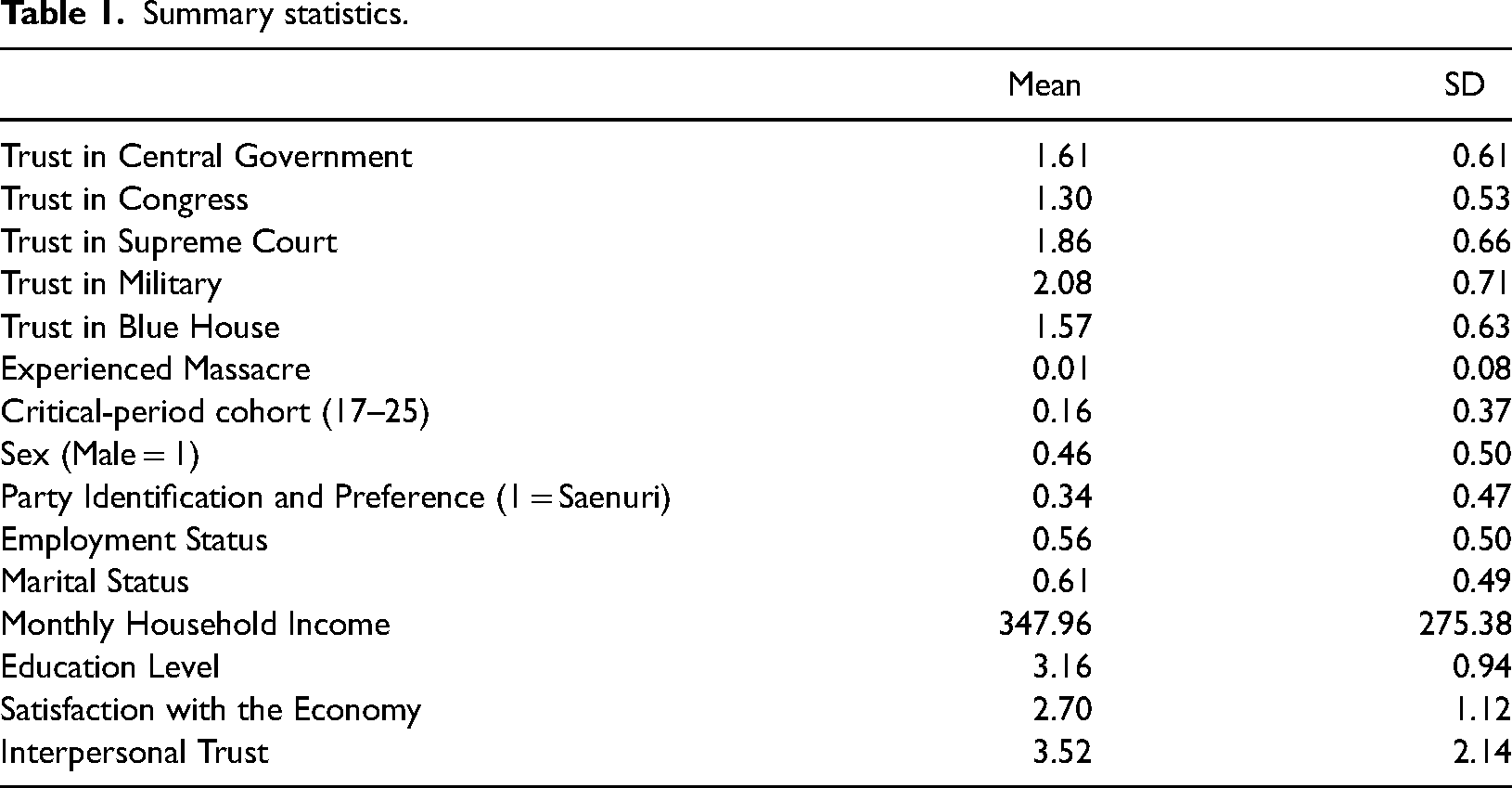
Individual covariates are controlled for—including sex, employment status, marital status, total monthly household income, and education level. The variables sex, employment status, and marital status are binary, where 1 indicates male, employed, and married, respectively. For the household income variable, the variable is recoded as continuous by taking the mean of the original coding, which was categorical. The variables that are argued to affect political trust by institutional theories and cultural theories of political trust are also included: evaluation of government performance, satisfaction with the economy, and interpersonal trust (Mishler and Rose, 2001). These variables were coded as continuous. I also include a party identification dummy variable indicating whether the respondent identifies with the Saenuri Party because the president was a member of the Saenuri Party when the survey was conducted, which could create a negative bias in the results. The summary statistics of the variables used in the analysis are reported in Table 1.
Summary statistics.
Methodology
To address the challenges in causal inference, I use the DID approach. Although this is commonly used in economics and public policy to estimate policy effects by observing the difference in the outcome before and after policy implementation, recently it has been used in the political science literature to estimate causal effects of historical experience on political behavior using data gathered in a post-treatment context (Cheruvu, 2022; Frantzeskakis and Sato, 2020; Hong and Kang, 2017). The analysis faces problems of reverse causality—i.e. that state repression occurred because the critical cohort in the Gwangju area had lower levels of trust towards the government in 1980 compared to the critical-period cohort in other areas. The DID approach allows me to estimate the counterfactual: by estimating differences in the expected trust levels of the non-critical-period cohort that experienced violence and the non-critical-period cohort that did not experience violence, I can estimate the counterfactual trust level of the critical-period cohort that experienced violence in Gwangju in 1980 had they not experienced violence. By identifying this counterfactual trust level and subtracting it from the difference in the expected trust levels among the critical-period cohort, I can obtain the causal effect of experiencing violence.
The DID set-up is presented in Table 2. The comparison between the political attitudes of the two groups, as identified in the second column, allows me to test the counterfactual on whether political attitudes would have been at the baseline level if the critical-period cohort that experienced the incident had not experienced it. The difference in the expected level of trust between (4) and (3), and between the expected level of trust between (2) and (1), is the causal effect of violence on the expected level of trust.
Difference-in-difference set-up.

I use OLS regression to estimate the effects. In the equation below, GovTrustit refers to the level of trust of a respondent i from the critical-period cohort t in terms of confidence in five different branches of the government: the central government, congress, the military, the supreme court, and the executive. The variable is coded as continuous, where 1 = “Hardly any confidence at all”, 2 = “Only some confidence,” and 3 = “A great deal of confidence.” ExpMass is a dummy variable indicating whether the respondent lived in the area when the massacre occurred. CriticalPeriod is a dummy variable that refers to the critical-period cohort, members of which were aged 17–25 in 1980.
Results
Table 3 reports results for the baseline model that only includes the variable experience in massacre and covariates (Models 1–5), and the results of the full model that includes the interaction term between experience in massacre and the critical-period cohort variable (Models 6–10). This is to highlight how the critical-period variable matters in explaining the effects of violence. There is a distinct difference between the two groups: although negative, the experience of the massacre itself does not have a statistically significant effect on trust in government institutions. Yet, when the interaction term is added, the coefficient estimate turns negative and is statistically significant for trust in the central government, the supreme court, and the executive (blue house). Figure 1 shows how the magnitude of the coefficient estimate changes in the full model compared to the baseline model.
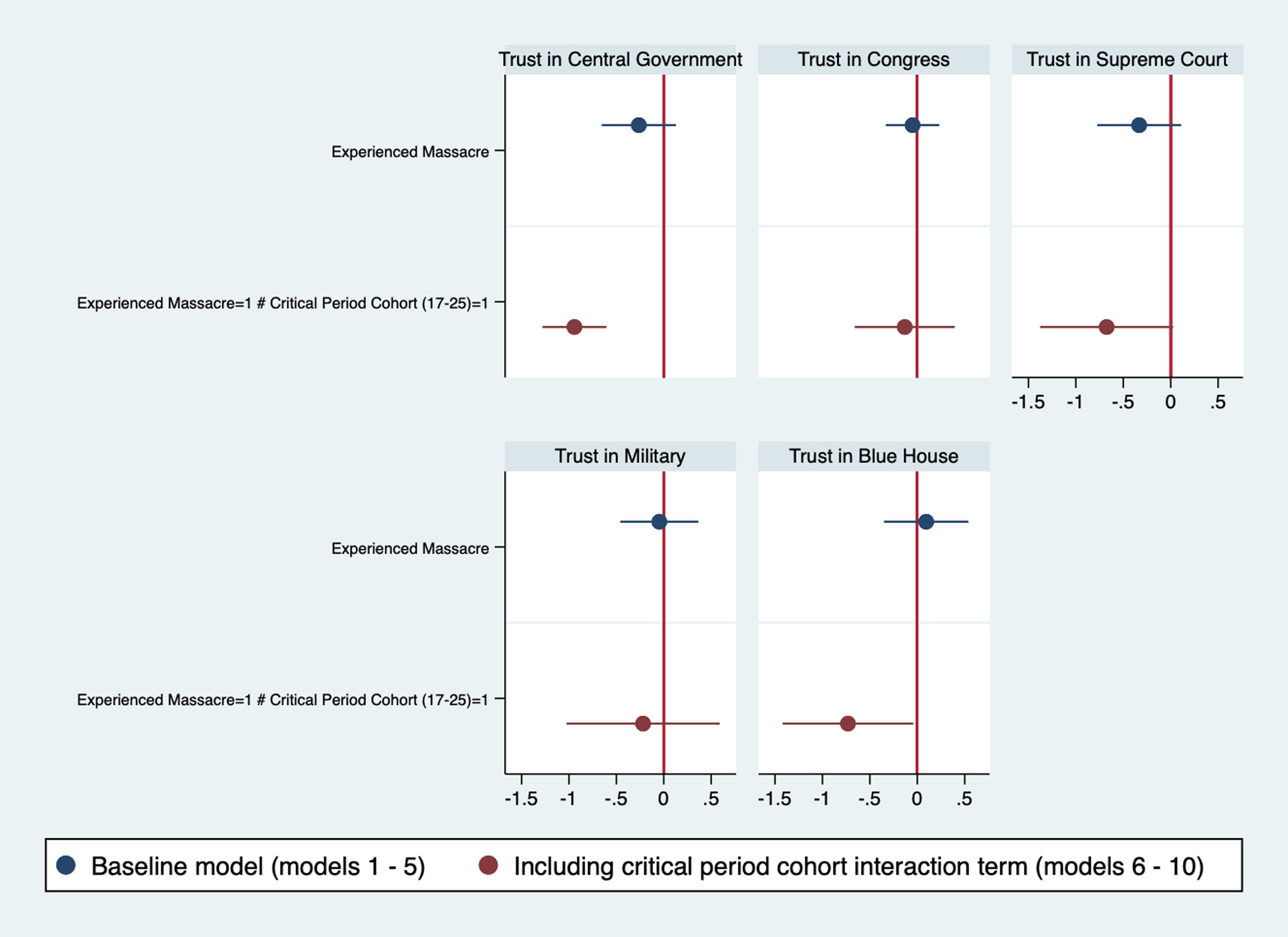
Coefficient estimate for the baseline model and the full model.
The effect of political violence on political trust.
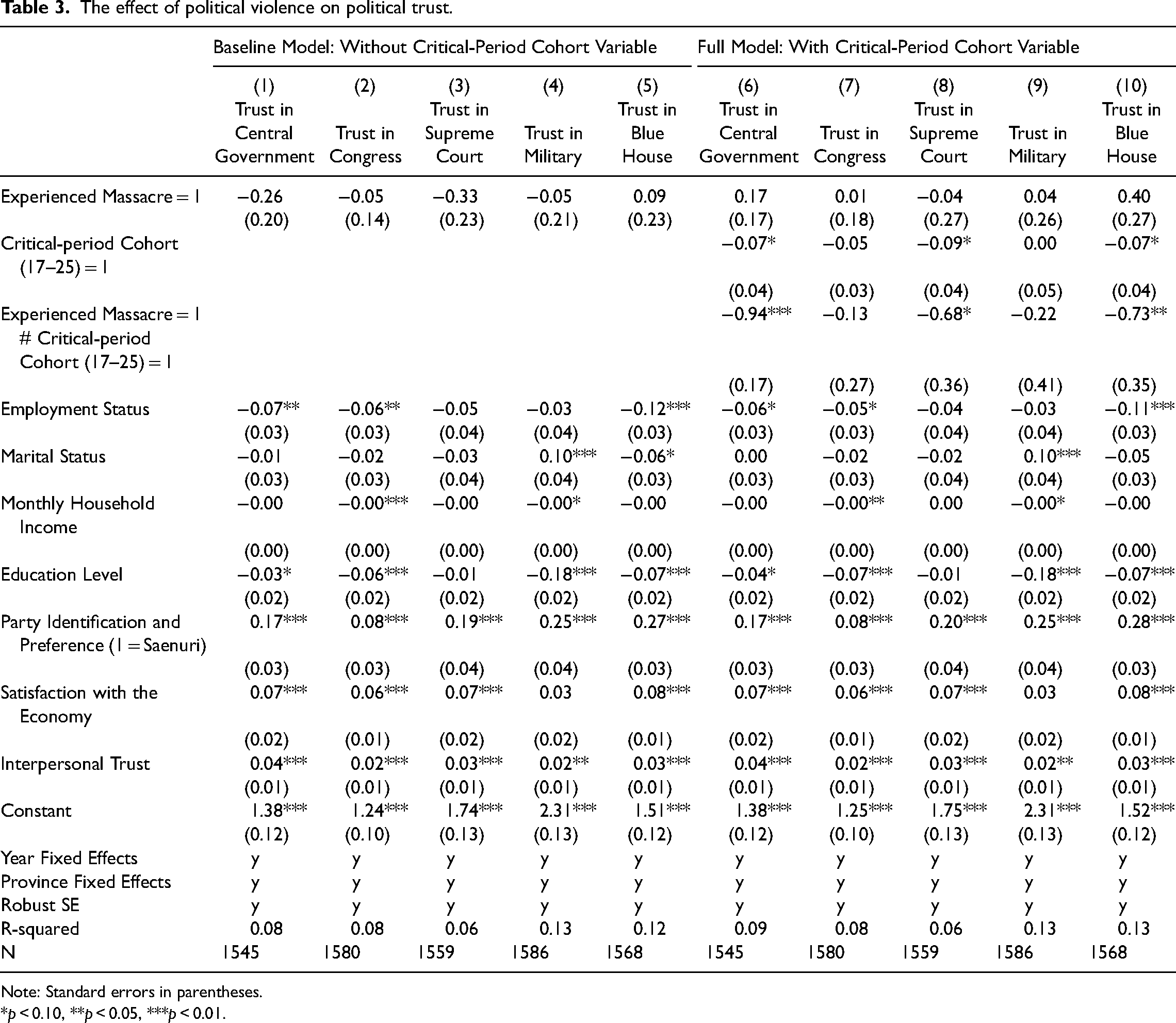
Note: Standard errors in parentheses.
*p < 0.10, **p < 0.05, ***p < 0.01.
I map the estimated coefficients with the DID identification in reference to Table 2. In the previous section, I noted that the difference in the expected level of trust between (4) and (3), and between the expected level of trust between (2) and (1), is the estimated causal effect of violence on the expected level of trust. In mathematical format, this is equivalent to (4) – (3) – (2) – (1), and from the OLS regression results above it is equivalent to
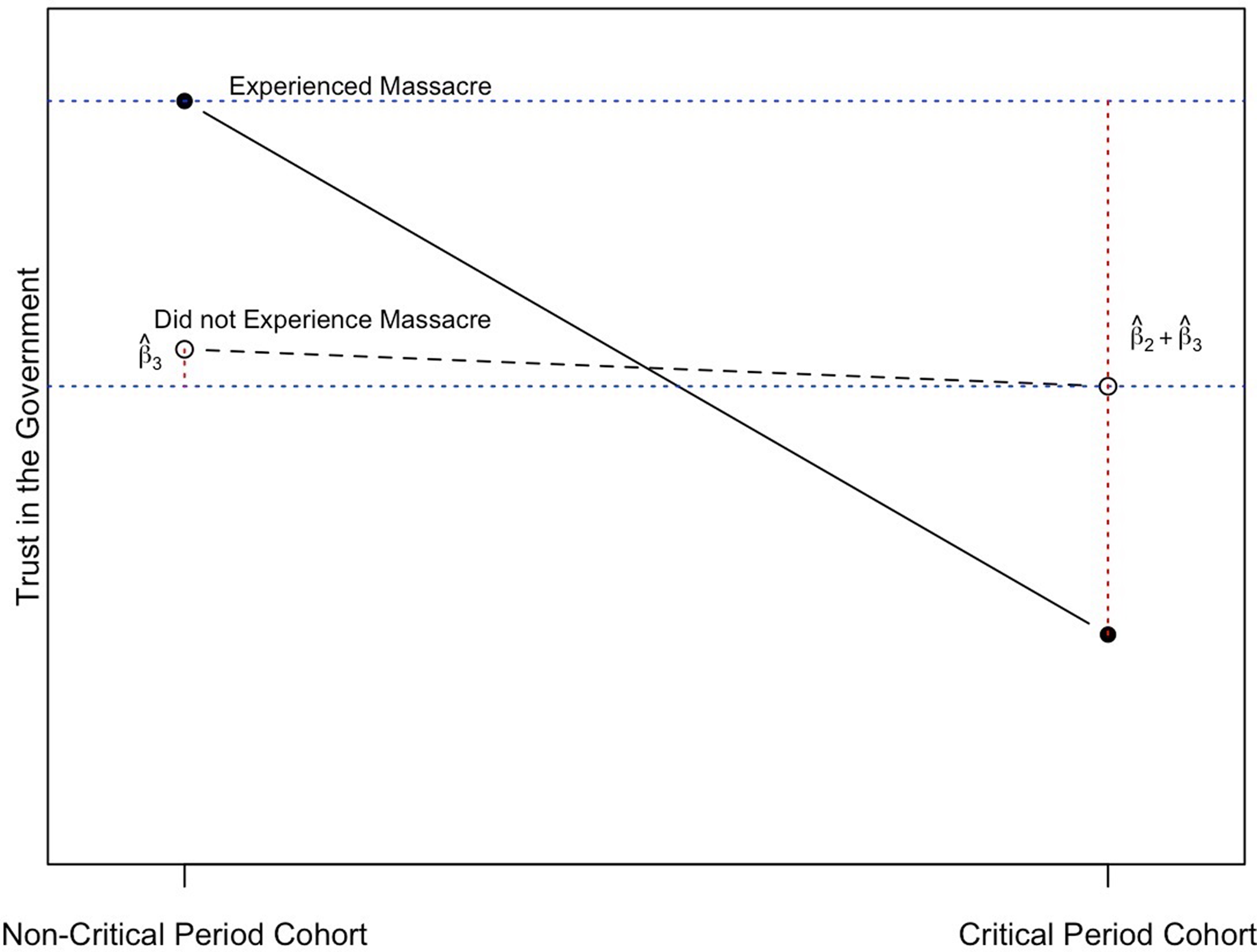
Summary plot of difference-in-difference estimates.
The results in Table 3 show that there is some support for Hypothesis 1. The coefficient estimate
Robustness checks using matching
To account for weak robustness that can arise from a small number of samples in the treatment group, matching was applied for robustness checks. Matching is a method that addresses the selection issue: by matching the treatment and control groups on covariates, it eliminates the potential that unobserved covariates in the pre-treatment group affect the outcome. I conducted the matching process using coarsened exact matching algorithm (CEM) and substantiated with an OLS regression. When using CEM, the treatment and control groups are not matched based on identical covariate values but matched after coarsening each variable into groups (Blackwell et al., 2009). By applying matching, the number of observations is pruned so that covariates are distributed equally between the treatment and control groups.
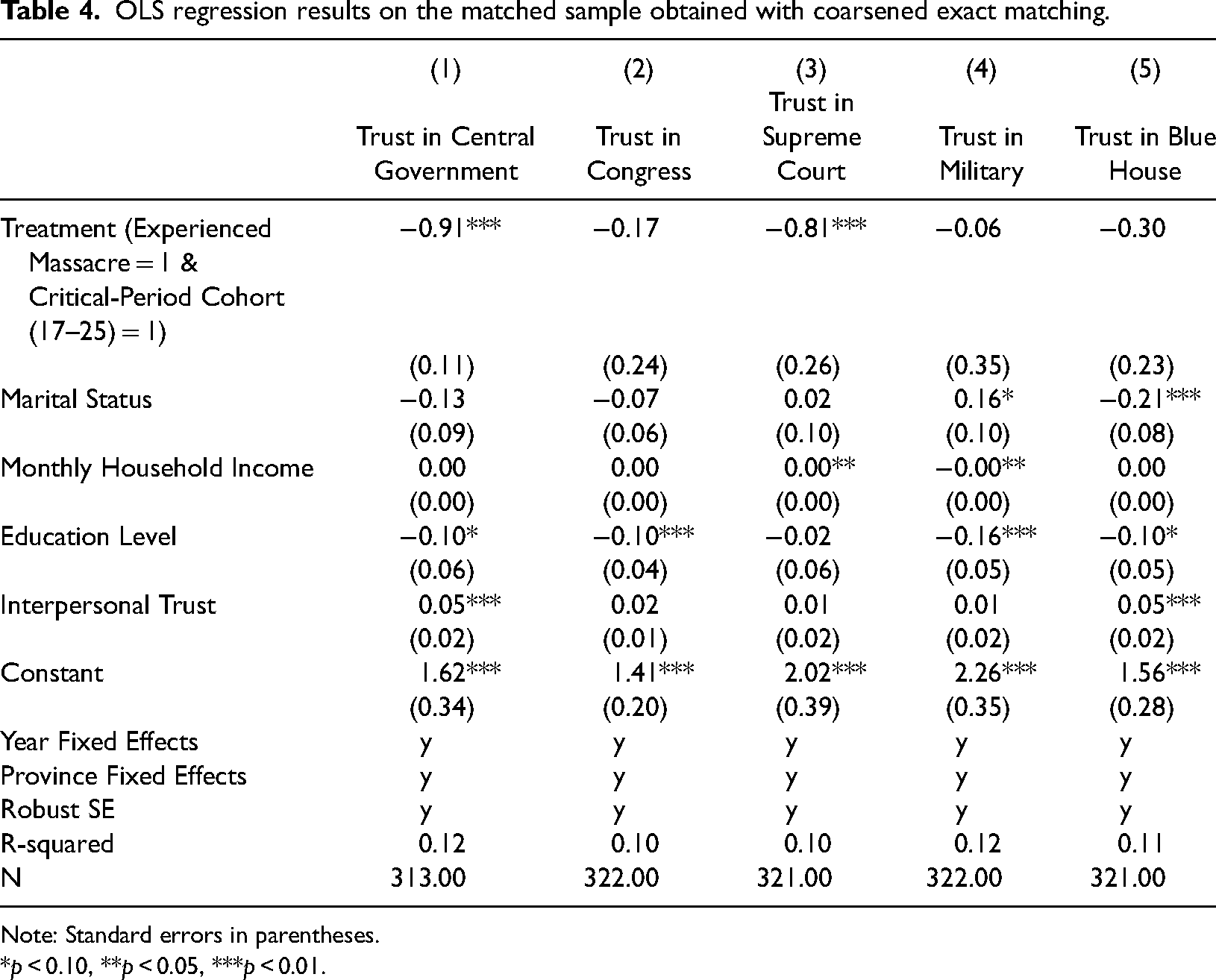
The treatment group is defined as the critical-period cohort that lived in Gwangju area when the massacre occurred (group (1) in Table 2), while the non-treatment group were the rest (groups (2)–(4) in Table 2). Due to a significant decrease in sample size when matching on all covariates, the sample was matched using covariates with relatively larger magnitudes and statistical significance, which were found after fitting the same model as in Table 3 without including the treatment variable (see Table 6 in Appendix). The selected variables used for matching were party identification, employment status, and satisfaction in the economy. The covariates that were not used for matching were controlled for in the OLS regression. After applying CEM, the multivariate L1 distance, which indicates the imbalance between the treatment and the control group, decreased from 0.8 to 0. Due to the pruning process, the size of the sample decreased to N = 322. Table 4 reports OLS regression results on the matched sample. The results closely resemble DID results: the estimated coefficient for the treatment is negative across trust in five institutions. The coefficient estimates were also statistically significant for outcome variables Trust in the Central Government and Trust in the Supreme Court but were not statistically significant for Trust in Blue House.
OLS regression results on the matched sample obtained with coarsened exact matching.
Note: Standard errors in parentheses.
*p < 0.10, **p < 0.05, ***p < 0.01.
Robustness checks using different critical periods
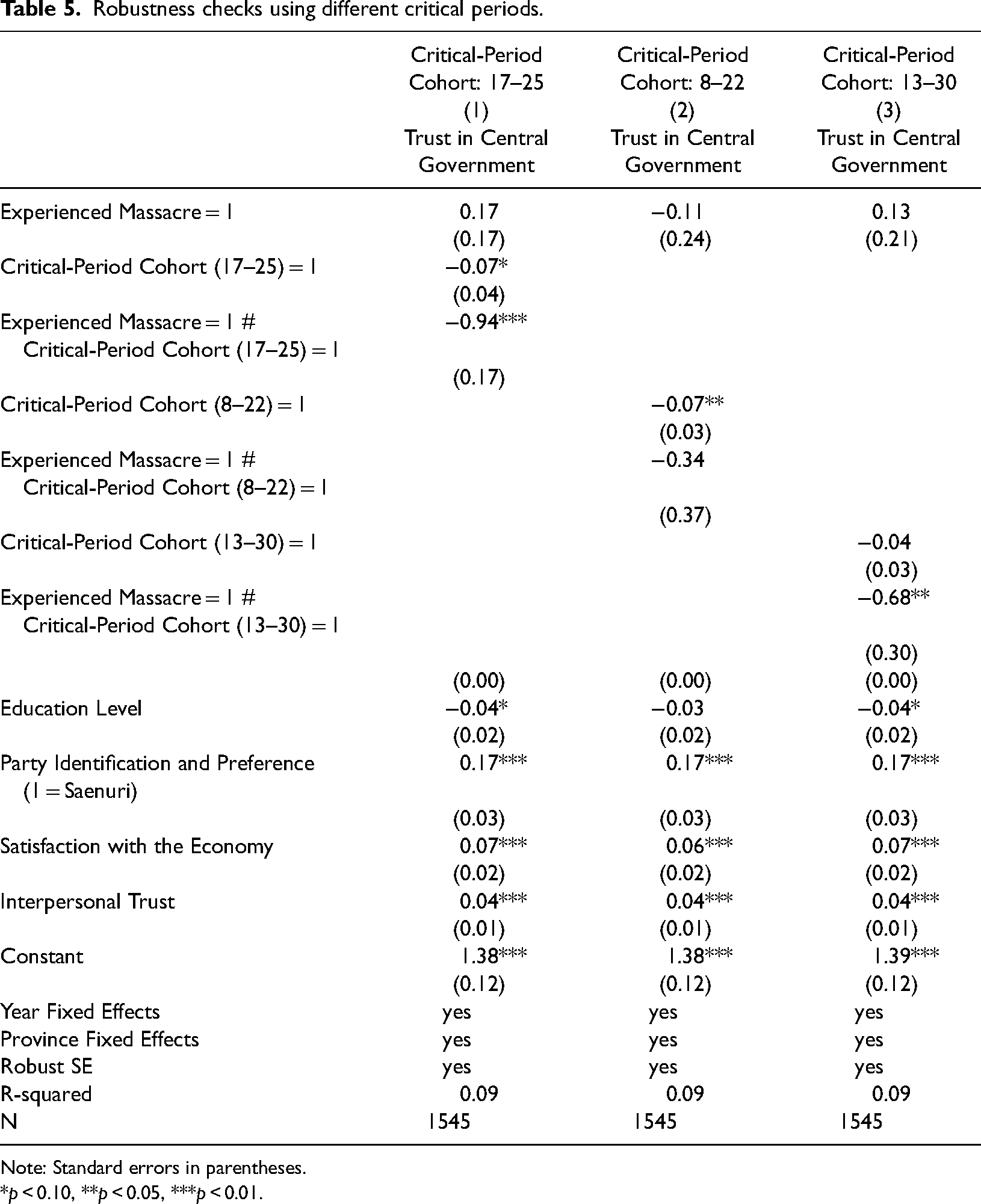
Despite accumulation of empirical works that test the critical period theory, the extant literature is divided regarding the exact age range of the critical period. For instance, Schuman and Corning (2012) recently drew from eight national surveys conducted in the United States and found that although Mannheim's critical years hypothesis can be supported, the period in question is not fixed, and could be wider, which includes later childhood and early adulthood (ages 8–22). On the other hand, Jennings and Zhang (2005) find that the critical period can even stretch to the late 20s; in their survey, respondents who remembered the founding of the People's Republic of China were those that were aged 13–30 when the event occurred, which extends further than Mannheim's range of 17–25. For robustness checks, I test the effect of political violence and different critical periods on trust in the central government and report the results in Table 5. I test results for the trust in the central government variable because this is the dependent variable where the size of the coefficient estimate was the largest and statistically significant. Overall, the negative trust levels are found even when the critical period is coded across different age ranges; however, the effect was not statistically significant for ages 8–22.
Robustness checks using different critical periods.
Note: Standard errors in parentheses.
*p < 0.10, **p < 0.05, ***p < 0.01.
Table 5 shows that there is less support for ages 8–22, the age found to be critical by Schuman and Corning (2012), but more support for the age range of 13–30, the age considered critical by Jennings and Zhang (2005). When coding the critical period as age 8–22, the estimated coefficient for the effect of violence is negative but smaller in size than for when the critical period is coded as 17–25 and is also statistically insignificant. When coding the critical period as 13–30, the coefficient estimate is slightly smaller than the coefficient estimates for the 17–25 range but is statistically significant at a 95% level. These results imply that in the case of the Gwangju Massacre, the critical period may be wider compared to Mannheim's (1952) suggestion and can comprise adults in their late 20s. However, at the same time, the younger age—before adolescence—seems less relevant in this context, as the critical period hypothesis was not supported for the age 8–22 range. Figure 3 summarizes the results for the different critical period age ranges.
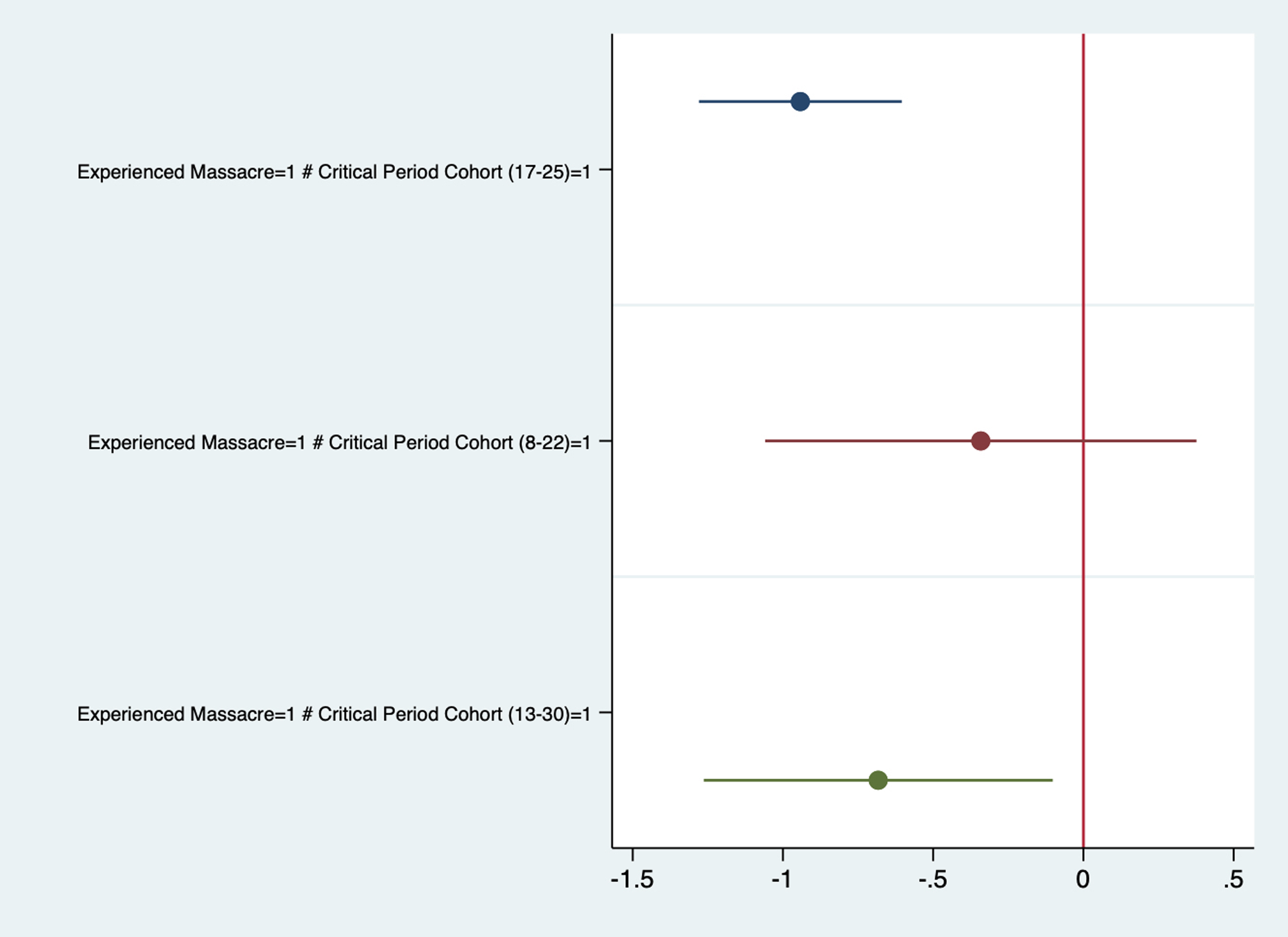
Coefficient estimates for different critical periods.
Discussion
Despite an accumulation of literature on the long-term effects of violence on political attitudes, few authors have examined its effect on political trust. Taking the unique case of region-concentrated violence that occurred in South Korea prior to democratization and a national survey with geolocational information of respondents, this article shows new evidence that experience in political violence has long-term negative causal effects on political trust.
It is also important to acknowledge that this work has limitations. For one, this work does not consider migration patterns—that people who have experienced massacre moved out of the area after it happened, which could increase measurement error. In this work, the measurement error does not necessarily cause a significant bias in the OLS results: in presence of the measurement error, these estimates would not be negative nor positive but closer to zero, yet the coefficient estimates for the variable experience in violence in Table 1 (Models 1–5) and those for the interaction term of experience in violence and critical-period cohort (Models 6–10) were zero. Future work could benefit from improving precision in measurement, which can improve preciseness of the estimates. Yet, as pointed out by Marbach (2021), works that examine the association between historical legacy and political behavior should make strong identifying assumptions about migration patterns or the observed difference between population that have resided in a place that was historically exposed to a treatment versus those that may be biased. Considering this point, future work should incorporate migration patterns to obtain uncontaminated estimates of the legacy of political violence on political trust.
Some questions can be asked about whether an absence of repatriations and weak development of political institutions have negatively affected the outcomes. However, several efforts were made to establish transitional justice. First, parting from how the Chun dictatorship has stigmatized the movement as a ‘Communist mutiny’, the first democratically elected president Kim Young-sam officially recognized the movement as a democratic movement in 1987. Second, a bill regarding reparation for the victims was passed in 1995, detailing monetary compensation for those affected, while former president Chun and those who were responsible for commanding open fire during the incident were put on trial. Lastly, democratic institutions were established, and democratic quality has improved since 1987. According to 2014 data from Democracy Barometer (http://www.democracybarometer.org), which measures components of democratic quality for 70 democracies, South Korea scored above average for indicators on representation and participation. Considering these developments, low levels of political trust among victims of the massacre are unlikely to be attributed to a lack of effort to build transitional justice or to low levels of democratic development.
The weak negative effect of the treatment on trust in the military should be addressed. At a glance, this is puzzling because the political violence conducted during the Gwangju Massacre was by the military, and it would be expected that there would be a strong negative relationship between experience in political violence and trust in the military. However, there are other factors that could be confounding the statistical relationship between the two variables: for example, it had been found that economic growth and overseas operations have a strong positive correlation with trust in the military even in countries with experience in military rule and repression (for Spain, see Martínez and Durán, 2017; for Latin America, see Montalvo, 2009). Another likely confounding factor is the quick depoliticization and professionalization of the military after democratization in South Korea, which was possible due to structures in the military which created a path-dependency toward stable civil–military relations after democratization (Moon and Rhyu, 2011). Future work should explore further how the aforementioned factors could cross-cut the effects of historical legacy of political violence on trust in the military.
This article has implications for the burgeoning literature on effects of political violence on political attitudes and behavior. The findings are mixed: some reveal positive effects such as increased political participation (Bellows and Miguel, 2009; Blattman, 2009), within-community trust, cooperation, and altruism (Gilligan et al., 2014). Recent works have found negative results—those that examine wartime violence found that experience of violence creates trauma and negative effects on political trust (Hong and Kang, 2017). This article by finding negative effects of authoritarian repression on political trust in a post-democratization setting adds to the literature that finds negative effects of political violence on individual political attitudes.
The results of this article also expand existing understandings of how authoritarian legacies of violence can have detrimental effects on democratic transition. While scholars studying democratization and democratic consolidation largely focus on the effects of authoritarian institutions on democratic consolidations (Perez-Linan and Mainwaring 2013), some argue that repression under authoritarian rule has detrimental effects on the development of civic culture, and subsequently democratic consolidation (Booth and Richard, 1996). The findings of the current article suggest that negative effects of state-led violence occurred in the authoritarian past can persist despite institutional changes of the polity.
Supplemental Material
sj-docx-1-acp-10.1177_20578911221147994 - Supplemental material for Long-term effects of political violence on political trust: Evidence from the case of the Gwangju Massacre in South Korea, 1980
Supplemental material, sj-docx-1-acp-10.1177_20578911221147994 for Long-term effects of political violence on political trust: Evidence from the case of the Gwangju Massacre in South Korea, 1980 by Esther E. Song in Asian Journal of Comparative Politics
Footnotes
Declaration of conflicting interests
The author declared no potential conflicts of interest with respect to the research, authorship, and/or publication of this article.
Funding
The author received no financial support for the research, authorship, and/or publication of this article.

Supplemental material
Supplemental material for this article is available online.
Notes
References
Supplementary Material
Please find the following supplemental material available below.
For Open Access articles published under a Creative Commons License, all supplemental material carries the same license as the article it is associated with.
For non-Open Access articles published, all supplemental material carries a non-exclusive license, and permission requests for re-use of supplemental material or any part of supplemental material shall be sent directly to the copyright owner as specified in the copyright notice associated with the article.
